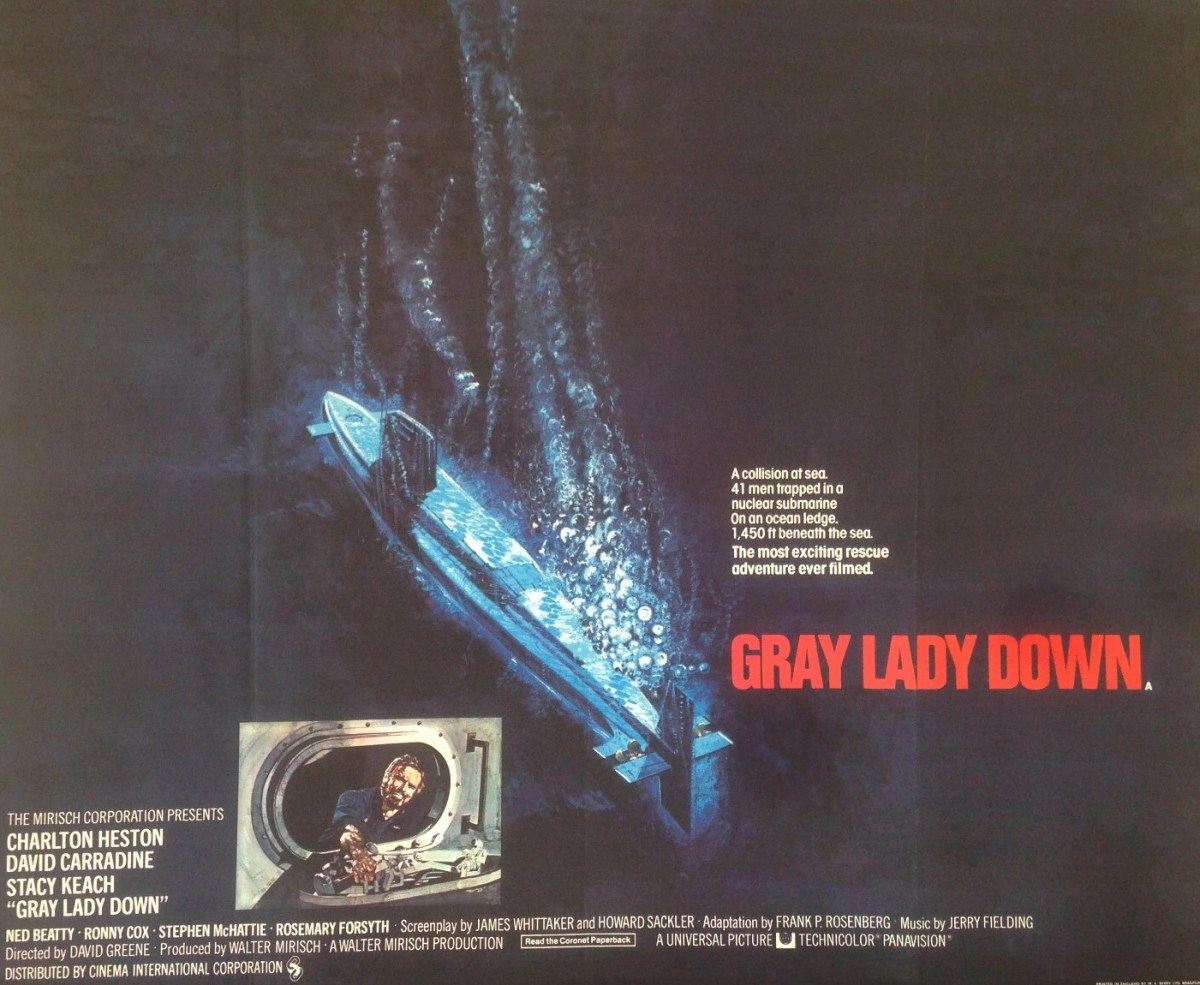
Producer Walter Mirisch could have afforded to rest on his laurels – he’d won the Oscar for In the Heat of the Night and been responsible for classics like The Magnificent Seven (1960) – and three sequels – and The Great Escape (1963). The 1970s had proved tougher, resulting initially in a string of pot boilers before hitting a home run with Mr Majestyk (1974) with Charles Bronson and knocking the ball out of the box office park with war picture Battle of Midway (1976), the former pulling in $20 million in rentals on a $2 million budget, the latter $50 million in rentals on a $7 million budget.
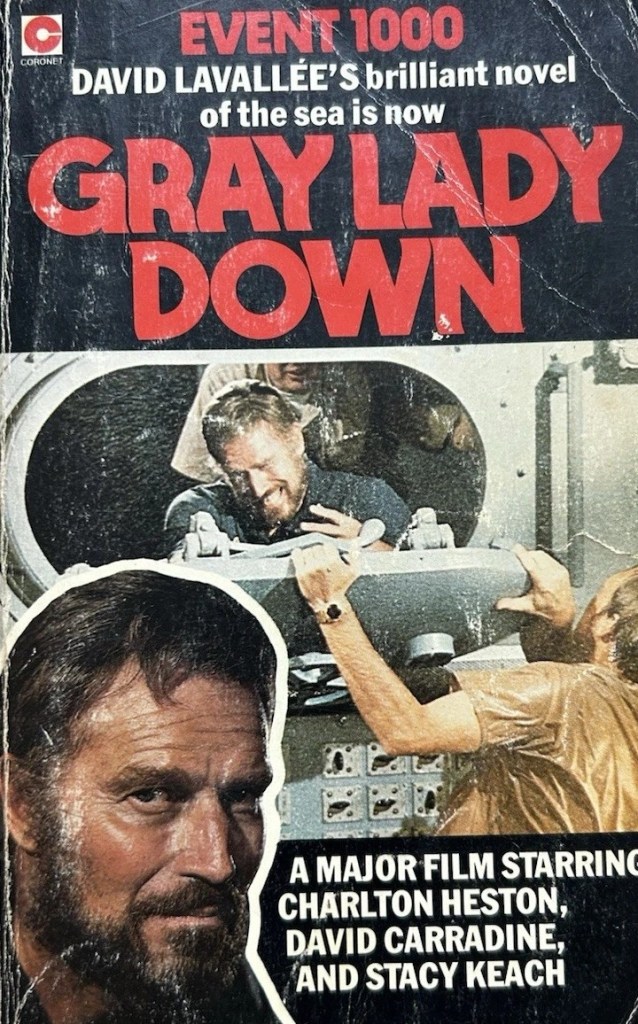
He had parted company with United Artists after nearly two decades in partnership and tied up a five-year deal with Universal. With Midway under his belt, he was the go-to producer for pictures on a naval theme. He had been sent a screenplay by James Whittaker about a submarine stranded at the bottom of the ocean. However, it turned out there was already a novel on the same subject, Event 1000 by David Lavallee, which result in various negotiations to determine the screenwriter credit, especially after playwright Howard Sackler (The Great White Hope, 1970) had completed a rewrite.
Charlton Heston, on a box office roll after Airport 1975 (1974), Earthquake (1974), Battle of Midway and Two Minute Warning (1976), was the obvious choice for the lead. But Mirisch had originally contemplated teaming Heston with Sidney Poitier (In the Heat of the Night). “He’s now backing away” from the idea, noted Heston in his diary in February 1976, “though I’m not sure why, save the cost of having us both in the film.” Heston was in strong demand, and turned down The Omen (1976) and The Pack (1977).
The film was slow coming together, “not much progress on the script…casting still slow” and there was the possibility of further delay to “mull” over the project. No director had been assigned by the end of February 1976. Following the Battle of Midway, the U.S. Navy was only too delighted to be involved. As well as following a disaster picture template, the movie was also tech heavy, featuring up-to-date ideas on rescue at sea.
The interior of the submarine, the main set, was constructed on a gimbal so that it could be tilted to achieve the effect of the sailors being thrown about as the sub sunk to the bottom and rolled over on a deep sea trench. Howard Anderson oversaw special effects work with models in a 44ft deep water tank which was filmed at CBS. Exteriors were shot at Universal with some work aboard a Navy escort vessel. Some material was also repurposed from Ice Station Zebra (1978).
To soak up the atmosphere of a real nuclear sub, Heston spent the day on USS Gurnard under the Pacific off San Diego. “I got a lot of useful little stuff,” commented Heston, “about the look and sound of submarine officers at work…the kind of thing nobody could tell you.” The sub contained a “vast array” of disparate and complex technology. “It was a very strange feeling to spend hours charging about under the ocean running mock torpedo attacks on surface vessels.” The experience also included drills for fire and flooding.
As shooting approached, Mirisch still had not done a deal for second lead Stacy Keach (Fat City, 1972). He was, however, “anxious” to recruit Ronny Cox (Deliverance, 1972). Ned Beatty, also form that film, came on board. David Carradine (Bound for Glory, 1976) and future Superman Christopher Reeve were added. Michael O’Keefe (The Great Santini, 1979) also made his movie debut.
Filming began on September 11, 1976. “I had very little to do,” noted Heston, “which was just as well, breaking in on a new film.” He played his only scene with Keach, “the tag of the picture and a key scene.” British director David Greene (Sebastian, 1968) was applauded for being as meticulous as William Wyler. More importantly, “he gives the actors a great deal and I find myself stimulated by almost all the suggestions he makes,” commented Heston. At one point, Greene decided to reshoot a major scene, bringing back offstage actors Heston thought he could do without. On the minus side, “he runs a rather loose ship.” Of his own contribution, the actor said, “I became preoccupied with giving an efficient performance rather than a creative one. The pressures I feel to be a consummate professional make me focus on getting it right.”
Filmed on a budget of just $5.25 million, it proved a huge hit, pulling in $19 million in rentals.
SOURCES: Walter Mirisch, I Thought We Were Making Movies, Not History (University of Wisconsin Press, 2008) p339-341; Charlton Heston, The Actor’s Life (Penguin, 1980) pp464-481.
Not cut out for the musicals, comedies, historical adventures (let’s not count The Greatest Story Ever Told, 1965), thrillers, dramas, and spy pictures that dominated that 1960s the western was John Wayne’s default. After his initial battle with lung cancer, he enjoyed an extended period of success in Henry Hathaway’s The Sons of Katie Elder (1965), Howard Hawks’ El Dorado (1967) and Burt Kennedy’s The War Wagon (1967) before diversifying in Vietnam war picture The Green Berets (1968), which he directed and was also a hit, and Andrew V. McLaglen oil drama Hellfighters which did, however, fall short of his high box office standards. So when any big western picture was mooted, it was either Wayne or James Stewart to whom producers first came calling. But when the actor particularly wanted a part, he usually got it.
Charles Portis was a journalist with one modern novel, Norwood published in 1966, to his name when he wrote True Grit, published in 1968, which, unusually for a western, spent 22 weeks in the New York Times bestseller list. The main attraction for a reader was the equally unusual first-person narrator, Mattie Ross, towards the end of her life telling the tale of how as a 14-year-old in Arkansas she sought bloody revenge for the death of her father. The narrative voice was highly individual with colorful phrases, punchy dialogue, and a taut storyline.
Producer Hal Wallis snapped it up for $300,000, beating out Wayne’s Batjac operation. Wallis had been making his own pictures for over two decades, having originally overseen films as varied as swashbuckler Captain Blood (1935) and Casablanca (1942). He also had a western pedigree, having set up John Sturges’ Gunfight at the O.K. Corral (1957), The Sons of Katie Elder and Five Card Stud (1968) with Dean Martin and Robert Mitchum.
The movie went into speedy production, barely a year from the novel’s publication to the world premiere. From the start Wallis had Wayne in mind for Rooster Cogburn, with Robert Mitchum as back-up. Mia Farrow turned down the role of Mattie Ross when she found out the director was to be Henry Hathaway. Genevieve Bujold turned it down because she didn’t want to work with Wayne. Wayne favored Katharine Ross (The Hellfighters, 1968) or Michele Carey (El Dorado) or his daughter Aissa whom Hathaway ruled out. Sally Field from the television series The Flying Nun was also considered, but the part finally went to 21-year-old Kim Darby.
She had been in the movies since 1963 (an uncredited role in Bye, Bye, Birdie) and, excepting small roles in Bus Riley’s Back in Town (1965) starring Ann-Margret, fourth-billing in both the low-budget The Restless Ones (1965) and Arthur Penn television movie Flesh and Blood (1968), confined to guest roles in routine television series such as The Fugitive, Star Trek, Gunsmoke and Bonanza.
Elvis Presley was touted for the role of Le Boeuf but manager Col. Parker insisted his client receive top billing and the role went to another popular singer Glen Campbell, who had made his movie debut in The Cool Ones (1967). Robert Duvall, filling the boots of Lucky Ned Pepper, was also a refugee from television (The Outer Limits, The Fugitive, Combat) although he had delivered a memorable performance as Boo Radley in To Kill a Mockingbird (1962) and had risen to third-billing for Francis Ford Coppola’s The Rain People (1969).
Henry Hathaway, a former child actor, had directed 60 movies beginning in 1932. But he had learned about direction at the feet of Josef von Sternberg and Victor Fleming, both hard taskmasters, and only made the move into megging at the third attempt. First of all, he had spent nine months touring India with the idea of making a film in the style of silent documentaries Grass: A Nation’s Battle for Life (1925) or Chang: A Drama of the Wilderness (1927). He managed to attract the interest of Irving G. Thalberg but the producer died before funding materialized. Next, Paramount planned to hire him when the studio planned an early 1930s investment in color but got cold feet and the idea was dropped. Finally, when Paramount decided it was going to make its own westerns, rather than buying them in, he was hired to direct Heritage of the Desert (1932) starring Randolph Scott but after six more in that genre – being paid $100 a week for the first two and then $65 a week for the next two after the Depression bit – he hit pay dirt with adventure The Lives of a Bengal Lancer (1935) with Gary Cooper and comedy Go WestYoung Man (1936) with Mae West.
When Paramount finally embraced three-color Technicolor they chose Hathaway to direct adventure The Trail of the Lonesome Pine (1936) starring Sylvia Sidney and Fred MacMurray. “It cannot be merely accidental that he was selected,” commented historian Kingley Canham, arguing that Hathaway had “more than just an aptitude for freshening familiar material through technical resourcefulness.”
And like John Ford he was economical with the camera. “I only shoot what can be used so the producer has no choice…I always cut in the camera, the cutter just has to put the ends together,” he said. Determined to achieve verisimilitude, instead of using studio hand-made locusts for biopic Brigham Young (1940), he travelled to Nevada where had been a big invasion of the insects. Except for this film and The Shepherd of the Hills (1941), starring Wayne, he steered clear of westerns, preferring action and drama. However, he was instrumental in helping Wayne extend his acting style. For Shepherd of the Hills, Hathaway “added new subtleties to the already characteristic western hero persona – the roiling gait and economy of dialog were still very much in evidence but his acting was more mature, more sensitive, and more assured.”
He was called upon to demonstrate further technical mastery in the first of Twentieth Century Fox’s semi-documentary dramas The House on 92nd St (1945) followed by film noir Dark Corner (1946) and Kiss of Death (1947). He made his first western in a decade with Rawhide (1951) toplining Tyrone Power and Susan Hayward and only two other westerns in the 1950s – Garden of Evil (1954), teaming Cooper and Hayward, and Hell to Texas (1958) with Audie Murphy, the twist in this one being the hero rather than the villain subjected to a manhunt. Another technical innovation came with The Desert Fox (1951), where he “did the whole raid before the titles,” the first time any action had been shown prior to the rolling of the opening credits.
He was so impressed with the acting skills of Marilyn Monroe in Niagara (1953) that he purchased Somerset Maugham’s Of Human Bondage intending to team her with Montgomery Clift, but nothing came of the concept. He worked with Wayne again in Legend of the Lost (1957) co-starring Sophia Loren.
But, like Wayne, he returned in triumph to the western in the 1960s, all bar two of his movies in this decade in this genre, the first four of the decade starring Wayne – North to Alaska (1960), How the West Was Won (1962), Circus World (1964) and The Sons of Katie Elder. He had finished up on Five Card Stud when Hal Wallis invited him to direct True Grit. He had only received one Oscar nomination, four decades previously, for The Lives of a Bengal Lancer, and no avant garde French film critic was reassessing his work, but he was known to bring movies in on time, and had his own distinct style if anyone could be bothered looking for it.
Certain themes did reappear, revenge for one, which was central to The Trail of the Lonesome Pine, Kiss of Death, historical adventure The Black Rose (1950), Prince Valiant (1954) with James Mason, The Sons of Katie Elder and Nevada Smith (1966) starring Steve McQueen. He also focused on disruption within the family, and situations where an older man aids an impetuous youngster, both instrumental to True Grit. “He is the only director I know,” observed Kingsley Canham, “to have specialized in films about backwoods and mountains.”
Screenwriter Marguerite Roberts was also old-school, born in 1905, with over 30 screen credits. She sold her first script while working as a secretary at Fox, had her first screen credit in 1933 for Sailor’s Luck. By 1939 she was earning $2,500 a week at MGM and turned out Honky Tonk (1941) with Clark Gable and Lana Turner, Sea of Grass (1946) with Katharine Hepburn and Spencer Tracy, Gunga Din remake Soldiers Three (1951) and big-budget historical adventure Ivanhoe (1951) with Robert Taylor and Elizabeth Taylor.
Like Abraham Polonsky she fell out of favor with Hollywood for her left-wing sympathies and was blacklisted for nearly a decade until Daniel Petrie’s The Main Attraction (1962) with Pat Boone and Nancy Kwan, Guy Green’s Diamond Head (1962) with Charlton Heston and Rampage (1963) with Robert Mitchum. She, too, had been working for Hal Wallis on Five Card Stud before receiving the commission to adapt the Portis book.
Roberts was familiar with the Old West, since her father had been a lawman in Colorado. Screenwriter Wendell Mayes, who wrote From Hell to Texas, commented that “Henry Hathaway is very easy for a writer to work with.” “When a screenplay is finished,” said Hathaway, “I go through it and work on it. I worked on True Grit with Marguerite Roberts because there was a great deal of repetition in the book and I eliminated a lot of things.” John Wayne felt Hathaway “never got the creative credit I think is due him…He was sort of a story doctor…a fine, instinctive, creator.”
Her first problem was how to translate the book’s distinctive first-person style onto the screen without the entire movie sounding too archaic and although many speeches were lifted verbatim from the book it was Roberts who established Mattie Ross as an authority figure from the outset by introducer the teenager as her father’s “bookkeeper” and inventing the argument about the type of horses he intended to buy.
The result is an unusual composite of tight storyline, exuberant characterization and wonderful dialog. The movie was filmed mainly in Colorado – Ouray, Owl Creek Pass, Ridgway, Canon City, Montrose, Bishop, and Gunnison – as well as Durango in Mexico and Inyo National Park in California where Hot Creek was used for the outlaw’s cabin and also Sherwin Summit.
The critics, who had slaughtered The Green Berets the previous year, and been largely indifferent to many of his previous westerns during the 1960s, virtually gave him a standing ovation. Variety called it a “top adventure drama…Wayne towers over everything in the film – the actors, script and even the magnificent Colorado mountains.”
Vincent Canby of the New York Times called it “a triumph…one of the major movies of the year.” The New York Daily News claimed it was “John Wayne’s finest moment.” The New York Post came closest to defining its appeal: “Few westerns will come along this or any other year that can be as fully enjoyed by as many people of varying ages and sex.” Vernon Scott of United Press was not alone in predicting “Wayne should win the Oscar.”
Joyce Haber of the Los Angeles Times said, “come Oscar time Wayne will be a leading contender.” Norma Lee Browning of the Chicago Tribune informed readers that “there’s already talk that he may, at long last, get an Oscar nomination.” Charles McHarry of the New York Daily News held the same view. Time opined “a flawless portrait of a flawed man.” International Motion Picture Exhibitor found it “the perfect vehicle for Henry Hathaway’s directorial style. He approached the simple western story in the most straightforward manner…garnished it with a delightful humor that springs right out of the vagaries of the homespun characters…and giving it a rhythm that carries the viewer along despite its lengthy running time.”
Allen Eyles in Focus on Film summed up the film’s appeal: “That True Grit could end up being the best western of the year is a tribute to old Hollywood – to a producer, director, star, cameraman and others who’ve been at the top of the film business for more than three decades. Their solid, unpretentious professionalism enables them to meet the challenge of filming a first-rate novel with pleasing assurance and directness…it is far superior to…the poorly-shaped but occasionally striking The Wild Bunch from Peckinpah…(it) is not innovatory in style but the details are communicated with a freshness that is appealing.”
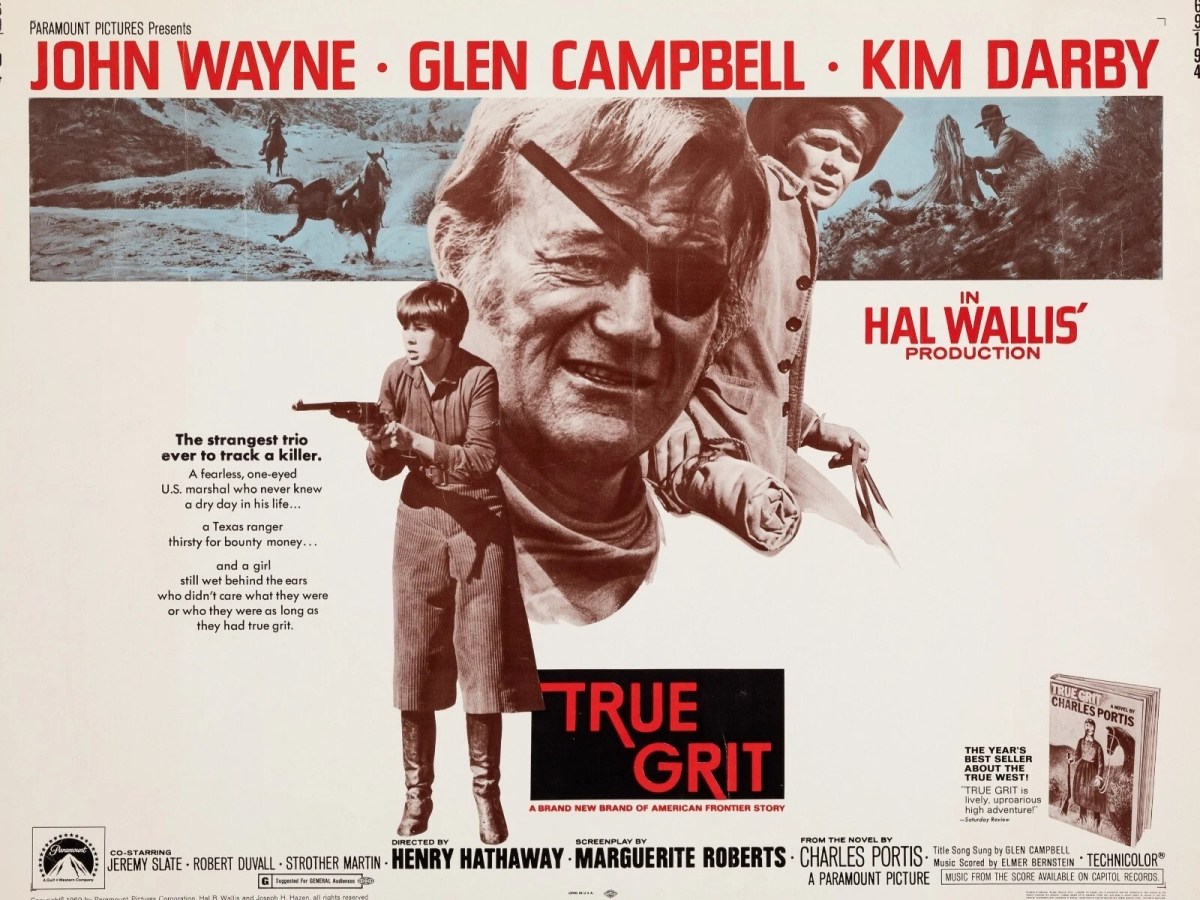
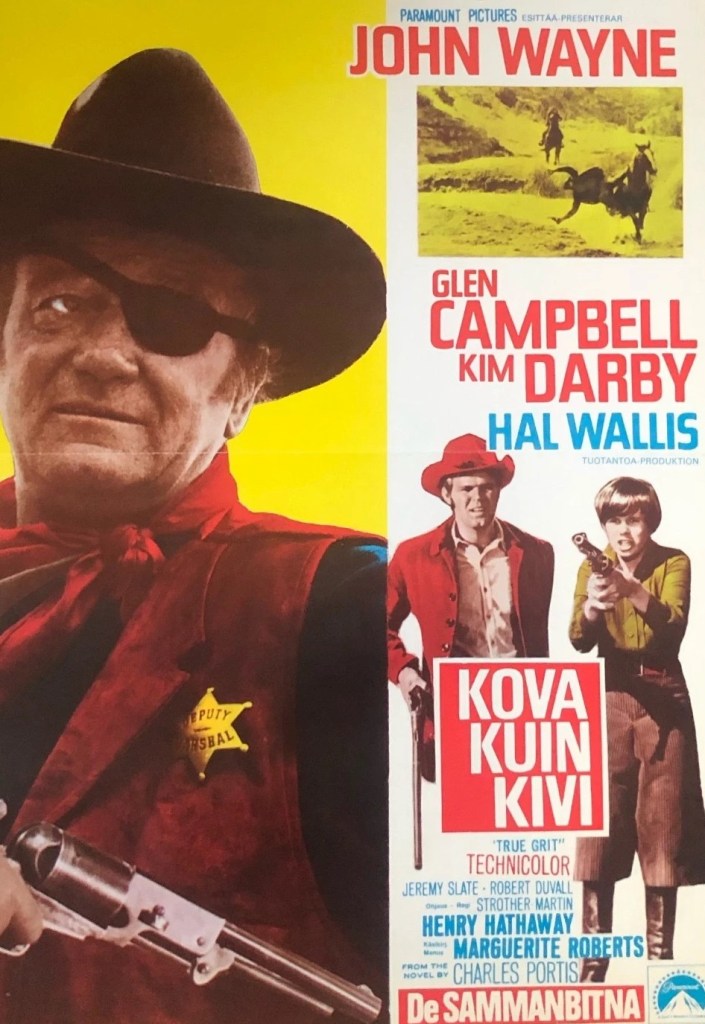
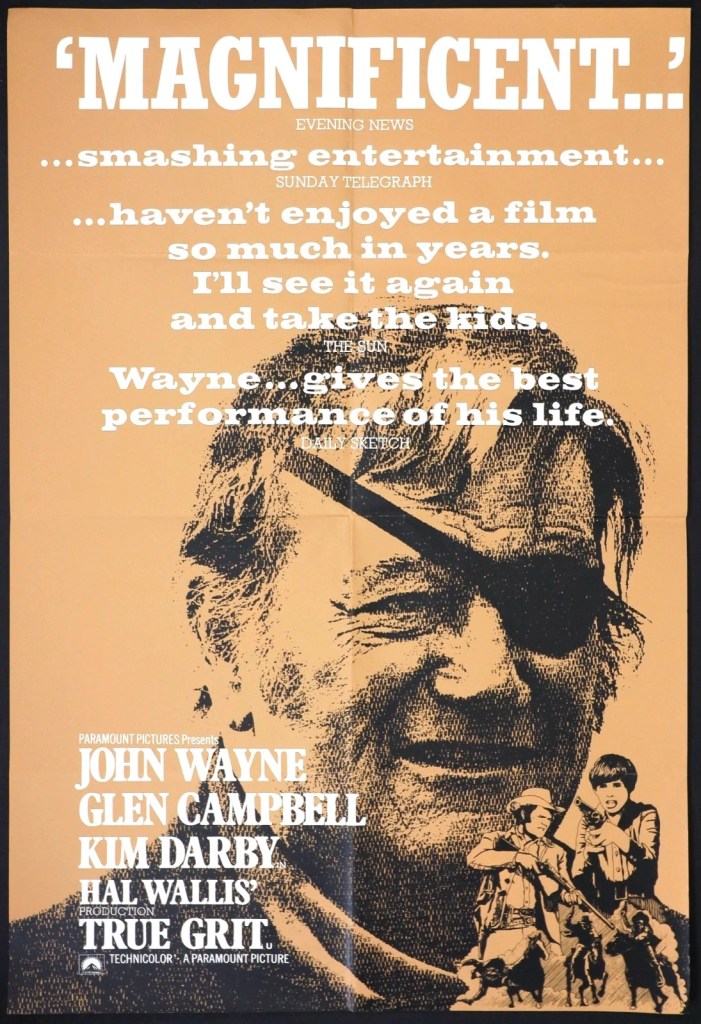
Unusually, for a film of the period, the movie repeated a single image in all of its advertising, Wayne’s face dominating the composition, with below him Mattie Ross standing gun in hand and Glen Campbell behind him. That Campbell sang the title song over the credits led to the release of a record, and there was a New American Library book tie-in. Ancillary promotional items included a t-shirt embellished with the words “This Man Has True Grit,” and buttons announcing “I Have True Grit” and, alternatively, “Give Me a Man with True Grit.” Stetson created a special hat called “The Duke,” with a special one costing $1,500 to be presented to Johnny Carson on his show, with an advertising campaign that included Playboy and Esquire while Aramis created a special line of “Grit Soap.”
Time magazine had raised expectations for the picture by putting John Wayne on the front cover, on August 8, although this was in part retaliation to Life’s joint cover story on Wayne and Dustin Hoffman which ran in the Jul 11 issue, and Paramount took a gamble opening it in New York at the Radio City Music Hall, partly a ploy to boost European revenues, the first western to be so honored, although the theater covered itself by claiming the movie was an “outdoor adventure” rather than a western per se. The picture broke all sorts of records there and went on to conquer America, shattering Dallas records, for example, and then helped along by the Time cover story. For a few months it looked set to become the best performing western of all time, but was soon overtaken by the release of Butch Cassidy and the Sundance Kid. Even so, it took $11.5 million in rentals to finish sixth in the annual chart. It was reissued after Wayne’s Oscar triumph the following year in an unlikely double bill with Oscar-nominated The Sterile Cuckoo and grossed $3.7 million in the twelve days. But Paramount, trying to offset calamitous losses, prematurely sold off the western to television so its reissue value was sharply curtailed.
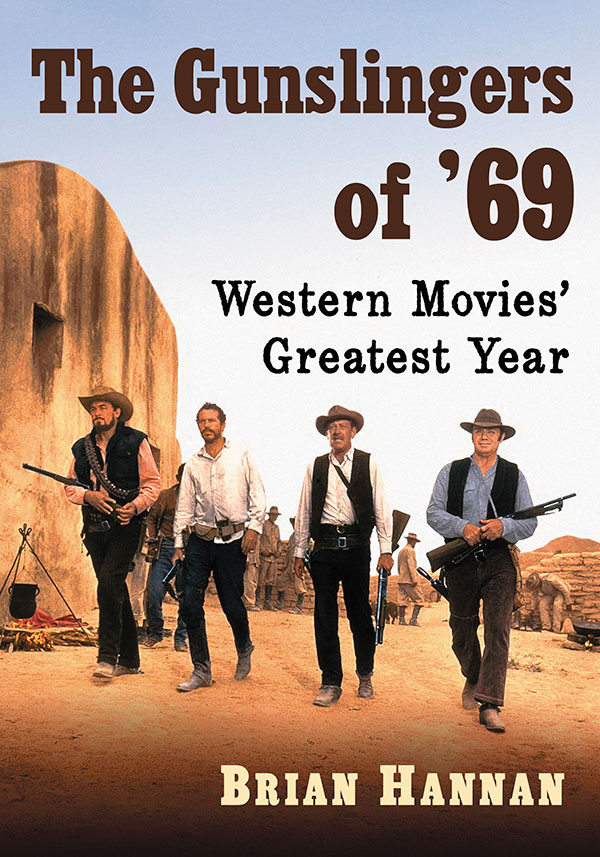
SOURCE: Brian Hannan, The Gunslingers of ’69: Western Movies’ Greatest Year, (McFarland, 2019).
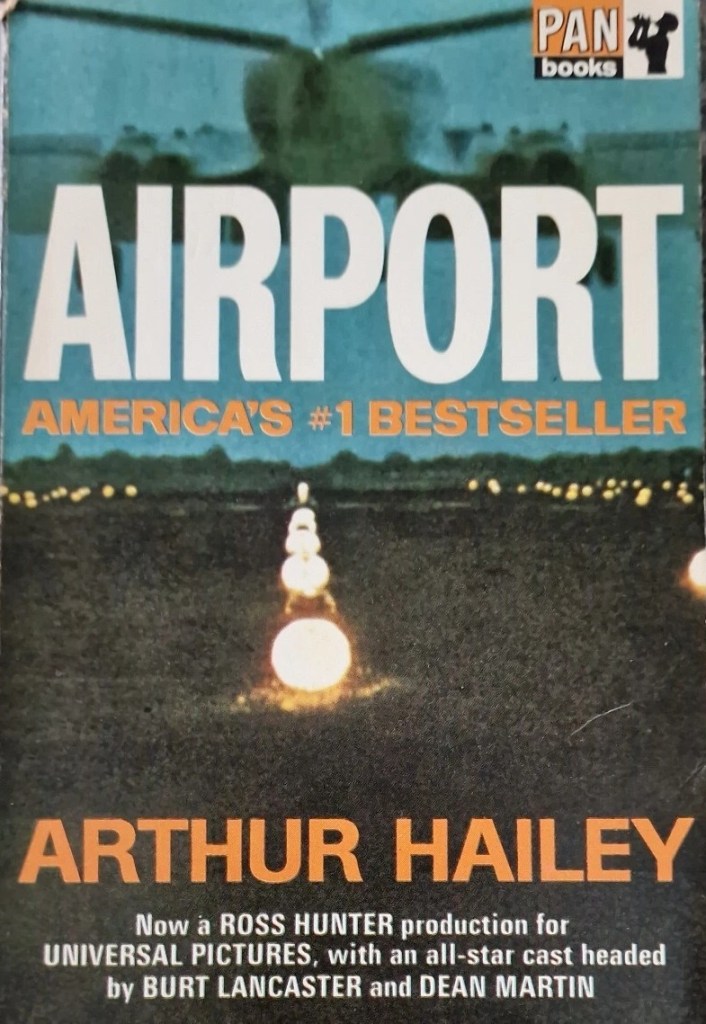
You might think director George Seaton wearing his screenwriter’s hat had his work cut out adapting Arthur Hailey’s 500-page tome for a lean two-hour picture. But Hailey’s book was anything but lean and the fat was easily trimmed away. The author had little idea of dramatic tension and there’s a clear example here that what plays in a novel won’t at all work on screen.
Had Seaton slavishly followed the Hailey template the tension-filled climax of the bomb exploding on the plane and the pilot having to land the stricken plane on an icebound runway would have been interrupted by numb-boring back-and-forth between airport executives and people complaining about planes flying overhead disrupting their lives and the author holding forth on the future of air travel.
A huge chunk of the book is politics one way or another and with the exception of a brief tussle between airport boss Burt Lancaster and his bosses that focuses, unlike the book, on Lancaster’s attempts to keep the runway open, Seaton chucks out all that stuff about townspeople, literally, on the march. Audiences won’t be much interested either in much of what Hailey, in investigative fashion, turns up about cargo loading and the problems facing shoe-shiners and skims over the question of why airports permit insurance agents to so freely operate in an airport, making a healthy living (from which the airport takes a cut) from selling fear to travelers.
It’s interesting, as always, to see what, apart from the obvious as I’ve outlined, a screenwriter doesn’t believe essential. So in the movie Dean Martin’s beef with Burt Lancaster is over the airport’s supposed inefficiency in keeping the runways clear in the face of a snowstorm. But in the book that’s the least of Martin’s concerns, since he’s taken umbrage at this dialing up of the fear factor by selling insurance policies to people about to board a plane.
When you see all those guys and all that heavy-duty equipment trying to clear a path for the airplane grounded in the snow, you think what the heck’s the problem, it’s only a big mound of snow. In the book, the real problem is explained. The plane isn’t stuck in the snow – it’s stuck in the mud underneath the snow, so actually the ground staff have to dig it out of a pretty big hole.
Hailey also takes a detour with the George Kennedy troubleshooter. Instead of getting a police escort to the airport he takes time out to sort out a traffic tangle, demonstrating, for the reader, his unique set of skills, which, sensibly, Seaton reckons will be amply shown when he is doing his job on the runway.
Fourth time unlucky – the series runs out of runway.
There’s a subplot that Seaton eliminates. As well as having a troublesome brother-in-law in Dean Martin, Burt Lancaster has a troublesome brother, so burned out by his job as an air traffic controller that he’s on the verge of committing suicide. But again, Seaton reckons there’s enough going on without over-egging the pudding.
Seaton really comes into his own on the emotional front, having a better notion than Hailey of how to heighten emotion. So there’s no mention that the apparently childless Dean Martin had a previous child from a previous affair – the baby was adopted (a policy airlines encouraged to get stewardesses back to the front line as soon as possible) so the question remains – does he want to be a father? Seaton also brings forward his idea about an abortion. In the book, Burt Lancaster and Jean Seberg have not consummated their affair, but Seaton makes it implicit in the film that they have. Also Hailey reveals from the start that Lancaster’s wife is already playing away from home but Seaton holds that knowledge back so there’s an emotional twist in the film.
What Seaton adds is just as demonstrative of the screenwriter’s skill. Not in the book: the nun, the priest, the bolshie passenger and the know-it-all teenager. These are Seaton inventions. Seaton also builds up Lancaster’s wife as coming from a wealthy family rather than being a failed actress. And he brings to the fore the women who are the casualties of male weakness, Dean Martin’s wife discovering his girlfriend is pregnant, the bomber’s wife realizing what he has done, Lancaster’s wife confronting him.
Although Hailey spends acres of print going on about the problems low-flying planes cause he doesn’t actually show their impact. Seaton cuts right to the chase, opening with a scene of plates and stuff crashing to the floor in a house as a plane flies overhead. And in scenes of the snowplows sending snow wafting through the air the director in Seaton turns what Hailey described as a “conga line” into a ballet
One other element – in the book the Burt Lancaster character has a limp. Movie heroes don’t limp.
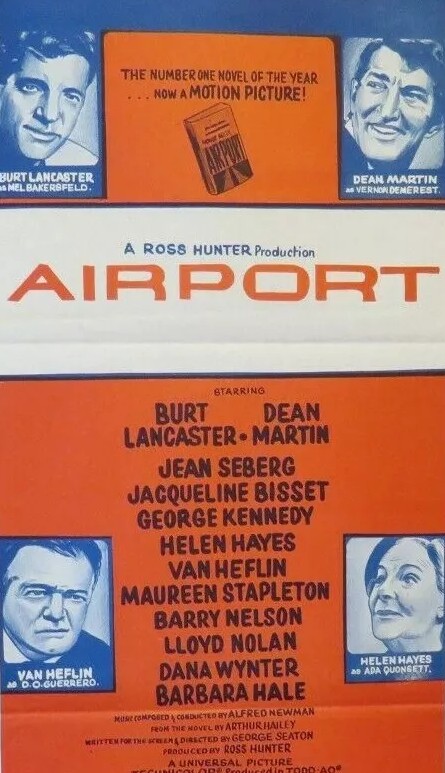
Ross Hunter had been a big wheel in the production business for the best part of two decades, shepherding home hits like Midnight Lace (1960), remakes of universal weepies like Back St (1961) and Madame X (1966), play adaptations such as The Chalk Garden (1964), the Tammy movie series and Julie Andrews musical Thoroughly Modern Millie (1967). He was as close to a sure thing as you could get. Even so, Airport, with a $10 million budget, was the biggest gamble of his career.
He paid $350,000 upfront plus another $100,000 in add-ons for the rights to the runaway Arthur Hailey bestseller. Initially, Hunter was targeting the roadshow audience, filming in 70mm, the first time Universal had employed Todd-AO.
Dean Martin, who had made Texas Across the River (1966) and Rough Night in Jericho (1968) for Universal, was first to sign up for his usual fee plus a percentage. Martin was at a career peak, carried along effortlessly at the box office by the Matt Helm quartet and targeted for westerns.
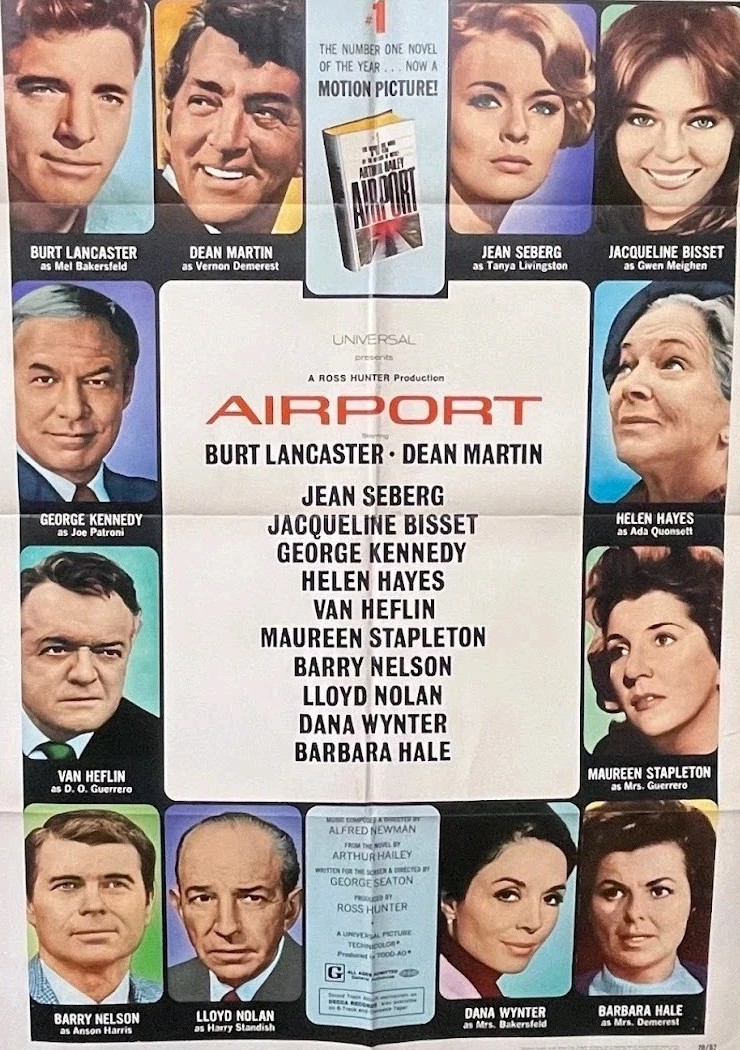
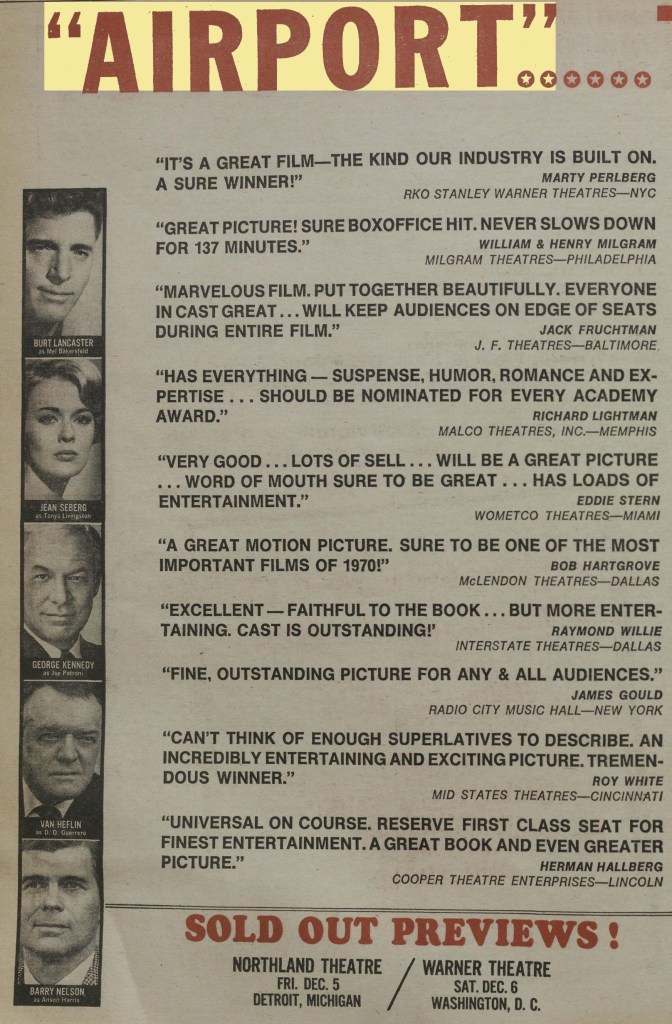
Hunter was pitching a movie with four major stars in Oscar-winner Burt Lancaster (Elmer Gantry, 1960), Dean Martin, Jean Seberg (Paint Your Wagon, 1969) and Oscar-winner George Kennedy (Guns of The Magnificent Seven, a1969) and another half-dozen names of varying marquee appeal that included British actress Jacqueline Bisset (Bullitt, 1968), and mature stars in Van Heflin (Once a Thief, 1965), Lloyd Nolan (The Double Man, 1967), Barry Nelson (The Borgia Stick, 1967), TV Perry Mason’s Barbara Hale and Oscar-winner Helen Hayes (Anastasia, 1956).
The picture came at a fortuitous time for Burt Lancaster. A trio of more challenging movies – The Swimmer (1968), Castle Keep (1969) and The Gypsy Moths (1969) – had flopped, so his marquee value was in question, especially at his going rate of £750,000 (plus a percentage). Doubts had set in with The Gypsy Moths, with MGM dithering over the opening date, switching it originally from summer to Xmas and then back again but happy to censor the picture to meet the approval of the Radio City Music Hall where it premiered.
And while he was still clearly in demand in 1968-1969, he had lost out the starring role in Patton (1970) with James Stewart in the Karl Malden role, which would have coupled commercial success with critical approbation. The shooting of Valdez Is Coming (1971) was postponed for a year. Originally it had been set for a January 1969 start date with Sydney Pollack directing. Face in the Dust, a Dino De Laurentiis production, never saw the light of day.
And although Lancaster later described Airport as “the biggest piece of junk ever made” (luckily he didn’t live to see Anora or Mercy), the disaster blockbuster put his career back on track. It was quite a change of pace for him, too. He wasn’t in every scene and at times he had to take whatever Dean Martin’s character threw at him. But what he brought to the picture was his natural electricity, the tension of never knowing what he was going to do. But Airport barely merits a page in Kate Buford’s biography.
Double Oscar-winner George Seaton was set the dual task of condensing Arthur Hailey’s 500-page novel into a lean two-hour movie which he would direct. In a directing career spanning a quarter of a century, Seaton was well-used to handling big stars of the caliber of William Holden (three pictures including The Counterfeit Traitor, 1962), Bing Crosby and Grace Kelly (The Country Girl, 1953) Kirk Douglas (The Hook, 1962), Montgomery Clift (The Big Lift, 1950) and Clark Gable and Doris Day (Teacher’s Pet, 1958),
Jean Seberg, under investigation by the FBI, had revived an ailing career with Paint Your Wagon (1969). Producer Ross Hunter initially preferred Angie Dickinson (Jessica, 1962) or Stella Stevens (Rage, 1966) for the role of Lancaster’s screen lover, but had to go along with Universal with whom Seberg had a two-picture “pay-or-play” deal (she got paid whether she made a picture or not). However, she was considered a marquee name in the international market, especially France where she had remained a cult figure after Breathless (1960).
Disconcerted by being considered unwanted, her natural nervousness increased until Hunter made a point of convincing her that he was “genuinely happy” at her involvement.
She wasn’t the only person to be considered second best. For the part of the elderly stowaway, six-time Oscar nominee Thelma Ritter (Boeing, Boeing, 1965) and Jean Arthur, who hadn’t appeared in a movie since Shane (1953), had been wooed before Hunter settled on Helen Hayes.
For Seberg, it was the biggest pay cheque of her career – $150,000 plus use of a studio car and $1,000 a week expenses for the 16-week schedule, but she lost out on a percentage. She was billed third. High-flying her career might be, but personally she was struggling, her marriage to Romain Gary in trouble and under pressure to help raise funding for the Black Panther movement. She was receiving calls in the middle of the night. “Many nights she’d be so frightened, she’d come and sleep on the couch at my home,” recalled Hunter, “there’s no doubt it was an extremely difficult period for her.”
Helen Hayes reminded Seberg of her grandmother, to whom the stowaway’s exploits would have appealed. As a teenager, Seberg had idolized Hayes. Dean Martin pushed for Petula Clark (Goodbye, Mr Chips, 1969) for the Jacqueline Bisset role and Stella Stevens (Rage, 1966), as well as being considered for the Seberg part, was also in the frame.
Virtually all the bit parts were played by Universal’s contract players. For Airport, the studio rounded up thirty-two of them. Patty Paulsen, who played stewardess Joan, was a genuine stewardess for American Airlines before she won the role on the strength of winning a beauty contest. It was veteran Van Heflin’s final picture, and also for composer Alfred Newman. George Kennedy would reprise his role through three other pictures in the series – though he turned down Airplane! (1980).
Location filming at Minneapolis-St Paul International Airport began in January minus director George Seaton who had come down with pneumonia. Henry Hathaway stepped in, at no cost, to cover. The producer had headed to Minnesota for the snow, but there was none around, and the production team had to import tons of fake stuff made out of whitened sawdust. Filming took place at night in plunging temperatures. Despite wearing face masks, cast and crew suffered and the freezing conditions slowed down the shoot.
Hunter hired a $7.5 million Boeing 707 for $18,000 a day. For studio work in Los Angeles Hunter brought in a damaged Boeing. Ironically, Dean Martin had a fear of flying and travelled to the location by railway. Ditto Maureen Stapleton.
Seberg’s outfits, including calfskin sable-lined coats designed by Edith Head, cost $2,000 apiece, though Seberg was less keen on the airport uniform. With Seberg’s hometown less than a five-hour drive away she was able to head home during breaks in filming.
John Findlater, who played a ticket checker in the film, remembered Seberg as “frail and lonely…very shy…she had a very hard time of it.” It took four days to film the scene where Helen Hayes explains the art of the stowaway and feels the brunt of the wrath of Burt Lancaster and Seberg. Delays always niggled Lancaster, for whom they smacked of unprofessionalism. To raise her spirits, Seaton improvised little comedy skits.
Seberg befriended Maureen Stapleton, playing the bomber’s wife. Seberg was “impressed” that Stapleton could cry on cue and the minute the scene was over be laughing.
In the end Hunter gave up the idea of a prestigious roadshow run, settling instead for a premiere opening at the Radio City Music Hall and first run houses across the country. There had been no shortage of pre-publicity. Any time an airplane hijack hit the headlines or a snowstorm shut down airports or an airplane skidded off the runway, editors were happy to insert a mention of the picture.
And there was an abundance of airports and travel companies willing to sign up for cooperative promotions, helped along by the fact that Edith Head had designed the “Airport Look” launched not just with male and female fashions but a range of travel accessories. A beauty queen competition “International Air Girl” managed to hook a 45-minute television slot in Britain.
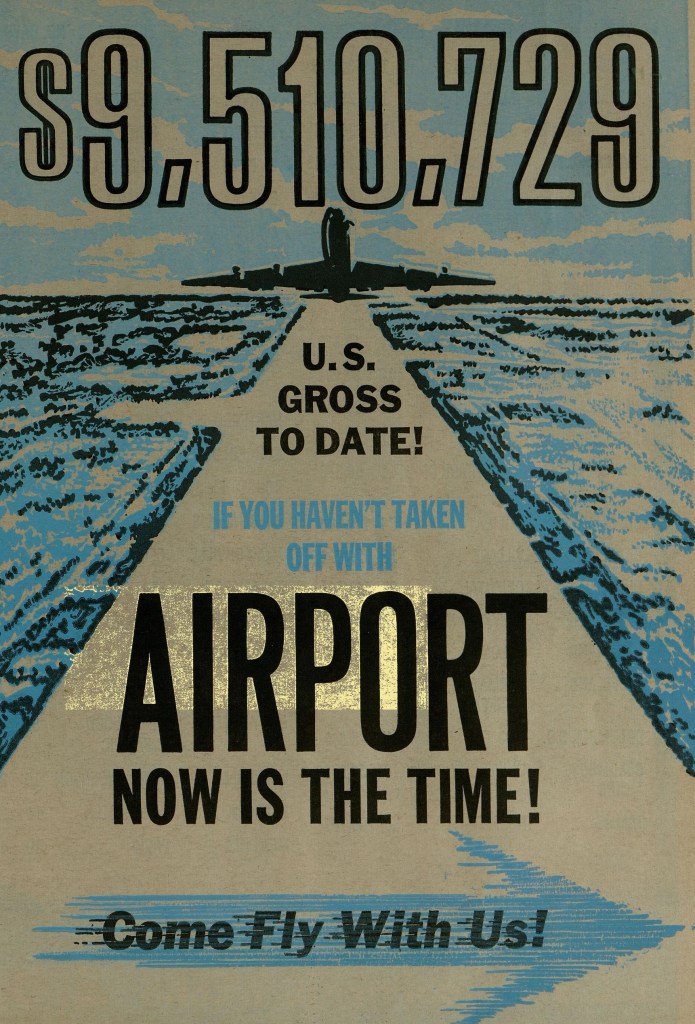
Opening at the Radio City Music Hall in New York, a couple of weeks in advance of the national roll-out, Airport plundered a record $235,000, topping that in its second week, and scooping up $1 million before the end of the month. It was gangbusters everywhere, opening in prestigious first run locations, with nary a showcase/multiple run in sight. “Wham” was the description beloved of the Variety box office headline writers, the word preceding its $80,000 opening week tally in Chicago, $28,000 in San Francisco, and $25,000 in Louisville. “Smash” was also brought into play for its $40,000 in Baltimore and $33,000 in Philadelphia. The subject matter allowed the sub-editors who wrote the headlines some license, so it was a “sonic” $40,000 in Boston and a “stratospheric” $45,000 in Detroit. And it had legs. Week-by-week fall-offs were slight. It was still taking in $25,000 in the 24th week in Detroit, for example.
By year’s end it was easily the top film of the year with $37 million in rentals, way ahead of Mash on $22 million and Patton $1 million further back. And it kept going, adding another $8 million the following year as it was dragged back into the major cities for multiple showings (seven in New York) in multiple engagements.
Business was not so robust abroad. Though Airport managed a six-week run at the Odeon Leicester Square, where it received a Royal Premiere on April 22, 1970, its opening week’s figures were down on both the final week of its predecessor at the London West End cinema, Anne of the Thousand Days, and its successor Cromwell and the film didn’t make the Annual British Top Ten. But in Australia it led the field, though its returns were one-third down on the previous year’s Paint You Wagon and Butch Cassidy and the Sundance Kid.
For its television premiere on ABC in 1973, the network demanded a record $140,000 per minute for advertising. Outside of Gone with the Wind, it earned the highest rating of any movie from 1961 to 1977.
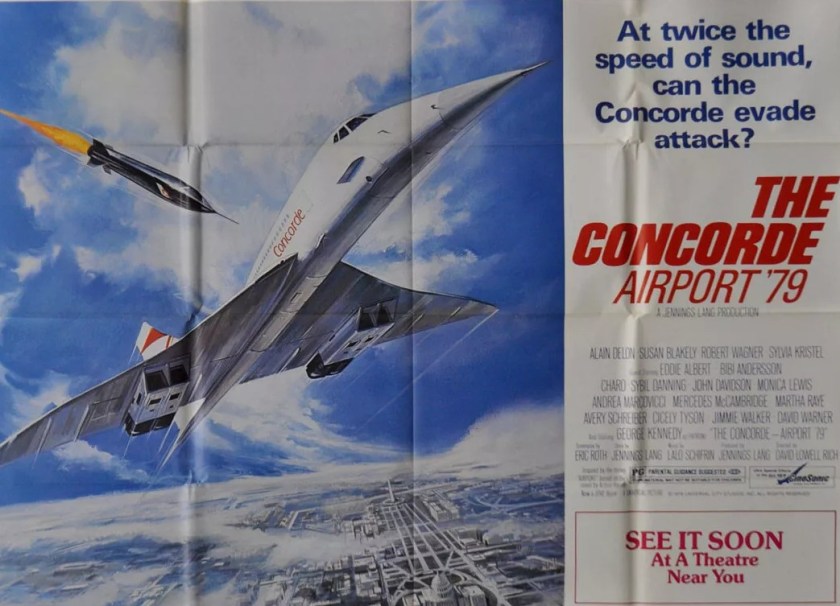
But it also set up an industry. Sequels were the name of the game. And though Airport ’75 (1974) headlining Charlton Heston and Airport ’77 (1977) starring Jack Lemmon were cut-price operations, they were huge successes at the box office, the former hauling in $25.8 million in rentals, the latter $16.2 million. A fourth venture, The Concorde…Airport ’79 (1979) with Alain Delon, flopped and put an end to the series.
SOURCES: Garry McGee, Jean Seberg, Breathless, 2018, p167-171; Kate Buford, Burt Lancaster, An American Life (Aurum Press, 2008) p264-265; “Cast Patton & Bradley,” Variety, September 20, 1967, p13; “Airport Film Deal,” Variety, May 29, 1968, p60; “Steiner at Goldwyn Plant,” Variety, July 24, 1968, p7; “Dean Martin First to Sign for U’s Airport,” Box Office, August 5, 1968, pK4; “Hollywood Happenings,” Box Office, January 6, 1969, pW2; “Airport Will Be U’s First Feature in Todd-AO,” Box Office, January 13, 1969, p12; “Seaton’s Temp Sub at U: H. Hathaway,” Variety, January 22, 1969, p7; “Airport Sequence Follows Real Event,” Box Office, January 27, 1969, pNC3; “17 Inches Snow Brings North East Business To Complete Standstill,” Box Office, February 17, 1969, pE1;“Ross Hunter’s Roadshow,” Box Office, April 28, 1969, pK2; “De Laurentiis Slates 3 Aussie Locationers,” Variety, September 24, 1969, p18; “Put Back Moths Scenes Cut Solely for Radio City,” Variety, October 22, 1969, p5; “Airport Smacks $1-Mil,” Variety, April 1, 1970, p4; “Airport Contest on TV,” Kine Weekly, April 18, 1970, p18; “Big Rental Films of 1970,” Variety, January 6, 1971, p11; “Encore Hits,” Variety, June 16, 1970, p5; “ABC Flying 140G Per Minute for Airport,” Variety, June 27, 1973, p14; “Hit Movies on TV Since ’61,” Variety, Sep 21, 1977, p70; “All-Time Film Rental Champs,” Variety, May 12, 1982, p5. U.S. weekly box office figures – Variety, March-April 1970; U.K. weekly box office figures, Kine Weekly, April-July 1970.
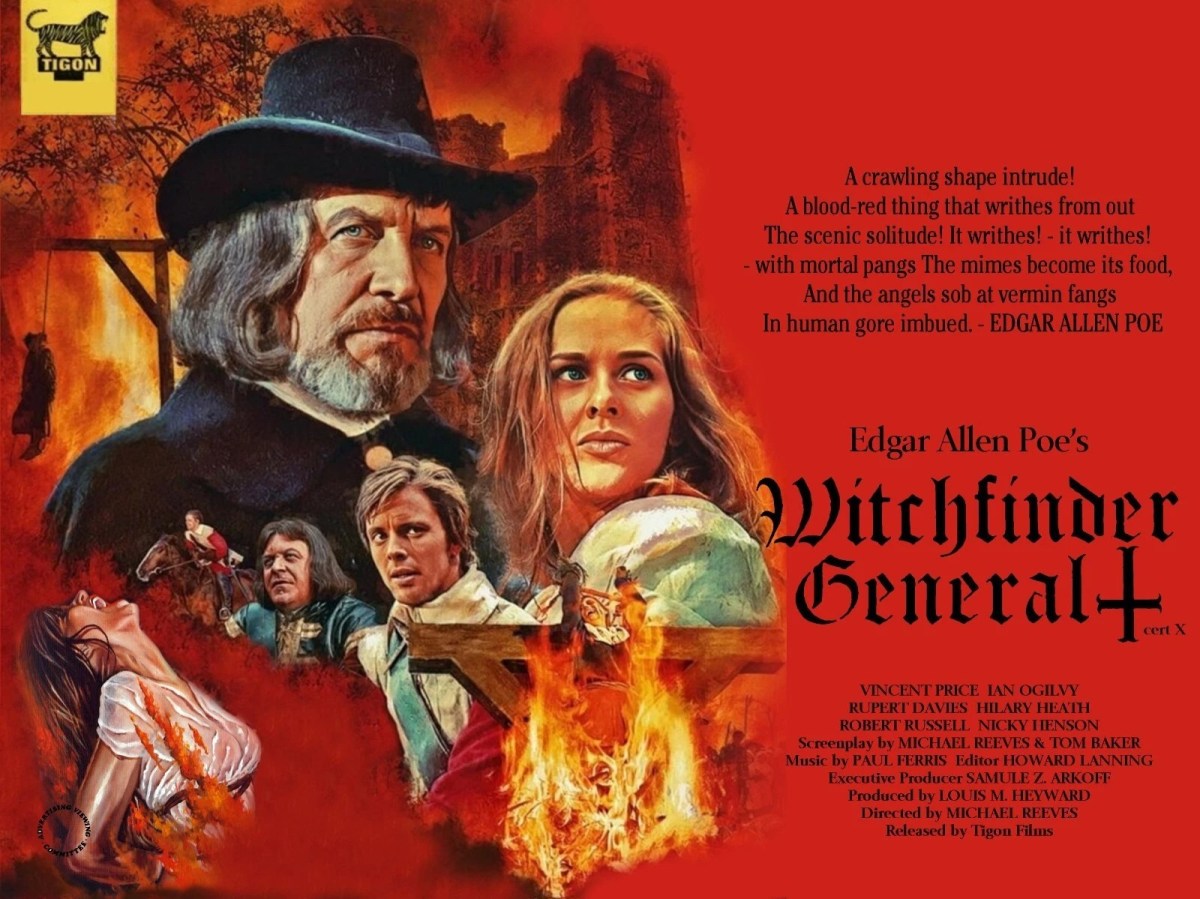
Truth was the first casualty. Matthew Hopkins, the character played in the film by Vincent Price, was 27 when he died in 1647. He had been hunting witches for three years. Price was 57 when the movie appeared. Co-star Ian Ogilvy, aged 25, would have been a better fit, though he lacked the menace. Oliver Reed, who had the swagger and the scowl, would have been the ideal candidate, age-wise, since he was just turning 30. And the movie might well have benefitted from presenting Hopkins as a young grifter who through force of personality and cunning held a country to ransom.
Price wasn’t director Michael Reeves’ (The Sorcerers, 1967) first choice. In fact, he originally wanted buddy Ogilvy, who had played opposite Boris Karloff in The Sorcerers. When that idea failed to float with Tony Tenser – previously head of Compton Films – now boss of British horror outfit Tigon, a challenger to the Hammer crown, Reeves pivoted to Donald Pleasance who, although better known as a supporting actor in the likes of The Great Escape (1963), had headlined Roman Polanski’s chiller Cul de Sac (1966). But when Tenser did a deal with American International Pictures, the U.S. mini-studio insisted on contract player Vincent Price, the mainstay of their Edgar Allan Poe output, with 16 previous films (out of 74) for the company.
Twenty-one-year-old Hilary Dwyer (The Oblong Box, 1969), under contract to Tigon, made her movie debut. Rupert Davies (The Oblong Box) was a seasoned veteran while Nicky Henson (Here We Go Round the Mulberry Bush, 1967) was a potential breakout star.
Tigon was a relatively new entrant to the horror scene, founded in 1966 by Tenser. Its second picture was The Sorcerers; this would be its fourth. Tenser has bought, pre-publication, the rights to Ronald Bassett’s novel Witchfinder General, published in 1966. Director Reeves faced something of a deadline once Tenser finalized the £83,000 budget. AIP chipped in £32,000 which included a £12,000 fee for Price. While it was Tigon’s biggest film to date, it was pin money for AIP.
The film needed to begin shooting by September 1967 at the latest to avoid the worst of the British cold weather. But the screenplay proved too unpleasant for the taste of the British censor. Reeves had already begun the screenplay with Tom Baker (The Sorcerers) with Donald Pleasance in mind portraying “a ridiculous authority figure” and had to quickly revamp it for Price. The laws of the period required a green light for the script from the British Board of Film Censors, who were repulsed by a “study in sadism” which dwelt too lovingly on “every detail of cruelty and suffering.”
That draft was submitted on August 4, 1967. The second draft, submitted on August 15, proved no more appealing. A third, substantially toned-down version, was approved. This resulted in the elimination of gruesome details of the Battle of Naseby and a change to the ending.
Production began on September 18, 1967. Star and director clashed. Reeves refused to go and meet Price on arrival at Heathrow Airport and told him, “I didn’t want you, and I still don’t want you, but I’m stuck with you.” The star was riled by the director’s inexperience. When told to fire a blank pistol while on horseback, Price was thrown from his horse after the animal reared up in shock at the sound. Price, in real-life a very cultured person, was surprised at Reeves’ attitude because in general he got on with directors.
Price turned up drunk on the last day of shooting, the filming of his character’s death scene. Reeves was planning revenge and told Ogilvy to really lay into the star. But the producer, anticipating trouble, ensured Price was well padded.
Reeves was better known for his technical rather than personal skills. Ogilvy commented: “Mike never directed the actors. He said he knew nothing about acting and preferred to leave it up to us.” That wouldn’t square with him falling out with Price over his interpretation of the character. And Hilary Dwyer saw another side of Reeves. “He was really inspiring to work with,” she said, “And because it was my first film, I didn’t know how lucky I was.” She would work with Price again on The Oblong Box and Cry of the Banshee (1970).
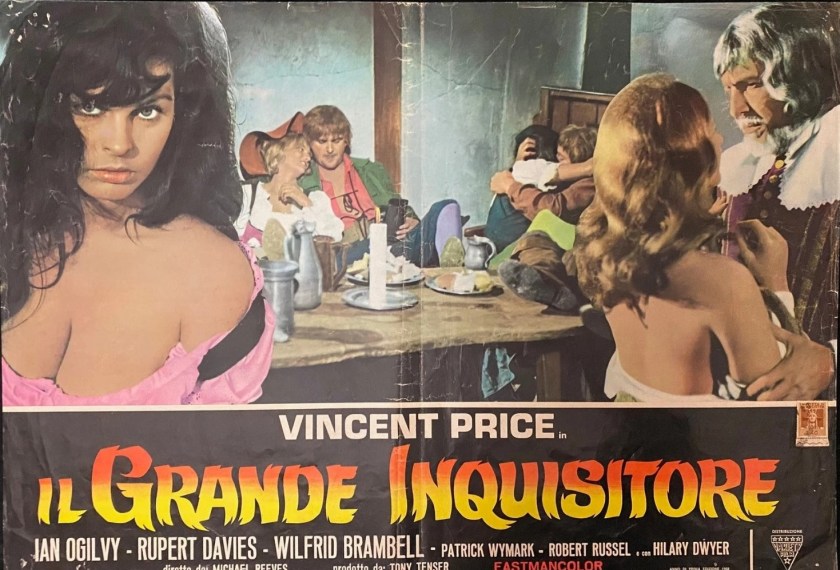
Tony Tenser, egged on by AIP’s head of European Productions, shot additional nude scenes in the pub sequence for the German version, A continuity error was responsible for the freeze-frame ending. There was a short strike when the production fell foul of union rules. Producer Philip Waddilove and his wife Susi were occasionally called upon to act.
Two aircraft hangars near Bury St Edmunds in Suffolk were converted for the interiors while a wide variety of locations were utilized for exteriors including Lavenham Square in Suffolk, the coast at Dunwich, also in Suffolk, Black Park in Buckinghamshire, Orford Castle in East Anglia, St John The Evangelist Church in Rushford, Norfolk, and Kentwell Hall in Long Melford on the Essex-Suffolk border. When the operation could not afford a camera crane, the crew improvised with a cherry picker.
Despite the tension on set, Price was pleased with his performance and the overall film. He praised the film in a 10-page letter. Price remarked, “I realized what he wanted was a low-key, very laid-back, menacing performance. He did get it but I was fighting him every inch of the way. Had I known what he wanted I would have cooperated.”
AIP retitled it The Conqueror Worm for U.S. release, hoping to snooker fans into thinking this fell into the Edgar Allan Poe canon, since the title referred to one of the author’s poems, part of which was recited over the credits.
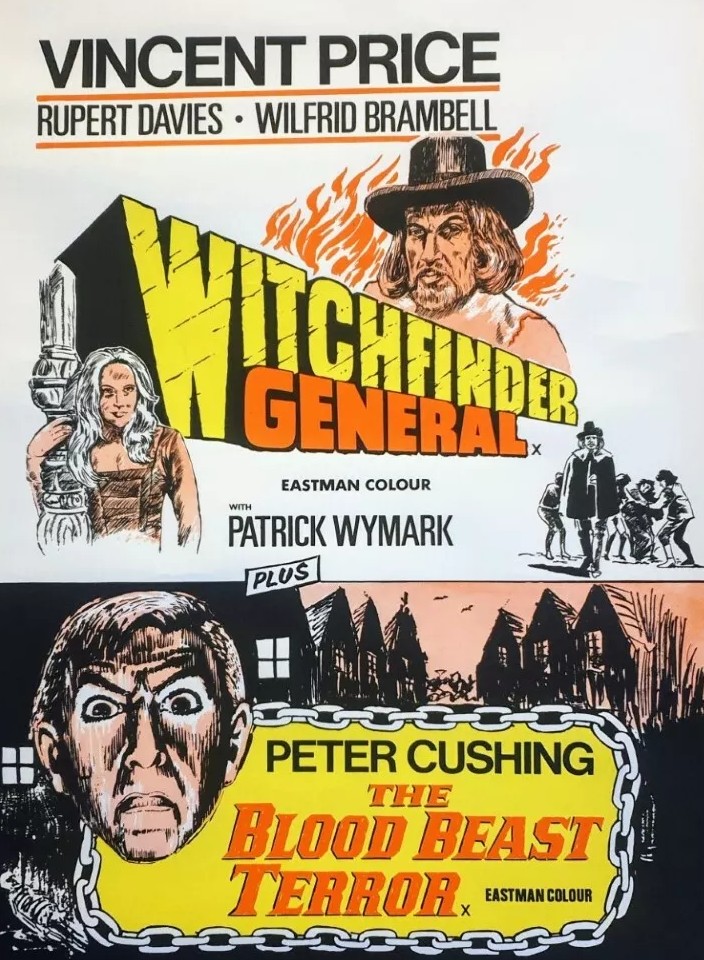
The movie was generally lambasted by critics for its perceived sadistic approach, but is now considered cult. It was a big box office hit, especially considering the paltry budget, gaining a circuit release in the UK – “very good run beating par by a wide margin” – and despite being saddled with the tag of “unlikely box office prospects” by Variety did better than expected business in New York ($159,000 from 28 houses), Los Angeles (a “lusty” $97,000 from 16) and Detroit ($35,000 from one). The final U.S. rental tally was $1.5 million placing it ahead in the annual box office charts of such bigger-budgeted efforts as Villa Rides starring Yul Brynner and Robert Mitchum, Anzio with Mitchum again, James Stewart and Henry Fonda in Firecreek and Sean Connery and Brigitte Bardot in Shalako.
SOURCES: Benjamin Halligan, Michael Reeves (Manchester University Press) 2003; Lucy Chase Williams, The Complete Films of Vincent Price (Citadel Press, 1995); “Big Rental Films of 1968,” Variety, January 8, 1969, p15; Steve Biodrowski and David Del Valle, “Vincent Price, Horror’s Crown Prince,” Cinefantastique, Vol 19; Bill Kelley, “Filming Reeves Masterpiece Witchfinder General,” Cinefantastique, Vol 22; “Box Office Business,” Kine Weekly, June 1, 1968, p8; “Review,” Variety, May 15, 1968, p6. Box office figures – Variety, May-August 1968.
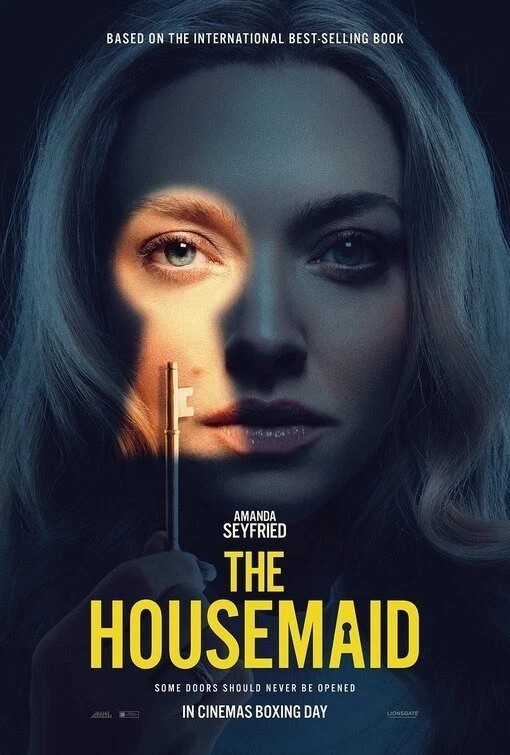
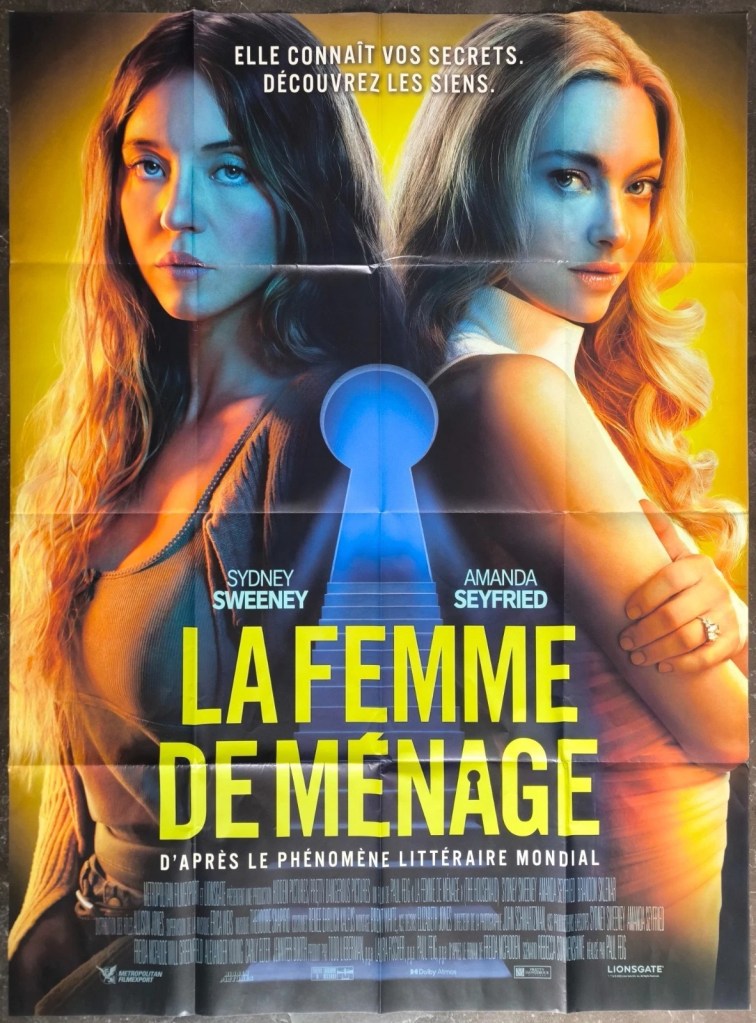
Now that Hollywood is waking up to the surprise hit of the season – worldwide gross now pushing $300 million – it’s equally surprising to discover just how much work went into converting a bestseller with a very enticing hook into a runaway success. The pitch is a stunner – abused wife grooms housemaid to take her place and, potentially, put her abusive husband in his place.
Screenwriter Rebecca Sonnenshine (The Keeping Hours, 2017) does a quite superb job of tailoring the bestseller by Freida McFadden. It would have seemed, on the face of it, with such a killer premise, you wouldn’t have to do much tampering. But you’d be wrong. What Sonnenshine removes and adds and touches up are a template for the art of screenwriting.
Major changes: the climax is completely changed and the role of handyman Enzo (Michele Morrone) considerably reduced, especially the icky section where our valiant housemaid Millie (Sydney Sweeney) looking for a no-strings-attached one-night-stand comes on to Enzo only to be rejected; and the screenwriter takes the “privilege” line that doesn’t appear until well into the book and brings it in much earlier, to add gentle menace.
Minor changes: just about everything.
The filling out begins at the start. In the book, there’s very little detail regarding the job interview and the grandeur of the house except that it’s grand. Here’s what Sonnenshine adds – the “W” on the gate, the display of enticing food that employer Nina (Amanda Seyfried) lays on for a prospective employee, the emphasis on the obnoxious child Cece (Indiana Elle) as a potential ballerina, the cops rousting Millie when she’s asleep in her car. Here’s what Sonnenshine immediately removes: the attic is smaller in the book, tiny, compressed, more ominous; an immediate warning from Enzo; and we don’t learn right away that Millie is a killer.
If you want to know the difference between taut narrative and drama, follow Sonnenshine. In the book, Millie meets husband Andrew (Brandon Sklenar) and child at the interview. In the film, it’s on her first day on the job when Cece introduces herself as the most obnoxious child, taking the new employee to task right away.
Other simple changes: in the book Millie starts work the next day, in the film she starts immediately following the job offer. In the book, Millie arrives overloaded with baggage that Nina doesn’t offer to help carry, in the film she brings very little and Nina does offer to help.
Major change: the heirloom plates. That’s pure Sonnenshine invention. They don’t appear in the book, and husband Andrew’s mother (Elizabeth Perkins) is scarcely in sight.
Sonnenshine also dumps Millie’s apparent first big mistake. In the book Millie makes Cece a peanut butter sandwich only for Nina to go ballistic because the child is apparently allergic. That’s too obvious a schematic and Sonnenshine opts for something better.
Right away, over the “dirty glass” issue, Sonnenshine brings in the first use of the “privilege” weapon long before as I said I was used in the book and never by the child. But she takes out the point about Millie’s glasses / contact lens. In the book this is a contentious issue – Nina accuses Millie of lying over wearing contact lens and glasses.
Also Nina gives her old clothes to Millie very early on whereas Sonnenshine dramatizes this so that it’s seen as an apology.
It’s Sonnenshine who adds drama to Millie’s visit to her probation officer and gives the probation officer the icky line asking Millie about her sex life. Nor, in the book, is Andrew mad keen on Stanley Kubrick’s Barry Lyndon (1975). That’s another Sonnenshine touch, to fill out Andrew’s character. “Hot saint” is another of Sonnenshine’s lines. In the book it’s Andrew who suggests going to the Broadway show, not Nina, so that’s a nice gesture rather than with Nina, another apology. I should also point out that in the book Nina is about 50lb heavier than in the film. The ballet isn’t so dominant, either, Cece in the book attending a range of classes.
In the book, Andrew and Millie don’t get separate rooms at the hotel. They are all over each other in the cab to the hotel. It’s Sonnenshine who adds the dramatic urgency and ratchets up the tension in that in the film Millie tries to avoid intimacy and it’s only when she thinks she’s been fired by mobile phone that she falls into Andrew’s arms.
The film’s killer twisty line of “did you learn to cook in prison?” is better than the book’s “what’s prison food like?” Sonnenshine’s other big switch is that in the book Millie’ in juvenile detention not a scholarship kid as a private school when she commits murder. In the book Nina’s discovery of the Playbill program for the Broadway play is more discreetly done. But Sonnenshine turns it more dramatic with Nina coming down the stairs holding the magazine.
Nina’s immediate revenge in the book is to have Millie suspected of shoplifting after an anonymous phone call to a supermarket. Again, in the film it’s ratcheted up, Millie arrest for stealing her boss’s car and handcuffed and more roundly humiliated that provides the grounds for Andrew to chuck his wife out. The book cuts Millie out of the confrontation between husband-and-wife which results in Nina leaving.
And the book has no equivalent to Nina howling in her car apparently in despair at being chucked out, nor, in a marvelous twist, once we discover what hell awaits Millie, to cutting back to that scene and Nina turn that wail into a whoop of delight at being free.
Nina having to compensate for not getting her roots done by pulling a hundred strands of her hair out twice is in the book. But since the book didn’t include anything to do with priceless heirloom crockery, Millie’s first punishment is, frankly, a lot less interesting. Millie has to balance a stack of heavy books on her stomach for hours at a time. Honestly, that’s nothing, and visually zero, compared to having to rip your stomach open with the sharp end of a broken piece of crockery, which must be one of the most horrific scenes committed to celluloid.
And it’s not a cake knife left in the attic deliberately by Nina that allows Millie to escape, it’s the remains of a pepper spray that had formed part of one of Nina’s punishments. Stabbing someone in the neck with a knife versus blinding them with a pepper spray – what’s the more visual? You don’t need me to tell you.
His punishment in the book is rather long-winded especially bearing in mind that there’s no heirloom plates and assorted crockery to up the ante. So first of all in the book, Millie tortures Andrew by making him bear the weight of the books for hours at a time. It’s only days later, in fact, that in the book Millie instructs Andrew to pull out a tooth. Bear in mind, too, there’s been no lead-up to this, not in the book, which is why the screenwriter places such emphasis on his teeth and smile.
Sonnenshine tosses away the book’s ending. And you can see why. It’s not remotely cinematic. Sure, Nina returns to help. But in the book little help is needed. By the time Nina returns several days later, Andrew has already starved to death, or dead by dehydration, technically. That would be more easily explained to the cops given the problems with the door and Andrew in the house alone except in the book Millie has had her fun and made him pull out four teeth.
So, Sonnenshine opts for another course of action. He’s not dead when Nina returns. She makes the mistake of thinking it’s Millie locked in the attic and inadvertently frees her husband and then after some coming and going Millie pushes him over the banister and down about 50ft to his death.
Sonnenshine adds a happier postscript, Nina giving Millie $100,000.
I read the book after I saw the film so I was amazed at the quality of the script, the changes, the omissions, the additions and especially the nuances, the rounding out of every character. I doubt if anyone voting for the Best Adapted Screenplay Oscar ever reads the source material and that will probably count against Rebecca Sonnenshine come next year’s awards when virtue-signaling will probably win the day once again.
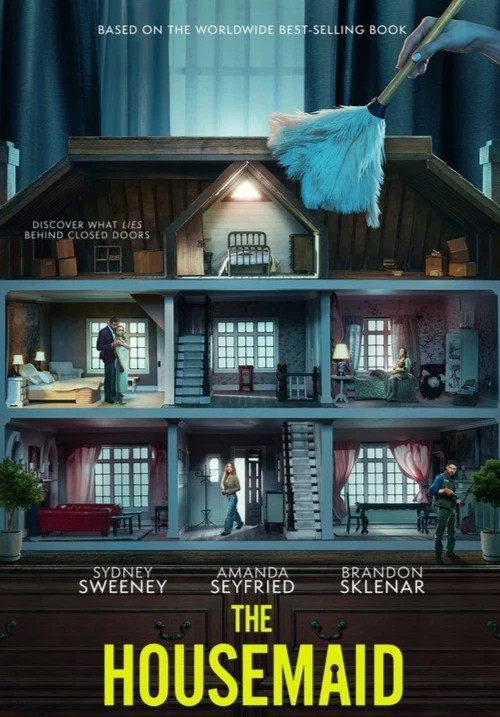
Other additions by the screenwriter: the toy troll, and therefore Cece stealing it from Nina’s bedroom, the creepy dolls house, and therefore Cece playing with it.
Much as I enjoyed the plot-heavy book, I enjoyed far more what the screenwriter made of it and I think Sonnenshine has played an enormous role in making the film such an appealing attraction.
The movie’s still going to be playing for weeks now, so if you get the chance check it out.
For the first four decades of the Hollywood business, success in markets other than domestic was random. Many countries restricted the number of U.S. films that could be shown, others like Britain prevented American studios for a long time taking out of the country money earned at the box office. There was always the chance it could be less profitable if a dominant foreign cinema chain or distributor demanded a larger slice of the box office. In addition, some genres that worked in America stiffed abroad – musicals and comedies found it hard to translate.
Except in extremely sporadic fashion, foreign box office was not reported in the trade media until the 1990s. So there was no such thing as worldwide grosses available on any real scale. These days for many films overseas receipts bring in more than domestic – Zootropolis a current example with around 70 per cent of takings coming from abroad – but that was virtually never the case until the arrival of the James Bond pictures, which acquired a genuine global brand, in the 1960s.
However, the United Artists archives held by the University of Wisconsin provide some fascinating insights into the growing power of the foreign box office in the 1950s. Movies released into the foreign market would make a percentage of their domestic take. But that varied enormously. Even the star-studded Around the World in 80 Days (1956), the second-biggest blockbuster of the year Stateside, with a colossal $16 million in domestic rentals took in less than a quarter of that abroad, just $3.9 million.
For some films, the percentage was better. Controversial William Holden drama The Moon Is Blue (1953) notched up $1.3 million abroad compared to $3.5 million at home. War picture Beachhead (1954) starring Tony Curtis bundled up $1 million overseas as against $1.4 million in domestic. The Barefoot Contessa (1954), boasting Humphrey Bogart and Ava Gardner, added $2.2 million in foreign coin to its domestic tally of $3.25 million.
Richard Burton as Alexander the Great proved the breakthrough, domestic’s $2.5 million matched by the exact same amount abroad. Robert Mitchum in Foreign Intrigue (1956) went one further, reversing the usual situation, foreign of $1.14 million ahead of domestic’s $1 million.
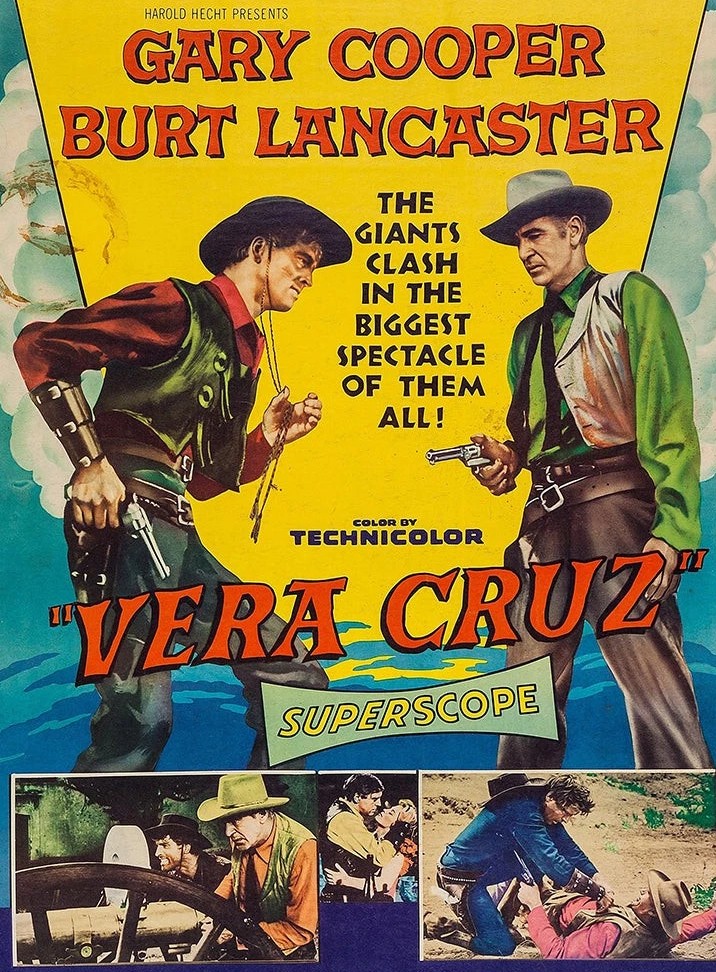
But the UA star with the biggest consistent pull overseas was Burt Lancaster. Robert Aldrich’s Apache (1954) knocked up $1.75 million abroad compared to $3.25 million at home. Vera Cruz, (1954) also directed by Aldrich and coupling Lancaster with Gary Cooper, hit a home run – the $3.94 million abroad being just short of the $4.5 million at home. The actor’s first venture into directing The Kentuckian (1955) kept up the pace with $1.97 million overseas versus $2.6 million at home.
While these were all action pictures, it was acrobatic drama Trapeze (1956), with Lancaster and Tony Curtis fighting over Italian sex symbol Gina Lollobrigida, that made Hollywood wake up. In the U.S, it came third on the annual box office charts with $7.5 million in rentals. If that took the industry by surprise that was nothing compared to foreign where the movie racked up $7.4 million.
Lancaster remained potent. Submarine war picture Run Silent, Run Deep (1958), co-starring Clark Gable, did virtually as well abroad as at home – $2.42 million overseas compared to $2.5 million at home.
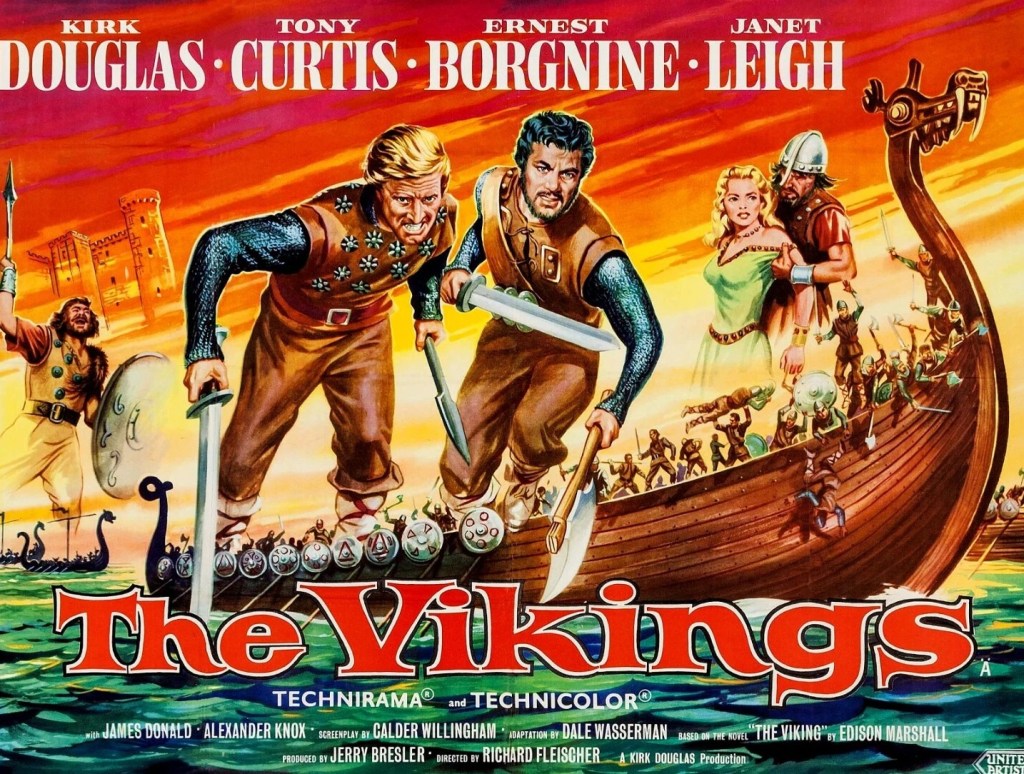
Perhaps learning from the experience of Trapeze, UA went for broke with historical actioner The Vikings (1958) starring Kirk Douglas and Tony Curtis. Domestic of $7 million, enough for fifth place in the annual box office league, was beaten by an overseas count of $7.34 million.
For the first time it appeared that Hollywood could count on overseas to swell the box office in sizeable fashion, thus allowing studios to invest more, especially in historical movies with an action angle, thus opening the door for the spate of 1960s roadshows. Such results also cemented star salaries. If a Burt Lancaster picture could make the same again abroad as at home that put him in a new category of dependable stars and allowed studios to gamble on increasing his salary.
That Charlie Chaplin proved a better draw overseas than in the U.S. was largely by default. The actor-producer-director had fallen foul of American politics with the result that his latest release Limelight (1952) flopped. Abroad it was a different story and Limelight hit a tremendous $5.1 million. With the U.S. reissue market also showing resistance to Chaplin oldies, it was left to overseas audiences to show what cinemas were missing as Modern Times (1936) racked up $2.1 million and The Gold Rush (1925) $1.25 million. For comparison the reissue of Red River (1948) pulled in just $19,000 overseas.
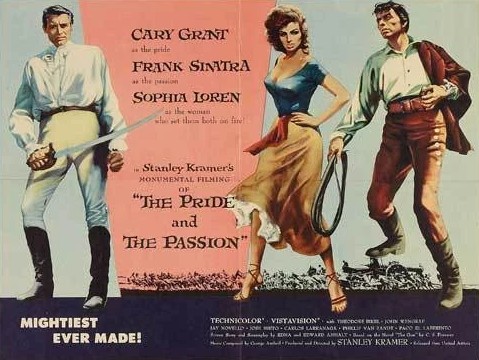
Other notable leaders in the overseas market included: Frank Sinatra, Cary Grant and Sophia Loren in The Pride and the Passion (1957) with $3.17 million ($5.9 million domestic); Billy Wilder’s Agatha Christie adaptation Witness for the Prosecution starring Tyrone Power and Marlene Dietrich on $2.81 million ($3.75 million domestic); and Love in the Afternoon (1957) with $2.7 million ($2 million domestic) starring Gary Cooper and Audrey Hepburn.
Also making a noise overseas were: Stanley Kramer medical drama Not As a Stranger (1955) toplining Olivia De Havilland, Frank Sinatra and Robert Mitchum on a $2 million haul ($7.1 million domestic): Sinatra again in Otto Preminger’s study of addiction The Man with the Golden Arm (1953) on $1.87 million ($4.35 million domestic); Sinatra in war picture Kings Go Forth (1958) on $1.83 million ($2.8 million domestic) and Kirk Douglas as The Indian Fighter (1955) with $1.84 million ($2.45 million domestic).
Bob Hope went against the grain when his overseas tally for Paris Holiday (1958) at $1.8 million bested the $1.5 million of domestic while John Wayne and Sophia Loren’s foreign engagements for Legend of the Lot (1957) counted as a disappointment with just $1.66 million compared to $2.2million domestic.
Low-budget Oscar-winner Marty (1955), produced by Burt Lancaster’s company, was as big a surprise abroad as at home, sprinting to $1.43 million ($2 million domestic). Others worth noting included: Bandido! starring Robert Mitchum on $1.42 million overseas ($1.65 million domestic); David Lean’s romantic drama Summertime (1955) with Katharine Hepburn on $1.3 million ($2 million domestic); Anthony Mann’s Korean War venture Men in War (1957) on $1.26 million ($1.5 million domestic); and Clark Gable in The King and Four Queens (1956) hauling in $1.24 million ($2.5 million domestic).
Olivia De Havilland as The Ambassador’s Daughter (1956) tabbed $1.1 million overseas ($1.5 million domestic) and Gary Cooper in Mark Robson’s Return to Paradise (1953) tallied $1.1 million ($1.8 million domestic). Slow burners numbered Dale Robertson in Sitting Bull (1954) with $1.1 million ($1.5 million domestic) and Stanley Kubrick’s anti-war picture Paths of Glory (1957) with Kirk Douglas shooting up $1 million ($1.2 million domestic).
SOURCE: “Foreign Distribution Gross Estimates,” United Artists Archives, Box 1, Folder 8, University of Wisconsin. Note that in this case “gross” means “gross rentals” not “box office gross.”
If you’re not Alfred Hitchcock with carte blanche to scare the pants off the audiences every which way but loose and you’re not launching a B-movie sexploitation drama, then you’ve got to take a more sensible path to selling a picture headlined by the world’s greatest hero Gregory Peck elevated to such a position by the extraordinary success of The Guns of Navarone (1961) which topped the annual box rankings in the USA.
So while your taglines can emphasize “shock and suspense” what you’re selling cinema managers is quality. So, in the Pressbook/Marketing Manual, Peck is portrayed as a “celluloid perfectionist” and “four-time Oscar nominee” so multi-talented he’s a triple hyphenate – writer, producer, actor. Such a perfectionist he’s known “to spend a week or more preparing for one small scene.”
He is a class act not some sleazy B-movie bum. “He not only completely absorbed all the dialog, its various nuances and shadings, but also probed the psychological and physiological motivations of the attorney he portrays,” notes the Pressbook.
And it’s not just Peck who’s to be praised. “Seldom has such an outstanding array of talent been so tellingly marshaled for such a dramatic thunderbolt.”
The messianic tone is evident throughout. Headlines claim “Bob Mitchum’s career reaches a new high,” Lori Martin has the “top role” of her career, Barrie Chase is “praised as top talent discovery” and “Telly Savalas termed top talent find by Peck.”
Polly Bergen “emerges as an actress of great sensitivity and insight.” Lori Singer, in her movie debut, “graphically attests to the polish she has achieved through her work as child lead in the video (television) series National Velvet.” Although Martin had another reason for turning up word perfect – so that she could get off early and go ice skating.
And the praise doesn’t stop there. “A whole new career should open for sultry Barrie Chase, one-time dancing partner of Fred Astaire.” She is “sensationally good as the casual pick-up ensnared by Mitchum.” The talent pickers had no doubt she was “destined to become one of the foremost dramatic talents of the industry. The very quality which made her such an outstanding dancer – her tireless attention to even the minutest detail – has helped turn her into a magnificent actress.” The marketeers were convinced her “masterpiece” performance would result in an Oscar nomination.
Peck had appointed himself the “tub-thumper” for Savalas after seeing him play Al Capone” in the television series The Witness (1960-1961) calling him “one of the finest new talents of the last 10 years.”
According to the Pressbook, director J. Lee Thompson “deliberately imparted…a distinctively British touch.” Claimed Thompson, “There emerges in the best of the British pictures a certain warmth and credibility which are looked upon as the English hallmark. Such an impression is achieved, it seems to me, through the simple technique of emphasizing character development.”
For journalistic snippets there’s not much beyond that Peck was so impressed with the location in Georgia that he purchased a plot of land on Sea Island to build a beach house. Plus that he’s turned into a noted photographer, now onto his seventh camera with a fast lens. Polly Bergen was creating a nightclub act. Robert Mitchum was thrown three times on his first film horse.
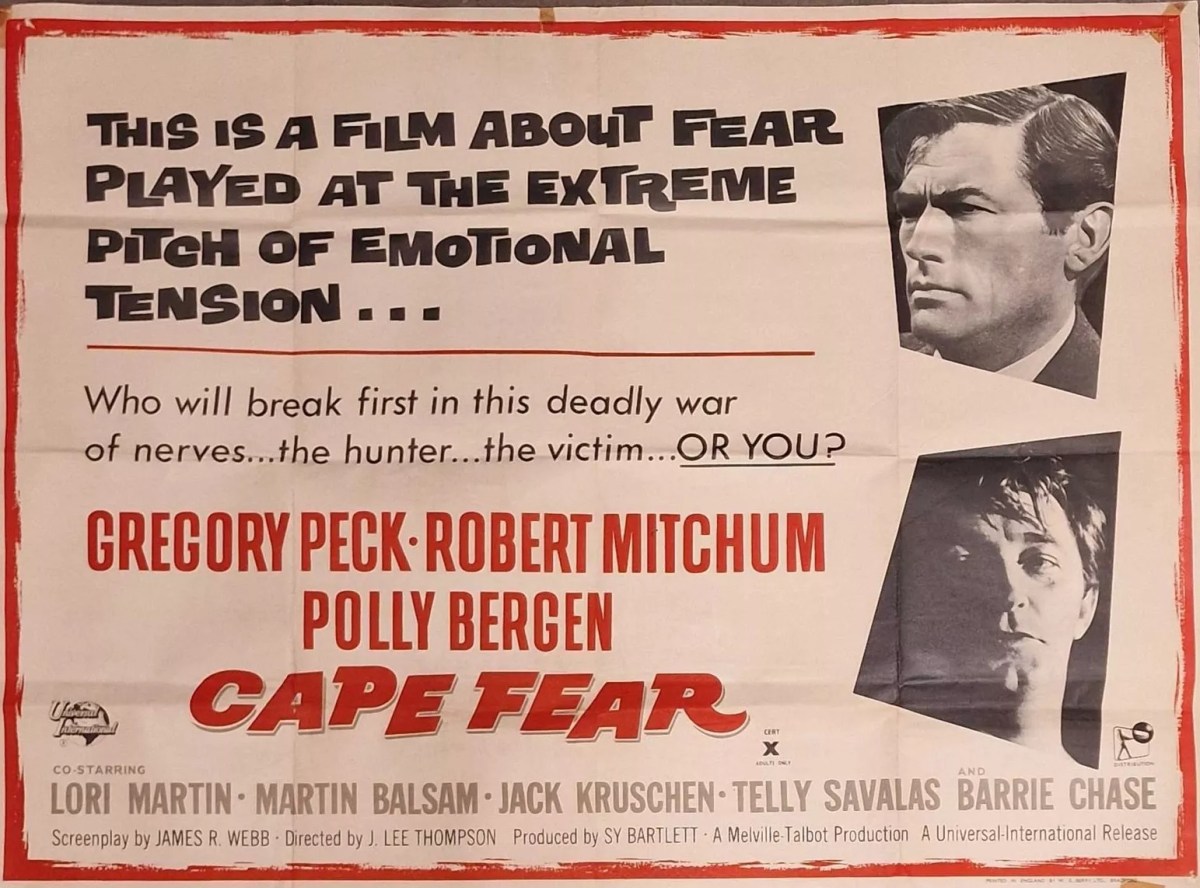
But it was unlikely that cinema managers would find a way of passing on to audiences the idea that this was a “quality sleaze” picture populated by proven and up-and-coming talent. The public had to make do with posters and taglines to get a feel for what was on offer. And in that respect the marketeers pulled few punches.
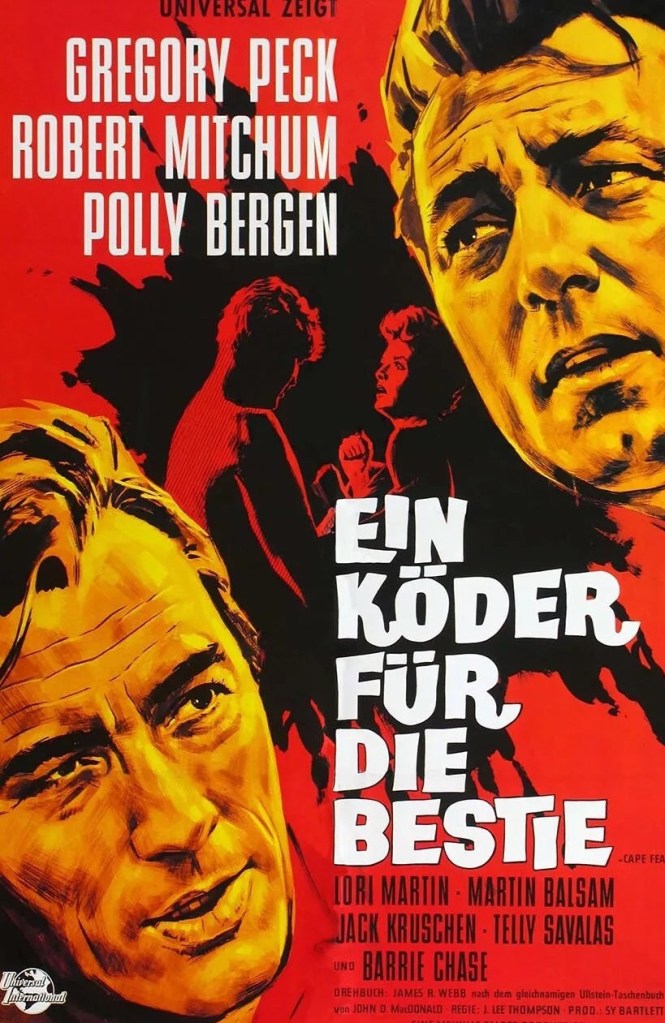
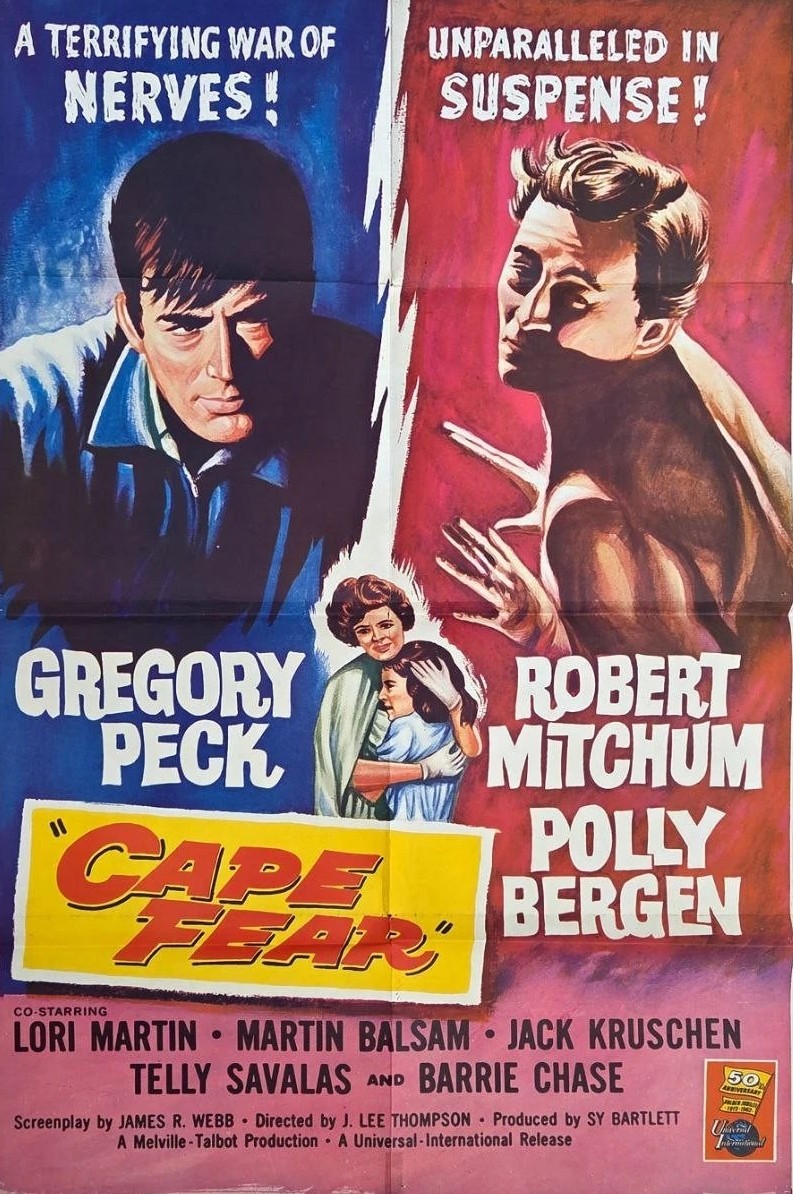
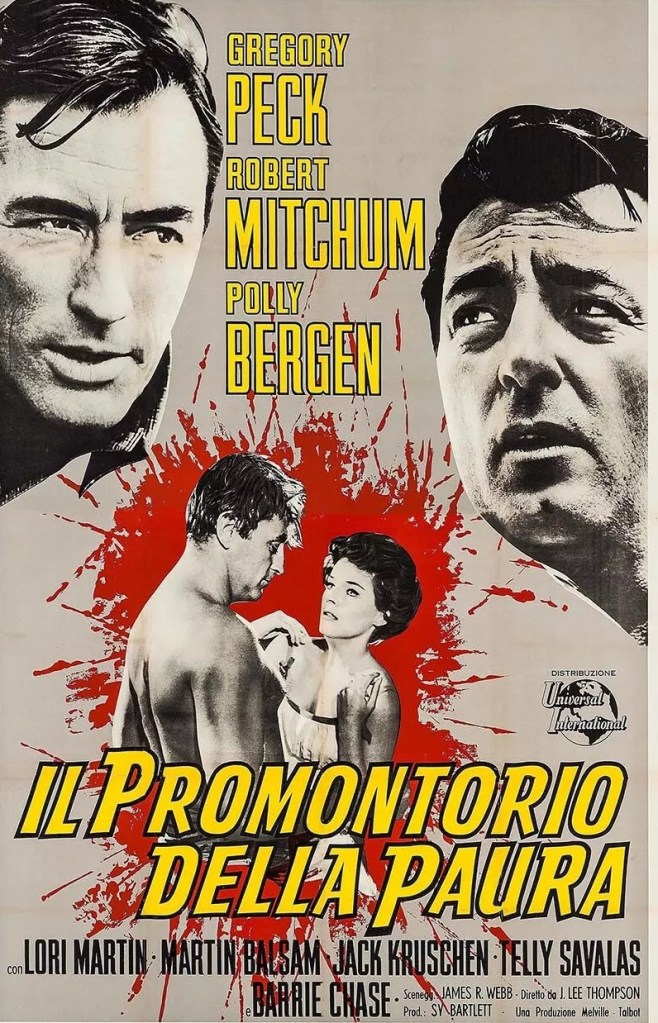
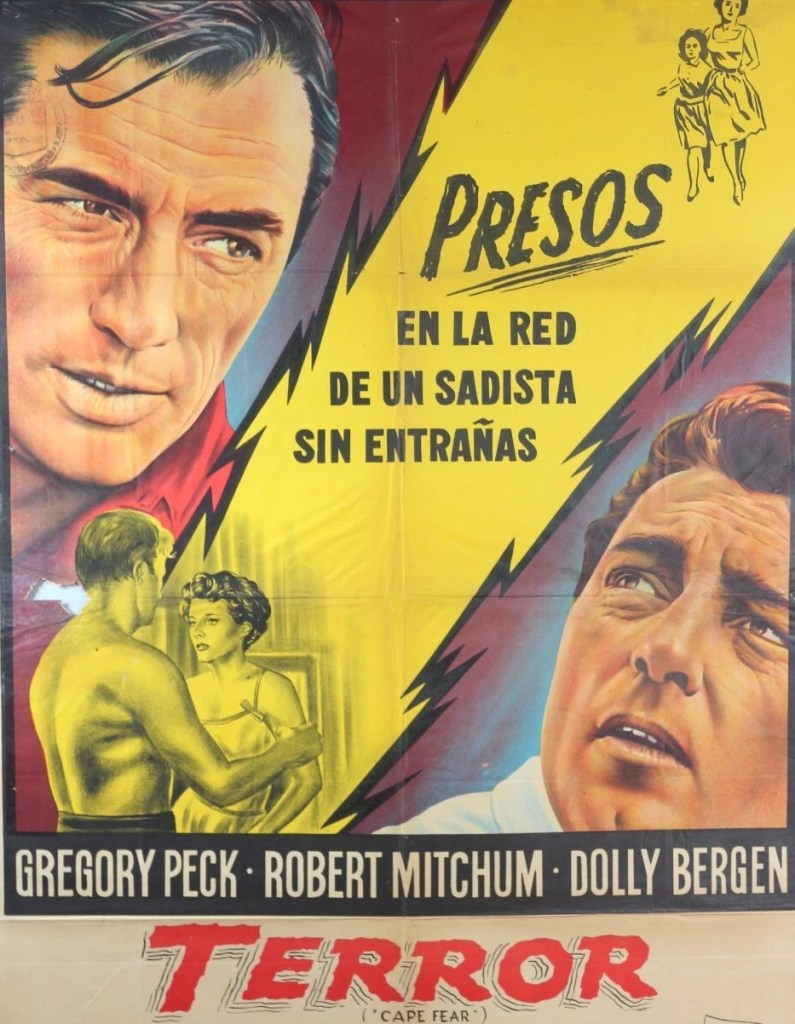
As usual, cinema managers were offered a plethora of choice when it came to the posters. Mostly, Peck and Mitchum were shown on opposite sides of the poster with in between an image intended to conjure up menace – the bare-chested Mitchum confronting Bergen, Bergen comforting her daughter, mother and daughter running, Mitchum tangling with the daughter.
Taglines spelled it out in a variety of ways: “A terrifying war of nerves unparalleled in suspense!” with a sub-tag of “A man savagely dedicated to committing a crime shocking beyond belief! A man desperately determined to end his ordeal of terror…even if it meant using the ultimate weapon – murder!”
Exclamation marks were in full flow. “Now, he had only one weapon left – murder…to prevent an even more shocking crime” was backed up by “the drama of an unrelenting war of nerves…and the helpless lives that were caught in its terrifying crossfire!”
Or try this – “The savagely suspenseful story of an unspeakable crime…and the man, the woman, the helpless people it touched with terror. From the moment they meet the tension is explosive. An electrifying war of nerves unrelenting in suspense!”
In case you didn’t get the message, here it is in more subtle form: “What happens to them in an adventure in the unusual!” That understatement is followed up with “So daring in theme…so frank in treatment…that it frightens while it fascinates and gives a terrifying new meaning in suspense!”
And there were variations of the above: “A terrifying war of nerves unparalleled in suspense! The Watched…who can only run so far before coming face-to-face with The Watcher…who waits for the moment when the woman and her daughter will be alone.”
And – “Now the nightmare was about to become a terrifying reality… the whispered threat a crime unspeakable. So daring in theme…so frank in treatment. What happens to them is an adventure in the unusual!”
Plus – “Their ordeal of terror triggers the screen’s most savage war of nerves! Unparalleled suspense…as one becomes a target for nightmare, the other becomes his target for execution.”
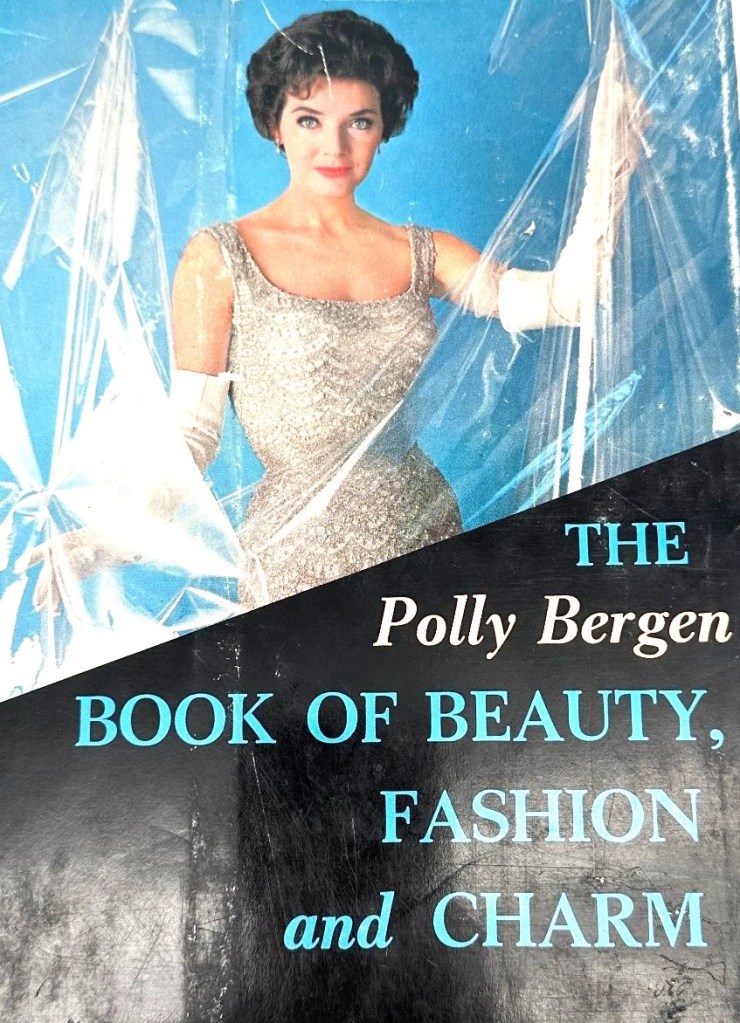
Unusually, there were a host of promotional items. As well as a motion picture paperback edition from Fawcett, “hot off the press” was the Prentice-Hall hardback The Polly Bergen Book of Beauty, Fashion and Charm, including stills from Cape Fear. Books were a major source for marketing, given there were over 100,000 outlets in specialist shops, drug stores, railway and bus terminals and carousels on newspaper stands.
Virtually any homely element of the movie was co-opted for promotional purposes. A scene taking place at a United Air Lines terminal counter provided opportunity for tie-ins with travel agents and ticket offices. Bowling “palaces” might be happy to display posters and promotional material given there’s a scene set in a bowling alley. Distributors of a Chris Craft boats, Chrysler station wagons, Larson speed boats and Scott outboard motors – which all appear in the movie – could be targeted.
Like many an ambitious – not to say greedy – actor, Gregory Peck had decided to go into the production business. In theory, there were two good reasons for this: actors could take control of their careers and they could make vanity projects. In reality, there were other over-riding reasons: after years in the business they thought they knew better than their Hollywood bosses and, more importantly, with a bigger stake in a picture they thought they could make more money. First of all came the tax advantages. As a producer, they could spread income over a number of years rather than just one. And they could take advantage of a loophole in the tax laws by making movies abroad. And then if all went as well as the actor imagined, they would get a bigger share of the spoils. If it proved a flop, then the studio carried the can and the actor walked off scot-free.
In 1956 Peck set up Melville Productions with screenwriter Sy Bartlett, with whom he had worked on Twelve O’Clock High (1950). They signed a two-picture deal with United Artists, the go-to studio for actors wanting to become producers. The first projected ideas fell by the wayside, Affair of Honor based on a Broadway play that subsequently flopped and Thieves Market – with William Wyler on board as director – whose commissioned script didn’t meet Peck’s standards. Also on the agenda was Winged Horse with a script by Bartlett and James R. Webb.
Instead, Peck set up The Big Country (1958) through another production shingle, Anthony Productions, and co-produced it with director William Wyler’s outfit, World Wide Productions. The budget rocketed from $2.5 million to $4.1 million, which limited the potential for profit.
Melville Productions launched with Korean War picture Pork Chop Hill (1959). When that flopped it was the end of the UA deal. Peck moved his shingle to Universal. The production company lay dormant while Peck returned to actor-for-hire for Beloved Infidel (1959) and On the Beach (1959), both flops, before jumping back into the top league with the biggest hit of his career The Guns of Navarone (1961) directed by J. Lee Thompson.
Melville Productions was resuscitated for Cape Fear. Peck and Barlett had purchased in 1958 a piece of pulp fiction (novels that bypassed hardback publication and went straight into paperback) by John D. MacDonald called The Executioners. Bartlett passed on screenwriting duties which were handed to James R. Webb (How the West Was Won, 1962).
Director and star had bonded on The Guns of Navarone. “We were working so well together,” recalled Thompson that when Peck handed him the script of Cape Fear he was intrigued. “I liked the book very much,” said Thompson. “Greg had a script prepared, we signed the contracts, and I came to make my first picture in Hollywood.” (The Guns of Navarone had been filmed in Greece and London).
Though author John D. MacDonald had written a hard-boiled thriller with a merciless killer, screenwriter James R. Webb (Pork Chop Hill) racked up the tension and added a thicker layer of predatory sexuality in the vein of Psycho (1960). The final touch was a Bernard Hermann (Psycho) score brimming with menace.
Ernest Borgnine (Go Naked in the World, 1961) was first choice to play psychopathic killer Max Cady. Rod Steiger (The Pawnbroker, 1964), Jack Palance (Once a Thief, 1965) and Telly Savalas (Birdman of Alcatraz, 1962) were also considered. “We actually tested Savalas and he gave a very good test for the part,” explained Thompson. “But these were character actors or at least secondary actors compared to Greg. At some point discussing it together we began to talk about having the villain played by an actor of equal importance, making it a much stronger match-up from the audience’s point of view and (Robert) Mitchum immediately came to mind.”
But Mitchum had essayed a similar venal character in Night of the Hunter (1955) and didn’t want to repeat himself. However, he liked the way the tale showed just how corrupt law enforcement could be and how easily the cards were stacked. Mitchum understood the character from the outset. “The whole thing with Cady is that snakelike charm. Me, Officer, I never laid a hand on the girl, you must be mistaken.”
“When we heard Mitchum’s thoughts,” noted Thompson, “we were more convinced than ever he would be terrific for the role. And I think by the end of the meeting he now realized that himself.” But he still held back, unsure. The producers sent him a case of bourbon. He drank the bourbon and signed up. There was the additional inducement of sharing in the profits by being made a co-producer which involved nothing more taxing than signing on the dotted line. Universal took it on as the first in two-picture deal with Melville.
Mitchum’s career was following its usual up-and-down course, a couple of flops always seemed to be followed by a big hit. His acclaimed performance in Fred Zinnemann’s The Sundowners (1960) had offset The Night Fighters / A Terrible Beauty (1960) and Home from the Hill (1960). His latest picture, The Last Time I Saw Archie (1961) was filed in the negative column.
Peck and Mitchum had opposite approaches to their profession, the former diligent and serious, the latter not able to get off a set quickly enough, not even bothering to learn his lines because thanks to a photographic memory he could scan his lines just before a scene began and be word perfect.
Locations were scouted in the Carolinas where MacDonald had set the book, but failing to find anything suitable exteriors were switched to Savannah in Georgia. Where Peck rented a house and went home every night, Mitchum took a room in the DeSoto Hotel and when work was finished for the day went out drinking, an assistant director taken along as ballast to keep him out of trouble. The town held bad memories for Mitchum. Last time he had visited he had been arrested for vagrancy and did a stint on a chain gang, which recollection possibly put steely bitterness in his portrayal of the ex-convict. Although he hated the town, he liked the idea that on his return everyone was kowtowing to the big movie star, including a bevy of hairdressers in town for a convention.
Fortunately, the Savanah sojourn was short, bad weather getting in the way, barely two weeks before the unit repaired to Hollywood (some of the boat scenes were filmed around Ventura but the climactic fight took place on the studio lake) where the production overshot its schedule by a month, wrapping on July 5 instead of June 8, and racking up $2.6 million in costs.
Mitchum appeared determined to demonstrate quite how different their approaches were. In one scene, off camera, Mitchum stripped naked to get a reaction from the stolid co-star, who remained immune to such provocation. In reality, Mitchum was very professional. “He would work perfectly,” said Thompson. “He just goes in and does it. He was superb.”
Though far from a Method Actor, Mitchum was chillingly close to the part. “I live character and this character drinks and rapes,” he confessed. During the scenes of violence he worked himself up. “He made people frightened,” acknowledged Thompson.
And that included Peck, especially during the slugfest in the water which took nearly a week of a night shoot to complete. Despite warmers being put in the water, it was freezing. “Sometimes, Mitchum overstepped the line,” said Thompson. “He was meant to be drowning Greg and he really took it to the limit…but Peck never complained.”
The final scene filmed was the rape of Polly Bergen playing Peck’s wife. Bare-chested and sweating, Mitchum built himself up into a fury. “You felt any moment he would explode,” said Thompson. “But there was no rehearsal, so nobody really knew what to expect. Thompson improvised the business with the eggs. But Mitchum was more brutal with the eggs than could ever be shown in a cinema, smearing the yolk over Bergen’s breasts. He cut his arm flailing wildly and he used the actress to break open the cabin door, so she finished the scene with the front of her dress sodden with egg yolk and the back covered in blood.”
While Peck expressed confidence in director J. Lee Thompson and could count on Mitchum’s experience to see him through, female lead Polly Bergen was making her first film in eight years, after a small part in western Escape from Fort Bravo (1953) starring William Holden. She had come to wider attention for winning an Emmy for The Helen MorganStory (1958).
“Greg spent an enormous amount of time with me,” said a nervous Bergen, “He was wonderful and he was very, very supportive.” She added, “I wouldn’t have let anyone know how insecure and frightened I was. But he, I think, knew that instinctively and was there to set me at ease and be helpful and nurturing.”
Peck had no worries about Thompson, the situation helped by the director appearing to take the line the producer-star wanted. When it came to editing, Peck played fair with Mitchum, resisting the temptation to tone down his co-star’s performance which threatened to overshadow his own.
The censors were livid. They eliminated all mention of the word “rape”, removed most of Mitchum’s ogling of Peck’s daughter and cut to the bone the sexual assault.
While critics tended to agree that Mitchum stole the show, the movie was mauled by the New York Herald-Tribune as a “masochistic exercise” and the New Yorker took Peck to task for becoming involved in “an exercise in sadism.”
Initially, it appeared to be doing well enough. There was a “big” $37,000 in New York, a “giant” $29,000 in Chicago, a “fancy” $14,000 in Cleveland, a “rousing” $18,000 in San Francisco and a “proud” $14,000 in Boston. But the “expectancy of lush performance” did not materialize. Final tally was $1.6 million in rentals, a poor 47th in the annual box office rankings, so there were no profits for Peck or Mitchum to share.
The British censor demanded five minutes of cuts. Thompson made headlines by claiming that 161 individual cuts, a record, had destroyed the film but censor John Trevelyan argued it was just 15. Despite claiming the movie would not be shelved until the controversy had died down, in fact it lost its May 1962 premiere slot at the Odeon Leicester Square in London’s West End and was held back until the following January when it opened at the less prestigious Odeon Marble Arch, setting a record for a Universal release. Bergen was furious at the cuts in her role. “I really blasted British censorship.”
Ironically, Peck made more money from selling the rights to Martin Scorsese for the 1991 remake, in which he had a small part, and whether it’s the Peck estate or Scorsese who benefits there’s a 10-part mini-series on the way starring Patrick Wilson (The Conjuring: Last Rites, 2025) as the attorney, Amy Adams (Nightbitch, 2024) as his wife and Javier Bardem (Dune, Part Two, 2024) as their tormentor.
SOURCES: Gary Fishgall, Gregory Peck, A Biography (Scribner, 2002) pp197-198, 208, 225-228; Lee Server, Robert Mitchum, Baby, I Don’t Care (Faber & Faber, 2001) p43-437; “Peck-Bartlett Spanish Pic Halts,” Variety, February 13, 1957, p2; “U Gets Melville Pair,” Variety, July 29, 1959, p18; “U Repacts Bartlett,” Variety, September 28, 1960, p4; “Director of Cape Fear Claims British Censor Demands Too Many Cuts,” Variety, May 9, 1962, p26; “Censor Replies to J. Lee Thompson,” Kine Weekly, June 28, 1962, p6; “Classification-Plus-Mutilation,” Variety, December 19, 1962, p5; “Your Films,” Kine Weekly, February 7, 1963, p14. Box Office figures: Variety April-May 1962 and “Big Rental Pictures of 1962,” Variety, January 9, p13,
The big news in a slack weekend at the box office is that the re-release of The Lord of the Rings trilogy – each film showing for just one day over Jan 16-Jan 18 – has taken $5 million in advance sales. Sure, the fanboys have been putting down their dollars as you might expect in appreciation of their favorite fantasy threesome, but it’s pretty certain that the trio will put in a far better showing by the end of the weekend. Old films are in the renewal business once again, with revenues showing a steady increase over the past five years and then a remarkable jump from 2024 to 2025.
But there’s nothing new in putting old movies back to work. They’ve been chucking old films back into the distribution pot since 1914 – at least according to the whopper of a book (now recognized as the authority on the subject) I wrote a decade ago about the history of the Hollywood reissue. After World War One, old films had struck box office gold during periods of marked low production such as post-WW2, the 1970s, and currently; and on the back of the Director’s Cut; or reinvention through a premium vehicle such as IMAX.
Theoretically, reissues should be dead in the water. Fans of any major or cult motion picture are most likely to own a DVD or can catch it easily enough for free on a streaming outlet without paying big bucks to watch it on the big screen. But reissue has also been reinvented on the back of an anniversary and through restriction. Used to be, an old movie would be thrown into the distribution maw in the same way as any other movie, running for any multiple of one week at your local multiplex. But then some smartass decided that restricting opportunity would increase demand. “For One Day Only” became a marketing tool, except in rare instances. Anniversaries – the dates shown below are the giveaway – remain the most common reason for oldies seeing the light of day, but occasionally it’s to cash in on a forthcoming addition to a long-running series.
You might be surprised to learn that the reissue is actually booming in terms of box office. Last year’s overall take of $138.8 million was more than double the previous year’s $58.4 million which was just ahead of the 2023 tally of $56.4 million. And that was also up on the 2022 total of $46.4 million which was light years behind the 2021 figure of $115 million. So in the space of a few years, reissue receipts have remained constant and you can see why cinemas, faced with such low box office figures for Oscar-bait, are turning to oldies.
The biggest hit in 2025 was Star Wars Episode III: Revenge of the Sith (2005) on $34 million followed by The Twilight Saga: Breaking Dawn – Part 2 (2012) with $19.9 million and The Twilight Saga: Breaking Dawn – Part 1 (2011) on $19.7 million. Jaws (1975) came next biting off $16.1 million then James Cameron sequel Avatar: The Way of Water (2022) on $13.8 million, Back to the Future (1985) on $13.1 million, Pixar’s Toy Story (1995) on $11.4 million and Japanese animated classic Princess Mononoke (1997) on $10.8 million.
In 2024 Christopher Nolan’s Interstellar (2014) led the way with $15.2 million, chased by Star Wars: Episode 1 – The Phantom Menace (1999) on $13 million, Tim Burton’s The Nightmare Before Xmas (1993) with $6 million, Columbia’s 100th anniversary bunch on $6 million and animated sequel Shrek 2 (2004) on $3.4 million. The Lord of the Rings trilogy knocked up $8.1 million, cumulatively, Howl’s Moving Castle (2004) was on $2.3 million, Ridley Scott’s unsurpassed space horror Alien (1979) on $2.3 million and Disney’s The Lion King (1994) drumming up $2.1 million.
The top re-release in 2023 was another James Cameron epic Titanic (1997) with $15 million followed by The Nightmare before Xmas clocking up $10.2 million and Star Wars: Episode VI – Return of the Jedi (1983) with $7.2 million. Henry Selick’s adaptation of the Neil Gaiman dark fantasy novel Coraline (2009) dished up $7.1 million, Bette Midler bewitchment Hocus Pocus (1993) spelled out $4.9 million, Talking Heads live performance film Stop MakingSense (1983) nabbed $4.8 million, Steven Spielberg’s SFX-driven Jurassic Park (1993) chewed up $2.9 million, Bruce Willis in Die Hard (1988) clobbered $2 million, Coen Brothers cult favorite The Big Lebowski (1988) bowled $1.2 million and TheLord of the Rings: Return of the King (2003) netted $1.1 million.
In 2022 James Cameron again came out on top with Avatar (2009) heading the list on $24.7 million, followed by Jaws – minus any anniversary hullabaloo – on $5.1 million, another Spielberg E.T. – the Extra Terrestrial (1982) on $2 million, perennial revival It’s A Wonderful Life (1946) with $1.4 million, Francis Ford Coppola gangster classic The Godfather (1972) on $1.4 million, Rogue One: A Star Wars Story (2016) on $1.3 million and Howl’s Moving Castle $1.2 million.
Avatar again led the way in 2021 with $57.9 million followed by John Carney romance Begin Again (2013) with $21.3 million, Harry Potter and the Philosopher’s Stone (2021) on $15.8 million, The Lord of the Rings: The Fellowship of the Ring (2001) with $8.9 million and Japanese classic Love Letter (1995) on $7.4 million.
Most of these are reissues are already reissues, the various Star Wars episodes going through a reissue mill over the decades, the Disney cartoons receiving a reissue hoopla when they went out on 3D or Imax. The Lord of the Rings trilogy in an “Extended Edition” should set the target to be matched for this year.
SOURCES: Box Office Mojo “Worldwide Top 200” annual charts; Brian Hannan, Coming Back to a Theater Near You, A History of Hollywood Reissues, 1914-2014 (McFarland, 2016)