Rampage (1963) ***

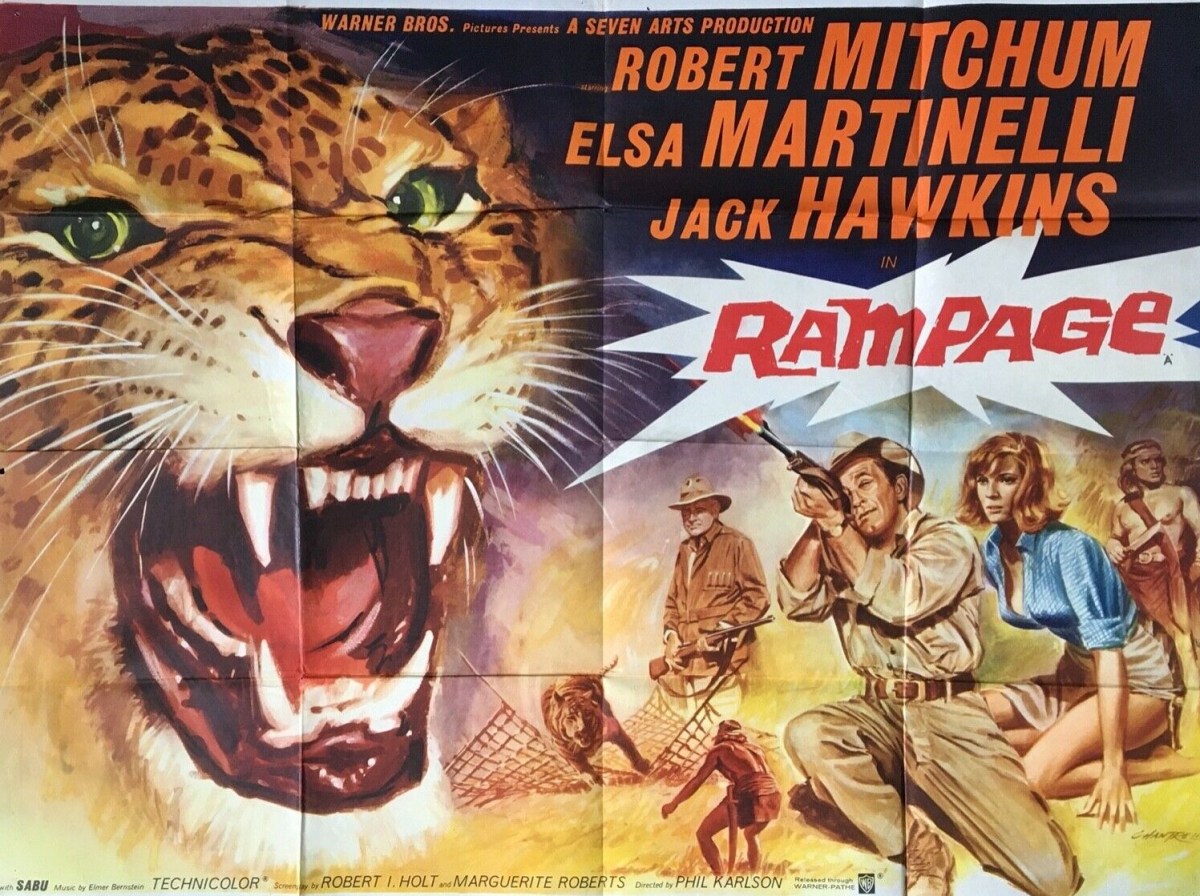
A more misleading title you’d struggle to find. There’s no sign of a rampage until the last 20 minutes, and even then it plays out on a rooftop in a city. Not a patch, action-wise, on Howard Hawks’ Hatari! the previous year, but sharing the female lead Elsa Martinelli. More romantic drama than jungle adventurer, and not much Malaysian jungle at that given Hawaii was the stand-in.

Big on metaphor, women viewed as trophies to boost the male ego or requiring male protection. Surprisingly contemporary with reference to the grooming of young women. Though Hatari! went down the same line, hunting animals for zoos rather than sport, this again take  contemporary approach, animal conservation seen as a battle of cultures, between men for whom shooting an elephant or a rhino reinforces their macho tendencies, and those who want to preserve rare wildlife for future generations.  
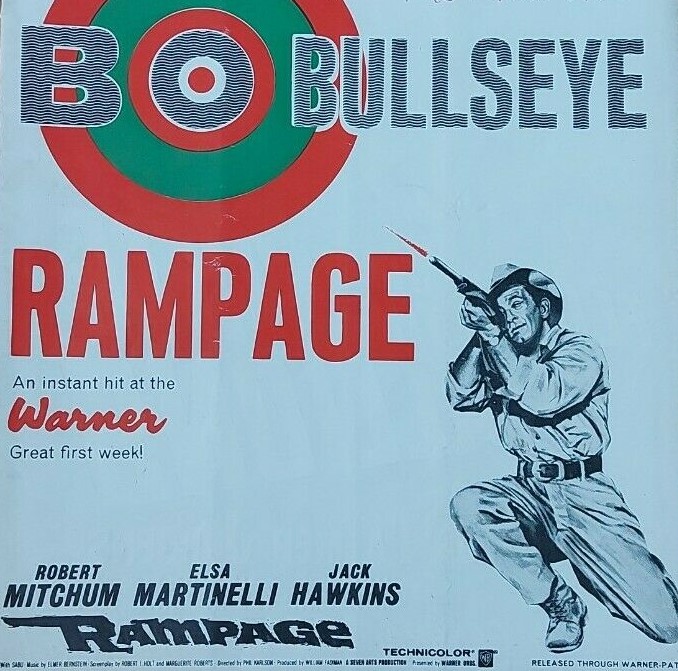
Trapper Harry (Robert Mitchum) and hunter Otto (Jack Hawkins) team up to capture for a German zoo two tigers and a legendary panther-like creature known as “The Enchantress.” From the outset, sexual tension sizzles between Harry and Otto’s young partner Anna (Elsa Martinelli). Although Otto is possessive, he permits Anna to take male companions on the assumption that she will always return to him.

Anna’s not quite as submissive as Otto would like to believe and she puts Harry in his place more than once. There’s a 35-year age difference between Otto and Anna. But Harry is disturbed at how they became lovers, persistently asking how soon, after the older man saved the orphaned girl from poverty, he seduced her.

The love triangle is set against a more primitive background where women have no rights and are as likely to be offered up to any passing male. Native guide Talib (Sabu) feels duty-bound to pass his wife onto to Harry. The wife not only acquiesces, but is insulted when the American refuses.

The men represent different cultures, Otto a marksman who prefers to bring his trophies back dead, hanging his virility on every scalp, Harry more emancipated for whom capture is enough. There’s a stand-off with a local tribe when Otto is too hasty with his rifle.
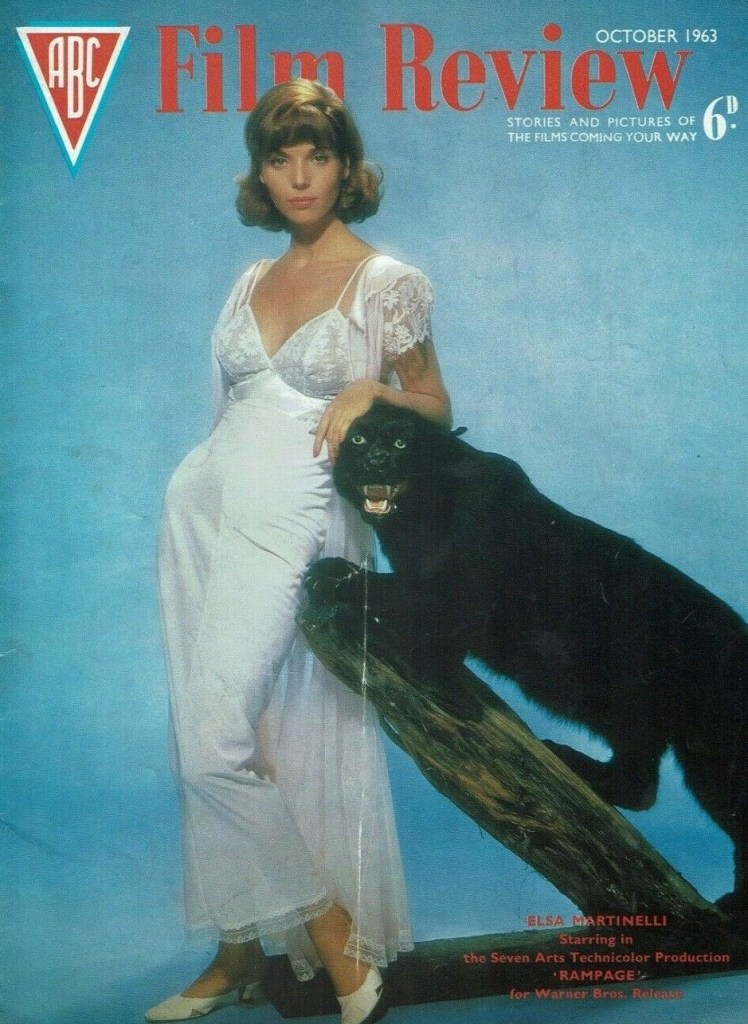
Martinelli does better here in terms of panther, the creature in the film was
more of a leopard with some red marks.

Given the lack of budget and the consequent lack of action, it’s no surprise that the drama revolves around whether Anna will betray her lover. Despite his apparent laid-back approach, Otto watches Anna with an obsessive eye, her potential loss deemed a blow not just to his esteem but a sign of approaching death.

What sets this aside from the submissive female trope is that the decision rests with Anna. Harry certainly doesn’t push his luck and until his pride is dented Otto allows the situation to play out. The shift in Anna’s feelings is discreetly rather than dramatically handled. The traditional bathing scene is used to reveal that Anna is not actually married and therefore neither committing adultery nor under legal obligation.

When we finally get down to some action, the build-up is interesting, Harry using beaters to nudge tigers towards his traps, but, unfortunately the majority of these animals are a disgrace to their wild forefathers, on the whole appearing pretty obliging if not outright dumb. There’s one charging rhino and, heaven forfend, Otto commits the cardinal son of requiring two bullets to finish it off.

The movie picks up when they encounter “The Enchantress,” by a long way the smartest beast in this particular animal kingdom, who enhances her mythical status by hiding in a cave, clash of personalities between the alpha males triggering the movie’s final, more dynamic, phase, Anna coming into her own not just as a crack shot but as an independent woman, Otto making Harry his prey.

More interesting as an examination of contemporary mores, not quite as sexist as initially it appears, and nudging in the direction of a woman attempting to attain independence, and in discussing the issues surrounding conservation. Just as bold is the questioning of Otto’s motivation is saving Anna from poverty, an act of kindness or grooming? You might wonder how much better off Anna would be with a man two decades older rather than one three decades older, but nobody goes there.

The acting is uniformly under-played. Elsa Martinelli is given a better showcase for her talents here than in Hatari! and this is Robert Mitchum (Five Card Stud, 1968) at his laid-back best while Jack Hawkins (Masquerade, 1965) keeps his simmering under control until the end.

Without the budget to ape Hatari! director Phil Karlson (The Secret Ways, 1961) has no option but to focus on characters rather than animals, but finds interesting ways to put various messages across. Marguerite Roberts (Five Card Stud) and Robert I. Hope (White Commanche, 1968) based their screenplay on the novel by Alan Caillou a.k.a Alan Lyle-Smith.

Guns for San Sebastian (1968) ****

Pre-Stagecoach (1939) Hollywood used to differentiate between historical adventure pictures and westerns. Given it’s set in 1746, before there was such a thing as a revolver or repeater rifle, so a complete absence of gunslingers, this falls squarely into the former camp though its format displays western credentials. A tad top-heavy with religious allegory, “miracles,” peasant piety and an Ennio Morricone score mainlining on the celestial, nonetheless it manages to achieve a character-driven narrative and some powerful action sequences.  

However, it’s a lengthy set-up. Outlaw Leon (Anthony Quinn), on the run from Mexican troops, takes refuge in a church. As punishment for giving him sanctuary Fr Joseph (Sam Jaffe) is expelled to the abandoned church of San Sebastian in an equally abandoned village. Ringing the bell to attract parishioners only alerts bandits who kill him. Donning his garb, Leon is mistaken for a priest by Yaqui leader Teclo (Charles Bronson) and strung up crucifixion style. But he’s rescued by villagers who almost elevate him to sainthood courtesy of a couple of accidental “miracles.”

Enjoying his newfound status, but still attracted to peasant Kinita (Anjanette Comer), he directs the parishioners to build a dam to flood the fields to assist in corn-growing. Teclo objects to challenges to his authority and burns down the village. The villagers turn against Leon, and although initially intending to vanish, he decides instead to blackmail his mistress, the wife of the local governor (Fernard Gravey) who agrees to supply him with weapons. Leon builds a fortress to withstand the expected attack setting up a very engaging climax in which the dam plays a critical role.

A modern audience might expect a sturdier narrative rather than one that seems to shift at whim, not helped by Leon’s indecision. And it’s too slight a vehicle to carry the political points, the state of Mexico at the time, the settlers vs. original occupants (i.e. Native Indians) scenario, the problems facing half-breeds (Leon and Teclo both), but it’s better at exploring the power of the church, the worship bestowed on any priest who turns up, regardless of how ill-suited he appears.  The occasional comic sequence, banter with an architect, negotiation with a Mexican colonel, seems out of place.

On the other hand there is a truly mesmerizing performance from Anthony Quinn (Lost Command, 1966) as a womanizing low-life who happens upon redemption, so deep does his impersonation of a priest go that he can’t bring himself to touch the compliant Kinita, who is aware of his true identity. Switching between shiftiness and godliness at the drop of a hat and deriding villagers for their lack of character his turning point comes when he realizes he has fallen into the same trap. That he emerges as a wily man of conscience is no mean feat.

The other big bonus is to see someone at last recognize Charles Bronson (Once upon a Time in the West, 1969). Here he is given cinematic status, camera pitched up at his face, and allowed to eliminate the growl and monosyllabic delivery that has been his wont in lesser roles. He’s a rather decent villain at the end.

There are a couple of inconsistencies. Teclo wants villagers to take to the hills but on the other hand somehow to spend enough time tending the corn that come harvest time he can steal. And it’s a bit too neat how he falls into the dam trap.

All in all, enjoyable and very under-rated primarily, i suspect, because people come at it expecting a western rather than a historical film in the adventure vein. But it’s elevated by the intriguing narrative, the questionable hero, Quinn’s performance and the introduction to a new-look Bronson.

Frenchman Henri Verneuil (The Sicilian Clan, 1969) does well to probe so many issues for an audience probably expecting something more straightforward. James Webb (Alfred the Great, 1969) wrote the screenplay based on novel by a William Faherty, a Jesuit priest. In the book, the hero was a soldier who became a priest rather than an atheist opportunistic outlaw.

One Million Years B.C. (1966) ****

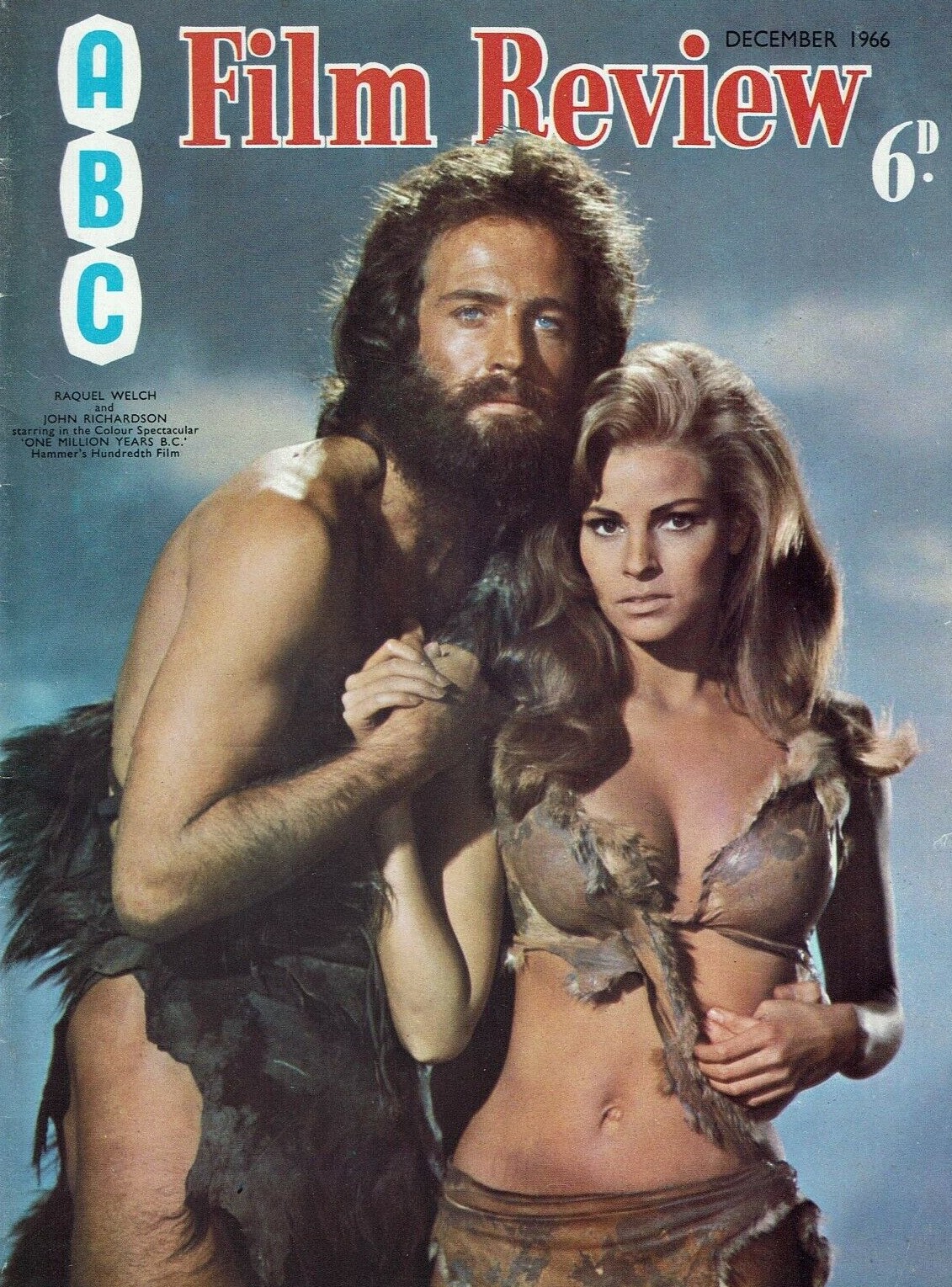
The three ages of man: child watches this film for the dinosaurs, teenager for Raquel Welch, mature male for the dinosaurs now he knows who Ray Harruhausen is.

Guilty pleasures multiplied. Add the Mario Nascimbene (The Vengeance of She, 1968) score to the delights of Raquel Welch in a fur bikini and Ray Harryhausen’s sensational stop-motion animation.  Generally dismissed as high-level hokum, it features an intriguing gender role reversal, and is virtually, not to be too academic about it, a throwback to silent cinema, minus the title cards that helped audiences a century ago work out what was going on. Everything relies on facial expression and gesticulation.

Luckily, there’s not too much in the way of narrative complication. Tumak (John Richardson), the son of the chief of the Rock Tribe, is chucked out into the wilderness for standing up to his father. He probably wouldn’t be crying too much about that, given the strong rule over the weak, old men are left behind to die, and the feeble are last in line for food.  Plus, his brother Sakana (Percy Herbert) is prone to stabbing people in the back.

Unusually, the picture went straight out into U.S. wide release (saturation). It was an 80-theater break. Twentieth Centry Fox mounted a huge advertising campaign based on the fur bikini image, but by this point she wasn’t an unknown star, already seen in “Fantastic Voyage.” The New York Times might be wincing now at its “monument to womankind” now.

Reaching a distant shore, Tumak is rescued by Loana (Raquel Welch) of the Shell Tribe who takes an instant fancy to him, helping protect him from a huge marauding creature. But his aggressive temperament doesn’t sit too well among this peace-loving democratic group either, despite him saving some kids from another marauding creature. But when he’s chucked out this time, Loana goes with him.

But you know that any journey pretty much takes them into the heart of dinosaur heaven, and Tumak makes the mistake of retuning to his own tribe, where Loana is made unwelcome by Nupondi (Martine Beswick), Tumak’s previous squeeze. It’s power politics all over again until marauding creatures and a convenient volcano intervene and matters can be settled.

All eyes are on Loana and her miraculous bikini until a dinosaur appears, which occurs at frequent intervals. Then you can’t take your eyes off Ray Harryhausen’s creativity, at first expecting the match between humans and his wizardry to be so obvious the illusion will be shattered, but once you realize that is not going to be the case you just sit back in wonder.

Spoof newspaper from the Pressbook.

Harryhausen has made dramatic improvements in his techniques since previous highpoint Jason and the Argonauts (1963). Cleverly, he builds anticipation by matte work to present scenes of live creatures. The first, the warthog, is of normal proportions, and its capture suggests man’s domination over beast. But that proves a false assumption. Anything later is just gigantic – iguana, turtle and tarantula. In normal circumstances only the giant spider might appear a threat but in the distant past it would appear any creature bigger than man looked upon humans as an easy meal.

And that’s before the allosaurus rampages into sight and a pteranodon swoops out of the sky snaring Loana and then has to battle a rhamphorhynchus over its prey, almost as if Harryhausen was determined to animate the most difficult creatures possible in order to prove his innate skill.

Sure, hostility is much easier to telegraph than other emotions and a fair bit of the picture is people getting cross with each other, but meet-cute between Loana and Tumak involves little as significant, glances and eye contact the core of communication. It’s pure cinema. Stripped of any meaningful dialog, the camera captures everything we need to know. It’s a brutal world, dog eat dog, man eat warthog, dinosaur eat woman, every living thing is a snack of one kind or another and when they’re not killing for food they’re battering each other out of power lust, rivalry or jealousy.

And although nobody could have guessed the impact Ms Welch would have on the male pulse, Hammer had previous in the department of introducing a stunning female into a tale, and it may be pure coincidence that both Loana and Ayesha in She (1965) were woman of power, rather than mere playthings of men. Ayesha is introduced in stunning fashion, her presence pre-empted, most of the picture prior to her appearance serving merely to build her up. Obviously, Ursula Andress did not disappoint but she was introduced in majestic fashion rather than catching fish at the seashore. Albeit Loana sported a bikini, so did all the other fisherwomen and director Don Chaffey resisted the temptation to present her in more statuesque fashion, regardless of the image presented on the poster.

Just as it’s hard to underestimate the iconic impact of Raquel Welch in a fur bikini, so, too, is the work of Harryhausen. And I would also add the innovative score of Nascimbene, with sounds Ennio Morricone would have been proud of.

Despite myth to the contrary, it’s rare for an unknown to emerge from a movie a real star, but Raquel Welch certainly did, though her image on a million posters might have had something to do with her sudden success.

As he did with Jason and the Argonauts, Don Chaffey keeps the story spinning along, makes the best of the lunar landscape and raw actors like Welch and John Richardson (She). Michael Carreras (The Lost Continent, 1968) based his screenplay on One Million B.C. (1940).

The problems of creating believable dinosaurs were so evident that nobody really tackled pre-history until Steven Spielberg waded in with Jurassic Park (1993). It’s a measure of how successful this effort is that the director eschews the cute kids that seemed endemic to the later genre and had his characters facing up to the monsters rather than running away like crazy or expecting that somehow man could control them.

Much more entertaining than I expected, high class special effects, strong narrative, and more than enough to wonder at.

Triple Bill Blues: Fall (2022) ***; The Forgiven (2021) **; Three Thousand Years of Longing (2022) ** – Seen at the Cinema

You may be aware that I am partial to a triple bill on my weekly Monday trip to the cinema. I’m rather an indiscriminate cinemagoer and generally just see what’s available, though it’s true return trips to view Top Gun: Maverick have helped paper over cracks in the current distribution malaise. Sometimes a triple bill can reveal unsung gems, sometimes I am rowing against the critical tide in my opinions and sometimes, not too often thank goodness, I end up seeing movies with few redeeming qualities. That was the circumstance this week.

FALL

So now I know. If I need to get a mobile phone dropped 2,000 feet without it breaking into pieces, the thing to do is stuff it inside a cadaver. That’s one of the more outlandish suggestions in this climbing picture two-hander that for most of the time is quite gripping.

So as not to have to spend the first anniversary of her husband’s death sozzled in booze and despair, Becky (Grace Caroline Currey) agrees to partner YouTube click-hound Hunter (Virginia Gardner) in scaling an extremely high disused radio mast. Becky, a mountaineer, had watched her husband fall to his death, so is pretty iffy about the expedition. When they reach the top they can’t get down again since the ladder they climbed has disintegrated. Although there was mobile phone reception at ground level, there’s none this high up. Hunter has 60,000 followers and reckons if only her phone reached the ground it would automatically activate so they toss it down in a shoe stuffed with a bra.

That doesn’t work nor does firing a flare pistol to alert two guys in a nearby RV – all they are alerted to is the girl’s vehicle which they promptly steal. The girls are trapped without water or drone, both stuck 50ft below on radio dishes. At one point you think this is going to go in an entirely different – murderous – direction after Becky discovers Hunter had an affair with her husband. But they manage to get over that hiccup. Recuing their water and drone results in Hunter being out of action as far as further climbing goes and it’s up to Becky to reach the top of the mast and recharge the drone from the power there, fending off a passing vulture.

There’s definitely one weird bit where it turns out that Hunter, who you imagined was up there all the time supporting a defeatist Becky, is already dead. But, luckily, the corpse provides the cavity in which to bury the mobile phone. I’m not sure much of a human body survives a drop of 2,000 ft, certainly not enough to safeguard a phone, but that’s the way this plays out.

A great mountaineering film is always a welcome find in my book. This isn’t great but it’s certainly passable. And while Becky is more interesting than the gung-ho Hunter, the pair, emotions almost spinning out of control, make a very watchable pair.

Grace Caroline Curry aka Grace Fulton (Shazam!, 2019) does well in her first starring role and Virginia Gardner (Monster Party, 2018) is as convincing. Jeffrey Dean Morgan (Rampage, 2018) has a small role. A novel take on the mountaineering sub-genre, it’s kudos to director Scott Mann (Heist, 2015) – who co-wrote the screenplay with Jonathan Frank (Final Score, 2018)  that I spent a lot of time wondering just how the hell they managed to make it look so realistic.

THE FORGIVEN

Note to studios, no matter how much you plan to tart up a modern version of Appointment in Samarra – aka a tale of unavoidable fate – you ain’t going to get anywhere if it’s filled with entitled obnoxious characters. The worst of it is this is well-made.

Functioning alcoholic doctor David Henninger (Ralph Fiennes) knocks down and kills young Muslim boy Driss (Omar Ghazaoui) while on the way with wife Jo (Jessica Chastain) to a hedonistic weekend party in Morocco hosted by Richard Galloway (Matt Smith) and his partner Dally (Caleb Landry Jones). There are hints that Driss was planning to hijack the tourists, but while his death is deemed an accident by the local cops, David agrees to go back with the boy’s father Ismael (Abdellah Taheri) and observe the local funeral rites and possibly pay the father off.

While her husband is away Jo has a one-night stand with serial seducer Tom (Christopher Abbott) while the rest of the party – including Lord Swanthorne (Alex Jennings) and assorted beautiful men and woman – trade bon mots and make racist and sexist remarks. While the arrogant David changes his perspective and accepts his fate, there is not, himself included, a single likeable person in the whole of the tourist contingent which makes it impossible to care what happens to anybody. Written and directed by John Michael McDonagh (Calvary, 2014) it spends all its time trying to make clever points, not realizing the audience has long lost interest.

THREE THOUSAND YEARS OF LONGING

Note to studios, if you’re going to indulge an action director in a vanity project, make sure he hires actors who don’t just drone on. It might also help if the director could decide what story he wants to tell, and not essentially present a voice-over narrative of stuff that happened in the past, no matter how exotic the timescale.

I was astonished to discover there actually is a job called narratologist. Alithea (Tilda Swinton) is a dried-up old stick of a narratologist who summons up the dullest genie/djinn in movie history known – no names, no pack drill – just as The Djinn  (Idris Elba) who proceeds to bore the audience to death with his stories of how he came to end up in a bottle.  

There’s a bundle of academic nonsense about storytelling, a swathe of tales that sound like rejects from The Arabian Nights, and a lot of unconnected characters. The invention of director George Miller (Mad Max: Fury Road, 2015) just isn’t inventive enough and the visuals just aren’t arresting enough. I’m assuming this got greenlit on the basis Miller would turn in a couple more in the Mad Max franchise.

Hellfighters (1969) ****

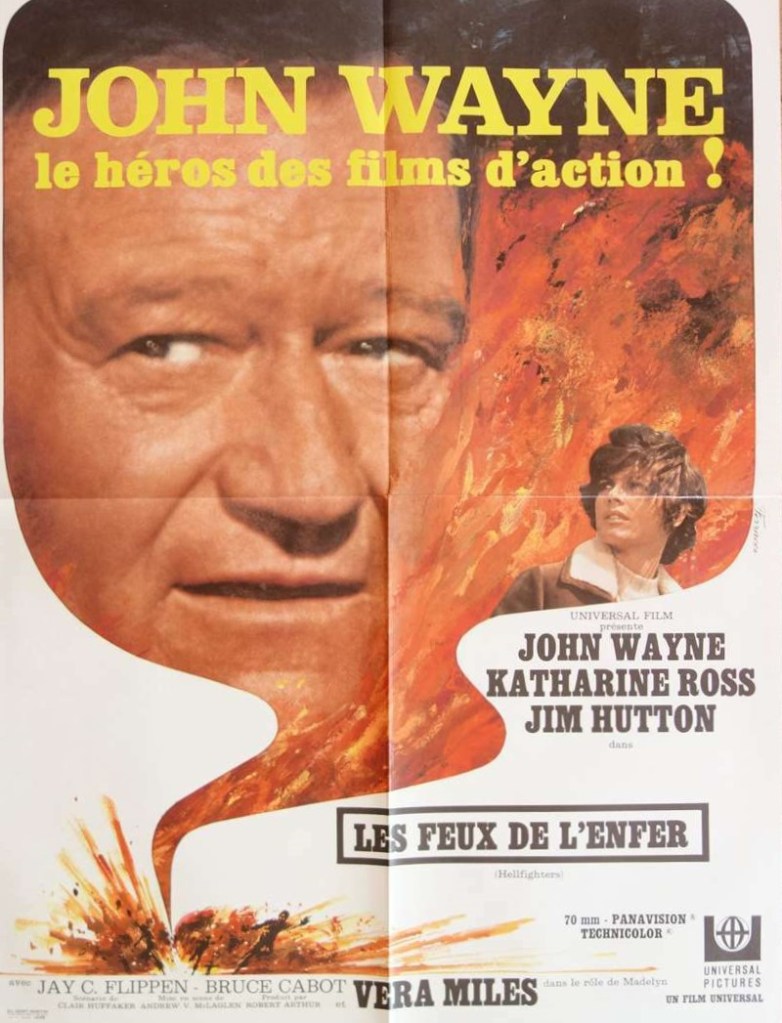
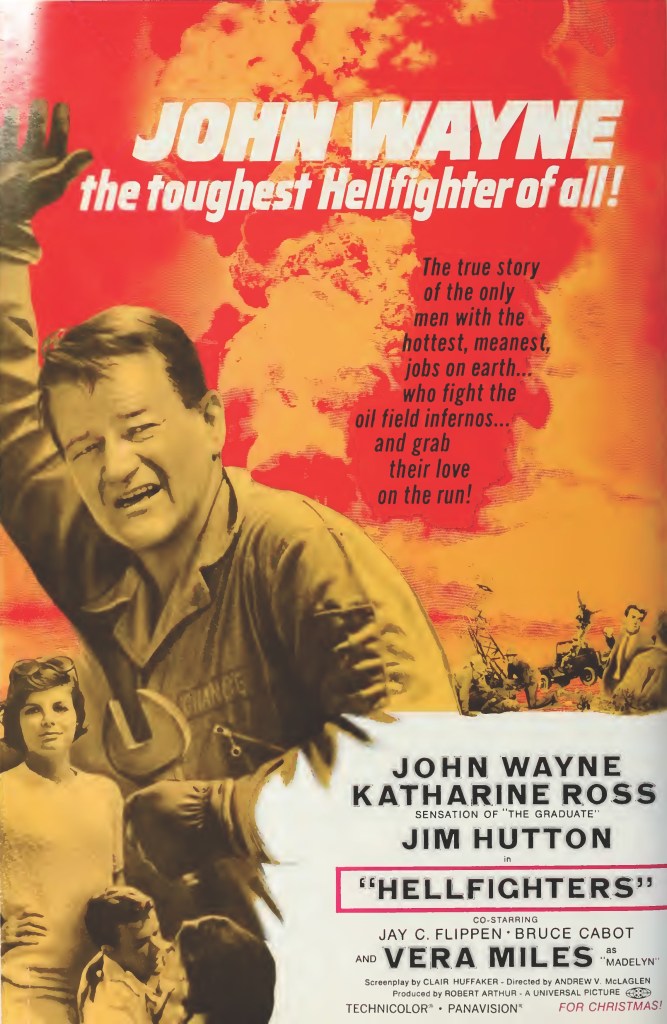
I’m sticking my neck out on this one – under-rated would be an understatement – and primarily because it’s the Duke’s most intriguing film of the decade and possibly ever. For a start we have John Wayne The Quitter (the hell you say!). Then he ducks out of the picture for a full quarter of an hour (he does what?). Fast forward a couple of years and this would have led the disaster cycle pack – a little tinkering with the structure and you would have all four principals fighting fires in South America in the middle of a revolution (beat that, The Towering Inferno.) But most enthralling of all this is a family drama masquerading as an action picture.

And it led me to thinking if True Grit (1969) had not landed on Wayne’s doorstep whether he would have continued down the dramatic rather than the action road for the tail end of his career. He had just collected his first million-dollar fee so in box office terms he was untouchable. And just for the record, the action scenes, especially given the absence of CGI, are terrific. Sure, the oil’s a little bit too thin to pass for real oil, but it does gets sloshed over all concerned, including the Duke, by the bucketload.

And it might be a shade on the episodic side, Chance Buckman (John Wayne) and compadres racing from one hellish event to another, but it’s wrapped around a tight dramatic core, Chance vs independent daughter Tish (Katharine Ross), Chance vs one-time sidekick and now Tish’s husband Greg (Jim Hutton), Chance vs. Tish’s mother Madelyn (Vera Miles) and Chance vs. all the dimwits on the board of the company he quit his own operation to join.

Chance is based on the real-life Red Adair, an oilman who had invented the extremely scientific but extremely dangerous method of putting out oil-well fires. When a gazillion gallons of oil spurting unchecked out of the ground catch fire you’ve got a helluva problem on your hands. A gazillion gallons of water ain’t going to cut it. The only solution is to cut off the oxygen supply long enough to cap the well. Red Adair’s technique: blast the oxygen out of the way. He’d attach drums filled with massive amounts of nitro-glycerine, roll them into the blaze on the end of cranes, hide behind nothing more resilient than hazard suits and shields made of corrugated iron, and detonate them. The resulting explosion did the trick.

The picture opens with this stunt, although after being accidentally injured, Chance is hospitalized, bringing estranged daughter and ex-wife into the dramatic frame. After a pretty frosty meet-cute,  Tish and Greg hit it off and get married, forcing Tish to confront the fear that drove Chance and Madelyn apart, that, like the wife of a Formula One driver, she never knows if her husband will come back. This bothers the feisty Tish a lot less than the weary Madelyn. And she even ignores all protocol and rushes to her husband’s side, regardless of the danger.

Meanwhile, Chance decides not only has he had enough of dicing with danger but he can leave his company in the safe hands of Greg. His life now on a more mundane keel, Madelyn is attracted back. But of course it wouldn’t do for Chance to live out retirement with nothing more testy than board meetings so he comes back into the fray during a rebellion in Venezula and both women have to confront their true feelings.

The action, considering the lack of CGI, or the kind of budget available to The Towering Inferno, is first-class. This is the ideal movie reversal. Instead of running away from a fire, these characters race towards it. There are some hair-raising moments. At one blowout, gas is leaking from the ground, poisoning everyone in sight, Greg is trapped underwater. And should complacency sneak in, fire, being on the unpredictable side, is prone to sudden explosion.

John Wayne (The Undefeated, 1969) has always excelled at restrained emotion and here he gets both barrels. Having got rid of the over-protective wife he’s now saddled with a daughter he’s desperate to protect from the hell he put his wife through. He’s faultless here, given considerably more acting scope than normal and not, as in McLintock (1963), just able to tan a woman’s backside, presenting a more contemporary male, perhaps as puzzled by female behavior as any of his cowboys, but taking a more modern approach to resolving his feelings.

Katharine Ross (Tell Them Willie Boy Is Here, 1969) has her best role, not a mere appendage as in her other films of this period, but driving forward the action through her independence. Jim Hutton (Walk, Don’t Run, 1966) is growing on me. I’ve reversed my view of him as a lightweight. Vera Miles (The Man Who Shot Liberty Valance, 1962) does a pretty good job of playing older – she was not yet 40 – and essays a complicated character, more rounded than was often the case with the female lead in Wayne pictures. Veterans Jay C. Flippen (Firecreek, 1968) and Bruce Cabot (The Undefeated) head the support.

The perennially underrated Andrew V McLaglen (The Undefeated) does a pretty good job with the action, as you might expect, but is also savvy enough to let the dramatic scenes flow. Clair Huffaker (Rio Conchos, 1964) penned the screenplay.

Guilty pleasure personified, you might say, but I’d retort that this is a damn fine picture erroneously ignored – rating only two paragraphs in Scott Eyman’s  650-page biography of John Wayne for example – possibly because it appeared in between the critically-reviled The Green Berets (1968) and the critically-acclaimed True Grit.

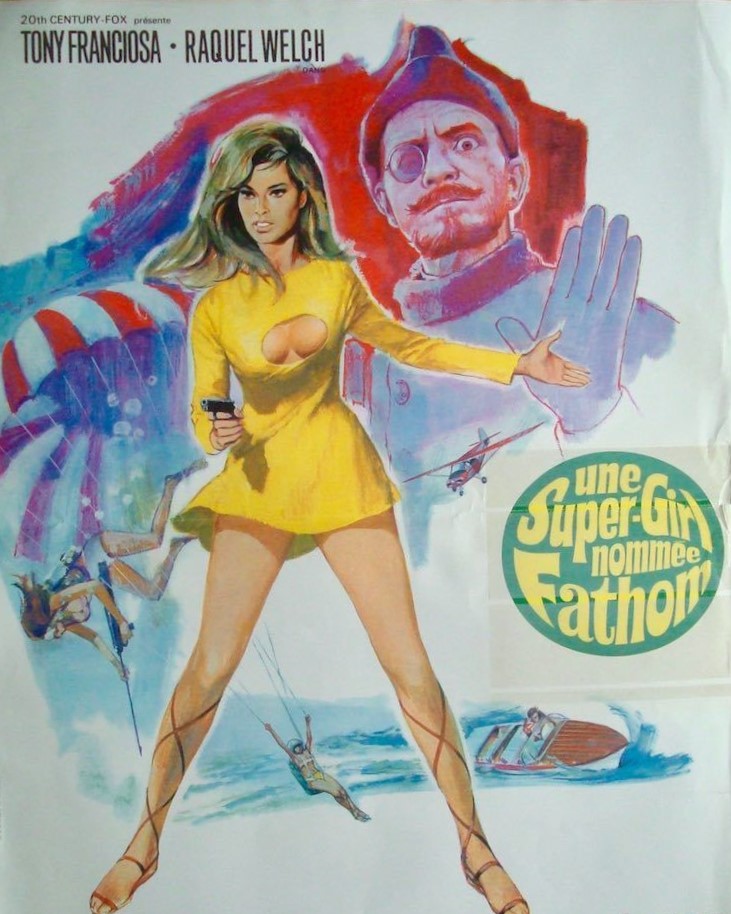
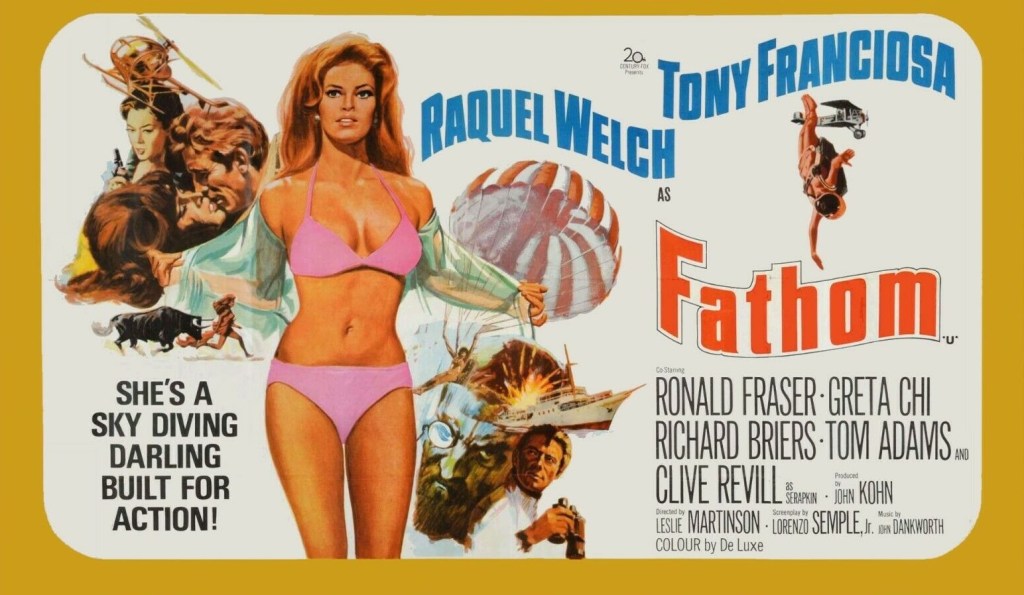
Fathom (1967) ***

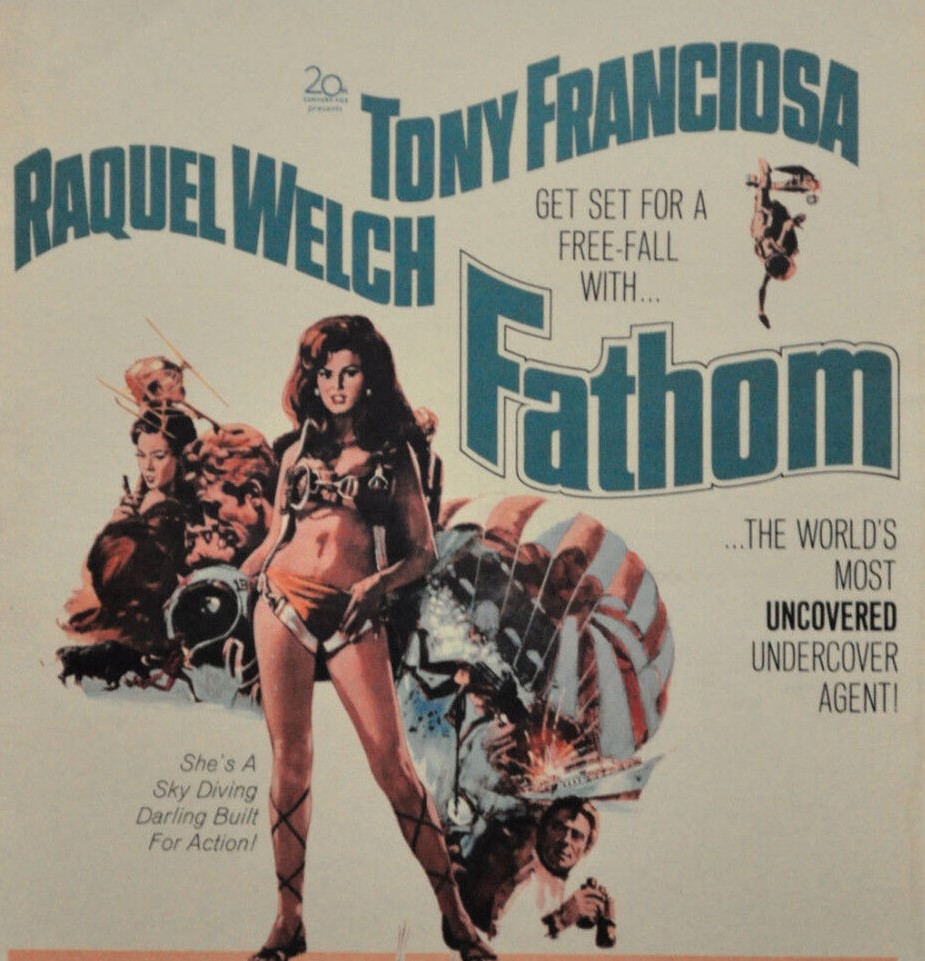
If audiences rallied to the sight of Raquel Welch wearing nothing more than a fur bikini for the entirety of One Million Years B.C. (1966) and a skin-tight suit in Fantastic Voyage (1966)  Twentieth Century Fox must have reasoned they would surely return in droves were the star to spend most of Fathom in a succession of brightly-colored bikinis.

Given such a premise who would care that a sky-diving expert was named after a nautical measurement? Or that Fathom (Raquel Welch) came nowhere near the height indicated by her name? Or that  the character as described in the source material (a novel by Scottish screenwriter Larry Forester) had a distinctly harder edge; murder, sex and drugs among her proclivities.

With Our Man Flint (1966), the studio had successfully gatecrashed the burgeoning spy genre and spotted a gap in the market for a female of the species, hoping to turn Modesty Blaise (1966) starring Monica Vitti and Fathom into money-spinning series. The Fathom project was handed to Batman, The Movie (1966) co-conspirators, director Leslie H. Martinson and screenwriter Lorenzo Semple Jr. (Flash Gordon, 1980).

Female independence was hard-won in the 1960s and there were few jobs where a woman was automatically at the top of the tree. Burglary was one option for the independent entrepreneur (see The Golden Claws of the Cat Girl) and sport was another.

Welch plays an innocent bystander recruited for her top-notch sky-diving skills (her aptitude demonstrated in the opening sequences) to help Colonel Campbell (Ronald Fraser) of British intelligence recover the “Fire Dragon,” a trigger that could explode a nuclear bomb. Her sky-diving skills are required to land in the courtyard of playboy Peter Merriwether (Anthony Franciosa).

That turns out to be baloney, of course, a MacGuffin to point her in the direction of a valuable Chinese heirloom. And then it’s case of double-cross, triple-cross and whatever cross comes next.   

There’s an intriguing mystery at the heart of this picture and a couple of top-class hair-raising moments. In one she is trapped in a bull ring and stunt double Donna Garrett had a few very definite close calls trying to avoid the maddened beast. In another she is stalked at sea by a circling motor boat while being peppered with harpoons. There is also an airplane duel and a ton of great aerial work. A couple of comic sequences are well wrung – Campbell pins his business card to one of the prongs of a pitchfork being brandished with menace by Fathom  while Peter delivers a classic line: “The only game I ever lost was spin the bottle and that was on purpose.”

You could probably determine something about national character from the color of costume different countries chose to show Raquel Welch in.

The biggest problem is that the film veers too far away from the source material which posited the heroine as a much tougher character, one who can despatch bad guys with aplomb. Instead, Fathom is presented almost as an innocent, bundled from one situation to another, never taking charge until the very end. Minus karate kicks or a decent left hook, she is left to evade her predators by less dramatic means. She has a decent line in repartee and by no means lets the show down. However, the idea, no matter how satisfactory to fans of the actress, that Fathom has to swap bikinis every few minutes or failing that don some other curve-clinging item, gets in the way of the story – and her character. Into the eccentric mix also come a millionaire (Clive Revill) and a bartender (Tom Adams).

There’s no doubt Welch had single-handedly revived the relatively harmless pin-up business (not for her overt nudity of the Playboy/Penthouse variety) and had a massive following in Europe where she often plied her trade (the Italian-made Shoot Loud, Louder…I Don’t Understand in 1966 and the British Bedazzled in 1967) but she was clearly desperate for more meaty roles. Those finally came her way with Bandolero (1968) and 100 Rifles (1969) and Fathom feels like a lost opportunity to provide her with that harder edge. 

She’s not helped by the odd tone. As I mentioned she gets into plenty of scrapes and proves her mettle with her diving skills. In the hands of a better director and with a few tweaks here and there it could have been a whole lot better and perhaps launched a spy series instead of languishing at the foot of the studio’s box office charts for that year.  

Anthony Franciosa (Rio Conchos, 1964) , still a rising star after a decade in the business, who receives top billing, doesn’t appear for the first twenty minutes. And then he behaves like a walking advert for dentistry, as though his teeth can challenge Welch’s curves. And some of the supporting cast look like they’ve signed up for a completely different movie. Richard Briers (A Home of Your Own, 1965) – Ronald Fraser’s intelligence sidekick – looks like a goggle-eyed fan next to Ms Welch while Clive Revill (The Double Man, 1967) thinks it’s a joke to play a Russian as a joke. Ronald Fraser (Sebastian, 1968) provides decent support.

But it is certainly entertaining enough and you are unlikely to get bored.

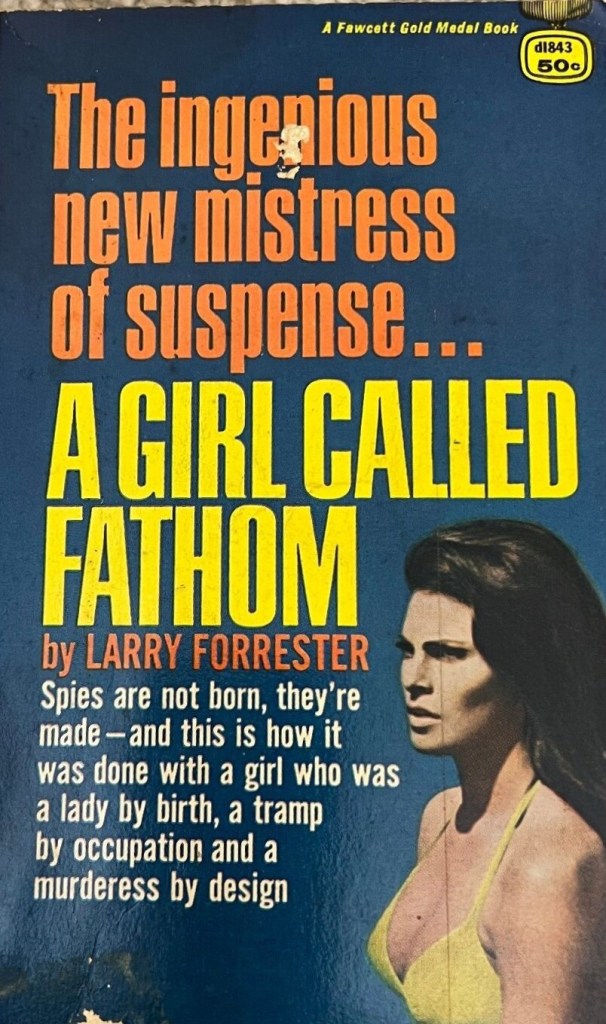
Book into Film: A Girl Called Fathom by Larry Forrester (1967)

The blurb gives the game away. The British paperback published by Pan went: “She was blonde. She was beautiful, she was six foot tall. She’d killed the man who had dragged her to the lowest depths of addiction and lust.” The American Fawcett Gold Medal paperback was more succinct: “lady by birth, tramp by occupation and murderess by design.”

If any of that rings a bell, it was not from the film Fathom (1967) starring Raquel Welch which chose to ignore her background and her venomous skillset. The novel opens with the heroine killing a man in cold blood. He had promised her a film career but turned her into a call girl and heroin addict. Her father, now dead, was in the British secret service.  Once she has committed her first murder, she is immediately kidnapped by a secret organization (C.E.L.T.S. – Counter Espionage Long-Term Security) and trained to become an even more ruthless government-sanctioned killing machine.

Larry Forrester was a Scottish television scriptwriter who had worked on a stack of British series such as Whirligig (1953), Ivanhoe (1958) and No Hiding Place (1960-1964) before publishing his first novel A Girl Called Fathom. His sole screenplay was Tora! Tora! Tora! (1970) after which he concentrated on U.S. television including episodes of Fantasy Island (1980-1983) and Hart to Hart (1983-1984).   

A Girl Called Fathom is split into two. Comprising roughly two-fifths of the book, the first section concentrates on her brutal training and on getting her off drugs. There’s a fair amount of sexual intrigue not to mention sex. But also a lover’s betrayal.  For the final part of her training she is abandoned in the middle of nowhere in scorching heat and barely makes it home. “She had passed over a great divide. She was empty, hard – dehumanized. Alone. She would always be alone.” And then she is forced to kill again.

As was common with this kind of book in the 1960s, it was fast-moving and globe-trotting with plenty of realistic detail to offset the preposterous plot. For the remainder of the book, which shifts location to Europe, Fathom is up against an organization called W.A.R. (World of Asian Revolution) which aims to destabilize the existing world order. Her arch enemy is an American-born Soviet agent (and whip and knife expert) Jo Soon (who turns up in the film Fathom in slightly different form as Jo-May). Fathom’s team must protect French elder statesman Paul-Auguste Valmier whose playboy son Damon (who fantasizes about burning people alive), a friend from her past, is her main contact.

The book is peopled by interesting and occasionally outrageous characters – for example Tin (shades of Iron Man), who has hardly a human bone left in his body; the far-from-harmless Aunt Elspeth; and a sadistic colleague who loves her but dare not let his emotions out lest he loose on her his love of pain. The central plot is driven by a mass of twists and turns, heroine endangerment, fights with knife and gun and fist, traitors (naturally) and the clever idea of killing off the leaders of the free world with a bomb hidden in the coffin of a man worthy of a state funeral being held in Paris.

At the end she is counting the human cost of victory and sees herself as one of the walking wounded, a reject, driven from the herd. The film was apparently based on an unpublished sequel so it’s conceivable that the plot concerning the Chinese heirloom was pulled from that in its entirety. But even so the film’s heroine was neutered, not a patch on the ruthless killer with a sordid past outlined in A Girl Called Fathom.

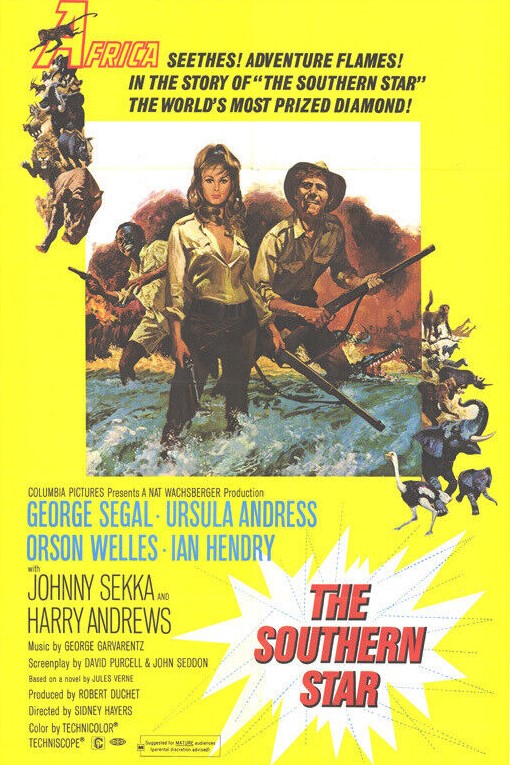
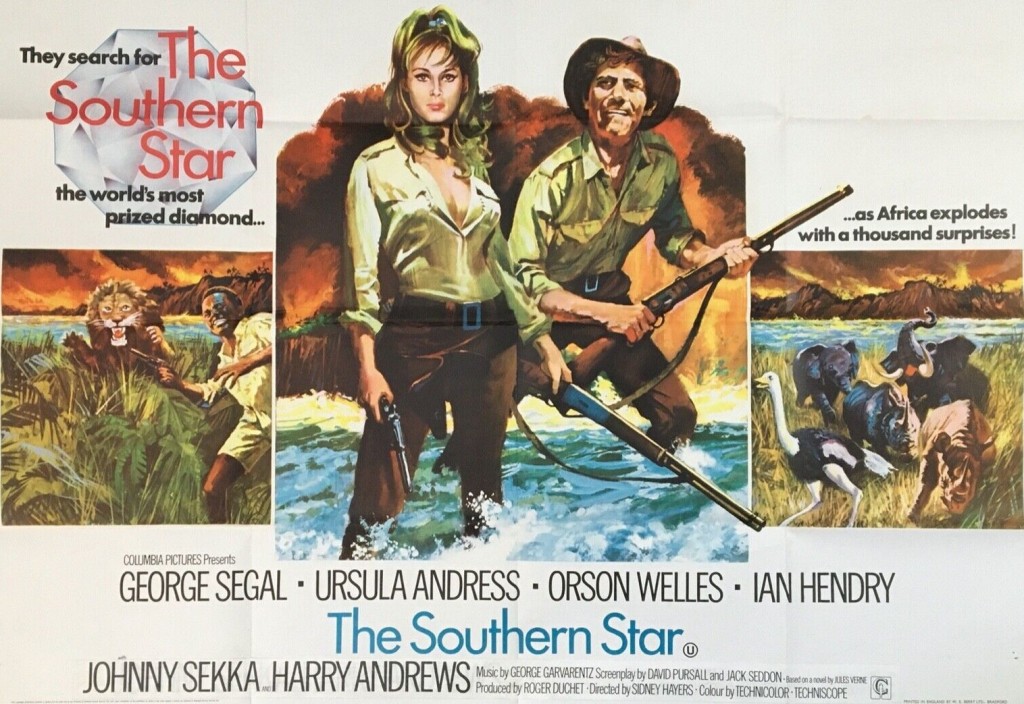
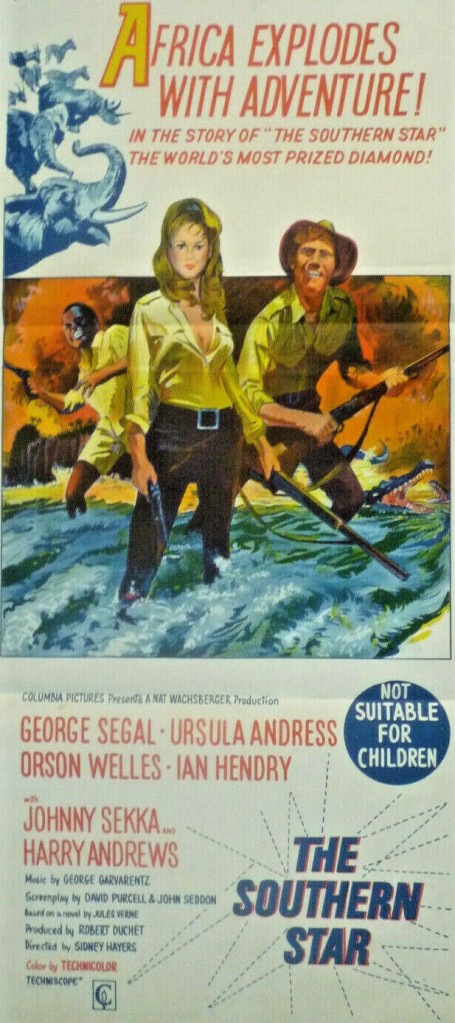
The Southern Star (1969) ***

There’s a surprisingly good movie here once you strip out the cliché jungle stuff and the racist elements. The diamond of the title is actually a MacGuffin, just enough to get you started on two parallel tales of revenge.

Dan (George Segal) is a mining engineer-cum-adventurer and Erica (Ursula Andress), daughter of mine owner Kramer (Harry Andrews), as far from the traditional jungle heroine (except in one regard) as you could get. She saves him from crocodiles, rescues him from jail and quicksand, swims across a hippo-infested river and is a better shot than him (or anybody for that matter) with a rifle. This is female empowerment with a vengeance.

Suspected of stealing the diamond, he is hunted by ranger Karl (Ian Hendry), Dan’s love rival, who intends to win Erica back using the simple expedient of killing the thief. Lying in wait is all-purpose rogue Plankett (Orson Welles) who seeks revenge on Karl. The second unit had a whale of a time filming anything that moved –  lions, leopards, zebras, giraffes, buffaloes, monkeys, antelopes, the aforementioned hippos and crocodiles and what looked like a cobra – and at one point everything does move in coordinated fashion if you can call a stampede coordinated.

But the main focus is an Erica who constantly confounds Dan’s sexist expectations. Docility is her disguise. Anytime she appears to be doing what she’s told you can be sure she’s planning the opposite. While Dan does have his own specific set of jungle skills, he often looks a fool. But they do make a good screen partnership and their dialogue is lively.

Hollywood spent millions of dollars trying to create screen chemistry between various stars and although it seemed to work very well in the industry’s golden age with Clark Gable and any number of MGM female stars, Bogart/Bacall and Tracy/Hepburn and I guess you could chuck John Wayne-Maureen O’Hara into that particular mix, the formula seemed to have gone awry by the 1960s discounting the Doris Day/Rock Hudson combo, big budget romances like El Cid (1961) and Doctor Zhivago (1965) and an occasional home run with whomever Cary Grant was romancing on screen. So it was usually hit-or-miss whether any sparks flew between the stars.

Andress had certainly been a European femme fatale par excellence as seen in Dr No (1962) and The Blue Max (1966), but it was certainly not a given that she would more than hold her own for an entire picture. Segal was nobody’s idea of a romantic leading man although the notion had been given a tryout in The Girl Who Couldn’t Say No (1968) with Virna Lisi. But here the whole enterprise works in an It Happened One Night vein with the supposedly superior male recognizing that perhaps his companion was more than a match.

Harry Andrews and Orson Welles both try to steal the picture, with polar opposite characterizations, Andrews loud and menacing, Welles soft and menacing. You can tell Scottish director Sidney Hayers (The Trap, 1966) was an editor because he cuts for impact and mostly does an efficient job of sticking to the story. Supposedly, Orson Welles directed his own scenes, but that might be to make sure he got to hog the camera. He has enough choice lines and bits of business to keep him happy and gives his venomous character a camp edge. Matakit (Johnny Sekka), Dan’s buddy, who actually has the diamond, is separately pursued and subjected to racism and being whipped.

Despite my reservations, this is well constructed and keeps one step ahead of audience expectation with plenty twists to subvert those, although the music by Johnny Dankworth gets in the way, offering musical cues opposite to what is required.

As it is a jungle picture there is the obligatory heroine’s bathing scene – and to balance the books on that score Segal does whip off his shirt at one point. Except for the clichés and the racism, it would have gone higher in my estimation for by and large it is well done and Andress is once again (see The Blue Max) a revelation.   

Lord Jim (1965) ***

What if redemption isn’t enough? When shame is buried so deep inside the psyche it can trigger no release? That’s the central theme of Richard Brooks’ adaptation of Joseph Conrad’s classic novel.

The title character’s shame comes from, as a young officer, abandoning a ship he believed was sinking only to later discover it had been rescued with a cargo of pilgrims who point the finger of blame. He is branded a coward and kicked out of the East India Trading Company, plying his trade among the debris of humanity.

You might think he later redeemed himself by foiling a terrorist plot at great risk to his own life. But that cannot erase his shame. Nor can helping revolutionaries overthrow a despotic warlord (Eli Wallach), enduring torture and again at great risk. What other sacrifice must he make to rid himself of the millstone round his neck?

Writer-director Brooks had a solid pedigree in the adaptation stakes – The Brothers Karamazov (1958), Cat on a Hot Tin Roof (1958), Elmer Gantry (1960) and The Sweet Bird of Youth (1962) – but sometimes you felt the writer got in the way of the director. That’s the case here. There was enough here to satisfy the original intended roadshow customers, great location work, grand sets, length, a big star in Peter O’Toole, but there is no majestic camerawork. There are good scenes but no great sweep and the result is a slightly ponderous film relieved by stunning action, some moments of high tension, the occasional twist to confound the audience and ingenious ways to mount a battle.

Hired killer Gentleman Brown (James Mason) has many of the best lines – “heroism is a form of mental disease induced by vanity” and “the self-righteous stench of a converted sinner” – all in reference to Jim. Everybody has great lines except Lord Jim, as introverted as  Lawrence of Arabia, face torn up by self-torture, fear of repeating his original sin of cowardice and convinced he will be cast out again should people discover he had abandoned hundreds of pilgrims.

Apart from the storm at the outset, the central section in the beleaguered village is the best part as Jim finds sanctuary, love and purpose, and conjures up the possibility of burying the past.

Part of the problem of the film is the director’s need to remain faithful to the source work which has an odd construction and you will be surprised at the parts played by the big-name supporting cast of James Mason, Jack Hawkins and Curt Jurgens. Many of the films made in the 1960s were concerned with honor of one kind or another and, despite my reservations about the film as a whole, as a study of guilt this is probably the best in that category, in that this character’s conscience refuses to allow him an easy way out.  

Peter O’Toole (Lawrence of Arabia, 1962) is chock-full of anguish but finds it difficult to create a character of similar heroic dimensions to the David Lean picture. James Mason (Age of Consent, 1969) is surprisingly good in an unusual role. Eli Wallach (The Magnificent Seven, 1960) as The General plays a variation of a character he has essayed before.  

This may have been a step up the Hollywood ladder but it was backward move in acting terms given Daliah Lavi’s performance in The Demon (1963) – reviewed here some time ago. Her talent is somewhat wasted in an underwritten part. Also in the supporting cast: Curd Jurgens (Psyche ’59, 1964), Akim Tamiroff (The Liquidator, 1965), Andrew Keir (Quatermass and the Pit, 1967) and Jack MacGowran (Age of Consent).  

Director Richard Brooks was also on screenwriting duties.

The Lost World (1960) ***

A pair of pink knee-length boots, courtesy of adventuress Jennifer (Jill St John), are among the wondrous sights awaiting our band of intrepid explorers. She’s not the only curiosity, Professor Challenger (Claude Rains) is certainly the most obstreperous of archaeologists, aristocrat Hoxton (Michael Rennie) must have a screw loose to keep on resisting the charms of Jennifer, while Gomez (Fernando Lamas) brings along his guitar to (literally) strike a chord at appropriate moments. But it’s a fun ride – cannibals, volcano, giant phosphorescent spiders, carnivorous plants, and dinosaurs.

There are secrets, too. Hoxton has been here – a lost plateau in the middle of the Amazon – before and abandoned an earlier exploration in favour of hunting for the mythical diamonds of El Dorado, Gomez wants to kill Hoxton, Jennifer plans to hook a duke, and Professor Summerlee (Richard Haydn) wants more than anything else to prove Challenger wrong.

A bit of poetic licence here by the illustrator, Jill St John’s pants staying intact throughout.

And of course, in the way of dinosaur pictures, having battled to find the damned creatures, intrepidity goes out the window and the explorers spend all their time running away from the dinosaurs, seeking a hidden way down from the plateau, while being hunted by cannibals. Any time you see a ledge you know there’s something terrible above – battling monsters with long tails capable of swishing you downwards – or below, not just a sea of lava but a giant sea beast. The only element that’s missing is the booby-traps. Unfortunately, all the spunk goes out of the otherwise spunky Jennifer when faced with monsters and she turns into the quivering screaming cliché.

But the script is on point, feelings indicated by action rather than dialogue. Having learned of Hoxton’s past, Jennifer spurns him by refusing a cigarette and a moment later taking one of her own, Gomez sneaks glances at a mysterious locket. With so much action there’s little time for romance so mainly by looks and the occasional rescue sparks fly between Jennifer and newspaperman Ed (David Hedison) and between Jennifer’s brother David (Ray Stricklyn) and the native girl (Vitina Marcus). And to alleviate the drab scenery there’s always Jennifer in a new bright outfit and, for comic effect, her poodle.

Given that writer-producer-director Irwin Allen (Voyage to the Bottom of the Sea, 1961) was unable to hire the likes of Ray Harryhausen (Jason and the Argonauts, 1963) for the special effects or even find the budget to utilize the drawings of Willis O’Brien (King Kong, 1933) who had been responsible for the stop-motion techniques in the original silent version of The Lost World (1925), the monsters come across on the small screen as acceptable enough. The infusion of sub-plots keeps the project ticking along.

Allen made significant changes to the original – introducing the diamonds, making Challenger rather than following in the footsteps of a previous explorer having previously visited the plateau but lost his proof, swapping the heroine’s pet monkey for a pet poodle, turning the heroine into a gold-digger, substituting as plateau inhabitants natives for ape men, and adding the heroine’s wardrobe. The spicing up of the story helps divert the tale in certain places from the dinosaurs, so the tension is not just waiting for the next attack.

Oddly enough, the film strikes a very contemporary note with regards to the current contentious issue of invasion of privacy. Challenger hits out at pestering journalists for what he views as the invasion of his privacy. Later on he says, “invasion of privacy gives man the right to kill,” but that bold statement relates to the explorers breaching the lost sanctuary, “we are the invaders.”  

It’s still pretty enjoyable stuff especially allowing for the budget limitations. None of the actors is called upon to do much, which is what you would expect, although Claude Rains is a surprise and Jill St John a delight. Michael Rennie  (Hotel, 1967), primarily there for his stiff-upper-lip, is provided with a neat reversal, the supposed hero with feet of clay. Claude Rains (Casablanca, 1942) is the standout as the feisty bombastic professor not above battering annoying newspapermen with his umbrella.

In an early role, Jill St John (The Liquidator, 1965) provides not just sultry evidence of her physical charms, but carries a terrific almost playful screen presence, though she’s better as the tough gal in a man’s world of the earlier section of the movie than the damsel in distress of the last part. Former Latin movie heartthrob Fernando Lamas (100 Rifles, 1969) is the only other one with a decent part, participating in the expedition to find his lost brother. Vitina Marcus (Taras Bulba, 1963) has a small but pivotal role. David Hedison (Live and Let Die, 1973) and Ray Stricklyn (Track of Thunder, 1967) are outshone by their respective amours. Jay Costa (Escape from Zahrain, 1962) is a pantomime villain.

Charles Bennett (City in the Sea, 1965) helped Irwin Allen flesh out the screenplay.

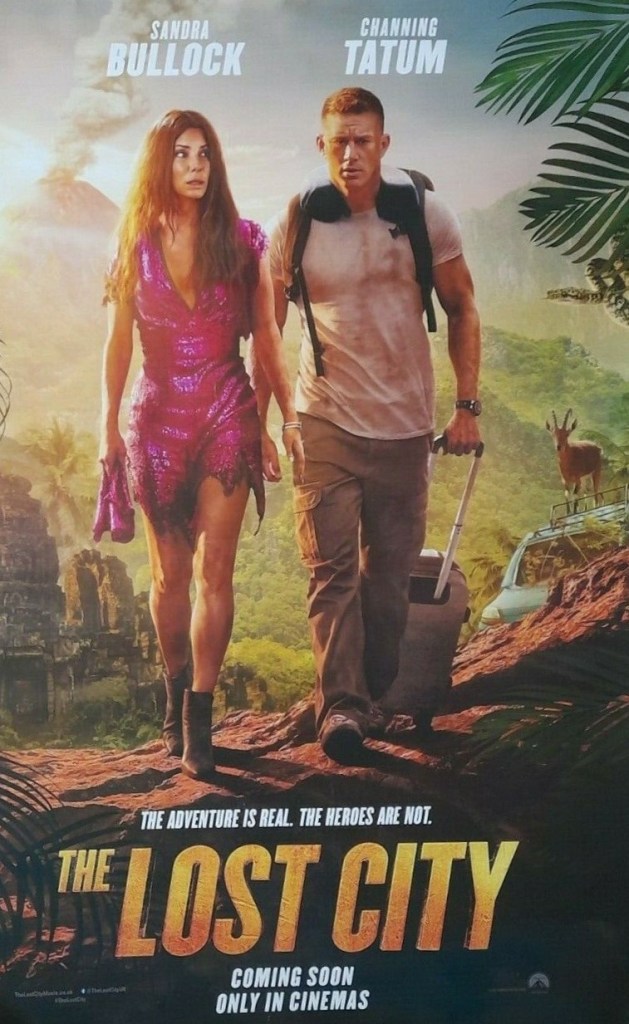
The Lost City (2022) *** – Seen at the Cinema

I was wondering when Brad Pitt would show up. Judging from the trailer it would be close to the end when he leaps, long hair blowing wild, to save the day. I didn’t expect him to show up almost right from the start. Nor, I have to say, that before the halfway mark – SPOILER ALERT – his brains would be splattered all over Channing Taum’s face. For me, in that one scene, the film never recovered, despite a bizarre post-credit sequence where it transpired that Pitt had in fact survived having his brains blown out all over Tatum’s face.

But let’s recap. Grieving widow romantic novelist Loretta (Sandra Bullock) whose fans prefer muscular cover model Alan Chaning Tatum) is kidnapped by over-the-top nutjob Abigail (yep!) Fairfax (Daniel Ratcliffe) to recover lost treasure from an island in the middle of nowhere. Alan, assuming that he must act like her fictional hero Dash, enlists Jack Trainer (Brad Pitt) to rescue her. Pitt, having lost none of the athleticism he displayed in Troy (2004), does just that but in the course of the escape – SPOILER ALERT AGAIN – he gets his brains splattered out.

Neither Loretta and Alan are really cut out for escapist adventure and spend most of the time making a hash of it, which is a nice twist on the genre. There’s not really enough chemistry between Bullock and Tatum, both playing personas we’ve seen before. There’s some cute stuff, snuggling up in a hammock, Alan discovering some survival skills and eventually she stops her endless whining and springs into proper heroine mode and the climax includes a romantic surprise when she finally decodes the meaning of the archaeological mystery. But the idea of him being allergic to water seems extreme and it makes even less sense – except as an excuse to show his bum and make a lame joke about the size of his manhood – for him to be only one covered in leeches.

But we hardly need a volcano simmering in the background especially as those special effects are poor. The idea of a deadline for this lackadaisical pair is a joke and reeks of writers struggling for a third act. Without the impending explosion Pitt could just have suffered a broken leg and been left behind; if he miraculously appeared for the coda in crutches that would have been perfectly acceptable, his superhuman skills already demonstrated. And there’s only so much humor you can stretch out of stretching a flimsy dress. And especially idiotic is that they require pushy agent Beth (Da’Vine Joy Randolph) to come to the rescue – the ending is singularly poorly worked-out unlike Uncharted where it all made logical sense. The problem is that everyone in his picture is just dumb without enough of the dumb and dumber-ness to make it an effective comedy.

The surprising part is that with all these misfiring elements and setting aside the brain-splatter the movie works well enough. There’s none of the personality clash – both irritate the other rather than hate them – that marked out Romancing the Stone (1984) and there’s not really enough derring-do but generally it jigs along and both Tatum and Bullock have strong enough fan bases. There’s a determinedly feel-good factor at play.

In particular it’s a welcome return to the big screen for Sandra Bullock (The Heat, 2013) who has somewhat ill-advisedly become the Netflix Queen. A movie star for nearly 30 years she has been very adept at choosing roles and switching her screen persona and her brand of awkward/prickly geek still works. Channing Tatum (Dog, 2022) always plays against his physique, strong but vulnerable and here he adds caring to the formula. Daniel Ratcliffe (Escape from Pretoria, 2020) doesn’t do much more than rant and look manic – Harry Potter in a hissy fit.

Could easily be renamed Search for a Lost Genre as the rom-com struggles to provide partnerships to match Richard Gere-Julia Roberts and Tom Hanks-Meg Ryan and no one has come close to repeating the legendary Tracy-Hepburn dynamic. And while we’re at it, I’m not sure by what authority Loretta concludes that (beyond a swipe at Indiana Jones) snakes have no logical place in ancient tombs.

Despite my nitpicking, they do make a good team and it’s enjoyable enough.

Discover WordPress

A daily selection of the best content published on WordPress, collected for you by humans who love to read.

The Atavist Magazine

by Brian Hannan

WordPress.com News

The latest news on WordPress.com and the WordPress community.