North by Northwest (1959) ***** – Seen at the Cinema in 70mm – Bradford Widescreen Weekend

Only thing better than seeing this on the big screen is seeing it on biggest screen possible, Some clever clog has blown it up to 70mm by scanning  the “original 6-perf 35mm Vistavision camera negative in 13k with all restoration work completed in 6.5k. The 70mm film print was created by filming out a new 65mm negative.” I don’t know what it means either – except that extra 5mm is the soundtrack and perfs refers to height – but I’m delighted with the result.

Not only does the crop spraying scene  bask in  greater glory but the pivotal scrambling on Mount Rushmore where Hitchcock used the wide screen at its widest takes on a vivid clarity that’s just impossible watching a DVD when characters are literally hanging off the furthest edges of the screen.

But setting aside the widest widescreen-ness what seeing it on the big screen more than anything restores is the audience experience and that allows the sly humor to reach its full potential. I hadn’t realized just how funny this darned picture is, not just the eye-rolling mother treating her grown-up son as a michievous scamp, and the zingers of lines but the interplay between the various characters.

And putting to one side Hitchcock’s wizardry it is a tour de force for screenwriter Ernest Lehman. I must have counted at least 20 narrative beats, not just thriller or action twists and turns but changes in our appreciation of the characters, plus the devilishly clever sexual banter. And while hero Roger Thornhill (Cary Grant) is a hero by accident, heroine Eve Kendall (Eva Marie Saint)  is heroine by design, and thanks to her exceptionally callous boss, The Professor (Leo G. Carroll),  likely to pay a heavy price for wanting to do something worthwhile in a life that from her looks seems as if aerated, gliding along with nary a care in the world, her beauty ensuring she would always garner easy attention.

There are some exceptionally clever moments that emanate from Lehman rather than Hitch. The elusive villain hiding behind a variety of identities is finally unmasked as Vandamm (James Mason) at an auction when the auctioneer calls out his name as he buys an artefact that contains stolen microfilm. And so a scene that appeared there for a different purpose – the emotional one of Van Dam realizing he has been cuckolded and Kendall realizing she is going to lose the only man she ever truly loved – turns out to play a vital role in the narrative, critical to the ending.

Given Hitch suffered from accusations of misogyny it’s astonishing how often he serves up exceptionally self-confident women who can string men along, in this case two men, Eve using Roger for mere sexual gratification while seducing Van Dam for the more serious business of snaring a traitor and giving her life meaning. And can there have been a more convincing femme fatale? That is, not the obvious kind as in film noir where a male dupe is easy pickings for a clever female and her seduction techniques over-obvious.

Here, the seduction is not only very gentle, and to some extent baffling, and achieving through language and screen dexterity a marvellous intimacy, but her femme fatale-ness only revealed when she secretly sends a note to Van Dam asking what does she do with her victim in the morning.

There are lot of elements more obviously coming to your attention on the big screen. The irony of a cab firm being called “Kind Taxis” especially in New York where their drivers err on the side of the irate. The train porter whose clothes we think Roger has stolen only for a quick cutaway to reveal him counting his bribe. The cleverness of that disguise. How many red-capped porters will you find in a train station?

A lot of the time Cary Grant (Walk, Don’t Walk, 1966) doesn’t have a great deal to do except react sometimes to very little at all. When he’s waiting to be collected at the crop field he makes his feelings known through shifting his gaze and jiggling with his trouser pockets.

There’s even a scene that might have given Sergio Leone the idea for his famous shootout in Once Upon a Time in the West (1969) where, on first meeting, Roger and Van Dam circle each other with the camera taking each’s POV. 

This is just overloaded with delights – the drunken Roger telling the cops to call the cops, using his only phone call in jail to call mother, escaping from thugs in an elevator by the “women first” device, the amazing innocence when he encounters locked doors, clearly expecting them still to be left open to facilitate his escape.

Hitchcock – and to a greater degree in The Birds (1963) – ushered in the random action explosion (gas tankers always seem to be convenient) that would become de rigeur in the genre and used with less finesse here when the crop plane crashes into the tanker and car passengers stop to gawk allowing our hero the chance to steal one and escape.

It generally passes unnoticed how Hitch sets up his main character. At the start of films, especially these day when viewers are in on the gimmick, most audience eyes are on spotting the directing putting in his trademark appearance, rather than assessing Roger as a workaholic advertising executive, dragging his secretary out of the office when she should be on her way home so he can dictate a few more lines to her in a taxi, and inadvertently setting himself up as the kind of man who tells lies for living who for once must stick to the truth.

Grant’s acting ability was rarely fully recognized. Here the more urgent question seems to be how many suits he got through in filming (16) rather than the way he holds the picture together. And only Hitch would keep the audience waiting 30 minutes before introducing the female lead and make it hard for the maternally-dominated Thornhill to exude any sexual attraction after being under the thumb of mother for the first section.

This was the British premiere of the 70mm version so look out for it turning up at your local arthouse. Perhaps someone will go the whole hog and accord Hitch the contemporary honor of re-tuning his pictures in Imax.

I am assuming that I saw the 70mm version of the new 4k that’s just being released.

Not to be missed on big screen or small.

Subterfuge (1968) ***

Worth seeing alone for super-slinky leather-clad uber-sadistic Donetta (Suzanna Leigh) who delights in torturing the daylights out of any secret agent who crosses her path, in this case Michael Donovan (Gene Barry). She’s got a neat line in handbags, too, the poisonous kind. Two stories cross over in this London-set spy drama. American Donovan (Gene Barry) is under surveillance from both foreign powers and British intelligence. When his contact comes into unfortunate contact with a handbag, he finds himself on the sticky end of the attention of Shevik (Marius Goring) while at the same time employed by the British spy chief Goldsmith (Michael Rennie) to find the mole in their camp.

The three potential suspects are top-ranking intelligence officers: Col. Redmayne (Richard Todd), British spy Peter Langley (Tom Adams) and backroom underling Kitteridge (Colin Gordon). On top of this Langley’s wife Anne (Joan Collins) adds conscience to the proceedings, growing more and more concerned that the affairs of the secret state are taking too much precedence over her marriage.

The hunt-the-mole aspect is pretty well-staged. Kitteridge always looks shifty, keenly watching his boss twisting the dials on a huge office safe containing top secret secrets. Langley is introduced as a villain, turning up at Shevik’s with the drugs that are going to send  Donovan to sleep for eight hours for transport abroad in a trunk. But he turns out to be just pretending and aids Donovan’s innovative escape. Charming but ruthless Redmayne is also under suspicion if only because he belongs to the upper-class strata (Burgess, Philby and Maclean etc) that already betrayed their country.

In investigating Langley, Donovan fixes on the wife, now, coincidentally, a potential romantic target since her husband is suing for divorce. She is particularly attracted to Donovan after he saves her son from a difficult situation on the water, although that appears manufactured for the very purpose of making her feel indebted. However, the couple are clearly attracted, although the top of a London bus would not generally be the chosen location, in such glamorous spy pictures, for said romance to develop.

As you will be aware, romance is a weak spot for any hard-bitten spy and Shevik’s gang take easy advantage, putting Anne, her son and Donovan in peril at the same time as the American follows all sorts of clues to pin down the traitor.

This is the final chapter in Gene Barry’s unofficial 1960s movie trilogy – following Maroc 7 (1967) and Istanbul Express (1968) – and London is a more dour and more apt climate for this more down-to-earth drama. Forget bikinis and gadgets, the best you can ask for is Joan Collins dolled up in trendy min-skirt and furs. Gene Barry, only too aware that London has nothing on Morocco or Istanbul in the weather department, dresses as if expecting thunderstorms, so he’s not quite the suave character of the previous two pictures, but that does not seem to dampen his ardor and the gentle romantic banter is well done.

Joan Collins, in a career trough after her Twentieth Century Fox contract ended with Esther and the King (1960), has the principled role, determining that the price paid by families for those in active secret service is too high. No slouch in the spy department himself, essaying Charles Vine in three movies including Where the Bullets Fly (1966), Tom Adams plays with audience expectations in this role.

It’s a marvelous cast, one of those iconic congregations of talent, with former British superstar Richard Todd (The Dam Busters, 1955) and Michael Rennie, television’s The Third Man (1959-1965), Marius Goring (The Girl on a Motorcycle, 1968) and Suzanna Leigh (The Lost Continent, 1968) trading her usual damsel-in-distress persona for a turn as terrific damsel-causing-distress.

Shorn of sunny location to augment his backgrounds, director Peter Graham Scott (Bitter Harvest, 1963) turns his camera on scenic London to take in Trafalgar Square, the zoo, Royal Festival Hall, the Underground, Regent’s Park with the usual flotilla of pigeons and ducks.

Get slinky.

The Vengeance of She (1968) ***

Sequels boomed in the 1960s mainly thanks to multiple spy spin-offs in the James Bond/Matt Helm/Derek Flint vein but for every From Russia with Love (1963) and In Like Flint (1967) there was a more tepid entry like Return of the Seven (1966). One of the prerequisites of the series business was that the original star reappeared. But Ursula Andress who played the title character in Hammer’s She (1966) declined to reprise the role.

John Richardson did return from the first picture but in a different role, as the immortal Killikrates within the lost city of Zuma. So Hammer brought in Andress lookalike statuesque Czech blonde Olinka Berova (The 25th Hour, 1967), even emulating the Swiss star’s famous entrance in Dr No (1962), although instead of coming out of the sea Berova is going in and substituting the bikini with bra and panties, but the effect is much the same.

Story, set in the 1960s, has supposed Scandinavian Carol (Berova) mysteriously drawn south against her will and driven by voices in her head conjuring up the name Ayesha. We first encounter her walking down a mountain road in high heels only to be chased through the woods by a truck driver. It transpires she had unusual powers, or someone protecting her has, for the lorry brake slips and the truck crushes the driver. Next means of transport is a yacht owned by dodgy drunken businessman George (Colin Blakely) and before you know it she is in Algeria, assisted by Kassim (Andre Morell) who attempts to forestall those trying to control her mind, but to no avail.

Philip (Edward Judd), whose character is effectively “handsome guy from the yacht,” follows as she continues south and eventually the pair reach Kuma, where she is acclaimed as Ayesha aka She. Kallikrates’ immortality depends on her with some urgency crossing through the cold flames of the sacred fire. There’s a sub-plot involving high priest Men-hari (Derek Godfrey) promised immortality for returning Ayesha to Kuma and further intrigue that comes a little too late to help proceedings. You can probably guess the rest.

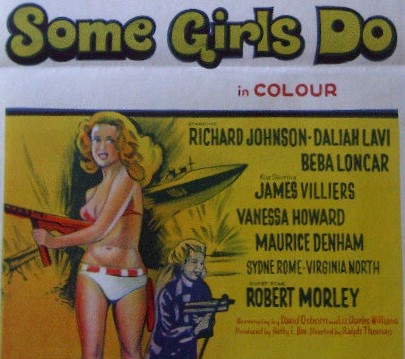
There’s no “vengeance” that I can see and certainly no whip-cracking as suggested in the poster. Berova, while attractive enough, lacks the screen magnetism of Andress and the mystery of who Carol is and where she’s headed is no substitute for either pace or tension and Berova isn’t a good enough actress to convey the fear she must be experiencing. The script could have done without weighting down the Kuma high priests with lengthy exposition explaining the whys and wherefores. Neither a patch on the original nor the expected star-making turn for Berova, this is strictly Saturday afternoon matinee fare and the slinky actress, despite her best sex-kitten efforts, cannot compensate.

Director Cliff Owen (A Man Could Get Killed, 1966) assembles a strong supporting cast, headed by Edward Judd (First Men in the Moon,1964) and Colin Blakely (a future Dr Watson in Billy Wilder’s The Private Life of Sherlock Holmes, 1970). You can also spot Andre Morell (Dark of the Sun, 1968), George Sewell (who later enjoyed a long-running role in British television series Special Branch, 1969-1974) and television regular Jill Melford. 

Curious change of pace for writer Peter O’Donnell, best known at this point for creating another sultry heroine, Modesty Blaise (1966).

Behind the Scenes: “How the West Was Won” (1962)

These days fact-based magazine articles commonly spark movies – The Fast and the Furious (2001) inspired by a piece in Vibe, A Beautiful Day in the Neighborhood (2019) started life in Esquire – but it was rare in the 1960s (see Note below).

However, a series of seven lengthy historical articles in the multi-million-selling Life magazine in 1959 about the Wild West, extensively illustrated with material from the time, captured the attention of the nation. Bing Crosby acquired the rights, not as a potential movie, but for a double album recorded in July 1959 on a new label Project Records set up specifically for the purpose – two months after the series ended – and a proposed television special.

When the latter proved too expensive, the rights were sold to MGM which then linked up in a four-film pact with Cinerama to create the first dramatic picture in that format, the three-screen concept that had taken the public by storm in 1952 with This Is Cinerama. Since then, Cinerama had focused exclusively on travelogs and coined $115 million in grosses from just 47 theaters, including $9 million in seven years at the Hollywood theater in Los Angeles. Eight years in its sole London location had yielded $9.4 million gross from a quartet of pictures, Cinerama Holiday (1955) leading the way with (including reissue) a 120-week run, followed by 101 weeks of Seven Wonders of the World (1956), 86 for This Is Cinerama and 80 weeks for South Seas Adventure  (1958).

Box office was supplemented with rentals of the projection equipment. But the novelty had worn off, lack of product denting consumer and industry interest, many of the theaters set up for  the project returning the equipment, so that by the time of this venture there were only 15 U.S. theaters still showing Cinerama. The company went from surviving primarily on equipment royalties to becoming a producer-distributor-exhibitor. Ambitiously, the company believed it could generate $5,000 a week profit for each theater, and, assuming growth to 60 houses, could bring in $15 million a year.

Crosby initially remained involvement – crooning songs to connect various episodes – but that idea was soon abandoned. Director Henry Hathaway (North to Alaska, 1960), claimed he came up with the movie’s structure. “The original concept was mine,” he said, “The first step in the winning of the West was the opening of the canal, then came the covered wagon, next the Civil War which opened up Missouri and the mid-West then the railroads, and finally the West was won when the Law conquered it instead of the gangs; which was the theme I worked out for the picture.

“So I conceived the whole idea and then got writers to work on the five episodes. Each episode was about a song originally. Then I travelled all over the country to find locations.”

For once this was a genuine all-star cast headed up by actors with more than a passing acquaintance with the western: John Wayne (The Man Who Shot Liberty Valance, 1962), Oscar-winner Gregory Peck (The Big Country), James Stewart (Winchester ’73, 1950), Richard Widmark (The Alamo, 1960) and Henry Fonda (Fort Apache, 1948) with Spencer Tracy (Broken Lance, 1954) as narrator plus George Peppard (Breakfast at Tiffany’s, 1961) in his first western.

The two strongest female roles were given to actresses playing against type, Carroll Baker (Baby Doll, 1956), who normally essayed sexpots, as a homely pioneer and Debbie Reynolds (The Tender Trap, 1955), more at home in musicals and comedies, as her tough sister. The impressive supporting cast included Lee J. Cobb, Eli Wallach, Walter Brennan, Robert Preston, Carolyn Jones and Karl Malden.

Glenn Ford and Burt Lancaster were unavailable.  Frank Sinatra entered initial negotiations but ultimately turned it down. Gary Cooper, also initially considered, died before the film got underway.

Initially under the title of The Winning of the West screenwriter James R. Webb (The Big Country, 1958) was entrusted with knocking the unwieldy non-fiction story into a coherent fictional narrative. In effect, it was an original screenplay at a time when Hollywood was turning its back on bestsellers, “the pre-sold theory less compelling.” His first draft accommodated various montages covering the journey from the Pilgrim Fathers to the building of the Erie Canal and the Civil War and it was only in subsequent drafts that the tale of Linus Rawlings (James Stewart) emerged with surprising focus on female pioneers.

Webb’s initial ending had involved a father-son conflict, presumably a fall-out between the Rawlings played by James Stewart and George Peppard, but that was abandoned in order not to finish on a “note of bitterness” not in keeping with spirit of the movie. Although he did not win a credit, John Gay (The Happy Thieves, 1961) also contributed to the screenplay.

Given the film’s episodic structure it is amazing how well the various sequences fit together and a narrative thrust is maintained. The story covers a 50-year stretch beginning in 1839 with the river sequence bringing together James Stewart and Carroll Baker. After Stewart is bushwhacked by river pirates, he marries Baker and they set up a homestead. The next section pairs singer Debbie Reynolds with gambler Gregory Peck whose wagon train is attacked by Indians on the way to San Francisco. Later, Stewart and son George Peppard enlist in the Civil War (featuring John Wayne as an unkempt General Sherman).

Stewart dies at the Battle of Shiloh. Peppard joins the cavalry and later as a marshal in Arizona meets Reynolds and prevents a robbery that results in a spectacular train wreck. It took a superb piece of screenwriting to pull the elements together, ensure the characters had just cause to meet and to create solid pace with a high drama and action quotient.

The undertaking was too much for one director. Initially, it was expected five would be required but this was truncated to three – John Ford (The Searchers, 1956), Henry Hathaway  and George Marshall (The Sheepman, 1958) although Hathaway carried the biggest share of the burden and Richard Thorpe (Ivanhoe, 1952) handled some transitional historical sequences. 

The directors broke new ground, technically. The Cinerama camera was actually three cameras in one, each set at a 48 degree to the next and when projected provided a 146-degree angle view. Each panel had its own vanishing point so the camera could, uniquely, see down both sides of a building.

But there were drawbacks. The cumbersome cameras required peculiar skills to achieve common shots. Directors lay on top of the camera to judge what a close-up looked like. Sets were built to take account of the way dimensions appeared through the lens, camera remaining static to prevent distortion. When projected, the picture was twice the size of 65mm and before the invention of the single-camera lens led to vertical lines running down the screen. Trees were built into compositions to hide these lines.

“You couldn’t move the camera much,” recalled Hathaway, “or the picture would distort. You have to shove everything right up to the camera. Actors worked two- and three-feet away from the camera. The opening dolly down the street to the wharf was the first time it had ever been done.”

Despite a lengthy pre-production of over a year, and an eight-month schedule due to start on May 28, 1961, and a completion date of  Xmas 1961, MGM anticipated a 1962 launch, Independence Day pencilled in for the world premiere. The original $7 million budget mushroomed to $12 million and then to £14.4 million, $1 million of that ascribed to adverse weather conditions, hardly surprising given the extent of the location work. A total of $2.2 million went on the 10 stars and 13 co-stars, virtually talent on the cheap given the salaries many could command, transport cost $1 million and there was another million in props including an 1940 vintage Erie canal boat.

Rain and overcast skies added $145,000 to the cost of shooting the rapids sequence in Oregon and another $218,000 was required when early snowfall scuppered one location and required traveling 1,000 miles distant. Nearly 13,000 extras were involved as well as 875 horses, 1,200 buffalo, 50 oxen and 160 mules. Thousands of period props were dispersed among the 77 sets. Over 2,000 pairs of period shoes and 1500 pairs of moccasins were fashioned as well as 107 wagons, many designed to break on cue.

Virtually 90 per cent  of the picture was shot on location to satisfy Cinerama customers accustomed to seeing new vistas and to bring alive the illustrations from the original Life magazine articles. Backdrops included Ohio River Valley, Monument Valley, Cave-in-Rock State Park, Colorado Rockies, Black Hills of Dakota, Custer State Park and Mackenzie River in Oregon.

The picture, including narration, took over a year. Cinerama sensation was achieved by shooting the rapids, runaway locomotive, buffalo stampede, Indian attack, Civil War battle and cattle drive. Motion was central to Cinerama so journeys were undertaken by raft, wagon, pony express, railroad and boat, anything that could get up a head of steam.

Initially, too, the production team had been adamant – “rigid plans for running time will be met” – that the movie would clock in at 150-155 minutes and there was some doubt, at least initially, on the value of going down the roadshow route in the United States. Roadshow was definitely set for Europe, a 15-minute intermission being included in those prints, a continent where both roadshow and westerns were more popular than in the States.

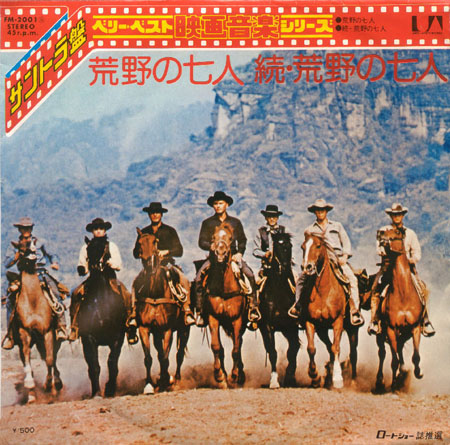
Big screen westerns in particular in Europe had not been affected by the advent of the small-screen variety. Some films received substantial boosts abroadd. “The Magnificent Seven and Cimarron (both 1960) took giants steps forward once they made the transatlantic crossing.” British distributors also reported “striking” success with The Last Sunset (1961) and One-Eyed Jacks (1962) which had toiled to make a similar impression in the U.S.

In the end the decision was made to hold back the release in the U.S. in favor of The Wonderful World of the Brothers Grimm, which had begun shooting later and ultimately cost $6 million, double its original budget. Rather than bunch up the release of both pictures together, MGM opted to kick off its Cinerama U.S. launch with Grimm in 1962 and shifted How the West Was Won to the following year. MGM adopted the anticipation approach, holding the world premiere in London on November 1 1962 and releasing the picture in roadshow in Europe.

A record advance of $500,000 was banked for the London showing at the 1,155-seat Casino Cinerama (prices $1.20-$2.15) on roadshow separate performance release. Before the advertising campaign even began in October, a full month prior to the world premiere, over 62,000 reservations had been made via group bookings. Critics were enamored and audiences riveted. The cinema made “unusually large profits” and after two years had grossed $2.25 million from 1722 showings.

Dmitri Tiomkin (The Alamo, 1960) was hired to compose the music, but an eye condition prevented his participation though he later sued for $2.63 million after claiming he was fired before the assignment began. Alfred Newman (Nevada Smith, 1966) wrote the thundering score but uniquely for the time MGM shared the publishing rights with Bing Crosby.

In the U.S. Bantam printed half a million copies of a paperback tie-in, sales of the soundtrack were huge and there was a massive rush to become involved by retailers and museums with educational establishments an easy target. 

Audience response was overwhelming, a million customers in the first month, two million by the first 10 weeks at just 36 houses, some of which had only been showing it for half that time. But it failed to hit ambitious targets – predictions that it would regularly run for three years in some situations “based on the star roster and the fact the pic offers more natural U.S. vistas than anything yet done on the screen” proving wildly over-optimistic. Still, it had enjoyed 80 roadshow engagement including eight months at the Cinerama in New York and grossed $2.3 million in 92 weeks in L.A, $1.14 million after 88 weeks in Minneapolis and $1.5 million after one week fewer in Denver.

By 1965, as it began a general release roll-out with 3,000 bookings already taken, it had already passed the $9 million mark in rentals including a limited number of showcase breaks the previous year.

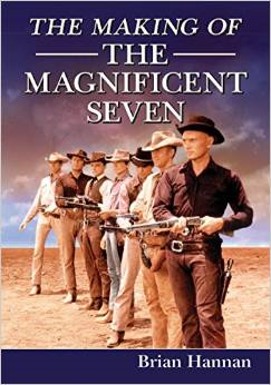
Nominated for a Best Picture Oscar, it won for screenplay, sound and editing. The movie became MGM’s biggest hit after Gone with the Wind and Ben-Hur. In my recent book The Magnificent ‘60s, The 100 Most Popular Films of a Revolutionary Decade I placed it twelfth on the chart of the decade’s top box office films.

It provided a popularity fillip for most of the big stars involved, none more so than James Stewart who, prior to shooting, had been on the verge of retirement. Box office appeal diminishing, work on his next picture Take Her, She’s Mine postponed by the Actor’s Strike, after the death of his father he had “quietly begun to make plans to get out of his Fox contract, retire, and move his family out of Beverly Hills.” He had spent $500,000 on a 1,100-acre ranch and was already well set for leaving the movies behind having accumulated a large real estate portfolio in addition to oil well investments.

SOURCES: Brian Hannan, The Magnificent ‘60s, The 100 Most Popular Films of a Revolutionary Decade (McFarland, 2022) p168-170; Marc Eliot, James Stewart A Biography (Aurum Press, paperback, 2007) p350-351; Sir Christopher Frayling, How the West Was Won, Cinema Retro, Vol 8, Issue 22, p25-29; Greg Kimble, “How the West Was Won – in Cinerama,” in70mm.com, October 1983;  “Reisini Envisions Cinerama Leaving Travelog for Fiction Pix,” Variety, December 14, 1960, p17; “Metro in 4-Film Deal with Cinerama,” Variety, March 1, 1961, p22; “Cinerama Action Awaits Plot Tales,” Variety, March 8. 1961, p10; “Fat Bankroll for How West Was Won,” Variety, May 24, 1961, p3; “Return to Original Scripts,” Variety, June 28, 1961, p5;“MGM-Cinerama Set 3-Hour Limit For West Was Won,Variety, August 23, 1961, p7; “Hoss Operas in O’Seas Gallop,” Variety, August 23, 1961, p7; “Coin Potential As To Cinerama,” Variety, September 20, 1961, p15; “Changing Economics on Cinerama,” Variety, October 11, 1961, p13; “Bantam’s 22 Paperback Tie-Ups in Hollywood,” Variety, October 25, 1961, p22; “How West Was Won for July 4 Premiere,” Box Office, December 11, 1961, p14; “Crosby Enterprises Holds West Cinerama Songs,” Variety, January 24, 1962, p1; “Grimm First in U.S. for Cinerama but Abroad West Gets Priority,” Variety, April 4, 1962, p13; “Cinerama Fiscalities,” Variety, April 11, 1962, p3; “Cinerama Story Pair Burst Budgets,” Variety, May 16, 1962, p3; “Tiomkin’s $2,630,000 Suit Vs MGM et al,” Variety, June 27, 1962, p39; “Hathaway a Pioneer,” Variety, July 25, 1962, p12; “Bernard Smith Clarifies Fiscal Facts,” Variety, August 8, 1962, p3; Review, Variety, November 7, 1962, p6; “London Critics Rave Over West,” Variety, November 7, 1962, p19; “Brilliant World Premiere in London for West,” Box Office, November 12, 1962, p12; “West in Cinerama the Big Ace,” Variety, November 14, 1962, p16; Feature Reviews, Box Office, November 26, 1962; Bosley Crowther, “Western Cliches; How West Was Won Opens in New York,” New York Times, March 28, 1963; “Big Book Aid for West,Box Office, April 1, 1963, pA3; “West Was Won Seen By 2,000,000 in 10 Weeks,” Box Office, June 3, 1963, p15;  “How West Was Won for 19 Showcase Theaters,” Box Office, June 15, 1964, pE1; “West End,” Variety, November 11, 1964, p27; “How West Was Won Ends Roadshowing,” December 9, 1964, p16; “3,000 Bookings Expected for How the West Was Won,” Box Office, May 3, 1965;

NOTE: Robert J. Landry (“Magazines a Prime Screen Source,” Variety, May 30, 1962, 11) pointed to Cosmopolitan as the original publication vehicle for To Catch a Thief (1955) by David Dodge in 1951 and Fannie Hurst’s Back Street (1932), serialized over six months from September 1930.  Frank Rooney’s The Cyclist’s Raid – later filmed as The Wild One (1953) – first appeared in Harpers magazine. Movies as varied as Edna Ferber’s Ice Palace (1960) and The Executioners by John D. MacDonald, later filmed as Cape Fear (1962) were initially published in Ladies Home Journal. The Saturday Evening Post published Alan Le May’s The Avenging Texan, renamed The Searchers (1956), and Donald Hamilton’s Ambush at Blanco Canyon, renamed The Big Country (1958) as well as Christopher Landon’s Escape in the Desert which was picturized under the more imaginative Ice Cold in Alex (1958). 

How the West Was Won (1962) **** * – Seen at the Cinema in Cinerama 70mm – Bradford Widescreen Weekend

I’ve got Alfred Newman’s toe-tapping theme music in my head. In fact, every time I think of this music I get an earworm full of it. Not that I’m complaining. The score – almost a greatest hits of spiritual and traditional songs – is one of the best things about it. But then you’re struggling to find anything that isn’t good about it. For some reason, this western never seems to be given its due among the very best westerns.

Not only is it a rip-roaring picture feature the all-star cast to end all-star casts it’s a very satisfying drama to boot and it follows an arc that goes from enterprise to consequence, pretty much the definition of all exploration.

Given it covers virtually a half-century – 1839-1889 – and could easily have been a sprawling mess dotted by cameos, it is an astonishingly clever in knowing when to drop characters and when to take them up again, and there’s very little of the maudlin. For every pioneer there’s a predator or hustler whether river pirates, gamblers or outlaws and even a country as big as the United States can’t get any peace with itself, the Civil War coming plumb in the middle of the narrative.

Some enterprising character has built the Erie Canal, making it much easier for families to head west by river. Mountain man fur trader Linus Rawlings (James Stewart) on meeting prospective pioneers the Prescotts has a hankering after the young Eve (Carroll Baker) but as self-confessed sinner and valuing his freedom has no intention of settling down. But he is bushwhacked by river pirates headed by Jeb Hawkins (Walter Brennan) and left for dead, but after saving the Prescotts from the gang changes his mind about settling down and they set up a homesteading.

We have already been introduced to Eve’s sister Lilith (Debbie Reynolds) who has attracted the attention of huckster Cleve Van Valen (Gregory Peck) and they meet again in St Louis where she is a music hall turn and widow. Her physical attraction pales in comparison with the fact she has inherited a gold mine. He follows her in a wagon train which survives attack by Cheyenne, but still she resists him, not falling for him until a third meeting on a riverboat.

Zeb Rawlings (George Peppard) wants to follow his father to fight in the Civil War. Linus dies there, but there’s no great drama about it, he’s just another casualty, and the death is in the passing. In probably the only section that feels squeezed in, after the Battle of Shiloh a disillusioned Zeb saves General Sherman (John Wayne) and Ulysses S. Grant (Harry Morgan) from an assassin.

The space at the top of this ad was for cinemas to stick in their own name.

Returning home to find Eve dead, Zeb hands over his share of the farm to his brother and heads west to join the U.S. Cavalry at a time when the Army is required to keep the peace with Native Americans enraged by railroad expansion. Zeb links up with buffalo hunter Jethro Stuart (Henry Fonda), who appeared at the beginning as a friend of his father.

Eve, a widow again, meets up in Arizona with family man and lawman Zeb who uncovers a plot by outlaw Charlie Gant (Eli Wallach) to hijack a train. Zeb turns rancher once again, looking after her farm.

But the drama is peppered throughout by the kind of vivid action required of the Cinerama format, all such sections filmed from the audience point-of-view. So the Prescotts are caught in thundering rapids, there’s a wagon train attack and buffalo stampede, and a speeding train heading to spectacular wreck. There’s plenty other conflict and not so many winsome moments.

Interestingly, in the first half it’s the women who drive the narrative, Eve taming Linus, Lilith constantly fending off Cleve. And there’s no shortage of exposing the weaknesses and greed of the explorers, the railroad barons and buffalo hunters and outlaws, and few of the characters are aloof from some version of that greed, whether it be to own land or a gold mine or even in an incipient version of the rampaging buffalo hunters to pick off enough to make a healthy living.

And here’s the kicker. Virtually the entire all-star cast play against type. John Wayne (Circus World, 1964) reveals tremendous insecurity, Gregory Peck (Mirage, 1965) is an unscrupulous though charming renegade, the otherwise sassy Debbie Reynolds (My Six Loves, 1963) is as dumb as they come to fall for him, and for all the glimpses of the aw-shucks persona James Stewart (Shenandoah, 1965) plays a much meaner hard-drinking hard-whoring version of his mean cowboy. Carroll Baker (Station Six Sahara, 1963) is an innocent not her usual temptress while George Peppard (The Blue Max, 1966) who usually depends on charm gets no opportunity to use it. .

Also worth mentioning: Henry Fonda (Madigan, 1968), Lee J. Cobb (Coogan’s Bluff, 1968), Carolyn Jones (Morticia in The Addams Family, 1964-1966), Eli Wallach (The Moon-Spinners, 1964), Richard Widmark (Madigan), Karl Malden (Nevada Smith, 1966) and Robert Preston (The Music Man, 1962). 

Though John Ford (The Man Who Shot Liberty Valance, 1962) had a hand (the short Civil War episode) in directing the picture, it was a small part, and virtually all the credit belongs to Henry Hathaway (Circus World) who helmed three of the five sections with George Marshall (The Sheepman, 1958) taking up the slack for the railroad section.

And though you might balk at the idea of trying to cover such a lengthy period, there’s no doubting the skill of screenwriter James R. Webb (Alfred the Great, 1969) to mesh together so many strands, bring so many characters alive and write such good dialog.

I’m still tapping my toe as I write this and I was tapping my toe big-style to be able to see this courtesy of the Bradford Widescreen Weekend on the giant Cinerama screen with an old print where the vertical lines occasionally showed up.

Behind the Scenes: “La Dolce Vita” – Part Three – Reissue Takes the Brigitte Bardot All-Time Crown

Astor had yanked La Dolce Vita from the Henry Miller Theatre in December 1961 perhaps a bit prematurely but, unless willing to wait until spring when another arthouse became free, it had nowhere else to put Les Liaisons Dangereuses, which had performed extremely well in its native France with 639,000 admissions.

Anxious to get this latest hit, the Henry Miller Theatre had offered a fat guarantee. Although only 1¾ hours long, compared to the three-hour La Dolce Vita, it was launched as a roadshow, with three performances a day, at 2.30pm, 7.00pm and 9.30pm. This was an equally controversial film; it only managed 10 days play in February in New Jersey before being closed down by the authorities, although by then it had been seen by 7,500 customers.

Believing there was a lot more juice left in the Fellini film, Astor acquired all the worldwide rights, including all existing contracts with current distributors, for $1.35m. The film had not yet been released in Latin America, which was expected to provide strong box office. This proved correct; for example, it grossed $100,000 in Chile. Despite not being entered in the foreign film category of the Oscars, La Dolce Vita managed nominations for best director, best screenplay, best art direction and best costume design, for which it won. Nino Rota’s music was nominated for a Grammy.

In the summer, Astor continued to expand, acquiring the Pathe American distribution company, a deal which included 18 unreleased films such as Bryan Forbes debut feature Whistle Down the Wind. The purchase was part of a broader strategy to give Astor a deeper penetration of the market, guaranteeing them better playoffs for their own films. Even so, questions were beginning to be asked of the company’s financial situation. President George Foley complained: ‘People seem to have the knife in us.’ He explained that, in the wake of the company’s explosive growth from a turnover of $500,000 to $4m it was guilty of over-ambition, and it was trading profitably.

But that was not correct and soon the company required a $1m loan. Negotiations dragged on and when they were concluded in August, the loan granted by the Inland Credit Co was only half that requested.

However, La Dolce Vita remained a cash cow. After completing a 34-week run at the  Henry Miller Theatre in December, it transferred to two cinemas in New York, the Embassy and the Beekman, where, with lower admission prices, it took an astonishing $44,500 in its first week. Thereafter, it shifted to 15 neighborhood cinemas in New York. Its longevity was assisted by the shortage of mainstream product created by the major studios investing so much money in roadshows. That meant the big studios made fewer feature films, leaving exhibitors scrabbling to fill playdates. Some cinemas survived by extending the playing period of existing bookings, but for other cinemas, accustomed to a weekly change or lacking the audience-base to support films running for two or three weeks, this was impractical. 

More and more local cinemas turned to foreign movies. Often these movies, sometimes helped along by lurid titles, received the saturation treatment previously given to horror or science-fiction films. La Dolce Vita was able to take advantage of these changes in exhibitor strategy. But where you might have expected a subtitled film to play at the bottom of a double bill (local theatres always showed two films), more often than not La Dolce Vita was by that time so well-known that it was advertised as the main feature.

By September it had clocked up 3,000 bookings, a record for a subtitled film, and expected at least another 2,000 before the well ran dry. It also started to be reissued, turning up in programmes with A Cold Wind In August and Two Women. At year’s end it was Joe Levine’s turn to crow. Two Women was the top foreign film of the year and with a gross of $6m took 30th position at the annual box office race.

By now Astor’s rapid expansion was taking its toll. Ironically, La Dolce Vita, the gamble that had succeeded beyond anyone’s dreams, had inspired too many other gambles that had failed. In the old days, the revenues generated by Anotnioni’s Rocco and His Brothers and Vadim’s Les Liaisons Dangereuses would have put them in the category of hits. While favoured by the critics, the Italian film did not fare well at the box office. The Vadim film, hampered by a Condemned rating from the Production Code and by mixed reviews, managed only 300 bookings and ended up costing Astor $500,000. Last Year at Marienbad had only managed a $350,000 gross.

Not only did none of the films replicate the success of La Dolce Vita, they did not justify the amounts Astor had paid for them. In January 1963 Inland Credit announced a public auction of Astor’s assets. This crisis was quickly resolved with a new loan repayment schedule. There were no irregularities involved, just an inexperienced company diving into the acquisition market with too much enthusiasm. Having quit its plush offices in Madison Ave and cut back on staff, Astor remained optimistic. The cash cow La Dolce Vita was not dead yet and in February was reissued again, this time in a double bill with British film Victim starring Dirk Bogarde, on the RKO circuit in New York.

There were high hopes for the adaptation of the Brendan Behan play The Quare Fellow and The Black Fox. Better, there was a new full-length Fellini on the horizon. Based on its first six weeks in Rome and Milan, where it notched up $320,000, the producers of were projecting an Italian gross of $3m. Astor had marked out June for its US premiere.

But Astor did not make it to June.

In March, Inland Credit called in its loan. Astor battled this in court, but the judgement went again them. The company which had single-handedly launched arthouse films into the mainstream was out of business. The rights to La Dolce Vita were acquired by Landau-Unger, who had made the American arthouse hit The Pawnbroker starring Rod Steiger. But their reissue of La Dolce Vita in 1965 was underwhelming and they sold on the rights to AIP, another company which saw marketing foreign films as the way to mainstream credibility. AIP was famous for horror and exploitation films and for turning out both on ludicrously short shooting schedules. It had ransacked almost the entire portfolio of Edgar Allan Poe for Fall of The House Of Usher, The Pit And The Pendulum, The Premature Burial and The Raven.  

Fellini, of course, had an unassailable name at the arthouse box office. While attracted neither the critical kudos, although it did receive an Oscar nomination and took the BAFTA for best foreign film, nor the box office of its predecessor, it was still good for $3.6m gross. Counting the grosses of , La Dolce Vita, La Strada and his share of Boccaccia 70, Fellini was, with De Sica, the top foreign filmmaker.  De Sica added his box office clout to that of Loren in The Condemned of Altona and Marriage Italian Style, which won Loren another Oscar nomination, and in Yesterday, Today and Tomorrow, which was named Best Foreign Film in 1965 at the Oscars.  

Like Astor, AIP was not a company that played by the rules. In 1966, it decided to reissue La Dolce Vita in a dubbed version. One of the main reasons for this was to achieve a sale to television, a medium still hostile to subtitled films.

The dubbed film went against Astor’s original agreement with the National Legion of Decency (now re-named the National Catholic Office of Motion Pictures), but by now there were more contentious films on the market. Who’s Afraid of Virginia Woolf had gone out with a ‘no under-18’ policy. And the Production Code’s A+IV classification (morally objectionable for adults but with reservations) had been slapped on Alfie, , Tom Jones and The Servant. So AIP sidestepped a Legion condemnation by agreeing to a ‘recommended for adults’ advertising campaign and accepted the Code’s A+IV classification.

Quite why AIP chose two cinemas in Virginia and Oregon, respectively, to launch the new dubbed version is anybody’s guess. Perhaps it was inexperience, or a belief that the movie was played out in the bigger cities, or market hostility to a company best known for a different product. Or maybe this was simply a tactic to generate television interest, similar to the way some movies are released these days for a week in cinemas to fulfil a contract prior to DVD release. Eventually, however, La Dolce Vita found its way to its spiritual home, an arthouse in a big city and in its opening week at the 868-seater Four Star in Los Angeles in October it took a ‘socko’ $10,000. And like Astor before it, AIP found it had a bigger hit on its hands than it could imagine when the dubbed version took another $3m.

The tactic worked and next year La Dolce Vita was screened on television, with, once again, astonishing results.

In November, on the independent WOR-TV station, it swept aside in the ratings a Frank Sinatra special and I Spy. Unsurprisingly, the network served up the dubbed version. But there were a few eyebrows raised at the bowdlerisation.  ‘Homosexual’ was changed to ‘depraved’ and ‘fascist’ to ‘scandal’. By then, the arthouse movie was rejuvenated by movies like Elvira Madigan, A Man and A Woman and Belle De Jour. But La Dolce Vita was the one that had opened to the door for arthouses movies into the mainstream and it was fitting that by the end of the decade it was declared the foreign film champ of all time with a gross that had risen to $15m.

In my exclusive chart of The 1960s Top 100 Movies according to US box office it was ranked 91st, above such films as To Kill A Mockingbird, Blow Up, Where Eagles Dare, Cool Hand Luke, The Thomas Crown Affair and The Pink Panther. Even to people who never visited an arthouse cinema, Fellini was a household name and the term La Dolce Vita passed into the general vocabulary.

SOURCES: Brian Hannan, La Dolce Vita and the American Box Office Bust-Out (Baroliant, 2018) ; “Brian Hannan Revisits La Dolce Vita,” Cinema Retro, No 33.

Behind the Scenes: “La Dolce Vita” (1961) – Part Two – The Crossover King

La Dolce Vita opened in New York and Boston the same day – April 19, 1961 – and smashed the first day record in both cinemas. And the weekly record. In truth, given the hype, and the increased ticket prices, that was no surprise. But whereas La Dolce Vita made $16,000 in its first week in New York and $35,000 in Boston, Mein Kampf made $87,000 in New York. In the 1960s, movies lasted in cinemas far longer than they do now. And that kind of longevity cannot be maintained by advertising alone. The two most powerful tools in giving a film ‘legs’ were word-of-mouth and the critics, who could make or break a movie in a way that is impossible these days.

Reviews were superlative. ‘Awesome but moral,’ commented the New York Times. ‘Brilliant’, ‘outstanding’, ‘a masterpiece’, seemed to be the consensus. Another powerful opinion-maker, in that it was her business to put her money where her mouth was, Helen Thompson, bought out 25 complete shows for her Play-of-the-Month club. There were sell-out performances in New York and Boston, but would the rest of the country fall in line?

In an attempt to create a bidding war, Astor screened the movie for 25 cinema owners from the big cities. The Todd Theatre in Chicago was chosen as the next venue, also as a roadshow, but that was for a limited period only and when it moved onto continuous performances (called ‘grind’), it set a new high for ticket prices – $2.50 compared to the previous record of $1.80. In Los Angeles, Herbert Rosenor, owner of two arthouses, guaranteed $75,000 and an eight-week minimum run.

Despite breaking so many rules in the launching of La Dolce Vita, there was one rule that remained sacrosanct.

In the 1960s, delay, which in turn created heightened anticipation, was a powerful marketing tool. It was used by the major studios to build demand for their roadshows. So it did no harm that the rest of America had to wait for La Dolce Vita.

It took three months for the film to reach Los Angeles. On arrival it shattered all records, taking in upwards of $30,000 between the two cinemas. And its first weeks elsewhere that July achieved similar results – $17,000 in Pittsburgh, $14,000 in Baltimore, $26,000 in Detroit. Astoundingly, it was keeping pace with the year’s biggest blockbuster The Guns of Navarone. In its 25th week at the Henry Miller Theatre, La Dolce Vita registered $25,000 while The Guns of Navarone in its 6th week at two cinemas took a combined $66,000. In the first week of both films in San Francisco, the war film made off with $32,000 at one 1,400-seater while the art film scrambled £28,000 at two 400-seat cinemas, and both had the same top price of $2.

In Baltimore, the second week of La Dolce Vita beat the second week of The Guns of Navarone. In the weekly national box office chart compiled by Variety, which covered the 24 US major cities, La Dolce Vita notched up fifth position. By August it was fourth and then third. 

Ancillary marketing helped. RCA issued the soundtrack album, which included the sensuous theme as well as Rota’s adaptations in the movie of standards like “Yes, Sir, That’s My Baby” and “Jingle Bells.” While the album reached the lower echelons of the Top 50 album charts for  several weeks, which, for an arthouse film would be considered an excellent result, it was overshadowed by its biggest competitor Never on Sunday, which spent over a year there, reaching the top five. Ballantine publishers brought out a paperback of the screenplay with 200 stills.

Controversy was milked when Atlanta threatened to boycott the movie and the Los Angeles Times censored an advert, blacking out most of a prostrate girl with her hands on her breasts. Clubs began springing up calling themselves La Dolce Vita. Archbishop William Scully launched a campaign to prevent its showing in Albany. ‘Pass this one up for the good of you soul,’ he intoned. Getting equal press attention was a review in The Presbyterian Life which called it  ‘a highly moral movie.’ The media latched onto news reports that the tossing of coins into the Trevi Fountain in Rome had trebled.

To prove it was not a one-hit wonder, in July Astor launched its follow-up movie, another Italian film, Rocco and His Brothers, directed by Luchino Visconti. This had been a  box office sensation in Italy, earning over $625,000 in its first year, and the rights had cost $325,000.

Astor had made three versions – subtitled and dubbed versions of the full 175-minute film and an edited 145-minute dubbed one. Now that Astor was a proven success, cinemas opened up to them and it was able, this time, to launch the Visconti film on two cinemas, the Beekman and the Pix. The film was launched on June and broke records at both cinemas, with $15,000 at the Beekman. Using a promotional technique borrowed from La Dolce Vita, to coincide with the launch the company released a single, “The Ballad Of Rocco”, even when there was no such song in the movie, following up with the original soundtrack, by Nino Rota, in August. 

With other backers from Italy and France, it was financially involved in a planned remake of the Hedy Lamarr 1930s sensation Ecstasy and was in negotiation with the new pretenders to the Italian artistic throne, Michelangelo Antonioni and Luchino Visconti.

Astor purchased India by Robert Rossellini and, as if not wishing to lose trace its roots, The State Department Murders and were hoping to conclude a deal with Russell Hayden for three pictures. Having been pipped by Joe Levine to Boccaccia 70, a compendium of short films directed by Fellini, Visconti, De Sica and Mario Monicelli and starring Loren and Ekberg, Astor turned towards the French New Wave.

George Foley snapped up Roger Vadim’s Les Liaisons Dangereuses, so controversial no other distributor had gone near it since its launch in September 1959, Alain Resnais’ Last Year at Marienbad and the new film from Francois Truffaut, hot after Breathless and 400 Blows, Shoot the Pianist. The company moved into prestigious offices in Madison Avenue and recruited more staff including Douglas Netter who joined as international president from Samuel Goldwyn’s head office. Soon it would set up a literary department, its first purchase The Only Reason by Tereska Torres, which, since it was set in Paris, was being proposed as a future project for Vadim.  Confidently mapping out the company’s direction, Foley said, ‘In coming years we foresee co-productions in every major picture-producing locale where satisfactory projects can be created.’

Gradually, Astor achieved its ambition of expanding La Dolce Vita beyond its core audience in the big cities. Mastroianni embarked on a 28-city promotional tour. On October, a double-page advert in Variety announced: ‘All over American cities and towns, theatres that have never played a subtitled picture before are doing terrific business with La Dolce Vita.’

The advert listed cinemas in previously unimaginable locations for an art film such as Little Rock and Hot Springs, Arkansas, Wilmington in Delaware, Macon in Georgia, and Dodge City in Kansas. In all, 162 cinemas had shown the film including nine roadshows, all still running, and nine modified roadshows. The top roadshow run was in New York (27 weeks).  The roadshows totalled 121 weeks including stints in Chicago, Miami, Philadelphia,  Milwaukee, Minnesota, Toronto (US grosses always include Canada), New Jersey and  Vancouver. Astor had bookings for another 134 cinemas.

Towards the end of the year, it started moving into neighborhood theatres where, at lower prices (called ‘popscale’), it played extended runs. In London, after ending its run at the Curzon, La Dolce Vita transferred to the Berkeley where it ran for another 20 weeks, and then went on national release through the National Circuit cinema chain. Its 34th and final week, in December, at the Henry Miller Theatre generated $10,000. In Italy, it was bracketed with Ben Hur as the top film of the 1960-61 season, beating the Hollywood epic in several cities including Milan.

When all the US figures were in, La Dolce Vita proved the most successful gamble of the year, the three-hour arthouse epic turning into a massive mainstream hit well beyond even the most optimistic expectations of the ambitious Astor, taking in an astonishing $9m (gross not rental).

It ranked 12th  on the 1961 box office chart, above other big-risk movies like One Eyed Jacks and Cimarron. It finished ahead of Paul Newman in The Hustler, Audrey Hepburn in Breakfast at Tiffany’s, John Wayne in North To Alaska, Elvis Presley in Blue Hawaii, Never On Sunday and Mein Kampf. In that nationwide list, The Guns of Navarone came top, with The Alamo 5th and The World of Suzie Wong 8th. But in the placings for Los Angeles, La Dolce Vita came 5th, beating all three. Of course, the cognoscenti claimed it was a fluke.  But the simple riposte to that was that every hit film was a fluke, otherwise the supposedly wiser Hollywood heads who had committed millions in One Eyed Jacks and The Alamo would have been left celebrating, rather than ruing, their investment.

Come the year end, La Dolce Vita was on every critics top ten list, if not the film of the year. It was named best film by the National Board of Review and the New York Film Critics Circle. It should have been a shoo-in for the best foreign film Oscar. In fact, it was not put forward, as the nomination was done by the Italian government, which believed, bizarrely that La Dolce Vita had won too many awards, and it was someone else’s turn.   

Everyone involved, however peripherally, in La Dolce Vita wanted to build on its  success. Columbia, for example, released La Verite starring Brigitte Bardot in the same Columbia/Curzon duet in London but its first week had brought in only a combined $13,500. But Omat soon faded from the marketplace. Other majors like 20th Century Fox were inspired to invest in European films, most notably The Condemned of Altona, starring Loren, and Luchino Visconti’s The Leopard starring Burt Lancaster.

Meanwhile, Embassy had not conceded defeat on the arthouse front. Joe Levine knew only too well, from his success with Hercules, how to parlay an investment in a foreign film into gold at the American box office. And it was clear to him that Astor had copied his marketing techniques to turn La Dolce Vita into an enormous success.

So he cast around for another foreign film. He found it in De Sica’s Two Women. This toplined Sophia Loren who had the added benefit of already being a marquee name in the US, having starred with top names like Alan Ladd in Boy on a Dolphin, Frank Sinatra in The Pride and The Passion, John Wayne in Legend of The Lost, William Holden in The Key, and  more recently, Houseboat (which, incidentally, produced another hit single) with Cary Grant.

Noting the success of the English-language Never On Sunday, Embassy was canny enough to make a dubbed version of this film. Of course, for the sake of appearances, a subtitled version was also available, but, inevitably, the bulk of cinema owners, especially outside the big cities, opted for the dubbed version. When Sophia Loren was nominated for the Best Actress Oscar in spring 1962, Levine capitalised on the publicity. She was far from being the favorite. She was the unexpected victor and, naturally, her win boosted bookings and, by association, conferred on Levine the mainstream recognition he craved.

Boccaccio 70 produced another fierce bidding war, this time just between Astor and Embassy. Levine was determined not to lose another prized asset. Again, Levine broke the rules, and on the strength of the directors and stars, pre-sold the movie to distributors in various countries. By the time the film opened, he reckoned he would have already broken even, before he received his share of the profits.

His boldness reached new levels. The four directors in the film had each made a segment that last one hour. He toyed with the option of releasing the movie in two parts. In the end, he simply chopped out the least well-known director Mario Monicelli, leaving him with a three-hour movie. Not only did he intend to present Boccaccio 70 as a roadshow, but it would have two intermissions instead of one, so that each section would be seen afresh.

His new-look company also had two films by Swedish director Ingmar Bergman, who had just won the Best Foreign Film Oscar for Through the Glass Darkly, lined up for distribution and Il Bel Antonio starring Claudia Cardinale and Mastroianni. Already involved, with various partners, in the production of Italian movies, he now had American movies in development. In total, he had committed nearly $10m to Sodom and Gomorrah, Boccaccio 70, The Wonders of Aladdin and Boys Night Out, for which he was paying star Kim Novak $500,000. In addition, he was planning a big budget roadshow film about the San Francisco earthquake plus psychological thriller Whatever Happened to Baby Jane (he pulled out of this after a row with director Robert Aldrich) and The Carpetbaggers (made for Paramount).

Every bit as bullish as Astor, he announced, ‘I want theater owners all over the world to know this is the kind of schedule they can expect from me.’

Until now the director had been the prime tool for marketing arthouse films, but La Dolce Vita and Never On Sunday threw up, for the first time, actors, in the shape of Mastroianni and Melina Mercouri, as dependable marquee names. They became ‘bankable’ names for European producers looking for a guarantee of selling their films to an American audience. Mastroianni appeared in most of the films by the big Italian directors while Mercouri was absorbed into the mainstream in films like The Victors and Topkapi. Fellini, of course, now the biggest box office draw in foreign films, could more or less write his own ticket. He was in talks to make his first American movie, but not with Astor. Instead, he opened negotiations with the Mirisch Brothers, who were known for entering into deals that actors and directors found profitable. 

Part Three tomorrow.

SOURCES: Brian Hannan, La Dolce Vita and the American Box Office Bust-Out (Baroliant, 2018) ; “Brian Hannan Revisits La Dolce Vita,” Cinema Retro, No 33.

Behind the Scenes – La Dolce Vita (1961) – The Biggest Roadshow Gamble Of All Time

In 1961, Hollywood was a casino. The advent of the roadshow and the lure of repeating the big-budget successes of Ben Hur (1959), Around The World In 80 Days (1958), Bridge On The River Kwai (1957) and The Ten Commandments (1956) had seen every studio sink colossal sums on the roll of the box office dice. United Artists had lavished $4m on three-hour epic Exodus about the formation of Israel with a star Paul Newman who had no blockbusters to his name. Columbia had sanctioned an even bigger budget, $5m, for war film The Guns Of Navarone.

Two studios were backing the directorial debuts of two major stars whose inexperience had seen both budgets soar. United Artists was part-funding John Wayne’s The Alamo while Paramount had too much riding on Marlon Brando’s western One-Eyed Jacks. MGM had a roadshow re-make of the 1931 Oscar-winner Cimarron with Glenn Ford and unknown Maria Schell in the leads. Even Disney had been tempted into the big-budget arena with Swiss Family Robinson, its most expensive live action movie.

None of these represented the biggest gamble of the year.

That honour, or should it be folly, went to the three small distributors bidding the unheard-of sum of $500,000 (the equivalent of $5m now) for the US rights for a three-hour Italian black-and-white Italian arthouse film, La Dolce Vita, directed by Federico Fellini.  Despite the success in America in the 1950s of films like the Japanese Seven Samurai and Fellini’s previous La Strada and the current vogue for Swedish director Ingmar Bergman (The Seventh Seal) and the French New Wave, the marketplace for arthouse movies was tiny.

For marketing, arthouse exhibitors depended on movies winning prizes at film festivals or being directed by someone who had previously won such a prize. In the past decade only a handful had ever made $1m. Even the most successful of the recent spate of British films, classed as imports, such as Room at the Top, driven by massive publicity from its Oscar nominations and wins, had barely hit the $2m mark. The most successful foreign-language art movie had been Roger Vadim’s And God Created Woman, which had grossed $7.5m. But that had starred Brigitte Bardot in a state of some undress.

Fellini was certainly a solid arthouse marquee name, having been awarded the Oscar for Best Foreign Film in successive years for La Strada (1956) and Nights of Cabiria (1957). In this he had matched the director credited with Italy’s post-war movie renaissance, Vittorio De Sica, who had also won Honorary Oscars (predating the Foreign Film category) for Shoeshine (1946) and Bicycle Thieves (1948). But Fellini was also aligned with the wider European New Wave, in 1958 forming a loose partnership with French directors Jacques Tati (M Hulot’s Holiday) and Robert Bresson (Diary of a Country Priest). Tati had his own company and had already invested in Bresson’s Lancelot du Lac and there had been talk of Fellini directing Tati in Don Quixote.

Filming of La Dolce Vita began in February 1959 with a cast including Marcello Mastroianni, Swedish actress Anita Ekberg and Anouk Aimee. Based on the performance of his previous films, producers Cineriz were dubious about its commercial prospects, but went ahead because it was a prestige picture. When the movie opened in Rome on St Valentine’s Day 1960, it astonished and shocked in equal measure.

The Catholic Church was outraged, demanding cuts, controversy boiling over when this met with refusal. Fellini had no truck with censorship. He said it was ‘dangerous in any way, in any occasion, because an artist cannot create under the sign of the guilty.’ Initial reaction to the movie was mixed; there was even a smattering of boos at the premiere. But some were already calling it a masterpiece.

Its opening weekend in Rome set a new house record of $16,000 (the equivalent to over $160,000 today) and then it broke every other conceivable record. In May it won the Palme D’Or at the Cannes Film Festival. Record giant RCA issued the popular theme tune by Nina Rota in Italy and in France a novelisation,  La Douceur de Vivre, was published complete with screenplay and soon it would appear as an illustrated book in Italy with shooting script and behind-the-scenes photos. Fellini was already planning his next film, The Trip, to star Ekberg and Sophia Loren. After six months, still in its two launch cinemas, La Dolce Vita was taking $15,000 a week in Milan and $9,000 a week in Rome. By October it was outgrossing most new releases. By year’s end it had hoisted a sensational $1.125m in Italy. The season’s box office champion by a considerable margin, it left big-budget-Hollywood films in the dust.

Columbia Pictures, which had sizeable investments in European films, was quickest off the mark, purchasing in August the rights to distribute the film in the UK, where a November release was planned, and the British Commonwealth. Convinced the film was too controversial to receive a Production Code Seal (the censorship system of the time) in the US, nor wishing to drag the company name through any subsequent scandal, Columbia did not bid for the American rights. And so it became the tale of three companies, Omat Corporation, Embassy Pictures and Astor Pictures, who all had the same aim, to reinvent themselves through entering the arthouse business.

They were a disparate bunch. Omat had made its name reissuing old American movies which had been withheld from television. An abortive move into film production with Brotherhood of Evil had almost bankrupted it. But it  had come back to buy a batch of Mexican films for distribution including Beyond The Limit starring Jack Palance and films with lurid titles like Never Take Candy From A Stranger. Embassy was run by Joe Levine, an independent distributor from Boston with an impeccable pedigree until he decided to relaunch himself in 1957 as a wheeler-dealer on a national scale, buying the rights to the Italian-made Attila the Hun starring Anthony Quinn and Sophia Loren and sending it into the American market on the back of more promotional dollars than it had cost to purchase. The next year, on a much bigger scale, he did the same thing with Hercules starring Steve Reeves, opening the movie with 600 prints nationwide in July. It made him a fortune. He followed up with films like Hercules Unchained and Jack the Ripper.

But soon he sensed a change in the marketplace and wanted to build up the prestige of his company away from the exploitation marketplace. ‘A small revolution is taking place,’ he told Variety, ‘among the major and independent circuit operations. Many large houses (cinemas) are converting to specialty and art policies. Demand for those films is growing. That’s for me.’

He bought a French film called The Law, directed by Jules Dassin, and changed the title to the more snazzy, and suggestive, Where The Hot Wind Blows. But by late 1960 he had another reason to be in hot pursuit of La Dolce Vita. He had missed out on Jules Dassin’s new movie Never On Sunday, at that time just opened in New York to record business. Astor Pictures was Embassy on a smaller scale, distributing exploitation films like The Girl in Room 13, Festival Girl and Yellow Polka Dot Bikini. The 30-year-old company had been taken over from the estate of Richard Savile in 1959 by a group including George Foley, financier and vice-president of City Stores Franklin Bruder, and Everett Crosby, brother of Bing and his business representative. Like Embassy, it had bigger aspirations, planning to release 10 features, the most in its history, including three produced by Crosby, in 1961. And then it saw an opportunity to crash the arthouse system.

Each company put in a bid in the region of $500,000 – an astronomical sum for an arthouse flick – for the rights. And each believed its bid had been accepted. In October 1960, Omat claimed it had a deal with Italian producers Cineriz for that sum plus a percentage and promptly announced the film on their distribution list.  Joe Levine contested that, saying he had a ‘handshake deal’ that later turned into a ‘verbal agreement’, binding under Italian law, in front of two witnesses, for roughly the same amount. Astor also claimed victory. But in December Cineriz took out an advert in Variety declaring all claims were premature, as the US rights had not yet been granted. To everyone’s surprise, on January 7 1961, Astor was announced as the winner with a contract to prove it. They had outbid the others, paying a whopping $625,000 for the privilege. Al Schwartzberg of Omat complained: ‘All I know is we had a deal and nobody had told me different.’ 

Even more astonishing, Astor planned to spend a further $400,000 – more than the lifetime gross of  most arthouse movies in the US – on promotion. Just to break even (since the cinema took about 50% of the gross), it would need to make $2.5m. In order to do that, it would have to achieve what had not been done since And God Created Women, guarantee an arthouse film a nationwide release. For a three-hour film foreign film without Brigitte Bardot, it was madness.

Astor wanted to start recouping their investment as quickly as possible. There was just one problem. That would prove impossible in the current system of releasing arthouse movies.

There were only a handful of such specialist cinemas, just 15 in New York, the biggest city in America. A New York opening was paramount, the gateway to the rest of the American arthouse circuit. The problem was every cinema was already tied up months in advance. Once a US distributor had bought a foreign movie it could take upwards of a year to find a New York cinema to release it in. And there had been a squeeze of another kind. The British New Wave was sweeping into America via the arthouse circuit and swallowing up screens wholesale. Since they did not require either dubbing or subtitles, British films were more accessible to American audiences, and cheaper for distributors.

Out of the approx 700 weeks playing time available annually at the New York cinemas, British films had accounted for 252 weeks (up from 154 the year before) compared to 85 weeks for French films and 45 weeks for Italian films. In addition, the majors had started to use arthouses for the kind of mainstream releases that would appeal to that particular audience. Even with arthouse films, there were trends, and there was a fear that American audiences would start to reject subtitled films altogether.

Never having played this game before, Astor decided to break the rules. To get round the Production Code, they simply did not apply for approval. Technically, they were within their rights; only films made by US companies were required to comply with the Code. After Room at the Top, which had not been passed by the Code, had won two Oscars earlier in the year, the exhibitors organisation (TOA) attempted to plug this loophole, aiming to force cinema owners to play only films passed by the Code.

Even United Artists, which had decided to release Never on Sunday through its subsidiary Lopert to avoid being besmirched by scandal, had submitted the film to the Code, receiving the worst rating. Still, there was no dodging the National Legion of Decency, at the time an extremely powerful force. The Legion passed its verdict whether you liked it or not. By normal standards, given the content, La Dolce Vita should have been condemned. But the Legion had a special category, for films with artistic merit dealing with dubious issues, and it decreed that La Dolce Vita was actually a moral film. Normally, Legion disapproval could boost a movie’s box office, since sophisticated arthouse movie buffs considered the Legion irrelevant. But that only worked if your target market was just the chic crowd. For Astor to have any chance of getting its money back, La Dolce Vita had to break out of the strictly arthouse market.

So Astor made a deal with the Legion. The Legion placed the film in a ‘separate classification’ and pronounced it was ‘animated throughout by a moral spirit.’ The Legion said, ‘The shock value is intended to generate a salutary recognition of evil as evil, sin as sin.’ Nonetheless, there were conditions. The film was cut by five minutes. Astor had to guarantee its advertising would have no prurient appeal, and, more important, agreed not to dub the film  – the Legion felt dubbing would make the film more accessible to a younger, impressionable, audience. To show the film only in subtitles was a massive gamble, especially for the intended wider audience. Then Astor broke the rules again. Initially, in order to gain the impact it felt the movie required, it intended opening it on two arthouse screens in New York rather than one. But, of course, that was just doubling the problem. So with no cinema immediately available, it opened at the 946-seater Henry Miller Theatre in New York, which had never, in its history, shown a film, only presented plays. Astor had to guarantee the theatre $100,000 before the theatre was converted at a cost of $50,000.

Now Astor went for broke, and decided to release La Dolce Vita as a roadshow film. This move – arrogant, impudent or plain crazy, take your pick – was met with universal incredulity. The roadshow was the preserve of big-budget American-made major-studio widescreen colour films like Ben Hur not for foreign black-and-white interlopers. (Two foreign films had gone down this route before, The Golden Coach in 1954 and Tosca in 1958, but both had met with dismal failure). The only thing La Dolce Vita had in common with Ben Hur was the running time.  In truth, Astor hedged its bets, also opening the film in the normal way in a proper cinema, the Gray Theatre, in Boston.

In New York, there was a reserved seat policy for each of the ten performances, one show per night plus matinees on Wednesday, Saturday and Sunday. In Boston, there were four shows a day, starting at 11am with barely 10 minutes between each performance, and reserved seats at the weekend. There was one instant advantage to going roadshow – putting up the prices (called ‘hardticket’).  How the film went out to other cinemas thereafter – if it went anywhere at all – would depend on which release technique proved more successful.

Astor embarked on the kind of campaign associated with a roadshow. There were adverts in newspapers and customised PR, it was featured in Life magazine and on television, a paperback tie-in was published and RCA issued six different singles of the theme tune. The trailer was unusual, a scattergun sequence of still images.

From the UK came encouraging news. As well as opening in December 1960 in the country’s most prestigious art house cinema, the 500-seater Curzon in Mayfair to a record gross of $11,000, La Dolce Vita had also opened at exactly the same time in a mainstream West End cinema, the 740-seater Columbia, the first time such a thing had occurred (called ‘daydating’ in exhibitor terminology), grossing $16,000. To put that in perspective, the week’s top film was Tunes of Glory which took $22,000 at the 1,400-seater Odeon Leicester Square. In January, each cinema was outgrossing the West End takes of Burt Lancaster in Elmer Gantry and William Holden in The World of Suzie Wong, which had opened in the same week as La Dolce Vita. At the Columbia it ran for 11 weeks, but was in its 18th week at the Curzon (still grossing a healthy $6,600) by the time it opened in the States.

On the other hand, by now, unexpectedly, La Dolce Vita had competitors for that sophisticated in-crowd. Major studio Columbia, which had baulked at Never on Sunday, had  Mein Kampf scheduled to open in New York the same month. Jules Dassin’s Never on Sunday, which cost just $125,000 to make, was already doing terrific box office. On the one hand, the fact that a foreign film, equally controversial due to its content, was making money, could be construed as good. On the other hand, since the films appealed to the same audience, there were doubts whether the restricted marketplace could accommodate both. In addition, Never on Sunday had a far more popular theme tune, a singles chart-topper, the music acting as a powerful promotional tool for people who had never heard of the movie. And although the subject matter of Never on Sunday was prostitution, it was treated in such a light-hearted, charming, way that people fell in love with the film. And it had been made in English, not dubbed, so its appeal was instantly more universal.

Yet Never on Sunday demonstrated the pitfalls facing small distributors like Lopert and Astor. Black Orpheus, distributed by Lopert, had won the best foreign film Oscar in 1960, but the week it won was taken off the Plaza, the cinema owned by Lopert, because another film was pre-booked. There was just no flexibility in the arthouse industry. Like others in the market Lopert trod a fine line between art and profit. And in same month as Black Orpheus won the Oscar, Lopert announced twelve new films, more bread-and-butter than arthouse, including two horror films, one from Japan and one from Italy, and a Brigitte Bardot movie which would change its title from The Woman and The Puppet to the more sensational A Woman Like Satan. If a subsidiary of major studio United Artists could not survive in the arthouse field, what chance was there for an upstart like Astor?

Part Two tomorrow.

SOURCES: Brian Hannan, La Dolce Vita and the American Box Office Bust-Out (Baroliant, 2018) ; “Brian Hannan Revisits La Dolce Vita,” Cinema Retro, No 33.

The Demon / Il Demonio (1963) *****

I was riveted. This is one of the most extraordinary films I have ever seen. Highly under-rated and largely dismissed for not conforming to audience expectation that horror pictures should involve full moons, castles, darkness, fog, costumes, nubile females exposing cleavage, graveyards, a male leading character, shocks to make a viewer gasp, and the current trend for full-on gore. So if that’s what you’re looking for, give this a miss. Even arthouse critics, spoiled by striking pictures by the Italian triumvirate of Fellini, Visconti and Antonioni, were equally scornful. For the most part this takes place in broad daylight and set in an impoverished town in the Italian mountains, so primitive farmers till the soil with horse and plough and water is collected in buckets from the river.

One of the most striking aspects of the picture is that it creates its own unique universe. The townspeople are both highly religious and deeply superstitious, every traditional Catholic ceremony matched by old-fashioned ritual. Even some of the formal traditions seem steeped in ancient belief, sinners marching up a steep hill being scourged or carrying a heavy rock, in a convent the tree of a suicide covered in barbed wire. Less conformist notions include a wedding night rite involving shoving a scythe under the bed to cut short Death’s legs with the bedspread covered in grapes to soak up evil and discord arranged in the form of a cross to act as bait for bad thoughts and poison them before they can cause the couple harm. When the people run through the town brandishing torches it is not, as would be genre tradition, to set fire to a castle but to vanquish evil from the air.

It is filmed in austere black-and-white. In the Hollywood Golden Era of black-and-white movies lighting and make-up transformed heroines, rich costumes enhanced background. Here, if the heroine is wearing make-up it’s not obvious and the only clothes worth mentioning are a priest’s robes or a plain wedding dress. Otherwise the most arresting feature is the stark brightness against which the black-dressed figure of the heroine Puri (Daliah Lavi) scuttles about.

And although there are no jump-out-of-your-seat shocks, there are moments that will linger on in your mind, not least the heroine enduring a vicious extended beating from her father, an exorcism that turns into rape and the sight, Exorcist-fans take note, of a spider-walk, the young woman’s torso thrust up high on elongated arms and legs. Virtually the entire success of the picture relies on atmosphere and in places it is exquisitely subtle, the audience only realizes she has been raped by the look on her face.

The picture opens with a dialog-free scene of stunning audacity, foreshadowing the idea from the start that image is everything. Puri pierces her chest with a needle, cuts off a chunk of her hair to mop up the blood, throws the hair into the oven and rams the crisp remains into a loaf of bread. Not to be consumed as you might imagine, but as a tool of transport. Shortly after, having failed to seduce Antonio (Frank Wolff), she tricks him into drinking wine infused with the ashes of her bloodied hair, bewitching him, so she believes, to abandon his betrothed. In an echo of a Catholic sacrament she shouts, “You have drunk my blood and now you will love me, whether you want to or not.”  

The next morning when collecting water at the river she has a conversation with a boy Salvatore only to discover he has just died, his death blamed on her because his last words were a request for water, which she is judged to have denied him. She is beaten by women. She is feared by everyone in the village, her family tainted with the same brush, wooden crosses nailed to their door. She is not a ghostly figure, flitting in and out of the townspeople’s lives, an apparition tending towards the invisible, but fully formed, highly visible in her black dress and anguished expression, doomed by often vengeful action and forceful word.

Much of the film involves Puri being beaten or chased or captured, at one point trussed up like a hog. Attempts to exorcise her, whether pagan or Catholic, focus on getting the demon to speak his name. The ritual performed by heathen priest Guiseppe involves blowing on a mirror before taking on sexual aspects which culminate in rape. The Catholic version in a church in front of her family is primarily, as it would be in The Exorcist, a duel between the priest and whatever possesses her.

Movie producers took one look at the beauty of Palestinian-born Daliah Lavi (Blazing Sand, 1960) and thought she would be put to better use in bigger-budgeted pictures made in color that took full advantage of her face and figure and that stuck her in a series of hardly momentous movies such as The Silencers (1966) and Some Girls Do (1969). They should be ashamed of themselves for ignoring her astonishing acting ability. And much as I have enjoyed such films, I doubt if I could watch them again without thinking what a waste of a glorious talent. This is without doubt a tour de force, as she alternatively resists possession and adores the being who has taken hold of her mind. She dominates the screen.

The rest of the mostly male cast are dimmed in comparison, as if overawed by the power of her personality. Future spaghetti western veteran Frank Wolff (Once Upon a Time in the West, 1968) comes off best. Director Brunello Rondi (Run, Psycho, Run, 1968) is better known as a screenwriter for Federico Felllini. He made few films, none matching this in scope or imagination, perhaps as a result of the picture not receiving the praise it deserved. Even now it does not have a single critical review on Rotten Tomatoes.

One other point: you may have noticed that in general the proclivities of male horror characters are never in need of psychological explanation. Nobody considers that the Wolfman must have suffered from childhood trauma or that a vampire drinks blood because he was a rejected suitor. Strangely enough, as would be the case in The Exorcist and other instances of female possession, psychiatry is usually the first port of call and here all reviews I have read implicitly see Puri’s actions as based on sexual inhibition and rejection by Antonio. 

Behind the Scenes: From Cinerama to Imax

Given I’m on my annual Cinerama binge, it’s interesting to see how current giant-screen format Imax developed from the previous king of the giant screens, Cinerama.

Quiz question: what connects King Kong (1933) to Cinerama? Follow-up quiz question: what connects Lawrence of Arabia (the man not the film) to Cinerama? Tie-breaker: what connects Cinerama, which had its heyday in the 1960s, to the current Imax.

Merian Cooper, the producer behind King Kong, and Lowell Thomas, the broadcaster whose fame was built on the dramatic footage he took of Lawrence of Arabia during World War One, were both vital to the development of the new screen sensation Cinerama, which made its debut two years before Twentieth Century Fox unveiled Cinemascope.

Both Cinerama and Imax began as vehicles for documentaries, the cinematography they involved initially considered too cumbersome for Hollywood directors to use. Initially, also, both formats were presented in cinemas specifically designed for showing films made in the process.

But, effectively, both Cinerama and Imax followed the same business model, one that Hollywood only too readily appreciated. They were premium priced products. Whereas most items you buy are the same price wherever you make the purchase, movies followed an extended version of the way publishers sold books. Readers had to pay extra to be first in the queue for a favorite author’s latest work, the hardback version of a novel appearing about a year in advance of the cheaper hardback.

In the silent era, Paramount instituted a food chain for movie presentation. Pictures opened first in the big city center theaters at top dollar prices ($2 – the equivalent to $35 now – not unusual in the 1920s) before working their way down a dozen different pricing levels until they reached the cheapest cinemas. As the business developed, although the U.S. cinema capacity grew to around 20,000 outlets, Hollywood reckoned that 70 per cent of a movie’s income came from a fraction of those houses, primarily from the more expensive first- or second-run cinemas.

Treatment of audiences is more democratic now. All tickets cost the same and the food chain is long gone, but in the 1950s and 1960s when Hollywood was battling the beast of television it appeared that audiences could be wooed back to the movies by giving them something bigger and better – and they were happy to pay the price. Imax follows the same pricing strategy.

Cinerama was not just the ultimate in widescreen but it offered visceral thrills. Given camera point-of-view audiences raced down a rollercoaster in This Is Cinerama (1952) and were astonished to see different global vistas presented in their full glory rather than as mere backdrops to actors. And while audience response was astonishing even by industry standards, and receipts tumbled in hand over fist, the concept soon lost popularity as audiences moved on to the more dramatically-accessible Cinemascope and its imitators and by the 1960s the format was more or less dependent on the company spinning out its back catalog in endless reissues.

Hence, the move towards dramatic storylines as instanced by How the West Was Won (1962) and The Wonderful World of the Brothers Grimm (1962), both initially presented in the premium-priced roadshow, separate performance, format. In quick fashion, too, Cinerama dispensed with the cumbersome three-lens camera and invented a single-lens alternative which made it much easier for directors.

During the 1960s Cinerama presented another eleven big Hollywood pictures ranging from It’s a Mad, Mad, Mad, Mad, World (1963) and Grand Prix (1966) to Ice Station Zebra (1968) and Krakatoa, East of Java (1969). But as the industry hit the financial buffers at the end of the decade, the writing was on the wall, and although Cinerama invested in 35mm movies like Straw Dogs  (1971) the game was over for the format by 1972.

Imax was pretty soon positioned as its natural successor, unveiled in 1970 in Japan with Tiger Child, the first purpose-built cinema opening in Toronto in 1971 with North of Superior. The screen was much bigger than anything Cinerama or 70mm had offered. It was over three times the size of Cinerama. But it was of different dimensions; where Cinerama went wider, Imax went taller.

But again, the camera was an obstacle for Hollywood use. And like Cinerama, the format’s attraction was sheer spectacle. All the initial output was documentary-based, often with an educational purpose, though soon progressing to what was termed “entertainment” (Everest, 1998) and the movies were short by Hollywood standards, often less than an hour, which permitted Imax theater operators to present a greater number of daily screenings than an ordinary cinema.

Initially, they were not specifically premium-priced, but potentially more profitable because of the number of daily showings. Theaters typically kept 80 per cent of the box office which limited entrepreneurial interest since budgets for these movies were in the $6 million-$12 million range, not low enough to easily turn a profit. The movies could run for months, but there was the same problem as before – shortage of new product.

By 1990 Imax had largely pulled out of exhibition, ownership limited to nine theaters, and out of production.

Oddly enough, it was reissue that revived Imax. Disney planned a reworked version of its classic Fantasia (1940) as a method of generating more money from a picture that had already grossed $184 million on video. Traditionally, Fantasia got its best results from limited release, its previous revival outing shown in a maximum of 500 houses. Nor did Disney agree to the usual financial terms, demanding a 50 per cent share of the box office, rather than the normal 20 per cent.

Fantasia 2000 (2000) was released in 54 cinemas willing to commit to an 18-week run. While every Imax record was smashed, the picture, at a cost of $90 million, didn’t break even. But it did usher in Imax as a reissue vehicle. Disney used Imax for the 10th anniversary relaunch of Beauty and the Beast (1992), bringing in an extra $25 million in rentals. Two years later The Lion King (1994) in Imax brought in $15.6 million and Apollo 13 (1995) $1.7 million.   

Naturally enough, Disney recognized the potential for Imax for new films and made Treasure Planet (2002) in an Imax version. But the big boost came with The Matrix sequels. Both The Matrix Reloaded (2003) and The Matrix Revolutions (2003) were digitally remastered for Imax, the latter the first to be shown simultaneously with the ordinary print.

Nowadays, Imax is part of the release mix, bringing a hefty chunk of premium-priced box office to the overall gross and also, as witness the current Interstellar (2014) a hyped-up reissue vehicle.

SOURCES: Brian Hannan, Coming Back to a Theater Near You, A History of Hollywood Reissues (McFarland, 2016) p5, 10, 12, 295, 297-298; Kim R. Holston, Movie Roadshows (McFarland, 2013 )p 112-113; James B. Stewart, Disneywar (Simon and Schuster, 2008), p346-347; “A Decade of Limited Release,” Variety, February 18, 1998, p23; “Eric J. Olson, “Fantasia Signs Up Increase,” Variety, May 24, 1999, p32; Joseph Horowitz, “A Fantasia for the MTV Generation,” New York Times, January 2, 2000; “Fantasia Hits Imax Record,” Variety, January 4, 2000, p7; “Top 125 Worldwide,” Variety, January 15, 2001, p24; “The Top 250 Worldwide,” Variety, January 6, 2003, p26.

Discover WordPress

A daily selection of the best content published on WordPress, collected for you by humans who love to read.

The Atavist Magazine

by Brian Hannan

WordPress.com News

The latest news on WordPress.com and the WordPress community.