I am a published author of books about film - over a dozen to my name, the latest being "When Women Ruled Hollywood." As the title of the blog suggests, this is a site devoted to movies of the 1960s but since I go to the movies twice a week - an old-fashioned double-bill of my own choosing - I might occasionally slip in a review of a contemporary picture.
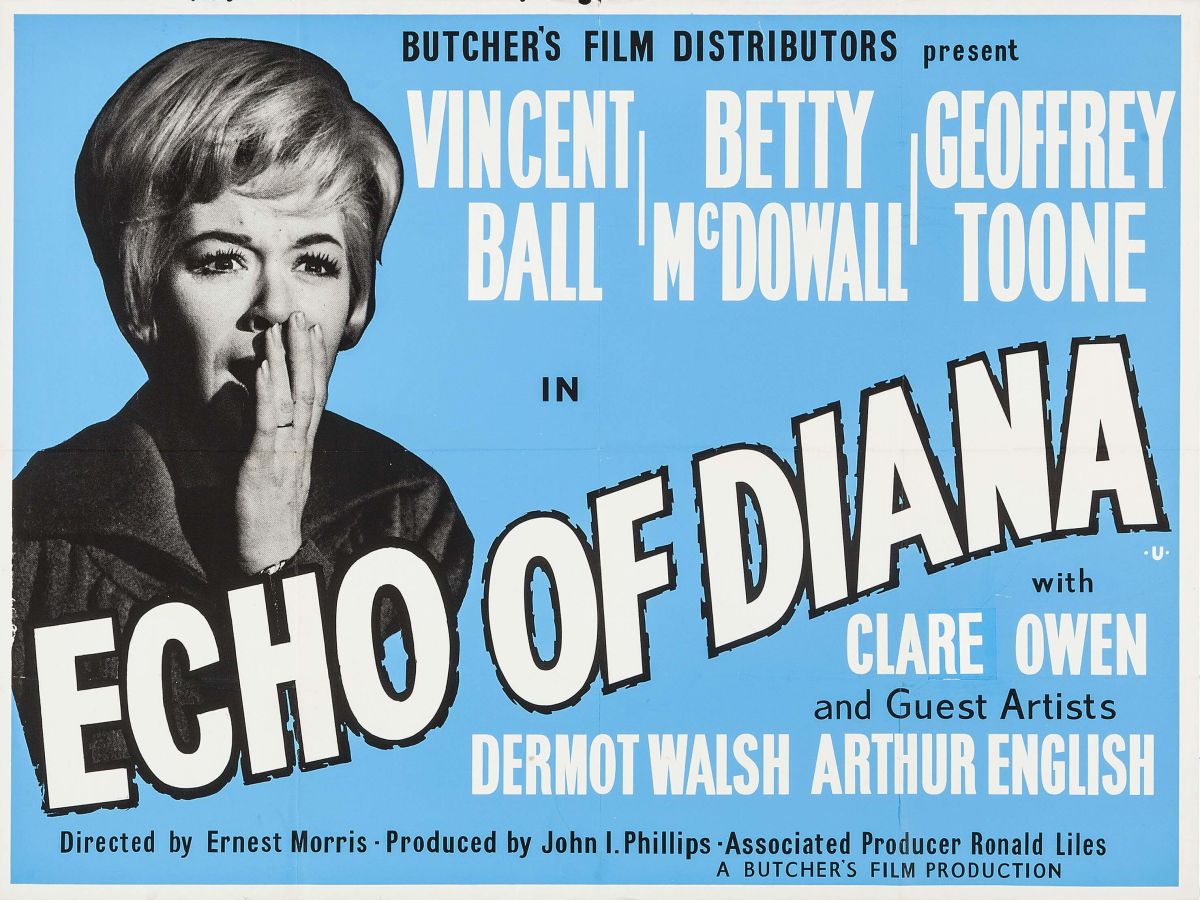
Minor British B-picture gem, though more for the exquisite narrative and tsunami of twists than the acting. And while not being one of those devious arthouse farragoes spins the starting point as the climax. Also, very prescient, heavily reliant of the espionage tradecraft that would later become de rigeur.
On the day she learns of her husband’s death in a plane crash in Turkey, Joan (Betty McDowall) finds an intriguing reference to the dead man in the “Personal Column” of The Times newspaper signed by “Diana.” Suspecting a mistress or skulduggery, her friend Pam (Clare Owen), a former fashion editor, investigates and triggers trouble. Joan’s flat is burgled, they are accosted by dubious police, the dead man’s effects are foreign to Joan, the receptionist at a newspaper makes a mysterious phone call.
Fairly quickly, Joan and Pam fall in the purlieu of British espionage chief Col Justin (Geoffrey Toone) who puts them in touch with suave journalist Bill (Vincent Ball), an old colleague of the husband, whose apartment has also been tossed, and who has taken a shine to Pam. The women are somewhat surprised when a murder is hushed up but that’s the least of the espionage malarkey. Mysterious contacts, equally odd points of contact, disguises (though mostly this runs to a blonde wig), code names, double agents, phone tapping and mail drops leave the women somewhat befuddled but they play along and with that British bluffness, not quite aware they are acting as decoys to draw out a crew of foreign spies headed by a rough fella called Harris (Basil Beale).
Halfway through it seems her husband might not be dead after all, but, according to the Turkish ambassador, Joan might need to head off to Turkey or thereabouts and certainly other interested parties want her out of the country.
And it being British, and nobody wanting to take the whole thing seriously, especially since the James Bond boom had not begun in earnest, the drama is offset by some pointed comedy: the proprietor of an accommodation address business has a side hustle in porn mags, one of the contacts is annoyingly punctilious, one promising lead turns out to be a very grumpy old man, another lead results in a race horse called Diana in a grubby betting shop where they are rooked by another old guy.
But it’s lavished with twists: double-crossers double-crossed, misleading clues, bad guys far cleverer than good guys, the wrong person in the right car, kidnap, unexpected occurrence. Pretty contemporary, too, with much of the action driven by telephone calls. But something of an ironic climax, the notice in the newspaper having legitimate espionage purpose.
The action is so pell-mell, Joan and Pam scarcely have time to draw breath, never mind give vent to heavy emotion, the best we are afforded is a moment when Joan doesn’t know “whether she’s wife or widow.” But that’s just as well. We are in B-movie land with a B-movie class of actors, probably recognizable to audiences then as the kind of actors who never managed a step up.
Vincent Ball did best, a long-running role in BBC TV series Compact (1962-1965), male lead in skin flick Not Tonight, Darling (1971) and decades of bit parts. You might have caught Betty McDowell in First Men in the Moon (1964) or The Omen (1976). Clare Owen was female lead in Shadow of Fear (1963) and had a part in ITV soap Crossroads (1965-1972).
Directed by Ernest Morris (Shadow of Fear) from a script by Reginald Hearne (Serena, 1962). You’d say a better script than a movie, and with better casting might have taken off, but, still, very satisfying supporting feature for the times.
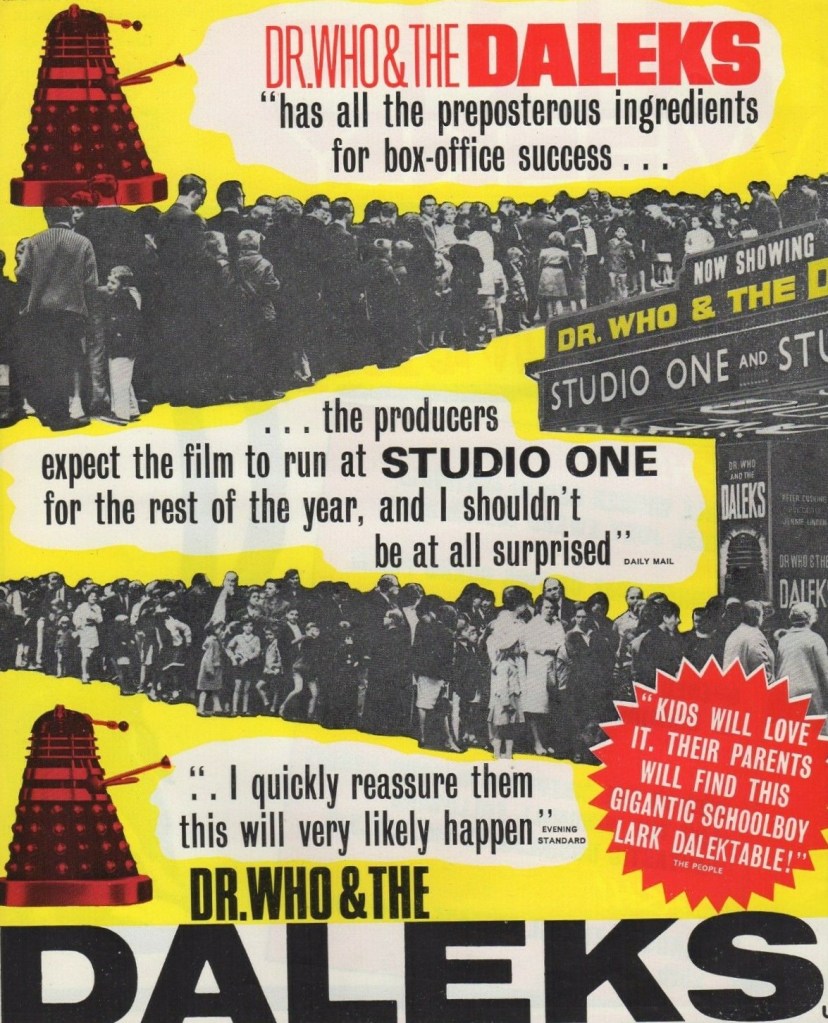
The maiden voyage of the time-travelling Tardis is triggered by some unexpected pratfall comedy. On board are the venerable doctor (Peter Cushing), his intrepid great-granddaughter Susan (Roberta Tovey) and a fearful pair, granddaughter Barbara (Jennie Linden) and accident-prone Ian (Roy Castle). They land on a petrified planet ruled by the robotic Daleks with menacing electronic voices.
The malfunctioning Tardis forces them to investigate an abandoned city but they are quickly imprisoned, the steel robots determined to discover why the earthlings should be immune to the radiation that has consumed this planet after nuclear war. Meanwhile, the planet’s remaining inhabitants, the Thals, are planning an uprising.
Budget restrictions ensure that menace is limited, even as the characters endure a heap of traditional obstacles such as swamp and rocky outcrop. Adults who did not grow up in the 1960s when the BBC television series took Britain by storm and apt to come at this without the benefit of nostalgia will certainly look askance at the sets and costumes. And it doesn’t possess the so-bad-it’s-good quality of some 1950s sci-fi pictures. But since it was primarily made for children, then perhaps it’s better to watch it with a younger person and gauge their response – of course, that may be equally harsh from someone brought up on the modern version of the series or already immersed in superheroes.
On the plus side, it does move along at a clip. Roberta Tovey (A High Wind in Jamaica, 1965) charms rather than annoys as the plucky grand-daughter even if her grandfather has mutated from the sterner figure of the television series into an eccentric inventor. Peter Cushing (The Skull, 1965) is only required to ground the production which he does adequately. The innate comic timing of comedian Roy Castle, in his leading man debut, brings a light touch to proceedings as the bumbling boyfriend and generates some decent laughs. Jennie Linden (Women in Love, 1969) has little to do except look scared.
Oddly enough, it was American Milton Subotsky who, in opportunistic fashion, brought the project to the big screen, although the BBC had a track record of providing product that might make such a leap, The Quatermass Experiment in the 1950s the leading example. He wrote the screenplay and acted as producer and had previously worked with Cushing on Dr Terror’s House of Horrors (1965) and was about to embark on horror masterpiece The Skull the same year. He has approached the material with some reverence and the fact that the budget allowed for hordes of Daleks rather than being seen one or two at a time as on the television probably made some child’s day.
Scottish director Gordon Flemyng (The Split, 1968) would make the leap to Hollywood on the back of this picture and its sequel the following year and you can see what made studios have faith in his ability – he deals with multiple characters, works quickly on a low budget and delivers an attractive picture that was a box office hit.
I suspect that audiences will divide into those who watch the film with nostalgia-colored spectacles, those who think it only as good as a bad episode of Star Trek and those who adore any low-budget sci-fi movie.
Charm was in short supply in the 1960s. Sure, for a period you still had Cary Grant but David Niven was as often to be found in an action picture (The Guns of Navarone, 1961) or a drama, and others of the ilk, like Tony Curtis, veered more towards outright comedy. Britain had something of what would today be called a “national treasure,” admittedly a term more likely to be accorded females of the standing of Maggie Smith or Judi Dench; maybe a space might be found for the idiosyncratic Ralph Richardson. Dare I put Leslie Phillips into contention for such an honor?
Once into his mellifluous stride and with his trademark appreciation of female beauty, “Ding dong!” a more welcome remark than the more common “Cor!” or “Strewth” or sheer inuendo, Leslie Phillips, not so well known perhaps in the USA and foreign parts, would fit that definition. He had charm in spades.
Unfortunately, you could split his career into those roles where “ding dong” entered the equation and those it did not. This is one of those, and I have to confess I’m both disappointed and delighted. Dissatisfied because the charm appeared part of his screen persona, but pleased whenever I found out he wasn’t tied down to it and could essay other characters just as well.
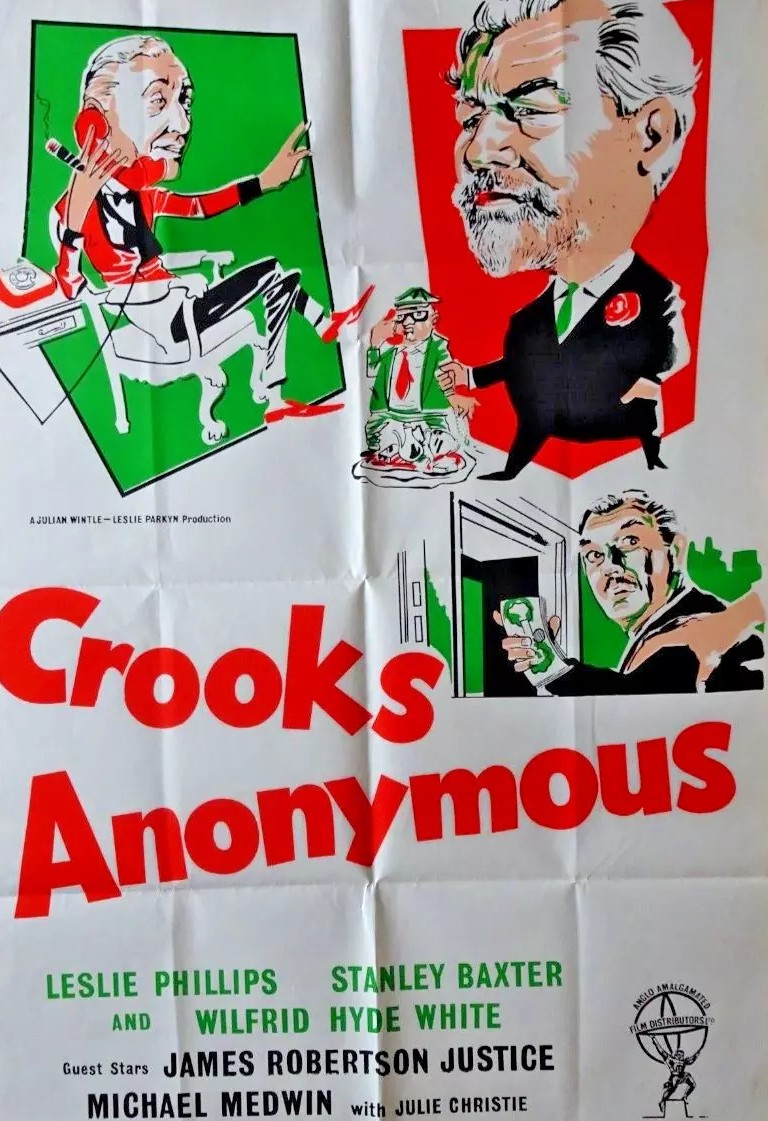
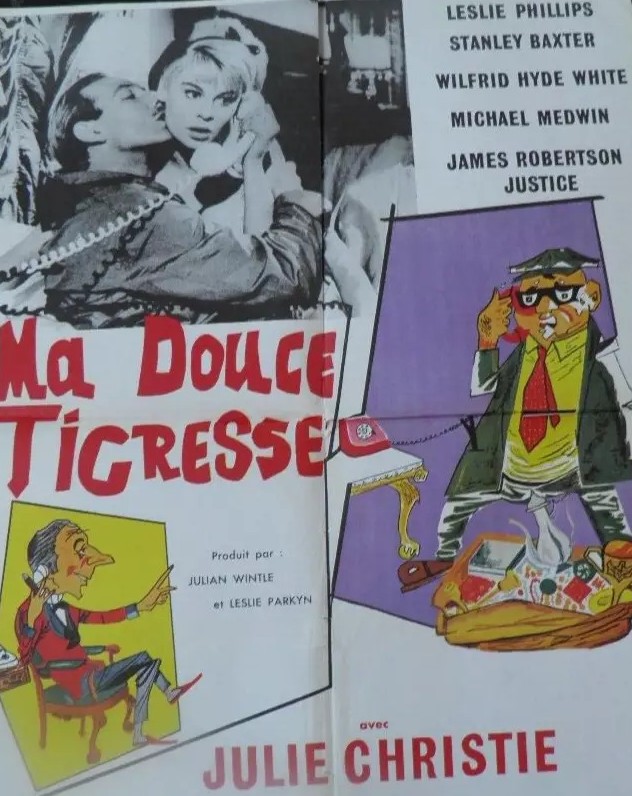
Here, here’s shifty criminal Dandy, whose only redeeming feature is that somehow he has acquired a beautiful girlfriend, stripper Babette (Julie Christie), who, despite her profession
appears to have steered cleared of seediness and insists he goes straight before she consents to marriage. And that would be fine, except what can Dandy do when faced with such obvious temptation and jewels left idly on a counter in a jewellery?
When she catches him out, he is sent to the criminal version of Alcoholics Anonymous where he is at the mercy of a particularly sadistic “guardian angel” Widdowes (Stanley Baxter – in a variety of disguises). He is locked in a cell full of safes. Food, cigarettes etc are hidden inside the safes, so to eat and satisfy his smoking habit, he must open them. The logic, presumably, is that he will grow sick and tired of opening so many safes for so little reward.
Maybe it’s the hidden punishments – a touch of electrocution and various other booby traps – that do the trick. Or, it could be the glee of Widdowes. When Dandy finds cigarettes, they come without any means of lighting them. He pleads with Widdowes to point him in the direction of a safe containing means of ignition.Replies the “angel”, “I’m glad you asked that because I’m not going to tell you.”
There’s a whole raft of comedy skits revolving around temptation, mostly involving Widdowes in one guise or another. And when the movie stays with Widdowes and a bunch of other reformed criminals, it fairly zips along. But once Dandy is released and plot rears its ugly head it falls back on more cliché elements.
Dandy manages to go straight, employed as a Santa Clause in a department store, while Babette decides to give up her job so both can start afresh. Unfortunately, temptation raises its ugly head to the tune of a quarter of a million pounds and all those goody-two-shoes reformed criminals line up to take a crack at it. The twist, which you’ll already have guessed, is that they have to break into the vault again to return the money they have stolen.
Scottish comedian Stanley Baxter was going through a phase of attempting to become a movie star and was given a fair old crack at it – The Fast Lady (1962) and Father Came Too (1964) followed, the former with both Philips and Christie, the latter with just him.
But what was obvious from Crooks Anonymous was that Baxter was better in disguise – and the more the merrier – than served up straight. He steals the show here where in the other movies his character is more of an irritant.
A well-meaning Leslie Phillips somehow snuffs out the charm and there’s not enough going on between him and Babette when he’s full-on straightlaced. Heretical though it might be, there’s not enough going on with Julie Christie either to suggest she might be Oscar bait. Here’s she’s just another ingenue.
Wilfrid Hyde-White (P.J. / New Face in Hell, 1967), another who generally traded on his charm (in a supporting category of course), is also in the disguise business, so he steals a few scenes, too. James Robertson Justice (Father Came Too) would have stolen the picture from under the noses of Baxter and Phillips had he been given more scenes.
Directed by Ken Annakin (Battle of the Bulge, 1965) from a screenplay by Jack Davies and Henry Blyth (Father Came Too).
I might have preferred Phillips in “ding dong” persona, but this works out okay, especially in the scenes set in the criminal reform school.
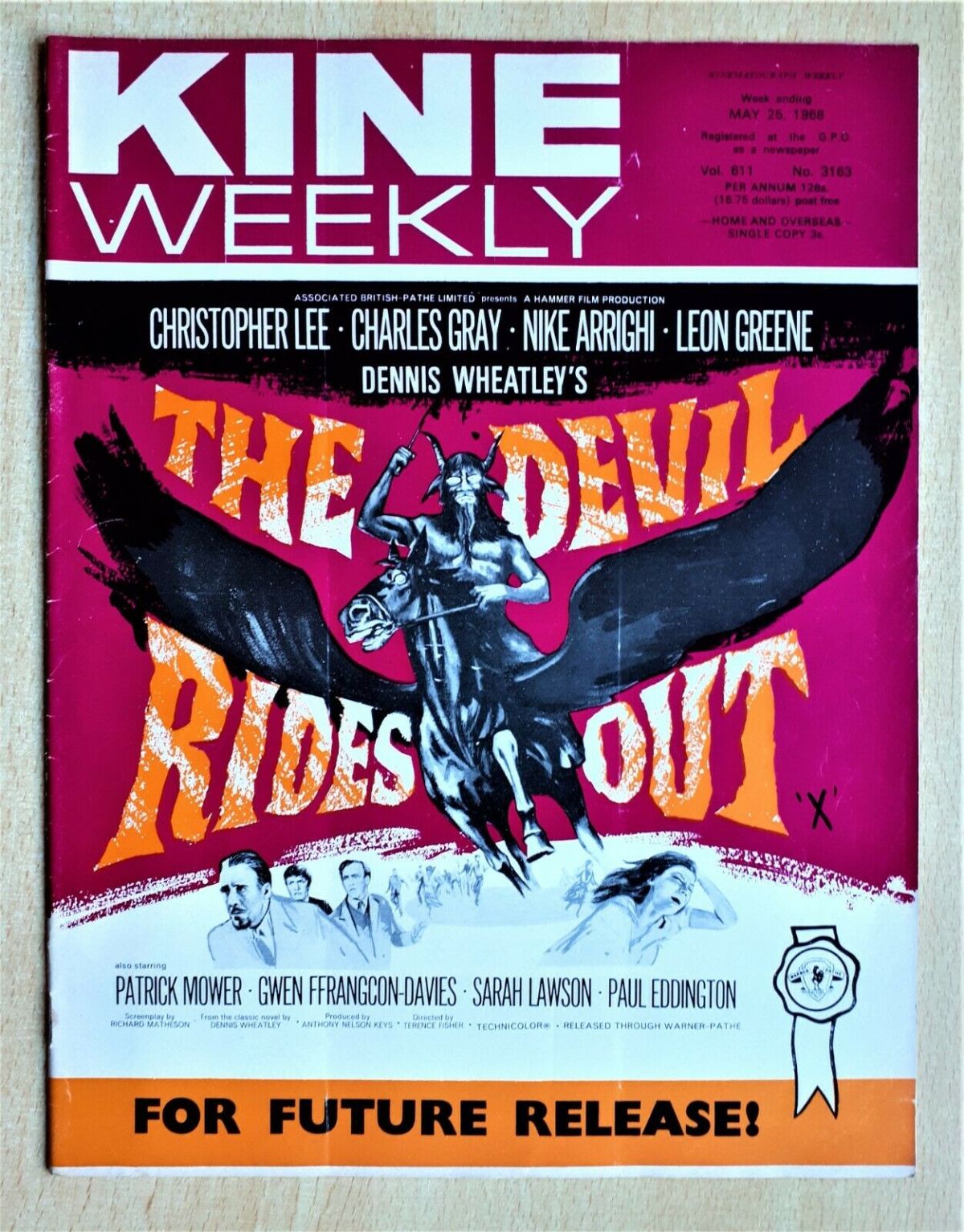
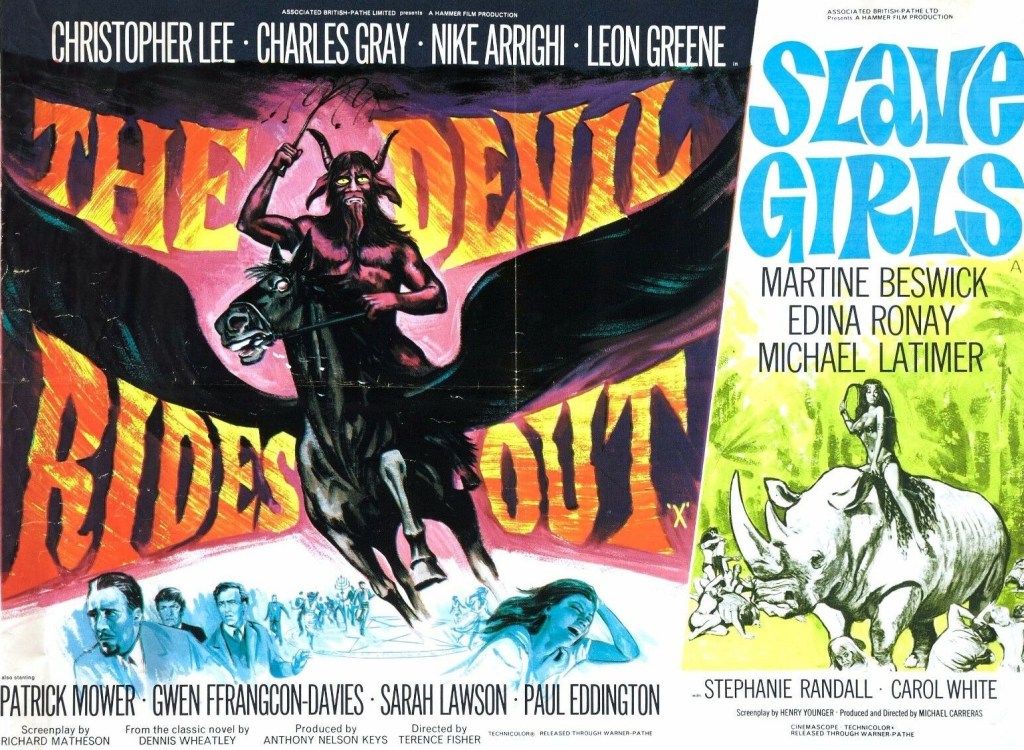
Strong contender for Hammer’s film of the decade, a tight adaptation of Dennis Wheatley’s black magic classic with some brilliant set pieces as Nicholas de Richleau (Christopher Lee) battles to prevent his friend Simon (Patrick Mower) falling into the hands of satanist Mocata (Charles Gray).
Initially constructed like a thriller with Simon rescued, then kidnapped, then rescued again, plus a car chase, it then turns into a siege as Richleau and friends, huddled inside a pentagram, attempt to withstand the forces of evil. Sensibly, the script eschews too much mumbo-jumbo – although modern audiences accustomed to arcane exposition through MCU should find no problem accommodating ideas like the Clavicle of Solomon, Talisman of Set and Ipsissimus – in favour of confrontation.
Unlike most demonic pictures, de Richleau has an array of mystical weaponry and a fund of knowledge to defend his charges so the storyline develops along more interesting lines than the usual notion of innocents drawn into a dark world. In some senses Mocata is a template for the Marvel super-villains with powers beyond human understanding and the same contempt for his victims. And surely this is where Marvel’s creative backroom alighted when it wanted to turn back time. Though with different aims, De Richleau and Mocata are cut from the same cloth, belonging to a world where rites and incantations hold sway.
While special effects play their part from giant menacing tarantulas and the Angel of Death, the most effective scenes rely on a lot less – Simon strangled by a crucifix, Mocata hypnotizing a woman, a bound girl struggling against possession. Had the film been made a few years later, when Hammer with The Vampire Lovers (1970) and Lust for a Vampire (1971) increased the nudity quotient, and after The Exorcist (1973) had led the way in big bucks special effects, the black mass sequence would have been considerably improved.
The main flaw is the need to stick with the author’s quartet of “modern musketeers” which means the story stretches too far in the wrong directions often at the cost of minimizing the input of de Richleau. In the Wheatley original, the four men are all intrepid, but in the film only two – de Richleau and American aviator Rex van Ryn (Leon Greene) – share those characteristics. At critical points in the narrative, de Richleau just disappears, off to complete his studies into black magic. Where The Exorcist, for example, found in scholarship a cinematic correlative, this does not try.
Christopher Lee (She, 1965), pomp reined in, is outstanding as de Richleau, exuding wisdom while fearful of the consequences of dabbling in black magic, both commanding and chilling. Charles Gray (Masquerade, 1965) is in his element, the calm eloquent charming menace he brings to the role providing him with a template for future villains. The three other “musketeers” are less effective, Patrick Mower in his movie debut does not quite deliver while Leon Greene (A Challenge for Robin Hood, 1967) and Paul Eddington (BBC television’s Yes, Minister 1980-1984) are miscast. Nike Arrighi, also making her debut as love interest Tanith, is an unusual Hammer damsel-in-distress.
Hammer stalwart Terence Fisher (The Gorgon, 1964) creates a finely-nuanced production, incorporating the grand guignol and the psychological. Screenwriter Richard Matheson (The Raven, 1963) retains the Wheatley essence while keeping the plot moving. A few years later nudity was no longer be an issue and Hollywood injected big bucks in horror special effects, so with those constraints in mind the studio did a devilish good job.
BOOK INTO FILM
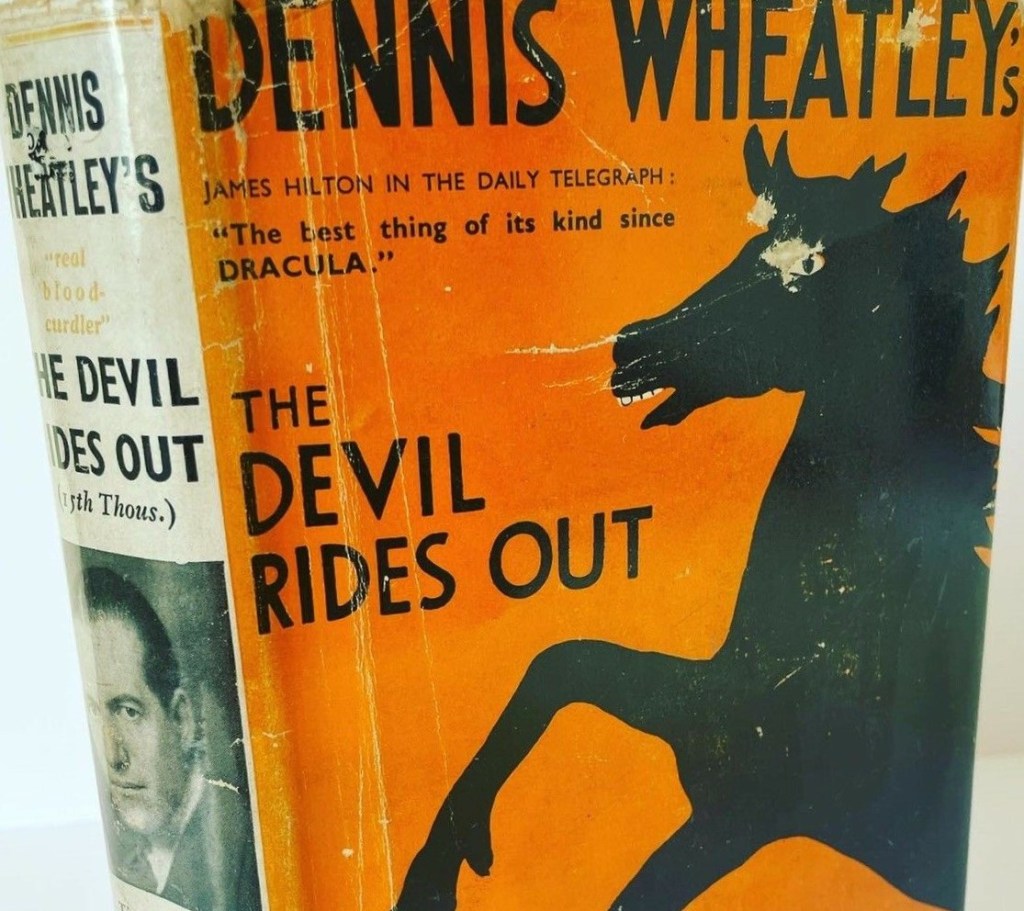
Dennis Wheatley was a prolific bestseller producing three or four titles a year, famous for a historical series set around Napoleonic times, another at the start of the Second World War and a third featuring the “four modern musketeers” that spanned a couple of decades. In addition, he had gained notoriety for books about black magic, which often involved series characters, as well as sundry tales like The Lost Continent. Although largely out of fashion these days, Wheatley set the tone for brisk thrillers, stories that took place over a short period of time and in which the heroes tumbled from one peril to another. In other words, he created the template for thriller writers like Alistair MacLean and Lee Child.
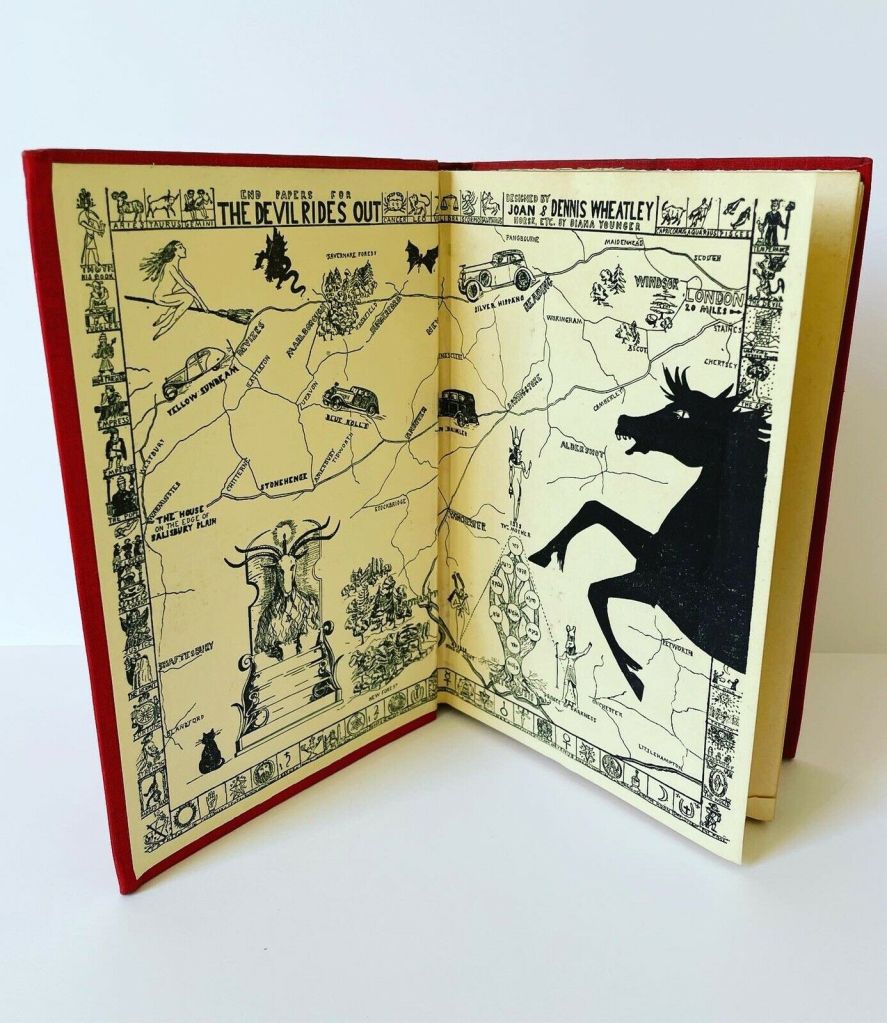
The Devil Rides Out, his fourth novel, published in 1934, featured the “musketeers” involved in his phenomenally successful debut The Forbidden Territory (1933), and introduced readers to his interest in the occult. Although of differing temperaments and backgrounds his quartet – the Russian-born Duke De Richleau (Christopher Lee in the film), American aviator Rex Van Ryn (Leon Greene) and wealthy Englishmen Richard Eaton (Paul Eddington) and Simon Aron (Patrick Mower) – are intrepid. And while screenwriter Richard Matheson stuck pretty much to the core of the Wheatley story, the film was hampered by the actors. The laid-back Paul Eddington hardly connects with the Wheatley characterization and Patrick Mower is too young for Aron.
As with the book, the story moves swiftly. Worried that Aron is dabbling in the black arts, De Richleau and Van Ryn go haring down to his country house where they meet black magic high priest Mocata (Charles Gray) and discover tools for satanic worship. And soon they are embroiled in a duel of wits against Mocata, climaxing in creating a pentagram as a means of warding off evil.
In order not to lose the audience by blinding them with mumbo-jumbo the script takes only the bare bones of the tale, bringing in the occult only when pivotal to the story, and that’s something of a shame. A modern audience, which has grown up on enormously complicated worlds such as those created for Game of Thrones and the MCU, would probably have welcomed a deeper insight into the occult. While out-and-out thrillers, Wheatley’s novels also contained copious historical information that he was able to dole out even when his heroes were in harm’s way. The Devil Rides Out is not a massive tome so it’s a measure of the author’s skill that he manages to include not just a condensed history of the occult but its inner workings. Every time in the film De Richleau goes off to the British Library for some vital information, his departure generally leaves a hole, since what he returns with does not always seem important enough to justify his absence.
But then the screenwriter was under far more pressure than a novelist. In some respects, this book like few others demonstrated the difference between writing for the screen and writing for a reader. With just 95 minutes at his disposal, Matheson had no time to spare while Wheatley had all the time in the world. Wheatley could happily leave the reader dangling with a hero in peril while dispatching De Richleau on a fact-finding mission, the action held up until his return. It’s interesting that Matheson chose to follow Wheatley’s characterization of De Richleau, who didn’t know everything but knew where to look. Matheson could easily have chosen to make De Richleau all-knowing and thus able to spout a ton of information without ever going off-screen.
But here’s where the book scores over the film. The reader would happily grant Wheatley his apparent self-indulgence because in the book what he imparted on his return, given the leeway to do so, was so fascinating. There are lengthy sections in the book which are history lessons where De Richleau gives readers the inside track on the satanic. In the opening section, once De Richleau and Van Ryn have rescued Aron, the author devotes a full seven pages to a brief introduction to the occult that leaves the reader more likely to want more of that than to find out how the story will evolve. He has hit on a magic formula that few authors ever approach. To have your background every bit as interesting as the main story is incredibly rare and it allowed Wheatley the opportunity to break off from the narrative to tell the reader more about the occult, which in turn, raised the stakes for the characters involved.
Dennis Wheatley
Effectively, there was too much material for a screenwriter to inflict upon an audience ignorant of the occult. Some decisions were clearly made to limit the need for lengthy exposition. But these often work against the film. For example, Mocata wants the Talisman of Set because it bestows unlimited power with which he can start a world war, but in order to accomplish that he needs to find people with the correct astrological births, namely Simon and Tanith. But this element is eliminated from the story, making Mocata’s motivation merely revenge. Matheson also removed much of the historical and political background, replaced the swastika as a religious symbol with the more acceptable Christian cross, and deleted references to Marie’s Russian background. Her daughter Fleur becomes Peggy. Matheson also treats some of the esoteric light-heartedly on the assumption that seriousness might be too off-putting.
Overall, the adaptation works, you can hardly argue with the movie’s stature as a Hammer classic, but the more you delve into the book the more you wish there had been a way for much of the material to find its way onscreen and to inform the picture in much the same way as the depth of history and character backstory added to Game of Thrones.
A hoot. Definitely a contender for that most sought-after of categories – the cult movie.
When I tell you it’s Vincent Price in a western you’ll see how much fun this could be. Price spent virtually a whole decade locked into horror typecasting, those distinctive tones dealing out doom. But like all typecast actors, no doubt he was desperate to show what he could do when the horror shackles were removed.
Trouble is – he does too much. This a lollapalooza performance, so wild and barmy it will have you in stitches, at the same time as wondering what the hell was going on in his head, and why he thought such barnstorming was required, as if he felt he had to steal a picture of which he was the denoted star.
Though effectively a western with all the tropes of that genre, and a remake to boot of Yellow Sky (1948), this, adding further hilarity and extending the cult status, is set in South Africa, with variable attention paid to accent.
Stretch Hawkins (Robert Gunner) is leader of a gang of outlaws robbing banks in the Transvaal during a gold strike. They escape the pursuing posse by heading into desert territory and eventually, parched, exhausted and suffering from heat stroke, seek refuge in a ghost town, former mining town Yellow Rock abandoned except for two inhabitants, Oupa Decker (Vincent Price) and his grand-daughter Willi (Diana Ivarson).
Naturally, on spotting the lone woman, the outlaws get the wrong ideas. But she soon puts them right. When she’s not holding them at bay with a rifle she’s decking Stretch with a neat right hook. Refusing to offer them any hospitality whatsoever seems particularly mean given the poor chaps are starving and this area is bereft of the animal population- lions, elephants, hogs – that had popped up previously in the way of the random stock inserts you found in any picture set in Africa.
So the fellows spread themselves out along the riverbank which provides the only water in the vicinity and where Willi must come calling, leading to further episodes of predatory sexual behaviour. By now Stretch has taken a liking to Willi, which is eventually reciprocated, and he tends to leap to her defence.
For no apparent reason, the outlaws surmise that the only reason the old man and his daughter are still hanging around this deserted spot is because they have found gold. Instead of doing the obvious and holding the younger woman hostage, Stretch attempts to strike a deal, agreeing to take only half the old man’s £20,000 stake in return for letting them go free.
This doesn’t go down so well with the rest of the gang and the shoot-out, when it occurs, sees Stretch siding with the good guys and turning over such a good leaf that he returns the money he stole to the bank.
Despite Vincent Price threatening to ruin the picture with his mugging there are some nice touches. After Stretch’s romantic overtures are derisively dismissed for him being too smelly, he smartens himself up, coming a-courting (or a rough version of it) in fresh shirt, armpits washed and hair combed. Stretch had a touch of religion in the past when a law-observing farmer. And you can tell what a change is wrought in him when at the end he buys rather than steals a pretty hat for Willi.
It’s true there is a transformation in Vincent Price (The Oblong Box, 1969). But not for the better. The lugubrious delivery is toned down, the iconic full beard reduced to a wisp, he wears a floppy hat, cackles like a madman and every time he looks at the camera it’s with a one-eyed leer. There’s something of the country bumpkin in his interpretation of the part, and that might just be a show put on to fool the outlaws. Whatever it is, it comes across as the barmiest performance this side of the Razzies.
On the other hand Diana Ivarson (Macho Callahan, 1970), in her debut, makes a pretty good stab at the feisty independent western women, channelling her inner Barbara Stanwyck, or in those tight jeans Jane Fonda in Cat Ballou (1965). She’s a sharpshooter, capable of missing “that close on purpose.” Robert Gunner (Planet of the Apes, 1968) is scarcely a decent substitute for Gregory Peck in the original.
Director Robert Webb (The Cape Town Affair, 1967) can do little to rein Price in. Written by Harold Medford (The Cape Town Affair), adapting the original by Lamar Trotti and W.R. Burnett.
But, really, there’s little to save it from being awful except that cult pictures are judged by different criteria and this has all the making of a cult.
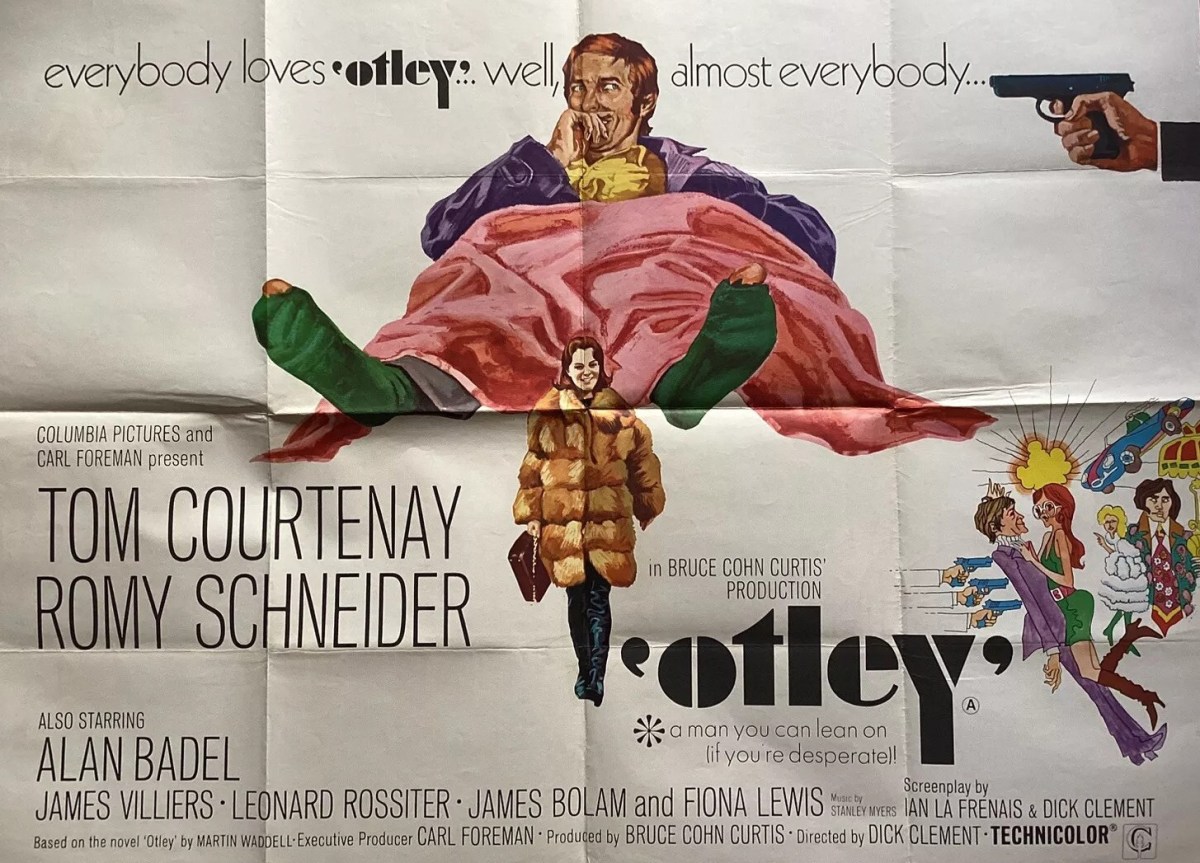
Misguided attempt to play the innocent-caught-up-in-espionage card. And minus the angst on which he had built his screen persona, Tom Courtenay (A Dandy in Aspic, 1968) fails to elicit the spark that would turn himself into a leading man – excepting one other film, this was his last top-billed picture. And anyone hooked by the billing expecting to see a lot of female lead Romy Scheider (The Cardinal, 1963) would equally be in for a surprise.
And that’s a shame because Courtenay can act, not in the Oscar-bait sense, but just in his physical gestures and reactions to whatever else is going on in a scene. Scheider, too, especially in the scene where she more or less laughs in Courtenay’s face when he points a gun at her and in her knowing looks.
But Otley (Tom Courtenay) is such an unappealing character, the movie is on a sticky wicket from the off. Petty thief, largely homeless because of it, his propensity for slipping into his pocket anything that looks valuable in the homes of anyone stupid enough to give him a bed for the night, giving the movie its only sensible piece of narrative drive. Because the rest of the story is a farrago, a series of unconnected episodes dreamed up for their supposed humor, which wants to be pointed and sly but ends up heavy-handed and dreary.
And there’s one of those narrative sleights-of-hand where Otley wakes up on an airport runaway (security impervious to his presence, of course) having misplaced two days of his life. That’s just one of competing narratives – the other being that he’s wanted for the murder of the chap, Lambert (Edward Hardwicke), who was stupid enough to give him a bed for the night. Count in the espionage and there’s a trio of useless narrative hinges that get in each other’s way and largely introduce us to a succession of odd characters.
Pick of these is Johnston (Leonard Rossiter), an assassin who has more lucrative side hustles as a tour coach operator, double-crosser and blackmailer. The only other believable character is the landlady who’s had enough of Otley’s thieving, but only (unbelievable element lurching into view) after she’s bedded him.
The movie just lurches from one scene to another, a car chase that ends up on a golf course, (“Are they members?” cries one outraged lady), a houseboat, various low-life dives and chunks of tourist tat thrown in, a bustling street market, Carnaby St etc. I can’t begin to tell you what the espionage element is because that’s so far-fetched and ridiculous you won’t believe me.
This is the kind of low-budget picture that sets scenes, for no particular reason except they’re part of tourist London, in the Underground, but a completely empty Underground, not another person in sight, and not late at night either which would be a saving grace, though clearly it was filmed either late at night or early in the morning when the Underground was closed to ordinary passengers (thus saving on the budget).
Two examples of how heavy-handed the humor is: on a farm having been doused in water by Johnston, Otley remarks that he’s now deep in the proverbial only for the camera to cut to his foot sinking into a cowpat. At the airport, a couple of staff get lovey-dovey behind a counter, the male sneaking a grope, and we cut to a sign “ground handling”. Ouch and urgh!
If you manage to keep going the only reward is to see a handful of familiar names popping up: Alan Badel (Arabesque, 1966), James Villiers (Some Girls Do, 1969), Fiona Lewis (Where’s Jack?, 1969) and British sitcom legends James Bolam (The Likely Lads and sequel) and Leonard Rossiter (The Fall and Rise of Reginal Perrin, 1976-1979).
And where’s Romy Scheider in all this? Looking decidedly classy, but clearly wondering how the hell she got mixed up in it.
Screenwriter Dick Clement (Hannibal Brooks, 1969) made his movie debut on this clunker. He co-wrote the picture with regular writing chum Ian La Fresnais from the novel by Martin Waddell.
What happens when a genre cycle – in this case the espionage boom – gets out of control.
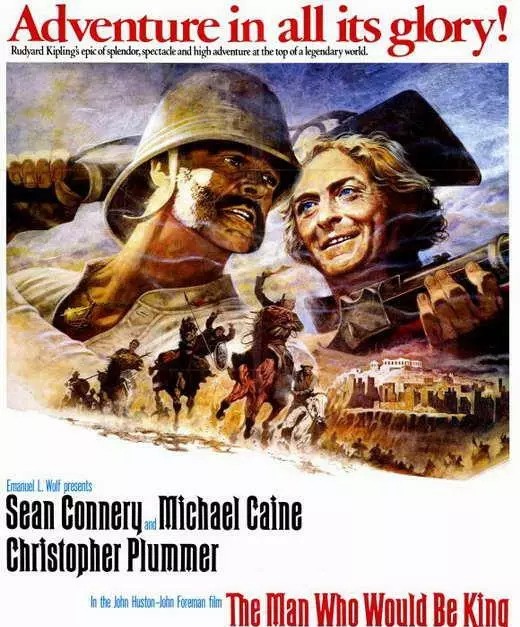
Variation on the director’s earlier The Treasure of the Sierra Madre as a pair of British ex-military cheekie chappies whose reach exceeds their grasp come unstuck when confronted by powerful religious elements. Enticingly presents a marvellously ironic puzzle – you can have everything your heart desires except anything that would make you human. And elevated less by John Huston’s cinematic achievement than by terrific performances by the two stalwarts of the British film industry at the time, Sean Connery and Michael Caine, the former taking the acting kudos by a nose as the less intelligent of the duo. Given Connery’s standing at the time, this was somewhat playing against type. Yes, he exudes screen charisma and is a macho as ever, but nonetheless not quite as quick on the uptake as the more calculating Caine.
Story is told in flashback after a maimed Peachy Carnehan (Michael Caine) turns up as the offices of journalist Rudyard Kipling (Christopher Plummer). They originally met when Peachy had stolen the writer’s watch, returning it on realizing they were fellow freemasons. With buddy Daniel Dravot (Sean Connery), they attempt to enlist Kipling in a blackmail scheme and in due course the soldiers set off to make their fortunes in the forbidding land of Kafiristan, at the top of the Indian sub-continent, where no white man has set foot since Alexander the Great.
Their scheme is simple – to hire themselves out as mercenaries to various tribes, bringing modern warfare skills and weaponry to primitive society and ascending the ranks of power. When Daniel appears unhurt after plucking an arrow out of his chest, the natives confer on him the status of god, and so he is elevated to kingshippery and all the gold he could want. But in this Garden of Eden there is a humdinger of a Catch 22, the apple he must not touch.
He can’t take a wife.
You can see the logic. As a god you should be above base earthly desires. A god could not possibly wish such intimacy with a human. Otherwise he would lose his otherworldly sensibilities, not to mention that the chosen woman would expect to physically explode. While the more sensible Peachy has been all the time calculating just how he’s going make a getaway with as much gold as he can carry, Daniel becomes trapped in the notion that he can have his cake and eat it.
The religious hierarchy says otherwise and it doesn’t end well.
Audiences may well have been disappointed at the lack of action. There’s only one battle and it’s over in a minute, albeit that there’s a timeout to make the point about the power of religion. And although our boys endure a momentous trek it’s fairly standard stuff and Huston lacks the vision of a David Lean to turn the journey into anything more dramatically or visually memorable. A whole bunch of indigenous background material – including the ancient version of polo where the ball is a human head – doesn’t make up.
What does transform this relatively slight tale is the playing. Connery and Caine are a delight, the kind of top-of-the-range double act on a par with the cinemagical pairing of Paul Newman and Robert Redford in Butch Cassidy and the Sundance Kid (1969) and The Sting (1973). They spark each other off just a treat. Caine, surprisingly, is the one in charge, Connery adrift in matters of arithmetic, strategy and, when it comes down to it, common sense even though when called up to judge on civil matters proves himself relatively astute and fair.
The writing, too, seems to understand implicitly how to get the best out of the characters. When they fall out, it is so subtle you would hardly notice. Caine scarcely bristles when Connery explains that Caine really should be falling in line with the rest of his subjects and bowing his head, but if you are astute reader of an acting face you can see the chasm that has opened up in their relationship.
To employ a Scottish phrase, Connery gives it “laldy” – acts with gusto – when playing the part of a madman, whirling around like a demented dervish, but mostly reins it in.
The intricacies of freemasonry would wait a few decades before called to the cinematic altar in The Da Vinci Code (2006) but here the mumbo-jumbo proves less important than, as with the Dan Brown epic, a symbol, and, again with the lightest of narrative strokes, we are left considering its mystic origins.
John Huston (Sinful Davey, 1969) back on top form but he’s more than helped by exceptional acting by Sean Connery (The Hill, 1965) and Michael Caine (Play Dirty, 1968) with Christopher Plummer (Nobody Runs Forever / The High Commissioner, 1968) in unusually subtle form as well. Gladys Hill (Reflections in a Golden Eye, 1967) and Huston were Oscar-nominated for the the screenplay based on the Kipling short story.
Impressed by this performance I should warn you I feel a Sean Connery binge coming on.
Exceptional down-and-dirty thriller and throwback film noir woefully underrated on release but with a brilliant mystery (or two), a touch of satire, red herrings, some great lines, and believable characters. Private eye P.J. Detweiler (George Peppard) is so down on his luck he is willing to play the lover so an errant wife can be photographed in a motel room. What little he earns goes on paying is debts. So he can hardly down the chance of serious money as bodyguard to Maureen (Gayle Hunnicutt), mistress of rich businessman William Orbison (Raymond Burr), never mind that she initially treats him as a servant.
Orbison has a legendary mean streak – secretaries have to type closer to the edge of sheets of paper, he forces wife Betty (Colette Gray) to account for every dime of her allowance to the point of almost making her beg. Sadism is another character trait. He is happy not to kill off animals he has shot. The childless millionaire adds Maureen to his will for the sole purpose of upsetting every other potential heir. In front of guests at a prestigious party he forces Betty to acknowledge Maureen’s existence.
This apparently wealthy world is riddled with seedy inhabitants, whose only motivation is greed, all desperate to retain status or inheritance and enjoying Orbison’s largesse, which, despite his miserly nature, he nonetheless flaunts. As well as Betty enduring ritual humiliation to remain his wife and enjoy a gilded lifestyle, his executive assistant Jason (Jason Evers) accepts being treated as a gofer in order to keep his position and the perks that go with it, and Maureen makes no bones about prostituting herself for temporary and future gain. Everyone has to kowtow, even the occupants of a West Indian island dependent on Orbison for investment, not only a kids choir welcoming Orbison on arrival, but a calypso performer singing a song in his praise.
As various threats, including narrowly missing a bullet, are made against Maureen, making a classical entrance in a red dress and alternating between helpless victim and femme fatale, with her creepy manservant Quell (Severn Darden) reporting on her every move, inevitably Detweiler grows closer to his client, unaware that Orbison is planning to have someone killed.
That someone turns out to be Jason, whom Orbison suspects of clandestine activity with his wife, and whom Detweiler innocently kills. As this takes place on the island, where the death is easily hushed up, Detweiler begins to wonder if he’s a patsy and, paid off by Orbison, undertakes his own investigation, quickly entering more dangerous waters, viciously beaten up at Quell’s behest in a gay bar, narrowly avoiding death in the subway and literally finding himself in the firing line.
Detweiler’s character undergoes transition, too. From begging for scraps and turning the other way so as not to jeopardize easy income, he rediscovers his suit of shining armor, walking down some pretty mean streets, a diligent private eye who can no longer be bought off, determined to get to the bottom of what turns out to be a complicated mystery.
Detweiler is no Marlowe or even Tony Rome, but rather despicable at the outset, employing all sorts of dodges, his interest in Maureen not slackening even after he knows she indulges in a quickie with Orbison. He takes too much at face value.
The unfolding mystery is superbly handled, involving proper clues and investigation, shoot-outs and fisticuffs, the outcome not what you might initially imagine. Although primarily an old school private eye picture, it’s great fun, with some wonderful comedy involving a dog, gentle satire on the West Indian island where whitewash is the order of the day, and some touching romantic foreplay.
Peppard (Pendulum, 1969) is outstanding as the dupe who rediscovers his moral code and his Detweiler is an excellent addition to the ranks of the private eye. Raymond Burr, a far cry from his Perry Mason (1957-1966) television persona, is easily one of the worst screen millionaires – on a par with Ralph Richardson in Woman of Straw (1964) in his contempt for humanity – and with his silver hair and bulk and scheming proves a slick adversary. Gayle Hunnicutt (Eye of the Cat, 1969) is allure on legs, brilliantly playing every man in sight, eye never diverted from the main chance.
Brock Peters (The Pawnbroker, 1964) has a standout cameo as the island’s cynical police chief. Susan Saint James (The Name of the Game, 1968-1971) makes her movie debut as Orbison’s slinky sex-mad niece. Also putting in an appearance are Wilfrid Whyte-Hyde (The Liquidator, 1965) as the island’s accommodating governor, Colleen Gray (Red River, 1948) as the humiliated wife, Severn Darden as the odious Quell, and John Ford regular John Qualen (The Man Who Shot Liberty Valance, 1962).
This was the second of director John Guillermin’s George Peppard trilogy following The Blue Max (1966) and prior to House of Cards (1968). Generally dismissed as a journeyman, Guillermin brings a sly eye to this picture, the send-up of British colonialism, the master-servant aspects, an over-the-shoulder shot of an unknown assassin, the scenes in the bar which is effectively Detweiler’s office, and a brilliant subway death adding layers to the movie. He is bold in his use of close-ups with Hunnicutt, some scenes almost a homage to the Bogart-Bacall chemistry, and brings out a world-weary performance from the usually cocky Peppard.
Philip Reisman Jr. (All the Way Home, 1963) fashioned the screenplay, delivering one of cinema’s most memorable final lines.
Bracketed with Pendulum and House of Cards demonstrates that Peppard is under-rated.
Woefully under-rated western with three A-list stars at the top of their game in a taut drama with an explosive ending. Not surprising it was overlooked at the time with John Wayne duo El Dorado and The War Wagon, Paul Newman as Hombre and an onslaught of spaghetti westerns garnering more attention at the box office. Though a rewarding watch, be warned this is more of a slow-burn drama than a traditional western and both male leads play against type.
Former lawmen Dolen (George Peppard) and Ben Hickman (John McIntire) have invested in a stagecoach business owned by twice-widowed Molly Lang (Jean Simmons), just about the only business in Jericho in which Alex Flood (Dean Martin) does not have a controlling share. Dolen’s first reaction on surmising Flood’s power is to quit, “stepping in’s a habit I outgrew.” And it’s not a bad approach given that Flood is judge, jury and executioner and apt to leave victims strung up to dissuade dissent.
Dolen and Flood have a great deal in common, moving from ill-paid law enforcement into business, Flood, having cleaned up the town, stayed on to reap the profit. While Dolen avoids confrontation, Molly aims to stir up opposition, invoking ruthless reaction.
What’s unusual about this picture is it’s mostly a duel of minds, Dolen and Flood sounding each other out, neither backing down even while Dolen intends quitting and when he happens to win a bundle on a poker game with Flood you have the notion that was somehow an inducement to help him on his way. It’s a power game of sorts, too, between Dolen and Molly, she determined to give no quarter to the point of drinking him under the table.
But when violence occurs it is absolutely brutal, Flood’s knuckles bloodied raw as he batters a man foolish enough to challenge his rule of law, Dolen taking an almighty whipping from Yarbrough (Slim Pickens), Molly viciously slapped around by Flood for daring to look at Dolen. When Dolen does move into action it is with strategic skill, gradually reducing the odds before the inevitable shoot-out between respectable citizens and gangsters.
A good half-century before the notion took hold, this is a movie as much about entitlement, about those doing the hard work receiving just reward, Flood, having risked his life to tame the town, deciding he should be paid more than a sheriff’s monthly salary. And the western at this point in Hollywood development had precious few female businesswomen in the vein of Molly.
This bold image only appeared in the Pressbook. Maybe Don Siegel was watching and appropriated it for “Dirty Harry.”
Both Dean Martin and George Peppard play against type. An unexpected box office big hitter through the light-hearted Matt Helm series, Martin explodes his screen persona as this vicious thug, town in his thrall, contemptuous of his victims, turning politics to his advantage, but still happy to hand out a beating when charm and chicanery fail. This is one superb, and brave, performance.
For Peppard, this picture is the bridge between the brash persona of The Blue Max (1966) and Tobruk (1967) and the thoughtful introspective characters he brought to life in P.J. / New Face in Hell (1968) and Pendulum (1969). Perhaps the most telling difference is a little acting trick. His blue eyes are unseen most of the time, hidden under the shade of his wide-brimmed hat. He is not laid-back in the modern sense but definitely unwilling to plunge into action, movement both confined and defined, a man who knows his limits and, no longer paid to risk his life, unwilling to do so.
Jean Simmons (Divorce American Style, 1967) is in excellent form, neither the feisty nor submissive woman of so many westerns, but clever and determined, perhaps setting the tone for later female figures like Claudia Cardinale in Once Upon a Time in the West (1969) and Raquel Welch in 100 Rifles (1969).
And this is aw-shucks Slim Pickens (Major Dundee, 1965) as you’ve never seen him before. John McIntire had spent most of the decade in Wagon Train but he punches above his weight as a mentoring lawman. If you are trying to spot any other unusual figures keep an eye out for legendary Variety columnist Army Archerd who has a walk-on part as a waitperson.
More at home in television, director Arnold Laven took to the big screen on rare occasions, only twice previously during the decade for Geronimo (1965) and The Glory Guys (1965), but here he handles story and character with immense confidence and considerable aplomb. The direction is often bold – major incidents occur off screen so he can concentrate on the reactions of the main characters. There is a fabulous drunk scene, one of the best ever – plus an equally good hangover sequence. The violence is coruscating, all the more so because it is not delivered by gun.
There’s a great screenplay by Sidney Boehm (Shock Treatment, 1964) and Marvin H. Albert (Duel at Diablo, 1966) which swings between confrontation and subliminal menace.
This would have been Peppard’s picture, given he was demonstrating under-used acting skills, but he’s been to the draw by even better performances by Dean Martin as you’ve never seen him before and Jean Simmons.
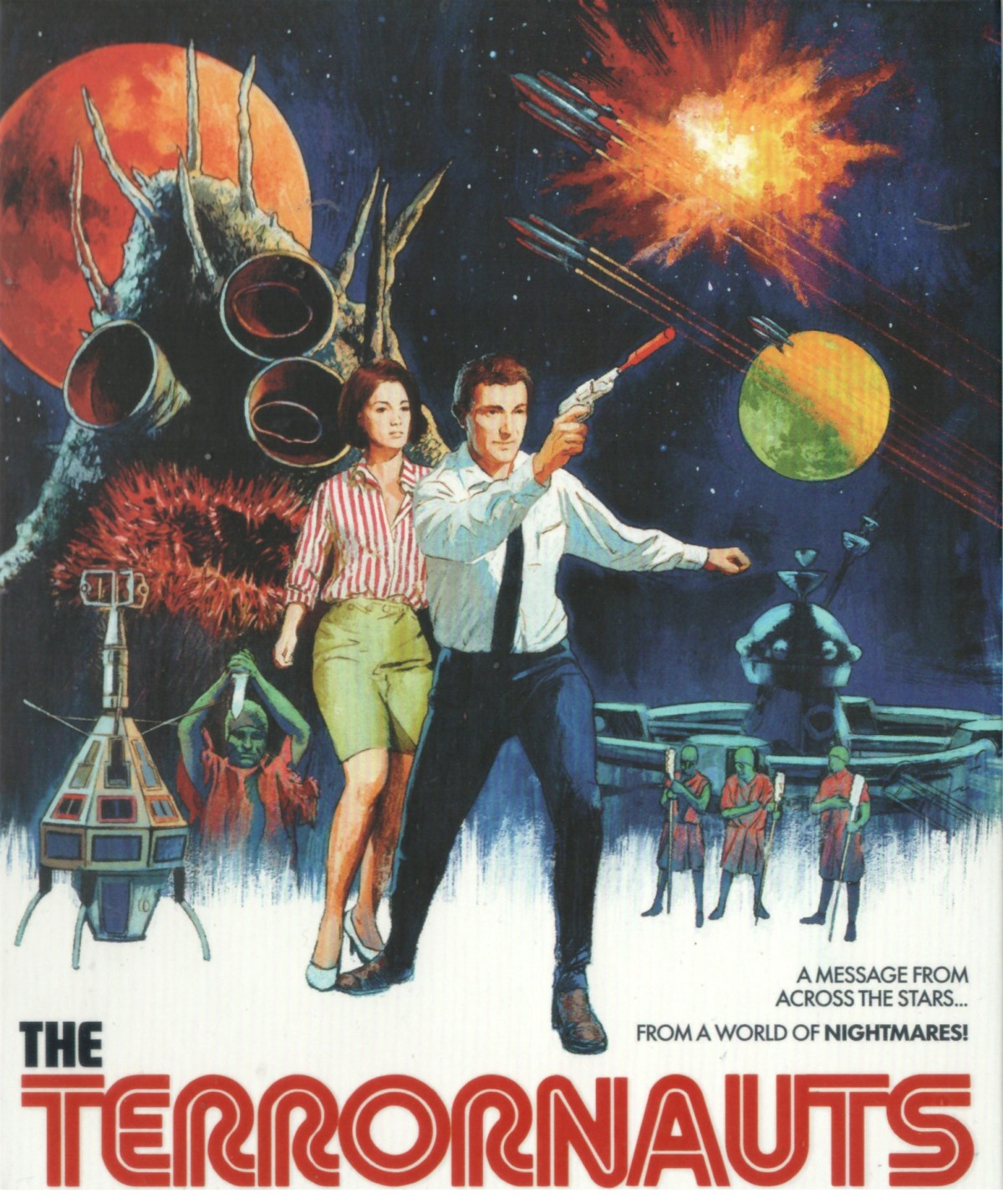
As a result of writing this Blog, I’ve come to the attention of the venerated Los Angeles-based Vinegar Syndrome outfit, specialists in revamped special editions of longlost DVDs, mostly of the cult variety. So I was recently called upon to head into the recording studio and deliver an audio commentary on The Terrornauts (1967), an Amicus production that was funded, somewhat unusually, by Joseph E. Levine, producer of Zulu (1964) and about to become a gazillionaire with The Graduate (1967).
He had commissioned Amicus to bring him a sci-fi double bill, with They Came from Beyond Space (1967) intended as the main feature. This was the program that went out in the United States. But much of the reason for The Terrornauts’ entry into cult territory was that it went A.W.O.L elsewhere, the other picture in Britain going out as the support to a bigger Hollywood-style feature, and so The Terrornauts was effectively left on the shelf.
Where it would have remained except for one of those flukes of the business.
Following the lack of any sightings of The Terrornauts on British cinema screens, star Simon Oates’s career took a dive, and he ended up in a succession of guest appearances on television series.
But then, as luck would have it, one of the earliest television ecological thrillers Doomwatch (1972) put him back in the limelight and, cashing in on that success, The Terrornauts saw the light of day.
Or so the story of revival miracle went.
In fact, I discovered this wasn’t the case at all. The Terrornauts had appeared on movie screens the previous year as support to Flight of the Doves (1971). But that was a flop and pretty much the movie disappeared. And as is the way with movies that vanish for no apparent reason, a groundswell grew.
The result of which is this splendid 4K offering, with yours truly as a bonus feature.
I plugged my forthcoming book King of the Action Thriller, Films from the Mind of Alistair MacLean, due to be published later this year by McFarland, a month or so back. At the time I said it was available for pre-order. Turns out it wasn’t at the time. But it is now.
So what are you waiting for?
My Blogs on Alistair MacLean have proved among the most popular I’ve ever done, so there’s clearly a demand for more. In fact, it was once again, thanks to the Blog, and someone else reading it, that I embarked on the book in the first place.
I’d be remiss in all the flurry of shameless plugs not to mention my audio commentary for Henry Hathaway’s Dean Martin-Robert Mitchum mystery western Five Card Stud (1968) also from Vinegar Syndrome.










 The Magnificent 60s