I am a published author of books about film - over a dozen to my name, the latest being "When Women Ruled Hollywood." As the title of the blog suggests, this is a site devoted to movies of the 1960s but since I go to the movies twice a week - an old-fashioned double-bill of my own choosing - I might occasionally slip in a review of a contemporary picture.
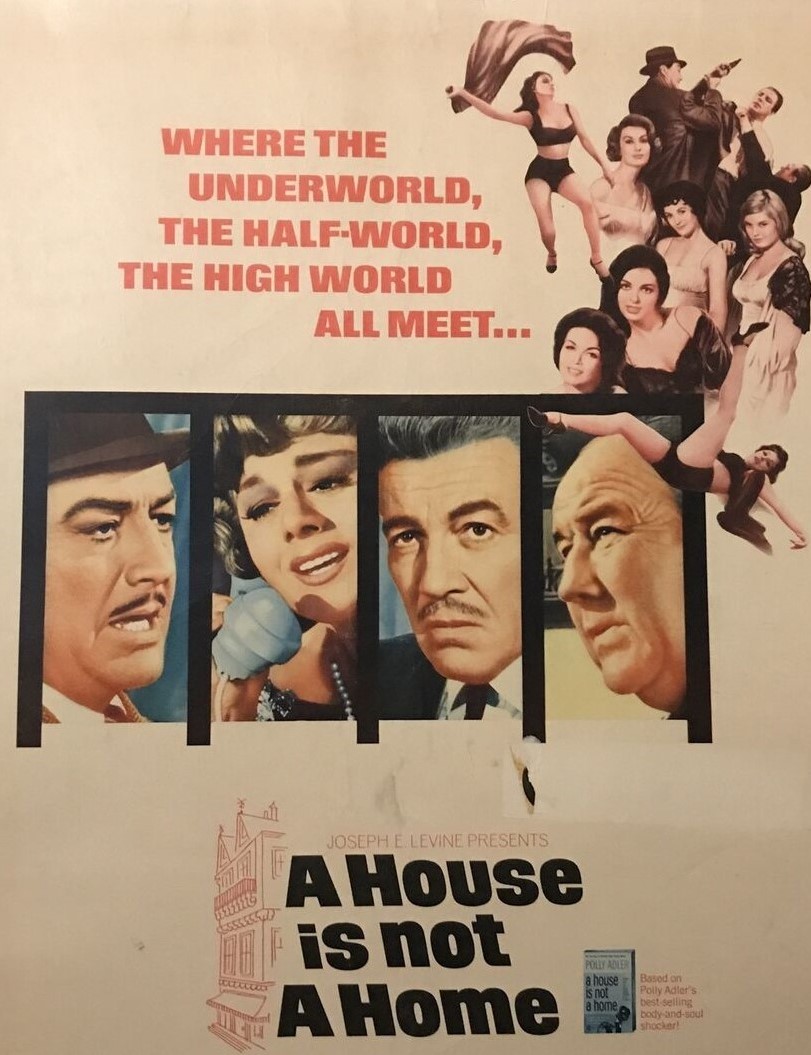
Best remembered these days as the debut film for Raquel Welch (One Million Years BC, 1966), the rest of the film is well worth a look.
Hypocrisy had its heyday in The Roaring 20s when prohibition made bootleggers millionaires, helped bankroll other criminal activities like prostitution and encouraged cops and politicians to seek their share of the loot. No surprise then that the biopic of real-life madam Polly Adler (Shelley Winters) is knee-deep in corruption.
Thrown out of her own home after being raped, Adler finds a knight in shining armor in the shape of bootlegger Frank Costigan (Robert Taylor) and is soon, at first apparently innocently, pimping out her friends. The reality of what becomes her profession is not ignored, the word “whore” bandied around, one girl, Madge (Lisa Seagram), turning junkie as a result while Lorraine (Meri Welles) commits suicide. As in Go Naked in the World (1961) Polly realizes that true love has no place in her world, a relationship with musician Casey (Ralph Taeger) unsustainable.
Adler, in her many voice-overs, explains why vulnerable women become sex workers – poverty, lack of family and lack of hope is her take on it – and she professes to view it as a business and preferable to working in a factory for pitiful wages, but the movie is at its best in linking the nether worlds of infamy and showing that the woman is always the loser. Morality got in the way of portraying Adler as a winner, a successful businesswoman who brought a certain amount of style to the oldest profession. Women profiting from illegal activity would not be deemed heroic (to use the word loosely) until Molly’s Game (2017) and like Jessica Chastain in that film Adler’s love life is in tatters because, like her male counterparts, she devotes so much time to her business.
While any attempt to properly portray the period is hampered by lack of budget, it does provide an array of interesting and occasionally real-life characters, Lucky Luciano (Cesar Romero) for example. A brothel proves an ideal meeting place for crooks and politicians, the latter easily bought by contributions to their campaign funds. Cops are not shy about asking for donations to their Xmas funds or using the facility.
The Adler operation puts a glossy shine on the shady business since all her girls are glamorous. But still the movie pulls no punches except in the case of the madam herself, presented too often as an innocent and who saw nothing wrong in taking as much advantage of the vulnerable girls in her employ as the clients who paid for them. Nonetheless, while Adler attempts to justify her life the film’s moralistic tone undercuts this.
Oscar-winner Shelley Winters (The Chapman Report, 1962), more often a supporting player at this point in the 1960s than the star, grabs the role with both hands and although unconvincing as the younger girl delivers a rounded performance minus the blowsy affectations that marred much of later work. One-time MGM golden boy Robert Taylor, pretty much in the 1960s reduced to television (The Detectives, 1959-1962) and low-budget pictures, shows a glimpse of old form as the smooth bootlegger.
Cesar Romero (Oceans 11, 1960) and Oscar-winner Broderick Crawford (All the Kings Men, 1949) head up a checklist of old-timers filling out the supporting cast. Future director Lisa Seagram (Paradise Pictures, 1997) as the junkie hooker makes the biggest impact among the girls.
From the flotilla of wannabes playing Polly’s girls, apart from Raquel Welch the only one to break into the big time was Edy Williams (Beyond the Valley of the Dolls, 1970). In the main they comprised beauty queens – Amede Chabot (Miss America), Danica d’Hondt (Miss Canada) and Leona Gage (Miss Universe) who had a small part in Tales of Terror (1962). Otherwise Sandra Grant became the most famous – for marrying singer Tony Bennett. Patricia Manning had the most screen experience, second-billed in The Hideous Sun Demon (1958), bit parts in television shows, and fourth-billed in The Grass Eater (1961). Inga Nielsen would later turn up as bikini fodder in The Silencers (1966), In Like Flint (1967) and The Ambushers (1967).
Director Russell Rouse (The Fastest Gun Alive, 1956) was better known for the screenplay of D.O.A. (1949) and had a story credit for Pillow Talk (1959). In fairness, although the film has no great depth, Rouse keeps it ticking along via multiple story strands, although occasional lapses into comedy fail to work. Lovers of curiosities might like to note that Rouse was the producer on an abortive American attempt to remake the classic British television comedy Steptoe and Son for U.S. audiences with Lee Tracy in the role of Albert and Aldo Ray as his son Harold.
This is hard to get hold of. Ebay will be your best bet. Youtube has a print but it’s not in great condition.
Like Skyfall, that rarity, an action film with a solid emotional core. Take away the action and you would still have an absorbing story of a loss, family tension, bickering siblings and an ego-driven pompous father. The action brings family together, initially the two girls, Natasha (Scarlett Johansson) and Yelena (Florence Pugh) rescuing papa Alexei (David Horsburgh) from a Russian maximum-security prison then with the addition of brainy mum Melina (Rachel Weisz) tackling criminal mastermind Dreykov (Ray Winstone) in an exceptionally clever secret location.
If you’ve come looking for simple action, this is the wrong movie for you. Family complication, on a par perhaps with the criminal clan of The Godfather and imbued with the darker hues of Christopher Nolan’s Batman, adds far more depth than normal for a superhero picture. And even for Dreykov, the issue is family. He is the repairer-in-chief, on the one hand putting back together as well as he can his own familial loss, and on the other giving a home for countless orphans worldwide, albeit to suit his own plans.
Natasha has run the gamut of raw emotion. Orphaned twice, forcibly ejected from the one place she called home, i.e. The Avengers family, her feelings about being reunited with adoptive Romanoff parents are noticeably negative. Yelena is more willing to embrace the errant parents. Never mind that this is the one superhero picture in The Avengers catalogue where the superhero, as fit and agile as Natasha is, has no demonstrable superhero powers. And even those powers are mocked by Yelena who makes fun of the pose we have so often seen Natasha adopt. Nearly stealing the show is the self-pitying Alexei, the over-ripe overweight over-emotional father who would always be embarrassing you, inflated with his own self-importance, as bereft now as his daughters, having been stripped of his own superhero status as the Red Guardian. Whenever any of his family are in danger you can be sure his ego will get in the way.
The story is simple enough. By accident, Yelena, a member of the Dreykov army of female orphans, accidentally discovers she is enslaved, teams up, but only after a knock-down scrap Jason Bourne would have been proud of, with on-the-run Natasha, and eventually her parents. The action is terrific, especially the jailbreak, which has time to steal the central riff from Force Majeure (2014) just to ramp up the tension. And there are plenty surprises along the way, especially apt reward for Natasha’s ruthlessness as a do-gooder.
This is an entire family up for redemption, forced to confront their pasts, and for once it is not action that provides the solution. In some respects it is the family that clings together that stays together. The Avengers aspect is mostly redundant here, so what’s left is a more solid action-fueled thriller with superb characters, each, including villain, with their own emotional story arc. And it’s not always dark either, the family scenario studded with comedy nuggets.
Visually stunning, as you might expect, this is a welcome big-budget showcase for Cate Shortland (Berlin Syndrome, 2017) who brings emotional intelligence to bear on a genre in which that is often in short supply. Eric Pearson (Godzilla vs Kong, 2021) was the wordsmith.
Johansson (Marriage Story, 2019) has rarely been better and it says a lot for the performance of Florence Pugh (Little Women, 2019) that in their scenes together she is rarely overshadowed. Hopefully, this is the breakout picture for David Harbour (No Sudden Move, 2021), and maybe even the MCU team might recognize the comedic opportunities in a stand-alone based on his character, so effortlessly has it been constructed. And it’s a welcome return for Rachel Weisz, absent from the big screen since The Favourite (2018). William Hurt (Avengers: Endgame, 2019) makes an expected appearance and Olga Kurylenko (The Courier, 2019) a surprise one and The Handmaid’s Tale’s O-T Fagbenie provides an interesting cameo.
This is definitely not going to work as well on the small-screen so if you’ve got the chance to see it in the cinema – where I saw it on my weekly Monday night outing – grab it while you can.
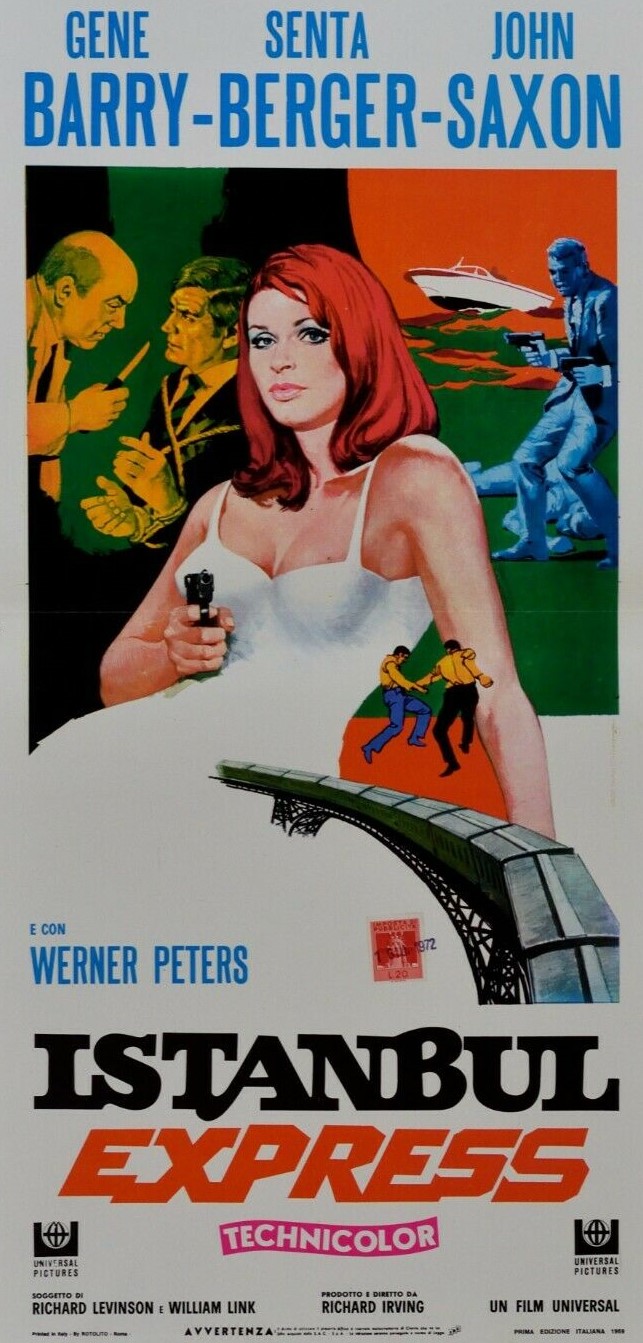
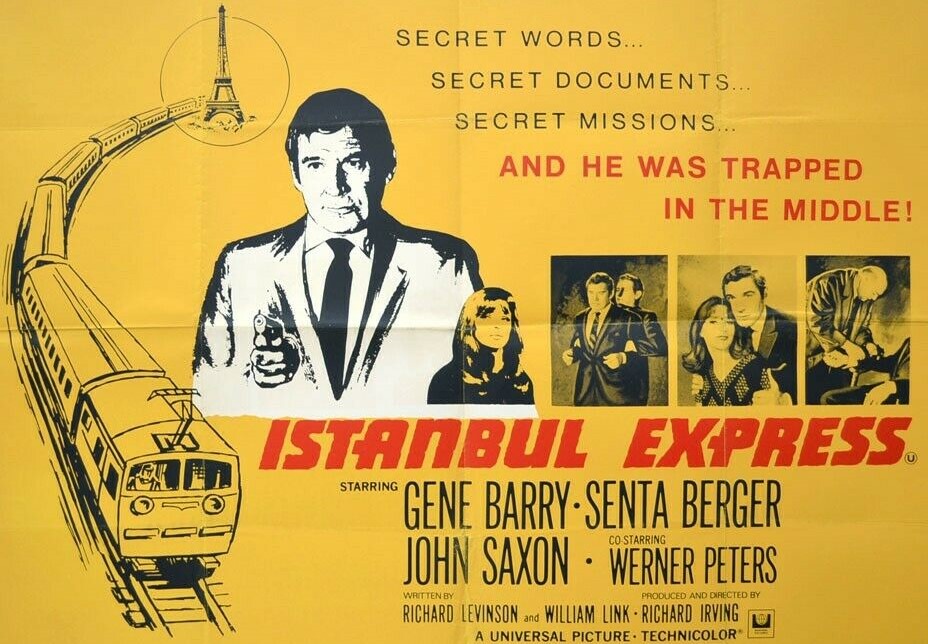
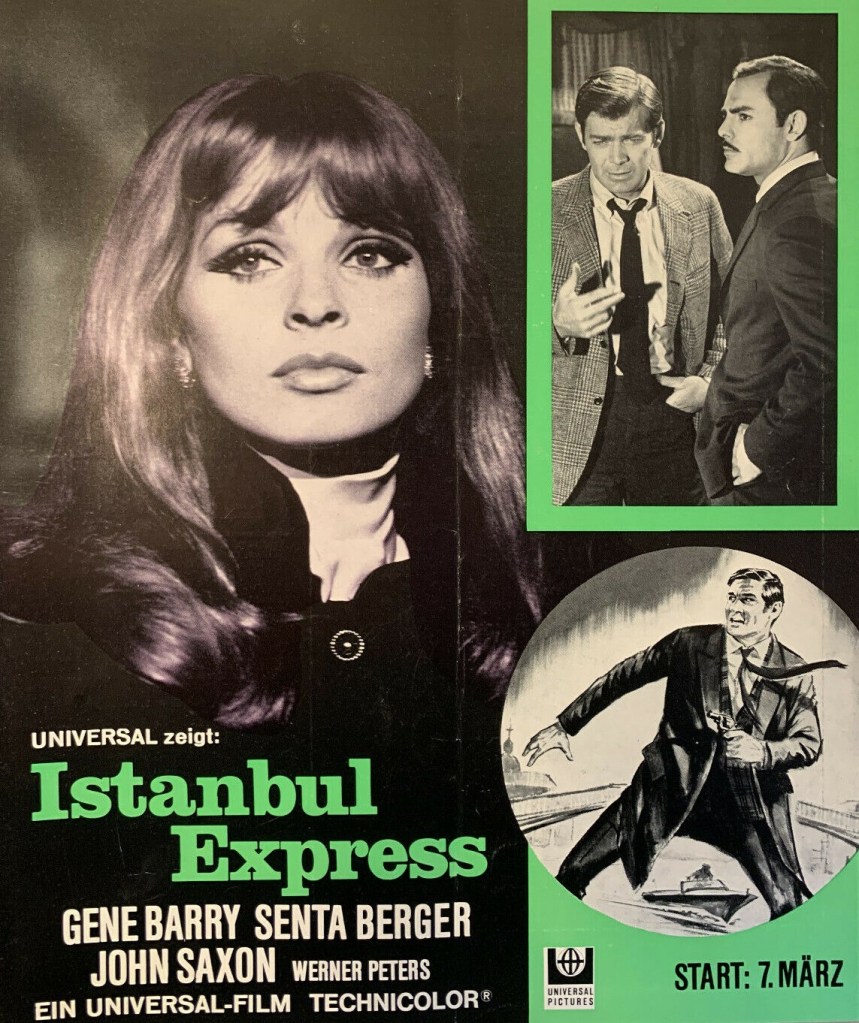
Calling this a by-the-numbers spy thriller does this movie no disservice since numbers are crucial to the complicated plot. On the one hand it’s quite a simple set up. Suave high-living art-dealer-cum-spy Michael London (Gene Barry) travels from Paris to Istanbul on the Orient Express to bid for secret papers in a secret auction. The complication: he must pick up the auction money from a bank in Istanbul using a code given to him along the way, each number by a different unknown person. On his side are train security chief Cheval (John Saxon), investigative journalist Leland McCord (Tom Simcox) and colleague Peggy (Mary Ann Mobley). Out to get him are Mila Darvos (Senta Berger) and Dr Lenz (Werner Peters).
The numbers business is an interesting addition to the usual spy picture formula of scenic location – Venice and the Eastern bloc as well as the other famous cities – violence and beautiful, sometimes deadly, women. You spend a good time guessing just how the numbers will be passed on and let me warn you it is sometime by inanimate means while the numbers themselves come with a twist. There’s also a truth serum, bomb threat, a traitor and every obstacle possible put in London’s way to prevent him completing his mission. London is about the world’s worst passenger, always missing the train as it sets off on the next leg of its journey, and requiring alternative modes of transport to catch up. But it’s as much about quick thinking as action and ends with a couple of unexpected twists. And it’s darned clever at times where the numbers are concerned.
Admittedly, the plot is a tad over-complicated but it’s fun to see London wriggle his way out of situations and for Cheval and McCord to turn up unexpectedly to provide assistance.
Gene Barry (Maroc 7, 1967) is little more than his television alter ego from Burke’s Law but he has an easy screen presence, never flustered, tough but charming and a winning way with the ladies. John Saxon (The Appaloosa, 1966) is the surprise turn, on the side of the angels rather than a villain, and equally commanding on screen, and certainly in one of his better roles. Austrian Senta Berger (Major Dundee, 1965) is not given as much screen time as you would like – a long way from being set up as the normal espionage femme fatale – but is certainly a convincing adversary.
This was only a movie if you saw it outside of the United States. There it was shown on television. But it had high production values for a television movie and director Richard Irving, who directed the television feature that introduced Columbo (Prescription Murder, 1968), keeps it moving at a healthy clip. The numbers idea was probably a television device, allowing the opportunity for timed breaks in the action. Writers Richard Levinson and William Link were a class television act, creating Columbo, and prior to that the Jericho (1966-1967) and Mannix (1967-1975) television series.
Interestingly, Senta Berger, John Saxon, Gene Barry, Levinson/Link and Richard Irving were all at various points involved in the groundbreaking U.S. television series The Name of the Game (1968-1971).
I had not realized Istanbul Express was a made-for-TV picture until I had finished watching it and in that case found it a superior piece of television and a decent-enough riff on the spy movie. You can catch it on Amazon Prime.
CATCH-UP: Senta Berger has featured in the Blog in The Secret Ways (1961), Sherlock Holmes and the Secret Necklace (1962), Major Dundee (1965), Bang! Bang! You’re Dead! (1966), Cast a Giant Shadow (1966) and The Quiller Memorandum (1966).
Sir Arthur Conan Doyle would be turning in his grave. Workmanlike at best, awful at its worst, or a “so-bad-it’s-good” candidate? Christopher Lee goes through the motions, there’s an oddly inserted heist, the continuity goes haywire, and the deduction would not have troubled a child. Even the great sleuth having to match nemesis Moriarty in cunning fails to lift this turgid tale. Despite being made in Germany, all the actors, save Senta Berger, appear injected with a fatal dose of stiff upper lip.
A corpse in the water alerts Sherlock Holmes (Christopher Lee) to the presence of Moriarty (Hans Sohnker) who is hunting Peter Blackburn (Wolfgang Lukschy) who has appropriated Cleopatra’s necklace from an archaeological dig. This takes them to Hampshire where corpses abound but the necklace is gone. Holmes burgles Moriarty’s apartment and steals back the necklace which is sent, in heavily protected police van, to an auction house. Holmes outwits Moriarty by infiltrating the heist the villain has planned.
The best scene comes at the beginning when boys throw stones at something floating in the Thames only to discover it’s a corpse. After that, you can choose from any number of bad scenes. Where do you start? The disguises? Holmes is first seen wearing a false nose to pass himself off as dock worker. An eyepatch is enough to convince Moriarty’s henchmen that Holmes in one of their kind. Bare-handed, Holmes kills an obviously plastic snake. To find out what Moriarty is up to, they listen down a chimney!
The deduction is so awful Dr Watson (Thorley Walters) could have done it. A dying man who manages to whisper one word is unable to whisper two and instead still has the strength to flap his hands in a way that any child in the audience familiar with shadow play would have known signaled a bird. Holmes follows bloody footsteps over grass in the darkness. The hands of a corpse are too calloused to be a high-class gentleman. And that’s as much of the detective’s genius as is on show. Moriarty, who is meant to be ever so bright, offers Holmes £6,000 a year to enter into a criminal partnership with him.
Did I mention the continuity? Holmes, in docker’s disguise, turns up outside his apartment lying on the pavement calling for help. Wounded, perhaps? A bit of a joke? We never find out. Once inside, he just turns back into Sherlock Holmes. In the middle of the Hampshire countryside, Scotland Yard’s Inspector Cooper (Hans Neilsen) turns up in a trice.
The film has also been dubbed so the performances are all flat except that of Ellen Blackburn (Senta Berger), the only character who injects emotion into the picture. Everybody else is wooden. Christopher Lee bases his entire interpretation of Holmes on his costume, deerstalker prominent and always puffing on his pipe. Austrian Senta Berger at least shows promise and manages to project some personality into her small part.
Made in a Berlin studio, with some location work in Ireland, this German-made movie has a screenplay by Curt Siodmak (The Wolf Man, 1941), purportedly based on the Conan Doyle tale The Valley of Fear. British director Terence Fisher (Sword of Sherwood Forest, 1960) is generally assumed to have helmed this project but the actual credits on the picture have him sharing duties with Frank Winterstein, so perhaps Fisher can be absolved of the complete blame.
The so-bad-it’s-good category had obviously not been invented in the early 1960s so this picture was shelved in Britain for six years, although shown in Germany and France before then.
CATCH-UP: If you’ve been tracking the often subtle performances – for a glamour queen – of Senta Berger through the Blog, you can also check out my reviews of The Secret Ways (1961), Major Dundee (1965), Cast a Giant Shadow (1966), The Quiller Memorandum (1966), and Bang! Bang! You’re Dead (1966). If you’re a Berger fan or fast becoming one to can see one of her later performances in Istanbul Express (1968) which, by coincidence, is reviewed tomorrow.
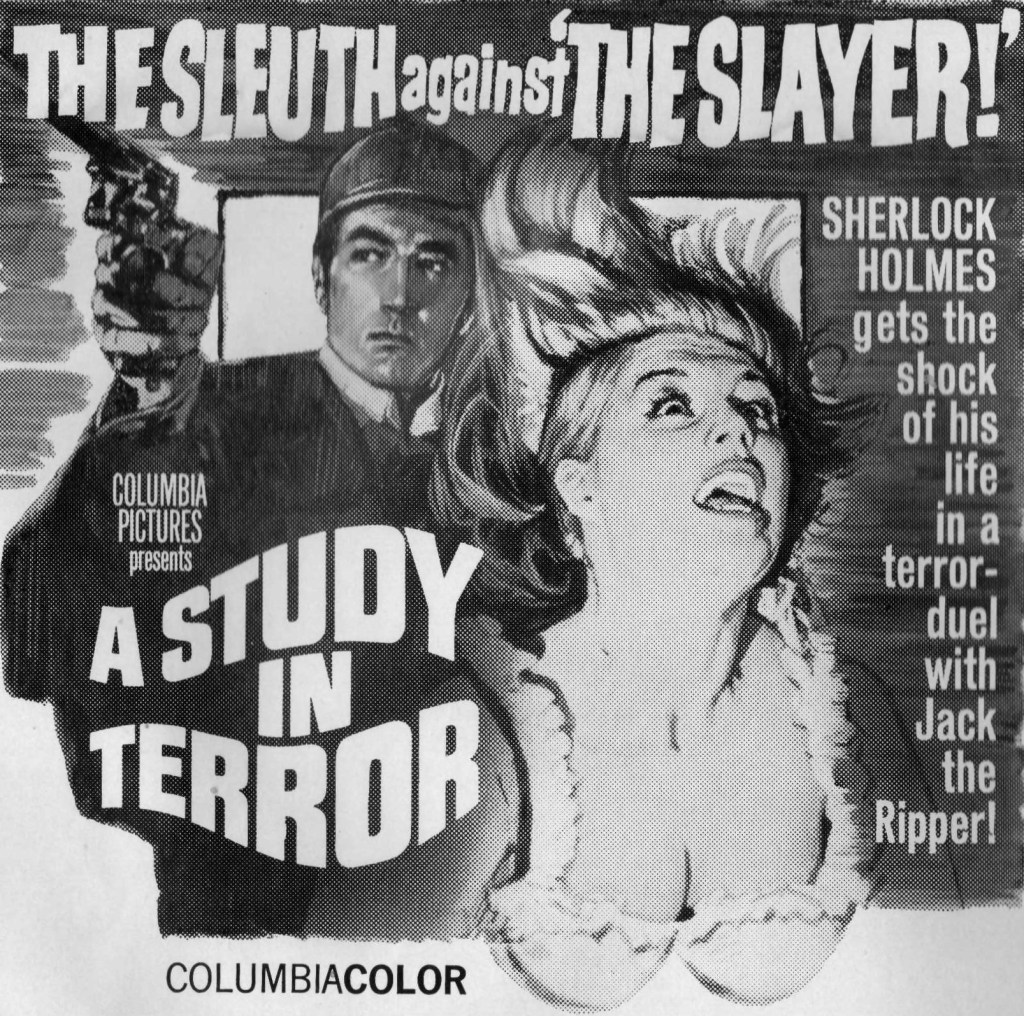
This is one of my favorite pressbooks because the marketing concept is so wacky and clearly an ill-advised attempt to cash in on the crime-busting efforts of television’s latest sensation Batman which had aired on the small screen in January 1966 and on the big screen in July of that year, a month before A Study in Terror found its way into U.S. theaters.
Rather than merely adapting the British exhibitors manual – the film had been released in Britain in October 1965 – Columbia, clearly deciding the movie was too old hat for American audiences, aimed to hijack some of the ideas currently being used for the Twentieth Century Fox television series/movie.
So potential moviegoers were treated to bizarre taglines such as “here comes the original camp-counsellor-in-a-cape” and “Flyaway Batman!” complete with the “Bam!” “Biff” and “Crunch” opticals that had become synonymous with the Batman television series. Not content with that, the advertising team invoked Superman as well with a spoof tagline: “faster than a speeding computer…able to leap tall tales in a single stroke of genius.” A third famous character was drawn into proceedings – “He’s James Bond in a cape.”
Also referenced was a famous movie campaign from two decades before. “Sherlock Holmes is Back and Jack the Ripper’s Got ‘Im” echoed the legendary tagline that welcomed Clark Gable back to the movies after his war stint “Gable’s Back and Garson’s Got Him.”
Interestingly, although exhibitors were supplied with a choice of several taglines, the core advertising image – a pistol-packing Holmes above a busty screaming victim – remained the same, contrary to the normal practice of devising a number of advertisements that allowed the exhibitor to choose the one most relevant to their customer base.
Outside of the spoof Batman ads, the campaign focused on the clash between the master sleuth and the villain. Other taglines spelled it out: “Sherlock Holmes takes on Jack the Ripper” / “Sherlock Holmes meets Jack the Ripper in a mad, mad thriller” / “Sherlock Holmes strikes back at the foulest fiend of them all, Jack the Ripper” and “The sleuth versus the slayer.”
Supplementary taglines were occasionally included: “girl after girl, he gives a new twist to the world’s oldest profession” / “the most savage killer of the century and the screen screams with suspense” / “the battle of wits is as terror sharp as the murder weapon.”
With copyline writers doing overtime, the Pressbook clocked up over 15 separate adverts. Pictorially, the emphasis appeared to be on cleavage and brutal murders of women.
With a virtual cast of unknowns, the Pressbook writers had to work hard to summon up interest in the principals. John Neville for example had been originally approached for a musical Baker Street and he fitted in shooting the film with his work in the theatre. Adrian Conan Doyle, son of the famed author, proclaimed that Donald Houston was “completely, utterly. right for the part.” The role of a disfigured girl was considered a “professional risk” for Adrienne Corri and Barbara Windsor announced she was going to turn brunette and concentrate on drama rather than comedy.
Another famous writing team was called into the promotional whirl, bestselling authors Ellery Queen writing the novelization of the screenplay.
On the basis that the detective was well-known, the marketeers felt safe enough exhorting exhibitors to persuade local libraries to hold a Sherlock Holmes Week and approaching bookstores to feature the other books in the series as well as the novelization. Another suggestion was a competition to name all ten stars who played the character. Sherlock Holmes fans were known as Baker Street Boys and “there may be a member or two in your community…who may prove tremendously helpful in radio/newspaper/television promotion.”
Another promotion focused on deerstalker hats and the hero’s interest in the violin and pipe-smoking lent themselves to tie-ups with retailers of such products.
Excepting Sherlock Holmes and the Deadly Necklace (1962) and The Hound of the Baskervilles (1959) the world’s most famous fictional detective had been absent from the big screen for over two decades so it seemed an inspired decision to set him on the trail of the world’s most infamous serial killer – Jack the Ripper. The result is high-class comfort food – the first of the series made in color – classic deduction coupled with barbaric murders in a fog-bound London replete with cobbled streets, Dickensian urchins and sex workers apop with cleavage and corset. Throw in sensitivity towards the abject poverty of the period, female exploitation and a nod towards an upper-class cover-up and you have a movie with a surprisingly contemporary outlook.
This is a tougher Holmes, handy with his fists, sporting a spring-loaded knife in his walking stick. The investigation draws in the Prime Minister (Cecil Parker) and the Home Secretary (Dudley Foster) as well as Sherlock’s pompous brother Myron (Robert Morley) and the ubiquitous Inspector LeStrade (Frank Finlay).
Pretty quickly it is Suspects Assemble. Due to a scalpel being the murderer’s instrument of choice, doctors are immediately implicated, the most likely candidate the philanthropic Dr. Murray (Anthony Quayle) who operates a soup kitchen. Publican Max Steiner (Peter Carsten), with a sideline in blackmail, is another possibility. And there is the mysterious disinherited son of a lord, Michael Osborne who has married sex worker Angela (Adrienne Corri).
The Italian ad campaign combined a more conservative Sherlock Holmes with exploitative illustrative detail.
As ever, the plot is complicated by red herrings and sleights of cinematic hand. But the highlight of a Holmes picture is the sleuth’s mastery of deduction based on clues missed by the ordinary mortal and every now and then the story comes to a halt to allow time for the detective to demonstrate genius. Occasionally he dons a disguise. And thoroughly enjoyable these scenes are before he gets down to the main business of uncovering the killer.
A Study in Terror introduces social depth to the Holmes saga. When the crimes focus the media spotlight on Whitechapel, Dr. Murray draws attention to the constant “murder by poverty” ignored by the state. Female exploitation is of course the norm in the sex worker business and small wonder that such women are easy targets for the Ripper and although that is an overdone trope in this case a different angle comes into play.
Shakespearian actor John Neville (Oscar Wilde, 1960) handles the main character with considerable aplomb with Donald Houston (The Blue Lagoon, 1949) as his often baffled sidekick Watson. Robert Morley (Genghis Khan, 1965) is a splendid Mycroft although Anthony Quayle (East of Sudan, 1964) fails to nail down his Scottish accent.
The considerable supporting cast includes Judi Dench making her second film appearance, Barbara Windsor of Carry On fame, John Fraser (Operation Crossbow, 1965), John Cairney (Jason and the Argonauts, 1963), Peter Carsten (Dark of the Sun, 1968), singer Georgia Brown (Nancy in the original stage production of Oliver!), Edina Ronay (The Black Torment, 1964), Corin Redgrave (The Girl with the Pistol,1968), former British leading lady Kay Walsh (Oliver Twist, 1948) and future television comedy writer Jeremy Lloyd (Are You Being Served?, 1972-1985).
The picture was unusual in that it was not drawn from the existing Holmes canon but as an original devised by Derek and Donald Ford (The Black Torment), the former going onto a more extensive career as a director of British sexploitation pictures such as Suburban Wives (1972). Production company Sir Nigel Films had been set up as an official vehicle to exploit the Holmes legacy.
Director James Hill (The Kitchen, 1961) had won an Oscar for the short Giuseppina (1960) and was a year away from his breakthrough Born Free. Given the low-budget this is a highly watchable picture.
Flick Vault has this for free on Youtube or if you want to own it forever there’s a DVD.
The movie tie-in was such an obvious synergy you had to wonder why it was not employed in more significant fashion prior to the 1960s. The reason was that movie-making and publishing were generally viewed as completely separate entities, only crossing over when books were sold to Hollywood. And up to the mid-1950s, Hollywood had a ton of other, better, more effective marketing tools at its behest. It was reckoned that by 1955 the industry was taking advantage of promotional plugs worth about $350 million a year (equivalent to $3.5 billion today).
In 1948, for example, Mr. Blandings Builds His Dream House had amassed an estimated $5 million merchandising pot (worth around $56 million today), so much so the booklet listing all the participants ran to a massive 72-pages. Anything that could be sold on the back of a picture – furnishing, clothes, vehicles – provided a mountain of free advertising by the simple device of enrolling manufacturers, suppliers and retailers in a marketing campaign. But by 1960, as television advertising more straightforwardly pitched such goods towards the general public, that well of merchandising dried up.
Film publicists casting about for new exploitation outlets latched onto paperbacks. At the start of the decade, the paperback industry was booming, shifting over 280 million copies a year. Dell, in particular, had come to realise the “remarkable sales impact of books which have tie-ins with a motion picture” and noted that “in most instances (paperback) book sales prior to the picture will be equaled following the release of the picture.” Publishing executive William C. Engel, pointing to the movie tie-in for Psycho, reprinted three times in two months, reckoned that a “big spectacular picture will stimulate sales of a paperback.” At that time Bantam was equally buoyant, with 32 books in the tie-in business on the basis that films increased sales by 50 per cent.
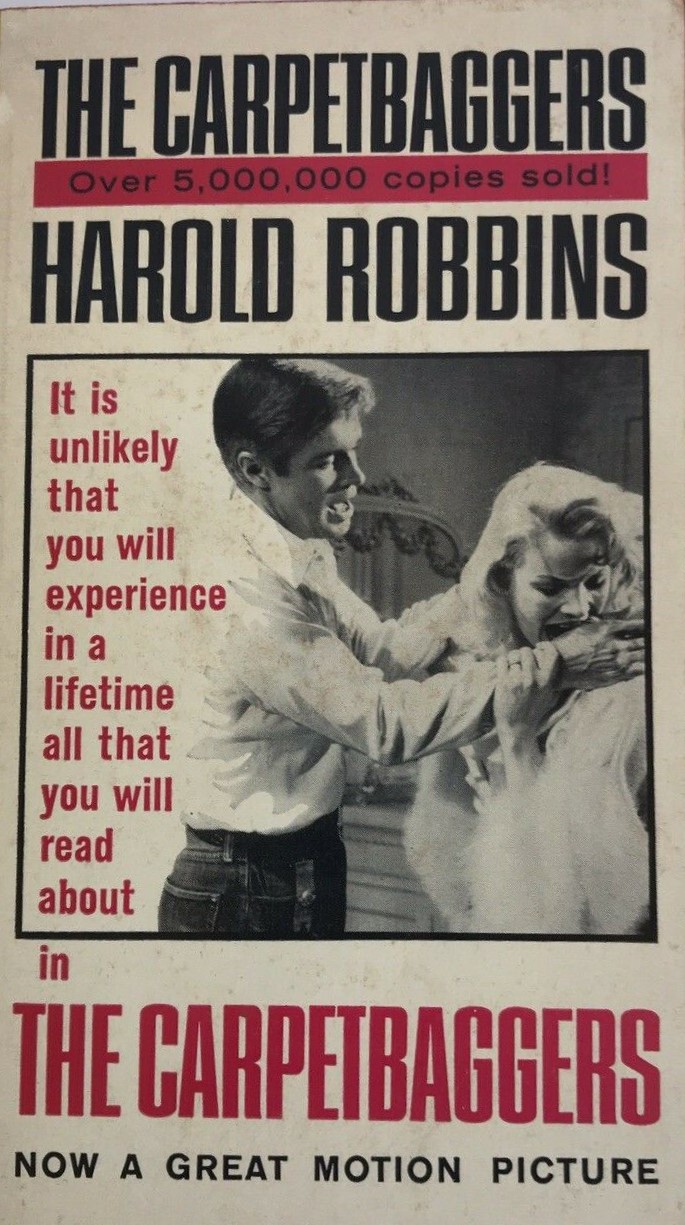
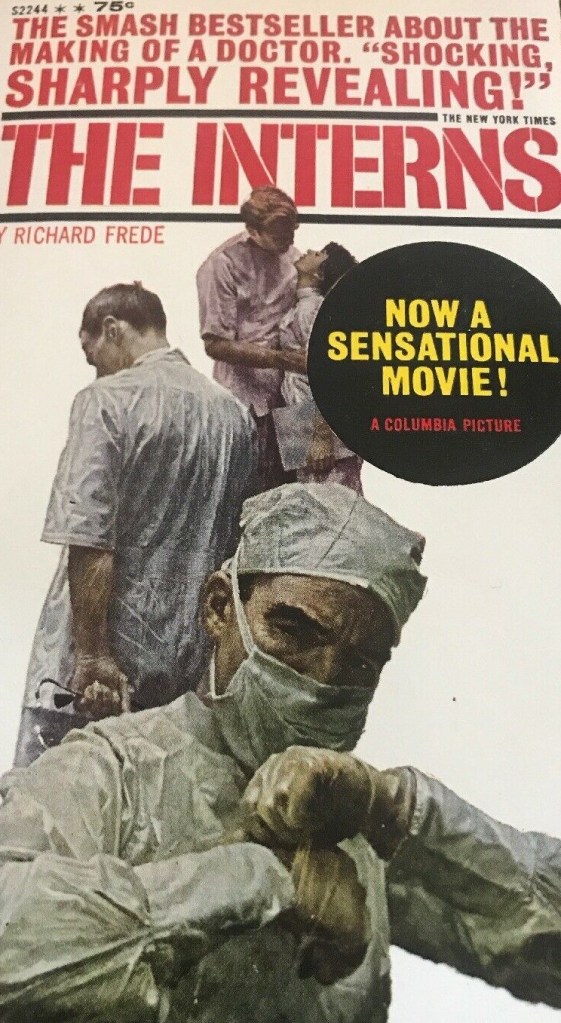
Many moviegoers will fondly remember the 1960s as the glory days of the movie tie in. Sometimes the first time a film fan would get a glimpse of a movie’s advertising campaign was when they picked up the book tie-in. In those days hardcover books were often very plain, little on offer but title and author. But paperback specialists like Dell, Avon, Pocket Books, New American Library, Bantam, Fawcett and Ballantine in the U.S. and Pan, Fontana and New English Library in Britain seemed to revel in glorious colorful titles and were positioned to take advantage of movie advertising campaigns.
While waiting to make the movie, Columbia kept the novel in the bestseller lists by pumping funding into an advertising campaign for the book.
Some studios like Columbia had begun to spend money promoting the books it had bought in order to keep the titles in the bestseller lists until it was time for the movie to appear – a technique later adopted by Paramount to turn Love Story (1970) into a bestseller in the first place.
At the start of the decade, virtually every Twentieth Century Fox release was linked with a paperback. United Artists, in 1961, could count on paperbacks to support ten of its releases – Judgement at Nuremberg, The Young Doctors, Paris Blues, Sergeants 3, Something Wild, Birdman of Alcatraz, The Miracle Worker, The Happy Thieves, What a Wonderful Life and Jessica.
It was an odd relationship in many respects. Studios paid publishers for the rights to film their novels then when the properties they had purchased were turned into films they then helped publishers achieve a bigger bounty, assisting them sell more books by furnishing movie artwork and stills for the covers. Yet there was benefit. Every copy printed was one more piece of advertising for the film, often in places where a studio would not normally advertise and serving as advance buzz.
It soon became apparent that publishers could target potential moviegoers in ways that were too difficult or too expensive for studios. Publishing designers did not need to employ their skills to come up with original covers, they simply took the movie advertising artwork and stills for front and back cover. Occasionally, they would run a photo spread inside. They might even run movie credits alongside the title page. If the sight of a movie advert on the cover of a paperback encouraged the public to consider going to the movie, then the reverse was equally true, movie advertising resulted in increased book sales. Studios used a diverse range of paperback publishers, going where they were likely to get the best promotional deal.
By the mid-1960s every studio was knee-deep in movie tie-ins.
In 1965 Dell had 47 titles sold to studios either for imminent or future production. The Collector, Genghis Khan and Lord Jim were slated for Columbia, there was Harlow for Embassy and The Sound of Music (based on the Von Trapp Family book) for Twentieth Century Fox. How to Murder Your Wife and The Knack were being filmed by United Artists, The Amorous Adventures of Moll Flanders by Paramount, Assault on a Queen and The Bride Wore Black set for Seven Arts, and The Cincinnati Kid and The Loved One lined up for MGM.
That same year MGM promoted ten movie tie-ins. Operation Crossbow, The Yellow Rolls Royce, The Sandpiper, She, Joy in the Morning, Once a Thief, Lady L and Doctor Zhivago were placed with publishers other than Dell who handled, as noted above, The Loved One and The Cincinnati Kid. In 1966 Paramount had nine deals with different paperback houses to promote Is Paris Burning?, Oh, Dad, Poor Dad, Seconds, Hurry Sundown, Funeral in Berlin, The Swinger, Alfie, El Dorado and Warning Shot. Disney, which had long been the master of merchandising, contracted with Scholastic Publishing to target schools and libraries.
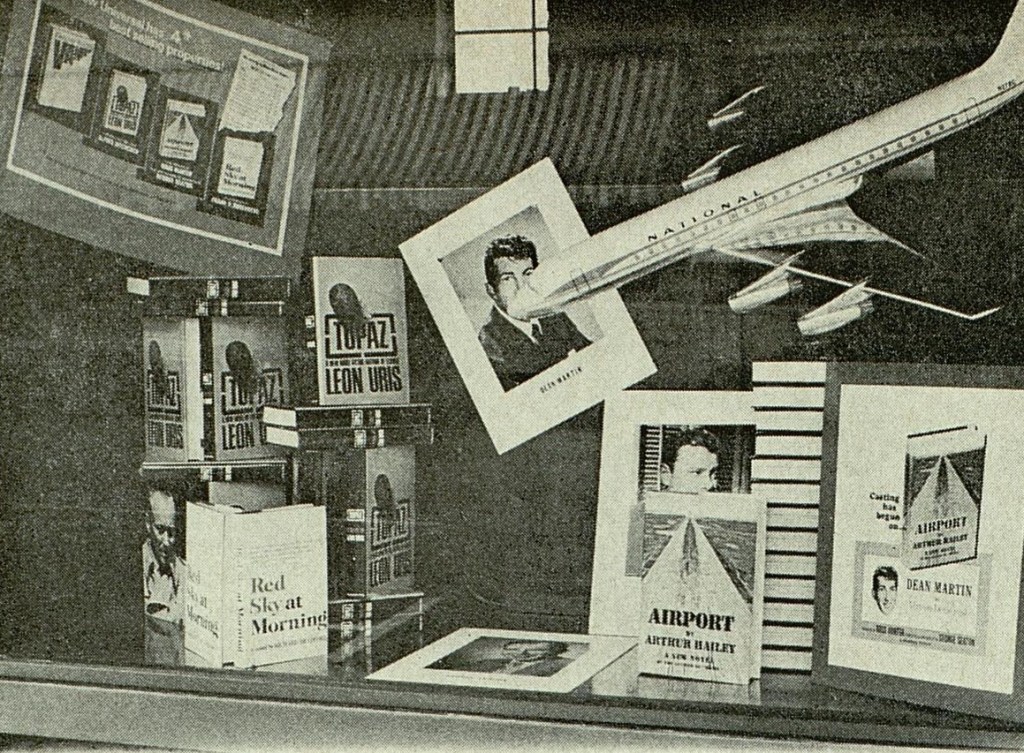
Studios occasionally ran their own bookstore promotions. This one, in 1968, simply announced that Universal had acquired “Airport,” “Topaz”, “Red Sky at Morning” – all later filmed – and “Vanished” which was not. Most interesting of all, these books were hardcover not paperback, so this fell very much into the long-range marketing department.
By the end of the decade publishers were desperate to jump on the movie tie-in bandwagon. In 1968 Twentieth Century Fox had pacts with a dozen different publishers covering 19 pictures including Bandolero!, Star!, The Devil’s Bride, Planet of the Apes, The Boston Strangler and The Sweet Ride. Dr Dolittle came out in 26 different editions through various publishers. The following year MGM pitched in with a half a dozen movie tie-ins including The Appointment and Goodbye, Mr. Chips, already having taken advantage of readership interest in Alistair Maclean hits Where Eagles Dare and Ice Station Zebra, the reissued Gone with the Wind and Ben-Hur, and The Shoes of the Fisherman and 2001: A Space Odyssey.
In 1969, the National Association of Theater Owners (NATO) tied in with National Library Week. Under the cross-promotional tagline “Read These Important Books – See These Important Films,” libraries across the country promoted a variety of current pictures sourced from novels including True Grit, Belle de Jour, Goodbye, Columbus, John and Mary and Topaz. In return NATO distributed posters advertising the library involvement via 5,000 theaters.
The same year Bantam Books ran a trailer in 100 cinemas for its own “film festival tie-in” of eight books – Goodbye, Mr. Chips, John and Mary, Bob & Carol & Ted & Alice, Hail, Hero!, Marooned, Topaz, A Dream of Kings and Women in Love.
Although it is often considered that the movie tie-in business began in the 1970s when books spawned mega-hits like Love Story, The Godfather and Jaws, these pictures were in reality only benefitting from the heavy lifting put in during the previous decade.
SOURCES: “Paperback-Film Tandems Zowie,” Variety, February 3, 1960, p5; “Columbia’s Book Bally Budget,” Variety, September 21, 1960, p24; William C. Engel, “Big Stake in Publishing’s 280,000,000 Annual Sale,” Variety, January 4, 1961, p25; “To Issue Paperback Books on 10 United Artists Films,” Box Office, August 28, 1961, p9; “Big Hike in Film Tie-Ins Noted by Bantam Books,” Box Office, November 27, 1961, pA3; “Commercial Tie-Ups Back After Slump,” Variety, December 27, 1961, p7; “Dell Paperback Tie-Ins,” Variety, January 13, 1965, p22; “Ten Books in Paperback Promote MGM Releases,” Box Office, May 31, 1965, pE-4; “Paperback Books Arranged for 9 Paramount Films,” Box Office, August 15, 1966, pE5; “Scholastic To Publish Disney Properties,” Box Office, May 2, 1966, pA1; “12 Publishers Print Books on 20th-Fox Productions,” Box Office, February 26, 1968, pA1; “Paperback Book Tie-Ups for 12 MGM Pictures,” Box Office, March 31, 1969, pA1; “Tenth Year for Tie-Up with Library Week,” Box Office, May 5, 1969, p6; “Bantam Books Plans Film Fest Tie-In,” Box Office, November 10, 1969, p10.
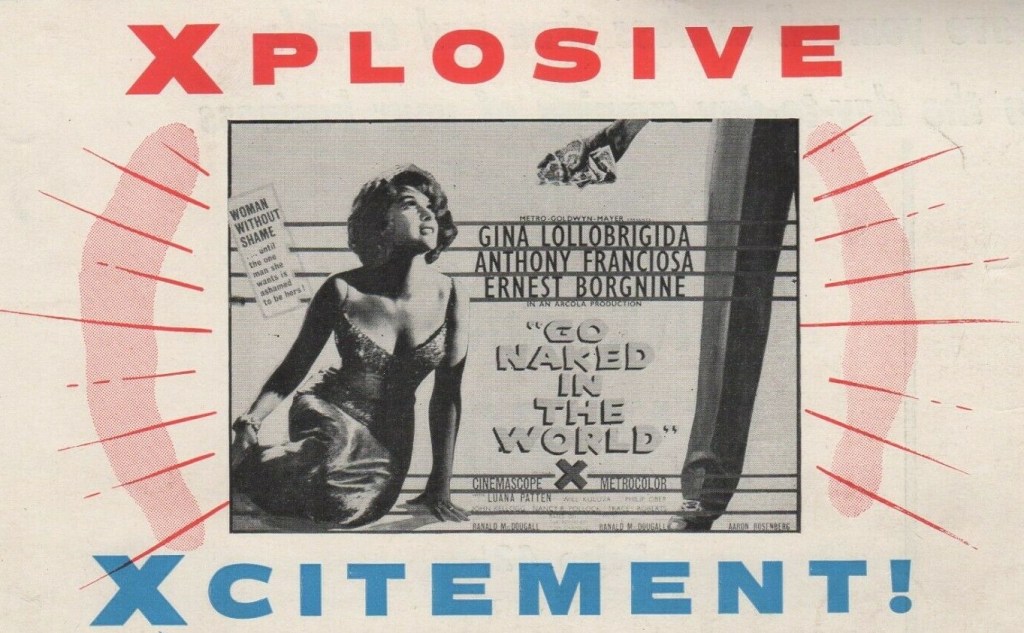
Under-rated at the time and ever since, and overshadowed at the box office by MGM’s other venture into the world of the good-time-girl Butterfield 8 (1960), this raw slice of emotion delivers on every front and may be even more pertinent today in its unashamed depiction of paternal love.
Spoiled brat Nick Stratton (Anthony Franciosca), trying to escape controlling millionaire Greek father Pete (Ernest Borgnine), falls in love with widow Julie (Gina Lollobridgida), unaware that she is a high-class hooker, among whose clients number Pete.
Three tales run in parallel – the main love story, Pete’s attempts to drag his son into the family construction business, and the father’s undying love for his son. Julie is only too aware that her profession prohibits the development of true love, her world consisting of putting on a happy face for grey-haired men, while avoiding commitment. Where Butterfield 8 evaded the reality of prostitution, that is not the case here, Julie tormented by the prospect of bumping into former clients or her lover unable to accept her past. Overwhelmed by guilt, she believes she is beyond forgiveness. Nick wants none of the commitment of a rich man’s son but all the entitlement.
Never mind the story, which was always going to tumble into tragedy, it’s the performers who steal the picture. Lollobrigida (Strange Bedfellows, 1965) gives a terrific performance, carrying the emotional baggage of the love story, devastation only inches away, self-destruction possibly the only path open, constantly aware that taking the easy path to riches and independence now stands in the way of happiness. The scenes where her self-loathing breaks through the patina of sexy gloss are tremendous as is her touching belief that somehow she can escape destiny.
While this might appear to be nothing but an over-the-top performance from Borgnine (The Split, 1968), it is anything but, and any man in an early 1960s picture who can demand a kiss from his grown-up son and constantly tells him how much he loves him is a pretty unusual character for the period. Of course, this overt show of emotion is explained by his nationality, but it’s clearly more than that. While attempting to control all around him, with hypocrisy in full spate, as heavy on religion as playing away from home, this is actually a superb piece of characterization, of a powerful man rendered impotent by the loss of love. He has the two best scenes, almost having a heart attack as he watches his son walk across a sky-high girder and later begging Julie’s forgiveness for attempting to wreck the romance.
Anthony Franciosca (Fathom, 1967) is the weak link. For all that he is saddled with a spineless character, moping and running away his default, he never quite seems worthy of romance with Julie nor for that matter of equality with his father. Former child star Luana Patten (Song of the South, 1946) makes an impact as the rebellious daughter while Nancy R. Pollock (The Pawnbroker,1964) brings dignity to her role as the doormat wife.
This was the fourth outing as a hyphenate for writer-director Ranald McDougall (The World, the Flesh and the Devil, 1959) but he was better known for screenplays such as Mildred Pierce (1945), The Naked Jungle (1954) and, later, Cleopatra (1963) and you can see he is accustomed to creating great roles for independent women and filling his picture with sharp dialogue and lines that sound like epithets. There’s more than enough going on to keep the various plots spinning and emotions teetering over a cliff edge.
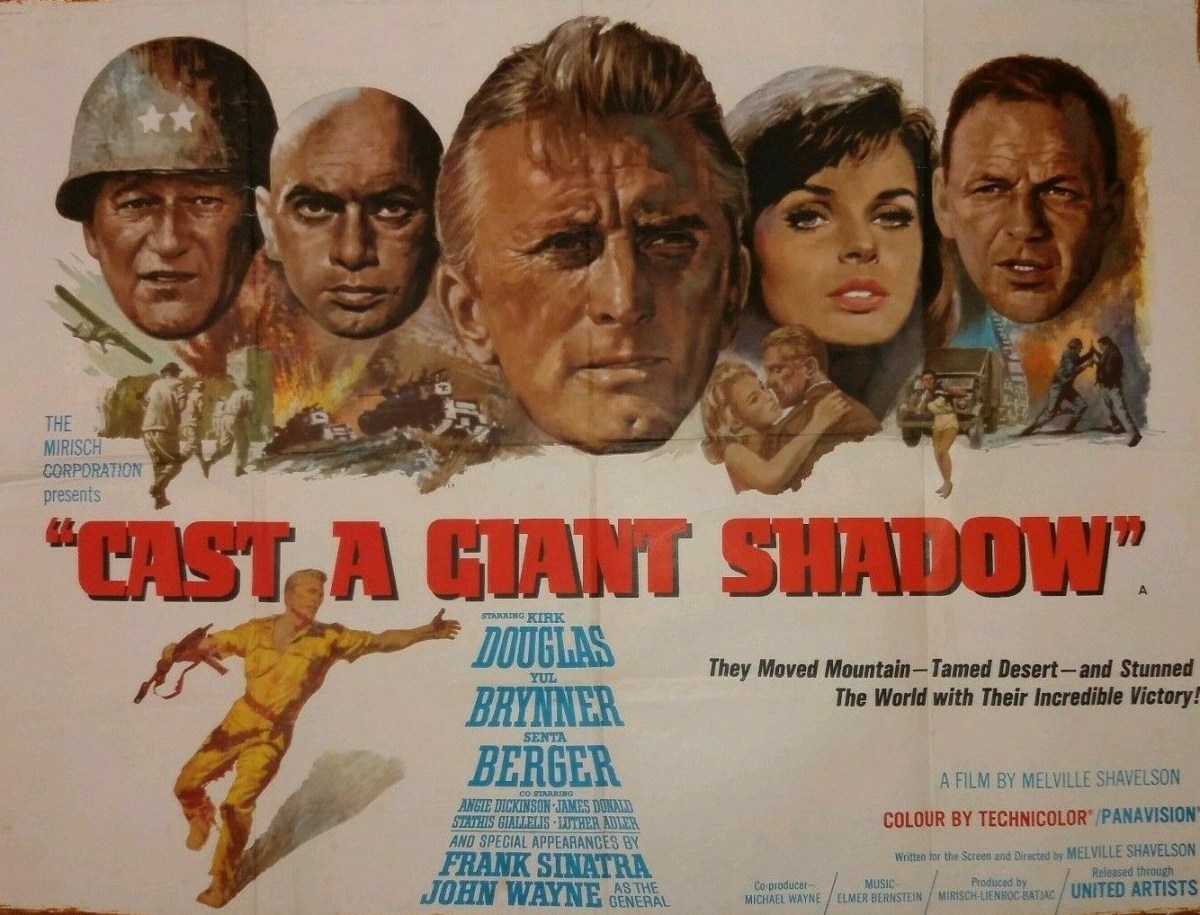
If recruiting John Wayne is essential to getting your new picture off the ground, it would help not to have fallen out with him big-style previously. After every studio in Hollywood had turned down Cast a Giant Shadow, writer-producer-director Melville Shavelson turned to the Duke. The only problem was the pair had hit trouble on football picture Trouble All the Way (1953) should take.
In his capacity as producer of Trouble All the Way, Shavelson, also co-writing the screenplay, had given Wayne one version of the script while behind his back instructing director Michael Curtiz to shoot a different version with subsidiary characters that would change the film’s plotline. When Wayne found out, Shavelson was the loser. When you make an enemy of John Wayne, it takes a lot to win him back as a friend.
After that debacle, Shavelson had gone on to win some kudos and occasional commercial success as a triple hyphenate on pictures like Houseboat (1958), It Started in Naples (1960) and A New Kind of Love (1963) with top-ranked performers in the vein of Cary Grant, Sophia Loren, Clark Gable and Paul Newman. When Shavelson pitched to Wayne the story of Cast a Giant Shadow, about the birth of Israel and based on the bestselling biography of Mickey Marcus by Ted Berkmann, the star’s response was: “That’s the most American story I ever heard.” Wayne was hooked on the idea that America had helped Israel achieve its independence and that top American soldier Colonel Mickey Marcus had died in the process.
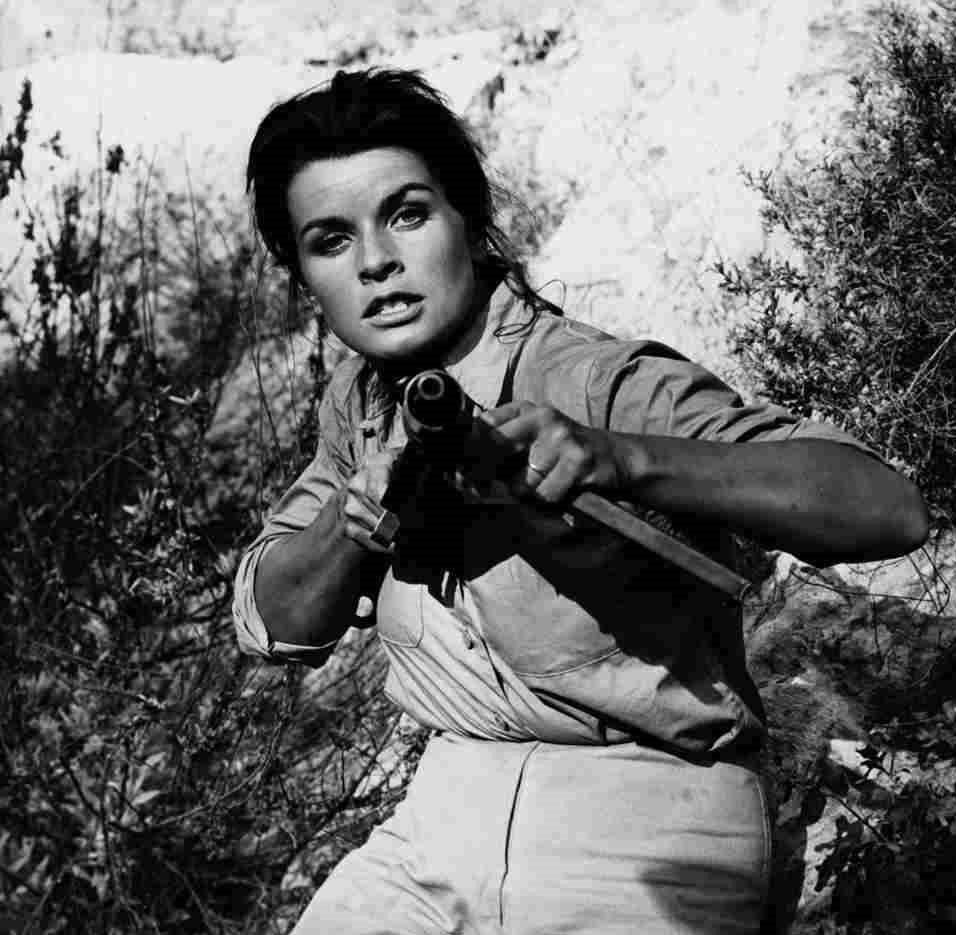
Senta Berger as the gun-toting Magda.
Wayne’s potential involvement came with a proviso – he had script approval. And while Shavelson owned the rights to the book, he didn’t have a screenplay. Nor, with his background as a writer being primarily concerned with comedy, did he consider himself best suited to the job.
He had, however, written a treatment. In his eyes, a treatment was not just about encapsulating the story, but about selling it to a studio. So his first few paragraphs included references to box office behemoths Lawrence of Arabia, The Guns of Navarone and Bridge on the River Kwai – planting in the minds of potential backers the notion that this film was headed down the same route of substantial profit – and a reference to an “American of heroic proportions…with the ability to love,” the latter being code for sex.
But in the end he wrote the screenplay as well. Wayne put his imprimatur on the picture in more ways than one. Part of the deal was that his production outfit Batjac become involved, with son Michael in line for a co-producer credit. Shavelson managed to snag Kirk Douglas for the starring role only by giving up part of his own salary to meet the star’s fee. Douglas and Wayne, with the credit ranking reversed, had starred together in In Harm’s Way (1965).
It was Douglas who insisted his character’s role be change from passive to active. Shavelson invented an American general for John Wayne and a female Israeli soldier (Senta Berger) for Douglas – in reality his character was a married man – to have an affair with. “I’m introducing a fictitious romance into the film with the full consent of Marcus’s widow,” Shavelson told Variety, though it’s doubtful that real-life wife Emma Marcus went along so merrily with this notion.
It wasn’t only Wayne who demanded script approval. The Israeli government, with whom cooperation was essential to guarantee the use of troops and equipment, had made the same condition. The Israelis worried that the film would fall into the usual Hollywood trap and to that extent the government insisted that the picture not end up as a “an Errol Flynn Burma stunt” – a reference to Objective Burma (1945), originally banned in London for Americanizing the film. The government spelled it out: “Col Marcus didn’t win our war, he just helped.” But the production was offered “further facilities than normal.” Two sound stages – the first in the country – were being built in Tel Aviv.
Shavelson was shown military locations that no other civilian had ever seen. When the Israelis did “approve” the script it was with the proviso that 31 changes were made including the deletion of the “sex-starved woman” (Senta Berger), although in reality Shavelson got away with his vision intact.
When the film went ahead it had a crew of 125 plus 800 Israeli soldiers, 1,000 extras and 34 featured players including Yul Brynner, Frank Sinatra, and Angie Dickson. Only some of the film was made in Israel. The interiors for the Macy’s department store were built in Rome, along with the concentration camp sequence, one of the battles, and scenes set in Coney Island that were edited out from the final picture.
The biggest problem was the supply of soldiers and equipment at a price the production could afford. Shavelson was being charged twice as much for the soldiers as the producers of Judith (1966). It took the intervention of the Israeli Prime Minister for sensible negotiation to get under way and for prices to drop to a tolerable level. Neither was it possible to film on the original battle sites in Israel since they were basically in a no man’s land, covered in barbed wire and littered with mines.
Principal photography began on May 18, 1965, in 115 degree heat – so hot the film buckled in the cameras – at the fortress of Iraq Suidan to recreate the Battle of Latrun. Shavelson had been denied permission to access the Latrun fortress itself which stood across the Jordanian border even though the engagement had been an Arab victory. To keep the sun off his face, Kirk Douglas decided to wear an Australian Army forage cap, and it did the job so successfully he kept it on for the entire movie.
On another location – this time when the temperature reached 126 degrees – a $40,000 Panavision camera exploded filming too close to a tank-muzzle firing, the jeeps got vapor lock, three soldiers were wounded by dummy bullets and the charging tanks vanished after the first take when their commander received new instructions from his army superiors.
Shavelson had met Sinatra some years before when he and scripting partner Jack Rose had helped write the Inaugural Gala organized by the singer in honor of President John F. Kennedy. Using that connection and the fact they shared the same agent, Sinatra, who had a pilot’s license, agreed to play a two-day role as a Piper Cub aviator dropping seltzer bottles on tanks. When filming began Shavelson discovered that what he had imagined was his own inspired invention turned out to be close to the actual truth. To write the score, Elmer Bernstein visited Israel to conduct his own research.
He also discovered the real reason for Sinatra’s eagerness to be involved. His salary had been donated to set up the Frank Sinatra Arab-Israeli Youth Centre in Nazareth. Actually, there was another less noble reason for Sinatra signing up. He had begun an aviation business, Cal-Jet Airways, supplying planes to Hollywood, and clearly thought appearing as a pilot in a picture would help promote the new company.
However, when filming of his scenes began Sinatra proved unintelligible. He had taken the script at face value and thought he was playing a Texan and delivered his lines with a Texan accent. Eventually, Sinatra was persuaded to play it with his own normal voice. But Sinatra could only be filmed in the plane on the ground since his insurance didn’t cover him being in the air unless accompanied by a co-pilot.
By the time they came to film the immigrants’ landing scene the picture was already half a million dollars over budget. With the country enjoying full employment and nobody inclined to take time off to work in the blazing sun as an extra, the 800 extras were in reality all newly arrived immigrants – and therefore unemployed – from Hungary, Rumania, Poland, Russia and Czechoslovakia.
The only item that was lacking to complete the landing scene was a ship offshore, but the owners were asking too much money. Instead, the director came up with the idea of a “glass shot.” An artist had painted in smoke billowing from the funnels, but it was blowing in the wrong direction from the wind. The solution – a double-exposure job in the lab – cost as much as hiring the ship.
Once the production headed home, Shavelson discovered that virtually all the sound recordings made in Israel were unusable. Frank Sinatra and Kirk Douglas re-recorded their dialog in Hollywood, Yul Brynner and Senta Berger in London and dozens of Israeli students attending Los Angeles universities were called upon to replicate background Hebrew voices.
For prestige purposes, the movie was launched at the end of March 1966 as a restricted roadshow, just three cinemas in New York – the DeMille in the Broadway area, the Fantasy Theater in Long Island and Cinema 46 in New Jersey. Douglas employed a helicopter to fly from venue to venue. The first wave of first run houses followed in Baltimore, Philadelphia, San Francisco and Miami.
Most of the promotional activity centered on the true story of Mickey Marcus but in London, where the character was unknown, United Artists took the gimmick route, placing an advert in The Times newspaper calling for “giant men” standing over six foot seven inches tall. Expecting to find 25 such giants, they ended up with 100 attending the British premiere, the tallest seven foot three inches. In keeping with this gimmicky approach, tickets for the first performance were also a king-sized twelve inches by nine inches.
SOURCES: Melville Shavelson, How To Make a Jewish Movie, W.H. Allen, 1971; “Wayne To Co-Produce, Star in Israeli War Pic,” Variety, May 27, 1964, 2; “We’ll Lift Part of Local Expenses, Israeli Offer to UA,” Variety, July 1, 1964, p3; “Kirk Douglas Set to Star in Cast a Giant Shadow,” Box Office, March 8, 1965 pW-2; “Batjac Productions Moves to Paramount Lot,” Box Office, March 29, 1965, pW-2; “Shavelson Aim on Mickey Marcus Film: Realism,” Variety, March 31, 1965, p25; “WB-Sinatra Film in October; Sinatra’s Aviation Firm,” Box Office, August 23, 1965, 6; “Elmer Bernstein to Israel for Film Music Research,” Box Office, October 18, 1965, pW-3; “Cast a Giant Shadow Set for 3 N.Y. Roadshow Dates,” Box Office, December 6, 1965, pE3; “Kirk Douglas To Helicopter to All 3 Shadow Openings,” Box Office, March 28, 1966, pE-7; “Cast a Giant Shadow set in 14 Key Centers, April 6-8,” Box Office, April 11, 1966, p6; “Small Ad Brings 100 Giant Men to London Opening of United Artists’ Cast a Giant Shadow,” Box Office, October 3, 1966, pA3.
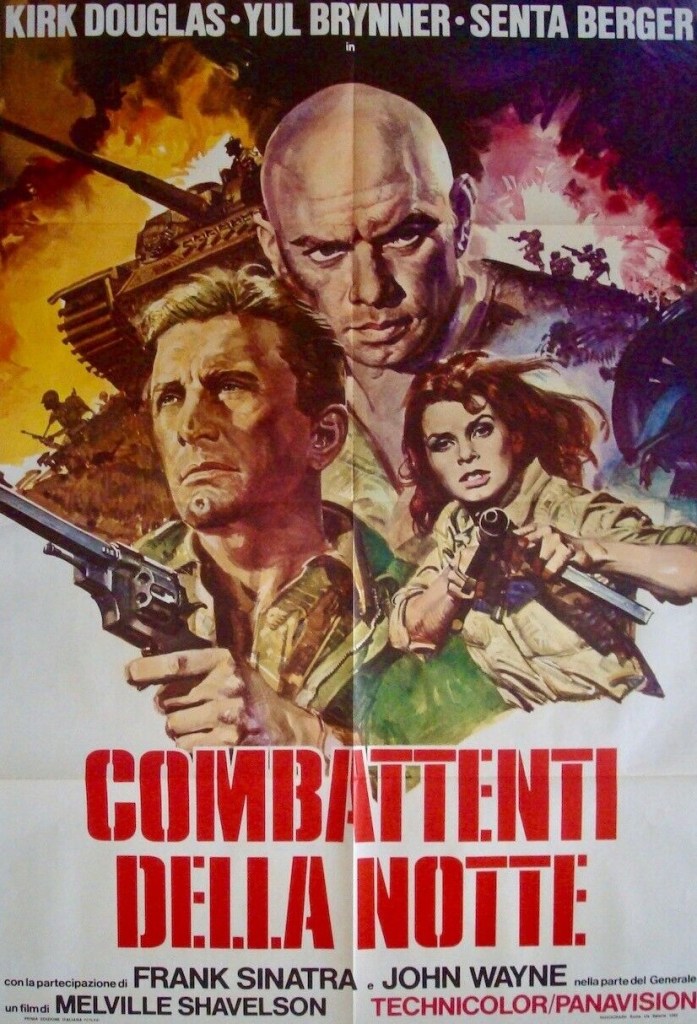
In some respects a sequel to the film Exodus (1960) as Israel, on the eve of independence in 1948, prepares to repel invasion from neighboring Arabs. Colonel Mickey Marcus (Kirk Douglas) is recruited to help organise the Jewish forces even though he has little actual combat experience, having sat out the Second World War behind a desk until D-Day, and having already resumed his legal career.
To facilitate entry to Palestine, he is met at the airport by Magda (Senta Berger), herself a soldier, pretending to be his sister. The journey from the airport in armored bus reveals the perilous reality of the situation, the vehicle strafed as they pass through towns. He finds a rabble of a fighting force, lacking in weaponry, disorganised, and made up of various groups at each other’s throats, and focused on defense rather than attack. Initially, Marcus is strictly an advisor, writing training manuals until he encourages a commando raid and is eventually, at the behest of Asher (Yul Brynner) put in complete command of all the units, effectively the country’s first general.
In the background, General Mike Randolph (John Wayne) is helping organise support in the United States to recognise Israel’s independence. Marcus organises a campaign to lift the siege of Jerusalem, first through direct attack, but then through an incredible foray into impassable mountains, building the “Burma Road,” equivalent in the tactical sense to Lawrence of Arabia’s trek through the desert to attack Aqaba.
A fair bit of the early part of the picture is flashback to establish Marcus’s military credentials, which are scant, in sum total no more than a week of active combat, and it would have been better to concentrate on why he was recruited in the first place, because of the name the real-life Colonel had made for himself in organizing the war crimes trials in Germany.
Apart from the action and military politics, the drama concerns Marcus abandoning wife Emma (Angie Dickinson) in New York, embarking on a romance with Magda and establishing a sense of identity with his adopted country. The action is particularly good, audacity the Israeli’s major weapon.
It is mostly through Magda that we view the Jewish experience. She married Andre (Michael Shillo) in order to save his life, although she did not love him. A veteran of many skirmishes, she suffers a breakdown when trapped in her vehicle during one particularly vicious battle. In what is possibly the most imaginative scene in the film, when Marcus encourages her to keep driving her stalled truck with cries of “Come on, Magda,” in cruel torment the surrounding Arabs take up the cry until it echoes round the hills. Once she falls for Marcus, of course, she never knows if he will return safe from battle.
Kirk Douglas (A Lovely Way to Die, 1968) leads mostly with his chin, never letting subtlety get in the way of his performance, but given the character assigned he has little option and is nonetheless effective as a leader and believable as a man torn between wife and lover. Senta Berger (Major Dundee, 1965) has never been better (or not so far in the films thus reviewed) with a meaty role that shows soldiering from a female perspective in a country where sacrifice is a given.
John Wayne (The Undefeated, 1969) has a small role as a grumpy general and Frank Sinatra (The Naked Runner,1967) a cameo as a commercial pilot who finds himself dragged into the war. Angie Dickinson (Fever in the Blood, 1961) is the long-suffering wife and singer Topol (Sallah, 1964) has a small role. The smattering of Brits includes Michael Hordern (Khartoum, 1966), Gordon Jackson (Danger Route, 1967), Jeremy Kemp (The Blue Max, 1966) and James Donald (The Great Escape, 1963).
Melville Shavelson wouldn’t be your first choice for an action picture given he made his name with comedies like It Started in Naples (1960), but does a fair job of directing, especially the action, the “Come on, Magda” scene and the confrontation with the British when immigrants land. He wrote the screenplay based on the biography by Ted Berkman.










 The Magnificent 60s