Banned, Ignored, Shelved: Part Two

It wasn’t just the censor who put paid to the chances of some films receiving a cinema release. Even more likely, a movie fell foul of distributors or cinema circuits especially in countries where chians were more dominant such us Britain.

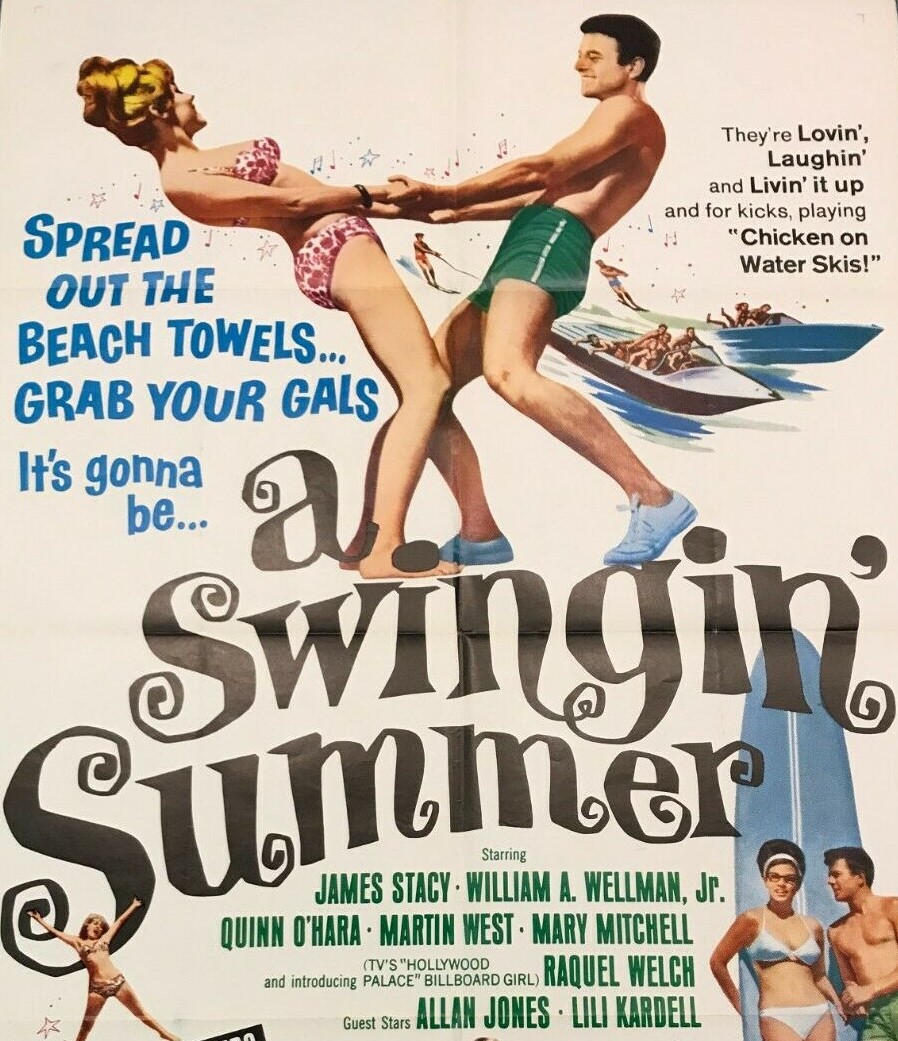
Some cultural boundaries were never meant to be crossed. A country like Britain that barely saw a drop of sunshine from one year to the next could hardly be expected to appreciate the joys of endless sunshine instanced in the sub-genre of movies revolving round surfing and beach activity. This was slightly surprising given that every spy picture came with a bevy of beauties in bikinis, but the slight stories and even more miniscule budgets of the beach movies failed to find an audience in Britain. Although Beach Party (1963) with Robert Cummings and Bikini Beach (1964) starring Frankie Avalon and Annette Funicello got the series off to a decent start, it was quickly downhill thereafter, the bulk of this kind of picture never shown not even the likes of The Ghost in the Invisible Bikini (1966) boasting an impressive cast in Boris Karloff, Basil Rathbone, Elsa Lanchester and Nancy Sinatra.

Whether or not they might have fared better at the box office will never be know because they were not given a chance. In Britain two cinema chains – ABC and Odeon (also including Gaumont) – predominated and if a movie failed to win a circuit release on either there was little chance of it opening at all. In general, assuming a programme did not always comprise a double bill, ABC/Odeon/Gaumont  between them showed around 200 films a year. Allowing that Hollywood produced 300 movies on an annual basis and the domestic industry produced about 75-100 and space had to be found for the occasional reissue or foreign blockbuster, it was no surprise that some films were just ignored altogether – never seen in Britain or received a derisory release.

This was not a situation that would be restricted to Britain. Every country in the world in the 1960s wanted to protect its domestic output, limiting audience access to American or British films by various embargoes or through the censor. Spain, for example, had 370 films on its backlog in 1962. But Britain is an interesting example since culturally it was closest to America and in theory at least there should have been no bar to movies making the Atlantic crossing.

As well as the beach party anathema, Britain film bookers proved resistant to the charms of country-and-western music, no homes found for the likes of Hootennany Hoot (1963), Nashville Rebel (1966) starring Waylon Jennings and That Tennessee Beat (1966). A variety pictures concerning serious subjects like racism, politics, drug addiction, or mental illness put paid to the prospects of, respectively, Black Like Me (1964), The Best Man (1964) – directed by Franklin J. Schaffner and starring Henry Fonda and Cliff Robertson – Synanon (1965) with Stella Stevens and Andy (1965).

Neither did stars necessarily open doors. Henry Fonda led the field in circuit disfavor with The Best Man, The Dirty Game (1966) and Killer on a Horse (1966). Also out in the exhibition cold: Act One (1963) with George Hamilton, Jason Robards and George Segal, Virna Lisi and James Fox in Arabella (1967), Who Has Seen the Wind (1965) with Edward G. Robinson, Maximilian Schell in Beyond the Mountains (1966), Ginger Rogers and Ray Milland in The Confession (1965), Rossano Brazzi and Shirley Jones in Dark Purpose (1964), Anthony Perkins in Violent Journey (1965), Robert Taylor and Anita Ekberg in The Glass Sphinx (1966), and Alec Guinness and Gina Lollobrigida in Hotel Paradiso (1965).

Other big names unwanted by the circuits: James Mason in Love Is Where You Find It (1967), Patrick O’Neal in Matchless (1966), Marcello Mastroianni and Pamela Tiffin in Paranoia (1965), Anthony Quinn and Rita Hayworth in The Rover (1967), Raquel Welch in Shout, Shout, Louder, I Don’t Understand (1966), Rod Steiger in Time of Indifference (1966), Troy Donahue in Come Spy with Me (1967), Angie Dickinson in I’ll Give My Life (1960),  and Elke Sommer in The Wicked Dreams of Paula Schultz (1967)

On the comedy front add to that list: Jackie Gleason in Papa’s Delicate Condition (1962), The Outlaws Is Coming (1965) with The Three Stooges and Woody Allen in What’s Up, Tiger Lily? (1966). Despite headlining Jayne Mansfield, Las Vegas Hillbillies (1966) found no takers. But that was not unusual for Mansfield. Other films never considered for the circuits were Promises, Promises (1963), The Fat Spy (1966), Panic Button (1964) co-starring Maurice Chevalier, and Single Room Furnished (1968). No room was found for  Jeffrey Hunter trio – Battle Royal (1965) with Luciana Paluzzi hot after Thunderball, The Christmas Kid (1967) and Witch without a Broom (1967). John Saxon – generally appreciated as a supporting actor – found no circuit support for pictures in which he was top-billed such as The Ravagers (1965) and The Cavern (1965) with Rosanna Schiaffino.

There was very low interest in William Castle gimmick-ridden horror films 13 Ghosts (1960), Mr. Sardonicus (1961) and 13 Frightened Girls (1963) and none at all in Project X (1967) while  the films of Samuel Fuller scarcely got a look-in, in part due to censorship, Underworld USA (1960) the only one to get any bookings. Despite the general demand for horror, The Blood of Dracula’s Castle (1969), Blood Bath (1966), Queen of Blood (1966) directed by Curtis Harrington, and Orgy of Blood (1968) did not get onto the bookings starting grid. Nor did Michael Rennie in Cyborg 2087 (1966) or Scott Brady in Destination Inner Space (1966) or Women of the Prehistoric Planet (1966).

Tammy and the Millionaire (1967) was one too many in the previously popular series. While topping the pop music charts, Sonny and Cher were considered box office busts, Wild on the Beach (1965), Good Times (1967) directed by William Friedkin and Chastity (1967) all failing to bag a booking.

The term “shelved” had a different meaning in the United States and tended to means films which had been cancelled at the production stage, rather than completed but not finding their way into the release system. In 1969, when Warner Brothers tied up with Seven Arts, around 40 projected pictures bit the dust including Sam Peckinpah pair The Diamond Story and North to Yesterday, Heart of Darkness to be directed by Andrej Wadja, William Friedkin’s Sand Soldiers, Edward Dmytryk’s Act of Anger, Paradise from a story by Edna O’Brien, and Sentries from the Evan Hunter novel.  Some movies killed off at this point would eventually be filmed: The Man Who Would Be King (filmed in 1975), 99 and 44/100%  Dead (1974) and a musical version of Tom Sawyer (1973)

While not on this scale, movies were cancelled all the time. Some movies carried hefty price tags. Shirley MacLaine nabbed $1 million after a pay-or-play deal after the cancellation of musical Bloomer Girl to be directed by George Cukor. the director was also initially involved in a version of Lady L to star Tony Curtis and Gina Lollobrigida. it was scrapped in 1961 but later filmed with different stars in 1965.

Even so, the shelf of unreleased films in the U.S. was at times very crowded. Although the vast majority of studio pictures received some kind of release, either in the arthouse or drive-in circuits if not deemed commercial enough for first run, sometimes they sat around for an unusually long time. When Variety determined in 1967 that the Hollywood vaults were bulging with over 125 completed pictures, among them were several movies that would not see the light of day until well into 1968 including Dark of the Sun, Planet of the Apes, Hang ‘Em High and The Odd Couple.

Although there were circuits in the United States, they were not national nor as dominant as in the U.K. so most films managed to find a way into the system somewhere, and therefore until the likes of The Picasso Summer (1969) and The Extraordinary Seaman (1969) – as previously mentioned in the Blog – were deemed to not hold sufficient commercial attraction and were dumped more or less straight into television then the number of movies not screened was considerably lower than in Britain.

SOURCES: David McGillivray, “The Crowded Shelf,” Films and Filming, September 1969, p15-22; “Lady L Cold,” Variety, June 21, 1961, p19; “Spain’s Unreleased Backlog: 370,” Variety, May 2, 1962, p120; “Shirley Yens $1-Mil on Fox’s Unmade Bloomer,” Variety, September 7, 1966, p7; “H’wood Backlog Hefty at 125,” Variety, September 13, 1967, p3; “Courtesy of the Film Road,” Variety, July 23, 1969, p 5; “Deferred Film Deals at W-7,” Variety, July 23, 1969, p 5; “Projects Scratched at Warners,” Variety, October 22, 1969, p6.

Selling James Bond – Pressbook for “From Russia with Love” (1963)

United Artists had two concepts in mind when it came to marketing the second in the James Bond series From Russia with Love (1963). The first, and quite audacious notion, was to tell anyone who hadn’t seen Dr No (1962) much they had missed. Producers Cubby Broccoli and Harry Saltzman reckoned 69 million moviegoers across the world had seen Dr No, but America only accounted for a small fraction of that total. So their mission was to ensure that American audiences did not miss out again on the “throbbing world of hot-blooded excitement.”

To target that marketplace, the adverts were more like a relaunch, not a sequel, and the taglines began with “Meet James Bond, Secret Agent 007.” And then, “For those unlucky few who missed Dr No…You are unprepared for the sophisticated mayhem and polished lovemaking. The James Bond bug has not bitten you. But take heart! There is still time to jump on the Bond bandwagon with the second James Bond adventure From Russia with Love. See it and we guarantee – you will be hooked for good.” The final exhortation: “Don’t you think it’s time you met secret agent 007?”

But of course James Bond already had some kind of fan club in the States. “James Bond Is Back!” screamed the alternative advertisements. For both, however, the emphasis was on the new. “His incredible new women! His new incredible enemies! His new incredible adventures!”

“Target: the unkillable James Bond 007. Blast him! Seduce him! Bomb him! Strangle him!” The tone of the adverts suggested something entirely new. While heroes in thrillers could expect to face danger at every turn, and while a romance might sweeten the pot, there would not be a selection of alluring scantily-attired women. “For those who saw Dr No, consider yourself fortunate. Now you are prepared for the further fantastic adventures of that master of intrigue and women, secret agent 007 James Bond, join him in his new thriller From Russia with Love.

To whet the appetite of local newspapermen there was a host of snippets. Oxford University had organized an 007 Society whose members included three lords and the heir to one of the the country’s largest department stores. While James Bond never uses a Windsor knot in his ties, Sean Connery does. Ian Fleming’s Bond novels had sold 30 million copies including six million of From Russia with Love. Four Istanbul mosques featured in the new film as well as an underground cistern a millennium old.

Door posters five feet high.

Beauty queens were always a good bet for coverage – Miss Universe runner-up Daniela Bianchi  won the role of James Bond’s girlfriend after a screen test and former Miss Israel Aliza Gur and former Miss Jamaica Martine Beswick played the fighting gypsy girls. Lotte Lenya was married to Kurt Weill who, with Berthold Brecht, wrote The Threepenny Opera. Sean Connery was fitted out by his own Savile Row tailor Anthony Sinclair and during filming got through ten customized shirts, eight suits, two top coats and a dress suit.

Highly sought-after these days in the memorabilia market are the door panels – measuring 20 inches x 60 inches – which exhibitors would stick to lobby doors but which could also be utilized as displays in stores. Signet brought out a movie tie-in paperback which came with its own promotional material. As there were already other books in the series, booksellers would be inclined to set up a Bond display. As well as the John Barry original soundtrack album, other artists recording material from the film included Matt Monro, Jackie Gleason, Kenny Ball, Al Caiola and Si Zetner, all creating promotional tools.

“Bondmanship” was the overall name given to lifestyle items worn by Bond or which he might wear so tie-ups with fashion stores and retailers were encouraged “no direct endorsement is necessary.” So, for example, restaurants were encouraged to offer “ a menu good enough for James Bond.” It didn’t matter that Bond did not wear a manufacturer’s shoes, ties or suits in the film, just that he might wear them if they were of sufficient quality.

The marketeers came up with a simple stunt: send a set of keys to a newspaper, turn up the next day with a dispatch box handcuffed to your wrist, open it and find inside various promotional items. Or the keys don’t open the case and you need to send for a locksmith. Either way it was important to have a photographer to hand.

Behind the Scenes: “The 7th Dawn” (1964)

Originally intended to pair Audrey Hepburn with William Holden and entitled variously Wherever Loves Takes Me, Ten Days to Penang, The Durian Tree (title of the source novel), Year of the Dragon, The Third Road, and Ten Days to Kuala Lampur, the picture eventually released as The 7th Dawn marked the entrance of British director Lewis Gilbert (HMS Defiant/Damn the Defiant, 1962) into the Hollywood big-time courtesy of producer Charles K. Feldman (Casino Royale, 1967). Gilbert had already been assured of a step-up from the budgetary confines of Britain to something more substantial after being signed in 1962 to direct Susan Hayward in Summer Flight, but that had fallen through.

William Holden was always interested in making movies outside the United States, in part down to a sense of adventure, in part to avoid paying taxes. He hadn’t worked in the States since 1958. “I’ve got a reputation for going to various part of the world to take advantage of background. There’s always new stories,” he said, adding, “I have to do things that satisfy me.” Actually, he could afford not to work. He had pocketed by far the biggest-ever Hollywood payout – over $3 million from his share of the profits from Bridge on the River Kwai (1957) and his current fee was in excess of $750,000.

Gilbert agreed to take the assignment on the basis of a script by Karl Tunberg (Ben-Hur, 1959) who had adapted the novel by Michael Keon. But what appeared relatively straightforward was soon anything but as the British director became enmeshed in clashes over production, the script and the casting. While Gilbert was tussling with the problems of working on location, where he was expecting the imminent arrival of a film crew, he was summoned to Hollywood and told that two-time Oscar-winning screenwriter Ben Hecht (Circus World, 1964) had rewritten the script.

Feldman was known for playing fast and loose with scripts, much to the surprise of director Edward Dmytryk and the frustration of star Laurence Harvey when new writers were  brought in for Walk on the Wild side (1962), earning the producer a reputation for interference.  On reading the new script Gilbert recalled, “The basic plot was similar, but apart from that it wasn’t like the old script at all. Bill Holden’s part kept shrinking while the part of the mixed race girl kept getting bigger.” This may have been a ruse to attract Audrey Hepburn. Although Holden and Hepburn were due to be paired in June 1962 on Paris When It Sizzles in a part more in keeping with her screen persona, that film was delayed (not released till 1964) leaving both free for the Malaysian picture. Despite Feldman’s assurances,  Gilbert later questioned whether Hepburn had ever been committed.

Gilbert hated the new script so much that he threatened to quit, only placated when Feldman promised he could work with Hecht on a revised version of the new script. But Hecht insisted on working closer to his home near New York. Their flight from Los Angeles to New York was delayed because of engine trouble, but by the time passengers were instructed to leave the plane, Hecht, who was addicted to sleeping pills, was fast asleep and could only be removed by ambulance. Facing a three-day deadline, Gilbert discovered that Hecht refused to work in the New York hotel assigned them by Feldman so they were decanted to the writer’s home in upstate New York. That scarcely improved the script, described by Gilbert as a “cockamamie affair.” However, that would not have unduly worried the producer who was of the opinion that performers with box office clout “can make successes of weak properties.”

Six months before release “The 7th Dawn2 was still being promoted as “Ten Days to Penang.” Incidentally, “The Dubious Patriots” was released as “Secret Invasion” (1964),
although its original title did not go to waste, used as an alternative to the
Charles Bronson-Tony Curtis “You Can’t Win ‘Em All” (1970).

The script in whatever version offered a key role for a Eurasian woman. Initially Gilbert and director of photography Freddie Young planned to scour the Shaw Brothers portfolio of budding stars to fill the role, and if not finding what they wanted in Malaysia aimed to head for Hong Kong and “seek her among the actresses there” according to Holden. However, once the compromise script was approved, Feldman proposed his real-life mistress Capucine (North to Alaska, 1960) for the part.

That was the first difference of opinion between director and producer, not to mention star and producer, and an education for Gilbert on just how little power he wielded when it came to confronting Feldman. William Holden objected strenuously to the involvement of Capucine, his opposition based on his experience of working with her on flop The Lion (1962). It may have counted against the actress that the duo had engaged in an affair on the African set. Holden may have wanted to treat the affair as one of those things that happened on location – and ended once the film is completed. “Whatever you do, Lewis,” Holden advised the director, “you must resist having her in the picture. I’ve just made a movie with her…and she was not very good. I think, really, the picture suffered for it and so if I make my next movie with her I’m going to look pretty stupid.”

Expecting Holden to back him up, Gilbert was surprised when the actor shied away from any confrontation with the producer, only learning later that Holden was somewhat in awe of Feldman, who had given him his big break in Golden Boy (1939) and, in his capacity as agent – the first to demand a $750,000 fee plus hefty percentage for his client – helped oversee his career. Although her three-year contract with Columbia had begun in 1961, Capucine had only made one film for the studio, Walk on the Wild Side (1962), more likely to turn up in pictures for Twentieth Century Fox, United Artists or independents. Feldman claimed Capucine was “in greater demand for roles after being starred in Walk on the Wild Side.” His position as star-maker-supreme was strengthened when he merged his agency with Ashley-Steiner and bought the rights to Mary McCarthy bestseller The Group, which boasted great parts for four women. Probably Gilbert did not quite realize what he was taking on when he raised his and Holden’s objections to  Capucine. Feldman responded, “We’re not making the film for Bill, we’re making it for the world.”

Gilbert was also having problems with Karl Tunberg who was also functioning as a co-producer “and therefore my producer,” according to the director. “As I’ve often done the job myself I haven’t worked with many producers but I can safely say this one was hopeless.” As a result of Tunberg’s “inertia” the production manager Bill Kirkby resigned, and Gilbert ended taking on the role of producer as well.    

Holden’s career, while not yet in the box office trough that would envelop him later in the decade, was enjoying an unexpected movie hiatus, his planned starring role in The Americanization of Emily, to be directed by William Wyler, having fallen through. Paris When It Sizzles was on the shelf for an interminably long time given the supposed box office pulling power of the stars. Made in 1962, it was not released until 1964, by which time Hepburn was back on top thanks to Charade (1963) and My Fair Lady (1964). By the time The 7th Dawn hit theaters, Holden had four box office flops on the trot.

Jack Hawkins was originally intended to play the Governor and for the role of his daughter Candace, who makes a play for Holden, Gilbert suggested Susannah York who had worked on his Loss of Innocence (1961), and who was beginning to attract attention in Hollywood. By the time the crew got to Malaya, where the film was to be shot, there was one notable absentee – the wardrobe mistress. Gilbert’s wife Hylda supplied York with a beautiful sarong purchased from a girl she spotted passing on a bike. Shooting was delayed due to a strike by Asian extras on the first day. They claimed discrimination because white extras were being paid more. Around 1,000 extras were required to play peasants and the security forces.

Although it was known Holden had an alcohol problem, prior to filming he had undergone aversion therapy in Switzerland and consequently remained dry throughout the filming. Gilbert admired the actor’s approach: “Bill Holden was a delight. He was an old time star.” If you asked him to crawl across a room, and climb up onto a chair, he would do it. “Whatever the director says, you do it. That’s how film actors were trained in his day and that was certainly his training.”

Capucine was the opposite. “Because she was untrained and didn’t understand what you were saying anyway, there was little you could do with her.” When the actress complained to her lover that she was being ignored on set, Gilbert had to take the producer aside and explain her deficiencies. “She doesn’t know about working with other actors. When I’m doing a scene where Susannah’s talking to her, I’m not just working with Susannah. I’m working with her too because I will be filming her reactions, how she listens to Susannah, that sort of thing. When I get back to the cutting room I can put all that together and even improve her performance.” (That said, I felt Capucine gave the best performance of her career.)

Unlike many top productions of the era, the film was not given an exclusive run at a New York city center cinema, but went straight into a Showcase (wide) release in 300 theaters simultaneously with its opening at the Astor and Trans-Lux East arthouses in the Big Apple.

William Holden, unable to stay off the wagon, succumbed to his affliction, hitting his head while on a bender alone in a cabin and dying at the age of 63 from his injury. Capucine was 62 when she committed suicide in 1990.

SOURCES: Lewis Gilbert, All My Flashbacks, (Reynolds & Hearn, 2010) p213-231, p234-235; Matthew Field, “Gilbert Goes to War,” Cinema Retro, Vol 6, issue 18, p46; “Capucine Option Renewed,” Box Office, November 27, 1961, NC2; “Mary Magdalene to Star Capucine,” Box Office, January 29, 1962, p13;  “Feldman Sees Wild Side as New Break-Through,” Box Office, February 5, 1961, p14; “Actor Harvey no Fan of Feldman,” Variety, May 9, 1962, p5; “Ransohoff Signs William Holden,” Box Office, May 28, 1962, p15; “Lewis Gilbert to Direct Summer Flight for UA,” Box Office, June 11, 1962, pE8; “William Holden Plans Continue Produce Pix in Overseas Spots,” Variety, November 20, 1963, p2; “Bill Holden Party Primes Malaya Pic,” Variety, December 19, 1962, 4; “Chatter,” Variety, April 10, 1963, p69; “West Side in Malaya,” Variety, April 17, 1963, p21; “Liz’s Cleo 10% Mebbe Soon; But Holden Coin Tops,” Variety, May 15, 1963, p1; “Holden Follows Wyler Leaving Emily,” Box Office, October 7, 1963, pW2;  “Feldman Acquires Rights to Mary McCarthy Novel,” Box Office, December 16, 1963, pE11;  “New UA Title,” Variety, December 23, 1963, p6; Advertisement, Variety, January 8, 1964, p51; “300 July Dates for Dawn,” Box Office, June 1, 1964, p8; Advertisement, “UA’s Blockbuster for Summer Release,” Variety, June 17, 1964, p12-13; “UA Opens 7th Dawn as Showcase Presentation,” Box Office, August 31, 1964, pE2.

RRR (2022) ***** – Seen at the Cinema

Easily the most extraordinary epic I have seen in a long time. Hitting every action beat imaginable, a stunning tour de force that ranks alongside the best Michael Bay or Steven Spielberg can offer. As if Rambo or John Wick had turned up a century ago. If films could go from 0 to 100 in ten seconds, this would be the prime contender. Astonishing sequences include a cop taking on a mob single-handed with only a stick for a weapon, a villager acting as bait for a tiger, wild animals leading an attack on a fort, a savage beating with a nail-studded whip, and the unforgettable image of one man mounted on another spraying bullets with two rifles.  

Following the virtual abduction of a native girl Milla, two friends are on a collision course in the oppressive British regime in India in 1920. Technically, it doesn’t count as a kidnapping because the British Governor Scott Buxton (Ray Stevenson) committed the crime, taking the child as a gift for his wife (Alison Doody). Villager Bheem (N.T. Rama Rao Jr.) is tasked with bringing the girl back, ambitious undercover cop Raju (Ram Charam) with stopping him. The two men, befriending each other in Delhi, are unaware of the other’s plan. That both are immensely likeable, if quite opposite, characters, creates terrific charisma, and their bromance is entirely believable.

Bheema has to connect both ends of the rope in order to keep a tiger trapped.

Everything in this picture is big and bold except when it is intimate and small. There is a beautifully-observed romance between Bheema and a kind British woman Jenny (Olivia Morris), the development of which, faced with the obstacle of neither understanding the other’s language, with Raju acting as matchmaker, could have been a film on its own. There are two brilliant pieces of screenwriting, phrases repeated throughout that acquire deeper meaning as the story unfolds. The British continually kill by brutal means rather than waste an expensive bullet; “Load. Aim. Shoot,” is a mantra taught the young Raju by his revolutionary father; both come into play at the climax.

The British are horrific. The Bheema-Jenny meet-cute occurs when the native is beaten for inadvertently embarrassing a British soldier. Lady Buxton is a sadist, determined to see a man whipped till he bleeds to death. By contrast, the two heroes are often far from heroic, Bheema unable to find the girl, Raju forced into terrible violence as a consequence of ambition. And in the midst of all this ramped-up violence perhaps the best scene of all, albeit one of conflict, is an energetic dance-off between the two men and the scions of the British upper class, the fantastic “Naatu Naatu” sequence, that demonstrates the superior stamina of the natives.

Director S.S. Rajamouli (Baahubali: The Beginning, 2015) makes as bold a use of narrative structure as Tarantino in Pulp Fiction, withholding until the last third of the movie a flashback which tilts the story in a completely different direction. But there is nothing lumbering about this epic, it has an incredible drive, an energy to set your head spinning. Even so, Rajamouli utilises a classic three-part structure and the three-hour-plus running time is anything but sprawling. In among a host of character-driven scenes he knows how to build a sequence, as the heroes successively triumph and fail with every passing minute, and among the introductory sequences for both main characters are some inspired images. Cleverly seeding the story creates a variety of twists, turns and reversals.

I was expecting not to like the traditional dancing sequences, which you would thought ill-fitting in a picture of this scope, but the “Naatu Naatu” sequence is treated as virtually a rebellion with tremendous dramatic impact. Although the two leads are muscular in Schwarzenegger/Stallone mold it does not prevent them channelling their inner Gene Kelly.

Except that it is set a century ago, this has all the bravura hallmarks of MCU, an exceptional adventure told at top speed that does not put a foot wrong.  N.T. Rama Rao Jr  (Janatha Garage, 2016) has the more difficult role, in that he switches from full-on action hero to romantic klutz. But the intensity of Ram Charam (Vinaya Vidheya Rama, 2019) should have Hollywood calling. The characters played by Ray Stevenson (Accident Man, 2018) and Alison Doody (Indiana Jones and the Last Crusade, 1989) are more one-dimensional but no less terrifying for that. In her movie debut, Olivia Morris is quietly effective.

On energy and cinematic imagination alone, this would more than pass muster but S.S. Rajamouli has also created a brilliant piece of entertainment with greater depths than you might imagine. There’s no other word for it: this is a knock-out.

Sergeants 3 (1962) ***

There’s a terrific western directed by John Sturges (The Magnificent Seven, 1960) inside this Rat Pack offering, the second of four in the series. On the plus side are plenty twists on traditional scenarios, Frank Sinatra and Dean Martin displaying a certain kind of easy screen charisma, and three exceptional and well-choreographed battle scenes.

Sinatra, Martin and Peter Lawford play the eponymous sergeants, Lawford committing the cardinal sin of wanting to quit the regiment to get married, with Sammy Davis Jr. as a former slave, bugler (an important plot point) and horse-lover wanting to sign up, and Joey Bishop (television star and occasional movie actor) as their sergeant-major boss.

A fair bit of time is spent on the usual Rat Pack shenanigans, getting drunk, brawling, playing tricks on each other, and exploring odd comic notions such as playing poker with a blacksmith’s implements as chips. But when it gets down to proper western stuff, it fairly zings along, with a decent plot (a Native American uprising) and excellent action scenes. You could have had William Goldman writing the script for the number of reversals involved as the picture keeps one step ahead of audience expectation.

For a start, rather than flushing out outlaws from a town, the troopers have to remove Native Americans who have taken it over. Instead of the cavalry pursuing Native Americans, it is mostly the other way round. It is the soldiers rather than the Native Americans who attack a wagon. Sinatra finds himself employing a bow-and-arrow and then a tomahawk rather than being on the receiving end of such weaponry.  Instead of dynamite, the good guys make do with fireworks. Where Native Americans are usually pinned down, this time it is Sinatra’s merry band. And when it comes to resorting to serious violence, that, too is usually the remit of the Native Americans, not as here, Sinatra chucking man off a cliff.

When it sticks to action, the picture is very well done and involving. When Sinatra has to take charge instead of larking about, the movie has focus. Both Sinatra and Martin were undertaking serious roles around this time, the former in The Manchurian Candidate (1962), the latter in political drama Ada (1961) so this might have appeared welcome relief.

The comedy isn’t along the laugh-out-loud lines of Support Your Local Sheriff (1969) or Blazing Saddles (1973) and the action of so full-on you wonder why anybody thought this required comedy at all, although there is a pretty good punchline ending. Action aside, It’s almost the equivalent of easy listening. The Rat Pack was a particular 1960s institution, the members joining each other on stage in Las Vegas or featuring in television programs, but there’s no real modern correlative.

It was interesting to see how the Rat Pack concept developed. This movie chucked out the idea of including a few songs as with Oceans 11 (1960) while the next one in the series, 4 for Texas (1963) was more of a serious straight western. But the final picture Robin and the 7 Hoods (1964) went in the opposition direction and was a full-on musical as if by the time they came to making that picture everyone had realized the film would make more sense if it played to their inestimable talents.

The series developed in other ways, too. Romance was minimal in Oceans 11, barely seen here, but was a major element of 4 for Texas – who would want to waste the talents of Ursula Andress and Anita Ekberg – but just as Andress is a smooth operator in 4 for Texas when it came to the last Rat Pack picture Barbara Rush was also a significant player for whom romance was merely a means to an end. You could also argue that the disappearance of Lawford and Bishop allowed the supporting roles to be played by actors who were not in on the joke.

CATCH-UP: the entire Rat Pack quartet has now been reviewed in the Blog with Oceans 11 (1960) and 4 for Texas (1963) also to be found here. Other Frank Sinatra films reviewed are Can-Can (1960), Cast a Giant Shadow (1966), The Naked Runner (1967) and The Detective (1968) while for Dean Martin the list, so far, comprises Texas Across the River (1966) and Rough Night in Jericho (1967).

Selling The Rat Pack: Pressbook for “Robin and the 7 Hoods” (1964)

Warner Brothers pushed the boat out for Robin and the 7 Hoods with this lavish Pressbook. Apart from roadshows, most pressbooks of the era were around 16-pages A3. But this stretched to 28 pages with a tremendous range of advertisements, taglines and tie-ups plus, easier to accommodate from the exhibitor’s perspective, a healthy number of relatively straightforward marketing suggestions. On top of that, always a great incentive for cinema managers to rack their brains for good promotional ideas, the studio was offering seven cash prizes worth a total of $1,500 – about $14,000 today – for the best individual campaigns as well as a “special bonus prize” of the golf clubs used by Frank Sinatra, Dean Martin, Sammy Davis Jr. and Bing Crosby for the most original stunt.

With Pressbooks popping through a cinema manager’s door at the rate of one or two or three a week – dependent on how often a picture house changed its program – this one would certainly have made an impact, not so much from its size, but its commitment to the exhibitor. Most Pressbooks began either with information on the stars and the filming or with the advertisements and there was a sense of exhibitors being called upon to fit in with a pre-conceived campaign. Warner Brothers was not the first studio to go down the prize-giving route as a means of attracting attention, but in making the competition the first item on the promotional agenda – two of the first four pages were devoted to it – it certainly ensured it was high priority.

Following the competition came four pages of suggestions for gimmicks, stunts and tie-ins. WB had already tied-up with the The Antique Automobile Club of America and its members were being encouraged to lend out their vehicles to any movie theater planning a stunt. Exhibitors were told that car owners were “pleased to show them off.” There were over 100 chapters/branches of the Club so no shortage of eager participants. A parade of old-time cars in the town or a rally outside the cinema or even a race was guaranteed to attract publicity.

The Roaring 20s was another concept easily adopted – flapper fashions, the Charleston being performed outside the theatre or a dance competition, or girls dressed up in the outfits of the day strolling around town “carrying phonographs and camp stools; at busy intersections they can sit down and play one of the Robin tunes.”  Reward posters could be put up for famous gangsters of the speakeasy period, with photographs of the film’s characters included. A jazz parade was another possibility complete with straw hats and blazers. Setting up a gambling den was another suggestion using “actual gambling equipment captured by the police.”

And all this was before exhibitors could let fly with ideas based on the archery motif since “the words Robin Hood and archery and practically interchangeable.” Archery contests could be staged in a sports store, park, shopping mall or in front of the cinema. Robin Hood hats made of simulated felt with a feather sticking out – or bullet-riddled – were available at a low cost and ideal for giving away to children and to be worn by ushers and other staff as well as employees in other organisations participating in any promotion. Or just handed out to a local restaurant.

On top of that, since this Rat Pack picture was actually a denoted musical in which all the principals sang, there was the best tie-in of all – an original soundtrack album, an easy marketing tool for record shops. WB had also arranged for a book tie-in with Pocket Books, novelization written by Jack Pearl and stocked in 120,000 outlets.  The record, promised WB, would be “on every radio station night and day.” Even though Sinatra was no longer a top recording artist – “My Kind of Town” did not break the Cashbox Top 100 singles chart – his voice and that of his co-stars were exactly the kind of easy listening that appeared to radio addicts fed up with the British Beatle invasion.

The advertising campaign was fairly straightforward consisting of as many of the stars as could be crammed onto a poster – usually the main four plus either Barbara Rush or Peter Falk, occasionally all six. The tagline went hip: “Like we’ve taken the Robin Hood legend and changed the bows and arrows to machine guns…! Like with songs yet!…Like Wild.” The last word might be changed to “Wow.”  An alternate tagline along similar lines went: “In Merrie Olde Chicago, in the days when King Al ruled the land…” And “Gather round all ye swingers and hear this…we’re doing the Robin Hood legend in Chicago’s wildest era…with songs yet!” A final version ran: “Warner Bros right merrily presents the wild idea of doing the Robin Hood legend in Chicago’s wildest era.”

With the box office and recording firepower of Sinatra, Martin, Davis and Crosby and the range of promotional ideas, there was little need to jazz up the Pressbook with journalistic nuggets, but WB did not stint on this count. The appearance of Edward G. Robinson in the genre and studio where he made his name three decades before in the like of Little Caesar was too good an opportunity to miss – more so when the wardrobe department discovered his suit size had not changed. Other cinematic stalwarts from the early gangster picture days included Allen Jenkins and Jack La Rue, now a restaurant owner and making his first WB movie in 23 years.

Elegance was a keynote for Barbara rush’s femme fatale. Designer Don Feld created a range of dinner gowns, coats and negligees which served almost as a disguise for the hard-as-nails operator. Commented Rush, “I am as tough as daddy and just as blood-thirsty. But I play it sweet throughout and never become hard or evil. The role has more substance when you realize this sweet girl has the ruthlessness of a cobra.” Pool hustler Harold ‘Red’ Baker was hired to teach Dean Martin how to perform like a champion player and also set up the shots for the game between Sinatra and Martin. Baker. But the editorial section ran for only two pages, which was a mighty small proportion of the overall Pressbook.

Phantom of the Open (2021) ** – Seen at the Cinema

A sentimental ending and Oscar winner Mark Rylance (The Bridge of Spies, 2015) can’t save this latest tribute to that particularly British phenomenon – the loser. While no doubt this is in essence the true story of golfing wannabe Maurice Flitcroft who gained some kind of notoriety – and latterly some celebrity – as the world’s worst golfer after posting, on live television, by a long way the worst score in British Open history, it’s plagued with a woeful attempt at no-hoper charm that just doesn’t work.

Rylance (Maurice Flitcroft) is part of the problem. He could be a cousin to Jim Broadbent’s dour character in The Duke, but where Broadbent comes to life in the second half, Rylance does not, a one-note performance that fails to elicit any sympathy for the character. Where do I start with what is wrong with the picture?

Well, for a start, the idea that a crane driver is an awful job. My grandfather was a crane driver in the shipyards in Clydebank and it was a skilled and highly-prized job and earned him a little bit more than the other workers down below and instead of moaning about his job he drove on his children to become educated – my mother among three of the family to go to university in World War Two Glasgow. Clearly, also, “poor” Maurice earned enough to put down a deposit on a house, a big achievement in the 1960s.

And the idea that Maurice had never heard of golf until the mid-1970s seemed preposterous when hardly 80 miles away Tony Jacklin, the son of a steel worker, won the British Open at Royal Lytham St Annes in 1969. The whole of Britain was electrified. I remember with my brother peering through the window of a television shop to watch it live on television. Equally preposterous is the notion that golf was a middle-class hobby. I remember as a teenager just after Jacklin’s famous win caddying for my father at a public golf course, which required no payment of annual fees nor wearing of fancy golfing ensembles. Golf was far from a hobby restricted to the well-off.

The closest loser-hero to Flitcroft is British ski jumper Eddie the Eagle (also filmed) but Eddie was at least a recognized and official contender in his sport. He did not try to sneak in the back door without doing any of the endless training necessary for anyone who wants to compete at a high level. It’s just crazy to set Flitcroft up as some kind of official-tweaking hero, when he simply managed to gain entry to the Open by cheating. The closest comparison in golf in the winner-from-nowhere category was John Daly who won a major in the U.S. in 1991, only qualifying after one of the contenders dropped out, but he had been a professional golfer for four years by that time.

And I hate this grim mud-tainted view of the 1960s and 1970s. I grew up in that period and certainly don’t recognize the picture painted. Flitcroft’s children, luckily, didn’t inherit the delusional gene, his twins becoming world champion disco dancers and his other son becoming a successful businessman.

Flitcroft just wanted glory without any of the hard work and it’s hard to find any sympathy for such a delusional man. Anyone who pointed out to Flitcroft just how delusional he was received short shrift in the film. Woe betide any official who thought this character was going to bring derision to golf, at a time when the sport was going through a revival, thanks to Jacklin who would inspire a generation of even better golfers like Nick Faldo and Ian Woosnam.

It’s almost a cosmic joke that everyday golfers looked upon Flitcroft as their idol simply because he played the game as badly as they did and that he received some kind of celebrity as a result. Odd, too, that nobody’s ever thought to make a film about a true winner like Tony Jacklin.

Banned, Ignored, Shelved

If anybody in Britain told you they saw Wild Angels (1966) when it came out that year you could safely accuse them of being liberal with the truth for that was one of the many films banned by the censors there. Global censorship remained a major issue for studios during the 1960s, every country imposing its own system, and very rarely did they conform with each other. At the beginning of the decade, the biggest issue was sex, by the end it was joined by violence and drugs.

Films were rarely banned in the United States since scripts for movies liable to violate the agreed guidelines tended to be submitted in advance and a compromise reached prior to production. However, local U.S. censorship bodies acting independently prevented some films being shown, This Rebel Breed (1960) in Memphis, Room at the Top (1959) in Atlanta. Movies banned in different countries included: Operation Eichmann (1961) in Israel and Germany, Queen Bee (1963) in Italy, The Collector (1965) in New Zealand, Wild Angels (1966) in Denmark, Lady in a Cage (1964) in Sweden and Geneva, Ulysses (1967) in Glasgow and Edinburgh, and Easy Rider (1969),  despite winning a prize at Cannes, in France. Doctor Zhivago (1965) was banned in Thailand for being pro-communistic and in India for the opposite reason. Ireland banned 56 movies in 1960, Finland 12 in 1962, Sweden 10 in 1963 and West Germany 19 that same year. In South Korea in 1962 you still could not see any Japanese movies.

Being banned of course became a promotional tool. It was a regular joke in America that a low-budget picture had no chance of box office success unless it was banned in Boston. In France, Les Teenagers (1968), Young Wolves (1968), The Nun (1966) and Paris Secret (1965) all benefitted from being released after tussles with the censor and the controversy over Ulysses saw it break box office records in Dundee in Scotland.

The British censor prevented screening of films deemed too violent including The Couch (1962) about a serial killer, Samuel Fuller’s Shock Corridor (1963), Violent Midnight (1963), The Thrill Killers (1963), Shock Treatment (1963) – despite a cast that included Lauren Bacall and Stuart Whitman – Fuller’s The Naked Kiss and Weekend of Fear (1966). Among horror films denied a showing were Blood Feast (1963), Two Thousand Maniacs (1964) and, initially, Mario Bava’s Black Sunday (1960) which was later reprieved and shown as Revenge of the Vampire.

Juvenile delinquency, often straddling the biker world, was another subject to fall foul of the British Board of Film Censors. Among them The Choppers (1961), Jacktown (1962), The Cool World (1964), Kitten with a Whip (1964) starring Hollywood sensation Ann-Margret,  the aforementioned Wild Angels (1966), Rat Fink (1966), Hot Rods to Hell (1966) with Dana Andrews and Mickey Rooney, Riot on the Sunset Strip (1967), Born Losers (1967), Devil’s Angels (1967) and virtually anything that mentioned Hell’s Angels.

Drug taking was also forbidden to be seen, thus accounting for the absence on British screens of The Trip (1967), Hallucination Generation (1967), Mary Jane (1967), LSD Flesh of the Devil (1967) with Guy Madison and Revelation – The Flowering of the Hippies (1967). Easy Rider (1969) was passed for “being actively concerned with human beings and the effect of drug taking.” Films considered too morally dubious or too sexually open to let loose on British audiences included Sinderella and the Golden Bra (1964), 3 Nuts In Search of a Bolt (1964) starring Mamie Van Doren, 90 Degrees in the Shade (1965) with Anne Heywood, Russ Meyer’s Motorpsycho (1965), Good Morning…And Goodbye (1967) and Lee Frost’s The Animal (1968). Explicit language was the objection to Warrendale (1967) and Ulysses (1967), homosexuality the problem for Deathwatch (1965) starring Leonard Nimoy and Shirley Clarke’s documentary Portrait of Jason (1967).  

In Britain, to get round the censor’s strictures, the “cinema club” was invented in 1960 by Gala Film Theatres, an offshoot of a distributor specializing in racy fare, and within a month had 7,500 members, the operation launching with a showing of The Wild One (1953).  Local authorities could also take exception to the national censor’s findings and grant a reprieve for various films, Wild Angels and The Trip eventually achieving exposure in this fashion. Most cinema clubs would eventually segue into becoming outlets for soft porn but some stuck with the original concept of showing arty movies considered too risqué by the censor. The New Cinema Club in London, for example, in August 1969 programmed Wild Angels and Kenneth Anger’s Scorpio Rising (1963)

But the censor was not the only reason why films were not shown and ended up either ignored by the distributors or stuck on the shelf and we’ll come to those in another article.

David McGillivray, “The Crowded Shelf,” Films & Filming, September 1969, 14-15; “High Cost of Censor Fights vs. Principles,” Variety, March 2, 1960, 1;“If Banned in Britain, All Is Not Lost,” Variety, April 20, 1960, p48; “Theatre, Not Censors, Banned Breed,” Variety, June 1, 1960, p24; “Room at the Top Ban,” Variety, July 27, 1960, 4; “Operation Eichmann Banned in Germany, ” Variety, May 3, 1961, 1; “211 Pix Scissored, 56 Banned in Ireland,” Variety, May 3, 1961, p15; “Operation Eichmann Banned by Israeli,” Variety, November 1, 1961, p2; “12 Pix Banned by Finland Censors,” Variety, March 28, 1962, 17; “Singapore Censor Gets Tough with U.S. Pix; Satan, Suzie Banned,” Variety, August 8, 1962, 21; “Japanese Pix Still Banned by S. Korea,” Variety, December 12, 1962, p16; “Bee Banned by Italian Censor,” Variety, January 23, 1963, p18; “W. Germany Claims Only 19 Pix Banned, “ Variety, December 4, 1963, p11; “Swedish Censors Banned 10 in ’63,” Variety, February 5, 1964, p2;  “The Group Banned,” Variety, April 8, 1964, p84; “Lady in Cage Banned by Sweden Censors,” Variety, July 15, 1964, 2; “New Zealand Censors Turn Down Collector,” Variety, November 3, 1965, 11; “Cage Banned By Geneva Censors,” Variety, January 19, 1966, 16; “Can’t Second Guess Global Censors,” Variety, November 30, 1966, 20;  “Banned in Australia,” Variety, May 24, 1967, 26; “Scot Exhib, Whose Town Disapproves Censorship, Cleans Up with Ulysses,” Variety, May 1, 1968, 27; “Film Censors in France Spark B.O.,” Variety, May 8, 1968, 131; “Dracula Sole Film Banned in Israel Last Year,” Variety, May 28, 1969, 39;  “Britain gives ‘X’ Tag to Fonda’s Rider Pic,” Variety, June 18, 1969, 30; “Eire Banned 35  Films in ’68,” Variety, August 20, 1969, 32.

Ambulance (2022) **** – Seen at the Cinema

High-octane non-stop adrenalin rush that crams in a heist, car chase, street shoot-outs, high-risk surgical procedures, some neat characterisations, helicopters (of course) and slam-bang technical wizardry. Director Michael Bay (The Rock, 1996) is back on form with this pulverising pedal-to-the-metal thriller through the streets – and river – of Los Angeles and even finds time for a couple of sly jokes, including a reference to one of his own pictures, a paint job and a dog that (literally) stops the astonishing action.

Bank robber Danny Sharp (Jake Gyllenhaal) organising the heist of a lifetime – $32 million – ropes in brother Will (Yahya Abdul-Mateen II) sorely in need of a mere $300,000 for a life-saving operation. Not only does lovesick cop Zack (Jackson White) jeopardise the operation but an elite cop division headed by Captain Monroe (Garret Dillahunt) is lying in wait. Cue shoot-out carnage forcing the siblings to hijack an ambulance containing paramedic Cam (Eiza Gonzalez). Her passenger, a wounded cop, ensures the pursuing flotilla of cop vehicles and fleet of helicopters remains at bay.

But only for a time because Monroe is a master of drawing his victims into a trap. But that will only work with lesser villains because Sharp has not one, but two, plans up his sleeve. To rack up the tension, FBI Agent Clark (Keir O’Donnell) joins the hunt while in the ambulance, tearing along at top speed, causing more carnage during rush hour, Cam is called upon to dig out a bullet in her patient’s spleen and Will realizes he needs to be a good bad-guy.

While the action is buckled up and buckled down, there is excellent savvy background as we learn just how top cops go about snaring their victims and for all that Monroe is pumped up with arrogance Clark is there to take him down by filling us in on just what a rapacious opponent he is dealing with. Despite the film’s pace, without slowing the picture down, Bay manages to seed the characters well. Sharp’s iconic gangster – cousin to Heat’s Neil Macauley in the ruthless stakes – still takes family seriously. Will brings his military training to bear to assist Cam, a closed-off loner who blew a promising medical career on drug addiction and is easily one of the toughest females recently seen on screen.

Characters are established in a few lines – the gay Clark in couples therapy, the tougher-than-tough Monroe still a sap unwilling to sacrifice his dog, Danny not quite as psychotic as his father. And there are some great supporting characters, sassy helicopter pilot Dzazhig (Olivia Stambouliah), a stressed-out gangster and another thug who wears the wrong shoes to a robbery.

Although it’s virtually all a set-piece, the action hardly straying from the ambulance, there are still some awesome sequences, the automated attack on the cops for a start, two surgeons whisked off the golf course to guide Cam through a tricky op. The camera races around with abandon, up and down skyscrapers like a hyperactive drone.

A remake of a Danish thriller of the same name, Bay has pumped up the action, brought believable characters to the fore, and hopefully given audiences something to whoop for outside of the comic book hero. In his movie debut Chris Fedak, best known for television work like Prodigal Son (2019-2021), sticks in the occasional zingy one-liner and treats the characters as human beings.

Only Jake Gyllenhaal’s second starring role in three years, his first action film in nearly a decade should thrust him back on top of the box office after a series of more arty pictures. He’s been creepy before, most notably in Nightcrawler (2014), but Danny is more a straight line gangster. Eiza Gonzalez (Godzilla vs. Kong, 2021) is the pick of the actors, in a difficult role confined for the most part to the ambulance. Yahya Abdul-Mateen II (Candyman, 2021) does well in what in other hands could have been a thankless role. Garret Dillahunt (Army of the Dead, 2021) and Keir O’Donnell (The Dry, 2020) are names you might hear more of in the future.

The Duke (2020) *** – Seen at the Cinema

The most stunning twist since Keyser Soze shucked off his disguise in The Usual Suspects (1995). But where Soze’s trick was a cinematic triumph, here moviegoers are duped by unfair sleight-of-hand. 

If ever there was a movie of two halves, this is it. For the first half we are presented with  Kempton Bunton (Jim Broadbent) as a dour working-class liberal devoted to fighting every cause. In the second half he’s a stand-up comic with the legal profession eating out of his hand, as if the character that turned up in court bore no relation to the one in the initial section. And if his defense for stealing from the National Gallery a Goya painting of the Duke of Wellington seemed rather far-fetched even for someone as cause-addicted as him that is because, as we discover in the trick ending, it was just that, entirely made up.

You may also have wondered how a 60-year-man was quite so nimble as to scale a high fence and climb up a couple of floors by ladder, then the trick at the end reveals that this too is part of the audience deception.

Which leaves you wondering just why the core of the story – that a father volunteers to take the place of his guilty son and face the prospect of years in prison – does not even merit a scene. If it wasn’t for the performance of Broadbent and Helen Mirren as his wife, as tour de force an acting partnership as you could hope for, you would wonder what on earth was the point of making the film.

Who outside Britain has ever heard of the license fee? Everyone knows about the BBC, of course, but I would doubt very much if anyone has any idea that what appears to be a free public service broadcasting body (akin to PBS in the U.S.) actually has to be paid for on an annual basis by every single person in the country who owns a television set. Since Bunton claims he stole the painting in protest against certain members of the public being forced to pay this fee, you might wonder how this is going to go down in foreign parts. Setting Bunton up as a working-class rebel on the basis of this preposterous idea is one of the barmiest notions ever to afflict a screenwriter.

This movie has been receiving rave reviews – and picked up £3 million at the box office – because it is charming, pokes fun at the BBC and the Police and the Government and feels like a latter-day Ealing comedy with Broadbent and Mirren in top form. I was duped by the reviews and by the trailer which showed all the funny bits but was bored for a first half that seemed like a very out-of-date attack on too many targets, without providing any real measure of the man who turned into a supreme entertainer in the second half. Some of the issues he raised such as racism were worthy of his defence, but others were simply ignored. The fact that workers could be dismissed in the 1960s for any reason whatsoever with no recourse to tribunals was glossed over. The fact that he was sacked for allowing his taxi passengers to travel for free – the taxi owners not Kempton thus footing the bill – or possibly for boring is passengers to death with his strident views is equally ignored.

I have to say that initially I did enjoy the film. But afterwards I began to have a niggling feeling that somewhere along the way I had been cheated. If Bunton knew he was innocent and was simply taking the fall for his guilty son, his idealistic crusade was pointless. You would have to ask why did he not just return the painting? I can’t believe there was no confrontation with his son. Are we expected to imagine that Bunton just congratulated his son on providing him with a perfect opportunity to embarrass the BBC and thought to himself it was well worth a jail sentence regardless of the fact it would put his wife through hell.

It feels like the director was expecting after the revelation at the end that the audience would just say “oh now it all makes sense” rather than the opposite, that it made no sense at all unless we were shown collusion between father and son, and the son especially accepting the burden of the sacrifice his father was making.

In The Usual Suspects, audiences went back over the film to marvel at just how clever Soze had been. Here, though, when you try to do the same, it doesn’t work. The Bunton we are shown in the first half was not a deliberate fiction dreamt up by the character, but simply a directorial device to misdirect the audience. The big reveal appears without any reference to the father and no sign of guilt on the part of the son.

This was not one of those legal pictures where there would be a last-minute reprieve or a lawyer in the Perry Mason mold saving the day. It was a contrivance so Bunton would have his day in court and deliver his philosophy on life to a wider audience. For all I know he may well have thought such an opportunity was worth the imprisonment. But for all this sleight-of-hand to work the director had to just completely ignore the core relationship between father and son and between innocence and guilt. It would say a lot for a son that he carried out the theft out of love for his deluded father, but such a scene would have to be left to our imagination.

Discover WordPress

A daily selection of the best content published on WordPress, collected for you by humans who love to read.

The Atavist Magazine

by Brian Hannan

WordPress.com News

The latest news on WordPress.com and the WordPress community.