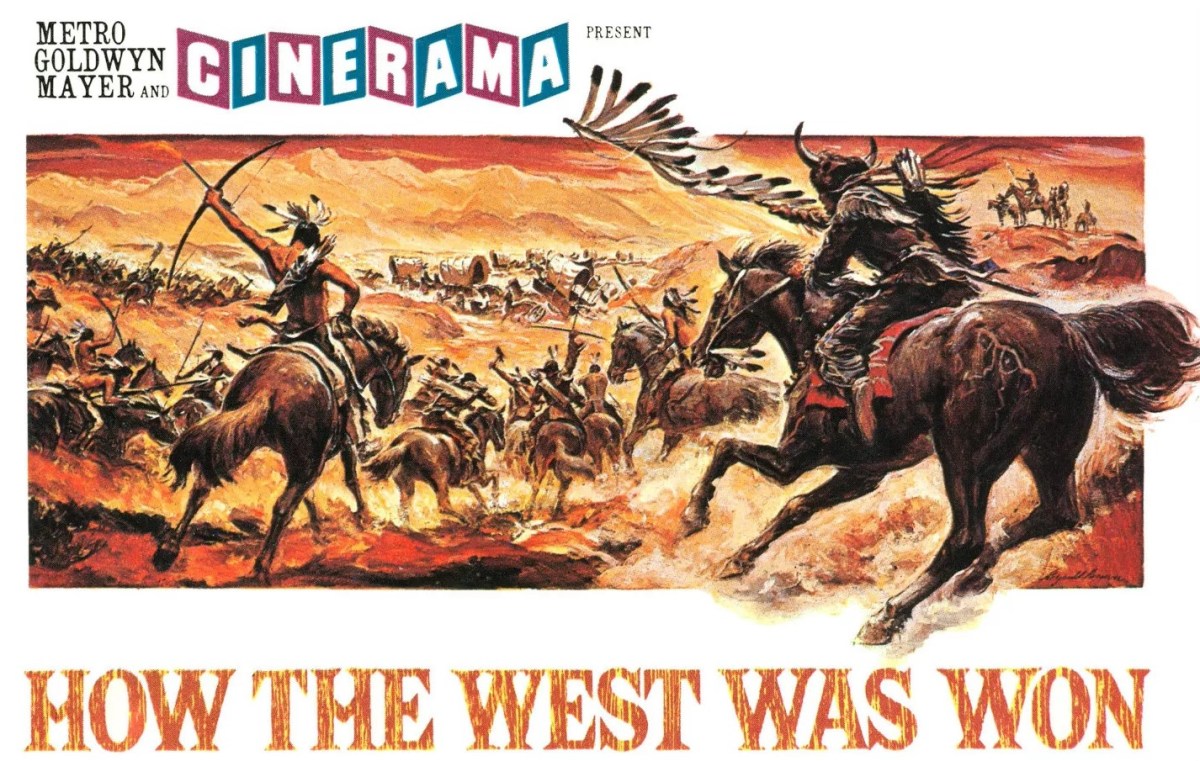
I’ve got Alfred Newman’s toe-tapping theme music in my head. In fact, every time I think of this music I get an earworm full of it. Not that I’m complaining. The score – almost a greatest hits of spiritual and traditional songs – is one of the best things about it. But then you’re struggling to find anything that isn’t good about it. For some reason, this western never seems to be given its due among the very best westerns.
Not only is it a rip-roaring picture feature the all-star cast to end all-star casts it’s a very satisfying drama to boot and it follows an arc that goes from enterprise to consequence, pretty much the definition of all exploration.

Given it covers virtually a half-century – 1839-1889 – and could easily have been a sprawling mess dotted by cameos, it is an astonishingly clever in knowing when to drop characters and when to take them up again, and there’s very little of the maudlin. For every pioneer there’s a predator or hustler whether river pirates, gamblers or outlaws and even a country as big as the United States can’t get any peace with itself, the Civil War coming plumb in the middle of the narrative.
Some enterprising character has built the Erie Canal, making it much easier for families to head west by river. Mountain man fur trader Linus Rawlings (James Stewart) on meeting prospective pioneers the Prescotts has a hankering after the young Eve (Carroll Baker) but as self-confessed sinner and valuing his freedom has no intention of settling down. But he is bushwhacked by river pirates headed by Jeb Hawkins (Walter Brennan) and left for dead, but after saving the Prescotts from the gang changes his mind about settling down and they set up a homesteading.
We have already been introduced to Eve’s sister Lilith (Debbie Reynolds) who has attracted the attention of huckster Cleve Van Valen (Gregory Peck) and they meet again in St Louis where she is a music hall turn and widow. Her physical attraction pales in comparison with the fact she has inherited a gold mine. He follows her in a wagon train which survives attack by Cheyenne, but still she resists him, not falling for him until a third meeting on a riverboat.
Zeb Rawlings (George Peppard) wants to follow his father to fight in the Civil War. Linus dies there, but there’s no great drama about it, he’s just another casualty, and the death is in the passing. In probably the only section that feels squeezed in, after the Battle of Shiloh a disillusioned Zeb saves General Sherman (John Wayne) and Ulysses S. Grant (Harry Morgan) from an assassin.

Returning home to find Eve dead, Zeb hands over his share of the farm to his brother and heads west to join the U.S. Cavalry at a time when the Army is required to keep the peace with Native Americans enraged by railroad expansion. Zeb links up with buffalo hunter Jethro Stuart (Henry Fonda), who appeared at the beginning as a friend of his father.
Eve, a widow again, meets up in Arizona with family man and lawman Zeb who uncovers a plot by outlaw Charlie Gant (Eli Wallach) to hijack a train. Zeb turns rancher once again, looking after her farm.
But the drama is peppered throughout by the kind of vivid action required of the Cinerama format, all such sections filmed from the audience point-of-view. So the Prescotts are caught in thundering rapids, there’s a wagon train attack and buffalo stampede, and a speeding train heading to spectacular wreck. There’s plenty other conflict and not so many winsome moments.
Interestingly, in the first half it’s the women who drive the narrative, Eve taming Linus, Lilith constantly fending off Cleve. And there’s no shortage of exposing the weaknesses and greed of the explorers, the railroad barons and buffalo hunters and outlaws, and few of the characters are aloof from some version of that greed, whether it be to own land or a gold mine or even in an incipient version of the rampaging buffalo hunters to pick off enough to make a healthy living.
And here’s the kicker. Virtually the entire all-star cast play against type. John Wayne (Circus World, 1964) reveals tremendous insecurity, Gregory Peck (Mirage, 1965) is an unscrupulous though charming renegade, the otherwise sassy Debbie Reynolds (My Six Loves, 1963) is as dumb as they come to fall for him, and for all the glimpses of the aw-shucks persona James Stewart (Shenandoah, 1965) plays a much meaner hard-drinking hard-whoring version of his mean cowboy. Carroll Baker (Station Six Sahara, 1963) is an innocent not her usual temptress while George Peppard (The Blue Max, 1966) who usually depends on charm gets no opportunity to use it. .
Also worth mentioning: Henry Fonda (Madigan, 1968), Lee J. Cobb (Coogan’s Bluff, 1968), Carolyn Jones (Morticia in The Addams Family, 1964-1966), Eli Wallach (The Moon-Spinners, 1964), Richard Widmark (Madigan), Karl Malden (Nevada Smith, 1966) and Robert Preston (The Music Man, 1962).
Though John Ford (The Man Who Shot Liberty Valance, 1962) had a hand (the short Civil War episode) in directing the picture, it was a small part, and virtually all the credit belongs to Henry Hathaway (Circus World) who helmed three of the five sections with George Marshall (The Sheepman, 1958) taking up the slack for the railroad section.
And though you might balk at the idea of trying to cover such a lengthy period, there’s no doubting the skill of screenwriter James R. Webb (Alfred the Great, 1969) to mesh together so many strands, bring so many characters alive and write such good dialog.
I’m still tapping my toe as I write this and I was tapping my toe big-style to be able to see this courtesy of the Bradford Widescreen Weekend on the giant Cinerama screen with an old print where the vertical lines occasionally showed up.


I know there would be outliers to my argument, but I feel this was the end of the classic Western, soon to be reborn as the rather more immoral spaghetti variety. Sure, Ford/ Wayne and others kept making them, and there’s plenty of genre classics after 62, but in a way, this was the ultimate Western in the way that Mad Mad World was the ultimate slapstick comedy; all star, huge screen bonanzas after which, things needed a little rethinking to figure out how to take on tv. Wasn’t the shape of the screen here something of a problem for tv pan and scanning?
LikeLiked by 2 people
I agree with you. It got tricky after that. The all-star cast was all awesome. For TV they used the 35mm version but generally all movies except b/w oldies were the wrong shape for TV.
LikeLike
My parents dragged me to see this in ’62 when I was seven and I was they did. I was riveted.
Lots here:
“According to the 24 Jul 1960 NYT, How the West Was Won began as a series of articles published during 1959 in Life magazine, chronicling the U.S. westward expansion of the nineteenth century. The series was followed by a record album of the same name, released on RCA-Victor in early 1960. The two-volume set featured singers Bing Crosby and Rosemary Clooney, among others, performing songs and stories of the Old West. On 21 Jun 1960, NYT announced that Bing Crosby Enterprises partnered with Metro-Goldwyn-Mayer (MGM) to produce The Great Western Story, using the Cinerama widescreen format. Inspired by the bestselling album, the story would be told in “six historical segments, each written for twelve of Hollywood’s stars.” The filmmakers also intended to include iconic Western characters and appropriate music from the period. A portion of the profits would be allocated for the construction of a new wing at St. John’s Hospital in Santa Monica, CA. More than two months later, the 1 Oct 1960 LAT reported the official title as How the West Was Won. The picture would now be comprised of eight episodes, with actor George Peppard as the unifying character. Veteran actress Irene Dunne was added to the cast, but did not appear in the finished picture. On 27 Feb 1961, LAT announced that Gary Cooper, Glenn Ford, and Burt Lancaster would also be given roles. Actors John Wayne and Spencer Tracy were chosen to play General William T. Sherman and General Ulysses S. Grant, respectively, according to the 21 Apr 1961 LAT. The 28 Apr 1961 LAT stated that Crosby would provide voice-over narration. Other casting announcements mentioned George Gobel (1 May 1961 LAT), Jim Hutton (6 May 1961 LAT), Barry Harvey, Tudor Owen, and Lee Van Cleef (12 May 1961 LAT), Frank Sinatra (24 May 1961 Var), and Jerry Holmes (4 Aug 1961 LAT). Crosby was replaced as narrator by Spencer Tracy, who relinquished the role of Grant to Henry (Harry) Morgan. Neither Ford, Lancaster, Gobel, Hutton, nor Sinatra participated in the completed film, and Gary Cooper died before the start of principal photography. Harvey, Owen, and Van Cleef appeared in uncredited roles. The picture also marked Jerry Holmes’s feature film acting debut.
An article in the 21 May 1961 NYT stated that production was expected to begin the following week, with a minimum budget of $8 million, to be shot on locations “from the Ohio River to the Pacific.” The article revealed that Bing Crosby purchased the rights to the original Life magazine series with the intention of making a “television spectacular,” rather than a movie. He eventually offered the project to MGM, which was searching for suitable properties to fulfill its five-picture deal with the Cinerama Corporation. Producer Bernard Smith anticipated a limited run for the 145-minute epic, as there were only 110 Cinerama theaters in the entire world at that time. As Smith explained in the 3 Sep 1961 LAT, screenwriter James R. Webb spent fifteen months composing the script, which chronicled the fictional Prescott family from 1840 to 1885 as each generation moved further west. Directors Henry Hathaway, John Ford, and George Marshall were each given their own units to avoid the logistical difficulties of moving an entire film company from one location to the next. Hathaway was assigned the first, second, and fifth segments, with Ford and Marshall filming the third and fourth segments, respectively. Production took place on locations in KY, IL, OH, CO, AZ, and southern CA. The 16 Sep 1961 NYT revealed that Marshall was originally assigned the second segment, depicting “a comic treatment of a mammoth Indian attack.”
Columnist Hedda Hopper, in her 12 May 1961 LAT column, announced the impending start of principal photography in Charlesville, TN. The 24 May 1961 Var estimated that ninety percent of the picture would be shot on locations across the U.S., with completion of photography anticipated for late Dec 1961. The budget was expected to exceed $12 million. Filming began 28 May 1961, according to a 19 Jul 1961 Var production chart. On 22 Aug 1961, LAT reported the production’s move to Montrose, CO, with new cast members Thelma Ritter, Robert Preston, and Gregory Peck. The 16 Sep 1961 NYT stated that John Ford was in the process of editing the completed Civil War sequence. With production nearly completed, the 3 Jan 1962 LAT announced a summer premiere, tentatively scheduled for 4 Jul 1962.
An article in the 24 Jan 1962 Var noted that How the West Was Won was the first MGM release for which the studio had no rights to the soundtrack. Bing Crosby Enterprises intended to market the score independently. Three weeks later, however, the 13 Feb 1963 Var stated that MGM subsidiary Robbins Music acquired rights to the score, composed by Alfred Newman, with plans to aggressively market the soundtrack album. According to the 3 Apr 1963 Var, music rights were originally under the control of Project Records president Si Rady, through his affiliation with Bing Crosby Enterprises. Following a buyout of the label by Capitol Records, MGM was able to purchase the rights for an estimated $250,000. The 4 Apr 1962 Var revealed that Dimitri Tiomkin was initially hired to write the score, but was forced to postpone the project due to an eye injury, from which he needed two months to recover. On 27 Jun 1963, NYT reported that Tiomkin was suing MGM for $2.6 million, claiming he was “unjustly” fired, causing him “a loss of royalties” and jeopardizing his chances for further employment. Tiomkin had already spent five weeks writing the score when he was injured on 12 Mar 1963, resulting in a four-week hospital stay. The composer received notice of his dismissal on 26 Mar 1963.
In his 10 Jan 1963 LAT column, sportswriter Jim Murray recounted the on-set accident that nearly cost stuntman and actor Bob Morgan his life. While performing a scene on a moving train in Globe, AZ, Morgan was struck in the face by a 6,000-pound stack of fiberglass logs. He was then run over by two flat cars and a caboose, severing his left leg. Morgan was transported seventy miles to a hospital in Phoenix, AZ, where his face was reassembled. He later sued MGM for an undisclosed amount, which Murray described as “enough money to buy a small country.”
Although principal photography was completed weeks earlier, the 14 Feb 1962 LAT reported that MGM executives Joe Vogel and Robert Weitman decided the film “needed a very important finish.” Another month of location shooting was required, featuring actors George Peppard and Debbie Reynolds. Henry Fonda would complete his scenes in New York City, where he was appearing in a play. Productions charts in the 14 Mar 1962 Var stated that photography resumed on 5 Mar 1962.
While filming was still in progress, the 21 Mar 1962 Var reported MGM’s plan to release How the West Was Won overseas, hoping it would present a positive image of American culture. Two months later, on 16 May 1962, Var announced autumn 1962 openings in England, France, Japan, Australia, Spain, and Austria. Subsequent openings were planned for Brazil, Argentina, Peru, Chile, South Africa, Belgium, and Germany. The 4 Oct 1962 NYT reported that a private screening was held for a select group of exhibitors the previous evening, adding that the picture would not be released in the U.S. for another year.
How the West Was Won premiered 1 Nov 1962 in London, England. The screening was preceded by a “charity gala,” according to the 7 Nov 1962 Var. The U.S. premiere took place on 20 Feb 1963 at the Warner Hollywood Cinerama Theatre in Los Angeles, CA. The 10 Feb 1963 LAT revealed that veteran actress Irene Dunne, president of the St. John’s Hospital Foundation, “was instrumental” in arranging the premiere, which benefited her organization.
Reviews were lukewarm, exemplified by the 27 Jan 1963 LAT and the 28 Mar 1963 NYT, both of which described the film as a composite of Western clichés. Native-American horse wrangler Gene Hoback, who coordinated 225 Navajo background actors for a battle sequence, told the 5 May 1963 LAT that he refused to see the film, saying the reenactment was too realistic. The 6 Mar 1963 reported that George Peppard attended the Dallas, TX, premiere, where he received the award for “most distinguished young motion picture star” by the Dallas chapter of Women of the Motion Picture Industry (WOMPI).
The 8 Jan 1964 Var declared How the West Was Won the top rental among exhibitors, anticipating earnings of $17 million over the course of its run.
The film was nominated for seven Academy Awards: Best Picture; Color Cinematography; Color Art Direction-Set Decoration; Color Costume Design; Original Music Score; Story and Screenplay—Written Directly for the Screen; Achievement in Sound; and Film Editing. It won the latter three awards. Other awards and accolades were bestowed by the American Cinema Editors, the Motion Picture Sound Editors, Photoplay magazine, Western Heritage, the National Board of Review, and the U.S. Congress. Although the picture continued as a first-run feature for more than two years, Var revealed on 30 Dec 1964 that it not yet earned “‘a substantial portion’ of Cinerama’s share of the film negative cost.” Faced with losses in excess of $10 million, Cinerama curtailed its investments in film production.
The 26 Jul 1961 Var reported that author Louis L’Amour was commissioned to write a novelization of the screenplay for Bantam Books. Six hundred thousand copies were planned for the first printing.
Location scenes filmed at Battery Rock along the Ohio River in Illinois; Courthouse Mountain in the Pinnacles National Monument, California; Chimney Rock in the Colorado Rockies; Monument Valley on the Arizona-Utah border; the countryside around Paducah, Kentucky; Custer State Park, South Dakota; and in Uncompaghre (Colorado), Tonto (Arizona) and Inyo (California-Nevada) National Forests. Opened in London 1 Nov 1962. Also reviewed at 162 and 165 min; copyright length: 149 min. The final scene in the Cinerama version, a panoramic helicopter view of modern-day America, was omitted from the film in its general release version. The non-roadshow version was released in 35mm CinemaScope.”
LikeLiked by 1 person
I was supposed to see in Cinerama when it first came out but my dad didn’t realise you had to book in advance. I didn’t see it in Cineram until I went to the Bradford Widescreen Festival.
LikeLike