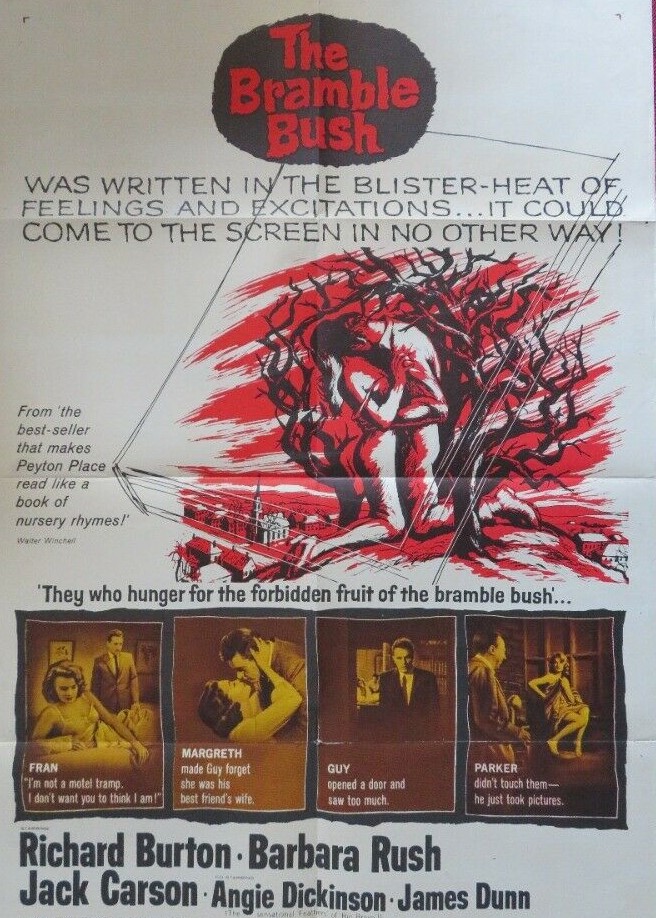
The secrecy business was working overtime in small-town America according to the Peyton Place template. And that wouldn’t be so bad here except returning big city doctor Guy (Richard Burton) has a few of his own in the locker but more importantly the unfolding of so many secrets detracts from the time available for the main dramatic premise which is an absolute corker.
We might as well account straight-off with the secret Guy drags around behind him like a two-ton weight thus explaining his general surliness, tight-lipped demeanor and occasional flashes of temper. As a twelve-year-old he told his father he had caught his mother in bed lover with Stew (James Dunn) which prompted his dad to chuck himself off a cliff.

The other big secret, dealt with fairly promptly, is that local nurse Fran (Angie Dickinson), who held a torch for Guy, now makes do with district attorney Bert (Jack Carson), that clandestine affair coming to light not so much in flagrante but in full beam when the illicit couple require treatment following a fire in a hotel bedroom.
The unravelling of both secrets impacts on Guy’s emotional state. The fire leads to Fran admitting her feelings to Guy, happy to have him use her for sex if love is not possible, “I love you so much I have no shame,” she proclaims, to no avail, but the hotel business also makes her fall prey to blackmail by local newshound Parker (Henry Jones), a budding amateur photographer of the unsavoury kind. Recounting his personal tragedy results in a Guy having a one-night stand with the married wannabe artist Margaret McFie (Barbara Rush).
But here’s the brilliant twist. Margaret’s husband Larry (Tom Drake) wants her to end up with Guy – but after his death. Larry, Guy’s best friend from childhood, is dying, the doctor scuttling back to a town that harbours too many bad memories in order to act as his personal physician. Larry’s never going to recover, he has the incurable illness Hodgkin’s Disease. His dying wish is that Guy marry Margaret.
Margaret is revolted by the idea, “I don’t want to be beautiful for anyone but Larry,” but unable to cope with his with illness is living on a cocktail of drink and drugs. And although Guy, who distrusts any woman, is similarly ill-inclined, Margaret becomes dependent on his medical ability, treating both husband and wife. Larry turns out to have another crazy idea – he wants Guy to kill him, medically speaking of course, some extra, illegal, doses of morphine would do the trick.
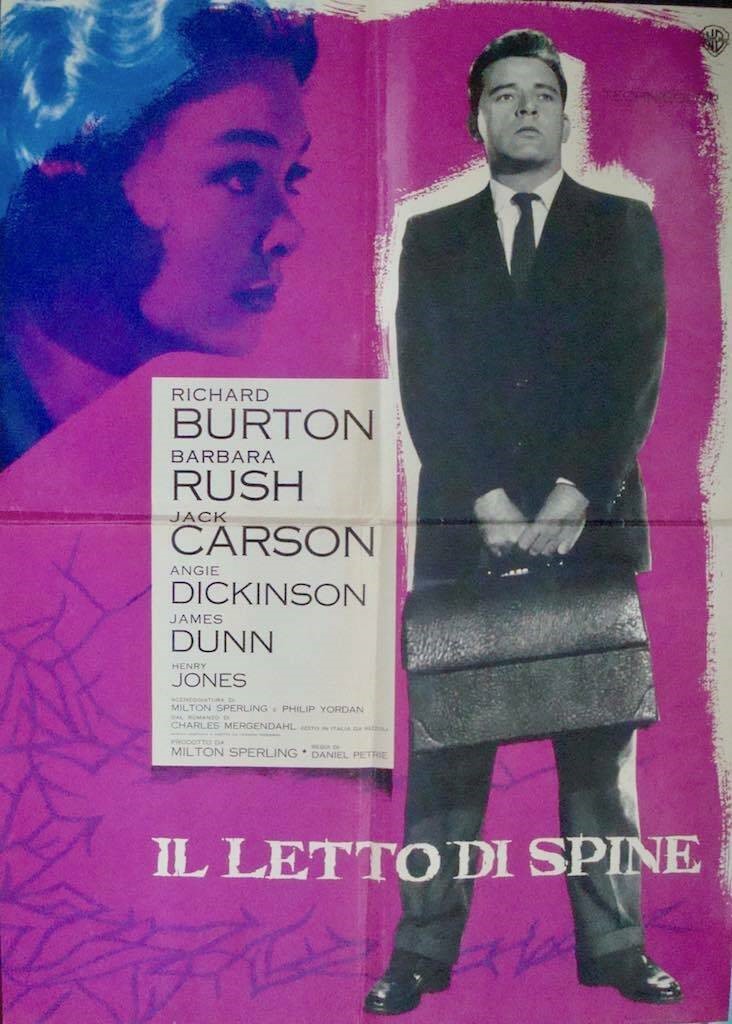
This incredible bucket list provides Guy with a huge dilemma, never mind what to do with Fran throwing herself at him and having to put up with the hypocritical Bert, and Stew, now the town drunk, begging for forgiveness, and Larry’s father Sam (Carl Benton Reid), who, for reasons unspecified, hates the doctor.
There’s more twists to come, just in case you thought you had everything worked out. But you can see the problem over-complication creates. The euthanasia-please-have-sex-with-my-beautiful wife combination would have set the movie up nicely from the get-go. Guy wouldn’t need to have a deep secret to find himself in very deep waters. How he would react to either or both outcomes, how Margaret would equally react to the possibility of ending her husband’s suffering in a quick and painless manner, would be more than enough to provide the dynamic the picture required. The movie then pivots on Guy being charged with murder.
It’s certainly interesting enough but Guy is too buttoned-down to incur sympathy and his revelation, devastating though it is, doesn’t suddenly make him an instantly more attractive screen character. In fact, it’s Fran who elicits the greater sympathy, the woman bedding someone who views her only as a sex object, yet willing to become a sex object for someone she does love if that’s all she can have. Eventually, the two key issues are put in the spotlight, which certainly puts a spark in the picture. But the poster promises a passion that just doesn’t exist.
Richard Burton (The Spy Who Came in from the Cold, 1965) plays this character in a lower register than his screen persona, the sonorous voice toned down, and although the look of someone who doesn’t want to be back rings true the performance lacks variety and there are only occasional glimpses of the fiery actor. Barbara Rush (Robin and the 7 Hoods, 1964) has her own legitimate reasons for being dispassionate and the vibrant character her husband married never really gets an airing. Angie Dickinson (Jessica, 1962) comes across as a more human character with, in emotional terms, a greater flaw, and a more tragic figure, even though there is nothing life-or-death about her circumstances. Two veterans are showcased: Jack Carson (Mildred Pierce, 1945) and James Dunn (Bad Girl, 1931).
Television director Daniel Petrie (A Raisin in the Sun, 1961) was making his movie debut. The screenwriting team of Milton Sperling and Philip Yordan (Battle of the Bulge, 1965) drew on the bestselling novel by Charles Mergendahl.
Hard to find DVD so Ebay is the best source.

 The Magnificent 60s
And I thought I’d seen all the best Burton, but I’ve not seen this, and by your account, it sounds pretty good…
LikeLiked by 1 person
Worth a look, especially since Burton is more restrained than later.
LikeLike
A wee bit”
“A memo dated 10 Sep 1958 found in the film’s file in the MPAA/PCA Collection at the AMPAS Library stated that Geoffrey Shurlock, then Production Code Administrator, met with screenwriters Philip Yordan and Milton Sperling, the latter of whom was also producing the film, before the first draft of the script was completed. According to Shurlock’s memo, “We stressed as essential the fact that the finished picture should not be a condonation of mercy killing or of adultery.” Shurlock and his associates suggested that the mercy killing and “Guy Montford’s” aquittal, both present in the Charles Mergendahl’s novel, be retained provided that the doctor admitted his guilt and gave up his medical practice. In the novel, the character “Mar” dies after giving birth to a son. Realizing the screenwriters had “doubt in their minds whether they want the woman to die at the end of the [film],” Shurlock “stressed the point that some tragedy is essential as the proper compensating moral values for telling a story with as much wrong-doing in it as this one.” Letters from the PCA to Jack Warner dated 10 Dec 1958 and 16 Mar 1959, while mentioning other matters, continued to express the PCA’s concern that the script appeared to justify mercy killing. The PCA gave their certificate of approval to the film in a letter dated 14 Jul 1959.
Additional information in the PCA file reveals that a congressman’s reference to a 30 Aug 1959 NYHerald article on the film complained that the Mergendahl novel included rape, murder, regicide, incest and mercy killing and that a picture based on that book would be an “obscene one.” According to an inter-office memo, the PCA was planning to respond: “Any amateur could do with MacBeth, King Lear, or Oedipus Rex, what [Thomas Wood, author of the article] did with The Bramble Bush….If he were giving out pre-release information on the three above named productions, I suppose he would pile up words like rape, murder, regicide and incest, and then faint.”
Also in the PCA file was a typed plot summary, part of the studio’s usual publicity sheet, that ended the story in a manner more consistent with Mergendahl’s book: The pregnant Mar enters a sanitarium after the trial, where “Fran” follows to be her nurse. Guy brings Mar back to the small town to have the baby, a sickly child whom she names “Larry” before dying. Guy prays at the church for the baby to live. Fran, still in love with Guy, offers to help him take care of the child. This version of the script ends with Guy inviting Fran and “Stewart” (who is then identified in the summary as Guy’s father, possibly implying that Montford was not Guy’s real father) to coffee. This sequence was marked for deletion on the document and replaced with a description of the ending seen in the final film.
According to the Var review, the California coastline was used to depict New England’s coast. Although some reviews spelled the character name of the sheriff as “Witt,” the CBCS and the novel spelled it “Whitt.” A HR news item adds Jack Richardson to the cast, but his appearance has not been confirmed. Although a Jan 1959 HR news item adds Carolyn Jones to the cast, she did not appear in the film. A Feb 1959 HR news item reported that Angie Dickinson, Patricia Crest and Diana Lynn tested for a role, and that Jeanne Crain was expected to win it. Dickinson was cast in a lead role and Crest portrayed a waitress in the film.
Although British actor Richard Burton, in a May 1959 ^LAEx news item, stated that The Bramble Bush was the first film in which he portrayed an American, Burton had played a 19th century American character, Edwin Booth, in 1955’s Prince of Players (see ^below). Although a HR news item mentions Carl Guthrie as cameraman on the film, only Lucien Ballard is listed in HR production charts and onscreen as the director of photography. The Bramble Bush marked the feature film debut of Canadian-born director Daniel Petrie (1920–2004), who had previously worked on stage and in television.”
LikeLiked by 1 person
Never knew any of this. I read the book so I knew what they’d have to leave out but didn’t realise the producers had tried to include stuff that would annoy the censor.
LikeLike