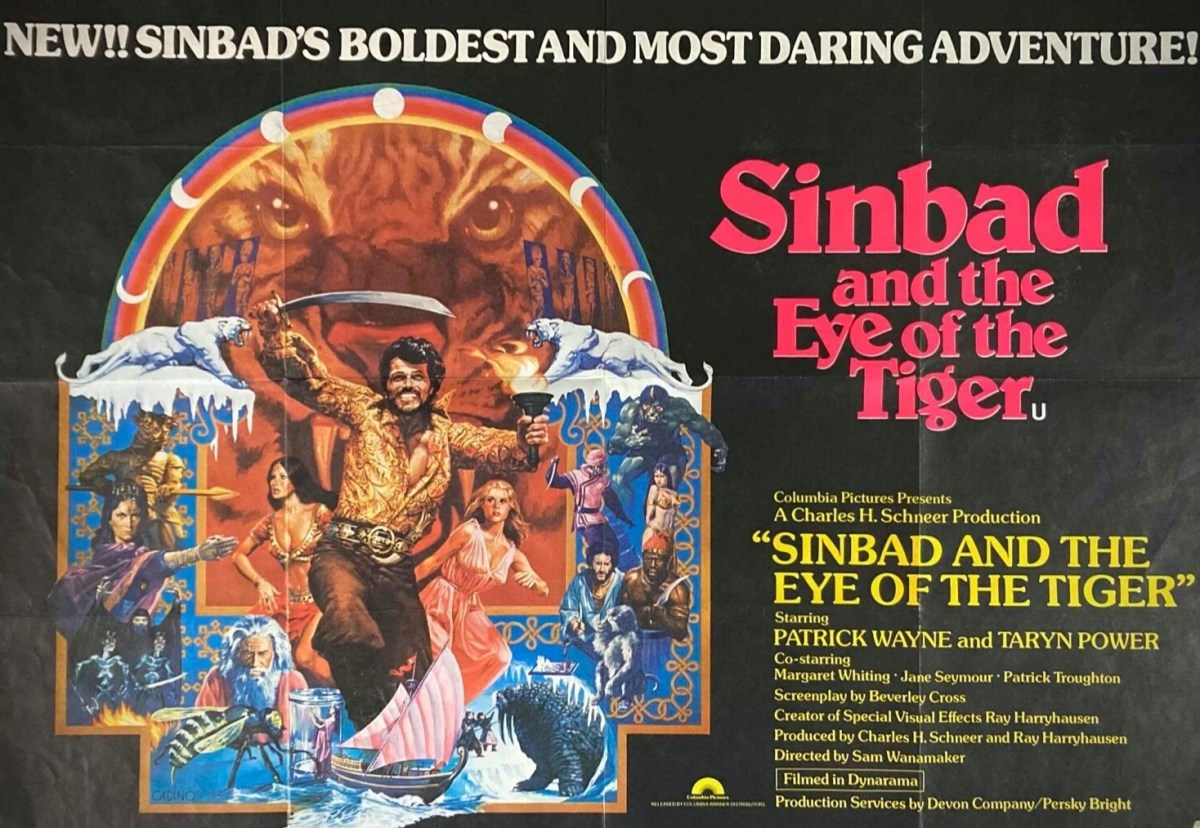
You can usually rely upon Ray Harryhausen to rescue any picture. But he’s got his work cut out in this leaden enterprise weighed down by nepo kids. One nepo kid would be bad enough but some bright spark had the terrible idea of pairing the son (Patrick) of John Wayne with the daughter (Taryn) of Tyrone Power, only to discover that neither could act. That’s not usually necessarily a massive drawback in an adventure picture, but they have zilch to compensate in the way of screen personas.
To make up, rather than periodic interventions by Harryhausen, this time we’ve got two of his creations with us virtually every step of the way – a baboon and a minotaur. The baboon playing chess is the highlight in terms of technical advances of Dynamation. To keep us on our toes when the narrative gets lost in exposition, every now and then we cut to the minotaur single-handedly rowing a ship or taking time out from such routine activity to spear some unwelcome visitor.
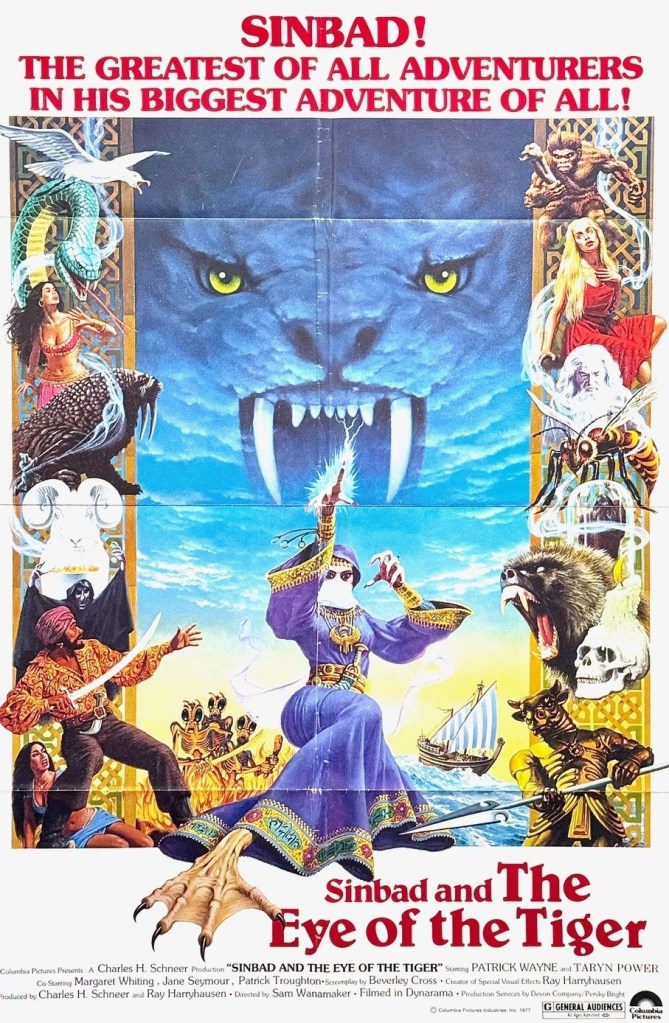
Given Harryhausen’s output switches from the mythical (Jason and the Argonauts, 1963) to the prehistoric (One Million Years B.C., 1966), he’s decided to mix it up this time round, with examples from both sub-genres. There’s a battle between a troglodyte (cave-man with what looks like a rhinoceros horn sticking out of his head) and a Smilodon (a sabre-toothed tiger)- and the baboon is so large it counts as prehistoric. Fulfilling the mythical end of the bargain a trio of ghouls with bulbous insect-like eyes arise from a fire, reminiscent of the skeleton army of Jason and the Argonauts. Halfway in between there’s a giant seagull, giant wasp, a miniature human and a very nasty cat.
Sinbad (Patrick Wayne) travels to the Arctic with sorcerer Melanthius (Patrick Troughton) who knows how to break the spell cast by the evil Zenobia (Margaret Whiting) that turned Prince Kassim (Damien Thomas), heir to the throne, into a baboon. Accompanying are the necessary ingredients for a love triangle – Kassim’s sister Farah (Jane Seymour) and Melanthius’s daughter Dione (Taryn Power).
Reversing the spell involves a sojourn to the icebound waste land of Arismaspi where the doors of temples look as if they have been constructed out of leftovers from King Kong (1976). Luckily, Zenobia isn’t as powerful as she thinks and after her outing as a seagull the witch can’t shake off the magic and is left with a bird’s foot. Every now and then her eyes glow like a cat.
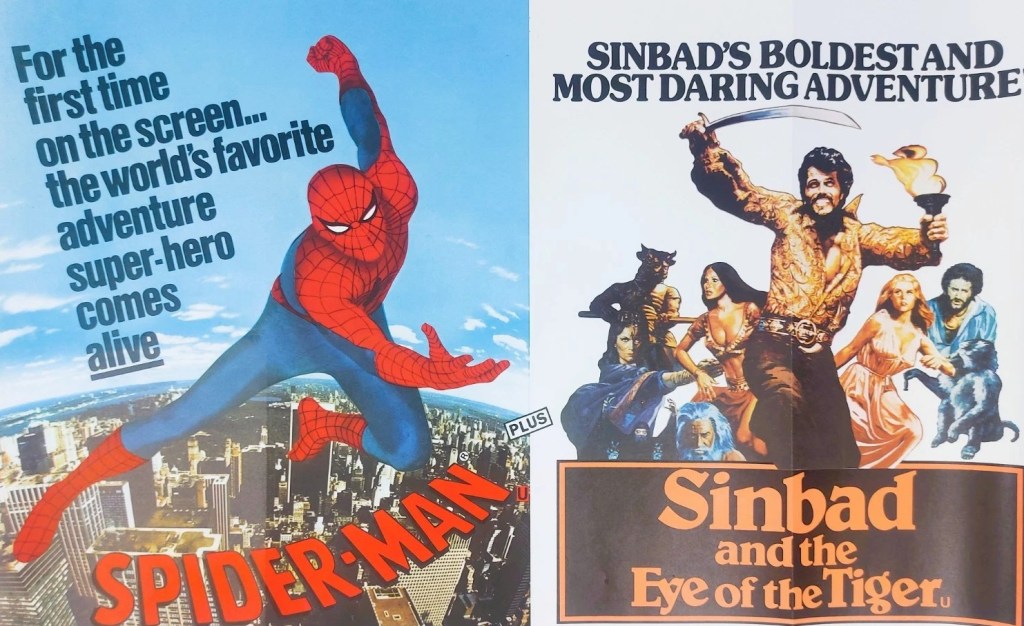
There must have been some optimism at Columbia that Patrick Wayne could step into the shoes of John Philip Law (The Golden Voyage of Sinbad, 1973) and that Bond girl Jane Seymour (Live and Let Die, 1973) could be the equal of scream queen Caroline Munro. And while Wayne had some form in the fantasy line via Beyond Atlantis (1973) and been acting since 1950 with routine appearances in his father’s westerns, in terms of quality roles he would be hard put to come close to Law whose portfolio included Otto Preminger’s Hurry Sundown (1967), and cult items Death Rides a Horse (1967), Barbarella (1968) and Danger: Diabolik (1968) and top-billed in admittedly more trashy ventures like The Love Machine (1971).
As you know being a Bond girl can be a curse as much as a blessing – Seymour had been offered little since. And although she would later make her mark, all that was on show here was promise, and not much of that. Taryn Power hadn’t capitalized on her starring role in the Spanish-made romance Maria (1972).
Nobody would accuse Errol Flynn of being a great actor but he more than compensated for any deficiencies with his screen charisma. Since neither nepo had much to offer in that department it was left to older hands like Patrick Troughton (Dr Who, 1966-1985) and Margaret Whiting (The Password Is Courage, 1962) to provide the gravitas. Even so, there’s not they can bring as the movie lumbers – and sometimes slumbers – towards its endpoint.
It’s as much as director Sam Wanamaker (The File of the Golden Goose, 1969) can do to keep the ship above water. Screenplay by Beverley Cross (Jason and the Argonauts).
On the other hand this movie is very much like the westerns I watched as a kid where I couldn’t wait for the grown-ups to stop quarrelling with each other or kissing and cuddling so that we could get on with the meat of the movie which was a gunfight or a battle between the Cavalry and Native Americans. Here, everything in between the Harryhausen elements just gets in the way.
Harryhausen rules – just.


A little something:
“Working titles included Sinbad in Hyperborea – An Adventure Fantasy, Sinbad Beyond the North Wind, Sinbad at the World’s End, and Sinbad III. Sinbad and the Eye of the Tiger was the third and final film in producer and visual effects creator Ray Harryhausen and producer Charles Schneer’s “Sinbad” films. The first two were The 7th Voyage of Sinbad (1958, see entry) and The Golden Voyage of Sinbad (1974, see entry).
End credits include the following written statement: “Made at Shepperton, Lee International and Pinewood Studios, England, and on location in Jordan, Spain and Malta, and re-recorded at De Lane Lea, London.”
According to Harryhausen in his autobiography Ray Harryhausen: An Animated Life (New York, 2004), the previous Sinbad feature, The Golden Voyage of Sinbad, was a “runaway success,” paving the way for the making of Sinbad and the Eye of the Tiger. Incorporating unused elements from the prior film, namely the character of the prince who is transformed into a monkey, Harryhausen wrote a fifteen-page story outline for Schneer’s approval in May 1974. Screenwriter Beverley Cross was brought in to write a full treatment, which was then submitted to Columbia Pictures. After Columbia approved the treatment, the first screenplay was completed 2 Dec 1974. With the script still in development, Harryhausen began shooting second unit photography in winter 1974, in the Spanish Pyrenees Mountains and Petra, Jordan. The final screenplay was delivered 9 Jun 1975.
Prior to selecting Patrick Wayne, son of actor John Wayne, for the role of “Sinbad,” the producers considered several actors, including Franco Nero, Timothy Dalton and Michael Douglas. For the role of “Zenobia,” Patricia Neal and Jean Seberg were discussed before the part was offered to Bette Davis, whose fee was too expensive. In an interview in the Nov/Dec 1977 issue of Film Comment, Harryhausen stated that Margaret Whiting’s performance as Zenobia was originally filmed without an accent, but Schneer and Harryhausen later decided to re-record her lines with Whiting using an accent, to add dimension to her character.
Most of the scenes featuring “Minaton” were created with Harryhausen’s signature Dynamation process, but Peter Mayhew, who played “Chewbacca” in the Star Wars film series, wore a fiberglass suit to portray Minaton in several background scenes, helping to cut down animation costs.
Principal photography began 16 Jun 1975 in Spain. The city of Avila was used for Charak, and Manzanares stood in for Hyperborea. In Toledo, the production found a twelfth century synagogue to double for the throne hall and the coast of Almeria was the setting for Zenobia’s palace. Due to cost overruns, the production moved to the island of Malta in Sep 1975, where filming locales included the Malta aircraft hangar and a marine tank at the Rinalla film studio, as noted in the Nov/Dec 1977 Film Comment.
After principal photography ended, Harryhausen rented a small studio space at Lee International Studios in West London, England, to create the visual effects and animation, which took thirteen months to complete. According to Harryhausen’s autobiography and a news item in the 10 Jan 1977 LAT, the film cost $3.5 million.
The film was a moderate financial success, but a critical failure. In a 25 May 1977 Var review, Mack. described the film as “technically adroit but childishly plotted hokum adventure fantasy,” adding, “Any film in which a constructed baboon wins acting honors is in trouble with audiences over the age of 12 years.”
According to the 28 May 1977 Screen International, the film premiered in Detroit, MI, before embarking on a large promotional tour around the US.”
LikeLiked by 1 person
very many thanks. Fills in all the gaps in my knowledge of this picture.
LikeLike