The Trouble with Angels (1966) ****

Shocking Fact No 1: director Ida Lupino was the only female director working in Hollywood at this time. And she hadn’t worked in features for over a decade. Her previous picture, The Bigamist (1953), was her fifth. And while she had continued to find work in television, the movie business shunned her. What was perhaps more shocking, as I pointed out in my book When Women Ruled Hollywood, was that in the period 1910-1919 more women worked as directors in Hollywood than at any time since and that it was a woman, Alice Guy, rather than Melies, who actually made the first narrative movie. Worst of all, despite being a major box office hit, this was Lupino’s last picture.

Shocking Fact No 2: this didn’t turn Hayley Mills into a major adult star. Oh yes, she made the transition – and how – in The Family Way later that year, a British romantic drama that saw her shed her clothes. Big hit in Britain, not so well-received in the USA. Her career then took an odd turn, into thrillers like Twisted Nerve (1968) and Endless Night (1972).

Not exactly demure. Marching band outfit takes the grey out of the convent uniform.

I say an odd turn because if there was any better demonstration that the actress had properly developed her comedy chops I’d yet to see it. Sure, Disney had used her in comedy, but that was mostly routine stuff. Here, she revealed an emotional maturity lacking in her previous work and, to some extent, in her future movies.

And, in part, because Lupino keeps her away from big dramatic moments, relying entirely on her facial expression to reveal character development. I am surprised that, at this point, with Doris Day’s box office allure dimming, that nobody saw Mills as her natural successor. She had the same puckish demeanor and she deftly handled comedy. Give her a few years and she would have been a natural for such polished items as Barefoot in the Park. You get the feeling there was more natural ability that was left untapped.

Anyway, on with the show.

This is just a delight. It shouldn’t work at all, certainly not for a modern audience accustomed to sharply-honed laugh lines. But it’s so cleverly constructed, in covering a three-year period, it could easily have been a string of loosely-connected episodes rather than a picture with an underlying narrative that mostly takes place beneath the surface.
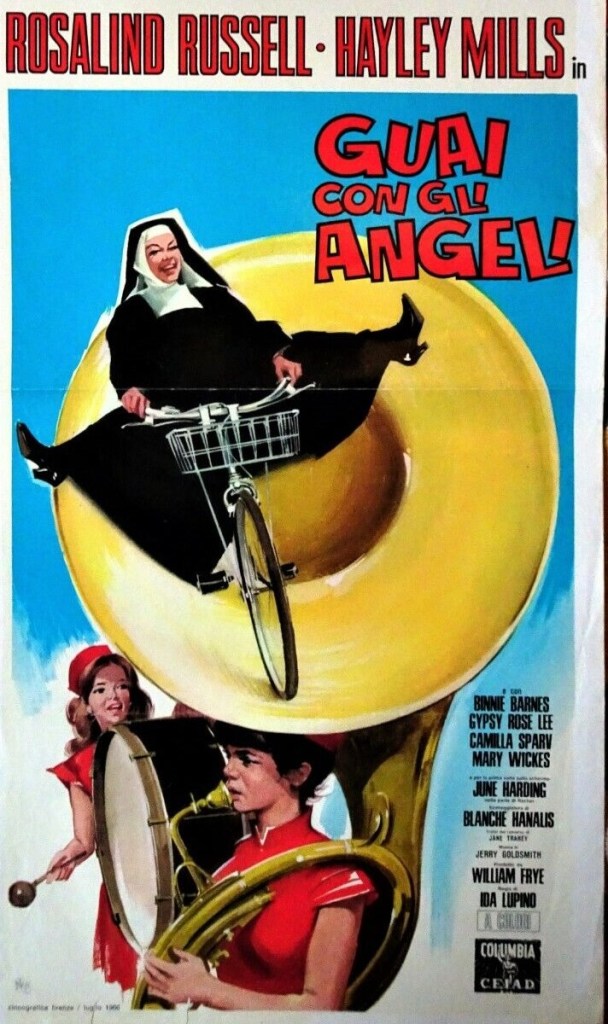
Orphan Mary (Hayley Mills) has been dumped by rich playboy uncle (Kent George) in a  convent boarding school that looks more like a medieval fortress than anything else. She teams up with the equally unhappy Rachel (June Harding), whose parents are at least indulgent, and together they torment the life out of the nuns and other kids, pouring detergent into tea-pots, setting off fire alarms, charging their schoolmates for an illicit guided tour of the convent, developing their smoking habits, breaking everything in sight. One scheme goes so badly awry the nuns have to take shears to a face mask.

Throughout all of this, she comes up against a tough Mother Superior (Rosalind Russell) who comes across like Miss Jean Brodie, minus her dangerously progressive side, but ever ready with a quip, able to tackle any emergency, though Mary drives her to distraction. While set in her ways, the nun does sail close to the wind, kitting out the girls in red cheerleader outfits in order to give them an unfair advantage in a marching band competition.

Any other director would have made the marching band competition the climax of the movie. I was fully expecting it to take up the final third, as pupils with little musical ability work hard and discover they can improve enough to win the competition and in so doing find out some platitudes about themselves. Instead, every episode is kept short and sweet, often the pay-off delivered in unexpected manner, for example, that we discover the girls have won when Mother Superior takes the opportunity to gloat over her rival headmaster (Jim Hutton). Or a section where teenage girls sent to buy their first bra go wild trying on all sorts of outrageous outfits that in other hands could easily have been expanded is ended sharply by Mother Superior holding up the plainest item and ordering two dozen of them.

It fairly skates along. But every now and then it dramatically slows down. And for what? Pretty much nothing at all. Just Mother Superior taking a quiet moment to herself amid all the hurly burly of running a school and dealing with mischief. But gradually, in those quiet moments, she is joined, at a distance, by a staring Mary, wondering about the nun’s inner  calm.

Ida Lupino’s color palette is extraordinary. Sure, it’s nuns, so we can expect a lot of black and white. But Lupino avoids the temptation to compensate with huge swathes of color. Instead, for most of the film, the girls are decked out in grey. So when splashes of yellow or pink or red appear they are distinctive. Only as the girls grow older does more color emerge.

The wry Rosalind Russell (Gypsy, 1962) is on top form. Instead of attempting to dominate, she nips in and steals scenes with her dry delivery. She shifts from indominable to maternal and eventually engages the psychological attention of Mary in a superb scene about her own life.

In that sense Hayley Mills has her work cut out to hold her own against such an accomplished professional, which she achieves through her own delivery, but much more through facial expression. This was June Harding’s only movie. But look out for Camilla Sparv (Assignment K, 1968) in her movie debut and a cameo from Gypsy Rose Lee.   

Terrific direction for Ida Lupino – watch for example how the camera closes in on characters – from screenplay by Blanche Hanalis (Where Angels Go Trouble Follows! 1968) from the bestseller by Jane Trahey.

As old-fashioned as they come and a joy to watch.

Catch it on YouTube – the first link is rent or buy, the second one is free but punctuated by adverts.

https://www.youtube.com/watch?v=37FnvNp2EYc

The Heroes of Telemark (1965) ****

Stellar World War Two mission picture, replete with tension and thrilling ski chases, told with some style, and with a conscience, probing the issue of civilian collateral damage.  Sensibilities were not so inflamed at the time when the US, as demonstrated in Oppenheimer (2023), dropped the atomic bomb on Japan, causing the deaths of hundreds of thousands of non-military personnel. Here, at stake are the 6,000 townspeople who live around the plant housing the German experiments into heavy water, the alternative method for building an atom bomb.

When the safety of the entire world is in the balance, and death is doled out by remote bombers, thousands of feet up, with no close-up of the carnage, it appears far more acceptable than when you are planting a bomb on a ferry boat, knowing you are possibly consigning all the passengers to drowning.

That’s the climax of this well-plotted and well-constructed quite thrilling last picture from director Anthony Mann (The Fall of the Roman Empire, 1964) – he died during the making of A Dandy in Aspic (1967) so that cannot be fully ascribed to him and in any case this is a much better send-off.

Probably old-school British and Hollywood pictures were to blame for depicting scientists as stuffy individuals, allowing work to overrule romance. But as Oppenheimer demonstrated, that was not always the case and here we are introduced to top Norwegian egghead Rolf (Kirk Douglas) when he is stealing an illicit fumble with an employee in the darkroom.

The Germans are racking up production of heavy water, aiming to produce – drip by endless drip – 10,000lb of the stuff in double quick time. Norwegian saboteurs led by Knut (Richard Harris) hitch a ride by boat to Britain to inform the Allies of the danger. The obvious solution is to bomb the hell out of the factory, despite the impact on the civilian population.

But that fails. Plan B, dropping 50 highly-trained British commandos, into snow-covered Norway, comes a cropper when the plane crashes. A beautifully-filmed sequence, by the way, in extreme long shot, with one character at the front to provide perspective, a burst of flame at the far end of the white landscape.

So the saboteurs have to do it for themselves, the reluctant Rolf forced into action since he’s the only one, purportedly, who knows where to place the plastic explosive around the tanks holding the heavy water. The Norwegians shoot themselves in the foot by, in limiting the potential civilian casualties, only aiming to blow up the water tanks not the entire factory. Turns out the clever Germans have their own Plan B, other tanks already assembled which can be quickly fitted in the event of such sabotage.

Now with the plant more heavily guarded, access is impossible, and the only chance to stop the consignment of heavy water reaching Germany is to stop it getting there, by blowing up the train carrying the materiel as it crosses the fjord by ferry. Had this sabotage taken place in Germany, nobody would have given two hoots about the passengers, collateral damage be hanged. But this being Norwegians, Rolf feels duty bound to remain on board rather than escape, and formulate a plan to minimize the casualties.

I’m not sure how true that aspect is, it feels like something intended to present the main characters in a less ruthless light, although in reality the bombs were positioned and timed to help make survival easier.

Although told in semi-documentary style a la the same year’s Operation Crossbow, In Harm’s Way and Battle of the Bulge, with the aforementioned sensibilities to the fore, and the re-firing of romance between Rolf and divorced wife Anna (Ulla Jacobsen), the ruthless Nazi habit of executing hostages any time one of their soldiers is killed or even attacked, a traitor in the camp, open hostility between Rolf and Knut and stunning ski sequences that are the equal of anything in the James Bond canon, this is a riveting watch.

Must have been one of the cheapest music scores and screenplays on record given how often the director dispensed with both dialog and music during the lengthy sabotage scenes. When dialog was permitted, it was often sharp or humorous.

There was no stiffer upper lip in Hollywood than that of Kirk Douglas (The Brotherhood, 1968) though his hard-nosed demeanor is alleviated by romance and his efforts to minimise civilian casualties. Richard Harris (This Sporting Life, 1963) always seemed ready to explode. Ulla Jacobsen (Zulu, 1964) and Michael Redgrave (Assignment K, 1964) bring some class to the supporting roles.

Tremendous piece of direction by Anthony Mann, as adept at the action and building tension as handling the personality clashes between the principals and the intimacy of romance. Ivan Moffat (Tender Is the Night, 1962) and Ben Barzman (The Blue Max, 1966) wrote the screenplay based on a memoir by Knut Haueklid and the novel But for These Men by John Drummond.

A fitting last hurrah for Anthony Mann.

https://amzn.to/3Rz0azh

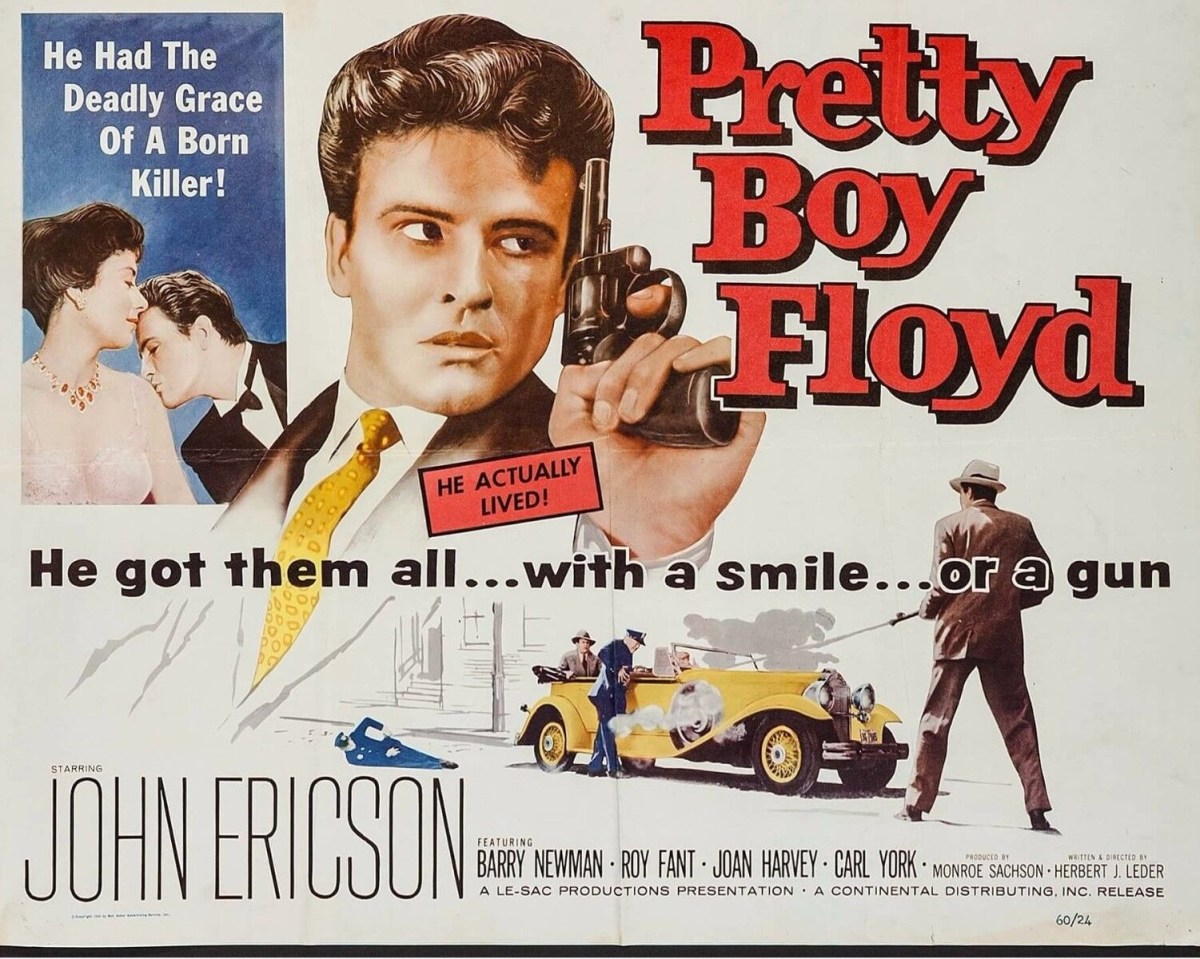
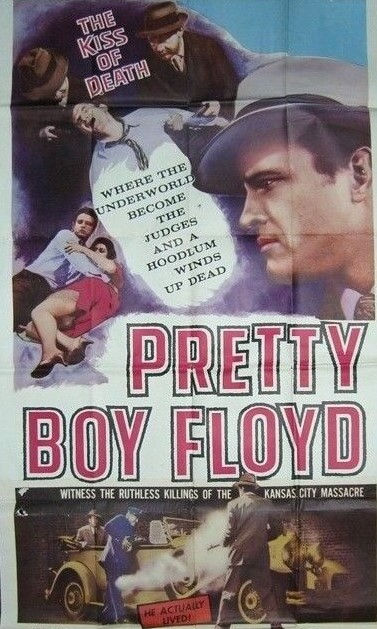
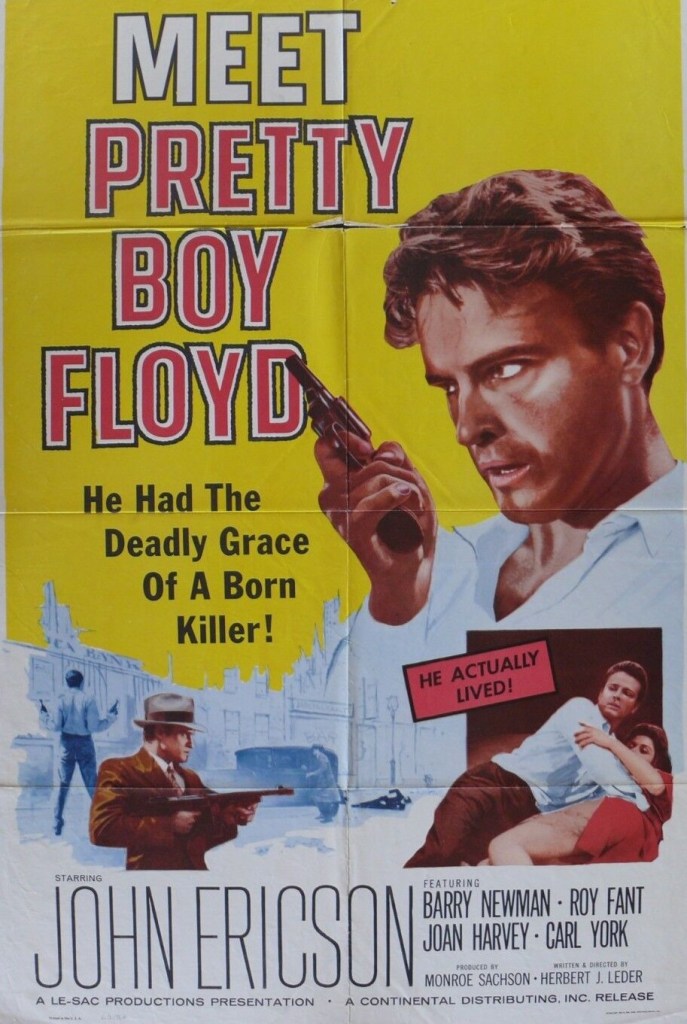
Pretty Boy Floyd (1960) ***

The makers of Oppenheimer (2023) and Napoleon (2023) cast light on the major problem of a biopic – what to leave out. Here, no such problem was actually countenanced. Hell, they just threw everything in – some job given the lean running time. That does mean, however, some mighty info dumps, as we are filled in on the gangster’s past and present. Not much of his life goes unturned.

There was a spate of gangster pictures around the turn of the decade. The success of Machine Gun Kelly (1958) starring Charles Bronson, The Bonnie Parker Story (1958) and Al Capone (1959) spurred a hot lead deluge the following year including Murder Inc (Lepke), Ma Barker’s Killer Brood, Pay or Die, The Rise and Fall of Legs Diamond and Pretty Boy Floyd. In 1961 came Mad Dog Coll, Portrait of a Mobster (Dutch Schulz) and King of the Roaring 20s (Arnold Rothstein).

But if you thought this would lead to a noir revival, think again. Nobody would give finesse the time of day. Not with so many facts to pack in. And to explain – love of power and ambition the only psychological insight available – why of all the millions of Americans brought to their knees by the Great Depression Floyd was one of the few who turned to violent crime. His own saving grace – if it can be called that, given the length of the murder sheet – is his Robin Hood-ism, he gives way a lot of his stolen loot

We pick up Pretty Boy Floyd (John Ericson) towards the end of his short-lived boxing career – by which time he’s already been sent away for five years by Sheriff Blackie (Jason Evers), annoyed the gangster had taken up with his sister. Floyd now beats up the husband of his lover, works on the oil rigs but loses his job for concealing his criminal record. Returning to Oklahoma, he discovers his father has just been shot by a character called Grindon, who got away with the crime.

He tries to go straight but is turned down for a loan by the bank. He locates Grindon and ices him. Partnering with hood Shorty Walters (Peter Falk), he enters the bank-robbing business, but Shorty’s loud mouth gets them caught. On the way to prison, they escape and rob the bank that refused him a loan.

He heads for Kansas City because until the FBI came along you could commit a crime in one state and vanish over the border to another knowing you were out of the original jurisdiction and couldn’t be tracked down. He finds another married woman, Lil Courtney (Joan Harvey), to romance, but the husband wants to turn him in for the reward, by now substantial. Returning to Oklahoma and teaming up with the vulnerable childhood pal Curly (Carl York), he gets into his stride, robbing a bank every two weeks.

You get the picture. This is biopic at full throttle. Every “I” is dotted and every “t” is crossed and still we don’t get any real idea what made him tick beyond he was as mad as hell and wasn’t going to take it anymore. I could have got all of this from a book.

The one ace fact I learned was where the term “kiss of death” comes from. Apparently, if you committed a crime against the mob – such as killing someone you were paid to rescue – you were put on trial before three Mob guys. The verdict had to be unanimous and was decided thus: a gun was passed between the three men, if each of them picked up the pistol and kissed it you were a dead duck.

The problem with all the gangster pictures is they all end the same way. Nobody is long for this world and nobody can evade justice.

This is straightforward stuff, shot on a tiny budget, and except for the info dumps and pausing here and there for a spot of philosophy/psychology or sympathy, tears along at a fair old pace. That’s very much on the plus side. On the minus side is the lack of depth and you would have to say lack of acting.

It’s not much of a stretch for John Ericson (The Money Jungle, 1967) to look mean, but he’s closer to James Dean than Charles Bronson. Peter Falk (Machine Gun McCain, 1969) is generally perceived as the standout but my money is on Barry Newman (Vanishing Point, 1970) as Floyd’s trainer and later criminal partner. Shame Joan Harvey (Hand of Night, 1962) only made three pictures, as she excels in a small part.  

The whizz-bang approach from writer-director Herbert J. Leder (It!, 1967) ensures that, like Napoleon, you need Google open to check out the flood of names racing towards you. You might be baffled and confused, but never bored.

Worth it for the “kiss of death.”

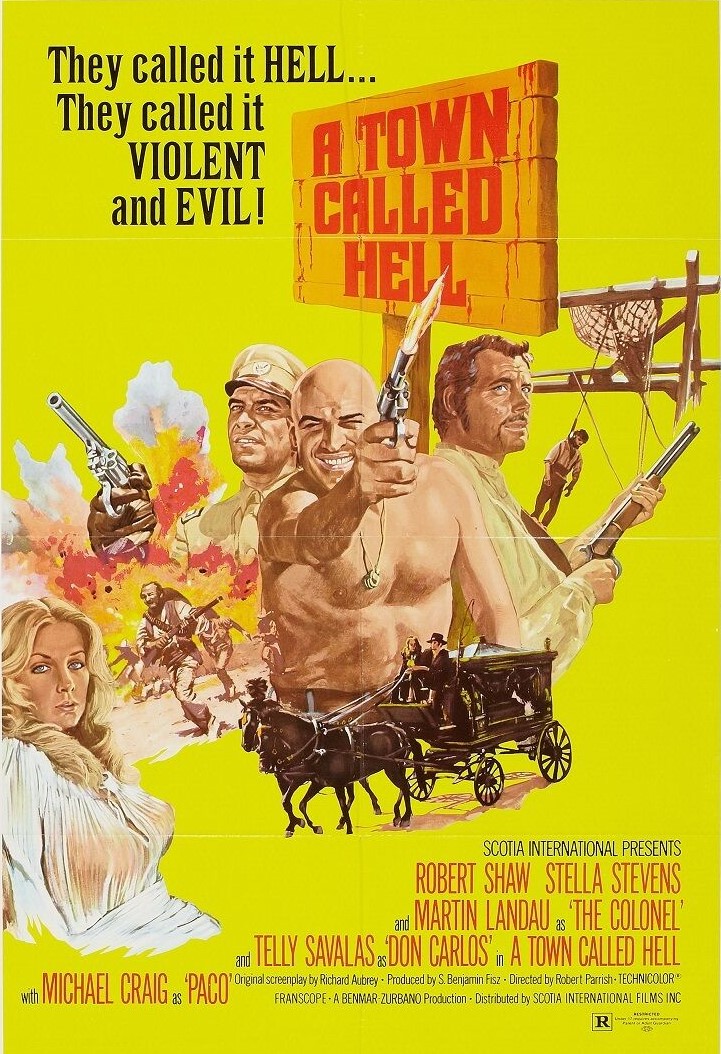
A Town Called Hell / A Town Called Bastard (1970) ***

You think you’re in for something quite stylish when widow Alvira (Stell Stevens) rides into town asleep in a coffin in a hearse. Or when she turns up in a dream as an avenging angel. Or when a rebel, entrusted with funds to buy guns, squanders the cash on women and booze. Or when a Mexican general is so disgusted by informer Paco (Michael Craig) that he refuses to face him. But these are about the only highlights in a bloody, sadistic confusing affair.

And diversity rules. Not only do we have a deaf mute going by the apocalyptic name of The Spectre (Dudley Sutton), there’s also an unnamed blind man (Fernando Rey) who comes in handy because he can recognise people by fingering the contours of their faces.

We begin straightforwardly enough with the massacre in a church of the well-to-do by Mexican rebels led by two unnamed characters (Robert Shaw and Martin Landau). Turns out that’s only the prologue and we cut to a decade later to a town ruled by sadistic sun worshipper Don Carlos (Telly Savalas) who has a tendency to string people up at the drop of a hat. Keeping a low profile is another unnamed character known only as the Priest (Robert Shaw) who may always have been a cleric or who has turned to God after being involved in the massacre. Even so, religion doesn’t prevent him having a mistress.

Alvira is offering a $20,000 reward for the killers of her husband, Montes, a victim of the earlier massacre. To get the money, Don Carlos employs the typical wheeze of framing a couple of villagers, husband and wife, hanging them before their tongues run so loose they can confess it wasn’t them. In a bid to save his own skin, the husband blames his wife.

Don Carlos’s luck turns bad when his sidekick La Bomba (Al Lettieri) decides it might be fun to take over, beginning by shooting off his boss’s fingers before hanging him in the sun. But just when you might think you are getting the hang of what’s going on, the unnamed Colonel (Martin Landau) appears. He’s also looking for information, but not inclined to pay for it. He’s hunting for a rebel leader with, wait for it, an actual name, though this still sounds like a pseudonym, Aguila (Eagle, get it?). For no reason whatsoever, it takes the priest a little while to work out this is his former comrade from the church massacre.

The Yanks were the ones who changed the title from the above. Interesting double bill, though, with Alain Delon as “Le Samourai.” Stella Stevens looks far more provocative
on the poster than she does in the film.

It doesn’t take long for the Colonel to get a grip on the hanging malarkey and with as much relish as Don Carlos, determining to continue hanging the townspeople until they tell him where Aguila is. The two narratives don’t quite mesh, but then what do you expect, this is high on atmosphere, sweating bodies, raw emotions, blazing sun. The Colonel, equally obviously, has given up on being a rebel, presumably because as a government official, he can officially murder people any time he likes without having to round up a gang of rebels to do so.

Every now and then the movie dips into flashback or Paco appears to confuse matters further.

There’s an odd sensibility at work. Maybe this is intended to be one of those down’n’dirty westerns trying to show us how mean the actual West really was (although given it’s set in Mexico, we only need to go as far back as The Wild Bunch, in 1969, to get that point). It doesn’t fit so easily into the spaghetti western canon, either, despite the uniform malevolence.

The oblique tone reminds you more of something that could have been put together by Luis Bunuel, but that would be ranking it far higher than it deserves.

The cast are the biggest plus points, though you might be asking whether Robert Shaw (Battle of the Bulge, 1965) and Stella Stevens (The Mad Room, 1969) were sold a different film entirely. Stevens doesn’t have much to do, except look beautiful and soulful. But Shaw is about the only leading man you’ll come across who so puts his heart into a part that he doesn’t mind being seen actually drooling at the prospect of massacre. In fairness, Telly Savalas (The Assassination Bureau, 1969) and Martin Landau (Nevada Smith, 1966), while not exactly dripping spit, drool in different ways.

There’s enough brooding going on stylistically that you are almost willing it to turn into something not just better but more definable. Alas, no such luck.

Robert Parrish (In the French Style, 1963) does his best with a screenplay  by Robert Aubrey (The One-Eyed Soldiers, 1967) and Benjamin Fisz, in his only writing gig, he was better known as a producer. My guess is they were more script doctors than anything else, the original damage having been done by the uncredited Philip Yordan (Battle of the Bulge).

Could a been something.

https://amzn.to/46Jpk2D

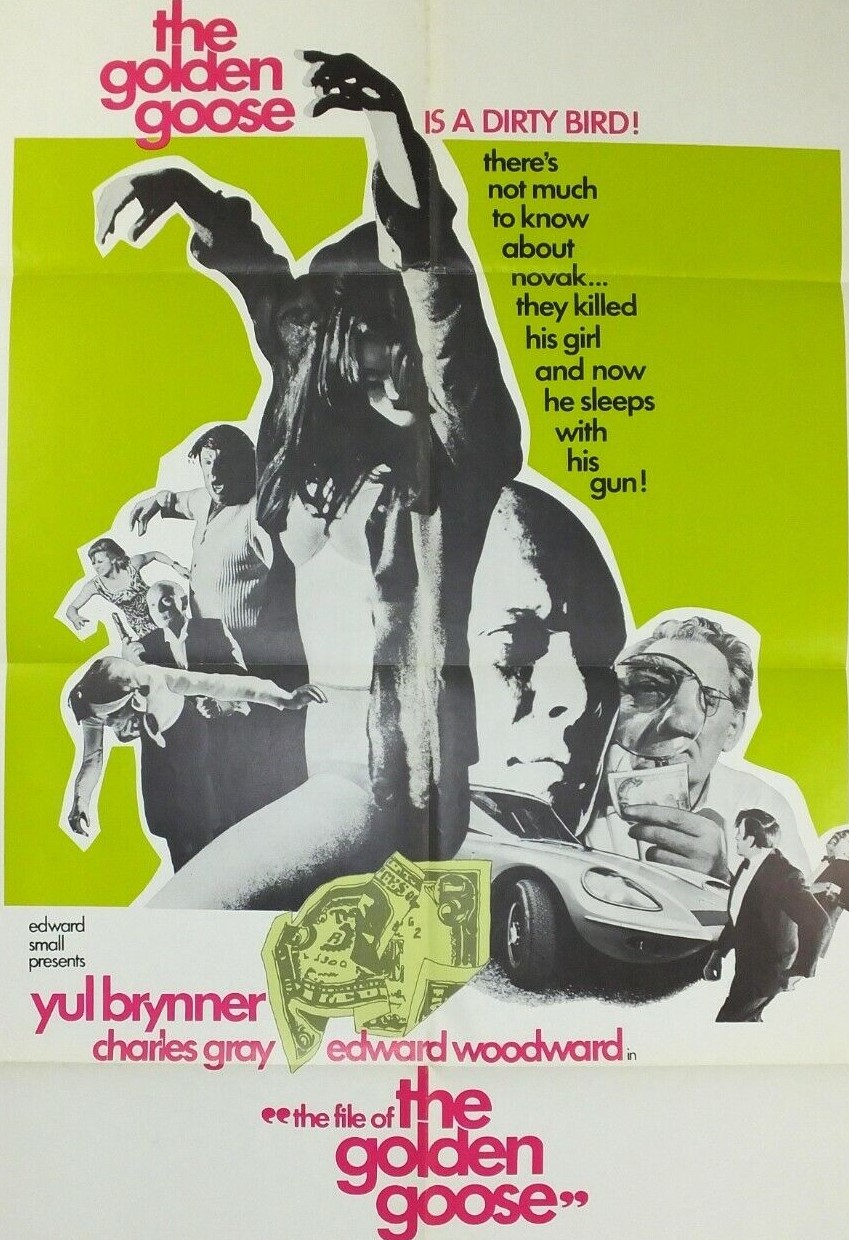
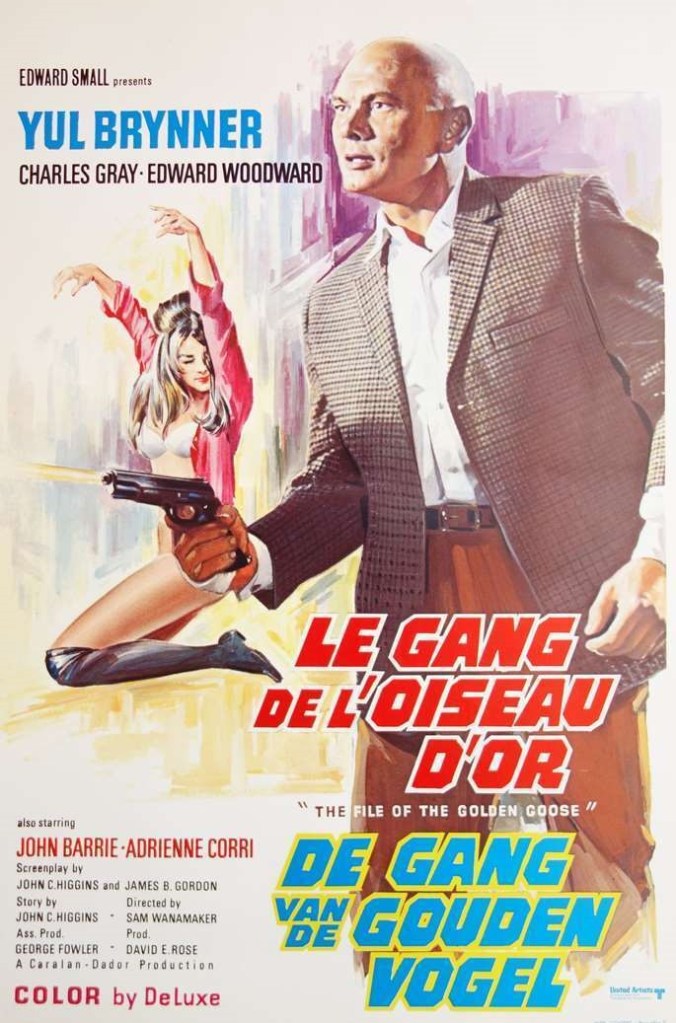
File of the Golden Goose (1969) **

A dud. Not even Yul Brynner, whom I pumped up as under-rated yesterday in Escape from Zahrain (1962), can save it, nor a camped-up Charles Gray (The Devil Rides Out, 1968). Takes too long to get started, meanders all over the place while suspension of audience disbelief breaks new ground.

The first ten minutes or so via voiceover are wasted telling us stuff that one character could deliver in a single line. That is, there’s a worldwide counterfeit operation in place and London is the next target. Hence, American Treasury Agent Novak (Yul Brynner) being seconded to Scotland Yard where he is saddled with ineffective British sidekick Thompson (Edward Woodward).

For no particular reason, they head off to Liverpool where they attempt to infiltrate the gang. The mobsters are so dumb they fall for their lame story, though without first giving them routine warehouse work (cue montage of the pair falling asleep on the job and doing the wrong thing). Novak, it has to be said, is pretty slick at avoiding any traps, cleverly talking himself out of dodgy situations, pinning any blame on whoever is convenient.  

But, eventually (thank goodness), they reach London. And if you have been waiting virtually the whole movie with bated breath for the appearance of female lead Adrienne Corri (Africa Texas Style, 1967)  you can stand easy for now she turns up as ostensibly the gangster queen-pin.

The journey to here is enlivened by hitman Smythe (Graham Crowden), as English as they come, bowler hat and all,  whose weapon of choice is a blade embedded in a walking stick, and The Owl (yep, The Owl, played by Charles Gray) with every fetish under the sun whose presence seems to demand an orgy.

By the time you get to the final shoot-out you couldn’t care less. With a bit more care and attention to detail, this could have been a reasonably thrilling picture. Novak is two-fisted enough to cut the mustard, and naturally treats the English cops as dumb-as-they-come, what with their lily-livered aversion to weapons. Surprisingly, Thompson takes to mobster life and quite enjoys dishing it out in a most un-English fashion.

There’s quite a nice twist when the chief counterfeiter leads Novak into a soundproof vault because he can’t be overheard spilling the beans on his colleagues and seeking witness protection.   

But the movie appears to have been not made for a contemporary audience. Given Lee Marvin has reinvented the movie tough guy in Point Blank (1967) and Clint Eastwood the hardnosed cop in Coogan’s Bluff (1968), Novak doesn’t come close, and since British gangsters are slick enough to pull off Robbery (1967) and The Italian Job (1969), it seems the criminals here have lived a very sheltered life.

There’s not even the old reliable comedic standby of American fish out of British water, such as occasionally helped along pictures like Brannigan (1975). In fact, all the humor rests upon the dry-witted Owl.

Television director Sam Wanamaker (Catlow, 1971) makes his movie debut. John C. Higgins (Impasse, 1969) wrote the screenplay along with Robert E. Kent (The Fastest Guitar Alive, 1967).

For Yul Brynner completists only.

Hard to find, but Talking Pictures has this, but only until Dec 10. Strangely enough, I can’t see any rush.

https://www.tptvencore.co.uk/Video/The-File-of-the-Golden-Goose?id=8a918a69-adf1-4db0-938c-921eaa6494e9

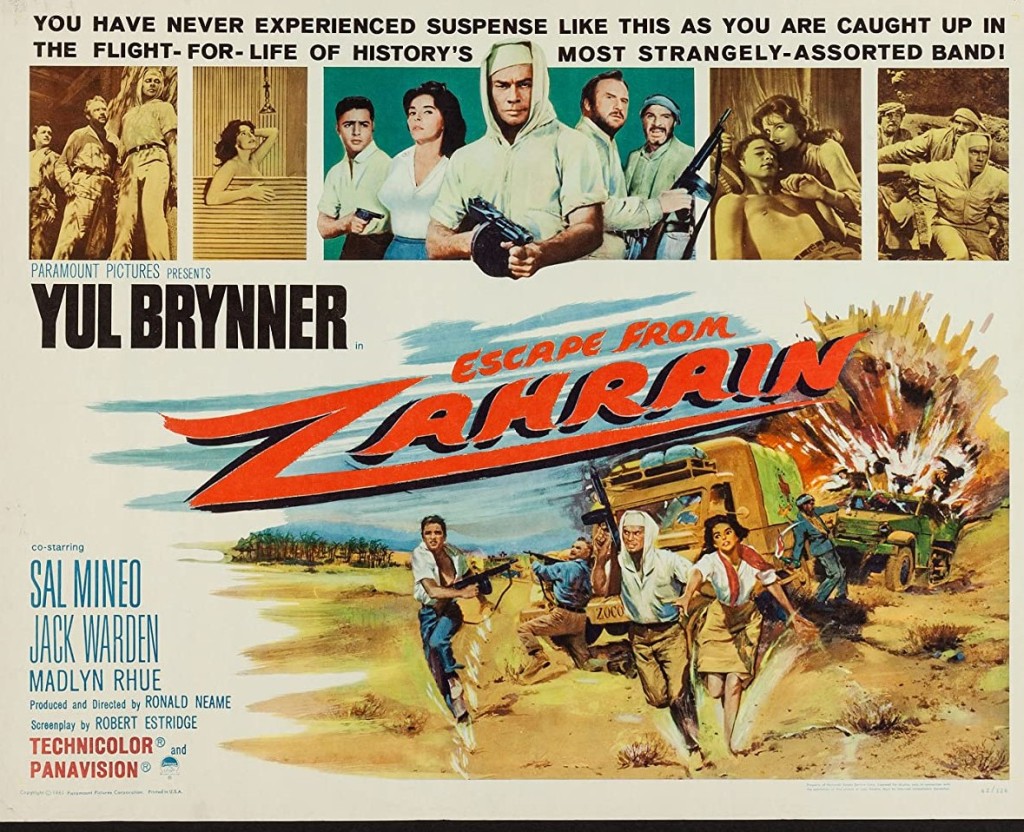
Escape from Zahrain (1962) ***

After being attacked by armored cars and strafed by airplanes, stranded in the desert, and overcome various tensions within the small group of escapees, there is still considerable life left in this picture at the end as Jack Warden, making his departure, comes up with a classic last line: “We must do this again sometime.”

In truth, the picture has far more going for it than a mere outline would suggest. In rescuing rebel leader Sharif (Yul Brynner) from a lorry bound for jail, the escapees led by Ahmed (Sal Mineo (Exodus, 1960) in a stolen ambulance also scoop up three convicts including American fraudster and loudmouth Huston (Jack Warden) and all-purpose thug Tahar (Anthony Caruso) plus nurse Laila (Madhlyn Rhue) as a hostage. Like most stranded-in-the-desert films, the storyline is on who will survive and how.

Action is one constant. The threat of failure is another. Supplies are rationed and, of course, someone steals more than their fair share. The members regularly switch allegiance. At various points someone is about to give up Sharif. Their gas tank is punctured so, thanks to Huston’s engineering skills, they just make it to a remote pumping station where they encounter maintenance man (James Mason in an uncredited cameo). Their numbers diminish and despite his recalcitrance Huston’s engineering skills save them again when they reach an oasis.

What makes the film different is that the characters all change. In a country where “half the wealth is stolen by Europeans and half by corruption,” Sharif is the altruistic leader whose ideals are shattered. Laila,  a Muslim, drinks alcohol and questions the number of deaths necessary for a revolution but declines to leave when the opportunity arises. Ahmed who thinks “women should be as free as men” reacts badly when Laila enjoys such freedom. Huston, who has embezzled $200,000, and has loyalty to no one stands by the shambolic crew.

I had always believed Brynner had enjoyed a rare case of beginner’s luck when he won the Oscar for his debut in The King and I (1956) and that once Hollywood became wise to his acting schtick he would never be nominated again – as proved the case. But after watching Brynner in The Magnificent Seven (1960) and its sequel and Invitation to a Gunfighter (1964) and Flight to Ashiya (1964) I have become convinced he is under-rated as an actor. He acts with his eyes and his delivery is far more varied than I had supposed. Here, clothed in Arab costume, there is no bald pate to distract. 

Sal Mineo (Exodus, 1960) can’t compete in the acting stakes with the canny Jack Warden (Blindfold, 1966). Anthony Caruso (a television regular) is lost in the mix but Madhlyn Rhue (A Majority of One, 1961) certainly looked a good prospect.

British director Ronald Neame (Tunes of Glory, 1960) holds the enterprise together, keeping to a tidy pace but allowing tension and character to emerge. Screenplay was courtesy of Robin Estridge (Eye of the Devil, 1966) based on the Michael Barrat novel and with an injection somewhere along the line by Dudley Nichols (Heller in Pink Tights, 1960).

Tight script, taut direction.

https://amzn.to/3Td6m1d

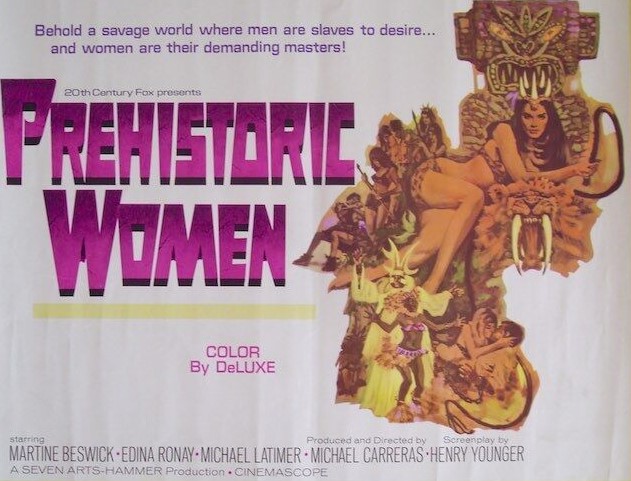
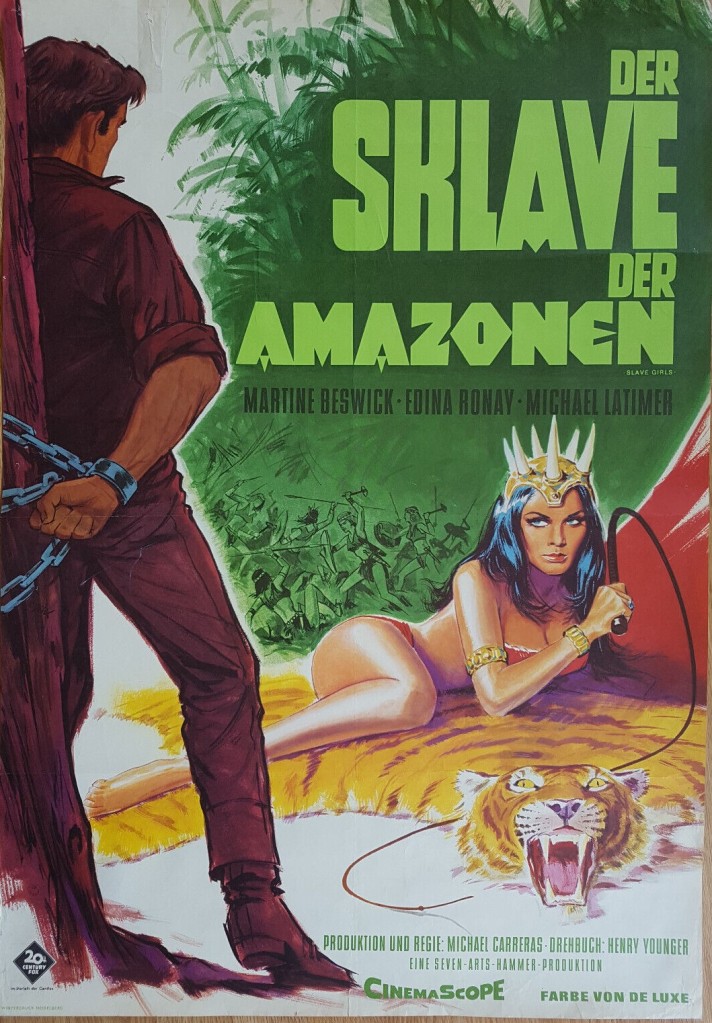
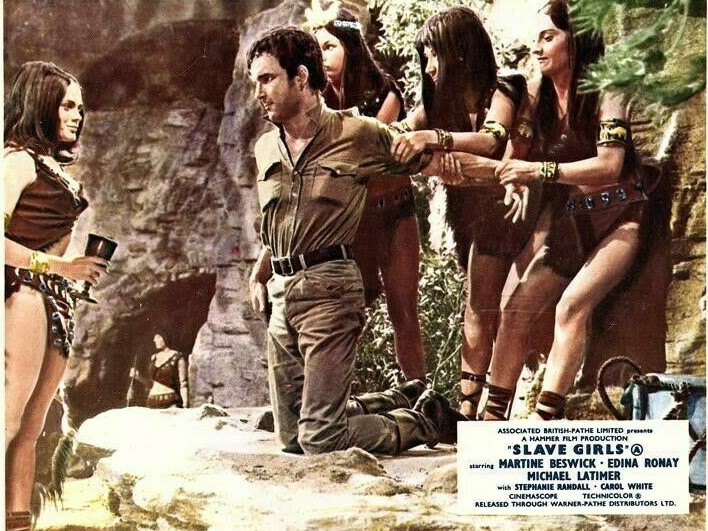
Prehistoric Women / Slave Girls (1967) ***

Can a dash of feminism rescue campy trash? Or even a genetics overload? Or is it enough to wonder what career hole Carol White (Never Let Go, 1960) found herself in to end up here? Or should we just sit back and watch the Pan’s People-style choreography and admire the astute re-use of all those bikinis left over from Hammer’s previous venture into this territory, the much more successful One Million Years B.C. (1966). Whatever, there’s no escaping the wooden acting and the one-note direction.

Dennis Wheatley (The Fabulous Valley, The Lost Continent, They Found Atlantis) and C.S. Lewis for that matter had the knack of transporting characters back in time or into other worlds. There’s usually some routine artefact, door or whatnot, that allows access to an amazing kingdom, or, in this case, queendom.

Here, big game hunter David (Michael Latimer), about to be sacrificed to some pagan African god, instead finds himself thrown back in time, chasing bewitching blonde Saria (Edina Romay), who, unfortunately is on the run, so when she is apprehended, so is he. Queen Kari (Martine Beswick) takes him as her lover. But he’s less keen, repulsed by her harsh rule. When one of her subjects rebels, the queen doesn’t delegate the task of bringing her into line but takes her on mano-a-mano. David, put to work with the other male prisoners, soon plots his escape.  

Setting aside the expected mumbo-jumbo – the tribe worships a mythical white rhino (phallic symbol anyone?) for example – if you want to extract anything more from this, there are fresh fields to plunder. For example, brunettes, such as Kari, are in control, but only after rebelling against the blondes who had subjugated the black-haired women in similar fashion as Kari. As well as having a female ruler, the movie makes a relatively pertinent point that gender scarcely comes into it when a dictator imposes such harsh conditions on their subject, Kari, for example, making the blondes eat off the dirt.

I’m not convinced the irony is deliberate. David, scion no doubt of Victorian nobility who made their pile from scarcely paying their downtrodden peasants a living wage, and who goes around shooting leopards, is hardly in a position to ask the queen to cool it. When she even considers giving him some equality – a big role reversal right there – he wants her to treat everyone in a nicer fashion.

The movie had an unsual history. Made quickly after “One Million Years B.C.” it was released in the U.S. as “Prehistoric Women” in 1967 but flopped so it was heavily cut, re-titled “Slave Girls” and sent out in 1968 in the UK as the support to “The Devil Rides Out.” The new title is a bit of misnomer because her kingdom is as full of slave men. The girls refers to the blondes. It was released in the U.S. in February 1967 by Twentieth Century Fox and managed a tie-in in one city with Cara Nome perfume. Actually, U.S. grosses were not as bad as have been reported – a “good” $25,000 in first run in Detroit, second only to “Grand Prix” there for the week, and decent enough openings in Boston, Minneapolis and San Francisco.

And she has the insecurity of Napoleon, needs to be loved, and not in mercenary fashion, and willing to attempt some form of rudimentary seduction if that’s what it takes to tempt the suddenly high-principled David into her bed. There’s an element of upending the Gentlemen Prefer Blondes trope, as though brunettes have always hankered after putting those ditzy blondes in their place.

Hammer lost sight of the fact that One Million Years B.C. owed as much to Ray Harryhausen as the statuesque temptations of Raquel Welch in a fur bikini and in its haste to cash in on that film’s big box office rushed into production a movie minus the battling dinosaurs. Although, of course, they could merely be making historical amends, since everyone knows dinosaurs and man (never mind women in fur bikinis) did not co-exist. And possibly ignored the fact that the puny Michael Latimer was no substitute for the brawnier John Richardson of the previous picture.   

If you’re not so interested in gender politics, you can always enjoy the dancing, which appears to take up a disproportionate amount of time (well, all those bikinis, need to be used). I was disappointed to discover the choreography was not the work of Flick Colby of the legendary BBC TV Top of the Pops dance troupe, but by one Denys Palmer, an actor it appears, whose main claim to fame was appearing in a classic Dr Who episode.

This was triple-hyphenate job, so blame Michael Carreras (The Lost Continent, 1968) for the screenplay and the direction and for taking on the production duties, or praise him for seeding a campy knock-off with issues that register more strongly today.

This was intended to be a big step-up for Michael Latimer but he was so charisma-free that he didn’t score another movie credit until low-budget British B-picture Man of Violence (1970). Martin Beswick (The Penthouse, 1967) never got another shot at a top-billed role. Carol White did better, next up was Poor Cow (1967) and from there it weas a small step to Daddy’s Gone A-Hunting (1969), but she doesn’t stand out here the way she did in Never Let Go (1960). If anyone stole the show it was Edina Ronay, and much good it did her, her next outing was in the lamentable Three (1969).

A curiosity, half-rubbish, half-interesting.

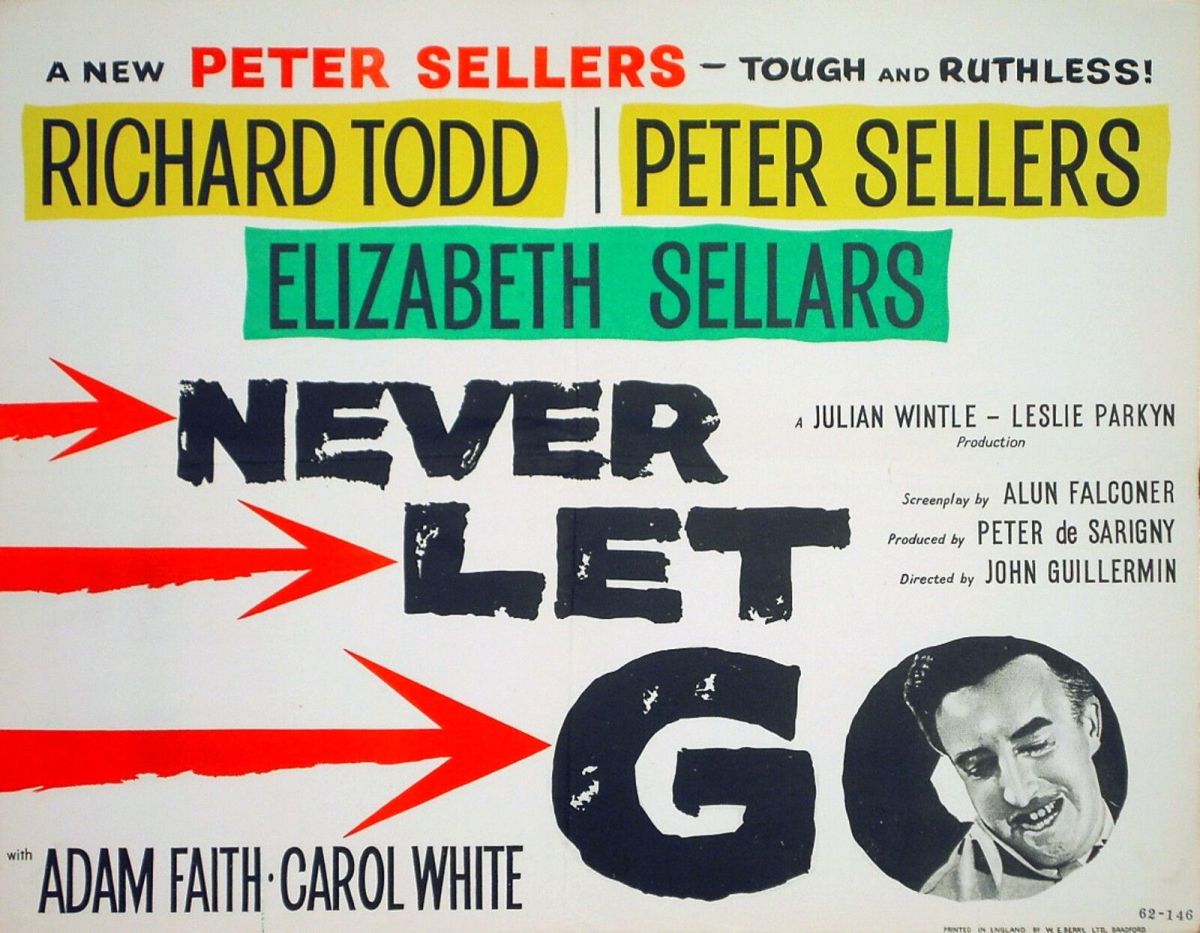
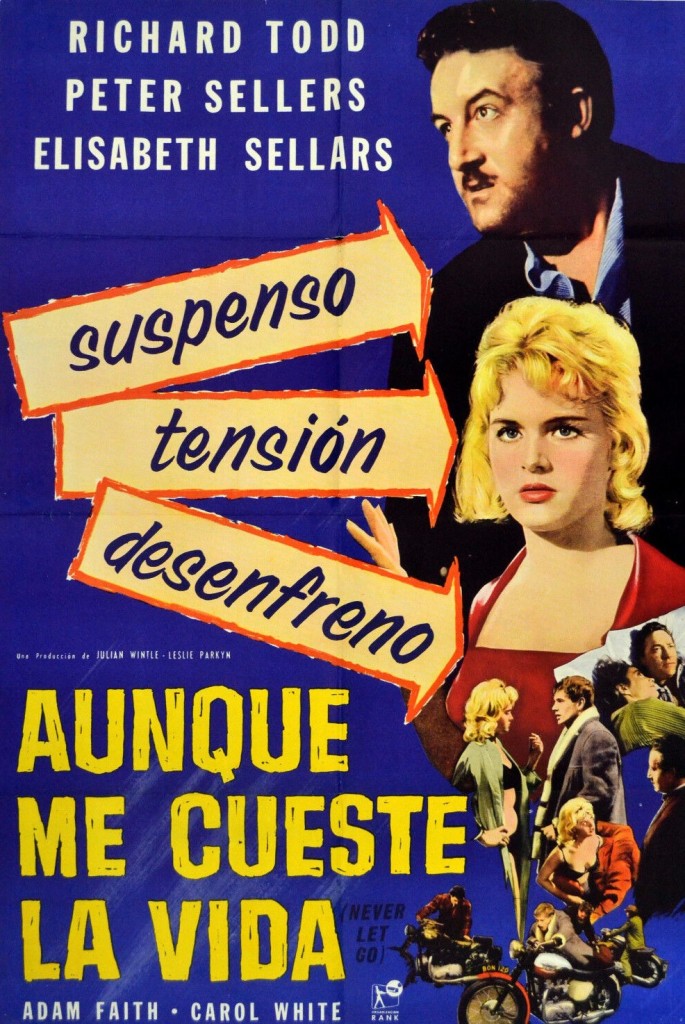
Never Let Go (1960) ****

Under-rated British film noir classic. All the principals playing against type. Comedian Peter Sellers (The Millionairess, 1960) as the villain, British hero Richard Todd (The Dam Busters, 1955) comes seriously unstuck, pop star Adam Faith (Beat Girl / Wild for Kicks, 1960) tosses away his cuddly image. One of the earliest scores by John (James Bond) Barry. First grown-up role for Carol White (Daddy’s Gone A-Hunting, 1969). As much savage violence as the censor would allow at the time.

Down-on-his-luck salesman John (Richard Todd) has his car stolen. It’s uninsured. Without it he can’t get to his appointments on time. The police aren’t interested. So he has to investigate. That leads first to dodgy Teddy Boy Tommy (Adam Faith) who steals cars to order for supposedly legitimate businessman Lionel (Peter Sellers) and makes a play for Lionel’s young mistress Jackie (Carol White).

The interest lies not so much in the investigation as how those involved deal with pressure. John, hardly able to support wife Anne (Elizabeth Sellars) and two kids, has a history of failure, squandering money on get-rich-quick schemes, and apt to blow his top at clients who complain when he fails to keep appointments.

Doesn’t take long for him to lose his job. But instead of knuckling down and finding another, he stubbornly refuses to abandon his investigation, upsetting Scotland Yard Inspector Thomas (Noel Willman) who has much bigger fish to fry.

Lionel is a cocky gangster not afraid to lash out. In fact, he seems to enjoy battering people with his fists, feet and broken bottle. He treats Jackie with contempt, reminding her she’d be a sex worker if it wasn’t for him. He’s got a nice little empire and has kept his nose clean. He pays off corrupt cops.

But the last thing he expects is to be pursued by a loser like John who’s not cut from the John Wick template. Not does he possess the very particular set of skills that appear to be the prerequisite of anyone embarking on a mission of revenge.

If director John Guillermin (El Condor, 1970) hadn’t been obliged to tag on a happy ending, this would have been a downbeat tour-de-force, with the good guy losing everything in order to win back his self-respect.

It just sizzles with tension. Lionel belongs to the generation that spawned the likes of Harold in The Long Good Friday (1980) or the Kray Twins, a simmering, stewing piece of work, all gloss on the outside, a tinderbox on the inside.  

There’s fabulous photography, eyes trapped in pools of light, overhead camera staking out victims, and seedy London picked out in detail. Newspaper vendor Alfie (Mervyn Johns), of pensionable age, the only witness to the crime, has his bedsit ransacked, the tiny terrapin he treasures crushed underfoot, when inadvertently he gives too much away.

Tearaway Tommy isn’t such a tough guy when Lionel comes battering on his door. Jackie is the only one who not so much stands up to Lionel as treats his idea of romance with disdain. Even when John fingers Lionel, Inspector Thomas bluntly tells him he’s too small fry and the cops aren’t interesting in chasing after his plebeian vehicle.

Lionel is the kind of gangster who is never going to realise he can’t always get away with it, that he might have to trim back his ambition until the coast is clearer. Instead, he batters on regardless, determined to terrify everyone into acquiescence.

As the movie progresses, the more you learn about John, the less you sympathise. His wife has stood by him through mostly thin, and will stick by him even if unemployed, but draws the line at antagonising a gangster who doesn’t know when to draw a line. John isn’t Gary Cooper in High Noon. He’s not a principled defender of the law. He’s almost as bad as the gangster, in that he doesn’t know when to stop, regardless of the danger this places his family.

Understandably, Peter Sellers attracted most of the critical plaudits, but this is the role of a lifetime for Richard Todd, who detonates his screen image, battered and bloodied almost beyond recognition, not hiding behind a stiff upper lip. Carol White, too, is superb as the mistress who just about recognises that this is not a good deal, and that she’s a chattel, not a loved one.

John Guillermin’s direction is superb. Coupled with the insistent, jazzy John Barry score, this is British film noir (admittedly, that’s not large pool to draw on) at its best.

https://amzn.to/3GoA77M

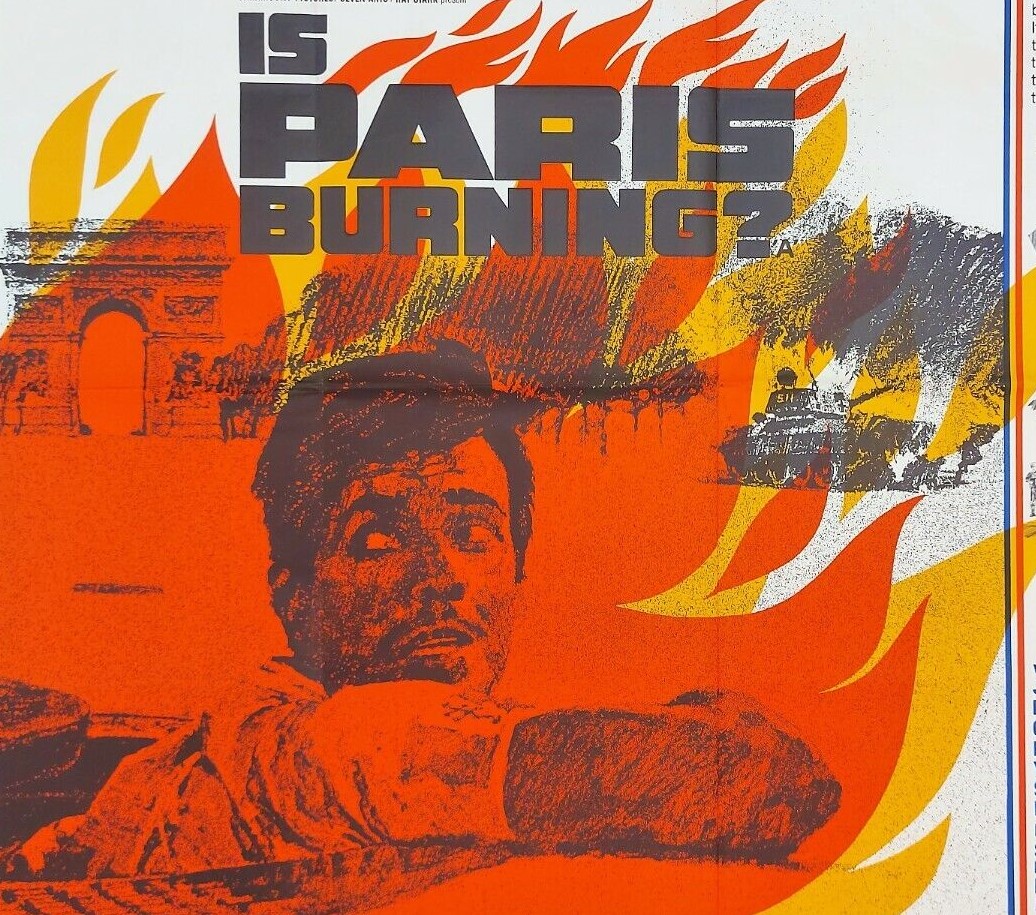
Is Paris Burning (1966) ****

Politics didn’t usually play a part in war films in the 1960s but’s it’s an essential ingredient to Rene Clement’s underrated documentary-style picture. Paris had no strategic importance and after the Normandy landings the Allies intended to bypass the French capital and head  straight for Berlin.

Meanwhile, Hitler, in particular vengeful mood after the attempt on his life, ordered the city destroyed. Resistance groups were splintered, out-numbered and lacking the weaponry to achieve an uprising. Followers of General De Gaulle, the French leader in exile, wanted to wait until the Allies sent in the troops, the Communists planned to seize control before British and American soldiers could arrive. 

When the Communists begin the fight, seizing public buildings, the Germans plant explosives on the Eiffel Tower, the Louvre, and other famous buildings and all the bridges across the River Seine.  The German commandant Von Choltitz (Gert Frobe), no stranger to slaughter having overseen the destruction of Rotterdam, holds off obeying his orders because he believes Hitler is insane and the war already lost.

The Gaullists despatch a messenger to persuade General Omar Bradley (Glenn Ford) to change his mind and send troops to relieve the city. Sorry for the plot-spoiler but as everyone knows the Germans did not destroy the city and the liberation of Paris provided famous newsreel and photographic footage.

Director Clement (Rider on the Rain, 1970) was also aware he could not extract much tension from the question of whether von Choltitz will press the destruct button, so he takes another route and documents in meticulous detail the political in-fighting and the actual street battles that ensued, German tanks and artillery against Molotov cocktails and mostly old-fashioned weaponry. The wide Parisian boulevards provide a fabulous backdrop for the fighting.

Shooting much of the action from above allows Clement to capture the action in vivid cinematic strokes. Like The Longest Day (1962), the film does not follow one individual but is in essence a vast tapestry. Scenes of the utmost brutality – resistance fighters thrown out of a lorry to be machine-gunned, the public are strafed when they venture out to welcome the Americans – contrast with moments of such gentleness they could almost be parody: a shepherd taking a herd through the fighting, an old lady covered in falling plaster watching as soldiers drop home-made bombs on tanks.

This is not a film about heroism but the sheer raw energy required to carry out dangerous duty and many times a character we just saw winning one sally against the enemy is shot the next. The French have to fight street-by-street, enemy-emplacement-by-enemy-emplacement, tank-by-tank.

And Clement allows as much time for humanity. Francophile Sgt Warren (Anthony Perkins), as an American grunt, spends all his time in the middle of the battle trying to determine the location of the sights he longs to see – before he is abruptly killed.  An unnamed café owner (Simone Signoret) helps soldiers phone their loved ones.

Like The Longest Day and In Harm’s Way (1965), the film was shot in black-and-white, but not, as with those movies for the simple reason of incorporating newsreel footage, but because De Gaulle, now the French president, objected to the sight of red swastika. Even so, it permitted the inclusion of newsreel footage, which on the small screen (where most people these days will watch it) appears seamless.

By Hollywood standards this was not an all-star cast, Glenn Ford (as Bradley), Kirk Douglas (General Patton) and Robert Stack (General Sibert) making fleeting glimpses.

But by French standards it was the all-star cast to beat all-star casts – Jean-Paul Belmondo (Breathless, 1960), Alain Delon (Lost Command, 1966), Yves Montand (Grand Prix, 1966), Charles Boyer (Gaslight, 1944), Leslie Caron (Gigi, 1958), Michel Piccoli (Masquerade, 1965), Simone Signoret (Room at the Top, 1959) and Jean-Louis Trintignant (A Man and a Woman, 1966).  Orson Welles, in subdued form, appeared as the Swedish ambassador.

Gore Vidal (The Best Man, 1964) and Francis Coppola (The Godfather, 1962) devised the screenplay based on the bestseller by Larry Collins and Dominic Lapierre

At $6 million, it was the most expensive French film ever made. It had a six-month shooting schedule and was shot on the streets of the city including famous locations like Etoile, Madeleine and the Louvre. It was a big hit in France but flopped in the United States, its box office so poor that Paramount refused to disclose it.

Gripping.

Behind the Scenes: Coming Soon, Maybe! – Exhibitor Woes

The global release is a relatively recent phenomenon. Back in the 1960s nobody would dream of letting loose a film on 7,000 screens worldwide all at once. In those days release patterns were a moveable feast. You could guarantee that a big new movie would open on a scheduled date in first run in a major city like New York, London or Paris, but after that it was anybody’s guess how long it might take to arrive at your local neighbourhood cinema. Especially, if a movie was part of the roadshow equation, it could occupy one cinema for months, maybe even years, and as long as it was screening there could go no further afield.

But even I was astonished, once I dug around in the files, to see just how long it took a movie to shift from world premiere to turning up at the last booking stations on the route, those tiny cinemas that appeared to litter small-town America. Towns with populations under 2,000 could still support a cinema. And it fell to the exhibitor to ensure a movie did not outstay its welcome. In Britain, cinemas in the 1960s screened films six days a week (Sunday films were subject to different regulations and were often one-off showings of old horror pictures hired on a fixed rental basis). Films ran for six days or the week was split into two, one program running Mon-Wed, the other Thu-Sat, the latter being allocated the movies with the better box office prospects.

It seemed, from an objective perspective, a fairly straightforward system. But in Britain a cinema with a catchment area of just a couple of thousand people would have gone to the wall a good time previously. All cinemas, even independent ones, fitted into some kind of release pattern, and might get the fifth or sixth or seven run of a movie after its big city first appearance, but, excepting roadshow, once it had made that vital first appearance you could rest assured it would take no more than six months or so to travel down the pipeline.

That did not hold true for small-town America. In 1967, for example, a picture could 18 months or more to reach towns such as St Leonard (pop 1900) in New Brunswick; Pittsfield (pop 2300) in New Hampshire; New Town (pop 1200) and Washburn (pop 968) in North Dakota; Lansing (pop 1328) in Iowa; St Johnsbury (pop 6000) in Vermont; England (pop 2136) in Arkansas; Flomaton (pop 1480) in Alabama; Oshkosh (pop 1100) in Nebraska; Grace (pop 775) in Idaho and Miltonvale (pop 911) in Kansas.

Weeks here appeared to be divided into three: Sun-Mon (or Sun-Tues); Tues-Wed (or Tue-Thu); and Wed-Sat (or Thu-Sat or Fri-Sat); and possibly into four if the exhibitor reckoned he had a bunch of stiffs. Certainly, minimal population counted against a small town being favored with a release ahead of a larger town. In addition, this type of exhibitor might well hold back until the rental terms were lower.

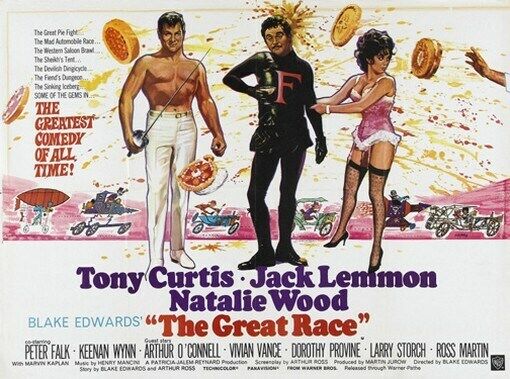
Tobruk was the fastest movie out of the blocks as far as these towns were concerned, just four  months passed from its launch in February 1967 until showing up in one of these aforementioned towns. Murderers Row was not far behind, six months after its December 1966 release. But these were rarities. It took nearly two years for The Great Race, a roadshow release in1965, to gain a booking while The Sound of Music, another 1965 roadshow, was only available on condition it was hired for two weeks rather than the usual maximum four days.

And it was nine or ten months from first run to last run for Raquel Welch vehicle Fantastic Voyage, Jack Lemmon-Walter Matthau comedy The Fortune Cookie and Rock Hudson sci-fi Seconds. It took a full year for World War One epic The Blue Max, Cary Grant comedy Walk, Don’t Run and the Oscar-laden Who’s Afraid of Virginia Woolf to show. There was an even longer wait for Marlon Brando drama The Chase (sixteen months) and Sophia Loren starrer Judith (eighteen months).

Assuming that any movie showing on a Saturday was considered the best risk, the following films were perceived by exhibitors to offer the best prospects: Disney family comedy That Darn Cat (booked for two  days), western spoof Cat Ballou (three), British spy picture Deadlier than the Male (three), William Holden Civil War western Alvarez Kelly (three), a revival of Hammer horror The Brides of Dracula (two), Lee Marvin-Burt Lancaster western The Professionals (three), Glenn Ford in Rage (three), British epic Khartoum (two), The War Wagon (four days in once cinema, only two in another), El Dorado (four days, running Fri-Mon), The Blue Max (four), Tobruk (two) and crime thriller Warning Shot (three).

Programs beginning on a Sunday I would reckon to have the next best chance of collaring an audience. Among these bookings were: The Great Race (three days), The Fortune Cookie (three), Fantastic Voyage (three), Paul Newman private eye thriller Harper (two), The Russians Are Coming, The Russians Are Coming (two), In Like Flint (two), Paul Newman western Hombre (two), Night of the Generals (three), Walk, Don’t Run (just one), The Quiller Memorandum (two), western remake Stagecoach (three) and Lost Command (two).

That sometimes left a two-day program in the middle of the week as a bonus in a good week or make-and-break in a bad one. Clearly, exhibitors took greater risks on pictures slotted in then. Sometimes the gamble paid off. Raquel Welch in Swingin’ Summer (two days), booked on the back of expectations for Fantastic Voyage, did surprisingly well. So did Wild Angels and a revival of Tom Jones.

Exhibitors were not slow in venting anger at a poor performer. Box Office magazine’s fortnightly feature “The Exhibitor Has His Say” – from which all this information is drawn – allowed the cinema owner to mouth off and warn fellow exhibitors. Terry Axley of the New Theatre in England was among the most vociferous. “Never been able to do much business on Ann-Margret,” was his view on Made in Paris. There was “no dice” for The Russians Are Coming, The Russians Are Coming. Despite Sean Connery, A Fine Madness did only “average business.” Fantastic Voyage “flopped here entirely.”

The Quiller Memorandum provided an all-time low for S.T. Jackson of the Jackson Theater in Flomaton. Walk, Don’t Run was a “real disappointment” at the Arcadia Theater in St Leonard. A Man Could Get Killed was pulled “after the poorest Sunday ever” at the Roxy in Washburn. Arabesque held “no appeal” for the audiences at the Scenic Theater in Pittsfield, where Stagecoach “didn’t seem to have much draw.”

But exhibitors were equally good at pointing to pictures that had exceeded expectations: Laurel and Hardy’s Laugh InBorn Free, Henry Fonda western A Big Hand for a Little Lady, Tony Curtis comedy Not with My Wife You Don’t, Dean Martin comedy western Texas Across the River, espionage spoof Bang! Bang! You’re Dead and a revival of Ma and Pa Kettle Back on the Farm from 1951.

What it showed was that one man’s turkey could prove another man’s golden goose. And while on the lowest rung of the distribution ladder that there was an inbuilt camaraderie that attempted to prevent fellow exhibitors from picking the wrong horse while hoping to pin their faith on an outsider romping home.

SOURCE: “The Exhibitor Has His Day,” Box Office, various issues, 1967.

Discover WordPress

A daily selection of the best content published on WordPress, collected for you by humans who love to read.

The Atavist Magazine

by Brian Hannan

WordPress.com News

The latest news on WordPress.com and the WordPress community.