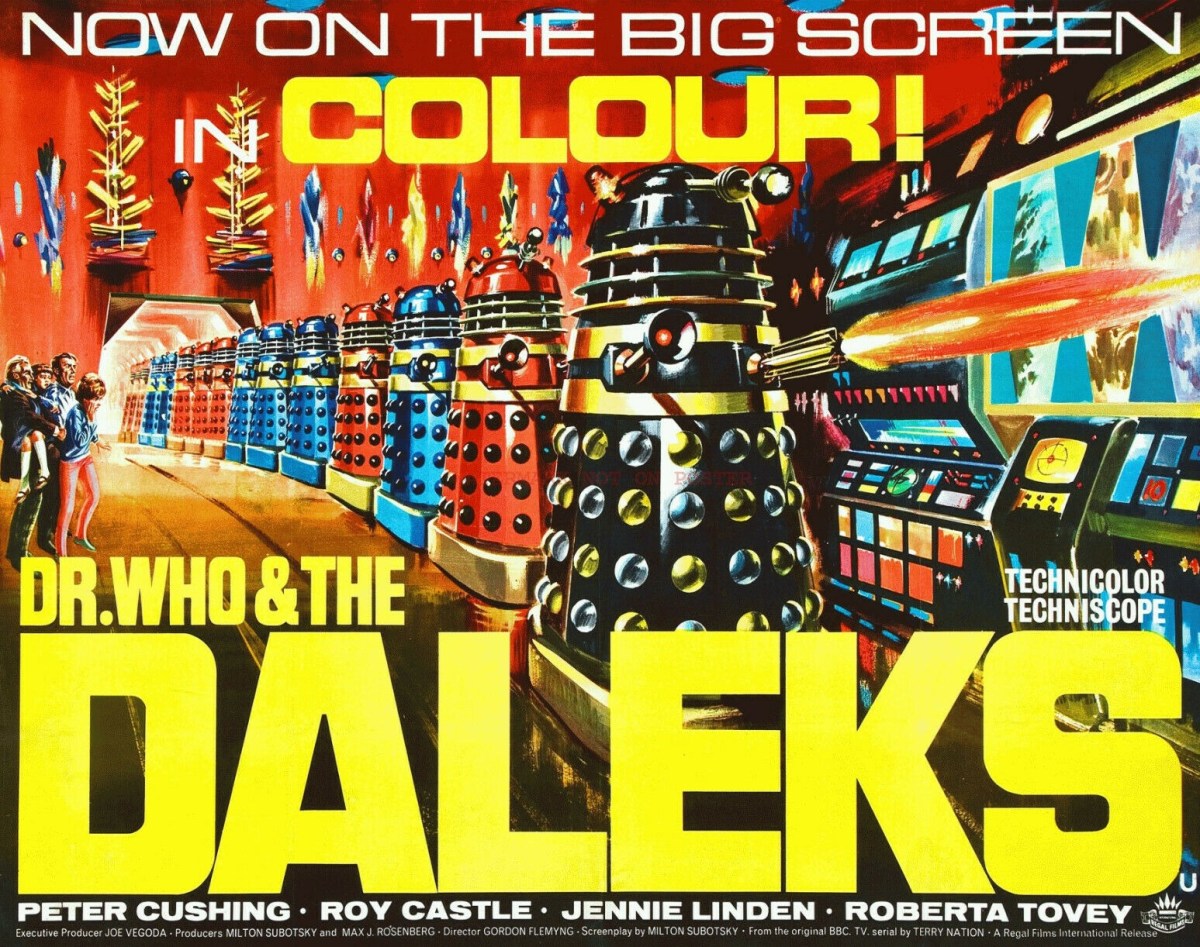
The maiden voyage of the time-travelling Tardis is triggered by some unexpected pratfall comedy. On board are the venerable doctor (Peter Cushing), his intrepid great-granddaughter Susan (Roberta Tovey) and a fearful pair, granddaughter Barbara (Jennie Linden) and accident-prone Ian (Roy Castle). They land on a petrified planet ruled by robotic Daleks with menacing electronic voices.
The malfunctioning Tardis forces them to investigate an abandoned city but they are quickly imprisoned, the steel robots determined to discover why the earthlings should be immune to the radiation that has consumed the planet after nuclear war. Meanwhile, the planet’s remaining inhabitants, the Thals, are planning an uprising.
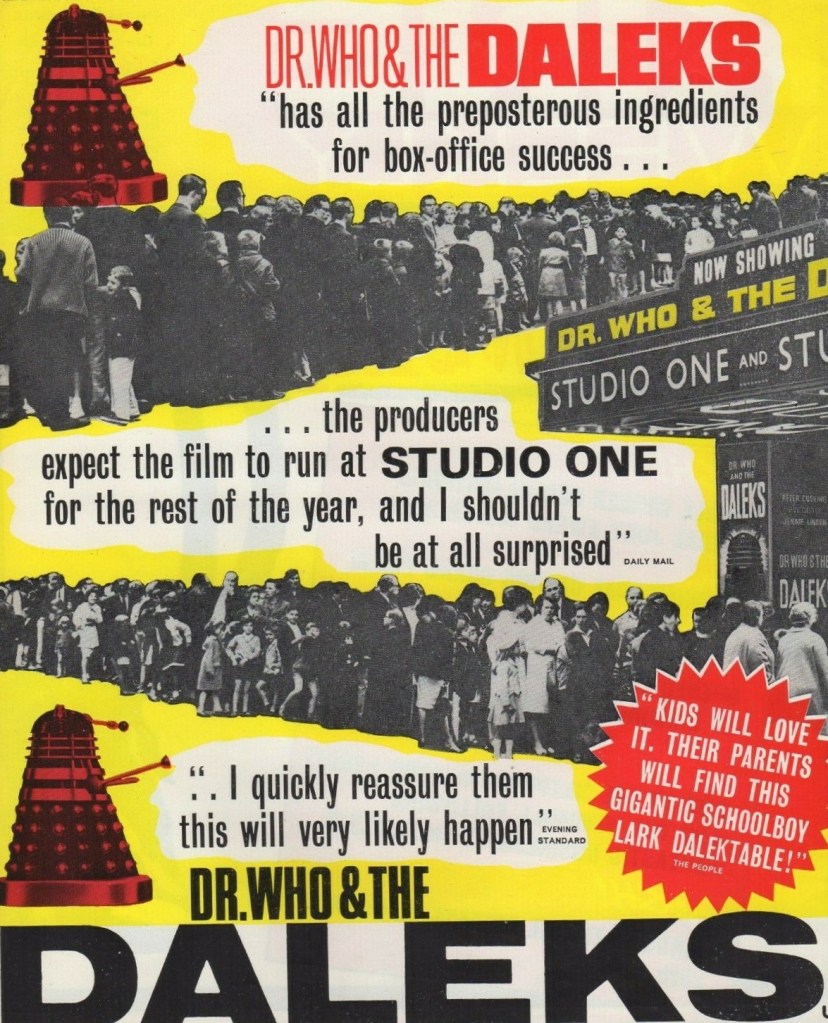
Budget restrictions ensure that menace is limited, even as the characters endure a heap of traditional obstacles such as swamp and rocky outcrop. Adults who did not grow up in the 1960s when the BBC television series took Britain by storm and apt to come at this without the benefit of nostalgia will certainly look askance at the sets and costumes. And it doesn’t possess the so-bad-it’s-good quality of some 1950s sci-fi pictures. But since it was primarily made for children, then perhaps it’s better to watch it with a younger person and gauge their response – of course, that may be equally harsh from someone brought up on the modern version of the series or already immersed in superheroes.
On the plus side, it does move along at a clip. Roberta Tovey (A High Wind in Jamaica, 1965) charms rather than annoys as the plucky grand-daughter even if her grandfather has mutated from the sterner figure of the television series into an eccentric inventor. Peter Cushing (She, 1965) is only required to ground the production which he does adequately. The innate comic timing of Roy Castle, in his leading man debut, brings a light touch to proceedings as the bumbling boyfriend and generates some decent laughs. Jennie Linden (Women in Love, 1969) has little to do except look scared.
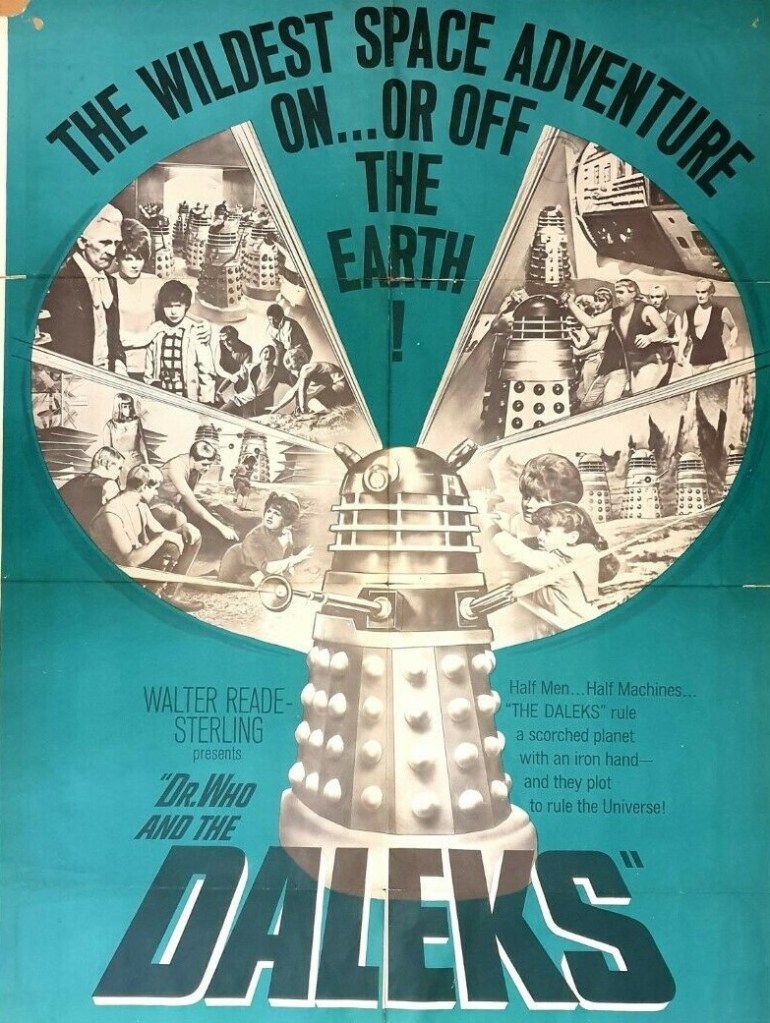
Oddly enough, it was American Milton Subotsky who, in opportunistic fashion, brought the project to the big screen, although the BBC had a track record of providing product that might make such a leap, The Quatermass Experiment in the 1950s the leading example. He wrote the screenplay and acted as producer and had previously worked with Cushing on Dr Terror’s House of Horrors (1965) and was about to embark on horror masterpiece The Skull the same year. He has approached the material with some reverence and the fact that the budget allowed for hordes of daleks rather than being seen one or two at a time as on the television probably made some child’s day.
Scottish director Gordon Flemyng (The Split, 1968) would make the leap to Hollywood on the back of this picture and its sequel the following year and you can see what made studios have faith in his ability – he deals with multiple characters, works quickly on a low budget and delivers an attractive picture that was a box office hit.
I suspect that audiences will divide into those who watch the film with nostalgia-colored spectacles, those who think it only as good as a bad episode of Star Trek and those who adore any low-budget sci-fi movie.
You can catch this on Amazon Prime.


I’m not on Amazon Prime. It could have delighted my two children both fond of the Doctor.
The second poster is terrific.
LikeLiked by 2 people
Merry Christmas by the way 😉🎄
LikeLiked by 2 people
While not ‘darlektable’, this is perhaps unfairly judged as not canon. But it’s fun as a nostalgia piece…
LikeLiked by 3 people
Was great to look back at it.
LikeLiked by 1 person
I enjoyed it as a kid even if I understood that it wasn’t canon. So did my nephew.
LikeLiked by 2 people
We all enjoyed it as kids and I think today’s youngsters would still be in awe of the robotic voices.
LikeLiked by 1 person
This was my first exposure to Doctor Who here in the States. The two Cushing films occasionally ran on TV when I was a kiddie. I didn’t know Doctor Who was a TV show until my first year of high school, when it started running on our local PBS station. They just listed the program title in the TV Guide, which niggled but I never checked it out. Finally one time they also listed the story title, Day of the Daleks.
I remembered the Daleks, so that made me remember Doctor Who. I was slightly confused at first since he not only wasn’t Peter Cushing but seemed to have a completely different personality, and certainly no granddaughter. In any case, Jon Pertwee was my first real Doctor, although they transitioned to Tom Baker pretty quickly, since our station played five episodes a week. Doctor Who wasn’t at all covered in printed media in the States at the time, and this was obviously before the Internet, so seeing the Doctor regenerate into a whole other dude was quite a shock.
I rather liked the second film better, since I always preferred it when the Doctor was on Earth fighting alien invaders. In this I was fortuitous in starting with Pertwee / early Baker, since most of those stories took place in Britain.
LikeLiked by 1 person
Grew up with Doctor Who so went through every shade of his reincarnations and iterations, some good, some bad. Seeing the Daleks on the big screen though I remember being particularly chilled as a kid.
LikeLike