Seven Golden Men (1965) ****

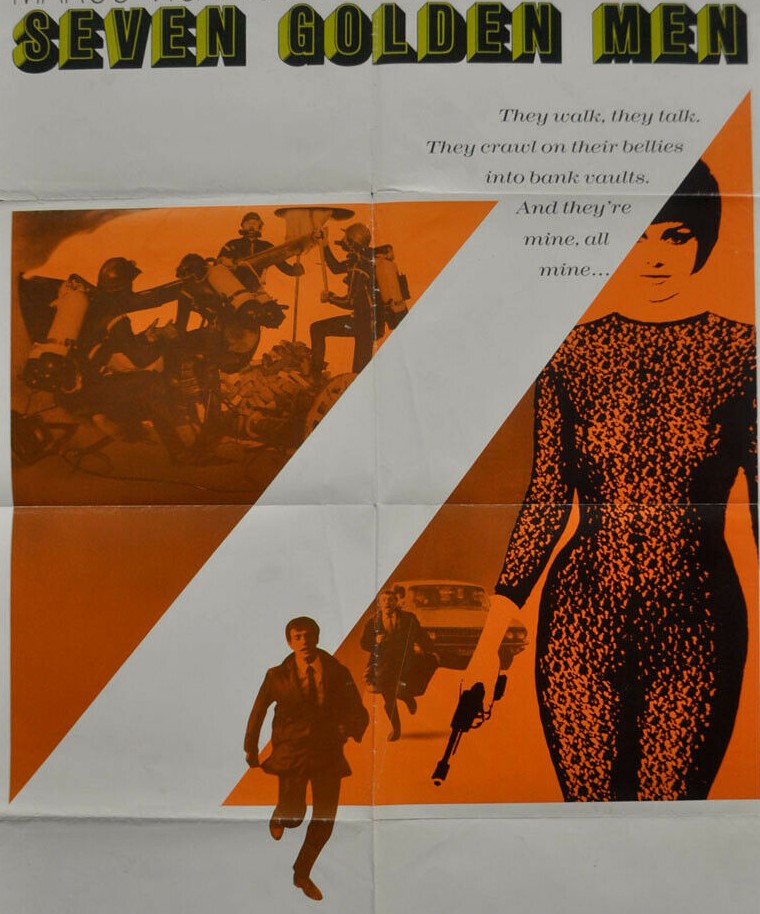
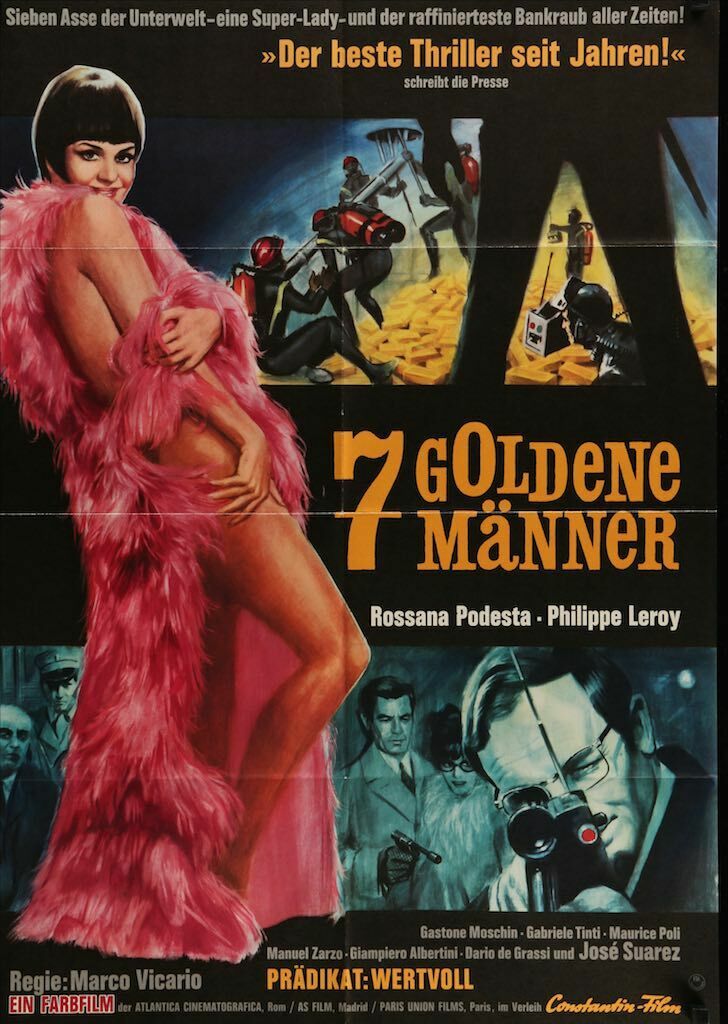
Very stylish caper picture that dispenses with the recruitment section, the ingenious hi-tech robbery accounting for the first half, escape and double-cross the second, a slinky Rosanna Podesta (the eponymous Helen of Troy, 1956, in case you’ve forgotten, and also appearing in Sodom and Gomorrah, 1962) an added attraction/distraction. The Professor (Phillippe Leroy), in bowler hat and umbrella, orchestrates the gold bullion theft from an uber-secure bank using hidden microphones, cameras and a host of electronic equipment, the inch-perfect heist organized to mathematical precision and timed to the second.

His team, disguised as manual workers, dig under the road, don scuba gear to negotiate a sewer, drill up into the gigantic vault and then suck out the gold bars using travelators and hoists. Giorgia (Podesta), sometimes wearing cat-shaped spectacles, a body stocking and other times not very much, causes the necessary diversions and plants a homing device in a safety deposit box adjacent to the vault. Occasionally her attractiveness causes problems, priests in the neighboring block complaining she is putting too much on show.

It’s not all plain sailing. A cop complains about the workmen working during the sacrosanct siesta, a bureaucrat insists on paperwork, a radio ham picks up communication suggesting a robbery in progress, the police appear on the point of sabotaging the plan.

But the whole thing is brilliantly done, the calm professor congratulating himself on his brilliance, Giorgia seduction on legs. The getaway is superbly handled, the loot smuggled out in exemplary fashion, its destination designed to confuse. Then it is double-cross, triple-cross and whatever-cross comes after that, and with every reversal no idea what is going to happen next. It is twist after twist after twist. Some of the criminals are slick and some are dumb so as well as the high drama there are moments of exquisite comedy.

Italian writer-director Mario Vicario (The Naked Hours, 1964) handles this European co-production with considerable verve and although, minus the normal recruitment section, we don’t get to know the team very well except for The Professor and Giorgia each is still given some little identity marker and in any case by the time they come to split the proceeds we are already hooked. Frenchman Phillippe Leroy (Castle of the Living Dead, 1964) is the standout as a mastermind in the British mold, a stickler for accuracy, calm under pressure, working with military discipline. Podesta (also The Naked Hours) has no problem catching the camera’s attention or playing with the emotions of the gang  to fulfill her own agenda. The gang is multi-national – German, French, Italian, Spanish, Portuguese, Irish – with only Gabriel Tinti likely to be recognized by modern audiences.

And there is a terrific score by Armando Trovajoli (Marriage Italian Style, 1964) that changes mood instantly scene by scene. One minute it is hip and cool jazz, the next jaunty, and then tense.

If ever a picture was pure cult, this is it.

The Blogger Speaks

This weekend I am one of the very few male speakers at the “Doing Women’s Film and Television History” international conference being hosted by Maynooth University, Dublin, on July 10-11. Naturally it is a virtual conference but it is packed with speakers from all over the world who have been researching issues relating to women working in film and television. I am not an academic so it is signal honor for me to be invited to speak at a university-run conference.

My topic is “When Women Ruled Hollywood” which looks at female salaries in the movie business from 1910 to 1970. Although most people think women were hard-done-by in Hollywood and generally considered as second-class citizens, I found this was not at all the case. In the 1910s, Mary Pickford earned double the earnings of Charlie Chaplin. In the 1920s, the top earning star of either gender was Corinne Griffith.s

At the start of the 1930s, Greta Garbo was the dominant figure when it came to salaries. In 1935 Mae West was the second-highest earner in the whole of America, beaten only by William Randolph Hearst, immortalised as Citizen Kane.

In the annual salary league for the remainder of the 1930s and 1940s, Claudette Colbert (twice), Irene Dunne, Ginger Rogers, Joan Crawford and Deanna Durbin all topped the rankings and in the years when males came out on top the female stars were not far behind.

While female salaries dipped in the 1950s, by the 1960s women were again beating the males at the salary game, Elizabeth Taylor way ahead of everybody, Audrey Hepburn on $1 million a picture, Julie Andrews out-earning Paul Newman in Torn Curtain and newcomer Barbra Streisand reaching unheard-of commercial heights.

I had written a couple of business histories of Hollywood, the research for which took me back to 1910 and in the course of writing those books I discovered information about salaries that would have been out of place in those works, so I dug around some more and came up with the information for this talk.

If you want an idea of my speech, you can check out this short sample on Youtube.

Maroc 7 (1967) ***

With a string of Swinging Sixties fashion models providing the requisite bevy of beauties, a gang of thieves, a Moroccan heist, superb locations, great cast and a touch of archaeology with secret chambers and a long-lost relic thrown in, this splendid espionage frolic proves a welcome return to big screen top billing for Gene Barry after nearly a decade in television in Bat Masterson (1958-1961) and  Burke’s Law (1963-1966).

Something of a cat burglar himself, Simon Grant (Barry) infiltrates a gang which uses fashion as a cover and whose ingenious speciality is to steal famous heirlooms and replace them with fake ones in the assumption that on their departure from a foreign country the customs officers will not be able to tell the difference. Louise Henderson (Cyd Charisse) and Raymond Lowe (Leslie Phillips) head up the gang while Claudia (Else Martinelli) may or may not be in on the act.

Her dalliance with Simon suggests an inclination towards the right side of the law but the fact that she has been involved with the pair for so long sets up the intriguing notion that she is stringing the American agent along. Initially, she rejects Simon’s advances until told by Louise to comply and pump him for information leading to one of the movie’s best lines (and innuendo that a British audience in particular would adore). Says Simon: “We haven’t done much about pumping but maybe that will come later.”  Doubts also surround the intentions of Michelle Craig (Alexandra Stewart).  On their trail is Inspector Barrada (Denholm Elliott).

There is mystery aplenty and a fair quotient of punch-ups, romance, shoot-outs and murder while the unearthing of the hidden treasure is less heist amd more straightforward Indiana Jones. The fashion is the icing on the cake. The Moroccan fashion shoots are more than merely decorative, or an excuse to bare the charms of the gorgeous models. Instead, the shoots would not disgrace Vogue or any of the other glossy magazine temples to haute couture, with that Sixties focus on fabulous clothes, genuine location and outlandish hairstyles.

On top of that, several of the stars are either playing against type or out of their comfort zones. Legendary Hollywood dancer Cyd Charisse famed for such classic musicals as The Bandwagon (1953) and Silk Stockings (1957) sets such fluff aside to essay a criminal mastermind, whose cunning often gets the better of Simon. Leslie Phillips (Crooks Anonymous, 1962), better known as a charming Englishman with an eye for the ladies, is as ruthless a photographer as he is a criminal. Director Gerry O’Hara (The Pleasure Girls, 1965) has managed to get both Phillips and Denholm Elliott to drop their standard methods of delivery, usually embracing a drawl, making their characterisations a good bit more fresh than normal. Phillips was clearly intending to make some kind of career change since he was the producer.

Gene Barry makes a perfect entrance as an adventurer-spy, as confident in his seduction techniques without women falling at his feet like James Bond, with a nice line in self-deprecation and more than able to look after himself. Before being side-tracked by television, Barry had shown movie star potential in War of the Worlds (1953) and Thunder Road (1958) and now he delivers on that earlier promise. Elsa Martinelli (Hatari!, 1962) is the femme fatale who may or may not wish to play that role, keeping the audience completely on edge as to which side of the law she is likely to come down on. Added bonuses are Alexandra Stewart (Only When I Larf, 1968), Angela Douglas (Carry On Screaming!, 1966), Tracy Reed (Hammerhead, 1968), dancer Lionel Blair (A Hard Day’s Night, 1964) and Maggie London.

Advance Buzz – The Phenomenon Created in the 1960s

In 1964, Twentieth Century Fox created a new way of selling pictures by inventing the advance buzz.

Of course, movies had always had some kind of pre-launch push but mostly on a small-scale via gossip columnists, who, while they had some influence, did not actually receive much space in a newspaper. Fox set out to change all that and put movies on the front pages and gain big feature spreads inside, an event that only usually occurred through  unwanted scandal (Cleopatra, for example), death  or a photo of a big female star.

Fox revamped the press junket – at that time primarily used as a vehicle to announce a movie premiere – and turned it into a method of creating advance publicity and expanding awareness on new pictures long before they reached the screen. And did so with enormous style, transporting over 100 American journalists to Europe to watch the production of three major big-budget roadshows.

Cecil B. DeMille of all people had invented the movie press junket – for the world premiere of his swashbuckler The Buccaneer in 1938. At a time when world premieres were confined to New York and Los Angeles, Hollywood had begun experimenting on a small scale with different locales for a first showing – whaling picture I Conquer the Sea (1936) was unveiled in New Bedford, Massachusetts, The Petrified Forest (1936) in St Louis and Sutter’s Gold (1936) in Sacramento. But these were all local affairs, the selected city putting on a big show for local dignitaries but the media were drawn only from the immediate surrounding area with stories syndicated to bigger newspapers.

When he selected New Orleans for his world premiere, DeMille, as skilled in marketing as he was in direction, hired a deluxe train to bring journalists from the top newspapers and magazines down from New York and Chicago. The train had a special compartment kitted out with typewriters, telephones, radio, Dictaphones and even stenographers to “relay hot news as it happens.”

All expenses – accommodation, meals, alcohol and various other sundries – for an entire week were picked up by Paramount. Three radio stations made daily broadcasts and the journalists filed news stories and features about the stars and the city, and, most important of all, reviews of the film they were privileged to be the first to see. The city went to extraordinary trouble, proclaiming a local holiday, organizing parades, enlisting the help of local organizations to ensure there was some event worth reporting every day. Local retailers, hoteliers and restaurateurs made a fortune as hundreds of thousands of people piled in to see the stars and witness the festivities.

The press junket was born.

In the following years, world premieres were held all over America either in locations where the movie was filmed or places linked with a star or character. These varied from major metropolises like Detroit (Disputed Passage, 1939), Houston (Man of Conquest, 1939), Memphis (Dr Erlich’s Magic Bullet, 1940) and Philadelphia (Intermezzo, 1939) to smaller locales like Littleton, New Hampshire (The Great Lie, 1941) and South Bend, Indiana (Knute Rockne, All American, 1940).

But by the 1960s, the world premiere idea had been done to death. There was scarcely a town, city or venue that had not been the subject of premiere marketing.

So in 1964 with an unprecedented three roadshow pictures in production Twentieth Century Fox upped the press junket ante by flying a fleet of 110 journalists on a specially chartered Boeing 707 to Europe to watch filming on actual locations in Britain, Austria and Italy.

Over 40 cities were represented by reporters and included representatives of the New York Post, Los Angeles Times, UPI, Detroit Free Press, Kansas City Star, Boston Globe and the Seattle Times as well as The Mike Wallace Show (television) and NBC Radio and magazines as diverse as McCalls, Cue and Newsweek.

At the reconstructed Booker Airport in Britain, journalists watched stunts for Those Magnificent Men in their Flying Machines (1965) and interviewed stars like Sarah Miles, Terry-Thomas and Robert Morley. Each journalist had a photograph taken as a personal souvenir alongside a replica of a 1910 Antoinette airplane specially built for the film, but undoubtedly many such photographs found their way into the newspapers and magazines.

When the media cavalcade shifted to Austria they were treated to a massive banquet at Schloss Klessheim in Salzburg where The Sound of Music (1965) was being filmed. Julie Andrews was interviewed with her feet on a table and the reporters watched choreographer Marc Breaux rehearsing the “I Have Confidence” number (the music had been recorded in Hollywood and then played back synchronized to the action). Andrews and co-star Christopher Plummer were interviewed at Frohnburg Castle.

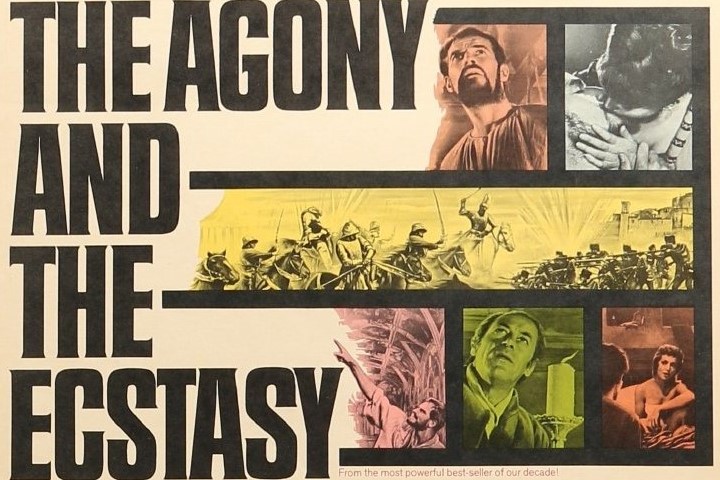
Italy – where The Agony and the Ecstasy (1965) was being shot – was the final destination. The visitors were conveyed up the perilous Carrera Mountains to the 4,700 ft Monte Altimissino to watch a scene being filmed in a quarry usually closed to visitors of a 200-ton block of marble being cut. Director Carol Reed, producer Darryl F. Zanuck and star Charlton Heston were on hand to welcome them. Rex Harrison (playing the Pope) was interviewed outside a restaurant in Rome that bore the Pontiff’s name 

Even before the journalists returned from the seven-day trip, they were sending stories back – over $8,000 (worth about $70,000 today) was spent on cable fees and nearly one million words had been written. Many of the journalists had never been to Europe before and took full advantage of the opportunity. Newspaper and magazines would not permit journalists to spend such a length of time away from the office without expecting a substantial bounty in the shape of news stories – the trip itself received extensive coverage.

Feature editors were deluged with stories and interviews that ran in the main sections of the newspaper and in weekend supplements, shifting the coverage of movies away from the  entertainment sections. In addition, to justify their time away, stories ran in the food, travel and fashion sections.

It was an unprecedented publicity bonanza for films that were still a full year away from release, creating a tsunami of public interest. For the first time a studio had created movie awareness on its own terms. While movies filmed in Europe had often received coverage based on reports by journalists living in that continent, this was rather cursory, had always appeared piecemeal in American newspapers, largely depended on an editor’s decision about reader interest in a particular star, and, more importantly, such stories usually coincided with the film’s launch rather than well in advance.

This huge media onslaught whetted public appetites well in advance. In addition, there were enough articles left over to be used up when the movies actually did open.

The trade press also widely reported on the event and Box Office magazine ran a 12-page feature one month later. In its evaluation of the junket, the studio concluded that it was the “most advanced type of industrial marketing.”

SOURCES: Brian Hannan, In Theaters Everywhere: A History of the Hollywood Wide Release 1913-2017, p32-36 (McFarland Publishing, 2019); “That Was the Week That Was…Fantastic,” Box Office, Jul 6, 1964, p10-21.
Esther and the King (1960) ***

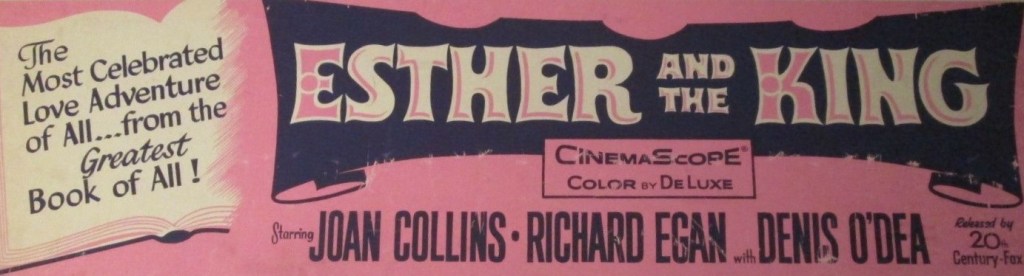
Taking a Biblical tale as a starting point, veteran director Raoul Walsh (White Heat, 1949) stirs up heady brew of intrigue, rebellion, politics and romance. Returning home victorious, King Ahasuerus (Richard Egan) discovers his wife Queen Vashti (Danielle Rocca) has committed adultery and that his minister Klydrathes (Renato Baldini) has been squeezing the people blind with punitive taxes, hanging them for non-compliance.

Casting his wife aside, the king seeks a new bride. Since he has conquered all the known world except Greece, marriage to make a political alliance is not an option, so, given women are treated as mere chattels and the king is all-powerful, all the likely virgins are rounded up including Hebrew Esther (Joan Collins) on her wedding day.

Her husband-to-be Simon (Rik Battaglia) kicks off, attacks Klydrathes and becomes a wanted man. The queen’s lover and the king’s chief minister Prince Haman (Sergio Fantoni) attempts to fix the bridal selection, inserting his hardly-virginal choice Keresh (Rosalba Neri) into the proceedings while attempting to murder clear favorite Esther. When that fails, Haman plots to usurp the crown. With the Hebrews facing possible annihilation, Esther is put in the position of giving in to the king in order to save her people. As her serenity soothes the savage beast, her initial hate turns to growing attraction.

Meanwhile, Simon is on a rescue mission and Prince Haman cooks up a devilish plot that will see the Hebrews blamed for passing on military secrets to the king’s enemies. Naturally, all hell eventually breaks loose.

More a drama than a typical big-budget DeMille offering, with battles taking place off-screen, action is limited to a few chases and skirmishes. There is a fair amount of sin on show what with a tribe of concubines at the king’s disposal, a whipping, a striptease by Vashti in a last gasp attempt to win back the king, and some very seductive dancing routines by female slaves who, at times, look as if they were coached by Busby Berkeley. Substantial amounts appear to have been spent on costumes and production design, so historical atmosphere is well captured.

Once you realize there’s not going to be any kind of big battle or major action centerpiece common to the Biblical genre, it’s easy to sit back and enjoy the political machinations, the initial torment of Esther, introduced as a rebellious soul, and the king, more at home with soldiers, shaking off his despondency at marital betrayal as he responds to Esther’s coaxing.

It was 1961 before it reached Britain.

Top-billed British actress Joan Collins (Seven Thieves, 1960) has a difficult role. Normally, you would expect expressions of passion or depths of anguish, but the rebellion she displays at the start soon disappears when she enters the palace and is helpless to change the situation except by, initially against her will, accepting the king’s desires. In that sense, her portrayal is understandable but the understated performance gets in the way of a woman who is supposed to be devastated by the loss of her husband and then trapped by the needs of her people into making the marriage.

Taking second billing, Richard Egan (300 Spartans, 1964) makes a thoughtful king, showing very little temper, possibly because he doesn’t need to with everyone, beyond the conspirators, cowering in his presence.   Regal and stately suits him fine rather than the more common explosions we are accustomed to seeing from people in that line of work.

Both stars were in need of box office redemption. It should have been a screen pairing made in heaven, both Collins and Egan coming to the fore in the mid-1950s, and if they had sustained their early promise, it would have been a star-studded picture. As it was, Collins had been billed above Richard Burton in The Sea Wife (1957) and above Jayne Mansfield in The Wayward Bus (1957) but had gradually drifted down the pecking order, in her previous outing credited behind Edward G. Robinson and Rod Steiger in Seven Thieves (1960).

Egan’s career had followed a similar trajectory – top-billed in pictures as diverse as drama The View from Pompey’s Head (1955), western Tension at Table Rock (1956), film noir Slaughter on 10th Avenue (1957), and romance A Summer Place (1959) but for his previous film, Pollyanna (1960) billed behind both Jane Wyman and Hayley Mills.

While Egan would enjoy a career resurgence it was the end of the line, at least temporarily, for Joan Collins. She was coming to the end of her seven-year Twentieth Century Fox contract but fell out with the studio after being rejected for Cleopatra, and on the evidence here you can see why. After leaving Fox, she only made five more films during the decade. This was the final picture for Irish actor Dennis O’Dea (The Fallen Idol, 1948). Director Raoul Walsh made only another two.

Sergio Fantoni (Von Ryan’s Express, 1965) excels as the spurned lover and Rik Battaglia (The Conqueror of the Orient, 1960) as the schemer. Rosalba Neri (Top Sensation, 1969) and Danielle Rocca (Behold a Pale Horse, 1964) both make striking appearances. Look out also for Gabriele Tinti (Seven Golden Men, 1965).

The Hitman’s Wife’s Bodyguard (2021) ****

Contrary to all my expectations – and the opinions of the Rotten Tomatoes critical aggregate – this was a blast. The over-the-top tongue-in-cheek action thriller is dominated by Salma Hayek who acts as a glorious foil to the bickering bad boys. Had she not been so well established, this would have been a career-making turn. It might yet give her a fresh burst of cinematic life away from the serious stuff to which she has previously devoted her screen life.

This movie follows the new rule for sequels, in that often these days they are better than the original. I had not been so taken with The Hitman’s Bodyguard (2017), which basically turned on the old idea of a mismatched duo with a more straightforward storyline.

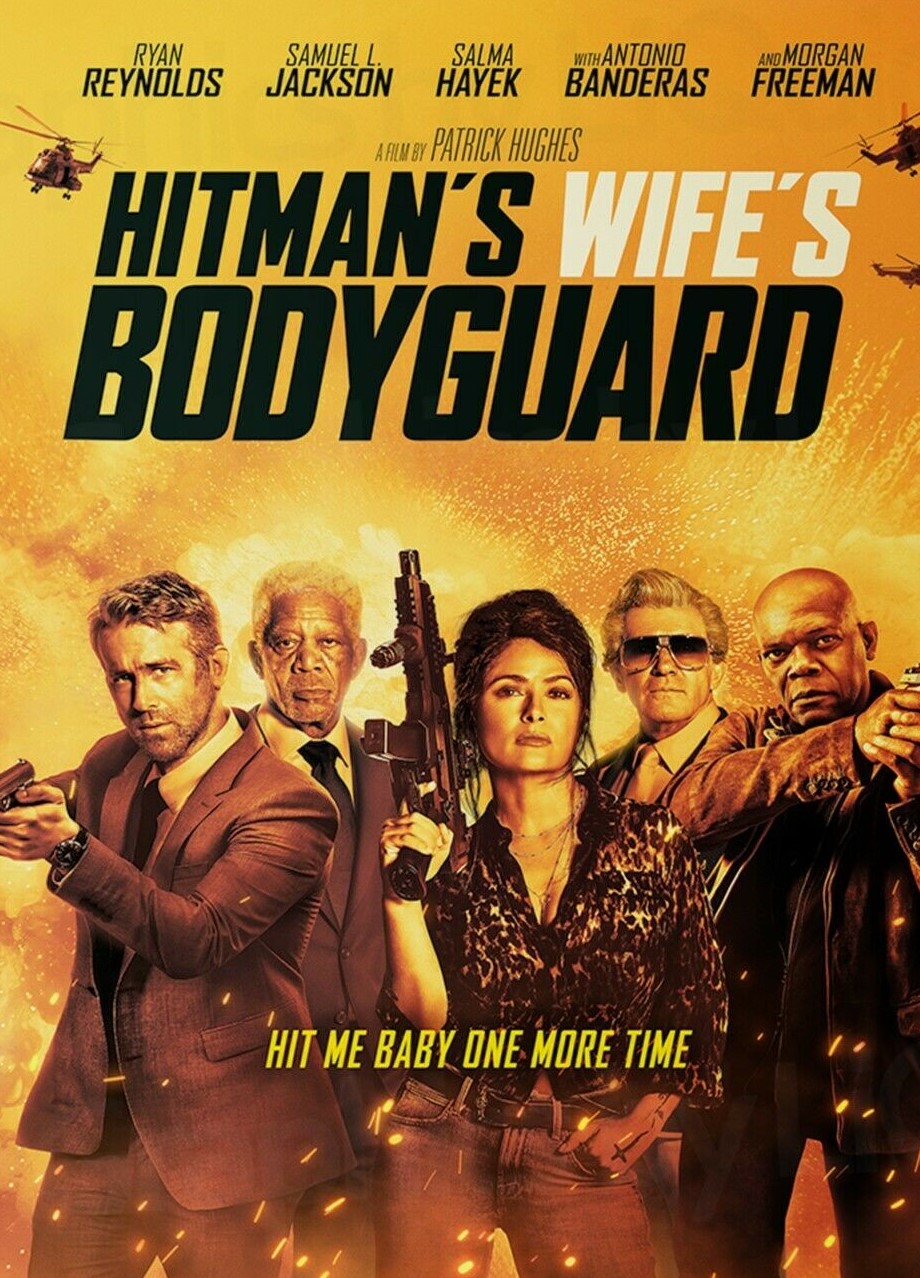
This time round, disgraced bodyguard Michael Bryce (Ryan Reynolds) is forced out of a very brief self-imposed retirement by Sonia Kincaid (Salma Hayek), who had small role in the original, to rescue husband Darius (Samuel L. Jackson) from gangsters. The main plot is straightforward enough – Greek shipping tycoon Aristotle Papadopolous (Antonio Banderas) plans to hold Europe to ransom after the EU imposes financial sanction on his native country by knocking out all digital communication throughout the continent. Interpol agent Bobby O’Neill (Frank Grillo) forces the trio to work together to foil the plot.

But there are a host of wonderful, and occasionally surprisingly emotional, subplots. For a Start Sonia is desperate to become a mother with question-marks about Darius’s ability or wish to make her pregnant. Bryce has vowed to give up violence and we get to meet his father, a legendary hitman (Morgan Freeman) who adds surprising complications to the story. Bobby O’Neill is constantly at odds with boss Crowley (Caroline Goodall) and can barely understand a word spoken by Scottish interpreter Ailso (a very dry Alice McMillan). Aristotle once had a thing for Sonia and his chief bodyguard Magnusson (Tom Hopper) is by far the coolest bodyguard on show.

The action just batters along, fueled by various plot twists, and there is hardly a pause for breath as the hitmen and their adversaries destroy a ton of Europe’s most attractive cities. There are also plenty of laugh-out-loud moments. There’s nothing remotely serious about the plot beyond personal issues facing the trio and that the preposterousness reaches high-octane levels only adds to the fun. If it’s not a shoot-out, it’s a chase. If the trio are not killing each other, they are trying to save each other. And there is a surprise ending which may trigger another sequel.

Salma Hayek (Oscar-nominated for Frida, 2002) at full throttle both emotionally, vocally and in murderous mode steals the picture. She delivers some hilariously salty dialogue in amongst the profanity and proves no slouch in the cunning department. All guns blazing is her default. Ryan Reynolds (Deadpool, 2016) I found to be surprisingly good, too, a long way from the cocky screen persona he has inhabited of late, most of the time here emotionally vulnerable, in part due to his current antipathy towards violence but also from childhood demons, and spending most of the time taking one beating after another, once so convincingly dead that hitman and wife callously dump his overboard.

Samuel L. Jackson (Glass, 2019) could play this kind of role in his sleep but he, too, is given some emotional depth. Only Antonio Banderas (The Mask of Zorro, 1998) overplays his role. Caroline Goodall (Hunter Killer, 2018) is great as the crisp authority figure and Frank Grillo (Point Blank, 2019) as the eternal underling. It’s great to see Oscar-winner Morgan Freeman (The Shawshank Redemption, 1994) back in action – and more action than you might initially expect – and there is a cameo from Richard E. Grant (Withnail and I, 1987).

Patrick Hughes reprises his directorial duties, respectively, from the original and turns in a fresh take.

I caught this on my weekly Monday Night at the Cinema outing, catching films on the big screen before they are belittled on the small screen.

The Man Who Shot Liberty Valance (1962) *****

A mighty cast headed by John Wayne (True Grit, 1969), James Stewart (Shenandoah, 1965), Lee Marvin (The Dirty Dozen, 1967) and Vera Miles (Pyscho, 1960) with support from Edmond O’Brien (Seven Days in May, 1964), Woody Strode (The Professionals, 1966), Strother Martin (Cool Hand Luke, 1967) and Lee Van Cleef (The Good, the Bad and the Ugly, 1967) do justice to John Ford’s tightly-structured hymn to liberty and equality and reflection on the end of the Wild West. So tight is the picture that despite a love triangle there are no love scenes and no verbal protestations of love.

The thematic depth is astonishing: civilization’s erosion of lawlessness, big business vs. ordinary people, political chicanery, and a democracy where “people are the boss.” Throw in a villain with a penchant for whipping and a lack of the standard brawls that often marred the director’s work and you have a western that snaps at the heels of Stagecoach (1939), Fort Apache (1948) and The Searchers (1956).

The story is told in flashback after Senator Ransom Stoddard (James Stewart) and wife Hallie (Vera Miles) turn up unexpectedly in the town of Shinbone for the funeral of a nobody Tom Donovan (John Wayne), so poor the undertaker has filched his boots and gunbelt to pay for the pay for the barest of bare coffins. Intrigued by his arrival, newspapermen descend and Stoddard explains why he has returned.

The backstory unfolds. Arriving on stagecoach, novice lawyer Ransom is attacked, beaten and whipped by outlaw Liberty Valance (Lee Marvin). He is found by horse-trader Donovan (John Wayne) and taken to a local boarding house-cum-restaurant where Hallie (Vera Miles) tends his wounds. With a young man’s full quotient of principle, Stoddard is astonished to discover that local marshal Link Appleyard (Andy Devine) has ducked out of responsibility for apprehending Valance on the dubious grounds that it is outside his jurisdiction and that Valance has so mean a reputation he has the town scared witless. When Valance turns up he humiliates Stoddard and only Donovan stands up to him, rescuing an ungrateful Ransom, who detests violence and any threat of it.

Stoddard soon turns principle into action, setting up his shingle in the local newspaper office run by Dutton Peabody (Edmond O’Brien) and on learning that Hallie is illiterate establishing  a school for all ages. In the background is politics, but the push for statehood is inhibited by big ranchers who employ Valance to intimidate. Despite his aversion to violence and insistence that due legal process will eliminate the law of the gun, Stoddard practices shooting. When Donovan gives him a lesson and, to point out his unsuitability to confront such a mean character as Valance, covers him in paint, Stoddard floors him with a punch.  

That principle I mentioned has something in common with Rio Bravo (1959) – Howard Hawks’ riposte to High Noon (1952) – in that Stoddard, determined to fight his own battles, refuses to ask for help when targeted by Valance. The inevitable showdown is extraordinary, not least because it takes place at night and Ford, a la Rashomon (1951) tells it twice from different points of view.   

Precisely because it retains focus throughout with no extraneous scenes as was occasionally John Ford’s wont, the direction is superb. As in The Searchers, to suggest emotional state-of-mind, the director uses imagery relating to doors. This time the humor is not so broad and limited primarily to one incident. Both main male characters suffer reversals, in the case of Stoddard it is physical but in the instance of Donovan it is emotional. Either way, action is character. In the romantic stakes, they are equals, dancing around their true feelings.

Upfront there is one storyline, the upholding of law and order whether against an individual such as Valance or against the attempts of big business to thwart democracy. But underneath is a subtly-told romance. Donovan and Stoddard are allies but in terms of Hallie they are rivals. Neither have an ounce of sense when it comes to women. Neither actually protests their love for Hallie. Although Donovan brings her cactus roses and is, unknown to her, building an extension to his house to accommodate what he hopes is his future bride, his idea of romance is to mutter, in patronizing manner, the old saw of “you look pretty when you’re angry.”  He would have been wiser to have taken note of her spunk, because she can be more than direct if need be.

Stoddard isn’t much better. Despite her growing feelings towards him being obvious to the audience, he assumes she prefers Donovan. Action drives the love element, the need to save or destroy.

All three principals are superb. This may seem a typical Wayne performance, a dominant figure, comfortable with a gun and his abilities, but awkward in matters of the heart. But he shows as great depth as in The Searchers and the despair etched on his face at the possibility of losing Hallie eats into his soul. Stewart combines the man-of-the-people he essayed for Frank Capra with some of the toughness he showed in the Anthony Mann series of westerns. Vera Miles tempers genuine anger with tenderness and practicality. Unlike many Ford heroines she is not a trophy wife, but a worker, mostly seen running a kitchen. Lee Marvin cuts a sadistic figure, with an arrogance that sets him above the law, his tongue as sharp as his whip.

As well as Woody Strode, Strother Martin, Edmond O’Brien and Lee Van Cleef, you will spot various members of the John Ford stock company including Andy Devine (Two Rode Together, 1961) as the cowardly gluttonous marshal, John Carradine (Stagecoach), John Qualen (The Searchers) as the restaurant owner and Jeanette Nolan (Two Rode Together) as his wife.

The boldest part of the picture, however, comes at the end, when the director dismantles the myth built up around Stoddard and which the politician has used to create a career that spanned two terms as a Senator, three terms as a Governor and been the American Ambassador to Britain. So be warned, if you ain’t seen the picture, this is spoiler alert. In some respects, Ford was way ahead of his time. The twist at the end where the good guy is revealed as the villain of the piece is more of a contemporary trope. There were plenty of pictures where the villain appeared to have gotten away with it only to be caught out at the very last minute. This is not that kind of movie. Stoddard gets away with it for the simple reason that he fits the heroic mold.

“Print the legend” is very much the standard American attitude to myth. Dig deeper and what you find is hypocrisy. Man-of-the-people Stoddard’s life is based on bare-faced fraud. He took the glory for an action he did not commit. Of course this was in the days before newspapers found that bringing down politicians sold more papers than building them up and these days I doubt if such a scoop would be ignored.

Nor for all his upstanding image does Stoddart show the slightest sign of remorse – until now when he must know his confession will never see the light of day. (Maybe, if he had gone to the New York Times but not the Shinbone paper). He built his entire career on this violent action, the antithesis of his supposed stance on process of law.  He takes all the plaudits and fails to acknowledge Donovan, except when it’s too late, and Donovan has died a pauper, his rootless life perhaps engendered as a result of losing Hallie. Hallie’s character, too, is besmirched. She chose Stoddart precisely because he was a man of principle who risked his life to tackle – and apparently kill – Donovan. Those two elements are indistinguishable. Had she know Stoddart had failed and was only saved by the action of Donovan it is questionable whether she would have chosen the lawyer.

There are a couple of other quibbles, not so much about the picture itself, but about other quibblers, commonly known as critics.  Alfred Hitchcock famously came under fire for the use of back projection, not just in Marnie (1964) but other later films. That spotlight never appeared to be turned on the at-the-time more famous John Ford. The train sequence at the end of the film uses back projection and the ambush at the beginning is so obviously a set.

Don’t let these put you off, however, this is one very fine western indeed and fully justifies its growing critical status.

CATCH IT ON THE BIG SCREEN: By the way, if you live in Italy you can catch this on the big screen in Bologna where it is showing at Il Cinema Ritrovato – Fondazione Cineteca di Bologna on July 20-27, 2021.

Readers’ Choice – Behind the Scenes and Other Stuff Top 10

Regular readers will know that I don’t just write movie reviews but pick up on “Other Stuff” relating to the 1960s. This will take the form of articles about interesting aspects of the decade, book reviews and analyses of how particular movies were sold to the exhibitor via the studio’s Pressbooks / Campaign Manuals.

In addition, I have become especially interested in how works of fiction were adapted for the screen and these go out under the general heading of “Book into Film.” And, lastly, I have written a number of Behind The Scenes posts on the making of specific pictures.

So given I have been highlighting those movies that were the most highly regarded either by myself or my readers during the year, I thought it only fair to include some mention of the “Other Stuff.”

So these are my Top Ten posts of “Other Stuff”- as measured by reader response – during my inaugural year as a movie blogger. It’s worth pointing out that had the “Other Stuff” been included in the same chart as the Top 30 Readers’ pictures, five would have made the Top 20.

  1. “Box Office Poison 1960s Style” highlighted the stars whose attraction was beginning to fade.
  2. The Gladiators vs Spartacus was a two-volume book that I reviewed about the ill-fated production launched by Yul Brynner against the Kirk Douglas production of Spartacus (1960).
  3. Behind the Scenes of “Genghis Khan” (1965) related the battle to bring this Omar Sharif vehicle to the screen
  4. Behind the Scenes of The Night They Raided Minskys (1968) produced a surprising amount of interest given the film, directed by William Fredkin and starring Britt Ekland, was a notorious flop.
  5. The Pressbook for “The Dark of the Sun” / “The Mercenaries” (1968) identified the efforts of the MGM marketing wizards to sell the Rod Taylor-Jim Brown action picture to the wider public.
  6. Behind the Scenes of “The Guns of Navarone” (1961) was based on my own successful book The Making of The Guns of Navarone which had been reissued with additional text and illustrations to celebrate the film’s 60th anniversary.
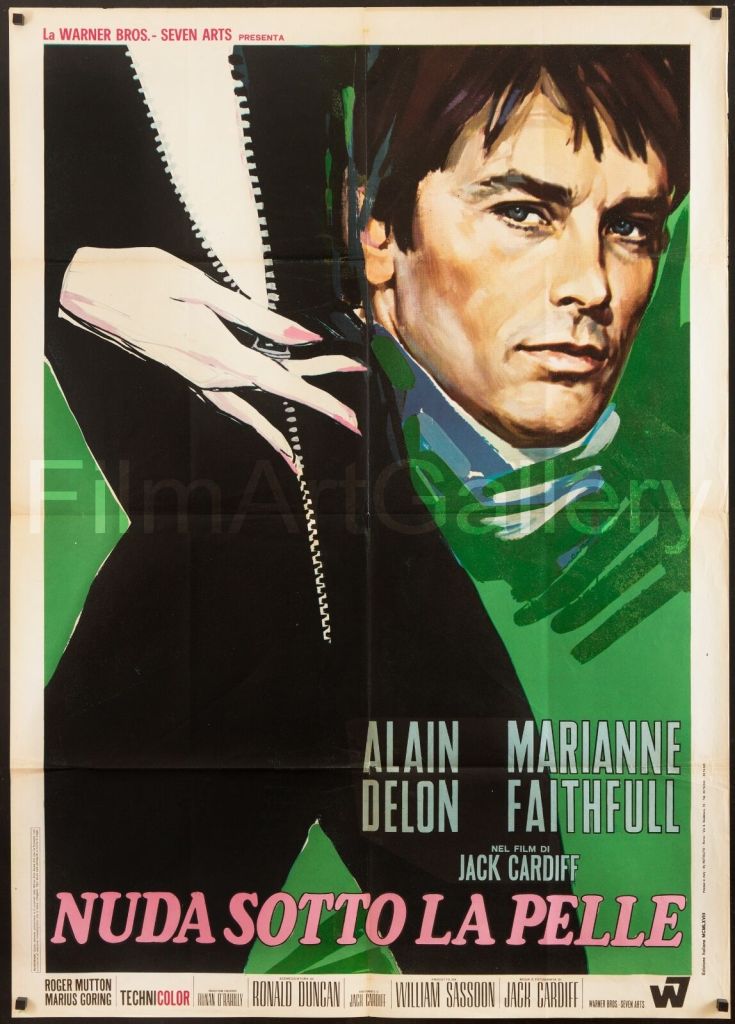
  7. Behind the Scenes of “The Girl on a Motorcycle” tracked how director Jack Cardiff beat the censor and cajoled a decent performance from Marianne Faithful even though it was yanked form U.S. release.
  8. Book into Film – “The Venetian Affair” explained how screenwriter E. Jack Neumann took the bare bones of the Helen MacInnes thriller and turned it into an excellent vehicle for Robert Vaughn trying to escape his The Man from Uncle television persona.
  9. Selling “Doctor Zhivago” (1965) examined the media campaign run by MGM for the London launch of the David Lean blockbuster.
  10. Book into Film – “A Cold Wind in August” demonstrated how screenwriter John Hayes toned down the sexy novel by Burton Wohl to escape the wrath of the censor while turning it into a touching vehicle for Lola Albright.

The Arrangement (1969) ***

It might have been better if director Elia Kazan had handed over the screenwriting chores for this adaptation of his bestseller about the midlife crisis of advertising man Eddie Anderson (Kirk Douglas). Anderson’s attempts to juggle wife Florence (Deborah Kerr) and mistress Gwen (Faye Dunaway) coupled with growing disgust at selling a new brand of cigarettes, Zephyr (“The Clean One”), in a way that pointedly avoids their cancer potential, leads to a suicide attempt.  

During convalescence he determines to quit the advertising world and go back to his first love, writing, but in fact he ends up sabotaging his career. Florence represents impossible seduction and conscience. Slinky, in dark glasses, hot-tempered rather than submissive or demure, she accuses him of self-deception in his job. The picture flits back and forth between his various choices – different job, return to wife, settle down with mistress, or what seems his ideal world, cossetted by both Gwen and Florence.

Gwen is an excellent study of the modern woman (of that fast-changing period, I hasten to add), who needs a man for sex but not necessarily love, and can use the opposite gender as ruthlessly as any man. What she actually requires in her real life is quite different to what she seeks in the fantasy love she enjoyed with Anderson, sex on the beach, the buzz of controlling a high-powered man. Florence could be seen as an old-fashioned portrait of the adoring wife except for capturing so well the bewilderment of betrayal.

Kazan conjures up some wonderful images: the tension before the suicide attempt as Anderson plays chicken between two trucks, Gwen emerging wet from the pool to eat dangling grapes or with her legs up on Anderson’s desk, Anderson’s mother lighting votive candles in her house before using the same match for her cigarette, Kerr’s futile attempts to win back her fallen husband, Anderson flying solo.

In parts well-observed and directorially savvy, quick cuts between the present and the past, however it sinks beneath its own self-indulgence. My guess is that author Kazan could not bear to kill off a single one of the characters he had created for his acclaimed novel and the upshot is a vastly over-populated picture, few of whom cast any real light on Anderson’s predicament. So we are not only introduced to mother, dying father, brother, sister-in-law and  analyst but priest and a bucket of clients and guys from the office. And there are some plot oddities – Anderson gets time off apparently to write journalistic pieces – and what is clearly intended as hard-hitting satire of the advertising world does not come off.

Dunaway (Bonnie and Clyde, 1967) is the standout as Gwen, living life according to her own rules, and with an unexpected vision of domesticity but Deborah Kerr (Prudence and the Pill, 1968) does pain like nobody else and is extremely convincing. Strangely enough, I didn’t go much for Douglas (Seven Days in May, 1964). He could have been leading a cavalry charge for all the range of emotions he exhibited. Douglas is no Montgomery Clift (Wild River, 1960), James Dean (East of Eden, 1955) or Marlon Brando (On the Waterfront, 1954) who was Kazan’s first choice. Kazan had not made a picture in six years and it had been eight years since his last hit Splendor in the Grass (1961). Not quite out-of-touch in concept and delivery, nonetheless it was shunned by the Oscar fraternity.

Readers’ Top 30

I’ve been writing this Blog now for one year, beginning July 2020, so I thought I’d take a look at which posts proved the most popular (in terms of views) with my readers. So here’s the annual top 30 films, ranked in order of views.

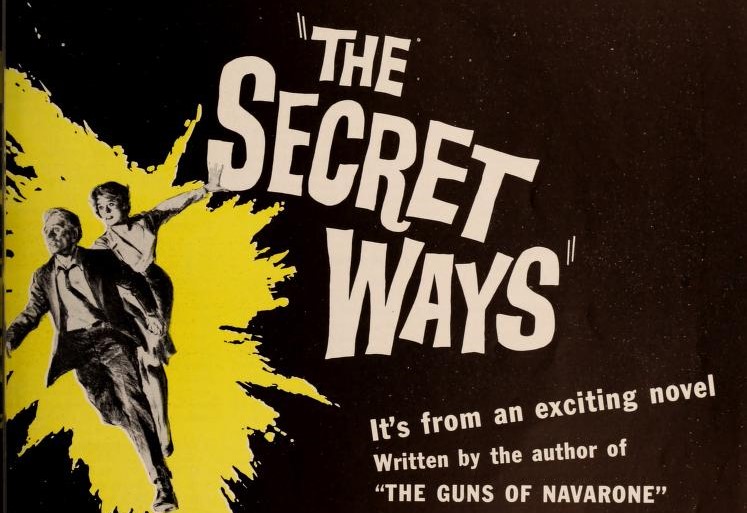
  1. The Secret Ways (1961) – Richard Widmark and Senta Berger – making her Hollywood debut – behind the Iron Curtain in gripping adaptation of the Alistair Maclean thriller.
  2. Ocean’s 11 (1960) – Frank Sinatra, Dean Martin, Sammy Davis Jr. and the Rat Pack in entertaining heist movie set in Las Vegas.
  3. It’s Not All Rock’n’Roll (2020) – remarkable documentary about the other side of the music business as ageing rocker Dave Doughman tries to keep his dreams alive.
  4. Age of Consent (1969) – British actress Helen Mirren makes her movie debut as the often naked muse for painter James Mason in touching drama directed by Michael Powell.
  5. The Venetian Affair (1966) – Robert Vaughn shakes off his The Man from Uncle persona in taut Cold War thriller also starring Elke Sommer as his traitorous wife and Boris Karloff in a rare non-horror role.
  6. The Golden Claws of the Cat Girl / La Louve Solitaire (1968) – French cult thriller starring Daniele Gaubert as sexy cat burglar forced to work for the government.
  7. Pharoah / Faron (1966) – visually stunning Polish epic about the struggle for power in ancient Egypt.
  8. The Swimmer (1968) – astonishing performance by Burt Lancaster as a man losing his grip on the American Dream.
  9. Stiletto (1969) – Mafia thriller with hitman Alex Cord and and illegal immigrant girlfriend Britt Ekland hunted by ruthless cop Patrick O’Neal.
  10. The Naked Runner (1967) – after his son is taken hostage businessman Frank Sinatra is called out of retirement to perform an assassination.
  11. Marnie (1964) – Sean Connery tries to reform compulsive thief Tippi Hedren in Alfred Hitchcock thriller.
  12. Our Man in Marrakesh / Bang! Bang! You’re Dead (1966) – Entertaining thriller sees Tony Randall and Senta Berger mixed up in United Nations plot involving the likes of Klaus Kinski and Herbert Lom.
  13. The Happening (1967) – Anthony Quinn locks horns with Faye Dunaway and a bunch of spoiled rich kids in kidnapping yarn.
  14. Dark of the Sun / The Mercenaries (1968) – Rod Taylor and Jim Brown head into the heart of darkness in war-torn Africa with a trainload of diamonds and refugees including Yvette Mimieux.
  15. The Guns of Navarone (1961) – men-on-a-mission Alistair Maclean World War Two epic with all-star cast including Gregory Peck, David Niven, Anthony Quinn, Anthony Quayle, Stanley Baker, Irene Papas, James Darren and Gia Scala.
  16. The Sicilian Clan (1969) – three generations of French tough guys – Jean Gabin, Lino Ventura and Alain Delon – clash in Mafia-led jewel heist.
  17. 4 for Texas (1963) – Frank Sinatra and Dean Martin as double-dealing businessmen in highly entertaining Robert Aldrich Rat Pack western starring Ursula Andress and Anita Ekberg.
  18. Five Golden Dragons (1967) – Innocent playboy Robert Cummings becomes enmeshed with international crime syndicate led by Christopher Lee, George Raft and Dan Duryea.
  19. Duel at Diablo (1966) – James Garner and Sidney Poitier team up to protect Bibi Andersson in Ralph Nelson western.
  20. Move Over Darling (1963) – after years marooned on a desert island Doris Day returns to find husband James Garner just married to Polly Bergen.
  21. Pressure Point (1962) – prison psychiatrist Sidney Poitier is forced to treat paranoid racist inmate Bobby Darin.
  22. Wonder Woman 84 (2020) – in one of the few films to get a cinematic screening during lockdown, Gal Gadot returns as mythical superhero to battle supervillain Kristen Wiig.
  23. Genghis Khan (1965) – Omar Sharif as the Mongol warrior who conquered most of the known world, tangling with rival Stephen Boyd and Chinese mandarin James Mason on the way.
  24. A Fever in the Blood (1961) – Warner Bros wannabes Efrem Zimbalist Jr, Angie Dickinson, Jack Kelly and veteran Don Ameche in tough political drama.
  25. The Prize (1963) – Paul Newman and Elke Sommer investigate murder in the middle of the annual Nobel Prize awards in Sweden.
  26. In Search of Gregory (1969) – wayward Julie Christie embarks on pursuit of Michael Sarrazin who may – or may not – be a figment of her imagination.
  27. Justine (1969) – Dirk Bogarde and Michael York become entangled in web woven by Anouk Aimee in corrupt pre-World War Two Middle East.
  28. The Girl on a Motorcycle (1968) – singer Marianne Faithful in a hymn to the open road and sexual freedom.
  29. Blindfold (1965) – psychiatrist Rock Hudson and dancer Claudia Cardinale in highly entertaining mystery thriller about missing scientists.
  30. Hammerhead (1968) – secret agent Vince Edwards and goofy Judy Geeson on the trail of evil mastermind Peter Vaughn.
Discover WordPress

A daily selection of the best content published on WordPress, collected for you by humans who love to read.

The Atavist Magazine

by Brian Hannan

WordPress.com News

The latest news on WordPress.com and the WordPress community.