East of Sudan (1964) ***

Remembering this picture as a summer holiday matinee of stiff-upper-lip-ness entangled in all sorts of Khartoumery, I came at this film with low expectations. Given producer Charles H. Schneer’s (First Men on the Moon, 1964) involvement, there were no Ray Harryhausen magical special effects. I was only aware of star Anthony Quayle as a bluff supporting actor in epics like Lawrence of Arabia (1962) and The Fall of the Roman Empire (1964) and Sylvia Syms as a willowy supporting actress (The World of Suzie Wong, 1960). So I was in for a pleasant surprise. Take away the back projection, stock footage and the unlikely zoo of wild animals and there is a fairly decent action film set in the Sudan on the fringes of the Mahdi uprising (that story filmed as Khartoum the following year).

Quayle is a former army sergeant awaiting court martial when he escapes from a battle near Khartoum, ends up saving governess Syms, her charge Jenny Agutter (making her debut), officer Derek Fowlds (BBC Yes, Minister) and a wounded soldier. The motley crew flees down the Nile in a boat. You know you are in for something quite different when the soldier dies and Quayle wants to toss him overboard. Overruled by prim Syms and stiff upper lip Fowlds, this good deed is rewarded by losing their beached boat while burying the dead. A picture like this only survives on twists. Burning the remainder of their boat to attract the attention of the British relief force only brings in their wake a mob of Arabs, who we are informed, in a spicy exchange, don’t know the ten commandments, especially “thou shalt not kill.”  It turns into a battle of the sexes, with Syms’ innocence and good breeding quickly eroded in the face of danger, her natural antipathy towards a scallywag like Quayle softening. Lacking due deference, said scallywag is given some choice lines which spark up proceedings. It being Africa, the animals have nothing better to do than torment them, so cue snakes, crocodiles, charging rhinos, hippos, elephants without even an entertaining monkey to lighten proceedings. Quayle sets his ruthless tendencies to one side to take a tender, paternal interest in young Agutter. Ongoing action prevents the usual male-female meet-cute African Queen-style banter and it’s all the better for it.

Capture by African tribesman takes the story on an interesting detour. Quayle, attempting to make friends, shouts out despairingly (and without irony), “Don’t any of you even speak English?” only for chieftain Johnny Sekka (The Southern Star, 1969) to stride out of the bushes with the reply, “I speak, English, Arabic and Swahili.” Quayle explains, “We come in peace.” Sekka retorts, “With gun in hand?” Game on! The plot goes offbeat when we become involved in Sekka’s life. A former slave, his village presents an unusually realistic alternative world not least for Agutter, ill by this time, saved by an African witch doctor.  There are further surprises, clever ruses to foil the enemy, revelations about Syms and a surprising but very British ending.

Quayle is convincing, reveling in the opportunity to create a fully-formed character rather than  confined to a small chunk of a picture. Syms, too, with more on offer than normal, Agutter (Walkabout, 1971) not a precocious Disney cut-out, and Fowlds revealing what did for all those years before turning up on television as puppet Basil Brush’s sidekick. As a British B-picture making do on a small budget, it overcomes this particular deficiency with some sparkling dialogue and attitudes that go against both the time in which it was set and the era in which it was made.

NOTE: Khartoum, The Southern Star, The Fall of the Roman Empire, The Southern Star and First Men in the Moon (with Harryhausen effects) have all been reviewed on this blog.     

Villa Rides (1968) ***

Best viewed as Charles Bronson’s breakout movie. Yes, he had played supporting roles in The Magnificent Seven, The Great Escape and The Dirty Dozen, but these had all been versions of the same dour, almost monosyllabic, persona. Here, though somewhat ruthless, he steals the show from the top-billed Robert Mitchum and Yul Brynner with many of the best lines and best situations with an extra slice of humor (make that first-ever slice of humor) to add to the mix. He is the most interesting of the three main characters, in part because he does not have to spout any of the “good revolution/bad revolution” dialog that falls to the other two.

Villa (Brynner) is fighting the Colorados but his superior General Huertas (Herbert Lom) is planning to overthrow President Madero (Alexander Knox). Mitchum is an aeronautical gun-runner from El Paso, initially against the revolutionaries, stranded in Mexico when his plane breaks down. He has just about time to romance a local woman Fina (Maria Grazia  Buccello) before the Colorados arrive, take over the village, start hanging the leaders and raping Fina. Villa saves them, Bronson slaughtering the Colorados with a Gatling gun on the rooftop. Faced with the one-man firing squad that is Bronson, Mitchum turns sides. His  plane comes in handy for scouting the enemy, then bombing them.

The actions sequences are terrific especially Villa’s attack on a troop train. To get Villa out of the way, Huertas puts him in the front line in a suicidal attack on a heavily-defended stronghold which turns into another brilliant set-piece with cavalry charges.  The plot is constantly interrupted by politics of one kind or another and comes to dead stop when Villa is arrested by Heurtas and Villa demands a proper trial. It’s kind of hard to take when a murdering bandit, no matter how legendary, decides that he has been hard done by in the justice department.

That aside, there are interesting attempts to build up his legend. He doesn’t want power for himself, but to give it to the people, although he has sat back and let the first village be attacked so that the people there learn to hate the Colorados enough to join the fight. There’s not really any good guys – Brynner and Bronson are stone-cold killers, Mitchum a mercenary. But Brynner does marry Fina in order to prove that a raped woman should not be treated with dishonor, though he has a tendency to marry other women as well.

Bronson’s unusual one-man firing squad involves him laying on the ground with a pistol in each hand and giving prisoners the opportunity to escape before he shoots them. After all that hard work, he bathes his hands. Then he decides he can kill three men with one bullet, lining them up exactly so he can drill them all in the heart. But he’s also the one who shoots a molester in a cantina, then delivers the classic line: “Go outside and die, where are your manners?” He is at the heart of some well-judged comedy – continually sending back his meals and trying to get out of getting into a plane with Mitchum. Without him, there would be too much justification of slaughter (Brynner) and arguments against (Mitchum). This is the first time in the kind of action role that suits him that he has an expanded characterization.

Brynner did not like Sam Peckinpah’s original script so Robert Towne (Chinatown) was brought in to present Villa in a more appealing light.  Jill Ireland (Mrs Bronson) has a small part and you can also spot Fernando Rey.  

The links below seem somewhat dodgy but you could try the Talking Pictures channel which is free.

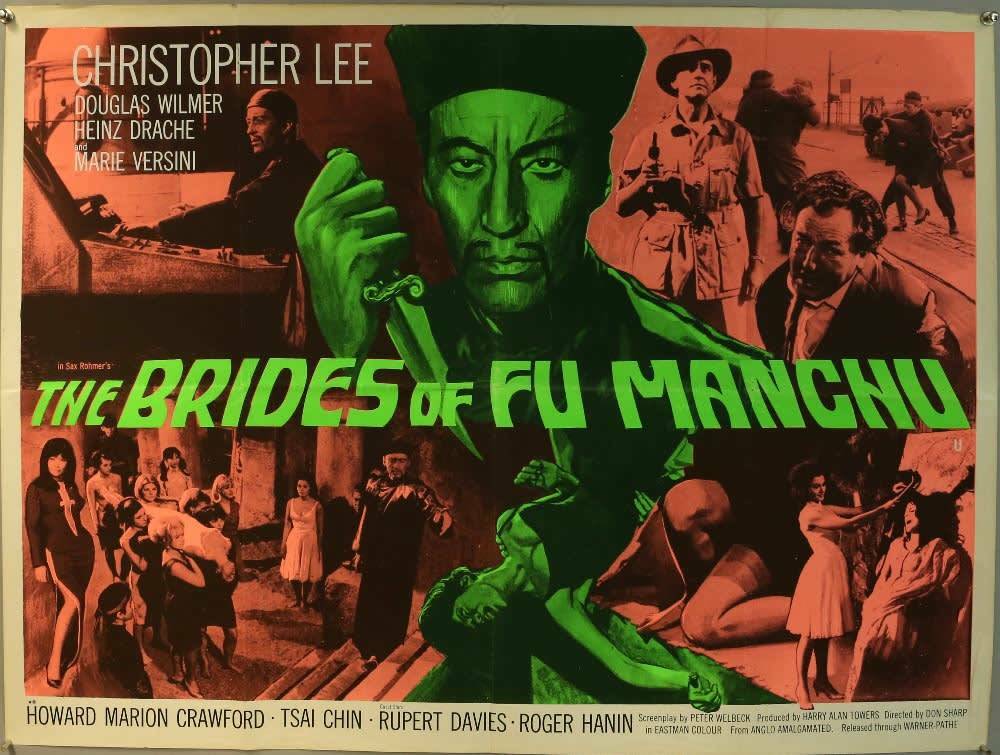
The Brides of Fu Manchu (1966) ****

The 1960s was awash with movie megalomaniacs, most courtesy of the spy vogue. You could also count on secret agents for trailing in their wake bevies of beauties. So no surprise then that criminal mastermind Fu Manchu (Christopher Lee) has his own gang, his “brides,” although they are hardly volunteers, being the kidnapped daughters of top scientists. His plan for global domination this time consists of transmitting energy as sound waves, using miniaturization, a sonic death ray, with enough power to destroy a city.

The result is good hokum, a thriller set in the 1920s with a cracking pace, plenty of action, explosions, burgeoning romance, and  plot that gets more complicated by the minute as a tribe of worthies try out to outwit the evil genius. There is a terrific lair – where the disobedient end up in a snake pit – a passable laboratory, chases, truth serums (“the dust that loosens tongues”), hypnotism, bait-and-switch tricks and decent special effects.  Three stories race along in a parallel pell-mell: Manchu needs one more kidnapping to complete his complement of daughters; the good guys headed by Fu Manchu’s old adversary Nayland Smith (Douglas Wilmer) are trying to locate the bad guy’s secret location while at the same time attempting to find out where he will strike next. 

While Fu Manchu is indestructible – supposed dead after the previous film – his henchmen (and henchwomen) are all too human. It takes three attempts to kidnap Manchu’s next victim. They are easily identifiable by their giveaway cummerbunds and bandannas and their method of assault is not kung fu but brawling so a good solid British punch of the old-school soon sorts them out. Manchu’s daughter Lin Tang (Tsai Chin) is a chip off the old block, delighted at any opportunity to torment the brides.  

The brides wear diaphanous gowns that might have been a job-lot from the set of She, but are far from compliant, even rebelling at one point, and employing vicious fight tactics. Fans of director Don Sharp will find him every bit as inventive as in The Devil-Ship Pirates and Bang, Bang, You’re Dead. It’s another Harry Alan Towers (written under his pseudonym Peter Welbeck) production so that means an international cast. Two television cops, British Rupert Davies (BBC’s Maigret) and German Heinz Drache (cop in a Francis Durbridge series), plus Francois Mitterand’s brother-in-law Roger Hanin, provide solid support. Not forgetting Burt Kwouk as a henchman. Brides of the Year include French Marie Versini (German western Winnetou, 1963) and Rhodesian Carole Gray (Curse of the Fly, 1965). The film did not prove much of a jumping-off point for other brides such as Ulla Berglin, Danielle Defrere and Anje Langstraat, for whom this debut was as far as their careers went.

Christopher Lee, despite the dodgy moustache, is resplendent, exuding evil, and with a gift for rising again (just like Dracula) as he would do for another three films in the series.

Note: The Devil-Ship Pirates and Bang, Bang, You’re Dead are reviewed on this blog.

The Movie That Never Was: The Long-Lost Screenplay of Abraham Polonsky’s “The Gladiators” *****

This is the second volume of The Gladiators vs Spartacus opus, published separately to the tome I reviewed on February 24, 2021. Reading Abraham Polonsky’s screenplay is like having a piece of history in your hands. And it is a fascinating read. Polonsky’s take on the Spartacus legend was quite different to that of Dalton Trumbo for Stanley Kubrick’s 1960 Spartacus. Based on works presenting alternative visions, Polonsky’s on the book by Arthur Koestler and Trumbo’s on the Howard Fast novel, suggested there would be differences.

The most initial significant departure is that Polonsky gives considerably less emphasis to Roman politics. It’s a classic three-act film, the first section revolt and escape, part two battle against pursuing Romans, the final segment betrayal and defeat. Rather than viewing the uprising as a glorious event, Polonsky concentrates (as does Koestler) on conflict among the escapees. Where the relationship between Kirk Douglas and Jean Simmons follows a pure Hollywood arc, the female lead here, Lydia, is a more unusual character and for most of the time Spartacus fends her off. 

Top pic: Variety, June 24, 1959, p44; above Variety, February 12, 1958, p3. Ira Wolfert was a “front” for the blacklisted Polonsky.

And the revolt kicks in right away. Within 25 minutes (allowing one minute of screen time for every screenplay page), Spartacus spares the life of rival gladiator Crixus and together with their compatriots they rise up against their oppressors and escape to Vesuvius. Immediately, the differences between Spartacus and Crixus become apparent, the former wanting to press on, while Crixus wants to stop at an inn (“half-brothel, half resting place”), eat his fill, get drunk and have sex. To Spartacus, self-indulgence risks turning the men into a drunken horde, but to others (as expressed by the poet Fulvius) “this is freedom…the first thing a man wants back is his vices.”

But unexpected freedom brings a rebellion “without leaders, without plans, without hope” and the gladiators have attracted a rag-tag of other slaves. Crixus wants to discard these camp followers, head south, steal a ship and get home. Addressing the horde, Spartacus is brutal in his assessment, “I see a host of dead men” unless they submit to his authority and “swear by the gods never to surrender.” Crixus refuses and leads his Gauls away. With the Roman legions in pursuit, and blocking the one path up the mountain, Spartacus begins to train his horde. In a brilliant scene, the slave army, “faces and bodies blackened with charcoal,” descend on vine ropes on the outside of the crater in the darkness to surprise the Roman encampment.

When Crixus returns, he sees not a rabble but a proper army, Spartacus the undisputed commander. Spartacus plans to build a Sun City in alliance with the “old Greek cities conquered by Rome.” But such coalitions require compromise, forcing Spartacus to return to the Greeks slaves who have run away to join his army. “Every road has its detours,” says Spartacus. Naturally, his decision causes dissension, especially from Crixus. In order to win, Spartacus is willing to become a tyrant. (“It’s survival. It’s a detour. It’s a way around what we can’t go through.”)

Divisions within the army lead to a showdown. Crixus and Spartacus fight, at one point Crixus sparing his opponent’s life, to repay the debt from their skirmish  in the arena, and, reprieved, Spartacus kills him. But, eventually, Rome exerts its power, the slaves are betrayed, Spartacus refusing an opportunity to save himself, and in the final battle overwhelmed by superior forces, resulting in “eight thousand slaves on eight thousand crosses, all the way from Capua to Rome.” The screenplay ends in mythical fashion (i.e. true Hollywood). Spartacus’s body cannot be found. “They say the ground opened beneath him and swallowed him up. And some say he’ll be back.”  The final scene is of Spartacus’s infant son in the desert of Qumrum “empty, formidable, immense, the barrenness everywhere and yet here the spirit and first sign of modern man.”

Polonsky’s epic (two hours forty minutes by page count) is driven by conflict, not just against the pursuing Romans, but by different attitudes within the slave army as to the best way to achieve – and enjoy – freedom. The Crixus approach would be to loot every city. Spartacus adopts a policy of the end justifying the means. These “detours” were crucial to Koestler’s assessment of the true cost of revolution (taking the Russian revolution as his starting point). This is not a story of an impotent leader, driven to destruction by more powerful forces, but one where an individual, taking up the mantle of leadership, must make cruel decisions. This is the battle commander as politician. He faces a chorus of dissent from his own chief supporters – the poet Fulvius, the priest and scribe John, and his “wife” Lydia – who challenge his rulings, each with their own idea of how the revolt should fulfill its destiny. Spartacus himself is under little illusion, resisting attempts at deification, far more realistic than your standard Hollywood revolutionary. He does not believe in the gods or destiny and, ultimately, considers the revolt has little chance of success.

Polonsky, too, ignores the rules of the Hollywood romance. There is no meet-cute, Spartacus distrusts the willful and obsessive Lydia, possessor of mysterious powers, and, unlike the Hollywood standard attraction of opposites, there is no happy reconciliation. “I would never pick a wife who wanted to rule all men, the gods, and the world,” he tells her, “I would never choose a superstitious woman like you, with a tongue like a snake.” As for many a slave, the only freedom he enjoys, beyond a brief period unshackled, is the freedom not to die in servitude. From reading the screenplay, this is very much a movie I would have liked to see take its place on the big screen as an intelligent and challenging epic.

However, the actual screenplay only forms part of this 500-page-plus volume. Dr Fiona Radford provides extensive annotations and a critical commentary to the screenplay, drawing on both historical and literary sources and on Koestler’s book and Polonsky’s own notes. The commentary is worth reading in itself. Also included are draft scenes omitted from the revised script, lengthy excerpts from Polonsky’s Journal (which touches upon the screenplay and the blacklist) plus a survey of Roman gladiators in fiction and film from 1822 (Susanna Moodie’s Spartacus: A Roman Story) to 2020 and an examination of how Polonsky’s screenplay drew upon the source material, what he left out and what he invented. Henry Macadam and Duncan Cooper contributed the background essays. The combined volumes of The Gladiators vs Spartacus come to around 1,000 pages and a thousand more informative and highly readable pages would be hard to find. Dr Radford, by the way, along with Dr Peta Greenfield, runs a fascinating podcast-driven website “The Partial Historians” focusing on ancient Rome.

Note: I have not previously awarded marks to book reviews, in part since some are mine, modesty forbids, but if I ever there was a case for a five-star review, both these volumes fall into that category.

As with volume 1, The Gladiators vs. Spartacus Vol 2 is published by Cambridge Scholars Publishing.

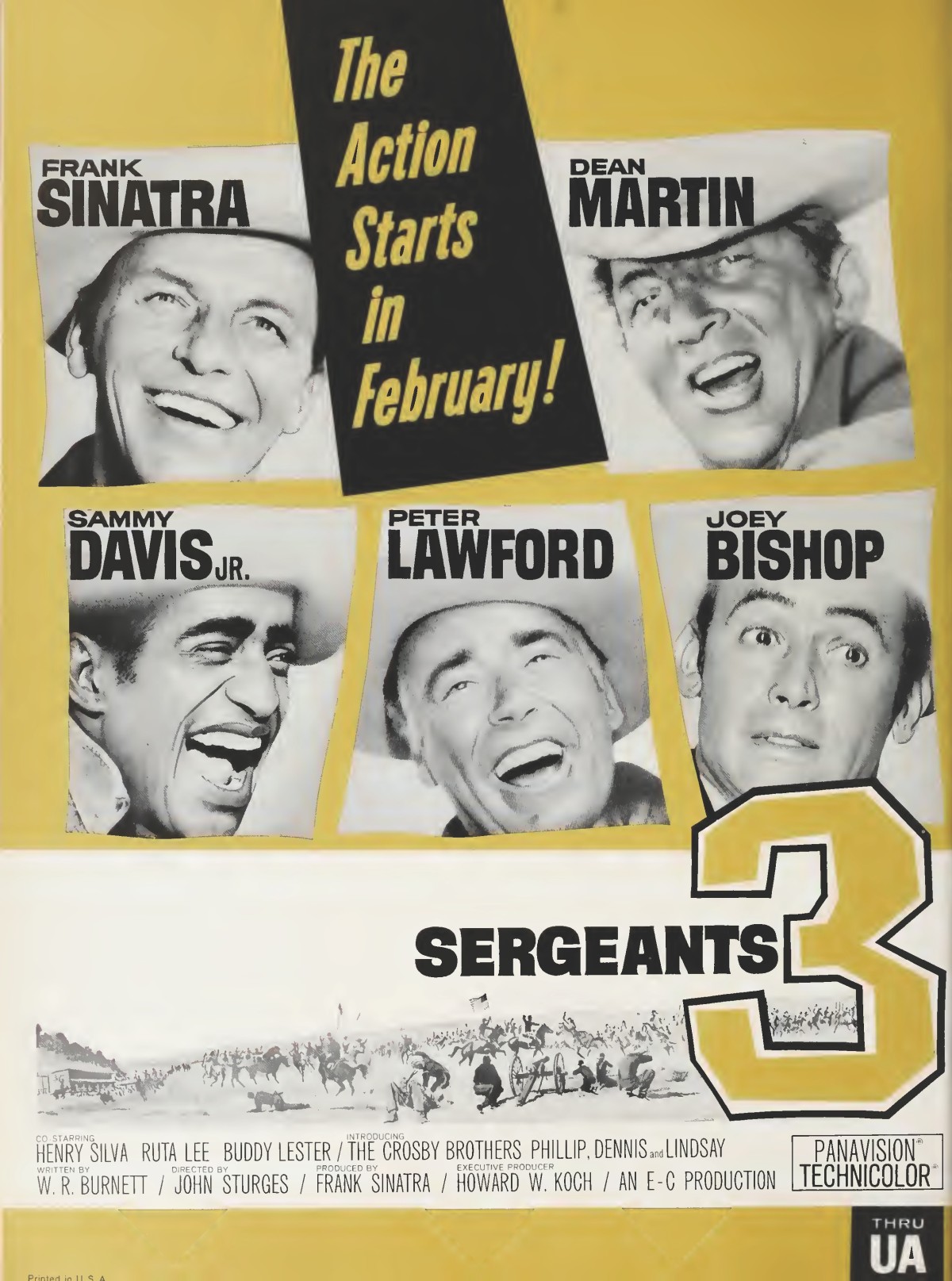
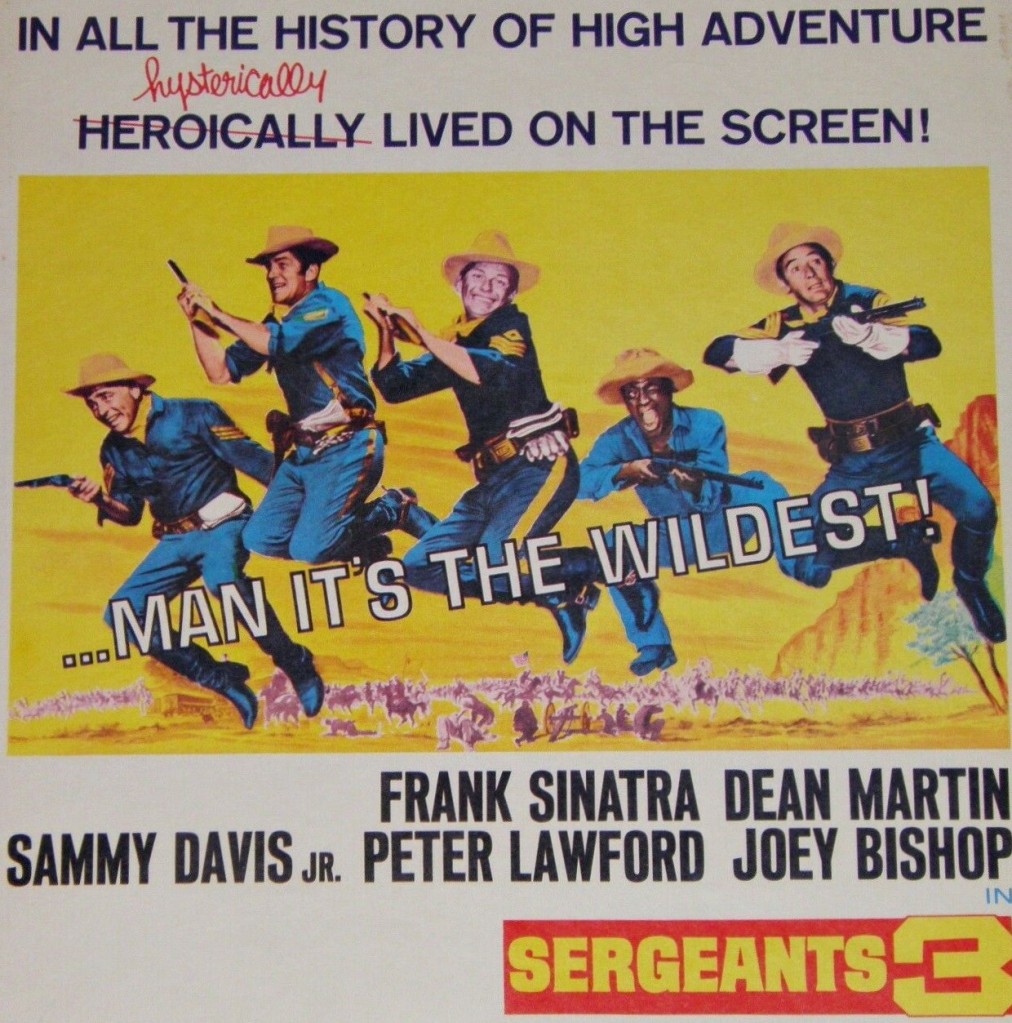
Sergeants 3 (1962)***

There’s a terrific western directed by John Sturges (The Magnificent Seven, 1960) inside this Rat Pack offering, the second of four in the series. On the plus side are plenty twists on traditional scenarios, Frank Sinatra and Dean Martin displaying a certain kind of easy screen charisma, and three exceptional and well-choreographed battle scenes. Sinatra, Martin and Peter Lawford play the eponymous sergeants, Lawford committing the cardinal sin of wanting to quit the regiment to get married, with Sammy Davis Jr. as a former slave, bugler (an important plot point) and horse-lover wanting to sign up, and Joey Bishop (television star and occasional movie actor) as their sergeant-major boss.

A fair bit of time is spent on the usual Rat Pack shenanigans, getting drunk, brawling, playing tricks on each other, and exploring odd comic notions such as playing poker with a blacksmith’s implements as chips. But when it gets down to proper western stuff, it fairly zings along, with a decent plot (a Native American uprising) and excellent action scenes. You could have had William Goldman writing the script for the number of reversals, where the picture keeps one step ahead of audience expectation. For a start, rather than flushing out outlaws from a town, the troopers have to remove Native Americans who have taken it over. Instead of the cavalry pursuing Native Americans, it is mostly the other way round. It is the soldiers rather than the Native Americans who attack a wagon. Sinatra finds himself employing a bow-and-arrow and then a tomahawk rather than being on the receiving end of such weaponry.  Instead of dynamite, the good guys make do with fireworks. Where Native Americans are usually pinned down, this time it is Sinatra’s merry band. And when it comes to resorting to serious violence, that, too is usually the remit of the Native Americans, not as here, Sinatra chucking man off a cliff.

When it sticks to action, the picture is very well done and involving. When Sinatra has to take charge instead of larking about, the movie has focus. Both Sinatra and Martin were undertaking serious roles around this time, the former in The Manchurian Candidate (1962), the latter in political drama Ada (1961) so this might have appeared welcome relief. The comedy isn’t along the laugh-out-loud lines of Support Your Local Sheriff (1969) or Blazing Saddles (1973) and when the action is so full-on you wonder why anybody thought this required comedy at all, although there is a pretty good punchline ending. Action aside, it’s almost the equivalent of easy listening. The Rat Pack was a particular 1960s institution, the members joining each other on stage in Las Vegas or featuring in television programs, but there’s no real modern correlative.

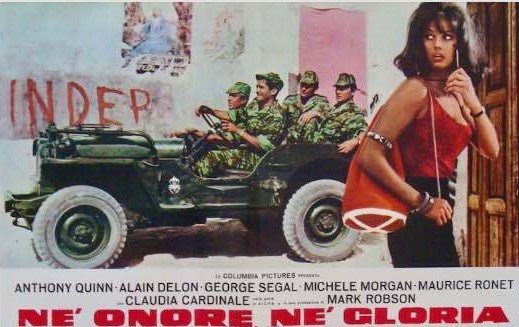
Lost Command (1966) ****

Derring-do and heroism were the 1960s war movie default with enemies clearly signposted in black-and-white. This one doesn’t fall into that category, in fact doesn’t fall into any category, being more concerned with the military and political machinations pervasive on both sides in war. Movies about revolutions generally succeed if they are filmed from the perspective of the insurrectionists. When they take the side of the oppressor, almost automatically they lose the sympathy vote, The Green Berets (1968) in this decade being a typical example, although the sheer directorial skill of Francis Coppola turned that notion on its head with Apocalypse Now (1979) when slaughter was accompanied by majesty.  In the 1950s-1960s the French had come off worse in two uprisings, Vietnam and Algiers. This movie covers the tale end of the former and the middle of the latter and it’s a curious hybrid, part Dirty Dozen, part John Wayne, part dirty tricks on either side, with a few ounces of romance thrown in.

Scene from the Italian photobusta.

Anthony Quinn, in unlikely athletic mode (that’s him leaping in the poster) is the officer of a paratroop regiment who sees out the debacle of the final battle of the French war in Vietnam, loses his commission, and then, reprieved, is posted to Algeria, where the fight for independence is in full swing, with a ragbag of rejects plus some faithful comrades from his previous command. In any spare moment, Quinn can be seen keeping fit, doing handstands, swinging his arms, puffing out his chest, and a fair bit of running, presumably to avoid the contention that he was too old for this part. Alain Delon, a bit too moralistic for the dangerous business of war, plays his sidekick. Quinn is an ideal anti-hero for a hero, an officer who ignores, challenges or just plain overrides authority, adored by his men, hated by the enemy, ruthless when it matters.

Cardinale’s seductive wiles can’t fool Quinn.

The brutal realism, which sometimes makes you quail, is nonetheless the best thing about the picture, no holds barred here when it comes to portraying the ugly side of conflict. The training in The Dirty Dozen is a doddle compared to here, soldiers who don’t move fast enough are actually shot, rather than just threatened with live ammunition, and there’s no second chance for the incompetent – at the passing out ceremony several are summarily dismissed. The only kind of Dirty Dozen-type humor is a soldier who fills his canteen with wine. Otherwise, this is a full-on war. Battles are fought guerilla style, the enemy as smart as the Vietnamese, catching out the French in ambushes, using infiltrators sympathetic to the cause and terrorism. Unlike Apocalypse Now where the infantry appeared as dumb as they come, relying on strength in numbers and superior weaponry, Lost Command at least has an officer who understands strategy and most of what ensues involves clever thinking. The battles, played out in the mountains, usually see the French having to escape tricky situations rather than blasting through the enemy like cavalry, although having sneakily pinched a mayor’s helicopter (though minus Wagnerian overtones) gives Quinn’s team the opportunity to strafe the enemy on the rare occasions when they can actually be found, their camouflage professionally done.

George Segal, unrecognizable under a slab of make-up apart from his flashing white teeth, plays the Arab rebel chief. In terms of tactics and brutality, they are evenly matched, Segal shooting one of his own men for disobeying orders. Claudia Cardinale appears briefly at the start as Segal’s sister and when she turns up halfway through giving Delon the come-on it’s a bit too obvious where this plotline is going.  With both sides determined to win at all costs, atrocities are merely viewed as collateral damage, so in that respect it’s an unflinching take on war. The picture could have done with another 15 minutes or so to allow characters to breathe and develop some of the supporting cast. The movie did well in France but sank in the States where my guess is few of the audience would even know where Algeria was. Gilles Pontecorvo’s The Battle of Algiers, out the same year, gave the revolutionaries the leading role. For the most part Quinn is in bull-in-a-china-shop form but his character is more rounded in a romantic interlude with a countess (Michele Morgan), his ability to outsmart his superior officers, his camaraderie with his own soldiers and, perhaps more surprisingly, the ongoing exercise routines which reveal, rather than a keep-fit fanatic, an ageing soldier worried about running out of steam.

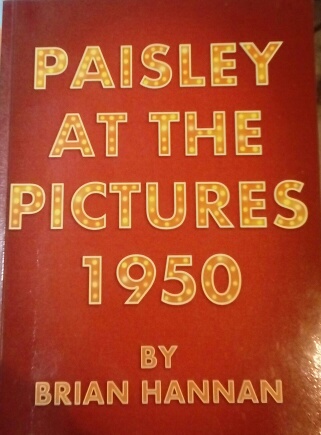
Books by Brian Hannan – “Paisley at the Pictures 1950”

Although this Blog focuses on films made in the 1960s, I have written various business histories of Hollywood as well as this book about cinemagoing in 1950 in the town where I live. Paisley, in Scotland, at that time had eight cinemas for its 93,000 inhabitants. Over 1200 movies were shown that year in the town, far more than you would see at your local picture house these days. Six of the cinemas were first-run and two were second-run. Most cinemas changed their programs mid-week, but one house, the Astoria, changed its program three times a week.

Although national statistics on the annual popularity of films and stars are readily available, what is less known is that the experiences of few cities or towns fitted in with that. Each area had its own favorite movies and stars. In Paisley, in 1950, for example, the top star was Virginia Mayo followed by Abbott & Costello and John Wayne. Less than 10 per cent of the films shown were British. And, unlike today, when movies are shown everywhere all at once, less than 10 per cent of the movies seen in Paisley in 1950 were released in 1950. So it was quite a different experience to the present era. You could still see serials as part of the program and series characters like Blondie, Charlie Chan, Hopalong Cassidy, Tarzan and Bulldog Drummond were regularly shown.

There are over 50 illustrations and the book also includes a list month-by-month cinema-by-cinema of all the films shown in Paisley that year.

Discover WordPress

A daily selection of the best content published on WordPress, collected for you by humans who love to read.

The Atavist Magazine

by Brian Hannan

WordPress.com News

The latest news on WordPress.com and the WordPress community.