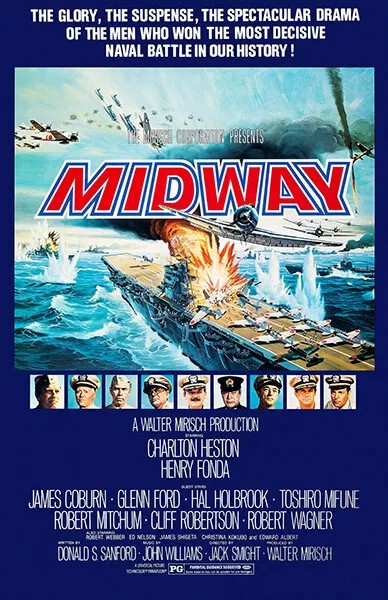
Producer Walter Mirisch could have afforded to rest on his laurels – he’d won the Oscar for In the Heat of the Night and been responsible for classics like The Magnificent Seven (1960) – and three sequels – and The Great Escape (1963). The 1970s had proved tougher, resulting initially in a string of pot boilers before hitting a home run with Mr Majestyk (1974) with Charles Bronson and knocking the ball out of the box office park with war picture Battle of Midway (1976), the former pulling in $20 million in rentals on a $2 million budget, the latter $50 million in rentals on a $7 million budget.
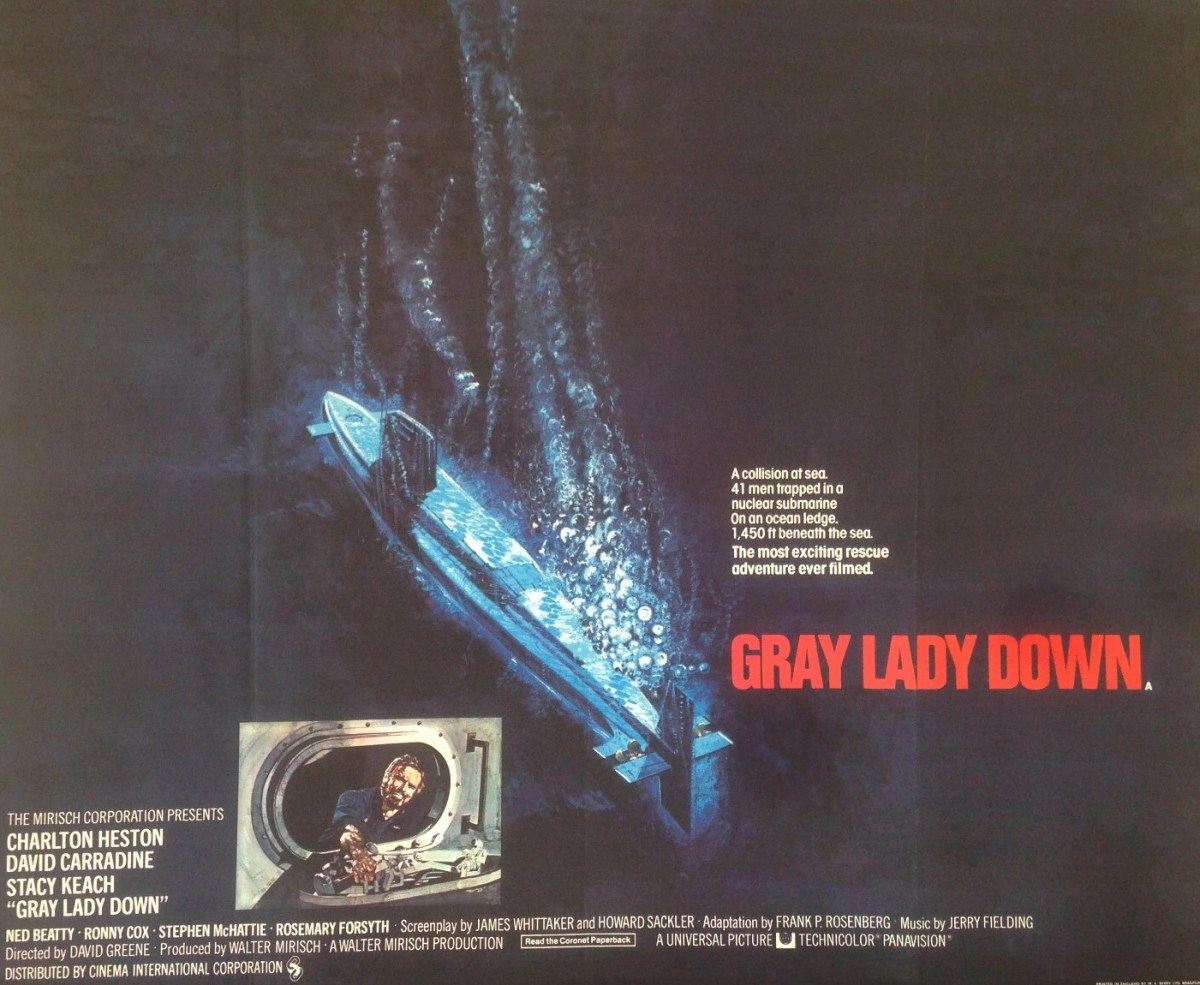
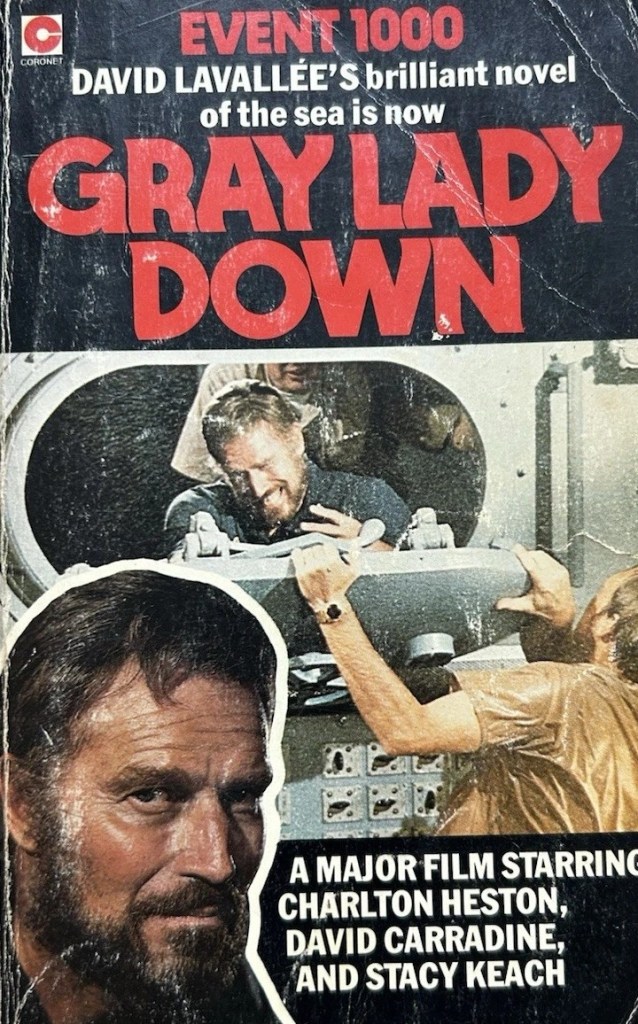
He had parted company with United Artists after nearly two decades in partnership and tied up a five-year deal with Universal. With Midway under his belt, he was the go-to producer for pictures on a naval theme. He had been sent a screenplay by James Whittaker about a submarine stranded at the bottom of the ocean. However, it turned out there was already a novel on the same subject, Event 1000 by David Lavallee, which result in various negotiations to determine the screenwriter credit, especially after playwright Howard Sackler (The Great White Hope, 1970) had completed a rewrite.
Charlton Heston, on a box office roll after Airport 1975 (1974), Earthquake (1974), Battle of Midway and Two Minute Warning (1976), was the obvious choice for the lead. But Mirisch had originally contemplated teaming Heston with Sidney Poitier (In the Heat of the Night). “He’s now backing away” from the idea, noted Heston in his diary in February 1976, “though I’m not sure why, save the cost of having us both in the film.” Heston was in strong demand, and turned down The Omen (1976) and The Pack (1977).
The film was slow coming together, “not much progress on the script…casting still slow” and there was the possibility of further delay to “mull” over the project. No director had been assigned by the end of February 1976. Following the Battle of Midway, the U.S. Navy was only too delighted to be involved. As well as following a disaster picture template, the movie was also tech heavy, featuring up-to-date ideas on rescue at sea.
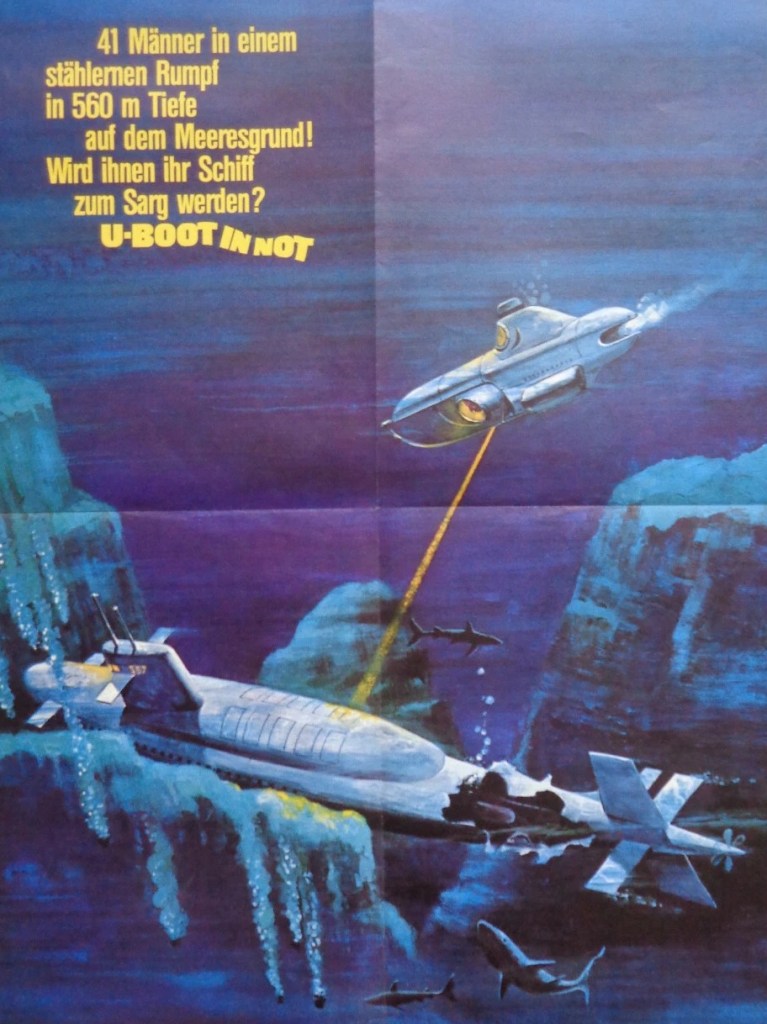
The interior of the submarine, the main set, was constructed on a gimbal so that it could be tilted to achieve the effect of the sailors being thrown about as the sub sunk to the bottom and rolled over on a deep sea trench. Howard Anderson oversaw special effects work with models in a 44ft deep water tank which was filmed at CBS. Exteriors were shot at Universal with some work aboard a Navy escort vessel. Some material was also repurposed from Ice Station Zebra (1978).
To soak up the atmosphere of a real nuclear sub, Heston spent the day on USS Gurnard under the Pacific off San Diego. “I got a lot of useful little stuff,” commented Heston, “about the look and sound of submarine officers at work…the kind of thing nobody could tell you.” The sub contained a “vast array” of disparate and complex technology. “It was a very strange feeling to spend hours charging about under the ocean running mock torpedo attacks on surface vessels.” The experience also included drills for fire and flooding.
As shooting approached, Mirisch still had not done a deal for second lead Stacy Keach (Fat City, 1972). He was, however, “anxious” to recruit Ronny Cox (Deliverance, 1972). Ned Beatty, also form that film, came on board. David Carradine (Bound for Glory, 1976) and future Superman Christopher Reeve were added. Michael O’Keefe (The Great Santini, 1979) also made his movie debut.
Filming began on September 11, 1976. “I had very little to do,” noted Heston, “which was just as well, breaking in on a new film.” He played his only scene with Keach, “the tag of the picture and a key scene.” British director David Greene (Sebastian, 1968) was applauded for being as meticulous as William Wyler. More importantly, “he gives the actors a great deal and I find myself stimulated by almost all the suggestions he makes,” commented Heston. At one point, Greene decided to reshoot a major scene, bringing back offstage actors Heston thought he could do without. On the minus side, “he runs a rather loose ship.” Of his own contribution, the actor said, “I became preoccupied with giving an efficient performance rather than a creative one. The pressures I feel to be a consummate professional make me focus on getting it right.”
Filmed on a budget of just $5.25 million, it proved a huge hit, pulling in $19 million in rentals.
SOURCES: Walter Mirisch, I Thought We Were Making Movies, Not History (University of Wisconsin Press, 2008) p339-341; Charlton Heston, The Actor’s Life (Penguin, 1980) pp464-481.
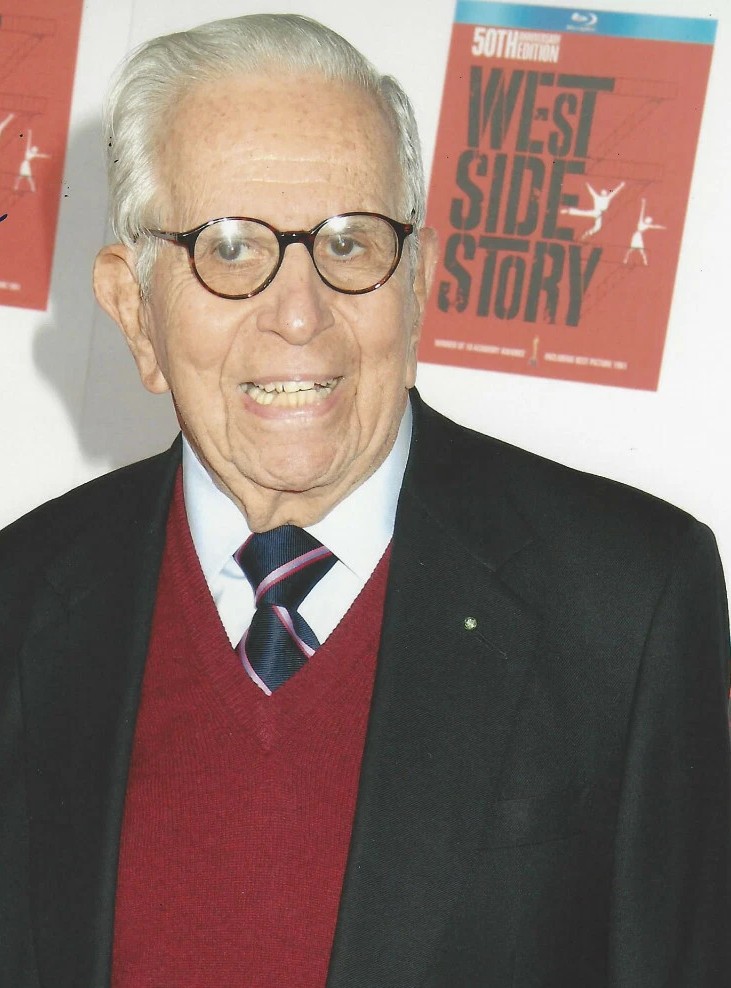
You don’t just waltz into Hollywood and start churning out classics like Some Like it Hot (1959), The Magnificent Seven (1960), West Side Story (1961) and The Great Escape (1963). Usually, there’s a long apprenticeship, especially for a producer. Walter Mirisch spent nearly a decade at the B-picture coalface. And before that a year as a gofer, working his way up in the business, but on one of the smallest rungs of all, at Monogram.
Born in 1921, the of a Polish immigrant tailor specializing in custom-made garments, one of whose customers was George Skouras, owner of a cinema chain, Walter, not surprisingly in the Hollywood Golden Age, started out an even lower rung, as an usher in the State Theater in Jersey City, owned by Skouras, an hour’s commute from his home in the Bronx, earning 25 cents an hour. He was quickly promoted to ticket checker.
His older brother Harold was a film booker, receiving an education in negotiation, and then as a cinema manager in Milwaukee flexed his entrepreneurial muscles by starting a concession company. After the family moved to Milwaukee, Walter attended the University of Wisconsin and then Harvard Business School. Physically unfit for active duty during the war, he worked for Lockheed in Los Angeles on its aircraft program in an administrative capacity.
While Harold was a highflyer at RKO, acting as chief buyer and then managing its cinema chain, Walter entered at a lower level in 1946 as a general assistant to Steve Broidy, boss of Monogram, maker of B-pictures of the series variety – Charlie Chan, The Bowery Boys, Joe Palooka, shot within eight days and at budgets under $100,000.
After badgering Broidy for a bigger opportunity, he was granted permission to hunt for a property he could produce. For $500 he found a Ring Lardner short story about a boxer, but Broidy felt the main character was unsympathetic. Stanley Kramer did not and snapped it up to make Champion (1949).
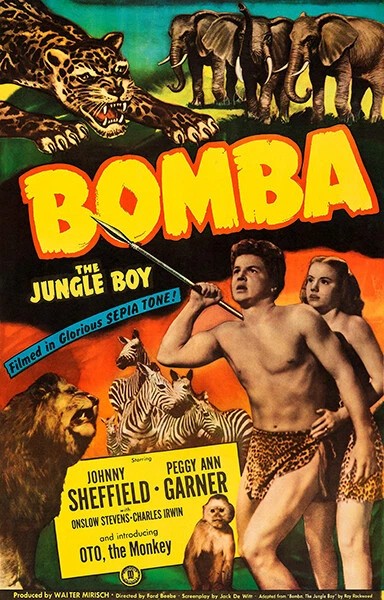
Walter’s first ventures were in film noir. Fall Guy (1947), based on a story by Cornell Woolrich, made for $83,000, broke even. I Wouldn’t Be In Your Shoes (1948) followed, from a Woolrich novel but there was a drawback to being a producer. He was taken off the payroll and his $2,500 producer’s fee didn’t compensate for the loss of a $75 weekly salary. The answer was to invent his own series, ripping off the Tarzan pictures for Bomba the Jungle Boy (1949), starring Johnny Sheffield who had played Tarzan’s son and utilizing stock footage from Africa Speaks. Apart from his fee, Walter had a 50 per cent profit share.
For six years, these appeared at the rate of two a year, earning Walter a minimum of $5,000 and he soon branched out into other genres, sci fi like Flight to Mars (1951) and westerns such as Cavalry Scout (1951) and Fort Osage (1951), both starring B-movie stalwart Rod Cameron.
Monogram had decided to move upmarket with the introduction in 1951 of Allied Artists, its sales division run by Walter’s brother Harold, with Walter acting as an executive producer and other brother Marvin as treasurer, turning out solid B-picture-plus hits like Riot in Cell Block 11 (1954).
When the threat from television hit the B-picture market Allied went properly upscale, investing in William Wyler western Friendly Persuasion (1956) and Billy Wilder’s Love in the Afternoon (1957), both starring Gary Cooper. Their failure at the box office sent Monogram back to basics.
But the Mirisches wanted more of the big time. The three brothers turned to United Artists and negotiated a deal for that studio to finance four pictures a year, cover the brothers’ overhead and salaries and throw in a profit share. The Mirisch Company was born and their creative credit within the industry was so high – and the deals they offered, it has to be said, so advantageous to their creative partners – that soon they were scooping up big names like Wilder (he made his next eight pictures for Mirisch), William Wyler, Gary Cooper, Tony Curtis, Doris Day, Audrey Hepburn and Lana Turner. One of the first pictures announced was a remake of King Kong (1933). Wilder planned My Sister and I with Hepburn. John Sturges was attached to 633 Squadron. Doris Day would star in Roar Like A Dove and there were two-picture deals with Alan Ladd and Audie Murphy.
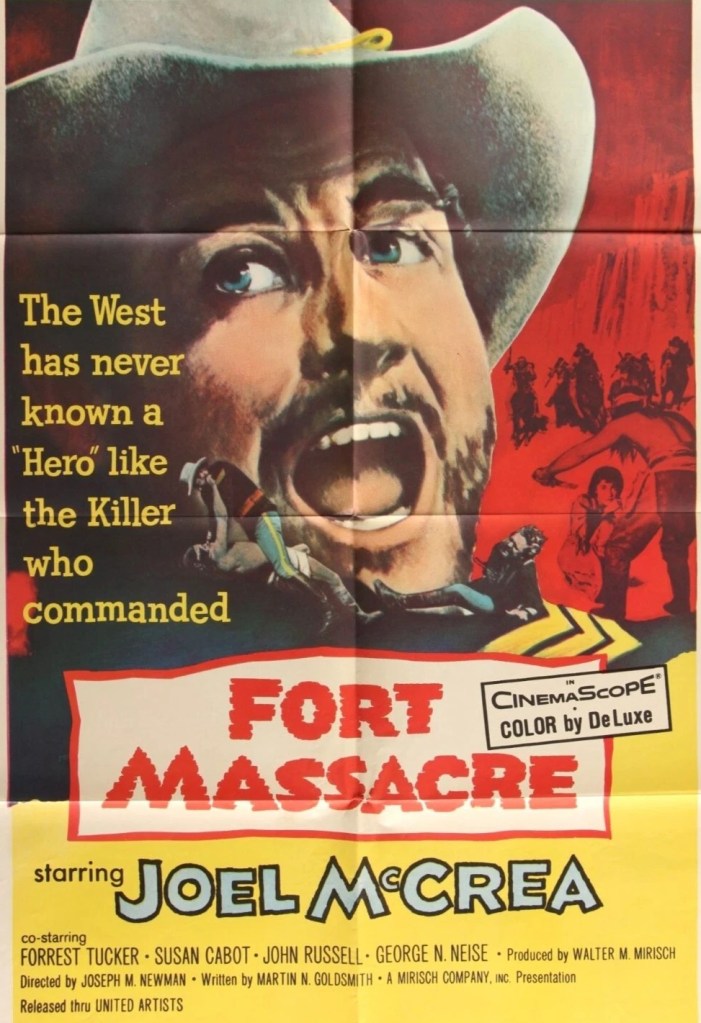
Their first two efforts didn’t break the budget bank, Fort Massacre (1958) starring Joel McCrea, and Man of the West (1958) headlined by Cooper, but neither were they hits. Hoping to provide ongoing financial sustenance, Walter turned to television, turning Wichita (1955) into the series Wichita Town (1959), and further television contributions were mooted for UA Playhouse but that and Peter Loves Mary and The Iron Horseman failed.
Movies proved a better bet and Walter struck gold with the third picture in the Mirisch-UA deal, Some Like it Hot (1959), costing $2.5 million, an enormous financial and critical success and tied down a triumvirate of top talent in John Wayne, William Holden and John Ford for western The Horse Soldiers (1959), the actors pulling down $750,000 apiece.
Such salaries sent the nascent company on a collision course with traditional Hollywood. The majors “screamed” that independents were overpaying the talent, hefty profit shares accompanying the salaries.
On top of that in 1959 in the space of two weeks Mirisch spent a record $600,000 pre-publication on James Michener blockbuster Hawaii and tied up a deal to film Broadway hit West Side Story. Within two years of setting up, Walter Mirisch announced a $34.5 million production slate, earning the company the tag of “mini-major,” as part of a shift in attitude to a “go for broke” policy. By the start of the new decade it was by far the biggest independent the industry had ever seen, handling $50 million worth of product, including The Magnificent Seven and The Apartment (1960). Average budgets had risen from $1.5 million to $3.5 million.
To outsiders, assuming the Mirisch venture was Walter’s first, it might look as if Walter had knocked the ball out of the park in a very short space of time, but, in reality, by the time he produced Some Like it Hot, he had been responsible for thirty-three pictures. Not bad for a “beginner.”
Explained Walter Mirisch, “Producing films is a chancy business. To produce a really fine film requires the confluence of a large number of elements, all combined in the exactly correct proportions. It’s very difficult and that’s why it happens so infrequently. It takes great attention to detail, the right instincts, the right combinations of talents and the heavens deciding to smile down on the enterprise. Timing is often critical.”
What would have happened to Allied Artists, for example, had Wilder made Some Like it Hot there instead of Love in the Afternoon?
Added Walter, “Where is the country’s or the world’s interest at that time? What is the audience looking for? Asking them won’t help because they themselves will tell you they don’t know what they’re looking for. They don’t know what it is until they’ve seen it. All the elements must come together at exactly the right time. So to say one embarks with great certainty on such an endeavor is an exaggeration.”
After 33 films Mirisch hit a home run with Some Like It Hot and continued to do so throughout the 1960s chalking up further critical and commercials hits like The Pink Panther (1964), In the Heat of the Night (1967) and The Thomas Crown Affair (1968) and vacuuming up a stack of Oscars.
SOURCES: Walter Mirisch, I Thought We Were Making Movies, NotHistory (University of Wisconsin, 2008); “Mirisch Freres Features Outlet Via United Artists,” Variety, August 7, 1957, p16; “3 Mirisch Bros Set Up Indie Co for 12 UA Films,” Variety, September 11, 1957, p7; “RKO vs Mirisch Kong,” Variety, September 11, 1957, p7; Advertisement, “United Artists Welcomes The Mirisch Company,” Variety, November, 13, 1957, p13; “Brynner, Mirisch Pledge UA TV Tie,” Variety, January 1, 1958, p23; “Mirisch Freres 6 By Year-End,” Variety, March 19, 1958, p3; “Majors Originated Outrageous Wages,” Variety, December 10, 1958, p4; “UA-Mirisch’s $600,000 For Michener’s Hawaii,” Variety, August 26, 1959, p5; “Mirisch West Side Story,” Variety, September 2, 1959, p4; “Mirisch Takes on ‘Major’ Mantle With 2-Yr $34,500,000 Production Slate,” Variety, October 21, 1959, 21; “Mirisch Sets $50,000,000 14-Pic Slate; Biggest for Single Indie,” Variety, August 17, 1960, p7.
Mirisch could easily lay claim to be the top independent production outfit of the 1960s generating hits like The Magnificent Seven (1960), West Side Story (1961), The Great Escape (1963), The Pink Panther (1964) and its sequel A Shot in the Dark (1964), The Russians Are Coming, Russians Are Coming (1966), In the Heat of the Night (1967) and The Thomas Crown Affair (1968) plus a shelf load of Oscars and Oscar nominations. But dependence on a partnership with Billy Wilder in the 1970s and a more lackluster performance at the box office – with the noted exception of Fiddler on the Roof (1971) – spelled the end of its 17-year relationship with United Artists, which was reeling from financial losses and under new management.
The company found a new partner in Universal which had a series of deals with other major producers like Alfred Hitchcock, Zanuck and Brown (Jaws, 1975) and George Seaton (Airport, 1970). Mirisch was not in any financial trouble, having severed ties with UA after Mr Majestyk (1974), a major success abroad, and recovered its development costs for Wheels, based on the Arthur Hailey novel but the script rejected by UA, from Universal which turned it into a mini-series.
The Universal deal was initially not as good as that enjoyed at UA. Universal charged a twenty-five per cent overhead whereas UA had charged nothing and Universal was now doing direct deals with directors rather than relying on the likes of Mirisch to tie up the talent.
Many years before, Mirisch had commissioned a script on the Battle of Midway from Donald S. Sanford who specialized in war pictures but of the distinctly low-budget variety – Submarine X-1 (1968), The Thousand Plane Raid (1969) and Mosquito Squadron (1969), none of which had enjoyed any success.
Though all of the Mirisch war pictures had concentrated on Europe, Walter Mirisch, generally the creative driving force for the production company, in his previous incarnation with Allied Artists had some experience of the Pacific War, having produced Flat Top / Eagles of the Fleet (1952), set around an aircraft carrier during the Battle of Leyte Gulf, and was an avid reader of books about the Second World War.
John Ford and Louis de Rochmont had made documentaries about the Pacific naval battles. UA rejected the script twice, a shrewd move in the end because Tora! Tora! Tora! (1970) lost a packet for Twentieth Century Fox. The Sanford screenplay had initially taken more of a documentary approach but after gaining the interest of Charlton Heston, who had starred in Mirisch’s The Hawaiians (1970), the script was tweaked.
Programming a war picture was a risk for the studio. There hadn’t been a big-budget war picture in five years. And while Patton (1970) and Kelly’s Heroes (1970) ended up on the right sight of the ledger book, Tora!, Tora! Tora! and Too Late the Hero (1970) were stiffs.
Mirisch signed a two-picture deal with Universal, for Midway and Wild Card with a screenplay by Elmore Leonard (Mr Majestyk). Mirisch proposed to reduce costs by using footage from naval archives, converting the original 16mm film to 35mm. The producer also took footage from Japanese film Storm over the Pacific / I Bombed Pearl Harbor (1960) – the rights cost him $96,000. Footage of the Pearl Harbor attack in Tora! Tora! Tora! doubled for shots of the attack on Midway Island. A clip of the Dolittle raid on Tokyo from Thirty Secondsover Tokyo (1944) was used in the credit sequence after “subjecting it to a sepia bath.”
After the success of Earthquake (1975), Heston was back in the top ranks of box office stars and his involvement guaranteed the green light. The U.S. Navy offered its support, not surprising since Midway was considered its greatest success.
John Guillermin (The Towering Inferno, 1974) was hired to direct and Stirling Silliphant (In the Heat of the Night) signed up for a screenplay rewrite. Mirisch had determined to employ the all-star-cast device that had been an essential ingredient of many of the 1960s roadshow pictures, kicking off with Henry Fonda (The Boston Strangler, 1968), by now pretty much a spent force at the box office – he hadn’t made a picture in three years – but still a well-known name.
The amount of work involved for the other stars was minimal – mostly just one day – and, astutely, Mirisch called on stars who had worked for him in the past and who, like James Coburn (The Great Escape), Cliff Robertson (633 Squadron, 1964) and Christopher George (The Thousand Plane Raid) owed him something in terms of a career leg-up. Others included Robert Mitchum (The Sundowners, 1960), Robert Wagner (The Biggest Bundle of Them All, 1968) and Tom Selleck in an early role. Mitchum was the first of these stars to sign up, in March 1975, six weeks before the scheduled start date of April 27, followed two days later by Coburn.
Toshiro Mifune (Red Sun, 1971) headed up the Japanese cast and proved so meticulous in his preparations that he had his uniform made by Japanese tailors. The white gloves he wore had a finger shortened on the left hand because his character Admiral Yamamoto was missing a pinky. However, despite coaching in English by actress Miko Taka (Walk, Don’t Run, 1966), his dialog was revoiced by Paul Frees.
Guillermin demanded a bigger budget to accommodate more airplanes and equipment and a longer shooting period. Two months before filming was due to start, Mirisch put his foot down and told the director he couldn’t accommodate his requests as Universal had only provided funding on the basis of Mirisch’s original idea. Guillermin walked. As far as the public was concerned, the parting of the ways was due to a “conflict of schedules.” Jack Smight, who had directed Airport ’75 (1974), a box office success and also starring Heston, was his replacement.
The Navy lent aircraft carrier U.S.S. Lexington – the last remaining World War Two carrier – while it was at sea training pilots as long as the shoot didn’t interfere with those exercises. A limited number of World War Two vintage planes – in great condition having been cared for by their owners – were permitted on board. The Navy charged the crew for accommodation – Mirisch was housed in Admiral Strean’s quarters – and meals. “We had a detailed contract with the Navy,” recalled Mirisch, “in which we agreed to stay out of their way when asked.”
On board, the crew filmed scenes, some silent and others with dialog, and “made plates for rearview projection and aerial shots of our vintage planes so positioned that we could print them into flights of six or nine.” Charlton Heston, Glenn Ford (Rage, 1966) and Hal Holbrook (The Group, 1966) were aboard and the shoot went well. A scene involving Henry Fonda was shot at Pensacola. The Florida coast stood in for the Pacific. Additional exteriors were filmed in Los Angeles at Long Beach and Point Dune with interiors at Universal.
The construction of the interiors for the Japanese aircraft carriers was so authentic Mirisch was later asked to reassemble the set for the Smithsonian Institute for a presentation there. The interpolation of the old footage was crucial and it was planned in advance where such shots would appear. The old footage was precut and scenes were shot with actors with “scene missing” in those sequences into which the old footage could be dropped. Other devices were used to ensure the background in the old footage was more lively.
The final element was in cinematic presentation. Sensurround, a precursor of Imax, had been introduced with great success by Universal to Earthquake and this added greater realism to the battle scenes. While limited to those theaters which had installed the expensive equipment, and although the roadshow was long gone, it created an “event” aspect to those viewing it in that system. In his autobiography Mirisch suggested the addition of Sensurround was last minute and sparked by the success of Earthquake. But, in fact, Universal had announced a year in advance of opening that Battle of Midway would utilize Sensurround.
Some cinema owners were outraged at the stock footage, whose proposed inclusion had been kept from them when they went into the blind-bidding process at the start of the year. Mirisch countered that there was no alternative. “A great many aircraft,” he argued, “used in the battle no longer exist.” Universal’s terms were stiff – a minimum nine-week run starting at a 70/30 split for the first three weeks in the studio’s favor, a $75,000 advance guarantee from cinemas and 5% of the gross for use of Sensurround.
With the budget kept as low as a reported $4 million it was a massive hit, picking up $20.3 million in rentals (what the studio retains of the box office gross) – sixth in the annual box office league beaten only by Oscar-winner One Flew over the Cuckoo’s Nest, All the President’s Men with Robert Redford and Dustin Hoffman, demonic The Omen, Walter Matthau baseball comedy The Bad News Bears and Mel Brooks’ Silent Movie and just ahead of such offerings as Sidney Lumet’s Dog Day Afternoon with Al Pacino, and comedy Murder by Death but nearly doubling the take of the more critically-acclaimed Taxi Driver, Clint Eastwood western The Outlaw Josey Wales and thriller Marathon Man also starring Hoffman. The final domestic figure amounted to $21.8 million.
Foreign figures were astonishing, especially in Japan, where its gross exceeded $4 million. The benefits of the promotional tour undertaken by Heston in the Far East were soon obvious – in Manila it beat both Jaws and Earthquake. In the annual box office league there and Hong Kong, it ranked third. In Italy it proved a “big surprise”, coming in fourth behind King Kong, Taxi Driver and a local offering.
While a successful movie could expect to benefit from television viewings – this was before the video revolution – the movie had an unusual afterlife. NBC, which had bought the rights, wanted the film to be longer, so it could be shown over two nights, thus increasing advertising and setting it up as a more prestigious event. Largely by adding plotlines to the Heston character, the running time increased by nearly an hour, which proved a bonus for the future home screening revolution.
“Of all the films that I have made,” noted Mirisch, “it produced the greatest amount of profit.”
SOURCES: Walter Mirisch, I Thought We Were Making Movies Not History (University of Wisconsin Press, 2008) pp324-339; “Readying Midway,” Variety, February 5, 1975, p6; “Universal in New Shake,” Variety, July 23, 1975, p3; “Admiral Mitchum,” Variety, March 12, 1975, p18; ”Jap Feature Footage Inserted into Midway,” Variety, June 6, 1976, p7; “Midway Big in Manila,” Variety, August 11, 1976, p24; “Big Rental Films of 1976,” Variety, January 5, 1977, p14; “Jaws Led Bangkok,” Variety, February 9, 1977, p39; “International,” Variety, June 29, 1977, p35.
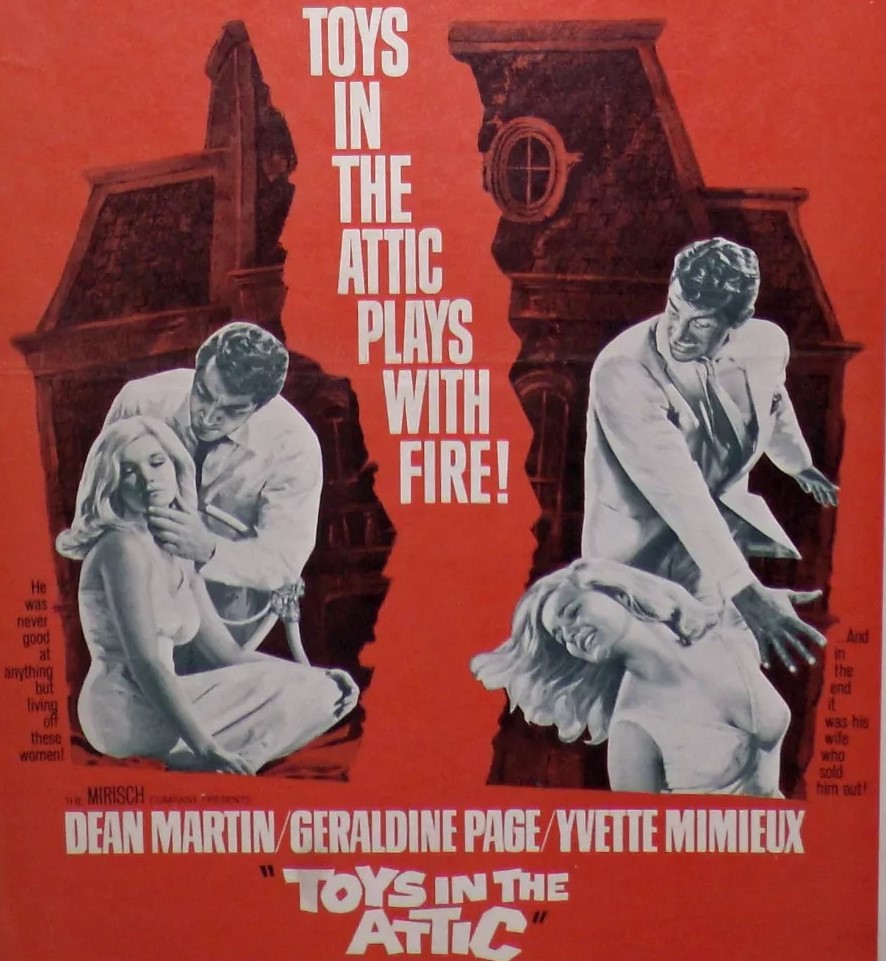
Producer Harold Mirisch purchased the rights to the 1960 Broadway hit play by Lilliam Hellman as a way of hooking William Wyler. He had originally signed up the director in the mid-1950s when his Paramount contract came to an end. This was before the Mirisch Brothers was an independent production entity and later responsible for films like The Apartment (1960), The Magnificent Seven (1960), West Side Story (1961) and The Great Escape (1963). At that point Mirisch worked for Allied, the upmarket offshoot of B-picture outfit Monogram. Allied backed Wyler’s Oscar-nominated western Friendly Persuasion (1956).
In 1960 Wyler was the most celebrated Hollywood director of the era, not just with three Oscars and ten nominations, but riding as high as anyone ever had after the monumental critical and commercial success of Ben-Hur (1959). He had his pick of the projects and had shown “great eagerness” to do Toys in the Attic. He was friends with the playwright Lillian Hellman and had filmed These Three (1936) from her stage play The Children’s Hour and The Little Foxes (1941) from her original screenplay.
But Wyler decided instead to opt for a remake of The Children’s Hour (1961), assuming that changes in public perceptions would permit him to bring to the fore the lesbian elements kept hidden in his previous adaptation, but, critically, it was a Mirisch production.
In his absence, the Mirisch Bros decided to stick with Toys in the Attic, possibly to bolster their attempt to be seen as a purveyor of serious pictures and hence a contender for Oscars, which would solidify their reputation, as would soon be the case. After consultations with distribution and funding partner, United Artists, “it was decided that…since we had considerable investment in (Toys in the Attic)… we should try and put together a film,” explained Walter Mirisch.
Next in line for directorial consideration was Richard Brooks who had acquired a reputation for adapting literary properties after The Brothers Karamazov (1958), Cat on a Hot Tin Roof (1958) and Elmer Gantry (1960). Initially, Brooks “had been so insistent and enthusiastic” about becoming involved. However, he, too, rejected the opportunity. He, too, after Oscar and commercial success, was riding high. “It was not because he did not wish to work with the Mirisches because he would be delighted to make a picture for them…but he felt it would be wrong for his career to do a film so similar in mood and background as the one he was working on, Sweet Bird of Youth (1962).”
In fact, it was probably more to do with his financial demands. He wanted $400,000 a picture, which was extremely high at the time, plus “a drawing account of $2,000 a week” (i.e. payment in advance of an actual production). While Cat on a Hot Tin Roof and Elmer Gantry had been box office hits, they were nothing like Ben-Hur. And Brooks already had other pictures in mind. He had purchased a book called Goodbye My Son – never filmed – and was already revving up for Lord Jim (1965) funded by Columbia.
Walter Mirisch eventually settled on television director George Roy Hill (Thoroughly Modern Millie, 1967). This would have been his debut except preparations for the movie dragged on and in between Hill helmed Period of Adjustment (1962), an adaptation of another play, this time by Tennessee Williams. He would later direct Hawaii (1966) for Mirisch.
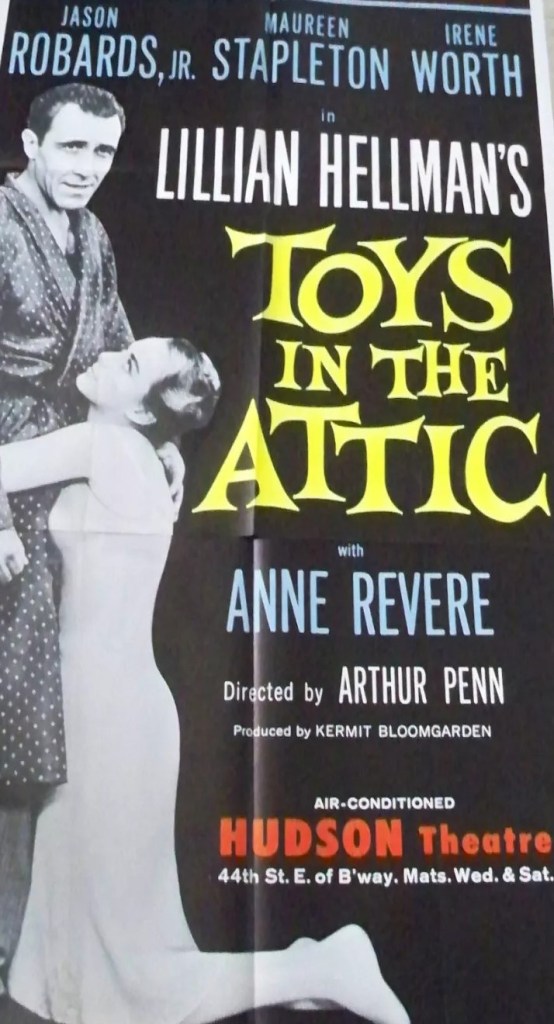
The play had been a significant hit, running for just over a year on Broadway at the Hudson Theater, and making $129,000 profit on a $125,000 investment, though it incurred a loss of $48,000 on a subsequent tour. Hellman did pretty well out of it too. She received ten per cent of the gross and twenty per cent of the profit – a total of around $36,000 – exceptionally good going for a playwright, especially when other monies would be forthcoming from movie rights and foreign and amateur runs. Director Arthur Penn’s share of gross and profit came to over $10,000 in addition to a $5,000 fee.
Turning a play or musical into a movie came with one inbuilt problem. It was inevitably subject to delay. No movie could go into production until the play had exhausted its theatrical (as in stage-play) possibilities. In this case, that meant 58 weeks in the original run and then another 20 weeks once it hit the road. Any contract with a significant movie player would have to include the possibility that in the meantime star or director would have lined up other projects while awaiting the green light on this one, and that in itself could cause further hold-ups.
Hill was in greater demand than Mirisch anticipated, juggling four separate projects – Period of Adjustment, The Rise and Fall of the Third Reich for MGM (never made), and the $2.5 million A Bullet for Charlemagne starring Sidney Poitier (not made) as well as Toys in the Attic.
Jason Robards, star of the play, was the obvious contender for the movie role. But he lacked box office cachet, so he was bypassed in favor of Dean Martin, “an attractive motion-picture figure.” However, in the time it took the movie version of the play to reach the public, Robards was potentially a screen star. He had bought himself out his stage contract after 37 weeks – paying $3,950 for the privilege – having been offered second billing on By Love Possessed (1961) opposite Lana Turner, and in Twentieth Century Fox’s ambitious mounting of Tender Is the Night (1962) opposite Jennifer Jones. While Robards would never become as big a star as Dean Martin, he was the superior actor, later adding two Oscars and one nomination to his name.
In addition to being much better known to cinema audiences than Robards, “we felt he (Martin) would bring humor to it” – Martin having originally made a splash as part of the Martin-Lewis comedy team of the 1950s – “as well as an audience that might expand the normal constituency of that type of film.” Trade magazine Box Office agreed with the decision, viewing Martin as a “good choice for the haunted show-off.”
The play’s other stars – Oscar nominee (and later winner) Maureen Stapleton (The Fugitive Kind, 1960) – and Irene Worth (Seven Seas to Calais, 1962) – were ignored in favor of Geraldine Page, who incidentally scored an Oscar nomination in Summer and Smoke, and Wendy Hiller (Sons and Lovers, 1960), who already had an Oscar. Shooting began on September 16, 1962. Hill tried to “inject more suspense, more action, more melodrama into the movie version,” without cheapening the material. He was convinced the hiring of Martin was inspired, and would prove a personal turning point, as he gives “the best dramatic job of his career.”
Titles didn’t matter so much on Broadway, plays sold on the name of the writer or the star. Mirisch feared Toys in the Attic would either mean nothing to a general audience ignorant of the picture’s origins or be considered so obscure as to serve to confuse them. So, they planned to rename it Fever Street or “some sensational substitute.” Hill was furious, pointing out the “violence of his feelings” to this title. He complained that “others will assume that it is an exploitation title…a cheap gimmick to get people into the theater (cinema) … automatically puts the picture in a low budget quickie picture category that might be appropriate for 42nd St all-night houses or a second feature at Loews 86 St.”
Hill felt changing the title would demonstrate that Mirisch was “ashamed to have bought the play Toys in the Attic, have no faith in the picture, are resorting to panic tactics to get some money out.” And that Fever Street would have the opposite effect, and “keep people away in droves.” His impassioned plea worked, and the original title remained.
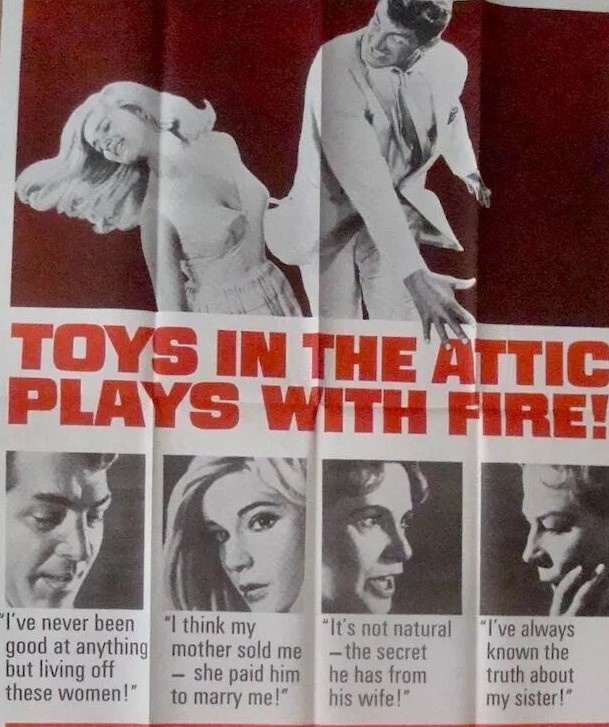
While backing down on the title, Mirisch veered towards the exploitative in the main poster which showed Dean Martin slugging Yvette Mimieux.
However, United Artists remained in two minds about the release policy. Despite the prestige of being chosen for the San Sebastian Festival, United Artists opted to open it in New York as part of a “showcase” run. That was a relativelynew distribution notion, a version of regional wide release. It would eventually be refined to allow several weeks in prestigious first run venues first, but inclusion in this release pattern meant first run was simultaneous with an opening in – in this case – another 20 New York neighbourhood cinemas. Had UA had more faith in the project, it might have benefitted from an opening just in first run. The $55,000 first week from two first run houses on Broadway was judged a “wow” result by Variety. First run in other major cities suggested a prestige title – “very stout” $15,000 in Boston, a “sock” $14,000 in Washington D.C., “neat” $14,000 in Buffalo, while it was “bright” in Kansas City ($8,000), Los Angeles ($10,000) and Chicago ($18,000).
Hill’s concerns about United Artists’ ability to sell the picture were mirrored in the result. “It did not turn out well,” concluded Walter Mirich, “It’s a grim story. It was not well reviewed and was not financially successful.” Part of the reason for its failure, he argued, was that it “probably appeared at the end of a cycle” of American Broadway adaptations of heavy Tennessee Williams dramas.
While the movie came in $70,000 below the $2.1 million budget, the savings were put down to the fact that it was filmed in black-and-white rather than color, as had been originally envisioned. The box office followed a common, but disturbing, trajectory, a big hit in the big cities, mostly ignored elsewhere. But it was not as bad as all that. Mirisch tallied the domestic box office as $1.7 million with another $900,000 from the overseas box office. By its estimation, once marketing costs were considered, it was facing a loss of $183,000. But that was before television revenue entered the equation and that should have at the very least, made up the difference. There were various pickings later on, too, picked up by CPI under the “Best of Broadway” label in 1981.
SOURCES: Walter Mirisch, I Thought we Were Making Movies, Not History (University of Wisconsin press, 2008) p157-159. Leon Goldberg, “Office Rushgram: Final Cost on Toys in the Attic, May 13, 1964, United Artists Files, Wisconsin Center for Film and Theater Research; “Mirisch Pictures Box Office Figures,” UA Files; Letter,” George Roy Hill to Walter Mirisch, March 15, 1963, UA Files; “Lillian Hellman Could Mop Up if Toys Clicks,” Variety, February 4, 1960, p103; “Toys Exit,” Variety, January 18, 1961, p72; “George Roy Hill To Direct Toys for Mirisch Co,” Box Office, January 22, 1962, pE8; “Hollywood Report,” Box Office, February 22, 1962, p16; “George Roy Hill Announces First Film on UA Deal,” Box Office, March 19, 1962, p16; “Bloomgarden Had Varied Fortune,” Variety, August 29, 1962, p49; “Toys in Attic Chosen for San Sebastian Festival,” Box Office, June 10, 1963, pE8; “Premiere Showcase,” Variety, July 31, 1963, p22. Box office figures from Variety issues dated August 7, August 14, August 21, September 4, September 11 and October 23.
Call it friendly persuasion. After The Magnificent Seven (1960), producer Walter Mirisch wanted to keep director John Sturges on-side. Other potential projects were falling by the wayside and Sturges needed, for financial reasons, to keep working while Mirisch wanted to ensure that when they finally licked the script for The Great Escape, still three years off as it happened, they would have a grateful director all set.
Especially, they did not want him to fall into the hands of rival producer Hal Wallis who was making a second attempt to set up The Sons of Katie Elder. Sturges had been the original director in 1955 with Alan Ladd in the leading role but a dodgy script. Although the script was in better shape, Wallis couldn’t get Paramount to bite (and wouldn’t until 1965). Another Sturges prospect was a remake of Vivacious Lady (1938) teaming Steve McQueen and Lee Remick in the Ginger Rogers-James Stewart roles, but that also fell through.
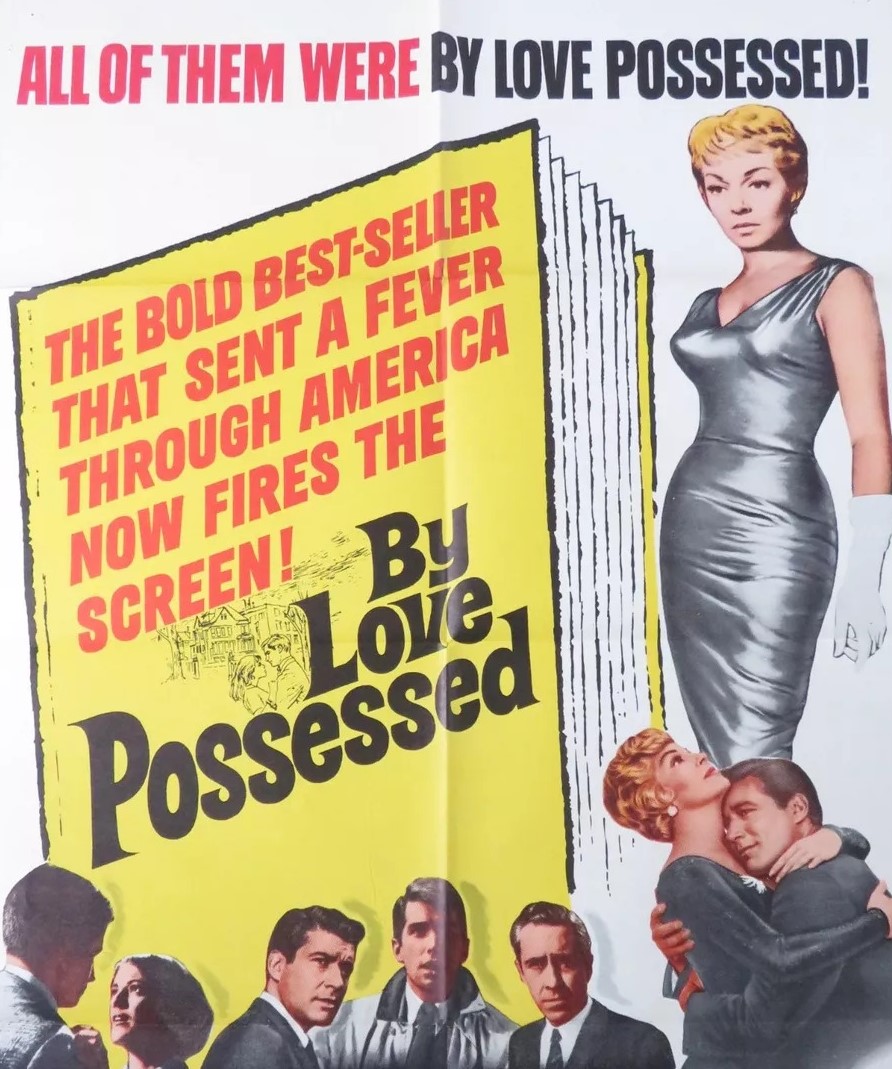
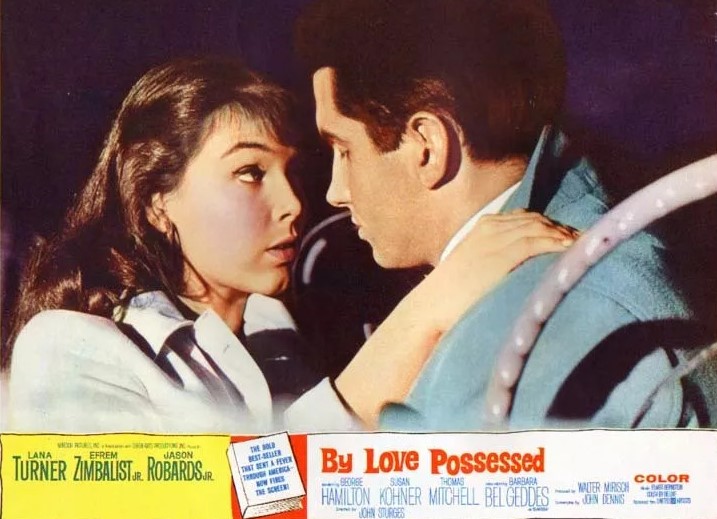
“I didn’t want John to go elsewhere and get tied up in another film,” admitted Mirisch. Partly as a means of finding a vehicle for Lana Turner, Mirisch had struck a deal with Seven Arts to make By Love Possessed by James Gould Cozzens, a 1957 bestseller for which producer Ray Stark had forked out $100,000 as a means of finessing his television-dependent company into the movies.
Essentially, Mirisch picked up the picture on the rebound. Seven Arts had fallen out with United Artists which had financed the acquisition of three expensive properties: Broadway hits West Side Story and Two for the Seesaw and the novel By Love Possessed, all of which fell into the Mirisch lap. Mirisch enthused about the two stage productions, interesting Robert Wise in the musical and Billy Wilder, at least initially, in the romantic drama. Prior to The Magnificent Seven, Mirisch had tied Sturges down to a long-term deal and now handed him the script for By Love Possessed. “He read it and said he would like to do it.”
Lana Turner had revived her career with an Oscar-nominated turn in Peyton Place (1957), a huge hit, and had hit gold with remake Imitiation of Life (1959). She seemed the ideal candidate for another adaptation of a seamy besteller. At this point the Mirisch company was still trying to make it way in Hollywood. Its prime method of getting its foot in the door was to pay stars over the odds and allow them greater say in their movies, sometimes backing pet projects. The price of working with big marquee names was often a lot of grief.
Like any other major producer, Walter Mirisch saw himself as a star-maker. Hiring talent on a long-term contract for a low fee was one way of ensuring he could ride on their inexpensive coat-tails in the future. Efrem Zimbalist Jr was the star of hit television series 77 Sunset Strip and the producer “hoped that casting him with Lana in our picture would make him a motion picture star.” He viewed the likes of Jason Robards and George Hamilton as merely supporting actors and not potential stars in their own right, although both would go on to have more stellar careers than Zimbalist.
Ketti Frings, Oscar-nominated for Come Back, Little Sheba (1952), had been paid $100,000 plus a percentage to write the screenplay of what was perceived as a difficult novel to adapt, given it was riddled with flashbacks and introspection. “If we told the book on the screen, we would be making an 18-hour picture,” said Sturges, derisively, as if blockbuster novels (From Here to Eternity etc) were not filetted all the time. Oscar-winner Charles Schnee (Red River, 1948) was drafted in for a rewrite – he had worked on Jeopardy (1953), though uncredited, a Sturges thriller starring Barbara Stanwyck.
Now the screenwriter was dogged with script changes demanded by Lana Turner. According to Mirisch, the actress “never let up” wanting script alterations. But Schnee’s work didn’t meet the director’s expectations and was doctored to such an extent the screenwriter removed his own name from the credits and substituted the pseudonym John Dennis. Mirisch initially brought in Isobel Lennart, who was adapting Two for the Seesaw, for a polish but eventually her version departed significantly from the Schnee original.
Novels could get away with a lot more blatant sexuality than books, though Peyton Place (1957) had made a very good stab at scorching the screen. But the finished script didn’t manage to match the novel’s carnality except in the character of Veronica (Yvonne Craig), the one-night stand who triggers the family downfall. Whatever the problems the script couldn’t nail, Sturges was clearly not the director to get round them with hot onscreen love scenes. Much as he admired strong women, couples getting it on were not his speciality.
The movie was filmed on the Columbia lot with a week on location.
“You get talked into it…or you need the money,” said Sturges. “I knew I had no business making that picture. Sure it was well-acted and staged …but I couldn’t care less about these people. I didn’t like ‘em, didn’t understand ‘em. And if you don’t understand people in a given situation, and you don’t like what’s happening, you shouldn’t try to make a movie out of it.”
Mirisch was as philosophical. “John Sturges was more at home with male-oriented, action pictures than soap opera. I was well aware of that, but I was guilty of ignoring my own misgivings and of wanting to keep him involved in one of our projects while we were doing the script preparation for The Great Escape.” The failure of the movie was, for Mirisch, “a psychological and emotional blow,” one that wasn’t softened by success at the box office.
SOURCES: Glenn Lovell, Escape Artist, The Life and Films of John Sturges (The University of Wisconsin Press, 2008) p218-220; Walter Mirisch, I Thought We Were Making Movies, Not History (The University of Wisconsin Press, 2008) p99, 114-116, 119-120;
Richard Burton was first choice. Sean Connery second. Jack Lemmon a distinct possibility. A suave Frenchman such as Jean-Paul Belmondo (Breathless, 1960) was briefly entertained. Brigitte Bardot a certainty for the female lead. Thoughts of entertaining Steve McQueen for the male lead were so far beyond left field as to have entered the outer limits. He played down’n’dirty working characters clad in nothing more sophisticated than denim. Faye Dunaway’s screen persona – violent slutty bitch – was the opposite of the character depicted.
Producer Walter Mirisch was well versed than most about McQueen, having hired him for The Magnificent Seven (1960) and The Great Escape (1963). But when Burton rejected the part, “we determined to try to interest Sean Connery in the role.” The Scottish actor was receptive to any movies that would instantly take him away from the typecasting of the James Bond series. Lunch at the Regency Hotel was followed by further conversation “for most of a Saturday afternoon.”
But to no avail. “We were crestfallen when we failed to convince Sean Connery,” who was, after all, the biggest star in the world, and looked immaculate in a suit.
Even Steve McQueen acknowledged he was an odd choice. He told a film school class in January 1967 that he was a “limited actor, I mean my range isn’t very great.” But after the possibility of crowning his acting career with Oscar glory for The Sand Pebbles (1966) had faded and with motor racing epic Day of the Champion in cold storage but with a six-picture with Warner brothers promising a hefty $700,000 per, he had the pick of projects.
Maybe too many came his way, over 100 in a few months. He took a meeting with Twentieth Century Fox over a proposal to star with Audrey Hepburn in Two for the Road (1967). He was mooted, along with Paul Newman, for In Cold Blood (1967) and was wooed by John Huston for The Kremlin Letter (not made till 1970).
Eventually, director Norman Jewison, who had worked with McQueen on The Cincinnati Kid (1965), another change to the actor’s screen persona, after much badgering, agreed to let him see the script. “Norman and I both felt that Steve was completely wrong to play Thomas Crown,” commented Mirisch, especially over the demand that “he should to wear a necktie on the screen.”
Although Jewison and McQueen shared the same agency, William Morris, the notion of the actor being tapped up for the role didn’t come from there. McQueen heard about it from a friend Steve Ferry who had seen the screenplay. Jewison came straight to the point when he took a telephone call from McQueen: “If it’s Thomas Crown, forget it. You’re not right. I love you and respect you as an actor. But I’ll never tell you lies. You can’t have the part.”
Jewison went further, listing the actor’s shortcomings, explaining McQueen was prone to “looking down at the ground or squinting up into the sun…What’s going to happen when you have to look people in the eye?” Only after three hours on the director’s back lawn did Jewison’s obstinacy relent. “The more he talked, the more I saw him as Thomas Crown. Now we had the problem of turning him physically into Thomas Crown.”
“He’s a rebel like me,” surmised McQueen, “Sure, a high society rebel, but my kinda cat.” Jewison kept telling him he “wasn’t right for it.” It was “unlike anything Steve had ever done” and casting him still seemed a risk. McQueen was aware of the damage miscasting could do to this career. “I don’t have any illusions on that score…If people laugh at me, my ass is gone.”
McQueen explained his enthusiasm for the role. “I had thought of changing my screen image for more than a year. I felt it was time to get past those tough upright types. When Norman showed me the Crown part I grabbed it.”
It was an odd movie from the beginning, not churned out by a seasoned professional. An experienced Hollywood type would never have considered writing a heist picture where the mastermind was a slick millionaire with a string of successful businesses behind him, who, rather than being a professional criminal, was drawn to crime from sheer boredom.
Alan R. Trustman was a legal eagle, partner at the law firm of Nutter, McClennen and Fish. “I had never written a line, except for law briefs. One Sunday afternoon I got bored watching TV and suddenly, for no apparent reason, I thought it would be fun to write a screen story…in two months The Crown Caper was done.” But it was nothing like the polished movie that ended up on screen. “It had a lot of dialogue, a lot of description and a lot of prose,” recalled Mirisch, and at thirty pages long was more of a treatment than a script. “But it had a great germ of an idea.”
Mirisch was an early advocate of Faye Dunaway, having seen her on stage in a play, Hogan’s Goat (1965), recognized her potential and “always had in mind that, one day, a role would come along.”
Mirisch had McQueen on some sort of a financial string. Their multiple-picture deal with him dated back to The Magnificent Seven (1960), at a time when he was a rising rather than established star. In the way of such pacts, initial remuneration was pretty low, rising with each successive picture, and relying on the actor having become, somehow, a success.
“His agent and manager made a big fuss about the nominal salary provided for in our second option. To settle the argument,” stated Mirisch, “I agreed to pay him the salary called for in the third option as well as to cancel that last option. I recognized that we really should be paying him more than the price stipulated in the option. Also I felt that trying to enforce the third option would be difficult if not impossible.”
If Walter Mirisch thought he was getting a bargain, it wasn’t much of one. McQueen still pulled in $650,000 plus $1,000 a week living expenses and a ton of perks – including it later transpired the dune buggy (worth about $50,000 at today’s prices), all the tailor-made suits, and the shoes and a swag-bag of props. The actor called on his Beverley Hills tailor Ron Postal to deck him out in $400 suits (over $3,500 now), had his hair transformed by celebrity stylist Jay Sebring (later murdered along with his girlfriend Sharon Tate by the Manson gang) and learned to play polo “until his hands literally bled.”
Dunaway, by contrast, with Bonnie and Clyde (1967) in the bank and wanted by every studio in town, was paid a larger salary (though McQueen made up for it by his profit share). Out of the $4.3 million budget around a third was spent on the salaries of the two principals.
Dunaway proved terrific casting for another reason. She was as tough, single-minded and independent as the character she played. She had an inner strength McQueen’s previous leading ladies and contemporary amours lacked. In person “she threw him off-balance” and she “did the same thing on camera” which provided the anchor of their relationship. She was far from the typical Hollywood “love interest.”
Mirisch’s pact with Jewison had proved wildly successful, among the best financial deals the company had ever achieved, the hot box office of The Russians Are Coming, The Russians Are Coming (1966) exceeded by In the Heat of the Night (1967). Jewison rehired many of the crew from his previous picture, including two budding directors, cinematographer Haskell Wexler (Medium Cool, 1969) and editor Hal Ashby (Shampoo, 1975).
Aside from the sensational screen charisma of the leading actors, the screenplay’s originality was enhanced by a huge step forward in the use of technology, the innovative split-screen process, executed by visual designer Pablo Ferro, who had devised the credit sequence for The Russians Are Coming, The Russians Are Coming.
Multiple image was used in three principal area – to introduce six characters and establish their relationship during the initial robbery, for the polo game, and in the final caper. The polo game employed “not only out-of-focus and soft effect panels but also at some point involved over fifty separate panels on the screen simultaneously,” said Jewison. For the second robbery “the amount of film used in relationship to the amount of screen time was probably in the ratio of four-to-one.”
In other words, not only was it incredibly stylish, but it vastly compressed screen time, reducing the running length by fifteen or twenty minutes, ensuring that the audiences concentrated on the evolving relationship between McQueen and Dunaway.
McQueen could ride, of course, what Hollywood star, with westerns in high demand, could not. “But he hated horses and he hated polo, but he wasn’t about to give up.” Thanks to his dedication, he proved a worthy competitor. Jewison only believed in McQueen once he witnessed him in action playing polo. “That’s when I realized how much he was giving for the film. Polo was symbolic of all the reasons why he wanted to play Thomas Crown.” The snobs at the club might sneer but they could not ignore “his sensational back hand.”
McQueen had never used the English saddle, a prerequisite for polo. He trained at the Myopia hunt club from morning till night until he mastered the art of riding using his knees not his arms (essential to be kept as free as possible to swing the mallet) as well as becoming such a “proficient player” he received a standing ovation from the members.
The F.B.I. refused to cooperate. Rejecting a request to film in its Boston office, the crime buster operation complained about what it perceived as “an outrageous portrayal of the Bureau” especially as the film ended with Thomas Crown outwitting the organization.
McQueen turned up for shooting as if he had swallowed the Method. “Call me Tommy,” he told the crew. But there was limited time to knock the character into shape, the actor having only signed up for a week of pre-production.
The twelve-week shoot was marred for McQueen by “some letters of a threatening nature that he had received.” That meant posting a security guard on his rented house to ensure the safety of his children. “It preyed on his mind a great deal during the shooting,” said Mirisch.
According to Jewison, McQueen’s security concerns evolved into paranoia, itself driven by his drug-taking. As well as a 24-hour security detail and surveillance on the front of his house, he demanded the same facility for the back of his house which between him and the Atlantic Ocean consisted only of a private beach. “Who the hell did he think was going to get in from there?” mused the director. Off-screen McQueen never exhibited his on-screen confidence. Jewison observed, “He was tortured.”
Filming was, as Jewison put it, best described as “bittersweet.” Producer Robert Relyea recalled “refereeing” a few incidents between actor and director. McQueen’s unease or the eternal power battle between director and actor resulted in one opportunity missed. For the dune buggy scene, said Jewison, “we had everything lined up for a scene on the beach at Magic Hour just as the sun was going down. Beautiful… conditions were perfect, everyone was ready except Thomas Crown Esq who was out in the surf in his dune buggy not answering his radio.”
Oddly enough, McQueen objected to the director speaking to him snippily when the actor returned and after that their relationship wasn’t the same, McQueen nibbling away at the director’s confidence, objecting to scenes or lines, until Jewison at one point ended up in tears. McQueen became a consummate actor, expressing emotion with the slightest lift of an eyebrow, or tightening a facial muscle, because “he couldn’t get his tongue around a lot of words.”
The producer was delighted to return to Boston, the movie’s main location, because he had attended college there a quarter of a century previously. Locations used included Old Copp’s Hill Cemetery, the Boston commons, the Little Italy outdoor markets, Anthony’s Pier 4 restaurant, and the sand dunes near Crane’s Beach and Provincetown. The St James Ballroom of the Jordan Marsh mansion provided the setting for the ballroom while the chess game was shot at the Goldwyn Studio. The initial bank robbery was filmed using hidden cameras at the National Shawmut Bank.
For the chess game “ we were hoping to get inspired moments that could give us more than dialog could.” Inspiration didn’t stop there, the fashionable outfits adorning Dunaway helped enormously and, of course, the movie hit pay dirt with the Oscar-winning theme song, “The Windmills of Your Mind” composed by Michel Legrand with lyrics by Marilyn and Alan Bergman, a huge success in the global singles charts.
The original title of The Crown Caper was changed for a time to Thomas Crown and Company before setting finally on The Thomas Crown Affair.
Although initially criticized as being primary style over substance, and now recognized as a work of inspired genius, one of the few times when everything falls into place on a movie, according to Mirisch, it was more “an exhibition of style…we hoped to dazzle the audience with the multiple panels and the chess game, the photography and the music.”
It proved a smash at the box office, rentals of $6.25 million in the U.S, nearly matched by $5 million abroad.
SOURCES: Walter Mirisch, I Thought We Were Making Movies, Not History (The University of Wisconsin Press, 2008) p265-270; Penina Spiegel, Steve McQueen, The Untold Story of the Bad Boy of Hollywood (Collins, 1968) p201-209; Christopher Sandford, McQueen, The Biography (HarperCollins Entertainment, 2002) p196-198, 202-206.
Blame Robert Wise for falling behind on The Sand Pebbles (1966), otherwise John Sturges would have pressed ahead with Steve McQueen pet project Day of the Champion (later resurrected as Le Mans, 1970, though minus Sturges). Needing another hit after the consecutive box office failures of The Satan Bug (1965) and The Hallelujah Trail (1965), Sturges fell back on an equally favoured project, The Law and Tombstone, a revisionist and darker look at the Wyatt Earp legend, with “a few liberties taken so it doesn’t become a documentary.” Despite the failings of the last two films, Mirisch had just re-signed Sturges, expanding his current deal from two to four pictures.
“It seemed like a first-rate idea,” recalled producer Walter Mirisch, who had worked with Sturges on The Magnificent Seven (1960) and The Great Escape (1963). In his memoir he said, “If there was still a market for Western pictures, John Sturges was certainly the ideal director to test it.” (Mirisch’s memory is a bit hazy here regarding the commercial prospects for westerns – 1966 had seen box office success for El Dorado, Nevada Smith, The Professionals and The Rare Breed while 1967 would usher in The War Wagon and Hombre among others). The initial idea was to re-team Burt Lancaster and Kirk Douglas from Gunfight at the O.K. Corral, to which this was a sequel, but Paramount, which had made the original picture, nixed the notion.
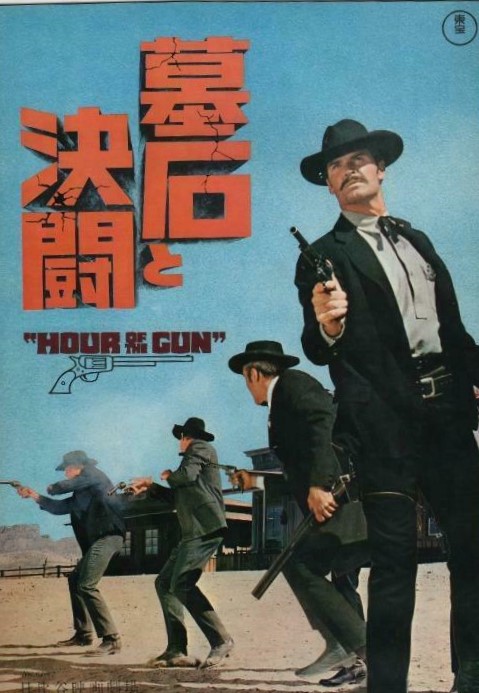
The image for the Japanese poster was taken from the initial shootout at the O.K. Corral that opened the picture.
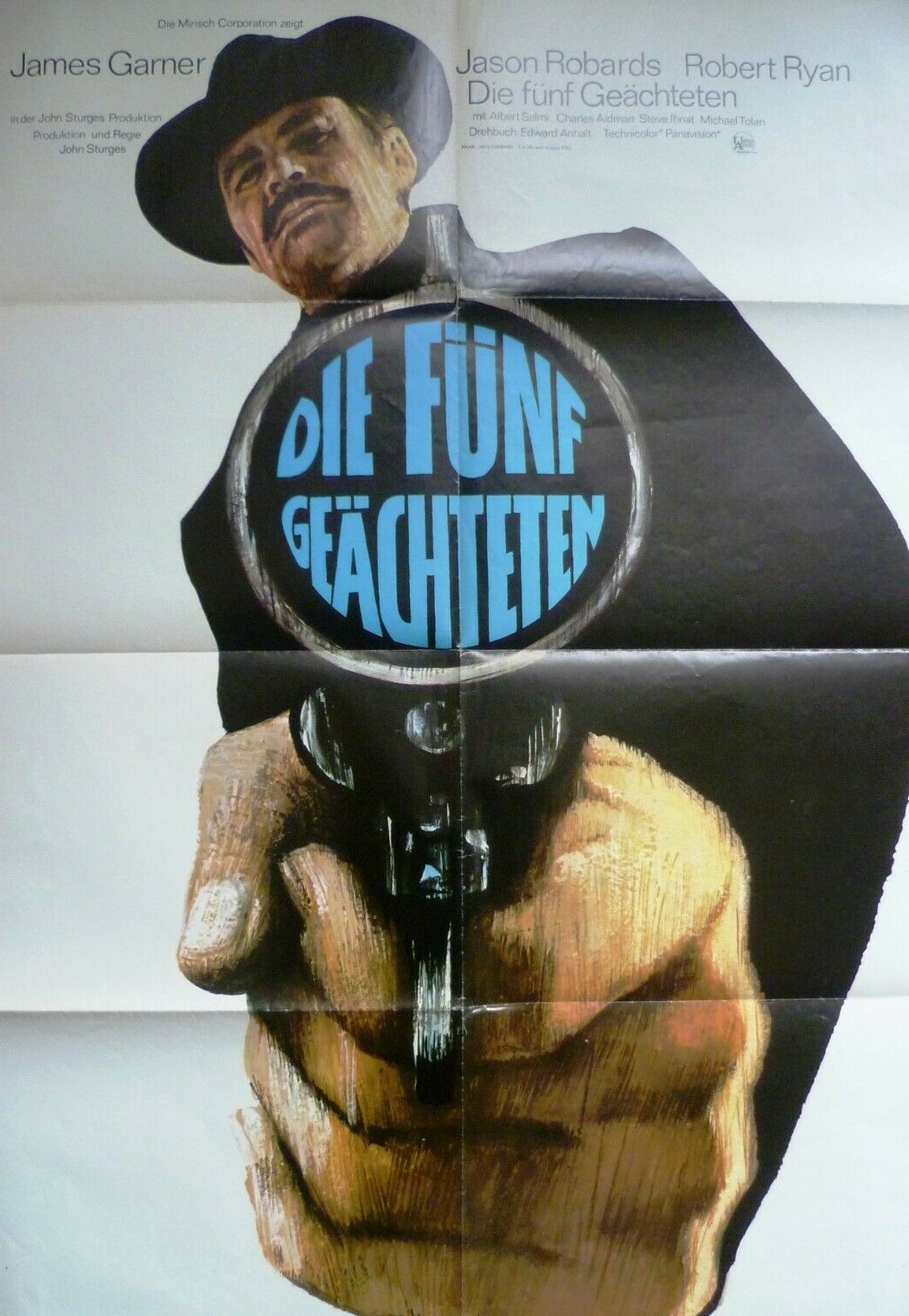
James Garner came on board in the main because he still owed Mirisch, marking a decade in the business, a picture. He had originally worked for Mirisch in The Children’s Hour (1961). He was hired for “not much,” a straight salary, but credited Mirisch with kick-starting his career after his battle with Warner Brothers. Mirisch had also funded By Love Possessed (1962) in which Sturges had directed Jason Robards, “a brilliant actor though one with problems” (something of an understatement).
There was some surprise in Hollywood when Sturges returned to Mexico after the difficulties – censorship, threats to boycott the film, union issues – he had encountered shooting The Magnificent Seven there. Having vowed “never to make another picture” in that country, “one of the reasons we’re back here is because they’ve eased up on regulations.” Having expected to import most of the cast from Hollywood, the producers were delighted that “six of the ten other featured parts” went to Mexicans, as a result of extensive auditions. Although Lucien Ballard (The Wild Bunch, 1969) remained director of cinematography, a Mexican camera crew was hired with Jorge Stahl in charge.
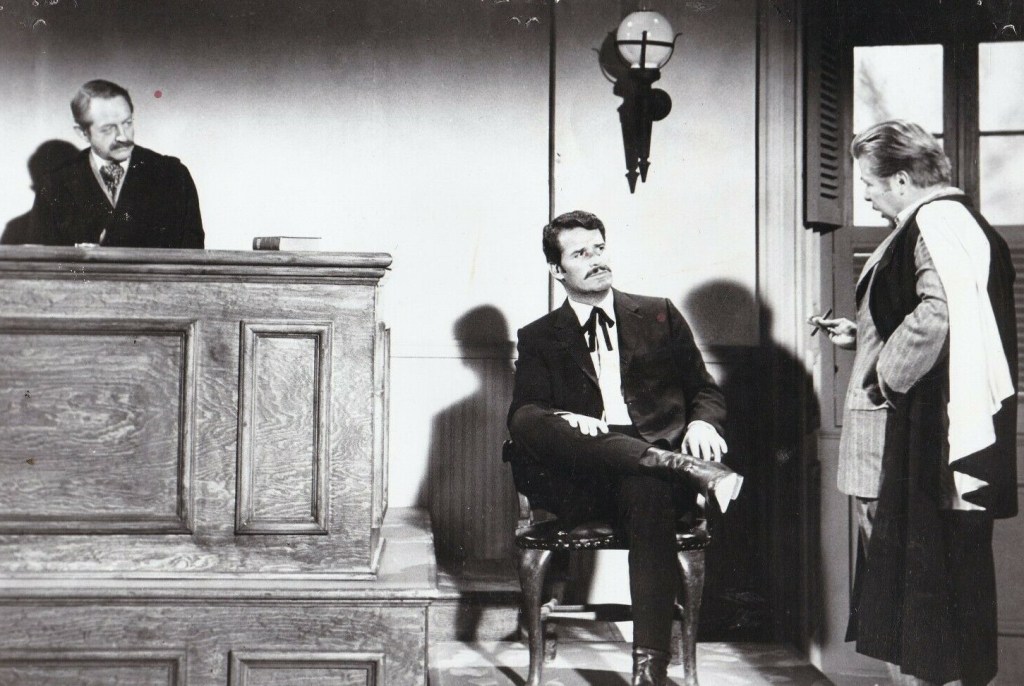
James Garner takes the stand in court defending himself against allegations of murder.
Shooting began on November 9, 1966, at Torreon, “a quiet little agricultural town with a single hotel and bar,” where a fake town had been built at a cost of $100,000. Filming shifted to Churusbusco Studios in Mexico City on December 20 and four weeks later production wrapped after exteriors at a hacienda near San Miguel de Allende for the face-off with Ike Clanton (Robert Ryan in the film).
James Garner (The Great Escape, 1963) was keen to be reunited with Sturges. “I was happy to play the character,” reminisced Garner, “because John always knew what he was doing. He would take five, six, seven factions in a story and bring them together.” Garner saw Earp as “a guy taken with his own power, who nobody could defy.”
Jason Robards, as Doc Holliday, with a well-known wild side, was difficult to manage. Assistant directors were dispatched every morning to find out where, bar or brothel, the actor had ended up the night before. Sturges rounded on him when Robards turned up at lunch for a scheduled 8am start. He was perfect after that. Unusually, Sturges would invite the cast to watch the dailies. Producers Mirisch were not happy with the title which was eventually changed to Hour of the Gun.
“My mistake,” rued Sturges, “was that I thought people would be fascinated by the real story about the quarrel between the Earps and the Clantons. You didn’t just shoot people, there were trials, lawyers, citizens’ committees…I got preview cards that said of all the stories told about Earp and Holliday this was the dullest. They (the audience) considered them fictional characters. They couldn’t have cared less that that’s the way it really was.”
As Variety pointed out in its review: “Probing too deeply into the character of folk heroes reveals them to be fallible human beings – which they are of course – but to mass audiences …such exposition is unsettling.”
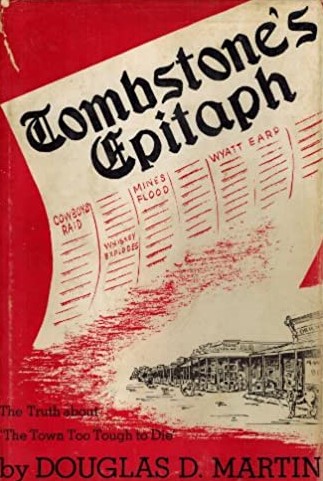
Edward Anhalt’s screenplay was based on this book published in the late 1950s.
There were clearly reservations about the project. Mirisch announced it was “ready for release” at the end of March 1967 but it did not see the light of day for another seven months. Although the film was budgeted at just over $3 million – $1 million more than In the Heat of the Night (1967), another Mirisch project – and received tremendous support from the industry-wide “Fall Film Fair” promotional campaign (“commended…for excellence in entertainment”) it was a huge flop in the U.S. bringing in a miserable $900,000 in rentals (the amount studios receive once the cinemas have taken their share of the gross). It did better abroad with $1.5 million but the total was nowhere near enough to recoup the costs.
“Also playing a large role in the reaction to the picture was the continued loss of interest by audiences in Western pictures,” said Mirisch. “I was again guilty of thinking that this trend would reverse and that Westerns, led by a hit picture, would return to favour stronger than ever. I was wrong. As a new generation arose, their interest in westers had been satiated, probably by television, and they now embraced the so-called Easy Rider era of movie-making.”
This is another piece of faulty memory. The year after the release of Hour of the Gun commercial success was enjoyed by Bandolero!, Hang ‘Em High and The Scalphunters to name a few and Will Penny and The Stalking Moon, both revisionist westerns, won critical favour. And, apologies for harping on about it, but, as I showed in my book The Gunslingers of ’69, that year proved a box office bonanza for westerns despite Easy Rider.
SOURCES: Glenn Lovell, Escape Artist (University of Wisconsin Press, 2008) p257-262; Walter Mirisch, I Thought We Were Making Movies, Not History (University of Wisconsin Press, 2008), p259-260; United Artists Archive, Appendix II, University of Wisconsin; “Mirisch, Sturges Revamp Pact for Two More Films,” Box Office, July 25, 1966, W-1; “James Garner Moves from Actor To Future Producer Status,” Variety, October 5, 1966, 5; “Director John E. Sturges Returns to Mexico for Law and Tombstone,” Box Office, November 7, 1966, pW-2; “Mirisch Schedules Five Major Films,” Box Office, March 13, 1967, p10; “Film Title Changes,” Box Office, April 24, 1967, p18; Advert, Box Office, Aug 28, 1967, p4-5; Review, Variety, October 4, 1967, p16.
In 1963 John Sturges made a deal for his Kappa Productions outfit with United Artists. The director was keenest on The Hallelujah Trail (1965) and what became Hour of the Gun (1967) but The Satan Bug was greenlit first because of the production difficulties inherent in developing westerns. To cut down on travel, Sturges decided to shoot in and around the desert area close to his home turf of Palm Springs and the Joshua Tree National Park. He called in James Clavell, responsible for the screenplay of The Great Escape (1963), and Edward Anhalt (Becket, 1964) to Americanize and update the English-set Alistair Maclean thriller written before the Cold War escalation of the Cuban Crisis and the increasing fears of nuclear arsenals.
Hardly a director known for “message pictures” – more likely to emanate from the likes of Stanley Kramer – nonetheless he recognized the implicit threat of biological warfare for “its terror potential” and envisioned a powerful climax in the evacuation of Los Angeles. He swapped the married, lame and disfigured hero of the novel for a hip loner in the Steve McQueen mold.
Unable on a $6 million budget to afford a leading man of the McQueen calibre – a strange notion when Two for the Road’s $5 million budget included $1 million for Audrey Hepburn – he settled on rising star George Maharis (Quick Before It Melts, 1964) who had graduated from television’s Route 66 (1960-1963). “We were disappointed that we were not able to get a major star to play the leading role,” commented producer Walter Mirisch, whose company Mirisch Pictures bankrolled the picture. “The idea of using… George Maharis was suggested… John (Sturges) pressured us to cast him. I had felt the subject required a major action-adventure star. George Maharis wasn’ t that, nor did he ever become a major shooting star. ”
Richard Basehart was also plucked from television – the star of Voyage to the Bottom of the Sea (1964-1968) – as was Frank Sutton (Donald in the film) from comedy Gomer Pyle, USMC (1964-1969). Initially cast as the general’s daughter, Joan Hackett (The Group, 1966) – in what would have been her movie debut – was replaced by Anne Francis. In fact, Hackett worked on the movie for two weeks. “John called,” explained Mirisch,” and told me he was very dissatisfied with Joan.” Sturges had worked with her replacement Anne Francis before on Bad Day at Black Rock (1955).
Sturges biggest problem was creating imposing research facility Station 3. Sticking it underground saved a chunk of cash on the budget, since interiors were minimalist. “The set cost us nothing,” said Sturges. But to add a sense of tension, the set was lit with an ominous amber glow.
However, it proved impossible to achieve the one effect Sturges had set his heart on – the panic-crazed evacuation of Los Angeles. City officials put a block on the gridlock called for in the script. Recalled Sturges, “The sons-of-bitches wouldn’t let me stop traffic…we didn’t get the panic on the streets, the motorists trapped on the freeways…the nightmare of the evacuation.” The director was forced to resort to “glass shots” and background noise to create the sense of pandemonium, the gridlock limited to the roadblock.
Also hampering production was a sense that the director’s mind was not fully on the job. Screenwriter John Gay (The Hallelujah Trail) was often on set conferring between shots with Sturges. The laughter they enjoyed dreaming up ideas for the comedy western seemed at odds with the mood of the pandemic thriller, leaving some actors annoyed.
Commented Mirisch, “It never developed any momentum on its (U.S.) release and wasn’t successful commercially.” According to the Mirisch internal records, the picture’s negative cost (excluding marketing and advertising) was $1.78 million. It only brought in $850,000 in rentals from the U.S. release though foreign business was better, $1.75 million, but the combined total was not enough, once the promotional costs were included, to turn a profit.
SOURCES: Glenn Lovell, Escape Artist: The Life and Films of John Sturges, University of Wisconsin Press, 2008,p243-248; Walter Mirich, I Thought We Were Making Movies, Not History, University of Wisconsin Press, 2008, p211-212; Mirisch Financial Records for 1965.




 The Magnificent 60s