Behind the Scenes: Becoming a Producer, Part One – The Walter Mirisch Story

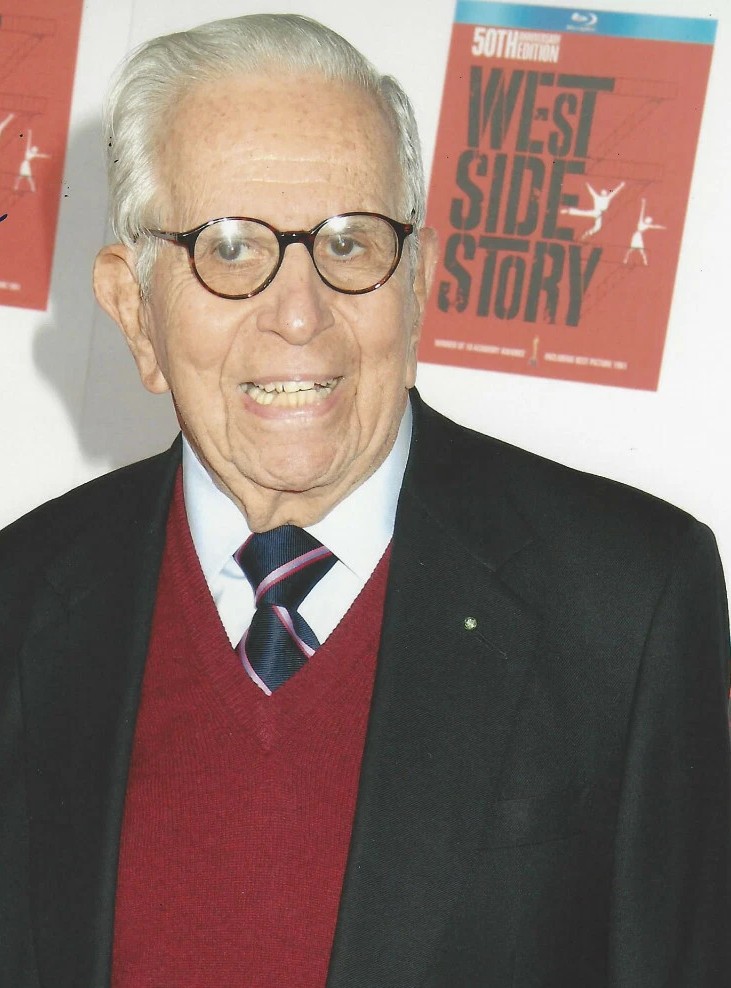
You don’t just waltz into Hollywood and start churning out classics like Some Like it Hot (1959), The Magnificent Seven (1960), West Side Story (1961) and The Great Escape (1963). Usually, there’s a long apprenticeship, especially for a producer. Walter Mirisch spent nearly a decade at the B-picture coalface. And before that  a year as a gofer, working his way up in the business, but on one of the smallest rungs of all, at Monogram.

Born in 1921, the of a Polish immigrant tailor specializing in custom-made garments, one of whose customers was George Skouras, owner of a cinema chain, Walter, not surprisingly in the Hollywood Golden Age, started out an even lower rung, as an usher in the State Theater in Jersey City, owned by Skouras, an hour’s commute from his home in the Bronx, earning 25 cents an hour. He was quickly promoted to ticket checker.

His older brother Harold was a film booker, receiving an education in negotiation, and then as a cinema manager in Milwaukee flexed his entrepreneurial muscles by starting a concession company. After the family moved to Milwaukee, Walter attended the University of  Wisconsin and then Harvard Business School. Physically unfit for active duty during the war, he worked for Lockheed in Los Angeles on its aircraft program in an administrative capacity.

While Harold was a highflyer at RKO, acting as chief buyer and then managing its cinema chain, Walter entered at a lower level in 1946 as a general assistant to Steve Broidy, boss of Monogram, maker of B-pictures of the series variety – Charlie Chan, The Bowery Boys, Joe Palooka, shot within eight days and at budgets under $100,000.

After badgering Broidy for a bigger opportunity, he was granted permission to hunt for a property he could produce. For $500 he found a Ring Lardner short story about a boxer, but Broidy felt the main character was unsympathetic. Stanley Kramer did not and snapped it up to make Champion (1949). 

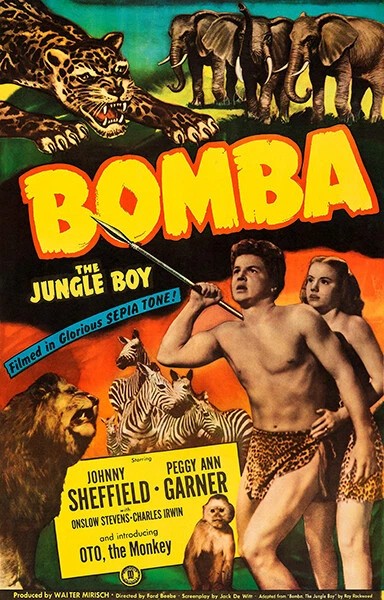
Walter’s first ventures were in film noir. Fall Guy (1947), based on a story by Cornell Woolrich,  made for $83,000, broke even. I Wouldn’t Be In Your Shoes (1948) followed, from a Woolrich novel but there was a drawback to being a producer. He was taken off the payroll and his $2,500 producer’s fee didn’t compensate for the loss of a $75 weekly salary. The answer was to invent his own series, ripping off the Tarzan pictures for Bomba the Jungle Boy (1949), starring Johnny Sheffield who had played Tarzan’s son and utilizing stock footage from Africa Speaks. Apart from his fee, Walter had a 50 per cent profit share.

For six years, these appeared at the rate of two a year, earning Walter a minimum of $5,000 and he soon branched out into other genres, sci fi like Flight to Mars (1951) and westerns such as Cavalry Scout (1951) and Fort Osage (1951), both starring B-movie stalwart Rod Cameron.

Monogram had decided to move upmarket with the introduction in 1951 of Allied Artists, its sales division run by Walter’s brother Harold, with Walter acting as an executive producer and other brother Marvin as treasurer, turning out solid B-picture-plus hits like Riot in Cell Block 11 (1954).

When the threat from television hit the B-picture market Allied went properly upscale, investing in William Wyler western Friendly Persuasion (1956) and Billy Wilder’s Love in the Afternoon (1957), both starring Gary Cooper. Their failure at the box office sent  Monogram back to basics.

But the Mirisches wanted more of the big time. The three brothers turned to United Artists and negotiated a  deal for that studio to finance four pictures a year, cover the brothers’ overhead and salaries and throw in a profit share. The Mirisch Company was born and their creative credit within the industry was so high – and the deals they offered, it has to be said,  so advantageous to their creative partners – that soon they were scooping up big names like Wilder (he made his next eight pictures for Mirisch), William Wyler, Gary Cooper, Tony Curtis, Doris Day, Audrey Hepburn and Lana Turner. One of the first pictures announced was a remake of King Kong (1933). Wilder planned My Sister and I with Hepburn. John Sturges was attached to 633 Squadron. Doris Day would star in Roar Like A Dove and there were two-picture deals with Alan Ladd and Audie Murphy.

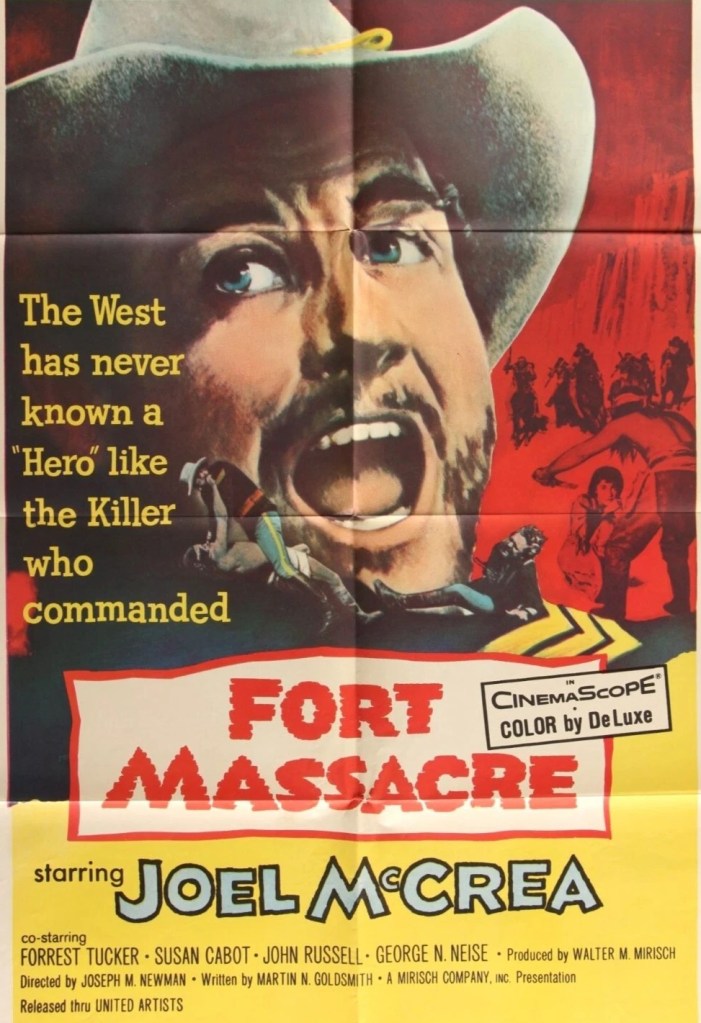
Their first two efforts didn’t break the budget bank, Fort Massacre (1958) starring Joel McCrea, and Man of the West (1958) headlined by Cooper, but neither were they hits. Hoping to provide ongoing financial sustenance, Walter turned to television, turning Wichita (1955) into the series Wichita Town (1959), and further television contributions were mooted for UA Playhouse but that and Peter Loves Mary and The Iron Horseman failed.

Movies proved a better bet and Walter struck gold with the third picture in the Mirisch-UA deal, Some Like it Hot (1959), costing $2.5 million, an enormous financial and critical success and tied down a triumvirate of top talent in John Wayne, William Holden and John Ford for western The Horse Soldiers (1959), the actors pulling down $750,000 apiece.

Such salaries sent the nascent company on a collision course with traditional Hollywood. The majors “screamed” that independents were overpaying the talent, hefty profit shares accompanying the salaries.

On top of that in 1959 in the space of two weeks Mirisch spent a record $600,000 pre-publication on James Michener blockbuster Hawaii and tied up a deal to film Broadway hit West Side Story. Within two years of setting up, Walter Mirisch announced a $34.5 million production slate, earning the company the tag of “mini-major,” as part of a shift in attitude to a “go for broke” policy. By the start of the new decade it was by far the biggest independent the industry had ever seen, handling $50 million worth of product, including The Magnificent Seven and The Apartment (1960). Average budgets had risen from $1.5 million to $3.5 million.

To outsiders, assuming the Mirisch venture was Walter’s first, it might look as if Walter had knocked the ball out of the park in a very short space of time, but, in reality, by the time he produced Some Like it Hot, he had been responsible for thirty-three pictures. Not bad for a “beginner.”

Explained Walter Mirisch, “Producing films is a chancy business. To produce a really fine film requires the confluence of a large number of elements, all combined in the exactly correct proportions. It’s very difficult and that’s why it happens so infrequently. It takes great attention to detail, the right instincts, the right combinations of talents and the heavens deciding to smile down on the enterprise. Timing is often critical.”

What would have happened to Allied Artists, for example, had Wilder made Some Like it Hot there instead of Love in the Afternoon?

Added Walter, “Where is the country’s or the world’s interest at that time? What is the audience looking for? Asking them won’t help because they themselves will tell you they don’t know what they’re looking for. They don’t know what it is until they’ve seen it. All the elements must come together at exactly the right time. So to say one embarks with great certainty on such an endeavor is an exaggeration.”

After 33 films Mirisch hit a home run with Some Like It Hot and continued to do so throughout the 1960s chalking up further critical and commercials hits like The Pink Panther (1964), In the Heat of the Night (1967) and The Thomas Crown Affair (1968) and vacuuming up a stack of Oscars.

SOURCES: Walter Mirisch, I Thought We Were Making Movies, Not History (University of Wisconsin, 2008); “Mirisch Freres Features Outlet Via United Artists,” Variety, August 7, 1957, p16; “3 Mirisch Bros Set Up Indie Co for 12 UA Films,” Variety, September 11, 1957, p7; “RKO vs Mirisch Kong,Variety, September 11, 1957, p7; Advertisement, “United Artists Welcomes The Mirisch Company,” Variety, November, 13, 1957, p13; “Brynner, Mirisch Pledge UA TV Tie,” Variety, January 1, 1958, p23; “Mirisch Freres 6 By Year-End,” Variety, March 19, 1958, p3; “Majors Originated Outrageous Wages,” Variety, December 10, 1958, p4; “UA-Mirisch’s  $600,000 For Michener’s Hawaii,Variety, August 26, 1959, p5; “Mirisch West Side Story,” Variety, September 2, 1959, p4; “Mirisch Takes on ‘Major’ Mantle With 2-Yr $34,500,000 Production Slate,” Variety, October 21, 1959, 21; “Mirisch Sets $50,000,000 14-Pic Slate; Biggest for Single Indie,” Variety, August 17, 1960, p7.

Behind the Scenes: “Battle of Midway” (1976)

Mirisch could easily lay claim to be the top independent production outfit of the 1960s generating hits like The Magnificent Seven (1960),  West Side Story (1961), The Great Escape (1963), The Pink Panther (1964) and its sequel A Shot in the Dark (1964), The Russians Are Coming, Russians Are Coming (1966), In the Heat of the Night (1967) and The Thomas Crown Affair (1968) plus a shelf load of Oscars and Oscar nominations. But dependence on a partnership with Billy Wilder in the 1970s and a more lackluster performance at the box office – with the noted exception of Fiddler on the Roof (1971) – spelled the end of its 17-year relationship with United Artists, which was reeling from financial losses and under new management.

The company found a new partner in Universal which had a series of deals with other major producers like Alfred Hitchcock, Zanuck and Brown (Jaws, 1975) and George Seaton (Airport, 1970). Mirisch was not in any financial trouble, having severed ties with UA after Mr Majestyk (1974), a major success abroad, and recovered its development costs for Wheels, based on the Arthur Hailey novel but the script rejected by UA, from Universal which turned it into a mini-series.

The Universal deal was initially not as good as that enjoyed at UA. Universal charged a twenty-five per cent overhead whereas UA had charged nothing and Universal was now doing direct deals with directors rather than relying on the likes of Mirisch to tie up the talent.

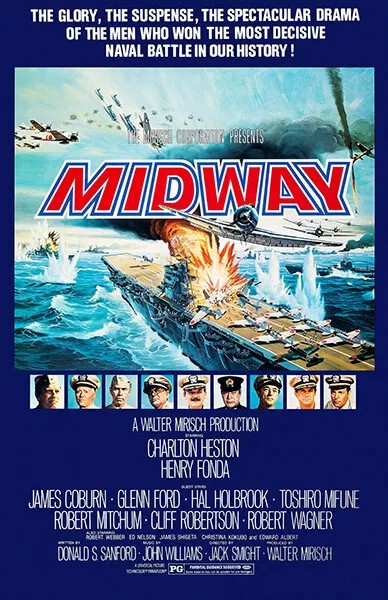
Many years before, Mirisch had commissioned a script on the Battle of Midway from Donald S. Sanford who specialized in war pictures but of the distinctly low-budget variety – Submarine X-1 (1968), The Thousand Plane Raid (1969) and Mosquito Squadron (1969), none of which had enjoyed any success. 

Though all of the Mirisch war pictures had concentrated on Europe, Walter Mirisch, generally the creative driving force for the production company, in his previous incarnation with Allied Artists had some experience of the Pacific War, having produced Flat Top / Eagles of the Fleet (1952), set around an aircraft carrier during the Battle of Leyte Gulf, and was an avid reader of books about the Second World War.

John Ford and Louis de Rochmont had made documentaries about the Pacific naval battles. UA rejected the script twice, a shrewd move in the end because Tora! Tora! Tora! (1970) lost a packet for Twentieth Century Fox. The Sanford screenplay had initially taken more of a documentary approach but after gaining the interest of Charlton Heston, who had starred in Mirisch’s The Hawaiians (1970), the script was tweaked.

Programming a war picture was a risk for the studio. There hadn’t been a big-budget war picture in five years. And while Patton (1970) and Kelly’s Heroes (1970) ended up on the right sight of the ledger book, Tora!, Tora! Tora! and Too Late the Hero (1970) were stiffs.

Mirisch signed a two-picture deal with Universal, for Midway and Wild Card with a screenplay by Elmore Leonard (Mr Majestyk). Mirisch proposed to reduce costs by using footage from naval archives, converting the original 16mm film to 35mm. The producer also  took footage from Japanese film Storm over the Pacific / I Bombed Pearl Harbor (1960) – the rights cost him $96,000. Footage of the Pearl Harbor attack in Tora! Tora! Tora! doubled for shots of the attack on Midway Island.   A clip of the Dolittle raid on Tokyo from Thirty Seconds over Tokyo (1944) was used in the credit sequence after “subjecting it to a sepia bath.”

After the success of Earthquake (1975), Heston was back in the top ranks of box office stars and his involvement guaranteed the green light. The U.S. Navy offered its support, not surprising since Midway was considered its greatest success.

John Guillermin (The Towering Inferno, 1974) was hired to direct and Stirling Silliphant (In the Heat of the Night) signed up for a screenplay rewrite. Mirisch had determined to employ the all-star-cast device that had been an essential ingredient of many of the 1960s roadshow pictures, kicking off with Henry Fonda (The Boston Strangler, 1968), by now pretty much a spent force at the box office – he hadn’t made a picture in three years – but still a well-known name. 

The amount of work involved for the other stars was minimal – mostly just one day – and, astutely, Mirisch called on stars who had worked for him in the past and who, like James Coburn (The Great Escape), Cliff Robertson (633 Squadron, 1964) and Christopher George (The Thousand Plane Raid) owed him something in terms of a career leg-up. Others included Robert Mitchum (The Sundowners, 1960), Robert Wagner (The Biggest Bundle of Them All, 1968) and Tom Selleck in an early role. Mitchum was the first of these stars to sign up, in March 1975, six weeks before the scheduled start date of April 27, followed two days later by Coburn.

Toshiro Mifune (Red Sun, 1971) headed up the Japanese cast and proved so meticulous in his preparations that he had his uniform made by Japanese tailors. The white gloves he wore had a finger shortened on the left hand because his character Admiral Yamamoto was missing a pinky. However, despite coaching in English by actress Miko Taka (Walk, Don’t Run, 1966), his dialog was revoiced by Paul Frees. 

Guillermin demanded a bigger budget to accommodate more airplanes and equipment and a longer shooting period. Two months before filming was due to start, Mirisch put his foot down and told the director he couldn’t accommodate his requests as Universal had only provided funding on the basis of Mirisch’s original idea. Guillermin walked. As far as the public was concerned, the parting of the ways was due to a “conflict of schedules.” Jack Smight, who had directed Airport ’75 (1974), a box office success and also starring Heston, was his replacement.

The Navy lent aircraft carrier U.S.S. Lexington – the last remaining World War Two carrier – while it was at sea training pilots as long as the shoot didn’t interfere with those exercises. A limited number of World War Two vintage planes – in great condition having been cared for by their owners – were permitted on board. The Navy charged the crew for accommodation – Mirisch was housed in Admiral Strean’s quarters – and meals. “We had a detailed contract with the Navy,” recalled Mirisch, “in which we agreed to stay out of their way when asked.”

On board, the crew filmed scenes, some silent and others with dialog, and “made plates for rearview projection and aerial shots of our vintage planes so positioned that we could print them into flights of six or nine.” Charlton Heston, Glenn Ford (Rage, 1966) and Hal Holbrook (The Group, 1966) were aboard and the shoot went well.  A scene involving Henry Fonda was shot at Pensacola. The Florida coast stood in for the Pacific. Additional exteriors were filmed in Los Angeles at Long Beach and Point Dune with interiors at Universal.

The construction of the interiors for the Japanese aircraft carriers was so authentic Mirisch was later asked to reassemble the set for the Smithsonian Institute for a presentation there. The interpolation of the old footage was crucial and it was planned in advance where such shots would appear. The old footage was precut and scenes were shot with actors with “scene missing” in those sequences into which the old footage could be dropped. Other devices were used to ensure the background in the old footage was more lively.

The final element was in cinematic presentation. Sensurround, a precursor of Imax, had been introduced with great success by Universal to Earthquake and this added greater realism to the battle scenes. While limited to those theaters which had installed the expensive equipment, and although the roadshow was long gone, it created an “event” aspect to those viewing it in that system. In his autobiography Mirisch suggested the addition of Sensurround was last minute and sparked  by the success of Earthquake. But, in fact, Universal had announced a year in advance of opening that Battle of Midway would utilize Sensurround.

Some cinema owners were outraged at the stock footage, whose proposed inclusion had been kept from them when they went into the blind-bidding process at the start of the year. Mirisch countered that there was no alternative. “A great many aircraft,” he argued, “used in the battle no longer exist.” Universal’s terms were stiff – a minimum nine-week run starting at a 70/30 split for the first three weeks in the studio’s favor, a $75,000 advance guarantee from cinemas and 5% of the gross for use of Sensurround.

With the budget kept as low as a reported $4 million it was a massive hit, picking up $20.3 million in rentals (what the studio retains of the box office gross) – sixth in the annual box office league beaten only by Oscar-winner One Flew over the Cuckoo’s Nest, All the President’s Men with Robert Redford and Dustin Hoffman, demonic The Omen, Walter Matthau baseball comedy The Bad News Bears and Mel Brooks’ Silent Movie and just ahead of such offerings as Sidney Lumet’s Dog Day Afternoon with Al Pacino, and comedy Murder by Death but nearly doubling the take of the more critically-acclaimed Taxi Driver, Clint Eastwood western The Outlaw Josey Wales and thriller Marathon Man also starring Hoffman. The final domestic figure amounted to $21.8 million.

Foreign figures were astonishing, especially in Japan, where its gross exceeded $4 million. The benefits of the promotional tour undertaken by Heston in the Far East were soon obvious – in Manila it beat both Jaws and Earthquake. In the annual box office league there and Hong Kong, it ranked third. In Italy it proved a “big surprise”, coming in fourth behind King Kong, Taxi Driver and a local offering.

While a successful movie could expect to benefit from television viewings – this was before the video revolution – the movie had an unusual afterlife. NBC, which had bought the rights, wanted the film to be longer, so it could be shown over two nights, thus increasing advertising and setting it up as a more prestigious event. Largely by adding plotlines to the Heston character, the running time increased by nearly an hour, which proved a bonus for the future home screening revolution. 

“Of all the films that I have made,” noted Mirisch, “it produced the greatest amount of profit.”

SOURCES: Walter Mirisch, I Thought We Were Making Movies Not History (University of Wisconsin Press, 2008) pp324-339; “Readying Midway,” Variety, February 5, 1975, p6;  “Universal in New Shake,” Variety, July 23, 1975, p3; “Admiral Mitchum,” Variety, March 12, 1975, p18; ”Jap Feature Footage Inserted into Midway,” Variety, June 6, 1976, p7;  “Midway Big in Manila,” Variety, August 11, 1976, p24; “Big Rental Films of 1976,” Variety, January 5, 1977, p14; “Jaws Led Bangkok,” Variety, February 9, 1977, p39;  “International,” Variety, June 29, 1977, p35.

Behind the Scenes: United Artists’ Mea Culpa: Why Flops Flopped, 1969-1971, Part Three

Box office hits like Never on Sunday (1960), La Dolce Vita (1960), Zorba the Greek (1964), A Man and a Woman (1966) and Z (1969) gave Hollywood the wrong idea. Studios believed they could take advantage of the cheaper costs of shooting in Europe, set up alliances with critically acclaimed French, Italian, Greek, German and Swedish directors as well as several top overseas marquee names, and create a pipeline of product to fill out release schedules with pictures that were as acceptable to neighborhood cinemas as to arthouses.

The reliance of United Artists on this source was as much to blame for the box office crisis it endured as the other films covered in the first two articles in this series. In many cases, the studio gave directors their head, not reining them in on budgets, allowing several final cut, and assuming that critics and awards at festivals like Cannes, Berlin and Venice would do the job of selling the product to the domestic market.

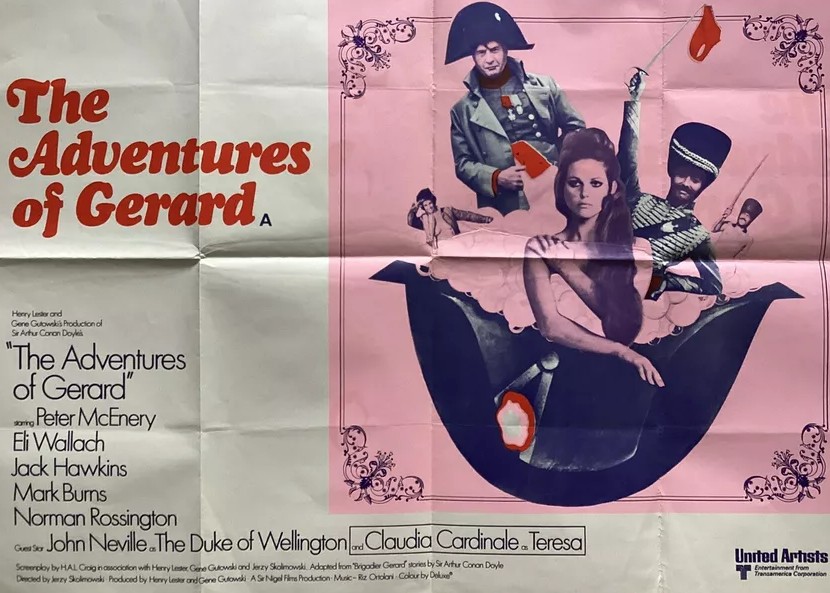
On the basis of Polish director Jerzy Skolimowski winning the Golden Bear at Berlin for Le Depart / The Departure (1967) starring Jean-Luc Godard protege Jean-Pierre Leaud – and its subsequent arthouse success – UA bequeathed him big-budget The Adventures of Gerard (1970), set during the Napoleonic War, based on a book by Sherlock Holmes creator Arthur Conan Doyle, and headlined by rising British star Peter McEnery (Negatives, 1968) and established Italian import Claudia Cardinale (The Professionals, 1966) and a supporting cast including Jack Hawkins and Eli Wallach.

“The picture turned out to be one of the worst disasters in the history of the company,” the company directors told the shareholders. “It was the result of reliance on one of the new fashionable foreign film directors. The picture was beset by problems due to the unprofessional excesses…indulged in by the director.” The outcome was a movie that could not be reshaped into a “more acceptable form” and that ending up occupying “a limbo area between adventure and farce.” Prospects were so poor, the studio doubted if it would even recoup marketing and advertising costs never mind any of the production costs.

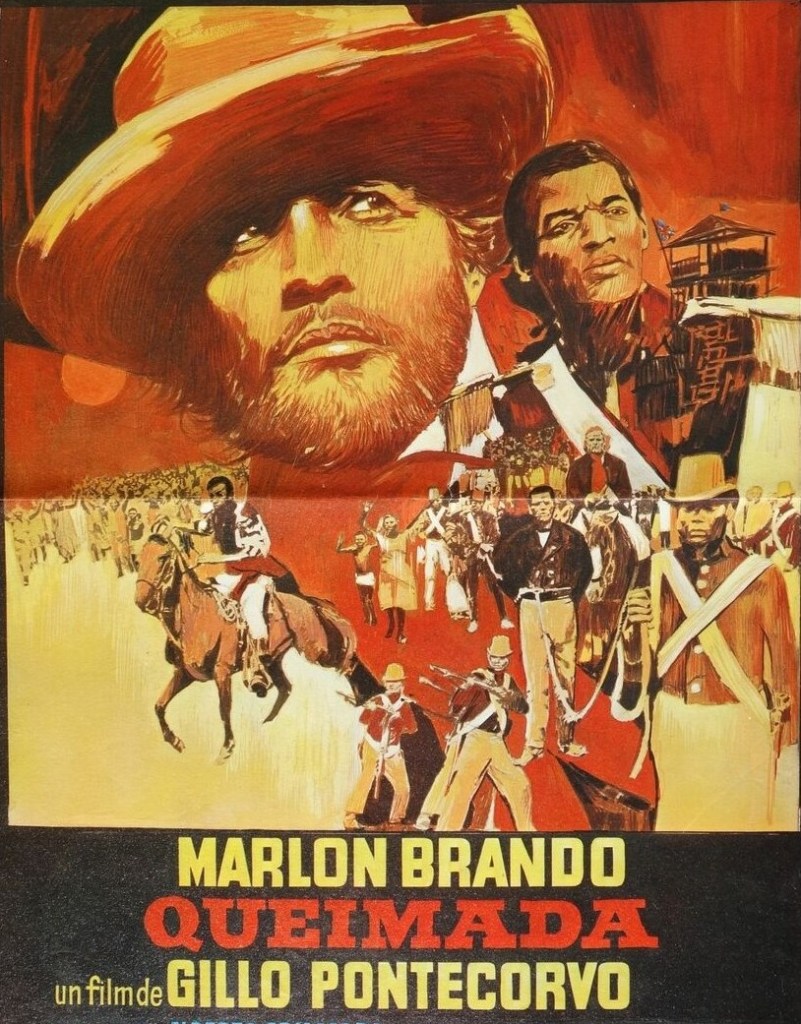
Theoretically, Burn! / Quiemada (1969) should have fared better. At least it had a proper star in Marlon Brando, even though his marquee value was being questioned. This had been placed in the hands of Italian director Gillo Pontecorvo whose The Battle of Algiers (1966) had been nominated for the Best Foreign Language Film Oscar. The studio had hoped to “combine interesting message with entertainment values.” However, personality conflict between director and star saw the picture to go “way over budget.” Prospects remained dim because “despite all efforts to persuade the director to reduce it to realistic length,” it was deemed overlong and “badly cut.” It fell between the stools of the arthouse audience who would have appreciated the message and the action audience who would have welcomed the more commercial elements. It was marked down for “a substantial loss.”

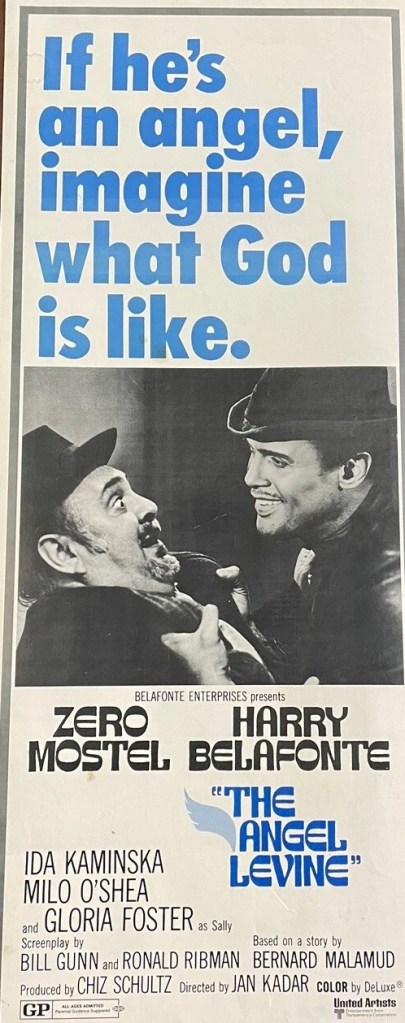
On the strength of a nomination for the Palme D’Or at Cannes for The Shop on Main Street (1965), the studio backed a project by its Hungarian director Jan Kadar.  The Angel Levine (1970) attracted investment because the director had achieved “a certain cult,” the recording career of star Harry Belafonte had reached new heights, and the story was supposed to have a special appeal to ethnic groups. “Everything went wrong. The direction and performance came out slow and leaden. The story…didn’t work.” The picture was over budget and overlong. “The director could not be persuaded to make the necessary cuts” resulting in expectation of another “substantial loss.”

Italian director Elio Petri had enjoyed cult success with the offbeat sci fi The 10th Victim (1965) starring Marcello Mastroianni and Ursula Andress. For A Quiet Place in the Country (1968) he had lined up top British Oscar-nominated actress Vanessa Redgrave and rising Italian star Franco Nero who had played lovers in Camelot (1967). It was greenlit at a time when the studio believed there was a wider market among discriminating audiences for foreign films previously restricted to arthouses. But it had become clear that films in this category faced “inevitable loss.”

You probably haven’t heard of That Splendid November (1969), greenlit to “fulfill a pay-or-play commitment to Italian star Gina Lollobrigida” (Strange Bedfellows, 1965). While targeting the European market, it was hoped it would do additional business in America. It didn’t. Once again, the director (Mauro Bolognini) was allowed too much leeway. He had not been “persuaded to make the changes that would improve its chances” while the studio discovered that La Lollo had lost her marquee luster.

However, United Artists had also committed to potential “breakout” pictures, foreign movies aimed at American arthouses. The bulk of the overseas pictures that had thrived in the U.S. had done so via the arthouse circuit after being favorably reviewed by critics. These were considered relatively low-cost and low-risk investments. But, as events proved, these were as big a gamble as more high-budget projects.

Red, White and Zero / The White Bus (1967) proved “an utter failure” despite the presence of three top British directors, Lindsay Anderson (This Sporting Life, 1963), Oscar-winner Tony Richardson (Tom Jones, 1963) and Peter Brook. Although made for the arthouse market, these proved fewer in number than anticipated when the film was greenlit.

A French heist film entitled Score “would not be made today,” admitted the UA executives. Hoping to capitalize on the caper genre, the studio discovered no one was interested. Three French pictures, Philippe de Broca’s Give Her the Moon (1970) starring Philippe Noiret, The American and Lent in the Month of March (1968), were written off due to the softening of the arthouse market, as was Yugoslavian number It Rains in My village (1968) starring Annie Girardot. French/Brazilian Pour Un Amour Lointain (1968), “one of the poorer foreign pictures,” had such dismal prospects it was denied U.S. distribution. German picture Gentlemen in White Vests (1970) lacked appeal even its home market.

SOURCE: “Comments supplementing notes to Balance Sheet and Statement of Operations of United Artists Corporation for 1970,” United Artists Archive, Box 1 Folder 12 (Wisconsin Center for Theater and Film Research).

Behind the Scenes: “Judgement at Nuremberg” (1961)

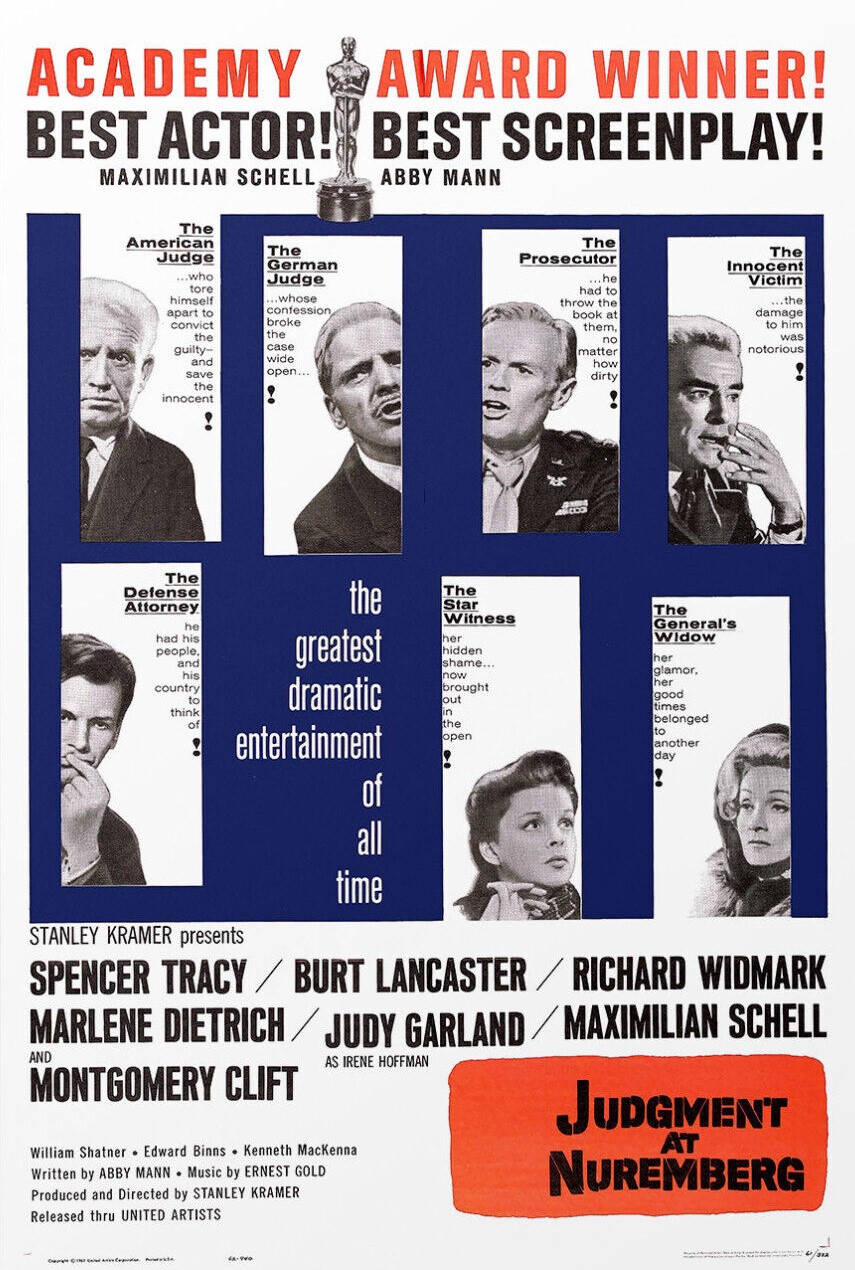
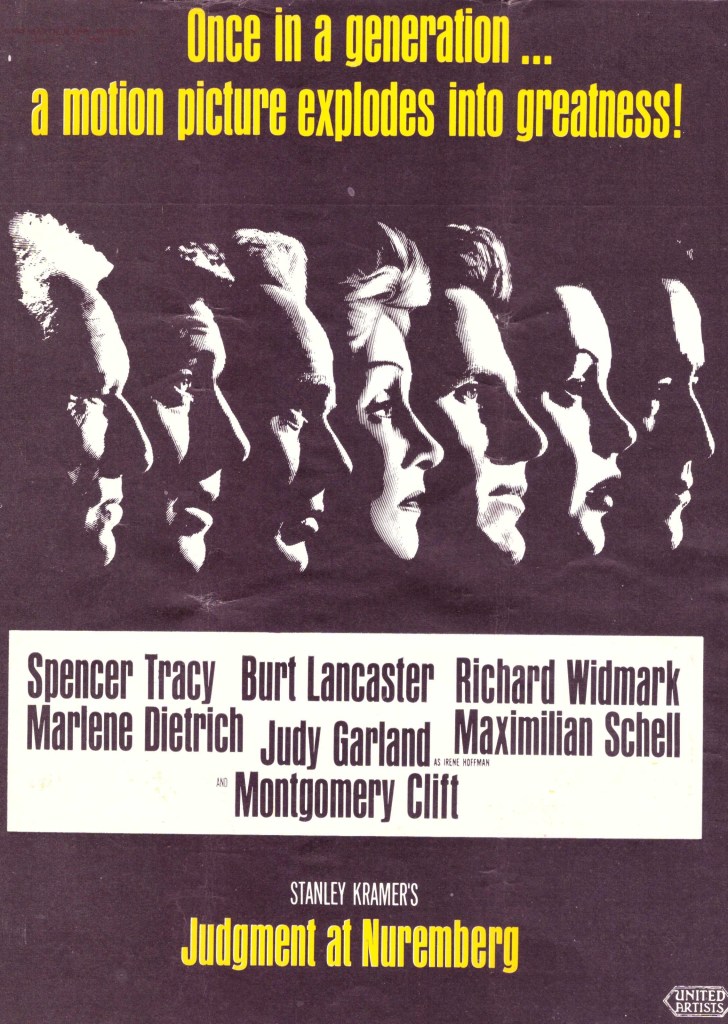
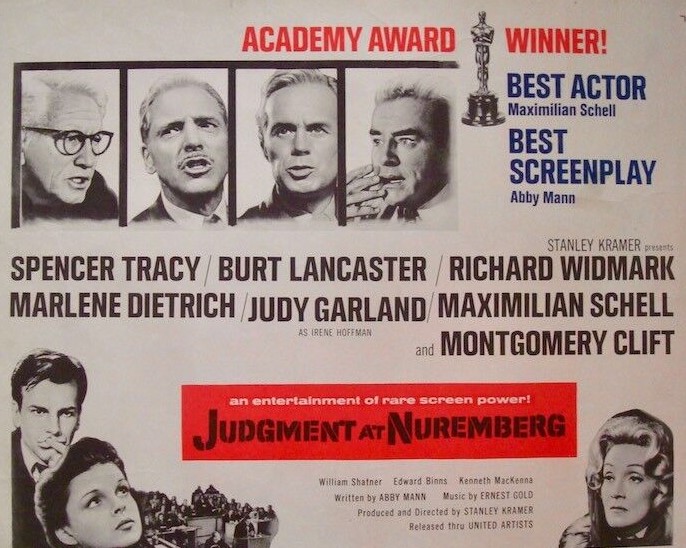
Laurence Olivier could have played a Nazi long before his celebrated villainous turn in Marathon Man (1976). He was producer-director Stanley Kramer’s first choice to play Chief Judge Dr Ernst Janning. He turned the role down in favor of getting married to actress Joan Plowright. Kramer had already decided an all-star cast was required to attract an audience for the grim picture.

The screenplay was an extended version of Abby Mann’s teleplay that had screened on the ABC in 1959. Although Marty (1955) had transitioned with box office and critical success from television to cinemas, that boom was long over.

United Artists, with whom Kramer had a multi-picture deal, were not keen. “I did what looked like a compromise to them, but what I had been planning to do anyway. I promised to fill the cast with stars of such magnitude that their presence would almost guarantee the film wouldn’t lose money.”

There were a couple of other obstacles to overcome. A stage version of the teleplay was being planned for London and Paris and Kramer had to take out an injunction against a documentary with a similar title, Verdict at Nuremberg.

Kramer was known as an issues-driven director, his debut Not As a Stranger (1955) tackling the medical profession, The Defiant Ones (1958) racism and in On the Beach (1959) nuclear war. Along with Otto Preminger, he was viewed as a director of “worthy” pictures, not always a recommendation in the eyes of the critics, but as long as the movies made money and attracted Oscar interest likely to remain attractive to studios. Kramer was just about the only producer (High Noon, 1952, and The Caine Mutiny, 1954, on his calling card) who made a successful career-long transition to direction.

With the exception of Olivier, replaced with Oscar-winner Burt Lancaster (Elmer Gantry, 1960) – not incidentally second choice either, the director preferring to have used a German actor – Kramer hired all his first choices. Spencer Tracy, in fact, was the first recruit. After working with him on Inherit the Wind (1960), Kramer got it into his head when considering a picture to ask himself what part there might be for Tracy.

The actor provided “A depth and candor that would make people notice.” Maximilian Schell (Topkapi, 1964) reprised the role he had essayed on television, a man “living in a complicated gray zone.”

Kramer had a reputation for hiring singers and dancers – Gene Kelly, Fred Astaire, Frank Sinatra –  for dramatic roles and he continued in that vein by hiring Judy Garland. It was a difficult decision. He theorized that “the very disorders that made it difficult to work with her fitted perfectly with the role.”

You could have said the same of Montgomery Clift (Freud, 1962), “reduced almost the level of the unsound person he was portraying.” Given the actor’s problems remembering lines, Kramer allowed Clift to basically ad lib, when attacked on the witness stand permitted to reach “for a word in the script” that appeared the correct emotional response to “convey the confusion in the  character’s mind.”  While Clift did not often adhere to the script, whatever he said worked well enough. Rarely has a director been so sympathetic to a troubled actor. “He needed someone to be terribly kind,” said Kramer, “someone who would consistently bolster his confidence and tell him he was wonderful.

Marlene Dietrich, who had firsthand experience of Nazi Germany at first hand, having fled the country, actually knew the general whose wife she was portraying, which helped to “deepen my understanding of the emotions of Hitler’s victims,” conceded Kramer. Opening up about her experiences and fears allowed Kramer to extend the scope of the character.

While the courtroom where the original trial had taken place was not available for hire – it was in current use – Kramer was permitted to measure and photograph the room to reconstruct it on a soundstage. Only 15 pr cent of the movie was shot in Germany.

The experience of filming Inherit the Wind, another courtroom drama, taught Kramer the need to have fluid camerawork since talk and gesture tends to be static. “I learned to move the camera often to achieve a sense of movement for the viewer.”

Abby Mann was required to open up the teleplay, move the action outside the courtroom – scenes in the judge’s accommodation, on the derelict streets, in restaurants – and avoid cinematic claustrophobia and making it a “pious sermon.” “In my opinion,” argued Kramer, “Judgment at Nuremberg conveys a moral not always honoured, then or now, in the world of politics.”

Kramer had a particular method of pre-production. He built all his sets six weeks before filming began. As part of that process, he sat down with his cinematographer and went through the script scene by scene working out the lighting and camera positions. Then he called in the actors and took them through the sets and roughly his shooting thought-process, taking on board any queries and suggestions.  Film like this “sort of demanded it be shot in sequence with a single camera,” explained cinematographer Ernest Laszlo  (Fantastic Voyage, 1966).

The 360-degree turning of the camera was not as revolutionary as you might imagine – although, according to critics, Michelangelo Antonioni invented it for The Passenger (1975). Laszlo had done if before on The Hitler Gang (1944) for director John Farrow. But this was infinitely more complicated set-up with the revolving camera in constant use to allow Kramer the required fluidity.

“I used two key lights,” said Laszlo. “Shooting this I used one and then as we went round I used the other.” It wasn’t as simple as it sounds, the lights needed to be positioned with mathematical precision so the audience wasn’t aware of any change in the lighting.

“The circling camera saved us photographically,” said Kramer, preventing the picture from seeming “slow and cerebral.” As smooth as it appears on screen it was cumbersome. The entire crew involved had to carry cables and equipment round in a circle. But it permitted Kramer to pick up the judges without cutting to them.

Kramer also used the camera to achieve another transition. As the picture began, German actors spoke in German (with translators offscreen) to show the trial was mostly in German. But for the movie to work, the dialog needed to be in English. “We started the transition scene with Schell addressing the court in German. Laszlo’s camera zoomed in on him, then turned elsewhere, then turned again to Schell so that we were able to switch his speech from German to English in perfect cadence as the camera came in on him the second time. His English picked up from his German so naturally you could almost let it pass without noticing.”

Kramer conceded there might, in fact, be “too much camera movement.” But that was in part dictated by a “very authentic situation, a long courtroom, very wide, and the spacing between the original attorney’s box and the witness box was at least forty feet. That’s a long distance if your try to photograph it.” Also, it wasn’t like a normal Hollywood or American trial, where the lawyers can prowl in front of judge and jury. Here, the attorneys could not move from their box.

“Unless you want to play ping-pong in the cutting room, you have to move the camera…I felt trapped by these three positions – the judges, the attorneys and the witnesses in that big spread. So, the forty feet was compressed to twenty-eight feet. We had to put a lot of light on the far figures to hold the forms in focus,” resulting in the actors “perspiring a lot during these shots.”

The movie, rolled out as a roadshow, did better than expected, the all-star cast proving a major draw, global box office netting a healthy profit. Schell won the Oscar as did Abby Mann, Kramer was nominated in his dual capacity as producer and director.

SOURCES: Stanley Kramer, It’s a Mad, Mad, Mad, Mad World: Life in Hollywood (Harcourt Brace & Company, 1997) p179-197; Donald Spoto, Stanley Kramer Film Maker (Samuel French, 1990)p230-233;  “An AFI Seminar with Ernest Laszlo, American Cinematographer, January 1976, p52; “Judgment at Nuremberg Still Slated for Legit,” Box Office, February 3, 1960, p6; “Kramer Gets Injunction,” Box Office, December 11, 1961, p14.

https://amzn.to/3Mkl7v5

Behind the Scenes: Sherlock Holmes and Other Stories, Thumbs Up or Thumbs Down, United Artists 1966 – Part Two

Although Billy Wilder had written a script based on The Life of Sherlock Holmes, he was not considered as its director. Mirisch was looking at a budget in the region of $2 million, which would rule out any big star. However, there were issues with the Conan Doyle Estate which was in the process of firing up other movies based on Sherlock Holmes, A Study in Terror (1965) being the most recent. That had been the brainchild of Henry Lester and perhaps to general astonishment these days Mirisch had  agreed Lester would be allowed to make more Sherlock Holmes pictures as long as they remained very low-budget, on the assumption, presumably, that the marketplace would treat them as programmers rather than genuine competition.

However, Mirisch and UA retained the upper hand as regards the Conan Doyle Estate and “could cut him (Lester) off at such time as we have made definite plans to proceed.”

There was another proviso to the deal. The Estate would agree to forbid any further television productions unless Mirisch decided it wished to go down the small screen route itself. It was odd that Mirisch had eased Billy Wilder out of the frame given the mini-major had enjoyed considerable success with the director on Some Like it Hot (1959) and The Apartment (1960), a commercial partnership that would extend to The Fortune Cookie (1966).

Instead, Mirisch lined up British director Bryan Forbes who would be contracted to write a screenplay based on the Wilder idea. The sum offered – $10,000 – was considered too low, but it was intended as enticement, to bring Forbes into the frame as director. If Forbes refused to bite, “the only other name suggested and agreed upon was that of John Schlesinger.”  Although David Lean was mooted, UA were not in favour. Mirisch didn’t want to risk paying for a screenplay before there was a director in position.

The offer of the Sherlock Holmes picture was seen as a sop to Forbes. At this meeting, Mirisch had canned The Egyptologists, a project which Forbes believed had been greenlit. And why would he not when he was being paid $100,000 for the screenplay. In bringing the project to an untimely close Mirisch hoped to limit its financial exposure to two-thirds of that  fee. Should Forbes balk at Sherlock Holmes, he was to be offered The Mutiny of Madame Yes, whose initial budget was set at $1.5 million, plus half a million for star Shirley Maclaine. Another Eady Plan project, this was aimed to go before the cameras the following year. If Forbes declined, then Mirisch would try Norman Jewison with Clive Donner and Guy Hamilton counted as “additional possibilities.”

As for Billy Wilder he had much bigger fish to fry. He was seeking a budget of $7.5 million to adapt into a film the Franz Lehar play The Count of Luxembourg to pair Walter Matthau and Brigitte Bardot. Should Matthau pass, Wilder would try for Cary Grant (whose retirement had not yet been announced) or Rex Harrison. Both sides played negotiation hardball. UA currently in the hole for $21 million for The Greatest Story Ever Told (1965) and Mirisch, having pumped $13 million into the yet-to-be-release Hawaii (1966), didn’t want to commit to another unwieldy expensive project. So Mirisch insisted the project advance on a “step basis” allowing UA to reject the project after seeing the screenplay. Wilder countered by insisting that if it went into turnaround he, rather than the studio, would have the right to hawk it elsewhere (generally, studios tried to recover their costs if a movie was picked up by another studio). But Wilder was also in placatory mood and even if UA rejected this idea he was willing to work with the studio on a Julie Andrews project called My Sister and I.

However, UA and Mirisch were all show. “After Billy left the meeting,” read the minutes, “it was agreed we would not proceed with The Count of Luxembourg since we did not want to give Billy the right to take it elsewhere if United Artists did not agree to proceed.” Harold Mirisch was detailed to give Billy the bad news, but use a different excuse.

Mirisch was also on the brink of severing links with Blake Edwards. Negotiations for a new multiple-picture deal were to be terminated, which would mean the director would only earn his previous fee of $225,000 for What Did You Do in the War Daddy? It was also sayonara for Hollywood agent Irving Swifty Lazar, whose current deal was not working out to the studio’s satisfaction.

Other long-term deals with directors were under discussion. While its previous John Sturges movie, The Hallelujah Trail (1965), had flopped, UA was still keen on the Mirisches pursuing a long-term deal with the director, feeling that he was a “good picture-maker with the right project.” To that end, it was suggested Mirisch reactivate Tombstone’s Epitaph, but emphasising Stuges had to bring the cost down.

At this point nobody knew Norman Jewison was embarking on all almighty box office roll – The Russians Are Coming, The Russians Are Coming set to hit the screens, In the Heat of the Night at screenplay stage, so Mirisch was prescient in trying to put together a long-term deal with the director. Wind on Fire and Garden of Cucumbers were seen as tentpoles for a multi-picture deal. Mirisch had already agreed a $50,000 producer’s fee for Wind of Fire, payment of one-third of which was triggered for supervising the screenplay.

The meeting also gave the greenlight to Death, Where Is Thy Sting-A-Ling, a project that would be later mired in controversy with shooting ultimately abandoned. The go-ahead was given with the proviso the Mirisches secured the services of Gregory Peck or an actor of his stature.  Budget, excepting Peck’s fee, was just over $3 million and it was another one hoping to take advantage of the Eady Plan.

This kind of production meeting was probably more typical than you would imagine, studios trying to keep talent sweet while not committing themselves to dodgy product. It’s perhaps salutary to note that of the projects under discussion, only a handful found their way onto cinema screens. Garden of Cucumbers (as Fitzwilly), How To Succeed in Business, having met budget restraints, and Tombstone’s Epitaph (as Hour of the Gun) with James Garner all surfaced in 1967 and Inspector Clouseau the following year. Neither of the Steve McQueen projects survived nor the pair proposed by Billy Wilder. High Citadel, Saddle and Ride, The Narrow Sea, The Great Japanese Train Robbery, and The Cruel Eagle failed to materialize. Billy Wilder eventually made The Private Life of Sherlock Holmes under the Mirisch auspices but not until 1970. 

Behind the Scenes: Thumbs Up or Thumbs Down, United Artists 1966 – Part One

Most observers don’t have a clue why some films are made in preference to others, or even of which movies have sat in turnaround hell for years. When I was researching my book The Making of The Magnificent Seven I came across some priceless material that gave some clues regarding the process. An “Inter-Office Memorandum” dated February 3, 1966, provided an insight into how independent producers Mirisch, then allied to studio United Artists, set about giving the thumbs up or thumbs down.

The memo referred to a meeting held at the Beverley Hills Hotel on January 29-30, 1966, attended by the three Mirisch Brothers – Harold, Marvin and the recently-deceased Walter – as well as UA head honcho Arthur Krim, Herb Jaffe and David Picker. On the agenda: Inspector Clouseau, Sherlock Holmes, The Mutiny of Madame Yes, The Egyptologists, Garden of Cucumbers, Wind on Fire, High Citadel, Saddle and Ride, The Narrow Sea, The Great Japanese Train Robbery, Lydia, In the Heat of the Night, The Cruel Eagle, How To Succeed in Business, and Death, Where Is Thy Sting-a-Ling.

Separately, the group examined commitments to various talents including John Sturges, Norman Jewison, Bryan Forbes and Billy Wilder.

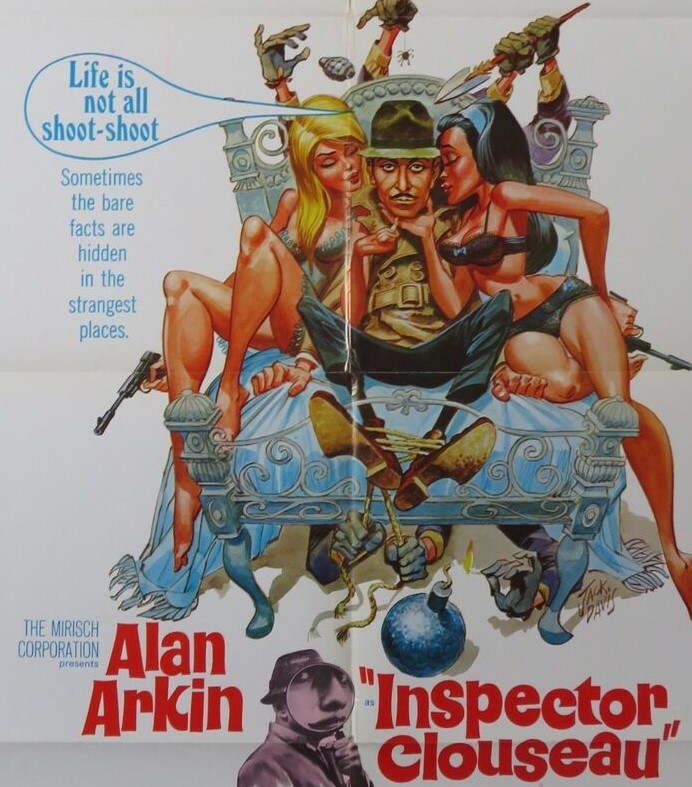
Top of the agenda was Inspector Clouseau, a sequel to the successful Pink Panther series, from which Peter Sellers had withdrawn. The budget was set at $3 million including $466,000 for director and star. Alan Arkin was not yet a lock, UA reserving its opinion on Arkin’s marquee’s credentials until it saw how The Russians Are Coming, The Russians Are Coming (1966), in which he was the star, performed at the box office. Should it bomb, second choice was Zero Mostel. Jonathan Winters, viewed as a “questionable choice,” was also in the running. Clive Donner was the preferred director. If he passed, next up was Guy Hamilton. (In the end both rejected the offer and it was released in 1968 with Bud Yorkin at the helm.)

Two projects on the table were mooted as vehicles for Steve McQueen. The first, Wind of Fire, was intended as “immediately following Sturges’ racing picture.”(This was Day of the Champion but a legal battle with MGM would derail this and McQueen was five years away from releasing Le Mans). Wind of Fire, to be directed by Norman Jewison, suffered from an incomplete script which restricted discussion. John Wayne had shown an interest but UA “was not really interested in Wayne,” possibly as a result of the fall-out from The Alamo (1960). The second McQueen project was the thriller Lydia based on the book by E.V Cunningham (the pseudonym of Howard Fast of Spartacus fame). Here, the script was complete and in the actor’s hands. Doris Day had been touted for female lead but Mirisch had nixed her involvement. When dealing with any major star, greenlighting a picture depended on schedules not clashing. (In the end neither project saw the light of day.)

Mirisch was also juggling two properties to star Dick Van Dyke.  The Great Japanese Train Robbery was due to commence filming in June 1966, although that meant cooperation from Columbia and Disney who had first call at that point on the actor; Disney had excused him, Columbia had not. Virna Lisi, the intended female lead, was dunped for demanding too much money, $300,000 her current asking price. In her place were suggested Claudine Auger, Catherine Deneuve, Stefania Sandrelli or Luciana Paluzzi. Although the budget was approved at around £3.3 million, the movie never went ahead.

Garden of Cucumbers with Van Dyke, though minus a female lead, was already scheduled to start shooting in August-September 1966. Proposed director, in order of preference, was Norman Jewison, Arthur Hiller or Elliott Silverstein. This project did make it over the line though the title, changed to Fitzwilly, was helmed by Delbert Mann and co-starred Barbara Feldon in her biggest role to date.

A budget of $1.89 million had been set for High Citadel, based on the Desmond Bagley thriller. UA was locked into a pay-or-play deal, which meant star James Garner would receive his salary whether or not the picture was made. However, there was a get-out clause. The studio could use Garner for another picture as long as it slotted into the same timeframe. The other options were Saddle and Ride and The Narrow Sea. Of these Mirisch preferred the former, UA the latter. But there was a directorial issue with The Narrow Sea. Mirisch had a moral commitment though not a legal contract with producer Robert Relyea to make this his directorial debut and UA didn’t want him. (In the event neither film was made.)

There were budget issues on How To Succeed in Business. UA had given the go-ahead on the basis that it would cost no more than $3.25 million but the budget had since soared by over half a million. To meet the May 1 start date, the budget had to be trimmed back to the original amout. (This was presumably done, since the movie appeared the following year). In the Heat of the Night was in the early stages of development, the production company still to see the Stirling Silliphant script, but at this stage no objections were raised. Fred Zinnemann was being considered as the director of The Cruel Eagle by Frederick E. Smith, author of 633 Squadron. (It was never greenlit).

Making movies in Britain – in order to take advantage of the tax advantages of the Eady Plan – was central to the Mirisch strategy. While Inspector Clouseau, Death, Where Is Thy Sting-a-Ling,  and The Mutiny of Madame Yes– budgets totalling around the $10 million mark – were already committed to the Eady Scheme, Mirisch was also seeking backing to set up a low-budget unit in Britain to maximize the government’s largesse. Budgets per picture would be limited to $1 million or less. In the memo they were described as “disciplined” or “service” pictures to be “produced in color.” In essence that meant basic programmers that could be sold to drive-ins and cinemas with a high movie turnover, on a rental basis if they topped the bill, for a flat fee if they were supports. This would have the added benefit, for those houses whose customers demanded a double bill, of being able to offer a program where all the revenue would end up in the Mirisch pocket.

Behind the Scenes: When “Worldwide” Didn’t Exist – Global Box Office Part One

Box office fans, excited no doubt at how Avatar: The Way of Water (2022), is charging up the all-time charts, might be surprised to discover that the concept of “worldwide” box office figures didn’t exist in the 1960s. Although foreign markets had proved important to Hollywood since the 1940s, there was no accepted way of measuring their impact.

Box office results in certain countries – Italy, France, Brazil, Australia etc – were reported only on an occasional basis and were never considered front page news. Global box office figures were more likely to appear courtesy of one of the profit participants. Star William Holden’s share of Bridge on the River Kwai (1957) and producer Sam Spiegel’s earnings on Doctor Zhivago (1965), for example, were widely reported. Or a studio might want to defray rising investor discontent by pointing how well a Stateside flop such as The Magnificent Seven (1960) had performed overseas.

But these were one-offs and it was impossible to get a handle on the worldwide results for an entire year of Hollywood output. The kind of global box office reporting we take for granted did not appear until the 1990s and often even then, for many pictures, it was only as a year-end figure.

However, during my digging into hordes of records for my book The Making of “The Magnificent Seven” I came upon a tranche of reports on foreign box office figures relating to United Artists for the years 1965 to 1969. And they make for fascinating reading, not least to discover which Stateside hits did poorly abroad and, conversely, what flops in the domestic market made up for it in foreign countries.

Volume of production at UA more than doubled over the period, from 17 pictures in 1965 to 38 in 1969, but the average budget came down from $3.68 million per movie to $2.14 million. 

You won’t be surprised to learn that James Bond pretty much reigned supreme, taking three of the top four spots. But you might be taken aback to discover just how profitable this series was – over $100 million in rentals (the studio share of box office once cinemas have taken their cut) for three movies mentioned here – more than four times what they cost to make, and that would not take into account the colossal revenues accruing from merchandising.

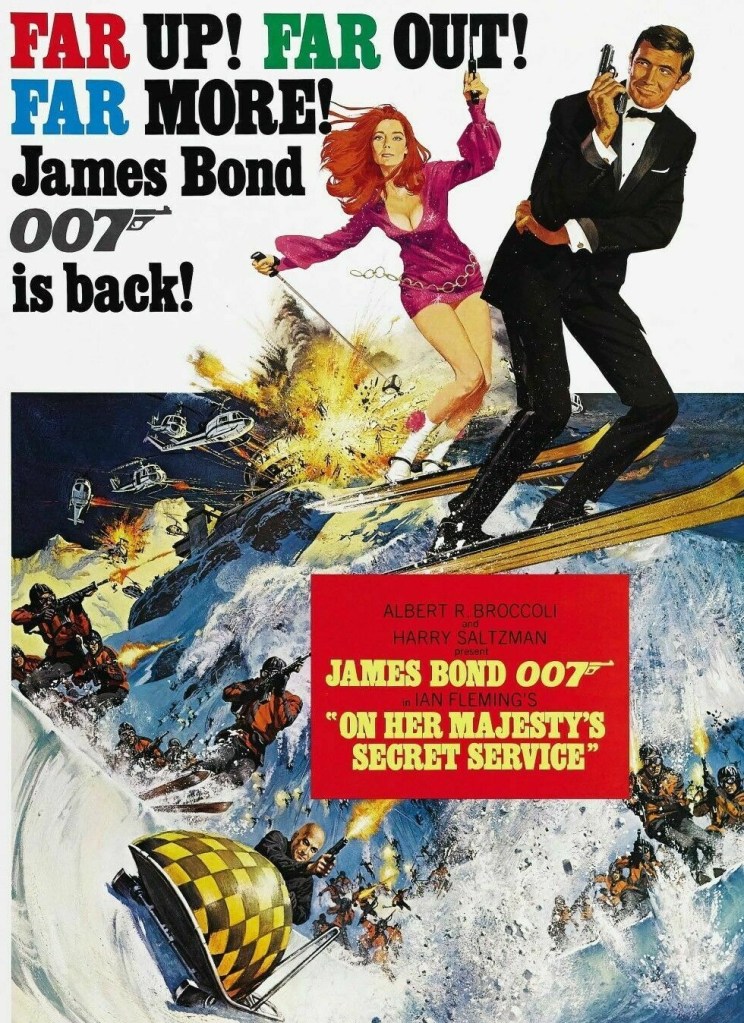
The 1965-1969 worldwide winner by some margin was Thunderball (1965), clocking up $48 million in worldwide rentals. In second place was You Only Live Twice (1967) on $36 million. but the prospect of a cosy one-two-three was nipped in the bud by Oscar-winning Midnight Cowboy (1969) on $26 million with On her Majesty’s Secret Service (1969,) hampered by losing the services of Sean Connery, settling for fourth after pulling in $23 million.

Fifth spot went to big-budget roadshow Hawaii (1966) starring Julie Andrews and Max von Sydow which sank $18.8 million worldwide followed by Norman Jewison’s low-budget crime story In the Heat of the Night (1967) on $16 million helped by Sidney Poitier at a box office peak and Rod Steiger, courtesy of an Oscar, at a career one. Placing seventh was big-budget all-star British World War Two epic The Battle of Britain (1969) which soared, largely on foreign grosses, to $15.5 million. Next, on $14.8 million, came roadshow musical Chitty Chitty Bang Bang (1968) starring Dick Van Dyke. 

Biggest surprise of the year was the performance of family melding comedy Yours, Mine and Ours (1968) with out-of-favor stars Lucille Ball and Henry Fonda which closed in on $13 million. Rounding out the Top Ten was George Stevens’ Biblical roadshow The Greatest Story Ever Told (1965). However, its global figures of $12.1 million were a disappointment given its budget topped $21.2 million.

Just behind, on $12 million worldwide, setting another comedic hot pace, was Clive Donner’s What’s New Pussycat (1965). Despite having no roadshow credentials it boasted an all-star cast consisting of Peter O’Toole, Peter Sellers, Woody Allen, Ursula Andress, Romy Scheider and Paula Prentiss. Comedy also accounted for twelfth – the unfancied, though timely, Norman Jewison effort The Russians Are Coming, The Russians Are Coming (1966) starring Alan Arkin and Eva Marie Saint which coasted in with $11.8 million.

Thirteenth was Steve McQueen-Faye Dunaway romantic thriller The Thomas Crown Affair (1968) directed with considerable elan also by Norman Jewison. That flew in with $11.25 million, a cool million ahead of the second picture, Help!, by British pop sensation The Beatles.

Fifteenth place went to the final picture in the Sergio Leone trilogy The Good, the Bad and the Ugly (1968) starring Clint Eastwood which crested $10.2 million. John Frankenheimer’s World War Two thriller The Train (1965) with Burt Lancaster trying to outfox Paul Schofield tracked $9.75 million. But, as if to emphasize Clint Eastwood’s growing box office power, his first American western Hang ‘Em High came next on $9 million worldwide.

Second World War mission picture The Devil’s Brigade (1968) starring William Holden and Cliff Robertson in a Dirty Dozen-style knock-off paraded $8.6 million for eighteenth position. Comedy filled out the final two places in the Top 20. Jack Lemmon scored a suprise hit in Richard Quine’s How To Murder Your Wife (1965). Co-starring Virna Lisi and Englishman Terry-Thomas it romped away with $8.4 million. Although The Graduate (1967) had been a massive global success, United Artists only held the rights to certain territories but that was enough to pull in $7.7 million worldwide.

There wasn’t actually an informal Top 20 reported by United Artists over this five-year period. I’ve concocted it out of the reports below.

SOURCE: “United Artists Corporation and Subsidiaries Motion Picture Negative Costs for Pictures Released in the Year Ended 1965;” “United Artists Corporation and Subsidiaries Motion Picture Negative Costs for Pictures Released in the Year Ended 1966;” “United Artists Corporation and Subsidiaries Motion Picture Negative Costs for Pictures Released in the Year Ended 1967;” “United Artists Corporation and Subsidiaries Motion Picture Negative Costs for Pictures Released in the Year Ended 1968;” “United Artists Corporation and Subsidiaries Motion Picture Negative Costs for Pictures Released in the Year Ended 1969,” United Artists Files, Wisconsin Center for Film and Theater Research, University of Wisconsin.

The Bond They Couldn’t Sell – “Dr No” (1962)

United Artists almost had to give away this picture in the United States in order to gain bookings. Astonishingly, it was the picture the studio felt it could not sell. And for good reason – the studio hated it. “To them it was a B-picture,” recalled producer Harry Saltzman. “They said Hammer made the same kind of picture for one-third of the price.”

Dr No, produced on a miserly budget of $840,000 – $40,000 over budget –  had triumphed in London after snagging an opening run in 1962 at the Leicester Square Theatre primarily because the cinema needed to fulfil its quota of showing British pictures. Although it set a London box office record that would stand for more than a decade and proved a huge draw throughout Britain, U.S. studio United Artists had been burned once too often by British films that did well at home only to flop spectacularly in America.

Since box office statistics began to be gathered in earnest in the 1930s only a handful of British pictures mustered the $1 million in rentals required for entry into the annual list of box office champions. The bulk of the Ealing comedies had not made the grade, nor had such diverse successes as Doctor in the House (1954), Reach for the Sky (1956), Room at the Top (1959) and Saturday Night and Sunday Morning (1960). American audiences rejected British films as too slow, technically backward, and with accents it was often impossible to understand. Putting together an advertising, public relations and marketing package for them could easily cost as much as the film itself.

“When we had an answer print ready there were about eight people from United Artists including (chairman) Arthur Krim who came to see it,” Saltzman told Variety a quarter of a century later. “We started the film at 10am and when it was over a few minutes before twelve the lights came up and nobody said anything except a man who was head of the European operation and he said, ‘the only good thing about the picture is that we can only lose $840,000.’ Cubby (Broccoli) and I were just shattered,” confessed Saltzman.

That didn’t stop Saltzman and Broccoli embarking on their own campaign to raise awareness. They went right to the heart of the American exhibition community, taking space at the annual Show-a-Rama event in Kansas City in March, bringing along Sean Connery and models to represent the Bond girls. In addition, around the same time UA held a sneak preview in New York attended by the likes of Johnny Carson, Zsa Zsa Gabor and Rudy Vallee i.e. not that high-falutin’ an audience but at least the festivities were filmed and broadcast on NBC Monitor and Armed Forces Radio. Sean Connery also featured in a 12-minute segment in the middle of ABC Sunday Night at the Movies.

The Bond promotional bandwagon set up shop for a couple of days each in New York, Chicago and Los Angeles between March 7 and March 15 and pulled in journalists from the surrounding areas. There was also a touring show comprising 150 stills. And the marketeers had some success in targeting exhibitors through the trade magazines although the two-page article featuring in Box Office attempted to interest exhibitors on the basis of a marketing campaign in Connery’s native Scotland, which hardly seemed to be ideally suited. Nor did the marketing team really care what tricks exhibitors pulled to bring in the customers – for no particular reason one cinema employed a safe-cracking stunt even though the film’s story did not lend itself to that.

Dr No’s biggest marketing tools were photos of Ursula Andress in a bikini and copies of the Ian Fleming novels which since 1961 had the endorsement of President John F. Kennedy. Cheap paperbacks sold in drug stores and newsstands had created greater awareness of the character as well as acting as unpaid advertising for the forthcoming film.

But, basically, that was as much – or as little – as the film had going for it. In effect, no great marketing energy.

As it happened, exhibitors were beginning to organise their own marketing programs – “box office building campaigns” – and the Bond team were able to convince exhibitors in the Midwest and Southwest to kick off the idea with Dr No.

That meant shifting away from the conventional release pattern where a film opened in one cinema in a big city and then fanned out week-by-week to smaller venues and towns. Instead it was everywhere all at once which meant it cannibalized its own audience since it could not be held over in any cinema for a further week because the prints were already scheduled elsewhere.

Although most historians pinpoint New York as the launch pad for Dr No, United Artists did not want to risk the picture potentially flopping in that territory.  According to Harry Saltzman the first commercial showing, effectively a trial run, was in Atlanta, Georgia, where it ran for eleven weeks and was considered a success. But not enough for UA to consider shifting its release strategy. A movie that launched anywhere other than New York was considered a dodgy proposition.

From May 8 it was launched in 450 cinemas in the Midwest and southwest. This was the same release strategy as had been employed on another film about which UA had its commercial doubts – The Magnificent Seven (1960) – and that had turned into a flop. It opened in New York in June in 18 cinemas including two in the city centre, the Astor and the Murray Hill, both arthouses.

But here’s the kicker.

In order to get the bookings, United Artists had to dramatically lower its asking price.

Normally new pictures were sold to exhibitors on a 50/50 basis – meaning the studio received 50 per cent of the gross. “The funny things is,” recalled Saltzman, “they booked it for 30 percent. The theaters took it at first because they got it for 30 per cent.” That meant UA sold Dr No to cinemas on the basis that any exhibitor booking the picture would retain 70 per cent of the gross.

This was not unheard-of. In fact, it was often the standard deal for foreign movies going into arthouses. But arthouse pictures with the occasional exception of a La Dolce Vita were usually hard sells to a very finite audience. James Bond was anything but.

As a result of this approach, the movie did not register particularly well on the annual box office rankings. In fact, it placed 42nd. Not a disaster, but not a particularly brilliant showing. However, that did not represent the film’s true appeal. Had it been sold on a 50/50 basis, the rentals would have been high enough to pitch it just outside the Top 20, which would been seen as a genuine success. On the other hand, if UA had not been so generous in handing the exhibitors the bigger share of the box office, perhaps it might have elicited far fewer bookings and the James Bond story might have been completely different.

SOURCES: “United Artists Sell Campaign in Its Dr No Film,” Box Office, February 25, 1963, p10;  “Festivities Mark Dr No Sneak Preview in New York,” Box Office, March 11, 1963, pE-2; “450 Situations Play Dr No at Opening,” Variety, April 3, 1963, 19; “Producer Saltzman Faces Big Decision on 2nd James Bond Thriller,” Variety, April 25, 1962, p13; “Feature Reviews,” Box Office, April 1, 1953 pA-11; “Showmandiser: Premiere Showmen Say Yes to Dr No, Ticket Buyers Too,” Box Office, April 29, 1963, pA1; “Harry Saltzman Recalls Early Coolness to Bond Features,” Variety, May 13, 1987, p57; “Dr No in 17 Theatres,” Box Office, May 27, 1963, pE-8; “Picture Grosses,” Variety, June 5, 1963, p10; “Smash Business General for 4-Day Holiday,” Box Office, June 10, 1963, pE-2; “Box Office Barometer,” Box Office, June 17, 1963, pA3; “Safe Crackers Invited,” Box Office, June 24, 1963, pA3.

Discover WordPress

A daily selection of the best content published on WordPress, collected for you by humans who love to read.

The Atavist Magazine

by Brian Hannan

WordPress.com News

The latest news on WordPress.com and the WordPress community.