Tag: Tony Curtis
Behind the Scenes: Selling the New-Look Paul Newman – Pressbook for “The Hustler” (1961)
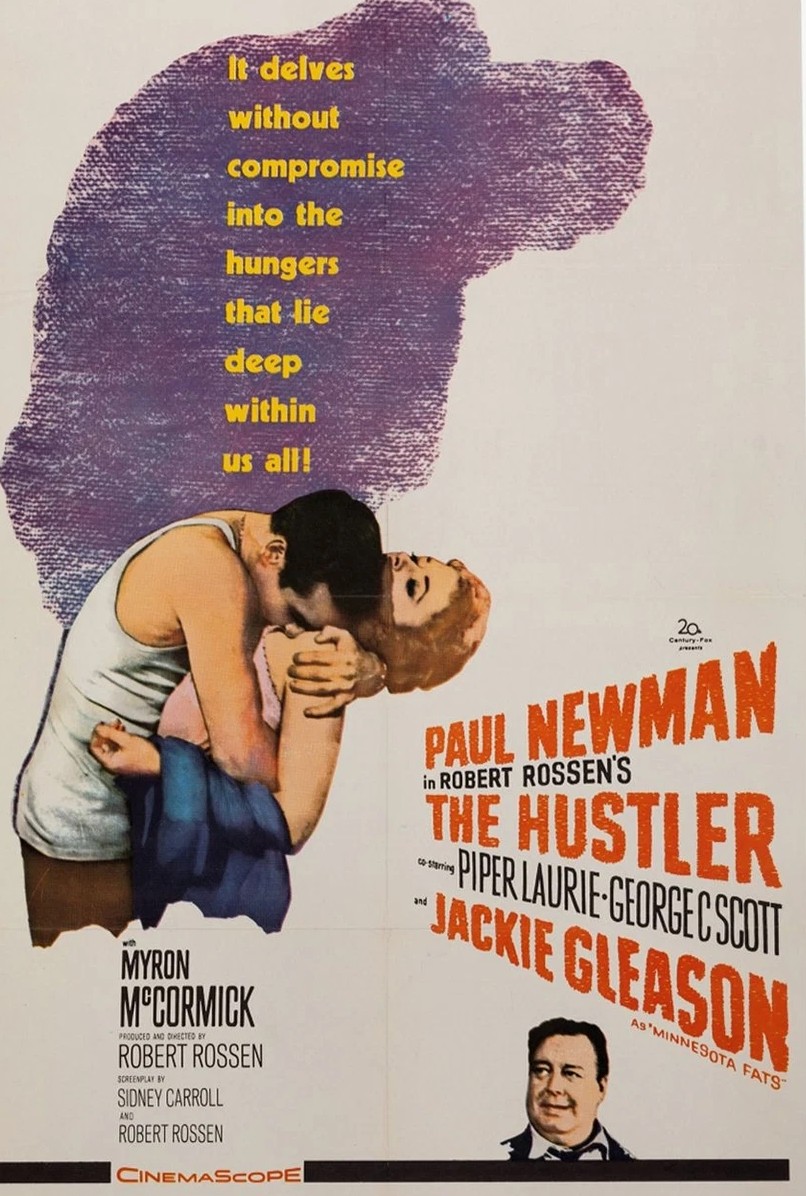
While Twentieth Century Fox head honcho Spyros Skouras initially balked at the title, with its connotations of prostitution, by the time the movie appeared that subject matter was less contentious thanks to critical and commercial big hitters Butterfield 8 (1960) and Never on Sunday (1960). Given that the idea of a movie set in a poolroom was going to be a hard sell to a female audience, despite the marquee lure of Paul Newman, the studio gave marketeers free rein to pitch it as a raw, sex-oriented drama.
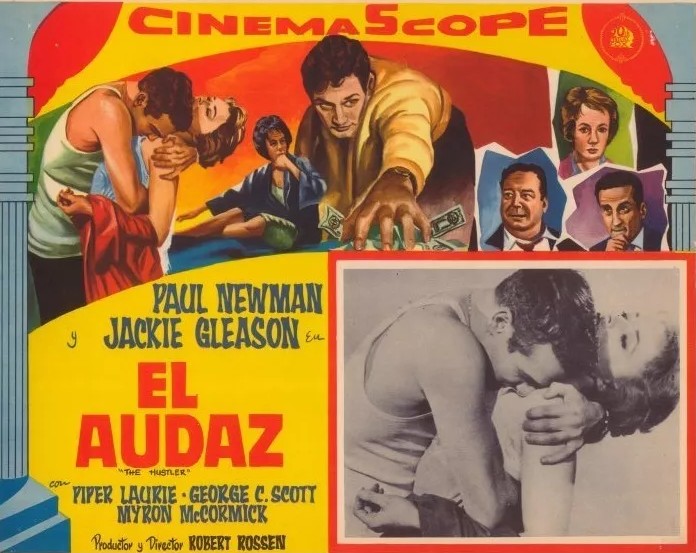
There’s little sign of a pool cue in some of the artwork. Instead, we have Paul Newman lustily nuzzling Piper Laurie’s neck or bosom. The taglines promise something far removed from a sports picture.
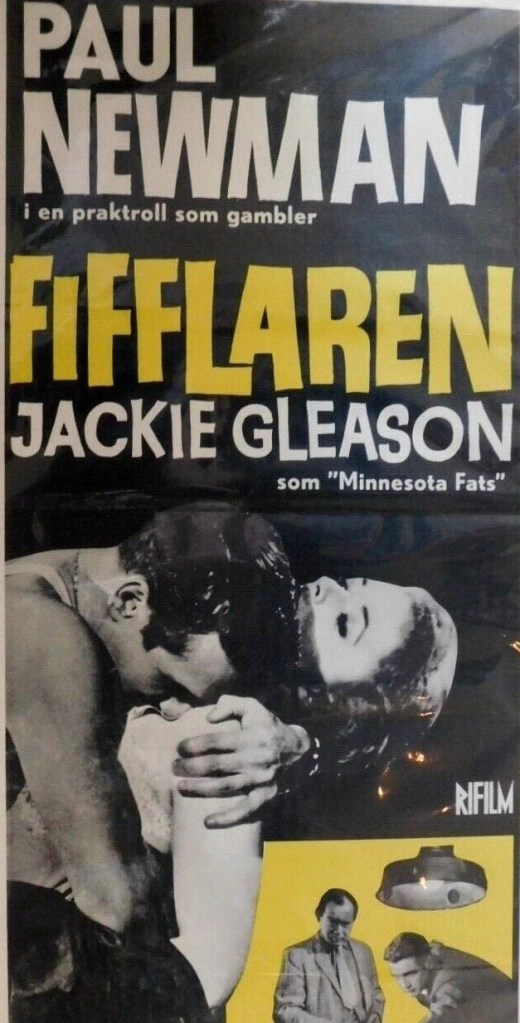
“It probes the stranger…the pick up…the savage realities,” screamed the main tagline. Another tempted with: “It delves without compromise into the inner loneliness and hunger that lie deep within us all!” In other words we’re talking about sex, not love, and casual sex at that, the world of the one-night stand between consenting adults for whom marriage is the last thing on their minds. “The word for Robert Rossen’s The Hustler is prim-i-tive” suggested out of control lust.
Fast Eddie Felson (Newman) has “the animal instinct.” Sarah (Piper Laurie) has a “bottle, two glasses and a man’s razor always in her room.” Bert (George C. Scott) is on the look-out for the “sucker to skin alive.”
Those images which did show a cue and pool balls did not suggest an august sport like football or baseball, not with a tagline like “he was a winner, he was a loser, he was a hustler.”
With such talented actors to hand, the Pressbook wasn’t short of good stories relating to the actual movie rather than the kind of snippets that might appeal to an editor on a slow news day. So we learn that Piper Laurie continually limped, Method-style, around on the set. “When I limp in the picture, I don’t want to act it. It’s something that has to be a part of me, something of which I am no longer conscious, apart from its being a physical defect. I must be able to limp as if I had a bad foot from birth.”
Laurie had made so few pictures that her name wouldn’t be on any director’s wanted list and what she was best known for – ingénue roles when a contract player for Universal (who gave out that she bathed in milk to keep her skin soft) opposite the likes of Tony Curtis – wouldn’t have inspired confidence. Robert Rossen might well have spotted her in two Emmy-nominated performances in successive years including Days of Wine and Roses (1958), but instead said he remembered her for “a sensitive characterization” from a stage production of Rosemary.
Ames Billiards Academy had once been a Chinese restaurant so boasted a balcony. This was unseen in the picture but allowed director Robert Rossen to shoot from widely varied overhead angles. The crew took over the Manhattan Bus Terminal for a day and a night. A row of lunch booths was constructed in front of the existing lunch counter. “It looked so real,” we are told, “that passers-by sat down and waited for their orders to be taken.” A nice story, and the kind often furnished by Pressbook journos, but rather fanciful, since it would be obvious what with the crew milling around and the lights and cameras and miles of cable that this was a movie set with security posted to prevent trespassing.
Just how good a pool player was Jackie Gleason, who came to the picture with a reputation for handling a cue? Well, at one point, the affable television comedian with a top-rated show, potted 96 consecutive balls.
Paul Newman plays the iconic hero as a “figure cut from the fabric of our time.” He had a firm grasp of the character. “With him it’s a question of commitment. He is so wrapped up in his drive to win and be somebody that he has no time to give of himself that which others need. It is a disease of our time, both the ambition and the isolation. I want him to be understood.”
Needless to say there was no mention of author Walter Tevis. That wasn’t so unusual in the make-up of Pressbooks, but if the marketeers these days were looking for something to write about the eclectic Tevis would be prime. He followed up The Hustler, published in 1959, four years later with sci fi The Man Who Fell to Earth, filmed in 1976 with David Bowie. A sequel to The Hustler, The Color of Money, was directed in 1986 by Martin Scorsese with Newman reprising his role and managing Tom Cruise. Tevis also wrote The Queen’s Gambit, turned into an acclaimed television mini-series in 2020 with Anya Taylor-Joy.
Paris When It Sizzles (1964) ***
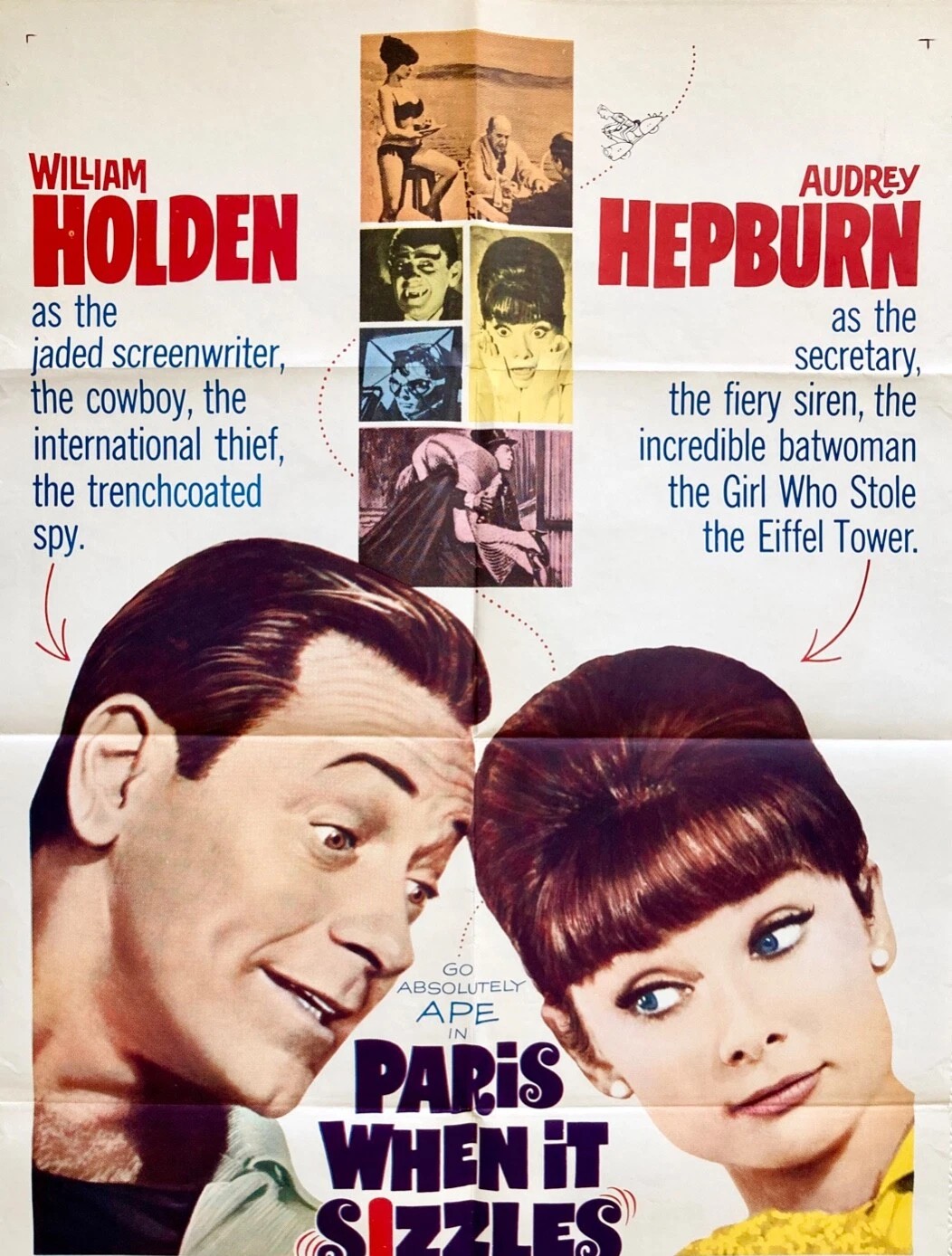
Screen charisma can only get you so far. The pairing of William Holden and Audrey Hepburn must have seemed certain to create a box office tsunami given they had worked together before on the hit Sabrina (1954) and were coming off hits, the former in The World of Suzie Wong (1960) and the latter having reinvented herself as a ditzy fashion icon in Breakfast at Tiffanys (1961). But clearly studio Paramount knew something about the outcome of this production that it was keeping to itself, otherwise how to explain that a movie completed in 1962 languished on the shelves for nearly 18 months.
By the time it appeared Hepburn was still a big box office noise after Hitchcockian thriller Charade (1963) but Holden’s flame was dying out following three successive flops, The Devil Never Sleeps, The Counterfeit Traitor and The Lion all released in 1962. Had the studio played an even longer waiting game and held off release until the end of 1964 when Hepburn was enjoying sensational success with My Fair Lady, audiences might have been more likely to be suckered in to this romantic comedy. Although whether they’d be any more appreciative is doubtful.
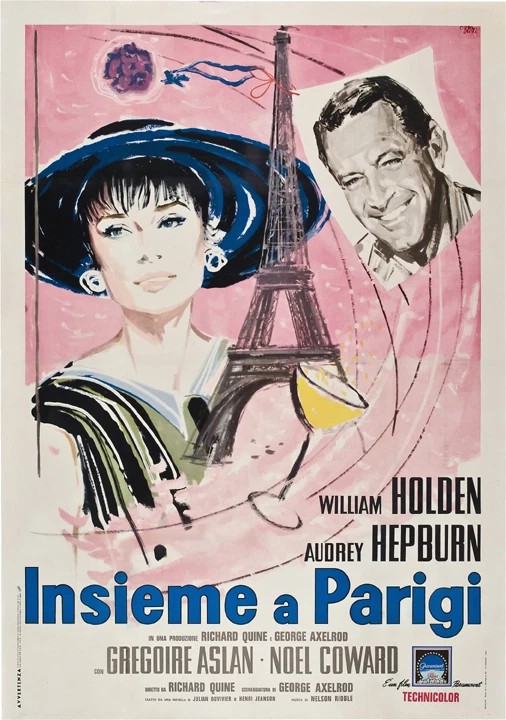
Problem is, the narrative hardly exists. And what remains is too clever by half. It might have appealed as an insight into how Hollywood works, but it lacks backbone and is more of a series of spoofs as we wait inevitably for the two stars to fall in love.
Alcoholic Richard Benson (William Holden) has writer’s block and having frittered away his time drinking, traveling and romancing, now has two days to deliver a screenplay for producer Meyerheim (Noel Coward) – who incidentally seems to spend his time in the sunshine drinking and surrounded by beautiful women. Benson hires typist Gabrielle (Audrey Hepburn) both to speed up the process and have someone to bounce ideas off.
Primarily a two-hander and virtually contained on a single set, his swanky apartment in Paris, it only ventures out to assist his imagination by playing out various concepts in which the pair act out various scenes in what turns into a relatively ham-fisted satire of the movie business. The only really interesting Hollywood expose is when Benson explains the tricks of the screenwriting trade, the various reversals (they were called “switches” in those days) and conflicts to keep the audience on their toes and prevent the potential lovers getting to the actual loving stage too quickly.
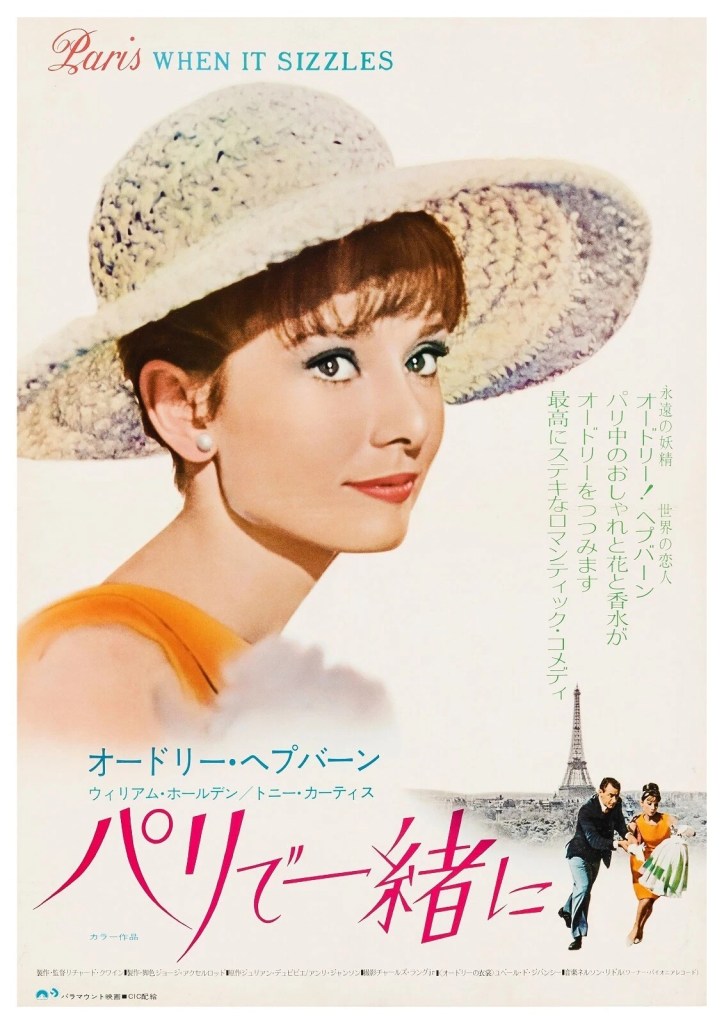
So we watch Gabrielle initially fending off his moves before becoming entranced and ridding herself of a carapace of dustiness before transforming into a flighty fun lass. But when the dialog often centers on arguments over the meanings of words there’s not a great deal for the audience to get its teeth into.
The concept, such as it is, allows Richard and Gabrielle to act out various scenarios, rattling through the genres – spies, musical, the jungle, horror, whodunit and western – while they manage to find a way to turn his title The Girl Who Stole the Eiffel Tower into a movie.
Even though the last thing this needs is further levity – any more froth and it would disintegrate – Tony Curtis (The Boston Strangler, 1968) has a recurrent role in a variety of cameos and you can spot an uncredited Marlene Dietrich (Judgement at Nuremberg, 1961) and Mel Ferrer (Brannigan, 1975). Perhaps the most unusual angle was that it was a remake of the French La Fete a Henriette (1952) directed by Julien Duvivier. Or that it was the first screen credit for Givenchy, who devised Hepburn’s clothes.
While both Holden and Hepburn are very easy on the eye, the actor often topless, and Hepburn going through the fashions, it only works if you want to see screen chemistry at work and are not remotely interested in narrative or if you are so unaware – and of course genuinely interested – in the screenwriter’s craft that you are find out how words on paper are translated into images on the screen. It might well be an audience’s first encounter with such gems as “Exterior:Day.”
Oddly, both Holden and Hepburn are good and it’s solidly directed by Richard Quine (The World of Suzie Wong) from a script by George Axelrod (Breakfast at Tiffany’s) adapting the previous film.
A harmless trifle, you might say, but just too bad that with the talents involved it doesn’t even rise to a soufflé.
You Can’t Win ‘Em All (1970) ***
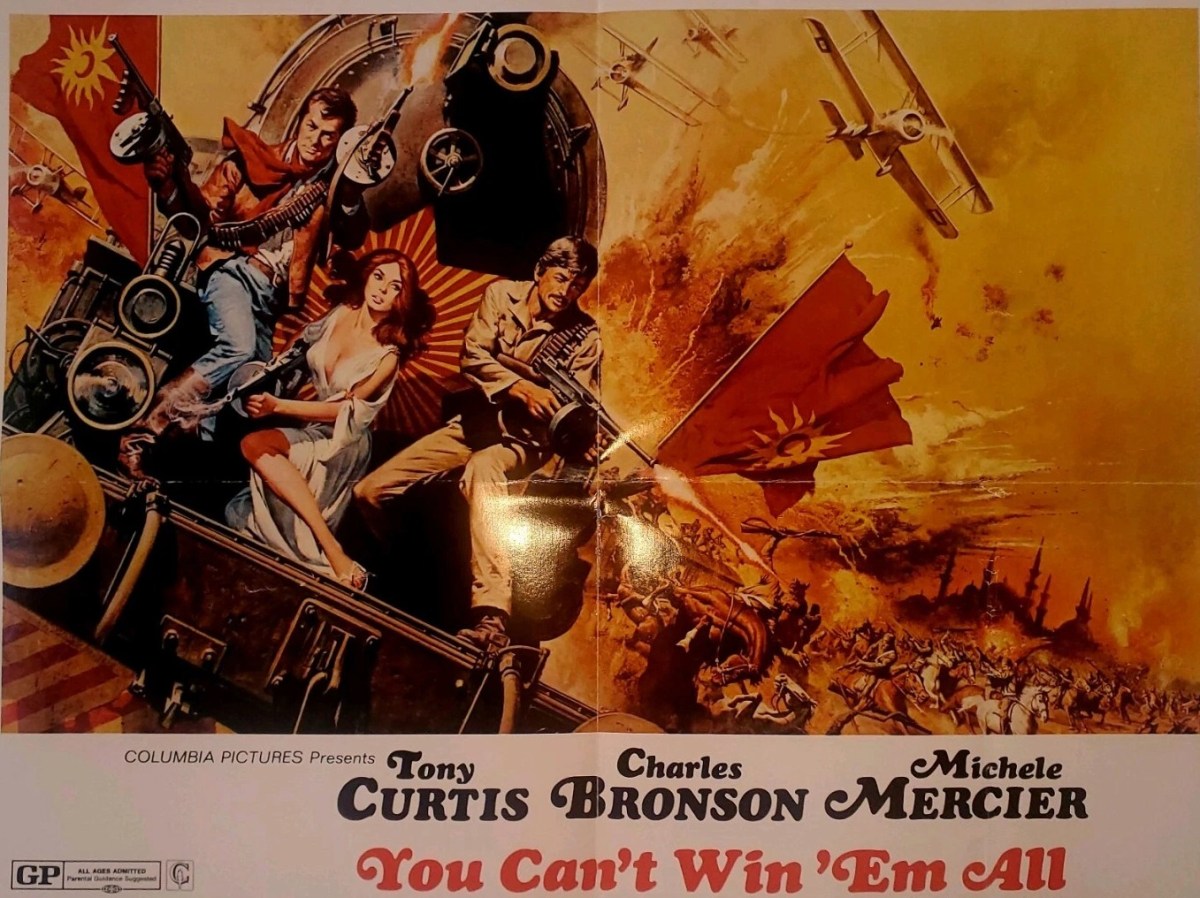
Charles Bronson travelogue. Slowest action picture you will ever come across. Director Peter Collinson forgets all he learned about tension from The Penthouse (1967) and action from The Italian Job (1969) and in trying to create a Turkish version of the visual delights of David Lean’s Lawrence of Arabia (1962) comes a cropper, not least because he hasn’t counted on the dust resulting in endless scenes of men on horseback being obscured. There must be about 10-15 minutes of just travelling by horse, train and boat through boring scenery.
There’s an interesting story in here somewhere but you’ll need all your patience to stick with it. Soldiers of fortune Adam (Tony Curtis) and Josh (Charles Bronson) are the type of characters who buddy up one minute and stitch each other up the next. Their attitudes are ingrained from the outset – Josh robs shipwrecked Adam who takes revenge by stealing his boat. They team up to take advantage of the chaos ensuing in Turkey in 1922 following the collapse of the Ottoman Empire, setting themselves up as mercenaries before their small force of like-minded fellows, armed with Tommy guns, is hired by Governor Osman Bey (Gregoire Aslan) to escort a consignment of gold to Cairo. They soon discover that’s just a cover. The only gold on the gold bars is as much as it takes to provide a golden sheen to blocks of lead. There are actually more valuable prizes: Bey’s daughters and a trunk of priceless jewellery.
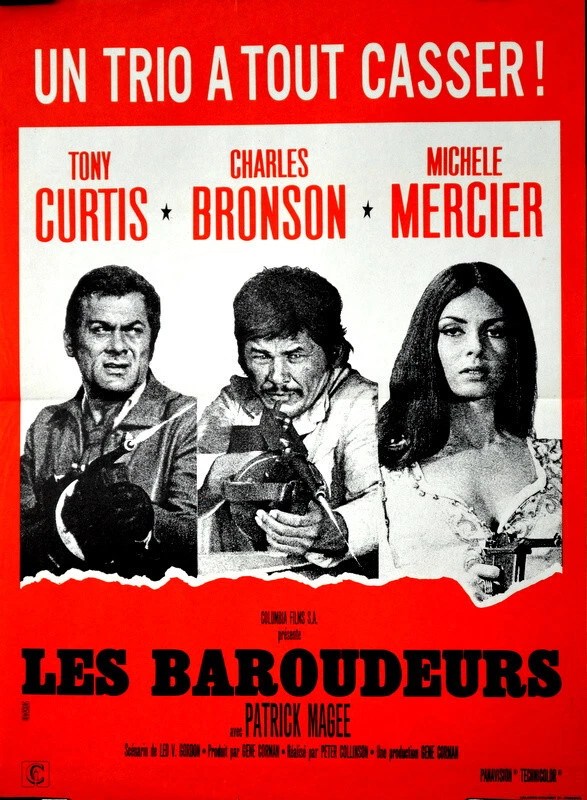
So far, they’ve beaten off various attacks, the submachine guns making short work of rebels armed only with rifles, and this looks as if it’s heading into fairly standard territory whereby the scoundrels will evade their captors and make off with the loot. But halfway through it does a U-turn. We discover that Adam is actually in the country to repossess one of his father’s ships lost in World War One. This is tweaked into an important plot point – the Turks have been blockaded by the Brits but a ship flying an American flag would be permitted safe passage.
Then it twists on its axis once again and we’re dropped into femme fatale land. The daughters are being escorted by the beautiful but wily Aila (Michele Mercier). She’s a step up from the usual two-timing female of the species. She’s a three-timer, attempting to woo in turn the governor, Adam and Josh. Actually, she returns to two-timing when she knifes the governor to death. And her plans go awry when Josh rejects her advances with a vicious slap.
Even so, he’s not averse to teaming up with her to betray Adam and make off with the loot. Adam, who has considered himself worldly wise, is furious and eventually traces Josh and Aila to the port of Smyrna.
It doesn’t end well, Josh and Adam are captured. But then it does end well. Aila, revealed as a spy, negotiates their freedom. After all, inadvertently, they helped her to transport the real treasure, an ancient Koran, while keeping the jewels for herself.
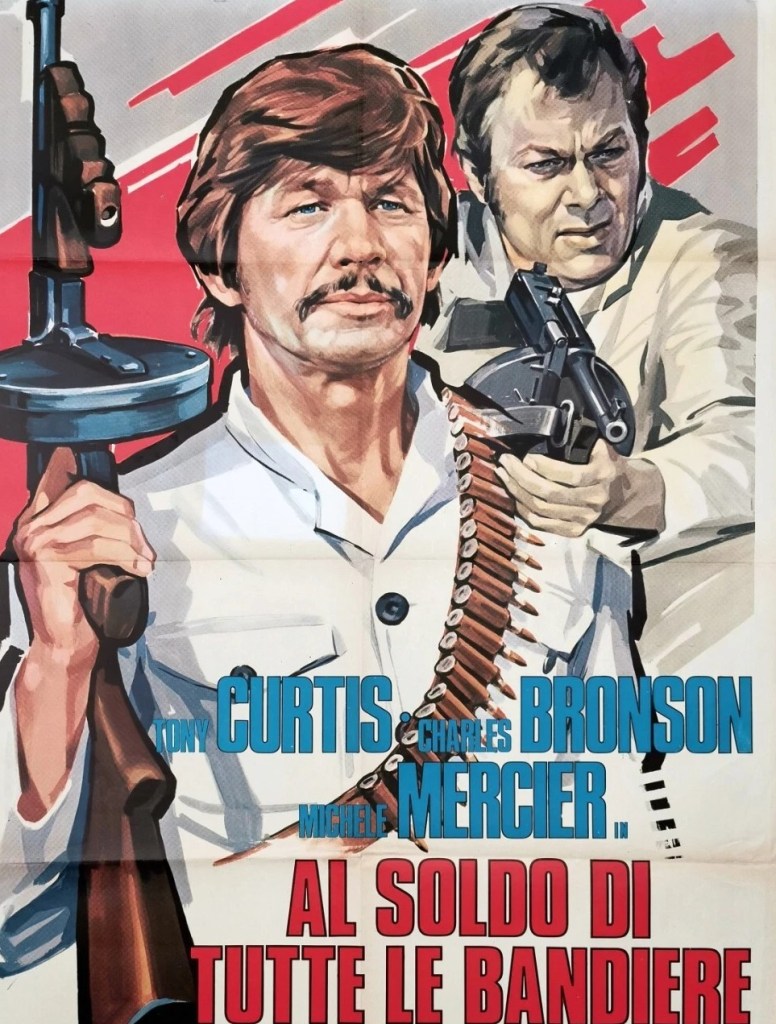
Leo Gordon (Tobruk, 1967) has penned a very wayward screenplay. Charles Bronson (Farewell, Friend, 1968) and Tony Curtis (The Boston Strangler, 1968) play well off each other, occasionally exchanging decent quips, with the kind of personalities that might congeal into an acceptable screen pairing, guys, while minus an honor code, who don’t stray into unacceptable behaviour. And it might have worked equally as well if the Michele Mercier (Angelique, 1964) strand had been introduced at the beginning and we had a three-way romantic dilemma. But director Collinson takes forever to get the two elements of the tale to mesh and wastes countless minutes, as previously noted, as our heroes laboriously grind their way towards their destination. The introduction of Mercier – sudden light catching her eyes in the darkness – is the only composition of note. And while Bronson and Curtis are a sparky pairing most of the time they flounder in an incomprehensible tale.
You can either catch this on YouTube and have your viewing interrupted by an advert every two minutes or on Amazon Prime where such interference is minimal.
The Rat Race (1960) ****
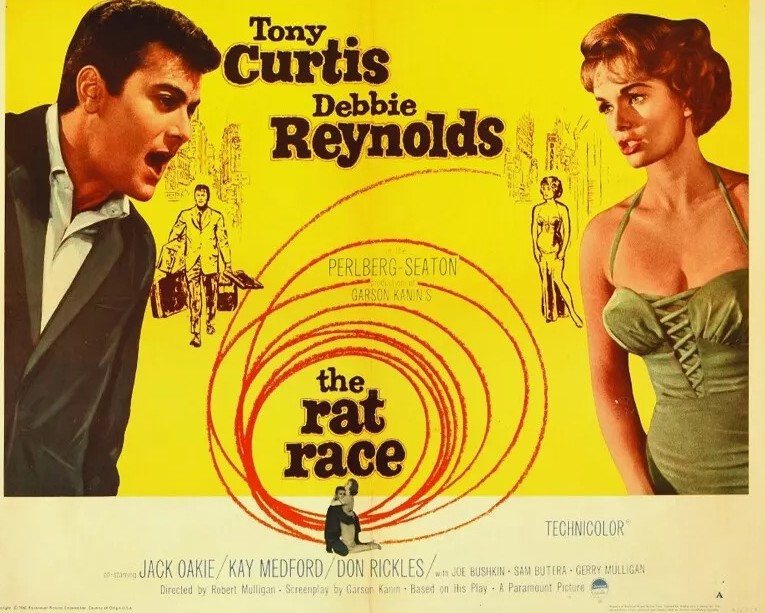
Surprisingly hard-edged tale with Debbie Reynolds giving the performance of her career and with a steely contemporary relevance. Snookers the audience into thinking it’s a standard romance, mismatched characters thrown together by circumstance, various rows and incidents to keep them apart before the expected happy ending. If screenwriter Garson Kanin had held his nerve, there wouldn’t be the get-out of a happy ending. As it is though, a formidable drama that doesn’t pull its punches.
From the title I expected a movie set in the world of big business, but instead we’re looking down on the lowest tiers of the entertainment business and, effectively, it’s a piece about the price paid for dreams. There are laffs, some good one-liners, but even these have a sourness to them.
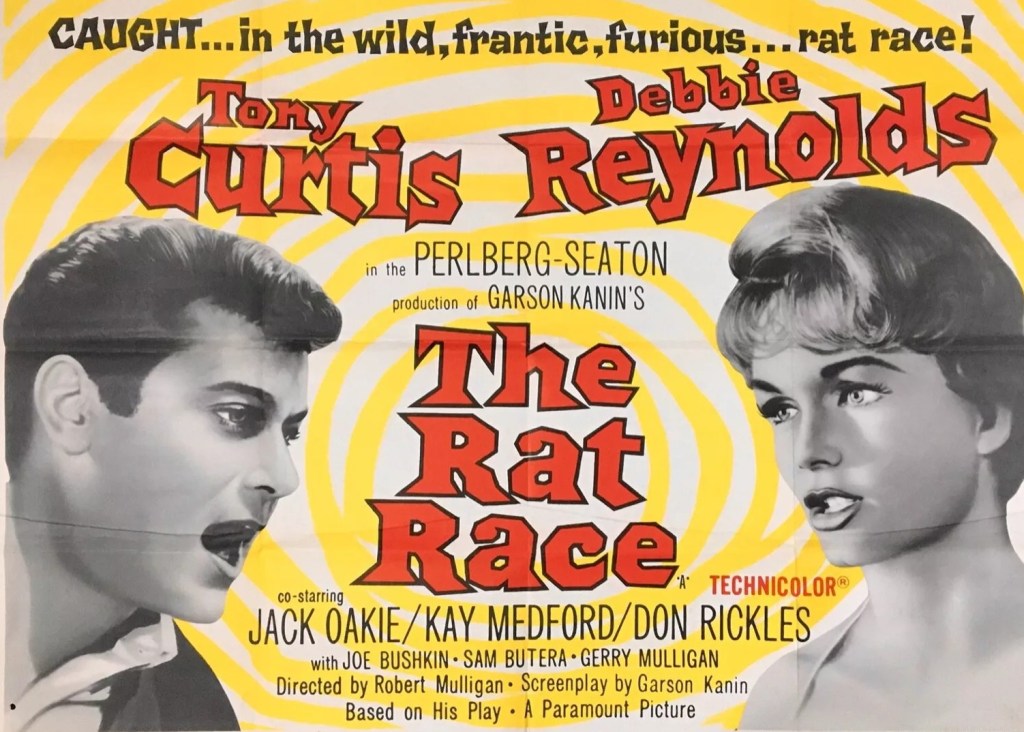
Pete (Tony Curtis) leaves Milwaukee for New York seeking fame and fortune as a saxophonist, not realizing he’s more likely to join the thousands of out-of-work musicians already resident, dreams dashed but determined to avoid the ignominy of going home with their tails between their legs, not just to face the mundane life that awaits but seared through with the guilt of failure. Through circumstance he ends up sharing an apartment with model-cum-dancer Peggy (Debbie Reynolds), who’s already given up on her dream once, but couldn’t stand more than a few minutes of the home she’d clearly been desperate to leave.
Peggy is clean out of modelling assignments and hasn’t made it to Broadway, either, not even to a chorus line. Instead, she earns not much of a living as a taxi dancer, more innocent than it would be now in the era of the lap-dancer but still seedy enough with roving male hands. She’s paid to dance with complete strangers, the kind of deadbeats unlikely to ever get on the dance floor with a beautiful woman in the normal course of events.
She’s about to lose her phone, but not above leading on the creepy repairman (Norman Fell) to believe he’s onto a promise should he give her a break. Only pride prevents her solving her financial problems – as well as not making her rent she owes cash to her sleazebag boss Nellie (Don Rickles) – by going down the sex worker route.
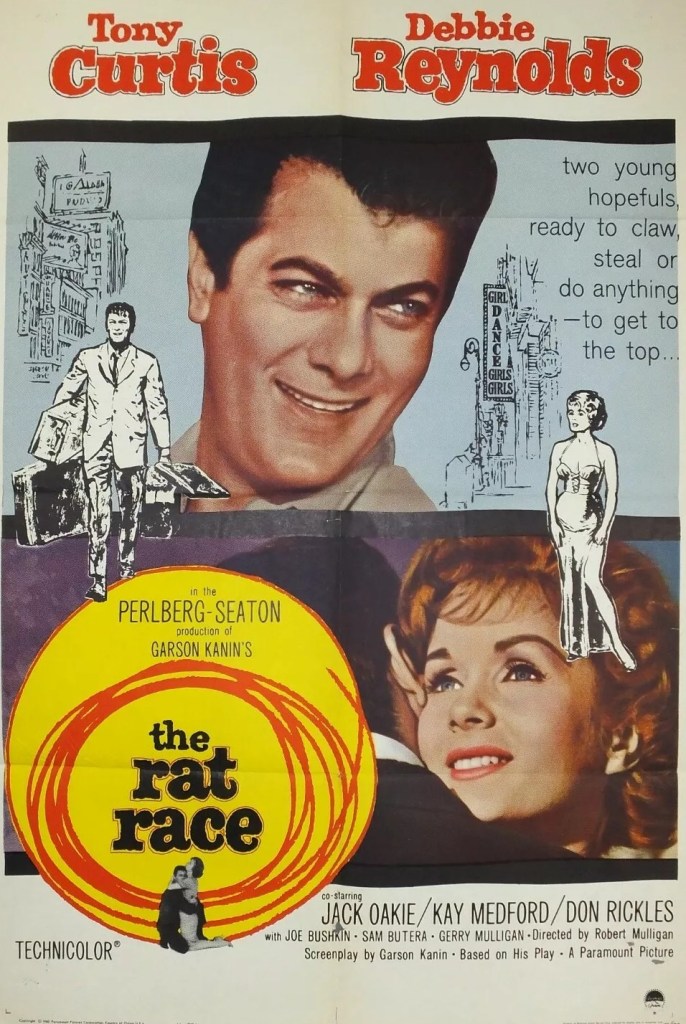
Pete thinks he’s got the smarts but in fact he’s afflicted with dumbness and gets ripped off for a mink coat made of cat fur and then loses a complete set of brand-new musical instruments to another scam. When he’s thrown the lifeline of a gig on a cruise ship, Peggy stumps up to buy him a new sax and the requisite tux. She’s paying for this with a promise to Nellie to enter the prostitution game, not quite spelled out as that but as close to the knuckle as you’re going to get in this era, the kind of soft-soap approach that worked for Butterfield 8 (1960).
When Peggy fails to deliver, Nellie humiliates her in the worst possible way. Beginning with her jewellery he strips her down to undergarments to show how much he owns her and just how good he is at playing hardball. It’s a gut-clenching scene. Sure, you know there’s not going to be any nudity, not in this period before the Production Code got flattened, but even so, it works extraordinarily well, especially as clearly Peggy doesn’t know just how far he will go and that he might not, in his quiet fury, be above turning her out into his club starkers.
Meanwhile, to ensure we get to the ending that audiences expected, Pete, on board the ship, has been ignoring any other romantic opportunities, and sending her a heartfelt letter a day, which she appears determined to ignore, knowing that the “rat race” isn’t the kind of world that accommodates long-term romance.
Suffice to say, when Pete manages to bail her out, that changes her mind, though the genuine Peggy would still have balked, knowing that, with their levels of talent, they were only going to become more wasted by lack of fulfilment.
So, yeah, happy ending, but you feel that’s been grafted on to allow audiences to take the rest of the tougher storyline. The MeToo campaign has exposed the pitfalls of the entertainment business, so what happens to Peggy wouldn’t come as a surprise to a contemporary audience.
By this point Debbie Reynolds (Goodbye Charlie, 1964) wasn’t known for drama, more for a spunky or sparky screen persona in a series of lightweight comedies or romances, this showed Hollywood what it was missing. Tony Curtis (Goodbye Charlie) had proven he could do comedy or drama and here he mostly plays it straight.
Director Robert Mulligan (The Stalking Moon, 1968) is probably responsible for maintaining the harder edge. This was originally a Broadway number, so I doubt if the sharpness would have worked so well in that medium. Garson Kanin (Where It’s At, 1969) and an uncredited John Michael Hayes (Nevada Smith, 1966) knocked out the screenplay based on the former’s play.
Worth it for Reynolds alone.
Lepke (1975) ***

Gangsters are just the same as you and I. They want to be loved, they want a family, they want the kind of respect that isn’t achieved by just pointing a gun at someone. The Godfather (1972) led the way in subtly reminding us that gangsters were human beings even if it was more seductive in making us believe we should excuse their criminal tendencies. Lepke spends as long on romance and trying to win the approval of the bride’s father as it does on the character’s perfidy. The idea that marriage cannot so much absolve you of your sins but provide an oasis of calm inside a murderous world is one only a true romantic would consider pursuing. As is the notion that a wife would forgive you your sins because her love would outweigh your actions, in the same way as the wife-beaten wife (as shown in Love Lies Bleeding) still loves her husband no matter how brutal the treatment meted out.
Lepke has got reason to be sore with the world. He was left out of the gangster chronicles. An important part of the Murder Inc operation, he was ignored when Hollywood passed judgement on such criminal enterprises. And you get the sneaky feeling his life story was only revived because after the Coppola epic his was one of the few tales untold in the gangster chronicles.
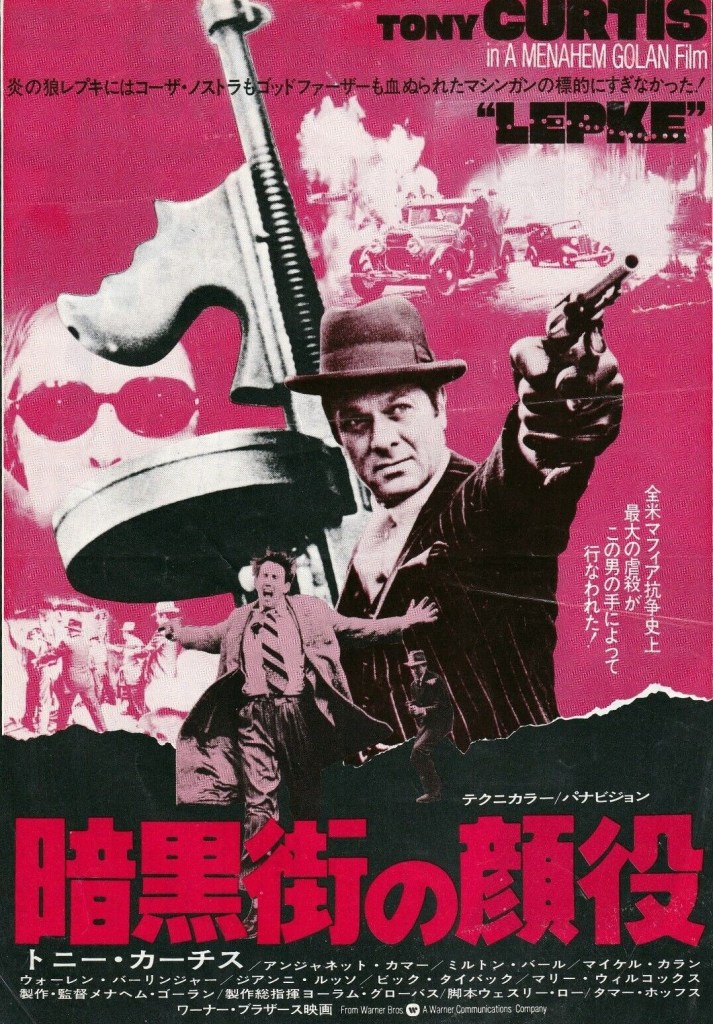
“If there’s any good in him, that’s the part I’ve got,” says wife Berenice (Anjanette Comer), “If I was a whore I could leave him.” And you can see the part she adores, not only respectful to the point of being obsequious to her upstanding father Mr Meyer (Milton Berle), but charming and romantic with her and he’s clearly able to separate business from romance, turning into an exemplary family man (but then so, too, did Don Corleone).
Which is just as well because Lepke (Tony Curtis) is a dreaded Mafia enforcer, forming a murder syndicate with Dutch Schulz (John Durren) and Lucky Luciano (Vic Tayback) that takes responsibility for knocking off anyone who steps out of line away from the big bosses. There’s some standard gangster stuff, machine guns in violin cases, bombs in the spaghetti, but also some interesting touches, a shoot-out on a carousel, and of course the last person a gangster can trust is the one he places his truth with. Double-dealing is the order of the day.
Like all the top gangsters, Lepke is an entrepreneur, expanding out of the killing racket into dope, extortion and trade unions. New York D.A. Thomas E. Dewey is on the Murder Inc case and his assassination is only prevented by the intercession of Lepke. But he’s tackled as much by Robert Kane (Michael Callan), friend to Berenice who works in narcotics along with Dewey.
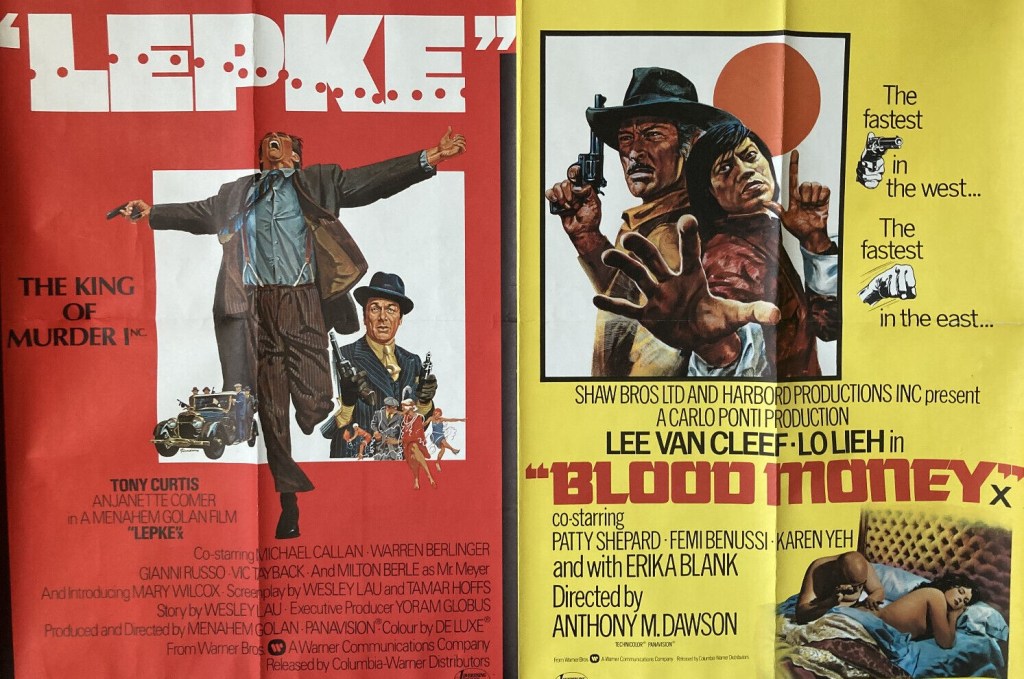
Dewey’s not the only real-life character making an entrance. Legendary journalist Walter Winchell (Vaughn Meader) plays a significant role. Most of the picture involves Lepke being nefarious by day and loving at night and the gang are only tripped up when witnesses need to be eliminated and as the cops work a similar kind of dodge to the one that snared Al Capone. Instead of tax evasion it’s anti-trust issues.
Covering the period from 1923, Lepke’s emergence as a ruthless street rat, and his development of the narcotics business by sourcing product direct for the Far East, to his execution in 1944, it pays only cursory attention to the period. Most of the time, Lepke is fighting for his life one way or other, suspicious of colleagues, walking a knife-edge between actions that could inavertently lead to his demise, and trying to remain the best part of himself that remains appealing to his wife.
That any of this works other than being a standard depiction of the rise and fall of a gangster is down to Tony Curtis (The Boston Strangler, 1968) who delivers one of his best later performances while maintaining a difficult balancing act, clearly believing that he can separate the two sides of his personality, and that the murderous part is really just a performance. The documentary-style rendition helps as this can be complicated stuff, especially with so many disparate traitors.
Anjanette Comer (Guns for San Sebastian, 1968) is always watchable. Menahem Golan, of Golan-Globus and Cannon fame, perhaps taking a cue from The Godfather, takes considerable care with the family elements and is rewarded with a better picture than the elements might suggest.
This pretty much rounds out my Hollywood History of the Gangster.
The Great Race (1964) **** – Seen at the Cinema

And not just any old cinema, but the 87-year-old Fine Arts in Los Angeles, I guess the second oldest movie house still standing there, with admission a princely 50 cents and the whole place done out in a gaudy red. I was taking time out from a research mission to the Academy of Motion Pictures Arts and Sciences’ (the Oscar people) equally famous Margaret Herrick Library, where I was digging up stuff for my next book about the films of Alistair MacLean.
And where I discovered to my unimaginable delight they they had my books on their shelves. I’ll never win an Oscar and bestsellerdom will continue to evade me, but for a writer of books on movies, there can be no greater honor than to have your works on the shelves of Hollywood’s most important library. Since data protection will prevent me from discovering who has checked out my books, I can safely imagine that it was bound to be Harrison Ford, Greta Gerwig, Christopher Nolan and/or Steven Spielberg.

Anyway, enough of that self-congratulatory nonsense and on with the show. If you’ve any memory of this picture – jaunty jalopies battling it out at the start of the 20th century when suffragettes were raising hell – it’ll be for the slapstick. The upfront feminism most likely passed you by. A savvier female you would be hard put to find, especially one that susses out exactly that when a male falls in with her views it’s just to get her into bed. So, from the contemporary perspective, this is a far harder-nosed picture than the fluffy narrative suggests.
Setting aside the famous pie-throwing homage to silent film pie-throwing (and every circus clown act since Doomsday) and a couple of sequences that outlive their welcome and the odd decision to find a plotline that can accommodate Jack Lemmon going down the (almost) identical twin route, this is pretty much sheer delight.

Characters could not be more black-and-white – in visual terms as well – than rival mechanical whizzes The Great Leslie (Tony Curtis) and Professor Fate (Jack Lemmon) except for the much more rounded (in character terms) interloper Maggie Dubois (Natalie Wood) as a reporter. Not content with being a legend in his own lunctime, the mad professor follows the Gore Vidal tack of being upset by any rival’s successes. However, he’s such an incompetent saboteur he doesn’t realize he’s merely the feed for a number of superb visual gags.
The Great Leslie, smile resounding with the Colgate audible zing, doesn’t have much to do except expound the principles of fair play and occasionally demonstrate his fencing skills when the plot turns sideways. Maggie is the ace inveigler, and when that doesn’t work resorts to handcuffs to ensure she will not be moved or someone else will be stuck fast. Standard bearer for female equality, she manages to put all the arguments without sounding dull, especially as, verbally, she is dealing with a keen dueller. And when she’s not switching sides, she’s rooting for the good guy.
The plot could have come out of a dishwasher but roughly equates to a round-the-world road race with most countries conveniently missed out, ending up in Paris with a stop-off somewhere in Germany. The deliberately cartoonish feel shouldn’t work at all, especially for a contemporary audience, but then we all laughed at Dumb and Dumber and plenty comedies with even less of a one-note touch. Thankfully, there was no such thing as deconstructed comedy in those days so everyone enters the spirit of the thing. And it’s quite refreshing to watch stuff being blown up and falling apart not for overblown thriller or comicbook reasons.
I wasn’t taken with the overlong sequence in the saloon – extended singing and brawl (heck, what else are saloons for) – and wasn’t so hot on the legendary pie section either and certainly the notion that Professor Fate could be such a doppelganger for a dumb German prince that the powers behind the throne plan to substitute one for the other seems to belong in the furthest reaches of the Far Fetched Highway.
But there are so many gags and the characters, no matter how cartoonish at times, seem true to themselves, and with Maggie on hand to constantly upset the misogynistic applecart it seems a tad picky to be so picky. I was astonished that the audience I watched it with, primarily much younger than I, were so tickled.
Tony Curtis (The Boston Strangler, 1968) and Jack Lemmon (How to Murder Your Wife, 1965) repeat the magic of Some Like it Hot (1959) thanks to the strong directorial hand of Blake Edwards (The Pink Panther, 1963). Natalie Wood (Bob and Carol and Ted and Alice, 1969) shines. Rare comedy role from Peter Falk (Penelope, 1966). Excellent support from Keenan Wynn (Warning Shot, 1966). Edwards co-wrote the script with Arthur A. Ross (Brubaker, 1980).
Certainly more than stands the test of time.
Goodbye Charlie (1964) ***

Gender switch comedies were a rarity in Hollywood at this point though of course Billy Wilder had scored big with Some Like it Hot (1959) and I’m guessing the possibility of Tony Curtis repeating his drag act was an audience lure for this one. Alas, that wasn’t to be. This goes the other way. Or several other ways. A woman playing a man who is a woman. That would be catnip these days were it a transgender thing, but it ain’t.
Confused? So sex predator Charlie (a male) drowns while escaping enraged husband Sir Leopold (Walter Matthau) only to reappear, re-born or reincarnated (as the producers decide after googling it, sorry, after they look it up in a book) as a naked woman walking along the highway, rescued by the wealthy Bruce (Pat Boone) and delivered to the nearest house, Charlie’s own pad, now occupied by old buddy George (Tony Curtis).

There’s some light comedy as George tries to safely manhandle the unknown woman, clad only in Bruce’s coat (necessitating his later return of course) and gradually the surroundings seem over-familiar to the woman and then, shazam, George works out from what she knows about him that actually she must have returned as a man, also called Charlie (Debbie Reynolds).
A cosmic joke, in other words. The man who preyed upon women returning as a woman. See how he likes it to be on the receiving end of misogyny. But, mostly, he/she lolls around with legs spread like a man, gulps down whisky and is a dab hand at cards. But that’s not where the humor lies, apparently, because the movie moves on quickly from the woman acting the man and into the man-woman discovering all the female tricks of the trade, visiting a beauty parlor and the hairdresser. Charlie discovers it’s not the same fun slapping a woman’s backside – what a revelation – if you’re a woman.
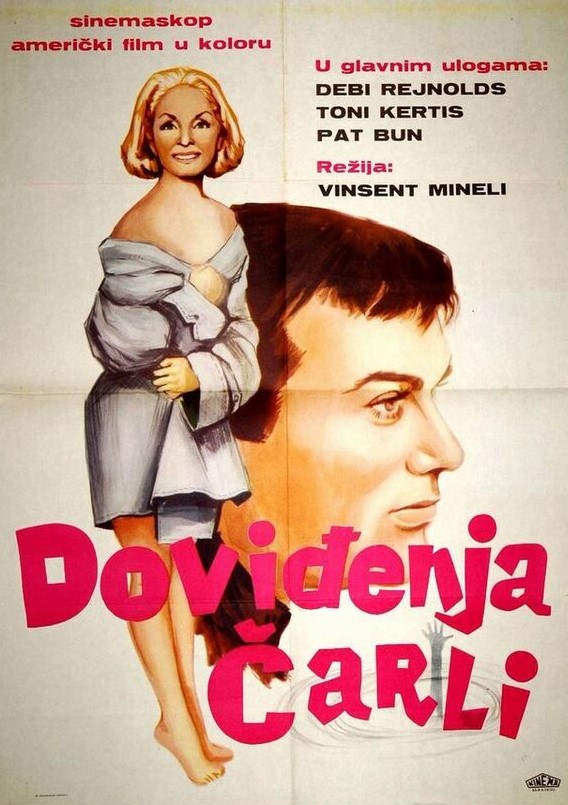
But, basically, the female Charlie decides to become a female version of the male Charlie, the predator, ripping off friends, chasing the big money, trying to seduce Bruce. So, mostly, it’s one odd plot device after another.
But the sizzle is Debbie Reynolds, not so much the man-woman stuff, but turning into a mean Bette Davis character before your eyes, all hard-edge and shifty moves. There’s sexual tension as well, George initially resisting the woman he knows is or was a man, before finding the attraction too much, and the same going for Bruce. There’s a fair whack of sexual confusion, as the newborn Charlie still finds herself ogling women.
In those far more innocent times, it doesn’t know what it wants to say and lacks the narrative to say it. Audiences had terrific fun with Jack Lemmon and Tony Curtis in Some Like it Hot, but that narrative ploy was bang on, and Lemmon enjoying dressing up as a woman and Curtis having to keep his male instincts at bay while ogling Marilyn Monroe was pure catnip.
Here, Curtis is mostly the foil for Debbie Reynolds and by the time it looks as though they might get it together she is way past behaving like a man and is most definitely a desirable woman so it’s kind of difficult to make this work romantically or humorously.
Perhaps the oddest element is that the signs were already there that it wouldn’t work that well. It started as a Broadway play written by George Axelrod (The Seven Year Itch, which was a Broadway smash) but it barely lasted a dozen weeks on stage. By that time, though, Twentieth Century Fox had splashed out $150,000 for the rights. Still, bigger sums have been buried in the annual accounts.
And I guess when Vincente Minelli (Two Weeks in Another Town, 1962) came on board with a pretty decent cast it seemed at least doable. Like many a lightweight comedy from the decade – Dear Brigitte (1965) for example – it’s keep afloat by a terrific performance by the principal star, in this case Debbie Reynolds (Divorce American Style, 1967). You might spot Ellen Burstyn (The Exorcist, 1973) in an early role.
Take away Debbie Reynolds and it would limp along.
Behind the Scenes: Coming Soon(er) or Later or Not At All

My discovery that Hayley Mills’ career could have taken an entirely different turn had either Deep Freeze Girls or When I Grow Rich entered production in 1965/1966 and therefore prevented the star returning to Britain for The Family Way (1966) – and, as it transpired, love and marriage – made me look again at the huge volume of movies that were either never made at the time initially announced or never made at all.
I’d covered a couple of classic examples previously, 40 Days of Musa Dagh for example taking nearly half a century from initial proposal to some kind of fruition. And, of course, the financial collapse of studios at the end of the 1960s put an end to the prospects of such big budget movies as Man’s Fate, to be directed by Fred Zinnemann.
But sometimes as many as half the movies announced by a studio or independent for their forthcoming schedule never made it to the big screen. Others such as This Property Is Condemned (1966), initially to star Elizabeth Taylor and directed by John Huston, still got over the line but with new players, Natalie Wood as star and Robert Mulligan in the hot seat. On the other hand, of the quartet of movies – Lie Down in Darkness, Guardians, Grass Lovers, and Linda – that producer William Frye (The Trouble with Angels) thought would make his name, none were made.
Everyone knows moviemaking is a dicey business, but you don’t realize just how tricky it is unless you count up just how many pictures, often trumpeted with big stars signed up, just don’t make it to the cinema screen. Not that Hollywood was unwilling to gamble. Studios snapped up anything – novel, Broadway play – that appeared a decent prospect.
In the early 1960s talent agency Famous Artists earned for its clients a grand total of $850,000 (equivalent to $8.5 million now) for a disparate bunch of properties. King Rat by James Clavell went for $160,000 plus a percentage and was made in double quick time. As was Lilith by J.R. Salamaca, costing $100,000, and Sylvia ($20,000 purchase price) by E.V. Cunningham (aka Howard Fast). Ken Kesey’s One Flew Over the Cuckoo’s Nest went for $85,000 to Kirk Douglas’s Bryna outfit, which explained why, a decade later, it ended up being produced by his son, Michael.

But Broadway play The Perfect Set-Up by Jack Sher, sold to Hollywood for $400,000 and with Angie Dickinson signed up for the lead, was never made. You might recall George Peppard in a TV movie Guilty or Innocent: The Sam Sheppard Murder Case (1975) but that wasn’t based on The Sheppard Murder Case by Paul Holmes that someone shelled out $25,000 for in 1962.
Director Paul Wendkos had planned to follow up Gidget Goes to Rome (1963) with Native Stone, an architectural drama in the vein of The Fountainhead based on the Edwin Gilbert book that cost him $10,000 but that hit the buffers. Two novels by thriller writer John D. MacDonald, hot after Cape Fear (1962) – the aforementioned Linda costing $15,000 and A Child Is Crying $5,000 – were not made either. Nor, out of this batch, were Indian Paint by Glenn Balch or Fish Story by Robert Carson.
Even as powerful a producer as Ross Hunter (Midnight Lace, 1960), couldn’t get onto the starting grid The Public Eye as a vehicle for Julie Andrews, Laurence Olivier and director Mike Nichols (it would have been his movie debut) – when made in 1972 starring Mia Farrow and Topol it was under the aegis of Hal Wallis. Hunter also spent $350,000 on Dark Angel to star Rock Hudson but that fell at the first hurdle as did Broadway play A Very Rich Woman to star Katharine Hepburn.
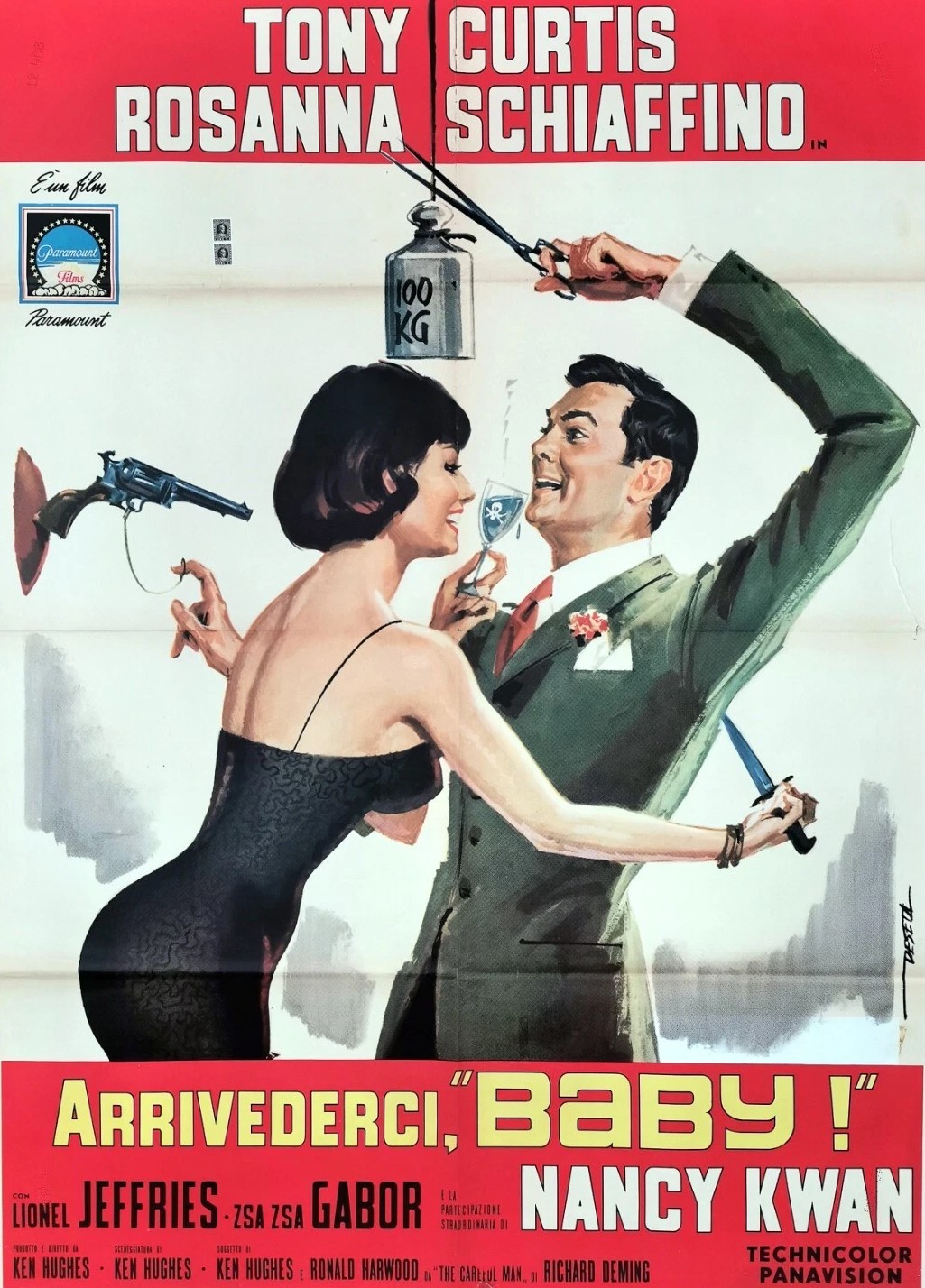
Tony Curtis was down for a remake of Casablanca (1942) called The Fifth Coin and relocated in Hong Kong and to co-star Nancy Kwan. Shooting on the Seven Arts production had a start date: November 15, 1965. But never went in front of the cameras. Kwan was particularly unlucky. The aforementioned Deep Freeze Girls also had a budget ($1.5 million) and a start date (October 1965) but it didn’t get off the ground either.
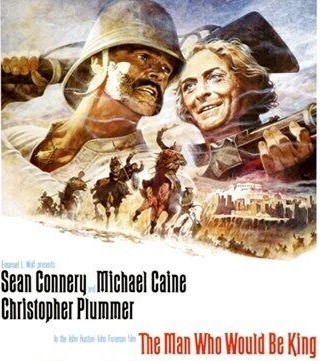
And of course Seven Arts had become enmeshed in the long-running John Huston saga of The Man Who Would Be King. This version, to star Richard Burton, had been set a $4 million budget and was due to start in April 1966. No go. At least The Owl and the Pussycat, budgeted then at $1.6 million and due to start on Dec 1965, was worth waiting five years for – when it was eventually filmed, though by Rastar not Seven Arts, it starred Barbra Streisand and George Segal.
In 1964 Columbia had 77 movies on the stocks. Richard Brooks was setting up Catch 22, Peter Sellers was being lined up for the musical Oliver!, and Carl Foreman was prepping Young Churchill. All these projects dropped off the roster, only to pop back up several years later with different stars (Ron Moody in Oliver!) or directors (Mike Nichols for Catch 22) or even studios (Paramount for Catch 22).
But others were simply shunted aside. Whatever happened to The Gay Place to team James Garner and Jean Seberg? Or The Fabulous Showman to be directed by Blake Edwards? Or another long-running saga, Andersonville with Stanley Kramer at the helm? Or Stephen Boyd as Richard the Lionheart? Even though The Ipcress File (1965) proved a big hit the same author’s Horse Under Water stalled at the starting gate, as did Robert Rossen’s Cocoa Beach and Ann-Margret in Strange Story.
When Robert Evans ushered in a new era at Paramount he placed his faith in writers. He doubled production and had over 40 writers working on projects. Some had little or no experience of movies but were big literary names. John Fowles, the adaptation of whose The Magus (1968) was an expensive flop, was hired to write Dr Cook’s Garden, but it was never made. Edna O’Brien had Three into Two Won’t Go on the stocks at Universal so she was set to write Homo Faber. Another casualty.
Oscar-winning screenwriter Edward Anhalt (Becket, 1964) was to make his directorial debut with We Only Kill Each Other. It didn’t happen. Nobody had ever managed to film Thomas Wolfe’s epic novel Look, Homeward Angel, so Paramount took a tilt at that without success. Escape from Colditz went into cold storage and an adaptation of Harold Robbins bestseller 79 Park Avenue ended up as a television mini series in 1977 and at a rival company, Universal.
It’s still standard operating procedure for Hollywood to snap up any big bestseller or Broadway hit without ever knowing whether it will ever see the light of day but willing to take the risk.
SOURCES: “Famous Artists,” Variety, August 8, 1962, p5; “Sanford and Frye of TV To Make Theatrical Films,” Box Office, January 7, 1963, p10; “Col-Frye TV Pact,” Box Office, August 19, 1963, p10; “Columbia Policy,” Variety, May 6, 1964, p13; “Seven Arts Pix Multiply,” Variety, March 31, 1965, p4; “Ross Hunter’s Crowded Future,” Variety, May 12, 1965, p7; “Bob Evans Pays Chip Service To Writer As Star,” Variety, May 1, 1968, p19.
Don’t Make Waves (1967) ****
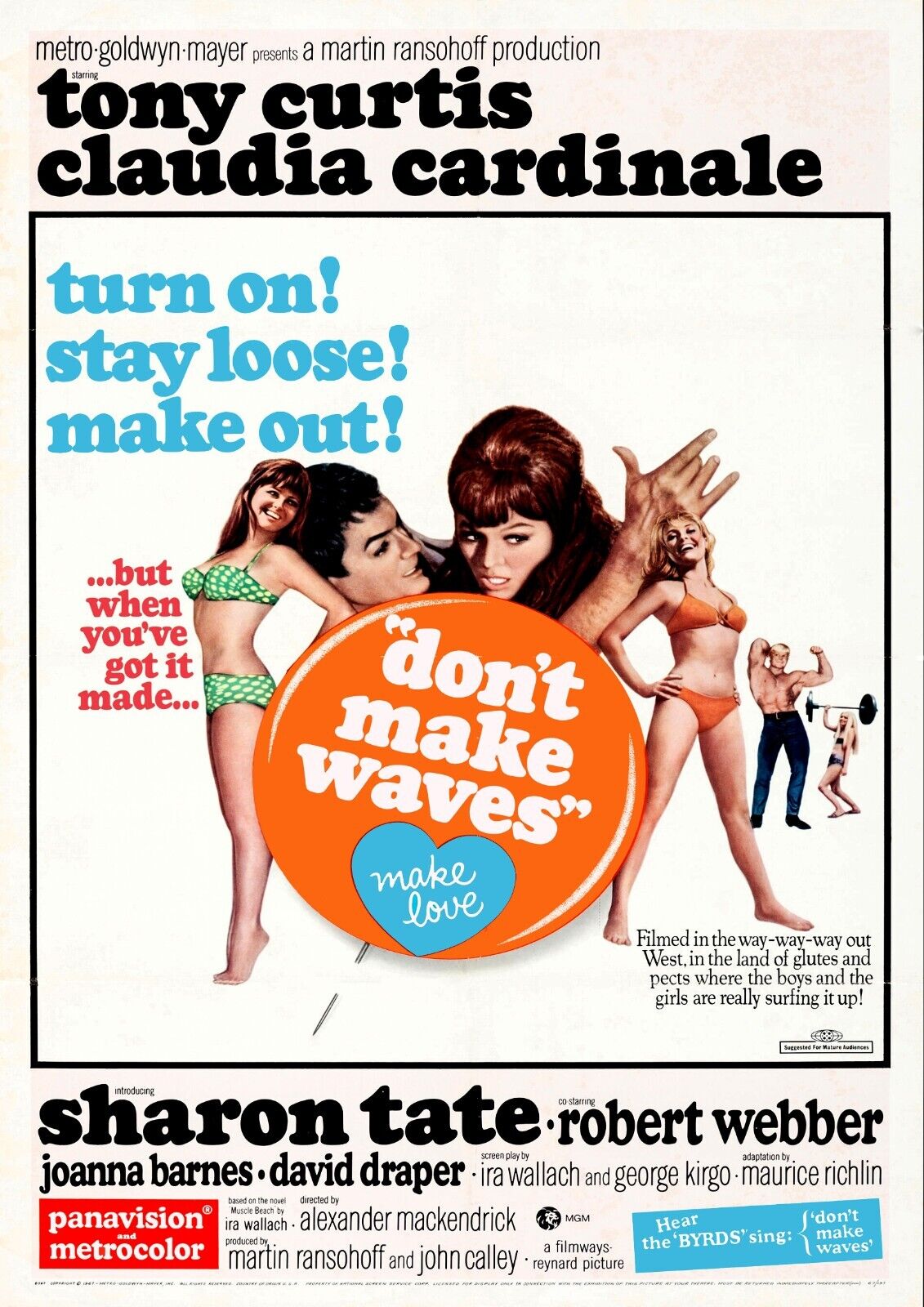
Unfairly maligned on release. Part throwback screwball comedy, part farce, part satire and in low-key fashion the first disaster movie. Oddly enough, that wild combination hits the mark. Tony Curtis makes amends for Boeing Boeing (1965). Claudia Cardinale on top form as a ditzy brunette. Last hurrah for Ealing Comedy grey eminence Alexander Mackendrick (A High Wind in Jamaica, 1965). Plus Sharon Tate as a sky-diver. What’s not to like?
Hardly surprising though at the time it got the thumbs-down from critics and the cold shoulder from audiences. A very late arrival to the short-lived beach movie cycle and unlikely to compete with the harder-edged satires like The Russians Are Coming, The Russians Are Coming (1966) and Divorce American Style (1967) or the latest off the Neil Simon conveyor belt Barefoot in the Park (1967).

Marvelous opening with sight gags galore sees vacationer Carlo (Tony Curtis) wrestling with a runaway car then seeing hapless wannabe artist Laura (Claudia Cardinale) accidentally setting fire to the vehicle. To make amends for destroying all his belongings, she invites him to stay the night. Unfortunately, her married lover Rod (Robert Webber) turns up, cueing a whole layer of farce, traditional bedroom-style here but later even better in the office, properly done this time compared to Boeing Boeing.
The next day Carlo is rescued from drowning by Malibu (Sharon Tate) with whom he promptly falls in love and attempts to separate her from her hulk of a boyfriend Harry (David Draper), all muscle but little brain and prone to easily-exploited bouts of depression.
Carlo is the smarter younger brother of the character in Boeing Boeing, managing to muscle in on Rod’s swimming pool business and demonstrating his sharp salesmanship skills. Except that Laura is so shrill and a kept woman, you’d expect him to be more interested in her than Malibu, but then where would be we be without a love triangle. In an odd sub-plot involving an astrologer (Ed Bergen), Carlo manages to win over Malibu. Meanwhile, Rod’s smarter wife Diane (Joanna Barnes) infiltrates her husband’s cosy love nest.
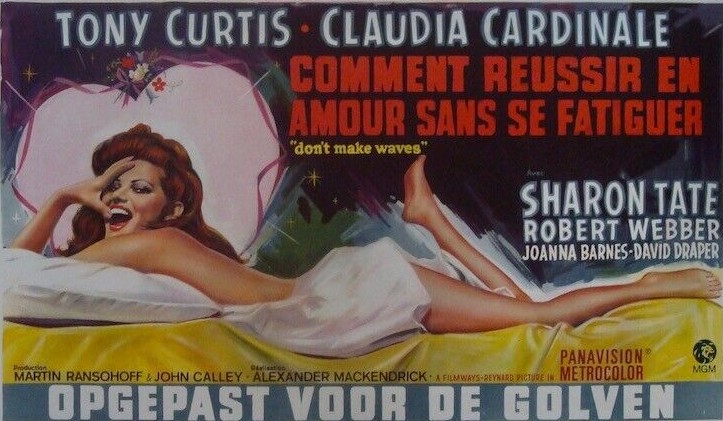
Although Carlo is effectively set up as somewhat shifty hero he undergoes a series of humiliations, brought down to earth by being repeatedly picked up and carried like a doll by Harry, and being drowned in mud. Other times he lives high on the hog, realizing he could make a killing here.
There’s no great plot, just the usual misunderstandings, but, unusually, characters are given moments of self-reflection and self-deprecation, and the satire focuses on the self-involvement of the beautiful people. There’s a fair bit of ogling but the camera is gender-equal, the toned bodies of the muscle men given as much attention as any passing female in a bikini.
I found myself chuckling all over the place, mostly at the antics of Carlo. This is a pretty good performance by Tony Curtis, mugging kept well under control but adept at physical comedy. And Claudia Cardinale (Once Upon a Time in the West, 1968) is equally game, drenched for a good chunk of time, and hit by sudden self-awareness as the tale unfolds. You might balk at her high-tempo performance but otherwise the set-up wouldn’t work. If she wasn’t so annoying why would Carlo look elsewhere for romance?
The disaster element involves a runaway clifftop house, a situation created by the unlucky Laura, and it doesn’t take much to see what elements The Poseidon Adventure filched, playing it for drama rather than comedy.
While not in the same category Mackendrick classics The Man in the White Suit (1951), The Ladykillers (1955) or even The Sweet Smell of Success (1957) – co-starring Curtis – this is not to so far off. Mackendrick excels at building the comedy, confidently marshals the farce, but, more importantly, doesn’t lose sight of the characters in the ensuing chaos.
Producer Marty Ransohoff tries to pull a fast one by slapping an “introducing” credit on Sharon Tate, conveniently ignoring her performance in the previous year’s Eye of the Devil (1966). She’s less iconic here – unless you imagine that with her bronzed face she’s a distant cousin of George Hamilton – but she’s far from the dizzy blonde, much more pragmatic, the one who switches electricity back on after the blackout, and with her own oddball ways. Trivia note: they modelled “Malibu Barbie” on Tate.
Worth a look.
 The Magnificent 60s