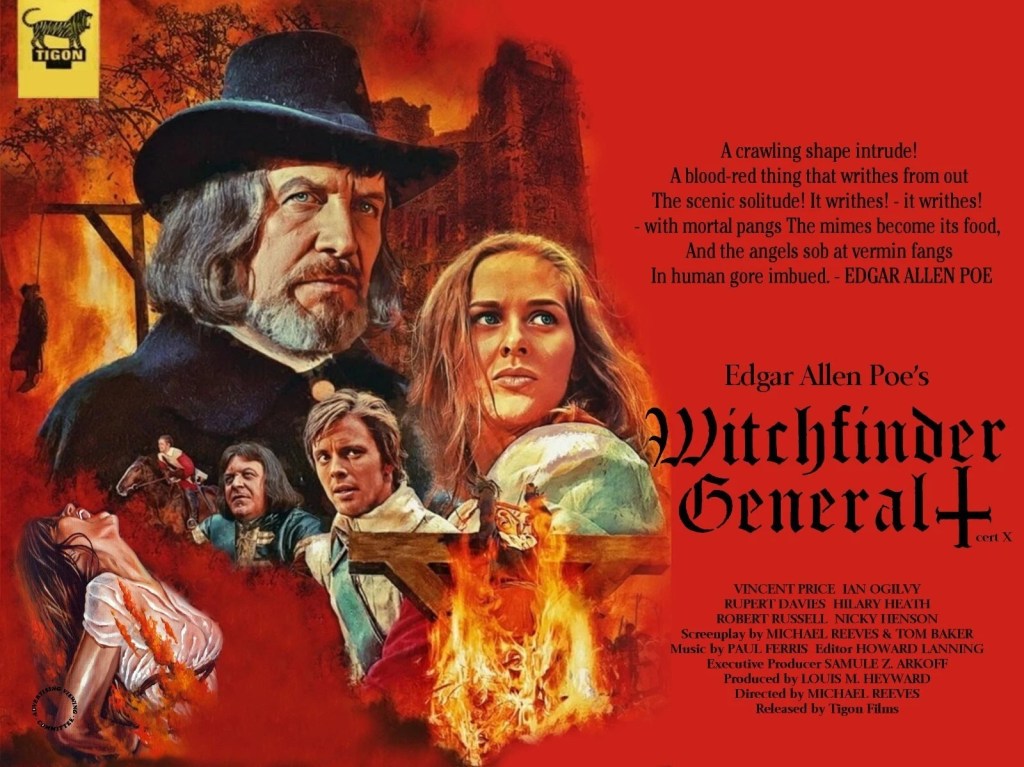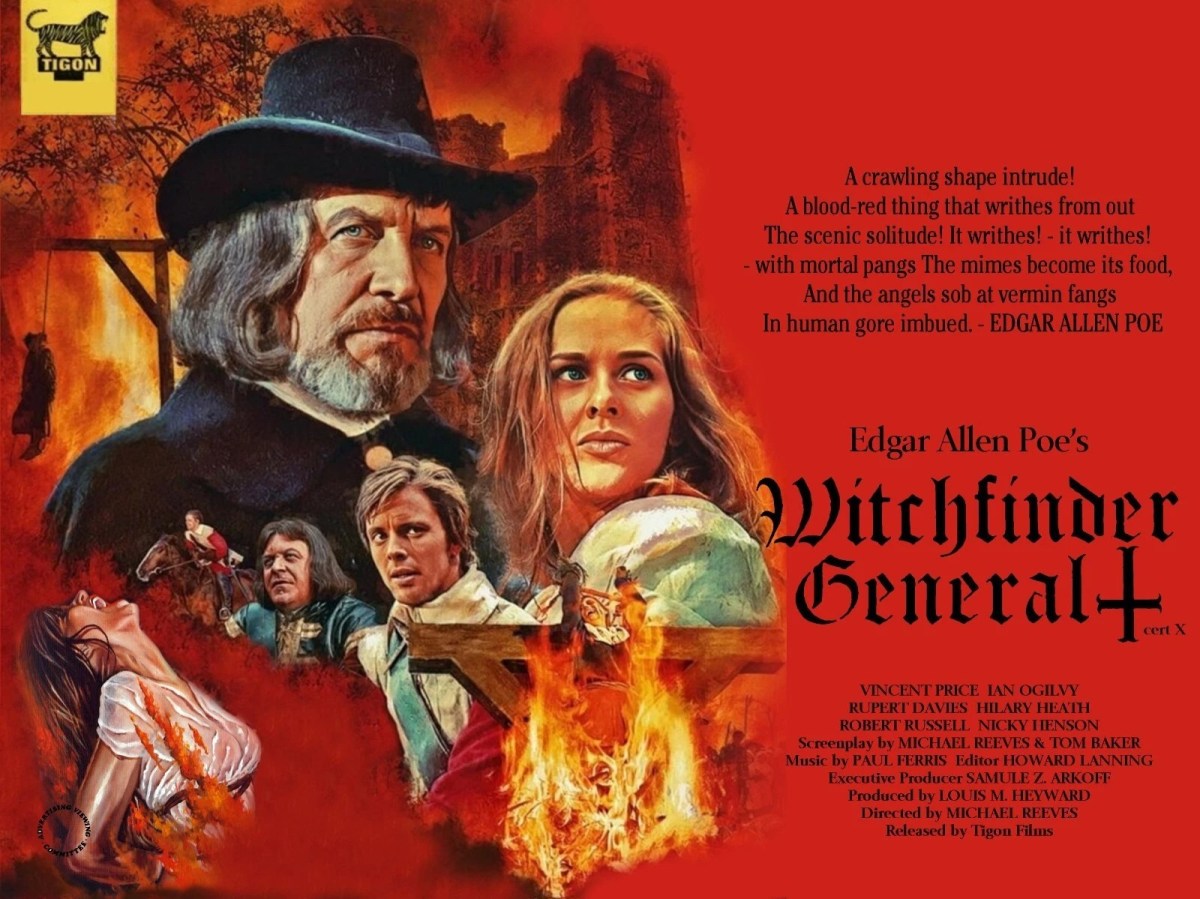
Behind the Scenes: “Witchfinder General” / “The Conqueror Worm” (1968)

Truth was the first casualty. Matthew Hopkins, the character played in the film by Vincent Price, was 27 when he died in 1647. He had been hunting witches for three years. Price was 57 when the movie appeared. Co-star Ian Ogilvy, aged 25, would have been a better fit, though he lacked the menace. Oliver Reed, who had the swagger and the scowl, would have been the ideal candidate, age-wise, since he was just turning 30. And the movie might well have benefitted from presenting Hopkins as a young grifter who through force of personality and cunning held a country to ransom.

Price wasn’t director Michael Reeves’ (The Sorcerers, 1967) first choice. In fact, he originally wanted buddy Ogilvy, who had played opposite Boris Karloff in The Sorcerers. When that idea failed to float with Tony Tenser – previously head of Compton Films – now boss of British horror outfit Tigon, a challenger to the Hammer crown, Reeves pivoted to Donald Pleasance who, although better known as a supporting actor in the likes of The Great Escape (1963), had headlined Roman Polanski’s chiller Cul de Sac (1966). But when Tenser did a deal with American International Pictures, the U.S. mini-studio insisted on contract player Vincent Price, the mainstay of their Edgar Allan Poe output, with 16 previous films (out of 74) for the company.
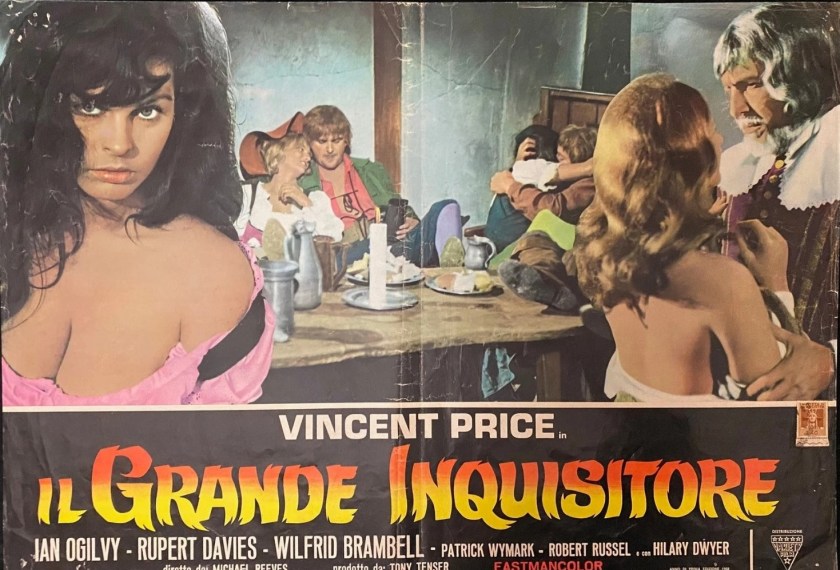
Twenty-one-year-old Hilary Dwyer (The Oblong Box, 1969), under contract to Tigon, made her movie debut. Rupert Davies (The Oblong Box) was a seasoned veteran while Nicky Henson (Here We Go Round the Mulberry Bush, 1967) was a potential breakout star.

Tigon was a relatively new entrant to the horror scene, founded in 1966 by Tenser. Its second picture was The Sorcerers; this would be its fourth. Tenser has bought, pre-publication, the rights to Ronald Bassett’s novel Witchfinder General, published in 1966. Director Reeves faced something of a deadline once Tenser finalized the £83,000 budget. AIP chipped in £32,000 which included a £12,000 fee for Price. While it was Tigon’s biggest film to date, it was pin money for AIP.

The film needed to begin shooting by September 1967 at the latest to avoid the worst of the British cold weather. But the screenplay proved too unpleasant for the taste of the British censor. Reeves had already begun the screenplay with Tom Baker (The Sorcerers) with Donald Pleasance in mind portraying “a ridiculous authority figure” and had to quickly revamp it for Price. The laws of the period required a green light for the script from the British Board of Film Censors, who were repulsed by a “study in sadism” which dwelt too lovingly on “every detail of cruelty and suffering.”
That draft was submitted on August 4, 1967. The second draft, submitted on August 15, proved no more appealing. A third, substantially toned-down version, was approved. This resulted in the elimination of gruesome details of the Battle of Naseby and a change to the ending.

Production began on September 18, 1967. Star and director clashed. Reeves refused to go and meet Price on arrival at Heathrow Airport and told him, “I didn’t want you, and I still don’t want you, but I’m stuck with you.” The star was riled by the director’s inexperience. When told to fire a blank pistol while on horseback, Price was thrown from his horse after the animal reared up in shock at the sound. Price, in real-life a very cultured person, was surprised at Reeves’ attitude because in general he got on with directors.

Price turned up drunk on the last day of shooting, the filming of his character’s death scene. Reeves was planning revenge and told Ogilvy to really lay into the star. But the producer, anticipating trouble, ensured Price was well padded.

Reeves was better known for his technical rather than personal skills. Ogilvy commented: “Mike never directed the actors. He said he knew nothing about acting and preferred to leave it up to us.” That wouldn’t square with him falling out with Price over his interpretation of the character. And Hilary Dwyer saw another side of Reeves. “He was really inspiring to work with,” she said, “And because it was my first film, I didn’t know how lucky I was.” She would work with Price again on The Oblong Box and Cry of the Banshee (1970).

Tony Tenser, egged on by AIP’s head of European Productions, shot additional nude scenes in the pub sequence for the German version, A continuity error was responsible for the freeze-frame ending. There was a short strike when the production fell foul of union rules. Producer Philip Waddilove and his wife Susi were occasionally called upon to act.

Two aircraft hangars near Bury St Edmunds in Suffolk were converted for the interiors while a wide variety of locations were utilized for exteriors including Lavenham Square in Suffolk, the coast at Dunwich, also in Suffolk, Black Park in Buckinghamshire, Orford Castle in East Anglia, St John The Evangelist Church in Rushford, Norfolk, and Kentwell Hall in Long Melford on the Essex-Suffolk border. When the operation could not afford a camera crane, the crew improvised with a cherry picker.

Despite the tension on set, Price was pleased with his performance and the overall film. He praised the film in a 10-page letter. Price remarked, “I realized what he wanted was a low-key, very laid-back, menacing performance. He did get it but I was fighting him every inch of the way. Had I known what he wanted I would have cooperated.”

AIP retitled it The Conqueror Worm for U.S. release, hoping to snooker fans into thinking this fell into the Edgar Allan Poe canon, since the title referred to one of the author’s poems, part of which was recited over the credits.

The movie was generally lambasted by critics for its perceived sadistic approach, but is now considered cult. It was a big box office hit, especially considering the paltry budget, gaining a circuit release in the UK – “very good run beating par by a wide margin” – and despite being saddled with the tag of “unlikely box office prospects” by Variety did better than expected business in New York ($159,000 from 28 houses), Los Angeles (a “lusty” $97,000 from 16) and Detroit ($35,000 from one). The final U.S. rental tally was $1.5 million placing it ahead in the annual box office charts of such bigger-budgeted efforts as Villa Rides starring Yul Brynner and Robert Mitchum, Anzio with Mitchum again, James Stewart and Henry Fonda in Firecreek and Sean Connery and Brigitte Bardot in Shalako.

SOURCES: Benjamin Halligan, Michael Reeves (Manchester University Press) 2003; Lucy Chase Williams, The Complete Films of Vincent Price (Citadel Press, 1995); “Big Rental Films of 1968,” Variety, January 8, 1969, p15; Steve Biodrowski and David Del Valle, “Vincent Price, Horror’s Crown Prince,” Cinefantastique, Vol 19;  Bill Kelley, “Filming Reeves Masterpiece Witchfinder General,” Cinefantastique, Vol 22; “Box Office Business,” Kine Weekly, June 1, 1968, p8; “Review,” Variety, May 15, 1968, p6. Box office figures – Variety, May-August 1968.
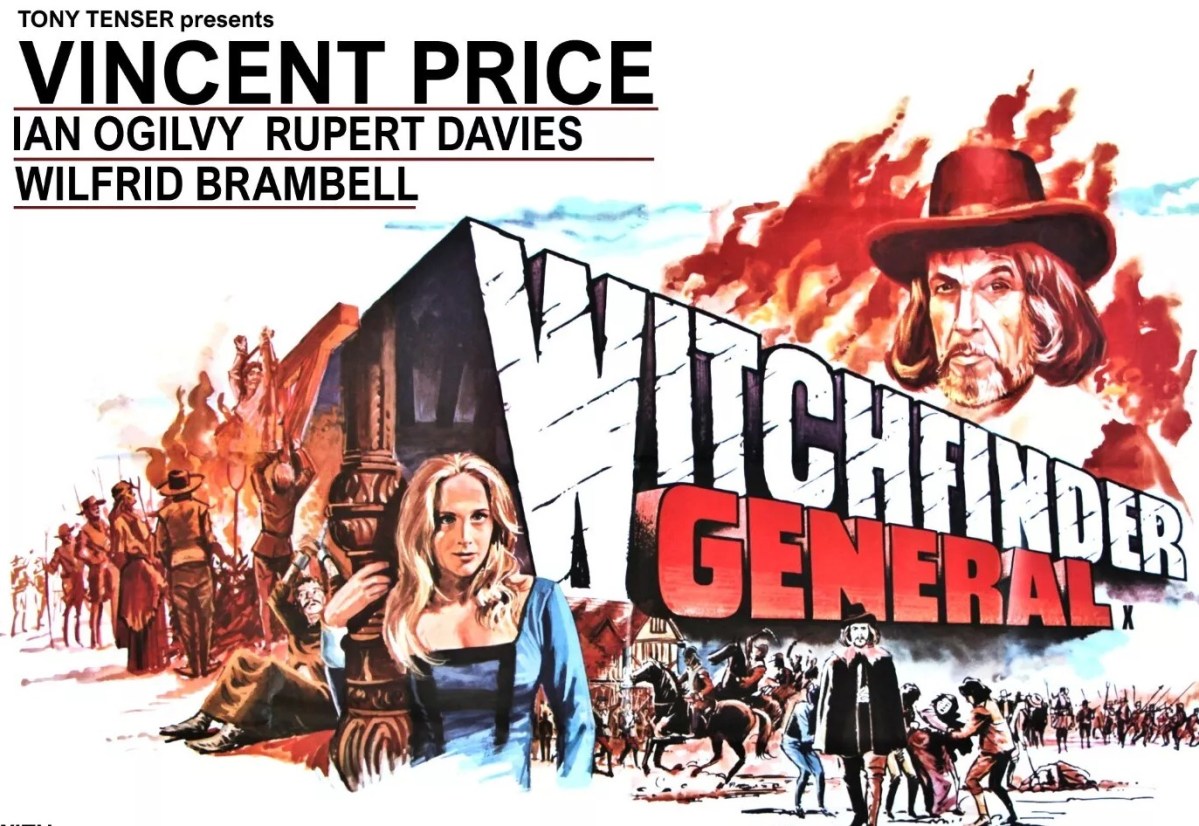
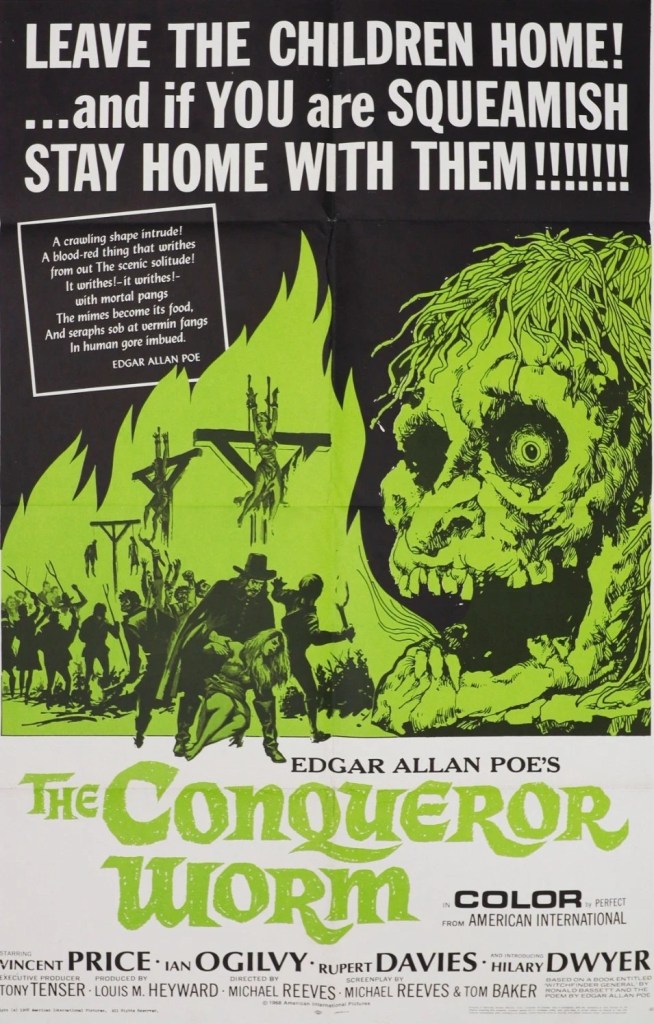
Witchfinder General / The Conqueror Worm (1968) ****

For 250 years Europe and America was in the grip of a man-made plague. Ever since Pope Innocent VIII declared war on supposed witches in 1584, tens of thousands were arrested, tortured and hung or burned to death. Although Arthur Miller’s play The Crucible is considered the last word on the subject, in fact it treats very lightly the physical degradation visited upon victims and the corruption that was at the heart of the disaster. And sure, cinema has poked its nose into the area of possession, most recently with the supposed final act of the The Conjuring series, and while items like The Immaculate (2024) and The Handmaid’s Tale series focus on female subjugation, none of these exposes the full horror of witchcraft accusation.

The British censor bristled at the violence depicted in this film, and the picture was censored to a degree, while movie critics howled at the film’s “sadism.” Yet though the film is a raw depiction of the terrors inflicted on the innocent – male and female – by a corrupt male hierarchy, it scarcely touches the surface of the tsunami of wanton killing and terror.

So this serves as a welcome reminder of that awful age. While romantic leads Richard (Ian Ogilvy) and Sarah (Hilary Dwyer) are insipid, Matthew Hopkins (Vincent Price), the self-appointed Witchfinder General, and his gang of thugs led by John Stearne (Robert Russell) are not, and the enormous delight they take in torturing the innocent is what drives the picture. Set in an England in 1645 riven by civil war, where the forces of law and order are in disarray, Hopkins takes delight in profiting from the lack of opposition to his reign of terror.

While Vincent Price (The Oblong Box, 1969) manages to resist the temptation to be overblown and his subdued performance carries ominous weight, it’s the unusual approach of  director Matthew Reeves (The Sorcerers, 1967) that makes this a standout. He’s not making a horror picture, but a historical one. Not just are their nods to a specific time period, he bypasses the Gothic, the movie taking place mostly in daylight rather than nighttime, and his visual composition stands comparison with the best of the 1960s roadshows rather than standard Hammer or AIP offerings.

Hopkins delegates the actual torture to his underlings, retaining for himself the more subtle pleasure of blackmailing women into providing him with sex and walking off with a fat purse from local dignitaries for his troubles.

When he descends on any town or village, there will be a price to pay in human ruin. He picks on the village of  Brandstone in Sussex and begins to torture local priest John Lowes (Rupert Davies), driving him to exhaustion by endlessly racing him up and down a room before his accomplices can get down to the serious business of plunging long needles into his naked body. Virtually all the weapons in the witch hunter’s armory are of the Catch 22 category. Nothing you do will present as innocent and then you are headed for the gallows or lowered alive into a bonfire.

Luckily for Lowes, his niece Sarah is sweet on Roundhead officer Richard, applauded for his courage in battle, and he attempts to come to her rescue. Unfortunately for her, he is called back to duty before he can save anybody and it’s only by sacrificing herself to Hopkins that Sarah believes she can save her uncle. That turns out to be the worst of the calumnies Hopkins visits upon the innocent, as once he has had his fun he just condemns the old man anyway, and the daughter to boot. And although audiences might wince at the torture it was only fraction of the pain inflicted on the victims who might well end up confessing to witchcraft just to get the agony over with. In my hometown of Paisley, seven witches were executed a few years after Salem on the accusations of an 11-year-old girl – The Renfrewshire Witch Trials has just been published on Amazon should you be interested – which shows the absolute contrivance of the authorities in ruthlessly hunting out victims on the slightest pretense.

It’s a shame that neither Ian Ogilvy (The Sorcerers) nor Hilary Dwyer (The Oblong Box) are equipped to show the depths of despair of their characters, but in some sense this is not their story, except as examples of victims, and the tale really belongs to the venal butchers who took advantage of a climate of fear. These days, it shows up almost as a quasi-documentary and that’s to its benefit.

Written by the director and Tom Baker (The Sorcerers) based on the bestseller by Ronald Bassett. For its U.S. release, AIP snuck in a poem by Edgar Allan Poe which explains the U.S. title The Conqueror Worm.

Interest in this movie is unfairly attributed to the cult status it acquired after the premature death of the director – this was the last of his three films – but in fact it sits easily in the well-wrought historical movies of the period, handsomely mounted and unflinching.

Oldies Every Day of the Week

In the 1960s you could watch old films in the cinema in virtually every country in the world every day of the week. Except in the United States, television had not impacted so much on the availability for booking films made within the last decade, so there was generally plenty of scope to operate a picture house that specialized in old movies. They were called “repertory” theaters. Of course studios dipped in and out of the repertory business themselves, yanking out of the vaults old blockbusters, but on an irregular basis, that particular supply rapidly diminishing as old movies were sold off for small screen presentation. 

Pre-television, in the United States in the 1940s a small industry had grown up, both in distribution and exhibition, either buying up the rights to old movies and recycling them as instituted by the Producers’ Releasing Corporation and Realart and PRC or establishing mini-chains of cinemas like the Academy of Proven Hits. But when television made such big inroads into old stock in the U.S. you were more likely to find old pictures turning up in arthouses, and even then that was limited to known attractions like Garbo and Bogart and occasional retrospectives of Bette Davis and Joan Crawford. Or arthouses would slip in a series of oldies one day a week.

In the 1960s “no cinema in the United States except the Thalia in New York and the Cinema Guild in Berkeley has ever made a serious attempt at presenting cinema repertory.” Occasionally, a U.S. distributor acquired a bundle of old pictures as the basis of an ongoing program distributed through arthouses, such as the 27-film series from Janus or Tom Brandon’s batch of 75. Paris, on the other hand, was a paradise for lovers of old movies. 

The 1960s saw the beginning of the film studies phenomenon, so cinemas showing old movies found new custom. Prior to that, the most common way to view classics was via a film society, another booming sector. While boasting four million members worldwide, access was limited to one movie – in 16mm not 35mm – a week for one screening only and a program that ran for about half a year.

Surprisingly, Britain was at the forefront of the repertory industry. When I was growing up in Glasgow in the 1960s I was astonished to discover a commercial chain – the Classic – operating three cinemas in the city center. Two of the operations, the Classic Grand and the Tatler Classic, while retaining the company name gradually shifted into the sexploitation business, the latter as a private members’ club. But the flagship Classic, just down the road from the Odeon, one of the city’s most prestigious houses, ran a weekly program of old films.

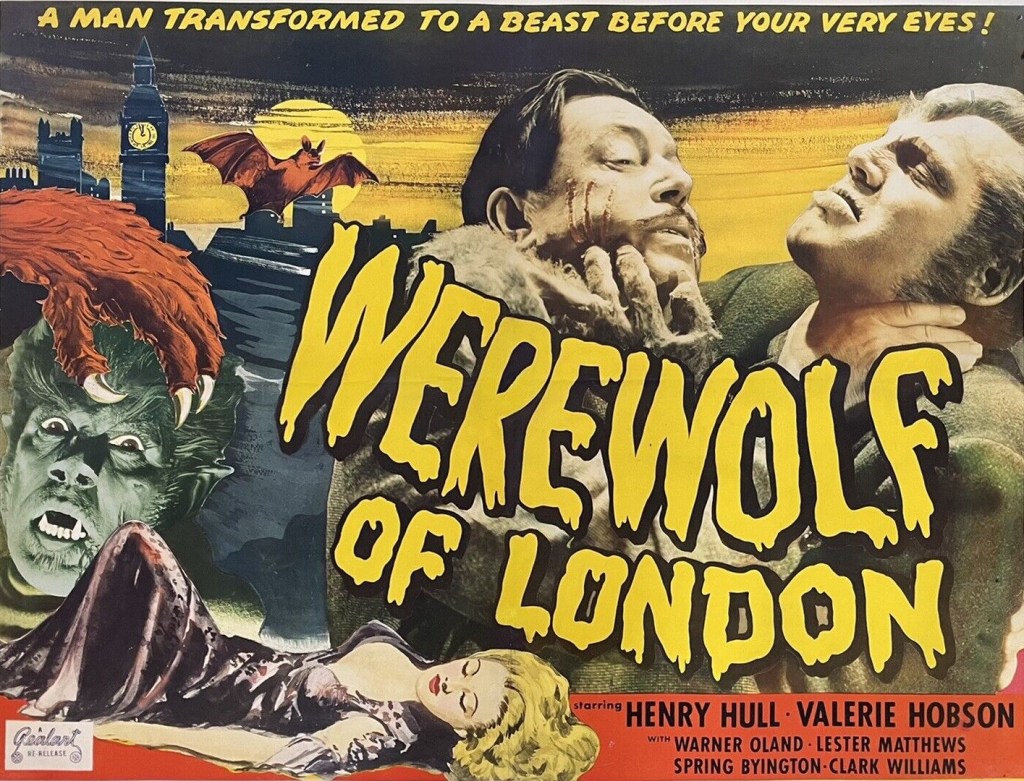
Realart reissue from the 1940s.

At the start of the decade, Classic operated ten cinemas in London and another 80-plus  throughout the United Kingdom. Programmes changed midweek if showing just one film while a double bill would run a full week. Several cinemas ran late night screenings, usually on a Saturday, but these could also be found on a Wednesday or Thursday.

Sometimes the movies shown were foreign, other times there might be a short season of Marx Bros comedies or Hitchcock thrillers, but mostly they were British or American pictures whose quality or reputation suggested they deserved repeat viewing on the big screen. One print would be enough to feed the entire system, shunted from screen to screen.

Quite a few of the films would be hired on a flat fee basis, no sharing the box office with a distributor or studio. Older audiences, fed up with the sex and violence prevalent in current movies, took refuge in safer, older films. Younger audiences, wanting to catch up with great films, found the screenings an unexpected bounty, especially to see them projected in their original dimensions.

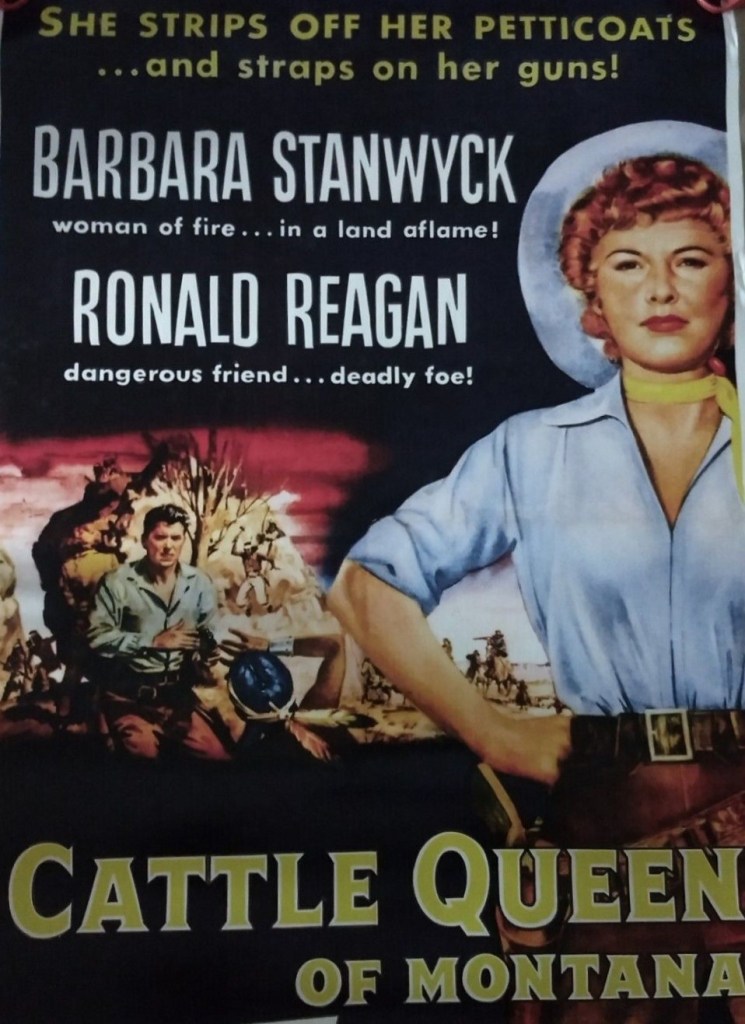
Just how old the offerings were varied. In 1968 over the period March 10-April 6 the youngest film presented on the Classic chain was Bonnie and Clyde (1967), the oldest Animal Crackers (1930), The Lady Vanishes (1938), Carol Reed’s The Stars Look Down (1940) and The Song of Bernadette (1943). In between you could choose between The Third Man (1949), Barbara Stanwyck as The Cattle Queen of Montana (1951), Viva Zapata (1952), The Brides of Dracula (1960), Billy Liar (1963), The Birds (1963), The Pawnbroker (1964) and Peter Sellers comedy After the Fox (1966).

On the foreign front, you could sample Vilgot Sjoman’s My Sister, My Love (1966), Godard’s A Woman Is A Woman (1961), offbeat French film Do You Like Women (1964) about cannibals owning a vegetarian restaurant, and Elke Sommer and Virna Lisi in Four Kinds of Women/The Dolls (1965). It was relatively easy to structure programs to cash in on a current picture by, for example, Peter Sellers or Marlon Brando or directors such as Alfred Hitchcock or Carol Reed.

By the 1970s repertory cinema was booming in America, 400 theaters in operation, major cities accommodating several, while in Britain the Classic chain was acquired by the Tigon production company.

SOURCES: Brian Hannan, Coming Back to a Theater Near You (McFarland, 2016) p48-49, 54, 63, 72-73, 77, 80-81, 72; Gideon Bachmann, “A New Generation of Critical Fans,” Variety, June 1, 1960, p5; Advertisement, Films and Filming, October 1961, p2;“One Night Revivals Add to Arthouse Profits,” Box Office, June 29, 1964, pA3; Gideon Bachmann, “International Film Societies Number 2,500,” Variety, April 20, 1967, p13; “Films in Repertory Set for Reade-Sterling House,” Box Office, February 8, 1965, pE5; “Brandon Lines Up Chain of 30 Arties for Medleys of Oldies and Offbeat Pix,” Variety, Septmeber 6, 1967, p5; “Repertory,” Films and Filming, April 1968, p23;“Squeeze More Coin on Last Run of Classic Films,” Variety, April 24, 1968, p7; “Classic Try Switch To Cinema Club,” Kine Weekly, February 8, 1969, p6; “Tigon Aims Complete Classic Deal by End July,” Kine Weekly, June 12, 1971, p3; Marianne Cotter, “Survival of Revival House,” Box Office, March 1, 1993, p24.

Behind the Scenes: “The Blood Beast Terror” (1968)

Sherlock Holmes vs Sherlock Holmes was the initial tantalizing casting prospect. Basil Rathbone, the most venerated actor to don the distinctive deerstalker, and Peter Cushing, just signed up by the BBC for a new 16-episode series, the former signed to play the villain, the latter his nemesis in a film that started out with the title of The Death’s-head Vampire, the first film by a new production shingle Tigon Films.

While Tigon was new, with a distinctive logo, its driving force was well-known British producer Tony Tenser who with partner Mike Klinger had initially specialized in exploitation pictures with titles such as Naked as God Intended (1961) and London in the Raw (1964). The pair split after the artistic and commercial success of Roman Polanski’s Cul de Sac, Tenser initially setting up under his own name for Mini-Weekend/Tomcat (1966), mining the exploitation vein as before, and The Sorcerers (1967) a new venture into the horror market. Expanding the business with fresh capital and new partners, Tigon was born.

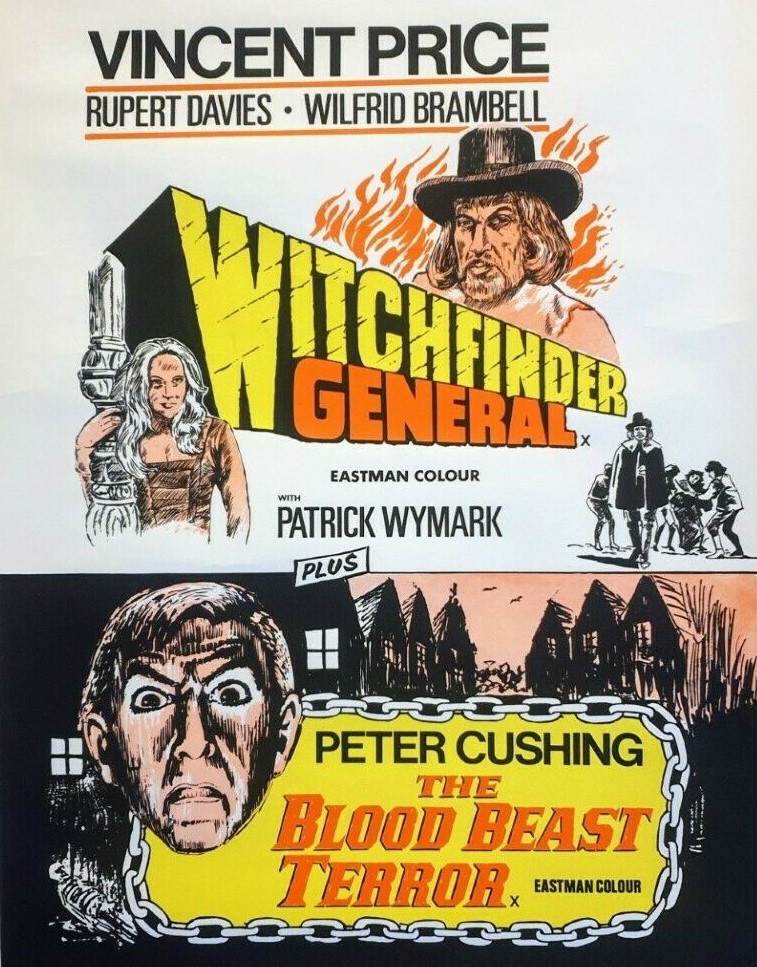
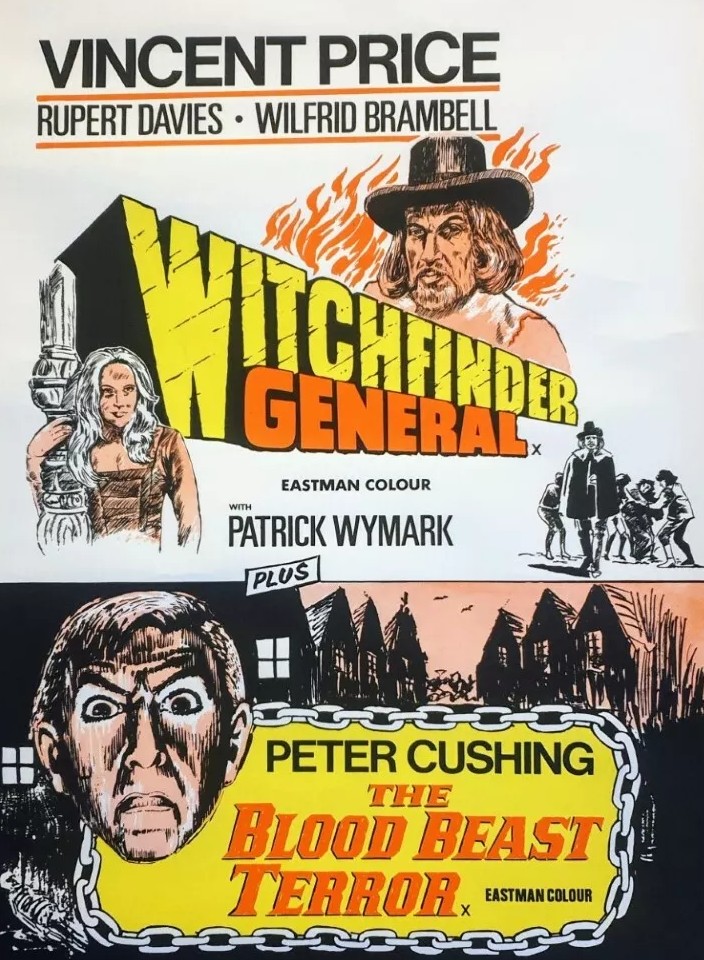
Supporting feature to “Witchfinder General” on ABC circuit release in Britain.

Explaining the new departure, Tenser said, “Films needs to be inexpensive. They need to sell, they need to appeal to an international audience, and one subject that always finds a market is horror.” Horror budgets were low, the genre did not require big stars, and the films had a surprisingly long shelf life.

First movie on the new company’s agenda was not The Death’s-head Vampire. Instead, Tenser had hooked Raquel Welch for a ghost story The Devil’s Discord to be produced by her husband Patrick Curtis, who had performed a similar task on The Sorcerers, and star Peter Cushing (The Skull, 1965). When that fell through, he held onto Cushing for a proposed Horror of Frankenstein and when that also bit the dust turned to him for The Death’s-head Vampire on a budget of just £40,000 (about $100,000). Offered the choice of playing villain Dr. Mallinger or Detective Inspector Quennell, the actor plumped for the “goodie,” Basil Rathbone lined up for the other role. The concept of older man/younger woman with action concentrated on an isolated house and the surrounding countryside was a horror trope.

Vernon Sewell (Strictly for the Birds, 1964), entering his third decade as a director, had worked with Cushing on Some May Live (1965) and was primarily known for low-budget and B-movies, and more importantly from Tenser’s perspective, sticking to a budget without any artistic pretensions or improvisation. He didn’t waste time on anything that would not be captured by the lens. He was calm on set, “nothing fazed him.” Cushing was a kindred spirit, never complaining, except famously, on this picture, when he told Sewell it was the “worst picture” he had ever made. The pair, however, had a very good working relationship to the extent that Sewell never offered Cushing any advice on the role –“he didn’t need my input.”

The Sherlock Holmes connection is promoted in this poster.

Just over two weeks before the August 1967 start date, Basil Rathbone died of a heart attack. Robert Flemyng, the last-minute replacement, was Cushing’s opposite, complaining all the time. The cast was rounded out by 32-year-old Doctor Who star Wanda Ventham (mother of actor Benedict Cumberbatch) and 18-year-old Vanessa Howard whose career highpoint thus far had been a duet with Cliff Richard for a television presentation of Aladdin (1967).

Interiors were shot at Goldhawk Studios, a converted three-story building in London’s Shepherd’s Bush, with exteriors at Grims Dyke, the former home of W.S. Gilbert, in north-west London. The 19th century manor house had lain empty since 1963.

Roger Dickens, who had cut his teeth on Thunderbirds Are Go! (1966) and worked on 2001: A Space Odyssey (1968) and would be later lionized for the mini-beast bursting out of John Hurt’s stomach in Alien (1979) was responsible for creating the monster. The model for the giant larvae was a much simpler task than creating a believable female giant insect. He took a mold of Ventham’s face, giving the features a repellant slant,  using costume jewelry for the eyes, adding a furry cap and two-foot long antennae, a representation  that would only really work if you scarcely saw the creature. For art designer Wilfred Woods his woods set turned into a disaster when the trees wilted and lost their leaves.

Opinions differ as to whether Tenser interfered with production. He saw his role during the film process to ensure that the project followed the script. “Sometimes you can put something in a film which will hinder the selling, sometimes you need to put something in which will help the selling.”

Comedian Roy Hudd, playing the morgue attendant, thought the script so awful he was delighted to work with Cushing on improvements. 

When John Ford’s boast that he never shot an extra foot of film in order to prevent a producer turning in a different film has resulted in many a masterpiece, the same did not hold true for Sewell. Sticking so close to the script, not filming anything that was not absolutely necessary meant that the movie was too short. Editor Howard Lanning commented: “I put in everything that was available. Even with expanding the lecture scene and the amateur dramatics as long as possible, to the detriment of pace, the picture clocked in at just 81 minutes, not the length expected of a main feature.

To ensure the movie came in at the required length, Tenser added the African sequence at the beginning (an extra five minutes) and re-shot the morgue material (two more minutes), encouraging Cushing and Hudd to improvise. The final product was over-budget and a week late. The version shown to the censor was 87 minutes though the official running time was a minute longer.

Tenser now deemed the working title as insufficient, preferring “something catchy and something that told people what you were selling.” His first stab at a new title was Blood Beasts from Hell. But in the final analysis it was altered to The Blood Beast Terror. Hoping to sell it to a circuit as a main feature it was originally shown in a double bill with Castle of the Living Dead, but despite the supposedly attractive title, audiences were not interested. To cut his losses, the film was repackaged as the support to another Tigon production Witchfinder General (1967) which meant Tenser would not have to share receipts with another distributor.

The Blood Beast Terror did not prove so sellable overseas either. It was shelved in France until 1971, although, sold for a flat fee, it did well in South America. A.I.P. who had U.S. distribution rights to Witchfinder General – title altered to The Conqueror Worm – had no interest in The Blood Beast Terror but it was picked up by Pacemaker Pictures who were also in title-changing mood and released it in summer 1969 as Vampire Beast Craves Blood on a double bill with Curse of the Blood Ghouls (1964).

Tenser’s predictions of long shelf life were correct. In Britain, the movie was reissued on a late night double bill with The Secret of Blood Island (1961), and then was revived with The Devil’s Hand (1961) before being re-teamed with Witchfinder General on a Sunday’s-only screening. Although none of these would be circuit releases in the sense of a nationwide day-and-date opening, they were nonetheless likely to get reasonable bookings to fit specific engagement profiles. In the States where there was endless demand for horror triple- and quadruple bills and all-nighters, The Blood Beast Terror received ongoing bookings.

SOURCES: John Hamilton, “The Making of the The Blood Beast Terror,” Little Shoppe of Horror, Issue No 43, p67-91; John Hamilton, “Regretting Nothing: John Sewell, Little Shoppe of Horror, Issue No 43, p92-98.

The Crimson Cult/ Curse of the Crimson Altar (1968) ***

Horror is a small world and at any moment you are likely to bump into stars of the caliber of Christopher Lee, Boris Karloff and Barbara Steele – or in this picture all three. Investigating his missing brother Peter sends antiques dealer Robert Manning (Mark Eden) to a remote country mansion where he encounters owner Morley (Christopher Lee), his seductive niece Eve (Virginia Weatherall), the wheelchair-bound authority on witchcraft Professor Marsh (Boris Karloff), deaf mute Elder (Michael Gough) and a centuries-old mystery.

Morley can legitimately deny that Peter has ever set foot on the premises since it was common for the brother to adopt an alias when seeking out significant antiques. By the time Robert amasses sufficient clues to challenge Morley on this particular issue, it appears that further ideas of more sinister goings-on may be illusory. On his first night Robert observes an annual celebration of the Black Witch but although an effigy is burned this festival appears to have more to do with the innocent consumption of alcohol and heady bouts of sex than satanism.

Thanks to career reinvigoration after Peter Bogdanovich’s “Targets” (1967)
Boris Karloff gained top billing in the British release.

And after a while, Robert indulges in carnal delight with Eve. However, he is plagued by a nightmare that involves a grotesque trial by a jury wearing animal heads. Gradually, he learns that Morley, meanwhile, is such a congenial host, and his niece delightful and sybaritic company, that the finger of suspicion points at Elder, who does take a pot shot at Robert, and the professor who has a collection of instruments of torture.

Were it not for veteran director Vernon Sewell (Urge to Kill, 1960) beginning proceedings with some kind of black mass complete with floggings and female sacrificial victim, the audience might have been kept in greater suspense. As it is, the non-violent annual celebration throws us off the scent as does the seduction of Eve and the prospect that Robert’s nightmare is little more than psychedelic hallucination. The denouement is something of a surprise. The ritualistic aspects of the picture are well done and given this is a Tigon film rather than Hammer you can expect harsher treatment of the S&M element, flagellation delivered by women, especially for the period.  

In the U.S. – where it was shown both as “The Crimson Cult” and “The Crimson Altar” – Christopher Lee was accorded prime billing status.

The eerie atmosphere and well-staged witchcraft scenes are a plus, but, despite the involvement of a handful of horror gods, the movie’s reliance on lesser players to drive the narrative is a minus. Lee, Karloff and Steele (though in a more minor role) are all excellent as is the demented Michael Gough but Mark Eden (Attack on the Iron Coast, 1968) is too lightweight to carry the picture although Virginia Wetherall in her first big part suggests more promise.  More of Lee, Karloff and Steele would have definitely added to the picture but since this type of film often requires the young and the innocent to take center stage that was not to be.

Discover WordPress

A daily selection of the best content published on WordPress, collected for you by humans who love to read.

The Atavist Magazine

by Brian Hannan

WordPress.com News

The latest news on WordPress.com and the WordPress community.