Mayerling (1968) ****

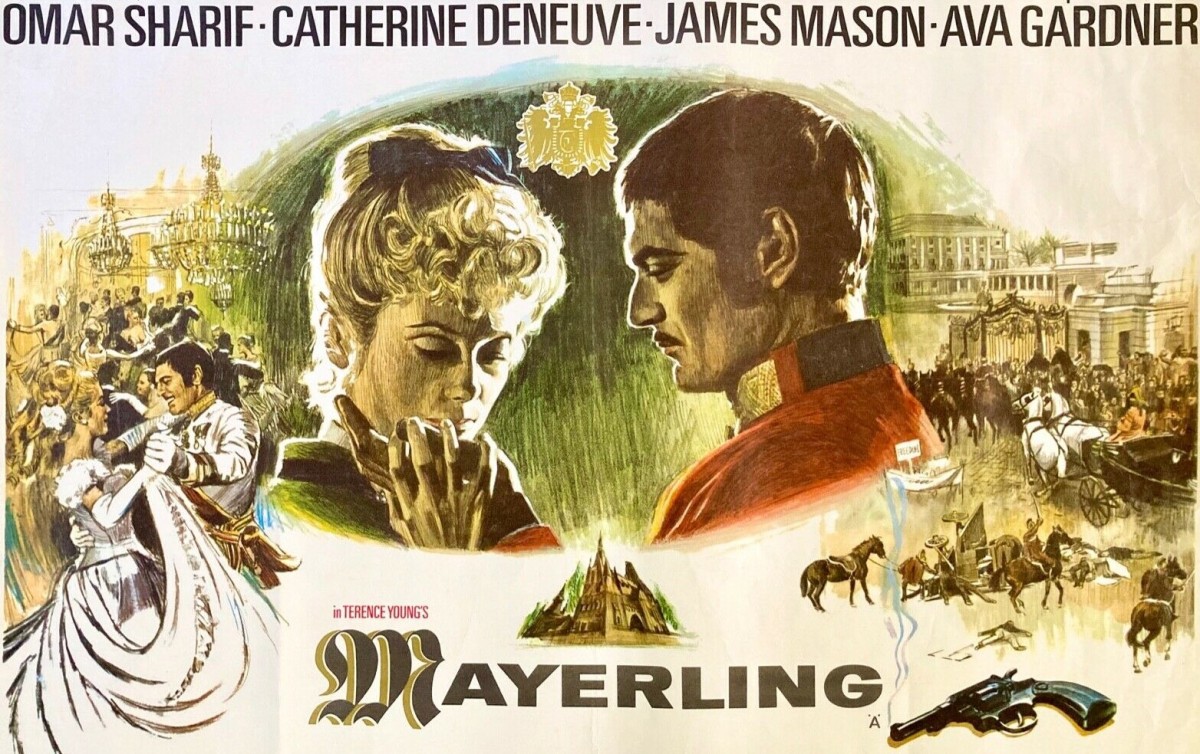
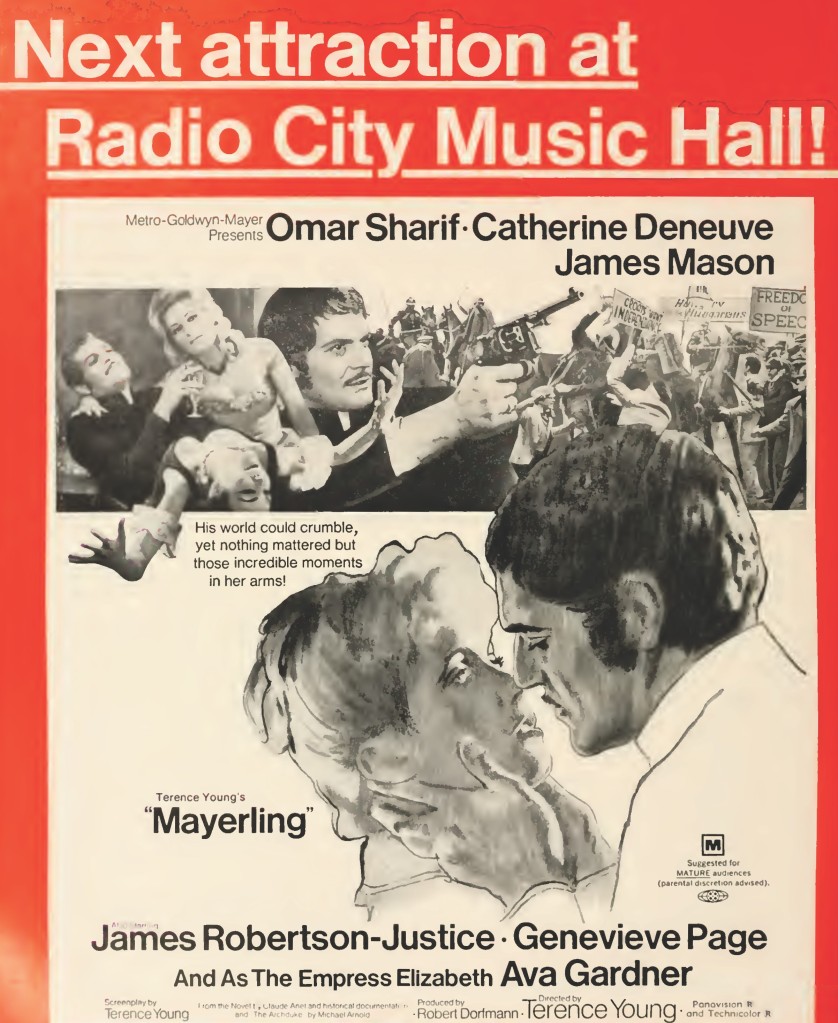
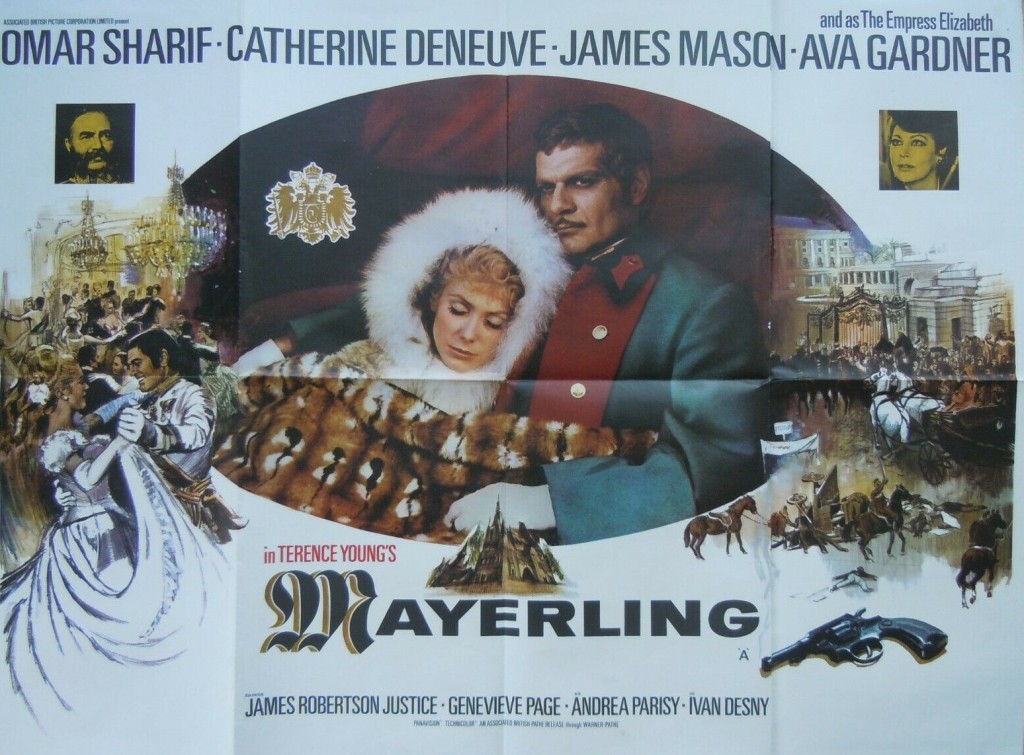
Sumptuous historical romantic drama set in a fading European empire awash with political intrigue and incipient revolution. Archduke Rudolf (Omar Sharif), married heir to the throne and constantly at odds with rigid father Emperor Franz-Josef (James Mason), sympathizes so strongly with Hungarian dissidents that he threatens to tear apart the Austro-Hungarian Empire. However, when he falls in love with Maria (Catherine Deneuve) and wants to marry her instead that, too, threatens to throw the empire into disarray.

Although dissolute, a mistress (or two) on the side, and addicted to morphine, that is not the way Rudolf is introduced to the audience. Instead, he is one of a string of bloodied men arrested after a demonstration giving his name to an officer in a police station who, once he is recognized, orders all other prisoners be released. He is the poster boy for good royalty. The Hungarians, agitating for independence, want him to become their king.

Beautifully mounted with lavish sets and enough in the way of balls, ballet, processions,  horse riding and sleighs to keep up a steady parade of visually interesting distractions, the films steadily builds up an undercurrent of tension, both between father and son and between rebels and ruler. The emperor is a political genius, not just spying on his son, but full of devious devices to hold together whatever threatens to break up the empire.

The romance develops slowly and with true historical perspective, the first kiss they share is not on the lips, Rudolf kisses both her cheeks, she kisses his palm. Yet, there is a real sense that, no matter his power, they can still both be trapped in roles they despise, separated at the whim of parents. Rudolf, as he understands true love for the first time, finds the self-belief to challenge political certainties.

The regal aspects are well done, arguments about the rule of monarchy come over as heated conversation rather than boring debate, the political realities unavoidable. Rudolf, desperate to avoid a future where someone has to die before he has a reason to live. Escape is not an option.

There is a wonderful bitchy atmosphere in the court, where ladies-in-waiting disparage each other behind their backs, one dress described as “wallpaper,” and are forever seeking advancement. Countess Larish (Genevieve Page) is a self-appointed procurer-in-chief for Rudolf, not caring what chaos she causes.

I should add, if you are as ignorant of your European history as myself, that Mayerling is a place not a person. I tell you this so that you don’t make my mistake of waiting for a Mayerling character to appear. The film pointedly avoids a history lesson but it could have spared a minute to explain that the events depicted take place just 20 years after the Austro-Hungarian Empire, the second largest land-mass in Europe, and among the top two or three nations. That would have helped clarify why Franz-Josef was in such a constant state,  worried about forces that could break up the empire, and as concerned that his son, living such a debauched life, lacked the personal skills to hold it together after his father’s death.

It is ironic that Rudolf does prove his worth as a result of being briefly separated from Maria, taking the army to task for its incompetent officers and poor maintenance of everything from weaponry to horses.

To his credit director Terence Young (Dr No, 1962) does not rely on Omar Sharif’s soulful brown eyes and instead allows action to convey character and looks and touch the meaning of his love. This is probably Omar Sharif’s best role, one where he clearly made all the acting decisions rather than being over-directed by David Lean as in Doctor Zhivago (1965). Catherine Deneuve is equally impressive as a far-from-docile innocent, especially given the wide range of more sexually aware characters she has created for Repulsion (1965) and Belle de Jour (1967).

James Mason (Age of Consent, 1969) is superb as the conniving emperor, so rigid he will not approve a change of buttons for the army, so cunning that an apparent rapprochement with his son has unseen strings attached. Ava Gardner (55 Days at Peking, 1963) sweeps in briefly as an empress protective of her son and making the best of life in a gilded cage. Also impressive are Genevieve Page (Grand Prix, 1966) and James Robertson Justice (Doctor in Distress, 1963) as the high-living British heir nonetheless under the thumb of his mother Queen Victoria.

Terence Young also wrote the literate, often amusing script, although Denis Cannan (A High Wind in Jamaica, 1965) and Joseph Kessel (Night of the Generals, 1967) are credited with additional dialogue. While Francis Lai (The Golden Claws of the Cat Girl, 1968) wrote the score he relies heavily on classical music from Aram Khachaturian’s Spartacus.

If you come at this not expecting a David Lean style affair full of striking compositions, but an old-fashioned drama advancing at leisurely pace, you will not be disappointed.

Dr No (1962) *****

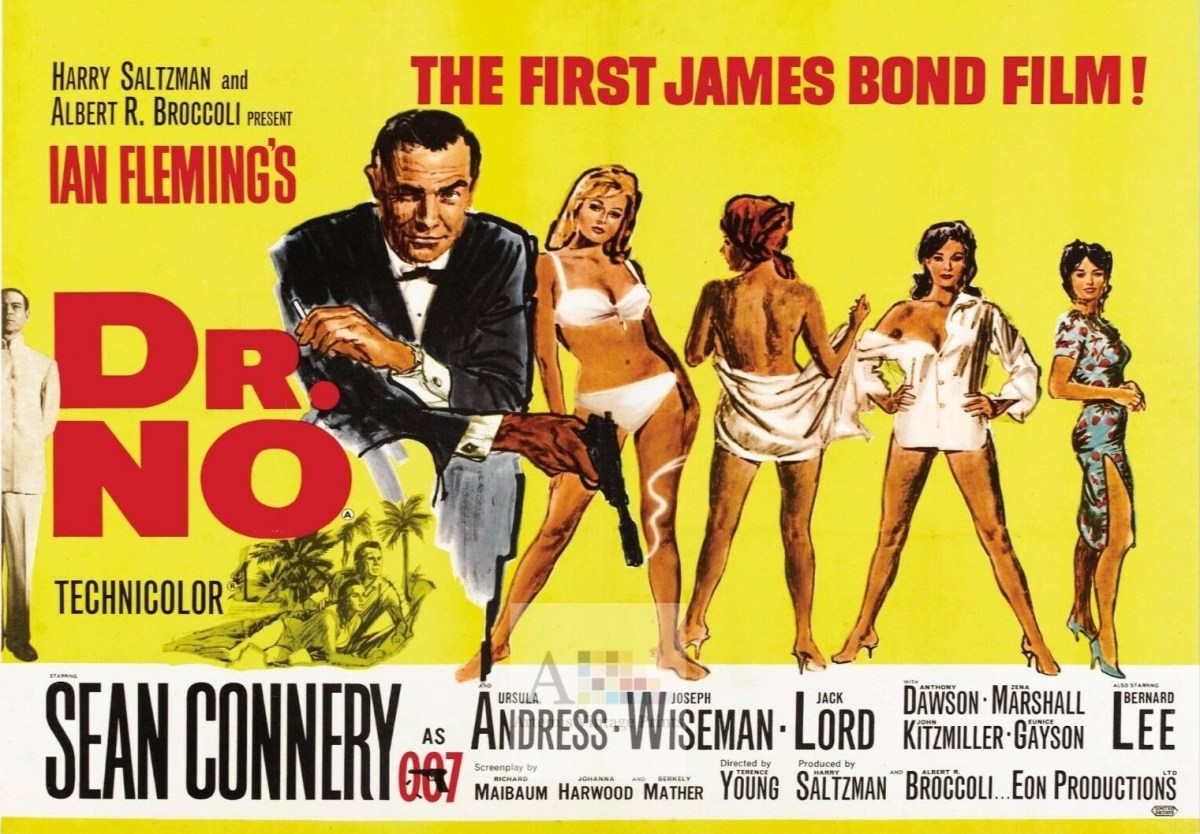
Minus the gadgets and the more outlandish plots, the James Bond formula in embryo. With two of the greatest entrances in movie history – and a third if you count the creepy presence of Dr No himself at the beds of his captives – all the main supporting characters in place except Q, plenty of sex and action, plus the Maurice Binder credit sequence and the theme tune, this is the spy genre reinvented.

Most previous espionage pictures usually involved a character quickly out of their depth or an innocent caught up in nefarious shenanigans, not a man close to a semi-thug, totally in command, automatically suspicious, and happy to knock off anyone who gets in his way, in fact given government clearance to commit murder should the occasion arise. That this killer comes complete with charm and charisma and oozes sexuality changes all the rules and ups the stakes in the spy thriller.

 Three men disguised as beggars break into the house of British secret service agent Strangways (Tim Moxon) and kill him and his secretary and steal the file on Dr No (Joseph Wiseman). A glamorous woman in a red dress Sylvia Trench (Eunice Gayson) catches the eye of our handsome devil “Bond, James Bond” (Sean Connery) at a casino before he is interrupted by an urgent message, potential assignation thwarted.

We are briefly introduced to Miss Moneypenny (Lois Maxwell) before Bond is briefed by M (Bernard Lee) and posted out immediately – or “almost immediately” as it transpires – to Jamaica, but not before his beloved Beretta is changed to his signature Walther PPK and mention made that he is recovering from a previous mission. But in what would also become a series signature, liberated women indulging in sexual freedom, and often making the first move, Ms Trench is lying in wait at his flat.

In another change to the espionage trope, this man does not walk into the unknown. Suspicion is his watchword. In other words, he is the consummate professional. On arrival at Jamaica airport he checks out the waiting chauffeur and later the journalist who takes his picture. The first action sequence also sets a new tone. Bond is not easily duped. Three times he outwits the chauffeur. Finally, at the stand-off, Bond fells him with karate before the man takes cyanide, undercutting the danger with the mordant quip, on delivering the corpse to Government house, “see that he doesn’t get away.” 

Initially, it’s more a detective story as Bond follows up on various clues that leads him to Quarrel (John Kitzmiller), initially appearing as an adversary, and C.I.A. agent Felix Leiter (Jack Lord) before the finger of suspicion points to the mysterious Dr No and the question of why rocks from his island should be radioactive. Certainly, Dr No pulls out all the stops, sending hoods, a tarantula, sexy secretary Miss Taro (Zena Marshall) and the traitororous Professor Dent (Anthony Dawson) to waylay or kill Bond.

But it’s only when our hero lands on the island and the bikini-clad Honey Rider (Ursula Andress) emerges from the sea as the epitome of the stunning “Bond Girl” that the series formula truly kicks in: formidable sadistic opponent, shady organization Spectre, amazing  sets, space age plot, a race against time. 

It’s hard not to overstate how novel this entire picture was. For a start, it toyed with the universal perception of the British as the ultimate arbiters of fair play. Here was an anointed killer. Equally, the previous incarnation of the British spy had been the bumbling Alec Guinness in Our Man in Havana (1959). That the British should endorse wanton killing and blatant immorality – remember this was some years before the Swinging Sixties got underway – went against the grain.

Although critics have maligned the sexism of the series, they have generally overlooked the reaction of the female audience to a male hunk, or the freedom with which women appeared to enjoy sexual trysts with no fear of moral complication. Bond is not just macho, he is playful with the opposite sex, flirting with Miss Moneypenny, and with a fine line in throwaway quips.

Director Terence Young is rarely more than a few minutes away from a spot of action or sex, exposition kept to a minimum, so the story zings along, although there is time to flesh out the characters, Bond’s vulnerability after his previous mission mentioned, his attention to detail, and Honey Rider’s backstory, her father disappearing on the island and her own ruthlessness. The insistently repetitive theme tunes- from Monty Norman and John Barry – were innovative. The special effects mostly worked, testament to the genius of production designer Ken Adam rather than the miserable budget.

Most impressive of all was the director’s command of mood and pace. For all the fast action, he certainly knew how to frame a scene, Bond initially shown from the back, Dr No introduced from the waist downwards, Honey Rider in contrast revealed in all her glory from the outset. The brutal brief interrogation of photographer Annabel Chung (Marguerite LeWars), the unexpected seduction of the enemy Miss Taro and the opulence of the interior of Dr No’s stronghold would have come as surprises.

Young was responsible for creating the prototype Bond picture, the lightness of touch in constant contrast to flurries of violence, amorality while blatant delivered with cinematic elan, not least the treatment of willing not to say predatory females, the shot through the bare legs of Ms Trench as Bond returns to his apartment soon to become par for the course.

Future episodes of course would lavish greater funds on the project, but with what was a B-film budget at best  by Hollywood standards, the producers worked wonders. Sean Connery (The Frightened City, 1961) strides into a role that was almost made-to-measure, another unknown Ursula Andress speeded up every male pulse on the planet, Joseph Wiseman (The Happy Thieves, 1961) provided an ideal template for a future string of maniacs and Bernard Lee (The Secret Partner, 1961) grounded the entire operation with a distinctly British headmaster of a boss.

Discover WordPress

A daily selection of the best content published on WordPress, collected for you by humans who love to read.

The Atavist Magazine

by Brian Hannan

WordPress.com News

The latest news on WordPress.com and the WordPress community.