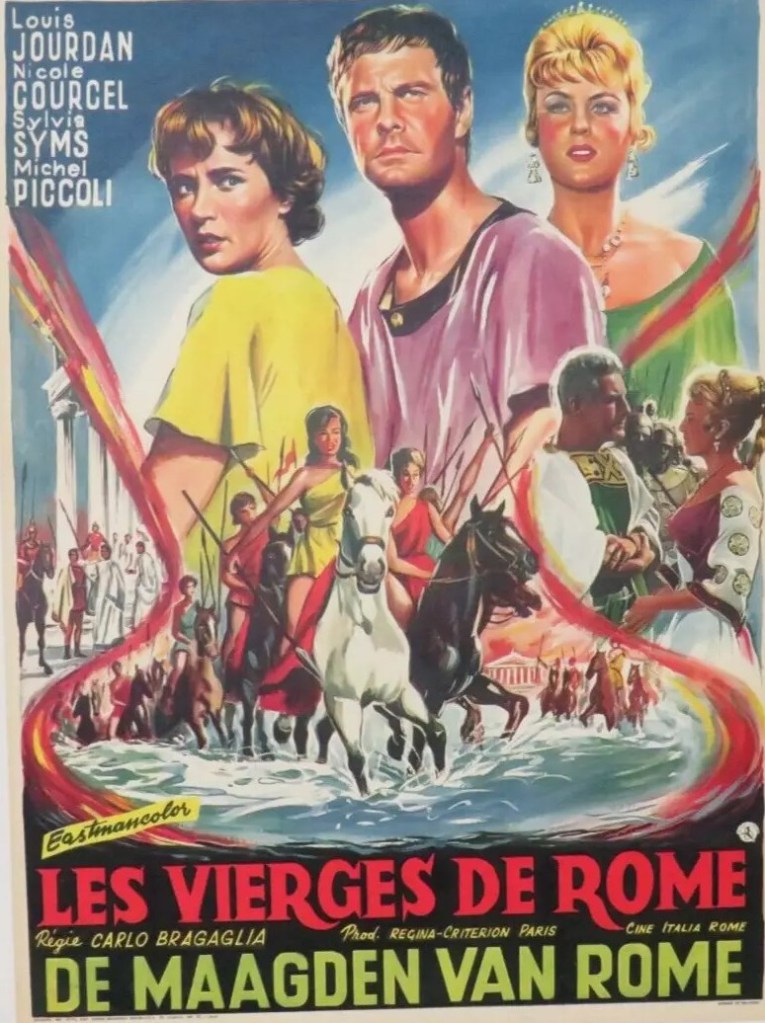
Amazons of Rome / Virgins of Rome (1961) ****

Starting with the cast  and the intelligence of the narrative a pretty unusual addition to the peplum subgenre. While there was no shortage of foreign stars hoping to find marquee redemption in Italy, I was frankly astonished to find leads of the caliber of Frenchman Louis Jourdan, fresh from Twentieth Century Fox big budget musical Can Can (1960), and rising English star Sylvia Syms coming off her biggest Hollywood role to date albeit as second female lead in The World of Suzie Wong (1960).

At the time of release, Jourdan did not seem a good fit for a genre that relied more on musclemen than the kind of suave charmer that he essays here. Syms equally seemed an odd choice, better known for prim Englishwomen than action. In fact, you’d have been hard put to find any American or British actress who would sign up for such a role. Although Sophia Loren in El Cid and Jean Simmons in Spartacus had significant roles in historical mocvies, they weren’t called upon to buckle a sword.

Given they start out as sworn enemies, Drusco (Louis Jourdan),  a barbarian laying siege to Rome, Cloelia (Sylvia Syms)  a besieged inhabitant, it was going to take some considerable narrative sleight of hand to contrive a happy ending. How it’s done is entirely believable, pivoting on ideals of honor that are initially foreign to this vicious war full of scores to be settled, unbridled ambition, deviousness and ruthlessness.

The civilized Etruscans backed by a barbarian horde headed up by Drusco have dealt a killer blow to the Roman armies led by one-eyed Horatio (Ettore Mani). Never mind the lack of obvious muscle Drusco isn’t anyone’s idea of a warrior leader. We are introduced to him munching on a watermelon and then chomping down on an apple on the edge of the battlefield. While other Etruscans, namely Stavros (Renaud Mary), want to raze Rome to the ground Etruscan leader Porcena (Jean Chevrier) wants peace. But it comes at a price – tons of gold in tribute and a thousand hostages. But since Rome is short of able-bodied men to fulfill that part of the deal, the Etruscans make up the numbers with a battalion of untested female warriors led by Cloellia.

Adding spice to the mix is Lucilla (Nicole Courcel), now an aristocratic Roman married to a noble, but originally an Etruscan captive, married to Porcena, who wants revenge on the Romans for her original harsh treatment at their hands. She finds a willing ally in the devious Stavros. 

initially merely amused by Cloelia and her warriors, impounded in a stockade outside the Etruscan camp, Drusco responds to their smarts. Devoid of weapons, the women find clever ways of stealing swords from their captors and secreting them in the stockade. However, when the scam is discovered, Cloelia volunteers to take whatever punishment is meted out. Porcena cedes choice of punishment to Lucilla who wants Cloelia to endure the same humiliation as was once handed out to her – to be whipped and then stripped naked in public.

But she hasn’t counted on Drusco’s cleverness. The minute one lash is administered, Drusco steps in, and pretty much on a technicality, announces that a “whipping” – number of strokes not specified – is complete. When Lucilla starts to strip Cloelia, he musters his soldiers to conceal this from the slavering Etruscans.

Cue some flirting but of course they are still on opposite sides. And in any case Lucilla puts paid to nascent romance, ensuring Drusco is chucked out of the camp for defying her. Infuriated, she sides with Stavros who has decided that mass rape will put the captives in their place. 

His scheme is thwarted by Cloelia who sets fire to the compound, escaping with her army after bullocks stampede. Pursued by Etruscan cavalry, they are saved by the intercession of Drusco. Embarassed by their escape, Porcena is now persuaded to restart the war. Back in Rome, Cloelia disobeys orders not to get involved and leads her army out through the sewers to attack the Etruscan rearguard. Porcena, realizing he has been used, calls for a truce. Lucilla is reunited with her Roman husband and Drusco, made a freeman of Rome, is able to marry the enemy.

Porcena comes over as an enlightened ruler. An early advocate of the zero sum game, his guiding rule for peace is “no victor, no vanquished” and he draws the line at the kind of ruthlessness espoused by his cohorts and although still attracted to Lucilla finds her attitudes distasteful and arranges for her to bury the hatchet with her Roman husband rather than continuing to foment her anger. There’s a lot more interesting dialog  than you’d expect in a picture like this.

But Louis Jourdan is what makes it special. His light comedic touches not only make his character much more human and attractive than the normal musclebound jerk, but also serve to underline his humanity. And since he’s so good anyway on the seductive side, the romantic elements catch fire rather than just limping along as was more normal in the genre. The only downside is he challenges George Hamilton in the over-tanned department.

Sylvia Syms, too, makes it all work. There’s no slacking in the action department and clearly no stand-in for the horse-riding, crossing of a river and a sewer on horseback. And without resorting to the athleticism of a Wonder Woman, the most recent example of the Amazon variety, and perhaps precisely because there’s no kowtowing to that, she is a believable heroine. No feminine wiles are required, either, just genuineness. 

Lucilla’s deviousness reminded me of Ian Bannen in Suspect, that spirit trapped by humiliation, revenge the only release. And though Nicole Carcel isn’t in Bannen’s league, she manages to essay the dark side of her nature with ease.

There are plenty narrative plot holes – how do the women emerging soaking from the river manage to burn the Etrucan battering ram being the pick – but the spirit of the picture more than compensates. 

The elements that made it stand out for all the wrong reasons back in the day are the very elements that make it so appealing to a contemporary audience. 

Highly enjoyable.

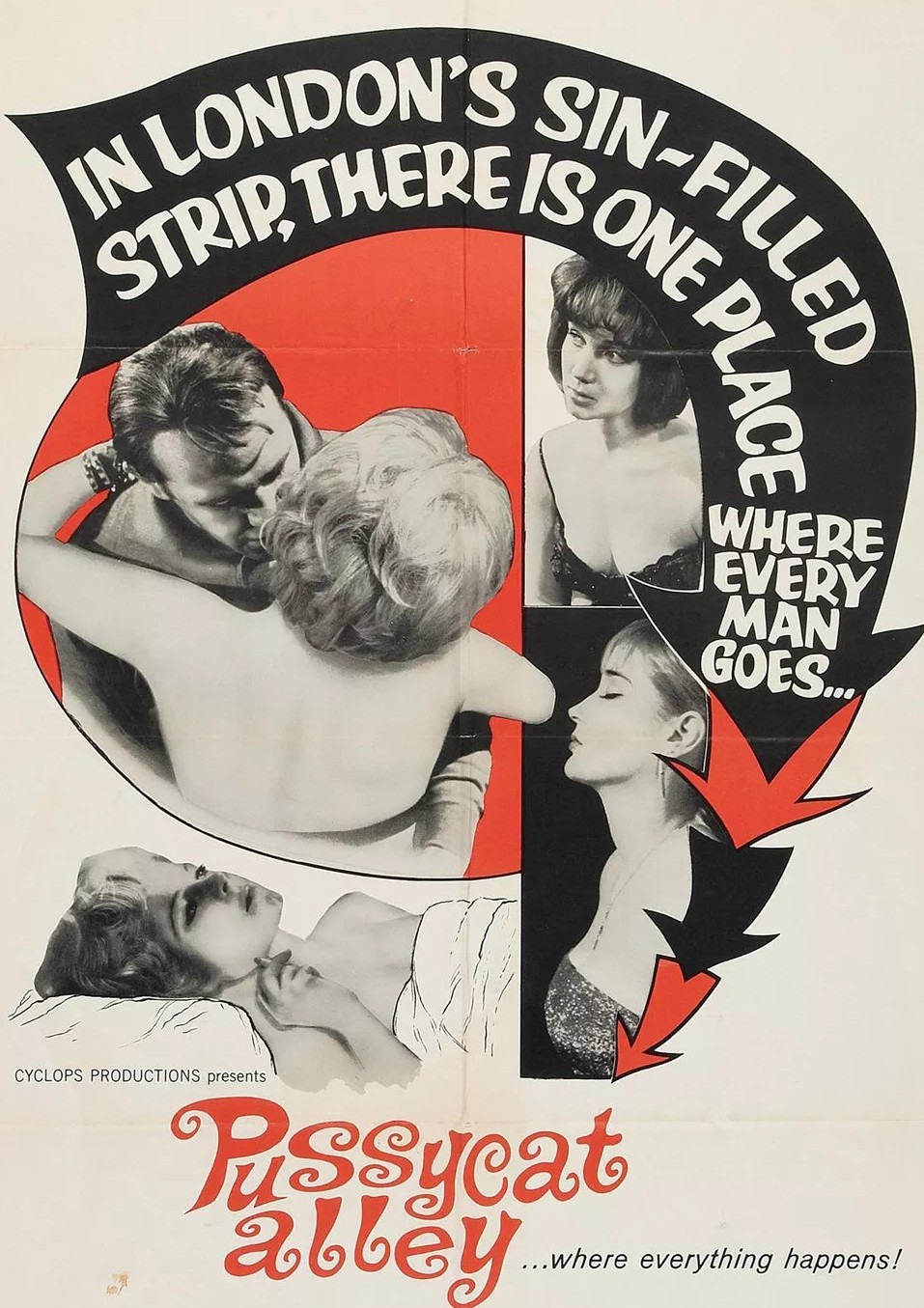
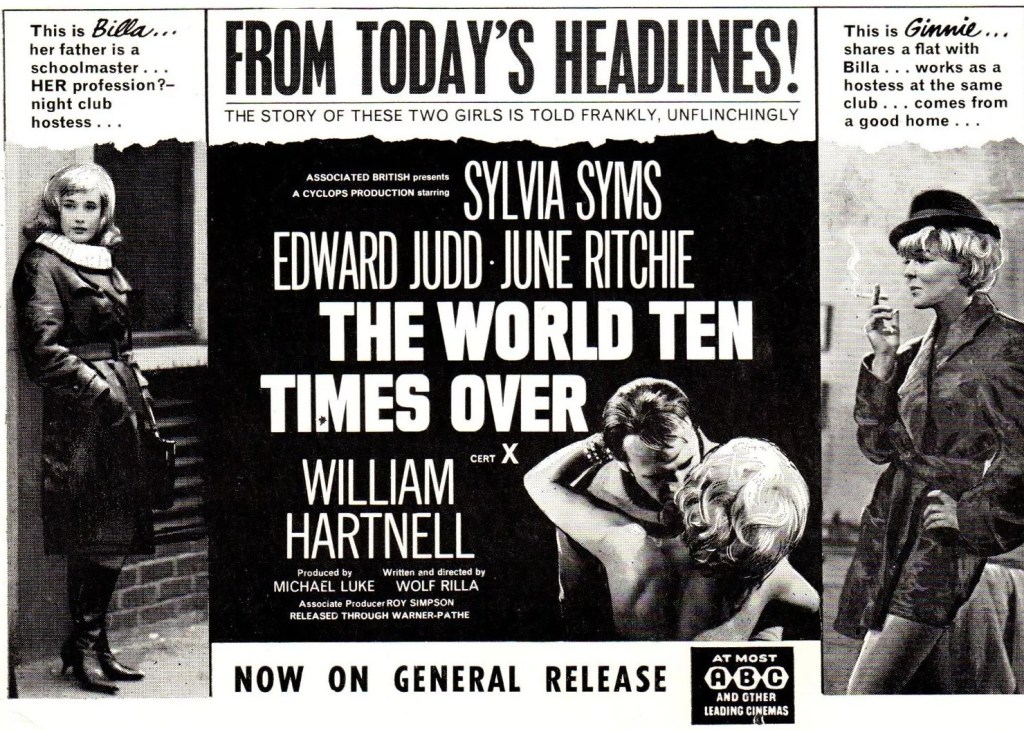
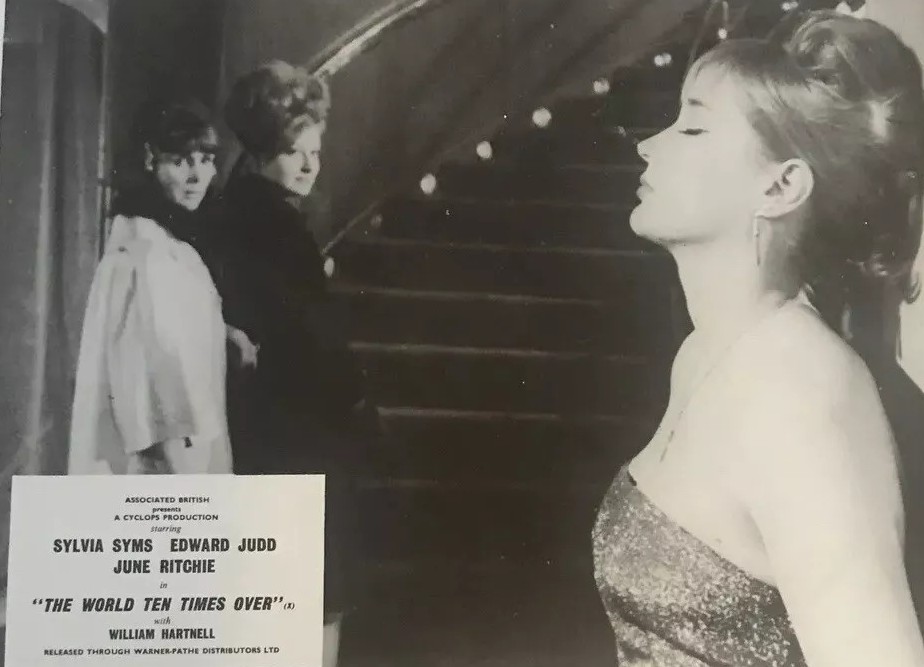
Pussycat Alley / The World Ten Times Over (1963) ***

Sold as sexploitation fare, this is more of a chamber piece as flatmates Billa (Sylvia Syms) and Ginnie (June Ritchie) face up to crises in their lives. For two-thirds of the picture we steer clear of their place of occupation, a Soho nighclub, and only go there for a scene of unsurpassed male humiliation. Unusually, since the expectation would be that the two girls, supplementing their official income with some part-time sex working (implicit rather than explicit), would be treated as victims of wealthy males, in reality they serve up several plates of juicy revenge, but in accordance with their characters rather than as noir femme fatales.

In a very drab London, shorn of tourist hallmarks and red buses and royal insignia, Ginnie sets the tone, furious at lover Bob (Edward Judd), pampered son of a wealthy industrialist, for bringing mention of “love” into what she views as either (or both) an expression of pure pleasure or financial transaction. Bob is the old cliche, the client fallen in love with the girl. Attracted as she is by the pampering and the fact that she can twist him round her little finger, she values her independence too much to commit to such a weak man. In addition, she is so used to getting her way and so wilful that she delights in running rings around him, humiliating him in front of his entire office. 

A contemporary picture like Anora (2024) would find space to excuse or explain her choice of employment, but here, beyond the fact that she left school aged 15 and has no qualifications, we are given nothing to work on, except that her predilection for doing exactly what she wants to do most of the time means she she might find steady employment a drain on her spritely personality.

Billa’s problem is she’s pregnant with no idea who the father might be and becomes infuriated by her widowed teacher  father  (William Hartnell) who can’t let go of his childlike notions of his beloved daughter. Thankfully, no  notions of abuse, but just a dad not coming to terms with a grown-up daughter, shocked that she can knock back the whisky, and whose idea of a treat is taking her to one of the most difficult of the Shakespeare plays. Eventually, suspicions aroused, he tracks her down to the nightclub where she takes great delight in behaving disgracefully, refusing to leave at his presence, parental authority cut stone dead, the staff treating the father like any other punter, even setting him up with a girl (though on the house and he doesn’t take them up on the offer). 

Meanwhile, the over-entitled Bob, failing to get his father to offer Ginnie a job except as an escort for the company’s clients, decides to leave his wife, books plane tickets for an exotic holiday only to be spurned. Ginnie recognizes more easily than him what a disaster marriage would be. She enjoys the fancy restaurants and fast cars but draws the line at commitment. She’s at her best when prancing around, indulging her whims, and yet there is a price to pay for her lifestyle as we discover in more sober fashion at the end.

Billa is sober pretty much all the way through, thoughtful, withdrawn, unable to connect with her father, her biggest emotional support being Ginnie. Despite her failure to go along with her father’s vision of her as an innocent child, her apartment is bedecked with childish paraphernalia, teddy bears, dolls etc. 

Not quite a harder-nosed version of Of Human Bondage, and not far off as far as the males are concerned, but more of a character study of the two women.

Although she has the less showy part, Sylvia Syms is the peach here, and if you consider her portfolio from The World of Suzie Wong (1960) through to East of Sudan (1964) this shows the actress at the peak of her ability. June Ritchie (A Kind of Loving, 1962) is excellent as the flighty piece and Edward Judd (The Day the Earth Caught Fire, 1961) steps away from his normal more heroic screen persona. This was William Hartnell’s last movie before embarking on his time travels for Doctor Who and it’s a moving portrait of an old man whose illusions are shattered.

Directed by Wolf Rilla (Village of the Damned, 1960) from his own screenplay.

Low-life never looked so glam and so shoddy at the same time.

Victim (1961) ****

Blackmail remains an odious and, unfortunately, booming area of criminal activity, especially targeting youngsters for perceived sexually inappropriate behavior. Politicians still fall into honey traps and I’m sure there are  Hollywood stars who dare not risk coming out for fear of jeopardising their careers. Too often, people pay up or commit suicide rather than endure what they view as a shameful transgression. Seventy years ago, it was a crime in Britain to be a homosexual so anyone with that particular inclination was open to blackmail.

This picture tied the British censor in knots just for daring to use the word “homosexual” never mind “queer” (in the old slang). The Americans were less sympathetic, refusing to allow it to be shown.

It remains surprisingly powerful, not just for the dealing with a subject that had ruined as brilliant career as that of Oscar Wilde over half a century before and had the power to continue to do so. While the wealthy might be able to hush up such criminal acts, the less well-off endured spells in prison.

It’s structured as a triple-edged thriller. Top London barrister Farr (Dirk Bogarde), a fast rising star, determines to root out a vicious blackmailer, while keeping from wife Laura (Sylvia Syms) his own submerged inclinations,  and all the time paying the price in emotional terms for denying his true feelings.

The police are surprisingly sympathetic so this isn’t full of tough cops beating up poor gay men but a community turned inside out trying to retain its sanity. The movie makes various open pleas to the British government to change its mind, but such agitation for change takes place within the context of an enthralling narrative.

It opens like a conventional thriller. A man on the run, Barratt (Peter McEnery), one step ahead of the law, seeking help from a variety of acquaintances, one of whom is Farr. We don’t know what this chap has done except he lugs around a precious suitcase. Not filled, it transpires, with compromising photos, as you might expect, but with a scrapbook.

Eventually, we find out Barratt has embezzled a large stash of cash in order to pay off blackmailers. When caught, he refuses to fess up, instead taking the suicidal way out. Farr, feeling guilty, decides to hunt down the blackmailers. This takes him through a gay underground, populated by characters who are being similarly fleeced: upmarket hairdresser Henry (Charles Lloyd-Pack), upmarket car salesman Phip (Nigel Stock), West End actor Calloway (Dennis Price). Some victims are not only complicit but implicate others (exactly as happened recently in Britain when a Tory MP was blackmailed). Eventually, the trailer leads to the vicious Sandy (Derren Nesbitt) and vile accomplice Madge (Mavis Villiers).

That it avoids falling into the exploitation sector is thanks to a story that focuses on human torment rather than pointing the finger. Prior to his marriage, Farr himself has owned up to a previous indiscretion and promised never to go astray. He can allow himself to fall in love, as with Barratt, but take it no further than giving the young man a lift home. Laura, meanwhile, refuses to just be his alibi, his “lifebelt,” her belief that she is in a proper marriage torn asunder by her husband’s admission that his career is under threat.

Inadvertently, Farr has wrecked other lives, small, dumpy bookseller Doe (Norman Bird) rejected by Barratt for unrequited love with the handsome lawyer. Laura’s brother cuts ties with her over the stain such a scandal would cast over the family. Friendship with Farr throws  suspicion onto married friend Eddy (Donald Churchill). Not everyone can hide their sexuality, Henry having endured four prison sentences for being caught.

And as with your normal thriller, there are red herrings, a newcomer to a pub possibly being in league with the blackmailer, and audience suspicion is directed to the camp pair whispering in the pub. As with the best red herrings, these are transformed into different narrative pegs.

Farr is far from your usual detective, what with his upper class lifestyle, and the danger – physical, marital and emotional – he puts himself in, but he is dogged and principled and in the end gets his man, knowing full well that he will pay a price. Eliminating stereotypes helps. Nobody minces around and there’s no vicious gossip or sarcastic observer on the sidelines.

I’d already been very impressed by the work of the underrated Basil Dearden whose portfolio includes lean thrillers The Secret Partner (1961) and The Man Who Haunted Himself (1970), grander affairs such as Khartoum (1966) and The Assassination Bureau (1964), and fistfuls of sub-Hitchcockian twisted complication in The Mind Benders (1963), Woman of Straw (1964), Masquerade (1965) and Only When I Larf (1968). This sits high on his list. But he is very much aided by a superb screenplay by Janet Green (The Clouded Yellow, 1950) and John McCormick (Seven Women, 1965).

Excellent performance by Dirk Bogarde (Our Mother’s House, 1967) and a very rounded one by Sylvia Sims (East of Sudan, 1964). A shout out for Derren Nesbitt (The Blue Max, 1966) as the creepy smug villain and John Cairney (Jason and the Argonauts, 1963), who recently died, and was a relation of my mother.

Recommended. Blackmail has an ominous contemporary ring.  

East of Sudan (1964) ***

Remembering this picture as a summer holiday matinee of stiff-upper-lip entangled in all sorts of Khartoumery, I came at this film with low expectations. Given producer Charles H. Schneer’s (First Men in the Moon, 1964) involvement, there were no Ray Harryhausen magical special effects. I was only aware of star Anthony Quayle as a bluff supporting actor in epics like Lawrence of Arabia (1962) and The Fall of the Roman Empire (1964) and Sylvia Syms as a willowy supporting actress (The World of Suzie Wong, 1960).

So I was in for a pleasant surprise. Take away the back projection, stock footage and the unlikely zoo of wild animals and there is a fairly decent action film set in the Sudan on the fringes of the Mahdi uprising (that story filmed as Khartoum the following year).

Baker (Anthony Quayle), former army sergeant awaiting court martial, escapes from a battle near Khartoum, saving governess Miss Woodville (Sylvia Syms), her charge Asua (Jenny Agutter making her debut), officer Muchison (Basil Fowlds) and a wounded soldier. The motley crew flees down the Nile in a boat. You know you are in for something quite different when the soldier dies and Baker wants to toss him overboard. Overruled by prim Miss Woodville and by-the-book Murchison, this good deed is rewarded by losing their beached boat while burying the dead.

A picture like this only survives on twists. Burning the remainder of their boat to attract the attention of the British relief force only brings in their wake a mob of Arabs, who we are informed, in a spicy exchange, don’t know the ten commandments, especially “thou shalt not kill.” 

The movie turns into a battle of the sexes, with Woodville’s innocence and good breeding quickly eroded in the face of danger, her natural antipathy towards a scallywag like Baker softening. Lacking due deference, said scallywag is given some choice lines which spark up proceedings. It being Africa, the animals have nothing better to do than torment them, so cue snakes, crocodiles, charging rhinos, hippos, elephants without even a decent monkey to lighten proceedings. Baker sets his ruthless tendences to one side to take a tender, paternal interest in young Asua. Ongoing action prevents the usual male-female meet-cute African Queen-style banter and it’s all the better for it.

Capture by African tribesman takes the story on an interesting detour. Baker, attempting to make friends, shouts out despairingly, “Don’t any of you even speak English?” only for chieftain Kimrasi (Johnny Sekka) to stride out of the bushes with the reply, “I speak, English, Arabic and Swahili.” Baker explains, “We come in peace.” The chief retorts, “With gun in hand?”

Game on! The plot goes offbeat for w while when we become involved in Kimrasi’s life. A former slave, his village presents an unusually realistic alternative world not least for Asua, ill by this time, saved by an African witch doctor.  There are further surprises, clever ruses to foil the enemy, revelations about Woodville and a surprising but very British ending.

Quayle is convincing, reveling in the opportunity to create a fully-formed character rather than confined to a small chunk of a picture. Syms, too, with more on offer than normal, Agutter (Walkabout, 1971) not a precocious Disney cut-out, and Fowlds revealing what did for all those years before turning up on television as puppet Basil Brush’s sidekick. As a British B-picture making do on a small budget, it overcomes this particular deficiency with some sparkling dialog and attitudes that go against both the time in which it was set and the era in which it was made. Directed by Nathan Juran (First Men in the Moon) from a screenplay by Jud Kinberg (Siege of the Saxons, 1963).

Action the old-fashioned way.

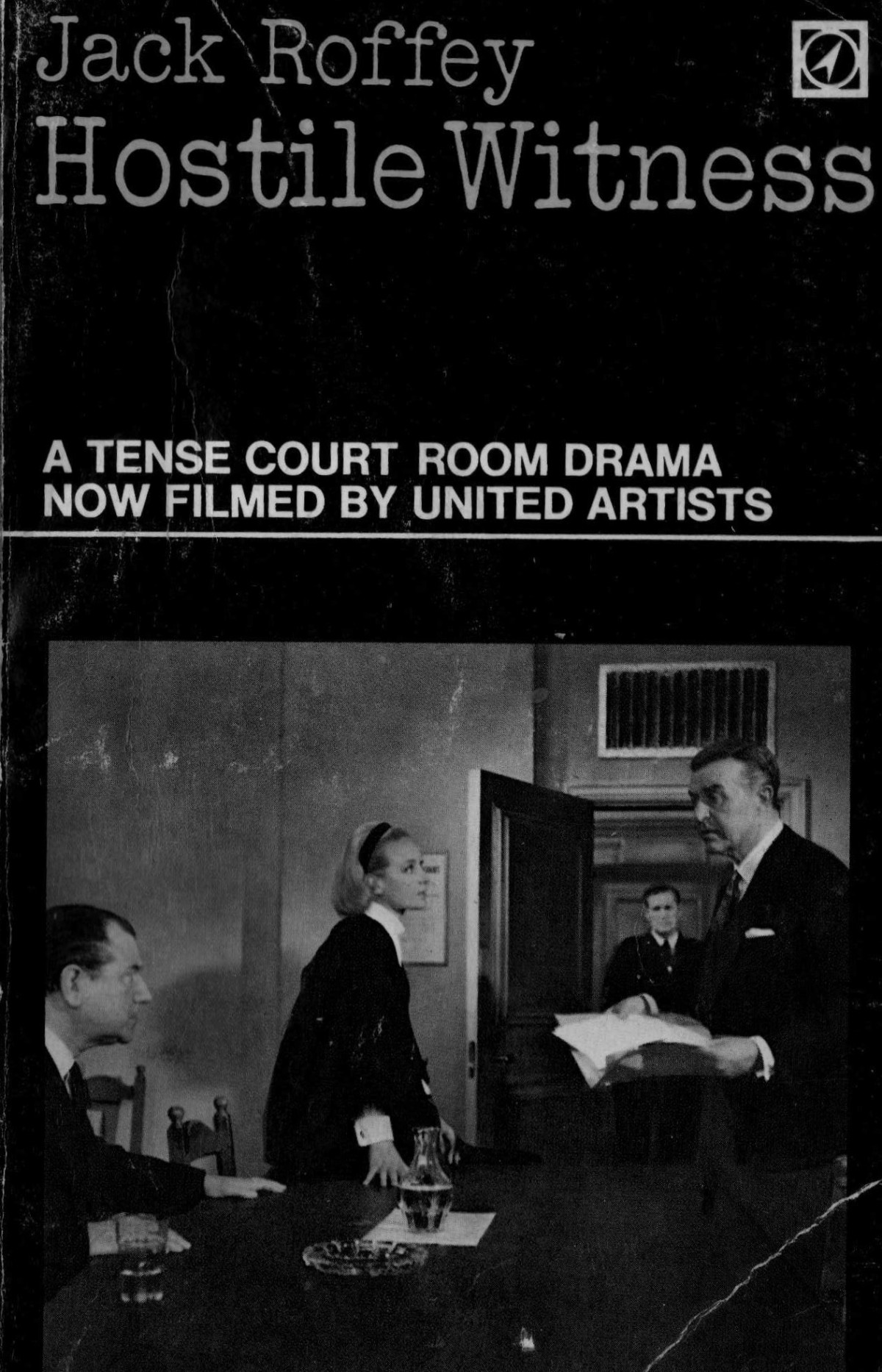
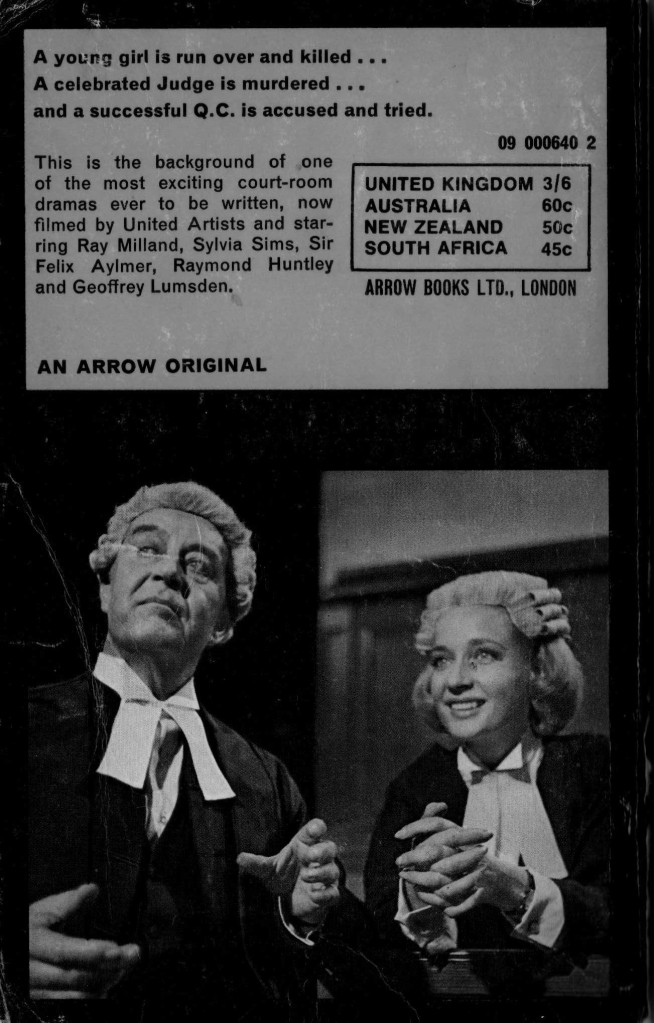
Film into Book – “Hostile Witness” (1968) Movie Tie-In

As you will be aware I have been running a little series of how books were adapted into films and I thought it would be interesting to see what happened when the process was the other way round. I have in general about the lucrative business of novelisations of screenplays as movie tie-ins but never examined any single one in particular. But I came across this book in a secondhand bookshop on holiday and gave it a read.

British writer Jack Roffey had turned his play – a hit in London West End and Australia though less so on Broadway – into a screenplay and was inveigled into making a quick buck by churning out the movie tie-in book, published straight into paperback in Britain by Arrow. It turned out to be an interesting exercise because the play was no longer in circulation and the film failed to get a proper release so the book had to survive on its own without the help of movie publicity or posters outside the chain cinemas.

The book is about 60,000 words long while the play/screenplay probably comprised fewer than 5,000 words so that was a lot of padding-out to do, if that was all the author could manage. Interestingly, Roffey proved himself an adept novelist, taking the opportunity to both clarify the proceedings and mystify the reader even more, accentuating the ambiguities of the initial work. Where the movie glosses over main protagonist Simon Crawford’s (Ray Milland in the film) mental difficulties until brought into question during the court case itself, in the book Roffey lays the groundwork more straightforwardly, recounting the period spent in hospital and, more importantly, his rapid decline after returning to work so that by the time he is arrested his mental health is very poor.

Sheila Larkin’s (Sylvia Syms) unspoken feelings for her boss remain just that, but there is a physical closeness – she catches him when he collapses, briefly nursing him, and she is presented as a woman more aware of her own sexuality. And the door is opened later in the book for a relationship – “intimacy umbrellaed them in soft folds, inviting positive expression.” Equally, when given the opportunity to take on the case, her first reaction is fear: “She couldn’t possibly accept it…it would be a terrifying responsibility for a junior of her standing” and she expects the episode to end in abject humiliation until she catches sight of her boss and registers the fear in his eyes. Thus, Roffey is able to get inside all the major characters rather than have the camera – and the shortage of screen time – dictate the point of view. Other characters, some incidental, are also more fully drawn.

While the play’s dialogue would not have sufficed to carry a book of this length, Roffey has to add considerably to his original material, and in most cases extended conversations are made to count. Perhaps most interesting of all since he is in charge, Roffey can dispense with the need to constantly cut back to the accused during the trial to register his facial reactions and that allows the personality of Sheila Larkins to flower and take true centre stage rather than be constantly undercut by continually focusing on Crawford. Roffey was also an expert on court procedure and the opportunity to delve into that gives the book greater authority.

The book is certainly enjoyable and well-written with some sharply observed characterisations. “Mr Justice Gregory came in, diffidently at first, like a small boy at the edge of a pond, who wonders if the ice will hold.”  Simon Crawford is introduced in court in the opening page thus: “There was an affected boredom is the half closed grey eyes – a calculated indifference to the heat and the coming verdict.” While Sheila Larkins is the opposite – “properly wrung out.”

There’s style in the descriptions. “Gordon Mews is one of those peaceful backwaters that an earlier and more gracious London put aside for a rainy day, and promptly forgot about.” And the book moves along briskly, a crime thriller with the unlucky caught in a web that is closing in fast. Roffey is able to touch on more specifically Crawford’s disintegration and his shock at being tabbed a criminal. Like the film, it was more than passably entertaining.

Play into Film – “Hostile Witness” (1968)

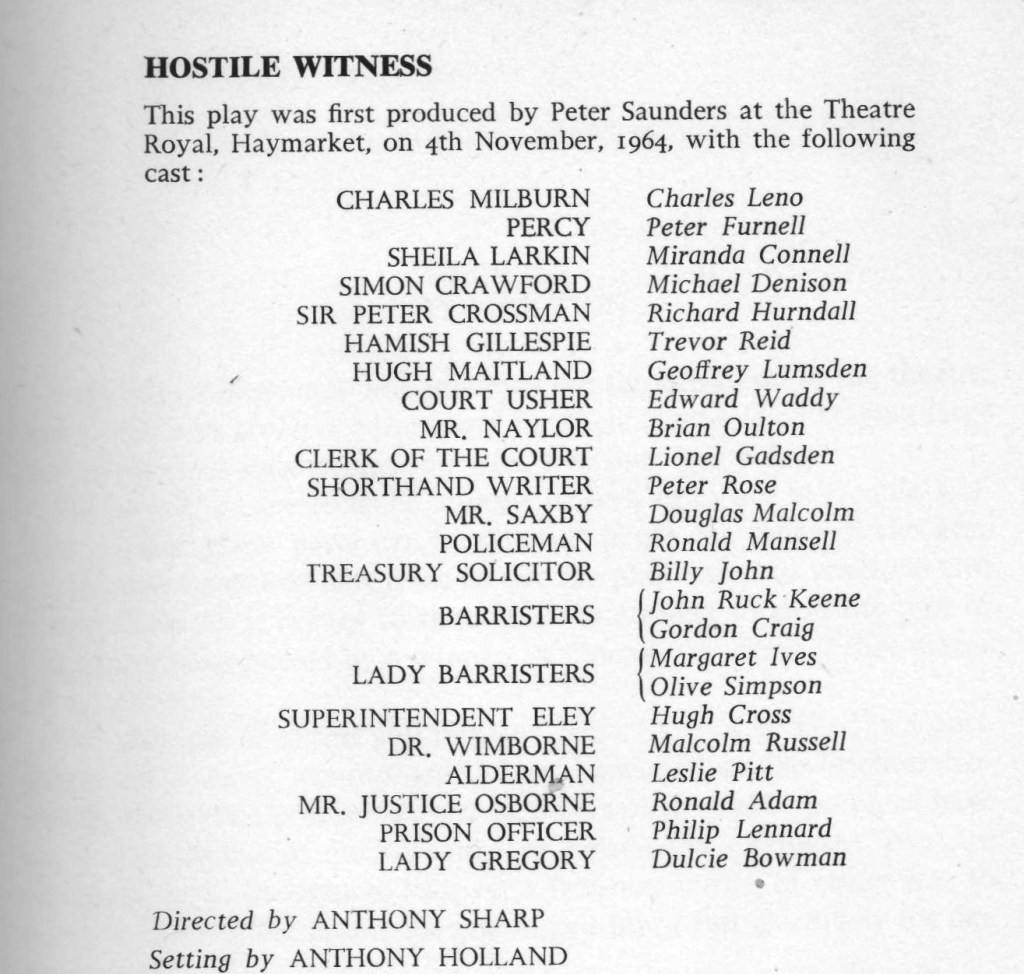
Adapting a play into a film requires more specialist skills than transforming a book into a movie. A book either needs considerably trimmed (example, The Detective) or the requiring a complete overall (as with Blindfold). It’s much harder to muck around with a play which has usually been well-honed, edited down night after night, from a run on the stage. The main decision the writer charged with the adaptation has to make is a tricky one – whether to open it up or not. Can a play, especially a thriller, sustain the tension it achieved on stage without additional elements – and therefore appear “stagey” on film – or must it be expanded in the hope of generating greater tension or ambiguity, making characters more sympathetic or clarifying the plot.  The story in both play and film concerns top lawyer Simon Crawford being arrest for murder.

Jack Roffey, adapting his own play, decided the original needed opening up. The play’s structure consisted of two acts, each containing two scenes. The first scene lasted 21 pages, scenes two and four 23 pages each, while scene three is considerably shorter just 12 pages. So, except for the third scene, the play’s rhythm is consistent. And while this might look as if most scenes last 20-plus minutes, an inordinately long time to sustain rhythm on the screen, there are lot of moment where various characters go offstage to concentrate action between fewer characters, thus heightening tension or creating character conflict.

 A lot of information that was imparted purely via dialogue in the play transforms on screen into a series of extra scenes. This is especially true at the beginning. The movie’s opening scene, set in a court and concerning the trial of a brothel-keeper, was not in the play; it was dealt with in passing at the beginning of the play, as a character reporting on the outcome, albeit that some of the reported speech became dialogue in the film. It was probably felt that the movie audience had to be introduced right away to a courtroom since the play’s opening scene takes place entirely outside the courtroom, in the offices of the leading character Simon Crawford (Ray Milland). The play begins in the present and the back story, that Crawford is widowed, recently lost his daughter in a hit-and-run traffic accident, and suffered a nervous breakdown as a result, is dealt with as exactly that – events from the past. The film puts them in the present. We are shown the daughter, who clearly has a strong relationship with her father, we hear the accident (which occurs offscreen), witness Crawford’s unravelling and the murder that forms the core of the story. And we are also treated to some additional scenes, not in the play, including an initial police investigation.

The upshot is that it takes 25 minutes for Crawford to be arrested. Compare that to the play. He announces his imminent arrest within the first five minutes. For pure audience shock the play holds the upper hand. I’m not sure the film ever matches that moment. Pre-arrest, in the film, Crawford’s erratic behaviour and hospital confinement add to a sense that he might be unhinged or, in classic film noir, feeding the audience a line. His state of mind is complicated by making visual some incidents that were just verbal in the play.

There are three major departures from the play. The first was the introduction of a private eye whom Crawford takes by the throat in frustration at the gumshoe producing no results. This suggests early on that Crawford is capable of violence. But it also causes a complication. In the play there is only one main private eye, name of Armitage, whose evidence proves key in the case against Crawford, but he is missing and in fact never appears. Apart from testifying to Crawford’s murderous inclination the introduction of this other private eye, named Rosen, makes little sense. The second is to bring quicker to the fore the involvement of junior lawyer Sheila Larkin (Sylvia Syms in the film). In the play she takes over his defence when her senior quits on a point of principle but in the film it is almost from the start.

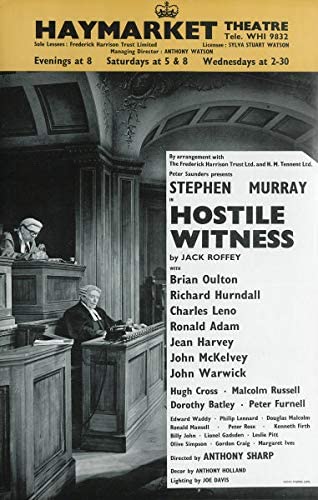
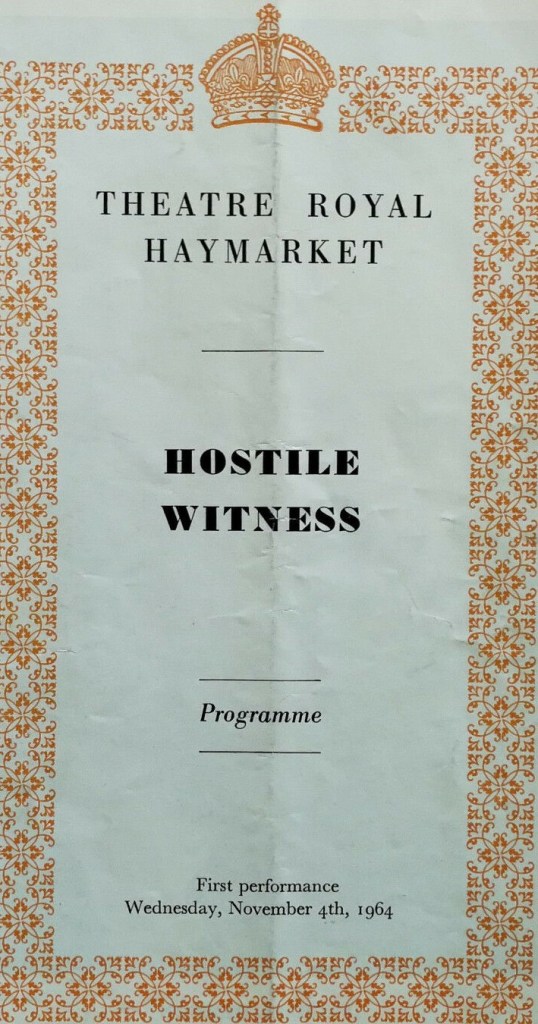
Programme for the premiere of the play in London’s West End.

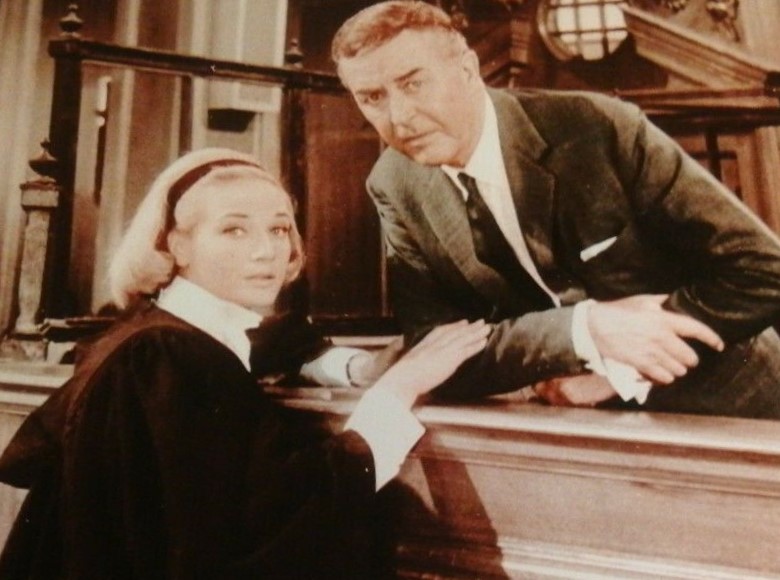
The third development also involves Larkins. But I’m not sure this one works in building up Crawford-Larkins into a potential May-December relationship. In the play it seems more obvious that Larkins is a daughter substitute rather than a potential love interest but the film adds an additional scene where she brings celebratory goodies to the lawyer and her demeanor suggests sublimated ardor. The way director Ray Milland uses looks between the pair and an occasional touching of hands makes the alternative more obvious.

You could argue that the film could have simply had Crawford arrested in the first five minutes but that would have necessitated police interrogation. The device brilliantly used in the play of imminent arrest would have worked in the film, I believe, and made for a more explosive start, and then either sticking with the play structure or dealing with the backstory in flashbacks.

It’s worth noting that plays on the page look far more intense than screenplays. There is nothing but line after line of dialogue whereas a screenplay always has cuts or directions to interrupt the flow of material. Dialogue, of course, being what a play relies upon more than the camera, Roffey, as the adaptor, was lucky in having so many choice lines at his disposal. Ray Milland, in his role as director, unfortunately, was not able to add atmospheric heft.

Hostile Witness (1968) ***

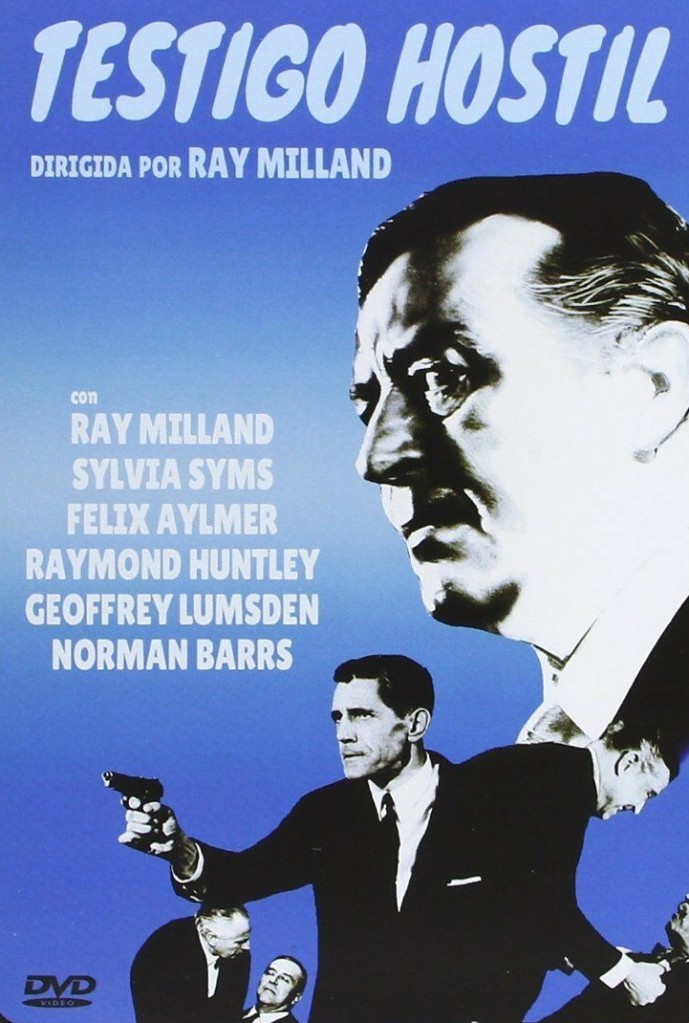
Shoddy initial release means this is unlikely to have been on your radar, but this entertaining courtroom drama plays on madness, involves minimal sleight-of-hand, employs some notable reversals as a defence strategy sinks under the weight of its own misplaced ambition.  Courtroom dramas were a scarce commodity in the 1960s, the sub-genre almost killed off by U.S. television hits like Perry Mason (1957-1966) and The Defenders (2961-1965).  Although, technically, Inherit the Wind (1960), Judgement at Nuremberg (1961) and To Kill a Mockingbird were of the same ilk, they did not rely on last-minute intervention or the normal twists and turns of legal dramas as evidenced by Witness for the Prosecution (1957). Hostile Witness only saw the light of day because Oscar-winner Ray Milland had starred in the Broadway version of the British play, author Jack Roffey experienced in the mechanics of this kind of fare after British television series Boyd Q.C. (1956-1964).

Daughter dead in a tragic car accident, top-notch Q.C. Simon Crawford (Ray Milland) is accused of killing the man he believed deliberately responsible. Unable to defend himself, he relies on his junior Sheila Larkin (Sylvia Syms). Circumstantial evidence links him to the crime. Questions surround his mental health, which disintegrated following his daughter’s death, especially after he cannot prove claims that would exonerate him. Casting around for the potential killer leads to a cul de sac, each clue that could absolve him rapidly dissolves and as he is soon fighting for his life. And as tension mounts, the defence team is soon in disarray, Sims quitting on a point of principle. Like all the best court cases the proof is in front of his eyes if only he could see it, and the traditional last-minute witness and twist does not disappoint. 

The courtroom aspect is very well done, great banter between the lawyers and swift and witty put-downs by the presiding judge (Felix Aylmer). While the story demands that Crawford remains off centre-stage at times, his presence, as a tense observer of proceedings that could spell his fate, calls on Milland to display probably the widest set of non-verbal reactions you will ever encounter. Syms (East of Sudan, 1964) is excellent in a role that offers greater scope than her usual female lead and while carrying a torch for Crawford she is more than capable to standing up to him and is ruthless in cross-examination. Geoffrey Lumsden (A Dandy in Aspic, 1968) tickles as a befuddled major and Raymond Huntley (later a success in Upstairs, Downstairs) sparkles as the grumpy prosecutor. To some extent, the picture plays on the film noir ethos that good guys often turn out to be anything but and Milland has the undoubted gift of looking both villain and hero dependent on the time of day.

By this point Welsh-born Milland was an odd refugee from Hollywood’s Golden Age, fallen far below the box office peaks of Billy Wilder’s The Long Weekend (1948) and noir turns like The Big Clock (1948). Apart from Dial M for Murder (1954) he was mostly became a television stalwart – the eponymous Ray Milland Show (1953-1955) and Markham (1959-1960) – and turned his hand to occasional direction. An unexpected dip into horror – The Premature Burial (1962), Panic in the Year Zero (1962) and The Man with the X-Ray Eyes (1963) failed to revive his mainstream career and prior to Hostile Witness had only appeared in one other movie.

For a time Hostile Witness did look as if he would put him back on top after taking up an offer to make his Broadway debut in the play. Although not a stand-out hit, it ran for a decent 157 performances, then went on tour in the U.S. and later Australia, leaving Milland with the impression that, with himself directing to cut costs and running to a tight 24-day shooting schedule in Britain, it might just be the correct vehicle. Unfortunately, it was probably the staid direction that put paid to any prospect of box office success. A director like Billy Wilder or Hitchcock would have concentrated far more on character ambiguity and  made more of the unreciprocated romance and either tightened or opened up the original play to add more tension. Even so, it is pleasant enough viewing, not a dud by any means.

Danger Route (1967) ***

If the producers had not signalled Bond-style ambitions with a big credit sequence theme song by Anita Harris, moviegoers might have come at this with more fitting expectations in the Harry Palmer and John le Carre vein. So although slipping into the late decade spy boom flourish don’t expect villains planning world domination, gadgets or a flotilla of bikinis.

Seth Holt’s bread-and-butter espionage thriller sets government agent Jonas Wild (Richard Johnson) – on his “last assignment” no less after eight licensed murders in five years – to kill off a defector in the far from exotic location of a Dorset country house not realizing that he is also being set up. That his liquidator will be a woman puts the mysterious Mari (Barbara Bouchet) in pole position.  

The Eliminator was the source material for Danger Route.

Wild gains access to the heavily-guarded mansion by seducing housekeeper Rhoda (Diana Dors) but after completing his mission is captured and tortured by Luciana – pronounced with a “k” – (Sam Wanamaker) who explains he is a patsy and that there is a mole in M.I.5. When his boss Tony Canning (Harry Andrews) disappears and another friend is murdered, Wild goes on the run with Mrs Canning (Sylvia Syms) and eventually makes his way back to his bolt-hole in Jersey to solve the mystery.

There is a decent amount of action, including a fight with a guard dog and a battle on a fog-bound yacht. Clever maneuvers abound – a bug is planted in a bandage. Treachery is always just round the corner and there is no shortage of suspects.

The film’s down-to-earth approach is somewhat refreshing after half a decade of spy thrillers and spoofs. Wild doesn’t employ anything more hi-tech than masquerading as a brush salesman to win over Rhoda. And although that relationship ends up in bed, there is no sex, Wild having drugged her to avoid that complication. Tony Canning is nagged by his wife. Wild’s girlfriend (Carol Lynley) is a sweet girl, sexy in a languid rather than overt fashion.  And Luciana takes enormous pride in telling Wild just how stupid he has been.

Sylvia Sims in a ticklish situation.

But that comes with a caveat. The plot doesn’t quite hang together and the movie sometimes fails to connect.

That said, Johnson (Deadlier than the Male, 1967) is excellent, quite an accomplished actor rather than a brand name. Both Barbara Bouchet (Casino Royale) and Carole Lynley (Harlow, 1965) play against type while Sylvia Sims (East of Sudan, 1964) and Harry Andrews (The Hill, 1965) present variations to their normal screen personas. Sam Wanamaker (The Warning Shot, 1967) has a peach of a role and Gordon Jackson (The Long Ships, 1964) and Maurice Denham (The Long Duel, 1967) are afforded small but critical parts. 

This is not easy to come by, so you are best looking for a secondhand copy.

East of Sudan (1964) ***

Remembering this picture as a summer holiday matinee of stiff-upper-lip-ness entangled in all sorts of Khartoumery, I came at this film with low expectations. Given producer Charles H. Schneer’s (First Men on the Moon, 1964) involvement, there were no Ray Harryhausen magical special effects. I was only aware of star Anthony Quayle as a bluff supporting actor in epics like Lawrence of Arabia (1962) and The Fall of the Roman Empire (1964) and Sylvia Syms as a willowy supporting actress (The World of Suzie Wong, 1960). So I was in for a pleasant surprise. Take away the back projection, stock footage and the unlikely zoo of wild animals and there is a fairly decent action film set in the Sudan on the fringes of the Mahdi uprising (that story filmed as Khartoum the following year).

Quayle is a former army sergeant awaiting court martial when he escapes from a battle near Khartoum, ends up saving governess Syms, her charge Jenny Agutter (making her debut), officer Derek Fowlds (BBC Yes, Minister) and a wounded soldier. The motley crew flees down the Nile in a boat. You know you are in for something quite different when the soldier dies and Quayle wants to toss him overboard. Overruled by prim Syms and stiff upper lip Fowlds, this good deed is rewarded by losing their beached boat while burying the dead. A picture like this only survives on twists. Burning the remainder of their boat to attract the attention of the British relief force only brings in their wake a mob of Arabs, who we are informed, in a spicy exchange, don’t know the ten commandments, especially “thou shalt not kill.”  It turns into a battle of the sexes, with Syms’ innocence and good breeding quickly eroded in the face of danger, her natural antipathy towards a scallywag like Quayle softening. Lacking due deference, said scallywag is given some choice lines which spark up proceedings. It being Africa, the animals have nothing better to do than torment them, so cue snakes, crocodiles, charging rhinos, hippos, elephants without even an entertaining monkey to lighten proceedings. Quayle sets his ruthless tendencies to one side to take a tender, paternal interest in young Agutter. Ongoing action prevents the usual male-female meet-cute African Queen-style banter and it’s all the better for it.

Capture by African tribesman takes the story on an interesting detour. Quayle, attempting to make friends, shouts out despairingly (and without irony), “Don’t any of you even speak English?” only for chieftain Johnny Sekka (The Southern Star, 1969) to stride out of the bushes with the reply, “I speak, English, Arabic and Swahili.” Quayle explains, “We come in peace.” Sekka retorts, “With gun in hand?” Game on! The plot goes offbeat when we become involved in Sekka’s life. A former slave, his village presents an unusually realistic alternative world not least for Agutter, ill by this time, saved by an African witch doctor.  There are further surprises, clever ruses to foil the enemy, revelations about Syms and a surprising but very British ending.

Quayle is convincing, reveling in the opportunity to create a fully-formed character rather than  confined to a small chunk of a picture. Syms, too, with more on offer than normal, Agutter (Walkabout, 1971) not a precocious Disney cut-out, and Fowlds revealing what did for all those years before turning up on television as puppet Basil Brush’s sidekick. As a British B-picture making do on a small budget, it overcomes this particular deficiency with some sparkling dialogue and attitudes that go against both the time in which it was set and the era in which it was made.

NOTE: Khartoum, The Southern Star, The Fall of the Roman Empire, The Southern Star and First Men in the Moon (with Harryhausen effects) have all been reviewed on this blog.     

Discover WordPress

A daily selection of the best content published on WordPress, collected for you by humans who love to read.

The Atavist Magazine

by Brian Hannan

WordPress.com News

The latest news on WordPress.com and the WordPress community.