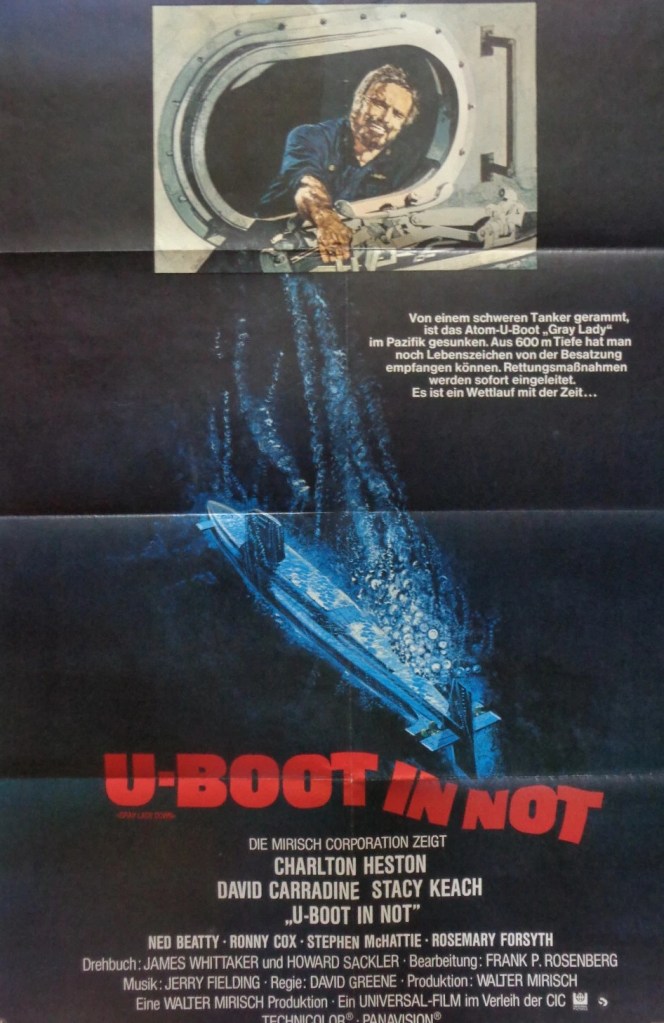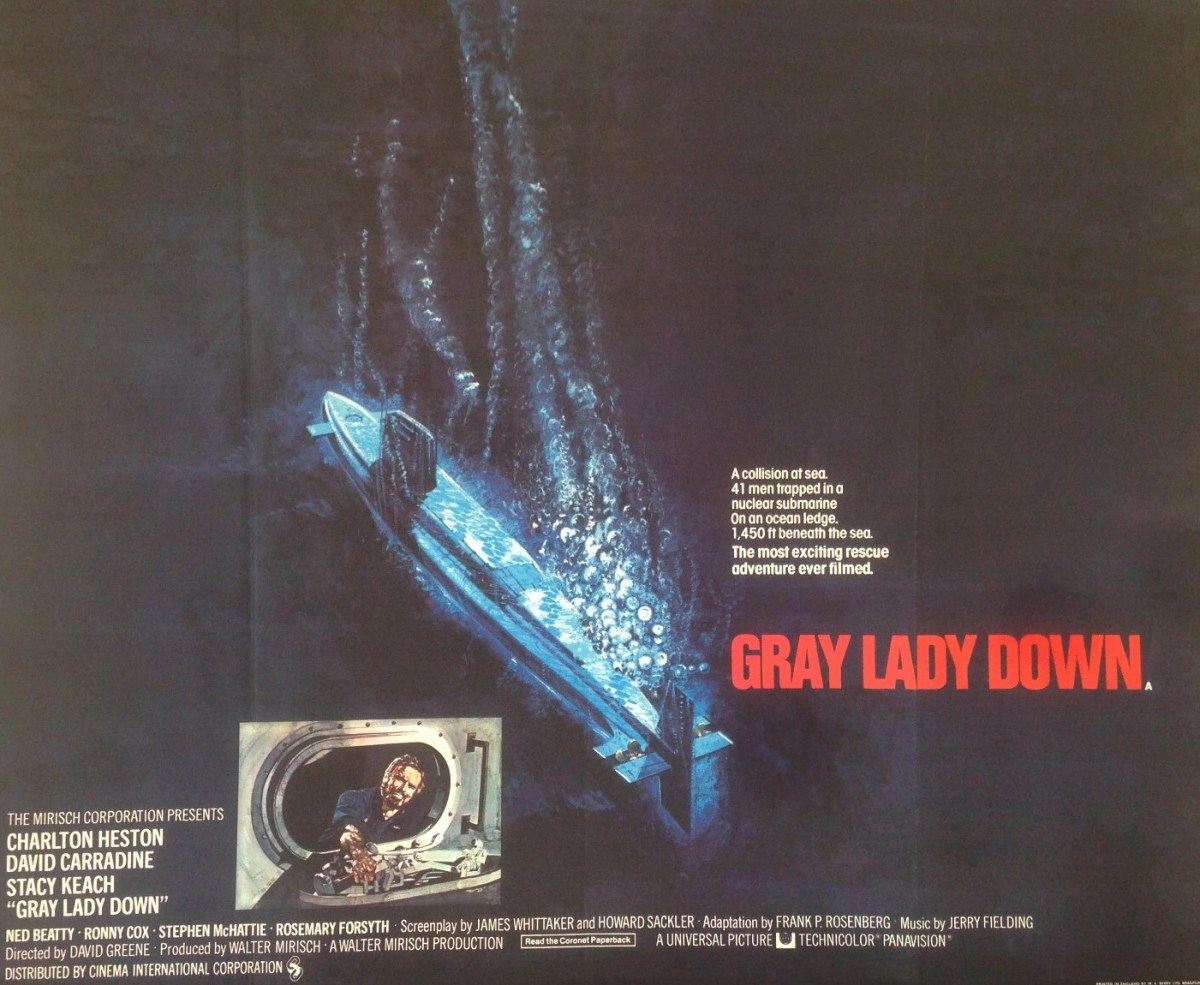
Behind the Scenes: “Gray Lady Down” (1978)

Producer Walter Mirisch could have afforded to rest on his laurels – he’d won the Oscar for In the Heat of the Night and been responsible for classics like The Magnificent Seven (1960) – and three sequels – and The Great Escape (1963). The 1970s had proved tougher, resulting initially in a string of pot boilers before hitting a home run with Mr Majestyk (1974) with Charles Bronson and knocking the ball out of the box office park with war picture Battle of Midway (1976), the former pulling in $20 million in rentals on a $2 million budget, the latter $50 million in rentals on a $7 million budget.

He had parted company with United Artists after nearly two decades in partnership and tied up a five-year deal with Universal. With Midway under his belt, he was the go-to producer for pictures on a naval theme. He had been sent a screenplay by James Whittaker about a submarine stranded at the bottom of the ocean. However, it turned out there was already a novel on the same subject, Event 1000 by David Lavallee, which result in various negotiations to determine the screenwriter credit, especially after playwright Howard Sackler (The Great White Hope, 1970) had completed a rewrite.
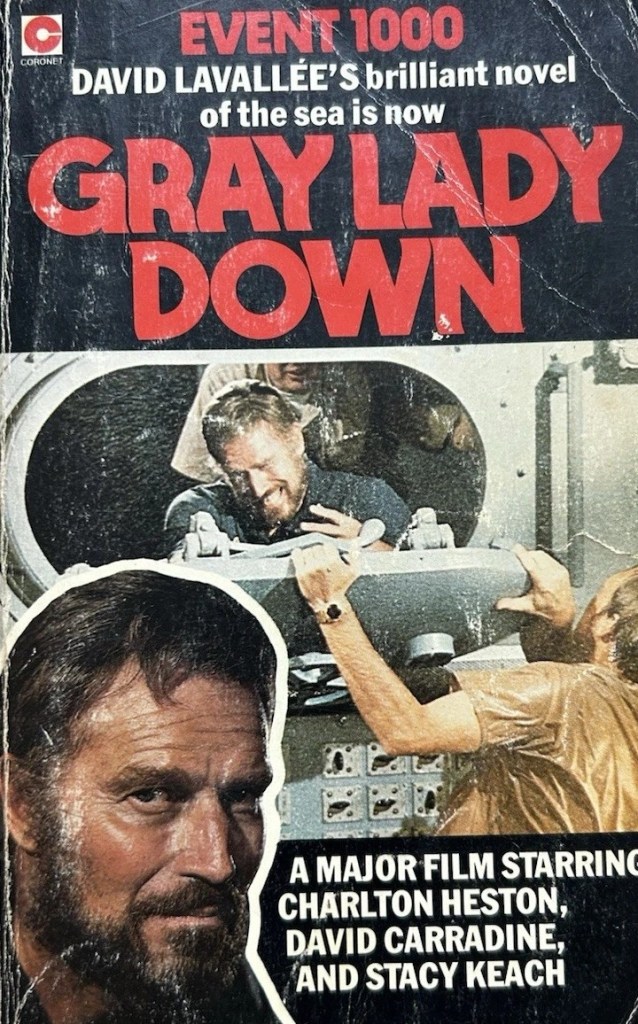
Charlton Heston, on a box office roll after Airport 1975 (1974), Earthquake (1974), Battle of Midway and Two Minute Warning (1976), was the obvious choice for the lead. But Mirisch had originally contemplated teaming Heston with Sidney Poitier (In the Heat of the Night). “He’s now backing away” from the idea, noted Heston in his diary in February 1976, “though I’m not sure why, save the cost of having us both in the film.” Heston was in strong demand, and turned down The Omen (1976) and The Pack (1977).

The film was slow coming together, “not much progress on the script…casting still slow” and there was the possibility of further delay to “mull” over the project. No director had been assigned by the end of February 1976. Following the Battle of Midway, the U.S. Navy was only too delighted to be involved. As well as following a disaster picture template, the movie was also tech heavy, featuring up-to-date ideas on rescue at sea.

The interior of the submarine, the main set, was constructed on a gimbal so that it could be tilted to achieve the effect of the sailors being thrown about as the sub sunk to the bottom and rolled over on a deep sea trench. Howard Anderson oversaw special effects work with models in a 44ft deep water tank which was filmed at CBS. Exteriors were shot at Universal with some work aboard a Navy escort vessel. Some material was also repurposed from Ice Station Zebra (1978).
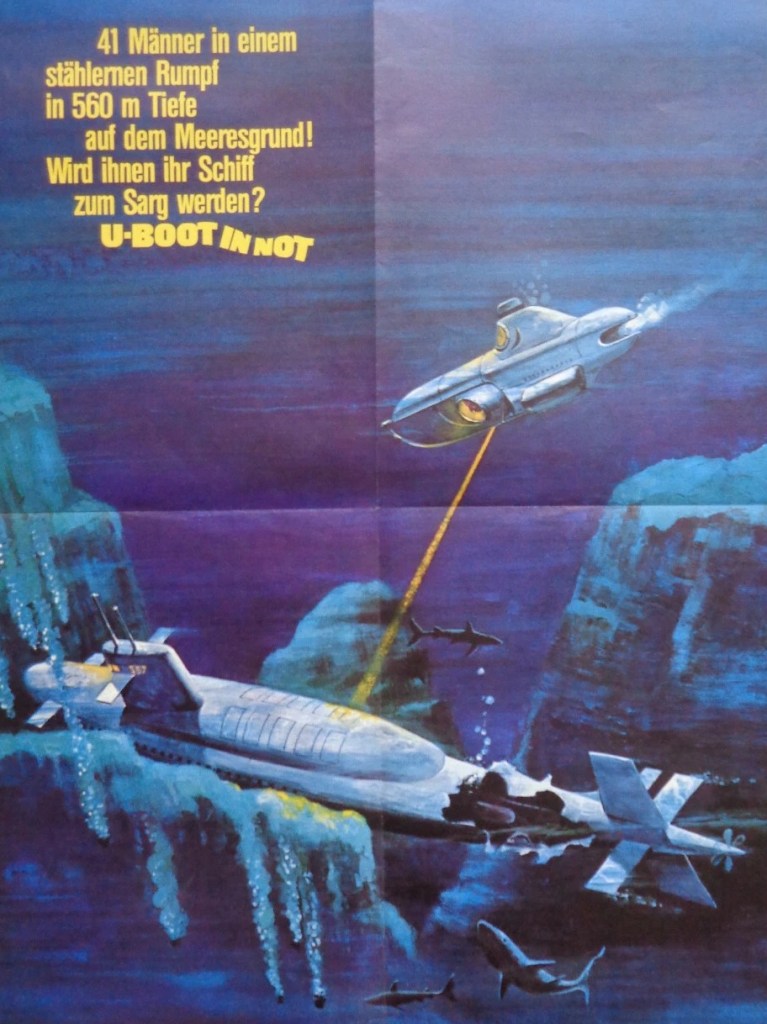
To soak up the atmosphere of a real nuclear sub, Heston spent the day on USS Gurnard under the Pacific off San Diego. “I got a lot of useful little stuff,” commented Heston, “about the look and sound of submarine officers at work…the kind of thing nobody could tell you.” The sub contained a “vast array” of disparate and complex technology. “It was a very strange feeling to spend hours charging about under the ocean running mock torpedo attacks on surface vessels.” The experience also included drills for fire and flooding.

As shooting approached, Mirisch still had not done a deal for second lead Stacy Keach (Fat City, 1972). He was, however, “anxious” to recruit Ronny Cox (Deliverance, 1972). Ned Beatty, also form that film, came on board. David Carradine (Bound for Glory, 1976) and future Superman Christopher Reeve were added. Michael O’Keefe (The Great Santini, 1979) also made his movie debut.  

Filming began on September 11, 1976. “I had very little to do,” noted Heston, “which was just as well, breaking in on a new film.” He played his only scene with Keach, “the tag of the picture and a key scene.” British director David Greene (Sebastian, 1968) was applauded for being as meticulous as William Wyler. More importantly, “he gives the actors a great deal and I find myself stimulated by almost all the suggestions he makes,” commented Heston. At one point, Greene decided to reshoot a major scene, bringing back offstage actors Heston thought he could do without. On the minus side, “he runs a rather loose ship.” Of his own contribution, the actor said, “I became preoccupied with giving an efficient performance rather than a creative one. The pressures I feel to be a consummate professional make me focus on getting it right.”

Filmed on a budget of just $5.25 million, it proved a huge hit, pulling in $19 million in rentals.

SOURCES: Walter Mirisch, I Thought We Were Making Movies, Not History (University of Wisconsin Press, 2008) p339-341; Charlton Heston, The Actor’s Life (Penguin, 1980) pp464-481.
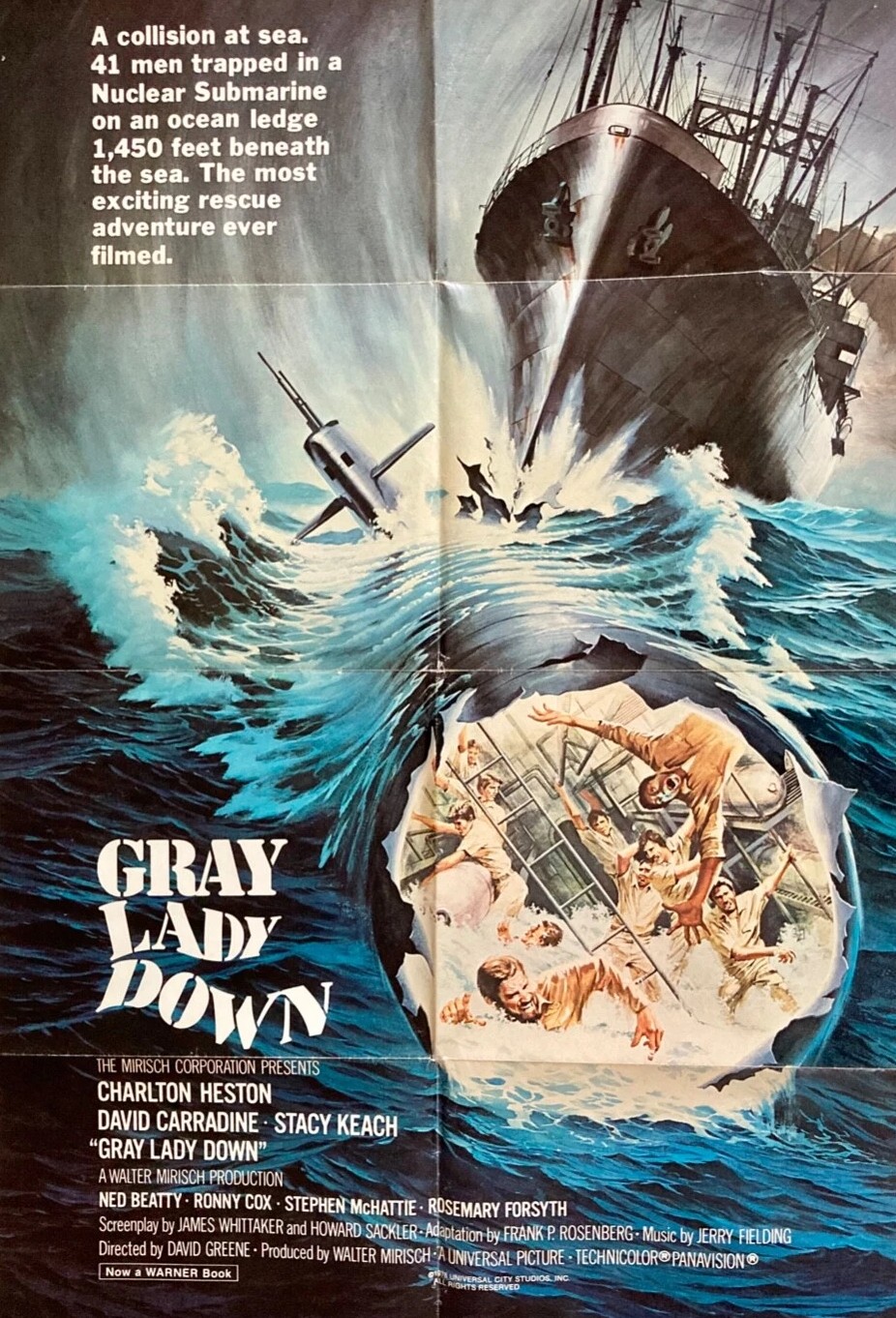
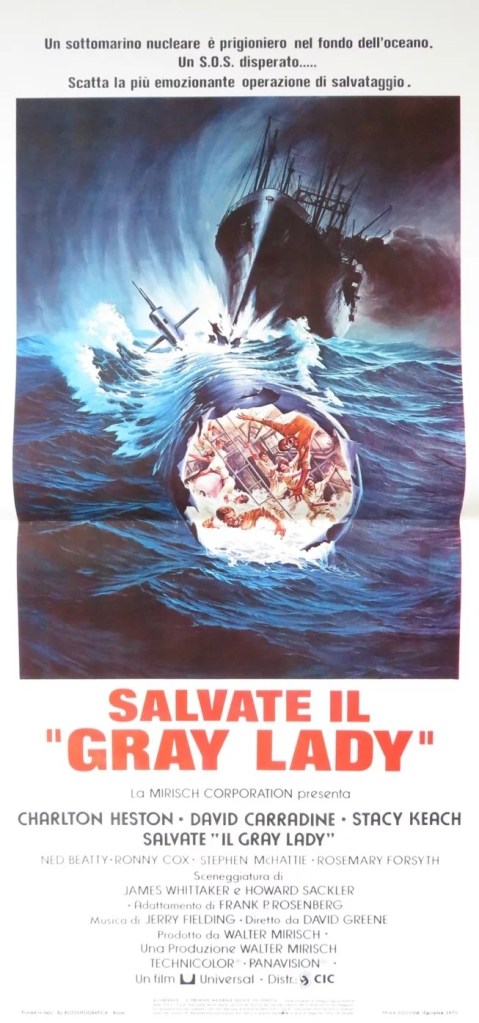
Gray Lady Down (1978) ****

The best of the late 70s disaster pictures and possibly the best of the whole short-lived genre, mixing technology, hair-rising tension and restrained emotion on top of a belter of a concept, sailors trapped in a submarine on the seabed with oxygen running out. But what lifts this above the norm is that it doesn’t follow the normal disaster picture template. Men do not rise easily to this challenge. Courage drains away as fast as time. Tempers flare and more than one of these hardy men collapse under the pressure.

The best scene in the picture is a man dealing wordlessly with loss and being a male of a certain era unable to shed a tear. So it’s all on the face. Capt Blanchard (Charlton Heston) has to shut himself away to grieve. And there’s a somber tone throughout. Corpses, covered only in a blanket, are laid out alongside the injured in an improvised sick bay. More than one person cracks. Even in a major crisis, bureaucracy gets in the way.

Blachard isn’t exactly the strong-jawed hero. As the situation grows more serious, his equanimity fails and he gets very snappy with the crew. And he’s also dealing with a heavy dose of guilt. Luckily, his major failing isn’t exposed to the crew, but his second-in-command points the finger.

Although the sub has been sent to the bottom courtesy of a collision in thick fog with a merchant ship boasting faulty radar, the accident should never have occurred. The sub shouldn’t have been on the surface. The only reason for that was Blanchard’s pride. This is his final voyage and he wanted to sail into harbor with is vessel atop the waves.

Now the sub is laid up in a deep trench and subject to “gravity slides”, the technical term for rock falls, which not only shift its position every now and then, pushing it deeper into the trench, but seal up the top of the escape hatch.

So the U.S. Navy’s new-fangled DSRV (Deep Submergence Rescue Vehicle) can’t do its job  and an even more new-fangled experimental submersible, operated by Captain Gates (David Carradine) and his sidekick Mickey (Ned Beatty) is called in. But its operation is sabotaged when officious Capt Bennett (Stacy Keach), tasked with the rescue mission, insists on one of his own men going down instead of the more experienced Mickey.

The underwater scenes are thrilling, and there’s plenty of technical know-how on view and a bunch of impression jargon spouted, as the sub slips further away and the submersible moves into more perilous depths. In the days before CGI, this is superb stuff. And since the sub is now upside down you certainly see more than normal of your typical submarine.

Unlike earlier disaster numbers like Airport (1970), The Poseidon Adventure (1972) and Towering Inferno (1974), no time is wasted setting up the various characters, usually embroiled in emotional entanglement, and for sure there’s no nuns or pregnant women to get in the way of a tight narrative. Comic relief, if that’s what you’re looking for, is provided by the chirpy Mickey.

But when you get right down to it, this holds all the narrative aces. You know rescue is going to get complicated. The unexpected always gets in the way.

But the men under pressure a thousand feet blow the surface are really under pressure and it’s not long before the cracks begin to show and widen.

Unfortunately, this came at the tail end of the disaster cycle when public interest was waning, and perhaps precisely because there was a lack of male-female interaction and no nuns it proved less appealing.

Charlton Heston (Will Penny, 1968) is very impressive, especially when he strains to hold it together and the scene I mentioned is one of his most best pieces of acting. Ned Beatty (Deliverance, 1971) also has a top-notch stiff-upper-lip scene.

Topping the supporting cast are David Carradine (Heaven with a Gun, 1969) and Stacey Keach (Fat City, 1972). You can spot Christopher Reeve (Superman, 1978) in an early role. Rosemary Forsyth (The War Lord, 1965) has a small part, but onshore.

Ably directed by David Greene (Sebastian, 1968) from a screenplay by James Whittaker (Megaforce, 1982)  and Howard Sackler (The Great White Hope, 1970) based on the book by David Lavallee

If you’re in the mood for a thrilling ride, hang on to your hat.

Ice Station Zebra (1969) ****

John Sturges’ Alistair Maclean Cold War thriller, released within months of the more action-oriented Where Eagles Dare, twists and turns as Americans in a nuclear submarine and the Soviet Union race to the Arctic to retrieve a fallen space capsule containing a deadly secret. Thoroughly enjoyable hokum filmed in Cinerama 70mm with an earworm of a booming theme from Michel Legrand and mostly outstanding special effects.

Nuke sub Commander Ferraday (Rock Hudson), despatched from Scotland, and believing he is only on a last-gasp mission to the save scientists at a stricken weather station, is somewhat surprised to be forced to carry as passengers arrogant British secret service agent David Jones (Patrick McGoohan) and Russian defector Boris Vaslov (Ernest Borgnine), the former refusing to divulge the reasons for being on board. From the outset the vessel is afflicted by sabotage and the cruel ice. Tensions mount further as they reach the Ice Station Zebra weather station. Since so much depends on mystery in a MacLean thriller, any other revelations would amount to significant plot spoilers.

So while there’s more than enough going on among the various characters and a plot that shifts like a teutonic plate, it’s the submarine section that proves the most riveting, the dives exhilarating. The underwater photography is superb in part thanks to an invention by second unit cameraman John M. Stephens which could film for the first time a continuous dive. Whether the sub is submerging, surfacing, puncturing the ice or in danger of being crushed to smithereens, it’s the nuke that takes centre stage, a significant achievement in the days before CGI.

Not all the effects are quite so top-notch, there’s some dodgy back projection, and the Arctic rocks look fake, but in general, especially with streamlined control panels, jargon spat out at pace, and sub interiors that appear realistic, the result of two years research, it’s a more than solid job, delivering the core of a Saturday night action picture.

The absence of a giant Cinerama screen does not detract from the movie – though if you get the chance to see it in 70mm, as I once did, jump at it – because the Super Panavision cameras capture in enormous detail the bow spray, the massive icebergs, the gleaming intricacy of the controls, and even the sea parting under the weight of the sub creates astonishing visuals. And there’s something inherently dramatic in the commander slapping down the periscope.

Rock Hudson (Tobruk, 1967) is back to straightforward leading man duty after his departure into paranoia in Seconds (1966) and he is burdened with both a chunk of exposition and having to develop a stiff upper lip in response to the secret agent’s reluctance to take him into his confidence. He comes more into his own in the action sequences. The tight-lipped brusque provocative McGoohan (Dr Syn, 1963) clearly has a ball as mischief-maker-in-chief, keeping everyone else on tenterhooks. Ernest Borgnine (The Wild Bunch, 1969) invests his character with wide-eyed charm at the same time as the audience doubts his credentials. Jim Brown (The Split, 1968) has little more than an extended cameo as the Marines’ chief and in smaller roles you can also spot future Oscar-winning producer Tony Bill (Castle Keep, 1969) and veteran Lloyd  Nolan (The Double Man, 1967).

This was the second MacLean adaptation for John Sturges (The Satan Bug, 1965) and he keeps a tighter grip on proceedings, a $10 million budget ensuring he could make the movie he envisaged, part-thriller, part-high adventure with well-orchestrated slugs of action.

Discover WordPress

A daily selection of the best content published on WordPress, collected for you by humans who love to read.

The Atavist Magazine

by Brian Hannan

WordPress.com News

The latest news on WordPress.com and the WordPress community.