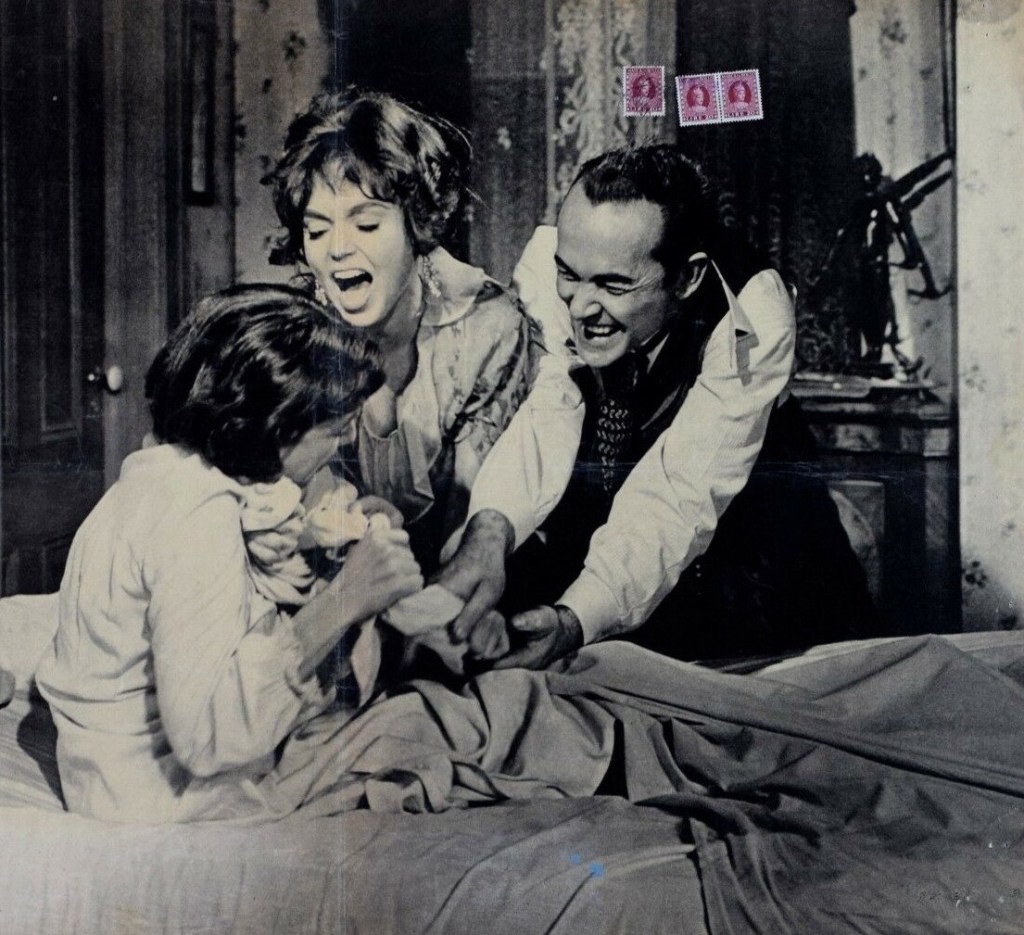
Behind the Scenes: “One-Eyed Jacks” (1961)

A three-hour western epic directed by Stanley Kubrick (2001: A Space Odyssey, 1968), written by Sam Peckinpah (The Wild Bunch, 1969) and The Twilight Zone’s Rod Serling and starring Spencer Tracy (Judgement at Nuremberg, 1961) and Marlon Brando. What’s not to like? That all of these major players, with the exception of Brando, had nothing to do with the final product was par for the course for a movie that didn’t reach cinema screens until two years after shooting was completed.

Marlon Brando was riding high when the project was first mooted in 1956. The box office and critical sensation of the 1950s, four Oscar nominations in successive years, winner for On the Waterfront (1954), his price was rising by the minute. And he had ambitions to take control of his career, set up his own production shingle, a trend that was beginning to gather pace.

He established Pennebaker (named after his mother) Productions in 1957 with ex-marketeer Walter Seltzer, producer of 711 Ocean Drive (1950), and George Glass, a former partner in Stanley Kramer’s independent production company. Paramount agreed to back the company. A western, A Burst of Vermilion, was intended as the company’s first offering. Soon there were five movies on the schedule including The Authentic Death of Hendry Jones by Charles Neider.

Brando had paid $150,000 for the rights to the book and a script by Sam Peckinpah. The original title was changed to Guns Up. It was going to mark the debut of the new Pennebaker outfit ahead of other projected movies like Shake Hands with the Devil to star James Cagney and Anthony Perkins (he didn’t make it to the final cast), The Raging Man and Ride, Comancheros (no relation to The Comancheros, 1961) and C’Est La Vie to be filmed in Paris.

Paramount paid through the nose, committing to an unprecedented deal. The studio would fund the entire cost of Guns Up and as well as $150,000 upfront Brando would receive 100 per cent of the profits, Paramount relying on its 27% of the gross as a distribution fee to turn a profit. Stanley Kubrick, riding high after Paths of Glory (1957), was hired to direct. While the studio preferred Spencer Tracy as co-star, Brando wanted old buddy Karl Malden who had co-starred with Brando in A Streetcar Named Desire (1951) and On the Waterfront, winning an Oscar for the former and a nomination for the latter.

And in part to reflect the Asian community in Monterey, location of the main section of the film, he also wanted current squeeze France Nuyen (A Girl Named Tamiko, 1962) to play his lover in the film, but Kubrick was aghast and instead cast Mexican debutante Pina Pellicer (Rogelia, 1962). There were roles for Katy Jurado (Barabbas, 1962) and recognizable western types like Ben Johnson (The Undefeated, 1969), Slim Pickens (Firecreek, 1968) and Elisha Cook Jr (The Great Bank Robbery, 1969).

Shooting was set for June 1958, then it shifted to September and then November. To Brando’s shock, Kubrick pulled out two weeks before production was due to begin, citing pre-production on Lolita (which, ironically, didn’t go ahead for a couple of years). To salvage the situation, Brando decided to direct. He wasn’t the first actor to go down this route, especially if you count Charlie Chaplin, Buster Keaton and Orson Welles as actors first and foremost. Laurence Olivier helmed Henry V (1944) and three others, Jose Ferrer The Cockleshell Heroes (1955), hoofer Gene Kelly Singin’ in the Rain (1951) and Charles Laughton Night of the Hunter, 1955. So he was in good company.

Cameras turned on December 2, 1958. It was an auspicious era for westerns, a total of 41 had appeared that year. Although budgeted for three months, it took six months to shoot in locations like Sonora in Mexico and Monterey in California (where the film was set) as well as Pfeiffer Beach on the Big Sur and the Warner Ranch.

Although prior to shooting commencing the title had changed to One-Eyed Jacks, scoring and editing were well in hand and Paramount announced it as one of its 17 pictures set for 1959 release. In the end Shake Hands with the Devil beat it to the punch as Pennebaker’s initial release, in 1959. But it didn’t favor so well, skipping the more lucrative but riskier Broadway first run in favour of hitting the circuits.

Meanwhile, Brando was angling for a three-hour running time. The budget kept increasing. The original $2m budget had doubled. Eventually, Paramount acknowledged it had cost $5 million though other estimates put it closer to $6 million.

Part of the problem in readying it for release was Brando’s other commitments. He was still a working actor and could hardly resist the offer of a record-setting one million bucks to star in The Fugitive Kind (1960). Even so, the bigger problem was not time, but experience and a first-time director being unable to make up his mind, having shot a colossal amount of footage and having tremendous difficulty trimming it down to workable length. Paramount still had it on the release agenda in 1960. It was going to be a “special release,” which most people took, especially given the running time, to be roadshow.

But by December 1960, the studio had waited long enough and just before Xmas the studio took over the editing and after editing out around 40 minutes from Brando’s three hour cut, Paramount scheduled it for a world premiere in New York in March 20, 1961, in a kind of semi-roadshow – moviegoers could buy in advance but the tickets did not come with reserved seats, which was the whole point of roadshow. Nor were prices hiked, which was gave roadshow its prestige.

Already deemed “Brando’s Folly” and coming in the wake of The Alamo (1960), the John Wayne-directed epic which had flopped in roadshow, commercial hopes were not high. In part, because production had been so long ago it had skipped under the journalistic radar which was concentrating on skewering The Alamo and the equally troubled The Misfits (1961). So it didn’t come trailing disaster. Still, it seemed more likely, audiences would not take to the odd tale which didn’t fit so easily into the western genre. Plus Brando’s previous effort The Fugitive Kind had been his first outright flop.

Turned out, though, Brando still was a major attraction. It snaffled a “huge” $81,000 in its opener at the 4,820-seat Capitol in New York. There was a “smasheroo” $21,000 in Detroit, a “big” $14,000 in Buffalo, a “hotsy” $15,000 in Cincinnati. “Giant” was the preferred adjective, covering $60,000 in Chicago, $32,000 in Philadelphia and $15,000 in Boston.

Rentals (what studios make after cinemas have taken their share of the gross) amounted to a very decent $4.3 million, enough to rank seventeenth for the year. And whereas those figures were considered decent enough, it did “substantially better abroad.”

So, more than likely, against all the self-destructive odds, it earned a profit.

SOURCES:  Stefan Kanfer, Somebody, The Reckless Life and Remarkable Career of Marlon Brando (Faber & Faber, 2008); “Glass, Seltzer in Brando Co Berths,” Variety, April 17, 1957, p22; “Chatter, Hollywood,” Variety, May 22, 1957, p62; “Marlon Brando Guns Up for Paramount,” Variety, April 30, 1958, p22; “Chatter, Paris,” Variety, July 30, 1958, p126; “Brando Gets 100% of Film Profit!”, Variety, August 6, 1958, p1; “Briefs from Lots,” Variety, September 24, 1958, p15; “Marlon Brando’s Own,” Variety, November 26, 1958, p5; “Shake Hands First with Circuits,” Variety, May 6, 1959, p4; “Brando’s Ugly American,” Variety, July 1, 1959, p3; “Par 17 Pix Set for Release,” Variety, July 15, 1959, p5; “Par Division Eyes Upcoming Product,” Variety, November 25, 1959, p22; “Doubt or Delay re Brando’s Jacks,Variety, August 10, 1960, p3; “Brando Jacks Editing,” Variety, December 21, 1960, p7; Advert, Variety, January 6, 1960, p32; Box Office Figures, Variety, April 5-Jul 24, 1961; “Hoss Operas in O’Seas Gallop,” Variety, August 23, 1961, p16; “1961 Rentals and Potential,” Variety, January 10, 1962, p13.

Stanley Kubrick’s “Napoleon”: The Greatest Movie Never Made

At the height of his power after the tremendous critical and commercial success of 2001: A Space Odyssey (1968) you wouldn’t have wagered on Stanley Kubrick being outfoxed by Italian uber-producer Dino De Laurentiis. But the latter’s Waterloo (1970) was the prime reason why MGM shuttered Kubrick’s ambitious project. It’s not the reason it was never eventually made – money was.

At one point, it looked as if the movie would shift over to Columbia, which had funded the director’s previous hit, Dr Strangelove (1964), and thence to United Artists – production scheduled to start in September 1970 – before ending up in the lap of Warner Brothers, which would prove Kubrick’s home for the next few decades.

One of the reasons WB was so keen was that it had greenlit a movie by British director Bryan Forbes called Napoleon and Josephine. This was to follow The Madwoman of Chaillot (1970), a project he had taken over at the last minute after John Huston bailed. But it never went ahead because Forbes instead took over as head of production at British studio EMI. To have considered the project in the first place, despite facing competition from Waterloo, would have meant WB viewed the idea as a financailly sound.

The bigger problem, commercially, was that two events coalesced. By the end of the 1960s, the 70mm roadshow was on its last legs. It still continued in haphazard fashion into the early 1970s, but scarcely with the vigor and elan that had produced such different movies as Lawrence of Arabia (1962), It’s A Mad, Mad, Mad, Mad World (1963), Doctor Zhivago (1965) and The Sound of Music (1965) that set fire to the global box office.

As important, studios hit a financial wall at the end of the 1960s as over-investment in all sorts of unlikely roadshow vehicles, often musicals, came back to bite Hollywood. And with Easy Rider (1969) cleaning up, the message to Hollywood was mean and lean.

So a project that could top out at $30 million – even with Jack Nicholson, Audrey Hepburn and David Hemmings involved – and inevitably run over budget, take well over a year to complete and appear when who knew how the movie landscape would have changed, and working with the only director from whom no studio executive in their right mind would dare seize control, this version of Napoleon was put on the back burner, resurrected every time Kubrick had a hit.

As well as the massive book, there were coveted extras, accessed via this card fixed to the inside front cover of the Taschen publication.

When MGM pulled out it was deemed “one too many…ultra-high budget commitments for the studio,” one of the hardest hit by financial turmoil. Columbia, it transpired, had only toyed with the idea. Warner Brothers built up the notion of coming to Kubrick’s rescue with Variety headlines such as  “Costume Epic Due Anew? WB Hunch,” that appeared in Variety in 1972. It was the kind of movie that you almost expected an operation looking to grab Hollywood attention, say new ventures like Cannon or Orion, to pick up.

While Waterloo (1970) was seen as the main obstacle, coupled with the fact that one of the reasons Abel Gance’s Napoleon had stiffed way back in the silent era was American audience indifference to the French Emperor, it has to be said Hollywood would have noticed that Kubrick faced more competition than just De Laurentiis. Wider awareness of subject matter might have come from an unusual source, since Barbra Streisand was contemplating starring in a new Broadway musical about Napoleon and Josephine,

That there was continued interest in Napoleon was proved with the release of Fielder Cook’s Eagle in a Cage (1972), starring Kenneth Haigh (The Deadly Affair, 1965) and Billie Whitelaw (Leo the Last, 1970) and British acting royalty like John Gielgud (Khartoum, 1966) and Ralph Richardson (The 300 Spartans, 1962). This was limited to Napoleon’s exile, and was funded by a newcomer, Group W, its biggest-ever production gamble, albeit with a budget of only $1.25 million. The Brits proved pretty keen on the subject matter, a television mini-series Napoleon and Love (1974) up next starring Ian Holm (Chariots of Fire, 1981).

Interest never dwindled. There was a French musical in 1985 and a French mini-series at the turn of this century with an all-star cast including Christian Clavier (Asterix and Obelisk: Mission Cleopatra, 2002), Gerard Depardieu (Green Card, 1990) Anouk Aimee (A Man and a Woman, 1966) and Isabella Rossellini (Blue Velvet, 1986).

The larger obstacle had always been the budget which the new Ridley Scott picture has overcome thanks to the deep pockets of Apple.

Just how far the ever-obsessive Kubrick got with his project can be seen from the gigantic tome –  Stanley Kubrick’s Napoleon: The Greatest Movie Never Made – running to 1100 pages, published by Taschen and now a collector’s item, copies changing hands for up to $2,000, containing not just the entire script, but all the details he had already filled in of costumes, locations, budget, and even his own thinking, as revealed in a series of interviews with collaborators. The book is crammed full of photographs and it’s a good a testament to a film that never was as you’re likely to find. I have a copy and can attest to that.

Surprisingly, there’s a happy ending. Apparently, Steven Spielberg is taking up the Kubrick mantle. HBO, not shy of spending gazillions as proven by Game of Thrones, has enlisted the director to make an eight-part mini-series based on the Kubrick screenplay. And although officially in retirement, Jack Nicholson is the first big name signed up.

Old legends never die.

SOURCES: Alison Castle, Stanley Kubrick’s Napoleon (Taschen, 2009) ; “Kubrick To Make Napoleon for MGM Next Year, Box Office, July 22, 1968, pE7; “Kubrick’s Napoleon not for MGM May Go Via Columbia,” Variety, January 1, 1969, p5; “Forbes Has Full Reign on Napoleon and Josephine,” Box Office, January 6, 1969, pW3; “Kubrick’s Napoleon to UA,” Variety, January 15, 1969, p21; “Newley-Steisand for Broadway Tuner on Nappy-Josie,” Variety, July 2, 1969, p1; “Group W Biggest Theatrical Feature,” Variety, September 10, 1969, p7; “Gaffney as Kubrick Assisant on Napoleon,” Variety, October 19, 1969, p25; “Costume Epics Due Anew? WB Hunch,” Variety, January 12, 1972, p6; Advert, Napoleon musical,” Variety March 13, 1985, p120; Peter White, “Steven Spielberg Says Stanley Kubrick’s Napoleon 7-Part,” Deadline, Feb 21, 2023.

Moonfall (2022) ***- Seen at the Cinema

Whether you enjoy the latest offering of Roland Emmerich (Independence Day, 1996) depends very much on how you liked your sci-fi served up. If you require your characters to wear long robes, spout cod philosophy, use superpowers and exist in empires with deposed heirs and family conflict, and whose story cannot be told in one sitting, this may not be for you. Emmerich protagonists tend to be ordinary people, albeit of the planet-saving variety if push comes to shove, and in this case not only does he prioritize diversity but the two most courageous are the wrong shape for heroes.

Where his previous films have enjoyed a longer build-up before catastrophe or invasion, here we are almost straight into the action. The moon is out of orbit, the government wants to hush it up against the advice of senior scientist Jo Fowler (Halle Berry), but conspiracy theory geek K.C. Houseman (John Bradley) activates social media to send the world into panic. Into the mix comes disgraced astronaut Brian Harper (Patrick Wilson) and it falls to these three not to just save the world, but first save the moon in order to prevent Earth’s destruction. They are certainly not quick enough off the mark to stop tidal waves swamping Manhattan, a bombardment of moon debris, and assorted earthquakes and tectonic activity, and in a piece of sfx bravura a gigantic gravity wave.

The trio leave behind loved ones, who are basically left to their own devices to combat the onslaught of destruction. And that is in stark contrast to officials in high office who abandon their positions in order to head for the hills (literally). In one spicy exchange two generals who hold the keys to a nuclear weapon are divided over who to save. In the various sub-plots which all coalesce, the theme is character transition.

The trailer doesn’t give away the movie’s big secret and I’m not about to either but it’s a whopper as Emmerich tracks back to favored ruminations about Earth’s origins. You can chuck away Genesis and the Big Bang as he settles on a different explanation. There are nods to Ridley Scott and even Stanley Kubrick’s 2001: A Space Odyssey, but in the end Emmerich ploughs his own path of originality. The second half is amazing and really lifts the picture.

One of the problems of science fiction movies is that virtually every one falls apart under micro examination. They are filled with plot holes and make up for lack of genuine characterization by having heroes plagued by preposterous villains and back stories that lack any sense. But who the hell cares?

Emmerich films tend to take a hammering because the hero is a close relative of Tom Hanks, the dependable guy whose life has gone a little awry but wants to make amends. Here, both Brian and Jo have family issues and make wrong decisions, both, in effect, abandoning their children for the greater good, and while that might seem to set up a series of sub plots it’s no different to any superhero picture where a beloved relative is put in harm’s way because  said superhero unleashes devastation in order to rein in the villain.

Emmerich could easily have anchored this with younger talent. Will Smith was in his late 20s when he starred in Independence Day. But going for older actors allows Emmerich more leeway with the family issues he brings to the fore. Nor do his disaster movies tend to top-bill a female star. That changes here with Oscar-winning Halle Berry (Bruised, 2020), who hasn’t had a hit in years, receiving a well-deserved career boost for a thoughtful role. Patrick Wilson, usually relegated to horror, also steps up.

John Bradley (Game of Thrones) is the wide-eyed geek who sees disaster as another name for adventure and as far removed from the clever-clogs Jeff Goldblum of Independence Day as you can get. Michael Pena (Fantasy Island, 2020) is the pick of the supporting roles. Donald Sutherland (The Hunger Games) has a cameo. Younger players worth a mention are Charlie Plummer (All the Money in the World, 2017) and Wenwen Yu (Forever Passion, 2021) and

Admittedly, the dialogue is cheesy in places, occasionally overburdened with scientific gibberish, but that’s par for the course.

A good old-fashioned fun ride.  

Bestseller Hollywood, Part Three – Novelizations

Novelizations were the hidden secret of 1960s Hollywood. While the decade is better known for widescreen 70mm roadshows, James Bond and the spy deluge, the musical and western revival and the start of the American New Wave, the novelization revolutionized the way films were marketed. By the end of the decade virtually every film released was accompanied by a book tie-in, either a bestseller sold to Hollywood, or a film script turned into a paperback / soft cover book.

At the start of this boom, around 1960, studios virtually gave away screenplays to publishers and allowed them to turn them into novels in return for the marketing angle they could provide.  “Producers looked at tie-in books primarily as an exploitation aid not a source of income,” explained Patricia Johnson of paperback specialist Gold Medal Books in 1962. “Motion picture companies with no  more – and often much less – than a rough script are being besieged by droves of publishers vying for the right to novelize original scenarios.”

The novelizations were usually short – about 60,000 words – and therefore attractively priced for the reading public but they could sell as many as half a million copies. But except in particular circumstances, studios allowed the rights to go to publishers for minute amounts of money. And for one simple reason – marketing. Half a century before social media, there was little advance promotion of movies. The week they were about to be released would see a flurry of advertising, but in general little promotion before that. Even journalists who had attended the press junkets I mentioned in a previous Blog would concentrate their articles into the week of release.

“What a publisher does for a film concern,” said Johnson, “is it creates a nationwide market, a popular anticipation of a film before it would ordinarily be more than a vague glimmer in the public consciousness.” The 125,000 outlets for books included not just bookstores but locations that targeted passing trade with extensive foot traffic. Newsstands in the street, hotel lobbies, railroad stations, department stores, airports and drugstores all boasted racks of paperback books with glossy covers, informing potential moviegoers of forthcoming films. Studios wanted to take advantage of the promotional device that bestsellers turned into movies could generate. For studios they represented an early marketing tool. Incorporating the movie advert or photos of the stars raised awareness of a forthcoming picture long before the first advert had appeared in a newspaper or billboard.

Robert Bloch cashed in on his “Psycho” fame to turn his original screenplay for The Couch into a novel.

One of the earliest novelizations was for Rat Pack heist picture Ocean’s 11 (1960) – pictured at the top of this page – and it showed the format to which publishers readily adhered. As you might expect, the cover featured a still from the movie incorporating the main stars, but there was also, by dictat of the Writers Guild of America (the screenwriters union), mention of the original scriptwriters in the same size of typeface as the authors who had carried out the novelisation.

Very rarely did the original screenwriter undertake this task. For a start, most considered it beneath their dignity. But, secondly, they got paid anyway. The screenwriter automatically received one-third of the fee a publisher paid the studio and the same share of royalties. By the mid-1960s the WGA was negotiating for a set fee of $6,000 (about $50,000 equivalent now) so a nice amount for no work but less appetising for a full-time screenwriter to do the whole job.

Bellah’s novel “The Valiant Virginian” was the inspiration for the TV series “The Virginian.”

But there were exceptions. Robert Bloch decided to turn his original screenplay The Couch (1961) into a novel. But then he had the experience of Psycho (1960) behind him. Prior to the 1960 Hitchcock film, his novel had only sold only 4,000 copies in hardback. The success of the film shifted 500,000 copies in paperback. Bloch must have reckoned his name emblazoned on the cover – and gaining sole credit, fee and royalties – would be more financially beneficial. Western author James Warner Bellah undertook the novelizations of his screenplays for Sergeant Rutledge (1960), A Thunder of Drums (1961) and The Man Who Shot Liberty Valance (1962).

But neither would have been as assiduously wooed by publishers as the team of Arthur C. Clarke and Stanley Kubrick who were jointly credited for the novelization of 2001: A Space Odyssey.  An extremely unusual aspect of this deal was that the novelization appeared first as a hardback. Although based on a Clarke short story, and despite the fact that Clarke was considered one of the greatest names in science fiction, on the writing side movie and book were promoted as joint efforts. Delacorte-Dell forked out a $150,000 advance for the hardback with a 15% royalty rate. Clarke/Kubrick refused to allow the hardback publisher a share of the paperback spoils for which they negotiated a 12-15% royalty, way above the norm.

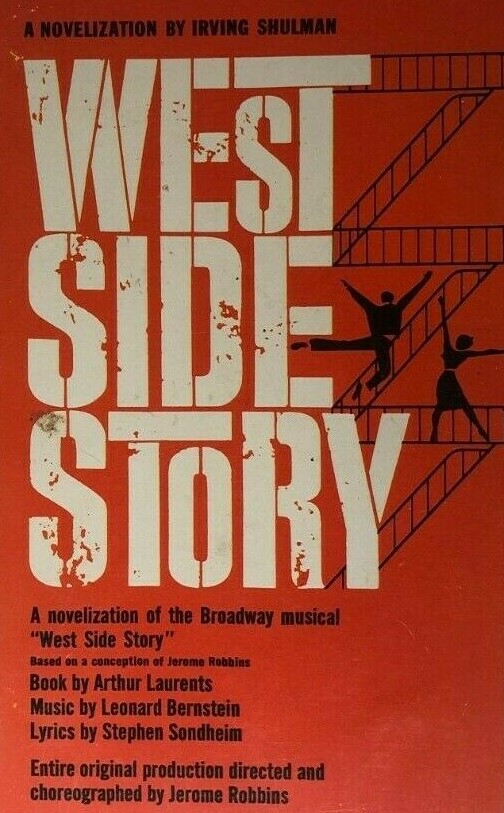
Note how many credits for the original musical were carried on the cover.

Occasionally the novelization would be undertaken by an author famous in their own right, such as when another sci fi giant Isaac Asimov took on the task of writing the book based on the script of Fantastic Voyage (1966). Famed western writer Louis L’Amour was handed the novelization of James Webb’s script for How the West Was Won (1963). Irving Shulman was a well-known novelist when called upon to turn West Side Story (1961) and The Notorious Landlady (1962) into novels. Screenwriter Adela Rogers St John (The Girl Who Had Everything, 1953) novelized King of Kings (1961). Sci fi writer Robert W. Krepps churned out novelizations for historical epics El Cid (1961) and Taras Bulba (1963), comedy Boys Night Out (1962) and westerns Stagecoach (1966) and Hour of the Gun (1967). Crime writer Jim Thompson novelized James Lee Barrett’s script of western The Undefeated (1969).

Some who took the novelization coin later made their name as bestselling authors in the own right. Marvin H. Albert – later known for the “Tony Rome” private eye novels that were filmed starring Frank Sinatra – was a relatively unknown journeyman writer when he became the go-to author for comedy novelizations, lending his name to the books of Come September (1961), Lover Come Back (1962), Move Over Darling (1963), The Pink Panther (1963), The Great Race (1965) and Strange Bedfellows (1965). Similarly, David Westheimer, a year before he published the bestselling Von Ryan’s Express, knocked out the book of Days of Wine and Roses (1962) from the J P Miller screenplay.

But mostly the novelizations were produced by journeymen such as Richard Wormer (Operation Crossbow, 1965), Alan Caillou (Khartoum, 1966), Ed Friend (Alvarez Kelly, 1966), John Burke (Privilege, 1967), Richard Meade (Rough Night in Jericho, 1967), Ray Gaulden (Five Card Stud, 1967), Jackson Donahue (Divorce American Style, 1967), Michael Avallone (Krakatoa-East of Java, 1968) and Joseph Landon (Stagecoach, 1966).

Publishers were not above picking over the spoils of decades-old scripts. Borden Deal was hired to novelize an un-made 1933 script written by Theodore Dreiser, author of An American Tragedy; Johnny Belinda (1948) was novelized in 1961. There were other departures. When writer-director S.Lee Pogostin received a $10,000 advance to novelize his own Hard Contract (1969) the book that appeared comprised the original script with stage directions and filmic addenda, in part due to the success of Butch Cassidy and the Sundance (1969) which was published as a screenplay rather than being novelized.

No genre was safe. Even musicals were plundered for their appeal to the book-reading public or for moviegoers wanting another way of reliving the film they had seen or getting a flavor of a picture they might consider seeing. As well as West Side Story and The Music Man (1962), there were novelizations of My Fair Lady (1964), Funny Girl (1968) and Paint Your Wagon (1969), an unexpected bestseller thanks to Clint Eastwood and Lee Marvin on the cover.

It wasn’t all plain sailing. Hollywood was notoriously lax when it came to release dates, the opposite of the publishing industry for whom such dates were sacrosanct. So a publisher could have put a great deal into organizing the delivery of hundreds of thousands of copies of a novelized title into over a hundred thousand outlets only for the book to molder away on the shelves waiting for a movie which arrived months late – or never at all. Or the movie might undergo a last-minute title change leaving publishers trying to flog a picture nobody had heard of.

SOURCES: “3-Yr Advance Campaign for King of Kings,” Hollywood Reporter, July 5,1961, p2; “Book Notes,” Hollywood Reporter, October 27, 1961, p9; “Book Notes,” Hollywood Reporter, December 5, 1961, p11; Patricia Johnson, “Ego, Yes, Indecision Often, But Love That Hollywood,” Variety, January 10, 1962, p42; “How the West Was Won with L’Amour,” Hollywood Reporter, January 26, 1962, p10; “Book Notes,” Hollywood Reporter, December 5, 1961, p11 “Book Notes,” Hollywood Reporter, January 17, 1962, p7; ; “Willson Novelizing Script,” Hollywood Reporter, February 5, 1962, p3; “Book Notes,” Hollywood Reporter, April 3, 1962, p8; “Book Notes,” Hollywood Reporter, August 15, 1962, p7; “Roger Lewis, Phil Langner and Corp Ready Garrick Production Slate,” Variety, November 13, 1963, p19; “Crossbow Books Tie In with Picture Release,” Box Office, May 31, 1965, pA2; “Stagecoach Screenplay To Become Paperback,” Box Office, March 14, 1966, pA1; “Signet Print Paperback of Cinerama Khartoum,” Box Office, June 13, 1966, pA1; “Divorce American Style Film and Book Tie-Up,” Box Office, June 20, 1966, p12; “Inside Stuff – Pictures,” Variety, August 10, 1966, p24; “Anti-Brush-Off of Writers,” Variety, November 16, 1966, p11; “Gold Medal Books to Print Alvarez Kelly Paperback,” Box Office, September 12, 1966, pA1; “Four Paperbacks Are Set On New Universal Films,” Box Office, September 19, 1967, pA2; “Sci Fi Award Goes To 20th-Fox for Voyage,” Box Office, September 26, 1966, pSW2; “Paint Your Wagon Set for Novelization,” Box Office, October 6, 1969, pA2; “The Undefeated Is Now Available in Paperback,” Box Office, November 3, 1969, pA2; “Inside Stuff – Pictures,” Variety, January 1, 1969, p23; “Advertisement, Krakatoa East of Java,” Box Office, November 17, 1969, p13-18; “Wagon Tie-In into Second Printing,” Box Office, December 1, 1969, pA2; “Marooned Printed in Paperback,” Box Office, December 15, 1969, pA1.

Pressure Point (1962) ****

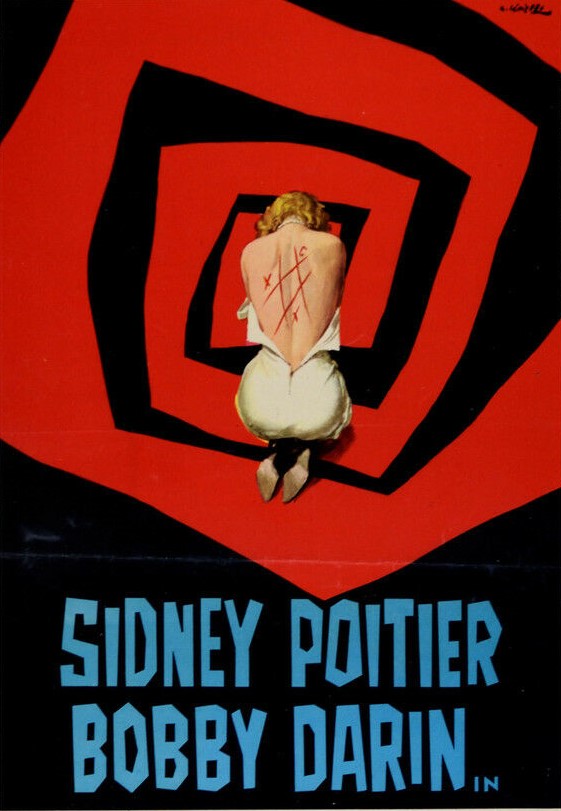
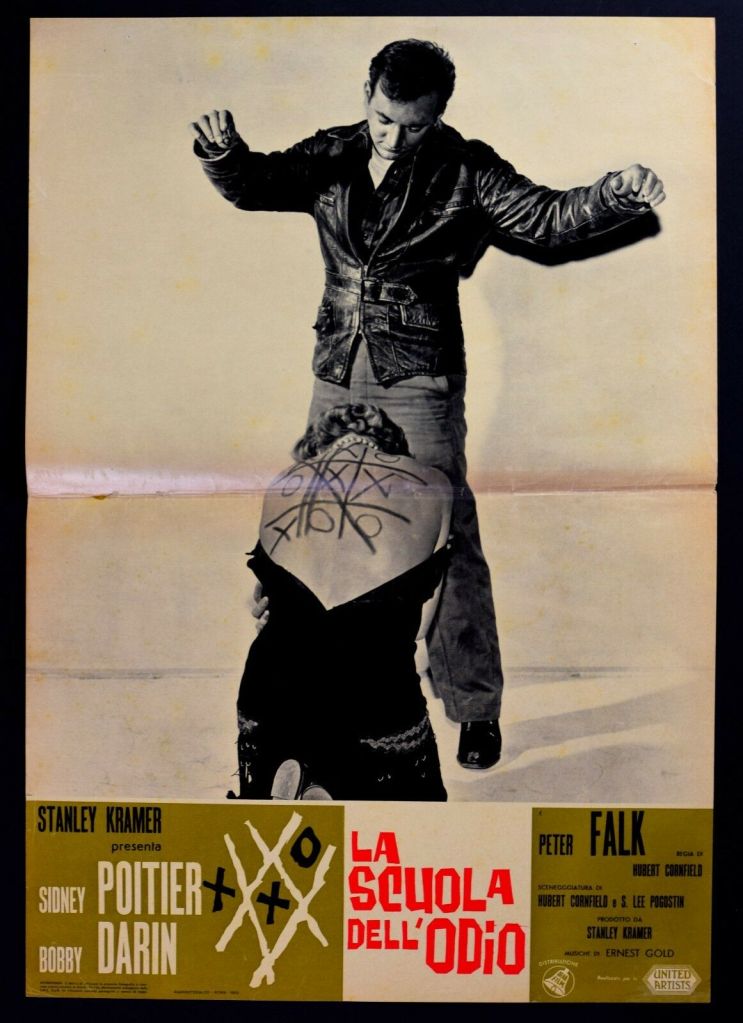
Central to this under-rated tale of psychopathy and racism is one extraordinary scene, possibly the most exceptional bar-room sequence ever filmed. In the annals of imaginative repulsion, it ranks alongside the rape committed by Alex and his “droogs” in Stanley Kubrick’s A Clockwork Orange (1971). It begins with mere intimidation as an unnamed young man (Bobby Darin) begins to etch into a bar counter the lines and symbols of Tic-Tac-Toe (a.k.a. Knots & Crosses or Noughts and Crosses). Discovering tins of paint, the man and his gang proceed to cover the entire bar – floor, walls, ceiling, even tables – with the same symbols.

The humiliation is ratcheted up a notch when the gang leader forces tavern owner (Howard Caine)  to lie on the floor behind the counter where he cannot see the bar hostess (Mary Munday), rigid with fear, being tormented. Using lipstick rifled from her handbag, the man decorates her face in the same fashion before pulling down the back of her dress and doing the same there. Fortunately, the rest of the scene, presumably ending in rape, is left to our imagination.

Italian poster showing image from the Tic-Tac-Toe scene. A variation of this was shown in the main image which removed the domineering man and concentrated on the humiliated woman.

Other potent scenes show how the man arrived at his crazed state, smothered with affection by a weak mother (Anne Barton) who has taken to bed in order to escape his drunken, raucous father (James Anderson) who taunts his ineffective wife by flaunting in her face his casual pick-ups and making love to them in the same room. Indicative of the lonely child’s disturbed personality is that when he invents an imaginary playmate, it is to have someone to subjugate, making his fictional friend lick his boots.

Imprisoned during the Second World War for sedition, the man, suffering from blackouts and nightmares – in which he imagines himself clinging to the edge of a giant plughole before being swept away by a torrent of water from the taps – becomes a patient of a young, also unnamed, doctor (Sidney Poitier) whom he subjects to racial abuse.  The doctor, physically bigger and more imposing than the patient, would like to simply give him a good thumping, but his profession necessitates that he treats this objectionable person as just another patient. And eventually they come to enough of a concord that the patient accepts treatment although the doctor suspects that his core personality has not changed.

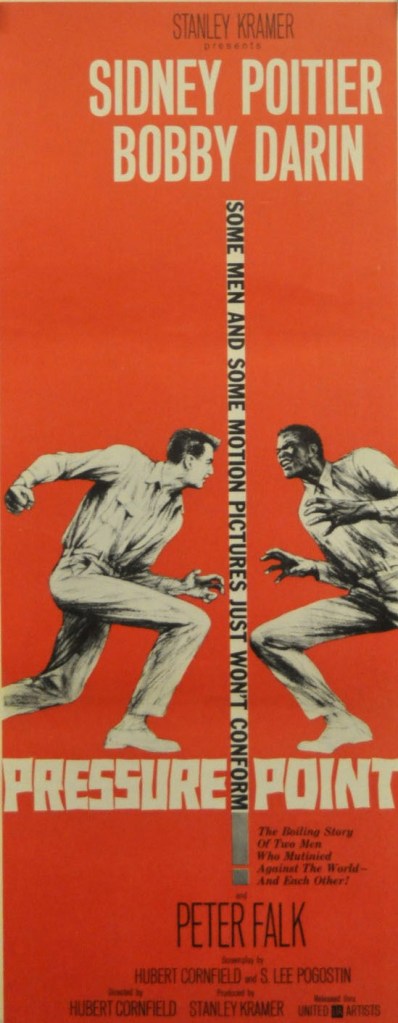
The U.S. poster was different to that used in Italy. This is pretty much a straight rip-off of “The Defiant Ones” (1958).

The movie is layered with themes other than psychopathy and psychiatry. While the racist element is to the fore, including the doctor’s need to prove himself in a white man’s world, and the lack of diversity in this particular medical field at that time, director Hubert Cornfield also explores the growth of right-wing extremism among the disaffected who see no contradiction in still espousing traditional American values, for example giving the Nazi salute while singing in all sincerity the national anthem. The African American doctor has to come to terms with lack of objectiveness when dealing with such an abhorrent person.

The movie flits between scenes between the two protagonists staged in a stagey manner and  expressionistic almost dreamlike sequences representing the patient’s upbringing such as being menaced by his butcher father among the swinging carcasses of the store. The patient flashbacks are shown without dialogue, explanation given in voice-over by either the patient or the doctor.

The father torments the mother by bringing a casual pick-up to their bedroom.

Reliance on visual dexterity, however, detracts from the tension and director Hubert Cornfield (The 3rd Voice, 1960) is also hampered by an unnecessary framing device which results in the story being told in flashback – leading to a conflation of flashbacks: the older Poitier explaining his earlier problems dealing with a difficult patent and listening in turn to the patient’s own life story. So the pressure indicated by the title is often undercut and does not build as much as you might expect. Critical reaction in those days pivoted on the racism elements, but a contemporary audience is almost certainly going to be as influenced by sequences involving the patient, so the picture automatically becomes more involved and Cornfield’s visual mastery more appreciated.

You can detect the influence of producer Stanley Kramer. In his capacity as director he had explored psychiatric therapy and anti-semitism in Home of the Brave (1949) and racism in The Defiant Ones (1958) also with Poitier. As producer he was responsible not only for selection of the original material, based on a short story The Fifty-Minute Hour by Robert M. Lindner, but also imposed the framing device, which Kramer wrote. Those scenes relate to another psychiatrist (Peter Falk) coming to a much older and experienced Poitier for advice after hitting a brick wall with a similarly repugnant patient, Poitier telling the story of his treatment of the Bobby Darin patient as a way of showing that even the worst patients are treatable.

This is quite a different Sidney Poitier than you might be used to. Wearing suit and tie, and spectacles, this is a more restrained, measured performance. Poitier’s taboo-busting Oscar nomination for The Defiant Ones had not progressed his career that much, still restricted to starring roles in low-budget pictures. But Kramer broke another taboo in Poitier’s favor with this one, casting him a role not initially written as an African American.

Bobby Darin (Come September, 1961) had parlayed his status as hit recording artist into a burgeoning movie career but does not quite display the menace necessary for a fully-fledged psycho. The likes of Richard Widmark would have been a more convincing adversary. Peter Falk (Machine Gun McCain, 1969) has a small one-tone role. The jazz-nuanced music by Ernest Gold (Exodus, 1961) is worth a listen. And if someone can tell me who designed the striking credit sequence I would be very pleased.

Incidentally, the title of Lindner’s short story is ironic. Patients pay for one hour of a psychiatrist’s time but in reality only receive 50 minutes in order for the professional to achieve a swift turnaround and keep his/her appointment timetable scheduled to the hour. Tic-Tac-Toe, in case you are unfamiliar with this two-person childhood game, consists of drawing lines to create nine squares and filling those with either a zero or a cross. The object of the exercise is to create a complete line of either symbols.

Catch-Up: Sidney Poitier films previously reviewed in the Blog are The Long Ships (1964), The Bedford Incident (1965) and Duel at Diablo (1966).

The Movie That Never Was: The Long-Lost Screenplay of Abraham Polonsky’s “The Gladiators” *****

This is the second volume of The Gladiators vs Spartacus opus, published separately to the tome I reviewed on February 24, 2021. Reading Abraham Polonsky’s screenplay is like having a piece of history in your hands. And it is a fascinating read. Polonsky’s take on the Spartacus legend was quite different to that of Dalton Trumbo for Stanley Kubrick’s 1960 Spartacus. Based on works presenting alternative visions, Polonsky’s on the book by Arthur Koestler and Trumbo’s on the Howard Fast novel, suggested there would be differences.

The most initial significant departure is that Polonsky gives considerably less emphasis to Roman politics. It’s a classic three-act film, the first section revolt and escape, part two battle against pursuing Romans, the final segment betrayal and defeat. Rather than viewing the uprising as a glorious event, Polonsky concentrates (as does Koestler) on conflict among the escapees. Where the relationship between Kirk Douglas and Jean Simmons follows a pure Hollywood arc, the female lead here, Lydia, is a more unusual character and for most of the time Spartacus fends her off. 

Top pic: Variety, June 24, 1959, p44; above Variety, February 12, 1958, p3. Ira Wolfert was a “front” for the blacklisted Polonsky.

And the revolt kicks in right away. Within 25 minutes (allowing one minute of screen time for every screenplay page), Spartacus spares the life of rival gladiator Crixus and together with their compatriots they rise up against their oppressors and escape to Vesuvius. Immediately, the differences between Spartacus and Crixus become apparent, the former wanting to press on, while Crixus wants to stop at an inn (“half-brothel, half resting place”), eat his fill, get drunk and have sex. To Spartacus, self-indulgence risks turning the men into a drunken horde, but to others (as expressed by the poet Fulvius) “this is freedom…the first thing a man wants back is his vices.”

But unexpected freedom brings a rebellion “without leaders, without plans, without hope” and the gladiators have attracted a rag-tag of other slaves. Crixus wants to discard these camp followers, head south, steal a ship and get home. Addressing the horde, Spartacus is brutal in his assessment, “I see a host of dead men” unless they submit to his authority and “swear by the gods never to surrender.” Crixus refuses and leads his Gauls away. With the Roman legions in pursuit, and blocking the one path up the mountain, Spartacus begins to train his horde. In a brilliant scene, the slave army, “faces and bodies blackened with charcoal,” descend on vine ropes on the outside of the crater in the darkness to surprise the Roman encampment.

When Crixus returns, he sees not a rabble but a proper army, Spartacus the undisputed commander. Spartacus plans to build a Sun City in alliance with the “old Greek cities conquered by Rome.” But such coalitions require compromise, forcing Spartacus to return to the Greeks slaves who have run away to join his army. “Every road has its detours,” says Spartacus. Naturally, his decision causes dissension, especially from Crixus. In order to win, Spartacus is willing to become a tyrant. (“It’s survival. It’s a detour. It’s a way around what we can’t go through.”)

Divisions within the army lead to a showdown. Crixus and Spartacus fight, at one point Crixus sparing his opponent’s life, to repay the debt from their skirmish  in the arena, and, reprieved, Spartacus kills him. But, eventually, Rome exerts its power, the slaves are betrayed, Spartacus refusing an opportunity to save himself, and in the final battle overwhelmed by superior forces, resulting in “eight thousand slaves on eight thousand crosses, all the way from Capua to Rome.” The screenplay ends in mythical fashion (i.e. true Hollywood). Spartacus’s body cannot be found. “They say the ground opened beneath him and swallowed him up. And some say he’ll be back.”  The final scene is of Spartacus’s infant son in the desert of Qumrum “empty, formidable, immense, the barrenness everywhere and yet here the spirit and first sign of modern man.”

Polonsky’s epic (two hours forty minutes by page count) is driven by conflict, not just against the pursuing Romans, but by different attitudes within the slave army as to the best way to achieve – and enjoy – freedom. The Crixus approach would be to loot every city. Spartacus adopts a policy of the end justifying the means. These “detours” were crucial to Koestler’s assessment of the true cost of revolution (taking the Russian revolution as his starting point). This is not a story of an impotent leader, driven to destruction by more powerful forces, but one where an individual, taking up the mantle of leadership, must make cruel decisions. This is the battle commander as politician. He faces a chorus of dissent from his own chief supporters – the poet Fulvius, the priest and scribe John, and his “wife” Lydia – who challenge his rulings, each with their own idea of how the revolt should fulfill its destiny. Spartacus himself is under little illusion, resisting attempts at deification, far more realistic than your standard Hollywood revolutionary. He does not believe in the gods or destiny and, ultimately, considers the revolt has little chance of success.

Polonsky, too, ignores the rules of the Hollywood romance. There is no meet-cute, Spartacus distrusts the willful and obsessive Lydia, possessor of mysterious powers, and, unlike the Hollywood standard attraction of opposites, there is no happy reconciliation. “I would never pick a wife who wanted to rule all men, the gods, and the world,” he tells her, “I would never choose a superstitious woman like you, with a tongue like a snake.” As for many a slave, the only freedom he enjoys, beyond a brief period unshackled, is the freedom not to die in servitude. From reading the screenplay, this is very much a movie I would have liked to see take its place on the big screen as an intelligent and challenging epic.

However, the actual screenplay only forms part of this 500-page-plus volume. Dr Fiona Radford provides extensive annotations and a critical commentary to the screenplay, drawing on both historical and literary sources and on Koestler’s book and Polonsky’s own notes. The commentary is worth reading in itself. Also included are draft scenes omitted from the revised script, lengthy excerpts from Polonsky’s Journal (which touches upon the screenplay and the blacklist) plus a survey of Roman gladiators in fiction and film from 1822 (Susanna Moodie’s Spartacus: A Roman Story) to 2020 and an examination of how Polonsky’s screenplay drew upon the source material, what he left out and what he invented. Henry Macadam and Duncan Cooper contributed the background essays. The combined volumes of The Gladiators vs Spartacus come to around 1,000 pages and a thousand more informative and highly readable pages would be hard to find. Dr Radford, by the way, along with Dr Peta Greenfield, runs a fascinating podcast-driven website “The Partial Historians” focusing on ancient Rome.

Note: I have not previously awarded marks to book reviews, in part since some are mine, modesty forbids, but if I ever there was a case for a five-star review, both these volumes fall into that category.

As with volume 1, The Gladiators vs. Spartacus Vol 2 is published by Cambridge Scholars Publishing.

Easy Rider (1969) *****

You could be forgiven for thinking that the movie’s main influences were the early Cinerama pictures that focused on extensive tracking shots of scenery (in this case, the open road) and unusual customs (ditto, alternative lifestyles, dope-taking etc) and Mike Nichol’s use of contemporary pop music in The Graduate (1967). But it also drew on the assumption, as did Hitchcock in Vertigo (1958) and Kubrick with 2001: A Space Odyssey a decade later, that a camera doing nothing can be hypnotic.

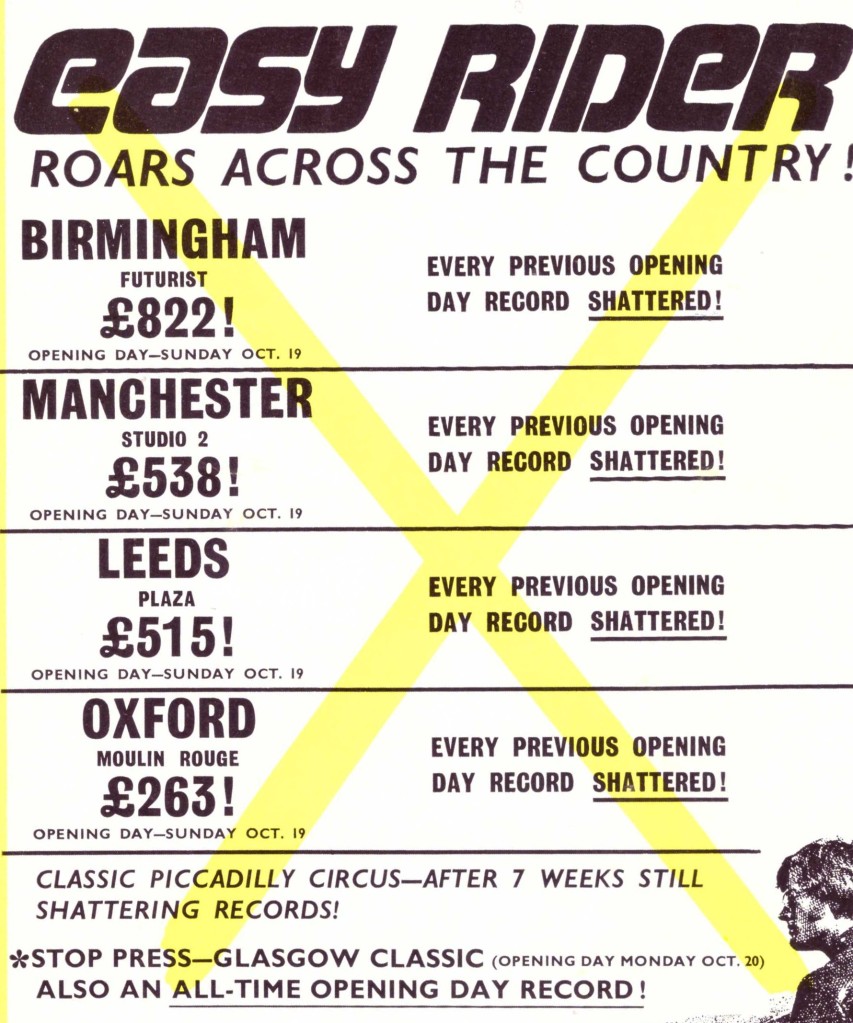
Selling a picture to the public and selling it to cinemas were two separate marketing skills. The easiest way to guarantee bookings for any film was to promote the box office figures through the trade press – as here in the British “Kine Weekly.” Columbia had cleverly booked the movie into one of the smallest cinemas in London’s West End where it was almost certainly guaranteed to break the box office record. But even the studio must have been taken aback by the way Easy Rider pulverized the previous record.

Message pictures were the remit of older directors like Stanley Kramer and Martin Ritt and films that had something to say about the human condition generally emanated from Europe and not low-budget efforts coming out of Hollywood. Easy Rider has a European sensibility, an almost random collection of unconnected episodes with no narrative connection to the main story, itself incredibly slight, of two mild-mannered dudes heading to New Orleans to see the Mardi Gras.

Road trips were not particularly unusual in American cinema but the form of previous locomotion was horse-related – westerns. The journey has been a central theme to movies. This is an 80-minute picture masquerading as a 95-minute one, a good fifteen minutes of screen time taken up with endless shots of Peter Fonda and Dennis Hopper on bikes passing through the landscape, with a contemporary soundtrack as comment.

Unusually, it’s also a hymn to ancient values, heads bowed in prayer at meals as different as you could get, the Mexican family and the commune, a marching band playing “When the Saints Go Marching In” and the recitation of prayers in the cemetery.

Success in London was no guarantee that a movie would perform as well all over the country. Columbia continued to book it into smaller venues in the hope it would repeat the London experience of breaking box office records. When it did the studio took out another advert in Kine Weekly to let exhibitors know.

What marks the film out stylistically, perhaps enforced by the lean financing, is the sparing way it is told. The most dramatic scenes – the three murders – are filmed in shockingly simple fashion. There are often long pans along groups of characters. While innovative, the flash-cut flash-forward editing adds little to what is otherwise a very reflective film. Inspired use is made of natural sound, the muffled thumping of oil derricks at the cemetery, the soundtrack to one death is just the battering of unseen clubs by unseen assailants.

The dialogue could have been written by Tarantino, none of the confrontation or angst that drives most films, but odd musings that bring characters to life. At the beginning of the trip, Hopper and Fonda are welcomed wherever they travel, but towards the end resented, treated as though a pair of itinerant aliens. They entrance young girls but are vilified by authority, jailed for no reason except the threat to traditional values they apparently represent.

Elements not discussed at the time of release make this more rounded than you would imagine. The excitable Hopper, a nerd in hippie costume, is driven by the American dream of making money. The more reflective Fonda senses something is not only missing from his life but has been lost forever. He has the rare stillness of a top actor, face reflecting unspoken inner turmoil.

It remains an extraordinary film, a series of accumulated incidentals holding up a mirror to an America nobody wanted to acknowledge and the brutal climax no less powerful now.   

Of course, the Easy Rider soundtrack itself summons up memories of the era and it is worth listening to just by itself and you might even want to go all the way and listen to it in the original vinyl.

Below is a link for the DVD.

   https://www.amazon.co.uk/Easy-Rider-DVD-Peter-Fonda/dp/B00LTK2Z44/ref=sr_1_1?crid=YSG6SCL8QQF9&dchild=1&keywords=easy+rider+dvd&qid=1596660339&s=dvd&sprefix=easy+rider%2Caps%2C153&sr=1-1

Discover WordPress

A daily selection of the best content published on WordPress, collected for you by humans who love to read.

The Atavist Magazine

by Brian Hannan

WordPress.com News

The latest news on WordPress.com and the WordPress community.