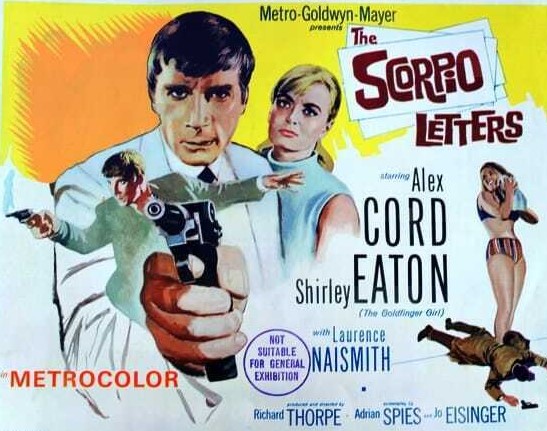
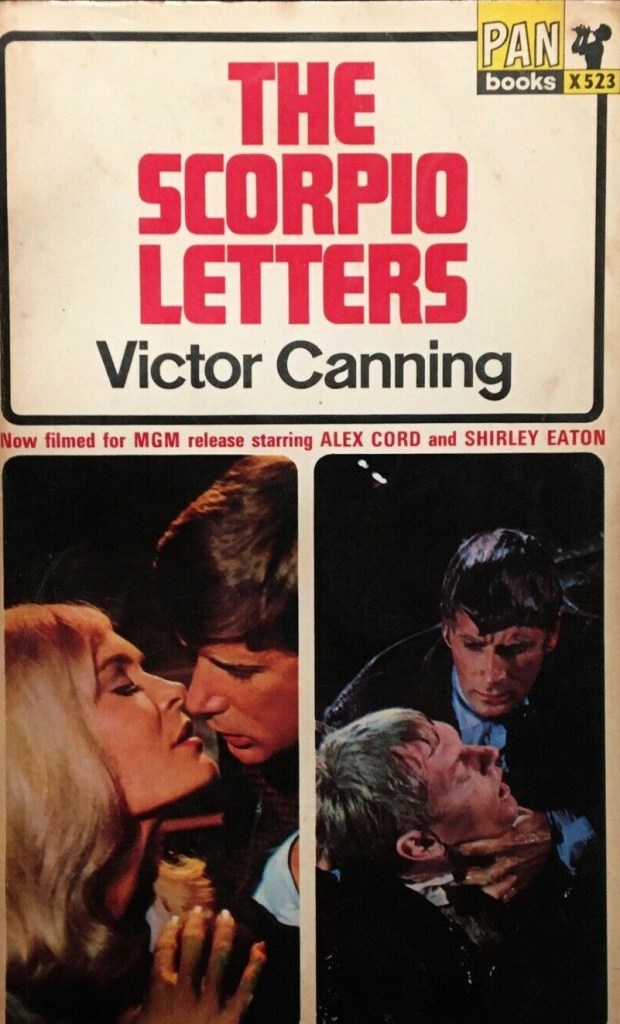
The Scorpio Letters (1967) ***

Desultory spy thriller with over-complicated story that’s worth a look mostly for the performance of Alex Cord (Stiletto, 1969). I can’t say I was a big fan of Cord and I certainly didn’t shower him with praise for his role as a disillusioned Mafia hitman in that movie. But now I’m wondering if I have been guilty of under-rating him.

Normally, critics line up to acclaim actors if they deliver widely differing performances – Daniel Day-Lewis considered the touchstone in this department after Room with a View and My Beautiful Launderette opened in New York on the same day in 1985. But usually screen persona rarely changes, a heightened or amalgamated version of the actor’s character or features. Once Charles Bronson, for example, started wearing his drooping mustache, for example, he was never seen without.  Actors may grow old, but never bald.
The macho mustachioed Cord of Stiletto is nowhere in sight. In fact, in The Scorpio Letters minus moustache and resisting attempts to reveal his musculature, he is almost unrecognizable. In this picture Joe Christopher (Alex Cord) is flip, resentful, thoughtful, occasionally pedantic, more natural than many of the current crop of Hollywood new stars, and for once in a movie that has transplanted an American in London rather scornful of British traditions.

There’s a realistic flourish here, too, he is so poorly paid – and on a temporary contract – that he has to take the bus. And although he is an ex-cop fired for brutality, that level of violence ain’t on show here. Virtually the opposite of the character Cord created for Stiletto, I’m sure you’ll agree. So full marks for versatility and talent.

Unfortunately, the rest of the movie is not up to much, at the very bottom of the three-star review, almost toppling into two-star territory. Christopher is investigating the death of a British agent who was the subject of a blackmail attempt. By coincidence – or perhaps not – another part of British Intelligence is investigating the same death, and this brings Christopher into contact with Phoebe Stewart (Shirley Eaton) and eventually they work together to unravel a list of codenames and uncover the conspiracy with a bit of risk to life and limb.

But the pay-off doesn’t work despite all the exposition attempting to build it up and you’re left with a kind of drawing-room drama rather than exciting spy adventure. It’s determinedly London-centric with red buses, red postboxes, Big Ben, Horse Guards Parade all putting in an appearance. The scene shifts to Paris and Nice without much increase in tension. There’s also an irate German chef.  Despite a couple of neat scenes – a chase held up behind a wedding party, an interrogation in a wine cellar – it’s much too formulaic.
Cord apart, Shirley Eaton (Goldfinger, 1964) adds some glamour, but her rounded portrait depicts a character with warmth rather than oozing sex. This is the kind of film that should be awash with character actors and up-and-comers, but I recognized few names except for Danielle De Metz (The Karate Killers, 1967), Oscar Beregi (Morituri, 1965) and Laurence Naismith (The Persuaders tv series, 1971).

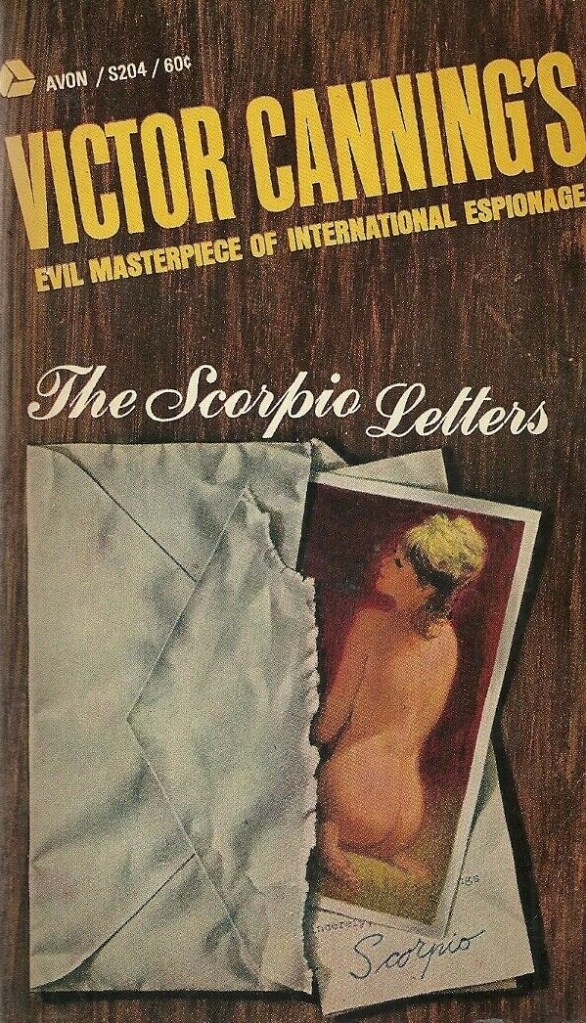
One-time top MGM megger Richard Thorpe (The Truth about Spring, 1965) was coming to the end of a distinguished career which had included Ivanhoe (1952) and Knights of the Round Table (1953). This was his penultimate film. The appropriately named Adrian Spies (Dark of the Sun, 1968) wrote the screenplay based on the Victor Canning thriller. Making his movie debut was composer Dave Grusin (Divorce American Style, 1967)

Albeit with a limited budget of $900,000, MGM intended the picture for theatrical release but with a short cinema window to make it available for a speedy showing on ABC TV. It was originally scheduled for a May 1967 theatrical release but MGM decided to cut out the American release and so it made its debut in the “Sunday Night at the Movies” slot on February 19, 1967, and was shown in cinemas abroad. Nor was it shown first on U.S. television because the studio believed it a disaster. Variety (February 22, 1967, page 42) called it “very hip.”

Ten Little Indians (1965) ***

This is more like it. Classic Agatha Christie mystery told in classic fashion but devoid of either of her major sleuths, Hercule Poirot or Miss Marple, and set in the grander equivalent of the country house locale that had become something of a trademark. Here it’s the kind of castle perched atop a mountain, accessible only by cable car unless you have mountaineering skills, that you would need the combined services of Clint Eastwood and Richard Burton to affect a rescue, and as with Where Eagles Dare (1968) the conditions are distinctly wintry.

Ten strangers, including the two servants, have been invited to this retreat by the mysterious Mr Owen. They soon learn they are cut off, telephone lines down, cable car out of commission for a couple of days, nearest village a straight drop 15 miles down a perilous cliff.

All they have in common, as they discover via a taped message delivered by their host, is that they all got away with murder or at the very least a dubious death. There is a private eye on hand, former cop Blore (Stanley Holloway), but he’s lacking in the little grey cells that Poirot put to such clever use in such circumstances. So, like a troupe of actors let down by some stage entrepreneur, they have to get the show on the road themselves, a combined effort to solve the problem.

Not so much why they are gathered here, but why they keep on getting bumped off, and rather in the fashion of the titular song. The movie business wasn’t awash with serial killers though this decade would see nascent interest in this sub-genre, witness Psycho (1960) and The Boston Strangler (1968). But Ms Christie mysteries never really seemed to get going until the death toll had reached multiple figures.

The good element of this kind of movie with a large cast is that each character gets a moment in the sun, here that spotlight largely concerned with what crime they committed for which they were never truly punished. Pop singer Mike (played by pop singer Fabian) gets the ball rolling, explaining that his only punishment for killing someone while driving under the influence was a temporary withdrawal of his license.

And so it goes on, everyone wondering who will be next to be despatched and going from the initial conclusion that Owen is responsible and is hidden somewhere in the house to the obvious one that Owen is one of them. I have to confess I’m easily gulled by the murder mystery and I hadn’t reached that conclusion myself.

The movie’s not necessarily filled with that kind of twist – although there certainly are a good few, some people not as guilty as they might appear, not quite who they appear to be –  more you glancing at the cast list and wondering, by dint of billing or box office pull, who will be next for the chop and unless the director has got the Hitchcock vibe it’s not going to be one of the leads.

So it’s a choice of Hugh Lombard (Hugh O’Brian), secretary Ann Clyde (Shirley Eaton), actress Ilona Bergen (Daliah Lavi), General Mandrake (Leo Genn), Judge Cannon (Wilfrid Hyde White), Dr Armstrong (Dennis Price) and the aforementioned Blore plus servants the Grohmanns (Marianne Hoppe and Mario Adorf). And this isn’t your standard serial killer either with a constant modus operandi that will eventually, through standard detection, trap him or her. Instead, variety is the key. Death by fatal injection, knife, poison, slashed rope.

As the numbers whittle down, and you even feel sorry for the actions of some, the actress, for example, whose husband committed suicide when she left him, the tension mounts. You won’t be on the edge of your seat because there are just too many characters involved for you to become overly concerned with their plight but it’s still has you on the hook. You do want to know whodunit and why and you can be sure Ms Christie, as was her wont, will have some clever final twist.

At least, unlike the later variations on the genre, nobody’s been bumped off because they are too fond of sex, and the violence itself is restrained, almost dignified, and there’s no sign of gender favoritism.

All in all, entertaining stuff, though since by now this kind of murder mystery, given we’ve been through various iterations of Poirot – Albert Finney, Peter Ustinov, Kenneth Branagh et al, not to mention numerous Miss Marples – a lot of this feels like cliché (though that’s a bit like a contemporary audience considering John Ford’s Stagecoach old hat, not realizing this was where many of those western tropes were invented or polished to a high level). And I had to say I had a sneaky hankering for some of the out of left field goings-on of The Alphabet Murders (1965).

Sad to see Hollywood not taking advantage of Daliah Lavi’s acting skills, under-estimated in my opinion after her terrific work in The Demon (1963) and The Whip and the Body (1963). But then this wasn’t Hollywood calling but our old friend producer Harry Alan Towers (Five Golden Dragons, 1967) who specialized in dropping a biggish American name into a B-list all-star-cast.

George Pollock, who helmed this decade’s four Miss Marple movies, enjoys keeping the mystery alive without resorting to a central know-it-all. Everyone cast does what they’re expected to do. Towers wrote the screenplay with his usual partner Peter Yeldham.

Worth considering alongside The Alphabet Murders, but stands up well on its own.  

PREVIOUSLY REVIEWED IN THE BLOG: Hugh O’Brian in In Harm’s Way (1965), Texas: Africa Style (1967); Daliah Lavi in The Demon (1963), The Whip and the Body (1964), Lord Jim (1965), The High Commissioner (1968), Some Girls Do (1969).

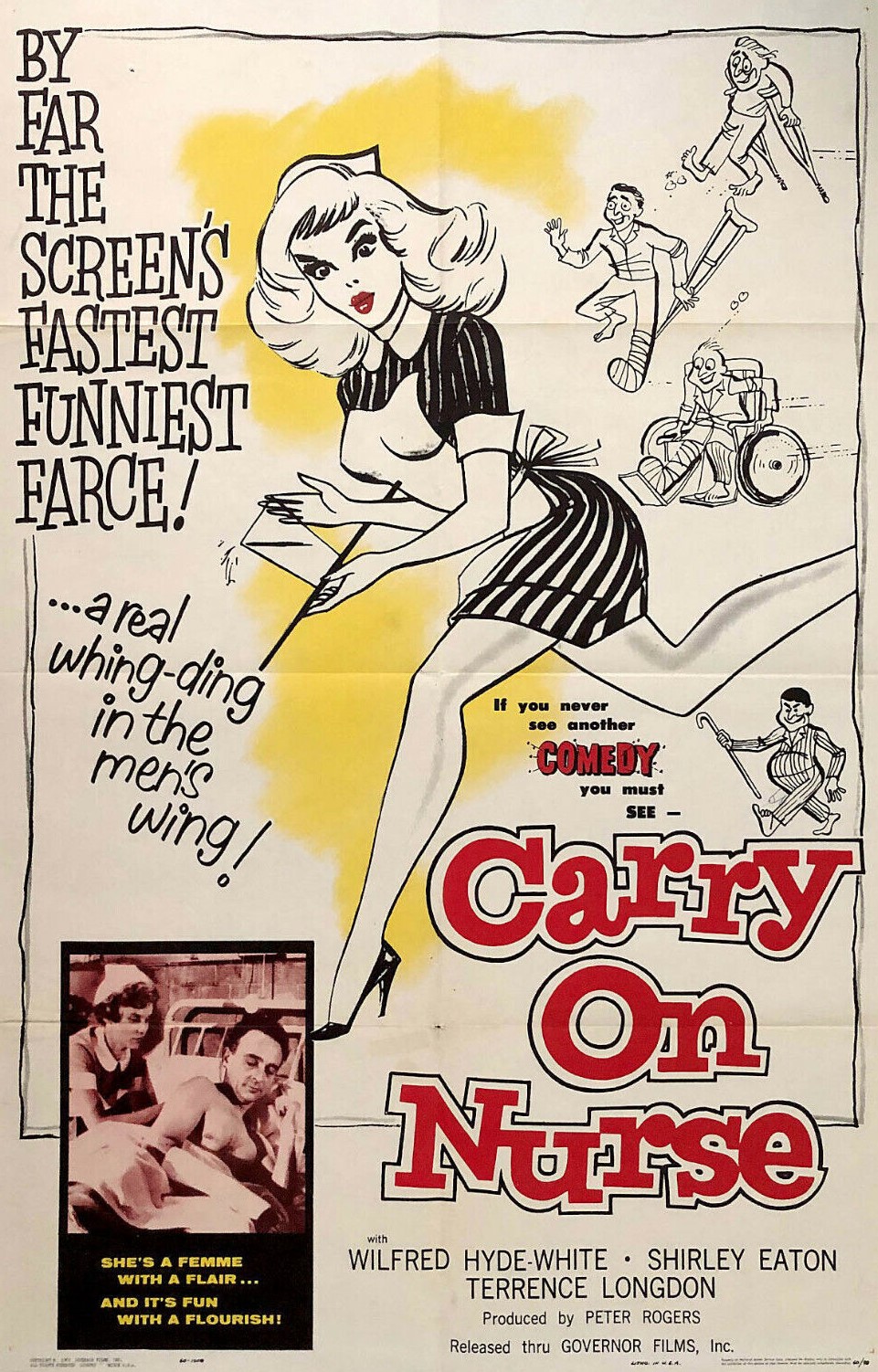
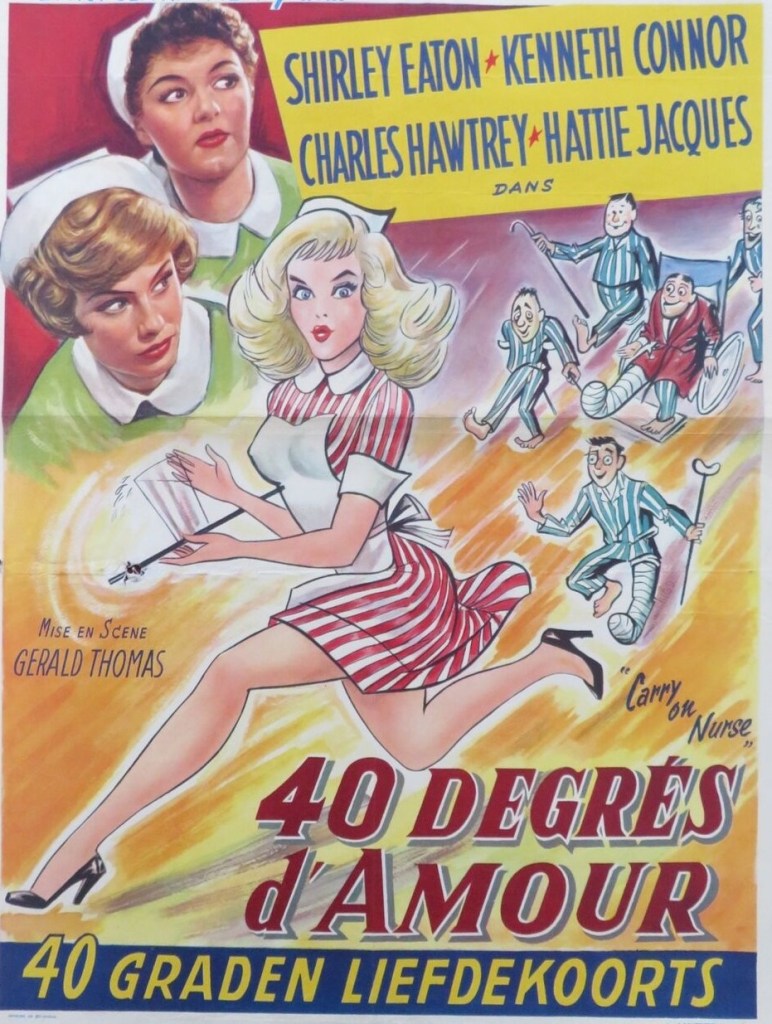
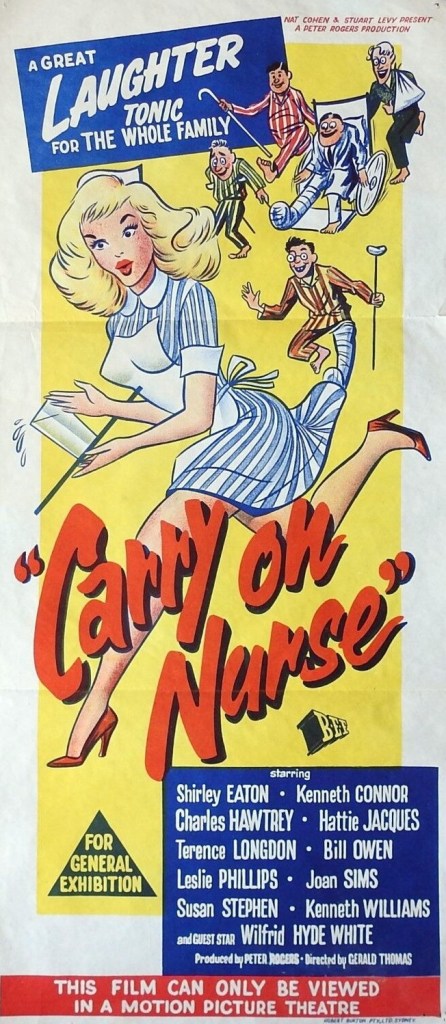
Carry On Nurse (1960) ***

There was no greater divide between audiences and critics in Britain than the long-running comedy “Carry On” series (outside of an occasional satirical bulls-eye like Carry On Up the Khyber, 1968). And a similar gulf existed between the type of audiences the movies attracted in Britain and those in America. In Britain they were vastly popular general releases while in America their usual habitat was the arthouse as if they were seen as the natural successors to the Ealing comedies. And there was a third chasm – between the endearing risqué early comedies and the more lascivious later versions.

Carry On Nurse fell into the endearing camp. The humor was gentle rather than forced, the emphasis on misunderstanding and innuendo and smooth seducers like Leslie Phillips rather than exposed female flesh and the grasping likes of the ever-chortling Sid James. Perhaps you could define this earlier film as pre-nasal Kenneth Williams, his peculiar type of delivery not yet at full throttle. Here there is innocence rather than lust and the males quake in fear not just of the indomitable Hattie Jacques in brusque matron mode but of the other efficient nurses led by Shirley Eaton who have the measure of their rather hapless patients, although student nurse Joan Sims – making her series debut – is an accident-prone soul.

And they say comedy doesn’t travel.

The action is mostly confined to a male ward. There are plenty of gags – alarms rung by mistake, boiling catheters burned to a turn, medication making a patient go wild, patients intoxicated by laughing gas and the famous replacement of a rectal thermometer by a daffodil. Wilfred Hyde-White as a constant complainer and obsessive radio listener Charles Hawtrey provide further ongoing amusement. 

But the thrust of the story is romance. Journalist Terence Longdon fancies Shirley Eaton but his initial advances are spurned as she is in love with a doctor. In a role far removed from his later brazen characters, Williams plays a shy intellectual who finally comes round to the charms of Jill Ireland (later wife of Charles Bronson). Although Leslie Phillips is his usual suave self, he makes no designs on the female staff since he has a girlfriend elsewhere and  his ailment – a bunion on the bum – makes him an unlikely candidate for a hospital liaison.  

Hattie Jacques is in imperious form, Shirley Eaton shows what she is capable of, Kenneth Williams playing against type is a revelation. 

British critics hated the “Carry On” films until late in the decade when Carry On Up the Khyber (1968) hit a satirical note. Critics felt the movies pandered to the lowest common denominator and were a poor substitute for the Ealing comedies which had given Britain an unexpected appreciation among American comedy fans.

It was a well-known fact the comedies did not always travel. Apart from Jacques Tati, the more vulgar French comedies featuring the likes of Fernandel were seen as arthouse fare. Unless they featured a sex angle or the promise of nudity, coarse Italians comedies struggled to find an international audience. The “Carry On” films were bawdy by inclination without being visually offensive

Carry On Sergeant (1958), the first in the series, had been a massive success in Britain. Distributor Anglo-Amalgamated was so convinced it would find a similar response in the U.S. that it was opened in New York at a first run arthouse. Although comedies were hardly standard arthouse fare, this was generally the route for low-budget British films.  The picture lasted only three weeks and taking that as proof of its dismal prospects other exhibitors ignored it. 

The follow-up Carry On Nurse (1959) took an entirely different route when launched in America in 1960. This time New York would be virtually the last leg of its exhibition tour.  Instead it opened on March 10 at the 750-seat Crest in Los Angeles. Away from the New York spotlight, the little movie attracted not just good notices but decent audiences.

Instead of being whipped off screens after a few weeks, it developed legs. In Chicago it ran for 16 weeks in first run before transferring to a further 50 theaters. Within a few months of opening it had been released in 48 cities. In Minneapolis it was booked as a “filler” at the World arthouse, expected to run a week and no more. Instead, it remained for six weeks and when it shifted out to the nabes out-grossed Billy Wilder’s big-budget comedy The Apartment (1960) with a stellar cast of Jack Lemmon and Shirley Maclaine.

In its fourth month at the 600-seat Fox Esquire in Denver where it opened in May, it set a new long-run record for a non-roadshow picture. It had been taking in a steady $4,000 a week since opening.

SOURCES: “How To Nurse a Foreign Pic That’s Neither Art nor Nudie: Skip N.Y.,” Variety, Aug 24, 1960, 3; “British Carry On Nurse A Sleeper in Mpls With Long Lopp Run, Nabe Biz,” Variety, Aug 24, 1960, 18;

Note: by and large this blog follows American release dates so although Carry On Nurse was shown in Britain in 1959 it did not reach America until 1960.

https://amzn.to/3G1h1Ei

Sumuru, Queen of Femina / The Girl from Rio / Mothers of America (1969) ***

Cult fans assemble. Sci fi crime thriller with for the time a fair sprinkling of nudity, and channelling psychedelic turns like Barbarella (1968) and Danger: Diabolik (1968) and one step up from the ultra-confident gals of Deadlier than the Male (1967) and Some Girls Do  (1969). It would have helped if there was a decent plot, and not just a barrage of double-crossing halfway in, but you can’t have everything and director Jess Franco seems to believe that the presence of a tribe of women decked out in red capes, white knee-length boots and not necessarily much in between, goes some way to compensate.

Crook Jeff Sutton (Richard Stapley) holes up in Rio with $10 million in stolen cash, unaware that his presence has already been noted by gang boss Masius (George Sanders) and local ultra-feminist Sununda (Shirley Eaton). After hooking up with manicurist Lesley (Maria Rohm), Sutton is set upon by Masius’ henchmen but escapes in a plane to Femina, “the capital city of the world of women,” a female fortress along the lines of the Bulldog Drummond pictures.

Turns out Sununda is partial to men with piles of cash, kidnapping and torturing them until they hand it over. So she can’t believe her luck when millionaire Jeff walks into her lair. Except Jeff is a bit of a fibber, having made up the story about the ten million, and instead landing at Femina in order to rescue Ulla (Marta Reves).

The plot only really kicks in when he escapes. Masius agrees to help Jeff in return for the pretend-thief helping him hijack Sununda’s vault of gold. In reality, Masius is using Jeff as bait, to tempt Sununda down from the clouds, and then turn him over in exchange for just half her gold. And so it’s back to Femina for all concerned.

There’s no real pretence at the kind of sci-fi that enthralled Barbarella audiences and none of the slick campness of Danger:Diabolik, and most of the ideas seem still-born and occasionally contradictory – in order to enslave men women must first be taught how to be irresistible to them – torture is accomplished either by whispering or kissing, and the ray-guns employed looked like cast-offs from the 1950s, but the regiment of women, with spies infiltrating everywhere, led by the ruthless Sununda, have the makings of a warrior nation.

The movie has far better luck with Masius, a splendidly-drawn character who doodles on restaurant tablecloths, enjoys reading Popeye comic books, and – a bit of drawback for a man in his profession – can’t stand the sight of blood. While his sidekicks are mostly incompetent, they do drive around in hearses that resemble pagodas or dress in unnecessary masks and while his girlfriends appear docile they are in fact spies. And there’s a spot of waterboarding in case you ever wondered where the American secret services got the idea.

The source material was from Sax Rohmer but Sununda lacks the inherent obvious evil of the author’s more successful Fu Manchu series, Shirley Eaton no match for Christopher Lee, the most recent Fu Manchu, nor Richard Shapley on a par with Fu Manchu nemesis Nayland Smith, regardless of whether played by Nigel Green (The Face of Fu Manchu, 1965),  Douglas Wilmer (The Brides of Fu Manchu, 1966) or Richard Greene (The Blood of Fu Manchu, 1968, and The Castle of Fu Manchu, 1969).

And anyone attracted to the picture by director Jess (Jesus) Franco is going to be disappointed by the lack of sleaziness he exhibited in pictures like Succubus (1968), 99 Women (1969) and  Marquis De Sade’s Justine (1969) and there’s not enough style, though abundant campness, to make up.  It’s hard to say quite why it did not have a harder edge, perhaps producer Harry Alan Towers, responsible for 99 Women, felt it should err in the softer direction of Fu Manchu than the overt sex-and-violence of the nascent women-in-prison genre.  

Franco and Towers (24 Hours to Kill, 1965, and Bang! Bang! You’re Dead!, 1966) had collaborated on The Blood of Fu Manchu and The Castle of Fu Manchu as well as Venus in Furs (1969) and Marquis De Sade’s Justine so presumably knew how far they could go and decided that here it was better to rein in Franco’s tendencies. Whether a tougher-edged approach would have made much of a difference given the indifferent playing – neither Shirley Eaton (The Scorpio Letters, 1967)  nor Richard Stapley (Two Guns and a Coward, 1968) bring much to the leading roles and George Sanders (Warning Shot, 1967) is not in it enough to save it. Maria Rohm, Franco’s wife, appeared in many of his films.  

Towers appeared on surer ground in the likes of 24 Hours to Kill (1965), Bang! Bang! You’re Dead! (1966) and Five Golden Dragons (1967) when he could draw on a more interesting cast, better stories and more colourful locations. This was a sequel to The Million Eyes of Sumuru (1967) again with Shirley Eaton and plum role for Klaus kinski.

Despite the film’s potential, the director and George Sanders it does not fit into the so-bad-it’s-good category nor has enough going for it to be labelled a true cult film. But I could be wrong in both those assumptions.

Spy Girls

If you’ve not already come across Cinema Retro magazine – now celebrating 18 years of publication –  or its various Special Issues you are in for a treat. Spy Girls fell under its “Foto Files Special Edition” portfolio and includes over 200 illustrations of the actresses who dominated the wave of espionage pictures in the 1960s and to a lesser extent the 1970s.

As well as focusing on the leading female stars in every series film – James Bond, Derek Flint, Matt Helm, Bulldog Drummond, The Man from Uncle and Harry Palmer – the magazine also pay tribute to the wide variety of starlets who appeared in bit parts such as Zena Marshall (Dr No, 1962), Aliza Gur (From Russia with Love, 1963), Shirley Eaton and Margaret Nolan (Goldfinger, 1964) Molly Peters (Thunderball, 1965) and Gila Golan (Our Man Flint, 1966).

However, in the main the concentration is on the flood of European actresses who set Hollywood agog following multiple appearances in spy pictures. Beginning with original Swiss-born Bond girl Ursula Andress (Dr No and Casino Royale, 1967, the magazine features every actress who had a starring role in the mainstream spy films. Some, of course, seemed very comfortable in the genre with roles in several pictures.

Leading that particular parade were Italian Daniela Bianchi who, after her spy debut in From Russia with Love, was seen in Slalom (1965), Operation Gold (1966), Special Mission Lady Chaplin (1966), Requiem for a Secret Agent (1966) and Operation Kid Brother (1967). Matching her was Austrian Senta Berger, caught in The Secret Ways (1961), The Spy with My Face (1965), Our Man in Marrakesh (1966), The Quiller Memorandum (1966), The Ambushers (1967) and Istanbul Express (1968).

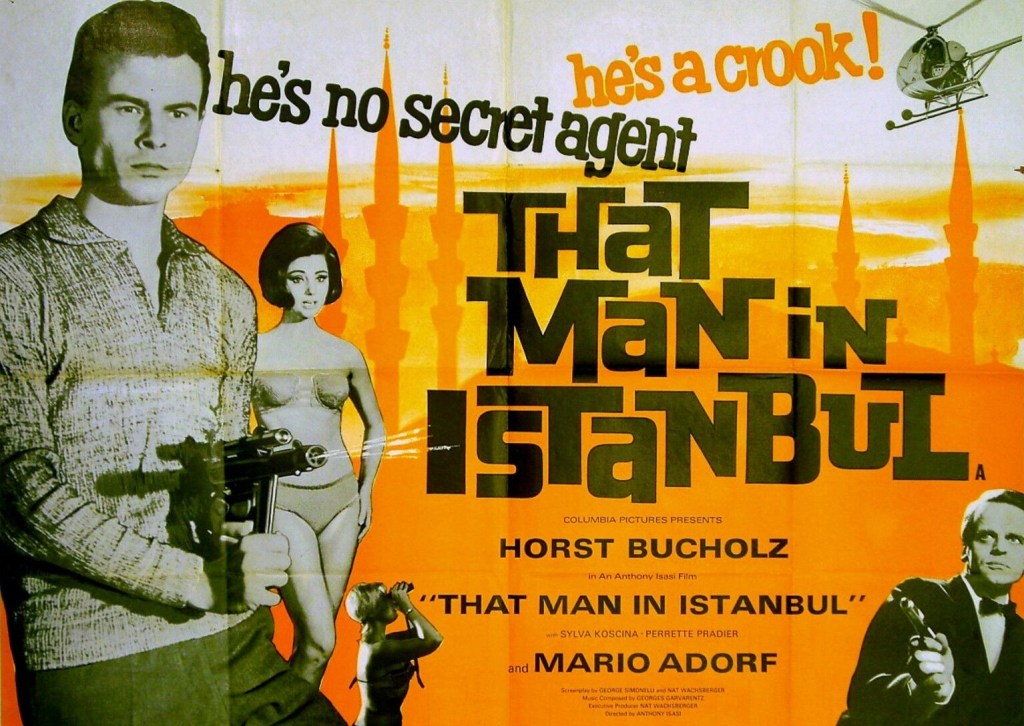
Not far behind came Israeli Daliah Lavi who lit up the screen in The Silencers (1966), The Spy with a Cold Nose (1966), Casino Royale (1967), Nobody Runs Forever (1968) and Some Girls Do (1969). German Elke Sommer was another regular, headlining The Venetian Affair (1967), The Corrupt Ones (1967), Deadlier than the Male (1967) and The Wrecking Crew (1968.) Also a regular in the genre was Yugoslavian Sylva Koscina with Hot Enough for June/Agent 8¾ (1964), That Man in Istanbul (1965), Agent X-77 Orders to Kill (1966) and Deadlier than the Male (1967)

Canadian Beverly Adams featured three times in the Matt Helm series, in The Silencers, Murderers Row (1966) and The Ambushers (1967). Czechoslovakian Barbara Bouchet turned up in Agent for H.A.R.M (1966), Casino Royale and Danger Route (1967) and Austrian Marisa Mell had top roles in Masquerade (1965), Secret Agent Super Dragon (1966) and Danger:Diabolik (1968). Another three-peater was Rome-born Luciana Paluzzi – To Trap a Spy (1964), Thunderball (1965) and The Venetian Affair (1967) – not forgetting Swede Camilla Sparv in Murderers Row (1966), Assignment K (1968) and Nobody Runs Forever (1968).

No study on the girls involved in espionage over these two decades would be complete without mention of Raquel Welch for Fathom (1967), Monica Vitti in Modesty Blaise (1966), Honor Blackman in Goldfinger and Britt Ekland in The Man with the Golden Gun (1974). The occasional American leavened the pot – Jill St John appearing in The Liquidator (1966) and Diamonds Are Forever (1971) and Lana Wood also in the latter. 

The extensive illustrations include stills, and photographs of the stars relaxing on set or setting up a shot, as well as a veritable archive of posters from virtually every country in the world, often with substantially different artwork to the originals. In addition, articles on the main actresses are included as well as snippets of information on the lesser stars.

Priced at just £6.95 / $11.99 this might make a nice Xmas filler.

http://www.cinemaretro.com/index.php?/archives/8048-COMING-FROM-CINEMA-RETRO-SPY-GIRLS-FOTO-FILES-ISSUE-1.html

The Scorpio Letters (1967) ***

Desultory spy thriller with over-complicated story that’s worth a look mostly for the performance of Alex Cord (Stiletto, 1969). I can’t say I was a big fan of Cord and I certainly didn’t shower him with praise for his role as a disillusioned Mafia hitman in Stiletto. But now I’m wondering if I have been guilty of under-rating him.

Normally, critics line up to acclaim actors if they deliver widely differing performances – Daniel Day-Lewis considered the touchstone in this department after Room with a View and My Beautiful Launderette opened in New York on the same day in 1985. But usually screen persona rarely changes, amounting to little more than a heightened or amalgamated version of the actor’s character or features. Once Charles Bronson, for example, started wearing his drooping mustache he was never seen without.  Actors may grow old, but never bald.

The macho mustachioed Cord of Stiletto is nowhere in sight. In fact, in The Scorpio Letters minus moustache and resisting attempts to reveal his musculature, he is almost unrecognizable. In this picture Joe Christopher (Alex Cord) is flip, resentful, thoughtful, occasionally pedantic, more natural than many of the crop of Hollywood new stars being unveiled at the time, and for once as a transplanted American in London rather scornful of British traditions. There’s a realistic flourish here, too, he is so poorly paid – and on a temporary contract – that he has to take the bus. And although he is an ex-cop fired for brutality, that level of violence ain’t on show here. Virtually the opposite of the character Cord created for Stiletto, I’m sure you’ll agree. So full marks for versatility and talent.

Unfortunately, the rest of the movie is not up to much, at the very bottom of the three-star review category, almost toppling into two-star territory. Christopher is investigating the death of a British agent who was the subject of a blackmail attempt. By coincidence – or perhaps not – another part of British Intelligence is investigating the same death and this brings Christopher into contact with Phoebe Stewart (Shirley Eaton) and eventually they work together to unravel a list of codenames and uncover the conspiracy with a bit of risk to life and limb.

But the pay-off doesn’t work despite all the exposition attempting to build it up and you’re left with a kind of drawing-room drama rather than exciting spy adventure. It’s determinedly London-centric with red buses, red postboxes, Big Ben, and The Horse Guards all putting in an appearance. The scene shifts to Paris and Nice without a commensurate heightening of tension. Despite a couple of neat scenes – a chase held up behind a wedding party, an irate German chef, an interrogation in a wine cellar – it’s much too formulaic.

Cord apart, Shirley Eaton (Goldfinger, 1964) adds some glamour, but her rounded portrait depicts a character with warmth rather than oozing sex. This is the kind of film that should be awash with character actors and up-and-comers but I recognized few names except for Danielle De Metz (The Karate Killers, 1967), Oscar Beregi (Morituri, 1965) and Laurence Naismith (Jason and the Argonauts, 1963).

One-time top MGM megger Richard Thorpe (The Truth about Spring, 1965) was coming to the end of a distinguished career which had included Ivanhoe (1952) and Knights of the Round Table (1953). This was his penultimate film. The appropriately-named Adrian Spies (Dark of the Sun, 1968) wrote the screenplay based on the Victor Canning thriller. Making his movie debut was composer Dave Grusin (Divorce American Style, 1967)

Albeit made on a budget of just $900,000, MGM intended the picture for theatrical release but with a short cinema window to make it available for a speedy showing on ABC TV. It was originally scheduled for a May 1967 theatrical release but MGM, contractually obliged to deliver the picture within a specified time to television, could not fit in an American release. So it made its debut in the “Sunday Night at the Movies” slot on February 19, 1967, and was shown in cinemas abroad. Nor was it shown first on U.S. television because the studio believed it to be a disaster. Reviews were positive. Variety (February 22, 1967, page 42) called it “very hip.”

Carry On Nurse (1960) ***

There was no greater divide between audiences and critics in Britain than the long-running comedy “Carry On” series (outside of an occasional satirical bulls-eye like Carry On Up the Khyber (1968). And a similar gulf existed between the type of audiences the movies attracted in Britain and those in America. In Britain they were vastly popular general releases while in America their usual habitat was the arthouse as if they were seen as the natural successors to the Ealing comedies. And there was a third chasm – between the endearing risqué early comedies and the more lascivious later versions.

Carry On Nurse fell into the endearing camp. The humor was gentle rather than forced, the emphasis on misunderstanding and innuendo and smooth seducers like Leslie Phillips rather than exposed female flesh and the grasping likes of the ever-chortling Sid James. Perhaps you could define this earlier film as pre-nasal Kenneth Williams, his peculiar type of delivery not yet at full throttle. Here there is innocence rather than lust and the males quake in fear not just of the indomitable Hattie Jacques in brusque matron mode but of the other efficient nurses led by Shirley Eaton who have the measure of their rather hapless patients, although student nurse Joan Sims – making her series debut – is an accident-prone soul.

The action is mostly confined to a male ward. There are plenty of gags – alarms rung by mistake, boiling catheters burned to a turn, medication making a patient go wild, patients intoxicated by laughing gas and the famous replacement of a rectal thermometer by a daffodil. Wilfred Hyde-White as a constant complainer and obsessive radio listener Charles Hawtrey provide further ongoing amusement.  

But the thrust of the story is romance. Journalist Terence Longdon fancies Shirley Eaton but his initial advances are spurned as she is in love with a doctor. In a role far removed from his later brazen characters, Williams plays a shy intellectual who finally comes round to the charms of Jill Ireland (later wife of Charles Bronson). Although Leslie Phillips is his usual suave self, he makes no designs on the female staff since he has a girlfriend elsewhere and  his ailment – a bunion on the bum – makes him an unlikely candidate for a hospital liaison.  

Hattie Jacques is in imperious form, Shirley Eaton shows what she is capable of, Kenneth Williams playing against type is a revelation.  

The story of how Carry On Nurse unexpectedly conquered America is told tomorrow in  “Follow that Nurse.”

Note: by and large this blog follows American release dates so although Carry On Nurse was shown in Britain in 1959 it did not reach America until 1960.

Many of the films made in the 1960s are now available free-to-view on a variety of television channels and on Youtube but if you’ve got no luck there, then here’s the DVD.

Discover WordPress

A daily selection of the best content published on WordPress, collected for you by humans who love to read.

The Atavist Magazine

by Brian Hannan

WordPress.com News

The latest news on WordPress.com and the WordPress community.