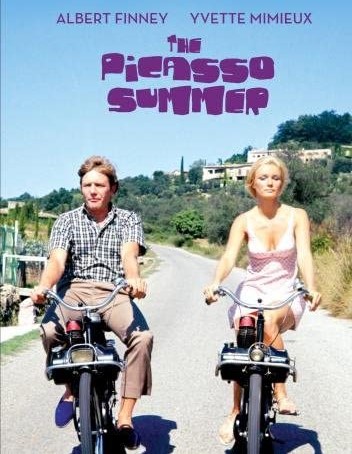
Must-see for collectors of cinematic curios. A treatise on entitlement, bullfighting, Picasso, the impact of celebrity on everyday lives and the hermaphroditic qualities of snails? Or an innovative piece of moviemaking through its use of a jigsaw split-screen, an audacious reimagining of the painter’s work, documentary and animation. Or despite the involvement of top talent like Albert Finney (Tom Jones, 1963), Yvette Mimieux (Dark of the Sun, 1968), composer Michel Legrand (The Thomas Crown Affair, 1968) and writer Ray Bradbury (Fahrenheit 451, 1966), rightly consigned to the vault and never given a cinema release.
George (Albert Finney), a disenchanted San Francisco architect who designs warehouses, and wife Alice (Yvette Mimieux) take a holiday in France to rekindle his love of Picasso and set out to find and – in in a severe case of early onset entitlement – talk to the legendary painter. So they fly to Paris, take the train to Cannes and cycle around. Romance, it has to be said, in that idyllic countryside is the last thing on his mind, although George does pluck a guitar and sing a love song on a riverbank and they do dally in the sea. And he is far from a stuffed shirt, in one scene stealing a boy’s balloon to prevent the kid hogging a telescope.
Not even Barbra Streisand singing the title track provided the movie with any momentum.
There are barely ten lines of meaningful dialog, though Alice’s frustration at her husband’s obsession is soon obvious. The best sequences are the reimagining of Picasso paintings as animation. Picasso broke down the world, so we are told, and represented it as his own so by this token it seems pretty fair to do the same to the artist’s work. In the best scene George turns toreador (not sure the budget ran to stuntmen) facing up to a real bull. But there is plenty Picasso to make up, including a candlelit walk along the “Dream Tunnel” displaying the artist’s War and Peace murals, a lecture on the painter’s ceramics and his self-identification with death in the bull ring.
And there is a twist at the end, as the couple on a beach do not loiter long enough to see a man resembling the famed artist make Picasso-like drawings on the sand. But mostly it’s a story about American entitlement, that a painter should not shut himself off from the world in order to prevent the world stopping him getting on with painting. When George, denied entrance or even acknowledgement of his bell-ringing, stands at the gate to the Picasso villa, it is almost as he is the one imprisoned by his need for celebrity. Half a century on, the need for ordinary lives to be validated by contact with celebrities has become an insane part of life. The fact that the impossible mission ends in defeat (“everything is still the same”) lends a tone of irony.
Work out in your own mind what resemblence the guy who appears briefly at the end bears to Picasso.
Finney’s box office status at this point in his career allowed him to retain his thick Lancashire accent – Sean Connery managed that trick for his entire career. As in Two for the Road (1967) he does a trademark Bogart impression and eats with his mouth open. And he is game enough to stand in a bull ring with a raging bull. Yvette Mimieux is scandalously underused, insights into her thoughts conveyed by lonely walks through night-time streets, although she is the only one to fully appreciate art when she comes across a blind painter (Peter Madden). The best part goes to Luis Miguel Dominguin playing himself, a bullfighter and renowned friend of Picasso. In the incongruity stakes little can match Graham Stark (The Plank, 1967) as a French postman.
As you might have guessed this had a somewhat complicated production. Three directors were involved: Robert Sallin, Serge Bourguignon and Wes Herchendsohn. It was the only directorial chore for Sallin, better known as the producer of Star Trek II: The Wrath of Khan (1982). It brought a temporary halt to the career of Oscar-nominated director Bourguignon (Sundays and Cybele, 1962) whose previous film was Two Weeks in September starring Brigitte Bardot. Herchendsohn was primarily an animation layout artist/supervisor credited with episodes of Star Trek: The Animated Series (1973-1974).
There is some stunning cinematography from Vilmos Zsigmond (Deliverance, 1972) and a superb score by Michel Legrand. This was the beginning and end of the movie career of Edwin Boyd who shared screenwriting credit with Bradbury. And it was the beginning and the end of the movie as a viable film for general release, Warner Brothers promptly shelved it.
In the hands of a French or Spanish arthouse moviemaker, with a tale of protagonists going nowhere, this might have gained more critical traction. It’s hardly going to fall into the highly-commended category, but in fact from the present-day perspective says a lot about celebrity obsession and entitlement. Despite the oddities – perhaps because of them – I was never bored.
United Artists had reinvented the sequel business, shifting it away from the low-burn low-budget Tarzan adventure or Gene Autry western or any inexpensive picture movie capable of maintaining a series character, to bigger-budgeted numbers like James Bond (four sequels so far), The Magnificent Seven (two), The Beatles (four) and The Pink Panther (two). Even Hawaii (1966) spawned The Hawaiians (1970). So when the company hit commercial and critical gold – five Oscars including Best Picture and Best Actor – with In the Heat of the Night (1967) it seemed too good an opportunity to miss not to try for a repeat.
You might have expected UA to continue with the pairing of Sidney Poitier and Oscar-winner Rod Steiger and locate a sequel again in the Deep South. Instead, Steiger was junked and the Poitier character Virgil Tibbs relocated from his Philadelphia hometown to the more snazzy environs of San Francisco, recently popularized by such items as Bullitt (1968).
But minus the racism element what you’re left with is pretty much a standard detective tale with domestic issues thrown in. Tibbs isn’t the kind of cop we’ve come to expect, sinking into alcoholic oblivion or having thrown away a marriage. Instead, and this would strike a contemporary chord, he’s struggling with fatherhood. His son comes off best in arguments and at one point Tibbs resorts to giving the child a few slaps. That looks initially as if emotions will quickly heal and the repentant dad quickly administers a comforting hug, but any bonding is blown apart when the resentful boy complains, as if this represents betrayal, that his father made him cry.
Tibbs is also the old-fashioned kind of male who believes the only way to teach his son not to fall into bad ways like smoking and drinking is to force him to puff on a big cigar and knock back a stiff one until the child throws up.
But Tibbs does do a diligent enough job of detection, evidence relating to the murder of a high-priced sex worker hinging upon whether the killer had long fingernails. The most obvious suspect is street preacher Rev Logan Sharpe (Martin Landau), who visited the prostitute in his capacity as spiritual adviser and who’s heading up a campaign to clean up the streets. But his alibi holds up.
Next in line is building owner Woody Garfield (Ed Asner), exposed, to the shame of wife Marge (Norma Crane) as being a client of the prostitute, and then a janitor of low intelligence called Mealie (Juano Hernandez) and pimp Weedon (Anthony Zerbe), the kind of hood who enjoys taunting cops.
While Tibbs doesn’t indulge in the blatant maverick approach to the job of the earlier Madigan (1968) or the later Dirty Harry (1971) he’s not above putting the squeeze on witnesses.
Rather foolishly, but perhaps feeling this has now become de rigeur, there’s a car chase which hardly compares to Bullitt. In fact, we’re stuck in an automobile rather too often but these only result in desultory conversations between Tibbs and his sidekick. While in some respects it’s refreshing that Tibbs isn’t subject to any racism, and the picture doesn’t head down the blaxploitation route, the result lacks edge.
Tibbs’ reactions to his child bring him down sharply from the ivory tower of sainthood from the previous picture, and the family stuff, while building up his character, doesn’t make up for what the story lacks.
Gordon Douglas, who had previously excelled in this genre via Tony Rome (1967), The Detective (1968) and Lady in Cement (1968), found out the hard way that Frank Sinatra was more appealing as an investigator and cop than Sidney Poitier and, without steaminess or wise-cracking to fall back on, the sequel quietly runs out of steam.
Screenplay by Alan Trustman (The Thomas Crown Affair, 1968) and James Webb (Alfred the Great, 1969) from the bestseller by John Ball. Not a patch on the original
Sumerian demons, Siamese twins separated at birth, a serial killer, oceans of fog, the flower of the mandrake, a climax that revolves around “it’s in his kiss” and a picture so shorn of light it could easily have been titled Dark Fiancé or Dark Wedding. Thematically truncated, too, and you get the feeling that with a little bit more narrative expertise and budget this could have been spun out into something that fitted in with the decade’s later spurt of horror a la Rosemary’s Baby (1968). There’s the bonus of Leslie Nielsen (Airplane, 1980) in a straight part though one which allows him a fair quota of quips.
In San Francisco 1890, occult expert and straight-down-the-line man-about-town toff Brett Kingsford (Leslie Nielsen) is surreptitiously engaged by the cops to investigate a series of brutal murders. Beside each corpse, the killer has left a memento, a tiny statuette that is traced back to Sumerian times, a demon – similar to the larger kind that turn up at the archaeological dig at the start of The Exorcist (1973) – banished from Earth and which attempts to return by entering another person’s body though presumably none of the four victims coming up to scratch.
Among the dead is Hannah, who had been involved in an archaeological expedition and later adopted a mysterious child. She has a connection to Brett’s friend, antiques dealer Robert Vandenburg (Mark Richman) who is engaged to be married to Evelyn Lang (Judi Meredith), another friend of Brett. Though Brett consults Chinese expert Chi Zang (Peter Brocco) and is attacked by the titular intruder who leaves him with claw marks on his shoulder, the bulk of the detection falls to Robert, who exhibits odd behaviour, standing in a daze, sleepwalking, going off in the wrong direction, suffering from blurred vision, and with a strange scar on his spine. He encounters the mysterious Professor Moloki (Werner Klemperer), face concealed, who tells him all will be revealed on the eve of his wedding.
The killings don’t stop, Brett no closer to catching the killer, and no further evidence forthcoming and the tale falls on the shoulders of Robert who is convinced from his own odd behavior that he is the killer. Eventually, he starts to work out the strange elements of his own life and the “invisible force” he is constantly fighting.
Turns out he was the Siamese twin separated at birth, and that Hannah had brought up the other, deformed, twin, who now wants his twin’s life – and wife. All we see of the creature is the claw, the rest of him hidden under a cloak or shuffling along behind curtains. The pair grapple in the darkness and it appears the bad twin is slain.
But is he? It’s Evelyn who gives him away, revolted by his kiss, and the matter is resolved. So really no more than the assembly of an interesting horror story. The claw is well done but as I said most of the detection comes from the mind of Robert rather than the occult detective working up the clues. But the dapper Brett is good value, keeping chatterbox Evelyn in check, and putting on his best Basil Rathbone impersonation.
As a bonus it’s insanely short, barely an hour long, which would have put it squarely in the B-feature category – but of two decades before, not of the mid-1960s. Turns out this was a pilot for a television horror series that wasn’t picked up by any of the three U.S. networks so was extended enough to be feature-length. The actors try desperately to add characterisation to their thin parts, Leslie Nielsen (Beau Geste, 1966) and Judi Meredith (Queen of Blood, 1966) best at that.
Harvey Hart (Bus Riley’s Back in Town, 1965) directed from a script by Barre Lyndon. The movie was released by Universal, who had Nielsen on an exclusive seven-year contract.
The sum of its parts without much else, but intriguing tale calling out to be extended – or remade.
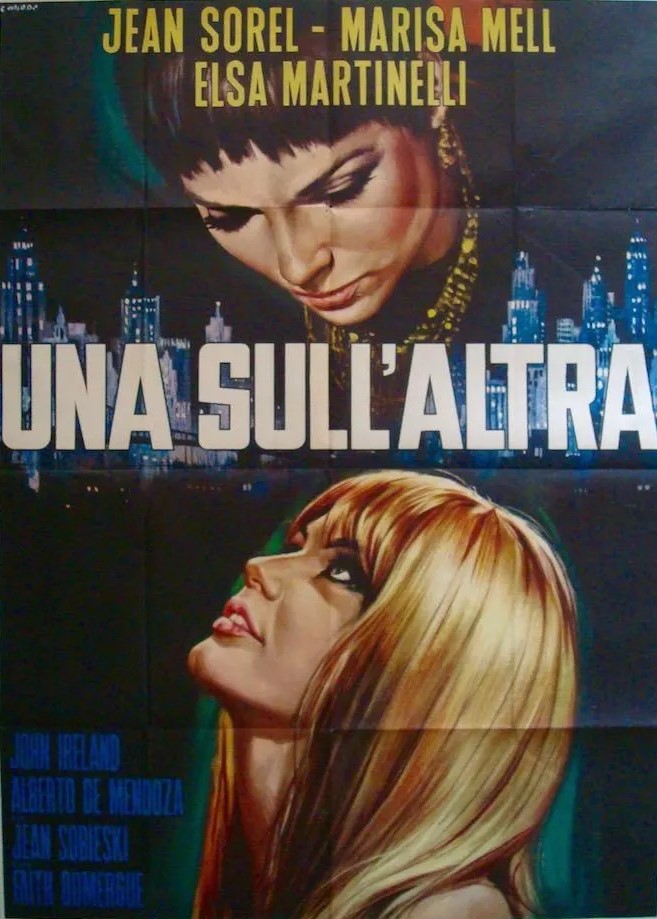
No idea how they thought they’d market this one. Neither of these titles would recommend it to first run, more likely sending it down the exploitation route. Which would be a pity because, although there is enough nudity and sex to satisfy those patrons, it is, almost to the very end, clever noir, femme fatales to the fore, and the kind of male patsy who would later decorate the likes of Body Heat (1981). And if it played out as all instinct – except that of a happy ending – told you, it would have been an absolute cracker. As it is, it’s more Hitchcock than giallo, director Lucio Fulci’s, known at that time for comedies, first dabble in crime, and with excellent cinematography and plot twists.
As it is, said sucker has a hell of a time, turned inside, beset by paranoia and trickery until he’s all set for the electric chair and it boasts a classy cast. It’s set in San Francisco, though I found those hilly streets a distraction as any minute I expected to see Bullitt racing over the top or Sean Connery demolishing a streetcar before heading to The Rock.
Asthmatic sickly wife Susan of top surgeon George (Jean Sorel) dies from accidental overdose in the first few minutes. The good doctor isn’t so upset, he’s having an affair with fashion photographer Jane (Elsa Martinelli) and is astonished to discover he’s about to inherit a couple of million from her insurance. That’ll come in handy because his business is going down the tubes.
But an anonymous tip sends him into a topless bar where the star performer and sometime sex worker Monica (Marisa Mell) bears a startling resemblance to his wife, blonde where she was brunette, brown eyes rather than green, but otherwise almost a dead ringer. But he’s seen his wife’s stone-cold corpse so he gets the doppelganger heebie-jeebies. Still, it’s not long before he’s testing out his theory and in the most intimate fashion.
But there’s an insurance agent on his tail, taking note of the philandering, and his concerns force the cops to re-open the case and discover Susan was poisoned and with George the obvious beneficiary that makes him the obvious suspect. Meanwhile, Jane’s trying to find out what’s Monica’s game, to the extent of giving her a fashion gig that goes a few steps beyond the Blow-Up playbook.
Top cop (John Ireland) isn’t slow to put two and two together and reckon Monica and George are in it together and bumped off Susan. He finds evidence of Monica perfecting Susan’s signature. But while Monica skedaddles, George is on the hook and eliminating all that annoying courtroom guilty/not guilty objection sustained palaver, the movie cuts to the chase and the surgeon is lined up for an appointment with the chair, knowing full well he’s innocent.
In a terrific twist I didn’t see coming turns out his brother Henry (Alberto de Mendoza), partner in the business, has been having an affair for years with Susan who – yep – is Monica after all, and takes delight in telling George what a sucker he’s been. Henry will inherit the dosh and take up where he left off with Monica/Susan. George hasn’t exactly elicited audience sympathy, although he’s occasionally staring moodily in the camera as his brain can’t compute what’s going on, and he’s a two-timing swine – no, make that three-timing – no, two-timing if Monica actually is his wife. Anyway, he doesn’t cover himself in glory whereas Monica is a class act, not just sexy as all-get-out but playing him beautifully, so you kind of want her to get away with it especially as you didn’t see the brother angle coming, and you just marvel at how cleverly George has been duped.
George is saved and the picture unaccountably suffers at the last minute when out of the blue a jealous client Benjamin (Riccardo Cucciolla) turns on the getting-away-with-it pair and blasts them to high heaven.
George is an unusual character, dominated by both women. When we first encounter Jane she’s on the point of dumping him, after a bout of sex first of course, and he’s the one who chases after her. But Susan clearly enjoys stringing George along, taking control in their lovemaking in a manner she clearly didn’t when being Susan, as if her new-found has freed her from her inhibitions.
My guess is this was heavily cut for U.S. and U.K. release and also that the moviegoers coming along expecting sexploitation might have been somewhat surprised to find themselves watching a Hitchcockian homage, but with the bad girl as the heroine.
A few plot flaws don’t hole this beneath the waterline. Great acting all round, Marisa Mell (Danger: Diabolik, 1968) the pick, but Elsa Martinelli (Hatari!, 1962) every bit as calculating and seductive. You feel sorry for Jean Sorel (Belle de Jour, 1967) caught between the two.
Lucio Fulci (A Lizard in a Woman’s Skin, 1971) makes the most of the locations and ensures the women, rather than the man, take center stage.
Take away the exploitation elements and you’ve still got a great thriller that turns on its head all expectations.
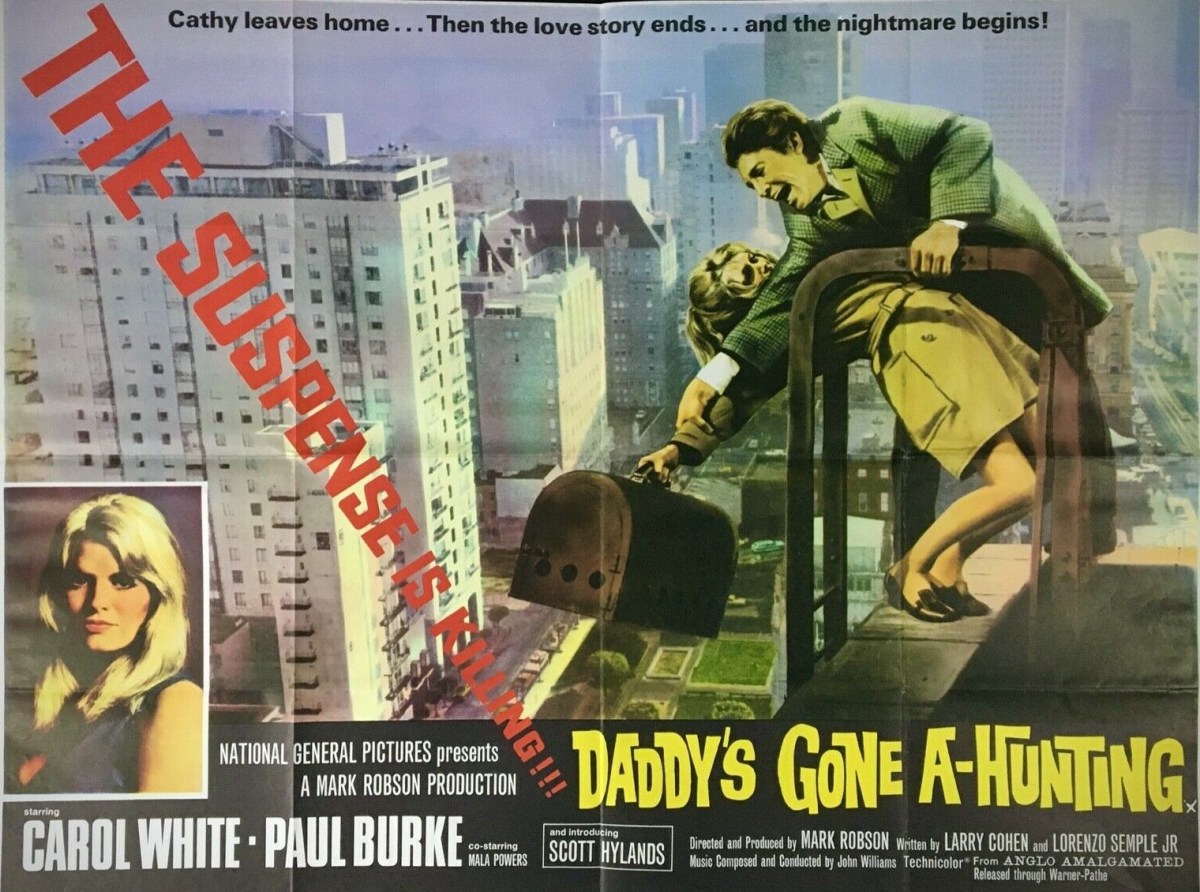
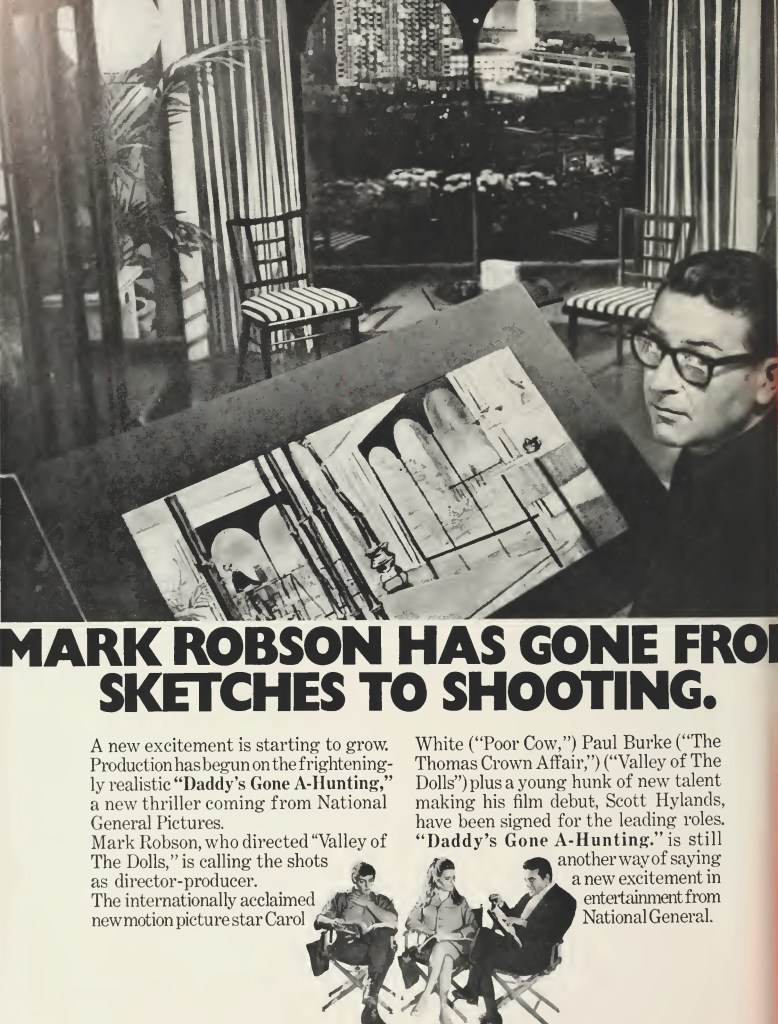
Everyone wants to be a star-maker. Director Mark Robson thought he had some form in this area after Valley of the Dolls (1968) showcased Barbara Parkins and Sharon Tate. There’s no doubt British actress Carol White reveling in critical kudos for Poor Cow (1967) had promise. But not necessarily good professional advice otherwise how to account for a supporting role in Prehistoric Women/Slave Girls (1967) her first picture after success in three BBC television productions. The female lead in Michael Winner’s I’ll Never Forget Whatisname (1967) was followed by a small role in the more prestigious John Frankenheimer drama The Fixer (1968). But none of these films did anything at the box office. Enter Mark Robson.
This thriller might have made her a star had it not been so darned complicated. It veers from paranoia to stalkersville to Vertigo via Gaslight without stopping for breath and some elements are so obviously signposted at the start you are just waiting for them to turn up. Plus, if ever a film has dated, it’s this one, going back to the days when abortion carried automatic stigma and fathers could get away with lines like “you murdered my baby.”
So, one of the few times in history San Francisco got snow (it averages zero inches annually according to Google) the meet-cute is sketch artist Cathy (Carol White) being hit by a snowball thrown by wannabe Kenneth (Scott Hylands, making his debut). But when she realizes how much he enjoys watching cats stalking canaries decides she doesn’t want his baby and aborts it.
A few years later she marries congressional candidate Jack (Paul Burke from Valley of the Dolls) and when pregnant crosses paths with Kenneth who manages to insinuate himself into her family via her husband. Twist follows twist until we are on the Top of the Mark (a famous city landmark) for a gripping climax.
White does well as she shifts through the emotional gears but she is barely given respite from being overwrought so at times her acting appears one-dimensional rather than varied. In fairness to her, the movie’s plot gives her no chance to deliver a settled performance. Hyland looks as if he’s auditioning for a role as a serial killer, but the depth of his cunning and his twisted perceptions kept this viewer on edge – what it would take for Cathy to make amends will chill you to the bone.
Robson has some nice directorial touches, a scene reflected in the eye of a cat, a clever jump-cut from marriage proposal to marriage ceremony and some flies in milk. Mala Powers makes a welcome big screen appearance after nearly a decade in television. That this whole concoction emanated from the fertile imaginations of screenwriters Larry Cohen (It’s Alive, 1974) and Lorenzo Semple Jr. (Fathom, 1967) might give you an idea of what to expect.
Cult films don’t come any bigger than The Wicker Man (1973). Regarded as a box office flop in Britain at the time of initial release, it struggled to gain any traction in the U.S., only managing a truncated release there towards the end of the decade. However, closer examination of the box office reveals a different story and suggests both that distributor British Lion was rather harsh in declaring it a box office disaster and that more careful handling on the delayed U.S. release could have produced better results.
In the U.K., it was denied a stand-alone release and went out as the second feature to the critically acclaimed and commercially successful Don’t Look Now (1973) directed with some style by Nicolas Roeg and starring Donald Sutherland and Julie Christie, and which has, assuredly, stood the test of time. Several weeks after Don’t Look Now launched as a solo feature on October 1973 at the prestigious Odeon Leicester Square in London’s West End it shifted in December to the less prestigious Metropole where it was coupled with The Wicker Man.
It’s my considered opinion that the reason the double bill managed such a long run – around five months – in the West End, moving between various cinemas, was, in substantial part, due to The Wicker Man. It had been released with virtually no fanfare and relied on word-of-mouth to attract an audience and I think it was the beginnings of that cult recognition that resulted in the double bill playing as long.
Given Don’t Look Now was a verified box office hit as a solo feature, it made little sense to couple it with an unfavored second feature since at this point the double bill was losing ground at cinemas. A single bill meant more performances, especially on the vital weekends, and therefore the potential for greater box office.
One of the elements that backed the notion that The Wicker Man was more important to the double bill than the distributors cared to acknowledge was that the fall-off week-by-week was minimal. The double bill played on in London’s West End long after it had completed a circuit run on the Odeon chain, suggesting that its attraction was perhaps due to the unexpected pulling power of The Wicker Man.
In its accounts, British Lion wrote off a $470,000 loss against The Wicker Man. But that seems like an accounting trick. The distributor had a choice in how it allocated the box office. A supporting feature could expect to receive little more than a flat fee as its share of the box office if it was deemed a B-feature. A genuine double bill – and bear in mind that horror maestro Christopher Lee was a box office attraction in Britain – would split the proceeds. That British Lion opted to treat it as a second feature, allowing it to maneuver the box office against the picture. Otherwise, given its low budget, it would certainly have turned a profit. The loss seems even more baffling when you take into account that it was sold to 17 countries.
In any case, since nobody else has tracked The Wicker Man’s actual performance in the UK and the U.S., I thought it might be interesting to do so.
UK (LONDON WEST END) BOX OFFICE 1973-1974
Don’t Look Now/The Wicker Man
Metropole (1,394 seats)
December 19 1973: – $5,300 (Variety deemed this “anaemic”)
December 26 1973: – $4,700
January 2 1974: – $4,900
January 9 1974: – $13,200
January 16 1974: – $9,700 (“very good”)
January 23 1974: – $8,700 (“fine”)
January 30 1974: – $7,700
Odeon Kensington (1,883 seats)
January 16 1974: – $16,800 (“boff”)
January 23 1974: – $13,700 (“robust”)
January 30 1974: – $10,900 (“fancy”)
February 6 1974: – $10,800
February 13 1974: – $9,300 (“stylish”)
February 20 1974: – $6,100
Odeon Haymarket (600 seats)
February 20 1974: – $6,000
February 27 1974: – $8,300
March 6 1974: – $7,700
March 13 1974: – $6,800
March 20 1974: – $7,400
March 27 1974: – $7,100
April 3 1974: – $6,900
April 10, 1974: – $5,700
Cincenta 3 (150 seats)
April 24 1974: – $2,600 (“nice”)
Cinecenta 2 (150 seats)
May 1 1974: – $2,700
It was pretty much unheard of in London’s West for a programme to move around five cinemas, and, with the exception of Cinecenta, running for so long at each venue with a low drop-off week-by-week (steeper falls would have seen runs more speedily terminated). And when it came to the U.S. release, half a decade later, as you can see, much to everyone’s surprise, The Wicker Man on its own delivered both some notable opening figures and lengthy runs.
US BOX OFFICE 1977-1981
The Wicker Man only
Although being rated “R” by the U.S. censor in April 1974 and being reviewed by Variety in May 15 1974, The Wicker Man failed to gain any release in the U.S. even though one-time partner Don’t Look Now was widely distributed. The Wicker Man received a promotional fillip after winning top prize at the Fantastic Festival in 1974 but it wasn’t enough to boost its Stateside distribution prospects. Both National General and New World had considered taking it on but ultimately passed. It ended up at Warner Brothers which stuck it in the vault after a disastrous test at drive-ins in Atlanta and San Diego.
Box Office magazine gave it a favourable review in 1978, calling it a “lost horror classic” and noting that director Robin Hardy had made “an impressive debut.” The version its reviewer saw was cut from the original 102 minutes to 87 minutes. But the version seen by The Hollywood Reporter in 1979 was the restored version and its reviewer reckoned that the “dark intagibles” of its mangled release made it ideal fodder for a “cult audience.” By now PR had kicked in and it received the accolade of a front-page story in The Hollywood Reporter, calling it “reborn” and making play of the problems encountered along the way.
But apart from the Minneapolis misadventure in 1977, it wasn’t until 1979 that it made any release headway. Most of the bookings were in arthouse cinemas. But what is noticeable is length of runs and comparatively small week-by-week drop-offs.
Minneapolis: World (461 seats)
October 5 1977: – $2,000 (“poor”)
San Francisco: Lumiere (300 seats)
January 24, 1979: – $19,000 “boffo”
January 31, 1979: – $15,500
February 7 1979: – $13,000
February 14 1979: – $11,000
February 21 1979: – $10,600
February 28 1979: – $7,000
March 7 1979: – $5,700
March 14 1979: – Not known
March 21 1979: – $5,900
Los Angeles: Los Feliz Westland 1 (763 seats)
March 21 1979: – $19,500
March 28 1979: – $13,500
April 4 1979: – $11,000 (“not bad”)
April 11 1979: – $9,500 (“tidy”)
April 18 1979: – $4,000
April 25 1979: – $4,000
May 2 1979: – $3,100
Los Angeles: showcase release in four other theaters
March 21 1979: – $26,000
March 28 1979: – $18,000 (“pretty”)
Seattle: Crest (700 seats)
April 4 1979: – $7,100
April 11 1979: – $6,700
April 18 1979: – $6,300
April 25 1979: – $4,700
May 2 1979: – $3,300
New York: Paramount (533 seats)
April 2 1980: – $21,000
April 9 1980: – $9,000 (transit strike ruined second and subsequent weeks)
April 16 1980: – $4,400
April 23 1980: – $4,000
Boston: Orson Welles II ( 200 seats)
April 23 1980: – $15,000 (“house record”)
April 30 1980: – $14,000 (“lusty”)
May 7 1980: – $8,800
May 14 1980: – $8,700
May 21 1980: – $7,600
May 28 1980: – $6,200
June 4 1980: – $4,200
June 11 1980: – $5,200
June 18 1980: – $3,200
June 25 1980: – $3,300
Washington: Cerberus II (150 seats)
December 3 1980: – $7,500
December 10 1980: – $5,500
Kansas City: Fine Arts (560 seats)
January 21 1981:– $3,200
Kansas City: Watts Mill (250 seats)
February 11 198l: – $2,500
Miami: showcase release in four cinemas
April 1 1981: – $3,700 (“remote”)
Cleveland:
April 1981: shown as part of the Cleveland International Film Festival
Pittsburgh: Arcade (775 seats)
May 20 1981: – $5,000 (“stout”)
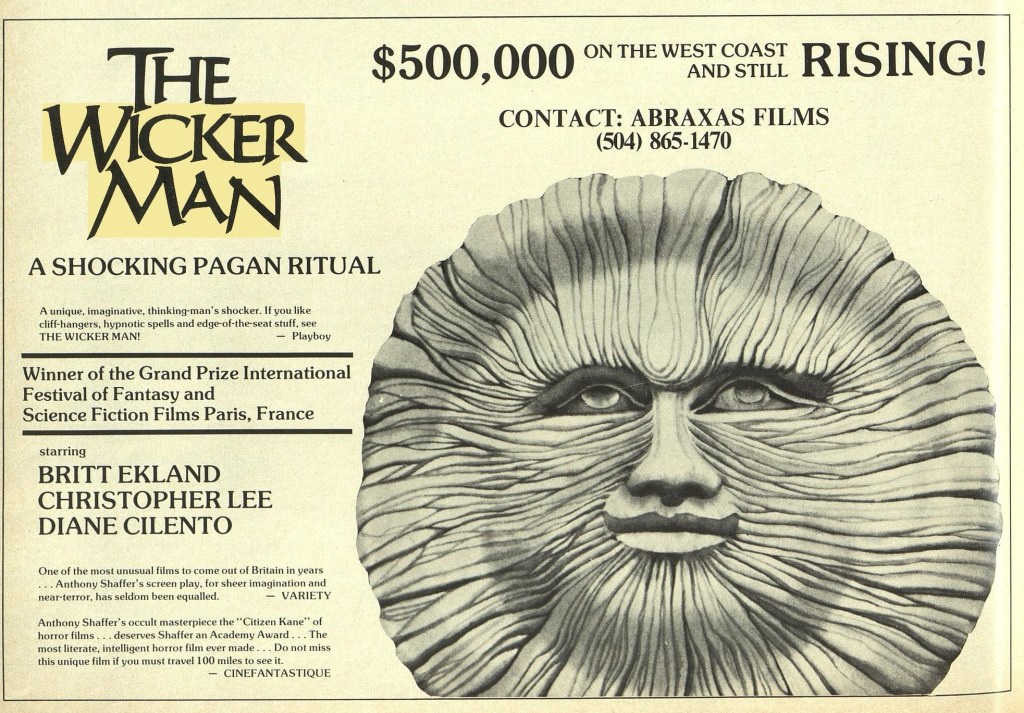
According to an advert in Box Office magazine placed by distributor Abraxas in October 1979, The Wicker Man had already grossed $500,000 on the U.S. west coast. counting it the 1980 and 1981 releases, more than likley it passed the $1 million gross. Whether any of these receipts found their way to British Lion is questionable, so the U.S. box office would have done little to remove the idea it was a flop, but, in fact, counting all the results together, it must have done enough overall to turn a healthy profit.
I should point out that the dates above refer simply to the dates when the box office was reported in “Variety” magazine and not to the actual date when the film was shown. Typically, “Variety” would report box office in the week after a film was shown but this could still be up to 14-17 days after. The actual week 1 / week 2 / week 3 stuff is completley accurate even if the dates might appear misleading.
NOTE/PLEA/WHATEVER: Collecting these figures took a huge amount of work so if you want to pass on this information to others, please acknowledge the source.
SOURCES: Variety, dates as shown; “Coming Releases,” Box Office, September 30, 1974, pA6; Review, Box Office, January 9, 1978, pA9; “Wicker Man Reborn Thanks to Persistent Young Distribs,” The Hollywood Reporter, February 15, 1979, p3; Review, The Hollywood Reporter, February 20, 1979, p3; Advert, Box Office, October 1979, 1979, p16; “Wicker Man Gets Proper Release After 6 Years,” The Hollywood Reporter, April 3, 1980, p1; “Strike Dents N.Y. Box Office,” Box Office, April 14, 1980, p7.
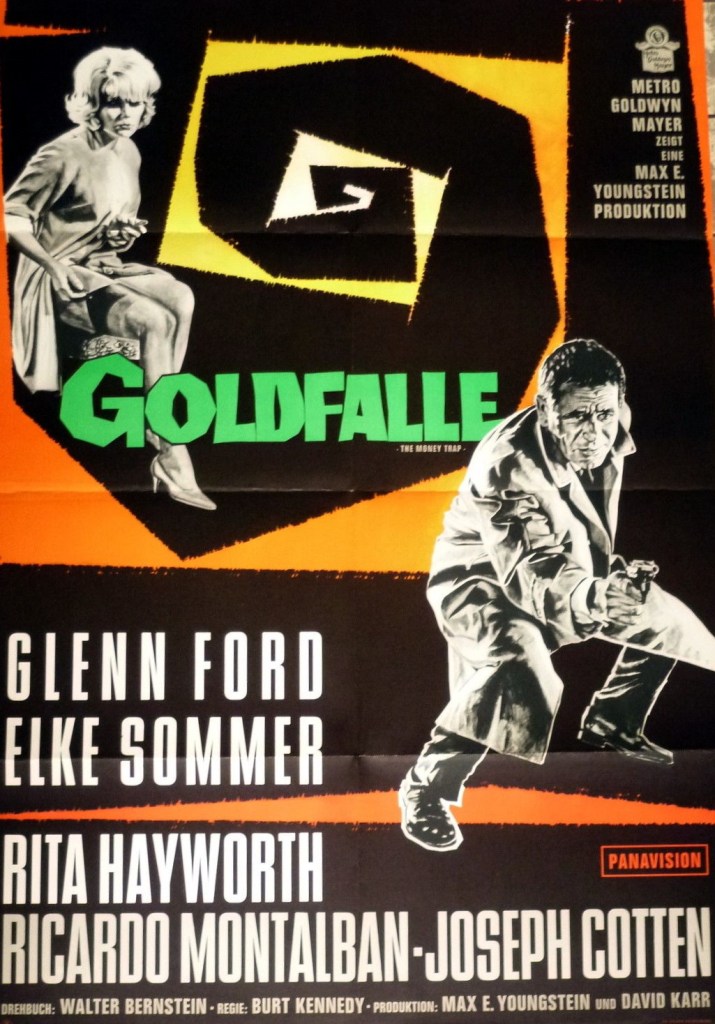
Film noir morality play. Highly under-rated, especially unfair since all four principals put in excellent performances, plus a nifty screenplay, and generally erratic director Burt Kennedy on very solid cinematic ground, even if he has a predilection for showing legs, and not just of the female variety.
Film noir is at its best when the plot is simple, usually good guy inveigled into taking a wrong turn through avarice, revenge or a femme fatale. This takes an unusual route. Idealistic cop Joe (Glenn Ford) worries beautiful wealthy spendthrift wife Lisa (Elke Sommer) will abandon him for a richer guy since her allowance has dried up.
Assuming she is already making her play, Joe has a one-night stand with old flame Rosalie (Rita Hayworth), a lush married to a murdered burglar. His partner Pete (Ricardo Montalban), envious of his buddy’s wealth, blackmails him into robbing the safe of Mafia doctor Van Tilden (Joseph Cotten) who, in self-defence, killed the burglar. Meanwhile, as contrast, the pair are investigating the murder of a sex worker trying to earn extra money to shore up her husband’s miserable income.
While it’s got all the requisite of film noir, atmospheric use of light given it’s shot in black-and-white, that unusual footage of legs, and feet, especially when Rosalie is followed by Tilden’s thug Matthews (Tom Reese), cunning villain, the unexpected twist, neither of the femmes it transpires is much of a fatale, greater backbone than you might expect.
But mostly, it focuses on decision and consequence. Will Joe accept he could lose his wife, will Lisa make the jump into a lower standard of living in order to hold onto her husband, or will Joe distrust that his wife can change and find a way to bring the loot he thinks will keep her satisfied? Lack of trust all round proves their undoing.
There’s the usual, silent, heist, though quite where Joe and Pete acquired their safecracking skills is never discussed. It is the perfect robbery, a dodgy doctor unlikely to call in the cops, especially as they might get suspicious as to just why he is such a common burglary target. Except it’s not. For what’s in the safe is too hot for any cop and Van Tilden, more streetwise than the police, is always one step ahead. Instead of it being the greedy Lisa who could ruin their otherwise stable and loving marriage, it’s Joe.
There are a handful of clever twists, not least that Joe’s dalliance with Rosalie signs her death warrant, but I won’t give those away. It’s too tightly told to spoil it. That’s part of the beauty here, it’s a neat 90 minutes, short and to the point, temptation and consequence.
If ever there was an actor under-rated during this decade it’s Glenn Ford (Rage, 1966). He was hardly ever cast in a big-budget picture except as part of an “all-star cast”, and mostly, given the extravagances elsewhere, in A-pictures whose budgets in reality turned them into B-pictures, and he ended the decade in a rut of westerns, all as under-rated as him. But he brought a tremendous intensity to every role, equally believable as romantic hero and potential heel, and in action, as here, he moves with lethal speed. He had a unusual gift as an actor – you always knew he was thinking. And was very likely to be saying one thing and thinking or meaning another.
Here he acts his socks off. You wonder just what has he got to live in such a fancy house with a rich gorgeous damsel and it doesn’t take long to find out his attraction to him, that right stuff that would rarely come an heiress’s way, more likely to trundle her way through endless marriages and affairs seeking a stability that wealth does not bring.
Elke Sommer (They Came To Rob Las Vegas, 1968) is a revelation, mostly because the script builds her a proper character, loving wife temporarily distracted by potential loss of wealth, but knowing enough about her husband to recognise she’s be better off with him than without him.
Rita Hayworth (The Happy Thieves, 1961) makes the most of her last meaningful role, not lit to shimmering glory by a black-and-white camera, but while shown at her blowsy physical worst redeemed by mental strength. Ricardo Montalban (Cheyenne Autumn, 1964) , usually relegated to a supporting role, provides not only the narrative impetus, but his character twists and turns throughout. Joseph Cotten (Petulia, 1968) has cold blood running through his veins.
This is early-promise Burt Kennedy (Dirty Dingus Magee, 1970) and with a tight script by Walter Bernstein (Fail Safe, 1964) delivers a surprisingly effective very late period film noir.
Terrific acting, by twisty plot held in check by realistic consequence.
Should have been, as you might have guessed, Cary Grant (Charade, 1963) in the lead. Should have featured, which you won’t have guessed, Ursula Andress (She, 1965). Should have run, which you’d be amazed to learn, for 145 minutes, almost as long as your standard epic. Should have appeared, like Hatari! (1962), under the Paramount banner.
In fact, the most likely studio destination was Columbia. Hawks’s agent Charles Feldman had spent 16 months trying to thrash out a very good deal for his client. Feldman, who owned the rights to Casino Royale, was also keen on Hawks directing a James Bond picture. That got as far as discussing Cary Grant as the handsome spy and Hawks’ enlisting the aid of his favorite screenwriter Leigh Brackett (Hatari!).
But instead of moving studios, Hawks decided to stay put, sitting on a three-picture deal worth a hefty $200,000 plus a 50 per cent profit share. First item on the new agenda could have been reuniting Rio Bravo (1959) alumni John Wayne and Dean Martin for The Yukon Trail. But that was before Hawks expressed interest in a romantic short story, The Girl Who Almost Got Away, published in Cosmopolitan magazine, and an ideal fit for Cary Grant.
But Grant, something of the entrepreneur himself, would only sign up if Hawks in turn agreed to direct one of the actor’s pet projects, The Great Sebastian. But the director didn’t like the idea of being a gun for hire and Grant’s attention meanwhile had wandered in the direction of Charade. Rock Hudson, borrowed from Universal, was seen as an ideal replacement. For the female lead Hawks initially enthused about Joanna Moore (Walk on the Wild Side, 1962) until he chanced upon Paula Prentiss (Where the Boys Are, 1960), an MGM contract player.
Paramount balked at a relative unknown. Hawks balked at anyone balking at his choice and switched the project to Universal. While toying with Casino Royale, Hawks had a sneak preview of Dr No (1962) and espied a natural for the second female lead in Ursula Andress. But her management team reckoned the Bond movie would open bigger doors. Instead, Hawks plumped for Austrian blonde Maria Perschy (The Password Is Courage, 1962). Charlene Holt (If A Man Answers, 1962) made such an impression on Hawks that she not only won the part of Rock Hudson’s fiancée but the role of regular girlfriend to the director and parts in his next two pictures.
Leigh Brackett was brought in to pep up the original script by John Fenton Murray (It’s Only Money, 1962) and Steve McNeil (Red Line 7000, 1965). Unusually, she was rewriting on the hoof, earning $1,000 a week to refashion the lines scene by scene as production unfolded. Everything except the opening scene set in San Francisco was shot on the Universal backlot. Even then, neither Hudson nor Prentiss was transported to San Francisco, their close-ups while driving cars filmed at the studio and inserted as process shots. Hawks didn’t leave the studio either, entrusting that initial footage to associate producer Paul Helmick and cinematographer Russell Harlan.
Like Otto Preminger, Hawks liked a lot of takes. Paula Prentiss didn’t, in part because she felt he was trying to mold her into a screwball comedy heroine of the past, and in part because every take not printed impinged on her confidence. Although Hawks lacked the reputation as a bully of the Otto Preminger variety, nonetheless the inexperienced Prentiss found herself in tears more than once. Cary Grant dropped by one time for a friendly chat. He was made welcome. Angie Dickinson, expecting a similar welcome, received a curt put-down, Hawks making it clear he preferred as a brunette.
While the credit sequence by photographer Don Ornitz was deemed sexist since it comprised 33 models in sports or beach gear, it was actually the opposite because the women were proving how superlative they could be at sports generally considered the preserve of men. But there was no doubt the reaction Hawks expected when he spent $20,000 on black scuba outfits for Prentiss and Perschy, using molds made from their bodies to achieve the skin-tight effect. Hawks was notoriously slow, the picture taking three and a half months.
The initial version of the film attracted at a sneak preview the most positive responses the studio had ever received. The only problem was – it ran 145 minutes, considered an impossible length for a light romantic comedy. Although the next version was shorter, the audience response was decidedly worse. Even so, Universal insisted on further cuts until the movie came in at the two-hour-mark.
Not everyone went along with the official Hawks version of events. Others remembered the response to the various cuts not being so different. The film wasn’t released until six months later and there is no evidence that Hawks fought hard to retain his edit. Although he would later complain that the movie was “sabotaged,” that may have been his automatic default position once the movie proved a relative commercial failure, with only $2.35 million in U.S. rentals
Leigh Brackett had more right to feel disgruntled. She was denied a credit by the Writers Guild of America who contended her work was a polish rather than an original contribution.
I have to say I’m out of step with some of the critical opinion. Molly Haskell reckoned the film was actually some kind of Adam and Eve deal with Hudson “a virgin who has written a how-to book on sex while harbouring a deep fastidious horror of it.” The Haskin critique allows that fish are phallic symbols, therefore giving sexual credence to the scene about learning to handle a fish.
It might just be more straightforward to say that, of course, this isn’t as good as Bringing Up Baby but then, nothing ever was, and just enjoy what Hawks did manage to conjure up with very likeable leads.
SOURCES: Todd McCarthy, Howard Hawks, The Grey Fox of Hollywood (Grove Press, 1997), p595-603; Joseph McBride (editor), Focus on Howard Hawks (Englewood Cliffs); Molly Haskell, “Howard Hawks: Masculine Feminine,” Film Comment, March-April 1974.
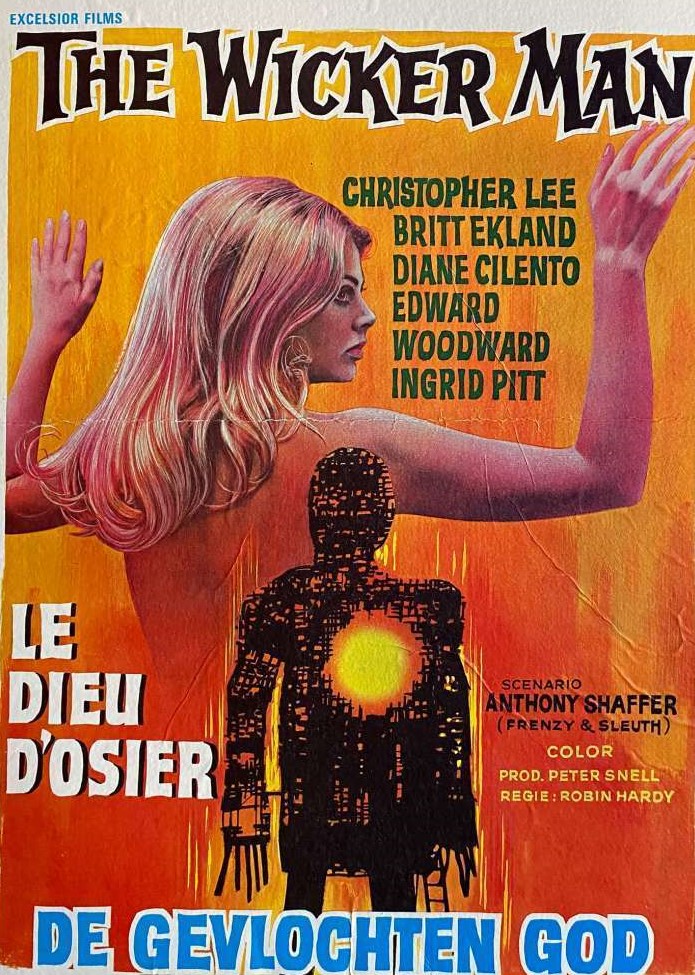
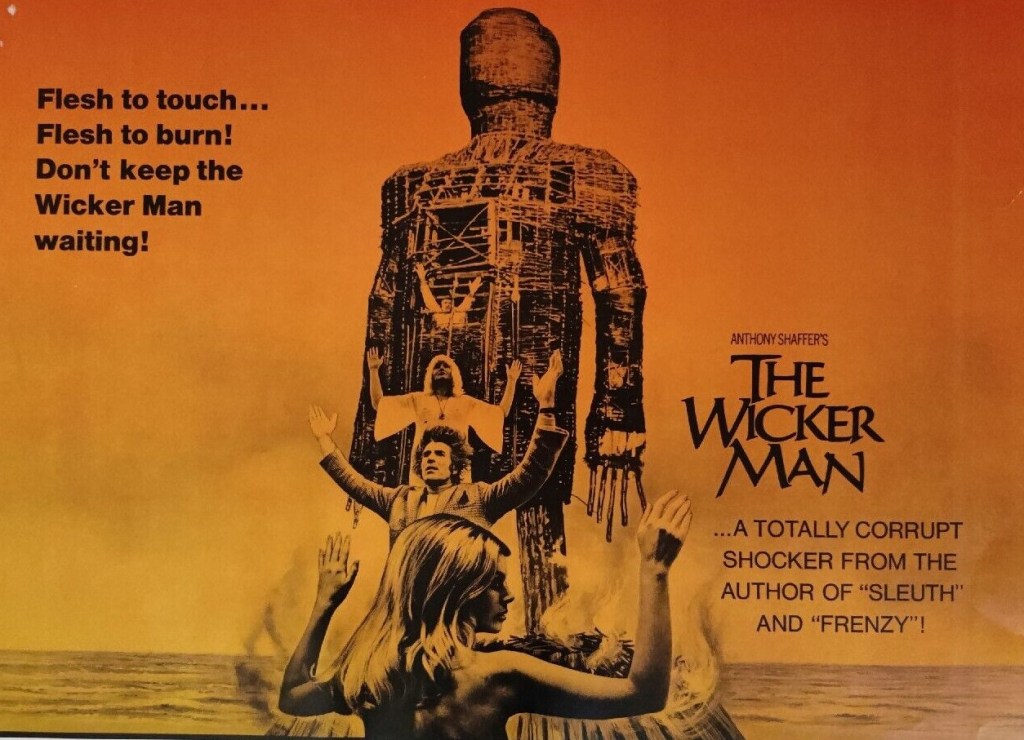
The movie Cinderella story to end all movie Cinderella stories. Quite how The Wicker Man came to earn its cult status given that for more than a decade it was hardly screened is quite a remarkable tale. An occult picture that as authoritative a producer as Michael Deeley (Blade Runner, 1982) deemed one of the ten worst films of all time – and without even the compensation of falling into the “so bad it’s good” category.
Most people who saw it during its original British release did so by default. They had gone to see Nicolas Roeg’s Don’t Look Now (1973) with top stars Donald Sutherland and Julie Christie and tagged onto that box office hit – and critical smash – was this other movie critics had dismissed. That it surfaced at all was because British Lion put it out on the lower part of a double bill in order to legitimately defray its costs by snipping off some of the revenue accrued by Don’t Look Now.
It certainly wasn’t that the Nicolas Roeg picture needed a helping hand on the box office front. Prior to opening, Don’t Look Now had already covered its $1.2 million budget by selling off foreign rights with Paramount taking it for the United States. Despite having the same budget of $1.2 million, The Wicker Man, did not attract the same foreign interest, or indeed any foreign interest. and for the time being was put on the shelve. British Lion had been sold to EMI who put Deeley in charge and his assessment of The Wicker Man‘s worth put paid to any prospect of a high-end launch.
Don’t Look Now opened, minus The Wicker Man, in October 1973 at the London West End’s most prestigious cinema, the Odeon Leicester Square and in phenomenal fashion. An opening week $32,000 (equivalent to $126,000 these days) was bettered by a second week of $44,000 ($174,000 equivalent). A further two weeks brought in $41,000 and $35,000 respectively (or about close on to a total of $600,000 in today’s money).
Advertisement that ran in the “Variety” trade paper on November 16, 1977.
Then it switched, still minus The Wicker Man, virtually next door to the equally prestigious 1,402-seater Leicester Square Theater. An opening salvo of $29,000 dropped just $1,000 in the second week. A six-week run garnered $138,000 ($546,000 equivalent). Four weeks into that run it also opened at the 1,394-seat Metropole, this time as a double bill with The Wicker Man. It wasn’t a genuine double bill. A proper double bill consisted of two films of roughly equal standing that might both have premiered in the West End, top billing given to the movie that had performed best at the box office.
The Wicker Man had been on quite a different trajectory to Don’t Look Now. Despite it being promoted in “a savvy publicity ploy” at the Cannes Film Festival in May 1973 with a 30ft high “wicker man” set on fire on the Croisette, once Michael Deeley took control, replacing Peter Snell, also producer of The Wicker Man, he had no intention of giving a solo launch. By piggybacking on a hit movie, it was guaranteed to bring in some income.
However, initially, it seemed a disastrous idea. The Metropole double bill opened in mid-December 1973 to a miserly $5,300, second week no better, just $4,900.
But then something extraordinary happened. The third week was through the roof, a whopping $13,700. Over seven weeks it snapped up $57,000 (equivalent to $225,000 today). It wasn’t that surprising, however, since in the first two weeks it was still showing at the Leicester Square Theatre, but once the Metropole was the only option, the figures jumped up. Assuming revenue would taper off, in the fifth week of the Metropole run it began playing simultaneously at the 1,883-seat Odeon Kensington – probably to coincide with the general release – where the first week raked in $16,800. It continued at this cinema for six weeks, bringing in another $57,000.
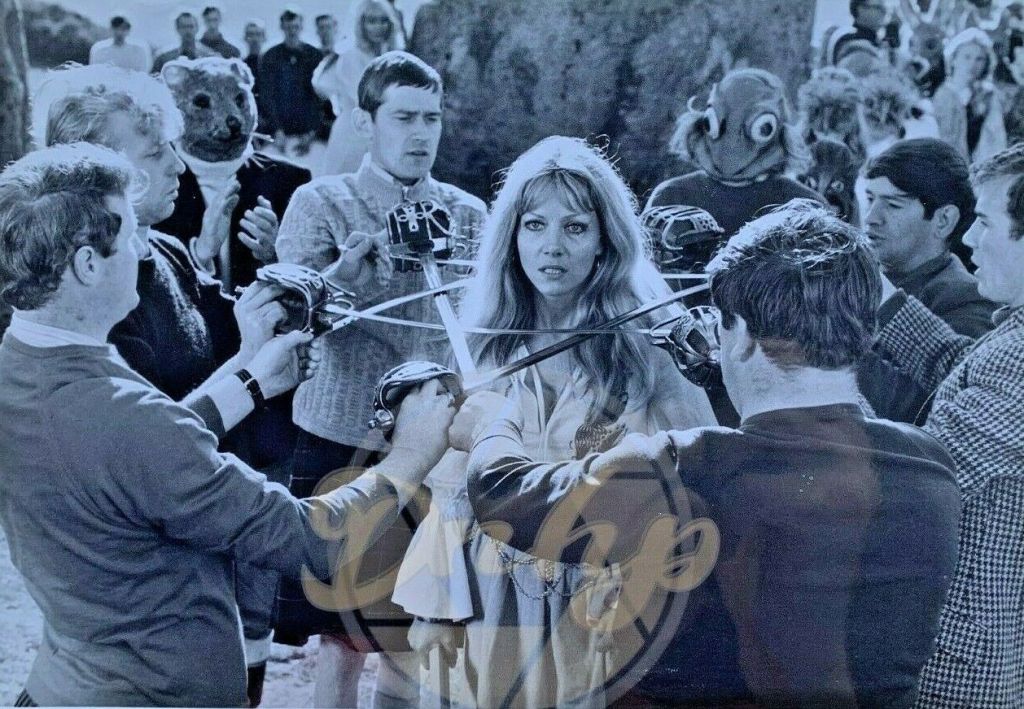
Let the fun begin: Ingrid Pitt does a blade runner.
And even then it wasn’t done. Towards the end of February the double bill switched to the 600-seat Odeon Haymarket, also in the West End. and opened with $6,000. A decent enough tally for a movie that had been on the market for over four months, but it turned out that except for its eighth and final week, that amount was the lowest it grossed. It ran out with a similar sum to the other two cinemas, $56,200. And then it moved again to the 150-seat Cinecenta 3, just off Leicester Square in London’s West end for a final flourish of $5,300 in two weeks, the second week improving on the first. All told, the double bill grossed $175,100 in the West End (just under $700,000 at today’s figures). The double bill also went out on general release on the Odeon circuit in Britain at the start of February 1974 – and not in December 1973 as has been argued (the London West End screenings were what would be termed “pre-release” activity).
How much of the double bill’s success could be attributed to The Wicker Man is not that difficult to calculate. As we have seen, Don’t Look Now was already an enormous success before it took on a perhaps-unwanted partner. Not every Odeon general release required a supporting feature, often a short would do. Without another film on the program, Don’t Look Now would have received more daily showings which could boost receipts and at the very least been more profitable for not having to share the box office.
Whereas Don’t Look Now sailed into New York on a tide of box office and critical glory at the 549-seat Sutton with a first week tallying $30,000 and had massed $110,000 in five weeks, The Wicker Man was deemed a massive flop. British Lion wrote it off to the tune of $470,000, a substantial amount.
There was no chance of British Lion fobbing off the more astute Americans with the notion of The Wicker Man running as the stablemate of Don’t Look Now. Major U.S. distributors bought pictures that had been hits on release in their home country. Perhaps not surprisingly, the main contender for the rights was Roger Corman, a horror specialist, and he thought he could make it work if the film was editing from the original 102-minutes to 86-minutes, a timing that make it more appealing in a double bill. But Corman could not meet EMI’s terms.
However, it was bought in 1974 for American release by the Beechwood Properties – which Variety mispelled as “Beachhead Corp” but only initially as as a tax shelter. However, Beechwood succeeded in drumming up a distributor, National General Corporation which distributed John Wayne movies Rio Lobo (1970) and Big Jake (1971) as well as Little Big Man (1971) and Le Mans (1971), The Getaway (1972) and The Life and Times of Judge Roy Bean (1972). NGC was taken enough by the movie to pay EMI $300,000 for the rights.
But then NGC hit a financial brick wall and pulled out and the project passed on to Warner Brothers after it picked up the top prize at the International Festival of Fantasy and Science Fiction. As a prelude to a release, Warner Brothers submitted it to the American censor where it earned an “R” (restricted) rating in keeping with its British X-certificate. Warner Brothers test-marketed the shortened version as a solo feature with 24 prints playing the San Diego and Atlanta regions. But when the movie failed to attract an audience it was deemed a flop and shelved.
And in summer 1974 it was officially shelved.
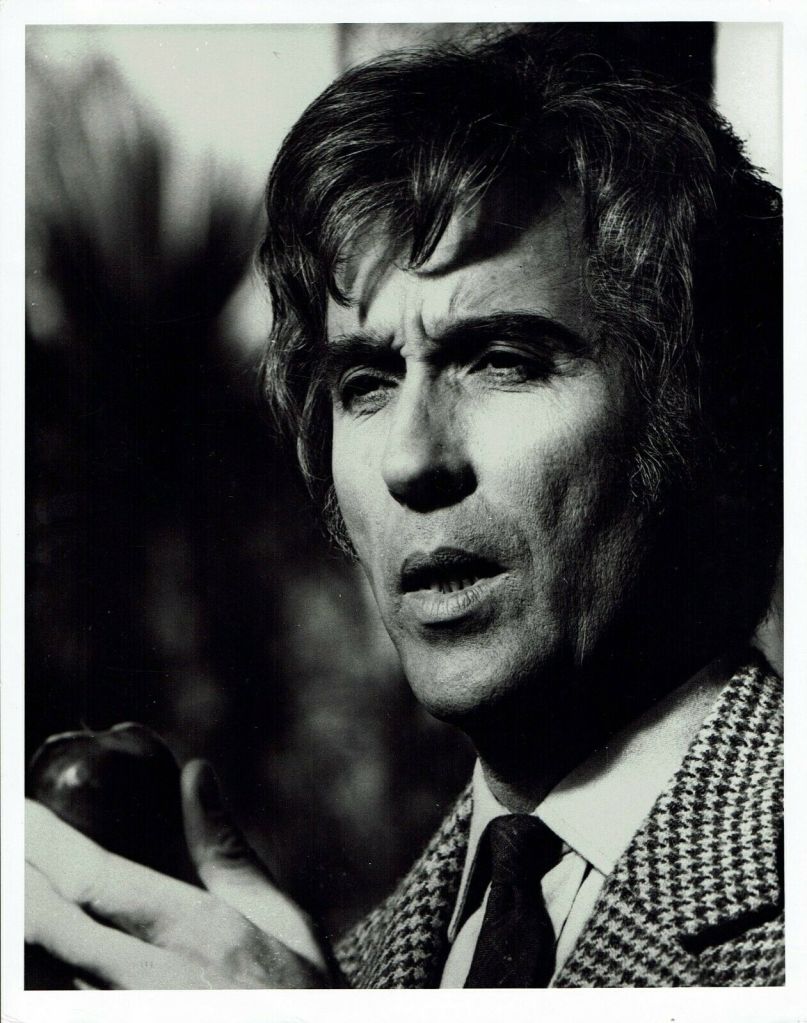
Christopher Lee with flowing locks.
So it sat in limbo for another three years before in 1977 Cinefantastique magazine dubbed it “The Citizen Kane of Horror Pictures” and devoted a 32-page spread to it in its Vol 6 No 10 issue, so determined it had uncovered a work of genius that it took out a substantial advertisement in U.S. trade paper Variety. That appeared to elicit some distributor interest and it was purchased in 1977 from Beechwood by New Orleans company Abraxas, headed by Stirling Smith, John Alan Simon, and Ron and Micheline Weinberg. Abraxas got the rights for a song – just $20,000.
But then the Weinberg’s split from Abraxas and set up a company (I am presuming) called International Films. It looked like they were licensed to show The Wicker Man, which they did in a kind of hit-and-run strategy, racing all over the country with the movie in the back of the car, and renting it out to around 30 arthouses, presumably assuming the “Citizen Kane” tag might attract an audience.
Distributed under the banner Summerisle Films, some of these showings were indeed propitious. In January 1979 at the 300-seat Lumiere in San Francisco with tickets priced at $4 it knocked up a “boffo” $19,000 (equivalent to a meaty $75,000 now). There was none of the steep fall-off either that you might expect. The second week hauled in an excellent $15,500 ($59,000 today) and the nine-week run brought in total of $93,000 (a very good $368,000 in today’s terms). It was deemed so successful that it achieved in exhibitor parlance a “move-over,” transferring to the 300-seat Cento Cedar.
Results were similar in Los Angeles. At the 763-seat Los Feliz Westland 1, also primarily an arthouse, it racked up opening week figures of $19,000 and after six weeks had powered to $61,900 plus another $37,000 from a two-week run at four suburban houses. There was a decent performance in Seattle, close on $40,000 in a five-week run at the 700-seat Crest. Enough to counter a poor showing in Minneapolis at the 461-seat World where it opened to a “slow” $2,000. And excepting that result, the prospects must have looked rosy.
That is, until the wheels came off.
International Films turned out to be beset by financial problems. Weinberg had been due to pay Abraxas a total of $150, 000 by December 1978, paid off in three tranches, an initial amount of $30,000 by December 1977, another $50,000 by June 1978 and the the remaining sum by December of the same year. When the debt was not settled, Abraxas took Weinberg in court in July 1979 and the outcome was that the rights reverted back to Abraxas, now headed by Smith and Simon. And that was timely from a publicity perspective for the movie had just been named Best Horror Picture and Best Screenplay by the Academy of Fantasy and Horror Films.
So Abraxas started all over again, sticking to the precedent of opening it in arthouses. But it looked like they sold off regional rights for the movie appeared under different distributors, Horror Films as well as Abraxas and the original Summer Isle banner April 1980 saw The Wicker Man set a new house record at the 200-seat Orson Welles III in Boston with a $15,000 opening and over the next eight weeks it locked up a hefty $73,500 ($256,000 equivalent). The same month it hit New York, but an excellent opener of $21,000 at the 533-seat Paramount dropped to just $9,000 in the second week, then $4,400 in the third and $4,000 in the last. In December it scored $7,500 at the 150-seat Cerberus II in Washington D.C, finishing with $16,000 for three weeks.
In January 1981 it was the last movie shown in a 12-week season of revivals at the 560-seater Fine Arts in Kansas City and, despite registering only a “mild” $3,500, it moved over the Watts Mill 2 for a $3,200 opener and an $8,400 total over four weeks. But a four-screen “showcase” in Miami produced a “remote” $3,700. There was some publicity derived for being selected, eight years after initial launch in Britain, at the Cleveland International film Festival.
But success in the independent field required momentum and despite excellent results in a handful of cinemas, The Wicker Man never really took off.
Salvation came via another route – video. Without VHS and then DVD it is doubtful if the movie would ever have achieved its current cult status. It’s not the first film to hit the ground running in the video format after a less than stellar performance in the cinema. I doubt that anyone, years after it was first shown, believed The Wicker Man had a hidden pot of gold. But my guess is the video rights cost little and in the burgeoning market where taste was not stifled by choices made at a cinema chain head office it was a film that finally found an audience.
SOURCES: “Michael Deeley Replaces Snell at Brit Lion,” Variety, April 11, 1973, p4; “Doing The Cannes-Cannes,” Variety, May 23, 1973, p26; “Form Beachhead Corp To Handle Wicker Man,” Variety, Jan 2, 1974, p4; “This Week’s Code Tags,” Variety, April 24, 1974, p4; “Wicker Man Wins Top Prize at Fantasy Fest,” Variety, May 1, 1974, p7; “British Lion 6 Months Slips to 890G,” Variety, January 29, 1975, p39; Advert, Variety, November 16, 1977, p38; Stuart Byron, “Something Wicker This Way Comes,” Film Comment, November-Dcember 1977; “Abraxas Corp Sues Ronald Weinberg,” Variety, April 18, 1979, p5; “Enjoin Weinberg Re Wicker Man,” Variety, Jul 4, 1979, p35; “Cleveland: 45 Titles: 3 Situations,” Variety, April 1, 1981, p24; “Metropolis Strikes Deal with Magnum,” August 10, 1988, p34. Box office figures all from the following issues of weekly Variety: Oct 24, 1973-April 24, 1974; October 5, 1977; March 21, 1979, April 11, 1979; April 18, 1979; April 25, 1979; May 7, 1979; April 23, 1980; December 3, 1980; February 4, 1981; April 1, 1981; May 20 1981.
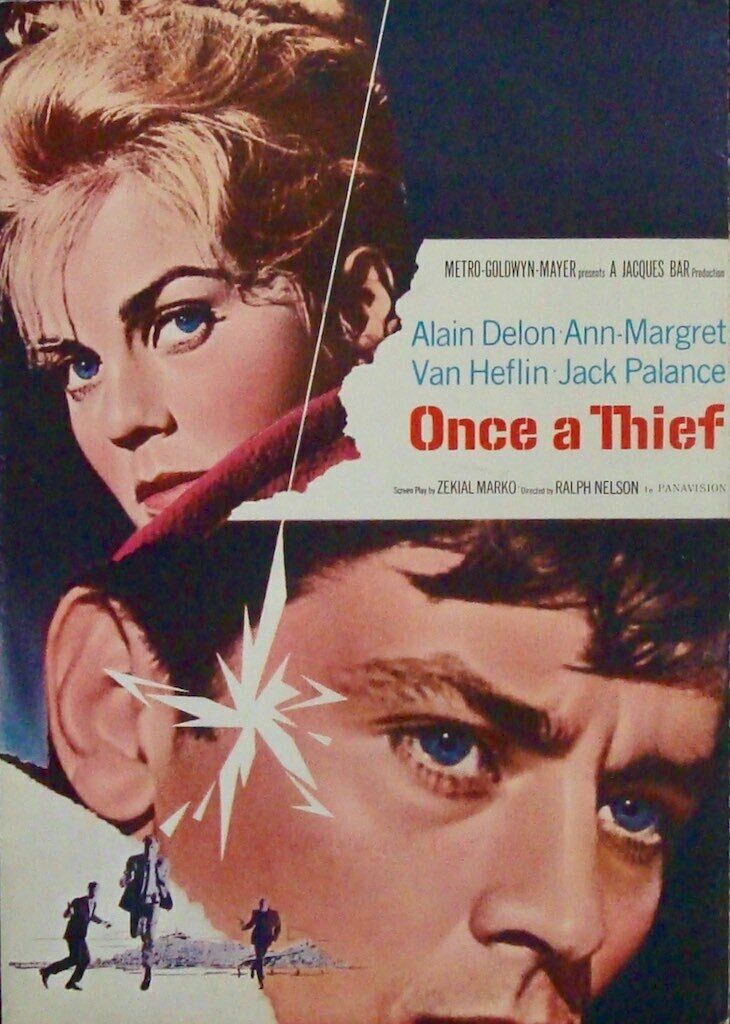
Latter-day film noir gem with terrific cast filmed in black-and-white and often at night that crams into a taut storyline different slants of the themes of the con-going-straight, the vendetta and the double-cross. While Hollywood at this point had imported platoons of foreign beauties in the Sophia Loren-Elke Sommer vein, there had been less interest in the male of the species with the exception of a small British contingent and possibly Omar Sharif, on whom the jury was still out.
MGM was gambling on Frenchman Alain Delon (The Leopard, 1963) to alter industry perceptions at the same time as pushing new contract star Ann-Margret (The Pleasure Seekers, 1964) along more dramatic lines away from the glossy puffery that had made her name and which relied more upon her physical assets than acting potential. Had she continued in this vein, her career would certainly have taken a different turn.
Eddie Pedak (Alain Delon), former minor hood turned San Francisco truck driver, is happily married to Kristine (Ann-Margret) with a young daughter they both adore. But tough cop Mike Vido (Van Heflin), with a reputation for brutality, is determined to pin a murder on him in revenge for purportedly being shot by him early in Eddie’s previous career. Eddie manages for a time to resist the overtures of brother Walter (Jack Palance) to participate in a million-dollar diamond. But when he loses his job, that changes.
While the robbery naturally takes center stage, that’s not actually the dramatic highlight. Instead, it is the Eddie-Kristine relationship. Instead of Eddie being the usual down-on-his-luck ex-con, he has clearly turned his life around, so much so he can afford a $500 down payment on a small boat. A loving father, he accepts without rancor when his daughter interrupts a night-time lovemaking session. And he’s stylish, too, wearing an iconic sheepskin jacket and driving a snazzy 1931 Ford Model A roadster. Kristine just wants a normal home life, desiring domesticity above all else, but swallowing her pride when she needs to go out to work in a night club to make ends meet, for a time rendering the unemployed Eddie a house husband.
But Eddie is not all he initially seems. His tough streak has not been smothered by the good life. In a brilliant Catch-22 situation he gets violent when an employment benefits clerk refuses to accept that Eddie was fired from his job, instead believing his employer’s claim that he resigned – the former triggering relief payment, the latter zilch. But that’s nothing to the beating he inflicts on Kristine when, pride injured that he is not the breadwinner, he discovers the skimpy costume she wears for her job.
Adding to the unusual mix are Vido and Walter, the former’s brooding presence somewhat undercut by the fact that in middle age he still lives with his mother, the latter while a big-time gangster letting nothing get in the way of strong fraternal feeling for Eddie. You won’t be surprised to learn that double cross is in the air, not when Walter employs a creepy sunglass-wearing henchman Sargantanas (John Davis Chandler) who appears to have more than a passing interest in little girls. The climax, which contains both emotional and dramatic twist, involves redemption and sacrifice.
Delon has played the cold-eyed ruthless but romantic character before, but here adds depth from his paternal commitment and as a man turned inside out by the system.
Ann-Margret is the revelation, truly believable as mother first, sexy wife second, and her anguish in the later parts of the picture showcase a different level of acting skill to anything she previously essayed. This role immediately preceded her man-eater in The Cincinnati Kid (1965) which attracted far more attention and considerably bigger box office and it would have been interesting to see how her career might have panned out had Once a Thief been the critical and commercial triumph. She probably did not attain such acting heights again until Carnal Knowledge (1971). And I did wonder, as with Daliah Lavi (The Demon, 1963) before her whether her acting skills were too often overshadowed in the Hollywood mindset by her physical attributes.
Van Heflin (Cry ofBattle, 1963) is excellent as the cop tormented by the idea that a villain is walking free, Jack Palance (The Professionals, 1966) is good as always and character actor Jeff Corey (The Cincinnati Kid) puts in an appearance as Vido’s whip-cracking boss. This marks the debut of Tony Musante (The Bird with the Crystal Plumage, 1970). Watch for a cameo by screenwriter Zekial Marko, who wrote the original book.
This represented another change of pace for director Ralph Nelson, Oscar-nominated for the Lilies of the Field (1963) and also known for box office comedy hit Father Goose (1964). His use of an experimental extremely light-sensitive camera eliminated the bulky lighting commensurate with filming at night, bringing freshness and greater freedom to those scenes. His natural gift for drama ensured that the emotional was given as much prominence as the action. Racial awareness was demonstrated by the opening scene in a jazz club where African Americans were clearly welcome, hardly the norm at that time.
The picture was shot on location in San Francisco including Nob Hill, Chinatown and Fisherman’s Wharf. To add authenticity, Nelson employed as extras or in bit parts people famed for different reasons in the area. There was Armenian Al Nalbandian who owned the Cable Car flower store on Union Square. William ‘Tiny’ Baskin was a highly successful diamond cutter, owner of the city’s biggest diamond collection – because of his size he was ideal to play a night club bouncer. The North Beach night club provided cameos for Big Al and resident jazz drummer Russell Lee, who both play themselves. Local singer Toy Yat Mar plays the woman murdered at the start of the film. Also appearing were piano player Jimmy Diamond, bus driver Wed Trindle and belly dancer Shereef.
Mention again of a terrific score by Lalo Schifrin, especially the bold drum solo that played out over the credit sequence. Schifrin’s work on the film was showcased in a featurette aimed at schools and colleges. Russell Lee’s drumming so impressed Ralph Nelson that the opening credits were rewritten around his drum solo.
Catch-Up: Alain Delon has featured in the Blog in reviews for Lost Command (1966), Is Paris Burning? (1966), The Girl on a Motorcycle (1968) and Farewell, Friend (1968); check out also Ralph Nelson’s Duel at Diablo (1966) and Ann-Margret in The Cincinnati Kid (1965).









 The Magnificent 60s