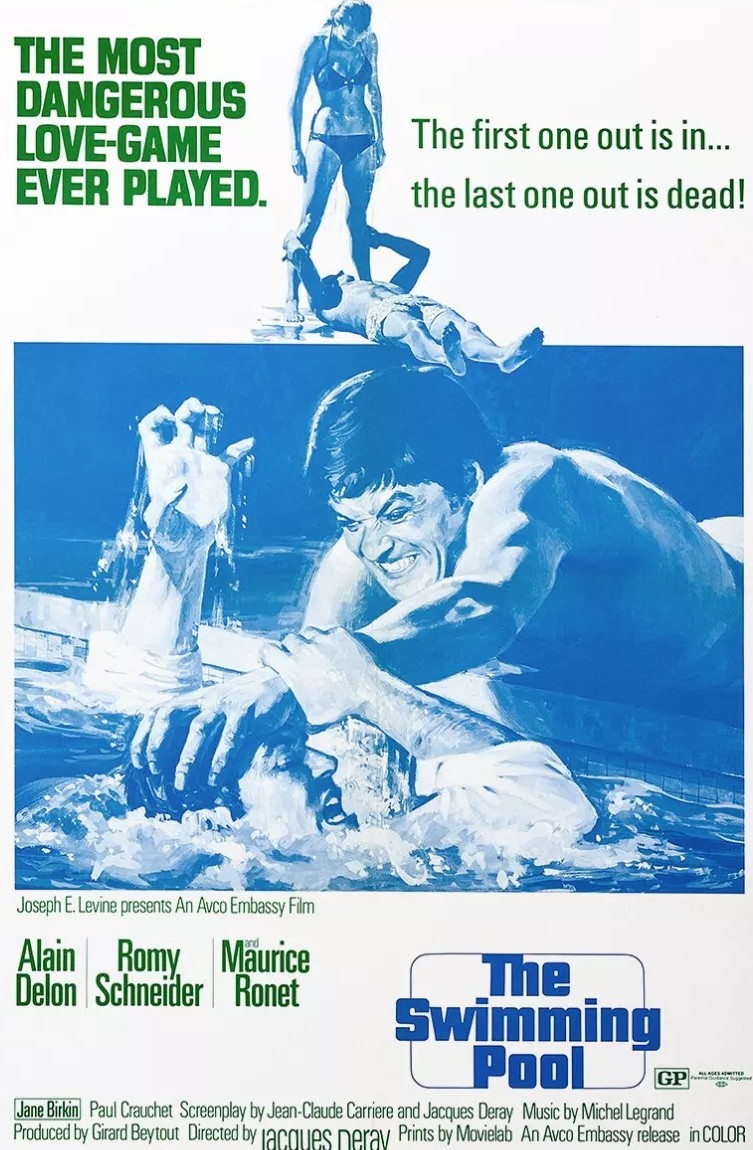
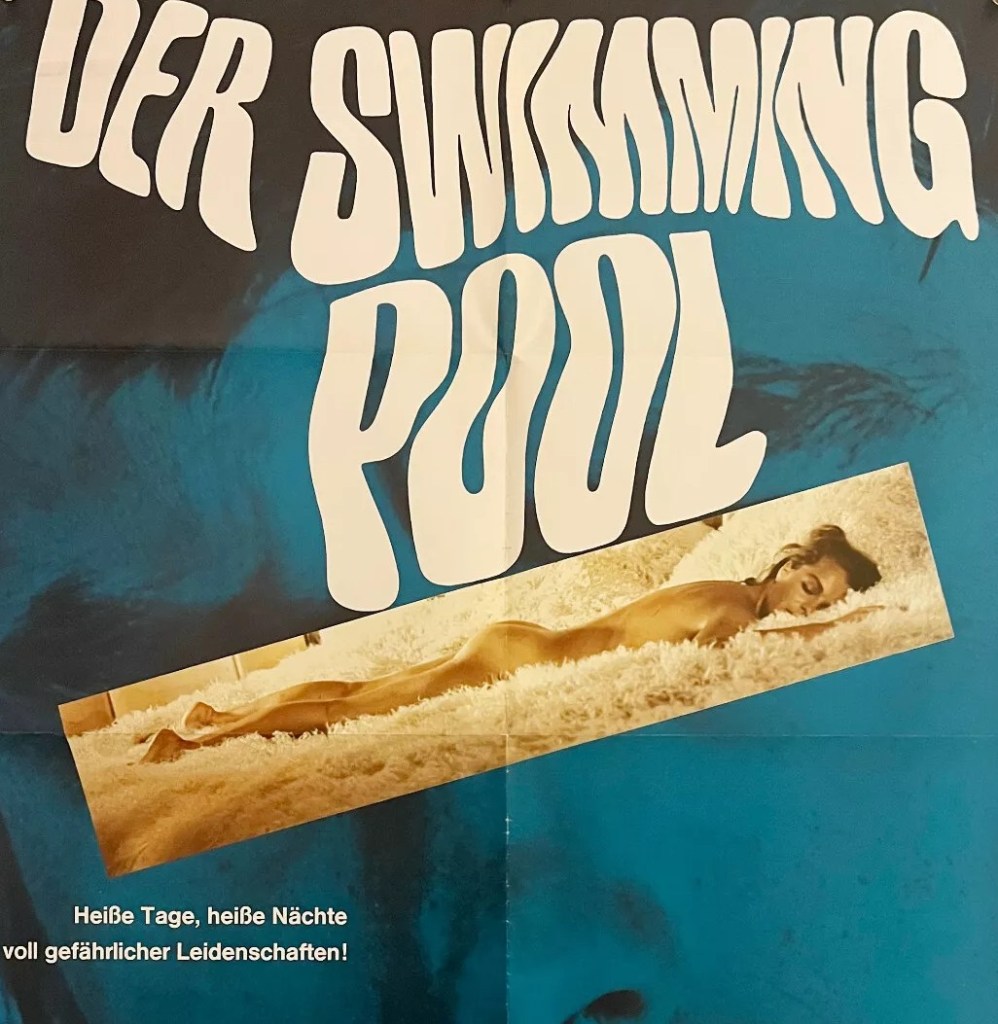
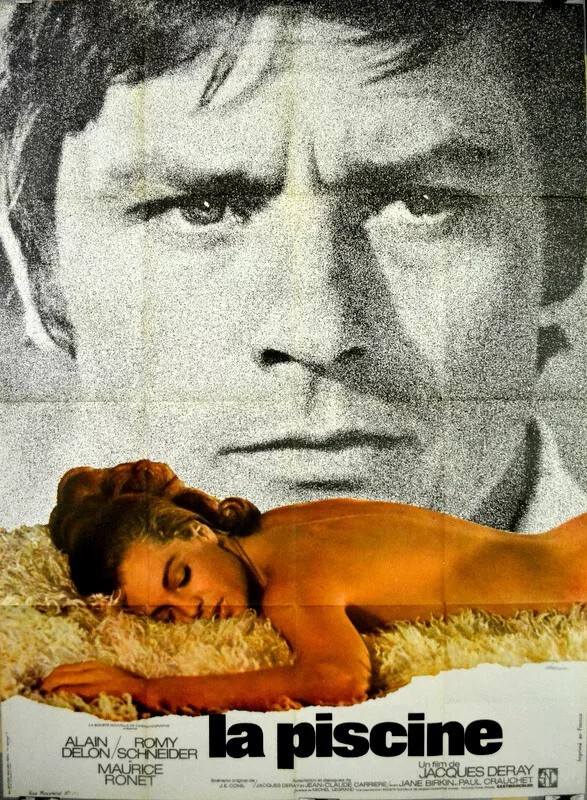
The Swimming Pool / La Piscine (1969) ****

A drunk falls into a swimming pool in the middle of the night and drowns. He has already crashed his car into the gate post of the villa. There’s no sign of foul play. No sign of the fact that his attempts to clamber out are hindered by someone holding his head down under the water until he loses consciousness.

The perfect murder? Well, no, actually, because in the aftermath of the murder, recovering alcoholic killer Jean-Paul (Alain Delon) does about the dumbest thing you’ve ever seen. And that significantly detracts from what otherwise is a superb examination of sexual tension and hidden secrets.

So instead of leaving the corpse of best friend Harry (Maurice Ronet) floating fully clothed in the titular pool, Jean-Paul decides it would look better if it appeared that Harry had foolishly gone for a late night swim. So he pulls the dead guy out, strips off his clothes and decks him out in swimming trunks and slides him back into the watery grave.

He hides the sodden clothes somewhere and at the side of the pool puts a small stack of fresh clothes stolen from Harry’s wardrobe – he was a guest at the villa. But for some reason in pulling off Harry’s shirt he omits to remove his expensive watch which isn’t waterproof. Inspector Leveque’s (Paul Crauchet) suspicions are aroused by that simple fact. Although, theoretically, Harry might have been too drunk to notice, even though, obviously, the watch strap and the bulky watch would have caught on his shirt sleeve as he was taking off the item of clothing.

So the cop, in examining the clothes, is mightily surprised to discover they are fresh, unworn, not a sign of sweat or crumpled-ness, which is odd given Harry had been out dancing and enjoying himself for hours.

Psychologically, most of the aftermath is not just whether the cold-blooded killer – the otherwise very handsome, relatively charming writer Jean-Paul – will get away with it  but whether his girlfriend Marianne (Romy Scheider), who has her own suspicions, will stand by him.

They have enjoyed a very intense sexual relationship and she clearly adores him. But she’s also the ex-lover of Harry and when Jean-Paul’s old pal, who is decidedly smooth with the ladies, turns up, the old sexual jealousy is rekindled. Either to get revenge or because he’s in any case that way inclined Jean-Paul has been making discreet moves on Harry’s eighteen-year-old daughter Penelope (Jane Birkin) who clearly despises her father.

We discover that Jean-Paul owes a great deal of his success to Harry who nurtured him through a severe depression that ended in attempted suicide. Rather than making Jean-Paul eternally grateful, it’s turned him into a spoiled brat, focused primarily on his own needs and without a loyal bone in his body when it comes to women.

For quite a while it looks like record producer Harry is going to steal away Marianne, if only for a brief affair, as Jean-Paul gives in to the sulks. But since Jean-Paul is already eyeing up Penelope, you would have thought any slip by Marianne would provide him with justification.

The murder is spur-of-the-moment. Jean-Paul has been drinking again and when Harry turns up drunk and launches into an attack on Jean-Paul’s character and hidden past, that’s when he ends up in the pool. Every time he tries to get out, Jean-Paul pushes him back in and eventually holds his head down underwater.

And he might have got away with the perfect murder except for stripping the body and forgetting about the watch, but when he decides to end his relationship with Marianne, the focus switches to whether she will betray him or not. There are a couple of twists on that score at the end.

So severely flawed psychological thriller. I’m guessing you could argue that anyone who kills someone out of the blue could easily be suffering from the kind of brain overload that prevents him thinking straight, but I didn’t fall for it. It would have been as easy to continue with the psychological stuff enough with Marianne maybe finding the wet clothes and facing the same choices that she eventually does.

What does elevate it are the performances. Austrian actress Romy Scheider (Otley, 1969), who had previously had an affair with Delon, is superb as a woman not sure if she has any principles given she is so easily in the thrall of attractive men. Although Alain Delon (Le Samourai, 1967) had played bad guys and immoral sorts before, this still feels like a fresh approach, the watchful, withdrawn calculating killer masquerading as something else.

Maurice Ronet (Lost Command, 1966) and Jane Birkin (Blow-Up, 1966) make significant contributions.

And director Jacques Deray (Borsalino, 1970) would have turned out another masterpiece had the movie not stumbled over the oddness of the murder. Written by the director, Alain Page (in his debut) and Jean-Claude Carriere  (Viva Maria!, 1965).

Excepting the murder mishmash, superb.

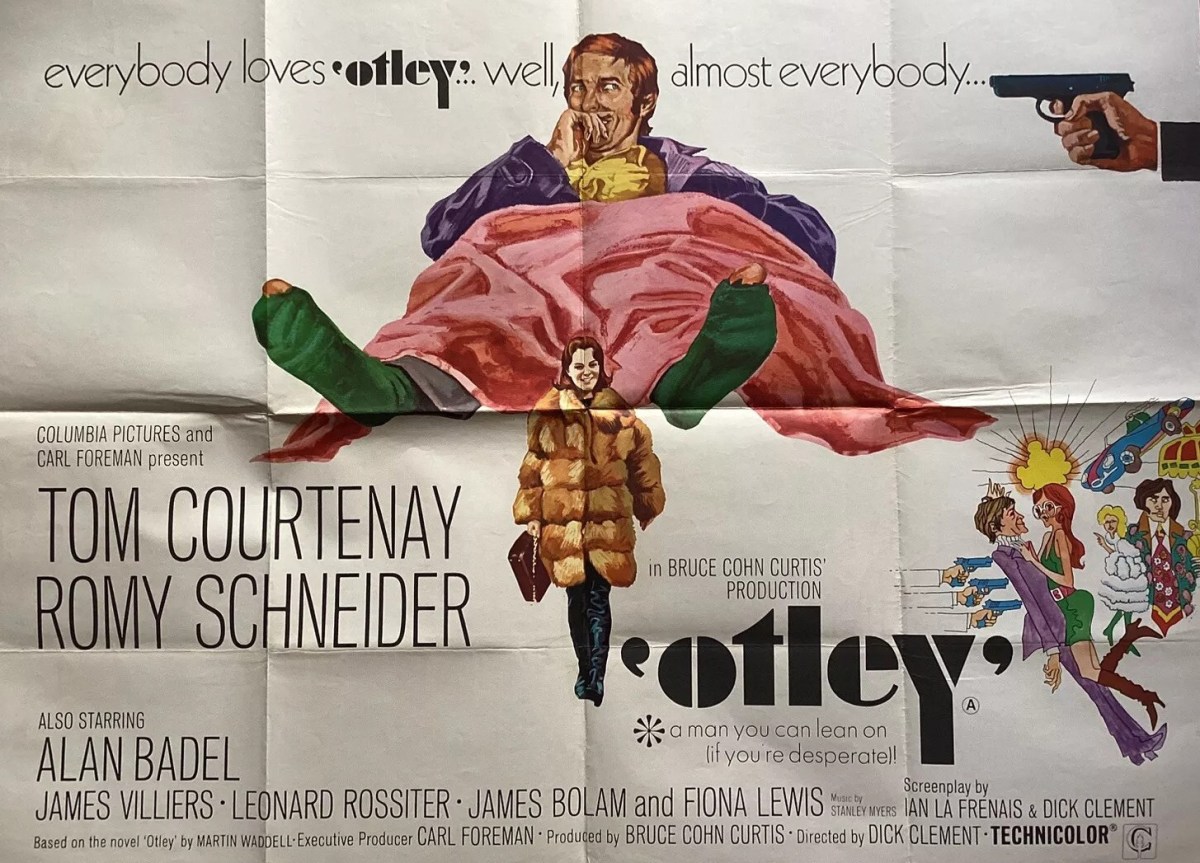
Otley (1969) **

Misguided attempt to play the innocent-caught-up-in-espionage card. And minus the angst on which he had built his screen persona, Tom Courtenay (A Dandy in Aspic, 1968) fails to elicit the spark that would turn himself into a leading man – excepting one other film, this was his last top-billed picture. And anyone hooked by the billing expecting to see a lot of female lead Romy Scheider (The Cardinal, 1963) would equally be in for a surprise.

And that’s a shame because Courtenay can act, not in the Oscar-bait sense, but just in his physical gestures and reactions to whatever else is going on in a scene. Scheider, too, especially in the scene where she more or less laughs in Courtenay’s face when he points a gun at her and in her knowing looks.

But Otley (Tom Courtenay) is such an unappealing character, the movie is on a sticky wicket from the off. Petty thief, largely homeless because of it, his propensity for slipping into his pocket anything that looks valuable in the homes of anyone stupid enough to give him a bed for the night, giving the movie its only sensible piece of narrative drive. Because the rest of the story is a farrago, a series of unconnected episodes dreamed up for their supposed humor, which wants to be pointed and sly but ends up heavy-handed and dreary.

And there’s one of those narrative sleights-of-hand where Otley wakes up on an airport runaway (security impervious to his presence, of course) having misplaced two days of his life. That’s just one of competing narratives – the other being that he’s wanted for the murder of the chap, Lambert (Edward Hardwicke), who was stupid enough to give him a bed for the night. Count in the espionage and there’s a trio of useless narrative hinges that get in each other’s way and largely introduce us to a succession of odd characters.

Pick of these is Johnston (Leonard Rossiter), an assassin who has more lucrative side hustles as a tour coach operator, double-crosser and blackmailer. The only other believable character is the landlady who’s had enough of Otley’s thieving, but only (unbelievable element lurching into view) after she’s bedded him.  

The movie just lurches from one scene to another, a car chase that ends up on a golf course, (“Are they members?” cries one outraged lady), a houseboat, various low-life dives and chunks of tourist tat thrown in, a bustling street market, Carnaby St etc.  I can’t begin to tell you what the espionage element is because that’s so far-fetched and ridiculous you won’t believe me.

This is the kind of low-budget picture that sets scenes, for no particular reason except they’re part of tourist London, in the Underground, but a completely empty Underground, not another person in sight, and not late at night either which would be a saving grace, though clearly it was filmed either late at night or early in the morning when the Underground was closed to ordinary passengers (thus saving on the budget).

Two examples of how heavy-handed the humor is: on a farm having been doused in water by Johnston, Otley remarks that he’s now deep in the proverbial only for the camera to cut to his foot sinking into a cowpat. At the airport, a couple of staff get lovey-dovey behind a counter, the male sneaking a grope, and we cut to a sign “ground handling”. Ouch and urgh!

If you manage to keep going the only reward is to see a handful of familiar names popping up: Alan Badel (Arabesque, 1966), James Villiers (Some Girls Do, 1969), Fiona Lewis (Where’s Jack?, 1969) and British sitcom legends James Bolam (The Likely Lads and sequel) and Leonard Rossiter (The Fall and Rise of Reginal Perrin, 1976-1979).

And where’s Romy Scheider in all this? Looking decidedly classy, but clearly wondering how the hell she got mixed up in it.

Screenwriter Dick Clement (Hannibal Brooks, 1969) made his movie debut on this clunker. He co-wrote the picture with regular writing chum Ian La Fresnais from the novel by Martin Waddell.

What happens when a genre cycle – in this case the espionage boom – gets out of control.

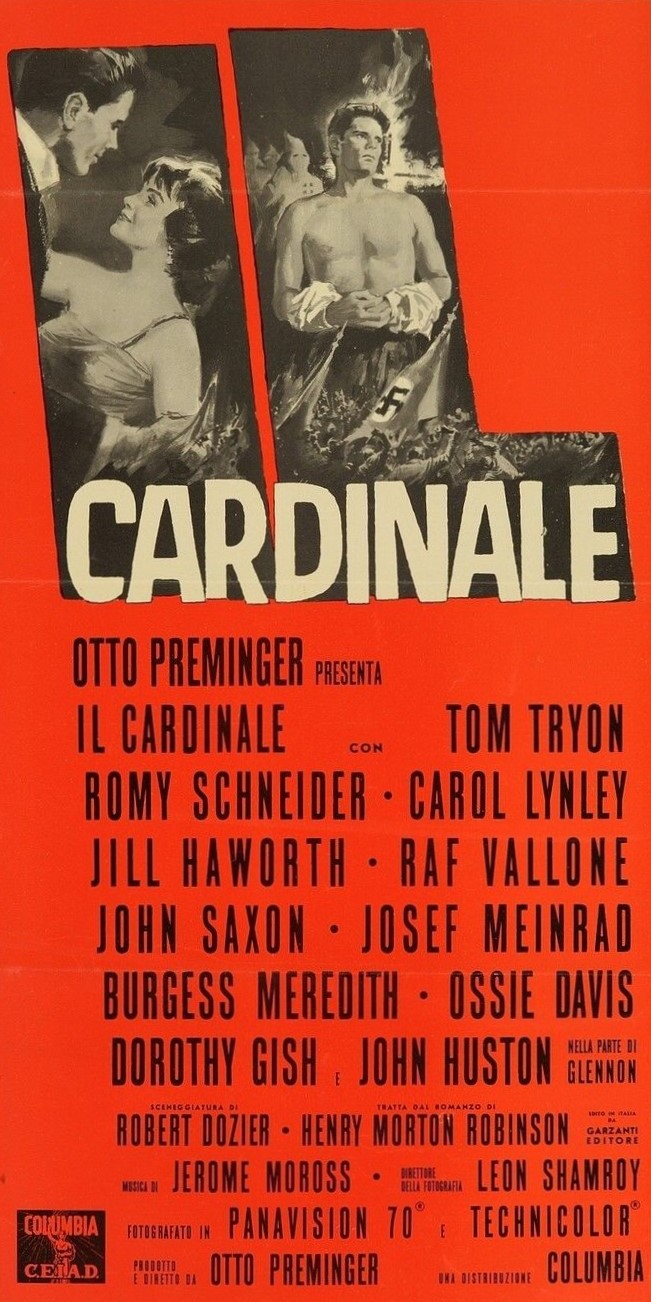
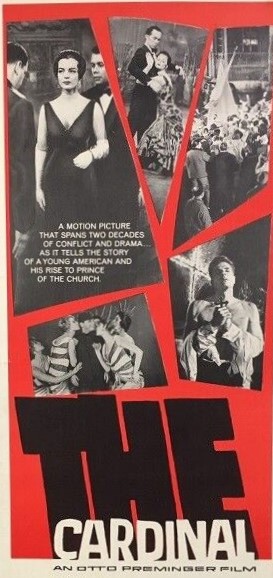
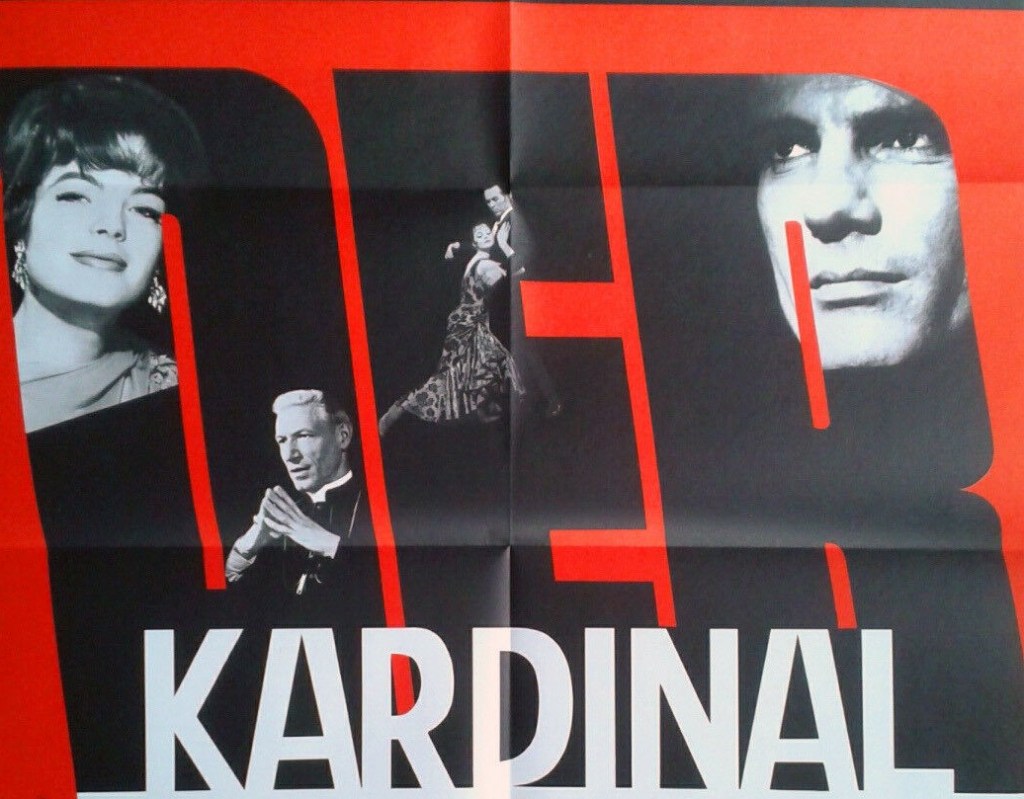
Behind the Scenes: “The Cardinal” (1963)

Otto Preminger was beaten to the punch on this one, the scandalous Henry Morton Robinson bestseller snapped up in 1955 by producer Louis de Rochemont (The Roman Spring of Mrs Stone, 1961) who had a tie-up with Columbia. Due to interference from the Catholic Church, de Rochemont dropped his option which Preminger picked up in 1961 while working on Advise and Consent (1962).

The last section of the novel, set in Austria during the Anschluss, reverberated with the director who was born in what was then the Austro-Hungarian Empire and although a Jew was well acquainted with Catholic society.  One of his most significant changes to the book was introducing the Austrian cardinal who endorsed Hitler.

The first two screenwriters James Lee (Banning, 1967) and Daniel Taradash (Castle Keep, 1969) failed to whittle down the complex novel to cinematic proportions. So Preminger brought in Robert Dozier (The Big Bounce, 1969) and began working with him in summer 1962 making other alterations to heighten the drama. The incident involving the unborn child of the sister of Fr Fermoyle (Tom Tryon) acquires greater emotional power in the film, touching on the ambiguities inherent in any institution and provoking the priest’s guilt.

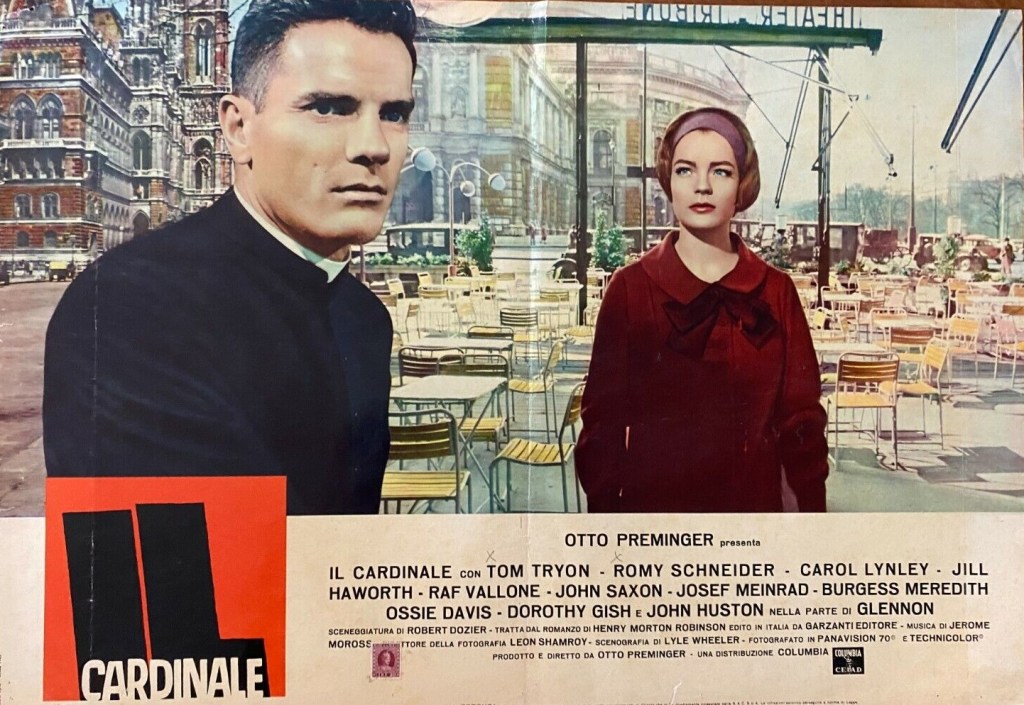
Gore Vidal (The Best Man, 1964) also worked on the script, swapping the novel’s Italian countess for the Viennese Annemarie (Romy Scheider) who, abandoned by the priest had married and was reunited with him prior to the Anschluss, and is sympathetic to Hitler until her husband’s faith endangers them both. Ring Lardner, who had satirized the Catholic church in a recent novel, was the final screenwriter added, his main task to rewrite scenes “to achieve what he (Preminger) wanted,” and, more importantly, to introduce the flashback structure. Ironically, both Vidal and Lardner were atheists.

Tom Tryon and Romy Scheider meet again in Vienna.

The director considered five actors for the leading role – Hugh O’Brian (Africa – Texas Style, 1967), Stuart Whitman (The Commancheros, 1961), Cliff Robertson (The Devil’s Brigade, 1968), Bradford Dillman  (Circle of Deception, 1960) and Tom Tryon (In Harm’s Way, 1965), the latter three advancing to the screen-testing stage. The 34-year-old Tryon won the role and a five-picture contract he would later regret. Carol Lynley (Bunny Lake Is Missing, 1965) who plays the priest’s sister also pacted for five movies.

Romy Scheider’s (Triple Cross, 1966) part was enhanced by the work of cinematographer Leon Shamroy who “fell madly in love with her,” resulting in the actress virtually shimmering on screen, never before “looking as beautiful.” Held in warm regard by the director, she was exempt from his tirades.

It took considerable persuasion on the part of Preminger for John Huston to participate. Curd Jurgens, initially cast as the Austrian cardinal, pulled out and was replaced by character actor Josef Meinrad whose lack of English meant he had to learn his lines phonetically.

Tom Tryon described Preminger as “tyrant who ruled by terror.” He was fired on the first day and probably wished the director had not rescinded the decision, for thereafter the actor was tabbed “lazy…a fool…stupid and unprofessional.” Commented Tryon, “I was so frightened he was going to scream that…I (just) wanted the experience to end.”

One scene with John Huston took 78 takes because Tryon could not deliver what the director wanted. And at one point first assistant director Gerry O’Hara (later director of The Bitch, 1979) found the star in tears and refusing to return unless the director agreed not to shout at him. Eventually, during the Italian section of the shoot, Tryon collapsed from nervous exhaustion, and was prescribed two days rest, and after this incident Preminger let up on his demands of the actor. 

Explained Preminger, “I probably chose him without deliberation because he is weak.” He felt than an ordinary person would not side with the Church against a family member in a predicament, and that only a person “with weakness in his character” would be believable in the role. The character “fails because when you become a priest you substitute your own judgement and your own feelings for the law of the Church…The big decisions are made for him.” (Quite why he never chose an actor who could portray such weakness is not known.)

Tryon admitted that he owed a brief let-up in the bullying to “Schneider’s benign presence.” He commented, “The only fun I ever had on The Cardinal was a (ballroom) scene I did with Romy.” Prior to turning the cameras, Prior called both over, appeared ready to issue instructions, but instead waved them away “you know what to do.”

Added Schneider, “Preminger taught me an important thing: work fast. It’s true that it greatly helps our acting. Each of his directions, whether of gesture or of intonation, is precise and correct. Even better, it’s the only one possible…Each phrase, each world, each syllable are minutely weighed.” That dexterity applied to his positioning of the camera. He made decisions immediately, never hesitating “over the placement of the camera and each time…it was the simplest, the most natural and, dramatically, the best.”

Ossie Davis (The Scalphunters, 1968),  who professed to have enjoyed a marvellous relationship with the director, observed:  “I met actors whom Otto liked, I met actors that had no relationship or feelings one way or the other and I met actors who were almost absolutely destroyed, almost literally in panic because of Otto Preminger (who) was always looking for a spark…whether you had the spark or not, he was going to find it and even put it in you.”

But Patrick O’Neal stood his ground. “I woiuld not take it from him.” And they became friends.

The unit shot for five weeks in New England before heading to Vienna, Preminger choosing to stay in the same suite in the Hotel Imperial as appropriated by Hitler when visiting the city. Permission to shoot in the National Library, “one of the most beautiful monuments in the city” was attacked by the current minister of education who wanted the Hitler era erased from memory. And he was barred from using other government buildings for spurious reasons.

After four and a half months in Austria, the unit shifted to Rome, locations including St Peter’s Square and inside St Peter’s Cathedral and the Santa Maria sopra Minerva church, with priests and monks hired as extras for the various ceremonies. The Georgia scenes were shot in Hollywood on the Universal back lot.

Although generally dismissed by the critics and given a hard time as you might expect from the Catholic Church, The Cardinal hit a chord with audiences, who turned it into Premigner’s second-biggest hit of the decade.

The Cardinal (1963) ****

Would appear resolutely old-fashioned except for Forrest Gump (1994) adopting same premise of the main character present at major events. Here it’s issues affecting the Catholic Church between last century’s two world wars and the protagonist is an American priest, Father Stephen Fermoyle (Tom Tryon) of Irish stock,  who rises to the position of Cardinal.

So we move at a relatively stately pace through abortion, inter-denominational marriage, racism, a miracle, challenging church philosophy, and Hitler’s annexation of Austria on the eve of the Second World War, in which the church played an inglorious part. Along the way Fr Fermoyle is afflicted so badly by doubt that he takes a sabbatical only for his flesh to be sorely tempted.

Astonishingly, I saw this on YouTube (it’s still there) in a beautiful 70mm print preserved by the National Film and Television Archive. The roadshow print, to be exact, which begins with a marvellous five-minute overture. Oddly enough there’s something very settling about sitting in the darkness with the curtains drawn watching a blank (black) screen and listening to the majestic score by Jerome Moross (The Big Country, 1958).

And then it’s another few minutes of a stunning credit sequence, all sunlight and shadow, before the movie begins. The movie itself is over three hours long, so if you are put off by this kind of epic now’s the time to check out. But if you do, you will miss something genuinely to be savored.

For Otto Preminger (Hurry Sundown, 1967) certainly knows how to tell a story, even one as sweeping as this. For all its pomp, he manages to retain intimacy.

Immediately after his ordination just as America enters the First World War, Fr Fermoyle faces a crisis. His sister Mona (Carol Lynley) wants to marry a Jewish dentist (John Saxon) who refuses to convert to Catholicism. Fermoyle’s advice, in keeping with the church’s stringent rules: give him up.

A noted intellectual, Fermoyle is astonished to be sent by the worldly piano-playing cigar-chomping Archbishop Glennon (John Huston) to an impoverished parish to learn humility. There, he encounters the blind faith of parishioners and a pastor, Fr Halley (Burgess Meredith), so inclined to put others first that he will not seek help for a debilitating disease.

Meanwhile Mona, now a dancer and drinker, has become pregnant, and not by the dentist. But complications arise and she is forced to choose between herself and the unborn child. According to Church doctrine, as Fermoyle, advises, abortion being illegal, the mother must die to save the baby. Mona, not the sacrificial kind, does the opposite. Fermoyle, racked with guilt, wants to quit the church. Instead, he is promoted to Monsignor, and given a two-year timeout which he spends lecturing in Vienna.

There he falls in love with Annemarie (Romy Scheider). In the nick of time, he is recalled to the States and sent to the Deep South to help the black Fr Gillis (Ossie Davis) who is being harassed by the Ku Klux Klan. In standing by his colleague, Fermoyle undergoes a brutal whipping. Promoted to bishop, he is despatched to Austria “to instruct the princes of the church in the realities of the modern world.” Unfortunately, the clergy, siding with the Nazis, presides over the marriage of Germany and Austria.

Meanwhile, he is reacquainted with Annemarie, who has married a Jewish banker, and witnesses at first-hand Nazi treatment of the Jews, her husband so fearful of his future he jumps out a window.   When a mob ransacks a church, Fermoyle isn’t so intent on facing up to them and instead, with Annemarie, manages to escape.

At its best and its worst by the narrative being forced through the prism of an individual. His reactions to issues are regulated by his employers, the Church, which exerts as much control over personal thought as the Communist Party, so, in effect, it becomes a tale of a person initially bristling against authority until, it turns out, the Church shares the same antipathy to the worst of the century’s scandals, the Ku Klux Klan and the Nazis.

Father Fermoyle hardly seems suited to high office, given he is so often inclined to temptation, either in a sexual sense, or in taking the opposite view of the Church. And it’s almost as though the splendid backdrop as represented by the immense wealth of the Church has only been achieving by subjugation of the individual. That the worldly Glennon appears as the poster boy for the Church hierarchy is almost Preminger playing with the audience.

It might be sumptuously mounted, but once again Preminger takes no prisoners, showing up an institution that while purportedly set up for the benefit of mankind so often sabotages noble endeavor.

Tom Tryon (In Harm’s Way, 1965) is excellent in the leading role, personal conviction getting in the way of the easy path to the top. But the pick of the performers are the supporting stars, especially John Huston, more famous as a director (The Night of the Iguana, 1964) and here making his acting debut, and Romy Scheider (Triple Cross, 1966). Look out for Carol Lynley (Bunny Lake Is Missing, 1965), silent film star Dorothy Gish in her final movie appearance, Maggie McNamara (The Moon Is Blue, 1953) in her first picture in eight years, and John Saxon (The Appaloosa, 1966) before he was typecast as a heavy.

Otto Preminger (In Harm’s Way) directs in stately fashion from a screenplay by Robert Dozier (The Big Bounce, 1969) and Ring Lardner Jr. (The Cincinnati Kid, 1965).

Thoughtful and striking.

Discover WordPress

A daily selection of the best content published on WordPress, collected for you by humans who love to read.

The Atavist Magazine

by Brian Hannan

WordPress.com News

The latest news on WordPress.com and the WordPress community.