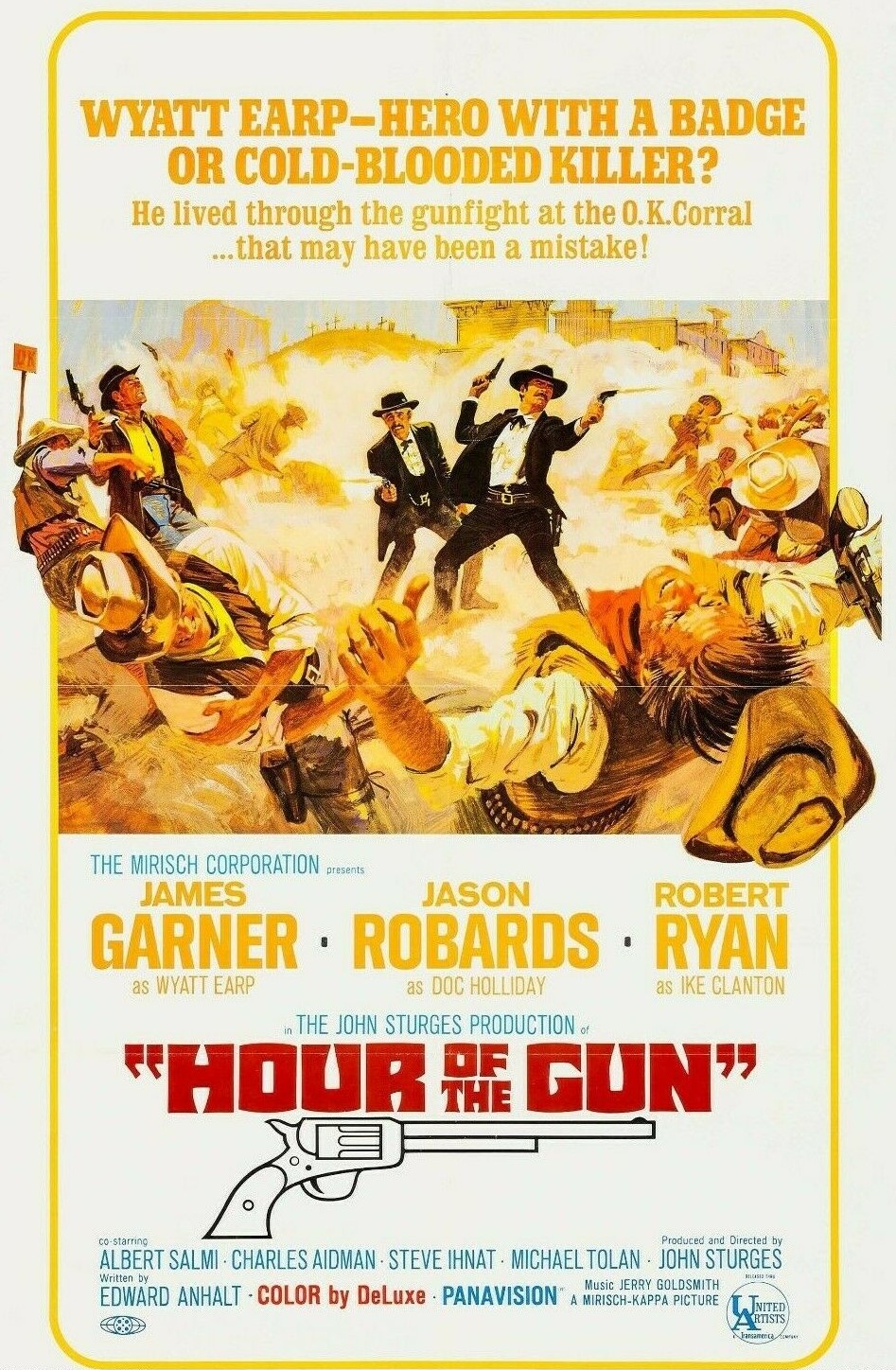
The second version of the Gunfight at the O.K. Corral follows on from the Burt Lancaster-Kirk Douglas 1957 version also directed by John Sturges and precedes Doc (1971) reviewed yesterday. Good chance to compare the differing approaches.
Destroy a legend at your peril. Mythic western hero Wyatt Earp (James Garner) goes down’n’dirty after the death of his brother, spurning law and order to turn bounty hunter, which is legitimate, and then vigilante, which is not, in pursuit of Ike Clanton (Robert Ryan). A revisionist western, then, with director John Sturges substantially reimagining the image of Earp he had been instrumental in creating through Gunfight at the O.K. Corral (1957), a box office smash starring Lancaster as Earp and Douglas as sidekick Doc Holliday.
The first change is to keep Clanton alive, having been a casualty in the previous picture. The opening sequence sets the record straight. But corruption and the law acting in conjunction pull Earp and Holliday (Jason Robards) up on criminal charges though they are found innocent. When corrupt law fails to work, Clanton resorts to ambush, killing Earp’s brother. Clanton organises a posse of twenty men to kill Earp while the lawman sets up his own, smaller, team of bounty hunters.
It soon transpires Earp’s warrants are little more than “hunting licenses” and although marginally he errs on the side of fairness the odds, courtesy of his superior gunplay, remain substantially stacked in his favour and he picks off the villains one by one, pursuing Clanton into Mexico.
This is the story of Wyatt Earp in transition, shifting into lawlessness, at a time – 1881 – when the West itself was undergoing dramatic change, big business from the East forcing greater acceptance of the law (and using it for their own purposes), the growth of the cattle barons and the gradual elimination of the gunslinger, gunfighter and criminal gangs. There’s no room for romance as there was in O.K. Corral and The Magnificent Seven (1960) just pitiless determination to revenge. But there’s little of the all-male camaraderie that informed The Great Escape (1963). Earp and Holliday remain tight but the others in their gang have been somewhat forcefully enlisted.
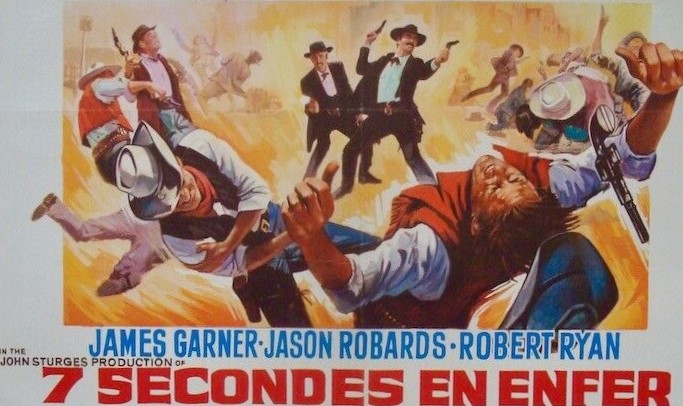
The poster is very misleading, giving the impression of an all-action gun-toting movie rather than one of somber reflection.
The best scenes are the result of Earp conniving, revealing a streak Machiavelli would have envied, even duping Holliday, until it’s clear the Earp of legend has been vanquished. Sturges congratulates himself on telling the “truth.” But that’s the problem. The truth involves a lot of background that slows the picture down. And presenting Earp as transitioning is pretty much a blatant lie. Earp was clearly as ruthless killer at the O.K. Corral as he is now and no amount of pointing to corrupt law can eliminate the fact that the lawman prefers to kill villains rather than see them face justice. So there’s really no transition. Earp is a more civilized version of The Man With No Name. But at least he accepts it. There’s no hypocrisy involved.
The two principals are superb, shucking off the mannerisms that previously defined their screen personas. Gone is the trademark James Garner cheeky chap, the grin and even the slicked-back hairstyle. He is your father in a continually bad mood now rather than your favorite uncle full of japes. How much Sturges pinned back Robards’ capacity for over-acting can be seen by comparing this with the actor’s performance in Once Upon a Time in the West (1968).
Full marks for Sturges in trying to tell a complex, morally ambivalent, story, and he avoids the more grandiose approach to changes in the West as instanced in Once Upon a Time in the West. The early courtoom scenes slow down the narrative when a couple of lines of dialog could have done the same job. But it is exceptionally true in its depiction of Earp. There is not a bone of redemption in his body. He is going on a killing spree and he doesn’t care who knows it or how it damages his reputation, still high enough before the final episode of the revenge hunt for him to be touted as a future lawman-in-chief for Arizona.
Nor does Doc Holliday offer anything in the way of consolation. This isn’t like The Wild Bunch where a ruthless band of robbers convince themselves they have a code of honor and provide rough camaraderie as a way of filling in the emotional gaps in their lives. Holliday mistakenly sees Earp as man who could not exist outside the law without destroying himself, but that would only concern an Earp who was still interested in rules. Holliday, a self-confessed killer, over 20 deaths to his name, seeks redemption by saving Earp from himself. But in keeping with the raw truth, he is wasting his time. “I’m through with the law,” proclaims Earp, somewhat redundantly, once he dispatches his final victim.
It was a different kind of western at a time when in mainstream Hollywood there was no such thing. Although elegiac in tone, it cuts to the mean. And it was the forerunner of other, more critically acclaimed, westerns like Will Penny (1968), The Wild Bunch (1969) and Pat Garrett and Billy the Kid (1973) and in a sense it was precursor to Dirty Harry (1971) where in order to obtain justice Harry Callahan has to throw away his badge.
Many reasons have been advanced for the film’s commercial failure, most erroneously assuming that the genre had fallen into disrepair and was not revived until the glory year of 1969, but as I point out in my book The Gunslingers of ’69, that was far from the case. The same year as Hour of the Gun, John Wayne had ridden high on the box office hog with The War Wagon to follow the previous year’s El Dorado and Paul Newman as Hombre had been a big hit. The first two spaghetti westerns, only released in the U.S. in 1967, were also given as instrumental in the failure of Hour of the Gun, but neither was a massive box office hit. Revisionism had not quite hit the target with the public either as witness Cheyenne Autumn (1964).
The most likely reason was the fact that Sturges set out to dispel a myth that the public were happy with, that the movie was slow moving, and the characters essentially unlikeable. John Ford averred that when the legend became fact you printed the legend, but the opposite was patently not true here. Edward Anhalt (The Satan Bug, 1965) wrote the screenplay based on the straight-shooting biography Tombstone’s Epitaph by Douglas D. Martin. who had previously written about the Earps.
It might be cold, and at times meandering, but it offers up a fascinating character study and although Earp’s transition could be construed as tragedy, the destruction of a good man, Sturges takes no refuge in such an idea. This is Sturges boldest, most courageous, picture and he does nothing to soften the killing. Where The Magnificent Seven, another bunch of killers, ride into Mexico on the back of a bombastic theme tune, this is a much leaner effort, and all the richer for it.
You ever wondered what happened to the Native Americans after they wiped out Custer at the Battle of the Little Big Horn. Well, they scarpered north to Canada, which flew the British flag, being part of the very powerful British Commonwealth, and where they were, effectively, out of reach of any pursuing forces. Any legitimate forces, that is. Nothing to stop an irate Yank rancher crossing the border to claim back a herd of horses he reckons the Sioux stole during their escape.
Otherwise, the Sioux would be relatively safe. But that safety was conditional. The might of Canada would not bear down on them as long as they didn’t resort to violence against that country’s citizens, as long as a rifle wasn’t shot in anger or a cartridge found beside the body of a white man.
Sure is a misleading poster, suggesting some kind of full-scale cavalry attack, when the grand total of Canadians involved is three.
So that was quandary number one. Quandary number two was that the unit set on enforcing this rule was the Royal Canadian Mounted Police. And though part of the uniform was a splendid leather holster, it was empty. They didn’t carry guns. They didn’t need to, as is sanctimoniously explained, because using weapons in law enforcement only caused more killing and, in fact, it was reckoned, there would be a lot less American outlaws if they had not been brought up in a society that worshipped guns.
And that lack of weaponry creates another predicament for the RCMP because rancher Boone (John Dehner) is going on the principle that killing a Native American is not a crime in his homeland and raids the Sioux camp, shooting people, including a two-year-old child, and kidnapping the child’s mother, an unnamed white squaw (Teresa Stratas). The kidnapping will justify any action he takes. Because if she’s been stolen from America, then it’s not a kidnap but a rescue, and that justifies any violence.
But RCMP leader Gannon (Robert Ryan), inevitably, in the only cliché in the picture, about to retire, reckons that’s up to a judge to decide. So with his two colleagues, the experienced McGregor (Torin Thatcher) and a rookie Springer (Burt Metcalfe) he’s intent on bringing them in. He’s helped in this enterprise by the Sioux acting as distant bodyguard.
Though naturally it’s only a matter of time before the Americans try to escape, especially as it soon transpires that Boone is lying when he says he knows the woman and has come north expressly to bring her back.
And this would be quite a curiosity, given the only real tension is how the RCMP can hold onto their captives for the week it takes to reach a town, and whether the Native Americans might reckon justice won’t be served and hand it out their own way.
You might remember the audience shock when Henry Fonda gunned down a young boy in Once Upon a Time in the West (1969), those baby blues turned steely. Well, that brutality has its unexpected precedent here, although, except for the mourning mother, not so much is made of it.
With the Canadians outnumbered – there’s three other Americans, all of the outlaw persuasion, Greer (Jack Creley), Ben (Scott Peters) and Billy (Richard Alden) – and unable to use weapons, you’re thinking how in heck is this going to last the pace. But, in fact, though presented as some kind of western, it’s a character-driven piece.
Gannon is an unlikely singleton, but he’s got too high hopes for a lawman and never found a woman he wanted to settle down with, and he’s got that principled look about him so he’s probably not one for one-night stands or creeping around brothels. The squaw’s child wasn’t the result of rape. Although initially trying to escape captivity, she fell in love with a Native American because he looked at her in a way no white man had, since she was so physically unprepossessing, and a bit like Lin in The Green Berets (1968) knows that she is likely to be ostracized by her own people if she returns to her home town.
You have to feel sorry for Boone, too. He’s not some kind of entitled whelp who inherited land and wealth. He saved up his hard-earned cash working as a ranch hand and bought one horse, then its mate, then started breeding, building up his herd the slow way, and he can’t afford to lose upwards of forty horses.
But the one you would extend most sympathy for is Greer. Being a legal outlaw – employed for gunslinging skills on a legitimate enterprise – is not his long-term goal. He repeatedly asks Boone for a job back at the ranch when this task is complete, only to be turned down with utter contempt. And he has a code. He won’t kill an unarmed man. Boone will, and an unarmed female to boot. Ben has no such code and reckons any woman is ripe for the taking and attempts to rape the squaw.
So the tension is mostly wondering how this is going to end, with the Canadians outnumbered and only able to call on their fists as weapons, and you soon work out there’s not enough time left in the picture to get to that destination and go through all the malarkey of a trial, or for the lonely Gannon to strike up a romance with the woman.
The Sioux come to the rescue once the Yanks have escaped and killed the woman. And it’s a peach of a solution. Remember, they can’t fire a shot. So they don’t. They get a herd of wild horses, for all we know the ones Boone is looking for, to do the dirty work. They stampede the horses and drive the bad guys over a cliff.
Very interesting debut for writer-director Burt Kennedy (The Rounders, 1965). Rare starring role for Robert Ryan (Ice Palace, 1960) who makes the most of it. Teresa Stratas was an opera singer so gets to sing. Otherwise, Jack Creley, who had a long-running role in the Marvel television series in the 1960s, is the pick.
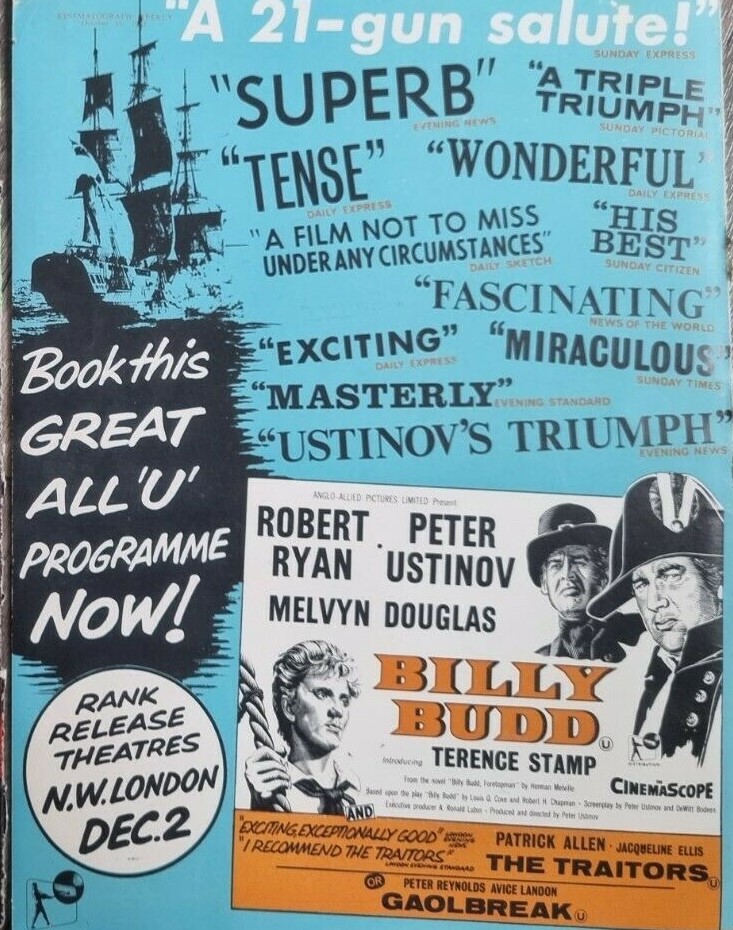
Unfairly muscled out by lavish roadshow Mutiny on the Bounty (1962) but covering similar territory minus sailors going off-piste on a South Pacific island. Peter Ustinov outranked fellow triple hyphenates Billy Wilder (writer, producer, director) and John Wayne (actor, producer, director) in that he could add acting to his other skills (writer, producer, director) and in some respects he was actually better remembered as a noted raconteur on late night television shows. I was surprised to discover he was actually well versed in the directing malarkey by the time he came to helm Billy Budd, four previous excursions dating from the late 1940s and most recently Romanoff and Juliet (1961). He was better known at this point as an Oscar-winner for Spartacus (1960). He would win another for Topkapi (1964) and go on to direct another three pictures.
Billy Budd is a claustrophic affair that you’ll need a bit of a history lesson to understand. The British Navy had two methods of recruiting sailors. The first was the more honest, awaiting a supply of volunteers. The second, the most dodgy legal proces ever invented, involved grabbing any likely candidate and forcing – “pressing”- them into service. Normally, this caper took place on land and gangs of recruitment officers did the business, hence the term “press gang.”
However, I was unaware that in times of war – this is set during the Napoleonic War – the British Navy could board any passing merchant vessel and commandeer any of its crew. In this case, Captain (actually Post Captain if you’re being technical about it) Vere (Peter Ustinov) hijacks only one sailor, Billy Budd (Terence Stamp).
Quite why it’s only this singleton is never explained. There are a couple of other irregularities that run against making this a tight ship in terms of narrative construction. The first is, that in the first of two critical incidents, our otherwise charming and chatty Budd is suddenly struck dumb with a stammer, the first time such an affliction has put in an appearance. The second is that, in consequence, Budd strikes an officer, the bullying Master-at-Arms Claggart (Robert Ryan) who hits his head while falling and dies.
Now even I know, and I’m hardly a naval scholar, that striking an officer is punishable by death. The fact that Claggart has a Capt Bligh disposition, inclined to find any opportunity to bring out the lash, makes no difference to the outcome. So while it seems that court martial provides dramatic scope, here the outcome is never in doubt. This isn’t Queeg on The Caine Mutiny, which is a more complicated affair, where the captain’s sanity is questioned.
So where the narrative should have built up in intensity, it largely flounders and depends (successfully as it happens) on audience appreciation of Budd as an innocent abroad.
That said, like Mutiny on the Bounty, it reveals the remarkable lack of recourse to any higher authority on ship should the highest authority either carry out or endorse cruelty. The minute he’s on the ship Budd is exposed to the sadistic will of Claggart who has condemned a sailor to a pitiless flogging for reasons that cannot be explained. Budd soon learns that Claggart has accomplices who will sabotage a crew member’s gear so that he will be put on a report, accumulation of sufficient black marks resulting in automatic flogging without interference from the captain.
While Vere is hardly in the Capt Bligh category and most of the time comes across as relatively amiable, our introduction to him is firing a shot across the bows of a merchant ship that doesn’t want to stop in case its crew is press ganged. He is quite ready to invoke the rules to get what he wants and is enough of a disciplinarian that the crew kowtow to him. He might feel a touch of remorse that Budd is the sacrificial lamb to the Royal Navy’s rule of law, but he’s hardly going to go against procedure.
So mostly what we’ve got is the acting. Terence Stamp (The Collector, 1965), in his debut, was Oscar-nominated and you can see why and in some senses this is the career-defining role before acting affectations and mannerisms took over. Robert Ryan (The Wild Bunch, 1969) is very effective as the sinister Claggart. And there are a host of other British names to look out for – David McCallum (Sol Madrid/The Heroin Gang 1968), Ray McAnally (Fear Is the Key, 1972), Paul Rogers (Three into Two Won’t Go, 1969) and Niall McGinnis (The Viking Queen, 1967) among the foremost.
Ably directed by Ustinov who wrote the screenplay with Dewitt Bodeen (Cat People, 1942) based on the original Herman Melville novel and a stage adaptation by Louis O. Coxe and Robert H. Chapman.
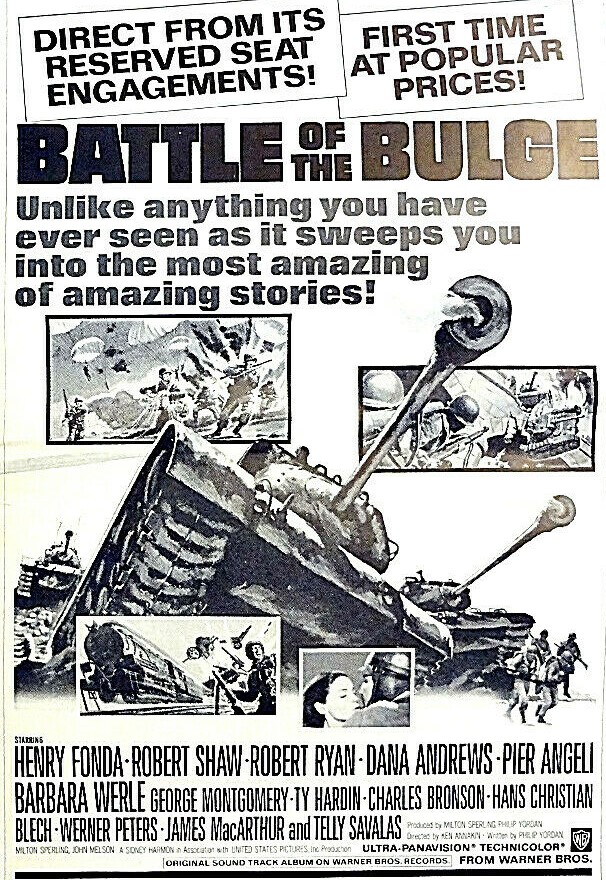
It was Hollywood’s worst nightmare. Two major studios – Columbia and Warner Brothers – were competing to make films about the Battle of the Bulge, one of the most famous episodes of the Second World War. Rival movies on similar or the same subject – classic examples You Only Live Twice (1967) vs Casino Royale (1967) or Deep Impact (1998) vs. Armageddon (1998) – risk cannibalising each other, each entry eating into the prospective audience of the opposition.
At first it seemed like the Columbia entry had the upper hand. Writer-producer Anthony Lazzarino had spent four years preparing The 16th of December: The Story of the Battle of the Bulge (the date referring to the start of the battle). Lazzarino’s project was endorsed by the U.S. Department of Defense which offered exclusive cooperation. Advisors were of the top rank – General Omar Bradley, General Hasso E. von Manteufel who had commanded the Panzers during the battle, British generals Sir Francis de Guingard and Robert Hasbrouck and Colonel John Eisenhower plus the cooperation of Eisenhower himself and Field Marshal Montgomery.
With a budget in the $6 million – $8.4 million range, and shooting was set to start in winter 1965, William Holden was lined up to play General Eisenhower and Kirk Douglas for General Hasso. Although initially intending to film in the Ardennes and Canada, ultimately the producers settled for the cheaper option of Camp Drum, one of the largest military installations in the U.S, a remote area in upper New York where the buildings could stand in for Bastogne, around which much of the real battle revolved, production there feasible because the Camp closed for winter. .
But that meant it would already be behind the eight-ball since Battle of the Bulge intended opening at Xmas 1965. Richard Fleischer (The Boston Strangler, 1968) was originally signed to direct. But he had become embroiled in a lawsuit with producer Samuel Bronston (El Cid, 1961, The Fall of the Roman Empire, 1964) whose production outfit had gone bust, killing off a deal for Fleischer to make The Night Runners of Bengal. The director was seeking g $910,000 in compensation.
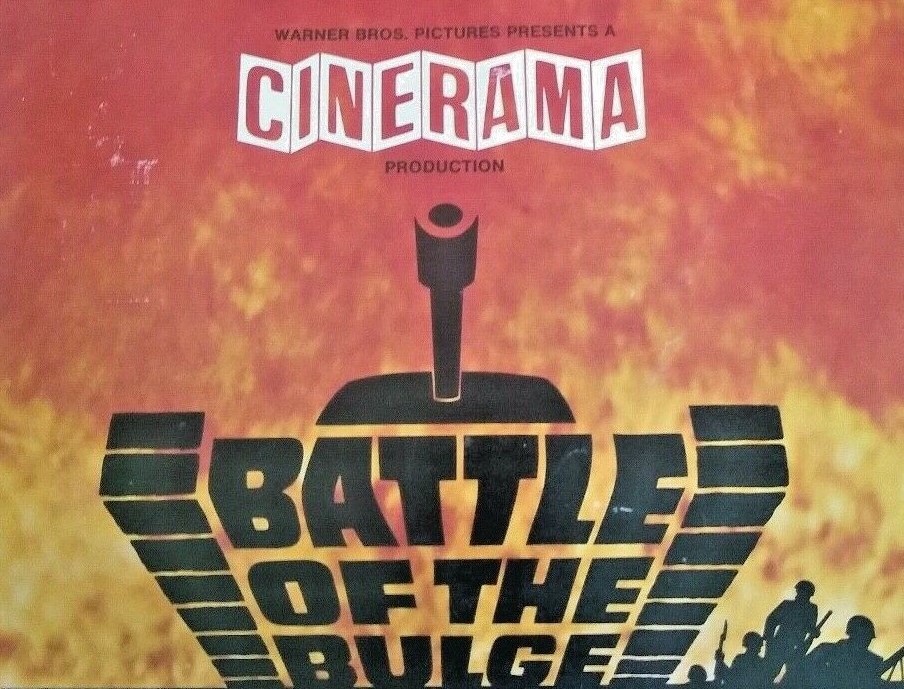
Warner Brothers had enlisted Cinerama as co-producer, the studio’s first involvement in the stunning widescreen process and the first time war was considered a subject. The process had been utilised in other Hollywood pictures most notably MGM How the West Was Won (1962), but that has been as a supplier of the equipment, and taking a small share of the profits. But now Cinerama planned to enter the production business and had contracted with WB to shoot the film in the single-lens process instead of the more complicated three-camera approach which had led to vertical lies on screens.
Neither company was in great shape. Cinerama had posted a $17.9 million loss in 1964, WB $3.8 million. But whereas WB had My Fair Lady on the horizon, Cinerama was less reaons for optimism. Its income stream relied on sales of its equipment, either for filming or projection, and a levy from every cinema using the process. Expansion was seen as key to renewal. With only 67 cinemas equipped to show Cinerama in the U.S. and only 59 overseas, a major program was underway to reach 230 by 1967. Setting up a production division would ensure there were enough films to feed into Cinerama houses, and since such films were intended as roadshows, they would keep the cinemas product-secure for months on end.
Cinerama planned to spend $30 million on five films – John Sturges western The Hallelujah Trail (1965) budgeted at $5 million, Battle of the Bulge ($.75 million) while $6.5 million had been allocated to an adaptation of James Michener bestseller Caravans, $6 million for Beyond the Stars which became 2001: A Space Odyssey (1968) and $7 million for Grand Prix (1966). Added to the list was epic William the Conqueror, due to film in England in early 1966 with Robert Shaw taking top billing.
The WB-Cinerama project, which had taken a year to negotiate, was to be filmed in Spain under the aegis of producer Philip Yordan, one time associate of Bronston who had built a mini-Hollywood there. Yordan, Bronston’s chief scriptwriter, had written the screenplay along with his co-producer Milton Sperling. Instead of seeking official support or reproduce the battle in documentary detail, Yordan and Sperling aimed for a fictional account that took in the main incidents. The cast would include “ten important stars.”
Just what constituted an “all-star cast,” one of the key ingredients of the roadshow phenomenon of the 1960s, was open to question. While The Longest Day (1962) boasted stars of the pedigree of John Wayne, Robert Mitchum, Richard Burton and Sean Connery, it was also liberally sprinkled with actors of no marquee value. David Lean in Lawrence of Arabia (1962) had loaded his film with the likes of Oscar winners Alec Guinness, Anthony Quinn and Jose Ferrer to offset unknowns Peter O’Toole and Omar Sharif as the leads. While The Great Race (1965) could boast Jack Lemmon, Tony Curtis and Natalie Wood, It’s A Mad, Mad, Mad, Mad World (1963) only had Spencer Tracy amid a host of television comedians.
But none of the stars of Those Magnificent Men in Their Flying Machines (1964) had successfully opened a major picture. Of the Battle of the Bulge contingent only Henry Fonda could truly be called a current star, although his box office star had considerable dimmed since the days of The Grapes of Wrath (1939) and Fort Apache (1948). Former stars Robert Ryan and Dana Andrews were now supporting actors, Ty Hardin was best known for television, Charles Bronson (The Great Escape, 1963) had not achieved top billing and while James MacArthur had done so that was in youth-oriented movies. Initially, Italian prospect Pier Angeli (Sodom and Gomorrah, 1962) was announced as “the only principal female role” – playing a Frenchwoman – for a touching scene showing the effect of war on innocent women caught up in the conflict.
Just before filming was about to start, Fleischer pulled out, citing differences of opinion with the producers. Yordan turned to British director Ken Annakin, who had helmed the British sequences in The Longest Day and Those Magnificent Men in Their Flying Machines. There was soon a double whammy. Realizing he was losing ground, and hoping to sabotage its progress, Larrazino sued WB for $1 million, claiming that “another film, less accurate, would be confused with his picture.” Just as filming of the Battle of the Bulge got underway in January 1965, it was hit by a temporary restraining order. While failing to shut down the production, it imposed a marketing blockade. WB was prevented from publicising its picture, a potentially major blow given how dependent big budget roadshows were on advance bookings which could only be generated by advance publicity.
Annakin’s immediate response to the opportunity was delight. He commented that he had a “lot of toys to play with.” He found inspiration for his approach from an unusual source, the Daleks (“an apparently irrevocable onslaught of metal monsters”) from the BBC television series Dr Who. He decided he would use Cinerama as “a kind of 3D, shooting in such a way that the tanks would loom up as monsters against humans whom I would make small and puny.”
Although he had no influence in the casting, Annakin was already familiar with some of the actors, James MacArthur from Swiss Family Robinson (1960) and Werner Peters and Hans Christian Blech from The Longest Day. He did not receive such a warm welcome from Robert Shaw whom he had rejected for a role in The Informer.
He found Fonda “a remarkable professional…always on time, patient, eager to get to work, and always knew his lines.” He confessed to being a reluctant movie actor, preferring the stage, and had not been a big office draw since his work with John Ford in the 1930s and 1940s. Even critical successes like Twelve Angry Men (1957) had lost money, some of it the actor’s own, and prestige movies like The Best Man (1964) and Fail Safe (1964) failed to attract sufficient audiences. “In the theatre,” he said, “the actor achieves fulfilment from beginning to end. But on a picture you create a minute here and a minute there over a twelve-week period. When it’s finished there’s no recollection of what you did…Films are a director’s medium.” Battle of the Bulge was his 59th picture, after completing a supporting role in Otto Preminger’s In Harm’s Way (1965) and taking second billing to Glenn Ford in modern western The Rounders (1965).
There was a stand-off with Bronson on his first day after the actor kept the crew waiting while fiddling too long with his costume. Ty Hardin (television’s Bronco, 1958-1962) was accident-prone, tumbling into a frozen river in full kit, and whacking the director’s wife in the face with his helmet. Dana Andrews had a drink problem so that in some scenes Fonda and Ryan would be surreptitiously holding him up. But such veteran actors could improvise their way round scenes and “give me hints and lead me into changes.”
Andrews was enjoying career resurgence. His movie career was at a standstill, a ong way from a peak like Laura (1944). But his last significant top-billed parts were over a decade gone. “I was starting to get nothing for a while but offers came swarming in when I told my agent to go ahead and try from Walter Huston parts.” After only televisions roles in the four years since Madison Avenue (1961), Battle of the Bulge would mark his eighth role in 1965, including The Satan Bug and In Harm’s Way.
Winter in Spain was cold which meant it provided the ideal backdrop for the WB version. The chosen location, 4,500ft high in the mountains of Segovia provided identical conditions to the actual battle. Spain had provided 80 tanks including Tigers mounted with 90mm guns and Shermans. Half of the 20-week shoot would be spent in Segovia with interiors filmed at studios in Seville and the Roma facility in Madrid. The WB adviser was General Meinrad von Lauchert, a divisional tank commander during the battle. He hoped the picture would show the German solider “as he was, brave and good” rather than clichéd presentation and not give the “impression that the American Army had nothing to do but walk into Germany.”
He wanted the film to reflect the truth that the “Americans had to pay a high price for every yard.
Extras were drawn from the Spanish village of El Molar, with a population of just 2,400, which specialised in that supply. Locals could earn 200 pesetas a day. A pair of tavern owners had established this lucrative side-line, demand so high at this point that “they can play Russian World War One Deserters for Doctor Zhivago (1965) one day and shipped to World War Two the next for Battle of the Bulge.” Whenever Annakin found himself in trouble with the script he turned to the senior actors, Fonda, Ryan and Andrews who could improvise their way round scenes and “give me hints and lead me into changes.”
For the first scene, a week’s worth of white marble dust, representing snow, had been spread over the ground before 40 tanks emerged from a pine forest. But just as the cameras begun to turn, unexpectedly, against all weather forecasts, it began to snow. While initially a boon, when it continued to fall for five weeks the snow turned into a liability. Nobody was prepared for snow, not to the extent of snowploughs or even salt and it was a three-mile hike uphill to reach the tank location until army vehicles could be used to transport the crew. The tanks churned up so much mud that three or four cameras were required to catch the action.
“It was a director’s feast,” recalled Annakin, salivating about the prospect of a “vast panoramic” employing the entire array of tanks. To speed production, he had two units one hundred yards apart and jumped from one to the other, thus achieving 30-40 set-ups a day while the effects team exploded tubes and burned rubber tyres to create a fog of black battle smoke. A small town, already wrecked and shelled from the Spanish Civil War, added an air of realism when standing in for Bastogne.
Midway through shooting the producers realised the movie lacked a theme and from then on Annakin was faced with daily rewrites as new scenes were added to bring out the humanity implicit in war. Then Cinerama boss William Foreman arrived and demanded the insertion of the type of shot he believed his audiences were expecting, the equivalent of the runaway train and the ride through the rapids in How the West Was Won. He angled for a jeep racing downhill or a plane spinning and diving and happy to stump up any extra costs.
Such a request was more easily accommodated than his insistence that a role be found for his girlfriend Barbara Werle. a bit part actress Tickle Me (1965). While Yordan, wearing his producer’s hat, was willing to keep one of his main funders happy, the director and Robert Shaw were not. Shaw refused to do the scene until Foreman pleaded with both, explaining that in a vulnerable period of his personal life – when, in fact, he had been imprisoned – Werle had helped him out and he owed her a favour.
In Annakin’s opinion Werle was “willing but completely dumb…as though you had picked a girl straight from the cash desk of a supermarket.” Her one scene, as a courtesan offered to Robert Shaw by a grateful superior, was used to mark out the German commander as a man of honour when he rejection such temptation out of hand.
To overcome problems of matching earlier Panzer footage with the climactic battle to be shot on the rolling hills of Campo – in the earlier shots the ground was covered in snow, but now it was summer and the ground was scorched by the sun – Annakin relied on aerial shots, shooting downwards, “keeping as close as possible so as not to reveal what the terrain actually looked like” while on the ground two units shot close-ups of the action. The action was augmented by 30 model shots with miniature explosions.
When shooting was completed, there was a race to get the movie ready for its schedule launch, on December 16, 1965, the 21st anniversary of the start of the battle. There were ten weeks left to do post-production. Four editors had already been working on the material but Yordan asked Annakin, who had not been near a moviola for two decades, to personally edit the climactic battle scene. The director found the experience exhilarating: “matching my location footage with miniature shots; a four-foot helicopter (i.e. aerial) shot cut with a couple of feet of a U.S tank rounding rocks to face a Panzer; a shot of Telly Savalas at his gun site yelling ‘Fire’ intercut with a miniature tank blowing up.” But all his intricate work never made it into the final cut. Another editor fiddled around with the material and since no one had thought to make a dupe of Annakin’s original it was lost.
Although the challenge from Lazzarino had died away, the Pentagon was unhappy with the amount of time allocated to the German perspective. Yordan had the perfect riposte, pointing the finger at Annakin and saying “see what happens when you get a limey director.”
Werle had the last laugh. She was billed sixth in the credits (Angeli came fifth) but in the same typeface as Fonda, Shaw, Ryan and Andrews, and above the likes of Bronson, MacArthur and Hardin who not only all had substantially greater screen experience but had a bigger impact in the movie.
With the smallest part of all the listed stars, nonetheless she managed to turn the experience to her advantage, introduced to the press part of the marketing campaign and attending the world premiere at the Pacific Cinerama on December 16, 1965 in Los Angeles and the New York premiere the following day, brought forward four days, at the Warner Cinerama. In Los Angeles she arrived in true style at the head of a marching brigade of 100 service men.
SOURCES: Ken Annakin, So You Wanna Be A Director (Tomahawk, 2001) p167-181; “Du Pont, Bronston, Co-Defendants,” Variety, July 22, 1964, p4; “Schenck-Rhodes Roll Battle of Bulge at Camp Drum in U.S.” Variety, July 22, 1964, p42; “German Military Sensitivity,” Variety, September 23, 1964, p32; “Columbia Will Distribute Battle of Bulge Film,” Box Office, September 28, 1964, p18; “Plan Battle of Bulge As Cinerama Film,” Box Office, November 23, 1964, p4; “Tony Lazzarino To Produce The 16th of December,” Box Office, December 16, 1964, p4; “Rival Battles of Bulge; Bill Holden Up for Ike in Lazzarino Version,” Variety, December 16, 1964, p5; “Warner Reports Loss of £3,861,00,” Variety, December 23, 1964, p5; “L.A. Court Has Its Battle of Bulge Hearing, 27th,” Box Office, January 25, 1965, pW-2; “Dana Andrews Strategy: Regain Momentum,” Variety, March 10, 1965, p3; “Battle of Bulge Now Being Lensed in Spain,” Box Office, March 15, 1965, pNE2; “Winter in Spain Cold But Correct for Bulge Pic,” Variety, March 17, 1965, p10; “Cinerama Plans Five Films to Cost $30 Mil,” Box Office, April 19, 1965, p13; “For Actor Satisfying Legit Still Beats Pix, Reports Henry Fonda,” Variety, May 3, 1965, p2; “London Report,” Box Office, May 3, 1965, p8; “One Girl in WB Bulge,” Variety, May 5, 1965, p20; “Battle of Bulge Pic May Roll Next Winter,” Variety, May 5, 1965, p29; “El Molar, Spain’s Village of Extras,” Variety, May 12, 1965, p126; “Cinerama Report Loss,” Variety, May 13, 1965, p15; Advert, Box Office, July 12, 1965, p22; “WB To Film Cinerama Epic in England,” Box Office, October 11, 1965, p11; “Introduce Barbara Werle,” Box Office, October 18, 1965, pE3; “Battle of Bulge Opens N.Y. Now Dec 21,” Box Office, October 18, 1965, p10; “Actress To Attend Bows of Bulge in L.A., N.Y.,” Box Office, December 6, 1965, pW4.
Cinerama was the IMAX of the day and far superior in my view in many aspects not least the width of the screen. IMAX goes for height but I’m not convinced that compensates for lack of the widest screen you could imagine. So the chance of seeing this in the original Cinerama print, 70mm and six-track stereo, at the annual Bradford Widescreen Festival yesterday was too good to miss. And so it proved. A thundering experience. Much as I enjoyed it on DVD, this was elevated way beyond expectation.
Superb even-handed depiction of war, far better than I remembered. Most war films of this era and even beyond showed the action primarily from the view of the Americans/British – even the acclaimed The Deer Hunter (1978) and Apocalypse Now (1979) show nothing of the skills of the Vietnam forces that would prove victorious. And while The Longest Day (1962) shows reaction to the invasion, the Germans are revealed as caught on the hop. Given the basis for this picture is the unexpected German offensive in the Ardennes, France, in December-January 1944-1945, you might expect the Germans to be accorded some attention. But hardly, given as much of the picture as this, so that in the early stages the Germans are portrayed as powerful, clever and patriotic while the Americans are slovenly and complacent, their greatest efforts expended on preparing for Xmas.
With tanks the main military focus, Cinerama is deployed brilliantly, the ultra-wide screen especially useful as the unstoppable vehicles rampage through forests and land and allowing true audience involvement when opposing armies meet head-to-head. Of course, it being Cinerama, there are a couple of scenes that play to the strength of this particular screen, a car careening round bends and a train racing along twisting tracks, the kind of scenes that previously would have had the audiences out of their seats with excitement, but here mainly used to raise the tension in the battle.
It’s to the film’s benefit that the all-star cast doesn’t feature a single actor who is truly a star in the John Wayne/Gregory Peck/Steve McQueen mould so that prevents the audience rubbernecking to spot-a-star that afflicted The Longest Day. The biggest name, technically, is Henry Fonda, and although he received top billing in many pictures, you would have to go back to The Wrong Man (1956) to find an actual box office hit. The only previous top billing for Robert Shaw (From Russia with Love, 1963) had been in The Luck of Ginger Coffey (1964), a flop few had seen. And the top-billing days of Robert Ryan (Horizons West, 1952) and Dana Andrews (Laura, 1944). In fact, the actor with the biggest string of hits was Disney protégé James MacArthur (Swiss Family Robinson, 1960). Anybody who had seen The Magnificent Seven (1960) and The Great Escape (1963) would recognise Charles Bronson in a supporting role. So fair is the movie that it’s the blond-haired Shaw who steals the show with a dynamic performance.
So it helped the almost documentary-style of the film that it was filled with familiar faces rather than dominant stars and the director was not bound to give a star more screen time or provide them with one brilliant scene after another, or establish a redundant love story in order to provide them with more emotional heft. In fact, the only romance goes to a sly black marketeer who views his relationship more as a business asset.
Initially, the role of Lt. Col. Kiley (Henry Fonda), a former cop, seems only to be to rile his superiors General Grey (Robert Ryan) and Colonel Pritchard (Dana Andrews), his pessimistic view contrasting with the accepted notion that the Germans are well and truly defeated and the war would be over soon. On airplane reconnaissance he takes a photograph of an officer later identified as Panzer tank genius Colonel Hessler (Robert Shaw). While Grey and Pritchard over-ride his conclusions, the movie concentrates on the German build-up, their discipline, efficiency, leadership and determination juxtaposed to the American inefficiency and sloppiness.
Where the Americans just want to get home, Hessler – more charismatic than any of the dull Yanks – is in his element, wanting the war to never end, convinced at least that a tank-driven assault would drive a wedge between the Allied forces, and reaching the target Antwerp in Belgium in the north would extend the war by another year by which time Germany’s V2 rockets would give them greater firepower. The Germans also have a clever idea, the type that the British were always coming up with and would make a film of its own, of parachuting American-born Germans behind enemy lines, dressed in American uniforms to carry out vital sabotage and hold crucial bridges across the River Meuse.
In one of the best scenes in the film, his tank commanders spurt spontaneously into a patriotic song with much stamping of boots. And while Hessler’s immediate superior (Werner Peters) , ensconced in a superior bunker, can enjoy a comfortable lifestyle, no more illustrated by the fact that he has courtesans to hand, one of whom, offered to Hessler, is furiously dismissed. And the clock is ticking, the Germans have limited supplies of fuel and must reach the enemy’s supply dumps before they run out of gas.
The maverick Kiley manages to be everywhere – the River Meuse bridge, in the air in the fog determinedly hunting for the panzers he believes are hidden, is the one who realises how critical the fuel situation is for the enemy, and at the fuel depot for the movie climax. Otherwise, the picture uses its cast of supporting characters to cover other incidents, the massacre of prisoners of war at Malmedy, the chaos as the Germans over-run American-held towns.
Best of all is the human element. It would be easy on a picture of this scope to lose emotional connection, as you would say was the prime flaw of The Longest Day. Not only is Kiley the outsider trying to beat the system, but we have the cowardly Lt Weaver (James MacArthur) who would rather give up without a fight than lose his life, the weaselly Sgt. Guffy (Telly Savalas) representing the worst instincts of the grunts, the confused General Grey can’t make up his mind how to respond to the sudden attack, and Hessler’s driver Conrad (Hans Christian Blech) who is fed up with paying the price of war.
The action scenes are outstanding. If you’ve never been up against a tank in full flight, you will soon get the idea how fearsome these metal battering rams are, as the rear up, crash over trees, race across open fields, and either with machine gun or shells wreak havoc. As with the best war films, you are given very precise insights into the battles, the tactics involved, the ultimate cost. Wolenski (Charles Bronson) is in the thick of the fighting.
While Robert Shaw is easily the biggest screen personality, Henry Fonda is solid, and holds the various strands of the picture together, while Charles Bronson enjoys a further scene-stealing role. But the pick of the acting, mostly thanks to bits of improvisation, is Telly Savalas (The Slender Thread, 1965) as the thieving Guffy. In one memorable scene he kicks out in resentment at his collection of hens and in another shakes his body at the tanks. No one else, beyond Shaw, comes close to his infusing his character with elements of individual personality.
Pier Angeli (Sodom and Gomorrah, 1962) as Guffy’s mistress and Barbara Werle (Krakatoa, East of Java, 1968) as the courtesan are inexplicably billed above Charles Bronson, Telly Savalas and James MacArthur perhaps in a ploy to deceive audiences into thinking there was more female involvement.
Full marks to British director Ken Annakin (The Biggest Bundle of Them All, 1968) for visual acumen and for simplifying a complicated story and peppering it with human detail. His battles scenes are among the best ever filmed. Credit for whittling down the story into a manageable chunk goes to Philip Yordan (The Fall of the Roman Empire, 1964), Milton Sperling (The Bramble Bush, 1960) and John Melson (Four Nights of the Full Moon, 1963).
A genuine classic, with greater depth than I ever remembered.
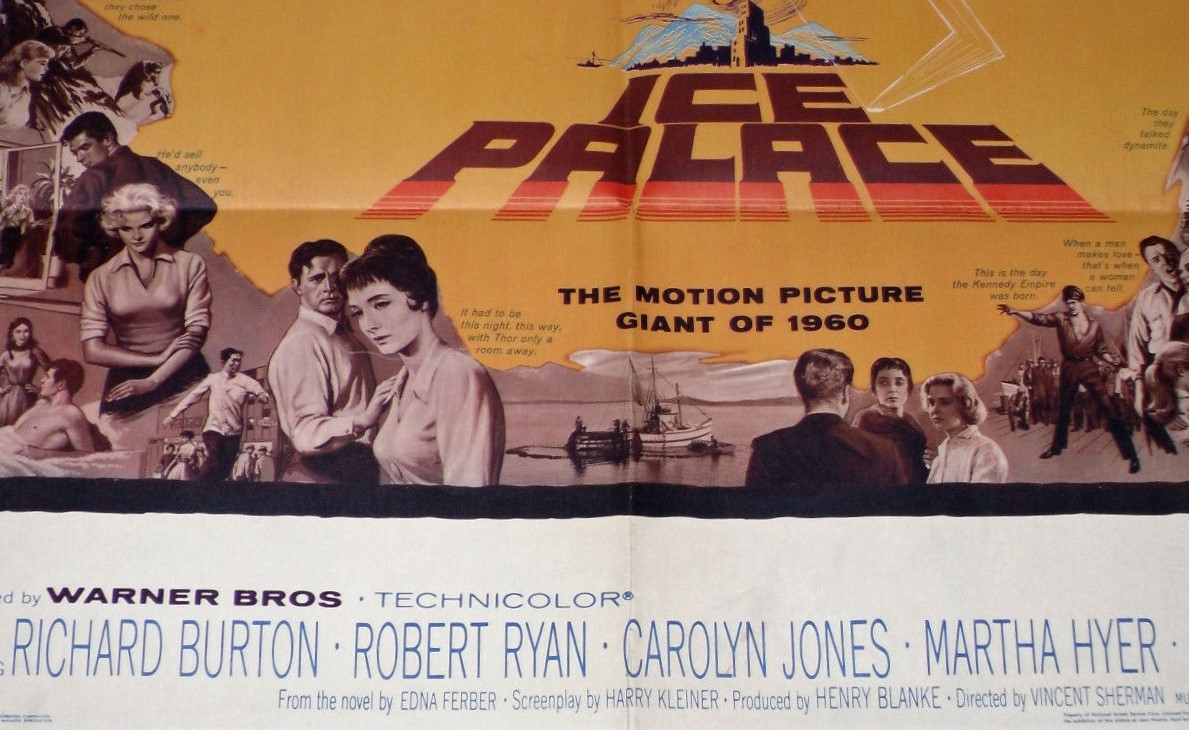
Adaptations of sprawling novels require a firm hand at screenplay stage. Exodus (1960), for example, excised the first couple of hundred pages depicting the first two millennia relating the history of the Jews in the Leon Uris bestseller. Hawaii (1966) sliced the James Michener epic in two, the sequel The Hawaiians (1970) taking up the slack. Otherwise, like here, you end up with a multi-generational sprawl.
The producers clearly felt that the endzone – two grandfathers warring over a grand-daughter that was also somehow a metaphor for the battle for Alaskan statehood – was too good to miss. Except author Edna Ferber (Giant, 1956) had already dealt with that problem, in her book beginning at the end, where feminist icon Christine Storm is given a voice and the story unfolds in flashback. Instead, it’s Christine who has to wait ages to make an appearance and scarcely in the manner outlined by the novelist.
Initially, ex-World War One soldier Zeb (Richard Burton) and Alaskan fisherman Thor (Robert Ryan) become friends after the latter saves the former from drowning, Zeb having lost his job in a cannery for fancying boss’s daughter Dorothy (Martha Hyer). The pair then decide to go into business together, Thor catching the salmon, Zeb canning them. But illicit love tears the incipient partnership apart, Thor’s fiancée Bridie (Carolyn Jones) falling for Zeb.
Finding banks are against funding a nobody, Zeb hits the mother lode in capitalizing his business by marrying the wealthy Dorothy, while a distraught Thor hits the snowy wastes and returns with an Eskimo son. Bridie hangs around long enough to sew the seeds of suspicion and take a hand in bringing up the baby, though holding back on the marriage that might seal the deal.
So then we are quickly onto the second generation. Thor’s son Einer (Barry Kelley) and Zeb’s daughter Grace (Shirley Knight) elope to the snowy wastes where, guess what, she gets pregnant, but, guess what, he is killed by a bear and she dies giving birth to Christine (Diane McBain).
So that takes us to the final act, Dorothy now also conveniently dead, grandfathers sharing custody, and the metaphor for the birth of Alaska in full swing. Zeb, now a greying ruthless industrialist who finds it easier to feed his multiple canneries by catching fish in traps as they exit the Alaskan rivers, opposes statehood, fearing legislation will curb his entrepreneurial tendencies and that, more to the point, he will be hardest hit by the taxation required to fund the government apparatus. Thor, meanwhile, has turned greying politician, fighting Zeb every inch of the way, Christine now mere collateral damage.
An Australian daybill hence the date “1961” rather than “1960” the date it appeared in the U.S.
It’s certainly a full-throated melodrama, and might have worked better if it had skipped a generation and got to the warring grandparents sooner, or worked the love triangle up to a higher pitch, but that might have felt like the bloodbath required to kill off Dorothy, Einer and Grace would have looked even more calculated. And it could have done with more actual high drama, fishermen battling mighty waves on the high seas, for example, as in The Perfect Storm (2000), and to be honest watching caught salmon shooting along cannery travelators is no substitute.
The other problem is that neither Richard Burton (Becket, 1964) nor Robert Ryan (The Wild Bunch, 1969) has settled into their screen persona. In the former’s case it’s the voice. Except in fleeting instances, we are deprived of his whisky-sodden sonorous tones. In the latter it’s the stillness, all the work done with the eyes or a grimace instead of an overworked marionette, body jumping, arms pumping. In both cases, and with the entire cast for that matter, there’s over-reliance on flashing eyes, a mainstay of overwrought melodrama.
If you’re searching out subtlety you’d have to watch the women, the look on Dorothy’s face on first meeting Bridie and recognizing a rival, the various expressions on Bridie’s face – for virtually the whole picture – as she observes the unobtainable Zeb grow even more distant, and Grace as she realizes she is being duped into a marriage of political convenience. And with so much story to pack in, the best scene in the picture just whizzes by, when, in the absence of the town doctor, Bridie is called upon to be midwife to Zeb’s child, knowing that it should, if only she had the courage at the time, be hers.
The Alaskan statehood element was, I imagine, lost on non-American audiences, the statehood metaphor probably lost on everyone except discerning critics, and as far as I can work out from the box office nobody anywhere gave two hoots for the picture. Bear in mind Richard Burton was far from a major star, having burned his boats after star-making roles in The Robe (1953) and Alexander the Great (1956) failed to provide the necessary glue to bind actor and moviegoer. In fact, Burton was so little in demand he was scarcely making a movie a year – and only The Robe entered positively in the box office balance sheet – until Cleopatra (1963) revived his career.
So with a cut-price Burton and an over-extended Robert Ryan there’s little the women can do to rescue the picture, though Carolyn Jones (How the West Was Won, 1962), Martha Hyer (The Sons of Katie Elder, 1965), the debuting Diane McBain (Claudelle Inglish, 1961) and Shirley Knight (The Group, 1966) put in more heartfelt performances.
Vincent Sherman (A Fever in the Blood, 1961) directed from a screenplay by Harry Kleiner (Bullitt, 1968). One look at the gem George Stevens created from Giant and all you can see here is missed opportunity.
Far grittier than I expected for a portrayal of one of America’s greatest, if flawed, western heroes. Far darker, with a two-fisted take on the endemic corruption at the highest level that fuelled the Indian Wars. Revisionism with a punch. And bold enough to turn Cinerama tropes on their head.
We should deal with the last first because that reveals the extent of the bitterness that seeps through a biopic in which a soldier’s great skills are put to unwarranted use. You may recall that from its earliest days, Cinerama relied on thrills of a specific nature, one that like 3D put viewers in the driver’s seat, only to scare the pants off them. You were always racing towards danger, whether that be down the rapids in How the West Was Won (1962) or downhill along twisting roads in The Battle of the Bulge (1965). There always seemed a runaway train to hand. Whatever, it was just a thrill ride, occupants escaping unhurt.
Not so here. The men on the runaway wagon have been tied to it. It careens downhill all right, at one point from an upside down point-of-view, but it ends up over the cliff, no escape for the men. A soldier rides a log river to escape Native Americans. He manages that but is killed on dry land by an arrow all the same. A runaway train falls into a burning bridge. The normal thrills, then, with a realistic edge.
The reward for the great hero, Custer (Robert Shaw), gallant leader of sixty dashing cavalry charges during the Civil War, is a commission with the 7th Cavalry in the Dakotas on a mission described by General Sheridan (Lawrence Tierney) as “plain robbery,” the blatant theft of land from Native Americans.
That’s virtually the first scene, a brutal analysis on the American West, greedy land-guzzling settlers requiring protection, a soldier in obeying orders tacitly agreeing to wage an unholy crusade, not a justified war against slavery.
And Custer doesn’t inherit your John Ford cavalry unit, where every drunk has redeeming features, if only to provide some comedy. His second-in-command, Major Reno (Ty Hardin) is an alcoholic, nearly an entire battalion of malingerers on sick parade. Although later spouting chivalrous nonsense about hating machines, it’s the cannon Custer brings to bear on the enemy that provides initial victory, permitting the boast that 255 men conquered the Cheyenne nation. But, of course, such triumphalism proves premature, the Cheyenne and Sioux taking revenge on defenceless towns.
Custer is presented with ambivalence, but granted something of a free pass given his intolerance of alcohol, antipathy to the war and whistleblowing that points the finger at government officials and corrupt businessmen. On the other hand he is the chief marketeer of his own image, vainglorious, not least in his determination to win the Battle of the Little Big Horn on his own, arriving a day ahead of other assigned forces.
He is both ruthless and comforting. Instead of upbraiding a mutinous soldier for stealing water during a trip over the desert, he tells him to wait till sundown when his thirst will be quenched. But, despite repeated broken treaties, he lacks sympathy for Native American chief Dull Knife (Kieron Moore) for failing to comprehend that a superior power will always win. There’s a bit too much crammed into a relatively short running time. A Russian appears to point out that the United States is negotiating to buy Alaska. Railroads enter the equation and an early version of a tank. An anonymous prospector has gold teeth because he likes “the taste of gold.” Robert Ryan makes a cameo appearance as a deserter.
All that is redundant when the venality confronting Custer is dealt with in one brilliant scene when gold prospectors start digging up the fort in the hope of finding the precious mineral.
I’m no expert on the historical accuracy but by and large whether this portrayal of the life and times of General Custer is actually true it certainly rings true.
British actor Robert Shaw (Battle of the Bulge), with his mean shifty eyes and trademark tight-lipped side-of-the-mouth delivery, doesn’t quite bring enough shade to the characterisation, but possibly that’s the fault of the screenplay, which has cast him, outside of the final calamitous engagement, as even more heroic in the political arena than on the battlefield. As his wife, Mary Ure (Where Eagles Dare, 1968) appears only fitfully and has little to do. Lawrence Tierney (Reservoir Dogs, 1992) is excellent as the self-serving Sheridan. Just like the later Cinerama epic Krakatoa East of Java (1968) this suffers from lack of recognizable stars.
Director Robert Siodmak (The Crimson Pirate, 1952) creates a literate, revisionist, western that ensures intelligence is not swamped by action. Bernard Gordon (Krakatoa East of Java) and Julian Zimet (Circus World/The Magnificent Showman, 1964) are credited with the screenplay.
A worthy attempt to use a legend to explore the greater issues of the day.
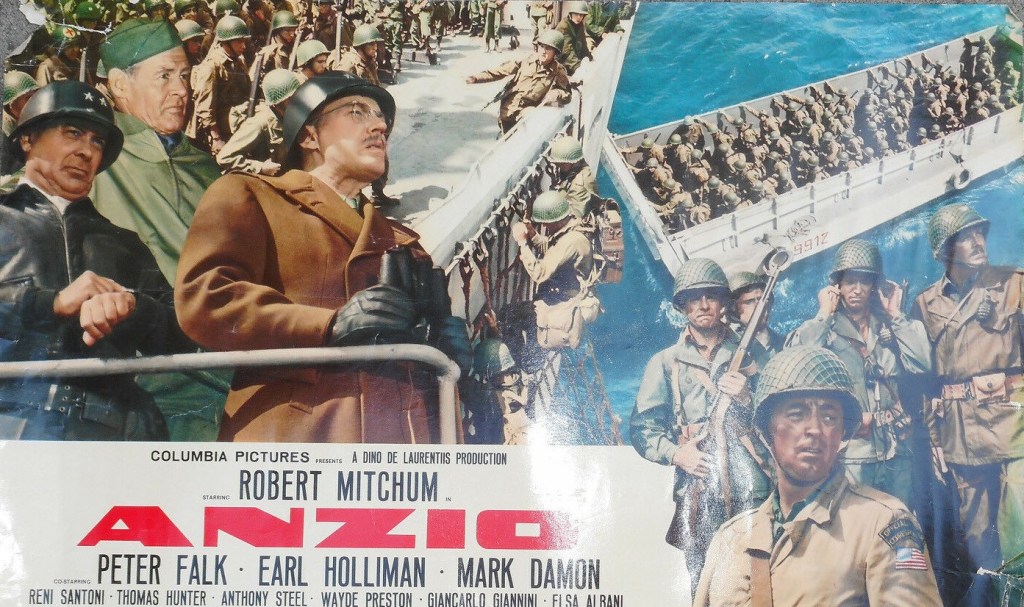
Seems you couldn’t make a moive about defeat in the 1960s, you had to find something in the story that sounded victorious. Although the Allied landings at Anzio in January 1944 eventually led to the liberation of Rome, the whole operation was a mess. So instead of concentrating on outnumbered American and British troops being pounded to pieces on the beaches, director Edward Dmytryk (Alvarez Kelly, 1966) opts for the men-on-a-mission angle.
Somewhat bizarre is the insertion of war correspondent Ennis (Robert Mitchum) into the story. Sure, because he’s not going to get busted for insubordination, he can challenge and/or lambast fictional commanding officers General Carson (Robert Ryan) and Major General Lasky (Arthur Kennedy) but it seems odd that he goes around spreading anti-war sentiment when the people escorting him are in serious danger of ebing killed. On the plus side are three sequences depicting the brutal reality of war in a way that no other picture of the period dared.
After landing unopposed Laskey decides not to risk moving forward, leaving his troops open to being trapped by advancing Germans even though Ennis, after commandeering a jeep, managed to reach Rome with encountering any opposition.
A Ranger battalion is sent to scout the surrounding countryside and the movie chooses to concentrate on a small platoon unit within that, headed by Sgt Stimmler (Earl Holliman) and including the fun-loving Corporal Rabinoff (Peter Falk), the kind of guy who spends the night before the landing entertaining three sex workers in the back of stolen ambulance who are of course desperate to learn the words to “Bye, Bye, Blackbird.”
After the Rangers are cut to pieces at the Battle of Cisterna, the unit escapes through a minefield, discovers a massive German construction site, holes up in house with three Italian women, is pinned down by snipers in a field of shell-holes and finally makes it back.
American tropps being slaughtered at Cisterna is a helluva note as the movie switches tack from exposing leadership folly to just getting the platoon out of this mess. Pursued by a flame-throwing Panzer, they pick their way through a minefield using the quite clever device of lobbing onto it large chunks of stone and then walking across on the stones as if crossing a dangerous river.
Wanting to find out more about the mysterious construction work results in Ennis causing the death of one of the gang. When they hide out in the Italian house, eventually killing off investigating Germans, the naïve Ennis wants to take the women with them.
Bit of marketing sleight-of-hand. Slinging a whole bunch of faces at the bottom of a poster was shorthand for all-star cast, which this picture definitely lacked.
Trapped by snipers in open country, they are being picked off one by one with only clever tricks and sacrifice offering a way out. One of the notions is to throw a fake grenade the snipers’ way. The instant reaction to any soldier to an incoming grenade is to get the hell out of the way, turning themselves into a turkey shoot. But the only other way to entice the snipers to reveal themselves is for the soldiers to take turns in presenting themselves as targets.
One of the ongoing themes of the picture is Ennis refusing to bear arms, and although the trailer shows him blasting away with a machine gun that only occurs at this climax when he seizes the weapon from a dead German. Ennis is an odd character for a war picture. None of the soldiers can believe anyone would not just volunteer to participate in a bloody war but carry nothing to defend themselves with. It’s a bit tiresome to hear him being reminded that he doesn’t have to be here, and to turn down the offer or a rifle or a grenade.
And for a non-combatant he’s not exactly uninvolved in strategic matters. A couple of times, as if he’s the most entitled grunt you ever came across, he virtually assumes command, barking orders that the others obey. Admittedly, it’s his cleverness that gets them through the minefield, but it’s his stupidity that gets others killed and to have him pontificating at the end that men go to war “because they like it” is incredibly facile, although in keeping with the anti-Vietnam sentiments of the time (1968, that is, not 1944).
Rabinoff, the only other character about whom we learn anything, is unfortunately on the preposterous side.
While the movie is far from dire, and as I said, very realistic when in portraying war actuality, it’s not the picture I guess audiences expected. While the scene-stealing of Peter Falk (Penelope, 1966) gets in the way, Robert Mitchum (5 Card Stud, 1968) proves an interesting character, although he is also laden down by having to spout a bunch of dumb lines. Arthur Kennedy (Fantastic Voyage, 1966) is the pick, especially at the end facing up to the ignominy of being relieved of command.
This kind of movie is potentially a breakout for the supporting cast. But here, with the exception of Falk, the script lets them down, nobody given the kind of distinctive characterisation that elevated The Dirty Dozen (1967), for example, above the norm. Apart from Earl Holliman (The Power, 1968) and Italian Giancarlo Giannini (The Sisters, 1969) this was not a career-making movie. You can spot Mark Damon (Dead Men Don’t Count, 1968), Patrick Magee (A Clockwork Orange, 1971), Anthony Steel (The Story of O, 1975), Rene Santoni (Guns of the Magnificent Seven, 1969), Wolfgang Preiss (Von Ryan’s Express, 1965) and Robert Ryan (Battle of the Bulge, 1965).
Edward Dmytryk (Mirage, 1965) does a reasonable job with the materials to hand, and the minefield and sniper scenes are first class. Italian veteran Duilio Coletti (Under Ten Flags, 1960) directed the Italian version though I’ve no idea what that was, or if it differed in any way from the Dmytryk cut. Coletti also had a hand in fashioning the screenplay along with H.A.L. Craig (Fraulein Doktor, 1969), Frank De Felitta (Audrey Rose, 1977) and Giuseppe Mangione (Run, Psycho, Run, 1968).
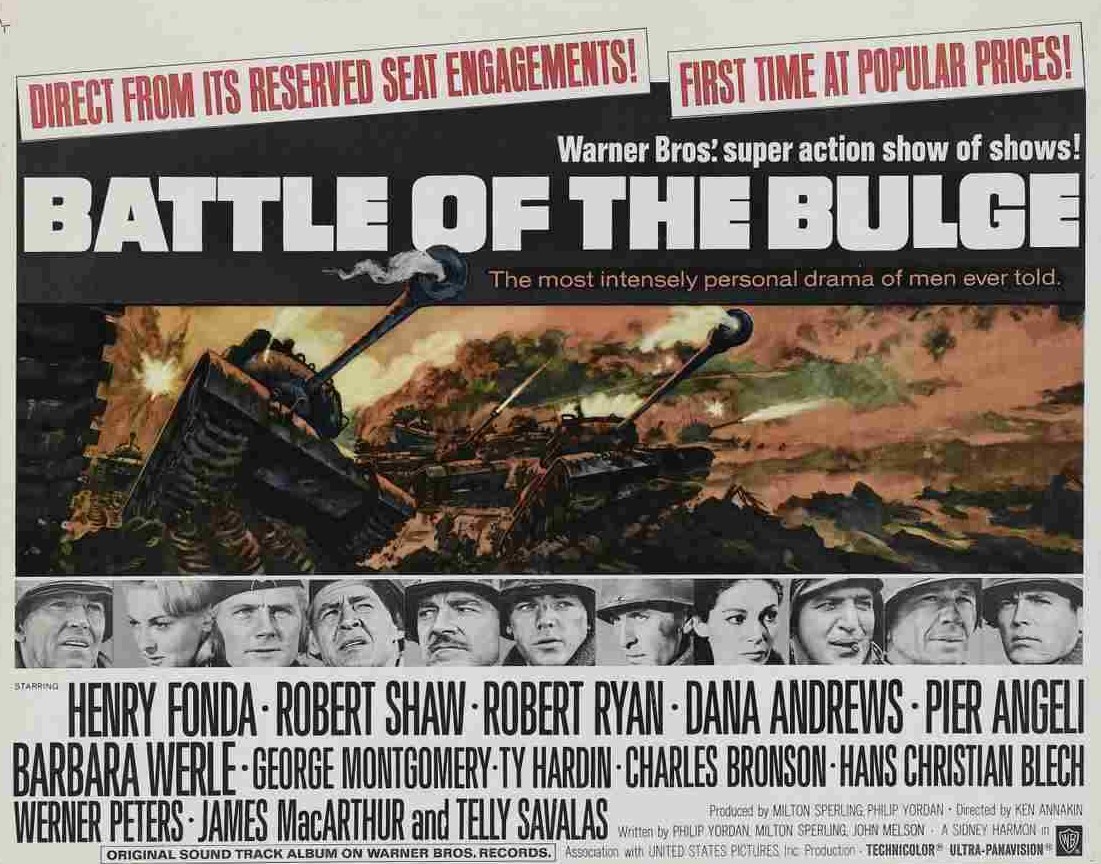
It was Hollywood’s worst nightmare. Two major studios – Columbia and Warner Brothers – were competing to make films about the Battle of the Bulge, one of the most famous episodes of the Second World War. Rival movies on similar or the same subject – classic examples You Only Live Twice (1967) vs Casino Royale (1967) or Deep Impact (1998) vs. Armageddon (1998) – risked cannibalizing each other, each entry eating into the prospective audience of the opposition.
At first it seemed like the Columbia entry had the upper hand. Writer-producer Anthony Lazzarino had spent four years preparing The 16th of December: The Story of the Battle of the Bulge (the date referring to the start of the battle). Lazzarino’s project was endorsed by the U.S. Department of Defense which offered exclusive cooperation. Advisors were of the top rank – General Omar Bradley, General Hasso E. von Manteufel who had commanded the Panzers during the battle, British generals Sir Francis de Guingard and Robert Hasbrouck and Colonel John Eisenhower (son of Ike) plus the cooperation of the legendary Eisenhower himself and Field Marshal Montgomery.
With a budget in the $6 million – $8.4 million range, and shooting set to start in winter 1965, William Holden was lined up to play General Eisenhower and Kirk Douglas for General Hasso. Although initially intending to film in the Ardennes and Canada, ultimately the producers settled for the cheaper option of Camp Drum, one of the largest military installations in the U.S, a remote area in upper New York where the buildings could stand in for Bastogne, around which much of the real battle revolved, production there feasible because the Camp closed for winter. .
But that meant it would already be behind the eight-ball since Battle of the Bulge intended opening at Xmas 1965. Richard Fleischer (The Boston Strangler, 1968) was signed to direct. But he had become embroiled in a lawsuit with producer Samuel Bronston (El Cid, 1961, The Fall of the Roman Empire, 1964) whose production outfit had gone bust, killing off a deal for Fleischer to make The Night Runners of Bengal. The director was seeking $910,000 in compensation.
Warner Brothers had enlisted Cinerama as co-producer, the studio’s first involvement in the stunning widescreen process and the first time war was considered a subject. The process had been utilised in other Hollywood pictures most notably MGM How the West Was Won (1962), but that had been as a supplier of the equipment, and taking a small share of the profits. But now Cinerama planned to enter the production business and had contracted with WB to shoot the film in the single-lens process instead of the more complicated three-camera approach which had led to vertical lines on the giant screen.
Neither company was in great shape. Cinerama had posted a $17.9 million loss in 1964, WB $3.8 million. But whereas WB had My Fair Lady on the horizon, Cinerama was less reasons for optimism. Its income stream relied on sales of its equipment, either for filming or projection, and a levy from every cinema using the process. Expansion was seen as key to renewal. With only 67 cinemas equipped to show Cinerama in the U.S. and only 59 overseas, a major program was underway to reach 230 by 1967. Setting up a production division would ensure there were enough films to feed into Cinerama houses, and since such films were intended as roadshows, they would keep the cinemas product-secure for months on end.
Cinerama planned to spend $30 million on five films – John Sturges western The Hallelujah Trail (1965) budgeted at $5 million, Battle of the Bulge ($5.75 million) while $6.5 million had been allocated to an adaptation of James Michener bestseller Caravans, $6 million for Beyond the Stars which became 2001: A Space Odyssey (1968) and $7 million for Grand Prix (1966). Added to the list was epic William the Conqueror, due to film in England in early 1966 with Robert Shaw taking top billing.
The WB-Cinerama project, which had taken a year to negotiate, was to be filmed in Spain under the aegis of producer Philip Yordan, one time associate of Bronston who had built a mini-Hollywood there. Yordan, Bronston’s chief scriptwriter, had written the screenplay along with his co-producer Milton Sperling. Instead of seeking official support or reproduce the battle in documentary detail, Yordan and Sperling aimed for a fictional account that took in the main incidents. The cast would include “ten important stars.”
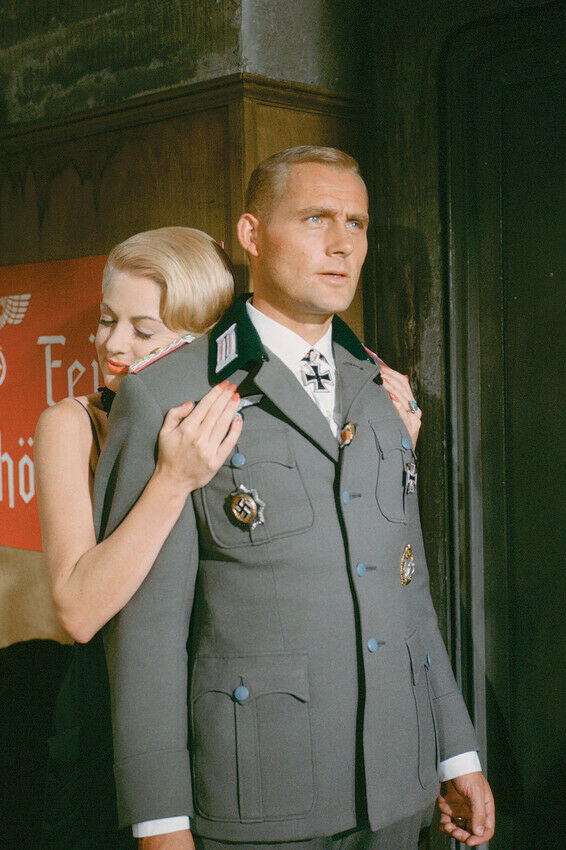
Barbara Werle seizes her moment – as a courtesan attempting to seduce Robert Shaw.
Just what constituted an “all-star cast,” one of the key ingredients of the roadshow phenomenon of the 1960s, was open to question. While The Longest Day (1962) boasted stars of the pedigree of John Wayne, Robert Mitchum, Richard Burton and Sean Connery, it was also liberally sprinkled with actors of little or no marquee value. David Lean in Lawrence of Arabia (1962) had loaded his film with the likes of Oscar winners Alec Guinness, Anthony Quinn and Jose Ferrer to offset unknowns Peter O’Toole and Omar Sharif as the leads. While The Great Race (1965) could boast Jack Lemmon, Tony Curtis and Natalie Wood, It’s A Mad, Mad, Mad, Mad World (1963) only had Spencer Tracy amid a host of television comedians.
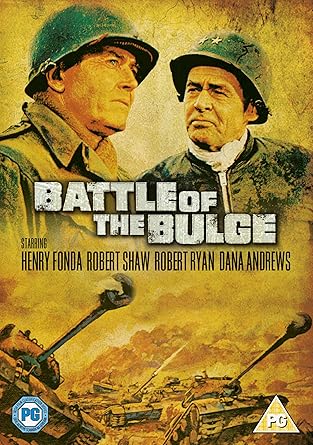
But none of the stars of the hit Those Magnificent Men in Their Flying Machines (1964) had successfully opened a major picture. Of the Battle of the Bulge contingent only Henry Fonda could truly be called a current star, although his box office star had considerable dimmed since the days of The Grapes of Wrath (1939) and Fort Apache (1948). Former stars Robert Ryan and Dana Andrews were now supporting actors, Ty Hardin best known for television, Charles Bronson (The Great Escape, 1963) not achieved top billing and while James MacArthur had done so that was in youth-oriented movies. Initially, Italian prospect Pier Angeli (Sodom and Gomorrah, 1962) was announced as “the only principal female role” – playing a Frenchwoman – for a touching scene showing the effect of war on innocent women caught up in the conflict.
Just before filming was about to start, Fleischer pulled out, citing differences of opinion with the producers. Yordan turned to British director Ken Annakin, who had helmed the British sequences in The Longest Day and all of Those Magnificent Men in Their Flying Machines. There was soon a double whammy from the rival picture. Realizing he was losing ground, and hoping to sabotage the opposition’s progress, Larrazino sued WB for $1 million, claiming that “another film, less accurate, would be confused with his picture.” Just as filming of the Battle of the Bulge got underway in January 1965, it was hit by a temporary restraining order. While failing to shut down the production, it imposed a marketing blockade. WB was prevented from publicizing its picture, a potentially major blow given how dependent big budget roadshows were on advance bookings which could only be generated by advance publicity.
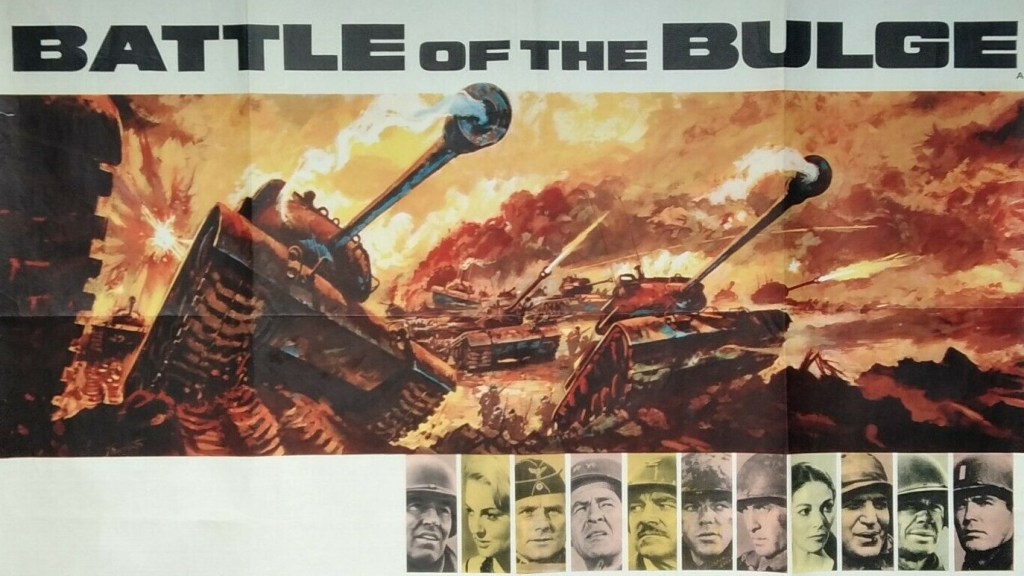
Annakin’s immediate response to the directorial opportunity was delight. He commented that he had a “lot of toys to play with.” He found inspiration for his approach from an unusual source, the Daleks (“an apparently irrevocable onslaught of metal monsters”) from the BBC television series Dr Who. He decided he would use Cinerama as “a kind of 3D, shooting in such a way that the tanks would loom up as monsters against humans whom I would make small and puny.”
Although he had no influence over the casting, Annakin was already familiar with some of the actors, James MacArthur from Swiss Family Robinson (1960) and Werner Peters and Hans Christian Blech from The Longest Day. He did not receive such a warm welcome from Robert Shaw whom he had rejected for a role in The Informers (1963).
He found Fonda “a remarkable professional…always on time, patient, eager to get to work, and always knew his lines.” Fonda confessed to being a reluctant movie actor, preferring the stage, and had not been a big office draw since his work with John Ford in the 1930s and 1940s. Even critical successes like Twelve Angry Men (1957) had lost money, some of it the actor’s own, and prestige movies like The Best Man (1964) and Fail Safe (1964) failed to attract sufficient audiences. “In the theatre,” he said, “the actor achieves fulfilment from beginning to end. But on a picture you create a minute here and a minute there over a twelve-week period. When it’s finished there’s no recollection of what you did…Films are a director’s medium.” Battle of the Bulge was his 59th picture, after completing a supporting role in Otto Preminger’s In Harm’s Way (1965) and taking second billing to Glenn Ford in modern western The Rounders (1965).
There was a stand-off with Bronson on his first day after the actor kept the crew waiting while fiddling too long with his costume. Ty Hardin (television’s Bronco, 1958-1962) was accident-prone, tumbling into a frozen river in full kit, and whacking the director’s wife in the face with his helmet. Dana Andrews had a drink problem so that in some scenes Fonda and Ryan would be surreptitiously holding him up.
Andrews was enjoying career resurgence. His movie career had been at a standstill, a long way from a peak like Laura (1944), his last significant top-billed parts over a decade past. “I was starting to get nothing for a while but offers came swarming in when I told my agent to go ahead and try for Walter Huston parts.” After only television roles in the four years since Madison Avenue (1961), Battle of the Bulge would mark his eighth role in 1965, including The Satan Bug and In Harm’s Way.
Winter in Spain was cold which meant it provided the ideal backdrop for the WB version. The chosen location, 4,500ft high in the mountains of Segovia, provided identical conditions to the actual battle. Spain had provided 80 tanks including Tigers mounted with 90mm guns and Shermans. Half of the 20-week shoot would be spent in Segovia with interiors filmed at studios in Seville and the Roma facility in Madrid.
The WB adviser was General Meinrad von Lauchert, a divisional tank commander during the battle. He hoped the picture would show the German soldier “as he was, brave and good” rather than clichéd presentation and not give the “impression that the American Army had nothing to do but walk into Germany.” He wanted the film to reflect the truth that the “Americans had to pay a high price for every yard.”
Extras were drawn from the Spanish village of El Molar, with a population of just 2,400, which specialised in that supply. Locals could earn 200 pesetas a day. A pair of tavern owners had established this lucrative side-line, demand so high at this point that “they can play Russian World War One deserters for Doctor Zhivago (1965) one day and shipped to World War Two the next for Battle of the Bulge.” Whenever Annakin found himself in trouble with the script he turned to the senior actors, Fonda, Ryan and Andrews who could improvise their way round scenes and “give me hints and lead me into changes.”
For the first scene, a week’s worth of white marble dust, representing snow, had been spread over the ground before 40 tanks emerged from a pine forest. But just as the cameras begun to turn, unexpectedly, against all weather forecasts, it began to snow. While initially a boon, when it continued to fall for five weeks the snow turned into a liability. Nobody was prepared for snow, not to the extent of snowploughs or even salt and it was a three-mile hike uphill to reach the tank location until army vehicles could be used to transport the crew. The tanks churned up so much mud that three or four cameras were required to catch the action.
“It was a director’s feast,” recalled Annakin, salivating about the prospect of a “vast panoramic” employing the entire array of tanks. To speed production, he had two units one hundred yards apart and jumped from one to the other, thus achieving 30-40 set-ups a day while the effects team exploded tubes and burned rubber tyres to create a fog of black battle smoke. A small town, already wrecked and shelled from the Spanish Civil War, added an air of realism when standing in for Bastogne.
Midway through shooting the producers realised the movie lacked a theme and from then on Annakin was faced with daily rewrites as new scenes were added to bring out the humanity implicit in war. Then Cinerama boss William Foreman arrived and demanded the insertion of the type of shot he believed his audiences were expecting, the equivalent of the runaway train and the ride through the rapids in How the West Was Won. He angled for a jeep racing downhill or a plane spinning and diving and happy to stump up any extra costs.
Such a request was more easily accommodated than his insistence that a role be found for his girlfriend Barbara Werle, a bit part actress Tickle Me (1965). While Yordan, wearing his producer’s hat, was willing to keep one of his main funders happy, the director and Robert Shaw were not. Shaw refused to do the scene until Foreman pleaded with both, explaining that in a vulnerable period of his personal life – when, in fact, he had been imprisoned – Werle had helped him out and he owed her a favour.
In Annakin’s opinion Werle was “willing but completely dumb…as though you had picked a girl straight from the cash desk of a supermarket.” Her one scene, as a courtesan offered to Robert Shaw by a grateful superior, was used to mark out the German commander as a man of honor when he rejected such temptation out of hand.
To overcome problems of matching earlier Panzer footage with the climactic battle to be shot on the rolling hills of Campo – in the earlier shots the ground was covered in snow, but now it was summer and the ground was scorched by the sun – Annakin relied on aerial shots, shooting downwards, “keeping as close as possible so as not to reveal what the terrain actually looked like” while on the ground two units shot close-ups of the action. This was augmented by 30 model shots with miniature explosions.
When shooting was completed, there was a race to get the movie ready for its scheduled launch, on December 16, 1965, the 21st anniversary of the start of the battle. There were ten weeks left to do post-production. Four editors had already been working on the material but Yordan asked Annakin, who had not been near a moviola for two decades, to personally edit the climactic battle scene. The director found the experience exhilarating: “matching my location footage with miniature shots; a four-foot helicopter (i.e. aerial) shot cut with a couple of feet of a U.S tank rounding rocks to face a Panzer; a shot of Telly Savalas at his gun site yelling ‘Fire’ intercut with a miniature tank blowing up.” But all his intricate work never made it into the final cut. Another editor fiddled around with the material and since no one had thought to make a dupe of Annakin’s original it was lost.
Although the challenge from Lazzarino had died away, the Pentagon was unhappy with the amount of time allocated to the German perspective. Yordan had the perfect riposte, pointing the finger at Annakin and saying “see what happens when you get a limey director.”
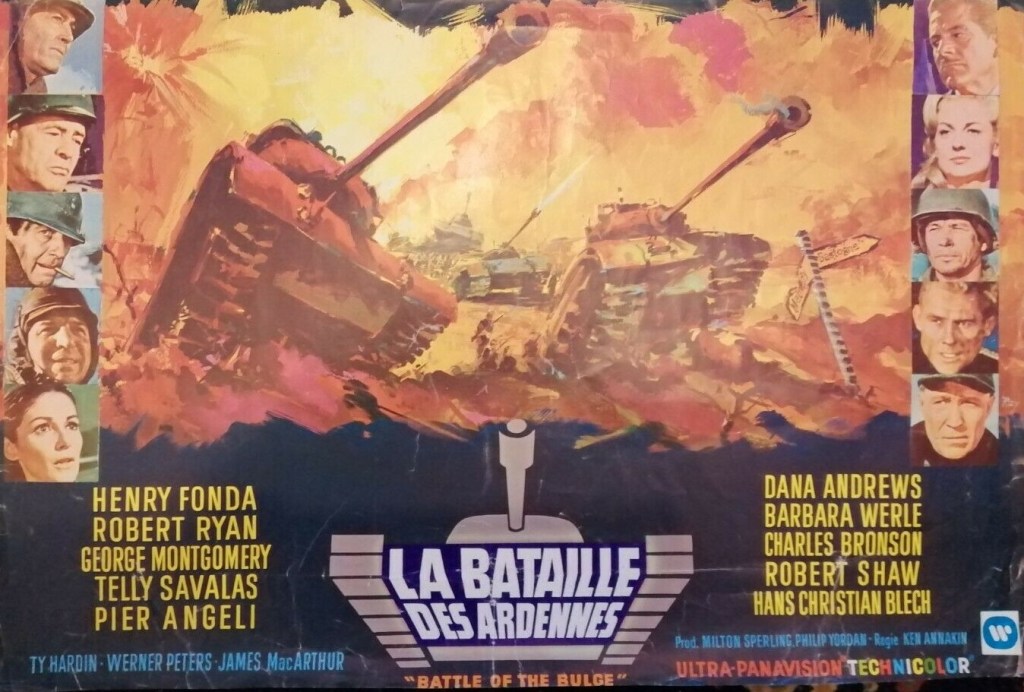
Werle had the last laugh. She was billed sixth in the credits (Angeli came fifth) but in the same typeface as Fonda, Shaw, Ryan and Andrews, and above the likes of Bronson, MacArthur and Hardin who not only all had substantially greater screen experience but had a bigger impact in the movie.
With the smallest part of all the listed stars, nonetheless she managed to turn the experience to her advantage, introduced to the press as part of the marketing campaign and attending the world premiere at the Pacific Cinerama on December 16, 1965 in Los Angeles and the New York premiere the following day, brought forward four days, at the Warner Cinerama. In Los Angeles she arrived in style at the head of a marching brigade of 100 service men.
SOURCES: Ken Annakin, So You Wanna Be A Director (Tomahawk, 2001) p167-181; “Du Pont, Bronston, Co-Defendants,” Variety, July 22, 1964, p4; “Schenck-Rhodes Roll Battle of Bulge at Camp Drum in U.S.” Variety, July 22, 1964, p42; “German Military Sensitivity,” Variety, September 23, 1964, p32; “Columbia Will Distribute Battle of Bulge Film,” Box Office, September 28, 1964, p18; “Plan Battle of Bulge As Cinerama Film,” Box Office, November 23, 1964, p4; “Tony Lazzarino To Produce The 16th of December,” Box Office, December 16, 1964, p4; “Rival Battles of Bulge; Bill Holden Up for Ike in Lazzarino Version,” Variety, December 16, 1964, p5; “Warner Reports Loss of £3,861,00,” Variety, December 23, 1964, p5; “L.A. Court Has Its Battle of Bulge Hearing, 27th,” Box Office, January 25, 1965, pW-2; “Dana Andrews Strategy: Regain Momentum,” Variety, March 10, 1965, p3; “Battle of Bulge Now Being Lensed in Spain,” Box Office, March 15, 1965, pNE2; “Winter in Spain Cold But Correct for Bulge Pic,” Variety, March 17, 1965, p10; “Cinerama Plans Five Films to Cost $30 Mil,” Box Office, April 19, 1965, p13; “For Actor, Satisfying Legit Still Beats Pix, Reports Henry Fonda,” Variety, May 3, 1965, p2; “London Report,” Box Office, May 3, 1965, p8; “One Girl in WB Bulge,” Variety, May 5, 1965, p20; “Battle of Bulge Pic May Roll Next Winter,” Variety, May 5, 1965, p29; “El Molar, Spain’s Village of Extras,” Variety, May 12, 1965, p126; “Cinerama Report Loss,” Variety, May 13, 1965, p15; Advert, Box Office, July 12, 1965, p22; “WB To Film Cinerama Epic in England,” Box Office, October 11, 1965, p11; “Introduce Barbara Werle,” Box Office, October 18, 1965, pE3; “Battle of Bulge Opens N.Y. Now Dec 21,” Box Office, October 18, 1965, p10; “Actress To Attend Bows of Bulge in L.A., N.Y.,” Box Office, December 6, 1965, pW4.









 The Magnificent 60s