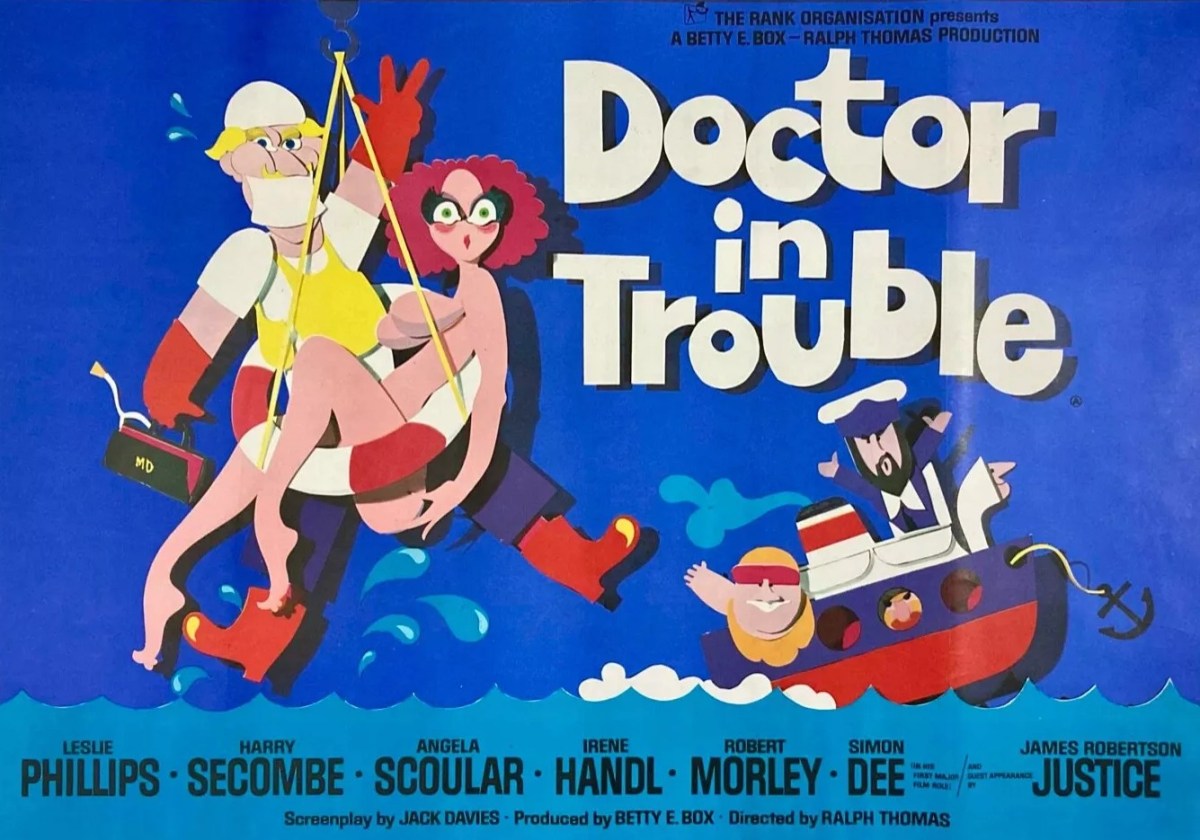
Doctor in Trouble (1970) **

Limp ending to a fine series. Torpedoed by too many oddities. Leslie Philips returns in the top-billed role, but he’s not playing the suave Dr Gaston Grimsdyke of the previous iteration, but instead a more hapless version of Dr Paul Burke, the character he played a decade before in Doctor in Love (1960).

Confused? You will be. It’s clearly set up for James Robertson Justice to play two characters, a la Sinners (2025), his usual Sir Lancelot Spratt and his presumably identical brother, ship’s captain George Spratt. But Justice fell ill and the naval part was taken by Robert Morley, of similar bombastic ilk, but in diction more long-winded and fluffy and lacking the bite of the surgeon.
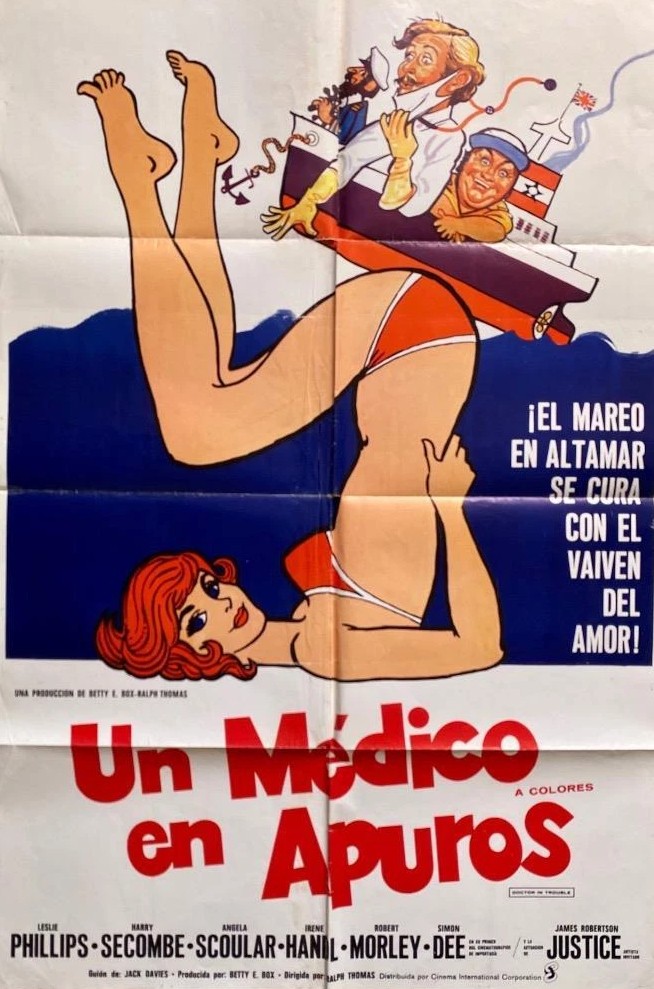
In the last two episodes I’d seen there had been an obnoxious salt-of-the-earth character who turned out to be surprisingly artistic. Here, we have to settle for the nouveau riche Pools-winner (a gambling game of the era) who is channeling his inner Sidney James, all leer and not much else. And if you want proof that it’s never a good idea to hire a television personality merely because he has a large following, look no further than Simon Dee.

Several notions will not endear themselves to the contemporary audience – the cross-dressing, the cliché gays, and the Englishman in brownface playing an Indian. That’s not to mention the pratfalls and endless falling into swimming pools.

There’s even less of a plot than in the last outing. Dr Burke (Leslie Philips) accidentally stows away on a cruise ship after pursuing model girlfriend Ophelia (Angela Scoular) who’s working there. He also comes up against actor Basil Beauchamp (Simon Dee), an old school bete noire, who plays a doctor in a television soap.
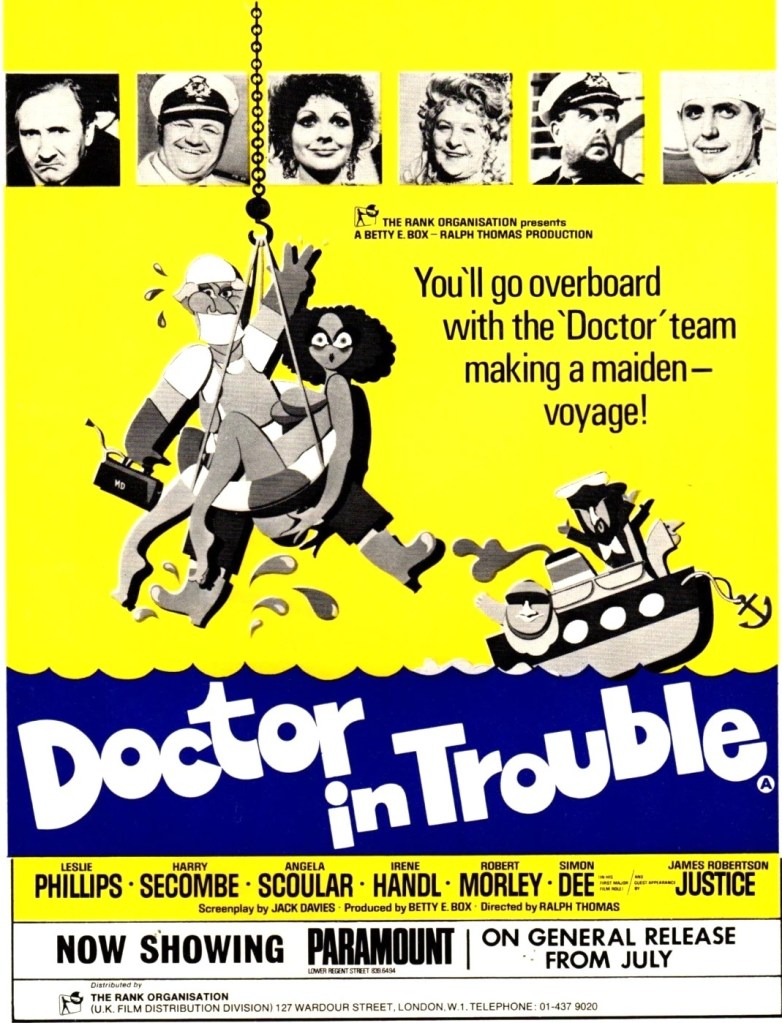
Dr Burke is hounded by the ship’s Master-at-Arms (Freddie Jones) so occasionally it lurches into farce. And there’s any number of sexy debutantes either desperate to climb into bed with the TV star or hook the gambler.

If it had settled on one tone – slapstick, sex comedy or farce – it might well have worked even in the face of the poor script. Cor blimey, there’s even some fleeting nudity from Ophelia and Leslie Philips and a striptease that’s way out of place for what was originally a much gentler comedy than the Carry Ons. In terms of style it’s all over the place and not a single member of the cast is appealing enough to rescue it.

Had Leslie Philips been in traditional “ding-dong” comfort zone it might have passed muster but here he’s just the butt of all the jokes without generating an ounce of sympathy. Robert Morley (Some Girls Do, 1969) isn’t a patch on James Robertson Justice. Angela Scoular (On Her Majesty’s Secret Service, 1969) seems off-key, Freddie Jones (Otley, 1969) as if he’s in a different picture while the constantly leering Harry Secombe (Oliver! 1968) belongs in a Carry On. Graham Stark (The Picasso Summer, 1969) is deplorable as the Indian waiter Satterjee.

The only person to rise above their station is Joan Sims (Doctor in Clover, 1966) who makes a cameo appearance as a Russian nurse. In bit parts you might spot Yutte Stensgaard (Zeta One, 1969) and Janet Mahoney in her debut.

Directed as usual by Ralph Thomas. Script by Jack Davies based on a Richard Gordon bestseller.

After this, the series was reimagined for television and returned to its gentle comedy roots.

For completists only – and even then…
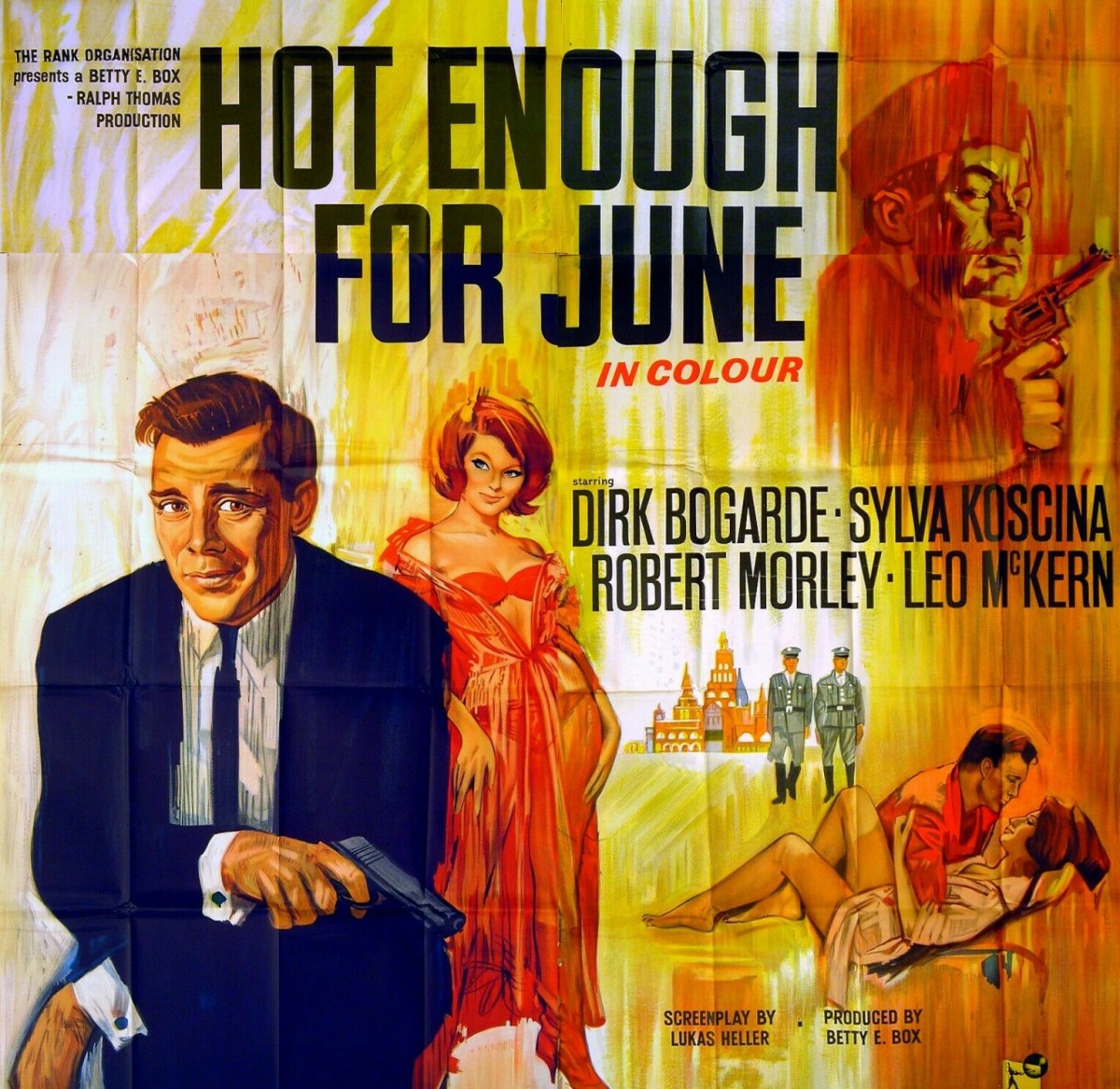
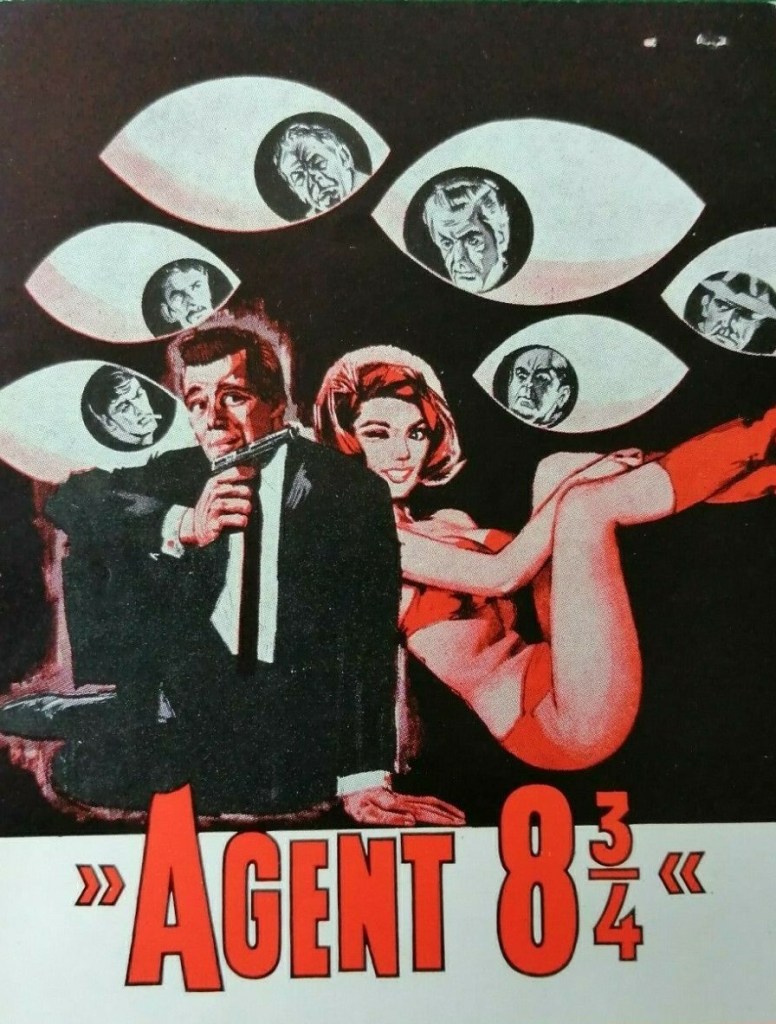
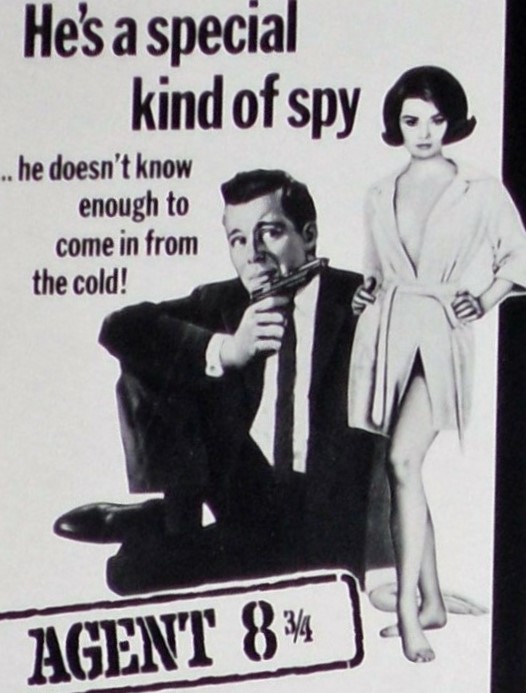
Hot Enough for June / Agent 8 3/4 (1964) ***

Thanks to his language skills unemployed wannabe writer Nicholas (Dirk Bogarde) is recruited as a trainee executive on a too-good-to-be-true job visiting a Czech glass factory  only to discover that while engaged on what appears a harmless piece of industrial espionage is in fact considerably more serious.  Complications arise when he falls in love with his chauffeur Vlasta (Sylva Koscina) whose father, Simenova (Leo McKern), is head of the Czech secret police.

Eventually, it dawns on Nicholas that he is in the employ of the British secret service headed by Colonel Cunliffe (Robert Morley). Soon he is on the run. Adopting a variety of disguises including waiter, Bavarian villager and milkman, he evades capture and makes a pact with Vlasta that neither of them will participate in espionage activities.

A chunk of the comedy arises from misunderstandings, Iron Curtain paranoia, the destruction of indestructible glass, password complications, Nicholas’s contact turning out to be a washroom attendant, and from the essentially indolent Nicholas being forced into uncharacteristic action. Soon he is adopting the kind of ruses a secret agent would invent to outwit the opposition, including burning the hand of a man with his cigarette and stealing a milk cart.

The romance is believable enough and Vlasta has the cunning to shake off the secret agent shadowing her, although the ending is unbelievable and might have been stolen from a completely different soppy picture. Although Nicholas is clearly in harm’s way several times that is somewhat undercut by the espionage at a higher level being presented as a gentleman’s game.

There are unnecessary nods to 007 and the kind of gadgets essential to Bond films, although none come Nicholas’s way. But these attempts to modernise what is otherwise an old-fashioned comedy largely fail. Taking a middle ground in comedy rarely works. You have to go for laughs rather than plod around hoping they will miraculously appear. And in fact the comedy is redundant in a plot – innocent caught up in nefarious world – that has sufficient story and interesting enough characters to work.

That the movie is in any way a success owes everything to the casting. Dirk Bogarde, though well into his 40s, still can carry off a character more than a decade younger. He can turn on the diffidence with the flicker of an eyelash. And yet can call on inner strength if required. He is the ideal foil for light comedy, having made his bones in Doctor in the House (1954), reprising the character for Doctor in Distress (1963) and dipped in and out of serious drama such as Victim (1961) and the acclaimed The Servant (1964), released just before this.

In some respects it seems as if two different pictures are passing each other in the night. The Bogarde section, excepting some comedy of misfortune, is played for real while in the background is a bit of a spoof on the espionage drama.

Sylva Koscina (The Secret War of Harry Frigg, 1968) is excellent as the beauty who betrays her country for love. Robert Morley (Topkapi, 1964) and Leo McKern (Assignment K, 1968), although in on the joke, are nonetheless convincing as the secret service bosses.  Look out for a host of lesser names in bit parts including Roger Delgado (The Running Man, 1963), Noel Harrison (The Girl from U.N.C.L.E. 1966-1967), Richard Pasco (The Gorgon, 1964) and stars of long-running British television comedies John Le Mesurier, Derek Fowlds and Derek Nimmo.  

This was the eighth partnership between director Ralph Thomas and Dirk Bogarde, four in the Doctor series but also three serious dramas in Campbell’s Kingdom (1957), A Tale of Two Cities (1958) and The Wind Cannot Read (1958). In themselves the comedies and the dramas were successful, but mixing the two, as here, less so. Written by Lukas Heller (Flight of the Phoenix, 1965) from the bestseller by Lionel Davidson.

American distributors were less keen on this picture and it was heavily cut for U.S. release and retitled Agent 8¾ presumably in an effort to cash in on the James Bond phenomenon. I’ve no idea what was lost – or perhaps what was gained – by the editing.

The end result of the original version is a pleasant enough diversion but not enough of the one and not enough of the other to really stick in the mind. 

Should you be interested in how the book was translated into the film, there’s another article here covering that. Link below.

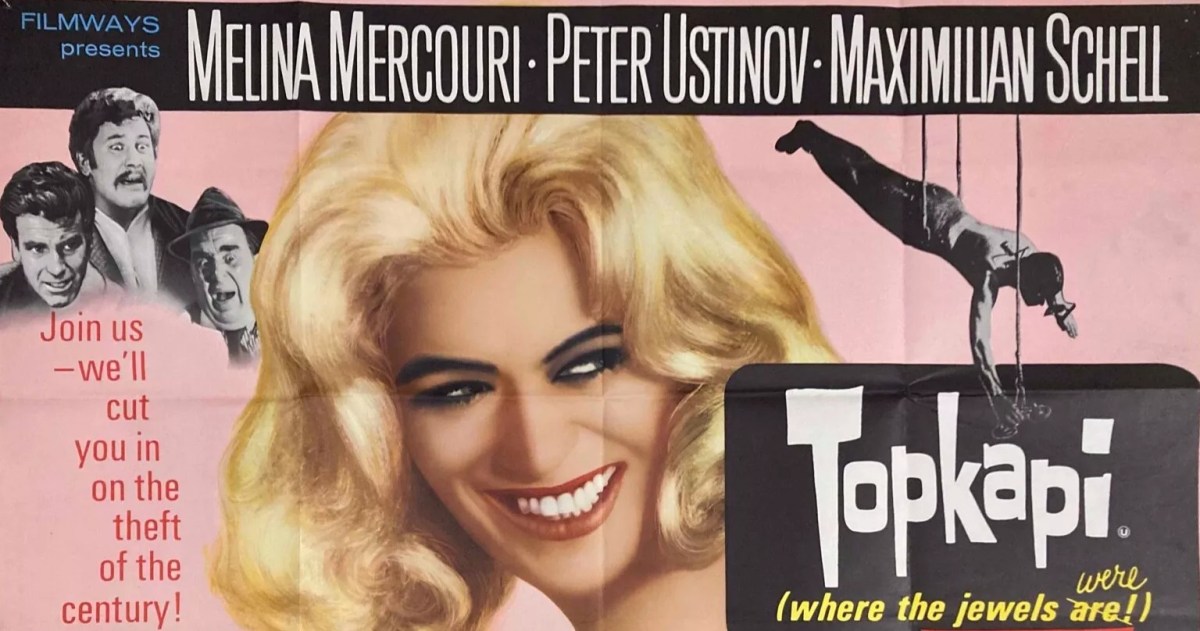
Topkapi (1964) *****

The mother of all heists directed by the father of all heist pictures. Films as diverse as The Italian Job (1969), Mission Impossible (1996) and Ocean’s Eleven (1960) owe director Jules Dassin a massive debt since he pretty much invented this genre with the French-made Rififi (1955). But that involved professional criminals. Outside of masterminds Elizabeth (Melina Mercouri) and Walter (Maximilian Schell), this crew are amateurs, deliberately chosen for their lack of criminal records and with a mind to the specific tasks required. So we have acrobat Giulio (Gilles Segal), upper-class English gadget inventor Cedric (Robert Morley), strongman Hans (Jess Fisher) and driver Arthur (Peter Ustinov).

The target is the impenetrable, complete with sound-sensitive floor, Topkapi Palace in Istanbul where they plan to steal a priceless emerald-encrusted dagger. The plan is ingenious. Arthur is initially only hired to smuggle the weapons essential to the audacious heist across the border. But when he is caught and forced to cooperate with the Turkish secret police, he is enlisted as a replacement for Hans. Minus the rifles and grenades which at first appeared indispensable to the plan, the thieves come up with an even more inspired alternative involving among other things scampering across rooftops, abseiling, a parrot and slowing down the revolutions of a lighthouse.

Originally intending to betray his colleagues as soon as possible, Arthur falls under the seductive spell of Elizabeth and finds himself recruited as the replacement muscles. Elizabeth exudes such sexuality she has the entire gang in her thrall and makes the cowardly, weak acrophobic Arthur believe he can overcome all his fears. Walter engages in a cat-and-mouse game with the police, always one step ahead, with a bagful of red herrings at his disposal, eventually giving the pursuers the slip during a wrestling competition held in a massive outdoor arena.

Interestingly, too, this doesn’t have the trope of gangsters at each other’s throats, planning to double-cross one another or bearing old grudges. Nobody challenges the leader. In fact, the entire crew could not be more docile, content to sit at the feet of Elizabeth and Walter, lapping up the former’s flirtation, wondering at the latter’s skill, as if they are all honored to have been chosen.

The climactic heist, carried out with no musical soundtrack and lasting over 30 minutes, is absolutely superb, setting a very high bar for future imitators, and there is a twist ending. Dassin mixes light comedy and high tension with the sultry attractions of Elizabeth to produce an at times breathtaking picture. As well as the heist itself, the wrestling sequence is stunning and the transition of Arthur forms the acting highlight (Ustinov won the Best Supporting Actor Oscar).

But all four main stars are superb. Audiences accustomed to a more uptight Maximilian Schell (The Condemned of Altona (1962) will have been surprised by his performance. Melina Mercouri (Oscar-nominated for Never on Sunday, 1960) is the archetypal blonde bombshell, liberal with her favors but careful not to favor just one. Although Walter devises the plan, she is actually the criminal supremo, selecting the targets, and then delegating to ensure the tasks are carried out. Robert Morley is having the time of his life. Akim Tamiroff (Lord Jim, 1965) has a cameo as a chef.

A film noir star after Brute Force (1947) and The Naked City (1948) Dassin’s Hollywood career collapsed in the wake of the anti-Communist McCarthy hearings and he was blacklisted. Rififi opened few doors but even the success of Never on Sunday (1960) brought little respite.  Despite returning to the mainstream with such elan through the conduit of Topkapi, albeit with a European cast, he remained on the Hollywood periphery and although Uptight (1968) – previously reviewed in the Blog – involved another heist that was primarily the wrapping for social documentary.

More at home with comedies screenwriter Monja Danischewsky (The Battle of the Sexes, 1960) draws out more humor than the source material, Light of Day by noted thriller writer Eric Ambler, would ostensibly suggest.

A delight from start to finish, the crème de la crème of the heist genre, this is unmissable. Dassin can lay claim to being the John Ford of the crime picture.

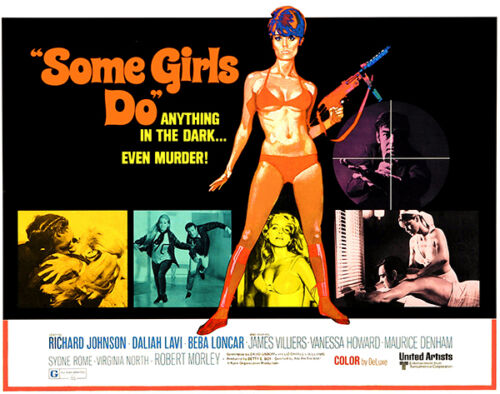
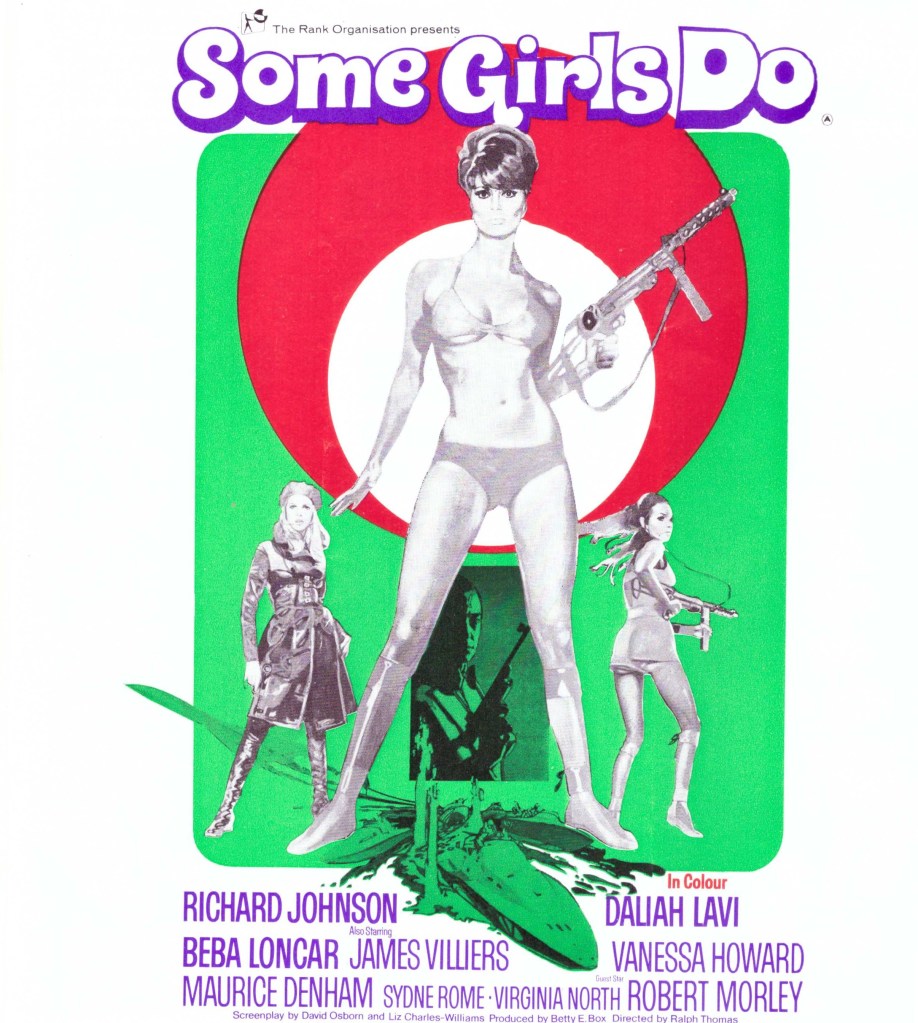
Some Girls Do (1969) ****

Enjoyed this sequel to Deadlier Than the Male (1967) far more than I expected because it sits in its own little world at some point removed from the espionage shenanigans that dominated the decade. Hugh (nee Bulldog) Drummond (Richard Johnson) is neither secret agent nor involved in espionage high jinks, instead employed in the more down-to-earth domain of insurance investigator, albeit where millions are at stake. Although his overall adversary is male, the smooth-talking Carl Petersen (James Villiers), adopting a series of disguises for most of this picture, the real threat comes from a pair of villainesses in the shape of Helga (Daliah Lavi) and Pandora (Beba Loncar). If anything, this pair are a shade more sadistic than Irma and Penelope from the previous outing.

The sequel doubles up – or doubles down – on the female villainy quotient, Petersen having created a race of lethal female robots who spend their time dispatching scientists working on the world’s first supersonic airliner. Global domination is only partly Petersen’s aim since he also stands to gain £8 million ($134 million today) if the plane doesn’t launch on schedule. Livening up proceedings are Flicky (Sydne Rome), a somewhat kooky Drummond fan who has her own agenda, Peregrine “Butch” Carruthers (Ronnie Stevens), a mild-mannered embassy official assigned bodyguard duties, and chef-cum-informant Miss Mary (Robert Morley).

Villiers has found a way of turning an ultrasound device intended originally to aid cheating in a boat race into something far more dangerous. But, of course, for Helga seduction is the main weapon in her armory, and Drummond’s first sighting of her – a superb cinematic moment – is sitting on the branch of a tree wielding a shotgun. Equally inviting are the squadron of gun-toting mini-skirted lasses guarding Petersen’s rocky fortress.

The movie switches between Helga, Pandora and the robots raining down destruction and Drummond trying to prevent it. Dispensing with the boardroom activities that held up the action in Deadlier than the Male, this is a faster-moving adventure, with Drummond occasionally outwitted by Helga and calling on his own repertoire of tricks. Dialog is often sharp with Drummond imparting swift repartee.

The action – on land, sea and air – is a vast improvement on the original. The pick is a motorboat duel, followed closely by Drummond in a glider coming up against a venomous aeroplane and saddled with a defective parachute. And there are the requisite fisticuffs. Various malfunctioning robots supply snippets of humour.

Richard Johnson (A Twist of Sand, 1968) truly found his metier in this character and it was a shame this proved to be the last of the series. Although Daliah Lavi never found a dramatic role to equal her turns in The Demon (1963) and The Whip and the Body (1963) and had graced many an indifferent spy picture as well as The Silencers (1966), she is given better opportunity here to show off her talent. Beba Loncar (Cover Girl, 1968) is her make-up obsessed bitchy buddy. Sydne Rome (What?, 1972) makes an alluring debut. James Villiers (The Touchables, 1968) is the only weak link, lacking the inherent menace of predecessor Nigel Green.

There’s a great supporting cast. Apart from Robert Morley (Genghis Khan, 1965) look out for Maurice Denham  (Danger Route, 1967), Adrienne Posta (To Sir, with Love, 1967) and in her first movie in over a decade Florence Desmond (Three Came Home, 1950). The robotic contingent includes Yutte Stensgaard (Lust for a Vampire, 1971), Virginia North (Deadlier Than the Male), Marga Roche (Man in a Suitcase, 1968), Shakira Caine (wife of Sir Michael), Joanna Lumley (television series Absolutely Fabulous), Maria Aitken also making her debut, twins Dora and Doris Graham and Olga Linden (The Love Factor, 1969).  Peer closely and you might spot Coronation Street veteran Johnny Briggs.

The whole package is put together with some style by British veteran Ralph Thomas (Deadlier than the Male). Screenplay by David Osborn and wife Liz Charles-Williams (Deadlier than the Male) is based on the book by “Sapper”.

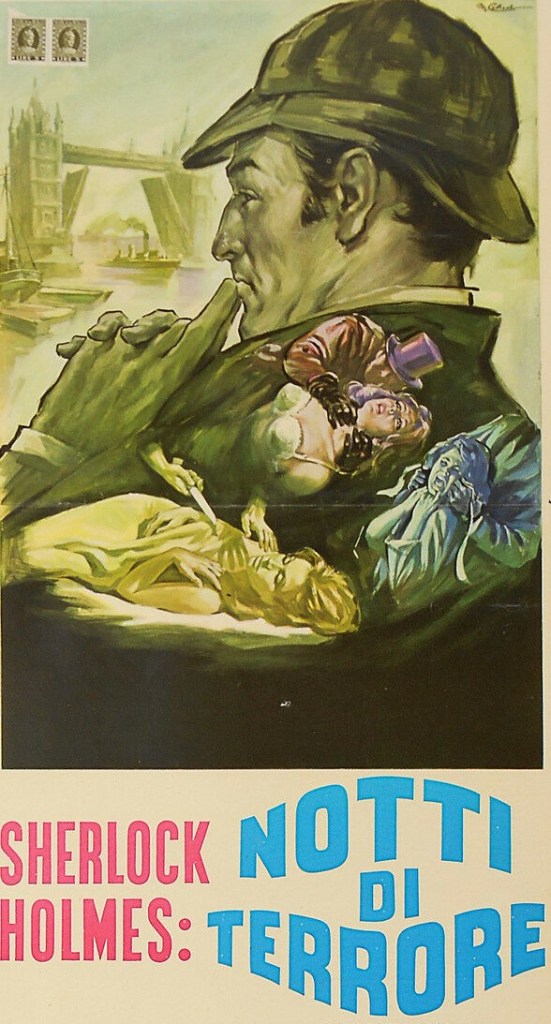
A Study in Terror (1965) ****

Excepting Sherlock Holmes and the Deadly Necklace (1962), the world’s most famous fictional detective had been absent from the big screen for over two decades so it seemed an inspired decision to set him on the trail of the world’s most infamous serial killer. The result is high-class comfort food, classic deduction coupled with barbaric murders in a fog-bound London replete with cobbled streets, Dickensian urchins and sex workers apop with cleavage and corset. Throw in sensitivity towards the abject poverty of the period, female exploitation and a nod towards an upper-class cover-up and you have a movie with a surprisingly contemporary outlook.

This is a tougher Holmes, handy with his fists, sporting a spring-loaded blade in his walking stick. The investigation draws in the Prime Minister (Cecil Parker) and the Home Secretary (Dudley Foster) as well as Sherlock’s pompous brother Myron (Robert Morley) and the ubiquitous Inspector LeStrade (Frank Finlay).

Pretty quickly it is Suspects Assemble. Due to a scalpel being the murderer’s instrument of choice, doctors are immediately implicated, the most likely candidate the philanthropic Dr Murray (Anthony Quayle) who operates s soup kitchen. Publican Max Steiner (Peter Carsten), with a sideline in blackmail, is another possibility. And there is the mysterious disinherited son of a lord, Michael Osborne, who has married sex worker Angela (Adrienne Corri).

As ever, the plot is complicated by red herrings and sleights of cinematic hand. But the highlight of a Holmes picture is the sleuth’s mastery of deduction based on clues missed by the ordinary mortal and every now and then the story grinds to a halt to allow time for the detective to demonstrate genius. Occasionally he dons a disguise. And thoroughly enjoyable these scenes are before he gets down to the main business of uncovering the killer.

A Study in Terror introduces social depth to the Holmes saga. When the crimes focus the media spotlight on Whitechapel Dr Murray draws attention to the constant “murder by poverty” ignored by the state. Female exploitation is of course the norm in the sex worker business and small wonder that such women are easy targets for the Ripper and although that is an overdone trope in this case a different angle comes into play. 

Shakespearian actor John Neville (Oscar Wilde, 1960) handles the main character with considerable aplomb with Donald Houston (The Blue Lagoon,1949) as his often baffled sidekick Watson. Robert Morley (Genghis Khan, 1965) is a splendid Mycroft although Anthony Quayle (East of Sudan, 1964) fails to nail down his Scottish accent.

The considerable supporting cast includes Judi Dench making her second film appearance, Barbara Windsor of Carry On fame, John Fraser (Operation Crossbow, 1965), John Cairney (Jason and the Argonauts, 1963), Peter Carsten (Dark of the Sun, 1968),  singer Georgia Brown (Nancy in the original stage production of Oliver!), Edina Ronay (The Black Torment, 1964), Corin Redgrave (The Girl with the Pistol, 1968), former British leading lady Kay Walsh (Oliver Twist, 1948) and future television comedy writer Jeremy Lloyd (Are You Being Served?, 1972-1985).

The picture was unusual in that it was not drawn from the existing Holmes stories but as an original devised by Derek and Donald Ford (The Black Torment), the former going onto a more extensive career as a director of British sexploitation pictures such as Suburban Wives (1972). Production company Sir Nigel Films had been set up to exploit the Holmes legacy.

Director James Hill (The Kitchen, 1961) had won an Oscar for the short Giuseppina (1960) and was a year away from his breakthrough Born Free. Given the low-budget this is a highly watchable picture.

The Loved One (1965) ***

If only British director Tony Richardson had seen fit to add some meat to the bones, this satirical look at the American funeral business might have emulated the dramatic impact of Elmer Gantry (1960). As it is, the director is so preoccupied with the funereal inanities that it doesn’t so much lose sight of the plot as pretty much ignore it.

So, yes, the burying of a loved is big business and just like weddings some of the trimmings would make your toe curl. But even when reality intrudes, feet swell after death so require larger shoes and the only way to fit a suit on a corpse is to slit open the back, these are treated in humorous fashion.

And that would all be fine if this was the laff-fest Richardson intended but even with a puffed-out roster of cameos – Liberace as a salesman and James Coburn (Hard Contract, 1969) as a truculent customs officer the pick – this ends up as more documentary than movie. And that’s it’s main attraction for a contemporary audience who might be less concerned about the director’s almighty fall from grace after the stunning critical and commercial success of Tom Jones (1963).

In fact, it’s a shame the story goes anywhere near internment because the initial section concentrating on Hollywood is more successful in achieving a modicum of gentle satire. Wannabe poet Dennis (Robert Morse) has won a trip to America as a prize and lands on upper crust uncle Sir Francis, a Hollywood veteran, tasked with improving the elocution of cowboy Dusty (Robert Easton) so that he can play a British spy akin to James Bond.

That section entails gorillas turning up outside telephone booths, all sorts of monsters dawdling through the studio canteen, and head honcho (Roddy McDowell) running his father’s studio by the seat of his pants until he comes unstuck, resulting in Sir Francis being fired after 31 years. There’s some interesting, almost British, issue-dodging and Sir Francis in true British style, unable to deal the embarrassment of being sacked, commits suicide, leading the nephew into the arms of Whispering Glades funeral operative Aimee (Anjanette Comer). She’s in love with the creepy Joyboy (Rod Steiger) leaving Dennis to woo her using other people’s poems.

There’s another nutcase dropping out of the woodwork every two minutes, and occasionally there’s a mild piece of slapstick or physical comedy. Of course, using rampant sex as the basis for comedy, as with Tom Jones, works far better than death. In the absence of a decent narrative or interesting characters, once the initial heavy-handed points have been made there’s nowhere else to go except be more heavy-handed.   

Until Brideshead Revisited (1981) was turned into a triumphant mini-series, the works of British author Evelyn Waugh had difficulty being transferred to the screen. In part, this was due to his idiosyncratic style and in part that, even at his most serious, he was viewed as a comedy writer.

Screenwriter Terry Southern (Candy, 1968) wouldn’t have been my first choice to translate the Waugh essence for the big screen, but co-writer Christopher Isherwood (Cabaret, 1968) was no more successful.

Robert Morse (Guide for the Married Man, 1967) offers little beyond mild buffoonery. While Anjanette Comer (Guns for San Sebastian, 1968) is surprisingly good as the angelic ditzy object of his affections, she can’t carry the entire picture. Robert Morley (Genghis Khan, 1965) manages to keep a straight face while delivering his lines.

Without doubt hits the immediate target but somehow misses the bulls-eye.

Even so, there’s one element of the picture that would have contemporary Hollywood salivating. And that is a producer not frightened of taking risks, willing to go outside the envelope in a bid to deliver the different kind of movie that audiences obsessed over with Barbie and Oppenheimer.

Martin Ransohoff had an enviable track record in the 1960s. For MGM, he was the mastermind behind movies as offbeat as The Americanization of Emily (1964), The Cincinnati Kid (1965) Eye of the Devil (1966) and Castle Keep (1969) as well as big-budget offerings The Sandpiper (1965) and Ice Station Zebra (1968). His name was on such later diverse titles as The Wanderers (1979) and Jagged Edge (1985). As you can see from this random selection, his movies didn’t always come off, but at least they were different.

Nine Hours to Rama (1963) **

Double Oscar nominee Mark Robson was a highly respected commercially successful director with hits like Peyton Place (1957) and From the Terrace (1960) behind him and The Prize (1963) and Von Ryan’s Express (1965) still to come. So what went wrong here, in this tale of the assassination of Ghandi, especially as he had successfully negotiated foreign climes in The Inn of the Sixth Happiness (1958)?

You could start with the Indian equivalent of “blackface.” Apart from Ghandi himself all the major roles are played by white actors. Even cutting back on his trademark plumminess, the sight (and sound) of Robert Morley trying to talk the Indian leader out of exposing himself to possible assassination would just be hilarious if it wasn’t such a cringingly bad misstep.

Sure, Hollywood struggled to find anyone in Bollywood who had the box office marquee or critical kudos to provide the necessary confidence for Twentieth Century Fox (a problem that hasn’t really gone away – witness Gandhi and Passage to India). But rising star Horst Buchholz, in the leading role of assassin Godse, was nobody’s idea of the kind of actor with the credentials of a Ben Kingsley or Alec Guinness who might make a decent stab at playing an Indian.

And it’s a bizarre narrative mixture, dragnet film noir hunt led by Supt Das (Jose Ferrer) for a potential assassin (done so well in Day of the Jackal, for example), biopic of the assassin, and providing sufficient room for Ghandi to spread his principles of love and peace as well as plenty of scenes of tourist India.

And even with all these deficiencies it might still have worked except that, in the modern idiom of altering characters, times and places for dramatic effect, this pretty much ignores the known facts about the assassin’s life and in its place presents a barmy mishmash of thwarted ambition and romance.

Set in 1948 after India gained independence from the British and during ongoing violence that followed Partition, the dividing of the country on religious grounds into India and Pakistan, we find Ghandi being blamed for everything that has gone wrong, even though he was never the country’s prime minister and disavowed political office.

According to this version, against his father’s wishes and at a very inconvenient time (he is about to enter an arranged marriage), Godse attempts to fulfil a lifelong ambition to become a soldier but is rejected on the grounds that as a Brahmin he will find it difficult to take orders. He becomes involved with a right-wing organization one of whose stated aims is to take down Ghandi.

It’s actually not that hard to attempt to do so and the film conveniently misses out the fact that Godse had previously been fond guilty twice of trying to kill Ghandi, only being spared prison by his target’s clemency. Instead of that grimly ironic touch, we are fed a hotchpotch. It’s hardly surprising that the film skips the potential gender conflict inherent in Godse, since for superstitious reasons he was initially brought up as a girl, including having his nose pierced in the female fashion. And for “dramatic purposes” his father is a priest rather than the postal worker of real life.

He falls in love with a married woman (Valeri Gearon) and is violent to a prostitute Sheila (Diane Baker) who rips him off. Theoretically, Ghandi would not have fallen to this assassin’s bullet if Mrs Gearon had done the decent thing and run off with Godse.

Or if Gandhi had accepted the presence of an armed bodyguard, but the spiritual leader, pacifist to the end, was also a fatalist, and at approaching 80 certainly had cause, should he indulge in such pride, to believe he had made a difference.

Nobody comes out of this well.  

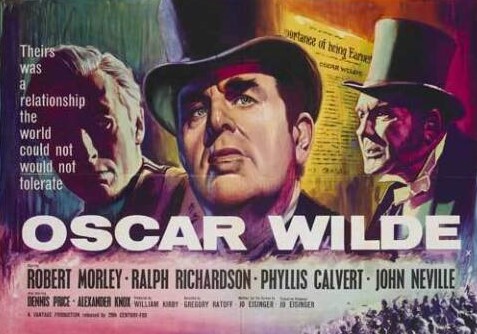
Oscar Wilde (1960) ****

You might be surprised to learn there were two Oscar Wildes. Not the famed writer and a doppelganger of course but two films on the same subject that were released in the same month. This is the low-rent version, costing a fraction of the rival The Trials of Oscar Wilde directed by Ken Hughes. It’s easy to be disdainful of the cheaper effort, with little cash available for scenery and costumes, but somehow it rises above budget limitations. Structurally, both movies focus on the trial – or in the case of The Trials of Oscar Wilde the three trials he endured – but the glossier pictures it has to be said glosses over a great deal.

While I enjoyed it at the time, I now find that in trying to make a modern martyr out of Oscar Wilde, the Ken Hughes picture built him up so much that it was difficult to find any flaw in his character. We never find out what was the actual slur the Marquis of Queensbury made on Wilde, resulting the playwright taking him to court for libel. And that version begins with Wilde and Alfred Lord Douglas (“Bosie”), son of the Marquis, already deep into their affair.

On the other hand, Oscar Wilde, the final film of Hollywood veteran director Gregory Ratoff (Intermezzo, 1939), starts at the beginning of their relationship with greater emphasis on Wilde’s practicality rather than his wit and Bosie’s (John Neville) tortured relationship with  his hypocritical father (Edward Chapman) who, while taking the moral high ground, keeps a mistress. On Wilde (Robert Morley) being described as a sodomite by the Marquis, Bosie’s desire to see his father humiliated in court verges on revenge. “You weren’t looking for a friend,” Wilde astutely tells his lover, “You were looking for a weapon.” Bosie is big on humiliation – he is the one to break the news of Wilde’s duplicity to the author’s wife (Phyllis Calvert). So determined is he on the court case that he fails to tell Wilde that his father has private detectives scouring London to find evidence.

While in court Wilde can keep the jury in stitches with his epigrams, he soon comes up against the Marquis’s formidable lawyer Sir Edward Carson (a quite stunning performance by Ralph Richardson). From Carson we learn a great deal more of Wilde’s practices, some of which nowadays would be termed grooming. Essentially, Carson paints a portrait of a predator, an older man (Wilde was 41) whose uses his wealth and wit to court many lovers, mostly aged around 20, but some as young as 16, barely the age of consent.. And when he felt his secret life was in danger of being exposed, he went so far as to pay for the passage to America of one of his lovers, Alfred Woods, to get him out of the way.

No matter that Wilde at the start can gloss over his promiscuity, complaining that Carson is misinterpreting innocent gestures of friendship, the cunning attorney soon has the author tied in knots as he wheels out one by one information regarding the various lovers.

It’s quite odd to realise that The Trials of Oscar Wilde in presenting the more accurate truth – that the author underwent three trials – fails to provide little more than a surface treatment of  the man’s real-life affairs. Oscar Wilde perhaps delves too deeply for audiences brought up to consider the author a martyr who deserves the free pass allocated all writers of genius. I found Oscar Wilde the more riveting watch because, of course, I already knew the outcome, but the sight of the famed writer, encouraged by the vengeful Bosie,  hung out to dry by his own hubris, and for a man of such wit to be outwitted in the courtroom by Carson was an exceptional watch.

Of course, the imprisonment of Wilde for the crime of being a homosexual is detestable. Even at the point this film was made homosexuality was a crime. So it’s fascinating to see how much The Trials of Oscar Wilde skirts round issues that Oscar Wilde had little problem in spelling out.

I was surprised how much I enjoyed Robert Morley’s performance. I may be wrong, but I think this was the only time he was accorded leading man status. Mostly, he was a supporting actor (The African Queen, 1951, say, or Genghis Khan, 1965) and often just playing a version of his self. Of course, he is outshone by a simply brilliant Ralph Richardson (Khartoum, 1966). John Neville (A Study in Terror, 1965) presents a more in-depth performance than in the rival picture. One-time British box office star Phyllis Calvert (The Golden Madonna, 1949) does well in a small but pivotal role. You might also spot Dennis Price (Tunes of Glory, 1960) and Alexander Knox (Mister Moses, 1965).

Lacking a budget to do much more, Gregory Ratoff sticks to the detail and draws out two superb performances, aided by a tight script by Jo Eisinger (Gilda, 1946; Cold Sweat, 1970) based on the play by Leslie and Sewell Stokes and the work of Frank Harris. As swansongs go, this is hard to beat.

Vastly underrated.

Catch it on YouTube.

NOTE: Oscar Wilde appeared in first run in Glasgow at the La Scala cinema in June 1960 one week ahead of The Trials of Oscar Wilde at the first run ABC Regal and ABC Coliseum.

Genghis Khan (1965) ****

Hollywood was never reined in by the strictures of history, much preferring fiction to fact for dramatic effect, and that’s largely the case here, although the titular hero’s real life remains shrouded in myth.

If you do catch this surprisingly good feature, make sure it’s not one of the many pan-and-scan atrocities on the market. I watched this in the proper Panavision ratio which meant it occupied only one-third of my television screen, but in that format it’s terrific. It’s a bit of an anomaly for a decade that churned out high-class historical epics like El Cid (1961) because this clocks in about a hour short of other films in the genre and there’s no star actor or director to speak of and no Yakima Canutt to handle the second unit action scenes.

Omar Sharif’s marquee value at this point was so low that if you check out any of the original posters you’ll note that his name hardly rates a mention and he also comes at the very end of the opening screen credits. Although this is post-Lawrence of Arabia (1962), it’s pre-Doctor Zhivago (1965), suggesting nobody had a clue how to market his talents.

Director Henry Levin was a journeyman, fifty films under his belt, best known for not a great deal except for, following this, the second and third in the Matt Helm spy series. Given this film was critically ignored on release and since, and a flop to boot, it definitely falls into the “Worth a Look” category. Although there are few stand-out scenes of the artistic variety such as pepper Lawrence of Arabia or El Cid, this is still well put together and Levin shows an aptness for the widescreen.

The narrative breaks down into three parts – the first section describing enslavement of Genghis Khan (Omar Sharif) by nemesis Jamuga (Stephen Boyd – the picture’s star according to poster and screen credits) – before banding together rival tribes in revolt; the second part a long trek to China; and the third encompassing a final battle and hand-to-hand combat with Jamuga. For a two-hour picture it has tremendous sweep, not just the scenery and the battle scenes, but political intrigue, romance, a rape scene and even clever comedy. Genghis Khan  believes his glory is predestined, but he has very modern ideas about the role of women.

The best section, oddly enough, is set in China where Genghis engages in a duel of wits with the distinctively contradictory Emperor (Robert Morley), but that’s not to detract from the film’s other qualities, the action brilliantly handled, especially the chaos of battle, the romance touching, and the dialog intelligent and often epigrammatic.

Unlike James Mason (Age of Consent, 1969) who makes a calamitous attempt at a Chinese accent, Robert Morley (Some Girls Do, 1969), costume apart and looking as if he has just walked out of an English country house, but his plummy tones belie a very believable character. Stephen Boyd (Assignment K, 1968) shines as the villain of the piece. Telly Savalas (Battle of the Bulge, 1965) and Woody Strode (The Professionals, 1966) have decent parts as Khan’s s sidekicks, the former unexpectedly bearing the brunt of the film’s comedy. French actress Francoise Dorleac (Billion Dollar Brain, 1967) is effective as Sharif’s wife.

Hitchcock stole one of his most famous ideas from Genghis Khan. About the only scene in Torn Curtain (1966) to receive universal praise was a killing carried out to a soundtrack of nothing more than the grunts of assailant and victim. But, here, where the score by Yugoslavian composer Dusan Radic was extensively employed, the rape scene is silent and just as stunning. If the only prints widely available are of the pan-and-scan variety I’m not surprised the film has been for so long overlooked, but if you can get hold of one in the preferred format you will be in for a surprise.      

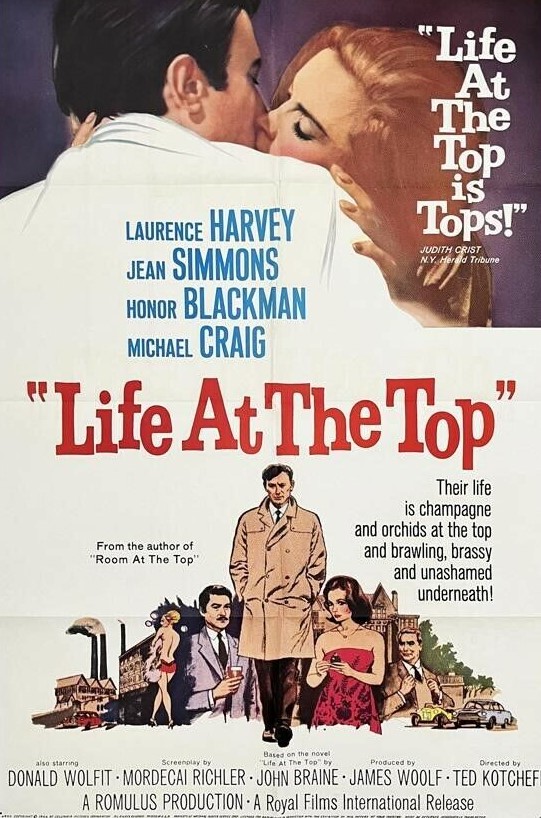
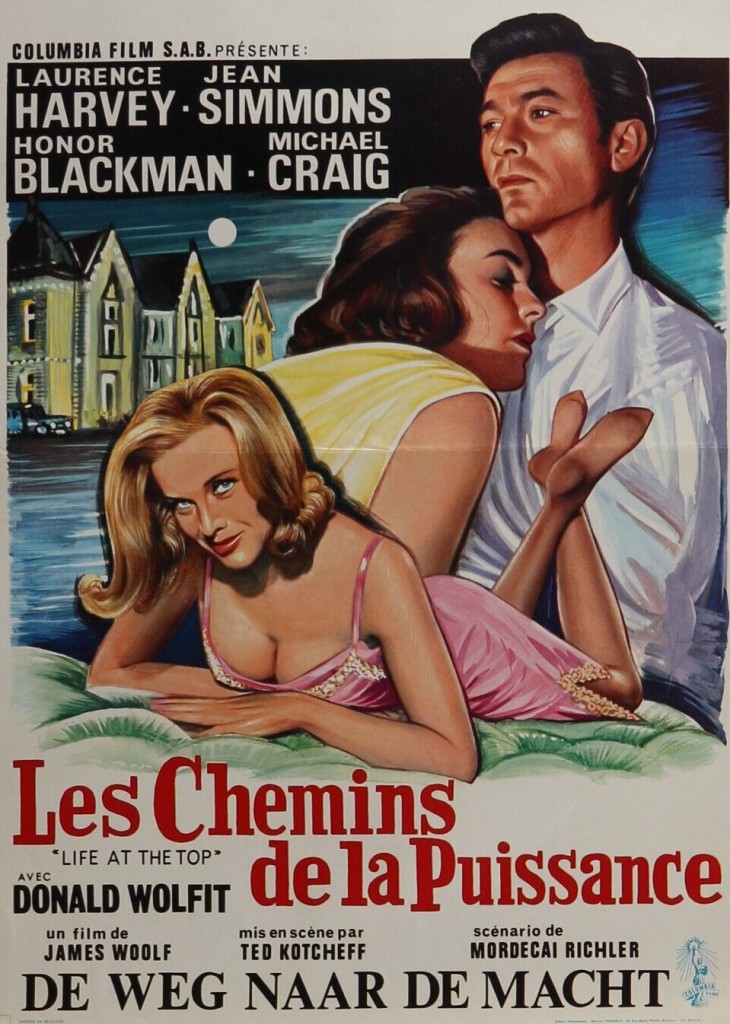
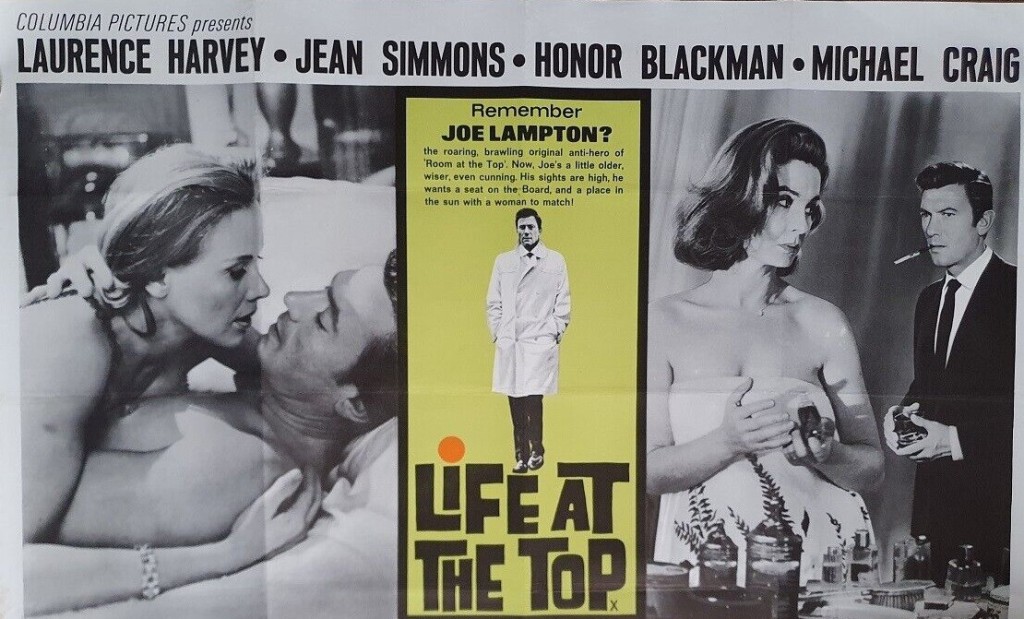
Life at the Top (1965) ***

Succession as seen from the perspective of someone like the inadequate Tom (Matthew Macfadyen), who has married his way into big business and has an elevated idea of entitlement.

Joe Lampton (Laurence Harvey) was a genuine working-class hero of Room at the Top (1958) who connived his way into the marriage bed of businessman Abe Brown’s (Donald Wolfit) daughter Susan (Jean Simmons) and set himself up as the heir apparent. Several years on, it’s not quite worked out the way he planned, stuck in a loveless marriage, out of his depth among the Yorkshire elite, passed over for promotion, pinning hopes of personal happiness on an affair with television personality Norah (Honor Blackman).

The only problem is that screen-wise he’s a b*****d without an ounce of the dominating personality of Brian Cox, the ultimate b*****d’s b*****d. This plays out more The Tale of Two Spoiled Brats. So if you’re looking to see Lampton get his come-uppance on several fronts, you’ve come to the right place. Unfortunately, that means there’s isn’t a single likeable character in sight. It might be the way of the world among the high-rollers but it makes for rather dispirited watching.

On the other hand, Lampton was always such a louse it is enjoyable to see him not only being put in his place but ending up a few rungs further down the ladder than where he started. This might have scored some points for social commentary but it’s such a scattershot approach – racing pigeons, local government corruption (by Tories, who else), strip club, ballroom dancing (the original Come Dancing before that usurper Strictly Come Dancing came along), drinking a yard of ale, swimming in the canal, ruthless entrepreneurs, luvvies  – it does little justice to any.

Perhaps the most surprising aspect is the independence of the women. Susan has a lover Mark (Michael Craig) and emasculates Joe by going behind his back to get whatever she wants, financially, from her father. Ambitious Norah refuses to give up her career for Joe and is likely to withdraw her favors should his ambition fails to match hers.

Even the cuckolded get in on the act, taunting those who had fallen for their partners’ adulterous ways. George Aisgill (Allan Cuthbertson) mocks Joe for falling (in the previous film) for his wife when she went after anything in trousers. Similarly, Mark’s wife ridicules Susan for just being the latest notch on Mark’s bed.

Naturally, Joe hasn’t the wit to see what a good deal he has and spends all his time in self-pitying mode. Poor Joe – he is stuck with driving a white Jag while Abe swans around in a Rolls-Royce. Poor Joe – his wife isn’t going to make do with hotel bedrooms for illicit assignations, but makes full use of the house. Poor Joe – his son doesn’t like him. Poor Joe – he trots out all his childhood deprivations at the slightest opportunity as if auditioning for a Monty Python sketch.

Poor Joe – he’s not even that good a businessman, so naïve that he doesn’t realise that many deals require sweeteners, backhanders, bribes, though smart enough enough to add on a little extra, when extracting such sums from the more worldly Abe, for himself. Poor Joe – he believes business blandishments. Poor Joe – Abe has no interest in the “Report” he’s slaved his guts over. Poor Joe – when he applies for another job, his lack of education marks him down.

The big problem is it’s impossible to feel any sympathy foe Joe. Your heart is more likely to go out to those he wounds with his atrocious behavior. The more he blames everyone else for his predicament, the more an idiot he looks, duped and a biter bit.

And Laurence Harvey (A Dandy in Aspic, 1968) whose screen person is one part arrogance, one part snarky, and one part well-groomed male is not capable of making you feel for his character. Jean Simmons (Rough Night in Jericho, 1967) reveals greater depths, vulnerable, passionate, seductive, practical. Honor Blackman (A Twist of Sand, 1968) gives a good account of herself as an ambitious woman with a conscience.  

Few of the other characters are more than ciphers but there’s a decent supporting cast in Donald Wolfit (Becket, 1964), Michael Craig (Stolen Hours, 1963), Robert Morley (Deadlier than the Male, 1967), Allan Cuthbertson (The 7th Dawn, 1964) and Nigel Davenport (Sands of the Kalahari, 1965).

Canadian Ted Kotcheff (Tiara Tahiti, 1962) directed from a screenplay by fellow country man Mordecai Richler (Young and Willing, 1962) based on the John Braine bestseller.  And it seems a bit mean to film it in black-and-white, presumably to emphasize the social aspects when in fact most of its takes place in glamorous settings.  

Discover WordPress

A daily selection of the best content published on WordPress, collected for you by humans who love to read.

The Atavist Magazine

by Brian Hannan

WordPress.com News

The latest news on WordPress.com and the WordPress community.