The Stripper (1963) ***

Can’t shake off its stage origins though Joanne Woodward is riveting as the eternally optimistic but ultimately luckless showgirl of this tawdry tale. For a while it looks like it’s going be another examination of small town morals but those who want to break free of social constriction come from such different parts of the world that the two tales –  teenage rite-of-passage and older woman trying to recapture her innocent youth – don’t mesh while the background for both is routine and stale.

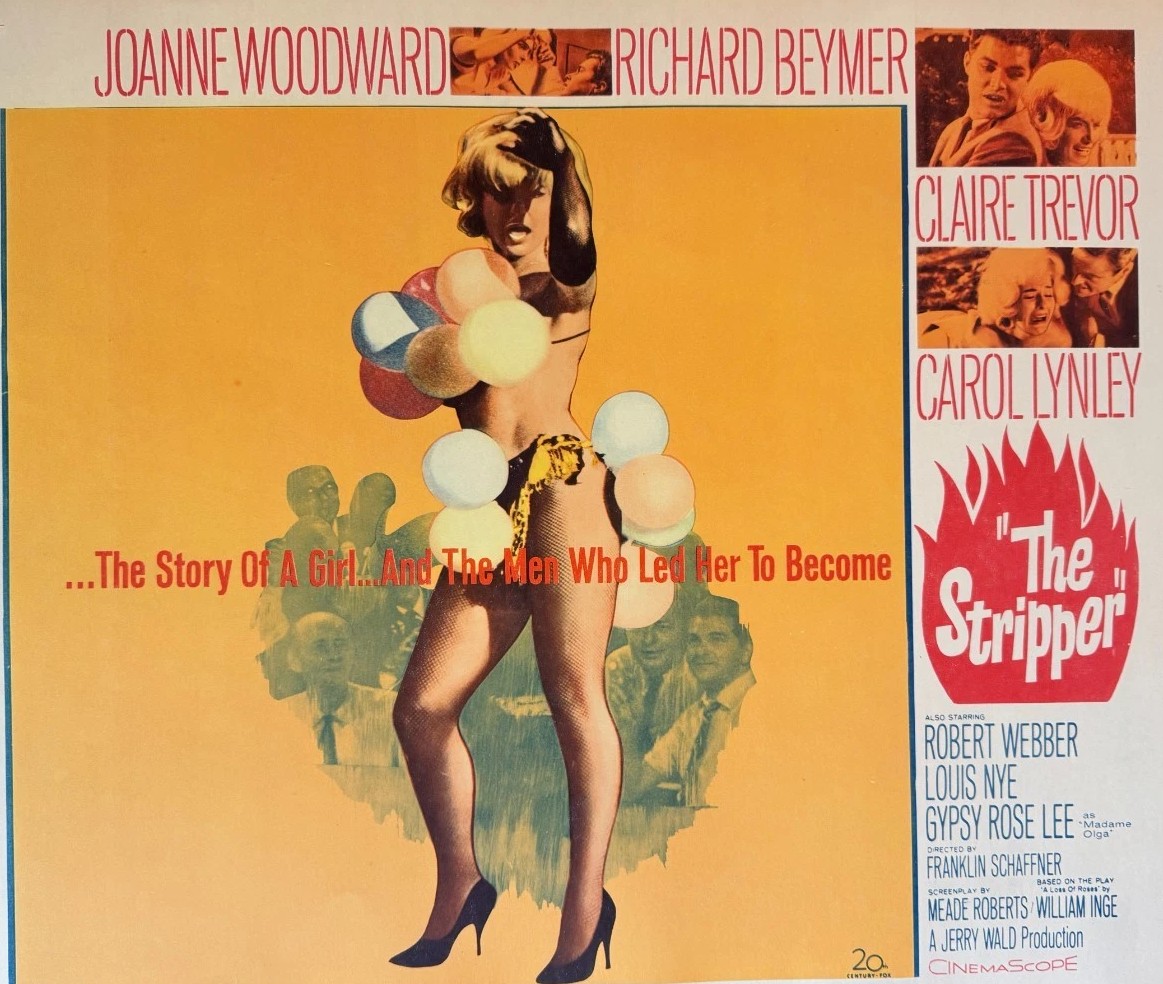
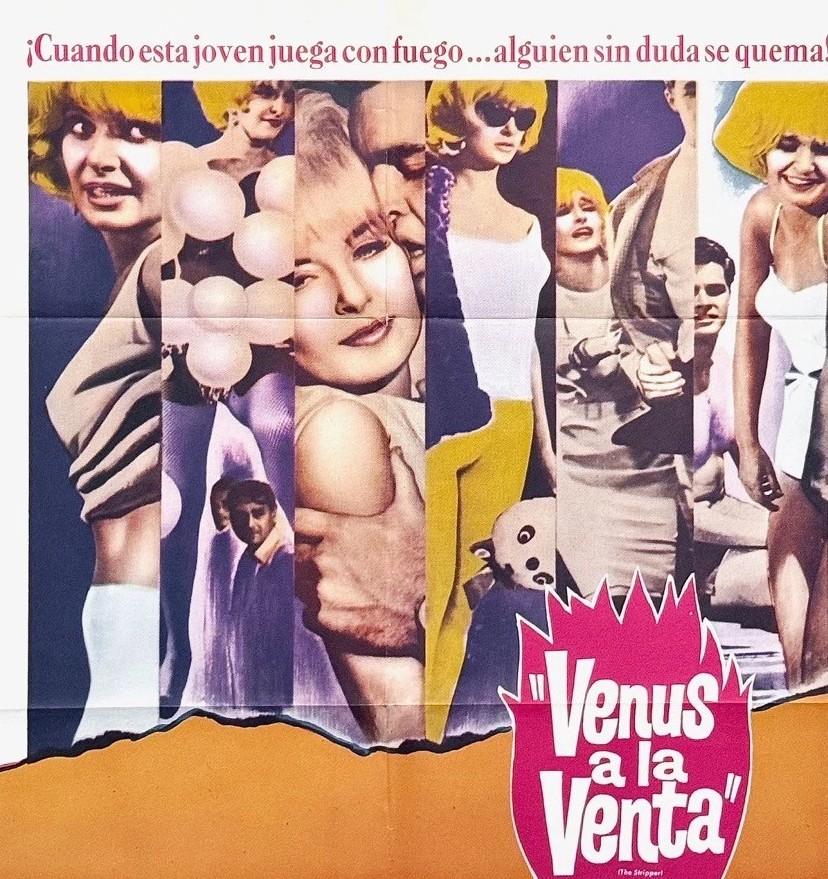
Magician’s assistant Lila (Joanne Woodward) returns to her home town and meets up with old neighbour Helen Baird (Claire Trevor) and her pump jockey son Kenny (Richard Beymer). He reminds Lila of Helen’s dead husband on whom Lila had a teenage crush. Abandoned by lover/manager Ricky (Robert Webber), she finds a safe berth with Helen. Kenny, annoyed at principled girlfriend Miriam (Carol Lynley), soon, as you might expect, falls for Lila. For a time she enjoys the security of small town life.

But, as you would expect, Ricky returns. He beats her up and drags her off to become a stripper. Kenny gets to witness her more degrading employment. Lila manages to quit Ricky and sets off with another suitcase full of delusions.

Despite Lila’s effervescence lacks the emotional punch to make this more than a re-tread of a standard Hollywood trope. Lila’s an eternal wannabe, not deterred by crushed dreams, but failing to understand the limitation of her talent, her most treasured possession a few strips of film from a screen test, and undone by her taste in men. She calls Ricky “daddy” and he punishes her with his belt.

The most effective sequence is the one with leering men reaching forward with lighted cigarettes to burst the balloons that cover her modesty while she strips. That tells a different story to the one we’ve sat through, the degrading endgame, the price paid for falling in with the wrong man or for believing you can live on illusion.

There would have been no shortage of better role models when she grew up, but dreams of stardom derailed that. In some respects, Ricky is rebelling against the same upbringing, requiring excitement (and sex) rather than the life he has been brought up to respect. He’s over-mothered for sure, but lacks ambition and probably needs marriage to give him some direction.
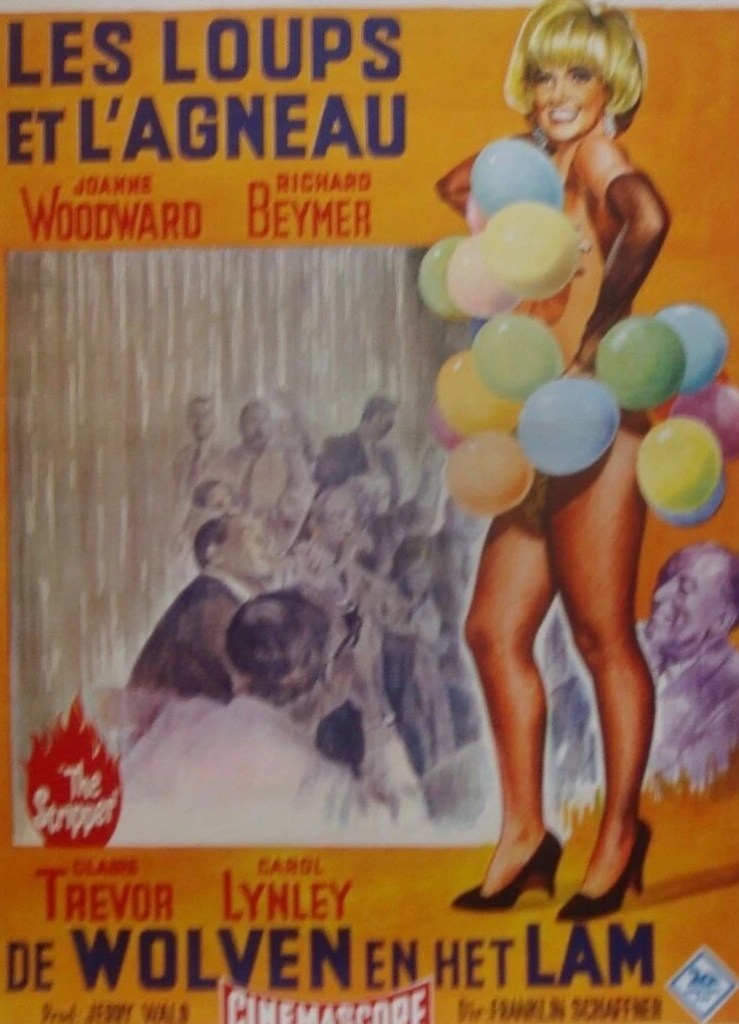
But there’s too many cliché characters, beginning with mother and girlfriend and rough lover. There’s nothing new about Ricky and no depth and while Lila is happily shallow that doesn’t help the story.

As I said, Joanne Woodward (Big Hand for the Little Lady, 1966) more than holds the film together but that’s not really enough. Richard Beymer (West Side Story, 1961) doesn’t rise above juvenile lead. Clare Trevor (The Cape Town Affair, 1967) has little to do but Carol Lynley (Bunny Lake Is Missing, 1965) acts against type.

Solid directorial debut I guess you would call it from Franklin J. Schaffner (Planet of the Apes, 1968). Screenplay by Meade Roberts (Danger Route, 1967) from a play by William Inge (Bus Riley’s Back in Town, 1965).

Worth it for Woodward but not much else.

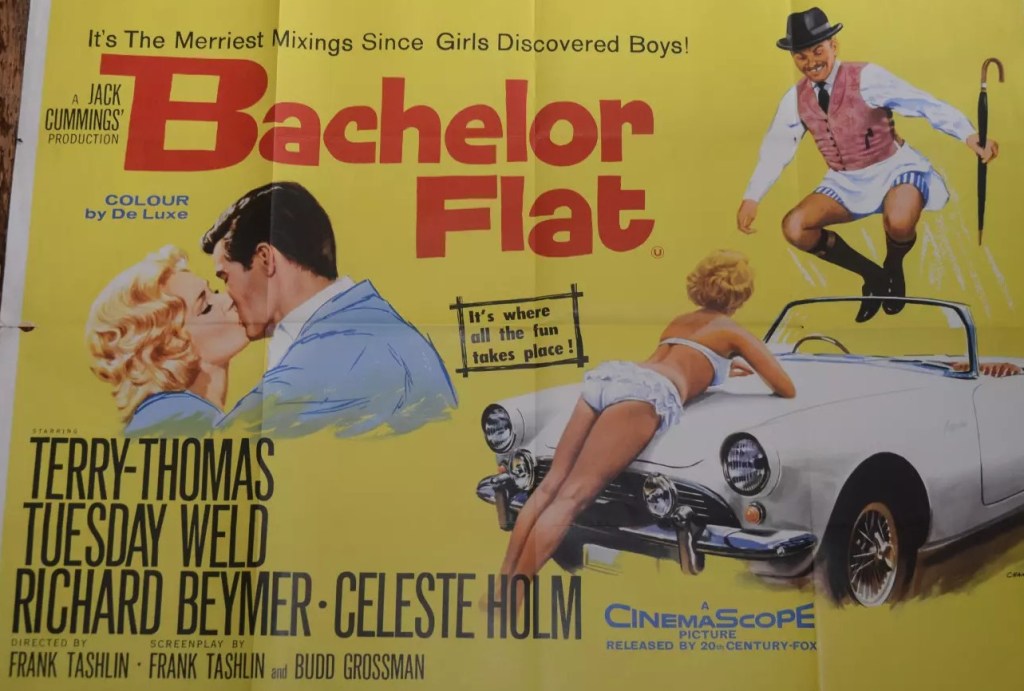
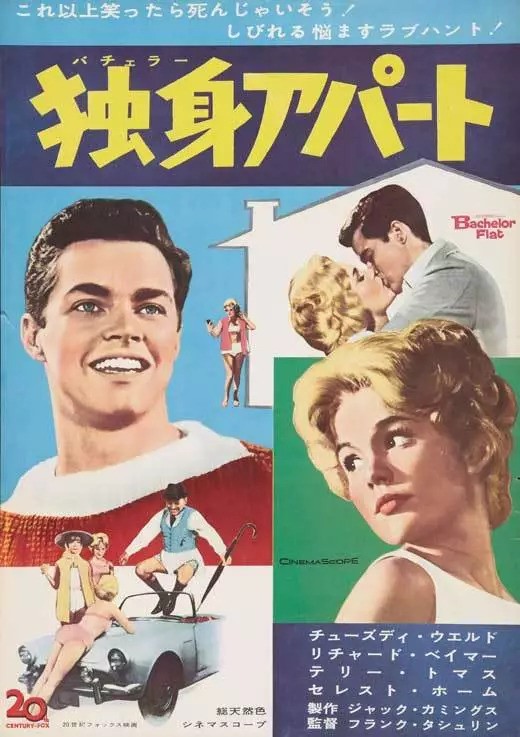
Bachelor Flat (1961) ****

Stereotypical Englishman reinvented. Where the suited-and-booted traditional British gent, umbrella at the ready, moustache awaiting twirling, bristling with pomposity, usually of military background and inclined towards the pedantic, was treated as a figure of fun, here in a marvelous conceit he is instead catnip to the ladies. You could imagine this was somewhat prophetic given the imminent arrival on Hollywood shores of such testosterone-charged figures as Sean Connery, Richard Harris et al.

All the elements that previously pointed to mickey-taking – impeccable manners, a sense of fair play anathema in the cut-throat American world, respect extended towards the opposite sex – are here presented as such ideals that the entire female population of a small town is swooning at the feet of its only known Englishman.

What’s more, director Frank Tashlin (The Glass Bottom Boat, 1966) doesn’t ask star Terry-Thomas (Arabella, 1967) to lampoon himself, as would often later be the case, where the actor was called upon to play an overstuffed romantic fantasist of the Bob Hope variety or presented as comedic villain or overacting butler. Instead, Terry-Thomas plays it straight, oozing astonishing charm that allows the slapstick and farcical ingredients to work a treat.

Sure, it’s mostly a dressed-up farce, people hidden in cupboards and under beds, doors slamming in faces, faces drenched in cake, and in a sharp swipe-left on gender equality, the man, rather than the woman, mostly seen in a state of undress.

Professor Patterson (Terry-Thomas) throws his adoring mostly adorable students into a tizzy when they discover he is engaged to actress Helen (Celeste Holm) currently residing in Paris. They met when the academic rented her beach house which is where Libby (Tuesday Weld) comes in. Astonished to discover a stranger in her mother’s house, Libby doesn’t let on she’s Helen’s daughter and instead pretends to have escape from juvenile detention. Helen has so far balked at telling her lover she has a 17-year-old daughter by a previous marriage.

Professor’s young neighbor, law student Mike (Richard Beymer), takes a shine to his unwelcome guest, but he’s mostly there to add complication to complication.

Usually, in these farces, it’s the guilty man trying to hide his various lovers from one another, hence stowing them away in cupboards and beds and whatever. But here the professor is a determined innocent who has to stoop to such shenanigans to pretect his integrity. But not only is he assailed by Libby but also by student Liz (Ann Del Guercio) who lets down his tyres so she can run him home and neighbor Gladys (Francesca Bellini) who makes eyes at Mike as a way of infiltrating Patterson’s defences. Added complications are a suspicious cop and a rival academic.

So when Patterson is not trying to keep the various female invaders from discovering one another, or the cop or Mike from finding them stashed away, he’s trying to fruitlessly explain how he has been snagged by the aforesaid predatory women. And of course when his fiancee returns there’s no queston she’ll catch him in some questionable act.

In some senses this is pretty formulaic stuff but it is brightened immeasurably by some choice lines (“I don’t take money from strangers unless I steal it” and “either you get a smaller bone or I get a bigger dog”), the occasional madcap situation (one of his suitors eating a slice of cream came while on a vibrating slimming machine and Mike discovering how Libby fed him a line), but mostly by the spirited playing of Terry-Thomas and Tuesday Weld. Apart from a small part in Tom Thumb (1958) this was the actor’s introduction to Hollywood and it says a lot for his talent that he’s entirely believable as the kind of charmer that women flock to.

Tuesday Weld (Pretty Poison, 1968) is more than glamor on legs and finesses her first top-billed role into surprising depths beyond the obvious enthusiastic ingenue, especially given her Ann-Margret-style shake-your-booty introduction, suggesting talent to burn. Richard Beymer (West Side Story, 1961), who was holding a real-life candle for Ms Weld, is little more than eye candy for the female gaze. And if none of this trio is sufficient to hold your attention, there’s a cute dog.

Frank Tashlin occasionally made films with more acerbic bite, but this isn’t one of them. It sticks to a magic formula that works mostly thanks to the two principles.

Raised up a good notch by the revelatory performance by Terry-Thomas, his drunk scenes are just superb and unusually played, and you probably can guess from this where Four Weddings and a Funeral (1994) got its rain-soaked proposal scene.

Tremendous fun.

Discover WordPress

A daily selection of the best content published on WordPress, collected for you by humans who love to read.

The Atavist Magazine

by Brian Hannan

WordPress.com News

The latest news on WordPress.com and the WordPress community.