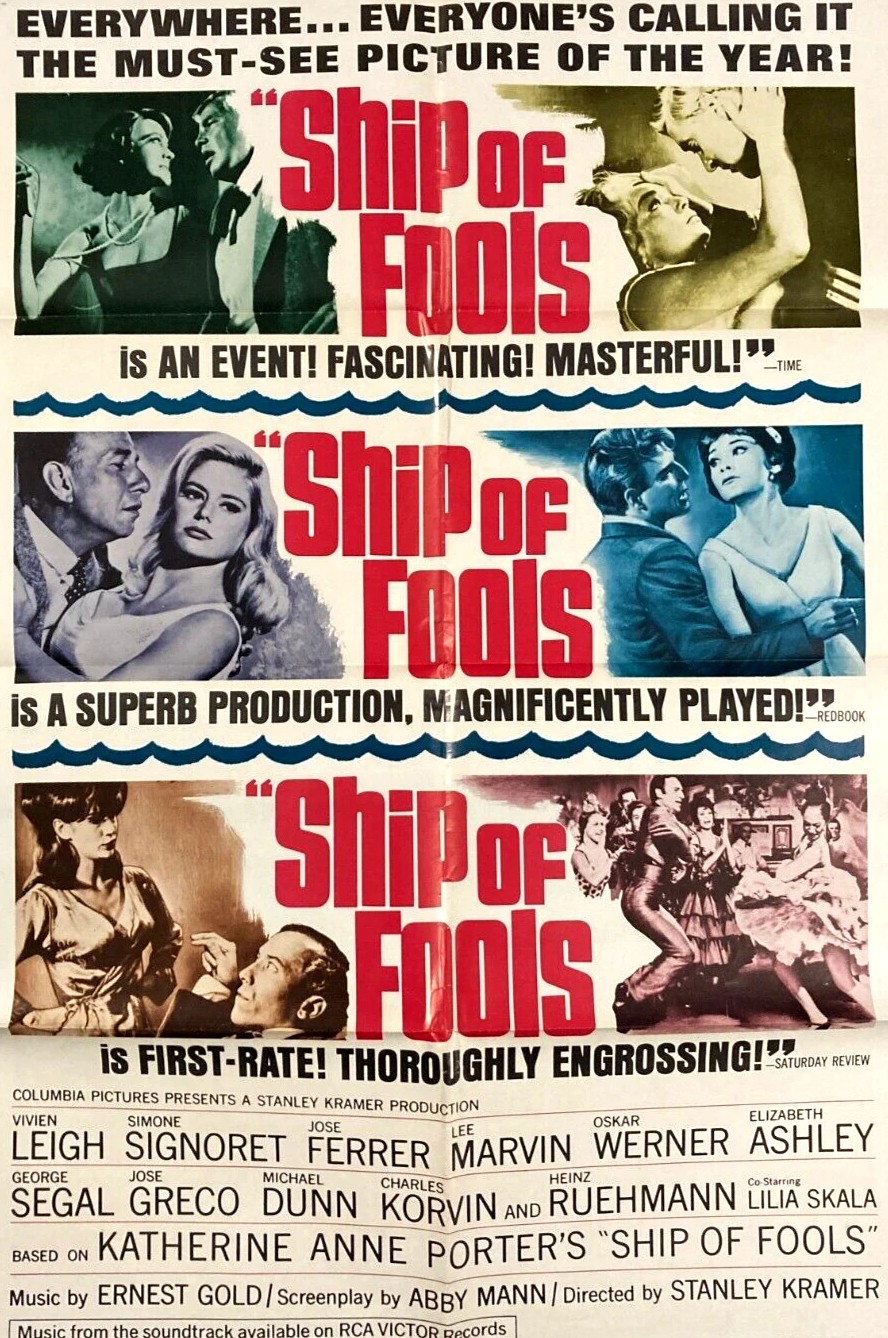
Behind the Scenes: “Ship of Fools” (1965)

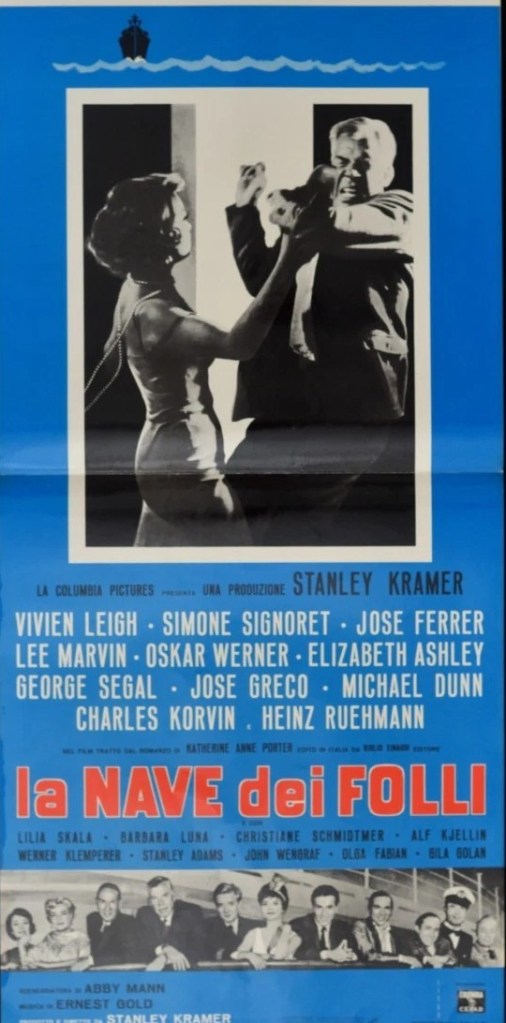
Stanley Kramer was on a roll, It’s A Mad, Mad, Mad, Mad World – an outlier in his portfolio of serious pictures – his biggest-ever hit. Although United Artists, where the director had made his last four pictures, was initially in the frame for Katharine Anne Porter’s 1962 best seller Ship of Fools, the project ended up at Columbia which Kramer had last partnered on The Caine Mutiny in 1951. While the asking price was $450,000 plus a percentage, Kramer secured the rights for $375,000 although he chipped in $25,000 towards the book’s advertising campaign.

Kramer envisioned a character-driven film that would make up for the lack of action. He shifted the timescale to 1933 from 1931 to bring greater overtones of the Hitler threat. “Although we never mention him in the picture,” said Kramer, “his ascendancy is an ever-present factor.” Since there were no seagoing liners available to take over, the movie was shot entirely on the soundstage. “We filmed a ship’s ocean voyage without a ship and without an ocean.” He ransacked old footage for establishing shots of the ship, usually seen in the distance. Decks, staterooms and dining areas were constructed in the studio.
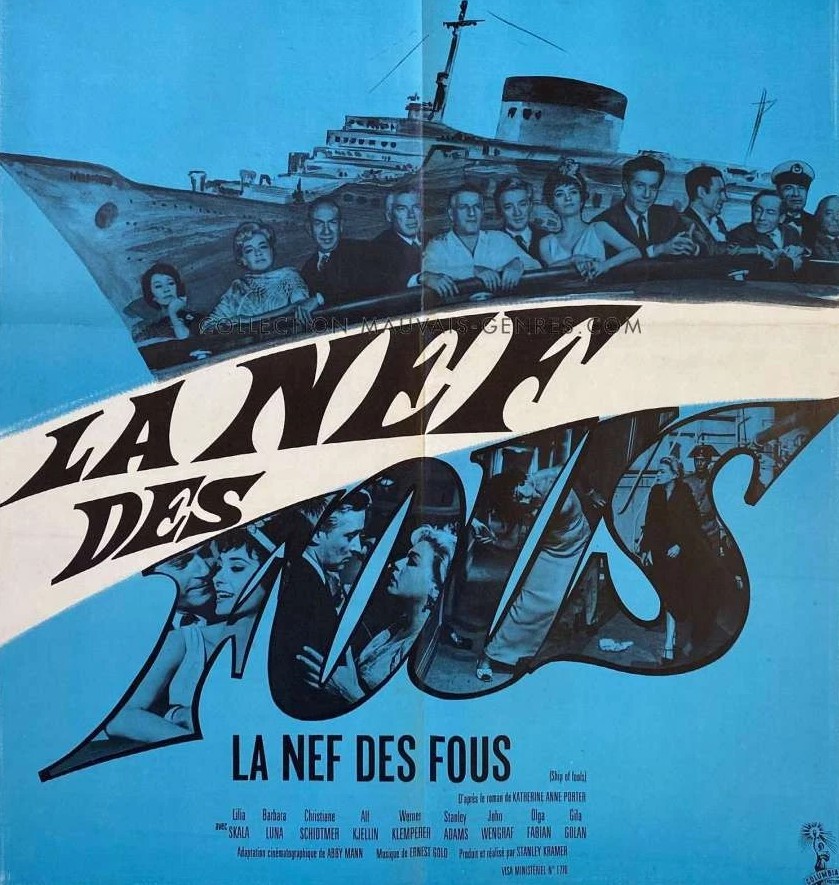
The kind of muted color he would have preferred was not available and since “the theme was just too foreboding for full color” he decided to film in black and white. Shooting in black and white wasn’t yet redundant. Of 27 features going in front of the cameras in 1964, six (including The Disorderly Orderly and Hush, Hush, Sweet Charlotte) were made in monochrome –  down from ten out of 24 the year before.

A thoughtful epic was always going to have trouble finding stars especially as current wisdom was that the industry only had at its disposal 22 genuine box office stars “thinly sprinkled” through the 43 pictures currently in production. While the movie’s marketeers boasted of an all-star cast, the reality was that while overall the actors had “combined heft” they were “minus any individual box office behemoth.”

Spencer Tracy, whom Kramer initially envisioned for the role of the ship’s doctor and who had starred in the director’s last three pictures, would have added definite marquee allure, but he was unavailable due to illness. Greer Garson and Jane Fonda also fell by the wayside.
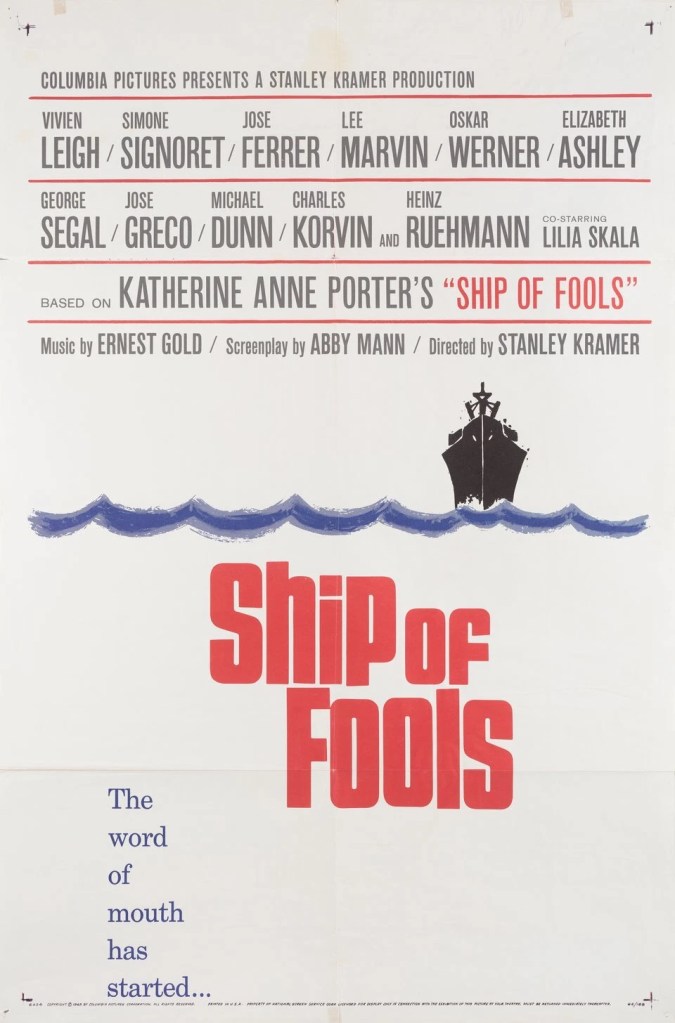
And unusually, Kramer insisted that many of those actors were not American. Vivien Leigh was born in India, Simone Signoret – who had just quit Zorba the Greek (1964) – was German and Oskar Werner Austrian. Jose Ferrer (who had won the Oscar in Kramer’s production of Cyrano de Bergerac, 1950) hailed from Puerto Rico, Jose Greco from Italy, Charles Korvin from Hungary, Lila Skalia from Austria and Alf Kjellin from Sweden. Signoret and Skala had Jewish ancestry.

His biggest casting coup was luring double Oscar-winner Vivien Leigh (The Roman Spring of Mrs Stone, 1961) out of retirement. But that was a double-edged sword. In real-life she led a tortured existence. Her marriage to Laurence Olivier was over and she had only appeared in two films since A Streetcar Named Desire (1951). She suffered from mental illness and tuberculosis. “Happiness or even contentment” eluded her and in that respect she was ideal for the role. “I’m sure she realized that, in the picture, she was playing something like her own life yet she never, by word of gesture, betrayed any such recognition.” She was another gamble, the reason her dance card was so empty down to directors despairing of getting a performance out of her.

Kramer flew to Germany to persuade Oskar Werner to take on the role intended for Spencer Tracy. At the time Werner, while familiar to European audiences and the American arthouse set through Jules and Jim (1962),was a relative unknown and a casting gamble. On set he proved obstinate. For one scene where he was instructed to enter camera right he did the opposite. When the direction was repeated, he stood his ground, insisting he preferred that view of his face. Despite the cost of reversing the set-up Kramer was forced to concede. Despite these trials, Kramer got along with Werner better than the actors. “They just couldn’t stand him.”  Notwithstanding such difficulties Kramer later signed him for another film, but the actor died before shooting began.

James MacArthur (The Truth about Spring, 1964) was mooted for a role as was Sabine Sun (The Sicilian Clan, 1969). The most unlikely prospect was German comedian Heinz Ruhmann who was cast as Lowenthal. The Screen Actors Guild complained when Kramer hired five Spaniards instead of Americans for bit parts paying union scale of $350 a week, but their complaints were ignored.

Kramer admitted the ingénue roles played by George Segal (The Bridge at Remagen, 1968) and Elizabeth Ashley (The Third Day, 1965) were too much of a cliché. “As in most pictures,” observed Kramer, “older actors not only had more stature but they were also better armed by the writers. There was no way Segal and Ashley could compete with Werner and Signoret.”

The film cost $3.9 million. Filming began on June 22, 1964. It was initially a long shot for roadshow release but since Columbia was already committed to the more expensive Lord Jim and there were already 15 others lined up from other studios, Columbia nixed the two-a-day release in favour of continuous program.

Boosted by book sales – it was the number one hardback bestseller of 1962 and had sold millions in paperback – the movie carved out a more commercial niche than had been anticipated. Positive reviews helped. It opened to a “mighty” $88,000 in New York breaking records at the 1,003-seat Victoria and the 561-seat Sutton arthouse.

There was a “socko” $25,000 in Chicago, “giant” $23,000 in Philadelphia, “sock” $14,000 in Baltimore, “strong” $13,000 in St Louis, “lively” $12,000 in Detroit, “stout” 12,000 in San Francisco, “sturdy” $11,000 in Pittsburgh, and “slick” $10,000 in Columbus, Ohio. The only first run location where it toiled was Denver where it merited a merely “okay” opening of $8,000.

There was a sense of Columbia letting it run as long as possible in first run in the hope of garnering Oscars to boost its subsequent runs. But the studio was the beneficiary three times over from the Oscars – with Cat Ballou, Ship of Fools and William Wyler’s The Collector in contention for various awards.

The studio had the clever idea of pairing Ship of Fools in reissue with Cat Ballou, for which Marvin had won the Oscar, and although not the star of Ship of Fools the teaming suggested it was a Marvin double bill. In Los Angeles the double bill hoisted $135,000 from 21 houses followed by $121,000 from 28. But in Cleveland Ship of Fools went out first with The Collector and then Cat Ballou. A mix-and-match strategy also saw Ship of Fools double up with, variously, A Patch of Blue, Darling and The Pawnbroker.

The final tally was difficult to compute. In its 1965 end-of-year rankings Variety reckoned it had only pulled in $900,000 in rentals but it was good for $3.5 million in the longer term, a realistic target once you counted in the $1.3 million in rentals generated by the combination with Cat Ballou.

SOURCES:  Stanley Kramer with Thomas F. Coffey, It’s A Mad, Mad, Mad, Mad World, A Life in Hollywood (Aurum Press, 1997) pp203-212; “New York Sound Track,” Variety, May 2, 1962, p4; “375G for Fools Novel,” Variety, May 2, 1962, p5; “Publisher’s Big Break,” Variety, May 23, 1962, p4; “Kramer to Produce Ship of Fools for Columbia,” Box Office, June 18, 1962, p9; “Abby Mann to Script Ship of Fools,” Box Office, November 1962, pSE4; “Top German Comic,” Variety, April 15, 1964, p23; “Simone Signoret Exits Zorba,” Variety, April 22, 1964, p11; “Control of Space,” Variety, May 6, 1964, p4; “Five Spaniards on Ship of Fools Irks SAG,” Variety, June 3, 1964, p5;“To Speed MacArthur for Ship of Fools,” Variety, June 10, 1964, p17; “27 Features Shoot in Color, Only Six in Monochrome,” Variety, August 5, 1964, p3; “Perennial Quiz,” Variety, September 2, 1964, p1; “15, Maybe 17, Pix for Roadshowing,” Variety, October 28, 1964, p22; “Too Many Roadshows,” Variety, August 2, 1965, p5. Box office figures, Variety September-November 1965, “Big Rental Pictures of 1965,” Variety, January5, 1966, p6.
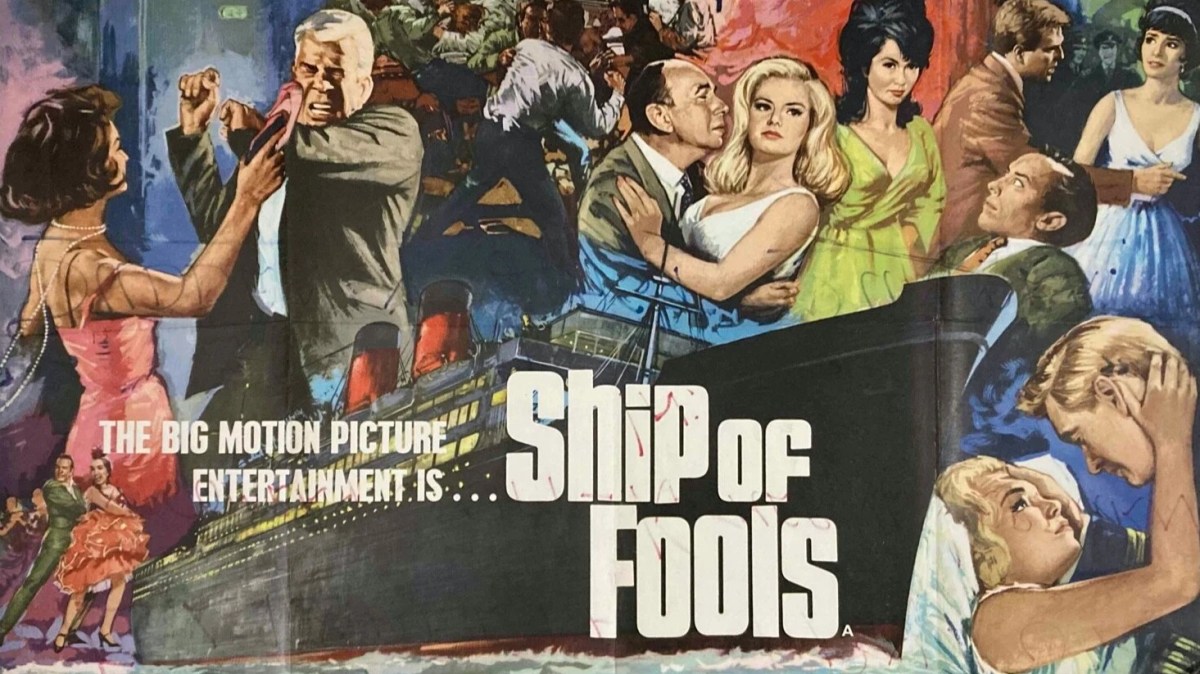
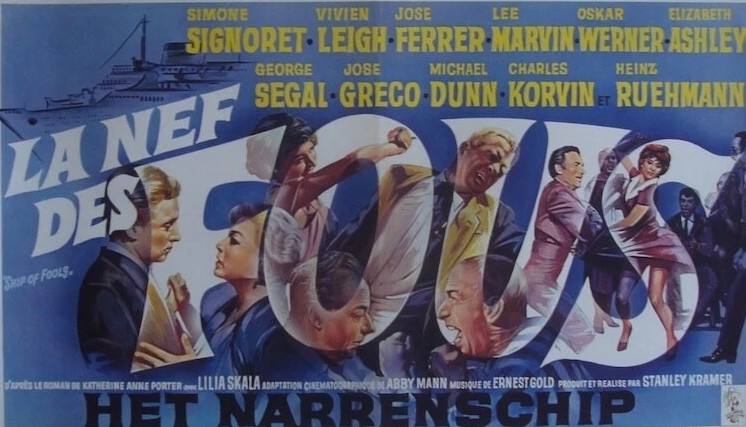
Ship of Fools (1965) ****

Too easily dismissed as soap opera masquerading as a movie making a serious point, this is redeemed and, in some respects, elevated by the performances. If anything, the two political aspects are underdone. The heavy air that hangs over proceedings given the German passengers are heading back to Nazi Germany at the start of Hitler’s reign in 1933 with no idea of the outcome is only there in the audience’s mind. That the racism is underplayed is in part due to the fact that those victimized, a Jew and a disabled man, refuse to act as victims and indeed bond.

The other political aspect, of Spaniards being deported from Cuba for economic reasons, would have more resonance today. But they, too, are heading for consequence and the Spanish Civil War which would break out a few years later. Director Stanley Kramer was noted, indeed often ridiculed, for tackling weighty subjects in movies like The Defiant Ones (1958), On the Beach (1959), Judgement at Nuremberg (1961) and Inherit the Wind (1961). That was tempered somewhat when he went off-piste for It’s a Mad, Mad, Mad, Mad World (1963) and although that’s generally remembered for its hilarity what’s often overlooked is the director’s dexterity in handling a busload of characters and narratives, his pacing and his understanding of character.

Deduct the comedy and you have a similar approach here, the meshing of various narrative arcs while allowing character to flourish so the general smorgasbord of, if I’m allowed such an obvious notion, ships passing in the night is what gives this more heft.  And the fact that the audiences knows more than the characters about what the future holds permits the director just to concentrate of character interaction.

Unusually, for a historical movie of the period, it’s the females who dominate and have the best storylines. The ship is so full that upscale single passengers who might otherwise have the choice of dining alone are thrown together thus divorcee Mary Treadwell (Vivien Leigh) shares a table with former baseball player Bill Tenny (Lee Marvin).

Their paths unexpectedly cross in unusual fashion. Both are seeking love, though in reality Tenny is happy to settle – and pay for – sex. Mary finds Captain Thiele (Charles Korvin) ignoring her subtle advances while in turn she dismisses the lieutenant. When a drunken Tenny without warning bursts into her cabin, she responds with ardor until she realizes he thinks she’s a prostitute.

La Condesa (Simone Signoret) is a civil rights activist who finds a fellow traveler in Dr Schumann (Oskar Werner). Although, initially, she mines him to feed her opiate addiction, it’s soon apparent they  are falling in love, although that doesn’t end well. Not much ends well in the romance department, Jenny (Elizabeth Ashley), while initially supportive of artist David (George Segal), soon realizes that his art will take dominance in their relationship.

The older Rieber (Jose Ferrer), with the most pronounced Nazi sympathies, has taken up with younger blonde Lizzi (Christiane Schmidtmer), among whose physical attractions is that she’s a great table tennis player, until she discovers he’s married.

Flamenco dancer Elsa (Gila Golan) is pimped out by her father Pepe (Jose Greco). Social exclusion leads Jew Lowenthal to bond with Glocken who suffers from dwarfism and when German World War One hero Freytag is forced to join them that permits most of the discussion about the state of Germany.

Otherwise, the fact that a mastiff is permitted to sit at table is more to do with aristocratic entitlement than any other social condition. 

For once, Kramer is more interested in character than scoring points. So what might have been heavy going turns into an acting class. To accommodate its portfolio of ageing superstars Hollywood had returned to the subgenre of movies about ageing beauties. Double Oscar-winner Vivien Leigh’s previous outing The Roman Spring of Mr Stone (1961) belonged in that category but this latest reincarnation was a class above, a truly tender examination of loss. However, it was Simone Signoret (The Deadly Affair, 1967) who was Oscar nominated.

Michael Dunn (Justine, 1969) and Oskar Werner (Interlude, 1968) were nominated and while Lee Marvin (Point Blank, 1967) and George Segal (The Bridge at Remagen, 1968) were overlooked the latter two clearly scored points judging by their future acceptance in the Hollywood hierarchy, Marvin in particular alerting the industry to untapped talent, a point made more emphatically in his next picture Cat Ballou for which he won Best Actor. Ship of Fools missed out to The Sound of Music for Best Film. Nominated for eight awards it picked up two, ernest Laszlo for Cinematogrpahy and Robert clatworthy and Joseph Kish foir Art Direction

You might also spot Alf Kjellin (Ice Station Zebra, 1968), Barbara Luna (Firecreek, 1968) and Gila Golan (The Valley of Gwangi, 1969).

Even without the political overhang, this holds together as Grand Hotel on the high seas with Stanley Kramer in his element employing compelling characters to flesh out an interesting narrative. Written by Abby Mann (Judgement at Nuremberg) from the Katherine Anne Porter bestseller.

While the politics add a contemporary veneer, watch it for the acting.

The Shoes of the Fisherman (1968) ****

Another nod to Conclave. Thought-provoking drama with a contemporary slant set against the grandeur of the Vatican amid geo-political turmoil. At a time of global crisis, dissident Russian archbishop Lakotov (Anthony Quinn) is unexpectedly freed from a labor camp by the Russian premier (Laurence Olivier). Arriving at the Vatican, he is promoted to Cardinal by the dying Pope (John Gielgud) before becoming an unexpected contender for Papal Office.

The spectacular wealth of the Catholic Church is contrasted with the spectacular poverty of China, on the brink of starvation due to trade sanctions by the United States, nuclear war a potential outcome. The political ideology of Marxism is compared to the equally strict Christian doctrine, of which Lakotov’s friend Father Telemond (Oskar Werner) has fallen foul. There is a sub-plot so mild it scarcely justifies the term concerning television reporter George Faber (David Janssen) torn between wife Ruth (Barbara Jefford) and young lover Chiara (Rosemary Dexter).

Lakotov is drawn into the Russian-Chinese-American conflict and the battle for the philosophical heart of the Christian faith while bringing personal succor to the lovelorn and performing the only modern miracle easily within his power, which could place the Church in jeopardy, while condemned to the solitariness of his position.

The political and philosophical problems addressed by the picture, which was set 20 years in the future, are just as relevant now. The film’s premise, of course, while intriguing, defies logic and although the climax has a touch of the Hollywood about it nonetheless it follows an argument which has split the church from time immemorial.

You would not have considered this an obvious candidate for the big-budget 70mm widescreen roadshow treatment, but MGM, after the Church not surprisingly refused access to the Vatican, spent millions of dollars on fabulous sets, including the Sistine Chapel. The roadshow version of the picture, complete with introductory musical overture and an entr’acte at the intermission, is leisurely and absorbing, held together by a stunning – and vastly under-rated – performance by Anthony Quinn (The Lost Command, 1966) who has abandoned his usual bombastic screen persona in pursuit of genuine humility and yet faces his moments when he questions his own faith.

Ruth has a pivotal role in bringing Lakotov down to earth but George has the thankless task, setting aside the quandaries of his love life, of talking the audience through the sacred ceremonies unfolding sumptuously on screen as the cardinals bury one Pope and elect another.

You wouldn’t think, either, that Hollywood could find room in such a big-budget picture for philosophical discussion but questions not only of the existence of God but whether he has abandoned Earth are given considerable scope, as are discussions about Marxism and practical solutions to eternal problems. None of these arguments are particularly new but are given a fair hearing. There is a hint of the Inquisition about the “trial” Telemond faces. Oskar Werner (Interlude, 1968) carries off a difficult role.

David Janssen (Warning Shot, 1967) is mere window dressing and Rosemary Dexter (House of Cards, 1968) mostly decorative but Barbara Jefford (Ulysses, 1967) is good as the wounded wife. Laurence Olivier (Khartoum, 1966) is the pick of the sterling supporting cast which included John Gielgud (Becket, 1964), Burt Kwouk (The Brides of Fu Manchu, 1966) Vittorio de Sica (It Happened in Naples, 1960), Leo McKern (Assignment K, 1968), Frank Finlay (A Study in Terror, 1965), Niall McGinnis (The Viking Queen, 1967) and Clive Revill (Fathom, 1967). In a small role was Isa Miranda, the “Italian Marlene Dietrich,” who had made her name in Max Ophuls’ Everybody’s Woman (1934) and enjoyed Hollywood success in films like Hotel Imperial (1939) opposite Ray Milland.

Michael Anderson (Operation Crossbow, 1965) directed with some panache from a script by veteran John Patrick (The World of Suzie Wong, 1960) and Scottish novelist James Kennaway (Tunes of Glory, 1960) based on the Morris West bestseller.

I found the whole enterprise totally engrossing, partly because I did not know what to expect, partly through Anderson’s faultless direction, partly it has to be said by the glorious backdrop of the Vatican and the intricacy of the various rites, but mostly from the revelatory Quinn performance. And even if the plot is hardly taut, not in the James Bond clock-ticking class, it still all holds together very well. From the fact that it was a big flop at the time both with the public and the critics, I had expected a stinker and was very pleasantly surprised.

All hail Anthony Quinn.

Interlude (1966) ****

Kevin Billington’s debut benefitted from a brief fad for classical music soundtracks, Elvira Madigan kicking off the fashion the year before, 2001: A Space Odyssey, which opened at the same time as Interlude, trumping everything in sight. And as luck would have it, this was not the only movie about an orchestra conductor, Counterpoint with Charlton Heston released in America a couple of months before this one opened in Britain.

What makes the movie so enjoyable is that overlaying the sumptuous love story is the angst of a mistress. It’s sweetly set in wonderful British locations, riverside inns, olde worlde hotels, trendy restaurants, a few flashes of swinging London, luxurious mansions. The solid backdrop for something as fragile as romance.

There could not be two more opposites to attract, the rich Oskar Werner (Jules and Jim, 1962) in full-on arrogant mode, all dark glasses and leather gloves with enough petulance to sink a barge, and journalist Barbara Ferris (off screens since the lamentable Catch Us If You Can three years before) who lives in a bedsit with a goldfish called Rover. He drives a Rolls-Royce convertible, she a Mini. 

There are some very good touches. We first see the characters in mirrors. He plays a “concerto for wine glass and index finger.” There is the very serious British business of whether milk goes in first to a cup of tea.

The screenplay by Lee Langley and Irish playwright Hugh Leonard is sharp and often witty.  “I want to marry you,” says Ferris, before conceding, “I just don’t want to be your wife.” There is clear realization of the nature of his personality in her remark, “Instead of being what you want, I’ll be what you’ve got.”

Even when emotion is expressed there is a feeling that a lot is still suppressed. Ferris goes from high excitement to high dudgeon and carries within the seed of fear, a character who spends as much time in terror as in love. This is exacerbated when she spots of Werner’s wife, stoically played by Virginia Maskell, at the hairdressers and “all of the sudden” the wife who has existed in her imagination “has a face.”

John Cleese and Donald Sutherland have decent cameos, the former in a bit of an in-joke as a PR man wanting to get into comedy (“satire – that’s my field”), the latter as the womanizing brother of Werner’s wife.

Oddly enough, the music – Beethoven, Tchaikovsky, Mozart, Dvorak, Brahms and Rachmaninov – acts in the same manner as Easy Rider the following year, as extensive interludes to the developing drama. Perhaps it is where Dennis Hopper got the idea.

It is very rounded for a romance, the acting excellent and the undernote of despair well-wrought.

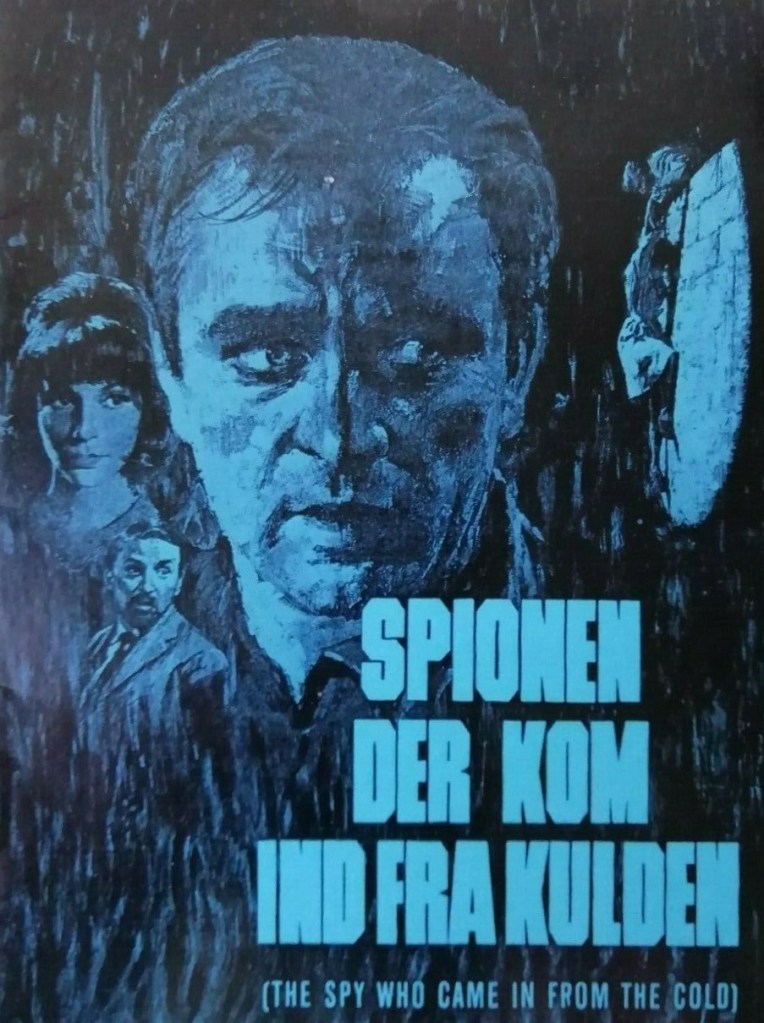
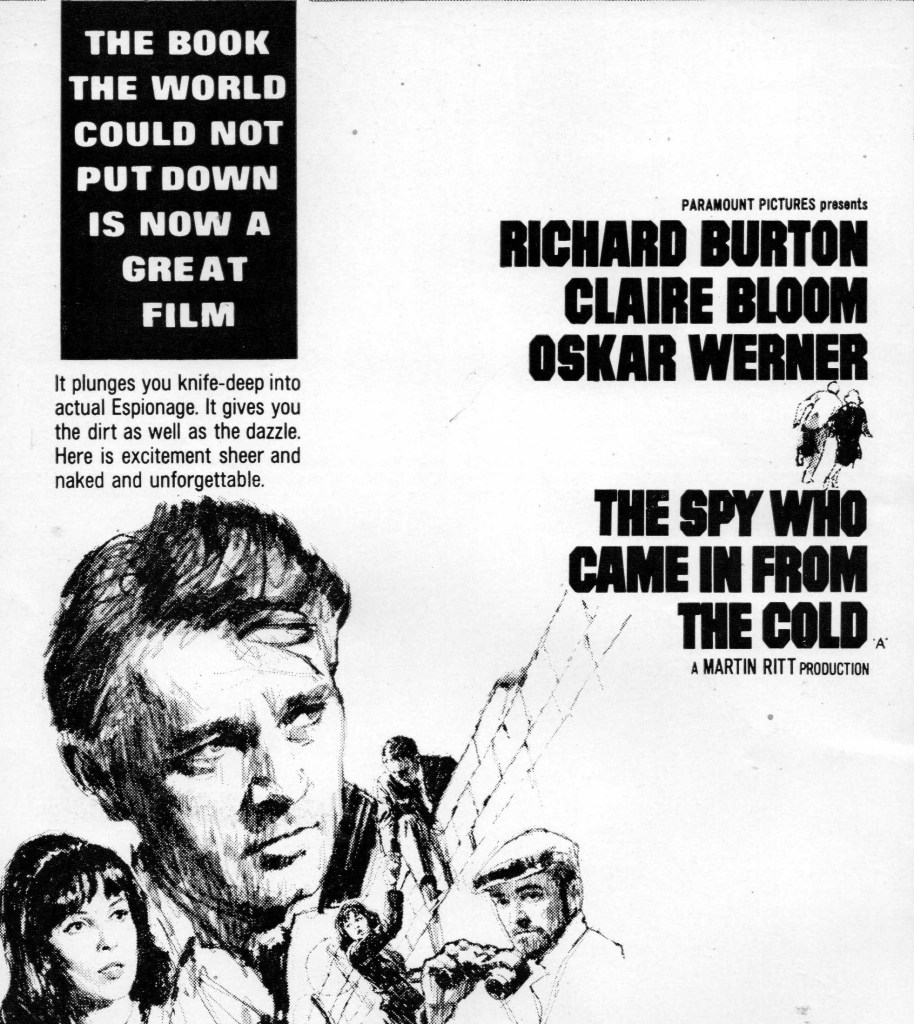
The Spy Who Came in from the Cold (1965) ****

The perfect riposte to the James Bond phenomenon. By comparison, a kitchen sink spy drama that challenges the glamorous version of espionage promoted by 007. Had the film been made as soon as the source novel by John Le Carre hit the bestseller charts in 1963 it might have stopped the Bond bandwagon, which didn’t really kick off until Goldfinger (1964), in its tracks. Realistic to the point of cynicism, the innocent are sacrificed in a ruthless chess battle for espionage supremacy.

Alec Leamas (Richard Burton) infiltrates the East German counter-espionage system after purportedly becoming a defector. His intention, however, is to stitch up Mundt (Peter van Eyck), the head of the East German unit, so that he is overthrown. Mundt has been causing too much grief to the British spy network in East Germany, the film opening with Leamas at the Berlin Wall watching an escaping agent being shot trying to pass through Checkpoint Charlie. At  the behest of Control (Cyril Cusack), the head of the British spy organization, Leamas pretends to quit the outfit, and playing the embittered card, ends up in prison for assault, on release being surreptitiously recruited by the East Germans as a potential defector.

Initially, the British appear almost too gentlemanly for the vicious spy game, Control almost apologizing (over endless cups of tea) about having to take such ruthless steps. Leamas has a tale he hopes will incriminate Mundt largely through the envy of his subordinate Fiedler (Oskar Werner). But once Leamas falls into the enemy’s hands, the game does not go according to plan. After initial gentle interrogation by Fiedler, the arrival of Mundt causes Leamas to be arrested and then tried for treason. Along the way, Leamas’s naïve girlfriend Nancy (Claire Bloom) is implicated and Leamas realizes he is a patsy, forced into quite a different role, that tests his beliefs.

The British, portrayed in Bond films and every other spy film up till then, as being on the side of the angels, are revealed as being just as heinous as the enemy. All through his defection Leamas is able to snigger at the abominable way the Communist superiors treat their underlings, simple demonstrations of power intended to humiliate at every opportunity, but it is soon apparent that the British are every bit as heartless. There is a very telling scene when Leamas realizes he may well be walking into a trap when his face appears on the front pages of a British newspaper. The look in Leamas’s eyes suggests he knows he has been betrayed.

If you remember Le Carre’s most famous creation George Smiley (Rupert Davies) as a humble man from the Tinker, Tailor, Soldier, Spy (1979) television series, you will be surprised to discover what depths the man will sink to here.

Oscar-nominated American director Martin Ritt (Hud, 1963) filmed this in black-and-white – even the advertising material was in mono – to remove all sense of glamour. There are no gadgets or girls in bikinis. This is the down-and-dirty version of espionage. And while the British top brass clearly regarded any staff lost as collateral damage, Leamas had a more human, more emotional, response.

Richard Burton (Where Eagles Dare, 1968) is superb, received a well-deserved Oscar nomination (his fourth), as a character destroyed by “minor human error” in a world where humanity is the last thing on anyone’s mind. Oskar Werner (Interlude, 1968) presents his character is such a way that he comes across as anything but a villain, even his costume has a little bit of the beatnik about it, and he treats his captive with courtesy. Peter van Eyck (Station Six Sahara, 1963) is a more standard German villain, complete with blond hair. Claire Bloom (Three into Two Won’t Go, 1969) has a small but pivotal role as a sweet librarian.

And there’s strength in depth in the supporting cast beginning with Cyril Cusack (Fahrenheit 451, 1966) in a deftly underplayed part. Sam Wanamaker (Warning Shot, 1967) and Michael Hordern (Khartoum, 1966) are among those routinely humiliated by their paymasters. Also watch out for Rupert Davies (television’s Maigret), Bernard Lee, moonlighting from James Bond duties, Beatrix Lehmann (Psyche ’59) and Robert Hardy (All Creatures Great and Small series 1978-1990).

Also taking time off from Bond duties was screenwriter Paul Dehn (Goldfinger, 1964) who adapted the novel with the help of Guy Trosper (Birdman of Alcatraz, 1962).

Paramount boldly opened around the same time as Thunderball in December 1965 and although the fourth Bond proved a box office tsunami, the Martin Ritt picture survived the onslaught and did pretty well.

The Spy Who Came in from the Cold was the number U.S. hardback bestseller of 1964, according to the Publishers Weekly annual chart. That year You Only live Twice by Ian Fleming came eighth, the first time a Bond had appeared in the annual top ten. The following year Le Carre’s The Looking Glass War took the number four spot while The Man with the Golden Gun was seventh. It was the beginning of a mini-boom in spy novels among hardback buyers, and although neither Le Carre nor Fleming featured again during the decade Helen MacInnes placed fifth in 1966 with The Double Image and third with The Salzburg Connection in 1968 while Leon Uris’ Topaz was fourth in 1967.

Selling Religion – “The Shoes of the Fisherman” (1968)

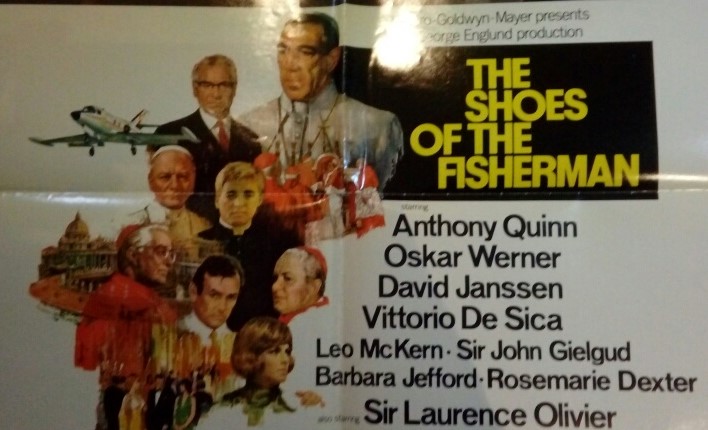
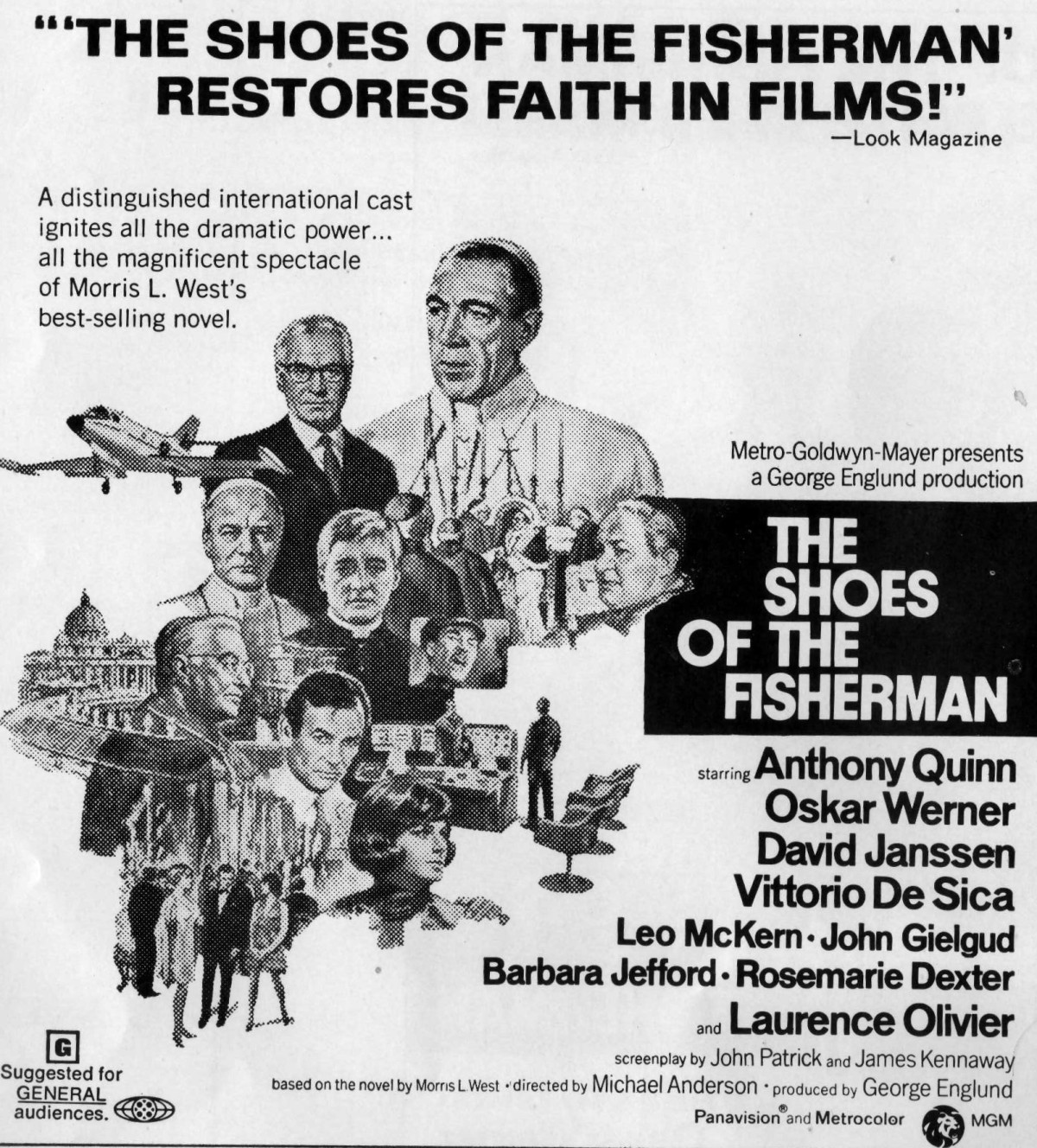
The Pressbook for The Shoes of the Fisherman is almost reverential in approach. For a start there is a complete lack of the madcap schemes designed by marketing men to promote the picture to the exhibitor. Nor is there any mention of the tie-ins that did exist – the book had sold seven million copies and the soundtrack by Alex North was already being acclaimed – it would be nominated for an Oscar. And there are very few of the titbits that might appeal to a local journalist.

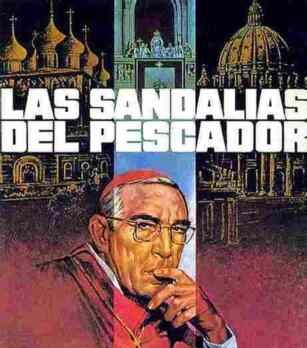
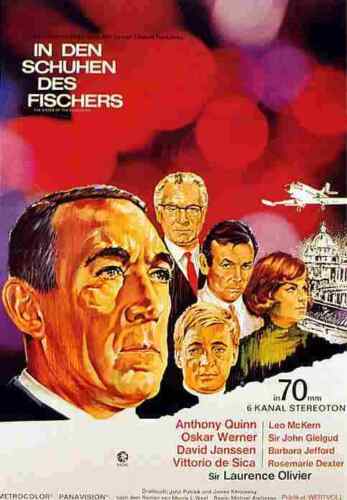
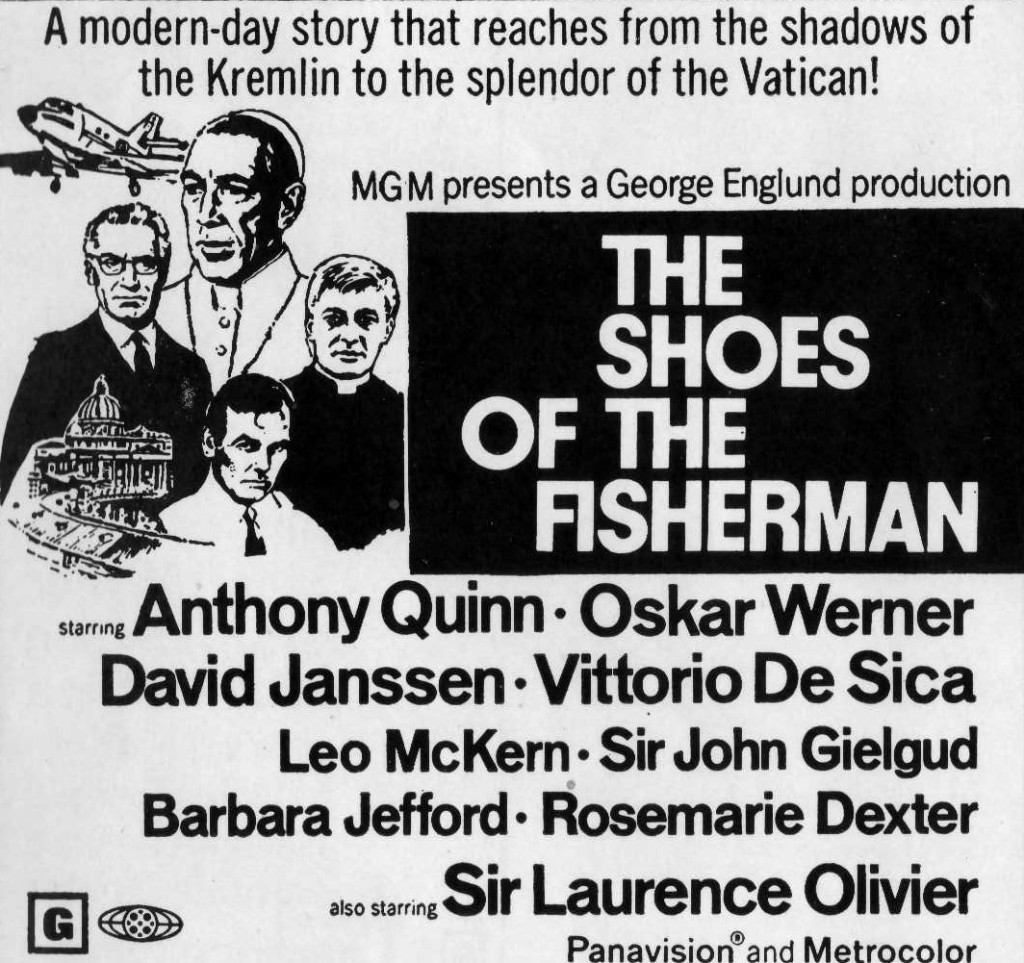
There is only one piece of artwork, although a truncated version provides a secondary opportunity for advertising and combined with a scene from the film material for a third ad. Taglines are equally scarce. “A distinguished international cast ignites all the dramatic power…all the magnificent spectacle of Morris L. West’s best-selling novel” is all there is apart from a puff from Look magazine puff that espouses “The Shoes of the Fisherman restores faith in films.”

The better tagline, in the sense that it sold an actual story rather than promoted the ingredients, was: “A modern-day story that reaches from the shadows of the Kremlin to the splendor of the Vatican.” One further tagline gave away more of the plot: “In a last desperate attempt to prevent World War III, a secret meeting is arranged. One man is called upon to succeed where all the world leaders have failed. That man was once a prisoner in a Russian labour camp. He is now the Pope.”

So what’s left, you might ask. Well, as promised in the tagline, the “distinguished international cast” and “magnificent spectacle.” The cast was awash with Oscars. The stars included four-time Oscar winner Vittoria De Sica, two-time Oscar winner Anthony Quinn, Oscar winner Laurence Olivier and Oscar nominated Oskar Werner.

The sets were of the no-expense-spared variety. Barred from using the Vatican itself, the producers used a mixture of real locations and sets at Italian studio Cinecitta to create the necessary backdrops. The Sistine Chapel set measured 133 feet by 45 feet and the paintings that dominate the altar including “The Last Supper” were copied in Hollywood and transported piece by piece. This set actually functioned and was accurate down to the tiniest detail. The only major touch omitted from the sets was the steps leading to the altar, since that would have necessitated cumbersome ramps to track the movement of the cardinals as they cast their votes.   

Oher buildings were appropriated for modern scenes – the Palazzo dello Sport for the secret peace conference. Cardinals arriving to vote were filmed at Fiumicino airport and Stazione Termini railroad station. Other locations included the Palazzo Farnese at Capranola used for scenes of the breaking of the old Pope’s seals, the Church of San Andrea della Valle for the interior of St Peter’s for the papal coronation, and Castello San Angleo, Biblioteca Vallicelliani and Palazzo Barberini.

Incidental information, the kind that journalists could use to augment their material, was scant. Author Morris L. West had once been a monk; bit part actor Clive Revill had been knifed in his previous film by Burt Kwouk; stage actress Barbara Jefford was appearing in only her third film and her role as a cerebral wife was in stark contract to her debut as the sensual Molly Bloom in Ulysses (1967); small-screen star David Janssen of The Fugitive played a small-screen reporter; and Oskar Werner had turned down over a 100 screen roles if they interfered with his commitment to the stage.

The Shoes of the Fisherman (1968) ****

Thought-provoking drama with a surprisingly contemporary slant set against the grandeur of the Vatican amid geo-political turmoil. At a time of global crisis, dissident Russian archbishop Lakotov (Anthony Quinn) is unexpectedly freed from a labour camp by the Russian premier (Laurence Olivier). Arriving at the Vatican, he is promoted to cardinal by the dying Pope (John Gielgud) before becoming an unexpected contender for Papal office.

The spectacular wealth of the Catholic Church is contrasted with the spectacular poverty of China, on the brink of starvation due to trade sanctions by the United States, nuclear war a potential outcome. The political ideology of Marxism is compared to the equally strict Christian doctrine, of which Lakotov’s friend Father Telemond (Oskar Werner) has fallen foul. There is a sub-plot so mild it scarcely justifies the term concerning television reporter George Faber (David Janssen) torn between wife Ruth (Barbara Jefford) and younger lover Chiara (Rosemary Dexter).

Lakotov is drawn into the Russian-Chinese-American conflict and the battle for the philosophical heart of the Christian faith while bringing personal succour to the lovelorn and performing the only modern miracle easily within his power, which could place the Church in jeopardy, while condemned to the solitariness of his position.

The political and philosophical problems addressed by the picture, which was set 20 years in the future, are just as relevant now. The film’s premise, of course, while intriguing, defies logic and although the climax has a touch of the Hollywood about it nonetheless it follows an argument which has split the Church from time immemorial.

You would not have considered this an obvious candidate for the big-budget 70mm widescreen roadshow treatment, but MGM, after the Church not surprisingly refused access to the Vatican, spent millions of dollars on fabulous sets, including the Sistine Chapel. The roadshow version of the picture, complete with introductory musical overture and an entr’acte at the intermission, is leisurely and absorbing, held together by a stunning – and vastly under-rated – performance by Anthony Quinn (The Lost Command, 1966) who has abandoned his usual bombastic screen persona in pursuit of genuine humility and yet faces his moments when he questions his own faith.

Ruth has a pivotal role in bringing Lakotov down to earth but George has the thankless task, setting aside the quandaries of his love life, of talking the audience through the sacred ceremonies unfolding sumptuously on screen as the cardinals bury one Pope and elect another.

You wouldn’t think, either, that Hollywood could find room in such a big-budget picture for philosophical discussion but questions not only of the existence of God but whether he has abandoned Earth are given considerable scope, as are discussions about Marxism and practical solutions to eternal problems. None of these arguments are particularly new but are given a fair hearing. There is a hint of the Inquisition about the “trial” Telemond faces. Oskar Werner (Interlude, 1968) carries off a difficult role.

David Janssen (Warning Shot, 1967) is mere window dressing and Rosemary Dexter (House of Cards, 1968) mostly decorative but Barbara Jefford (Ulysses, 1967) is good as the wounded wife. Laurence Olivier (Khartoum, 1966) is the pick of the sterling supporting cast which included John Gielgud (Becket, 1964), Burt Kwouk (The Brides of Fu Manchu, 1966), Vittorio de Sica (It Happened in Naples, 1960), Leo McKern (Assignment K, 1968), Frank Finlay (A Study in Terror, 1965), Niall McGinnis (The Viking Queen, 1967) and Clive Revill (Fathom, 1967). In a small role was Isa Miranda, the “Italian Marlene Dietrich,” who had made her name in Max Ophuls Everybody’s Woman (1934) and enjoyed Hollywood success in films like Hotel Imperial (1939) opposite Ray Milland.

Michael Anderson (Operation Crossbow, 1965) directed with some panache from a script by veteran John Patrick (The World of Suzie Wong, 1960) and Scottish novelist James Kennaway (Tunes of Glory, 1960) based on the Morris West bestseller.

I found the whole enterprise totally engrossing, partly because I did not know what to expect, partly through Anderson’s faultless direction, partly it has to be said by the glorious backdrop of the Vatican and the intricacy of the various rites, but mostly from the revelatory Quinn performance. And even if the plot is hardly taut, not in the James Bond clock-ticking class, it still all holds together very well. From the fact that it was a big flop at the time both with the public and the critics, I had expected a stinker and was very pleasantly surprised.

Discover WordPress

A daily selection of the best content published on WordPress, collected for you by humans who love to read.

The Atavist Magazine

by Brian Hannan

WordPress.com News

The latest news on WordPress.com and the WordPress community.