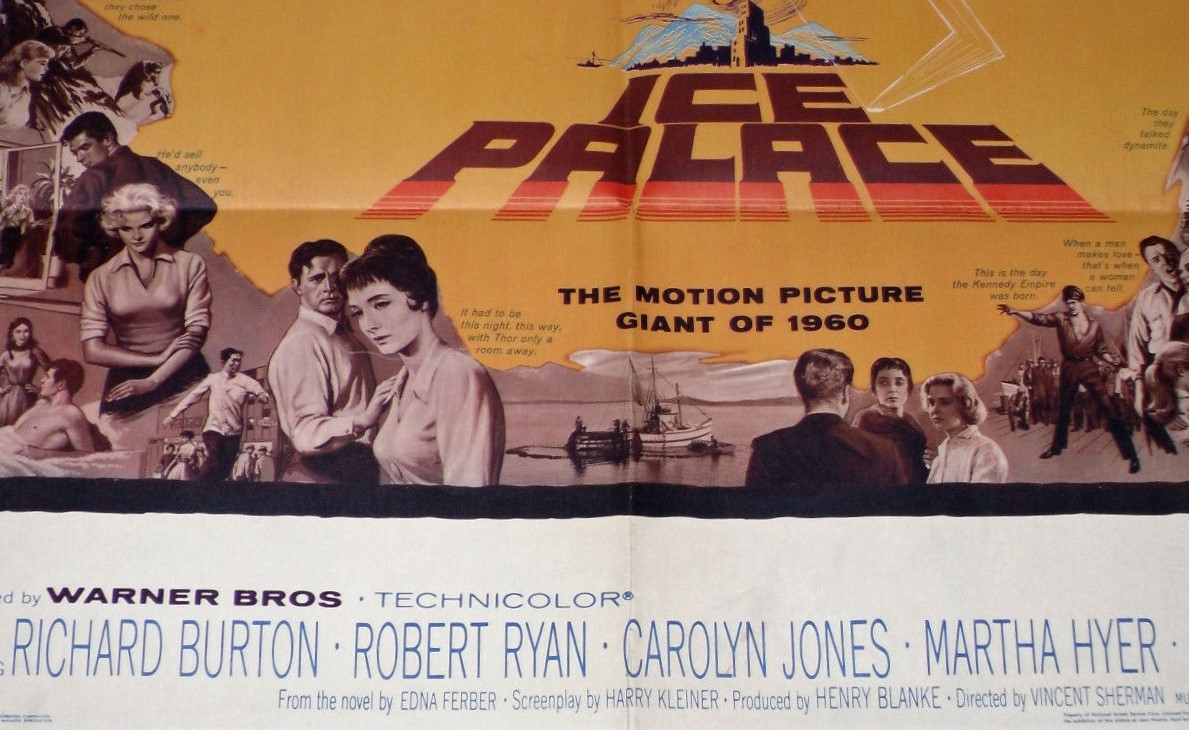
Ice Palace (1960) ***

Adaptations of sprawling novels require a firm hand at screenplay stage. Exodus (1960), for example, excised the first couple of hundred pages depicting the first two millennia  relating the history of the Jews in the Leon Uris bestseller. Hawaii (1966) sliced the James Michener epic in two, the sequel The Hawaiians (1970) taking up the slack. Otherwise, like here, you end up with a multi-generational sprawl.  

The producers clearly felt that the endzone – two grandfathers warring over a grand-daughter that was also  somehow a metaphor for the battle for Alaskan statehood – was too good to miss. Except author Edna Ferber (Giant, 1956) had already dealt with that problem, in her book beginning at the end, where feminist icon Christine Storm is given a voice and the story unfolds in flashback. Instead, it’s Christine who has to wait ages to make an appearance and scarcely in the manner outlined by the novelist.

Initially, ex-World War One soldier Zeb (Richard Burton) and Alaskan fisherman Thor (Robert Ryan) become friends after the latter saves the former from drowning, Zeb having lost his job in a cannery for fancying boss’s daughter Dorothy (Martha Hyer). The pair then decide to go into business together, Thor catching the salmon, Zeb canning them. But illicit love tears the incipient partnership apart, Thor’s fiancée Bridie (Carolyn Jones) falling for Zeb.

Finding banks are against funding a nobody, Zeb hits the mother lode in capitalizing his business by marrying the wealthy Dorothy, while a distraught Thor hits the snowy wastes and returns with an Eskimo son. Bridie hangs around long enough to sew the seeds of suspicion and take a hand in bringing up the baby, though holding back on the marriage that might seal the deal.

So then we are quickly onto the second generation. Thor’s son Einer (Barry Kelley) and Zeb’s daughter Grace (Shirley Knight) elope to the snowy wastes where, guess what, she gets pregnant, but, guess what, he is killed by a bear and she dies giving birth to Christine (Diane McBain).

So that takes us to the final act, Dorothy now also conveniently dead, grandfathers sharing custody, and the metaphor for the birth of Alaska in full swing. Zeb, now  a greying ruthless industrialist who finds it easier to feed his multiple canneries by catching fish in traps as they exit the Alaskan rivers, opposes statehood, fearing legislation will curb his entrepreneurial tendencies and that, more to the point, he will be hardest hit by the taxation required to fund the government apparatus. Thor, meanwhile, has turned greying politician, fighting Zeb every inch of the way, Christine now mere collateral damage.

An Australian daybill hence the date “1961” rather than “1960”
the date it appeared in the U.S.

It’s certainly a full-throated melodrama, and might have worked better if it had skipped a generation and got to the warring grandparents sooner, or worked the love triangle up to a higher pitch, but that might have felt like the bloodbath required to kill off Dorothy, Einer and Grace would have looked even more calculated. And it could have done with more actual high drama, fishermen battling mighty waves on the high seas, for example, as in The Perfect Storm (2000), and to be honest watching caught salmon shooting along cannery travelators is no substitute.

The other problem is that neither Richard Burton (Becket, 1964) nor Robert Ryan (The Wild Bunch, 1969) has settled into their screen persona. In the former’s case it’s the voice. Except in fleeting instances, we are deprived of his whisky-sodden sonorous tones. In the latter it’s the stillness, all the work done with the eyes or a grimace instead of an overworked marionette, body jumping, arms pumping. In both cases, and with the entire cast for that matter, there’s over-reliance on flashing eyes, a mainstay of overwrought melodrama.

If you’re searching out subtlety you’d have to watch the women, the look on Dorothy’s face on first meeting Bridie and recognizing a rival, the various expressions on Bridie’s face – for virtually the whole picture – as she observes the unobtainable Zeb grow even more distant, and Grace as she realizes she is being duped into a marriage of political convenience. And with so much story to pack in, the best scene in the picture just whizzes by, when, in the absence of the town doctor, Bridie is called upon to be  midwife to Zeb’s child, knowing that it should, if only she had the courage at the time, be hers.

The Alaskan statehood element was, I imagine, lost on non-American audiences, the statehood metaphor probably lost on everyone except discerning critics, and as far as I can work out from the box office nobody anywhere gave two hoots for the picture. Bear in mind Richard Burton was far from a major star, having burned his boats after star-making roles in The Robe (1953) and Alexander the Great (1956) failed to provide the necessary glue to bind actor and moviegoer.  In fact, Burton was so little in demand he was scarcely making a movie a year – and only The Robe entered positively in the box office balance sheet – until Cleopatra (1963) revived his career.

So with a cut-price Burton and an over-extended Robert Ryan there’s little the women can do to rescue the picture, though Carolyn Jones (How the West Was Won, 1962), Martha Hyer (The Sons of Katie Elder, 1965), the debuting Diane McBain (Claudelle Inglish, 1961) and Shirley Knight (The Group, 1966) put in more heartfelt performances.

Vincent Sherman (A Fever in the Blood, 1961) directed from a screenplay by Harry Kleiner (Bullitt, 1968). One look at the gem George Stevens created from Giant and all you can see here is missed opportunity.
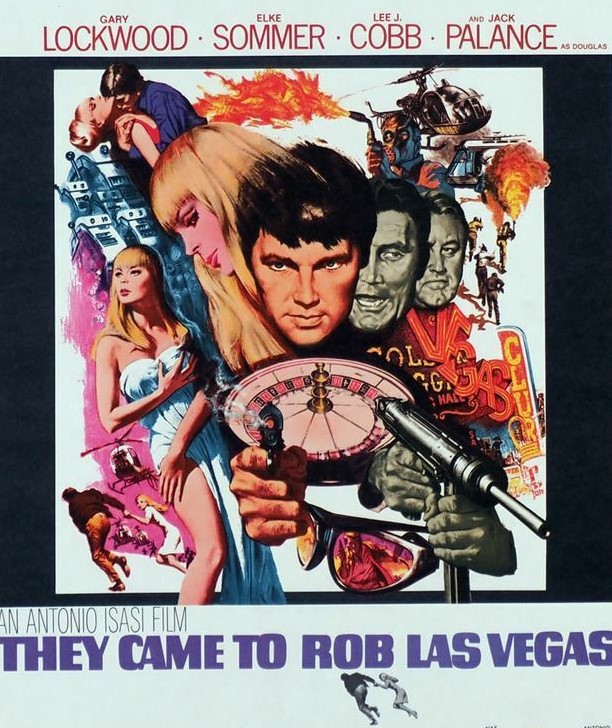
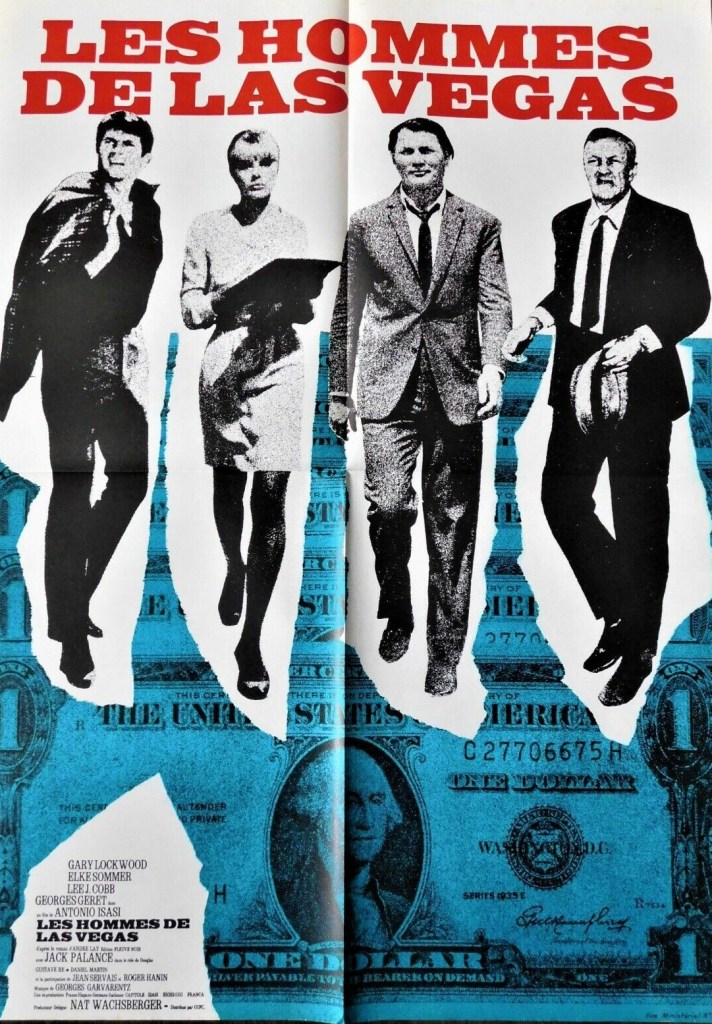
They Came To Rob Las Vegas (1968) ***

Actually, they didn’t. The thieves planned to pull off a heist of $7 million from a security truck as it travelled through the Nevada desert en route to Mexico. Las Vegas pops into the story every now and then, criminal mastermind Tony (Gary Lockwood) employed there as a croupier in order to romance the girlfriend Ann (Elke Sommer) of millionaire Steve (Lee J. Cobb) who owns the security business being targeted.

The picture’s overlong and a shade complicated but the robbery is terrific, if a bit unbelievable, while the ending is existential and almost Boorman-esque. It’s futuristic, too, with computers programming routes for security vehicles to make them harder to follow, pretty sophisticated visual communications for the era. The trucks are more like armored cars,  tough as tanks, steel so thick it’s impervious to an oxy-acetylene cutter, and with machine guns mounted on the roof.

You’ll scarcely have heard of the director, Spaniard Antonio Isasi (That Man in Istanbul, 1965) whose career only spanned eight movies. And while you might be familiar with Gary Lockwood (2001: A Space Odyssey, 1968), Elke Sommer (The Prize, 1963), Lee J. Cobb (Coogan’s Bluff, 1968), and Jack Palance (Once a Thief, 1965) who plays Douglas, an F.B.I. agent investigating Steve’s Mafia connections, you’ll struggle to keep tabs on the myriad other characters who flit in and out of what ends up as a four-way narrative.

So we start out with Tony’s brother (see, I told you it was complicated) who has bust out of jail and wants to go back to old-style heists that involve shoot-outs in the street, nostalgia getting the better of him as he winds up dead. Then we’ve got Steve who wants to quit the underworld. That seems to be a trope of the time, The Brotherhood (1968) and Stiletto (1969) going down a similar route.  When the truck is hijacked, Steve comes under suspicion from his Mafia buddies, who reckon he’s looking for an easy way to fund his retirement.

Meanwhile, as well as the $7 million in legitimate cash, the truck is also carrying millions in Mafia loot to be laundered across the border in Mexico, a notion that’s already attracted the attention of Douglas and his team.

Meanwhile, meanwhile, Tony is carrying out some low-grade casino theft, as croupier dealing Ann some very helpful cards and topping up his salary to the tune of $400-$500 a day. Ann, who could as easily be water ski-ing or living the high life in Acapulco with the married Steve, still takes time out of the mistress gig to undertake her ordinary job at the security company’s head office where she is in charge of the seemingly mindless task of feeding route cards into the computer.

While this takes quite a while to get all the wheels in motion and the various sub-plots and characters to fall into line, when finally we get to the robbery, it’s a cracker. Though you might find yourself asking who was funding the heist, with its five-man crew, helicopter, flame-thrower,  machine guns, plus what can only be described as a giant vault buried in the desert.  

At first, the heist appears patently old-fashioned. Gangsters dressed as guards replace the real guards but once in the back of the truck they have neither access to the loot nor the driver’s cabin. No matter, they know where the truck is headed, out into the desert, where they have made the road impassable with heaps of sand and just in case that didn’t work shoot out a tyre. The flame thrower finishes the job.

Thomas Crown would be impressed by their planning for they have another tyre buried in the sand to swap for the useless one and they also have metal tracks that can be laid over the sand to ease passage. They need the tracks because the truck goes off-road over the top of a dune and is lowered into the vault while the rotary blades of the whirligig serve to cover the top with a layer of sand, returning the desert to its normal pristine condition.

But we’re far from finished. We still have betrayal, underground paranoia, Steve being stalked by Douglas, the Mafia getting uppity with Steve, Steve becoming suspicious of Ann, a hapless motorist caught in the crossfire, squads of cops and goons descending on the hijack spot, and Tony still having to work out how to open the unbreakable truck.

At times, the plot comes together with devastatingly simplicity, but at other times the various strands merely serve to blow the whole thing apart. None of the principals is on their A-game, most appearing overly stiff and clichéd, while you’re still trying to work who all these other characters are.

The heist itself is splendidly done and the twist ending worthy of comment. Most of the time it’s pretty watchable but what should be a relatively seamless narrative is undone by over-plotting.

While the time was ripe for an ingenious heist, the crime thriller had taken one of those periodic leaps into new territory, what with Point Blank (1967) and The Thomas Crown Affair (1968), so it was virtually impossible to accommodate a movie with so many narrative jumps, where motive was unclear, characters diffuse and the tone widely variable.

On the other hand, as I said, the heist had me enthralled and the twist ending had me intrigued.

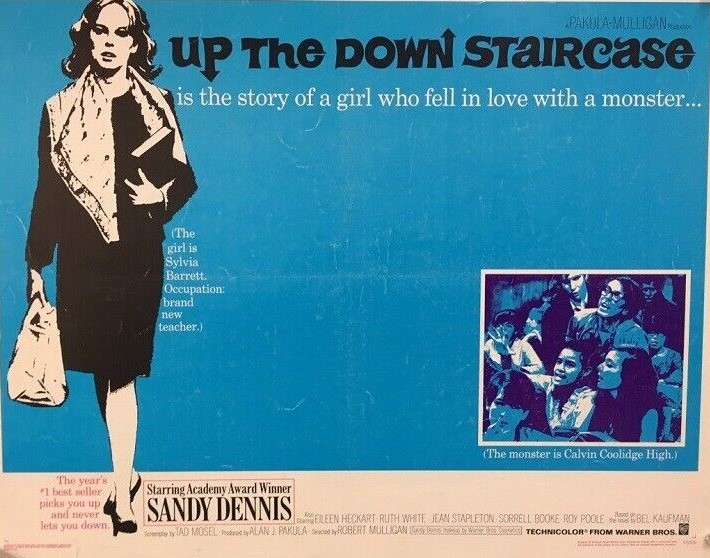
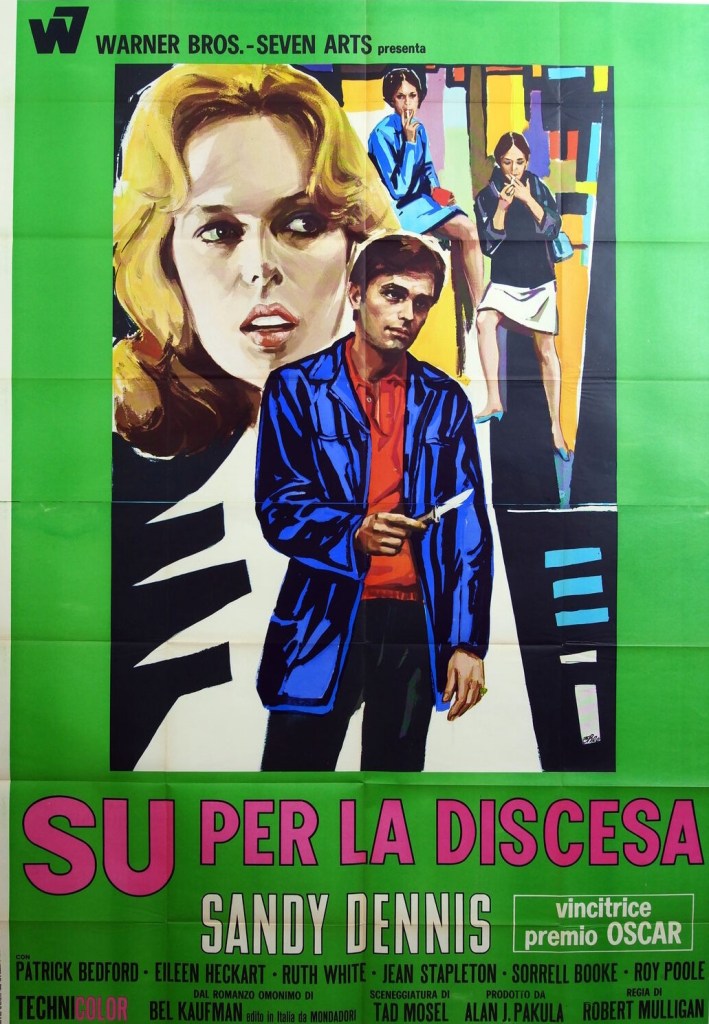
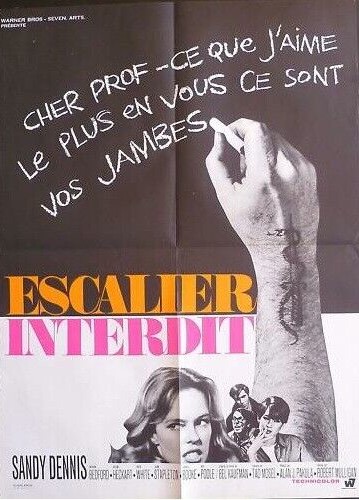
Up the Down Staircase (1966) ****

Impressive impressionistic tale of naïve young teacher and her travails in a rough inner city New York high school, a world away from the preppie hi-jinks of The Group the previous year and a good bit more realistic and less sentimental than To Sir, With Love the same year. If you thought teachers had a tough time these days, it was no better half a century ago.

We get no insight into the home life of idealistic singleton Sylvia (Sandy Dennis) beyond that once a week she gets a phone call from her annoying mother. Outside the school, she is warned to walk slowly in order to show she is not frightened to walk down these mean streets.

The school appears chaotic, hordes of almost-adult kids rampaging along corridors, hellbent on causing anarchy. And it takes some objective observation to realize that the endless rules,  sometimes delivered by intercom and very often improvised on the spot, imposed by the tough headmaster McHabe (Roy Poole) have created a semblance of order.

But if the kids are led astray by inherent attitude, the adults are undone by bureaucracy and petty infighting. A list of rules on the wall forbids the school nurse from actually treating any patients. There’s a marvellous librarian whose reaction to an attempted suicide is to demand the return of an overdue book. Teachers squabble about who has precedence to use a particular drawer. Budding novelist and lothario Barrington (Patrick Bedford) spends his mornings in a local café, an adoring secretary covering for his absence.  

The end-zone in all movies about schools (excepting If…a couple of years later) focuses on a struggling teacher who doubts her abilities but finds worth in her calling. Although that cliché pops up towards the end, mostly it’s an examination of the terrible home lives, seen in snippets, of the pupils and their parents, possibly who had the same experience, of viewing schools as obstacles to life and nothing more than the existing hierarchy’s way of keeping them in their place, education peeceived as akin to a police force exacting penalty.

With her fragile beauty, posh voice, and ideas of converting teenagers to the joys of Chaucer, Dickens and myriad poets, you would expect Sylvia to be gobbled up by the system. And at times, her quivering lip goes into overdrive, but that masks an inner determination not to fall for any sob stories – no matter that the audience will lap them up – and to extricate herself from dangerous situations with the macho Joe (Jeff Howard) who is convinced she won’t hand in him for carrying a switchblade and that she must be in love with him.

Pupils fall into three categories: those who fall in love with their teachers, those who want to kill them and those who are dying of boredom, living day-to-day in catatonic indifference.

Sylvia’s understated refusal to be intimidated carries the day and, while she encourages, realizes that she can’t resolve the endemic social issues – children battered at home or who have to work at night or who are brought up by a series of neighbors – by inflating a pupil’s mark just to help out. There’s none of the grandstanding of Dead Poets Society (1989) or Mr Holland’s Opus (1995) either, no individual or group who, in dramatic fashion, demonstrates allegiance, sides with the teacher or proves a test case for the teacher’s brilliance.

If Sylvia makes any impact, it’s shown in a small way by awkward pupil Alice (Ellen O’Mara) who believes all literature is about love and is humiliated by Barrington. Sylvia hasn’t the personality to collect a coterie of adoring pupils as in Dead Poet’s Society, nor like Robin Williams there have the confidence to chuck away set texts and do it his own way. But it would be a close run thing as to who would be the better teacher. Williams should win by a neck given his exuberance, but Sylvia, the mouse, is actually the better teacher.

It’s pretty bold of director Robert Mulligan (Inside Daisy Clover, 1965) to actually force the audience to watch Sylvia dissect the opening paragraphs of A Tale of Two Cities in order not just to prove what an insightful teacher she is but to demonstrate her command of her once-rowdy class. The show of hands of pupils desperate to ask questions is testimony to her quiet methods.

Superb performance from Sandy Dennis (The Fox, 1969), showy one from Patrick Bedford, touching one from Ellen O’Mara and with Jeff Howard attempting to channel his inner James Dean, but, for the last three, unusually in a film stuffed with newcomers, their roles did nothing for their careers. You might spot Bud Cort (Harold and Maude, 1971),  Eileen Heckart   (No Way To Treat a Lady, 1968), and Jean Stapleton (Emmy award winner for All in the Family, 1971-1979) but mostly it’s cameos in an ensemble picture.

Expertly mounted by Robert Mulligan with a screenplay by Tad Mosel (Dear Heart, 1964) from the Bel Kaufman runaway bestseller.

As much as it has you rooting for the little guy, it doesn’t gloss over the calamities schools are left to deal with.

Loss of Innocence / The Greengage Summer (1961) ***

The alternative title assumed nobody in America knew what a greengage was – it’s a type of plum – but the new title was actually pretty apposite. Until then director Lewis Gilbert had been known mostly for Second World War pictures like Reach for the Sky (1954) and Carve Her Name with Pride (1955) so this was a considerable change of pace, and filmed on location in France.

Joss (Susannah York) takes center stage as a girl on the brink of womanhood who experiences powerful emotions for the first time – love and its perpetual bedfellow jealousy – as well as rite-of-passage experiences like getting hammered on champagne. She is the oldest of four siblings stranded in a French chateau when their mother takes ill.

Left to her own devices, she promptly falls for the suave and much older Eliot (Kenneth More) who has interceded on their behalf when the hotel owner is against putting up with a bunch of motherless children. Matters are complicated because Eliot is having an affair with chateau owner Zizi (Danielle Darrieux) and by Joss attracting the attention of Paul (David Saire), a hotel worker closer to her own age. In short time, the situation is brimming over with suppressed emotion.

Hester (Jane Asher), suddenly aware of the romantic havoc being wreaked by her older sister, is going through her own transformation, jealous that the unrequited love of Paul is not directed towards her, her emotions flying off the handle when she triggers a violent altercation with a local lad.

Despite the distributor’s best efforts – the tagline promises “A Summer of Evil” – by modern standards this is a gentle tale, but not without a harsh undercurrent. York is superb as she undergoes a transformation from uncertain schoolgirl to a woman realizing the power her beauty can exert. She flares from child to adult and back again in seconds.

The main U.S. poster and this one seem determined to add seediness to the tale.

Susannah York (They Shoot Horses, Don’t They, 1969) had won her big break after a sparkling performance in a small role in Tunes of Glory (1960) and she floats effortlessly between chalet school pranks and more serious misdemeanors including drunkenness.

Sometime child actor Jane Asher (still better known as Paul McCartney’s girlfriend or for her cakes rather than stunning turns like Deep End, 1970) also achieves a career breakthrough and you could argue that she edges out York in a role that calls for more balance.

Kenneth More (Sink the Bismarck!, 1960) was at his charming best in the kind of affable role he had generally moved away from, but his character has a darker side. More importantly, as an older adult infatuated with a young girl, he manages to steer well clear of any inherent  creepiness. There is no sense of him exploiting the situation, rather trying to guide the young woman in the art of love.

The dialogue is surprisingly good and Danielle Darrieux (better known as one of Darryl F. Zanuck’s girlfriends rather than for the likes of Romain Gary’s The Birds Go To Die in Peru, 1968) is convincing as an aging beauty willing to do anything to hold onto her man.  There is an interesting under-developed subplot too dangerous to explore at this point in the decade of the hotel manager Madame Corbet (Claude Nollier) clearly being in love with Zizi.

The young Elizabeth Dear (The Battle of the Villa Florita, 1965), making her debut, also enhances her career and British character actor Maurice Denham (Danger Route, 1967) has a small role. 

Lewis Gilbert’s subtle direction set his career on a new course that would ultimately deliver an Oscar nomination for Alfie (1966).  The Howard Koch (The Fox, 1967) screenplay draws heavily on the source novel by Rumer Godden, an expert in the suppressed complexities of female life, best displayed in Black Narcissus (1947) and The Battle of the Villa Florita

The scenery is a bonus as are the snatches of provincial French life. All in all, an engaging piece of work, with Susannah York delivering a star-is-born kind of turn.      

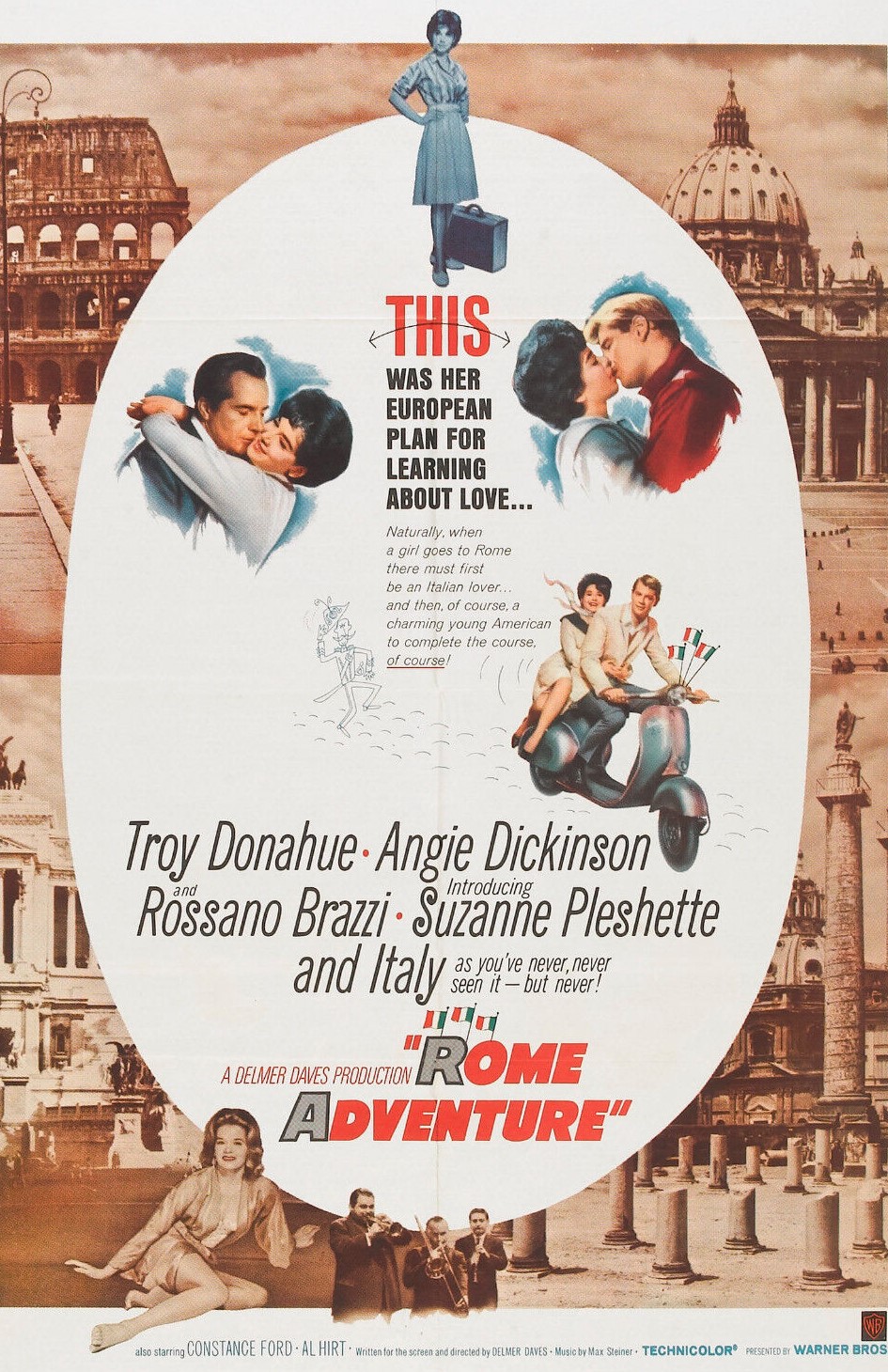
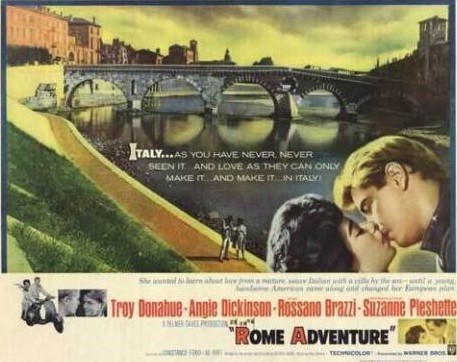
Rome Adventure / Lovers Must Learn (1962) ***

Angie Dickinson fans would be entitled to cry foul after the top-billed female star appears to be engaged in a bait-and-switch tactic. After a lengthy wait, when she finally does appear it’s only to high-tail it off to Switzerland leaving behind in Rome lover Troy Donohue. Her departure creates romantic opportunity, her return complication.

And is this the same Delmer Daves, you might ask, who made his name in a series of male-dominated westerns such as Broken Arrow (1950) and 3:10 to Yuma (1957)? Yes, it is, but once Daves had finished applying intense pressure to his male coterie, he did the same, in a different genre, to women.

Young teacher Prudence (Suzanne Pleshette) exerts her independence by quitting her job after being hauled over the coals in Small Town U.S.A. for teaching her pupils a controversial novel. On the boat to Rome she encounters Italian lothario Roberto (Rossano Brazzi), who holds the lofty sexist opinion that only a man can turn a girl into a woman, and the nerdy Albert (Hampton Fincher), both of whom come a-courting, the youngster’s diffidence ruling him out of serious contention.

Roberto is friends with student Don (Troy Donohue) but the minute he is introduced to Prudence he has to rush off to try to persuade artist Lyda (Angie Dickinson) not to leave. Roberto turns gracefully aside after Prudence denies him sex (put more subtly than that of course) and she, finding employment in an American bookshop (speaking the language no deterrent there),  embarks on romance with Don, fluent in Italian, who teaches her how to drink strega, takes her to jazz clubs and acts as tour guide.

A good chunk of the picture, it has to be said, is a travelogue, and when neither Roberto nor Don are on hand to point out this or that monument or embark on a potted history, suddenly she discovers an interior monologue to do the job. And at one point it turns into If It’s Tuesday It Must Be Pisa as the couple take off on a longer trip, bouncing from one tourist city to another, the route only complicated by some slight comedy over whether they should share a bed.

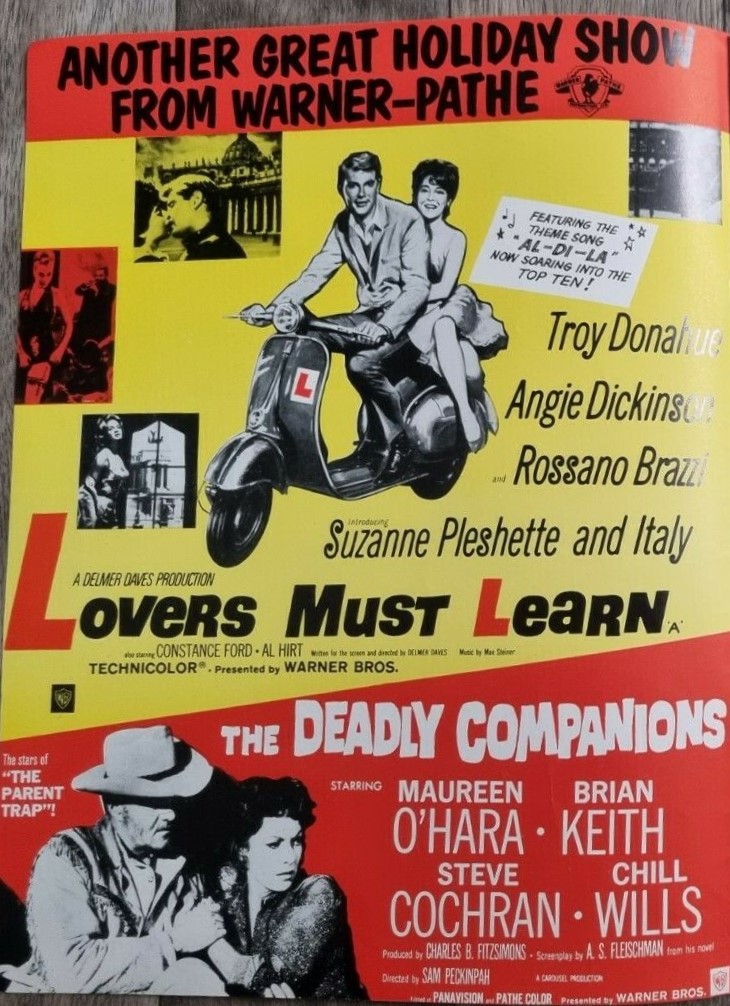
Re-titled in the U.K. and sent out with the most curious support.

Another decade and sex would most definitely be on the cards and the story would sink under an unplanned pregnancy or a fit of pique and scenes in a bedroom where they are separated by an open suitcase as one or other makes an effort to leave. But it’s the virginal aspects that makes this so sweet and for sure no director has managed to clear entire streets in usually heavily-congested tourist spots to deliver beautiful scenes in such scenic spots.

Actual drama might be light on the ground, but there’s no denying Delmer Daves knows how to apply pressure, this time on the woman, who can either treat romance as a  fleeting youthful episode or use it to launch big time into marriage and womanhood. Without a chaperone, unlike the hapless Albert, Prudence has only the example of her predatory employer who takes a male every season.

Just when the romance looks all set, back in Rome she catches Lyda and Don in a clinch and this sparks some good old verbal sparring between the two women as Lyda makes it very clear that Don is no virgin and that Prudence is out of her league.

You can guess how it will end. It’s as lightweight a confection as you will ever watch and yet it is worth watching because the director, close-up at the ready, scarcely gives Prudence a moment’s peace and if ever a director know how to gauge female intent and rely on eyes to express emotion it’s Daves.

Look beneath the façade of the travelogue and you find a woman trapped on the brink, that spark of independence misleading men into thinking she will surrender her virginity, and the woman not wanting to be another notch on a bedpost no matter if that fulfils the dual purpose of achieving womanhood. Daves’ name on the picture should be warning enough this isn’t quite your normal fluffy romance.

If you can ignore the sexism that dictates that a woman’s role is to “anchor” a man, turn his flightiness to one side and by some alchemy make him the best he can be, the narrative edges towards the independence of women, both Lyda and the bookshop owner pick and choose and sometimes abuse their men, and Prudence rejects romance on the rebound with Roberto.

But, of course, if that’s all you want, and you don’t want to hover near consequence, then writer-director Daves delivers a seamless concoction. If there’s an old-fashioned conceit to the whole thing, it’s perhaps because the source material, Lovers Must Learn, was written three decades before and preceded the likes of The Group in presenting a young woman as independent rather than merely yearning for marriage and motherhood.

It seems odd for Angie Dickinson to be relegated to the supporting cast but possibly having already done her Vespa-riding number in Jessica (1962) she preferred a stab at a more mature role, though she had already gone down that route in The Sins of Rachel Cade (1962). Maybe she upset someone in the studio. Maybe her role was bigger but ended up on the cutting room floor when Daves realized the talent he had uncovered in Suzanne Pleshette (A Rage To Live, 1965).

Daves worked again with Rossano Brazzi on the director’s final picture The Battle of the Villa Florita (1965) and Pleshette had a short-lived marriage with Troy Donohue.  

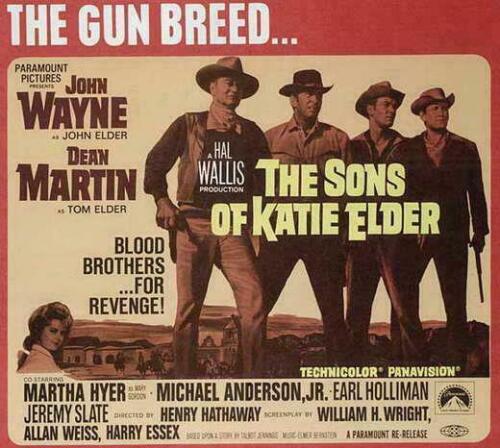
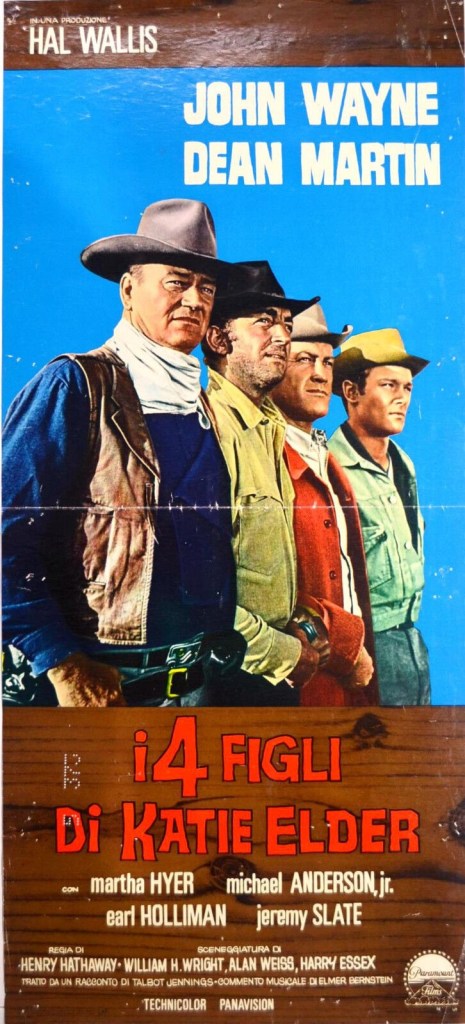
The Sons of Katie Elder (1965) ****

The rocking chair motif in this underrated film is ignored while the door opening and closing in The Searchers (1956) is hailed as one of cinema’s greatest images. Welcome to the world of director Henry Hathaway (Nevada Smith, 1966). Way down the pecking order when it comes to the makers of great westerns, below Sergio Leone (Once Upon a Time in the West, 1969) who only made four and Howard Hawks (Rio Bravo, 1959) only three.

Closer inspection, too, of The Wild Bunch (1969) might reveal cinematic ideas that turned up here first. Closer inspection of John Wayne (The Commancheros, 1961) might reveal a mighty fine, very touching, performance.

The genre was chock-full of vengeance, but here that is tempered by mystery over the death of their father, a drunken gambler, that has led to the loss of the family ranch, leaving the mother, for whose funeral the titular sons return, living hand-to-mouth, supplementing the usual sewing and mending with giving guitar lessons.

Hastings (James Gregory),  a businessman with big ideas, has taken over the ranch and pretty much the local town of Clearwater. And he’s just hired extra muscle, notorious gunslinger Curley (George Kennedy), to swell his already-growing army.

Only the youngest son, Bud (Michael Anderson Jr), a reluctant college student, is clear of the taint of wrong-doing. John Elder (John Wayne) has a reputation as a gunfighter but unlike shifty younger brother Tom (Dean Martin) doesn’t have a wanted poster following him around. The other son Matt (Earl Holliman) takes after John, some shady action but no legal consequence.

This is certainly not a great fraternal union. When they’re not engaged in low-level investigation or trying to prevent themselves being lynched, they’re bickering and fighting. The only thing that unites them, beyond love of the deceased woman, is determination to continue paying for Bud’s education.

Apart from the ranch, one of Hastings’ other lucrative investments is a firearms business, which allows him to tote around a telescopic rifle which, of course, ensures he can bump off those who get in his way from a distance, without fear of discovery. The easiest way to get rid of the brothers is to have them arrested for murder and to kill off the one man, Sheriff Wilson (Paul Fix), who might have the brains and experience to work out something fishy was going on.

John Wayne is more emotional here than in any picture since The Searchers, though, as you’ll be aware, his emotion is registered through his eyes or bits of business rather than a lengthy speech. And given double duty of looking after the youngest while holding back the more tempestuous Tom.

Dean Martin’s (Five Card Stud, 1968) charm runs thin, as is intended, no woman to gull, and no cliché alcoholism a la Rio Bravo to fall back on. It’s a part he plays completely against type, although you can sense he’s bursting out of those confines in the false eye con. He’s pretty much always brought to heel by Wayne. The one time he defies big brother ends in personal calamity. Imagine a marquee name as big as Dean Martin taking on a role where the part sets him up to be walking in the Duke’s shadow, despite his efforts to break loose.

In fact, unusually for a western, until Butch Cassidy and the Sundance Kid (1969) came long, it’s replete with reversals. Hathaway plays with expectations from the outset, the opening sequence of big beast of a train puffing through fabulous scenery doesn’t bring John, instead, unknown to the waiting brothers, Curley disembarks. Katie Elder’s friend Mary (Martha Hayer) cuts off at the pass any idea the audience might have of incipient romance when she gives John both barrels.

Thanks to the screenplay, Michael Anderson Jr.(Major Dundee, 1965) and Earl Holliman (The Power, 1968) are given more bite than their roles might suggest and James Gregory (The Manchurian Candidate, 1962) makes his villain meaty though you suspect the presence of George Kennedy (Cool Hand Luke, 1967) is another lure, creating audience expectation that is not fulfilled. Martha Hyer (The Chase, 1966) is more conscience than glamor,  spending most of the time on the sidelines.

You’d be surprised just how lean a production this is, and equally how deftly Hathaway avoids cliches. Just because there’s a kid you don’t need to teach him how to be a man. A huge herd of horses doesn’t need to stampede. Beautiful woman in the vicinity doesn’t necessarily call for a heated love affair. Ending up in jail doesn’t necessitate a bust-out. Villainous gunslinger doesn’t set up obligatory shootout in an empty street.

Hathaway’s unusual, too, in the way he anchors his pictures in reality. Here it’s a funeral director washing the wheels of his hearse, a blacksmith applying shackles.

You’d marvel, too, at just who was involved in fashioning the terrific screenplay: veteran William H. Wright, his first in two decades, Harry Essex (Creature from the Black Lagoon, 1954) in his first in eight years, and Allan Weiss whose six other movies were all Elvis Presley vehicles. Hardly the pedigree to produce one of the best westerns of the decade. This is the kind of screenplay where no line is wasted, not when a retort can be used to define  character.

Most people remember the rousing theme by Elmer Bernstein (The Scalphunters, 1968), but actually there are also some very innovative musical passages worth listening out for.

Curiously, it was Andrew Sarris,  hardly a John Wayne fan, who recognized the movie’s attributes, though in niggardly fashion, “The spectacle of people in Hollywood trying to do something different in a western at this late date is reassuring.”

It’s about time those differences and the picture’s excellence were recognized.

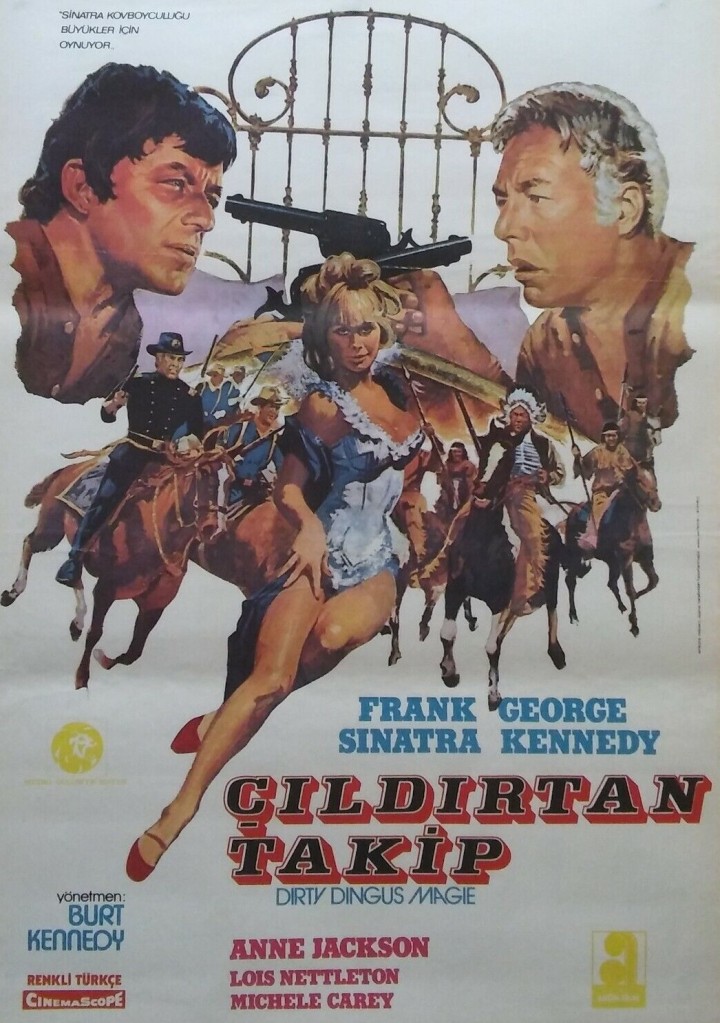
Dirty Dingus Magee (1970) ***

The boldest role ever undertaken by a major star of Frank Sinatra’s generation – and little thanks he got for it. Not only was he virtually unrecognisable under a slab of make-up that George Hamilton would have envied but the role was a complete reversal of his screen persona. Admittedly, he had flipped that persona for Tony Rome (1967) and as the cuckolded cop in The Detective (1968), but this was on a completely different level.

Sinatra was no Tom Hanks or Daniel Day-Lewis, known for inhabiting different types of characters, and, while he did have a vulnerability that he put to good use in The Manchurian Candidate (1962) and The Man with the Golden Arm (1955), he was best known on screen as the guy in charge.

That was far from the case here. Dumb and dumber might be more apposite. Dingus Magee (Frank Sinatra) is a scamp, an outlaw so useless he is worth only $10 in reward money, who steals the stash of old rival Hoke Birdsill (George Kennedy), triggering a revenge caper that is complicated by a host of unnecessary complications by director Burt Kennedy (Welcome to Hard Times, 1967) who has set his heart on some kind of satirical comedy western with a revisionist slant.

So we get a female mayor, Belle (Anne Jackson), who happens to own the local brothel, whose commercial prospects are endangered when the local Cavalry are called away to fight the Native Americans, an Indian chief Crazy Blanket desperate to trade his daughter for a rifle, and when that looks like not working out calling on any available squaw to seal the deal,  predatory schoolteacher Prudence (Lois Nettleton) and a running gag involving a Brown Derby hat that results in a gunfighter (Jack Elam) being mistaken for Magee.

It’s a bit long on complications and short on satire and is rescued by the double act of Magee and Birdsill, who constantly get in each other’s way or try to pull a fast one. Birdsill, as it happens, is appointed sheriff, since that’s in the purview of the mayor, and, on the right side of the law for the first time in his life, makes an ill-fated attempt to do good.

Magee tries to help him along. In exchange for the sheriff turning a blind eye for a period of time to Magee’s nefarious activities, the reward for the outlaw will mushroom, permitting greater kudos for the sheriff on his capture.

The main problem is that Kennedy directs with a very heavy hand, very obvious musical cues for a start, and there’s not enough that’s intrinsically funny. Though there is a reversal of an obvious joke of Birdsall being sent to the brothel to locate the mayor, expecting to find a client not the owner.

But both Sinatra and George Kennedy (The Sons of Katie Elder, 1965) are a delight, the latter also playing against type rather than his usual dominating character. Their dumbness takes some beating. Sinatra just about gets the upper hand, but there’s not much in it.

The best thing about the picture is the sense of reality. The U.S. Cavalry spend more time in the brothel than out hunting Native Americans. Law and order can go to hell as long as everyone is having illicit fun. The respectable schoolmarm proves a skilled seductress. Peace is desirable because it is more profitable than war. And the bulk of the outlaws in the Wild West are far from achieving legendary status, just two-bit punks.

Not surprisingly, this was a massive flop and killed off Sinatra’s movie career for the rest of the decade – not that he was overly concerned, “My Way” having reignited his singing career and he was a Vegas regular. But it’s a shame the acting was so vilified, Roger Ebert blamed Sinatra rather than the director for its failure, in particular taking him to task for the one-take approach that Gena Rowlands previously exalted (but what does she know, she’s just an acclaimed actress and knows how a movie works better than a critic).

Well overdue for a reappraisal and if you go in duly warned you might even enjoy it, or at least the Sinatra-Kennedy double act.

Nine Hours to Rama (1963) **

Double Oscar nominee Mark Robson was a highly respected commercially successful director with hits like Peyton Place (1957) and From the Terrace (1960) behind him and The Prize (1963) and Von Ryan’s Express (1965) still to come. So what went wrong here, in this tale of the assassination of Ghandi, especially as he had successfully negotiated foreign climes in The Inn of the Sixth Happiness (1958)?

You could start with the Indian equivalent of “blackface.” Apart from Ghandi himself all the major roles are played by white actors. Even cutting back on his trademark plumminess, the sight (and sound) of Robert Morley trying to talk the Indian leader out of exposing himself to possible assassination would just be hilarious if it wasn’t such a cringingly bad misstep.

Sure, Hollywood struggled to find anyone in Bollywood who had the box office marquee or critical kudos to provide the necessary confidence for Twentieth Century Fox (a problem that hasn’t really gone away – witness Gandhi and Passage to India). But rising star Horst Buchholz, in the leading role of assassin Godse, was nobody’s idea of the kind of actor with the credentials of a Ben Kingsley or Alec Guinness who might make a decent stab at playing an Indian.

And it’s a bizarre narrative mixture, dragnet film noir hunt led by Supt Das (Jose Ferrer) for a potential assassin (done so well in Day of the Jackal, for example), biopic of the assassin, and providing sufficient room for Ghandi to spread his principles of love and peace as well as plenty of scenes of tourist India.

And even with all these deficiencies it might still have worked except that, in the modern idiom of altering characters, times and places for dramatic effect, this pretty much ignores the known facts about the assassin’s life and in its place presents a barmy mishmash of thwarted ambition and romance.

Set in 1948 after India gained independence from the British and during ongoing violence that followed Partition, the dividing of the country on religious grounds into India and Pakistan, we find Ghandi being blamed for everything that has gone wrong, even though he was never the country’s prime minister and disavowed political office.

According to this version, against his father’s wishes and at a very inconvenient time (he is about to enter an arranged marriage), Godse attempts to fulfil a lifelong ambition to become a soldier but is rejected on the grounds that as a Brahmin he will find it difficult to take orders. He becomes involved with a right-wing organization one of whose stated aims is to take down Ghandi.

It’s actually not that hard to attempt to do so and the film conveniently misses out the fact that Godse had previously been fond guilty twice of trying to kill Ghandi, only being spared prison by his target’s clemency. Instead of that grimly ironic touch, we are fed a hotchpotch. It’s hardly surprising that the film skips the potential gender conflict inherent in Godse, since for superstitious reasons he was initially brought up as a girl, including having his nose pierced in the female fashion. And for “dramatic purposes” his father is a priest rather than the postal worker of real life.

He falls in love with a married woman (Valeri Gearon) and is violent to a prostitute Sheila (Diane Baker) who rips him off. Theoretically, Ghandi would not have fallen to this assassin’s bullet if Mrs Gearon had done the decent thing and run off with Godse.

Or if Gandhi had accepted the presence of an armed bodyguard, but the spiritual leader, pacifist to the end, was also a fatalist, and at approaching 80 certainly had cause, should he indulge in such pride, to believe he had made a difference.

Nobody comes out of this well.  

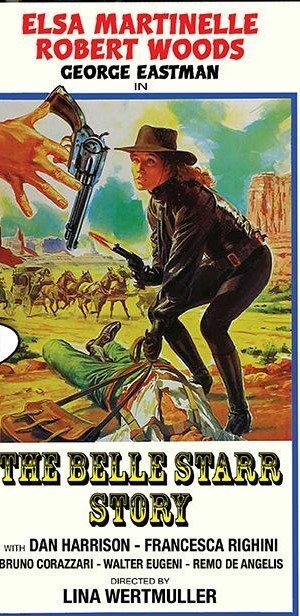
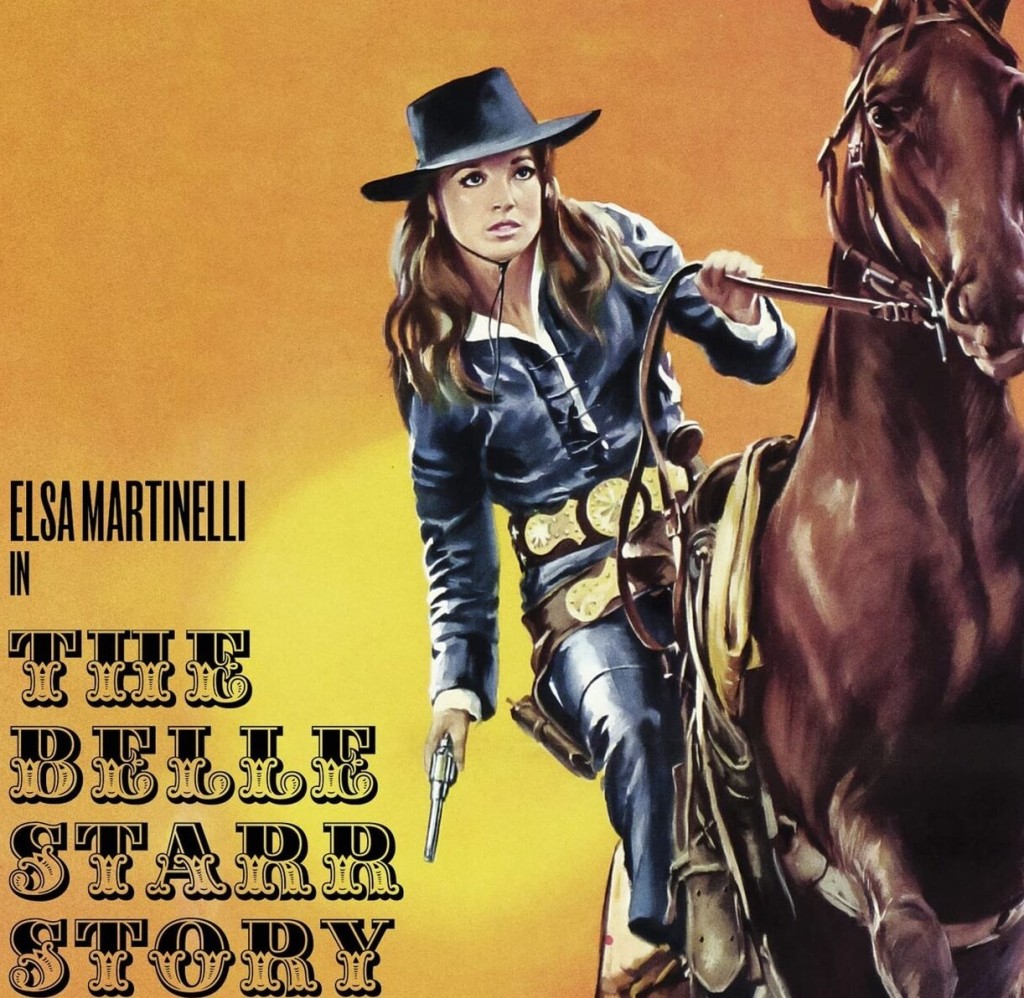
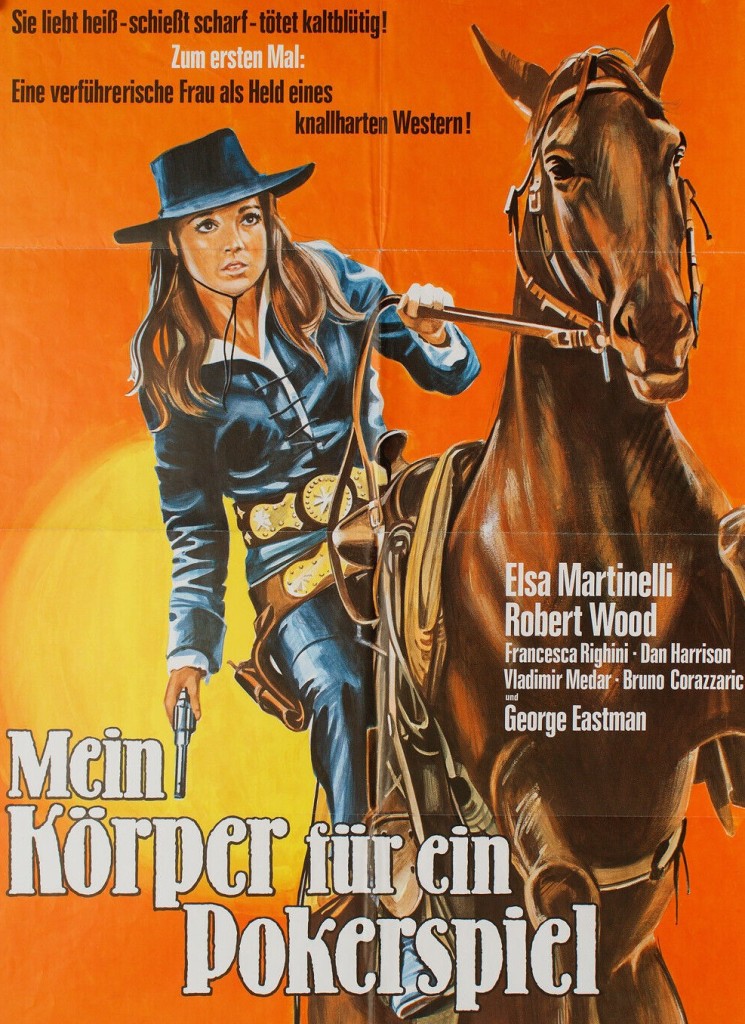
The Belle Starr Story (1968) ***

Only spaghetti western directed by a woman. Brings a distinctly feminist feel to that most sexist of the subgenres. You tend to forget that the sexy female Europeans imported to Hollywood as co-stars or to add spice further down the credits were actually top-billed stars in their natïve countries and demonstrated a greater range than the American industry allowed.

Not only do we have Elsa Martinelli (Maroc 7, 1967) as the leather-clad cigar-smoking titular gunslinger, whose watchword is female independence, but it was helmed by arthouse icon Lina Wertmuller (Swept Away, 1974).  There’s a thematic consistency lacking in most Italian-made westerns, for example predating Once Upon a Time in the West (1969) in its water imagery. But any potential for lyricism is undercut by the risk attached to being a lone woman. And there’s a Tracy-Hepburn tone to the endless bickering and battle for superiority in her niggling romance with outlaw Blackie (George Eastman).

And, unusually in that decade, a woman who throws caution to the wind and will even bet her body when the money runs out at the poker table, as twisty a meet-cute as a screenwriter could devise. But thereafter it’s a struggle for dominance between the pair. She won’t take orders from a man. He won’t accept female equality even when she shoots the wooden fence  he’s sitting on from under him, making him fall to the ground, and for good measure putting a bullet in his heels.

The first act builds up Belle Starr, cool at the poker table, even cooler in the bedroom, and demonstrating the gunplay that attracted her notoriety. The second act take an odd route, a lengthy flashback that digs deep into feminism, the orphaned Belle Starr running away after being sold into marriage by her uncle to an ugly old rich powerful man, traded, effectively, for political favor.

She returns to save a servant condemned to death for the crime of attacking the uncle when he tried to rape her. Sexual humiliation is a theme. Another outlaw Harvey (Robert Woods), who she regards as a platonic friend, steals her clothes as she swims in a lake, and then, having saved her from a posse, forcibly tries to take his reward.

The third act, like the duel between The Man With No Name and The Man in Black, is a case of double- and triple-cross. She refuses to join Blackie’s gang when he plans a million-dollar jewel heist, but hijacks the concept, recruiting her own gang to beat him to the robbery, and teach him a lesson.

But it backfires. Blackie is waiting. She has inadvertently hired his men. In the subsequence shoot-out he is captured. She rides to his rescue. But with their opposing ideas of a woman’s place in the world part on good terms.

The flashback was more subtly observed in Once Upon a Time in the West, and while she shared with Charles Bronson gunslinging skills he was not at any time viewed as a commodity or a piece of property or a candidate for rape. The flashback here fleshes out for the audience the powerlessness of women. But also the kind of camaraderie that is generally also usually only conferred on male characters.

We are pretty conversant with the notion that the gun rules the West. But less conscious of what happens when you are gun-less. Depriving someone of their fundamental weaponry makes them instantly impotent, as humiliating as denying someone water in a desert.

There are some nice directorial touches, blood dripping from a ceiling onto a dinner table, a saloon door opening to cast sudden light onto a corpse, waterfalls suggest sanctuary whereas open water attracts predatory males, and the finale, as they part, of Blackie, desperate to demonstrate his superiority, shooting off her hat from some distance.

Elsa Martinelli is a revelation as a star working to her own beat rather than playing second fiddle to some Hollywood marquee name. This wasn’t Lina Wertmuller’s first film and she had already made an impact with the Rita the Mosquito series, featuring another rebellious woman. Don’t be fooled by the co-directing credit, she replaced debut director Piero Cristofani after a few days.

It’s somewhat ironic that in a contemporary Hollywood attempt to create a female outlaw leader in Cat Ballou (1965), Jane Fonda was upstaged by Lee Marvin, and that in Bonnie and Clyde (1967), despite taking precedence in the title, Faye Dunaway was not the dominant one in the relationship.

By no means a great western but worth a look to see what Elsa Martinelli can achieve when not slotted in to the Hollywood co-star cliche and to get a preview of what Lina Wertmuller could offer.  

Decent print on YouTube.

The Fixer (1968) ***

Stunning opening section thrown away by shifting tone and despite excellent performances by the Oscar-nominated Alan Bates and Dirk Bogarde drifts into Kafkaesque virtue-signalling.

But let’s get the title out of the way first. I had assumed a “fixer” was a manipulator, an underworld type of character who could, for a price or future favor, sort out problems or find someone a job or act as an intermediary between politicians or businessmen. Not so. Yakov (Alan Bates) is nothing more than a handyman, who can fix broken windows or railings and turn his hand to anything such as wall-papering or basic accountancy.

In the credit sequence he demonstrates his skills by fashioning with wood, a couple of screws and some steel, a razor, with which to remove the hair and beard that would identify him as a Hassidic Jew. He is, as soon becomes apparent, afflicted by dogs. As he departs his remote cottage in a cart, a vicious dog so disturbs his horse that it bolts, resulting in the loss of a wheel. He continues his travels on horseback, arriving in a small town in time to witness a parade and Cossacks rampaging through the streets.

As it’s set in Czarist Russia, his journey is accompanied by melancholy violin with, for some reason, a disturbing undercurrent of military drum. As the credits end, we cut to the Russian flag and a marching band. He hides in terror as the horsemen drag people along by the ear, slash with sabers, hang others. It’s a pogrom, the type of attack commonly experienced by Jews living in ghettoes.

Up to now, it’s just outstanding. Then it tips into the picaresque. Yakov helps an old drunk Lebedev (Hugh Griffiths) who’s fallen down in the snow in the street. As reward he is offered work wall-papering a room. He has a prick of conscience when he realises that Lebedev is an anti-Semite. Lebedev’s daughter Zinaida (Elizabeth Hartman) seduces him. But, on spotting some blood on a cloth, he refuses to go through with the act.

Luckily, my reading of crime novelist Faye Kellerman has alerted me to the fact that it is an act of faith for Jews not to make love when a woman is menstruating. Luckly, Zinaida isn’t so up on her Bible (Leiticus 15: 19-23 in case you were interested) that she catches on to this revealing fact, for, as has been pointed out earlier, minus the distinctive curl, Yakov doesn’t have the physical characteristics associated in those times with a Jew. In fact, you would say Lebedev would more easily pass for one.

Anyway, Lebedev gives him another job, of counting the loads leaving his brickworks because he suspects he is being swindled. But the foreman, who has been rumbled, and suspects Yakov of being a Jew, calls in the Secret Police, it being a crime for Jews to leave the ghetto.

Now we tip into Kafka. The initial charge against Yakov is that he harbored another Jew during Passover. But then things spiral out of control. He is accused of passing himself off as a Gentile (non-jew), attempted rape of Zinaida and then of ritual murder, killing a small child.

Investigating magistrate Bibikov (Dirk Bogarde) is sympathetic and manages to avoid the rape charge much to the fury of prosecutor Grubeshov (Ian Holm) but once the other charges mount, he is nailed, everyone determined to prove an innocent man guilty.

This is based on a true case and clearly was a case of persecution and Yakov’s transition from worker happy to hide his ethnicity to gain work to a man who rediscovers his religion is a piece of great acting from Alan Bates. But the points are hammered home endlessly and where director John Frankenheimer (The Train, 1964) so deftly dispensed with dialogue in the superb opening sequence, now he more than makes up for it with leaden speeches, and a film that would worked better for being considerably shorter.

It feels like Hollywood is hard at work. After some moments of mild happiness Yakov’s cinematic chore is to invoke sympathy for an entire nation rather than taking on the Holocaust directly. Dalton Trumbo’s (Lonely Are the Brave, 1962) screenplay is filled with brooding lines. But providing Yakov with an interior monologue when he dithers over having sex doesn’t work at all, certainly not next to the more effective use of that technique in John and Mary (1969).

At the outset, Frankenheimer treats violence with discretion. We don’t see the dog being impaled on a saber, just its corpse thrown at Yakov. We witness a rope being wound round a man’s neck, as innocent of any crime as Yakov, but not the actual hanging. So what begins as highly-nuanced turned into a battering ram of a picture and characters forced into lines like “the law will protect you unless you are guilty” and “I am man who although not much is still more than nothing.”

Alan Bates (The Running Man, 1963) certainly deserves his Oscar nomination and Dirk Bogarde (Modesty Blaise, 1966) might feel aggrieved he missed out on a Supporting Actor nomination. But too many of the rest of the cast over-act. It’s an all-star cast only if you’re British. But check it out if you’re a fan of Hugh Griffith (The Counterfeit Traitor, 1962), Elizabeth Hartman (The Group, 1966),  David Warner (Perfect Friday, 1970), Ian Holm (in his sophomore movie outing), Carol White (Daddy’s Gone A-Hunting, 1969) and Georgia Brown (Lock Up Your Daughters!, 1969).

Frankenheimer at his best when he lets the action play without the overload and there’s one almost Biblical scene, lit only by candlelight, that demonstrates his cinematic virtuosity. But  otherwise it’s drowned in the verbal rather than the visual. Trumbo based his screenplay on the Pulitzer Prize winner and bestseller by Bernard Malamud.

Some effective moments, but too long drawn-out to make the impact expected.

Discover WordPress

A daily selection of the best content published on WordPress, collected for you by humans who love to read.

The Atavist Magazine

by Brian Hannan

WordPress.com News

The latest news on WordPress.com and the WordPress community.