Topkapi (1964) *****

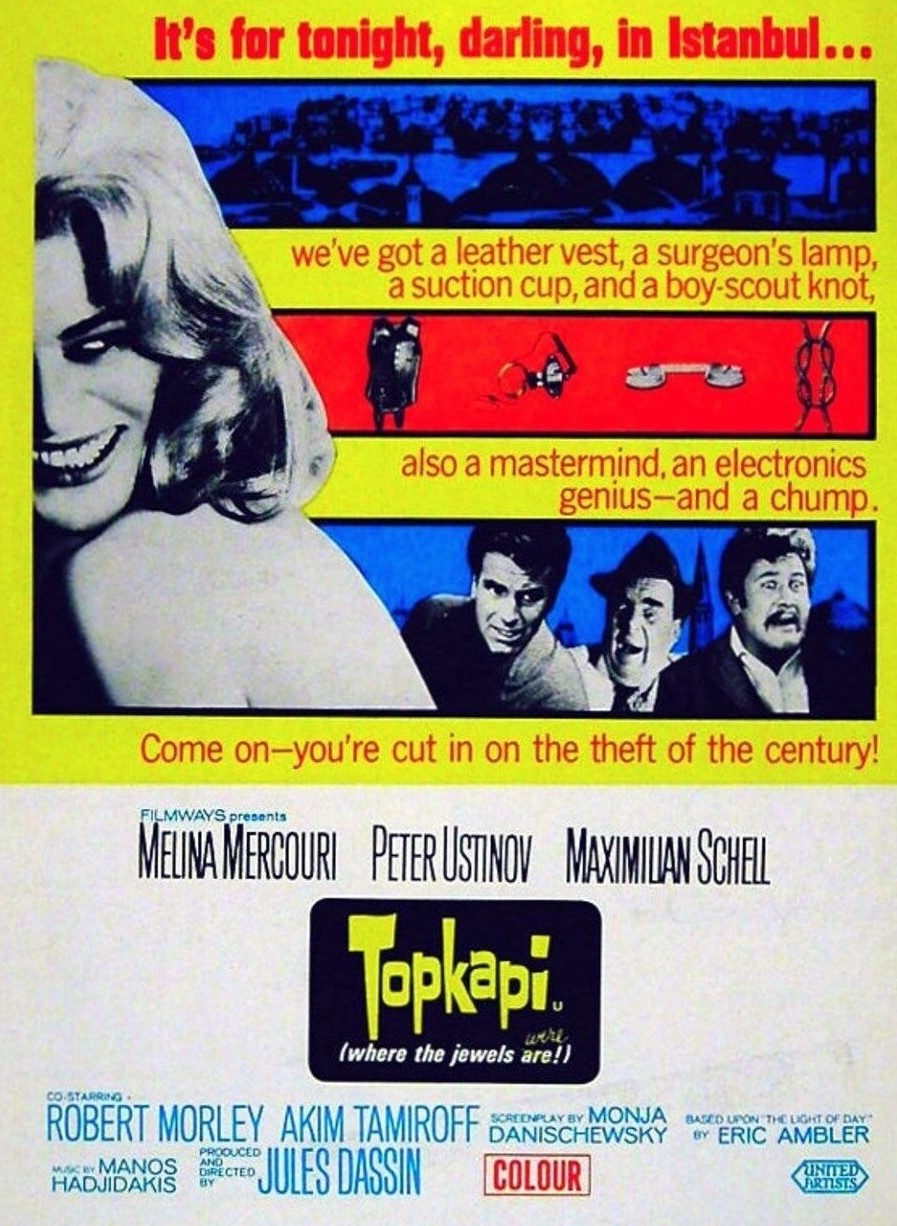
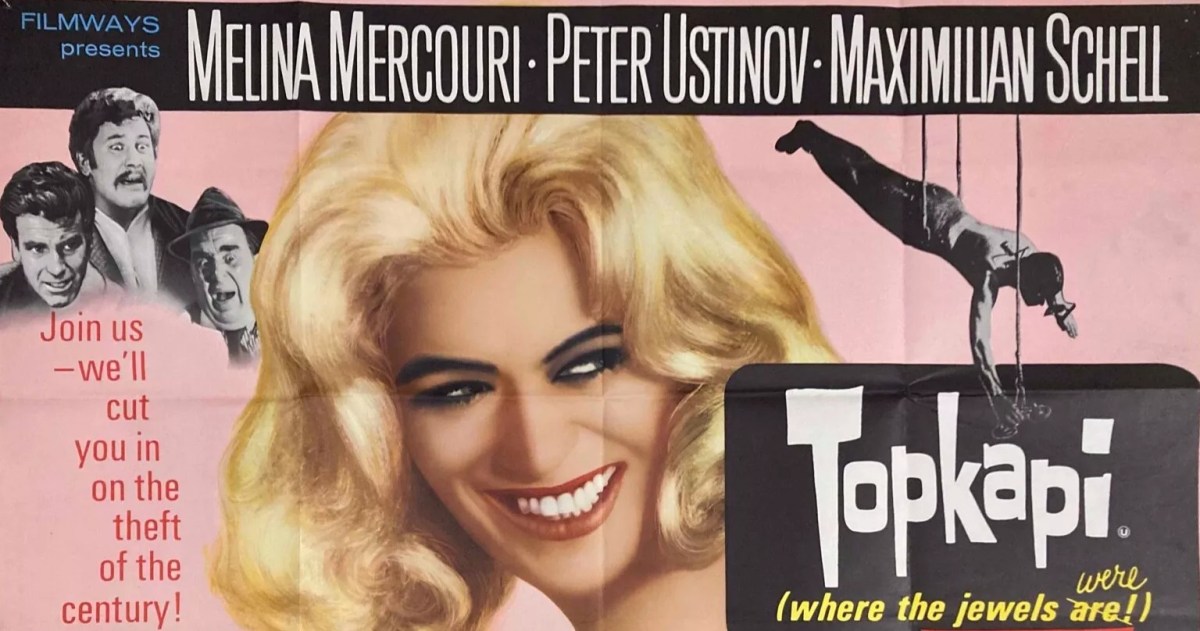
The mother of all heists directed by the father of all heist pictures. Films as diverse as The Italian Job (1969), Mission Impossible (1996) and Ocean’s Eleven (1960) owe director Jules Dassin a massive debt since he pretty much invented this genre with the French-made Rififi (1955). But that involved professional criminals. Outside of masterminds Elizabeth (Melina Mercouri) and Walter (Maximilian Schell), this crew are amateurs, deliberately chosen for their lack of criminal records and with a mind to the specific tasks required. So we have acrobat Giulio (Gilles Segal), upper-class English gadget inventor Cedric (Robert Morley), strongman Hans (Jess Fisher) and driver Arthur (Peter Ustinov).

The target is the impenetrable, complete with sound-sensitive floor, Topkapi Palace in Istanbul where they plan to steal a priceless emerald-encrusted dagger. The plan is ingenious. Arthur is initially only hired to smuggle the weapons essential to the audacious heist across the border. But when he is caught and forced to cooperate with the Turkish secret police, he is enlisted as a replacement for Hans. Minus the rifles and grenades which at first appeared indispensable to the plan, the thieves come up with an even more inspired alternative involving among other things scampering across rooftops, abseiling, a parrot and slowing down the revolutions of a lighthouse.

Originally intending to betray his colleagues as soon as possible, Arthur falls under the seductive spell of Elizabeth and finds himself recruited as the replacement muscles. Elizabeth exudes such sexuality she has the entire gang in her thrall and makes the cowardly, weak acrophobic Arthur believe he can overcome all his fears. Walter engages in a cat-and-mouse game with the police, always one step ahead, with a bagful of red herrings at his disposal, eventually giving the pursuers the slip during a wrestling competition held in a massive outdoor arena.

Interestingly, too, this doesn’t have the trope of gangsters at each other’s throats, planning to double-cross one another or bearing old grudges. Nobody challenges the leader. In fact, the entire crew could not be more docile, content to sit at the feet of Elizabeth and Walter, lapping up the former’s flirtation, wondering at the latter’s skill, as if they are all honored to have been chosen.

The climactic heist, carried out with no musical soundtrack and lasting over 30 minutes, is absolutely superb, setting a very high bar for future imitators, and there is a twist ending. Dassin mixes light comedy and high tension with the sultry attractions of Elizabeth to produce an at times breathtaking picture. As well as the heist itself, the wrestling sequence is stunning and the transition of Arthur forms the acting highlight (Ustinov won the Best Supporting Actor Oscar).

But all four main stars are superb. Audiences accustomed to a more uptight Maximilian Schell (The Condemned of Altona (1962) will have been surprised by his performance. Melina Mercouri (Oscar-nominated for Never on Sunday, 1960) is the archetypal blonde bombshell, liberal with her favors but careful not to favor just one. Although Walter devises the plan, she is actually the criminal supremo, selecting the targets, and then delegating to ensure the tasks are carried out. Robert Morley is having the time of his life. Akim Tamiroff (Lord Jim, 1965) has a cameo as a chef.

A film noir star after Brute Force (1947) and The Naked City (1948) Dassin’s Hollywood career collapsed in the wake of the anti-Communist McCarthy hearings and he was blacklisted. Rififi opened few doors but even the success of Never on Sunday (1960) brought little respite.  Despite returning to the mainstream with such elan through the conduit of Topkapi, albeit with a European cast, he remained on the Hollywood periphery and although Uptight (1968) – previously reviewed in the Blog – involved another heist that was primarily the wrapping for social documentary.

More at home with comedies screenwriter Monja Danischewsky (The Battle of the Sexes, 1960) draws out more humor than the source material, Light of Day by noted thriller writer Eric Ambler, would ostensibly suggest.

A delight from start to finish, the crème de la crème of the heist genre, this is unmissable. Dassin can lay claim to being the John Ford of the crime picture.

The Black Hole (1979) ***

Think of this as having been made before Star Wars (1977), Close Encounters of the Third Kind, Alien (1979), heck even Star Trek (1979), changed the sci fi world forever and imagine it’s a huge advance SFX-wise on the 1950s vanguard of sci fi pictures and you’ll probably come away very happy. A lot to admire in the matte work and some groundbreaking effects and actually the story – mad scientist lost in space – has a bit more grit than was normal for the genre.

But it’s laden down with talk and the action when it comes resembles nothing more than a first draft stab at the light sabers of  Star Wars and clunky robotic figures that come across like prehistoric Stormtroopers. A bit more light-hearted comedy than in the other three mentioned, various quips at the expense of the robots.

Scientists aboard space ship USS Palomino, a research vessel looking for life in space, is astonished to discover, hovering on the edge of a black hole, a missing spaceship USS Cygnus and are even more astonished to find out it’s not uninhabited, still on board is heavily-bearded Dr Hans Reinhardt (Maximilian Schell) and an army of robots that he has miraculously fashioned during his time lost in space.

This is a bit of an emotional blow to Dr Kate McCrae (Yvette Mimieux) whose father had been part of the crew of the Cygnus. Dr Reinhardt seems kosher enough except for his idea of, in the true spirit of space adventure, blasting off through the black hole. Although Reinhardt has been exceptionally clever in monitoring the invasion from the visitors and nullifying any threat with a blast from invisible laser, once they are on board that monitoring capability appears to vanish, allowing the visitors to search the ship where they find out that Reinhardt’s story doesn’t seem to add up.

Apart from Dr McCrae, the other personnel from the Palomino comprises Capt Dan Holland (Robert Forster), Dr Durant (Anthony Perkins) – the most inclined to follow Reinhardt into the greatest danger in the universe – quip merchant  Lt Pizer (Joseph Bottoms)  and dogsbody Harry (Ernest Borgnine). Plus there’s a cute robot Vincent (Roddy McDowall) constructed along even more rudimentary lines than R2-D2.

Vincent turns out to be a whiz at a basic version of a computer game, something between Space Invaders and Kong. But his main task is to wind up the crew with a head teacher’s supply of wisdom, spouted at the most inopportune moment. Except for the chest-bursting appearance of Alien, this might have garnered more kudos for the creepy mystery element – Reinhardt has lobotomized his crew members, turning them into these jerky robots, after they mutinied in revolt against his plan to dive into the black hole. Dr McCrae nearly joins the lobotomy brigade. And once she’s rescued it’s a firefight all the way. A stray meteor is on hand to add further jeopardy. And in the end the good guys are forced to plunge into the apparent abyss of the black hole, only to be guided by some angelic light and come out the other end unscathed, no worse for enduring the kind of phantasmagoric light show Stanley Kubrick put on in 2001: A Space Odyssey (1968).

By this point Maximilian Schell (Judgement at Nuremberg, 1961) was an accomplished bad guy, covering up inherent malignancy with charm and scientific gobbledegook. Joseph Bottoms (The Dove, 1974) is the pick of the incoming crew but that’s because he’s been dealt a stack of flippant lines. Anthony Perkins at least gets to waver from the straight-laced. But everyone else is a cipher, even Yvette Mimieux (Light in the Piazza, 1962) who might have been due more heavy-duty emotion.

This was the 1970s version of the all-star cast, all the actors at one point enjoying a spot in the Hollywood sun, but now all supporting players. Schell was variably billed in pictures like St Ives (1976), Cross of Iron (1977) and Julia (1977). Robert Forster (Medium Cool, 1969) hadn’t been in a movie in six years. Anthony Perkins was waiting for a Psycho reboot to reboot his career – only another four years to go. Yvette Mimieux had only made four previous movies during the 1970s including Jackson County Jail (1976). The most dependable of these dependables was Ernest Borgnine (The Adventurers, 1970), for whom this was the 24th movie of the decade, including such fare as Willard (1971), The Poseidon Adventure (1972) and Hustle (1975).

It didn’t prove a breakout picture for director Gary Nelson (Freaky Friday, 1976), Screenplay credits went to Jeb Rosebrook (Junior Bonner, 1972) and female television veteran Gerry Day.

Sci fi the Disney way.

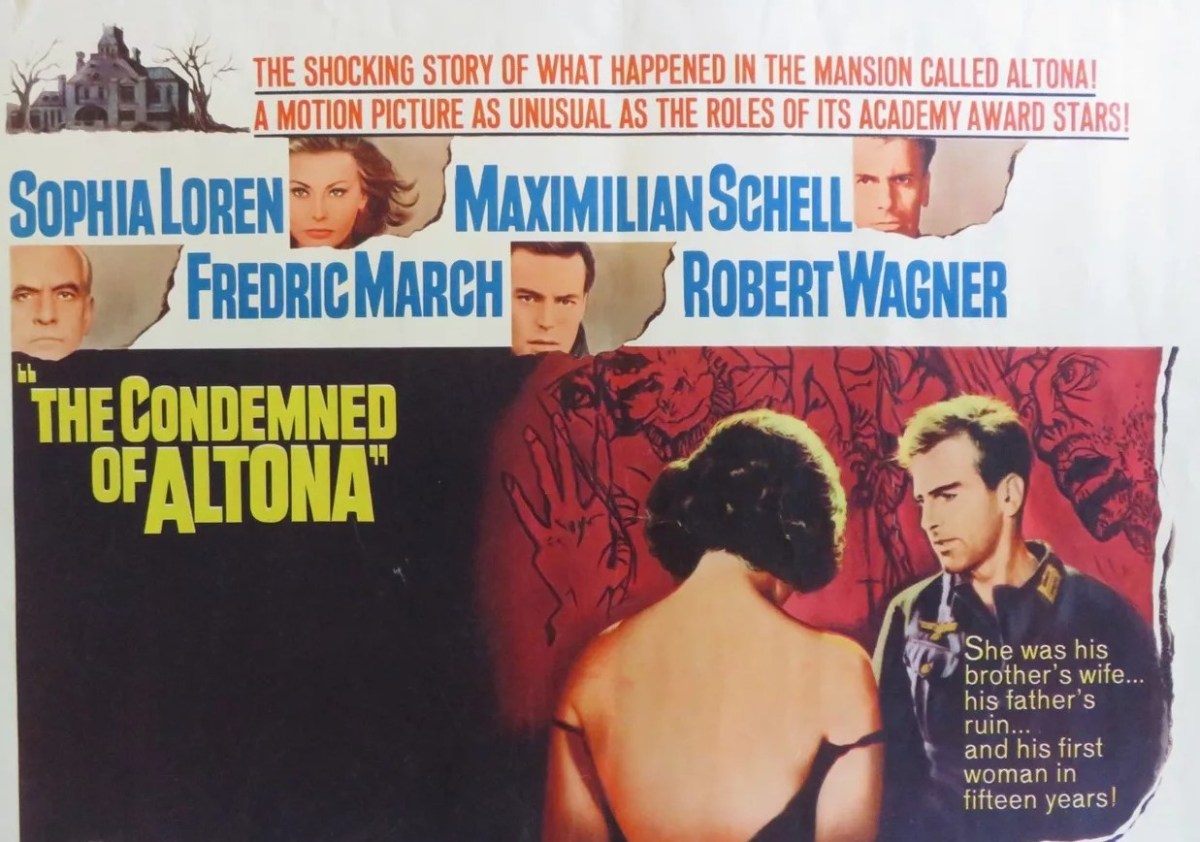
The Condemned of Altona (1962) ****

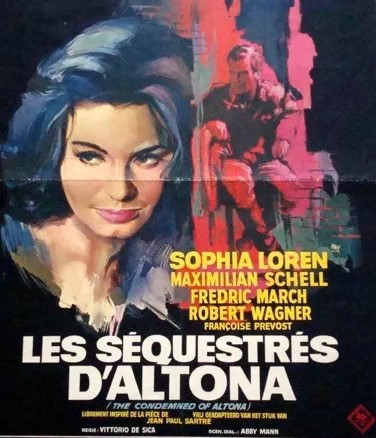
Shades of last year’s Oscar-winning Zone of Interest but with more guilt, some characters dodging it, others driven mad by remembrance of what they did or didn’t do during the Holocaust of World War Two. But mostly, an object lesson in how to expland a play (written by French philosopher Jean-Paul Sartre). Despite top class performances from Sophia Loren (Arabesque, 1966), Maximilian Schell (Counterpoint, 1967), Fredric March (Seven Days in May, 1964) and even, astonishingly, from Robert Wagner (Banning, 1967) it’s director Vitttorio De Sica (A Place for Lovers, 1968), with stunning images and clever camerawork, who steals the show.

You won’t forget in a hurry the outstretched hand of a prisoner in a blizzard condemned to die, nor the skeletal jaw seen through an x-ray machine. The backward crab crawl will remind you of a later movie. De Sica moves the camera every whichway. Aerial and overhead shots are mixed in with the camera swivelling from character to character or suddenly pulling back from a scene and then suddenly he stops you his restraint. But that doesn’t prevent him getting to the heart of the narrative matter and adding in some frisson of accuser attracted to accused.  

Set at the end of the 1950s, we begin on a Succession note, but without the contemporary angst and back-stapping. German shipping entrepreneur Albrecht (Fredrich March), a war profiteer turned post-war profiteer having taken advantage of demand in the Germany industrial boom, and now with only months to live, wants to pass on his business to son Werner (Robert Wagner). But Werner shies away, disgusted by his father’s unspoken collaboration with the Nazis during the war, ignoring the argument that the businessman was simply dealing with whatever party was in power. And this would be the narrative, father explaining actions, hoping for expiation, planning for the business to pass down the family line rather than be sold off.

Except that Werner’s left-winger actress wife Johanna (Sophia Loren) discovers there is another contender, the supposedly dead older son Franz (Maximilian Schell) who, instead of being sentenced to death for war crimes and fleeing to Argentina, where he purportedly died, as was the story given out, is actually hiding in the family mansion. He’s pretty much been driven mad, the walls of his substantial hidey-hole daubed with disconcerting images. Windows blocked-up and no knowledge of the outside, wearing his Nazi uniform he envisages a Germany languishing in decay, poverty and hunger. He lives on champagne, oysters and chocolate (so not quite the tough prison regime), and, as discreetly portrayed as was possible at the time, has an incestuous relationship with doting sister Leni (Francoise Prevost), the only human being with whom he is in contact. The inmate, knocking back handfuls of Benzedrine, occupies his time by recording messages to be delivered, he hopes, to Germans many centuries ahead.

Johanna wonders how this mentally-ill man came to be obsessed with guilt and we discover that when he was growing up his father rented out spare land around the mansion to the Nazis for a concentration camp where 30,000 people died. But Franz hid a Jew in the house, was reported to the S.S. by his father, and witnessed the man’s execution, then was punished by being forced to join the Army where he was known as a torturer. Finally, he emerges from isolation and sees a different Germany and confronts his father in a shock ending.

Both Loren and Schell had just won Oscars, for Two Women (1960) – incidentally directed by De Sica – and Judgement at Nuremberg (1961), respectively, so their confrontation, where his initial male dominance (the poster image reflects this scene) settles into a more equal power dynamic. Frederic March is good as the father convinced he has done no wrong and I had to check that this was the same Robert Wagner who had often been indifferent in pictures. De Sica draws great performances from all and layers the whole movie in a doom-laden atmosphere. Written by Abby Mann (Judgement at Nuremberg) and Cesare Zavattini (Woman Times Seven, 1967)

Remains surprisingly potent.

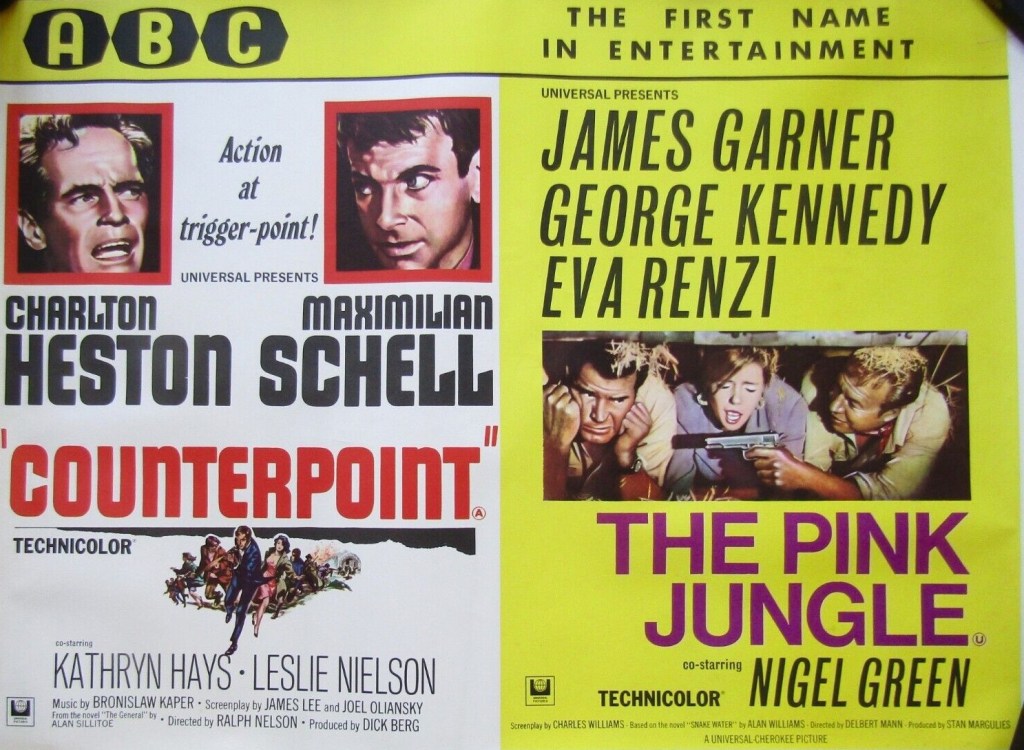
Counterpoint (1968) ****

Absorbing duel of minds between two autocrats obsessed with their own glory and needs and dealing with dissension in the ranks. That it takes place during the Battle of the Bulge turns out to be less of a dramatic hindrance though you maybe have to suspend disbelief in the notion that any resistance fighters might take time out from trying to sabotage Germans to help rescue a bunch of whining, pampered non-combatants with no strategic value whatsoever.

Once you accept that the U.S.O. would deem a classical orchestra the best way to entertain the troops rather than Betty Grable or Bob Hope then you’re halfway there.

Poster that misleadingly apes “The Great Escape” and “The Dirty Dozen”. Naturally, no woman would attempt such an escape without giving everyone a glimpse of cleavage.

Anyway, the Germans launching an offensive in December 1944 by accident capture the classical orchestra led by world-famous conductor Lionel Evans (Charlton Heston). The Germans are under orders to take no prisoners so as not to divert vital troops during this last-stage effort to extend the war, so under the direction of Colonel Arndt (Anton Diffring) the musicians face a firing squad until General Schiller (Maximilian Schell) happens to pop his head out of his window and recognize his hero, Evans.

Death is temporarily averted while Schiller purrs over his captive. But Evans, still high on principle and arrogance, refuses to comply with Schiller’s request to play a concert for him during a delay in the battle as, the Germans, hit by fuel shortage, are unable to continue their campaign and therefore have time on their hands. There ensues the aforesaid duel of minds plus various demonstrations of disloyalty and ruthlessness.

The joy here is the dialog because there’s not much else going on, beyond a half-hearted attempt to escape, and the tension doesn’t rachet up until Evans realizes Schiller is only keeping them alive until the concert, after which they will be turned over to the trigger-happy Arndt, who lacking any subtlety, has already begun to dig a mass grave in full view of the trapped self-proclaimed neutrals.

Teamed up in Britain with the long-lost “The Pink Jungle”, which, as it happens, I’m reviewing shortly.

It’s almost a parade of bon mots as each of the leaders tries to top the other’s sentences, and not in merely a clever manner, but with full-blown fascinating argument, in part about the different outlooks of each country, but also about their contradictions, and it’s a rare movie that can hold your attention just through dialog unless it’s set in a courtroom. But, here, Evans isn’t so much arguing for the suspension of a death penalty, for example, but in a remote high-mindedness complaining that, well, there’s no other word for it, that it’s just “unfair” as if the Geneva Convention has a special clause regarding classical musicians.

Maybe it does, given these are Americans, though not in uniform, which might be a point in their favor. But any commander would be correct in assuming they could, through courageous action, perform an act of sabotage or at the very least, as I mentioned, tie up vital resources.

Matters are complicated because Arndt, less self-indulgent than his superior, goes behind Schiller’s back to rat him out to HQ in Berlin while nameless persons within the orchestra are clearly in cahoots with the Germans. And you can’t blame them either. Arndt believes Schiller’s actions could compromise the attack, the orchestra traitors that Evans’ defiance will get them all killed. Evans is quite happy to sacrifice former lover Annabelle (Kathryn Hays) to keep the German commander, who has taken a fancy to her, happy.

Matters are complicated by the presence in the orchestra ranks of two U.S. soldiers in uniform, who feel duty bound to find a way out, so there’s a bit of the kind of action you’d get in a heist movie where an audience listens to classical music while above them a cat burglar is divesting them of their jewels. Here, the two soldiers are clambering up the innards of a church to the roof to scope out the territory and then attempt escape using a home-made rope made up of scarves and nylons etc.

As it becomes obvious that there is no point in Evans playing for time, the tension and turmoil does increase as that unfilled mass grave beckons. Doesn’t play out the way you’d expect, a couple of neat twists keeping cliché at bay.

But, as I said, the primary interest is the verbal battle between two refined minds convinced they are the most important people on the planet. The only standout scenes not involving Evans concern Schiller’s “seduction” of Annabelle and the playing of the American national anthem by one of the soldiers, planted in the orchestra, who Arndt suspects, from his age (too young to be in such august company unless a musical prodigy), doesn’t fit in.

Charlton Heston (Number One, 1969) and Maximilian Schell (Topkapi, 1964) are both superb as flawed characters. There’s a rare movie appearance for Kathryn Hays (Ride Beyond Vengeance, 1966) and another chance to see Leslie Nielsen (Beau Geste, 1966) before he became comedy catnip.

But it’s the script by James Lee (Banning, 1967) and Joel Oliansky (The Todd Killings, 1971), that really delivers, although I’m guessing that the best lines came directly from the source novel, The General by Alan Sillitoe (Saturday Night and Sunday Morning). Directed by Ralph Nelson (Once a Thief, 1965).

Rare to get a movie that relies so much on script and actors on such top form.

Underrated gem.

PREVIOUSLY REVIEWED IN THE BLOG: Charlton Heston in Diamond Head (1962), 55 Days at Peking (1963), Major Dundee (1965), The War Lord (1965), Khartoum (1966), Planet of the Apes (1968), Number One (1969); Maximilian Schell in Judgement at Nuremberg (1961), Topkapi (1964), Fate is the Hunter (1964), Father Goose (1964), Return from the Ashes (1965), The Deadly Affair (1967), Krakatoa -East of Java (1968); Ralph Nelson directed Soldier in the Rain (1963), Once a Thief (1965), Duel at Diablo (1966) and Soldier Blue (1970).

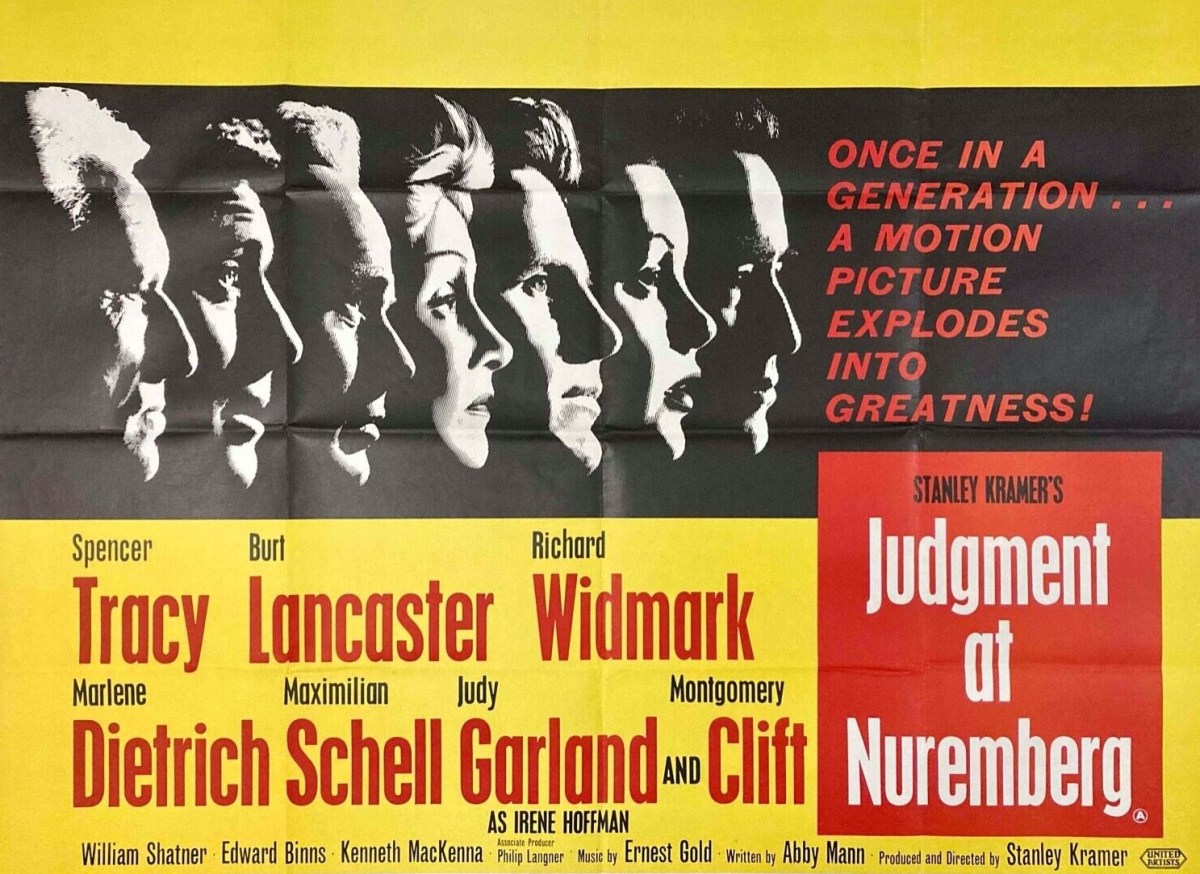
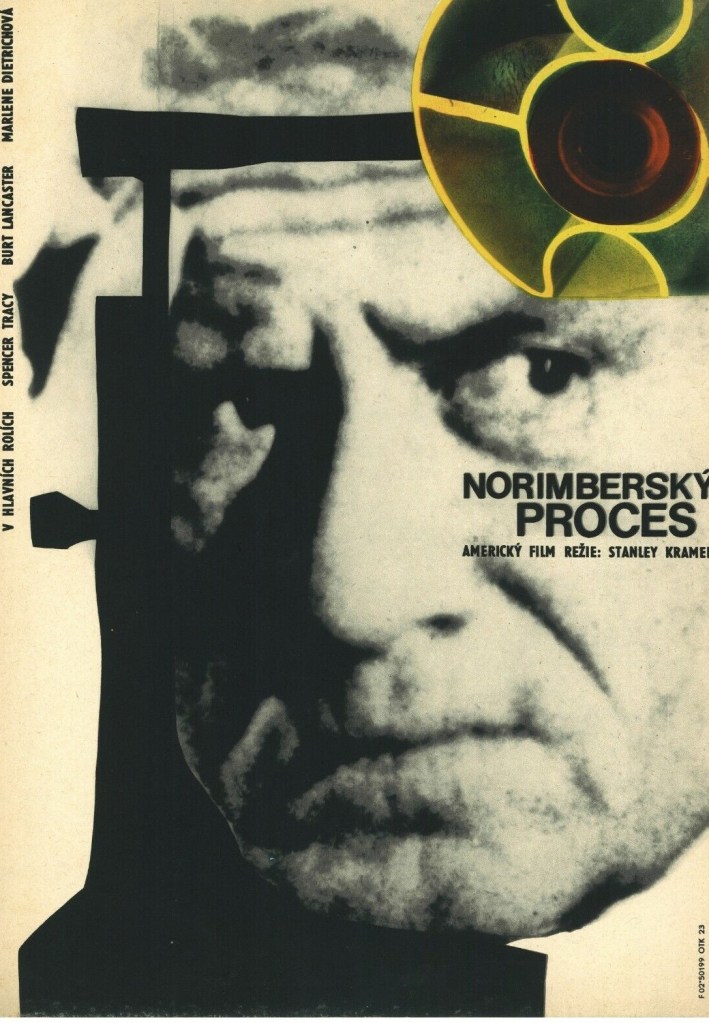
Judgment at Nuremberg (1961) ****

Stanley Kramer never caught a decent academic/critical break. Subject matter worthy, execution poor, was the overall consensus. But Judgement at Nuremberg, with its long tracking shots, sometimes turning 360 degrees around a character, should have changed all that. But the kind of critics who would have appreciated such bravura technique weren’t around at the time and even when Antonioni’s The Passenger (1975) appeared nobody thought to reference Kramer, believing this was a new cinematic invention by the esteemed Italian maestro.

So, Judgement at Nuremberg is remembered, if at all, for the subject matter and elevated by the performances rather than the director’s input. Most people misremember what the movie’s about. The main concern here isn’t the war criminal, the men personally involved in running the ghettos. Instead, it’s about those behind the scenes who could, theoretically, have prevented the camps flourishing, or at least challenged their opening.

Those on trial were freedom fighters of a different sort. As judges, the top tier of the legal system, their job was not just to uphold law and order and individual freedoms, but to take government to task for illegal action. It’s a basic tenet of the democratic world that governments cannot act in autocratic fashion but work within public accord.

Should the legal guardians find fault with government activity, their job is to take the ruling body to task – the European Court of Human Rights was set up with exactly that principal in mind, and various British and American law agencies have over time called a halt or questioned government proposals.

Some of the judges were clearly ill-fit for the task, lick-spittle jobsworths, desperate to hold onto rank and privilege, many sharing the same anti-semitic views as Hitler. But the Allied forces, being democratic, have to proceed along proper lines, taking potential criminals to court and allowing them legal defence.

So the main target is Dr Ernst Janning (Burt Lancaster), German’s pre-eminent legal force, a quiet, dignified man, who refuses to fawn or react to the charges. On the attack is prosecutor Col Tad Lawson (Richard Widmark). Acting for the defence is the wily, emotional, Hans Rolfe (Maximilian Schell) who is not above comparing the Holocaust to the Americans dropping the atom bomb on Hiroshima, indiscriminate terror brought on innocent civilians the result of both actions. He also brings to the court’s attention the distasteful theories that once held sway in high American legal circles as promulgated by Oliver Wendell Holmes, a Supreme Court judge, whose views on eugenics aimed at withholding procreation rights from the mentally handicapped.   

As referee we have Dan Heywood (Spencer Tracy), the American chief judge, who didn’t want the job and was way down the pecking order of those best qualified. And he’s a bit of a detective on the side, trying to discover how much ordinary people –  such as the flirtatious Mrs Bertholdt, widow of an executed German general, as well as the housekeeper and butler looking after him in some style – knew about the atrocities as they were taking place.

In the background is an Allied command not wishing to stir up any more controversy, conscious of the rising power of the Communist bloc, seeing West Germany as a bulwark against Stalin, concerned that forcing the country’s inhabitants to wallow in the past will turn their political minds towards the east rather than the west.

In due course, a variety of witnesses are called, testifying to ill-treatment under the German government including the backward Rudolph Pedersen (Montgomery Clift) and Irene Hoffman (Judy Garland).

What makes this so different is that innocence or guilt is not what’s under scrutiny, but reason. Why did such high-minded legal experts like Dr Janning give in to Hitler. And when? And do they recognise their role in providing Hitler with credence to continue with his massacre of the Jews?

Individual conscience and, conversely, collective guilt, might have been the driving force then but they are more than relevant today when actions in war come under even greater scrutiny and politicians are held to account. Perhaps, it’s ironic how little judgement was passed in the end on those convicted in these trials. Nobody was hanged, nobody received even a life sentence. In fact, by the time the movie was released, all were free men.  

Stanely Kramer, the Scorsese or Nolan of his era regarding running time  (it clocks in a just shy of three hours), does a superb job with his even-handed approach. While his technical skills were perhaps under-appreciated, he certainly knows how to command an audience’s attention and draws terrific performances from his actors.

Maximilian Schell, who won the Oscar, is perceived as the standout, but for me the highpoints were Burt Lancaster (The Swimmer, 1968) and Montgomery Clift (Freud, 1962). Abby Mann’s (The Detective, 1968) screenplay was an expanded version of his teleplay of two years before.

Has more than enough humanity to keep you riveted.

https://amzn.to/3Mh4v7c

Return from the Ashes (1965) ****

When your starting point is an arcane French inheritance law and the plot revolves around swindling a concentration camp survivor you are immediately on “icky” ground. Throw in a relationship between an adult male and the step-daughter of his deceased wife and the audience might already be backing off.

So it’s a tribute to the acting and that each character is not so much unlikeable as both vulnerable and predatory that this turns into a very involving drama. On the eve of World War Two in Paris Dr Michele Wolf (Ingrid Thulin) buys the love of penniless Polish chess player Stanislaus (Maximilian Schell) but at the cost of abandoning her step-daughter Fabi (Samantha Eggar). For him, love is contingent on wealth, but he marries Michele, a Jew, in a (failed) bid to save her from the clutches of the Nazis. Fabi, shorn of maternal love finds turns to a paternal variation, but is capable of coming up with an ingenious murder plot.

Just quite how hollow Michele has become is demonstrated in a brilliant opening scene set after the end of the war. In a railway carriage, a bored small boy endlessly kicks a door. Pretty much for 90 seconds we either see or hear that door being kicked. Foolishly, his hands wander from the window to the door handle. Next thing, he has fallen out. Cue screams, chaos, shocked passengers racing out of the carriage.

But when the conductor turns up to investigate the incident he finds Michele still sitting in her seat, oblivious to any death, even that of a child. When she returns to Paris, she takes a room in a hotel under a pseudonym, fearing that her ravaged looks make her unattractive, guilty at surviving (by volunteering to work in the camp brothel) when all her relatives were wiped out, unaware that she has unexpectedly inherited all their combined wealth.

So the story begins in a different way. When Stanislaus meets her accidentally under her false name, he immediately assumes she is just a dead ringer for his deceased wife and enrols her in a scheme to win the millions currently held in escrow under this inexplicable French law.

Since she continues to play the part of a different woman, she hears the truth about her relationship with Stanislaus, that although he committed the only unselfish “gallant act” in his life in marrying her nonetheless his prime reason was money. Already Fabi, in full femme fatale mode, is planning to rid the couple of Michele once the money has been legally acquired.

To his credit, Stanislaus initially balks at this notion, but when Michele reveals her true identity and scuppers his relationship with Fabi while at the same time trying to win back the affection of her step-daughter, matters take a deadly turn.

For the most part what we have is a menage a trois, equal parts driven by money and love, but in each instance propelled by innermost desire. Stanislaus is adept at pulling the wool over Michele’s eyes, she only too willingly blinding herself to his sexual deception. But Michele is equally willing, even when she knows his true feelings, to use her money to win him back while Fabi, aware that for her lover money will always trump romance, is determined to use her body to achieve the same effect.

What makes this so compelling is that, unusually, it avoids sentiment. It would have been easy to load each character up with such vulnerability that an audience would not condemn them. Instead, in addition to their individual weaknesses, we are shown their inherent predatory natures.

What makes it so enjoyable is the acting. So often Maximilian Schell is called upon to play stern characters, often typecast from his accent as a villainous German of one kind or another (Judgement at Nuremberg, 1961, The Deadly Affair, 1967), rather than allowing him to invent a more rounded character as he did in Topkapi (1964). This is a wonderfully involving performance,  the wannabe chess grandmaster who uses his considerable charm to buttress his fears of poverty, and is only too aware of his failing, full of joie de vivre, bristling at being a kept man yet at the same time only too ready to financially exploit the situation.  

Where in The Collector (1965) Samantha Eggar was constrained by circumstance and in Walk, Don’t Walk (1966) saddled with an initially cold character, here she is permitted greater freedom to develop a conflicted personality, loving and deadly at the same time, drawn to and hating her step-mother, attracted by the thought of the money that would secure Stanislaus but repulsed by the cost.  

Ingmar Bergman protégé Ingrid Thulin (Wild Strawberries, 1957) is given the least leeway, another of the tormented characters in her intense portfolio. Herbert Lom (Villa Rides, 1968) puts in an appearance as a friend trying to warn her off Stanislaus.  

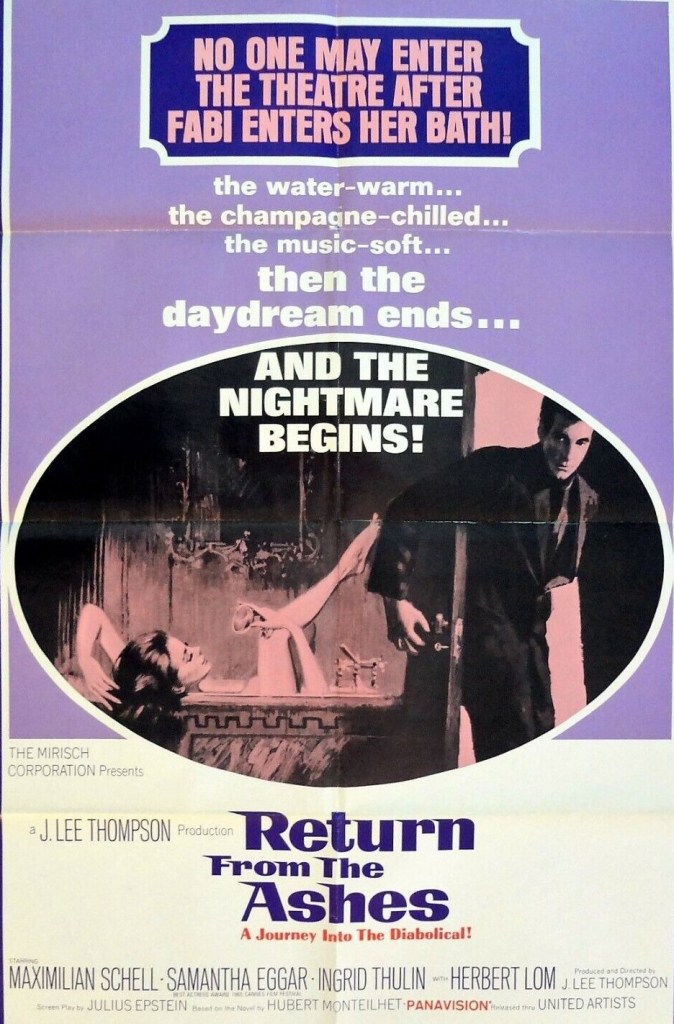
Director J. Lee Thompson (The Guns of Navarone, 1961) takes the bold approach of allowing characters and situation to develop before moving into thriller mode. There are a couple of quite superb scenes, running the opening segment close is the much-vaunted scene of Fabi in the bath (“No one may enter the theater once Fabi enters her bath” was a famous tagline). It is brilliantly filmed in film noir tones, bright light slashed across eyes rather than through windows, and Johnny Dankworth provides an interesting score. Julius J. Epstein (Casablanca, 1942) wrote the screenplay based on the bestseller by Hubert Monteilhet.

The Deadly Affair (1966) ***

Initially, much more of a character study than murder mystery or spy tale. And like the previous John Le Carre adaptation The Spy Who Came in from the Cold (1965) directed by an American, there Martin Ritt, here Sidney Lumet. Although as repressed as the main character in Lumet’s  The Pawnbroker (1964) and sharing with it remembrance of the Holocaust, master spy Charles Dobbs (name changed from George Smiley due to Paramount’s rights from the earlier film) is far more capable of expressing his feelings and taking action than the pawnbroker.

Dobbs sleeps in a separate bedroom, his wife Ann (Harriet Andersson) indulging in so many affairs she is considered a nymphomaniac. Although resigned to this behavior, he is nonetheless shocked when her latest amour turns out to be his old friend and colleague Dieter (Maximilian Schell) and even attempts to offer him advice, the politeness of the English at its best. “In any other country,” retorts Dieter, “we wouldn’t be on speaking terms.” This kind of betrayal Dobbs can manage, but the other kind, of a professional nature, has him rushing to the bathroom to throw up.

If you’ve come to admire the character of George Smiley (aka Dobbs) as played by Alec Guinness in BBC TV series Tinker, Tailor, Soldier, Spy (1979) and its sequel where he is generally a passive character you might get a shock when here the man springs into action.

Dobbs comes up against the Establishment when his boss (Max Adrian) refuses to investigate the suicide of a low-level agent Fennan (Robert Flemyng), a former Communist cleared of suspicion of being a double agent by Dobbs himself. Dobbs resigns in order to go his own way enlisting retired policeman Mendel (Harry Andrews), a pet lover and prone to falling asleep at inopportune moments. Although it is essentially a murder story, it’s Mendel who does most of the detecting, using his resources to track relevant pieces of information – typewriters, wake up calls, theatre tickets fall into his purview – and very much the old-school cop, not above a bit of burglary and beating up a suspect.

There are leaks within the secret service, Dobbs tailed, a blond man Harek (Les White) hovering into view long enough to tamper with witnesses, including dodgy car dealer Scarr (Roy Kinnear), a bubbly character with “two wives.”  Key to the investigation is Fennan’s wife Elsa (Simone Signoret), a Jewish refugee from the concentration camps, and committing the cardinal sin of not offering Dobbs a cup of tea when he comes to visit, though pouring herself one. “I’m a battlefield for your toy soldiers,” she proclaims, another in le Carre’s stream of innocents unwittingly caught up in the “game.”

This is dingy rather than tourist London, Battersea power station on the horizon, rain prominent, a murky Embankment, the Thames a river of sludge, dubious pubs in unsavory locations, except for a very English spurt of theatre (a plot point) involving characters with very jolly accents. In The Spy Who Came in from the Cold, the spy’s downfall is “minor human weakness” i.e. falling in love and so it is here, Dobbs’ mental health taking a beating by not just his wife’s unfaithfulness but by remaining faithful to her. Of course, he wouldn’t be the first man to have married out of his league and be unwilling to surrender his prize.

Lumet’s gaze is anything but sentimental. In fact, as much as Dobbs is a master of the spy game, he is a dunce at the game of love, and Lumet does not let him off lightly. Any man who commiserates with his wife’s lover on the grounds that he (said lover) will be hurt when the woman ultimately abandons him, is straight from idiot school.

So this is a far more complex, and human, reflection on the spy game, and it’s not so much about paying the price of being a spy, as occurred with Alec Leamas, than the folly of marrying the wrong woman. You can see how easily Dobbs was seduced by the insane prospect that a beautiful woman had fallen in love with him, rather than, as he must have been trained to do, examining her reasons.

Of course, it’s not unusual for detectives to have miserable home lives and end up as loners, but this was part of a trend (see The Quiller Memorandum, 1966) to see spies not as bed-hoppers of the James Bond variety but as human beings with normal failings. One oddity is that, in line with the Paramount dictat on names, Dobbs’ boss is called “The Adviser” rather than “Control” (although apparently there was such a title in le Carre’s version of the secret service prior to this book).

James Mason (Age of Consent, 1969) is excellent as brilliant spy/bewildered lover. Harry Andrews (The Hill, 1965) has a ball in a change from his normal taciturn characters. Oscar-winner Maximilian Schell (Topkapi, 1964) is equally convincing but I found Harriet Andersson (Through a Glass Darkly, 1961) too much one-note certainly compared to the riveting performance by Simone Signoret (Is Paris Burning? 1966).

You can spot a string of future stars in a supporting cast led by Lynn Redgrave (Georgy Girl, 1966), Corin Redgrave (The Girl with a Pistol, 1968) and Kenneth Haigh (A Lovely Way to Die, 1968) among older hands like Robert Flemyng (The Blood Beast Terror, 1968), Roy Kinnear (The Hill) and Max Aitken (Henry V, 1944).

Paul Dehn (The Spy Who Came in from the Cold) wrote the screenplay based on John le Carre’s novel Call for the Dead, which was written before the book which made the author famous.

Topkapi (1964) *****

The mother of all heists directed by the father of all heist pictures.

Films as diverse as The Italian Job (1969), Mission Impossible (1996) and Ocean’s Eleven (2001) owe director Jules Dassin a massive debt since he pretty much invented this genre with the French-made Rififi (1955). But that involved professional criminals. Outside of masterminds Elizabeth (Melina Mercouri) and Walter (Maximilian Schell), this crew are amateurs, deliberately chosen for their lack of criminal records and with a mind to the specific tasks required. So we have acrobat Giulio (Gilles Segal), upper-class English gadget inventor Cedric (Robert Morley), strongman Hans (Jess Fisher) and driver Arthur (Peter Ustinov).

The target is the impenetrable, complete with sound-sensitive floor, Topkapi Palace in Istanbul where they plan to steal a priceless emerald-encrusted dagger. The plan is ingenious. Arthur is initially only hired to smuggle the weapons essential to the audacious heist across the border. But when he is caught and forced to cooperate with the Turkish secret police, he is enlisted as a replacement for Hans. Minus the rifles and grenades which at first appeared indispensable to the plan, the thieves come up with an even more inspired alternative involving among other things scampering across rooftops, abseiling, a parrot and slowing down the revolutions of a lighthouse.

Originally intending to betray his colleagues as soon as possible, Arthur falls under the seductive spell of Elizabeth and finds himself recruited as the replacement muscles. Elizabeth exudes such sexuality she has the entire gang in her thrall and makes the cowardly, weak, acrophobic Arthur believe he can overcome all his fears. Like current television sensation Money Heist, Walter engages in a cat-and-mouse game with the police, always one step ahead, with a bagful of red herrings at his disposal, eventually giving the pursuers the slip during a wresting competition held in a massive outdoor arena.

Interestingly, too, this doesn’t have the trope of gangsters at each other’s throats, planning to double-cross one another or bearing old grudges. Nor is this the last robbery for anyone prior to retirement. Equally, nobody challenges the leader. In fact, the entire crew could not be more docile, content to sit at the feet of Elizabeth and Walter, lapping up the former’s flirtation, wondering at the latter’s skill, as if they are all honored to have been chosen.

The climactic heist, carried out minus music, and lasting over 30 minutes is absolutely superb, setting a very high bar for future imitators, and there is a twist ending. Dassin mixes light comedy and high tension with the sultry attractions of Elizabeth to produce an at times breathtaking picture. As well as the heist itself, the wrestling sequence is stunning and the transition of Arthur forms the acting highlight (he won the Best Supporting Actor Oscar).

But all four main stars are superb. Audiences accustomed to a more uptight Maximilian Schell (The Condemned of Altona (1962) will have been surprised by his charming performance. Melina Mercouri (Oscar-nominated for Never on Sunday, 1960) is the archetypal blonde bombshell, liberal with her favours but careful not to favour just one. Although Walter devises the plan, she is actually the criminal supremo, selecting the targets, and then delegating to ensure the tasks are carried out. Robert Morley is having the time of his life. Akim Tamiroff (Lord Jim, 1965) has a cameo as a chef.

A film noir star after Brute Force (1947) and The Naked City (1948) Dassin’s Hollywood career collapsed in the wake of the anti-Communist McCarthy hearings and he was blacklisted. Rififi opened few doors but even the success of Never on Sunday (1960) brought negligible offers. Despite returning to the mainstream with such elan through the conduit of Topkapi, albeit with a European cast, he remained on the Hollywood periphery and although the American-set Uptight (1968) – previously reviewed in the Blog – involved another heist that was primarily the wrapping for social documentary.

More at home with comedies screenwriter Monja Danischewsky (The Battle of the Sexes, 1960) draws out more humour than the source material, Light of Day by noted thriller writer Eric Ambler, would ostensibly suggest.

A delight from start to finish, the crème de la crème of the heist genre, this is unmissable. Dassin can lay claim to being the John Ford of the crime picture.

Discover WordPress

A daily selection of the best content published on WordPress, collected for you by humans who love to read.

The Atavist Magazine

by Brian Hannan

WordPress.com News

The latest news on WordPress.com and the WordPress community.