Selling James Bond: Part Two – Pressbook for “Thunderball” (1965)

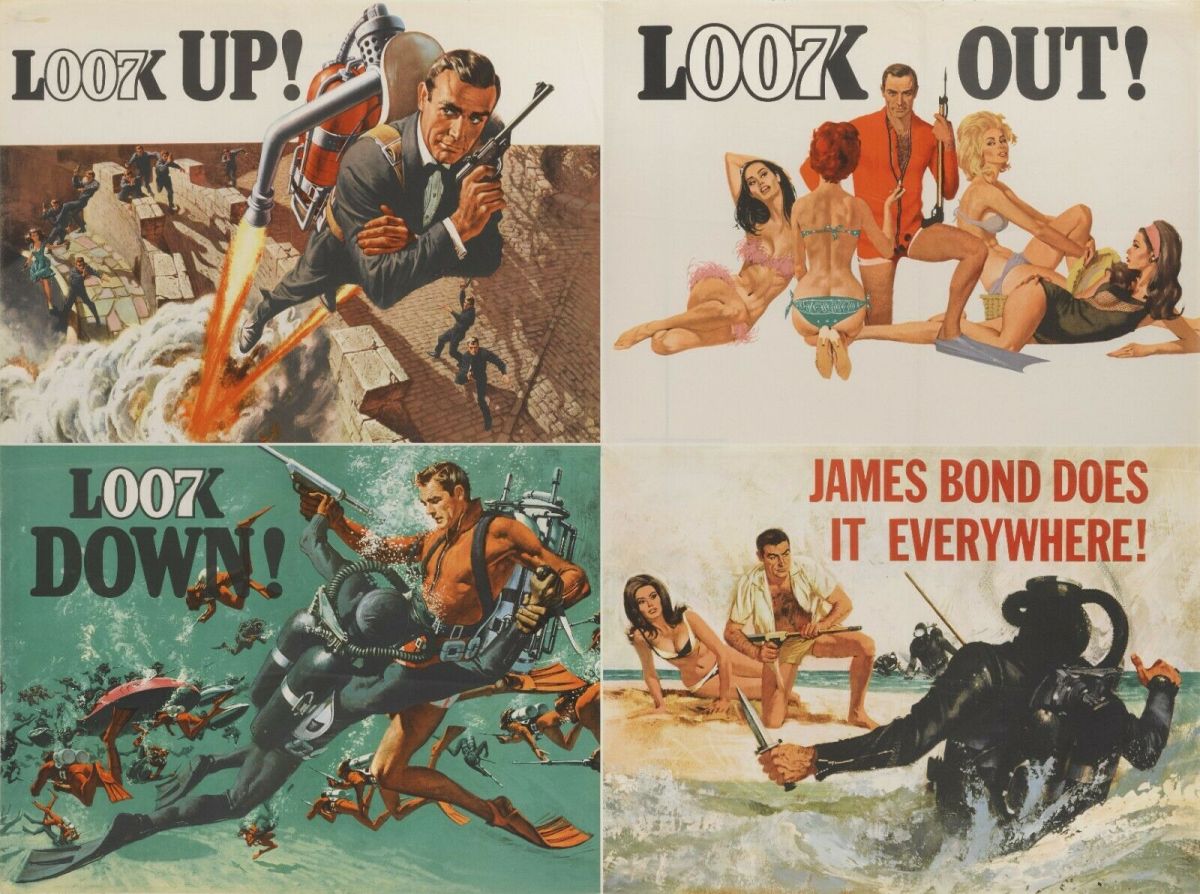
Wooing the audience was no longer required after Goldfinger (1964) had broken the box office bank. Thunderball, claimed producers Cubby Broccoli and Harry Saltzman, was “the hottest merchandise campaign you have ever handled” as the first four pages of the Pressbook went to show. No longer was there a retailer free-for-all with companies which had nothing to do with endorsements jumping on the Bondwagon.

The potential for promotional tie-in was so high that retailers and manufacturers were willing to spend a fortune to become involved and, in so doing, provide a massive spread of free advertising. Colgate had an entire line of toiletries for men including after shave, shaving lotion, deodorant, and talcum powder, each item branded with the 007 logo with Colgate investing in a massive advertising campaign aimed not just as men but the women who buy for men.

Shoe-wear manufacturer Endicott Johnson set up a nationwide contest through the Montgomery Ward chain of stores. Customers were invited to participate in a free sweepstake and store managers were encouraged to become active in promoting Thunderball at sales points throughout their shops.

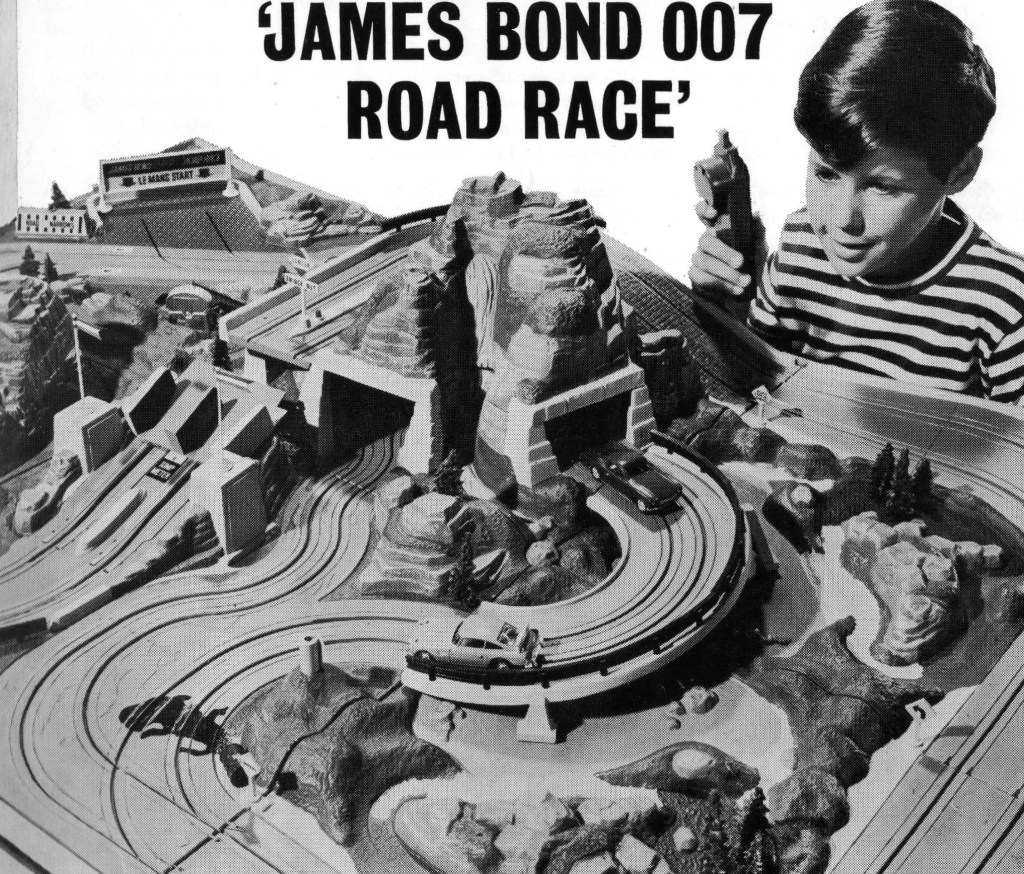
Toy manufactuer A.C. Gilbert had devised a James Bond 007 Road Race which would be promoted in the biggest marketing campaign in Sears Roebuck history to 60 million homes. The catalog would feature a five-page spread. “Beatles fans will be reached through a TV buy that Sears has made advertising the Road Race on ABC-TV’s Beatles Cartoon Show.” Adlers Slacks was the exclusive licensee for James Bond 007 Boys Slacks – with two hidden pockets. Revere Knitting Mills was promoting four sweaters “as worn by James Bond.”

Other licensed products included The Official James Bond Secret Agent 007 Shooting Attache Case, Harry Diamond sports shorts with the Bond logo, Allison tee-shirts and sweat shorts, bubble gum and trading cards from the Philadelphia Chewing Gum Corp, and a walkie-talkie set from Gabriel. In addition, Weldon was selling “007 Pyjamas – Go to Bed Dressed to Kill,” Voit manufactured underwater equipment, Spatz advertised its trenchcoats in Playboy, Trimount clothing range included items for men and boys, and Milton Bradley had four board games and six jigsaw puzzles.

So for the first time in history, exhibitors had to do nothing to attract customers, no zany attention-grabbing gimmicks required, because the massive cross-promotional campaign devised by the producers ensured that potential moviegoers could hardly go anywhere without coming across something alerting customers to the movie.

All this was in addition to the normal standard promotional tools such as original soundtrack album and paperback movie tie-in. Tom Jones had released a single and six other artists had brought out instrumental singles and albums. Trade magazine Cash Box noted that the Bond name signified “something big in the worlds of film and music…many labels have themed LPs after the valuable James Bond Agent 007 image.” Signet had brought out the movie tie-in paperback with artwork on front and back covers.

The bulk of the Pressbook was taken up with advertising and information about the licensed products leaving just three pages for the editorial section. By now of course Sean Connery was a big box office star so he received considerable coverage, explaining that he had been chosen for Dr No as a result of a London newspaper poll. There was space too for the movie’s playgirls – former Miss France Claudine Auger, villainess Luciana Paluzzi best known to American audiences through the Five Fingers television series, Molly Peters and a return for Martine Beswick who had appeared in From Russia with Love.

Not surprisingly, the Aston Martin DB5, which had caused a sensation in Goldfinger, also returned. The customised version cost $45,000 (worth $400,000 today), compared to the usual price of $13,000, and came complete with twin Browning machine guns, tire slashers, revolving number plates, radar screen, ejector seat, and retractable bullet proof shields.

Selling the Obvious: Pressbook for “Kisses for My President” (1964)

Fred MacMurray doesn’t actually wear a woman’s hat in this picture, he just imagines himself wearing one. But that image was all it took for the marketeers to do it to death. Warner Brothers clearly believed the picture was going to be a winner and produced a whopping 32-page A3 Pressbook (double the normal size) in a bid to persuade exhibitors of its potential. That included a blockbusting two dozen adverts. Although in the 1960s as this series on Pressbooks has shown, movies were not sold just on the basis of one core image, but even so a limit was generally called when the number of options reached eight or nine.

On top of that, the Pressbook writers provided interesting copy for editors who might file a snipper or two around the movie’s launch. Arlene Dahl, for instance, contended that a large proportion of the most prominent women in history – Salome, Cleopatra, Elizabeth I – had, like her, red hair. Writing a syndicated beauty column, Dahl also offered advice on wearing perfume.

Eli Wallach put forward a convincing argument for remaining a supporting actor. “Get your name above the title,” he opined, “and if you make a hit you have to play the same thing over and over – the actor gets sick of the monotony and sooner or later so does the public.” Polly Bergen, who based her screen wardrobe on Jackie Kennedy, argued that ordinary women were well turned out in America whereas abroad that was the preserve of the wealthy. Starting out in Wisconsin Fred MacMurray scraped paint off cars for $20 a week.

To get exhibitors in the mood to sell a political comedy, the Pressbook offered eight “punchy and funny” spoof campaign posters, suggesting they be positioned in door panels or along one wall in a straight line and on a voting booth in the lobby. Expanding on the concept in their local area, exhibitors were encourage to recruit an important woman “holding some office” who could be corralled into acting as a “president” embarking on an imitation tour backed up by supporters carrying placards.

Silent screen star Carmel Myers, who manufactured a fragrance line for men, was enrolled by Warner Brothers for a nationwide tour in part talking about the subject that is key to the movie’s subplot – “can a beautiful and glamorous woman be a successful business executive?” A high-flying vamp of the silent era, Myers starred in Ben-Hur: A  Tale of the Christ (1925) and later had her own short-lived television series before entering the beauty business.

Except twice, each of the other myriad adverts stuck with a photo of MacMurray wearing a hat. The taglines, running on the theme of what happened to the female President’s male consort, varied only slightly. “When a woman becomes President, what happens when her poor husband becomes First Lady?” / “President arrives in New York today, leaves First Lady home with knitting”/ “Women rise, men revolt, everybody cheer”

Inevitably, advertising focused on politics. “Republicans and Democrats agree this is the funniest picture you’ll ever see” / “First male First Lady takes Washington by storm” / “Is America prepared for the first woman president and her First Lady?

Some taglines took a different approach. “This year a woman will be elected President of U.S….and a man will be elected to the Comedy Hall of Fame” /”Vote the sdtraight ticket (the movie ticket, we mean” / “When you cast your next vote for President, be sure to do it at (this) theatre” / My father is the hostess with the moistest.” 

Selling The Rat Pack: Pressbook for “Robin and the 7 Hoods” (1964)

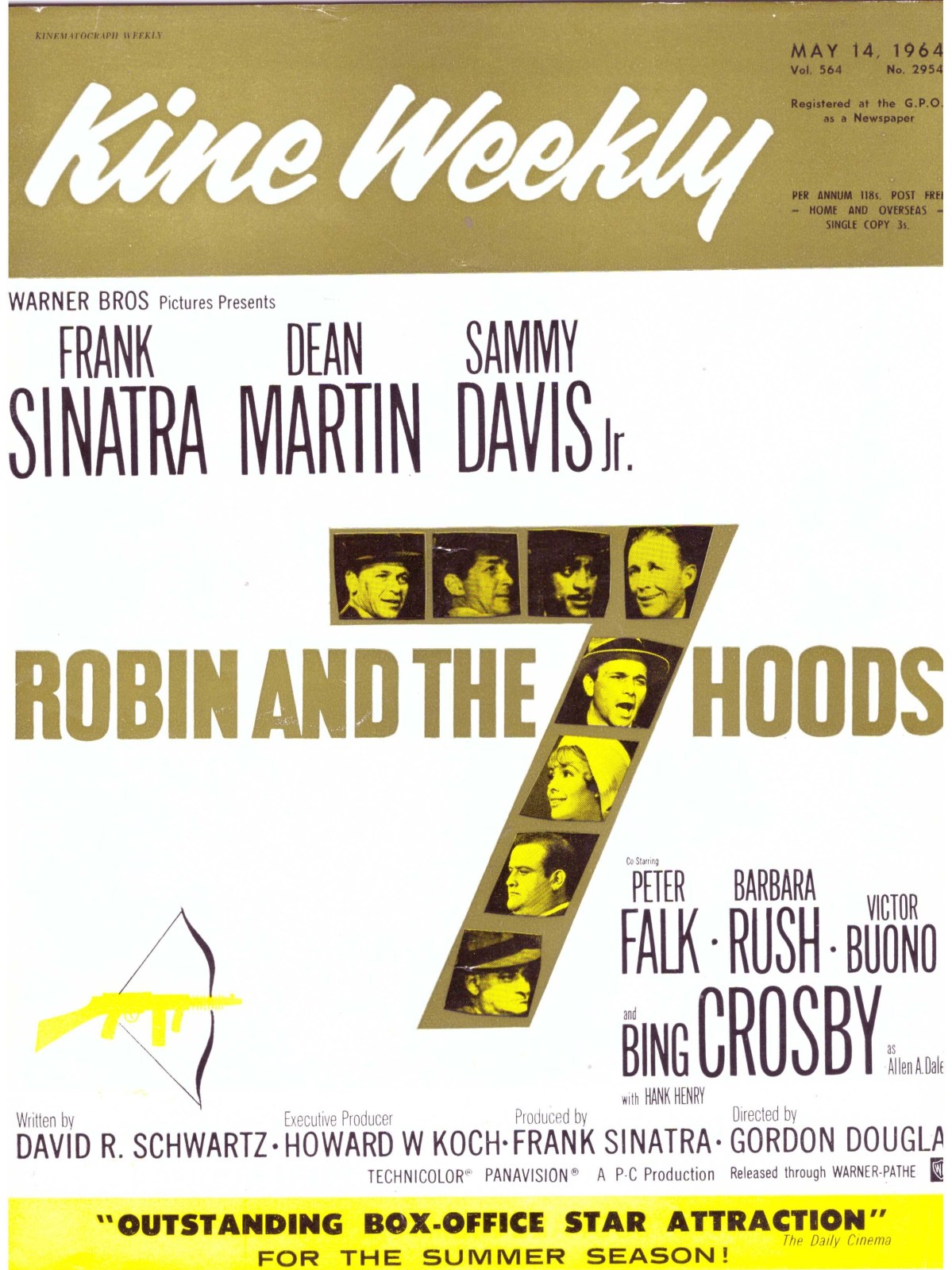
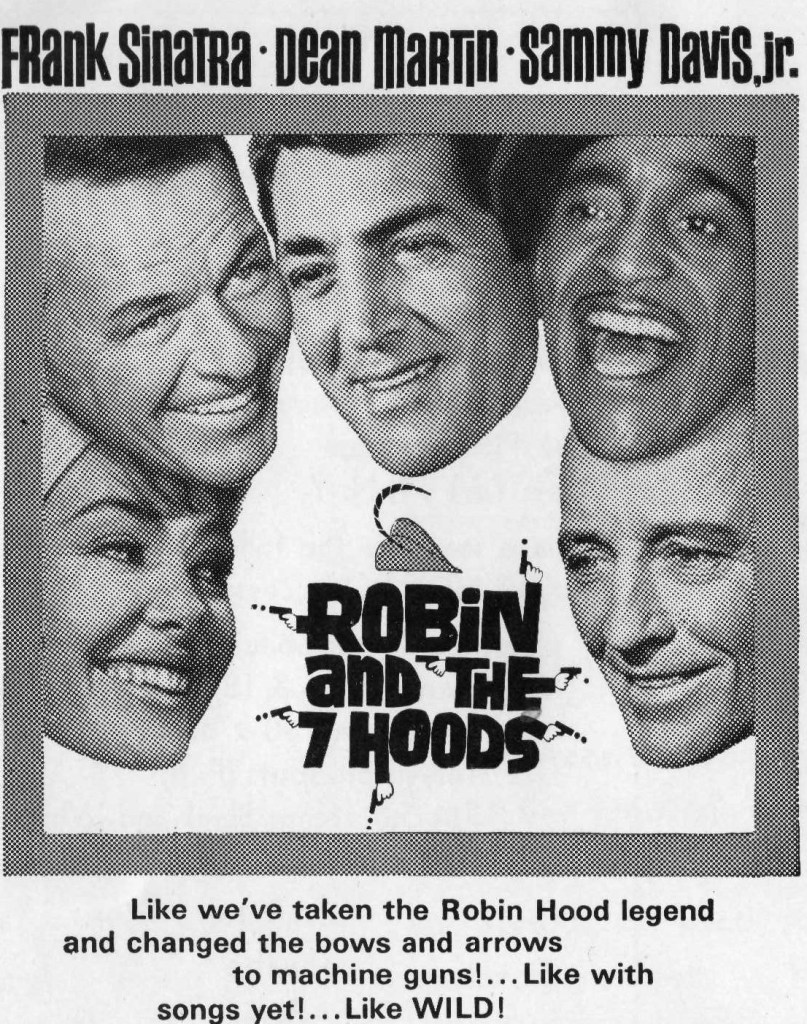
Warner Brothers pushed the boat out for Robin and the 7 Hoods with this lavish Pressbook. Apart from roadshows, most pressbooks of the era were around 16-pages A3. But this stretched to 28 pages with a tremendous range of advertisements, taglines and tie-ups plus, easier to accommodate from the exhibitor’s perspective, a healthy number of relatively straightforward marketing suggestions. On top of that, always a great incentive for cinema managers to rack their brains for good promotional ideas, the studio was offering seven cash prizes worth a total of $1,500 – about $14,000 today – for the best individual campaigns as well as a “special bonus prize” of the golf clubs used by Frank Sinatra, Dean Martin, Sammy Davis Jr. and Bing Crosby for the most original stunt.

With Pressbooks popping through a cinema manager’s door at the rate of one or two or three a week – dependent on how often a picture house changed its program – this one would certainly have made an impact, not so much from its size, but its commitment to the exhibitor. Most Pressbooks began either with information on the stars and the filming or with the advertisements and there was a sense of exhibitors being called upon to fit in with a pre-conceived campaign. Warner Brothers was not the first studio to go down the prize-giving route as a means of attracting attention, but in making the competition the first item on the promotional agenda – two of the first four pages were devoted to it – it certainly ensured it was high priority.

Following the competition came four pages of suggestions for gimmicks, stunts and tie-ins. WB had already tied-up with the The Antique Automobile Club of America and its members were being encouraged to lend out their vehicles to any movie theater planning a stunt. Exhibitors were told that car owners were “pleased to show them off.” There were over 100 chapters/branches of the Club so no shortage of eager participants. A parade of old-time cars in the town or a rally outside the cinema or even a race was guaranteed to attract publicity.

The Roaring 20s was another concept easily adopted – flapper fashions, the Charleston being performed outside the theatre or a dance competition, or girls dressed up in the outfits of the day strolling around town “carrying phonographs and camp stools; at busy intersections they can sit down and play one of the Robin tunes.”  Reward posters could be put up for famous gangsters of the speakeasy period, with photographs of the film’s characters included. A jazz parade was another possibility complete with straw hats and blazers. Setting up a gambling den was another suggestion using “actual gambling equipment captured by the police.”

And all this was before exhibitors could let fly with ideas based on the archery motif since “the words Robin Hood and archery and practically interchangeable.” Archery contests could be staged in a sports store, park, shopping mall or in front of the cinema. Robin Hood hats made of simulated felt with a feather sticking out – or bullet-riddled – were available at a low cost and ideal for giving away to children and to be worn by ushers and other staff as well as employees in other organisations participating in any promotion. Or just handed out to a local restaurant.

On top of that, since this Rat Pack picture was actually a denoted musical in which all the principals sang, there was the best tie-in of all – an original soundtrack album, an easy marketing tool for record shops. WB had also arranged for a book tie-in with Pocket Books, novelization written by Jack Pearl and stocked in 120,000 outlets.  The record, promised WB, would be “on every radio station night and day.” Even though Sinatra was no longer a top recording artist – “My Kind of Town” did not break the Cashbox Top 100 singles chart – his voice and that of his co-stars were exactly the kind of easy listening that appeared to radio addicts fed up with the British Beatle invasion.

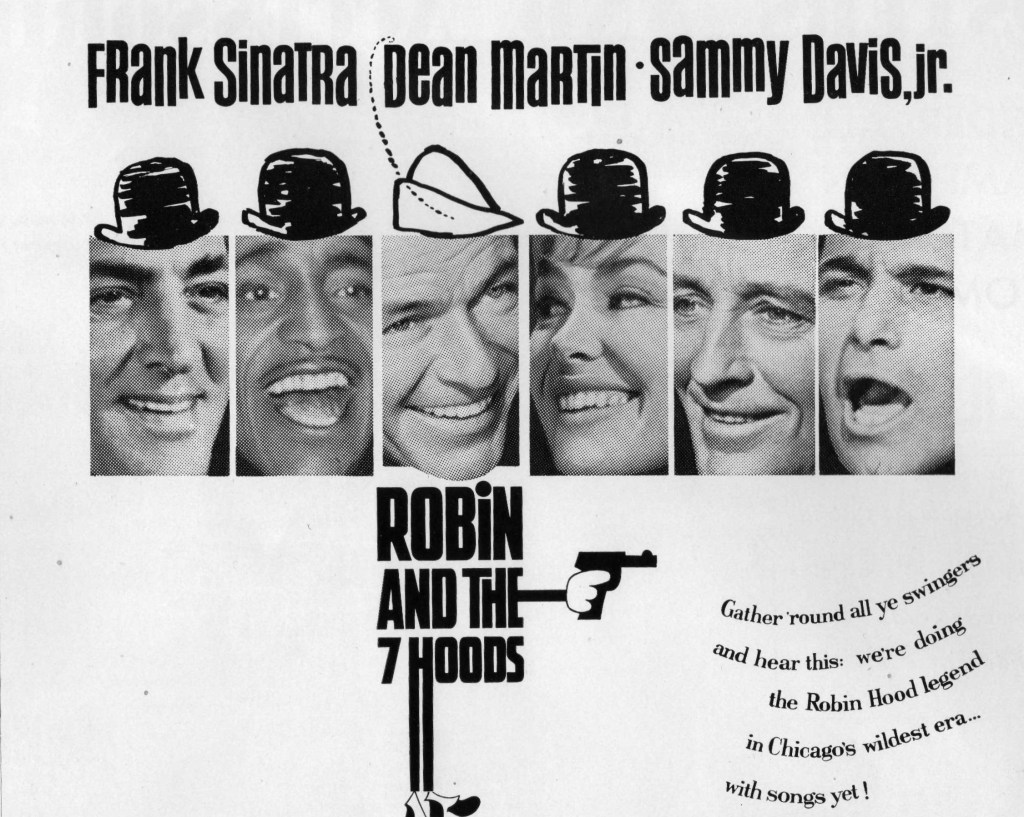
The advertising campaign was fairly straightforward consisting of as many of the stars as could be crammed onto a poster – usually the main four plus either Barbara Rush or Peter Falk, occasionally all six. The tagline went hip: “Like we’ve taken the Robin Hood legend and changed the bows and arrows to machine guns…! Like with songs yet!…Like Wild.” The last word might be changed to “Wow.”  An alternate tagline along similar lines went: “In Merrie Olde Chicago, in the days when King Al ruled the land…” And “Gather round all ye swingers and hear this…we’re doing the Robin Hood legend in Chicago’s wildest era…with songs yet!” A final version ran: “Warner Bros right merrily presents the wild idea of doing the Robin Hood legend in Chicago’s wildest era.”

With the box office and recording firepower of Sinatra, Martin, Davis and Crosby and the range of promotional ideas, there was little need to jazz up the Pressbook with journalistic nuggets, but WB did not stint on this count. The appearance of Edward G. Robinson in the genre and studio where he made his name three decades before in the like of Little Caesar was too good an opportunity to miss – more so when the wardrobe department discovered his suit size had not changed. Other cinematic stalwarts from the early gangster picture days included Allen Jenkins and Jack La Rue, now a restaurant owner and making his first WB movie in 23 years.

Elegance was a keynote for Barbara rush’s femme fatale. Designer Don Feld created a range of dinner gowns, coats and negligees which served almost as a disguise for the hard-as-nails operator. Commented Rush, “I am as tough as daddy and just as blood-thirsty. But I play it sweet throughout and never become hard or evil. The role has more substance when you realize this sweet girl has the ruthlessness of a cobra.” Pool hustler Harold ‘Red’ Baker was hired to teach Dean Martin how to perform like a champion player and also set up the shots for the game between Sinatra and Martin. Baker. But the editorial section ran for only two pages, which was a mighty small proportion of the overall Pressbook.

Selling the Exotic – Pressbook for “24 Hours to Kill” (1965)

No matter how small a picture, its budget had to stretch to a Pressbook. Even if the movie would end up on the bottom half of a double bill or a drive-in programmer and did not have much to shout about, it still needed a Pressbook. Low-budget films meant low-budget advertising campaigns unless your name was Joe Levine who often spent far more promoting films than he did making them.

The Pressbook was essential because it was the source of the movie’s adverts that could appear in a newspaper – these came in a variety of sizes so an  exhibitor could remove the one most relevant and take it down to their local newspaper to make up the display advertisement. In the pre-digital era, it was a crude as that, adverts were effectively cut and pasted.

While some Pressbooks could run to 16, 20 or 24 A3 pages in full color, the most basic requirement would be four pages, enough to show the ads and get the basic message across. This was of the basic variety. In this case, ads took up the first two-and-a-half pages, leaving a half-page to list the credits and explain the plot. The final page contained information about the stars..  

Perhaps as revenge for producer Harry Alan Towers not coughing up enough money for a decent Pressbook, his name was left off it. Instead, filing his slot was Oliver A. Unger, more famous as a pioneer of syndicated television, importer of foreign films and producer of The Pawnbroker (1964). In reality, he was an executive producer, in those days that function being fulfilled by someone who either invested in the picture upfront or once filming was complete bought territorial rights.

Artwork was minimal, one main advertisement, one alternative. But more or less the same taglines appear in both. Hoping to hook in the audiences was the notion of “perfumed harem…in mysterious Beirut…where every hour can be your wildest.. and your last.”

Usually films like these boasting a flotilla of European beauties devoted some space to explaining their origins and puffing up their potential. Not so here. Space is just too tight. The only actors covered are Lex Barker, Mickey Rooney and Walter Szelak. Strangely, no mention is made of Barker’s socko career as a German western hero – the notion that Europeans could make westerns remained absurd at this point (A Fistful of Dollars would take three years following completion to reach U.S. screens).

According to the Pressbook, Barker more or less jumped straight from Tarzan to this kind of thriller. Though he had been out of the loin-cloth for more than a decade (Tarzan and the She-Devil, 1953, his final appearance), the 40 pictures he had made since then (including La Dolce Vita, 1960) did not merit a sentence. The Pressbook did carry a quotable quote from Barker explaining his reasons for quitting jungle life: “It made me feel like a male Bardot because I was always parading around almost nude.” This was the type of quote that only made sense until you realised that Bardot did not become a star till three years after he quit playing Tarzan. Still, who was going to argue?

A strict regimen of physical exercise allowed him to keep in the shape necessary for the film which required him to “run for his life, rescue a pretty hostess from kidnap by helicopter and fight off thug after thug.” 

Mickey Rooney gets a better write-up, especially for making the rare jump from successful child star to accepted by audiences for his adult roles. Though the writer of the Pressbook never appeared to actually go the movies. Spot the mistake in this sentence: “Last seen in runaway box office hit It’s A Mad, Mad, Mad, Mad, World Rooney now appears for producer Oliver A. Under in a drama equally as challenging.” That the first film was actually a comedy and not a drama never seemed to sink in.

The usual promotional material – suggestions for marketing, maybe a record of the soundtrack available, perhaps a theme song to target radio stations, various stunts – was non-existent even though the movie leant itself to a tie-in with an airline or a travel company especially as the National Lebanese Tourist Council had gone out of its way to accommodate the production.

Selling Oscar Winners – Pressbook for “The Slender Thread” (1965)

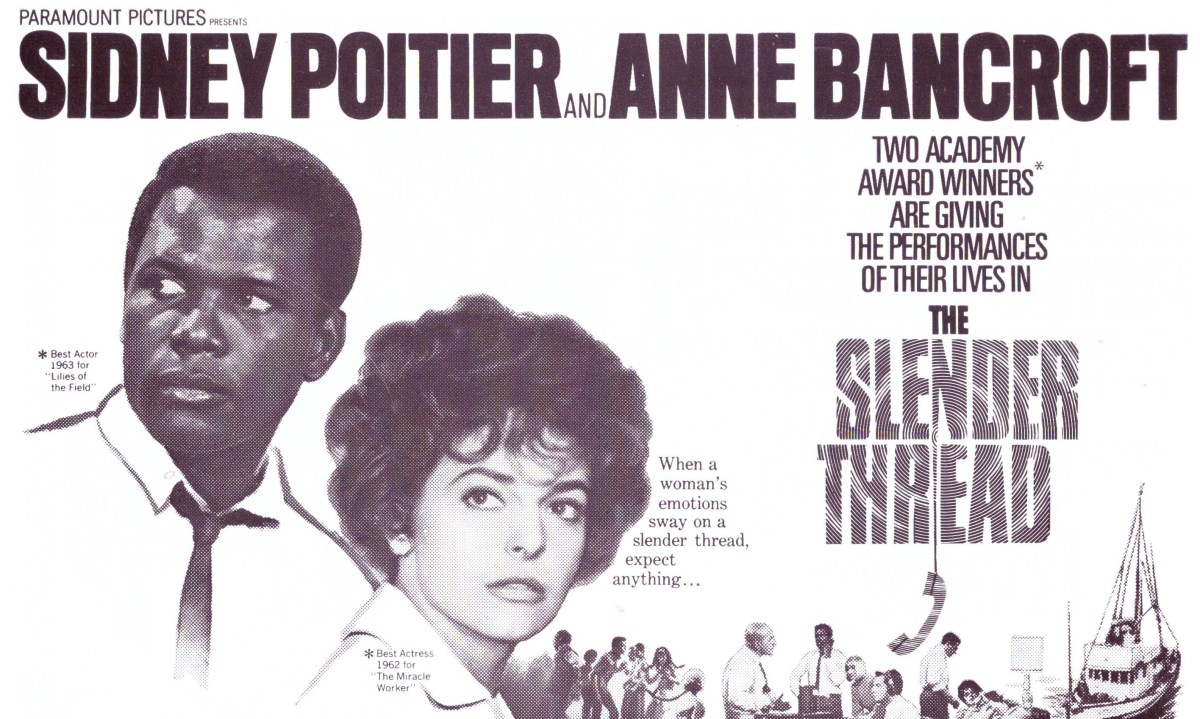
Just how do you sell a movie about a suicide to an audience for whom such a subject is still taboo? The answer is – you don’t. Instead, you fall back on your stars – and the fact that they are both Oscar winners.

We are pretty used these days to advertising campaigns, especially trailers, focusing on Academy Award recognition – The House of Gucci (2021), for example, boasting umpteen winners and nominees – but it was far rarer in the 1960s when exhibitors expected Pressbooks to provide them with sufficient marketing information to lure in the customers. Oscar success might have been mentioned in passing, forming part of a participant’s biography, but it would not be the entire focal point of the campaign.

The 16-page A3 Pressbook for The Slender Thread does nothing but. There was, of course, a link between the two stars in that Anne Bancroft recipient of the Best Actress Oscar for The Miracle Worker in 1962 had the following year presented Sidney Poitier with his Best Actor gong for Lilies of the Field (1963).

“Two Academy Award winners giving the performances of their lives” is pretty much as far as the tagline writers went in providing exhibitors with something to sell. The subsidiary tagline “when a woman’s emotions sway on a slender thread expect anything” offer little in the way of explaining the film’s content. An image of a phone plays a prominent role in artwork but again without clarifying its purpose. In much smaller writing, at the end of another reference to the Oscars, is the mention of “a motion picture rarely, if ever, surpassed in suspense” but again minus clarification.

You might actually come away with the notion that the drama takes place on the high seas since a ship features in the advertising.

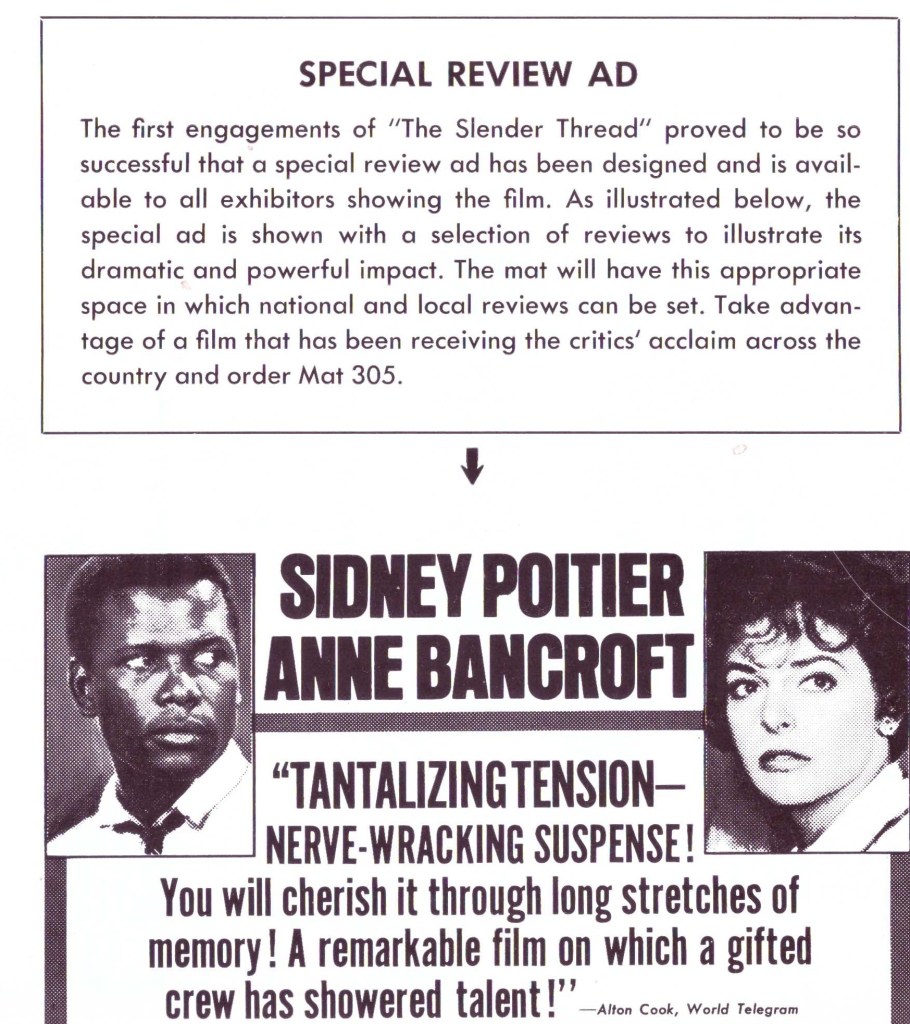
The only other assistance given exhibitors came in the form of reviews which make more mention of suspense. Cue magazine termed it “gripping, bristling tension and suspense all the way.” Kate Cameron in the Daily News concurred – “a high tension suspense film” as did Alton Cook of the World Telegram (“Tantalizing Tension! Nerve-Wracking Suspense!). Nobody mentioned what caused the tension and suspense.

The best bet for tie-ins came from record stores since record label Mercury has organised a “giant merchandising campaign” promoting the Quincy Jones soundtrack. The studio took the chance that exhibitors might take it into their own hands to organise some tie-ups with beauty salons, telephone companies and discotheques since these make an appearance in the picture.     

Quite how 16 pages of the same repeated artwork was meant to inspire exhibitors into, first all, booking the picture, and then, consequently, selling it to moviegoers is never explained.

Selling Sharif – The Pressbook for “Mayerling” (1969)

MGM didn’t know how to sell this. So they came up with three different campaigns. The first was the classical illustration of stars Omar Sharif and Catherine Deneuve about to kiss. This image was used for the film’s launch in the U.K. and at the Radio City Music Hall in New York. The artwork could be augmented if need be by various scenes from the film. You would categorize this as the straightforward romantic sell. Sharif after all was the most famous romantic idol of the decade following the monumental success of Doctor Zhivago (1965).

But this was the more liberalized 1969 rather the restrained mid-decade so MGM offered exhibitors the opportunity to promote the picture as a more salacious number, not overdone sexually since that would defeat the purpose of achieving a rating designed to attract the widest possible adult audience, but nonetheless touching on enough of the risqué to satisfy modern cinemagoing taste.

Of the two alternatives, one was considerably more spicy than the other. Using the tagline “No one woman could satisfy him…until he fell in love” this presented Sharif as wanton playboy, wine glass in hand, cavorting with cleavage-ridden woman.  The other approach, though technically more reserved, was as provocative since it highlighted Deneuve’s role as a high-class sex worker in Belle de Jour (1967), the sensational arthouse breakout. The connection would not be lost on the more sophisticated members of the audience.

Nor did the Pressbook avoid the more intimate elements of the drama and in fact the biggest article in the promotional material concerned the “emotional incest” between Sharif as the Crown Prince and his mother played by Ava Gardner – “the abnormally close relationship between the two was noted again and again in records of the era” – and in their first scene together “looked like lovers to the silver screen born.”

Historical films lent themselves to the kind of detail that journalists loved and the Pressbook for a movie set in a magnificent Vienna at the end of the nineteenth century capitalized on this.  As you might expect, waltzes played a key role in the social life of high society. The Pressbook introduced newspaper editors to the concept of “left-waltzing,” a particularly energetic form of the dance performed on state occasions. This waltz had a “strict etiquette” in that it is “forbidden to reverse no matter how dizzy one gets,” explained director Terence Young. Auditioning for extras to participate was made simpler by eliminating anyone who collided with another dancer.

The Pressbook, unusually, also casts light on directorial technique, again in reference to a waltz. This is the one where Omar Sharif scandalizes the court by opening a ball by dancing with his mistress Catherine Deneuve. Young wanted to create the effect of the whirling couple revolving into a world of their own.  To achieve this the stars had to “dance in a perfect circle, keeping a constant distance in the center of the ballroom floor from director of photography Henri Akedan and his revolving camera.”

Initially, Young resorted to “two elaborate and – as it proved – punishing devices since the dance had to be done over and over.” The first saw camera and stars balanced at opposite ends of a rotating “see-saw.” But this moved so fast Sharif lost his balance and Deneuve suffered from dizziness. Next, they were connected by a lasso but this metal contraption struck them so often in the hips it was abandoned. Finally, they reverted to the simplest of solutions, working round a circle chalked on the floor. 

To ensure authenticity, Young was able to film at the Hapsburg Palace, the Karlschirche and the Schonbrunn Palace. However, such was the urge to preserve these antiquities, the stars were not permitted to sit on any of the chairs or even get anywhere close to them, so it was standing room only for days at a time. However, the Vienna Opera House of 1888 was reconstructed on Parisian sound stages.

The marketers were able to take advantage of the current fashion for the vintage look as pioneered by the likes of The Beatles. Under the heading “Groovy Gear,” the promotional gurus encouraged exhibitors to target the university crowd and metropolitan areas with a preponderance of young people who would appreciate the “freaky clothes” and “up-town hippy clothing” like the military garb, long topcoats, high boots and fur hats worn in the film. Even so, the Pressbook originators were remarkably unimaginative when it came to dreaming up stunts and promotional gimmicks. Their best suggestions were a Catherine Deneuve look-alike contest and a competition to list all Omar Sharif’s roles. Rather more ambitious was the idea of inviting high school pupils to write an essay on aspects of the period.

Selling Crime – “King of the Roaring 20s” (1961)

Gambling dominates the 12-page A3-sized Pressbook with the legend of the sinister yet charming Arnold taking pride of place in the editorial section rather than, as would be usual, the actors. So we are given the inside story of the famous betting coup with Sidereal at a New York race track, but fleshing out the man shown on screen, exhibitors also learned that Rothstein was known as the “banker of the underworld,” how he won $600,000 in a poker game and a masterpiece painted by Sir Joshua Reynolds.

Not touched upon in the picture, but included here, was that he owned an art gallery, chartered ocean liners to transport liquor from Europe, ran protection rackets in the garment industry, and was instrumental in creating what became known as “The Syndicate.” In short, the Pressbook set out to built Rothstein up as even more fabulous figure than shown in the film.

As with Jessica, and as pointed out in my report on that Pressbook, the producers took the unusual step of sticking with the one dominant image in the poster of David Janssen (as Rothstein) leaning over a poker table with fistfuls of cash in his hand and Dianne Foster (Rothstein’s wife) at his back– although it’s possible in this instance the single-image approach was to reduce costs since this was in fact a glorified B-picture. The rest of the poster is an amalgamation of various scenes – racehorses, showgirls, people dancing the Charleston, a drive-by shooting. In the absence of one big star billed above the title, a total of 10 actors have their names below or their faces running down the side, almost giving the impression that it is an all-star ensemble picture.

After paying his dues in television with four years as Richard Diamond, Detective (1957-1960), David Janssen was a relative newcomer to a leading role although his performance in a second-billed role in war film Hell to Eternity (1960) had caused him to be touted as the new Clark Gable / Cary Grant. He was lucky that he had already been signed up for King of the Roaring 20s for his next picture after Here to Eternity was critical stinker and box office bomb Dondi (1961).

Other journalistic nuggets included that an Arab sheik once offered 100 camels for British star Diana Dors, Mickey Shaughnessey revealed as a Golden Gloves boxer, Dianne Foster previously taught modelling, and Keenan Wynn had a plate in his jaw. David Janssen’s sister Teri made her debut and their mother Berniece was an extra while Timmy Rooney, son of Mickey, was drafted in to play Johnny Burke as a youngster.

Not surprisingly several promotional ideas aimed at exhibitors revolved around gambling. One suggestion was to place a gambling wheel in the lobby with anyone landing on the numbers 7 or 11 winning a pair of guest tickets. Exhibitors were urged to get in touch with the local vice squad to see if they would donate confiscated gambling equipment for lobby display. Giving away cards that provided information on betting odds was another notion.

To get audiences into the mood of the era, cinema managers could run Charleston contests or a tie-in with a fashion store marketing clothes from the period or attire models as “flappers” to parade around town, especially in an open-top car from the era. More straightforward was a new movie tie-in paperback edition of The Big Bankroll, the book that inspired the picture, published by Cardinal.

Selling Angie Dickinson – “Jessica” (1962)

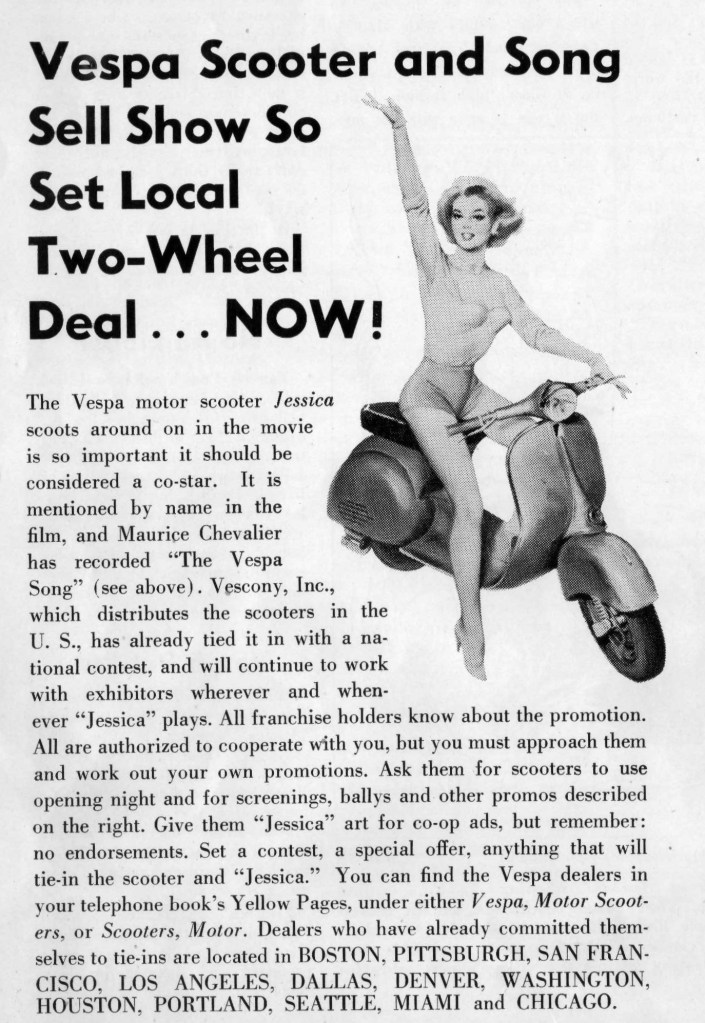
There was an age-old rule of thumb in Hollywood marketing. You can ignore iron-clad contracts as regards credits and billing if you have a sexy girl to promote. The top-billed Maurice Chevalier had been a major Hollywood star for nearly three decade from the likes of The Merry Widow (1934) to Gigi (1958) and twice Oscar-nominated. But you can scarcely see his face in any of the posters. He was passed over in favor of the glorious image of Angie Dickinson astride a Vespa scooter. And, unusually, for an industry that sold females in terms of facial features and bosom, Dickinson’s posterior was given as much prominence as the rest of her figure.

Bearing in mind the Vespa trick had already been used in more fashionable fashion by Audrey Hepburn in Roman Holiday, this was probably a more sensible approach. While there’s no doubt Dickinson was stylish nobody would ever beat Hepburn when it came to haute couture so there was no point trying, although it has to be said the sweater look was something of a throwback to the 1940s.

However, there were two other pieces of more stylish artwork as back-up for an exhibitor looking askance at the obvious and with more discerning patrons. While Mitchell Hooks was responsible for the main poster, also turning their hand to  promotional material were director Jean Negulesco (whose effort is pictured at the top) and artist Bernard Buffet who both concentrated on face to the exclusion of figure. Negulesco had begun his career as an expressionist artist in the 1920s and the Pressbook marketeers took this idea further by claiming that “every frame of the film was composed with such care that the picture…can be said to be painted with a camera.” 

Negulesco was a noted art collector and paintings by Bernard Buffet, also a French expressionist, adorned his walls. In 1955 Buffet was named the top post-war artist and his first retrospective at the age of just 30 was held three years later.

As readers of these occasional articles on Pressbooks will know, marketing a movie around one image was rare but the image of Jessica (Angie Dickinson) mounting a scooter was used exclusively in all posters even though the background and taglines might change. The background showed the locale, some subsidiary characters and dancing. You have to look close to catch a glimpse of top star Maurice Chevalier – he’s the guy in black toting a guitar.

The taglines centered on the mischievous Jessica causing marital mishap in sun-filled Italy. “Here comes trouble. The most delightful, delicious siren who ever scooted into town and put marriages on the skids!” was the main tagline. The rest were along similar lines. “She’s the most luscious forbidden fruit that ever dropped into the screen’s lap.” / “She lives it up saucily in Italy.” / “Meet the gal who took Italy by storm with a scooter, sweater and a smile.”   

The more artistic posters by Negulesco and Buffet had different taglines: “Not in a month of Never on Sundays have you heard such wonderful songs” and “Jean Negulesco, who put Rome on the map with Three Coins in the Fountain, now works wonders on the shores of the blue Mediterranean in Jessica, a most mischievous girl.” The marketeers of course were taking some artistic license since Roman Holiday preceded Three Coins in the Fountain.

The Pressbook offered a couple of pages of nuggets for hungry newspaper editors with Chevalier at last getting some attention – the “crooning cleric” was described as “the perennially youthful Frenchman (who) had sung, danced and acted his way across the stages of the world enjoying the adulation of several different generations.”  Chevalier was given tips on his guitar by a local singing cleric, apparently.

But there was little chance, even in print, of Chevalier stealing Dickinson’s thunder especially when particular reference was made to her nude swimming scene, for which she wore a skin-colored bikini to the disappointment of the hundreds of locals who climbed up a steep slope to the waterfall location.

Jean wasn’t the only artistic member of the Negulesco clan. His wife Dusty, also a painter,  designed the wardrobe, wrote lyrics for the film’s songs and taught Dickinson how to ride a scooter. The movie was filmed on location in the village of Forza d’Agro on a clifftop 1,000 feet high. The shoot lasted 55 days with 2,600 people from the surrounding area employed as support staff or in bit parts and extras. The production spent about $113,000 (over $1 million at today’s prices) on accommodation and meals and purchased 8,300 gallons of fuel. Traditional Sicilian music was incorporated into the film.

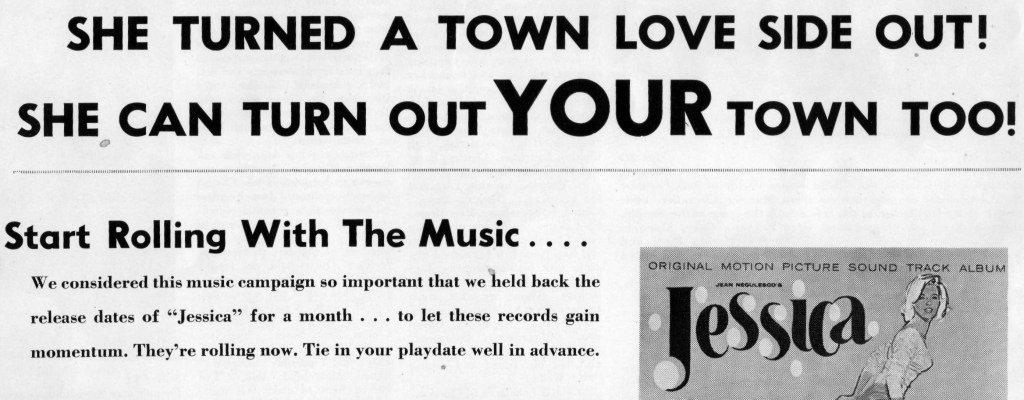
Given Chevalier was singing it was inevitable and promotionally essential to put out a single, this was “Jessica” backed by “The Vespa Song.” There was also an original soundtrack album. Both were ideal material for local radio stations to play during the film’s launch.

A key element of the promotion was a tie-up with Vescony inc which distributed Vespa scooters in the U.S. There was a national competition and franchisees were ready to lend scooters to theaters for openings and special screenings or just to sit in the lobby attracting attention. A subplot involving gardening inspired marketeers to suggest exhibitors give away orchids to women named Jessica and had tied up with supplier Orchids of Hawaii. Other ideas included targeting local midwives – both male and female – and a “Jessica Jump” reflecting the film’s wedding scene. There was book tie-in based on the source novel The Midwife of Pont Clery by Flora Sandstrom published by Pocket books.

Bernard Buffet’s involvement was something of a coup and promised an opportunity to create a promotion appealing to art lovers. “Not since Toulouse-Lautrec made advertisements for nightclubs has an artist of this stature contributed to ads for popular entertainment.”  

Selling Religion – “The Shoes of the Fisherman” (1968)

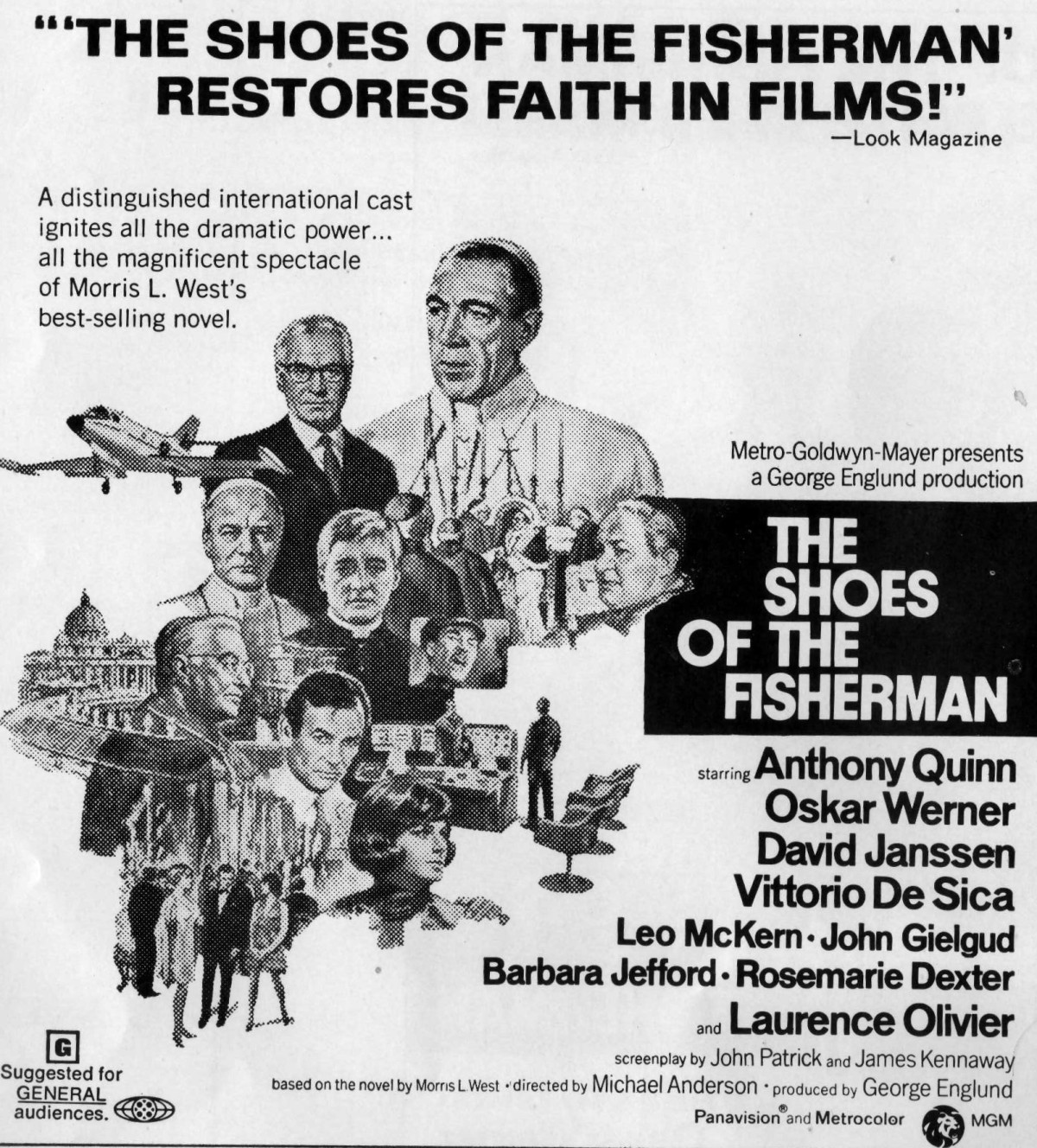
The Pressbook for The Shoes of the Fisherman is almost reverential in approach. For a start there is a complete lack of the madcap schemes designed by marketing men to promote the picture to the exhibitor. Nor is there any mention of the tie-ins that did exist – the book had sold seven million copies and the soundtrack by Alex North was already being acclaimed – it would be nominated for an Oscar. And there are very few of the titbits that might appeal to a local journalist.

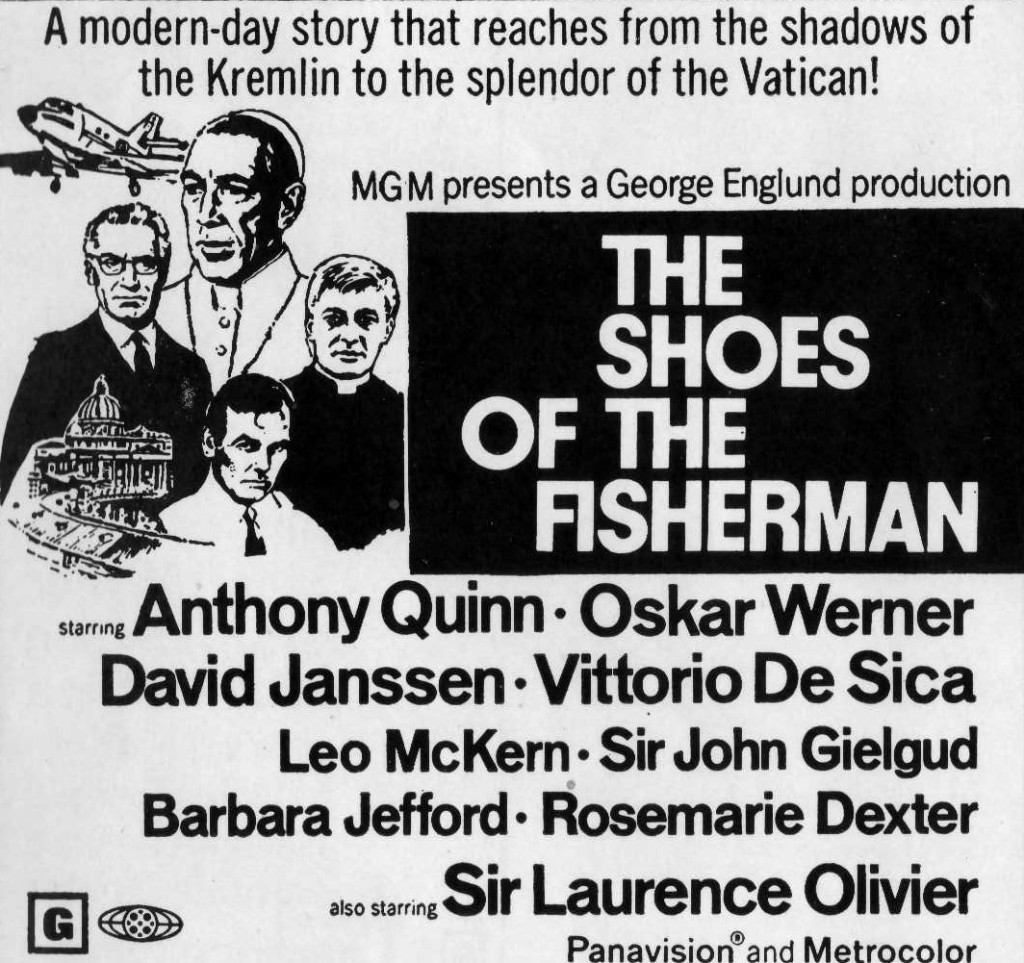
There is only one piece of artwork, although a truncated version provides a secondary opportunity for advertising and combined with a scene from the film material for a third ad. Taglines are equally scarce. “A distinguished international cast ignites all the dramatic power…all the magnificent spectacle of Morris L. West’s best-selling novel” is all there is apart from a puff from Look magazine puff that espouses “The Shoes of the Fisherman restores faith in films.”

The better tagline, in the sense that it sold an actual story rather than promoted the ingredients, was: “A modern-day story that reaches from the shadows of the Kremlin to the splendor of the Vatican.” One further tagline gave away more of the plot: “In a last desperate attempt to prevent World War III, a secret meeting is arranged. One man is called upon to succeed where all the world leaders have failed. That man was once a prisoner in a Russian labour camp. He is now the Pope.”

So what’s left, you might ask. Well, as promised in the tagline, the “distinguished international cast” and “magnificent spectacle.” The cast was awash with Oscars. The stars included four-time Oscar winner Vittoria De Sica, two-time Oscar winner Anthony Quinn, Oscar winner Laurence Olivier and Oscar nominated Oskar Werner.

The sets were of the no-expense-spared variety. Barred from using the Vatican itself, the producers used a mixture of real locations and sets at Italian studio Cinecitta to create the necessary backdrops. The Sistine Chapel set measured 133 feet by 45 feet and the paintings that dominate the altar including “The Last Supper” were copied in Hollywood and transported piece by piece. This set actually functioned and was accurate down to the tiniest detail. The only major touch omitted from the sets was the steps leading to the altar, since that would have necessitated cumbersome ramps to track the movement of the cardinals as they cast their votes.   

Oher buildings were appropriated for modern scenes – the Palazzo dello Sport for the secret peace conference. Cardinals arriving to vote were filmed at Fiumicino airport and Stazione Termini railroad station. Other locations included the Palazzo Farnese at Capranola used for scenes of the breaking of the old Pope’s seals, the Church of San Andrea della Valle for the interior of St Peter’s for the papal coronation, and Castello San Angleo, Biblioteca Vallicelliani and Palazzo Barberini.

Incidental information, the kind that journalists could use to augment their material, was scant. Author Morris L. West had once been a monk; bit part actor Clive Revill had been knifed in his previous film by Burt Kwouk; stage actress Barbara Jefford was appearing in only her third film and her role as a cerebral wife was in stark contract to her debut as the sensual Molly Bloom in Ulysses (1967); small-screen star David Janssen of The Fugitive played a small-screen reporter; and Oskar Werner had turned down over a 100 screen roles if they interfered with his commitment to the stage.

Selling War – The Pressbook for “The Devil’s Brigade” (1968)

This was an extremely unusual Pressbook for the 1960s. For a start with one minor exception there was only one advertisement. In the 1960s it was traditional for studios to provide upwards of five or six separate ads so that exhibitors could display the one most appropriate for their audience – that could mean, for example, that a tough western focused on the leading lady because an exhibitor wanted to appeal to female customers for a film that would fairly straightforwardly appeal to the male clientele simply because of its genre. Joseph E. Levine had broken this rule for Nevada Smith (1965), but he was an experienced producer not someone making his first movie.

But producer David L. Wolper went with the one image repeated over and over in different sizes – the varying sizes mattered because to make up an advertisement in a newspaper an exhibitor simply cut out the relevant advert from the Pressbook and took it down to their local newspaper. However, it was an an unusual advert in one sense in that it was a composite, an attempt to sell the two separate parts of the film, a first section that related to training and the cultural differences between the American and Canadian troops, and the second concerning the war where battle illustration was the priority.

Smaller advert taken from a section of the main advert.

Again, when studios invested in several advertisements, the marketing team came up with a fair number of taglines. Here, that idea goes out the window.  The sole advert contained only three taglines – “What they did to each other was nothing compared to what they did to the enemy” / “Spit! The brass-knuckled Americans” / “Polish! The brass-buttoned Canadians.”

And that was it, ten adverts of differing sizes, all with the same three taglines. Some other adverts minus the taglines but incorporating the action illustrations from the main image were available in smaller sizes.

The one exception kept some of the action material but topped it with details of the characters above their photos i.e. “The major. He keeps rattlesnakes for pets.” / “The loser. Last time he led was Dunkirk” / “The Commander. Creator of the Brigade – a madman or a genius!” For whatever reason, the actors’ names were omitted, so it was possibly pot luck whether audiences recognised, Vince Edwards, Cliff Robertson and William Holden, respectively. There were nine characters featured in this collage, so it was possibly an attempt to humanise the picture which was otherwise sold on conflict.

As the Pressbook pointed out, Wolper was an innovator. But thus far that had been restricted to television where he was “called by many TV’s most skilful producer of documentaries” with over 250 credits to his name including The Legend of Marilyn Monroe (1965), Hollywood: The Golden Years (1961), The Making of a President: 1964 (1966), The Incredible World of James Bond (1965) and his debut The Race for Space (1959). His biggest claim to fame had actually been a financial one, going direct to sponsors for funding raher than relying on broadcast companies. 

Since adverts hogged the Pressbook, other marketing material was scant. That Vince Edwards had begun his career as a lifeguard, that William Holden had business interests in four continents and that screenwriter William Roberts had been responsible for The Magnificent Seven (1960) was hardly likely to stimulate into action editors of the entertainment sections looking for nuggets to promote the film. While there was a tiny bit of information about locations and the origins of The Devil’s Brigade outfit, Wolper saw fit to note that the unit was the fore-runner of The Green Berets all the time as the film had the men, erroneously, wearing red berets.

In terms of exploitation ideas for exhibitors the sole advice was to contact former members of the brigade for publicity purposes. Otherwise there was a Bantam paperback movie tie-in, an album of the Alex North soundtrack and single of the film’s march played by a group called The Devil’s Brigade.

Wolper may have gone an innovation too far with his restricted approach to marketing but he did become a movie and television producer of some distinction, behind such films as L.A. Confidential (1997), The Bridge at Remagen (1968), Willie Wonka and The Chocolate Factory (1971) and television shows like Roots (1977), The Thorn Birds (1983) and North and South (1985).

Discover WordPress

A daily selection of the best content published on WordPress, collected for you by humans who love to read.

The Atavist Magazine

by Brian Hannan

WordPress.com News

The latest news on WordPress.com and the WordPress community.