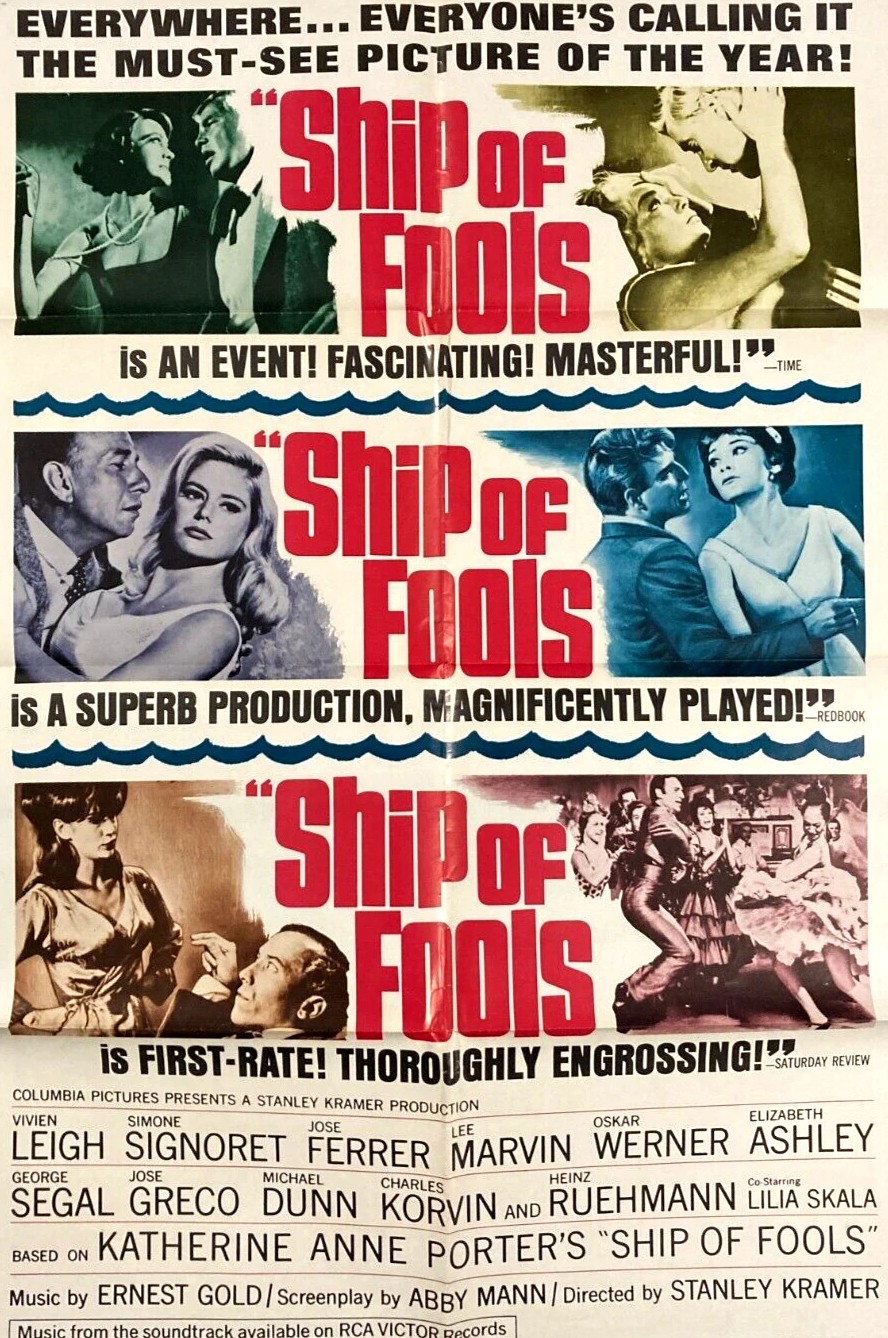
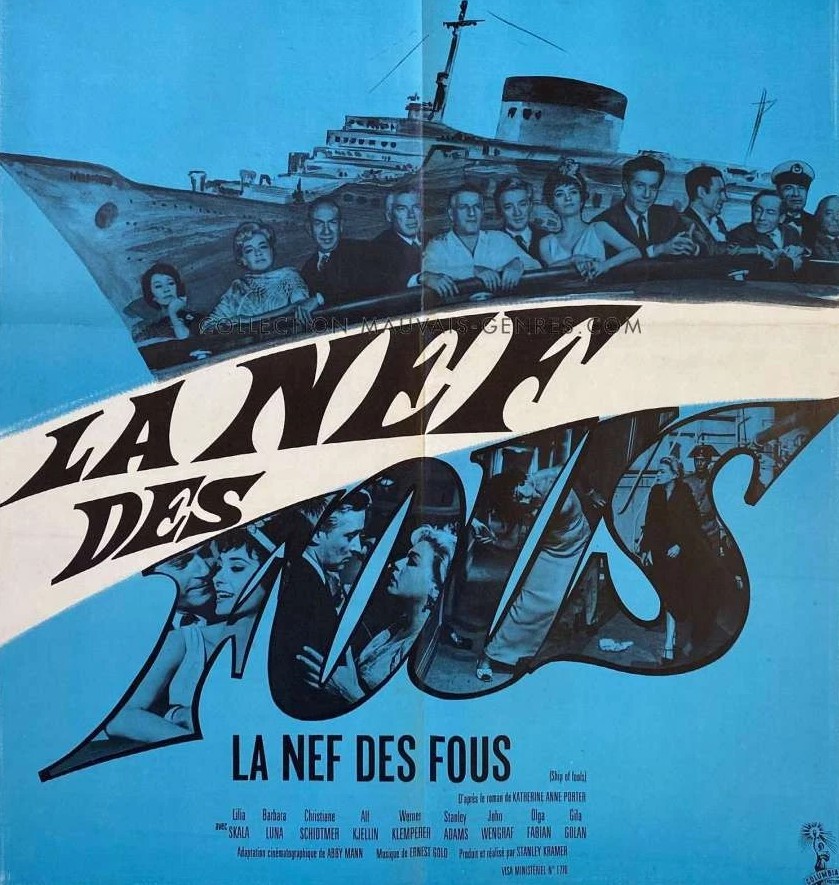
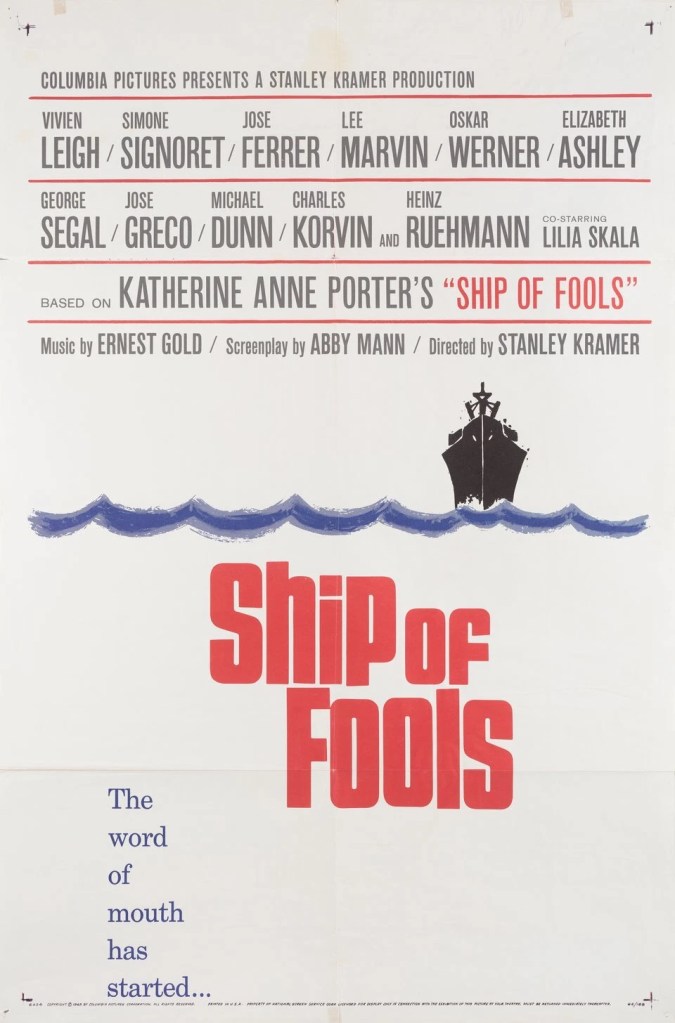
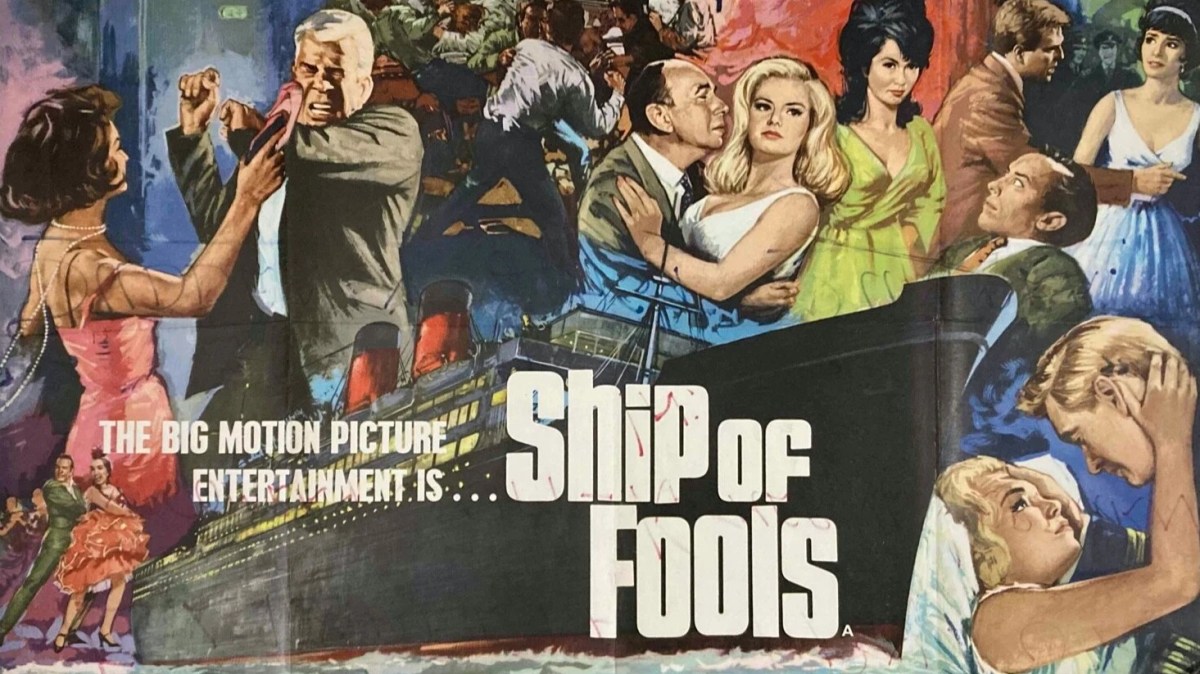
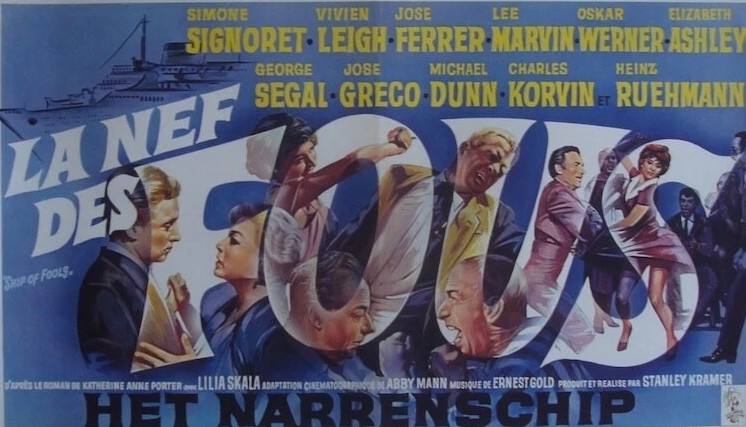
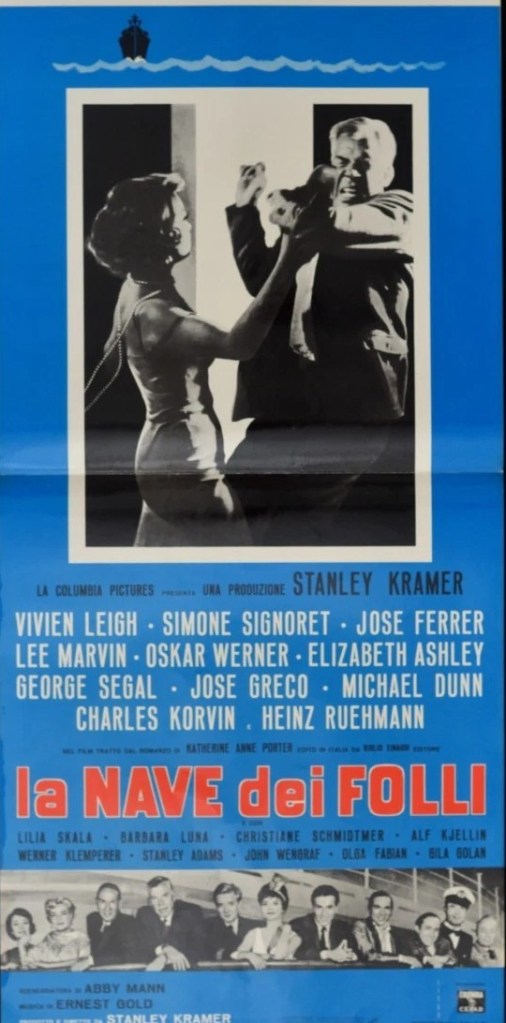
Stanley Kramer was on a roll, It’s A Mad, Mad, Mad, Mad World – an outlier in his portfolio of serious pictures – his biggest-ever hit. Although United Artists, where the director had made his last four pictures, was initially in the frame for Katharine Anne Porter’s 1962 best seller Ship of Fools, the project ended up at Columbia which Kramer had last partnered on The Caine Mutiny in 1951. While the asking price was $450,000 plus a percentage, Kramer secured the rights for $375,000 although he chipped in $25,000 towards the book’s advertising campaign.
Kramer envisioned a character-driven film that would make up for the lack of action. He shifted the timescale to 1933 from 1931 to bring greater overtones of the Hitler threat. “Although we never mention him in the picture,” said Kramer, “his ascendancy is an ever-present factor.” Since there were no seagoing liners available to take over, the movie was shot entirely on the soundstage. “We filmed a ship’s ocean voyage without a ship and without an ocean.” He ransacked old footage for establishing shots of the ship, usually seen in the distance. Decks, staterooms and dining areas were constructed in the studio.
The kind of muted color he would have preferred was not available and since “the theme was just too foreboding for full color” he decided to film in black and white. Shooting in black and white wasn’t yet redundant. Of 27 features going in front of the cameras in 1964, six (including The Disorderly Orderly and Hush, Hush, Sweet Charlotte) were made in monochrome – down from ten out of 24 the year before.
A thoughtful epic was always going to have trouble finding stars especially as current wisdom was that the industry only had at its disposal 22 genuine box office stars “thinly sprinkled” through the 43 pictures currently in production. While the movie’s marketeers boasted of an all-star cast, the reality was that while overall the actors had “combined heft” they were “minus any individual box office behemoth.”
Spencer Tracy, whom Kramer initially envisioned for the role of the ship’s doctor and who had starred in the director’s last three pictures, would have added definite marquee allure, but he was unavailable due to illness. Greer Garson and Jane Fonda also fell by the wayside.
And unusually, Kramer insisted that many of those actors were not American. Vivien Leigh was born in India, Simone Signoret – who had just quit Zorba the Greek (1964) – was German and Oskar Werner Austrian. Jose Ferrer (who had won the Oscar in Kramer’s production of Cyrano de Bergerac, 1950) hailed from Puerto Rico, Jose Greco from Italy, Charles Korvin from Hungary, Lila Skalia from Austria and Alf Kjellin from Sweden. Signoret and Skala had Jewish ancestry.
His biggest casting coup was luring double Oscar-winner Vivien Leigh (The Roman Spring of Mrs Stone, 1961) out of retirement. But that was a double-edged sword. In real-life she led a tortured existence. Her marriage to Laurence Olivier was over and she had only appeared in two films since A Streetcar Named Desire (1951). She suffered from mental illness and tuberculosis. “Happiness or even contentment” eluded her and in that respect she was ideal for the role. “I’m sure she realized that, in the picture, she was playing something like her own life yet she never, by word of gesture, betrayed any such recognition.” She was another gamble, the reason her dance card was so empty down to directors despairing of getting a performance out of her.
Kramer flew to Germany to persuade Oskar Werner to take on the role intended for Spencer Tracy. At the time Werner, while familiar to European audiences and the American arthouse set through Jules and Jim (1962),was a relative unknown and a casting gamble. On set he proved obstinate. For one scene where he was instructed to enter camera right he did the opposite. When the direction was repeated, he stood his ground, insisting he preferred that view of his face. Despite the cost of reversing the set-up Kramer was forced to concede. Despite these trials, Kramer got along with Werner better than the actors. “They just couldn’t stand him.” Notwithstanding such difficulties Kramer later signed him for another film, but the actor died before shooting began.
James MacArthur (The Truth about Spring, 1964) was mooted for a role as was Sabine Sun (The Sicilian Clan, 1969). The most unlikely prospect was German comedian Heinz Ruhmann who was cast as Lowenthal. The Screen Actors Guild complained when Kramer hired five Spaniards instead of Americans for bit parts paying union scale of $350 a week, but their complaints were ignored.
Kramer admitted the ingénue roles played by George Segal (The Bridge at Remagen, 1968) and Elizabeth Ashley (The Third Day, 1965) were too much of a cliché. “As in most pictures,” observed Kramer, “older actors not only had more stature but they were also better armed by the writers. There was no way Segal and Ashley could compete with Werner and Signoret.”
The film cost $3.9 million. Filming began on June 22, 1964. It was initially a long shot for roadshow release but since Columbia was already committed to the more expensive Lord Jim and there were already 15 others lined up from other studios, Columbia nixed the two-a-day release in favour of continuous program.
Boosted by book sales – it was the number one hardback bestseller of 1962 and had sold millions in paperback – the movie carved out a more commercial niche than had been anticipated. Positive reviews helped. It opened to a “mighty” $88,000 in New York breaking records at the 1,003-seat Victoria and the 561-seat Sutton arthouse.
There was a “socko” $25,000 in Chicago, “giant” $23,000 in Philadelphia, “sock” $14,000 in Baltimore, “strong” $13,000 in St Louis, “lively” $12,000 in Detroit, “stout” 12,000 in San Francisco, “sturdy” $11,000 in Pittsburgh, and “slick” $10,000 in Columbus, Ohio. The only first run location where it toiled was Denver where it merited a merely “okay” opening of $8,000.
There was a sense of Columbia letting it run as long as possible in first run in the hope of garnering Oscars to boost its subsequent runs. But the studio was the beneficiary three times over from the Oscars – with Cat Ballou, Ship of Fools and William Wyler’s The Collector in contention for various awards.
The studio had the clever idea of pairing Ship of Fools in reissue with Cat Ballou, for which Marvin had won the Oscar, and although not the star of Ship of Fools the teaming suggested it was a Marvin double bill. In Los Angeles the double bill hoisted $135,000 from 21 houses followed by $121,000 from 28. But in Cleveland Ship of Fools went out first with TheCollector and then Cat Ballou. A mix-and-match strategy also saw Ship of Fools double up with, variously, A Patch of Blue, Darling and The Pawnbroker.
The final tally was difficult to compute. In its 1965 end-of-year rankings Variety reckoned it had only pulled in $900,000 in rentals but it was good for $3.5 million in the longer term, a realistic target once you counted in the $1.3 million in rentals generated by the combination with Cat Ballou.
SOURCES: Stanley Kramer with Thomas F. Coffey, It’s A Mad, Mad, Mad, Mad World, A Life in Hollywood (Aurum Press, 1997) pp203-212; “New York Sound Track,” Variety, May 2, 1962, p4; “375G for Fools Novel,” Variety, May 2, 1962, p5; “Publisher’s Big Break,” Variety, May 23, 1962, p4; “Kramer to Produce Ship of Fools for Columbia,” Box Office, June 18, 1962, p9; “Abby Mann to Script Ship of Fools,” Box Office, November 1962, pSE4; “Top German Comic,” Variety, April 15, 1964, p23; “Simone Signoret Exits Zorba,” Variety, April 22, 1964, p11; “Control of Space,” Variety, May 6, 1964, p4; “Five Spaniards on Ship of Fools Irks SAG,” Variety, June 3, 1964, p5;“To Speed MacArthur for Ship of Fools,” Variety, June 10, 1964, p17; “27 Features Shoot in Color, Only Six in Monochrome,” Variety, August 5, 1964, p3; “Perennial Quiz,” Variety, September 2, 1964, p1; “15, Maybe 17, Pix for Roadshowing,” Variety, October 28, 1964, p22; “Too Many Roadshows,” Variety, August 2, 1965, p5. Box office figures, Variety September-November 1965, “Big Rental Pictures of 1965,” Variety, January5, 1966, p6.
Too easily dismissed as soap opera masquerading as a movie making a serious point, this is redeemed and, in some respects, elevated by the performances. If anything, the two political aspects are underdone. The heavy air that hangs over proceedings given the German passengers are heading back to Nazi Germany at the start of Hitler’s reign in 1933 with no idea of the outcome is only there in the audience’s mind. That the racism is underplayed is in part due to the fact that those victimized, a Jew and a disabled man, refuse to act as victims and indeed bond.
The other political aspect, of Spaniards being deported from Cuba for economic reasons, would have more resonance today. But they, too, are heading for consequence and the Spanish Civil War which would break out a few years later. Director Stanley Kramer was noted, indeed often ridiculed, for tackling weighty subjects in movies like The Defiant Ones (1958), On the Beach (1959), Judgement at Nuremberg (1961) and Inherit the Wind (1961). That was tempered somewhat when he went off-piste for It’s a Mad, Mad, Mad, Mad World (1963) and although that’s generally remembered for its hilarity what’s often overlooked is the director’s dexterity in handling a busload of characters and narratives, his pacing and his understanding of character.
Deduct the comedy and you have a similar approach here, the meshing of various narrative arcs while allowing character to flourish so the general smorgasbord of, if I’m allowed such an obvious notion, ships passing in the night is what gives this more heft. And the fact that the audiences knows more than the characters about what the future holds permits the director just to concentrate of character interaction.
Unusually, for a historical movie of the period, it’s the females who dominate and have the best storylines. The ship is so full that upscale single passengers who might otherwise have the choice of dining alone are thrown together thus divorcee Mary Treadwell (Vivien Leigh) shares a table with former baseball player Bill Tenny (Lee Marvin).
Their paths unexpectedly cross in unusual fashion. Both are seeking love, though in reality Tenny is happy to settle – and pay for – sex. Mary finds Captain Thiele (Charles Korvin) ignoring her subtle advances while in turn she dismisses the lieutenant. When a drunken Tenny without warning bursts into her cabin, she responds with ardor until she realizes he thinks she’s a prostitute.
La Condesa (Simone Signoret) is a civil rights activist who finds a fellow traveler in Dr Schumann (Oskar Werner). Although, initially, she mines him to feed her opiate addiction, it’s soon apparent they are falling in love, although that doesn’t end well. Not much ends well in the romance department, Jenny (Elizabeth Ashley), while initially supportive of artist David (George Segal), soon realizes that his art will take dominance in their relationship.
The older Rieber (Jose Ferrer), with the most pronounced Nazi sympathies, has taken up with younger blonde Lizzi (Christiane Schmidtmer), among whose physical attractions is that she’s a great table tennis player, until she discovers he’s married.
Flamenco dancer Elsa (Gila Golan) is pimped out by her father Pepe (Jose Greco). Social exclusion leads Jew Lowenthal to bond with Glocken who suffers from dwarfism and when German World War One hero Freytag is forced to join them that permits most of the discussion about the state of Germany.
Otherwise, the fact that a mastiff is permitted to sit at table is more to do with aristocratic entitlement than any other social condition.
For once, Kramer is more interested in character than scoring points. So what might have been heavy going turns into an acting class. To accommodate its portfolio of ageing superstars Hollywood had returned to the subgenre of movies about ageing beauties. Double Oscar-winner Vivien Leigh’s previous outing The Roman Spring of Mr Stone (1961) belonged in that category but this latest reincarnation was a class above, a truly tender examination of loss. However, it was Simone Signoret (The Deadly Affair, 1967) who was Oscar nominated.
Michael Dunn (Justine, 1969) and Oskar Werner (Interlude, 1968) were nominated and while Lee Marvin (Point Blank, 1967) and George Segal (The Bridge at Remagen, 1968) were overlooked the latter two clearly scored points judging by their future acceptance in the Hollywood hierarchy, Marvin in particular alerting the industry to untapped talent, a point made more emphatically in his next picture Cat Ballou for which he won Best Actor. Ship of Fools missed out to The Sound of Music for Best Film. Nominated for eight awards it picked up two, ernest Laszlo for Cinematogrpahy and Robert clatworthy and Joseph Kish foir Art Direction
You might also spot Alf Kjellin (Ice Station Zebra, 1968), Barbara Luna (Firecreek, 1968) and Gila Golan (The Valley of Gwangi, 1969).
Even without the political overhang, this holds together as Grand Hotel on the high seas with Stanley Kramer in his element employing compelling characters to flesh out an interesting narrative. Written by Abby Mann (Judgement at Nuremberg) from the Katherine Anne Porter bestseller.
While the politics add a contemporary veneer, watch it for the acting.
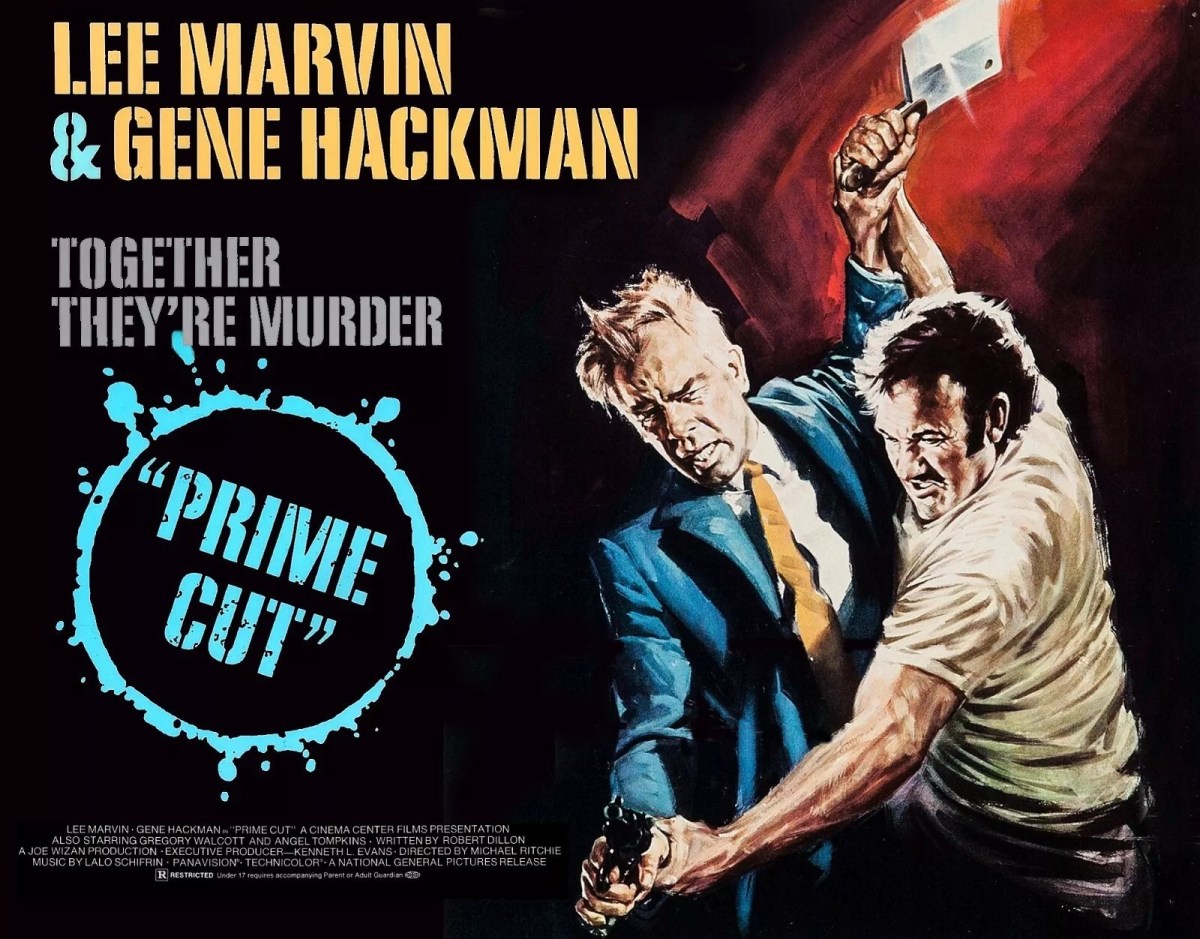
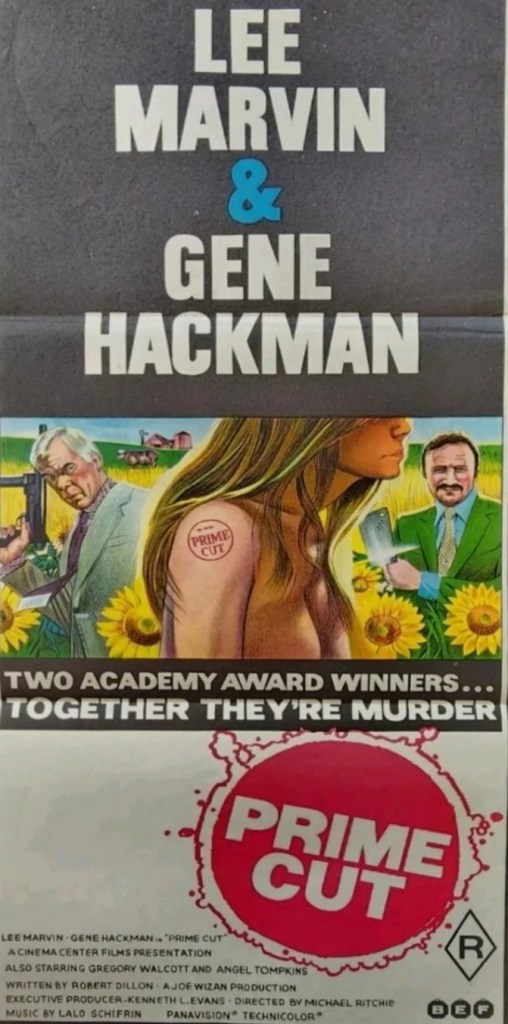
Unusually nuanced thriller. Unusually lean, too, barely passing the 90-minute mark. There’s a Hitchcockian appreciation of the danger lurking in wide open spaces. And the background is the Middle America of annual fairs, marching bands, pie-eating competitions, rural pride in farming and marksmanship.
But there’s an undercurrent that will strike a contemporary audience. The contempt of big business for its customers. The sex trafficking, too, will sound an all-too-common note especially as the young women come from an orphanage set in the heart of homespun America in what appears to be a streamlined service.
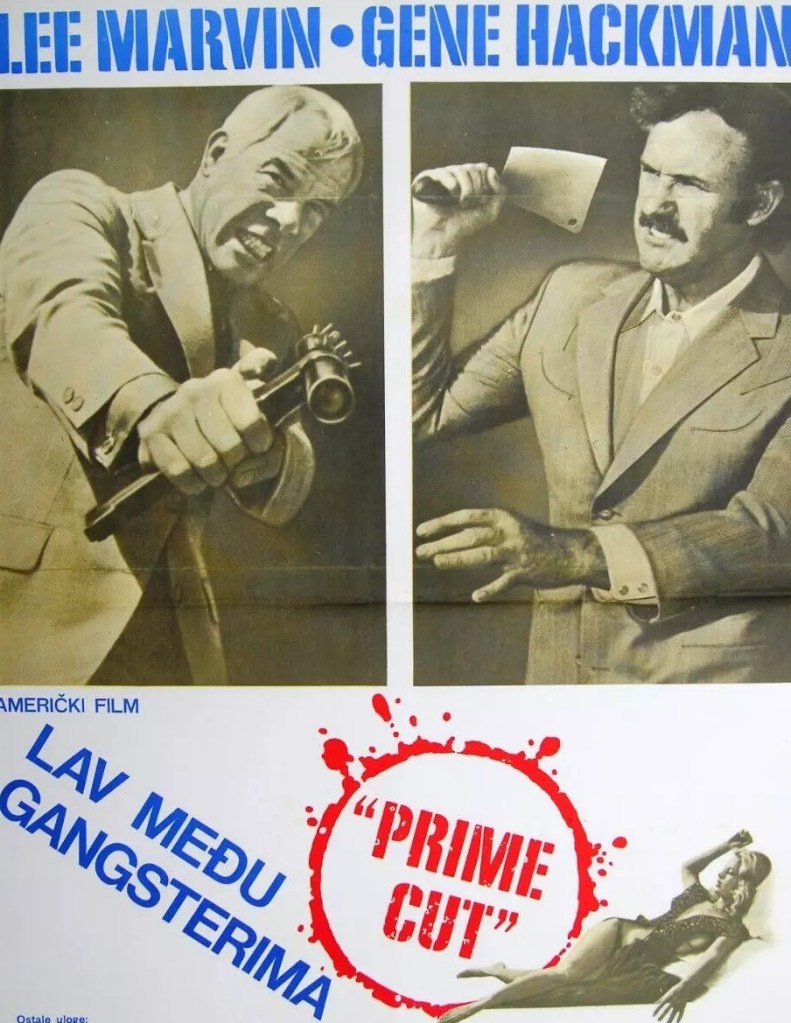
In the actual screen credits, Hackman was not above the title.
We shouldn’t at all take to hitman Nick (Lee Marvin) except that he’s got a code of honor and sparing with words. He’s been sent from Chicago to Kansas to sort out with what would later be termed “extreme prejudice” Mafia boss and meat-packer Mary Ann (Gene Hackman) who’s been skimming off the top. As back-up Nick is handed a trio of young gunslingers anxious to prove themselves while his faithful chauffeur owes Nick his life.
Mary Ann doesn’t just have a factory, he has a fort, a posse of shotgun-wielding henchman standing guard. So Nick has to plunge right in and confront the miscreant. As well as dealing with animal flesh, Mary Ann has a side hustle in sex trafficking, displaying naked women in the same straw-covered pens as his beef.
Responding to a whispered “help me” by Poppy (Sissy Spacek) Nick buys her freedom, but Mary Ann isn’t for knuckling down to the high-ups in Chicago and since he’s already despatched a handful of other hoods sent on a similar mission as Nick he’s intent on turning the tables.
The action, when it comes, is remarkably low-key and all the more effective for it. Swap a crop duster for a combine harvester and the head-high prairie corn for the usual city back streets and you realize someone has dreamed up a quite original twist on the standard thriller. No need for a car chase here to elevate tension, it’s already a quite efficient slow burn.
By the time this came out Hackman had won an Oscar for “The French Connection” (1971), Marvin already in that exalted league thanks to “Cat Ballou” (1965)
This could be an ode to machinery. The entire credit sequence is devoted to the way machines chew up cow flesh and turn it into strings of sausages and the like. The combine harvester chews up and spits out an entire automobile, grinding the metal through its maw. And then there’s the machinery of business, the ability, at whatever cost, to give the public what it wants, in whatever kind of flesh takes its fancy.
You’ll remember the combine harvester sequence and the shootout in the cornfields, but you will come away with much more than that. Remember I mentioned nuance. Sure Mary Ann is an arrogant gangster and you’d think with hardly an ounce of humanity, but that’s until you witness his relationship with his simple-minded brother Weenie (Gregory Walcott). That could as easily have fallen into the trap of cliché sentimentality. Instead, there’s roughhouse play between the pair and it’s all the more touching for being realistic.
There’s a tiny scene where one of the young hoods asks Nick to meet his mother, in the way of a young employee wanting to show off that he was working for a top man. And Nick also goes out of his way to praise what’s on offer at the fair from a couple of women anxious for praise.
One of the tests of a good actor is what they do when they enter an unfamiliar room. Your instinct and mine, like ordinary people, would be to look around not just lock eyes on the person you’ve come to meet. So when Poppy wakes up in a luxurious hotel room she doesn’t go into all that eye-rubbing nonsense, but instead marvels at her surroundings. And although she hangs on his every word – and his arm – Nick isn’t in the seduction business, instead spoiling the young woman with expensive clothes.
There are several other scenes elevated just by touches. The credit sequence ends with a shoe appearing among the meat being processed – Mary Ann’s victims don’t sleep with the fishes but with the sausages. Poppy recalls a childhood spent in a rural wonderland, squirrels, rabbits, the splendors of nature, and reveals a lesbian relationship with another orphan Violet that is the most innocent description of love and sexual exploration you’ll ever hear.
Violet is the victim of multiple rapists. Weenie has passed her onto a bunch of down-and-outs for the price of a nickel. When Nick unclenches her clenched fist you’ll be horrified to see how many nickels tumble out.
Lee Marvin (Point Blank, 1967) is at his laconic best and Sissy Spacek (Carrie, 1976) makes a notable debut but Gene Hackman (Downhill Racer, 1969) overplays his hand.
Director Michael Ritchie (Downhill Racer) was on a roll, following this with The Candidate (1972), Smile (1975), The Bad News Bears (1976) and Semi-Tough (1977) before the execrable The Island (1980) badly damaged his career.
Written by Robert Dillon (The French Connection II, 1975).
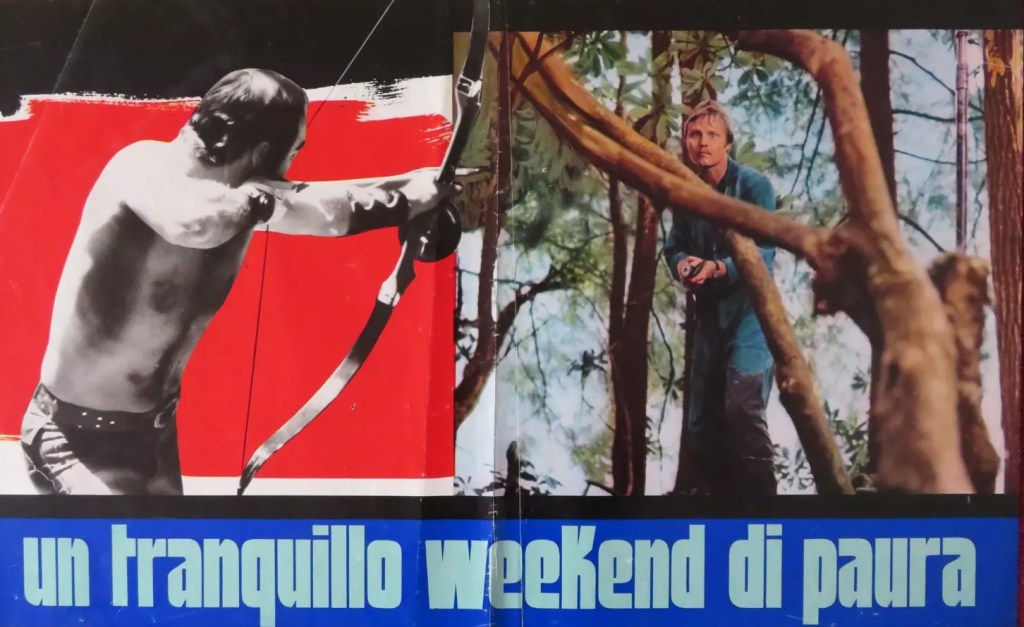
You couldn’t make it like that now, so the ill-informed tale goes. Actors doing their own paddling in canoes, climbing a cliff. But anyone who has watched Leonard DiCaprio and Kate Winslet half-drowning in Titanic (1997) is well aware that it’s just not always possible to use a stand-in for key sequences. Or, for that matter, William Holden breaking in a horse in Wild Rovers (1971).
For a start, there actually were four stunt men on Deliverance, one who was star Jon Voigt’s stunt double. None were credited in the picture, not so unusual in those days, and anyone who knows anything about filming climbing scenes, not least the one where actors are actually crawling across a floor, or where there are, out of sight of cameras, safety facilities underneath, will know that the actors here, though it might get a tad tough, were not risking life and limb. Greater injuries were endured by the stars during the storm scenes of The Guns of Navarone (1961). That said, the movie does benefit from sufficient shots of the actors braving the waters and Ned Beatty nearly drowned and Burt Reynolds cracked his tailbone.
But, of course, danger in moviemaking is relative. There’s scarcely any equivalent to the numbers of deaths that occur in other professions, mining, for example, or industry, and I’m always suprised how easily the Hollywood PR machine is so easily accepted by the public when the peril mentioned is rarely actually perilous at all.
For the scene where the canoe broke, director John Boorman had found a more serene location on a river which was dammed, so he was able to close the sluice gates and lay a rail on the river bed. However, in the event, the sluice gates were opened too soon and the actors engulfed in an avalanche of water.
Should any of the actors show temerity, Boorman would leap into a canoe himself, and paddle downriver over and around various obstacles to show how easy it was.
Deliverance was an unexpected bestseller in 1970, the author an unlikely candidate to hit the commercial jackpot or even to pen such a tale. Ex-adman James Dickey was known for his poetry. Warner Bros bought the book pre-publication about “four decent fellows killing to survive” for $200,000 and more for Dickey to pen the screenplay without working out how it could be filmed. The studio was going through a major transition. In 1970 only three releases had cleared $1 million in rentals; in 1971 the number tripled and the studio was high on a release slate that included Death in Venice, A Clockwork Orange, Summer of ’42, Klute, The Devils, Dirty Harry and Billy Jack.
The studio alighted on John Boorman because he had made Hell in the Pacific (1968) starring Lee Marvin and Toshiro Mifune, that, while a certified flop, was made under arduous physical conditions in the western Pacific.
After the surprise success of Point Blank, British director Boorman had helmed two flops, Leo the Last (1970) being the other, so he was in the market for the kind of hard-nosed project with which he had made his name. Warner “felt I was the man to take it on,” explained Boorman.
At one point, Warner Brothers planned to team up Jack Nicholson (hot after Easy Rider, 1969, and Carnal Knowledge, 1971) and Marlon Brando, still largely in the pre-The Godfather wilderness. The studio tried to tempt Charlton Heston, who turned it down (“I probably won’t have time to do it”) but consoled himself that WB considered him “employable.” Donald Sutherland also gave it a pass. Dickey agitated for Sam Peckinpah to direct and Gene Hackman to star while Boorman was keen to work a third time with Lee Marvin. Theoretically, Robert Redford, Henry Fonda, George C. Scott and Warren Beatty were considered, but such big names would hardly be compatible with the lean budget.
The final budget was a mere $2 million, not sufficient to attract big name – or even to pay for a score. WB had reservations about a picture without any women in lead roles. Jon Voigt was not a proven marquee name, despite the success of Midnight Cowboy (1969). He only had a bit part in Catch 22 (1970) and his other films, Out of It (1969) and The Revolutionary (1970) had performed dismally while The All-American Boy was sitting on the WB shelf, only winning a release to cash in on Deliverance.
Despite a less than buoyant career, Voigt was reluctant to commit. He resisted making the movie till the last minute. Even after trying to convince himself about the film’s worth by reading out the entire screenplay to his girlfriend Marcheline Bertrand (Angelina Jolie’s mother), it took a telephone call from the director and Boorman demanding a decision before he counted to ten before Voigt signed up. Voigt viewed the film as about how men “lose part of their manhood by hiding, coddling themselves into thinking we’re safe.”
Burt Reynolds was treading water in action B-films like Skullduggery (1970), as the second male lead in bigger films like 100 Rifles (1969) and in television (Dan August, 1970-1971). In his favor, he had the lead in offbeat cop picture Fuzz (1972). But it looks like Voigt and Reynolds took casting to the wire. Both were announced for the film a few weeks before it began shooting on May 17, 1971.
Whether it boosted his career is open to question, but Burt Reynolds’ name achieve notoriety in April 1972, a few months before Deliverance opened, by becoming the first male centerspread in Cosmopolitan. Billy Redden, as the banjo player, was hired for his physical appearance, clever use of the camera disguising the fact that there was a genuine banjo player concealed behind him doing all the playing. Boorman used snatches of the banjo music instead of coughing up for a proper score. While the credits claimed the “Dueling Banjos” number had been devised by Eric Weissberg and Steve Mandel, Arthur Smith, writer of “Feudin’ Banjos” in 1955, took the studio to court and won a landmark copyright ruling. The tune had received a gold record for sales.
Setting aside any inherent danger in the water, the shore could just be as perilous. A script altercation between Dickey and Boorman ended with the director losing four teeth. Cinematographer Vilmos Zsigmond got into a spat with his union and was slapped on the wrists for operating the camera too often. Filming of the rape scene was uncomfortable for all concerned, even observers. When Reynolds complained the director let the sequence last too long, Boorman countered that he let it run till he reckoned Reynolds, in his character, would intervene.
Despite WB including it in a promotion to its international partners in May 1971 Deliverance, filmed between May 17 – a week later than originally envisaged – and August 1971, sat on the shelf for nearly a year before being premiered at the Atlanta Film Festival in July 1972 with Playboy picking up the tab for flying Reynolds to the event.
These days it would be called a platform release. Deliverance opened in one small house in New York – the 558-seat Loews Tower East – at the end of July and except for Los Angeles didn’t go any wider until early October. Reviews were good, four faves out of five in New York. But it was the box office that caught the eye. An opening day record and an eye-popping $45,000 for the first week took the industry by surprise. It remained at Loews until December. Chicago led the applause in October with a “brawny” $49,000. Everywhere it was hot – “lusty” $26,000 in Washington DC, “socko” $21,000 in Philadelphia were typical examples of the public response.
In what these days would be called counter-programming it went into the New York showcases at Xmas – making off with a huge $589,000 from 46 the first week and $500,000 the second. WB had predicted it might hit $15 million in rentals. The studio was wrong. It scrambled up $21 million. The 1973 tally made it the second best at the box office that year.
SOURCES: Phil Hoad, “How We Made Deliverance,” The Guardian, May 29, 2017; Oliver Lyttleton, “5 Things You Might Not Know about Deliverance, Released 40 Years Ago,” IndieWire, July 30, 2012; Charlton Heston, The Actor’s Life (Penguin, 1980); “Bow and Arrow Party,” Variety, May 20, 1970, p30; “Dickey Ga-Bound,” Variety, January 21, 1971, p4; “Reps of 45 Flags,” Variety, April 14, 1971, p5; “Voigt in Deliverance,” Variety, May 12, 1971, p14; “Runaway Robert Altman,” Variety, December 15, 1971, p4; Advert, Variety, August 9, 1972, p23; “Big Rental Films of 1972,” Variety, Janaury 3, 1973, p7; “Big Rental Films of 1973,” Variety, January 9, 1974, p19. Box office figures from Variety October 11, 1972.
A mighty cast headed by John Wayne (True Grit, 1969), James Stewart (Shenandoah, 1965), Lee Marvin (The Dirty Dozen, 1967) and Vera Miles (Pyscho, 1960) with support from Edmond O’Brien (Seven Days in May, 1964) Woody Strode (The Professionals, 1966), Strother Martin (Cool Hand Luke, 1967) and Lee Van Cleef (The Good, the Bad and the Ugly, 1967) do justice to John Ford’s tightly-structured hymn to liberty and equality and reflection on the end of the Wild West. So tight is the picture that despite a love triangle there are no love scenes and no verbal protestations of love.
The thematic depth is astonishing: civilization’s erosion of lawlessness, big business vs. ordinary people and a democracy where “people are the boss.” Throw in a villain with a penchant for whipping and a lack of the standard brawls that often marred the director’s work and you have a western that snaps at the heels of Stagecoach (1939), Fort Apache (1948) and The Searchers (1956).
The story is told in flashback after Senator Ransom Stoddard (James Stewart) and wife Hallie (Vera Miles) turn up unexpectedly in the town of Shinbone for the funeral of a nobody, Tom Donovan (John Wayne), so poor the undertaker has filched his boots and gun belt to pay for the barest of bare coffins. Intrigued by his arrival, newspapermen descend, and Stoddard explains why he has returned.
Now we are in flashback as, arriving on stagecoach, novice lawyer Ransom is attacked, beaten and whipped by outlaw Liberty Valance (Lee Marvin). He is found by horse-trader Donovan (John Wayne) and taken to a local boarding- house-cum-restaurant where Hallie (Vera Miles) tends his wounds. With a young man’s full quotient of principle, Stoddard is astonished to discover that local marshal Link Appleyard (Andy Devine) has ducked out of responsibility for apprehending Valance on the dubious grounds that it is outside his jurisdiction and that Valance has so mean a reputation he has the town scared witless. When Valance turns up, he humiliates Stoddard and only Donovan stands up to him, rescuing an ungrateful Ransom, who detests violence and any threat of it.
Stoddard soon turns principle into action, setting up his shingle in the local newspaper office run by Dutton Peabody (Edmond O’Brien) and on learning that Hallie is illiterate establishing a school for all ages. In the background is politics, but the push for statehood is inhibited by big ranchers who employ Valance to intimidate. Despite his aversion to violence and insistence that due legal process will eliminate the law of the gun, Stoddard practices shooting. When Donovan gives him a lesson and, to point out his unsuitability to confront such a mean character as Valance, covers him in paint, Stoddard floors him with a punch.
That principle I mentioned has something in common with Rio Bravo (1959) – Howard Hawks’ riposte to High Noon (1952) – in that Stoddard, determined to fight his own battles, refuses to ask for help when targeted by Valance. The inevitable showdown is extraordinary, not least because it takes place at night and Ford, a la Rashomon (1951), tells it twice from different points of view.
Precisely because it retains focus throughout with no extraneous scenes, as was occasionally John Ford’s wont, the direction is superb. As in The Searchers, to suggest emotional state-of-mind, the director uses imagery relating to doors. This time the humor is not so broad and limited primarily to one incident. Both main male characters suffer reversals, in the case of Stoddard it is physical but in the instance of Donovan it is emotional. Either way, action is character. In the romantic stakes, they are equals, dancing around their true feelings.
Upfront there is one storyline, the upholding of law and order whether against an individual such as Valance or against the attempts of big business to thwart democracy. But underneath is a subtly told romance. Donovan and Stoddard are allies but in terms of Hallie they are rivals. Neither has an ounce of sense when it comes to women. Neither actually protests their love for Hallie. Although Donovan brings her cactus roses and is, unknown to her, building an extension to his house to accommodate what he hopes is his future bride, his idea of romance is to mutter, in patronizing manner, the old saw of “you look pretty when you’re angry.” He would have been wiser to have taken note of her spunk, because she can more than direct if need be.
Stoddard isn’t much better. Despite her growing feelings towards him being obvious to the audience, he assumes she prefers Donovan. Action drives the love element, the need to save or destroy.
All three principals are superb. This may seem like a typical Wayne performance, a dominant figure, comfortable with a gun and his abilities, but awkward in matters of the heart. But he shows as great depth as in The Searchers and the despair etched on his face at the possibility of losing Hallie eats into his soul. Stewart combines the man-of-the-people he essayed for Frank Capra with some of the toughness he showed in the Anthony Mann series of westerns. Vera Miles tempers genuine anger with tenderness and practicality. Unlike many Ford heroines she is not a trophy wife, but a worker, mostly seen running a kitchen. Lee Marvin cuts a sadistic figure, with an arrogance that sets him above the law, his tongue as sharp as his whip.
As well as Woody Strode, Strother Martin, Edmond O’Brien and Lee Van Cleef, you will spot various members of the John Ford stock company including Andy Devine (Two Rode Together, 1961) as the cowardly gluttonous marshal, John Carradine (Stagecoach), John Qualen (The Searchers) as the restaurant owner and Jeanette Nolan (Two Rode Together) as his wife.
Written by James Warner Bellah (X-15, 1961), Willis Goldbeck (Sergeant Rutledge, 1960) and Dorothy M. Johnson (A Man Called Horse, 1970).
SPOILER ALERT
Despite its five-star status, I am dubious about the famous “print the legend” conclusion and for two reasons. You could subtitle this picture The Good, the Bad and the Politician. In the first place, what Stoddart tells the newspapermen in the flashbacks is in fact a confession. He did not kill Liberty Valance. Donovan did. By this point in his life Stoddart has served two terms as a Senator, three terms as a governor and been the American Ambassador to Britain. And yet his career is based on bare-faced fraud. He took the glory for an action he did not commit. That is a huge scoop in anybody’s book. And I just can’t imagine a newspaperman turning a blind eye to it.
The second element is that Stoddart does not show the slightest sign of remorse. He built his entire career on this violent action, the antithesis of his supposed stance on the process of law. He takes all the plaudits and fails to acknowledge Donovan, except when it’s too late, and Donovan has died a pauper, his rootless life perhaps engendered as a result of losing Hallie. Hallie’s character, too, is besmirched. She chose Stoddart precisely because he was a man of principle who risked his life to tackle – and kill – Donovan. Those two elements are indistinguishable. Had she known Stoddart had failed and was only saved by the action of Donovan it is questionable whether she would have chosen the lawyer.
There are a couple of other quibbles, not so much about the picture itself, but about other quibblers, commonly known as critics. Alfred Hitchcock famously came under fire for the use of back projection, not just in Marnie (1964) but other later films. That spotlight never appeared to be turned on the at-the-time more famous John Ford. The train sequence at the end of the film uses back projection and the ambush at the beginning is so obviously a set.
Don’t let these put you off, however, this is one very fine western indeed.
Angie Dickinson (Jessica, 1962) is the standout as the cold-blooded double-crossing femme fatale in this slick tale of a double heist. Sure, Lee Marvin (The Professionals, 1966) attracted the bulk of the critical attention as the no-nonsense hitman and John Cassavetes (Machine Gun McCain, 1969) attempts to steal the show as the dupe, but Dickinson walks away with it. Although he makes a vicious entrance, Marvin really only tops and tails the movie.
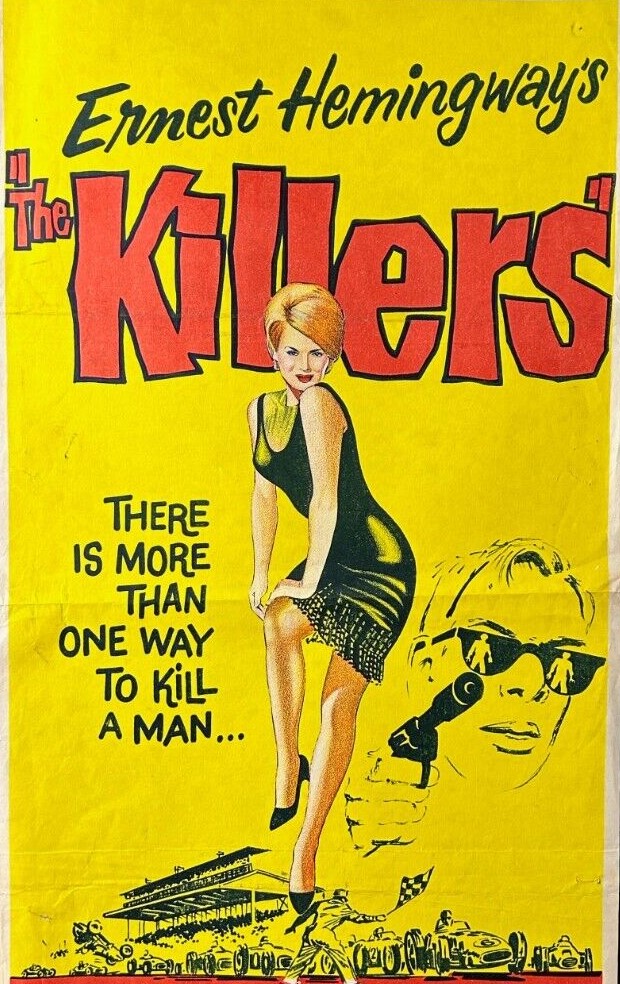
Violence wasn’t the marketable commodity it proved later in the decade, and this was initially made with television in mind, so it’s surprising how stunning the brutality remains today. In the opening sequence, set in a home for the blind, hitmen Charlie (Lee Marvin) and Lee (Clu Gulager) knock around a sightless receptionist before moving on to shooting at point-blank range their victim, ex-racing driver Johnny North (John Cassavettes). But when they get to thinking why they were paid way over the odds to shoot North, they discover he was involved in a million-dollar heist and before you can say flashback we tumble into the story of how gangster’s moll Sheila (Angie Dickinson) lured him into participating in the robbery organized by boyfriend Jack (Ronald Reagan).
There’s nothing particularly complicated about Jack’s plan – hijacking a mail truck on a remote road – but the movie takes its sweet time getting there, focusing on Johnny’s racetrack antics and on Sheila nudging Johnny into the illegal kind of pole position. She’s pretty convincing as the all het-up lover to the extent of persuading Johnny to double-cross Jack but her convictions only run one way – to whatever best suits herself.
Eventually, it appears as if the million bucks has disappeared into thin air. Jack presents himself as an honest businessman, but Sheila only holds to the party line for as long as it takes the hitmen to dangle her from a fourth-storey window. But gangsters are rarely as amenable or as dumb as the schmucks they snooker, so Jack is more than able to take care of himself and his property (counting the loot and Sheila in that category).
There might be twists a-plenty but the main narrative thrust is which way will Sheila spin? Was she ever even in love with Johnny? Or having snared Johnny and then managed to convince him to double-cross Jack did she plan to run off with the money herself? Or was she going to double-cross him all along once his usefulness was over?
And even if her heart is in the right place, then that’s plain tragic, stuck with the lout, unable to break free, perhaps playing all the alpha males off against each other her only hope of maintaining her fine lifestyle while not ending up another casualty.
A surprising chunk of time is spent on the racecourse, not just building up the romance and endorsing Johnny’s driving skills, and as well as the tension of a specific race – and the possibility that too much loving could fatally damage the driver’s track ambitions – you are kept in some kind of narrative limbo as you keep wondering when the heck the killers are going to re-enter the equation.
Don (here credited as Donald) Siegel (Coogan’s Bluff, 1968) directs with considerable aplomb, especially as this carries a television-movie-sized budget and that he hadn’t had a stab at a decent picture since making his initial mark with Invasion of the Body Snatchers (1956). From the iconic opening shot of a pair of dark sunglasses to the sad greed-soaked finale, Siegel’s brilliant use of sound and movement plays in stark contrast to moments of stillness and silence. Throw in aerial tracking sequences, realistic race scenes, and one bold shot of a handgun being pointed at the audience (a similar shot in his Dirty Harry, 1971, ruffled more feathers and generated more critical note).
But the director’s cleverest ploy is to introduce the hitman, then dive elsewhere, leaving audiences begging for more. So it’s just as well that Angie Dickinson delivers in spades. You need to believe she could be as conniving as she is seductive for the entire tale to work. She is the linchpin far more than Lee Marvin.
And that’s to take nothing away from his performance, a far cry from the over-the-top villains of The Commancheros (1961) and The Man Who Shot Liberty Valance (1962), setting up the template for the later quiet-spoken thug of Point Blank (1967).
As highly watchable as this is, it wasn’t a career breakout for any concerned. Lee Marvin was just a supporting actor on Ship of Fools (1965) and far from first choice for Cat Ballou (1965), the movie that did make his name. Don Siegel wasn’t offered another movie for four years. Angie Dickinson tumbled down the credits, reduced to second female lead in The Art of Love (1965) and working in television or in movies as a supporting actor until the low-budget The Last Challenge/Pistolero of Red River (1967).
Ronald Reagan bowed out of the movies after this. Clu Gulager, who had a running role in The Virginian (1963-1968) only made three movies in the next seven years.
Gene Coon (Journey to Shiloh, 1968) adapted the short story by Ernest Hemingway which when previously filmed in 1946 marked the debut of Burt Lancaster with the sultry Ava Gardner as the femme fatale.
Striking, tense, and a must for fans of Dickinson, Marvin and Siegel.
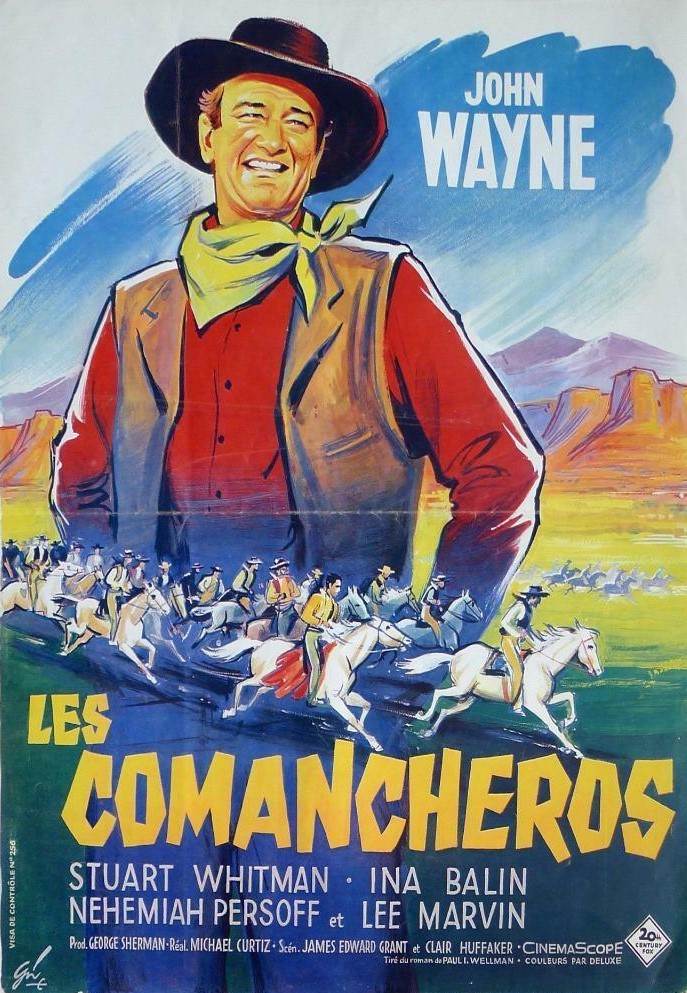
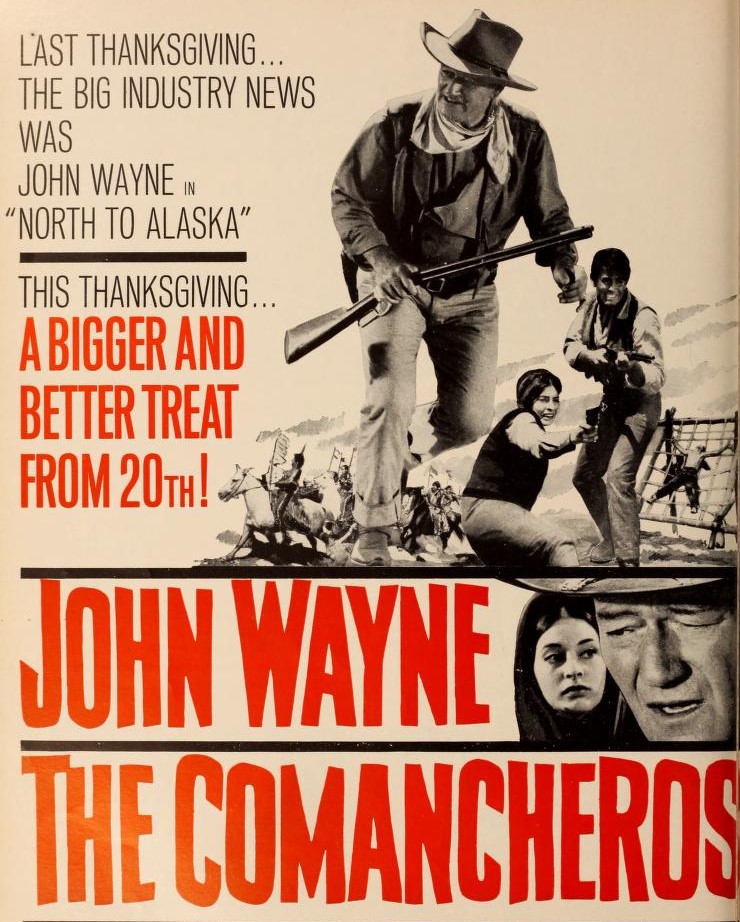
You can always tell a studio is piling a lot behind a rising actor when the top-billed star is absent, except for a fleeting moment during the credits, for the first 10 minutes. In this case, Twentieth Century Fox was showcasing two new talents, Stuart Whitman (Murder, Inc. 1960) and Ina Balin (From the Terrace, 1960).
I’m sticking my neck out a little on this one, not considered as top-notch as Duke’s other great westerns of the decade – The Man Who Shot Liberty Valance (1962), El Dorado (1967) and True Grit (1969) – but it’s an unusual story, hardly following a standard narrative, has a great score by Elmer Bernstein but most importantly because it’s real old-school film-making with the emphasis on the classic long shot and the horizon line.
And it takes a surprisingly feminist approach with gypsy Pilar (Ina Balin) making the running in the seduction stakes. Indeed, should she be willing to surrender an iota of her hard-won independence for a long-term relationship sticks to the view that in love there is always a dominant one and a subservient one, with no question about which she is. Plus, although the nickname “Pilgrim” became a famed element of The Man Who Shot Liberty Valance this is where the nickname notion began when lawman Jake (John Wayne) assigns prisoner Paul Regret (Stuart Whitman) the appellation “Monsoor” because he’s of French heritage.
Meshes effortlessly three storylines – Jake taking prisoner Regret back to base, Regret turning from western tenderfoot to accomplished hand, and Jake and his captive infiltrating the Comancheros of the title, a secret society of white men who utilize Comanche power to its own ends. You could argue this is ushered in the “buddy” movie, the repartee between the two principals a delight. Plus, you would have to take note that legendary director Michael Curtiz (Casablanca, 1942), in his final picture, has done something remarkable in getting the Duke to speak proper, not hi-hat English, but without that Wayne trick of breaking up his sentences so it appears he’s thinking.
Curtiz is pretty nifty when it comes to setting up scenes, interrupting gentle moments with elements of stunning ferocity. When Jake arrives at a ranch, the camera tracks back from his arrival to reveal the corpses hanging upside down under the ranch gateway. Later, Jake is tucking into a meal at the home of another rancher when that man’s pregnant wife in the background suddenly sits up and from her point-of-view we see through a window as big as the entire screen a band of renegades in attack mode charging through a river.
Regret isn’t one to hang around either when he can escape during the ensuing melee, but no sooner has he gone than he returns with a bunch of Texas Rangers, thus redeeming himself in Jake’s eyes. And there’s a great cut between Jake being knocked unconscious in the blazing sun and waking up in the pouring rain.
And it’s chock-full of reversal, not just that Pilar dumps her pick-up Regret when their riverboat docks at Galveston, but Regret, forced to ride a mule in handcuffs to prevent his escape, gets the jump on his captor at the saddest scene in the picture, the burial of a family killed by Comanches. Later, after taking on the alias McBain, he encounters Regret at a poker table and the wanted man does not give him away.
After a bit of legal chicanery, Regret is a free man, although with the proviso he teams up with Jake to go undercover into the Comancheros camp. This doesn’t work out too well, the pair strung up by suspicious crippled leader Graile (Nehemiah Persoff) until rescued by, surprise, Pilar. Love works its mysterious way and soon Pilar is on Regret’s side, resulting in a classy finale.
Along the way we encounter Lee Marvin (Raintree County, 1957) having another scene-stealing ball as the Comancheros contact. Clever screenwriters James Edward Grant (Circus World/The Magnificent Showman, 1964) and Clair Huffaker (Hellfighters, 1968) find an entirely believable method of getting him out of the way. And in passing we learn that Jake’s wife died “two years, two months and 13 days” ago and without an ounce of revealing dialog between them that Jake would like to take up with widow Melinda (Joan O’Brien). Meanwhile, initially presented as a man of such honor that he will fight a duel to protect such notions of nobility, Regret goes from gambler, wanton lover, and prisoner to revert to his original state.
Expect chunks of western lore – don’t give a hot horse water until it has cooled down is one takeaway. And men who swear by an unwritten code. Here, it’s “words are what men live by.” What’s so refreshing is that lore and code alike arequickly punctured. The follow-up to the code annoncement to which Regret shows indiference is a pronouncement from Jake: “You must’ve had a real careless upbringing. ” that’s not forgetting characters remembering to be characters in the midst of all the uproar as with the bedridden pregnant wife instructing her husband to make sure Jake eats off the “best china.”
It’s not only a well-structured movie but it’s filled with moments that reveal character and even when Curtiz feels duty bound to include standard tropes such as the bar-room brawl or the drunk there are enough twists to have you believe the clichés have been bitten in half.
A superb ending to Curtiz’s career, terrific performances all round, great double act from Wayne and Whitman, with the latter afforded considerably more leeway acting-wise than any time in his career, and Ina Balin in a prize role.
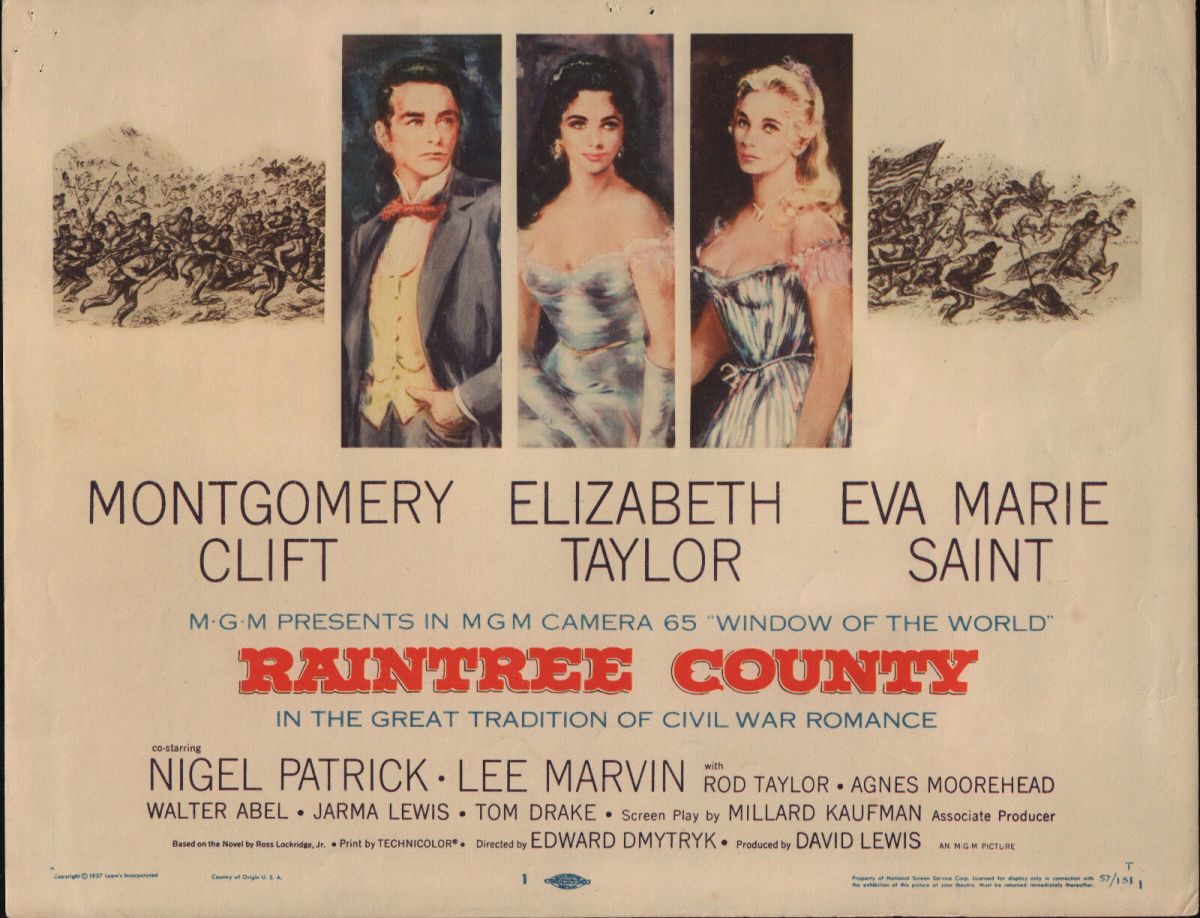
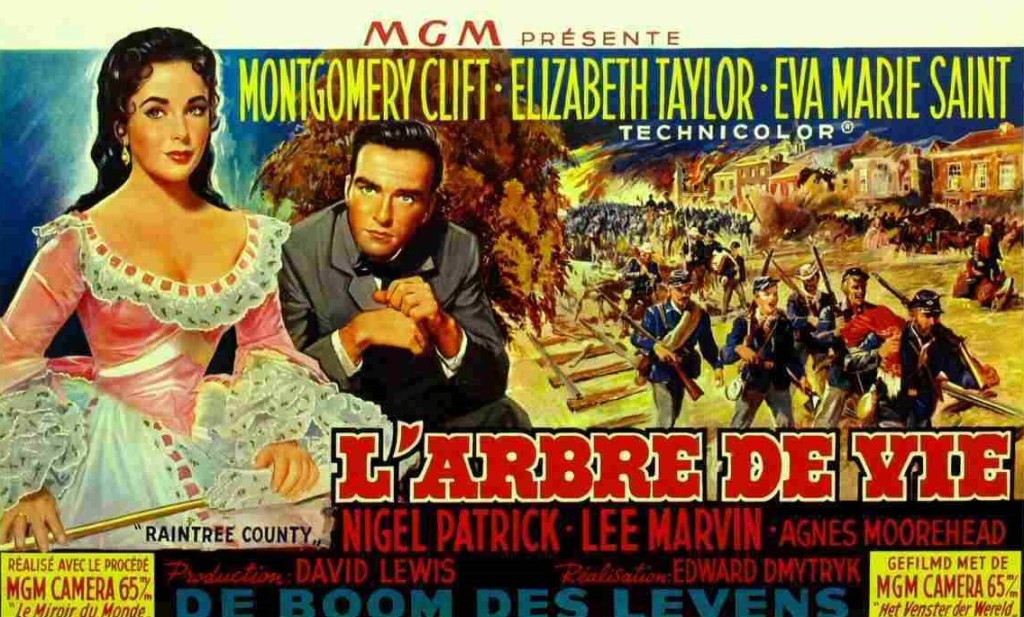
Much-maligned melodrama. No more episodic over a three-hour running time than Ben-Hur (1959) or Doctor Zhivago (1965) and though bookended by the American Civil War has less grandiose views on history. Part of the problem is that, faced with such length, critics expected something with greater depth rather than just ordinary people caught up in circumstance. As if a stunning treatment of madness was not enough, inside the warring mind of a beautiful woman, whose realisation of her condition sets her on the road to tragedy. But it is riddled throughout by an element of fantasy, the fabled “rain tree” with golden leaves triggers a moment of madness in all who seek to find it in the swamps.
Like Zhivago, the narrative arc is a love triangle between principled teacher John Shawnessy (Montgomery Clift), southern belle Susana (Elizabeth Taylor) and reporter Nell (Eva Marie Saint). Sub-plots involved drunken gregarious Flash (Lee Marvin), bumptious Garwood (Rod Taylor) and the charming adulterous Professor (Nigel Patrick). The characters intertwine at various points and John, Flash and the Professor come together during the war while Garwood tries to make political capital out of it afterwards.
John and Nell have known each other since childhood, but there’s no real sense that they are childhood sweethearts. If they have passion for each other, it’s well hidden, and when Susana turns up, she steals him away, in part by the ruse of pregnancy. Despite her incipient madness, perhaps because of it, John sticking by her no matter what, there’s grand passion in full view. But the best scenes are Susana talking not about her condition, but what she believes to be true and her fears that her truth may be false. She lies, for example, about her age when a fire killed her father and his lover. She leaves her husband a note that she discovers she has never written. Her confusion at the depth of her illness, fear that she might have inherit the genes of her mother (also insane), is very touching.
She also does one thing that smacks of “Hollywood madness,” the crazy action that is shorthand for insanity, but within the twisted confines of her mind that is out of love for John. She has a dark secret about her role in the events surrounding the fire. But she overcomes her innate racism out of love for him, prior to the war freeing her slaves. She clings to John because she knows he is the one route out of her madness.
Audiences wouldn’t buy a three-hour picture about madness. You might perceive the other episodes as mere filler, and in some senses that’s true, but the episodes in themselves are quite entertaining and revealing. Though told the “rain tree” is a local myth, a kind of “holy grail”, John is the only character who tries to find it, out of idealism or insanity who knows, and nearly drowns as a result. Flash has come by his nickname for his running exploits and is challenged to a race by John and the otherwise outwardly idealistic Professor, a gambler, tries to influence the outcome.
Though a stranger in town Susana (“I’ll arrange it”) positions herself to place the garland of victory upon his head. When the Professor tries to make off with another man’s wife, John’s skills with a bullwhip prevent him getting shot. Although John’s mother and Nell push him towards politics, Susana leaves him be, recognizing the joy and fulfilment he gets from teaching.
The war is primarily viewed through the perspective of the Professor, a non-combatant who has found himself a job as a war correspondent, making wry comment as he illustrates various battles. By the end of it, soldiers on both sides are weary of the slaughter.
This was intended as one of the first roadshows, MGM’s initial attempt at incorporating its innovative widescreen process Camera 65 (meaning 65mm – the other 5mm in the more common 70mm taken up with the sound strip) that was later used to tremendous effect on Ben-Hur. And while this lacks the scope or action sequences of the Biblical epic, it looks just sumptuous on the wide screen.
Director Edward Dmytryk (Mirage, 1965) has a keen compositional eye and he also favors actors over showing off his directorial skills. But there are exceptional scenes from the directorial perspective. In one the camera remains fixed on Montgomery Clift at the side of the screen while in the background Lee Marvin is creating havoc. In another we follow a female warden as she unlocks door after door in an asylum before Montgomery Clift is led to Elizabeth Taylor.
The acting is superb, Elizabeth Taylor was nominated for an Oscar and might well have won except Joanne Woodward was playing a character with a split personality in The Three Faces of Eve. But it was a bold role for a young star like Taylor, and a tremendous piece of casting. As much as she uses words to try to explain or understand herself, when the camera cuts to her face you can see the terror in her eyes.
Clift had disfigured his face during an accident during shooting and that clearly physically affected his performance. Eva Marie Saint (36 Hours, 1964) is very effective as the rejected lover. Lee Marvin (Point Blank, 1967) takes the showboating approach to his role while Rod Taylor (Chuka, 1967) is not above some scene-stealing himself. But then both are competing with the over-the-top Nigel Patrick (The Battle of Britain, 1969). Millard Kaufman (The War Lord, 1965) wrote the screenplay from the Ross Lockridge Jr. bestseller.
The kind of film to immerse yourself in the performances and let the running time take care of itself.
Universal pulled a fast one with this tidy courtroom drama. The studio resurrected a two-part television piece originally made as the The Case Against PaulRyker five years before under the Kraft Suspense Theatre brand to capitalize on the unexpected box office success of Lee Marvin, the decade’s most unlikely new star after a straight run of hits from the Oscar-winning Cat Ballou (1965) through western The Professionals (1966) to The Dirty Dozen (1967).
Re-titled and hoping audiences would not notice the sleight of hand, this was thrown out into first run. By normal standards it would be deemed a flop for a star of Marvin’s newfound magnitude but the $1 million notched up in rentals Stateside and more overseas prove a handy cache of found money for the studio. Audiences might have smelled a rat when the star’s name came at the bottom of the opening credits with an “And” billing, which generally denoted guest – rather than main – star.
Still, despite being promoted as an actioner, posters show Ryker with machine gun in hand in the midst of a battle scene – there is such a scene but Marvin plays no part in it – it’s actually a decent drama, especially given the unusual background. Set in 1951 during the Korean War there’s nothing gung-ho about it. The Americans are retreating, evacuating Seoul, when army attorney Capt Young (Bradford Dillman) feels Ryker was short-changed during a trial that condemned him to death as a traitor.
Young and Ryker’s estranged wife Ann (Vera Miles) embark on a deadline-dogged mission – he’s due to be hanged in a couple of days’ time – to clear his name. Strafed by enemy planes during a trip from Tokyo to Seoul, there’s a hint of nascent romance. And when they are later caught together in a clinch, this adds to the murky atmosphere, Young facing court martial accused of the deadly sin of having an affair with a colleague’s wife and deemed a pariah by colleagues. He has another strike against his name – he dug up a grave.
The situation is exacerbated by high command caught between troops needing the morale-booster of seeing a traitor hanged and fearing scandal if they are found after the event to have sent an innocent man to the gallows. And there is the irony that Young, in his capacity as prosecutor, was the man who found Ryker guilty in the first place. He only ends up on the opposite side as punishment for exposing technical irregularities in the defence’s handling of the case.
Ryker doesn’t help himself by initially proving to be an unreliable witness, remembering in erroneous detail minor matters but not the one thing that could clear his name, whether his commanding officer, now deceased, had left a note clearing Ryker. The sergeant, caught behind enemy lines, had claimed he was acting under orders during a counter-intelligence mission.
So the odds are heavily stacked against Ryker, at the re-trial the sheer malevolence of his boss Major Whittaker (Peter Graves), and sex-obsessed pal Capt Appleton (Murray Hamilton) and what seems like ranks of generals barely concealed. The investigation focuses on finding missing items – watch, pen, notebook – of the dead officer, none of which it transpires helps the case.
The courtroom has plenty of the usual twists including a surprise witness proving Ryker fraternised before the war with a Korean general. So, with army politics and a downbeat take on war thrown into the mix it’s a generally absorbing drama.
Bradford Dillman (A Rage to Live, 1965), usually relegated to leading man or supporting star in the credits, one or two places below the star in the billing, gets the chance to shine, essaying both a man standing up for his principles against heavy opposition and a lover guilty of attempting to steal another man’s wife. Appearing in virtually every scene, he gives a better account of his acting skills than in most of his movies, far more than the often one-note performances to which he was consigned. One-time Hitchcock protegee Vera Miles (Hellfighters, 1968) doesn’t bring quite enough of the internal conflict to her role but she’s a reasonable sidekick.
Had any big studio been paying attention, Lee Marvin gave pretty good notice of his potential for star status especially the menace he could impart with just a glance rather than the showy over-acting to which he was inclined in previous villainous outings such as The Man Who Shot Liberty Valance (1962). He’s careful to allow the shiftier and gloomier elements of his character to come into play rather than playing the role as heroic innocent. There’s good back-up from Peter Graves and allowed, a little leeway from their normal movie personas, Murray Hamilton md Norman Fell (both from The Graduate, 1967).
Buzz Kulik (Villa Rides, 1968) directed from a screenplay by Seeleg Lester (Change of Mind, 1969) and William D. Gordon (Cotter, 1973).
At a crisp 85 minutes it doesn’t outstay its welcome as long as you’re not taken in by the still-misleading poster. A good example of the species with excellent performances.
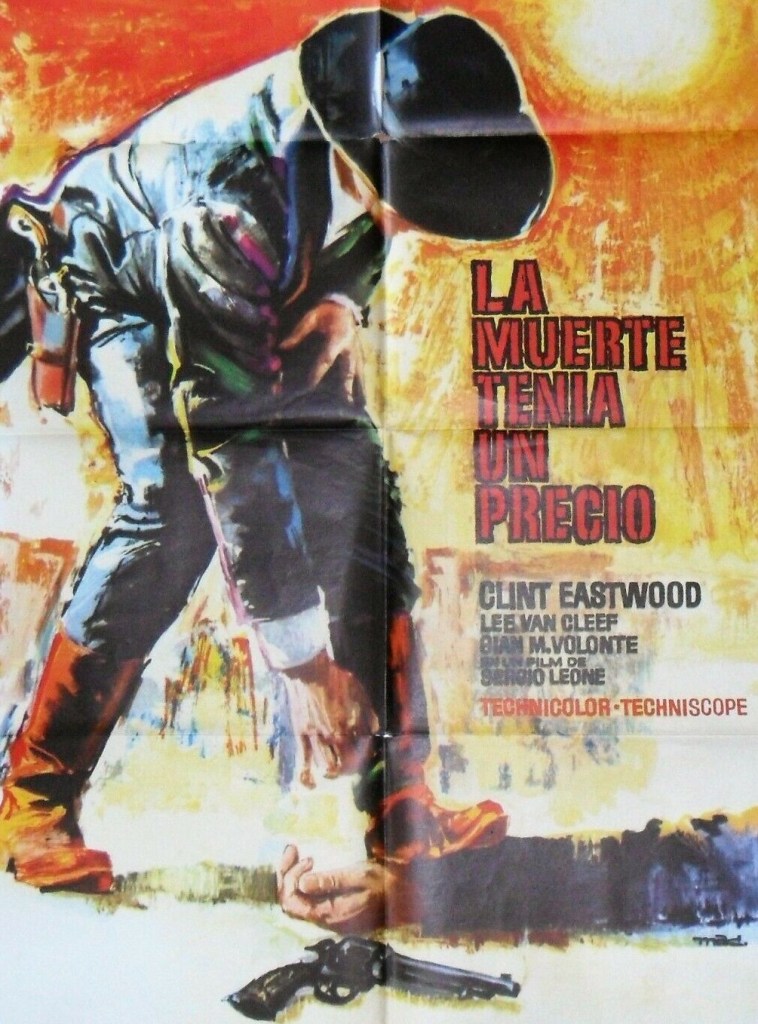
The prospective casting was tantalizing. How about Clint Eastwood and Lee Marvin, a pairing for the ages, two of the toughest guys in screen history? Failing that, Eastwood and Charles Bronson, The Man With No Name vs The Monosyllabic Man? The role of Colonel Mortimer could also have gone to Henry Fonda or Robert Ryan before in one of the movie business’s oddest tales it ended up with Lee Van Cleef.
In due course Bronson and Fonda would work with Sergio Leone in the director’s best film, Once Upon a Time in the West (1969). Fonda’s agent had already dodged Leone’s entreaties once, having rejected A Fistful of Dollars (1964). Marvin was, in fact, all set, an oral agreement in place until a few days before shooting began on For a Few Dollars More he suddenly opted instead for Cat Ballou (1965), a decision that won him an Oscar and turned him into an unlikely star.
When none of his first choices proved available or interested, Leone turned to Van Cleef. Or, more correctly, a photo of the actor pulled from an old casting catalog. Although a western buff like Leone remembered Van Cleef from his debut in High Noon (1952) plus Gunfight at the O.K. Corral (1957), The Tin Star (1957) and a dozen other bit parts and supporting roles in westerns, Van Cleef had not been credited in a movie since The Man Who Shot Liberty Valance (1962).
He proved virtually impossible to track down. No small surprise there because he earned a living mostly as a painter now, a car accident having left him with a limp. He couldn’t run, much less ride anything but a docile horse. He required a stepladder to get mounted. Leone flew to Los Angeles and his first sight of Van Cleef, older than his photograph, proved his instincts correct, Van Cleef’s face “so strong, so powerful.” The salary on offer, for a down-on-his-luck actor scarcely able to pay a phone bill, was a fat purse of $10,000. (Eastwood’s salary was $50,000 plus a profit share compared to just $15,000 for the first film).
Leone put him to work right away, the day he arrived in Italy filming reaction shots. It was just as well his input that day was so simple because, as Clint Eastwood had discovered, the language barrier was a problem. Equally disconcerting was that Van Cleef had no idea why he had been chosen, and since A Fistful of Dollars had not been released in the U.S., no inkling of the kind of western the director had in mind. At Eastwood’s urging, he nipped out to a local cinema and returned with the understanding that the script was “definitely second to style.” Van Cleef was easy to work with, and although he could put away a fair amount of liquid refreshment it never interfered with his work. He came ready for direction.
Leone had not wanted to make a sequel. His original plan was a caper picture called Grand Slam or a remake of Fritz Lang’s classic M to star Klaus Kinski or an autobiographical drama – Viale Glorioso – set in the 1930s. Jolly, the producers of A Fistful of Dollars, offered him a 30 per cent profit share on that film if he made a sequel, as they felt he was legally obliged to do. Instead, furious with his treatment at their hands, the director hit upon the title of a sequel For a Few Dollars More, the actual storyline only coming to fruition when he came across a treatment called The Bounty Killer by Enzo dell’Aquilla and Fernando Di Leo, who in exchange for a large sum, surrendered their screen credits. Luciano Vincenzoni completed the screenplay in nine days, leavening it with humor, after the director and his brother-in-law Fulvio Morsella had produced a revised treatment, Leone also involved in the final screenplay.
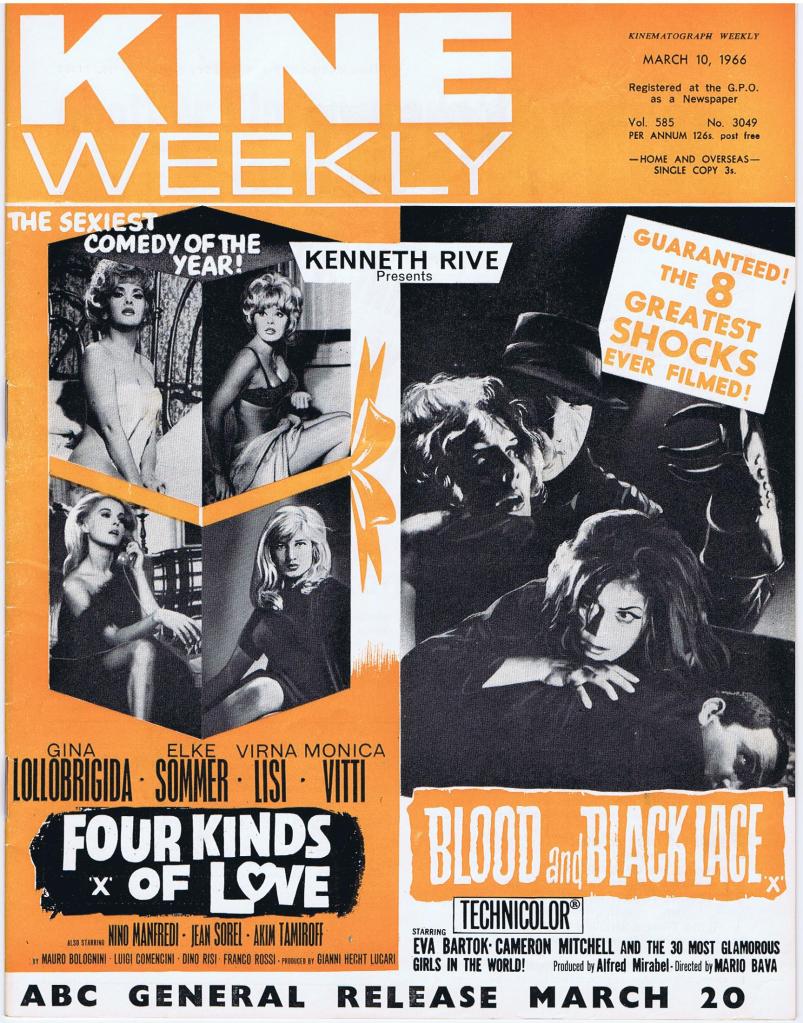
Jolly Films, the makers of “A Fistful of Dollars” already had experience of selling its films abroad. But as with Mario Bava’s “Blood and Black Lace” they were usually sold outright with no share of the box office and in turn sold as a supporting feature for a fixed price to an exhibitor.
Leone found a new backer in Alberto Grimaldi, an Italian entertainment lawyer who worked for Columbia and Twentieth Century Fox and had produced seven Spanish westerns. He promised to triple the first film’s budget to $600,000, with the director on a salary and 50 per cent profit share.
Success bred artistic confidence. A Fistful of Dollars had broken all box office records in Italy, grossing $4.6 million, and so Leone sought to improve on his initial offering and develop an “authorial voice.”
Thematically, with two principals, initially rivals who end up as “argumentative children,” it took inspiration from westerns like The Bravados (1958) – the photo and the chiming watch – and Robert Aldrich’s Vera Cruz which pitched Burt Lancaster against Gary Cooper. While bounty hunters had cropped up in Hollywood, they were not ruthless killers, actions always justified, rather than merely professionals doing their job. So in some sense Leone was drawing upon, and upending, films like Anthony Mann’s The Naked Spur (1953) and The Tin Star, Andre De Toth’s The Bounty Hunter (1954) and Budd Boetticher’s Ride Lonesome (1959). Just as Clint Eastwood’s bounty hunter underwent change, gradually the character played by Gian Maria Volonte evolved from a straightforward outlaw called Tombstone to a stoned, sadistic bandit named El Indio.
With artistic pretension came attention to detail. Leone required historical exactitude not just relating to weapons used, but their ballistics and range. Lee Van Cleef’s arsenal included a Buntline Special with removable shoulder stock, Colt Lightning pump action shotgun, Winchester ’94 rifle, and a double-barreled Lefaucheux. Carlo Simi’s town, constructed near Almeria, contained a two-storey saloon, undertaker’s parlor, barbershop, telegraph office, jail, hotel and an adobe First City Bank. And there was nothing pretty about it. The saloon was dirty and overcrowded, machines belching so much smoke it “looked as if a man could choke in there.” Filming took place between mid-April and the end of June 1965.
Perhaps the biggest area for improvement was the music. Ennio Morricone had scored another nine films since A Fistful of Dollars. Both director and composer had ambitious ideas about how to use the music. The score was not recorded in advance, nor was Morricone given a screenplay, instead listening while Leone told him the story and asked for individual themes for characters. Morricone would play short pieces for Leone and if met with his approval compose longer themes. Each character had their own leitmotif, sometimes the same instrument at different registers, the flute brief and high-pitched for Monco (Eastwood) but in a low register for Mortimer, church bells and a guitar representing El Indio. In a very real sense, they were experimenting with form. Bernardo Bertolucci regarded Morricone’s music as “almost a visible element in the film.” Musical ideas regarding El Indio’s watch, however, were developed at the rough cut stage, its repetitive melody becoming “sound effect, musical introduction and concrete element in the story.”
As well as creating music for audiences, Leone’s films are punctured with music that holds particular meaning for characters, here the watch and in Once Upon a Time in the West the harmonica, in both films flashback used to assist understanding.
The myth of why it took so long for either film to reach the United States was based on two misconceptions, firstly that Japanese director Akira Kurosawa, whose Yojimbo (1961) A Fistful of Dollars closely resembled, had blocked its progress, secondly that it relied on screenwriter Vincenzoni to make the breakthrough via a contact working for United Artists.
In fact, there were more obvious reasons for resistance from American distributors. In the first place, you could not discount snobbery. The notion that the country that had invented the western should now be reliant on importing them from Italy seemed a shade abhorrent. Although For a Few Dollars More was sold to 26 countries in a day at the annual Sorrento trade fair in 1965 – at the same fair a year earlier there had not been a single taker for A Fistful of Dollars – the United States was not among the buyers, distributors perhaps even more daunted by the prospect of introducing so much violence to American audiences reared on the traditional western.
Foreign movies that made the successful transition to the United States arrived weighted down with critical approval and/or awards or garlanded with a sexy actress – Brigitte Bardot, Anna Magnani, Sophia Loren among the favored – and risqué scenes that Hollywood dare not include for fear of offending the all-mighty Production Code.
But sex was a far easier sell in the U.S. than violence. And an actor with no movie marquee such as Clint Eastwood did not fill exhibitors with delight and even the notion that A Fistful of Dollars was a remake of Akira Kurosawa’s Yojimbo (1961) failed to stir the critics (as with The Magnificent Seven being a remake of Seven Samurai, most viewing the notion as repellent). So both the first and second pictures in the “Dollars” trilogy were stuck in distribution limbo for three and two years, respectively, before being screened in America.
And, initially, it had appeared that Italian audiences shared the same distaste for a cultural intruder such as A Fistful of Dollars. One cinema chain owner refused to book the film on the grounds that there were not enough female characters. A Fistful of Dollars was released in Italy in August, a dead period, since the month is so hot and everyone has abandoned the city for the beach. It opened – only in Florence and with neither publicity nor advertising – on August 27th 1964, a Friday, and did poor business that day and the next. But by Monday, it was a different story, takings had doubled and over the following two days customers were being turned away. New films typically played first-run for 7-10 days in Florence, A Fistful of Dollars ran for three months, triggering a box office story of Cinderella proportions.
But my research indicated there had been ample opportunity for an American distributor to snap up the rights to A Fistful of Dollars in 1965, two years before it was finally released there. In the first place, the music rights had already been purchased by New York firm South Mountain Music in March 1965 in expectation the film would acquire release that year. In December 1965 Arrigo Colombo, partner in Jolly, flew to the United States for the specific purpose of lining up a major distributor for A Fistful of Dollars. The company had previously secured U.S. distribution for horror product like Castle of Blood (1964) and Blood and Black Lace (1964) but those were outright sales.
With the movie already sold to Spain, West Germany, France and Japan, Colombo aimed to conclude a deal for the English-speaking market, “purposely holding back” from releasing the picture in those countries as he sought an all-encompassing contract. At that point, Kurosawa no longer stood in the way, that issue “now cleared up” settled in the normal fashion by financial inducement, in an “amicable settlement” Toho snagging the Japanese and Korean rights, the deal sweetened with a minimum $100,000 against a share of global profits. But Colombo went home empty-handed, unable to secure any deal and his temerity ridiculed by trade magazine Variety
Although Sergio Leone had one other legal obstacle to surmount that would not have got in the way of a U.S. distribution deal, the worst that could happen being that a contract might be struck with a different company. Italian companies Jolly Films/Unidis, which had backed the original, took umbrage at Leone going ahead with the sequel without their financial involvement, cutting them off from the profit pipeline. So in April 1966 they took Leone to court in Rome arguing that For A Few Dollars More “represented a steal as well as unlawful competition for its own Fistful.” Four months later the judge denied the claim on the grounds that “the character played by Clint Eastwood in each film is not characterized to such a degree that a likeness exists” (even though to all intents and purposes it was the same character, cigar, poncho, gun, bounty hunting!). Ironically, Italian laxity in such matters counted against Eastwood when he failed to prevent the distribution of a film based on two segments of Rawhide stitched together.
It would also be highly unusual if United Artists was not aware of both A Fistful of Dollars and For A Few DollarsMore since, in keeping tabs on the foreign performance of both Goldfinger (1964) and Thunderball (1965) the studio could scarcely fail to notice the Italian westerns close on their box office tail, the second western outpointing Thunderball in daily averages in Rome.
But the story still, erroneously, goes that it was the intervention of writer Vincenzoni which proved decisive. He had contacts in U.S, namely Ilya Lopert of United Artists. Grimaldi was, meanwhile, trying to sell U.S. and Canada rights relating to the second picture. Vincenzoni arranged for UA’s representatives to view A Fistful of Dollars in Rome and cut himself in for a slice of the profits when the distributor surprisingly purchased the entire series.
Since A Fistful of Dollars had already been sold to most major territories, UA could only acquire the North American rights – for a reported $900,000 – but for the other two films gained a considerably larger share of global distribution
United Artists was an unusual company among the Hollywood hierarchy, and not primarily due to recurrent Oscar success, but because it had, completely unexpectedly, hit box office gold with James Bond. There was nothing particularly odd about a series, as Tarzan, Sherlock Holmes etc (still flourishing in the 1960s) testified. What was distinctive about the Bonds was that each picture – the four so far had earned close to $150 million worldwide, not counting merchandising – had done better than the last, which went against the standard rule of sequels of diminishing returns and higher costs. Given the opportunity to buy into a ready-made series (two films in the can, the third in production) UA made an “attempt to calculatedly duplicate the (Bond) phenomenon” and in so doing “create a trend.” Assuming the movies would follow the Bond formula of increased grosses with each successive picture, the studio was prepared to spend “many hundreds of thousands” of dollars to establish the first picture.
United Artists embarked on an unusual sales campaign to the trade. Instead of marketing the pictures one at a time, they started to promote the series with the tagline “A Fistful of Dollars is the first motion picture of its kind, it won’t be the last.” The advertising campaign was unusual in that it was based entirely around introducing the character rather than the story (much in the same way as James Bond had been), three separate slivers of the poster devoted to visual aspects, the cigar, gun and poncho, each carrying mention of “The Man With No Name,” such anonymity one of the talking points of the movies.
Cinema managers were briefed on release dates, A Fistful of Dollars in January 1967, the sequel for April and The Good, the Bad and the Ugly for Xmas that year. Like the Bonds, it was expected that box office would progressively, if not explosively, increase. The studio unveiled a “hard-hitting campaign” designed to “intrigue the western or action fan.”
However, the North American premiere was held not in the United States but Canada, at the Odeon-Carlton in Toronto. Having committed to a four-week engagement, a risky prospect for an unknown quantity, the cinema started advertising a teaser campaign three weeks in advance. During the first week, posters were not just focused on the “man with no name” but also “the film with no name” and the “cinema with no name,” all those elements removed from the artwork until the second week of the campaign. UA allocated $20,000 in marketing, up to four times the usual amount spent on a launch there, and was rewarded with strong results – “bullish but not Bondish” Variety’s verdict.
However, the UA gamble did not pay off, especially when taking into account the high cost of buying the rights allied to huge marketing costs. Initial commercial projections proved unrealistic. Despite apparently hitting the box office mark in first-run dates in key cities, the film was pulled up short by its New York experience. Shunted straight into a showcase (wide) release rather than a first-run launch, it brought in a pitiful $153,000 from 75 theaters – even The Quiller Memorandum (1966) in its second week did better ($150,000 from 25). As a consequence when For a Few Dollars More was released in April/May, UA held off boking it into New York until “a suitable arrangement” could be made, which translated into hand-picking a dozen houses famed for appealing to action fans plus 600-seat arthouse the Trans-Lux West.
United Artists predicted $3.5 million in rentals (the amount returned to studios after cinemas take their cut of the gross) for A Fistful of Dollars and $4.5 million with For a Few Dollars More. Neither came close, the latter the marginally better performer with $2.2 million in rentals (enough for a lowly 41st on the annual chart) with the first film earning $2.1 million in rentals (46th) way behind more traditional performers like Hombre ($6.5 million for tenth spot), El Dorado ($5.9 million in 13th) and The War Wagon ($5.5 million in 15th).
The vaunted Bond-style box office explosion never materialized and it might have helped if UA had kept closer watch on the actual revenues posted in Italy for the series. While For a Few Dollars More increased by $2 million the takings of A Fistful of Dollars, the final film in the trilogy, The Good, the Bad and the Ugly produced lower grosses than even the first.
However, it did look as if The Good, the Bad and the Ugly would come good. UA opened it in two first-run cinemas in New York where each house retained it for six weeks. But although the final tally of $4.5 million (24th spot in the annual rankings) was the best of the series, it did not herald returns that made it anywhere near comparable to the Bonds.
It’s possible the movies did better in terms of admissions than the box office figures show. Distributors pushing foreign product into arthouses were generally able to achieve a high share of the rental – 50 per cent the going rate – because they were able to set rival arthouses against each other and movies with a sexy theme/star had inbuilt box office appeal, La Dolce Vita (1960) and And God Created Women (1956) the classic examples. But that would not be possible when trying to interest ordinary cinemas with a film lacking in sex.
When I researched the early Bonds for a previous Blog, I found that United Artists had only managed to achieve bookings for Dr No (1962) by lowering its rental demand. Exhibitors paid the studio just 30 per cent of the gross. And I wondered if perhaps the same occurred with A Fistful of Dollars given the star, like Sean Connery, was completely unknown. Of course, it would not explain why the series did not grow as expected.
Of course, there was a surprising winner and an unexpected loser in the whole ‘Dollars’ saga. Clint Eastwood emerged as the natural successor to John Wayne with a solid box office – and later critical – reputation for American westerns starting off with Hang ‘Em High (1968) which beat The Good, the Bad and the Ugly at the box office, while Sergio Leone’s Once Upon a Time in the West (1969) proved a huge flop in the U.S.
Christopher Frayling, Sergio Leone, Something To Do With Death (Faber & Faber, 2000), p160-162, p165-200; “Italo’s Own Oater Leads Box Office,” Variety, December 2, 1964, p16; “South Mountain Buys Dollar Score,” Variety, March 10, 1965, p58; “Jolly’s Colombo Discovers N.Y.C. Busy at Xmas,” Variety, December 22, 1965, p3; “Tight Race for Box Office Honours in Italy Looms as Thunder Leads Dollars,” Variety, January 65, 1966, p15; “Dollars World Distribution for UA,” Variety, March 22, 1966, p22; “Clint Eastwood Italo Features Face Litigation,” Variety, April 13, 1966, p29; “UA Cautious on Links to Italo Fistful; Faces Slap from Kurosawa,” Variety, July 13, 1966, p7; “Rome Court Rejects Plea for Seizure of Few Dollars Made By Fistful Film,” Variety, August 3, 1966, p28; “Clint Eastwood vs Jolly on 2 Segs of Rawhide ‘Billed’ New Italo Pic,” Variety, September 7, 1966, p15; “Italy Making More Westerns, Spy Films Than Star Vehicles,” Box Office, October 31, 1966, p13; “Hemstitched Feature,” Variety, November 23, 1966, p22; “UA Division Holds Screenings of Westerns,” Box Office, December 12, 1966, pE2; Advertisement, Variety, December 21, 1966, p12-13; “UA Gambles Dollars As Good As Bonds,” Variety, December 28, 1966, p7; “Fred Goldberg Shows Ads on UA ‘Dollar’ Films,” Box Office, January 2, 1967, pE4; “Review,” Box Office, January 9, 1967, pA11; “Fistful of Dollars: Male (and Italo) B.O.,” Variety, January 18, 1967, p7; “Fistful of Dollars: The Glad Reaper,” Variety, February 1, 1967, p5; “This Week’s N.Y. Showcases,” Variety, February 8, 1967, p9; “Fistful’s Weaker N.Y. B.O. Clench,” Variety, February 8, 1967, p7; “Methodical Campaign Kicks Off Ideal Fistful Ballyhoo in Toronto,” Box Office, May 1, 1967, pA1; “Few DollarsMore Runs 30% Ahead of First Dubbed Italo-Made Western, So Bond Analogy Makes Out,” Variety, May 31, 1967, p4; “N.Y. Slow to Fall Into Line,” Variety, May 31, 1967, p4; “B’way Still Boffo,” Variety, July 12, 1967, p9; “Carefully Picked,” Variety, July 12, 1967, p4; “B’way Biz Still Big,” Variety, July 19, 1967, p9; “Big Rental Films of 1967,” Variety, January 3, 1968, p25; “B’way B.O. Up,” Variety, January 31, 1968, p9; “Big Rental Films of 1968,” Variety, January 8, 1969, p15.







 The Magnificent 60s