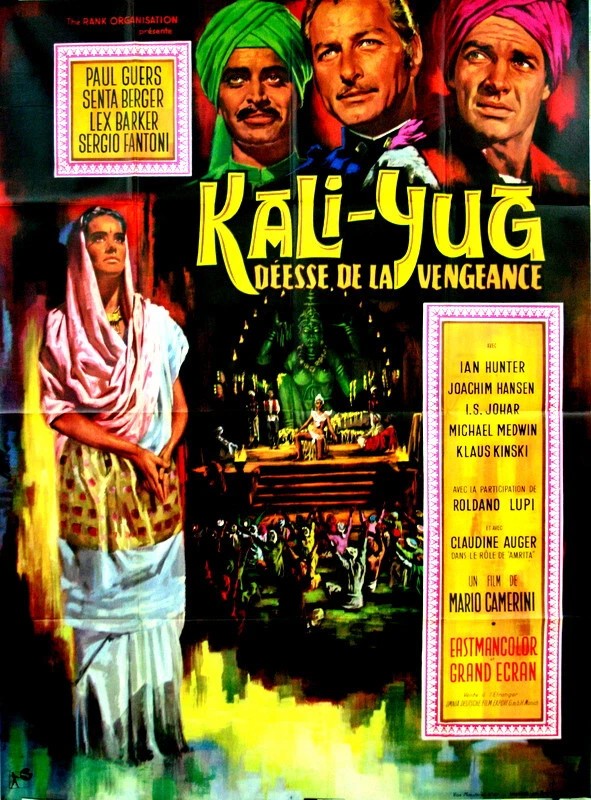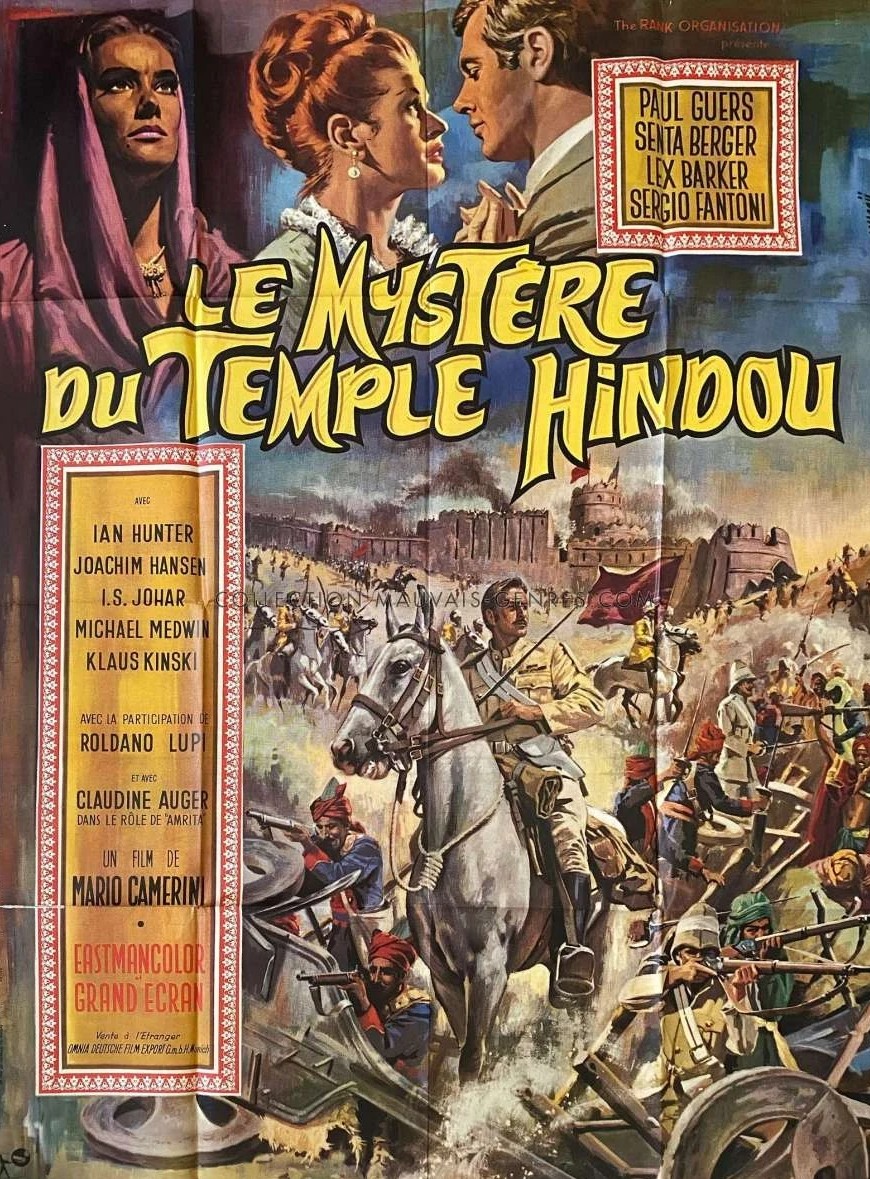
Kali-Yug Part II: The Mystery of the Indian Temple (1963) ***

Earnest students of the Senta Berger Syllabus may be somewhat disappointed, I’m afraid. This turns out to be an epic movie – in two parts – but even with a three-hour running time there’s hardly any space for the second-billed Ms Berger. Instead it’s the second female lead Claudine Auger who leads the way.

And as if it’s forerunner of the contemporary serial there’s a (longish) recap of part one, though this time recounted as if it’s nightmare into which our hero Englishman Dr Simon Palmer (Paul Guers) has unwittingly tumbled. He’s not, as I had imagined from the end of episode one, free. He’s still imprisoned by the Maharajah (Roldano Lupi) along with servant Gopal (I.S. Johar) although he has begun to deduce that all is not what it seems and that an insurrection may be on the cards under the guise of a revival of the cult devoted to the Goddess Kali.
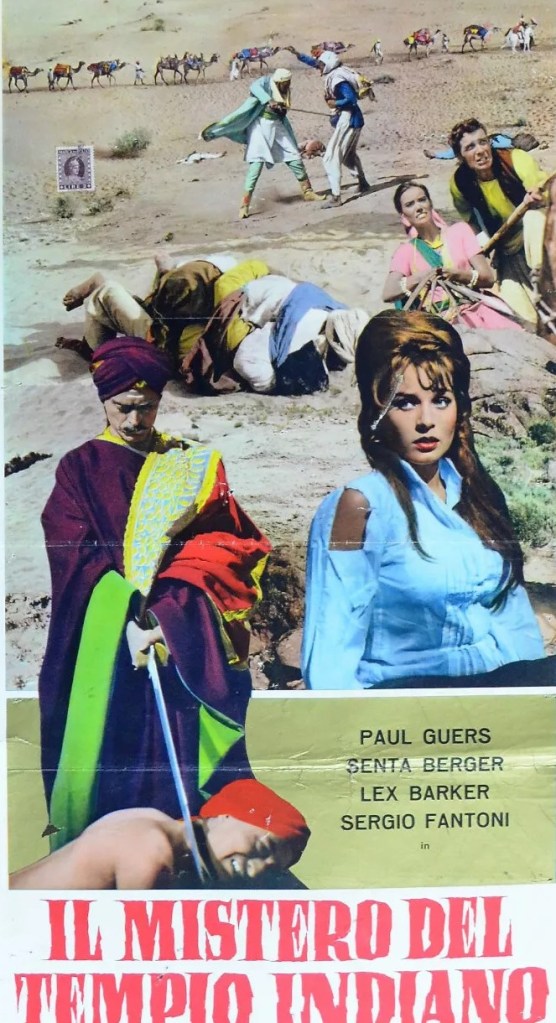
And when exotic dancer (in the old sense, not the contemporary) Amrita (Claudine Auger) fails to convince the Maharajah of Palmer’s innocence she organizes his escape via the old snake in the basket trick. But this is not altogether from altruism. The good doctor is whisked away to treat three children who have caught diphtheria, unaware one of them is the Maharajah’s grandson, kidnapped (in Part One) by the Kali cult of which she is a key participant. However, she is beginning to thaw in her attitude to the Englishman and wonder why the goddess Kali, to whom she is bound by oath, is so determined to kill such a good man.

They end up in the caravanserai of cult leader Siddhu (Klaus Kinski), but Amrita, who’s undergoing a crisis of faith, organizes their escape, along with the boy. She has betrayed her calling – her father was a priest of Kali – in order to save Palmer. They manage to evade the pursuing pack of thugs. When the road back to Hasnabad is blocked, they decide to make for the enemy lair, an abandoned fort in the desert turned into the rebel stronghold, on the basis of hiding in plain sight, nobody expecting them to head in that direction.

Meanwhile, on his way to the fort, the Prince (Sergio Fantoni), now showing his true colors, has kidnapped Catherine Talbot (Senta Berger), planning to trade her for the Maharajah’s grandson who is “absolutely essential” to his plans. Theoretically, there’s nothing her husband can do to save her. According to the Treaty of Delhi, British forces cannot cross state lines. However, Talbot (Ian Hunter) reckons that, as he’s technically a civilian, that rule doesn’t apply to him and Major Ford (Lex Barker) comes up with a similar ploy, explaining that he’s given his soldiers ten days’ leave leave and to his “great surprise” they all decided to spend it in the fort.
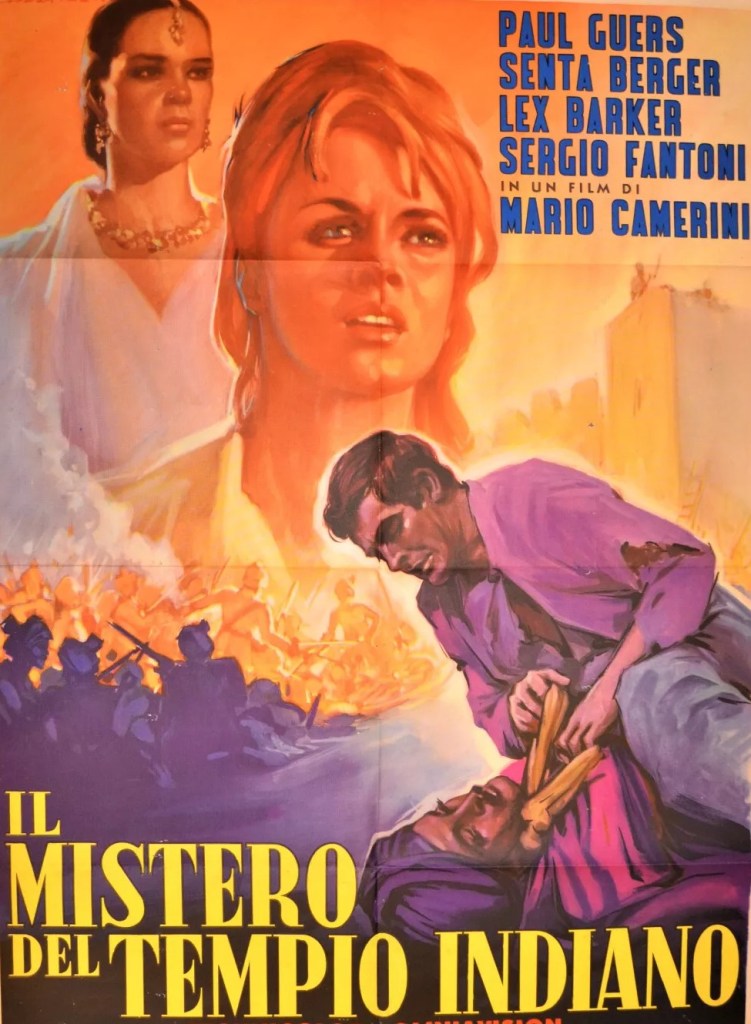
Meanwhile, to complicate matters, Amrita decides Palmer is so far from being a bad guy that he’s worth kissing. But that romance is nipped in the bud when Palmer spots Catherine being dragged along in the Prince’s caravanserai and decides to rescue her. Furious at discovering that Catherine takes precedence in Talbot’s romantic scheme, and correctly assuming she’s going to be dumped, she knocks him out and turns him and the boy over to the Prince. While the child is acclaimed as the “sacred prince” and figurehead of the revolution, Palmer is to be sacrificed to the goddess. While waiting for that, he’s chained up next to Catherine.

So now you know we’re going to be perming two from four. This doesn’t feel like it’s heading in the bold direction of everyone coming out of it bitterly disappointed on the romance front.

And so it transpires. Talbot the Resident, more courageous than you might expect, dies in the attack on the fort while Amrita is killed trying to protect Palmer. Although for a time it’s a close run thing, what with the attackers outnumbered and running out of ammunition, luckily they are saved by the arrival of the Maharajah’s army. And with Amrita and the Resident out of the way, the path is clear for the old flames to renew their romance though that’s implied rather than shown.

No tigers or elephants this time round, wildlife limited to a dancing bear and a performing monkey.

Hardly a story that requires such an epic scale and I’m wondering if it was so long they had to edit it into two parts or whether it was filmed in the fashion of The Three Musketeers (1973)/The Four Musketeers (1974) with both sections shot at the same time. I’m not sure how audiences reacted. From what I can gather moviegoers in some parts of the world only saw part one while others were limited to part two, that recap helping make the narrative comprehensible.

Senta Berger (Cast a Giant Shadow, 1966) completists will come away disappointed given how restricted her role is. But she does bring the necessary emotions of remorse and humiliation to the part. Claudine Auger (Thunderball, 1965) has the better role, femme fatale, conspirator, lovestruck, spurned, and at various points leaping into action. Lex Barker (24 Hours to Kill, 1965) looks as though he’s signed up for a role requiring a hero only to be not called upon to act as one. Fans of Klaus Kinski (Five Golden Dragons, 1967) will be similarly disappointed.

Paul Guers (The Magnificent Cuckold, 1964) looks thoroughly puzzled throughout although he gives plenty lectures on general fairness while Sergio Fantoni (Esther and the King, 1960) concentrates on how unfair the British – considered the exponents of fair play – actually are.

Given it was made outside the British studio system, the producers are free to be quite critical of the British in India and there are pointed remarks about “dirty little Hindus” and about how the British treat even the Indian elite with obvious contempt. In order to retain autonomy, the Maharajah has been forced into becoming a merchant to save his people from starvation thanks to the amount he is taxed. And the story pivots on the lack of medication supplied by the British to natives. The Resident hasn’t even bothered to reply to Palmer’s letters begging for medicine.

The picture is even-handed in its depiction of British rule. Film makers were always in a dichotomy about rebels. Sometimes they were the good guys rising up against despicable authority, sometimes they were the bad guys disrupting a just system. Here, since the rebels belong to a vicious cult that would kill regardless of cause, they come off as the villains of the piece.

Mario Camerini (Ulysses, 1954) directs without the budget to make the most of the story, the battles or the location. Along with writing partners Leonardo Benvenuti and Piero De Bernardi (Marriage Italian Style, 1964) and Guy Elmes (Submarine X-1, 1968), he had a hand in the script adapted from the Robert Westerby novel.

Not complex enough to be an epic, and not enough of Senta Berger to satisfy your reviewer, still interesting enough if you are thinking of seeking it out. Good prints of both parts are on YouTube.
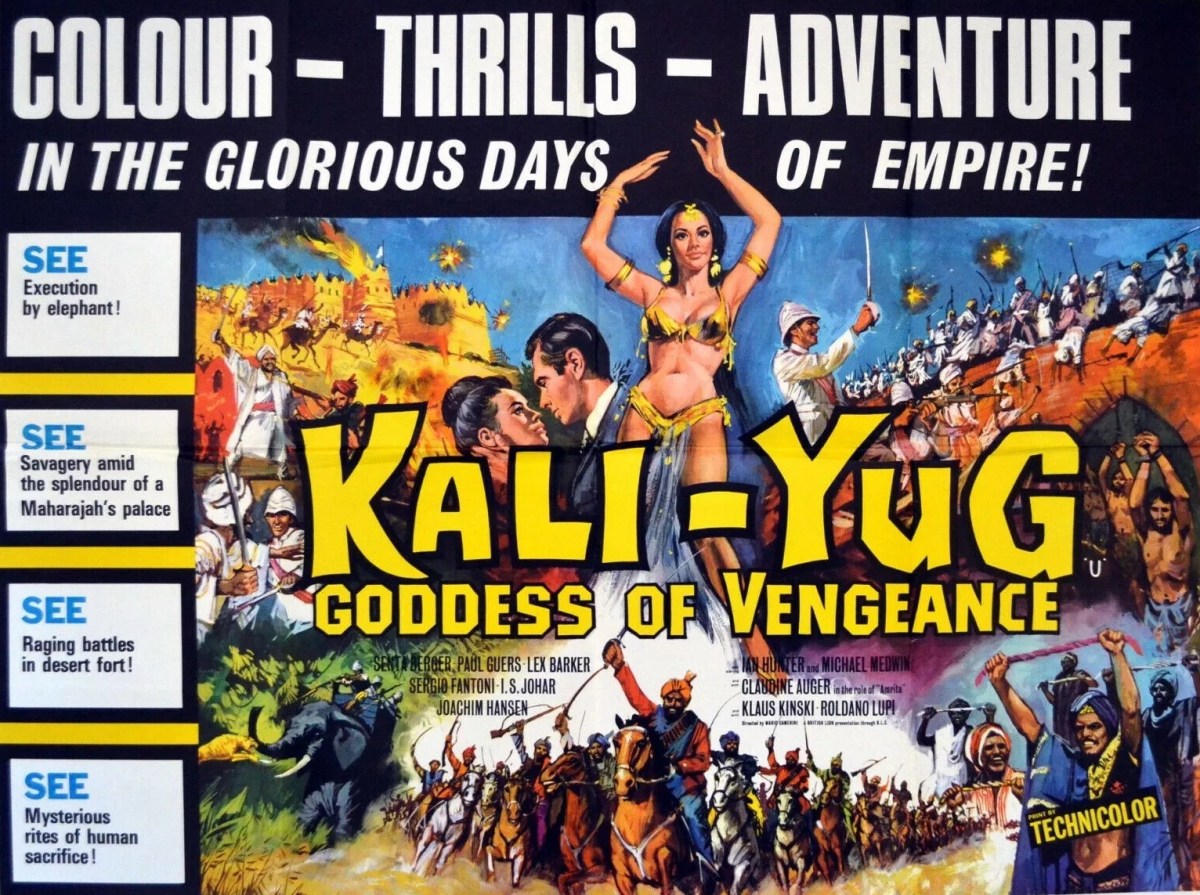
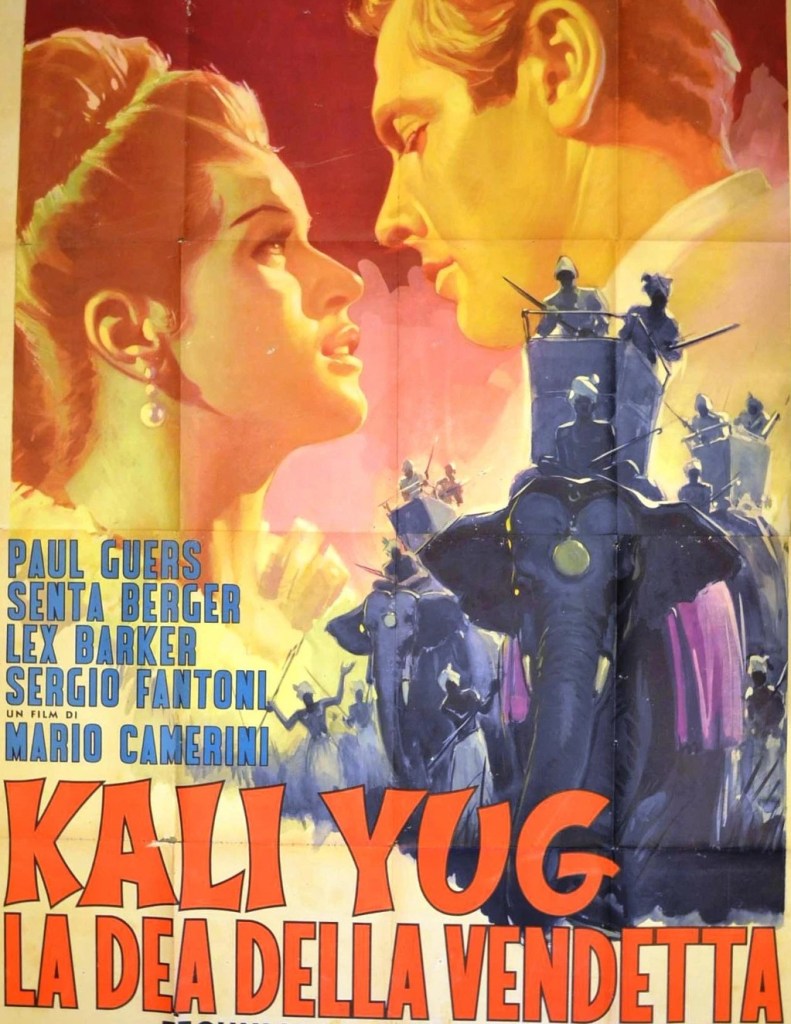
Kali-Yug Goddess of Vengeance (1963) ***

You can’t aspire to being Emeritus Professor of Senta Berger Studies unless you are willing to track down this early effort. Your curiosity can now be sated without much effort since it’s currently playing on YouTube. You’ll notice a preponderance of brownface (Klaus Kinski, Sergio Fantoni, Claudine Auger and eventually, though in legitimate disguise, Paul Guers) among a multicultural cast comprising actors from Germany, Poland, Switzerland, France, Italy, Austria, South Africa, the USA and Britain.  

To avoid confusion, the title of this German-made Indian adventure requires some explanation and once again I have undertaken the necessary research. As long as you make the distinction between “Kali-Yug” and “Kali Yuga” you will be on safe ground. The former refers to a cult while the latter refers to Hindu cosmology and the final age of the yuga cycle – the one predominant at the time – defined as an age of darkness, of moral and spiritual decline.

Even with that out of the way it takes quite a while to get your bearings here. This is India in the 1880s, four years after Queen Victoria has been declared Empress of India, at the height of British rule.  

We begin in rather traditional style with the kind of tale that would provide an Englishman with good reason to be in an impoverished Indian village. Dr Simon Palmer (Paul Guers) is fighting an epidemic of smallpox. Running out of medicine, he despatches a servant with a small convoy to the capital of Madanpur to secure further supplies to combat the disease. On its return this group is ambushed, so Palmer takes it upon himself to personally plead with local Governor (known here as The Resident) Talbot (Ian Hunter) of Madanpur..

It’s worth pointing out that, as this is relevant to the later narrative, a Resident has been appointed in those states such as Madanpur which the British took by force. Other states, which gave in to the British without a fight, such as the neighboring state of Hasnabad continue to enjoy autonomous rule by a Maharajah or Prince, but only in return for paying massive tributes to their conquerors.

After a satisfactory meeting with the Resident, Palmer encounters drunken British officer Capt Walsh (Michael Medwin) and retaliates when insulted. He also meets old flame Catherine Talbot (Senta Berger) who married the Resident. She’s not a gold-digger in the standard sense. Palmer had met her in Calcutta but when he went off to London to complete his medical studies her father died, leaving her impoverished, so in his continued absence she married the older man for security.

Capt Walsh is murdered and after their previous altercation blame falls on Palmer. He should get off scot-free. He has an alibi. At the time of the murder he was dallying with Mrs Talbot. But that wouldn’t go down well in British society. There would be a scandal. A good deal would be read into a moonlit assignation with a man other than her husband. And Palmer, in traditional stiff upper lip fashion, wouldn’t like to get her into trouble.  

So Palmer contacts elite dancer Amrita (Claudine Auger) because he thinks she knows who killed Walsh. Although promising to help, Amrita, it turns out, apart from charming the pants off (possibly quite literally) everyone in sight, is secretly in league with the characters, led by Siddhu (Klaus Kinski), responsible for the robbery and murder. So while Palmer is ambushed yet again, she is sent to Hasnabad where she will undertake her “next mission.”  

Which appears to be to dance for the Maharajah (Roldano Lupi) as entertainment for visiting merchants. Helped by servant Gopal (I.S. Johar), Palmer goes on the run and manages to fake his own death. In this regard, an entire corpse is not required as proof, just a torn limb, stolen from the local vultures, and a torn jacket. (Thus far the highlight of the show with white hunters and Mrs Talbot swaying in baskets atop elephants). To keep him safe, Gopal provides Palmer with brownface disguise. They witness a Kali ritual and follow Siddhu’s gang as they break into the palace to prevent the kidnap of his Maharajah’s grandson.

But Palmer is blamed for that too and condemned to death. That involves being buried up to  your neck in the sand while an elephant stomps on your head. But he is released because the Maharajah doesn’t want trouble with the English. Meanwhile Catherine has fessed up to her husband which, as expected, does not go down at all well.

The End.

So you can imagine my puzzlement. YouTube promotes Klaus Kinski (Grand Slam, 1967) as the reason to watch this, but so far, he’s only appeared briefly, though clearly wielding significant power as chief thug. But we’ve seen as little of third-billed Lex Barker (Old Shatterhand, 1964) as Major Ford. His contribution is to prevent Capt Walsh get even drunker and, as a member of the shooting party, pick up Mrs Talbot when she faints at the thought of Palmer being dead. Sightings of fourth-billed Sergio Fantoni (Hornets’ Nest, 1970) have been as fleeting, his main role as Prince Ram Chand to try and score points off The Resident by arguing about the unfairness of British rule and to partner Catherine briefly on the dance floor.

So this is beginning to look as though it’s a small-scale version of those big-budget pictures featuring an “all-star cast” which consists either of marquee names long past their best or various foreign stars recruited to cover all the bases for the international release rollout.  

The ending is so sudden and with so much unresolved, I also began to think it was one of those elaborate foreign jobs with stars who meant so little to British and American moviegoers that it was drastically edited to fit domestic distribution patterns.

On further research (the bane of any Emeritus Professor’s life) I got to the bottom of the problem.

This was only Part One. It wasn’t the end after all.

Luckily, I’ve found Part Two and will review that (as no doubt you’re delighted to hear) tomorrow.

That Man in Istanbul / Istanbul 65 (1965) ****

Action-packed superior James Bond rip-off belonging to the Eurospy subgenre and elevated by memorable lines, wit and visual imagination. So if you recall any movie where ricochets play havoc in a room, this is where it originated. Flying through a window on a rope and then crashing through a series of rooms and not stopping, ditto. That famous line uttered by Johnny Depp in Pirates of the Carribean (2003) about “the marchandise,” yep, you’ve guessed it. Although it did steal a nice touch from Robin and the 7 Hoods (1964), the one where an illegal drinking den (illegal casino here) is remarkably transformed.

And all the promise star Horst Buchholz showed in The Magnificent Seven (1960) and kept stowed away all these years, that’s back in spades. Chases, fistfights, shootouts, saloon (well, casino, actually) brawl, competing ruffians, safe-cracking, hitmen, infiltration of secret hideout, a pair of femme fatales and the inevitable atomic scientist.

Some clever thugs including Schenk (Klaus Kinski) dupe the U.S. government out of a million bucks by only pretending to hand over a missing scientist, instead pocketing the cash and blowing up a plane with him on board. With for the time suprising use of forensics, the CIA determines the man killed in the plane wasn’t the missing scientist and work out that he might well be getting sold on to China.

Camera footage taken of the plane crash scene points to mysterious underworld figure Tony (Horst Buccholz). Against her superior’s wishes, agent Kelly (Sylva Koscina) heads off to the titular city in pursuit, tracks down Tony with no great difficulty to his illegal gambling den just in time to witness the electronic miracle of the roulette wheels disappearing into the floor when the cops turn up. The electronic scam would have worked except for a drunken customer who demands his chips be cashed and the only way to silence him being for Tony to slug him and trigger a brawl.

Under the cover of which, Kelly sneaks into Tony’s office whereupon finding no evidence of either a million bucks or a missing scientist, she asks for a job. “Strip!” he demands. But that’s not for licentious reasons it transpires, but to examine the labels on her clothing, from which he and his henchmen deduce (I won’t bore you with the details but they do match up) she’s a plant.

However, she is the one, accidentally, to trip over the Chinese conspiracy, in, of all places, a cemetery. Eventually, she persuades Tony to help her out, although that’s for financial rather than patriotic reasons. She’s got a few tricks of her own up her sleeve, and under the guise of kissing him, steals his keys.

Kelly kind of fades in and out of the picture – which is a shame because she’s good value in a feisty seductive clever way – while all the chasing of opposing sets of criminals is down to Tony. First target being the man with the steel hand (though not the steel claw that in the old British comic The Valiant allowed him to become invisible).

The non-Chinese criminals are as likely to kill their own men to stop them coughing up. But mostly, Tony and his gang are stalking the two sets of criminals, Kelly mostly waiting in a car or popping up to ask questions, with Tony being driven off a mountainside, thrown off a tower, duelling underwater and avoiding a scalding in a sauna. But we’re talking the Houdini of spies and none better than when escape involves commandeering a bulldozer and ramping up over a bunch of vehicles (that idea’s got to have appeared in a later film, too).

Kelly’s the good kind of femme fatale, the spy who has to use her wiles to snare the bad (or badd-ish) guy. But she’s a rookie compared to Elizabeth  (Perette Pradier) who leads Tony a merry dance by first of all pretending to be a victim.

But there’s style by the bucket load, clever reversals by the ton. There’s a marvellous scene where Tony knocks out a guy and then with nowhere to hide him props him up at a piano only to be undone when the fella slides over and hits the piano keys. Ever seen someone use the rolling coin distracting device. Or when the rope between two stanchions snaps mid-air casually sliding down the broken end. Or sex indicated by one person hanging their bathrobe over a door after the other person has done the same. Or the hero doing up a bikini top instead of undoing it. And a leading man who spends more time in a state of undress than any of the females. And, for good measure, a couple of times, and this very much  in the contemproary idiom, breaking the fourth wall.

Once we get going it’s the kind of non-stop action we later equated with Taken (2008) or John Wick (2014). Horst Buchholz was never better, a brilliant light touch with the lines and good deal tougher with the fists. Sylva Koscina (A Lovely Way To Die, 1968) has less to do than you’d like once the rival femme fatale appears but she shows just how capable an actress she is in displaying in non-verbal fashion and in a three-shot of all things her jealousy.

If you’re familiar with Spanish director Antonio  Isasi-Isasmendi from They Came to Rob Las Vegas (1968) stick that to one side because this is way better. Screenplay by Giovanni Simonelli (Django Shoots First, 1966), Nat Wachsberger (Starcrash, 1978) and Luis Josep Comeron (They Came to Rob Las Vegas).

Great treat.

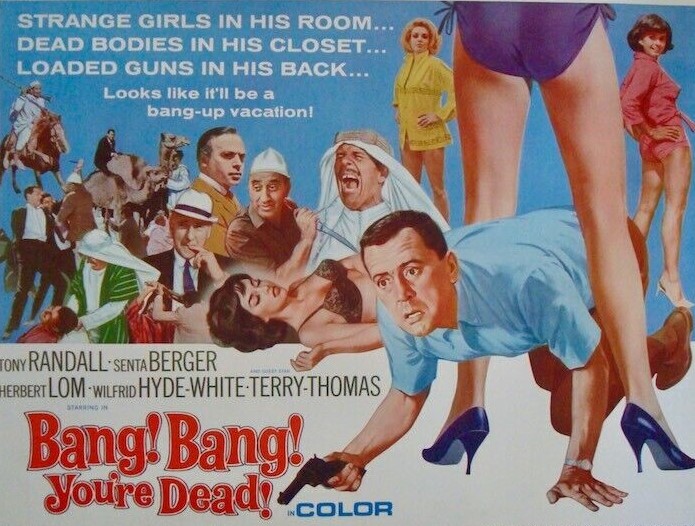
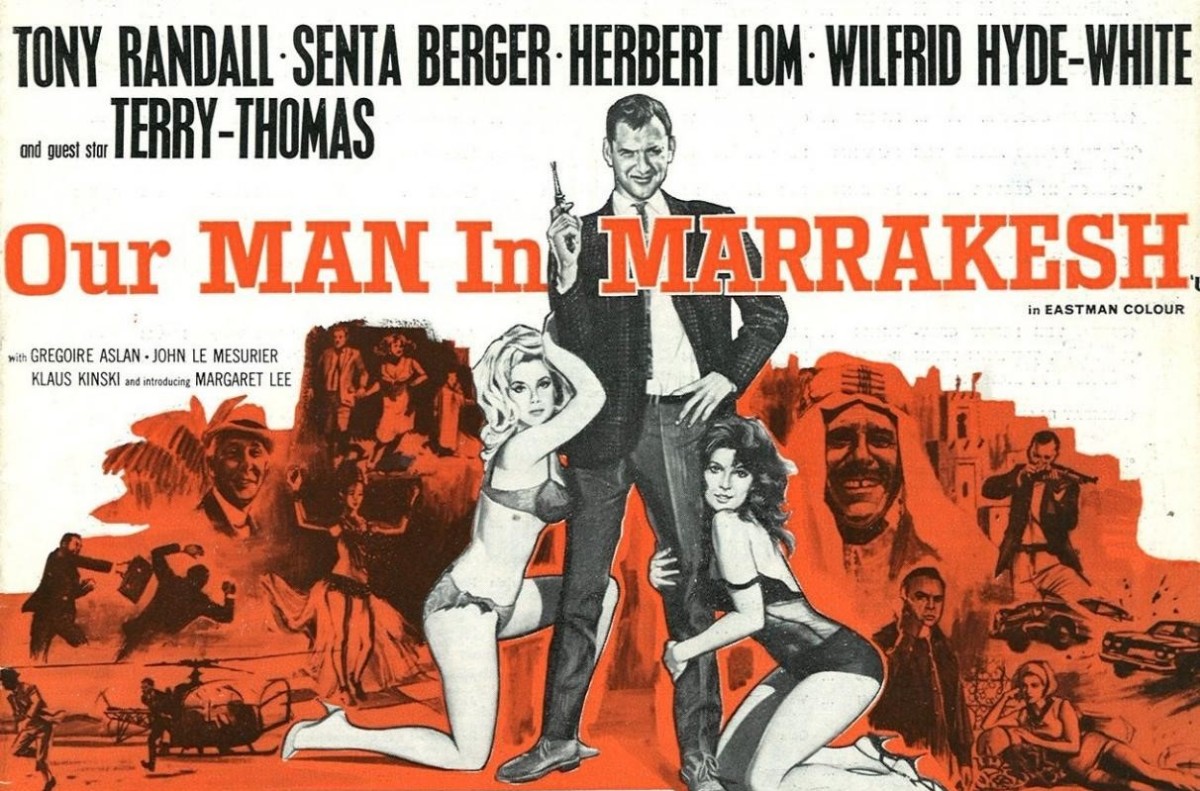
Our Man in Marrakesh / Bang! Bang! You’re Dead! (1966) ***

All hail Senta Berger! Another from the Harry Alan Towers (Five Golden Dragons, 1967) portfolio, this is a spy-thriller mash-up with a bagful of mysteries and a clutch of corpses. At last given a decent leading role, Senta Berger (Istanbul Express, 1968) steals the show from the top-billed Tony Randall (as miscast as Robert Cummings in Five Golden Dragons) and a smorgasbord of European talent including Herbert Lom (The Frightened City, 1961), Terry-Thomas (Danger: Diabolik, 1968), Klaus Kinski (Five Golden Dragons), John Le Mesurier (The Moon-Spinners, 1964) and Wilfrid Hyde-White (Ada, 1961).

In this company, the glamorous Margaret Lee (Five Golden Dragons), as the villain’s  cynical lover (“you are never wrong, cherie, you told me so yourself,” she tells him) is an amuse-bouche. Six travellers – including architect passing himself off as oilman Andrew Jessel (Tony Randall), travel agent George Lilywhite (John Le Mesurier), salesman Arthur Fairbrother (Wilfrid Hyde-White) and tourist Kyra Sanovy (Senta Berger), meeting her fiancé – board a bus from Casablanca airport to Marrakesh. One is carrying $2 million as a bribe to ease through a vote in the United Nations, but the villainous Mr Casimir (Herbert Lom) doesn’t know which one it is.

When Kyra’s fiance’s corpse tumbles out of Andrew’s cupboard, the pair become entangled. Kyra is a born femme fatale, trumping the incompetent Andrew at every turn.  With no shortage of complications, the tale zips along, directed on occasion with considerable verve by Don Sharp (The Devil-Ship Pirates, 1964).

It’s lightweight but no less enjoyable for that and makes a change from the more serious espionage fare (The Spy Who Came in from the Cold, 1965, and The Quiller Memorandum, 1966) beginning to capture the public’s attention. It might make it sound better to say it’s a mixture of The Man Who Knew Too Much (1956) and North by Northwest (1959) and throws a homage bone to Our Man in Havana (1959), but while it plays around with those riffs, it doesn’t give two hoots about focusing on Hitchcockian thrills. It’s more about the fish-out-of-water Yank Andrew being led astray by the sexy Kyra.

There are some inventive double-plays – with a body in the boot Kyra and Andrew are stopped by a cop who tells them their boot is open. An excellent rooftop chase is matched by a car chase. And there’s a terrific shootout. Kinski is at his sinister best and Terry-Thomas a standout in an unusual role as a Berber.

The film was shot on location including the city’s souks, the ruined El Badi Palace and La Mamounia hotel (featured in The Man Who Knew Too Much, 1956).

But Senta Berger seamlessly holds the whole box of tricks together, at once glamorous and sinuous, practical and tough and exuding sympathy, and it’s a joy to see her for a large part of the picture leading Randall by the nose. Quite why this did not lead to bigger Hollywood roles than The Ambushers (1967) remains a mystery.

A blast.

https://amzn.to/46T68Ax

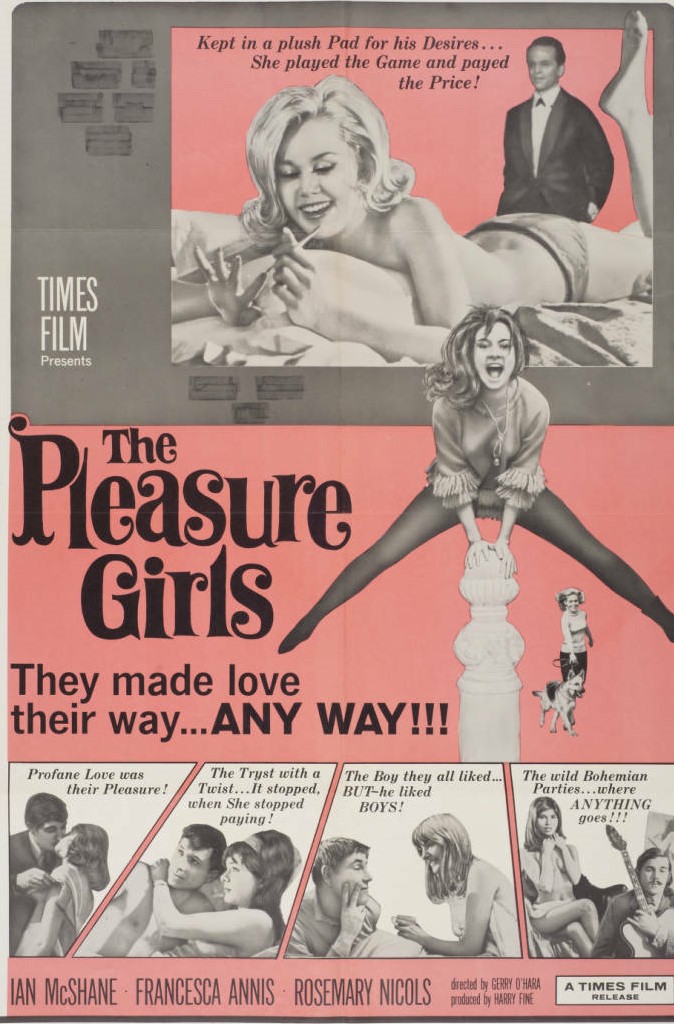
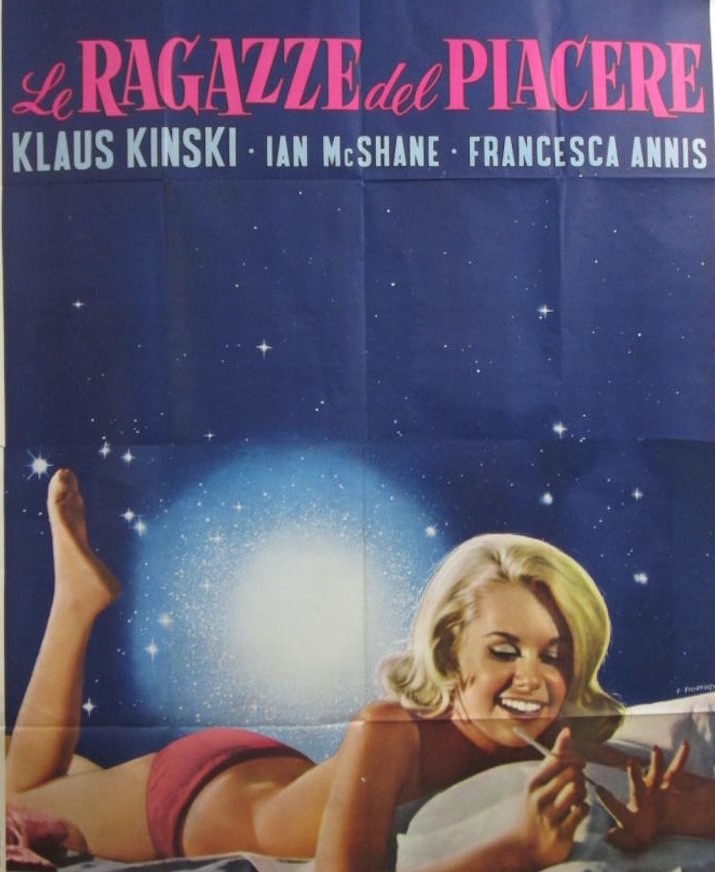
The Pleasure Girls (1965) ***

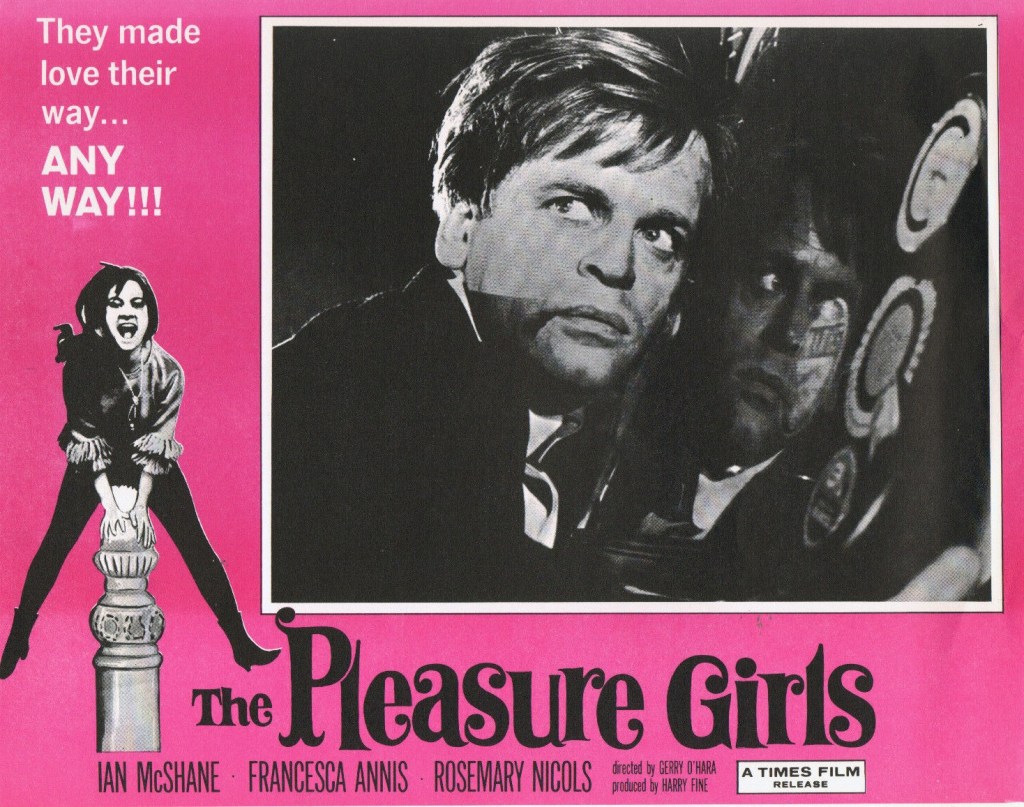
Klaus Kinski and The Pleasure Girls. What depraved mind dreamed up that concoction?

In reality, given this is early onset Kinski, before he was a fully-developed beast, and because it just precedes the British censor throwing off his shackles to accommodate the likes of Blow Up (1966) and The Fox (1967) it’s pretty tame stuff.

Klaus Kinski – what more did any B-picture of the decade need?

The girls might parade in night attire, and, should they happen to sleep in the nude, flash a bit of less rude skin, but that’s as far as it goes although at least couples are permitted to share a bed unlike the U.S. where that was outlawed by the Production Code (hence, in case you didn’t work it out, why there was so much frolicking via censor loopholes such as the outdoors or in the surf a la From Here to Eternity).

And you might find it hard to believe that John Wick’s Ian McShane has been a star for nearly half a century. Though here on the shifty side here and a shade fresh-faced his trademark cynical eyebrow is perpetually raised. He’s one of the suitors of a posse of girls sharing a house in London. A year later and a photographer like him would have had girls throwing themselves at him rather than primly trying to hold onto their virginity.

A weekend of drama awaits model wannabe and suburban lass Sally (Francesca Annis) on her arrival at the house, a whirlwind of parties beckoning, though drugs and booze in little evidence. Among her flatmates glamorous Dee (Suzanna Leigh) is mistress of slum landlord Nikko (Klaus Kinski) and while happy to be wined and dined and presented with jewellery,  fur coats and cash, draws the line at being put up in an apartment. Compliant Angela (Anneke Wills) is enmeshed with unscrupulous gambler Priddy (Mark Eden).

While there are plenty good-time girls to hand in casinos and there is some discreet nudity at a party it’s not exactly high-end stuff what with scenes set in launderettes and street markets and girls cutting themselves shaving their legs. And while proclaiming himself sex-mad, Keith (Ian McShane) is rather more romantic than he would like, prepared to wait for Sally, even while spouting self-conscious lines like “surely every girl wants you to want to even if she doesn’t want to,” the kind of hypocritical male double standard of the day.

The Sally-Keith relationship doesn’t get much beyond will she-won’t she so the real drama takes place in the lives of Dee-Nikko and Angela-Priddy and Dee’s very outgoing brother Paddy (Tony Tanner). Nikko collects debts with the help of thugs and an Alsatian, while Priddy sells his girlfriend’s precious brooch.

There’s more violence than sex. One man beaten up and tied to the hood of a car to be whipped with a belt. Another is tied to a chair and hung out a window. And, for the time, one man’s homosexuality is unusually tenderly expressed while the prospect of a career being more attractive than marriage is given a fair airing.

It’s surprisingly well acted, all the characters believable with enough development twists to keep you interested, and of course it’s not the degrading or unseemly world the posters would have you believe although in a pre-Pill world the dangers of unprotected sex are only too obvious.

Producers Tony Tenser (later founder of Tigon) and Michael Klinger (Get Carter, 1971) had made their reputations on exploitation pictures like the previously-reviewed London in the Raw (1964) and this attempts, at least for marketing purposes, to go down a similar seedy route, but is confounded by a storyline that is more Peyton Place than Bad Girls Have Sex.

It’s more an opportunity for rising stars to be put though their paces rather than characters put in their place. Ian McShane’s (Sky West and Crooked/Gypsy Girl, 1966) twinkle is never far from view and he demonstrates the charm that will keep him in demand for the next near-50 years. Klaus Kinski (Five Golden Dragons, 1967) is remarkably restrained given his later work, proving he doesn’t have to over-act to make his mark.

Of the others in the talent shop window, Suzanna Leigh (Deadlier than the Male, 1967) makes the biggest impact. It didn’t make a star out of Francesca Annis though Mark Eden (Curse of the Crimson Altar/The Crimson Cult, 1968) had marginally better luck.

Gerry O’Hara (Maroc 7, 1967) directed from his own script.

Behind the Scenes: “The Counterfeit Traitor” (1962)

Authenticity came at a cost. In electing to film in Europe veteran producer-director team of William Perlberg and George Seaton, their partnership stretching back two decades, incurred the ire of U.S. movie unions campaigning against “runaway” productions and tax-avoiding stars like William Holden. Feelings ran so high the movie was picketed on release, even though it had received a Presidential seal of approval after John F. Kennedy requested a screening.

Perlberg and Seaton were lucky not to be indicted for a further act of anti-Hollywood behavior, the hiring of so many European actors and actresses in favor of the home-grown variety, but with the incursion of Sophia Loren, Brigitte Bardot and Gina Lollobrigida into the U.S. box office introducing another big female star into the Hollywood firmament would likely have been welcomed.

Producer Perlberg bluntly defended the decision to film abroad a movie set in war-torn Europe (where much of the damage caused by the war had not been rectified). “Where would you find three solid blocks of rubble but Berlin?” he demanded. “Or a prison like Moabit? Our company was yesterday filming in a partially bombed out section of the Altona railway station, six stories high. Action involved a 14-car German train (which Union Pacific can’t reproduce). How can we build Stockholm in Hollywood.” More to the point, he added, “Of course where in the world can you get weather like this? It’s been raining every day.”

Perlberg and two-time Oscar winner Seaton (Airport, 1970), separately and together, had considerable experience of war pictures, having between them made The Proud and the Profane (1956) and The Bridges at Toko-Ri (1954), both pictures, incidentally, starring Holden. The Alexander Klein bestseller The Counterfeit Traitor, purchased in 1957 for a modest $75,000, appeared to follow a similar trajectory. “Competition for the entertainment dollar has wedded us to big films and global stories,” maintained Perlberg despite complaint by Hollywood unions that such films, in the face of shrinking U.S. production, denied their members work.

Although the European locations would shave $500,000 from the budget of The Counterfeit Traitor, still coming in at a hefty $3.4 million and originally to be filmed under the title Man in the Middle, Perlberg was adamant that “the picture could never be made in Hollywood with justice to the subject and story… We are shooting this picture where it happened. On the streets that Eric Erickson (the character William Holden plays) walked; in the houses that were his hideouts.”

Perhaps key to this philosophy was the ability to shoot inside the notorious and still-active Moabit Prison, housing 1,300 prisoners and located close to Berlin’s famous Tiergarten. Amazingly, the prison warden granted permission not just to shoot in the courtyard but also inside the actual building. The prison officials initially denied that anyone was shot in the courtyard (a key scene in the film) until Erickson turned up and testified to the contrary, standing in the cell through whose bars he had witnessed the execution. You could not buy such authenticity and certainly not recreate it in a Hollywood back lot.  

Paperback movie tie-in.

The 100-day shooting schedule included a month in Berlin, two months in Hamburg and scenes set in Copenhagen and Stockholm. It was the epitome of a multi-country adventure – the cameraman French (Jean Bourgoin who shot Tati’s Mon Oncle), wardrobe coordinator Italian, sound mixer German and assistant director British. But in Denmark, they worked with a Danish crew, in Sweden a Swedish crew. “I doubt that any other picture has been made with this type of operation – changing crews with each country involved. It has certain pitfalls but we’ve found in Germany alone that it would have been foolish to do it any other way,” added Perlberg.

“Hollywood set dressers, for instance, are great but no amount of research can match actual experience. Our interior decorators lived in the environment, witnessed the events and dressed the sets accordingly.” Apart from language problems, in Germany, where the bulk of filming took place, the lack of a centrally located “movie town” like Hollywood caused issues. Actors and crew were drawn from Berlin, Munich and Hamburg, with all the cast put up in first class hotels and paid a per diem of $15. With over 70 speaking roles, the movie also called on 2,000 extras.  The producers also worked in the oldest film studio in the world, Nordish Film in Copenhagen built in 1906, and the rebuilt Palladium, which had been blown up by the Germans during World War Two.

Actors and directors worked abroad to limit their U.S. tax exposure. Anyone taking advantage of foreign income was viewed as a tax cheat. William Holden, who would only make one movie in Hollywood in seven years, epitomized the wealthy tax dodger. Living abroad also cut down on paying U.S. tax. Switzerland, for example, where Holden took up residence, calculated tax on the amount you spent on the annual rental of your home, resulting in huge savings – Yul Brunner claimed this legitimate move alone had saved him $2 million.

Holden complained that he was unfairly being singled out. “How about Clark Gable in Naples, Tony Quinn, Charlton Heston in Ben- Hur? Why do they pick on me? I pay U.S. taxes in the highest brackets and will continue doing so for years.” He was a prime target not just because he was outspoken about living and working abroad but because he was, along with John Wayne, the highest-earning male actor, on $750,00 per picture plus percentage. He had the pick of the projects, linked with The Guns of Navarone (1961), The Alamo (1961), The Americanization of Emily with William Wyler in the director’s chair, The Visit with Ingrid Bergman and Melody for Sex where he would be paired with both Sophia Loren and Gina Lollobrigida. He had followed up The World of Suzie Wong (1961) filmed in Hong Kong, with Satan Never Sleeps (1961) filmed in Britain, and then was lining up The Lion in Kenya, Together in Paris (aka Paris When It Sizzles) in France and The 7th Dawn in Malaya.

Although Prussian-born Lili Palmer (Sebastian, 1968) was an established Hollywood import, the movie offered a wide range of parts to fast-rising European talent. Most major studios had already invested in “new faces from abroad” so Perlberg-Seaton were not going against the grain on this one. Paramount, for example, had hired the German Hardy Kruger and the French Gerald Blain and Michele Girardon for Hatari! (1962). Columbia lined up Frenchman Alain Delon for Lawrence of Arabia (1962) and Greek actress Irene Papas in the female lead in The Guns of Navarone (1961). MGM chose Ingrid Thulin for The Four Horsemen of the Apocalypse (1962) and United Artists set Maximilian Schell in Judgement at Nuremberg (1961). Claudia Cardinale was intended to make her Hollywood debut opposite Sidney Poitier in Iron Men – never made.

Heading the list of potential break-out stars were Ingmar Bergman protegees Sweden’s Eva Dahlbeck (Smiles of a Summer Night, 1955) and Ulf Palme (Dreams, 1955). They had appeared in two films together, Dreams and Meeting in the Twilight (1946). German Wolfgang Preiss would later appear in The Train (1965) and Von Ryan’s Express (1965). But the biggest casting coup was Klaus Kinski. “No German producer lightly engages him because most of his engagements in German theaters have ended with a resounding quarrel or scandal,” explained journalist Peter Baker, “(but he is) nevertheless regarded with awe and respect as one of the greatest actors to merge from post-war Germany.” His three days in The Counterfeit Traitor won him a role in Perlberg-Seaton’s next picture The Hook (1963).  

SOURCES: William Perlberg, “Searching Europe for Authenticity,” Films and Filming, February 1961, p9; Peter Baker, “The Tour of Babel,” Films and Filming, February 1961, p10-11, 41; “Lazar Percenting Ericson Spy Tome,” Variety, October 16, 1957, p3; “Lament for B.O. Stars,” Variety, January 29, 1958, p14; “Holding Money via Residence in Switzerland,” Variety, August 5, 1959, p12;“Par’s Sex Stars,” Variety, September 2, 1959, p3; “Holden, Seaton Invade Berlin for War Film,” Variety, October 28, 1959, p7; “H’wood – O’Seas Row Boils Up,” Variety, August 24, 1960, p7; “Bill Perlberg’s Back and Loves Hollywood,” Variety, November 2, 1960, p7; “New Faces from Abroad To Make Debuts in U.S. Films During 1961–62 Season,” Box Office, September 4, 1961, p12-13; “President Kennedy Sees Counterfeit Traitor,” Box Office, May 7, 1962, pW8; “Warm-Up for Picketing Strategy,” Variety, June 6, 1962, p4.

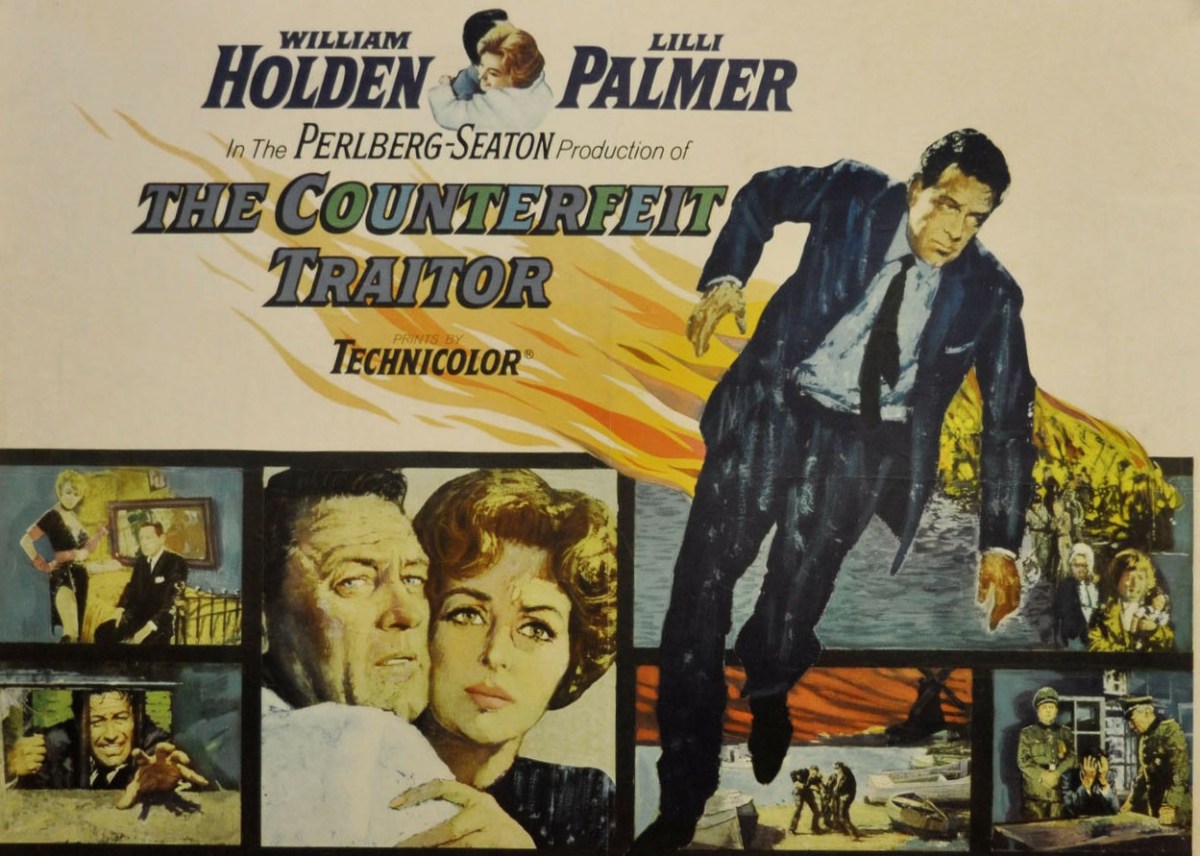
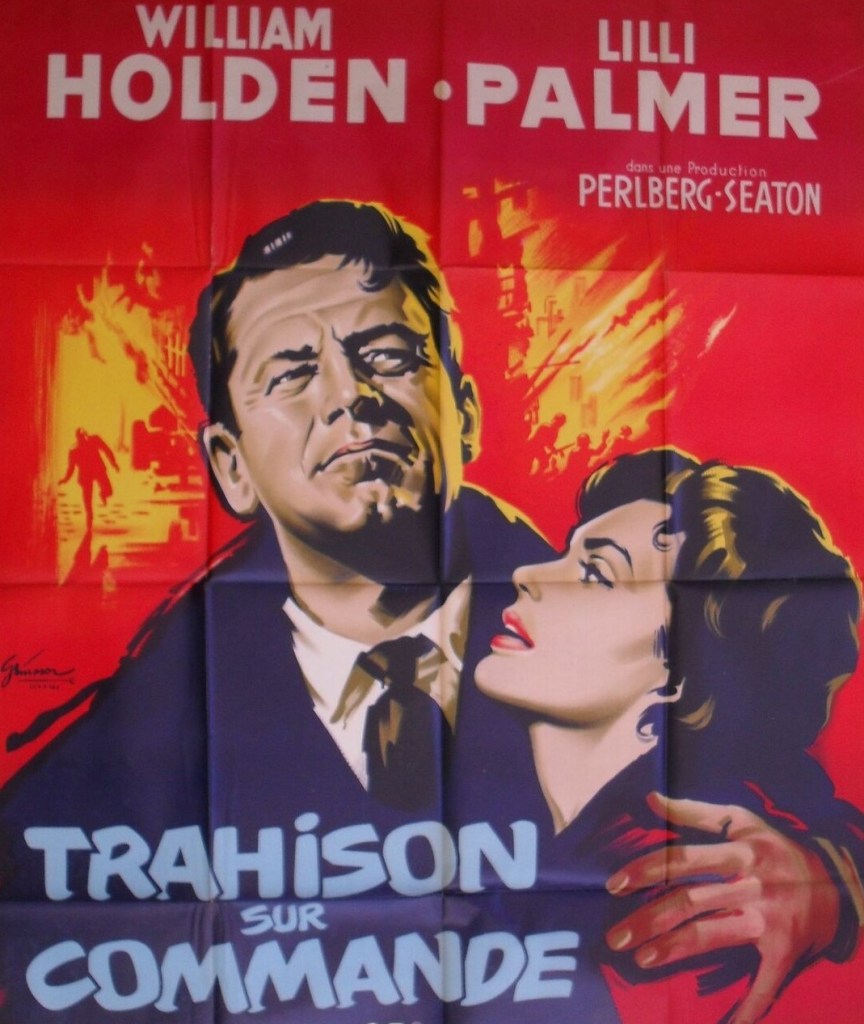
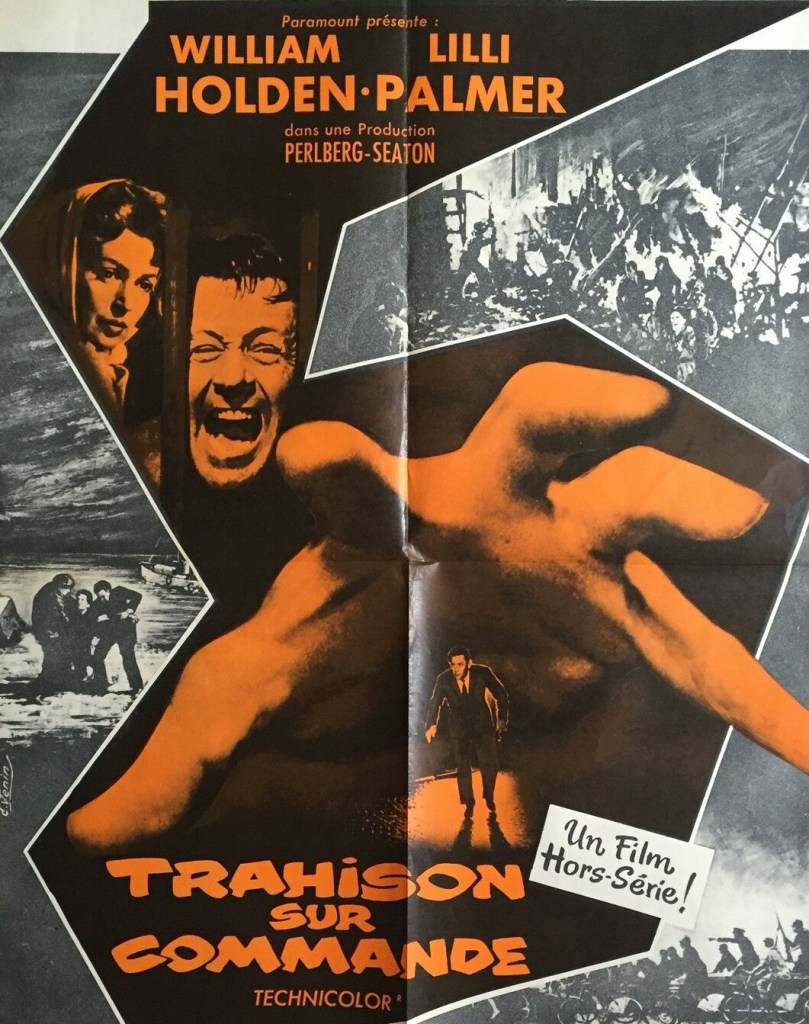
The Counterfeit Traitor (1962) ***

Cynical and opportunistic Swedish oil executive Eric Erickson (William Holden) blackmailed into World War Two espionage finds redemption after witnessing first-hand the horrors of Nazi Germany. Two extraordinary scenes lift this out of the mainstream biopic league, the first Erickson witnessing an execution, the second a betrayal. While some participants in the espionage game pay a terrible price, others like spy chief Collins (Hugh Griffiths) manage to maintain a champagne lifestyle.

Structurally, this is something of a curiosity. The first section, with over-emphasis on voice-over, concerns Holden’s recruitment and initial attempts at spying on German oil installations on the pretext of building a refinery in Sweden. Although resenting the manner in which he was recruited, Erickson has no qualms about resorting to blackmail himself to enlarge his espionage ring.

But it’s only when Marianne Mollendorf (Lili Palmer) enters the frame as his contact in Germany that the movie picks up dramatic heft. As cover for frequent meetings, they pretend to be lovers, that charade soon deepening into the real thing. While abhorring Hitler, she suffers a crisis of conscience after realising that the information she is passing on to the Allies results in innocent deaths. The final segment involves Erickson’s thrilling escape back home.

The picture is at its best when contrasting the unscrupulous Erickson with the principled Marianne. Virtually every character is trying to hold on to a way of life endangered by the war or created by the conflict and there are some interesting observations on the way Erickson manages to harness foreign dignitaries while being held to hostage in his home country. Loyalties are sparing and even families come under internal threat.

Sweden was neutral during the Second World War so in assisting the Allied cause Erickson was effectively betraying his country and once, in order to keep proposed German investors sweet, he begins to spout Nazi propaganda at home finds himself deserted by friends and, eventually, wife.  

In some respects, Holden (The Devil’s Brigade, 1968) plays one his typical flawed personalities, easy on the charm, fluid with convention, but once he learns the true cost of his espionage a much deeper character emerges. The actor’s insistence, for tax reasons, on working abroad – this was filmed on location in Europe – would hamper his box office credibility and although not all his movie choices proved sound this was a welcome diversion. Whether American audiences were that interested in what a Swede did in the war was a moot point, as poor box office testified. And the title might have proved too sophisticated for some audiences, given there was no counterfeiting of money involved.

Lili Palmer (Sebastian, 1968) is excellent as the manipulative Marianne, betraying her country in order to save it from the depredations of Hitler, not above using her body to win favour, but paralyzed by consequence. Hugh Griffith (Exodus, 1960) provides another larger-than-life portrayal, disguising his venal core. Werner Peters (Istanbul Express, 1968) puts in an appearance and Klaus Kinski (Five Golden Dragons, 1967) has a bit part.

Double Oscar-winner George Seaton (Airport, 1970) makes a bold attempt to embrace a wider coverage of the war than the film requires and could have done with concentrating more on the central Erickson-Mollendorf drama, especially the German woman’s dilemma, but, made before James Bond reinvented the idea of espionage, this remains a more realistic examination of duplicity in wartime.

CATCH-UP: William Holden pictures reviewed in the Blog are Alvarez Kelly (1966) and The Devil’s Brigade (1968); Lili Palmer movies reviewed are Operation Crossbow (1965), Sebastian (1968) and Hard Contract (1969).

Year-End Round-Up: Top 30 Films Chosen by You

Top 30

This isn’t my choice of the top films of the year, but yours, my loyal readers. This is a chart of the films viewed the most times over the full calendar year of January 2021 – December 2021.

  1. The Secret Ways (1961). Richard Widmark in spy thriller set in Hungary during the Cold War and adapted from the Alistair MacLean novel. Senta Berger has a small role.
  2. Ocean’s 11 (1960). Frank Sinatra, Dean Martin and the Rat Pack embark on an audacious Las Vegas robbery.  
  3. Pharoah (1966). Epic Polish picture about political shenanigans in ancient Egypt.
  4. Age of Consent (1969). Helen Mirren stars as the nubile muse of jaded painter James Mason returning to his Australian roots.
  5. The Venetian Affair (1966). Robert Vaughn hits his acting stride as a former CIA operative turned journalist investigating suicide bombings in Venice. Great supporting cast includes Elke Sommer and Boris Karloff.
  6. The Golden Claws of the Cat Girl (1968). Cult French movie  starring Daniele Gaubert as a sexy cat burglar.
  7. Moment to Moment (1966). Jean Seberg is caught up in a Hitchcockian murder plot in the French Riviera. Also features Honor Blackman.
  8. It’s Not All Rock’n’Roll (2020).  Ageing rocker Dave Doughman aims to mix a career with being a father in this fascinating documentary.
  9. 4 for Texas (1963). Frank Sinatra and Dean Martin face off in a Robert Aldrich western featuring Ursula Andress and Anita Ekberg with Charles Bronson in a smaller part.
  10. Once a Thief (1965). Trying to go straight ex-con Alain Delon is coerced into a robbery. Ann-Margret is a revelation as his wife. Jack Palance, Van Heflin and Jeff Corey add up to a great supporting cast.  
  11. Stiletto (1969). Alex Cord as a Mafia hitman wanting to retire is pursued by tough cop Patrick O’Neal. Britt Ekland heads a supporting cast which includes Roy Scheider, Barbara McNair and Joseph Wiseman.
  12. Subterfuge (1968). C.I.A. operative Gene Barry is called to London to uncover a mole in M.I.5. Joan Collins provides the romance. Richard Todd, Tom Adams, Suzanna Leigh and Michael Rennie lend a touch of class.
  13. The Swimmer (1968). Burt Lancaster delivers a superlative performance as a man whose life is falling apart.
  14. The Rock (1996). Blistering thriller starring Sean Connery as an ex-inmate of Alcatraz helping Nicolas Cage infiltrate the island to prevent mad general Ed Harris destroying San Francisco. Michael Bay directs.
  15. The Sicilian Clan (1969). Alain Delon joins forces with Jean Gabin to pull off an daring jewel heist with tenacious cop Lino Ventura on their trail. French thriller directed by Henri Verneuil.
  16. The Naked Runner (1967). With his son held hostage, Frank Sinatra is forced to carry out an assassination in East Germany.
  17. A House Is Not a Home (1965). Biopic of notorious madam Polly Adler (played by Shelley Winters) who rubbed shoulders with the cream of Prohibition gangsters.
  18. Pressure Point (1962). Prison psychiatrist Sidney Poitier must help racist Nazi Bobby Darin.
  19. Genghis Khan (1965). Omar Sharif plays the legendary warlord who unites warring Mongol tribes. Stellar cast includes Stephen Boyd, James Mason, Francoise Dorleac, Eli Wallach, Telly Savalas and Robert Morley.
  20. A Twist of Sand (1968). Beleaguered smuggler Richard Johnson spars with Jeremy Kemp in thriller about hidden diamonds in Africa. Honor Blackman is along for the voyage.
  21. Jason and the Argonauts (1963). Ray Harryhausen special effects dominate this legendary tale of the hunt for the Golden Fleece.  
  22. Dr Syn Alias the Scarecrow (1963). Disney movie that was turned into a mini-series in the U.S. starring Patrick McGoohan as the eponymous Robin Hood-type character who assists smugglers.
  23. The Hitman’s Wife’s Bodyguard (2021). Ryan Reynolds and Samuel L. Jackson reunite for wild sequel also featuring Salma Hayek and Antonio Banderas.
  24. Dark of the Sun / The Mercenaries (1968). Rod Taylor leads a private army into the war-torn Congo to rescue a cache of uncut diamonds. Jim Brown, Yvette Mimieux and Kenneth More co-star. Based on the Wilbur Smith bestseller.
  25. The Guns of Navarone (1961). Classic war mission picture with an all-star cast of Gregory Peck, David Niven, Anthony Quinn, Stanley Baker, Irene Papas and Gia Scala. Adapted from the Alistair McLean bestseller.
  26. Maroc 7 (1967). Gene Barry infiltrates a gang of jewel thieves in Morocco operating under the cover of a fashion shoot. Dazzling female cast includes Elsa Martinelli, Cyd Charisse, Tracy Reed and Alexandra Stewart.
  27. The Satan Bug (1965). John Sturges adaptation of Alistair MacLean pandemic thriller stars George Maharis, Richard Basehart and Dana Andrews.
  28. Five Golden Dragons (1967). Cult thriller with Robert Cummings as the playboy caught up in an international crime syndicate. Klaus Kinski and Christopher Lee head an exceptional supporting cast that also includes Margaret Lee, Brian Donlevy, George Raft, Dan Duryea and Maria Rohm.
  29. Claudelle Inglish (1961). Diane McBain as the poor farmer’s daughter who wants to get rich quick.
  30. Jessica (1962). Angie Dickinson plays a young widow who turns so many heads in a small Italian town that their wives seek revenge.

Our Man in Marrakesh aka Bang! Bang! You’re Dead! (1966) ***

All hail Senta Berger! Another from the Harry Alan Towers (Five Golden Dragons, 1967) portfolio, this is a spy-thriller mash-up with a bagful of mysteries and a clutch of corpses. At last given a decent leading role, and although you wouldn’t guess it from either poster, Senta Berger steals the show from the top-billed Tony Randall (as miscast as Robert Cummings in Five Golden Dragons) and a smorgasbord of European  talent including Herbert Lom (The Frightened City, 1961), Terry-Thomas, Klaus Kinski (Five Golden Dragons), John Le Mesurier and Wilfred Hyde-White (Carry On Nurse, 1959). In this company, the glamorous Margaret Lee (Five Golden Dragons), as Lom’s cynical lover (“you are never wrong, cherie, you told me so yourself,” she tells him) is an amuse-bouche.

A more comedic approach to the movie when it was re-titled for U.S. release. At least here it did not try to sell itself as a Bond-type picture.

Six travellers – including oilman Randall, travel agent Le Mesurier, salesman Hyde-White and tourist Berger, meeting her fiancé – board a bus from Casablanca airport to Marrakesh. One is carrying $2 million as a bribe to ease through a vote in the United Nations, but bad guy Lom doesn’t know which one it is. When Berger’s fiance’s corpse tumbles out of Randall’s cupboard, the pair become entangled. Berger is a marvellous femme fatale, trumping Randall at every turn. 

With no shortage of complications, the tale zips along, directed on occasion with considerable verve by Don Sharp (The Devil-Ship Pirates, 1964). There are some inventive double-plays – with a body in the boot Berger and Randall are stopped by a cop who tells them their boot is open. An excellent rooftop chase is matched by a car chase. And there’s a terrific shootout. Kinski is at his sinister best and Terry-Thomas a standout in an unusual role as a Berber.

The film was shot on location including the city’s souks, the ruined El Badi Palace and La Mamounia hotel (featured in The Man Who Knew Too Much, 1956). But Berger seamlessly holds the whole box of tricks together, at once glamorous and sinuous, practical and tough and exuding sympathy, and it’s a joy to see her for a large part of the picture leading Randall by the nose. Quite why this did not lead to bigger Hollywood roles than The Ambushers (1967) remains a mystery.

Discover WordPress

A daily selection of the best content published on WordPress, collected for you by humans who love to read.

The Atavist Magazine

by Brian Hannan

WordPress.com News

The latest news on WordPress.com and the WordPress community.