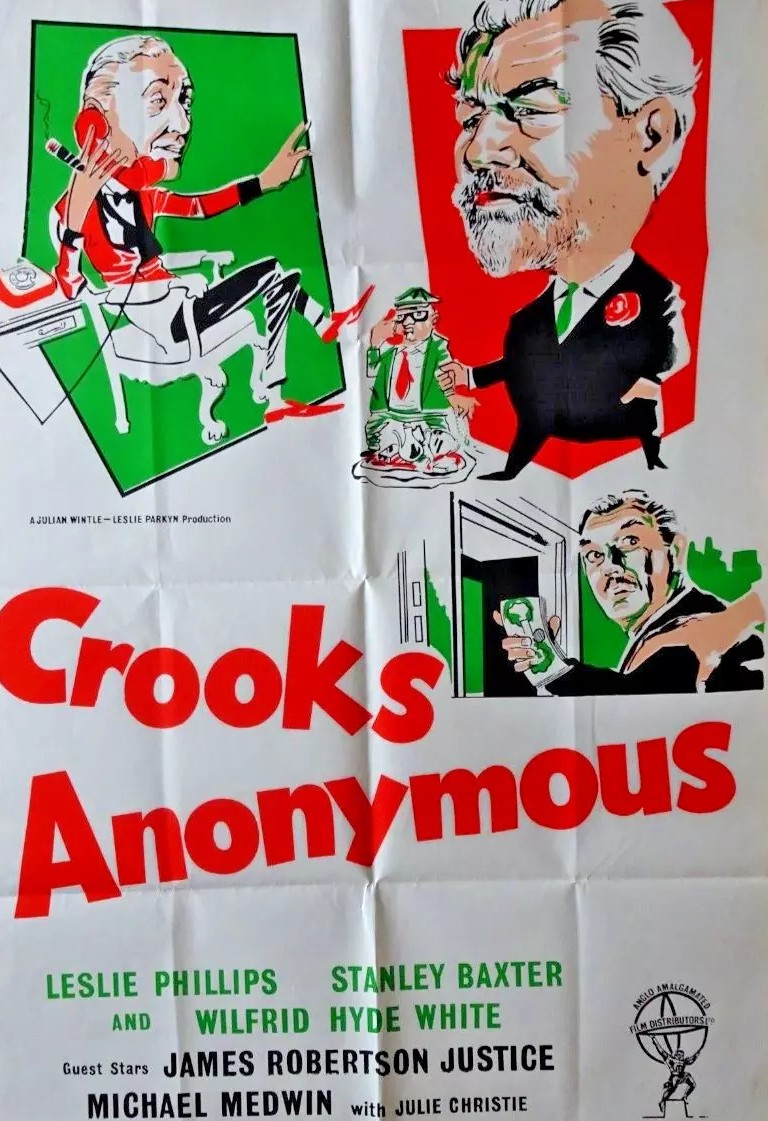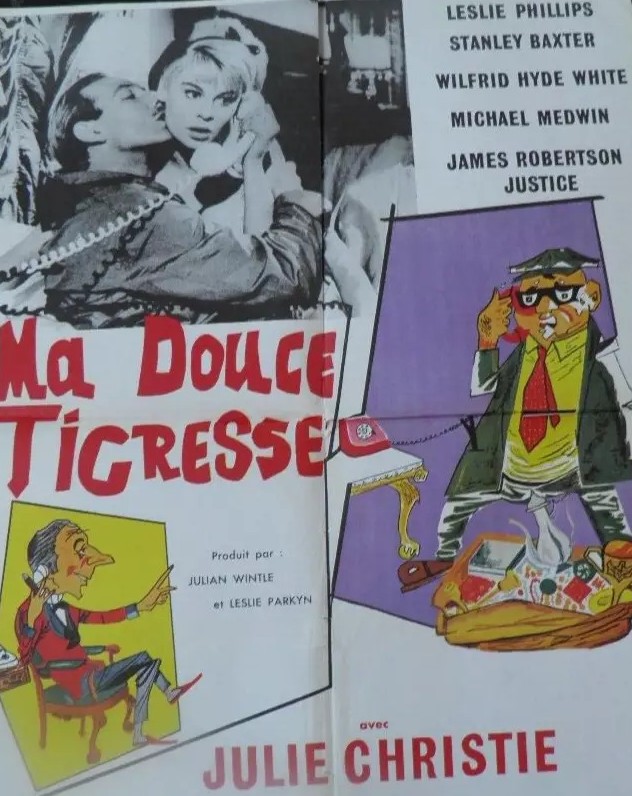
Crooks Anonymous (1962) ***

Charm was in short supply in the 1960s. Sure, for a period you still had Cary Grant but David Niven was as often to be found in an action picture (The Guns of Navarone, 1961) or a drama, and others of the ilk, like Tony Curtis, veered more towards outright comedy. Britain had something of what would today be called a “national treasure,” admittedly a term more likely to be accorded females of the standing of Maggie Smith or Judi Dench; maybe a space might be found for the idiosyncratic Ralph Richardson. Dare I put Leslie Phillips into contention for such an honor?

Once into his mellifluous stride and with his trademark appreciation of female beauty, “Ding dong!” a more welcome remark than the more common “Cor!” or “Strewth” or sheer inuendo, Leslie Phillips, not so well known perhaps in the USA and foreign parts, would fit that definition. He had charm in spades.

Unfortunately, you could split his career into those roles where “ding dong” entered the equation and those it did not. This is one of those, and I have to confess I’m both disappointed and delighted. Dissatisfied because the charm appeared part of his screen persona, but pleased whenever I found out he wasn’t tied down to it and could essay other characters just as well.

Here, here’s shifty criminal Dandy, whose only redeeming feature is that somehow he has acquired a beautiful girlfriend, stripper Babette (Julie Christie), who, despite her profession

appears to have steered cleared of seediness and insists he goes straight before she consents to marriage. And that would be fine, except what can Dandy do when faced with such obvious temptation and jewels left idly on a counter in a jewellery?

When she catches him out, he is sent to the criminal version of Alcoholics Anonymous where he is at the mercy of a particularly sadistic “guardian angel” Widdowes (Stanley Baxter – in a variety of disguises). He is locked in a cell full of safes. Food, cigarettes etc are hidden inside the safes, so to eat and satisfy his smoking habit, he must open them. The logic, presumably, is that he will grow sick and tired of opening so many safes for so little reward.

Maybe it’s the hidden punishments – a touch of electrocution and various other booby traps – that do the trick. Or, it could be the glee of Widdowes. When Dandy finds cigarettes, they come without any means of lighting them. He pleads with Widdowes to point him in the direction of a safe containing means of ignition.Replies the “angel”, “I’m glad you asked that because I’m not going to tell you.”

There’s a whole raft of comedy skits revolving around temptation, mostly involving Widdowes in one guise or another. And when the movie stays with Widdowes and a bunch of other reformed criminals, it fairly zips along. But once Dandy is released and plot rears its ugly head it falls back on more cliché elements.

Dandy manages to go straight, employed as a Santa Clause in a department store, while Babette decides to give up her job so both can start afresh. Unfortunately, temptation raises its ugly head to the tune of a quarter of a million pounds and all those goody-two-shoes reformed criminals line up to take a crack at it. The twist, which you’ll already have guessed, is that they have to break into the vault again to return the money they have stolen.

Scottish comedian Stanley Baxter was going through a phase of attempting to become a movie star and was given a fair old crack at it – The Fast Lady (1962) and Father Came Too (1964) followed, the former with both Philips and Christie, the latter with just him.

But what was obvious from Crooks Anonymous was that Baxter was better in disguise – and the more the merrier – than served up straight. He steals the show here where in the other movies his character is more of an irritant.

A well-meaning Leslie Phillips somehow snuffs out the charm and there’s not enough going on between him and Babette when he’s full-on straightlaced. Heretical though it might be, there’s not enough going on with Julie Christie either to suggest she might be Oscar bait. Here’s she’s just another ingenue.

Wilfrid Hyde-White (P.J. / New Face in Hell, 1967), another who generally traded on his charm (in a supporting category of course), is also in the disguise business, so he steals a few scenes, too. James Robertson Justice (Father Came Too) would have stolen the picture from under the noses of Baxter and Phillips had he been given more scenes.

Directed by Ken Annakin (Battle of the Bulge, 1965) from a screenplay by Jack Davies and Henry Blyth (Father Came Too).

I might have preferred Phillips in “ding dong” persona, but this works out okay, especially in the scenes set in the criminal reform school.

Ding dong-ish.

Crooks Anonymous (1962) ***

Charm was in short supply in the 1960s. sure, for a period you still had Cary Grant but David Niven was as often to be found in an action picture (The Guns of Navarone, 1961) or a drama, and others of the ilk, like Tony Curtis, veered more towards outright comedy. Britain had something of what would today be called a “national treasure,” admittedly a term more likely to be accorded females of the standing of Maggie Smith or Judi Dench; maybe a space might be found for the idiosyncratic Ralph Richardson. Dare I put Leslie Phillips into contention for such an honor?

Once into his mellifluous stride and with his trademark appreciation of female beauty, “Ding dong!” a more welcome remark than the more common “Cor!” or “Strewth” or sheer inuendo, Leslie Phillips, not so well known perhaps in the USA and foreign parts, would fit that definition. He had charm in spades.

Unfortunately, you could split his career into those roles where “ding dong” entered the equation and those it did not. This is one of those, and I have to confess I’m both disappointed and delighted. Dissatisfied because the charm appeared part of his screen persona, but pleased whenever I found out he wasn’t tied down to it and could essay other characters just as well.

Here, here’s shifty criminal Dandy, whose only redeeming feature is that somehow he has acquired a beautiful girlfriend, stripper Babette (Julie Christie), who, despite her profession

appears to have steered cleared of seediness and insists he goes straight before she consents to marriage. And that would be fine, except what can Dandy do when faced with such obvious temptation and jewels left idly on a counter in a jewellery?

When she catches him out, he is sent to the criminal version of Alcoholics Anonymous where he is at the mercy of a particularly sadistic “guardian angel” Widdowes (Stanley Baxter – in a variety of disguises). He is locked in a cell full of safes. Food, cigarettes etc are hidden inside the safes, so to eat and satisfy his smoking habit, he must open them. The logic, presumably, is that he will grow sick and tired of opening so many safes for so little reward.

Maybe it’s the hidden punishments – a touch of electrocution and various other booby traps – that do the trick. Or, it could be the glee of Widdowes. When Dandy finds cigarettes, they come without any means of lighting them. He pleads with Widdowes to point him in the direction of a safe containing means of ignition.Replies the “angel”, “I’m glad you asked that because I’m not going to tell you.”

There’s a whole raft of comedy skits revolving around temptation, mostly involving Widdowes in one guise or another. And when the movie stays with Widdowes and a bunch of other reformed criminals, it fairly zips along. But once Dandy is released and plot rears its ugly head it falls back on more cliché elements.

Dandy manages to go straight, employed as a Santa Clause in a department store, while Babette decides to give up her job so both can start afresh. Unfortunately, temptation raises its ugly head to the tune of a quarter of a million pounds and all those goody-two-shoes reformed criminals line up to take a crack at it. The twist, which you’ll already have guessed, is that they have to break into the vault again to return the money they have stolen.

Scottish comedian Stanley Baxter was going through a phase of attempting to become a movie star and was given a fair old crack at it – The Fast Lady (1962) and Father Came Too (1964) followed, the former with both Philips and Christie, the latter with just him.

But what was obvious from Crooks Anonymous was that Baxter was better in disguise – and the more the merrier – than served up straight. He steals the show here where in the other movies his character is more of an irritant.

A well-meaning Leslie Phillips somehow snuffs out the charm and there’s not enough going on between him and Babette when he’s full-on straightlaced. Heretical though it might be, there’s not enough going on with Julie Christie either to suggest she might be Oscar bait. Here’s she’s just another ingenue.

Wilfrid Hyde-White (P.J. / New Face in Hell, 1967), another who generally traded on his charm (in a supporting category of course), is also in the disguise business, so he steals a few scenes, too. James Robertson Justice (Father Came Too) would have stolen the picture from under the noses of Baxter and Phillips had he been given more scenes.

Directed by Ken Annakin (Battle of the Bulge, 1965) from a screenplay by Jack Davies and Henry Blyth (Father Came Too).

I might have preferred Phillips in “ding dong” persona, but this works out okay, especially in the scenes set in the criminal reform school.

Ding dong-ish.

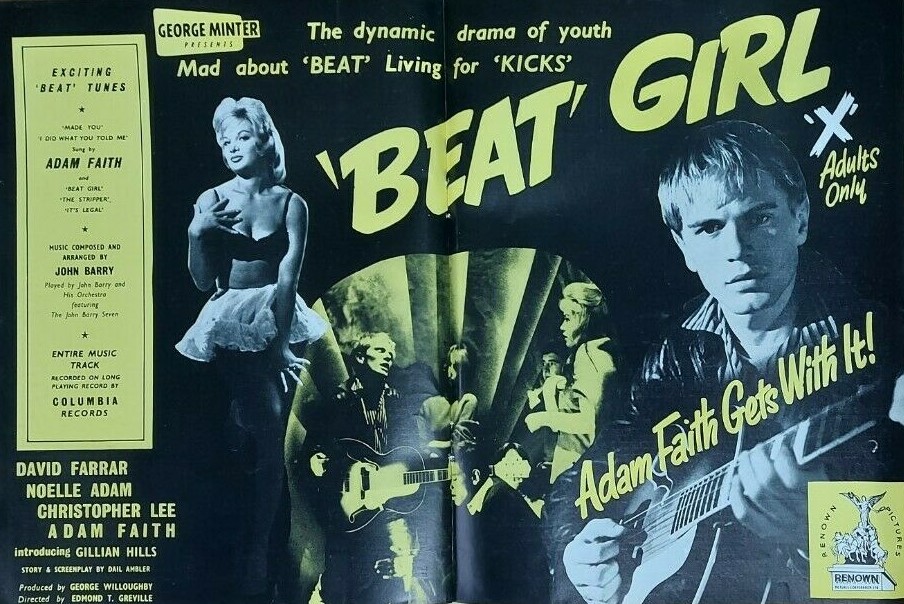
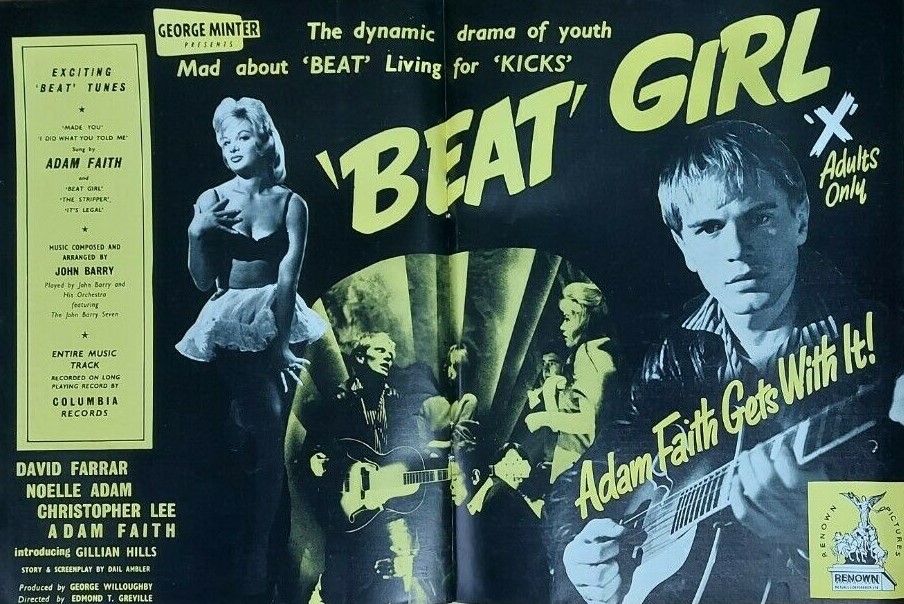
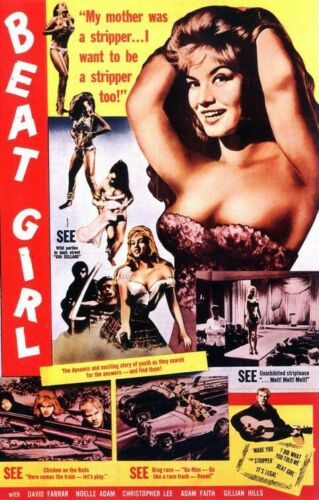
Beat Girl / Wild for Kicks (1960) **

More social document than drama, but that aspect somewhat diluted by the moviemakers’ attempts at exposing rebellious youth while taking for granted more sordid adult behavior. Narrative flow is interrupted now and then to showcase Adam Faith’s singing and to accommodate a few striptease acts. Probably more interesting is the array of new talent on show.

Spoiled teenager Jennifer (Gillian Hill) heads for the wild side of town to experience the beatnik lifestyle in Soho coffee shops and cellars. That there are no drugs involved, and that alcohol is considered “square” – as for that matter is violence – may come as a surprise to students of the period. Apart from one episode of road-racing and playing “chicken” along a railway track, most of the time the gang listen to music or dance until Jennifer gets it into her head that ejoining a striptease show might give her life the thrill it is missing.

This is prompted by the discovery that her new too-young stepmother Nichole (Noelle Adams) has been a stripper and most likely a sex worker in Paris before marrying wealthy architect Paul (David Farrar), cueing a round-robin of confrontations. Strangely enough, from the narrative perspective, none of the young bucks appear romantically interested in the provocatively dressed Jennifer and so it is left to creepy club owner Kenny (Christopher Lee) to make a move.

The gaping hole left by lack of narrative drive is not offset by immersion in the beatnik or striptease scene. Back in the day the British censors took the editing scissors to the striptease but although restored versions available now contain nudity you are left wishing that there was some lost element to the beatnik sections that would have given the picture the energy it required.

Gillian Hill (Les Liaisions Dangereuses, 1959), comes over as a cross between Brigitte Bardot and Diana Dors without having an ounce of the sex appeal of either. All pout and flounce, she is unable to inject any heart into her two-dimensional character, although given her youth and inexperience this was hardly surprising. Former British star David Farrar (Black Narcissus, 1947) was coming to the end of his career and in a thankless role as a frustrated father could do little to rescue the project.

French actress Noelle Gordon (Sergeant X of the Foreign Legion, 1960) could have been Jennifer’s mother given her own tendencies towards wiggle and pout but at least she makes a stab at trying to overcome her step-daughter’s hostility.

In the main, the picture’s delight is bringing to the fore a whole chorus of new faces. Pick of the supporting cast is Shirley Anne Field (Kings of the Sun, 1963) who doesn’t just have a knowing look but looks as if she knows what’s she doing acting-wise. Making his movie debut was teen pop idol Adam Faith, who had made his name playing in coffee bars. He had already notched up a couple of number one singles, but doesn’t quite set the screen on fire. Peter McEnery (The Fighting Prince of Donegal, 1966) plays his inebriated pal.

You can also spot Oliver Reed (Women in Love, 1969), Julie Christie (Doctor Zhivago, 1965), Claire Gordon (Cool It, Carol, 1970) and Nigel Green (Jason and the Argonauts, 1963).

Perhaps the most important debut belonged to composer John Barry. He had already been working with Adam Faith. Barry’s music for the film was the first British soundtrack album ever released, reaching number eleven on the charts, and opening the doors for future soundtrack albums, not least of which was the rich vein of theme tunes produced by Barry in the next few years. 

French director Edmond T. Greville, who brought little panache to the subject matter, would redeem himself with his next picture The Hands of Orlac (1960). 

This doesn’t fall into the “so-bad-it’s-good” category, nor has it been unfairly overlooked, and probably is better known as an example of the kind of exploitation B-picture that the Americans do so much better and a reminder that, except on rare occasions such as The Wild One (1953), older moviemakers seem incapable of capturing the essence of youth.

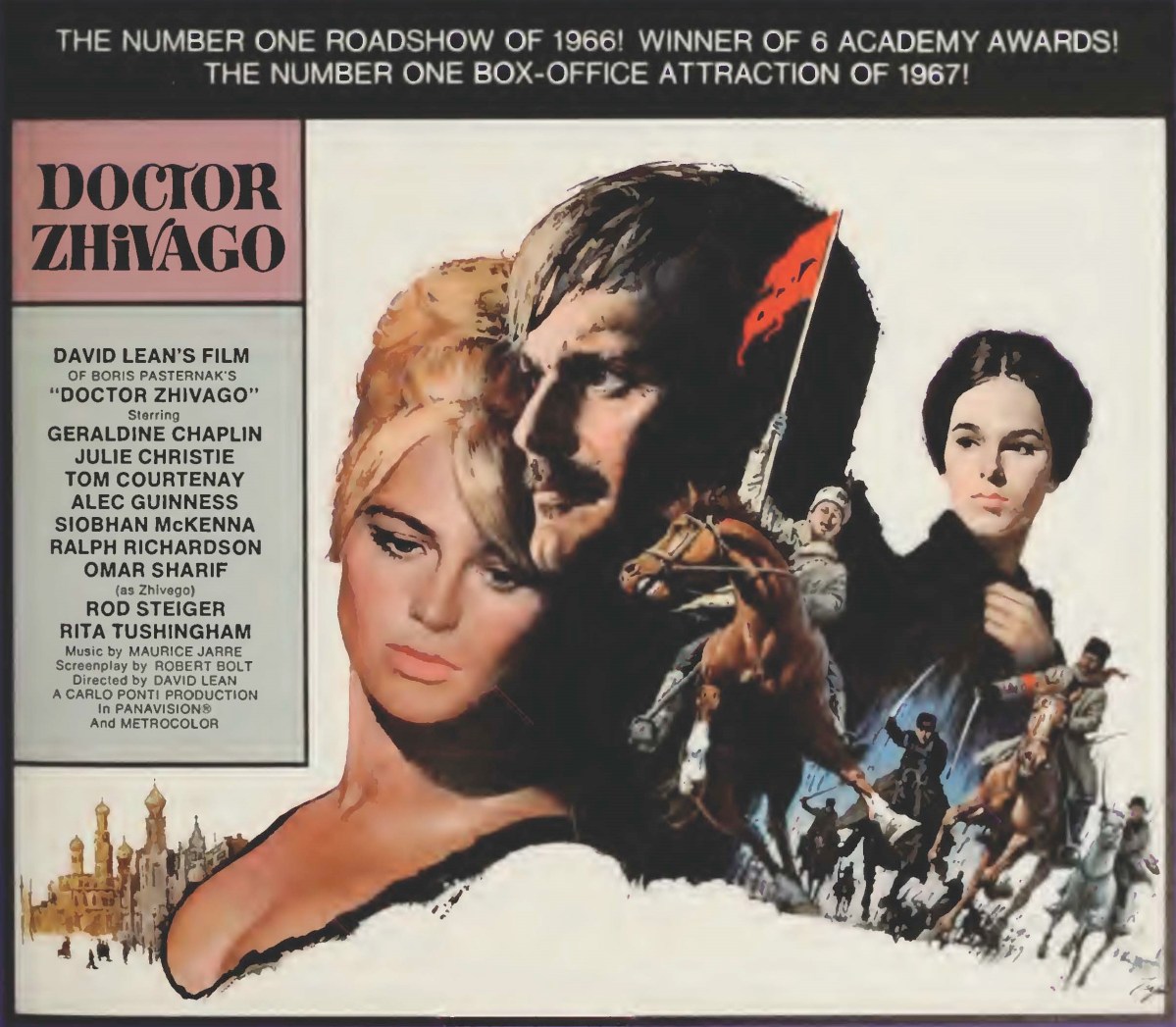
Behind the Scenes: “Doctor Zhivago” (1965)

That Italian producer Carlo Ponti owned the rights to Boris Pasternak’s worldwide bestseller – beating out a bid by Kirk Douglas and Stanley Kubrick – made it easier for David Lean to sever links with Sam Spiegel, producer of his two previous Oscar-winning blockbusters, Bridge on the River Kwai (1957) and Lawrence of Arabia (1962). Ponti lined up a deal with MGM who not only gave Lean carte blanche but the biggest ever salary handed to a director plus a generous profit share. Max von Sydow (The Quiller Memorandum, 1966) was Lean’s first suggestion for the leading role while MGM wanted Paul Newman (Cool Hand Luke, 1967) and Ponti was keen on Burt Lancaster (The Train, 1964).

Peter O’Toole (Lawrence of Arabia), fearing another exhaustive shoot, reportedly turned it down. Michael Caine (The Ipcress File, 1965) read for it. Omar Sharif (Lawrence of Arabia), all set to play the smaller role of Pasha, stepped in. Marlon Brando (The Chase, 1966) and James Mason (North by Northwest, 1959) were considered for Komatovsky – the former not replying to Lean’s offer, the laterr dropping out after accepting the role –  before that went to Rod Steiger (The Pawnbroker, 1964).

Front cover for the roadshow launch in the UK in 1966.

Jeanne Moreau (Viva Maria, 1965), Jane Fonda (Barbarella, 1968, who turned it down, then, recanted, by which time it was too late) Yvette Mimieux (Dark of the Sun, 1968), Sarah Miles (Lean’s Ryan’s Daughter, 1970), and, inevitably Ponti’s wife Sophia Loren (dismissed as “too tall” by Lean), were in the running for Lara until, on the recmmendation of John Ford who had directed Julie Christie in Young Cassidy (1965), the part went to the British actress. Audrey Hepburn (Charade, 1963) was Lean’s choice for Tonya until he was bowled over by the screen test by Geraldine Chaplin, the waif-like daughter of Charlie Chaplin, who, in the run-up to release, received the bulk of the advance publicity. Contrary to received wisdom, this was not her debut, she played opposite Jean-Paul Belmondo in Lovely Summer Morning (1965).

So, effectively, Lean was launching MGM’s biggest-ever productions with a cast headed by unknowns, Sharif’s marquee value not up to the mark, every film he had been in since Lawrence of Arabia had flopped and he had never received top billing – and would not here either.

Initially, Lean considered shooting in 70mm in black-and-white but 70mm equipment was deemed too cumbersome and monochrome too risky for such a big film so it was made in 35mm with the intention of blowing it up to the larger format for roadshow release. Ponti reckoned the movie could be made in the Soviet Union or Yugoslavia for $5 million. After switching to the eventual location, Spain, with some sequences filmed in Finland, it cost much more, over $11 million.

The shoot lasted 33 weeks but the production actually took two years and involved 800 craftsmen in three countries. . Original cinematographer Nicolas Roeg dropped out after “creative differences”, replaced by Freddie Young (Lawrence iof Arabia), adding two weeks to the schedule to reshoot Roeg’s scenes.

And for the general release three years later.

Much of what appeared on the screen was illusion. The Red Army charged across an apparently frozen lake at the height of summer, the lake itself non-existent, just a field covered in cement with sheet iron topped with thousands of tons of crushed white marble ironed out by steamrollers so when the horses slid it looked realistic. To complete the picture, a rowing boat was moored at the edge.

Other effects combined direcotrial genius with practicality. Prior to the scne featuring a huge field of daffodils, Lean had filmed three minutes of Zhivago and Lara against a freezing background, everything sprayed gray to remove any hint of color so that the sudden appearance of of the golden flowers cast a spell of spring.  To prevent the flowers  – 4,000 of them imported from the Netherlands – blooming too early, they had been dug up and put in pots to control their growth  and replanted when required. To make snow glisten in another scene, cellophane was spread over wintry bushes and trees.

The sleighs had little wheels fitted to the runners, icicles were made from polystyrene, the balalaika was created by the props team and the interior of the Ice Palace made from cellophane crushed into thousands of creases, paraffin wax and salicylic acid powder creating fantastic shapes. The floor was fashioned from a layer of soap flakes. The train journey went through Spain and in places where there were no railroad tracks, these were built.

Moscow, ten acres of it, rebuilt on a Spanish lot, took 18 months to construct and included 800 yards of cobbled street, the Kremlin, trolley cars and 60 houses and shops. Pasha’s armored train was an authentic replica. Even with the props trickery, Lean wanted to capture the different seasons so that was partly responsible for the long schedule. Sharif has his eyes taped back and his hairline shaved and straightened.

The aftermath of the dragoon charge down the steeets of Moscow was seen through the eyes of Zhivago – Lean’s advice to the actor was to imagine the moment before orgasm –  and it was just as well it worked because Lean had filmed no alternative.

The film intially struggled to attract public attention despite a $3 million publicity budget. Lean was not as marketable as Hitchcock or DeMille. The female leads were unknown, Darling (1965) not yet setting the box office buzzing except in arthouses. Sharif, as I mentioned, had not yet capitalized on Lawrence of Arabia.

“Lara’s Theme” was not yet in the shops – the soundtrack album sold 600,000 copies in a year becoming MGM’s biggest soundtrack seller –  and designer Phyllis Dalton’s furs were a long way from setting a fashion trend. Advance sales for the roadshow openings were poor, only $200,000 compared with $60,000 for Exodus (1961) and $500,000 for Cleopatra (1963). There was even speculation that the Capitol in New York where the film premiered had massaged the opening week’s figures. However, this kind of trickery would have been anathema in the industry, telling the truth about receipts to Variety every week considered the right thing to do, even if they fell short of expectation.

Historical epics had been long out of fashion. Lord Jim (1965) and The Agony and the Ecstasy, also roadshow numbers, were among the year’s box office casualties while a completely different type of movie, bouncy musical The Sound of Music (1965), was cleaning up. It didn’t help that Doctor Zhivago opened at the same time as Thunderball, the fourth Bond, which surpassed expectations with collosal initial box office. Nor did reviewers help. While Variety hailed its “soaring dramatic intensity” and the New York Daily News called it a “haunting emotion-charged drama,” the more influential New York Times slammed its “painfully slow-going and inevitable tedium” and it was condemned by the New York Herald Tribune as a “soap opera.”

In fact, if audiences had been slow to latch on, that was only during the first week, for soon it turned into a phenomenon, ending the decade as the $38.2 million in rentals. Lifetime rentals topped $60 million.  

SOURCES: Kevin Brownlow, David Lean (Faber and Faber, 1996); Eddie Fowlie, David Lean’s Dedicated Maniac (Austin & Macauley, 2010); Pressbook for Doctor Zhivago; “Metro Plots Two Features for Geraldine Chaplin,” Variety, February 24, 1965, p5; “Zhivago LP Soars Over 6000,000 Units,” Variety, August 17, 1966, 43; “All-Time Champs,” Variety, 1993.

Darling (1965) ****

Amorality tale. Compulsive opening but contradictory ending. Nobody comes out of this well as male and female alike use each other with little compunction shown. British film making that at one point appeared to be disappearing down the kitchen sink explodes into life with an exploration of just how far the Swinging Sixties can swing. Julie Christie picked up the Oscar for her portrayal of the impulsive, wilful, yet vulnerable model sleeping her way to the top, an unpopular theme in today’s climate.

The credits open with a striking image. A poster for global hunger relief being pasted over by one advertising model Diana (Julie Christie), the face of the decade. There are various other potshots at the hypocritical rich, fawned over for deigning to distribute some of their wealth to the poor, but it doesn’t quite complete the circle, because it’s exactly this kind of virtue-signalling philanthropic society to which Diana, with no sense of judgement, aspires.

It would be more convenient to view Diana as exploited, but, in fact, once she loses her puppy innocence, she is as good at the exploitation game as anyone else. First port of call is dull BBC arts journalist Robert (Dirk Bogarde) who provides her with an opening into the fashionable London set. Both, I should mention, are married, but ditch partners (and children in Robert’s case) and set up home together, she in demand as a hostess at charity events.

Trading sexual favors with advertising executive Miles (Laurence Harvey), she wins a role in a B-picture and his backing to make her the face of a campaign advertising chocolates, that commercial filmed in a palazzo in Italy owned by uber-wealthy but older Cesare (Jose Luis de Vilallonga), a prince, from whom she eventually accepts a marriage proposal, only to find she’s just as bored in Italy as elsewhere. There’s a speedy return to London and Robert’s bed, but he dumps her. Theoretically, she’s so powerless and vulnerable, poor lamb, that she submits to his plan to send her back to Italy, rather than, by now considerably more powerful, starting all over again with someone else.

Possibly the morality of the time or in keeping with some movie dictat required an unhappy ending (of sorts). But this seems to contradict her personality. Bear in mind she had already shown how readily she traded men, and you could already see her running off with a wealthy playboy in Italy and dumping  the prince.

At the remove of over half a century, the wild goings-on would be viewed as tame by contemporary standards, and the flashiness of the style, which attracted criticism, would be ignored in favor of the stunning performance by Julie Christie and her empowered female. Sure, she’s emotionally immature, shallow and all the rest of it, and as likely to become a member of the hypocritically rich, but she’s managed to finesse a life as a model into a high-flying princess with the world at her feet and sure as heck she would soon learn how to manipulate that world as easily as Swinging London.

The only dated aspect is the sexuality, much of which was sneaked in under the censor’s nose (though I would imagine would be considerably cut for U.S. audiences) but that acts as a time capsule for a period when homosexuality was still in Britain punishable by law. Nonetheless, there are fleeting references to cross dressing, an orgy, a threesome and oral sex. (Although a cynic might observe how effective courting controversy was for publicity purposes). In some senses, the obsession of director John Schlesinger with thumbing his nose at the censor gets in the way of the central section which is meant to show how far, in terms of decadence, Diana has fallen when in reality she seems to enjoy exploring the wilder and more sensual parts of her personality.

There’s a clever role-reversal. Usually, it’s the man who plays away from home but expects to still be accepted back by a resigned partner. Here it’s Diana. If the men in her life are to be blamed at all it’s for being dumb, not recognizing her ambition and demanding nature. A lover who continues to tap away at his typewriter while Diana exhibits signs of restlessness is as dumb as they come. Miles and Cesare are more her type, the sexually voracious former switching partners at the drop of a hat, while the older man probably already has a mistress stashed away and expects his trophy wife to pick up a discreet lover in the way of aristocracy the world over.

So, at the remove of several decades, a different Diana emerges, one very much in control of her own destiny, picking up men as it suits her purpose, yes still some emotional growing-up to do, but you could easily see her turning into one of the dowager duchesses who run these fundraising balls with young bucks like Miles lionising her and leaving a few other husbands and/or lovers in her wake, possibly still unhappy, but the rich rather than the poor version.

Not sure if she’d qualify as a feminist icon, but she certainly navigated the world of the male gaze and used it to her advantage.

Turned director John Schlesinger (Midnight Cowboy, 1969) into a brand name. Nominated for five Oscars including Best Picture and winning for three, Julie Christie as Best Actress, Frederic Raphael (Two for the Road, 1967) for the script and Julie Harris for costume design. Bogarde, as well as Christie, reigned supreme at the Baftas. Commercially, one of the most successful British films ever, on a budget of around $1 million earning over $4 million in U.S. rentals alone.

Ending doesn’t ring true, but the rest does.

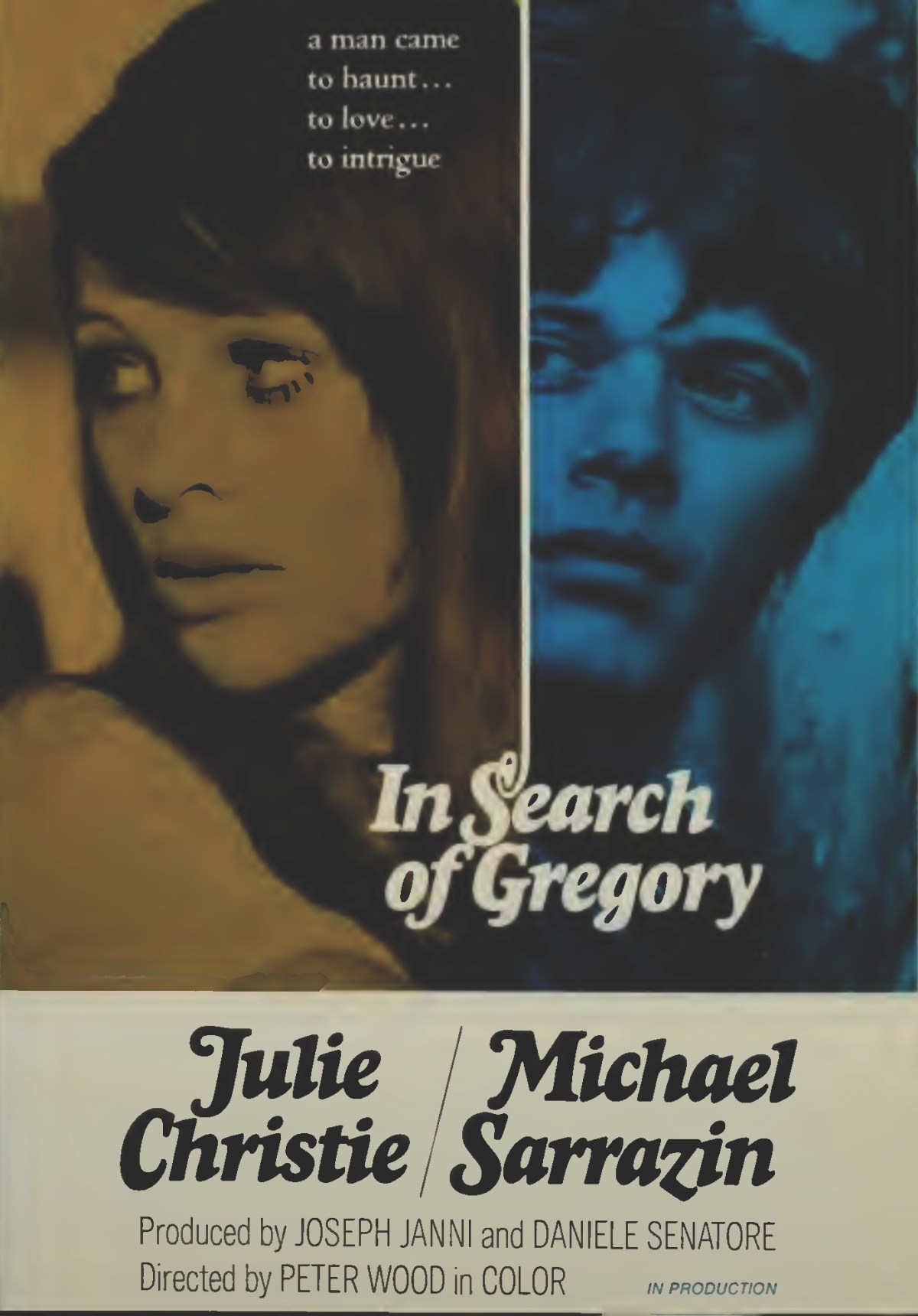
In Search of Gregory (1969) ***

Off-beat examination of the fantasy vs. reality conundrum with an ever-watchable Julie Christie as the woman on the titular hunt. The only film of acclaimed British theater director Peter Wood is a more whimsical cousin to the more deliberately obscure works of Alain Resnais (Last Year at Marienbad, 1961) and Michelangelo Antonioni (Blow-Up, 1966) which pivoted upon the question of whether events presented actually occur or exist only in the head of the leading character.    

Catherine (Julie Christie) is enticed to Geneva by her father (Adolfo Celi) for his latest wedding on the basis that she will meet the impossibly handsome Gregory (Michael Sarrazin). On arrival she discovers the agoraphobia of younger brother Daniel (John Hurt) has been temporarily lifted by Gregory. Catherine appears set to meet Gregory on a number of occasions, but either he does not turn up (the wedding) or somehow, they miss each other, even at one point occupying adjoining phone booths. And it would have been a pretty dull picture if that was all that was going on. But whether the result of reality or Catherine’s imagination, the Gregory we see is a vivid screen presence. The world the characters inhabit is unusual to say the least, so unique that it is either obviously real or fake, but virtually impossible to determine which.

The best Gregory sequence, of which Steve McQueen would be proud, involves the character moving by means of the windscreen from one side to the other of a car driven at high speed. In another scene Gregory plays the equally perilous game of Autoball, a kind of polo with stock cars. As convincing is Gregory’s avant-garde orchestra consisting of two guitars, bottles, a bicycle wheel, a waste bin and coins in a glass. 

The detail is so extraordinary that it must be real. The brother seems real enough, too real if anything, close to enjoying (or pining for) an incestuous relationship with his sister. But for every moment that appears questionable – did she really witness Gregory making love to her future mother-in-law – there are others where doubts are immediately quelled (an address which appears non-existent is not). And long before anybody came up with the idea of selling bottled water, Gregory is apparently in the business of selling tinned Alpine air. Other moments she does not witness – Daniel riding a Lambretta/Vespa with feet on the handlebars – add to the prospect of genuine reality.

Catherine might even have met Gregory except that in going to bed with the man who looks very much like what we believe Gregory to look like she determines that he shall remain anonymous. So it’s anybody’s guess whether Gregory is a figment or phantom of her imagination. And why, of course, should such invention be necessary? Does it mean that her father and brother do not exist either?

It’s an entertaining mystery. There’s no great angst. Antonioni had the sense or cunning to ensure that consequence mattered in Blow-Up – a murderer escaping justice. But there’s no such tension here. While Catherine is tabbed a nympho by her brother (who never questions her father’s predilection for multiple marriages), the suggestion that she’d fly from Rome (where she lives with her boyfriend) to Geneva is the hope of a hook-up seems too far-fetched.

Despite the presence of Julie Christie – who can certainly carry even as slight a picture as this – and a quixotic turn from John Hurt (Sinful Davy, 1969) it’s neither obscure enough to be arthouse nor sufficiently plot-driven to be mainstream and remains an oddity. If you are going to be irritated beyond belief that will occur in the first fifteen minutes or so, but if you stay the course, you may find it a worthwhile watch rather than a cinematic car crash. Written by Bonnie Golightly (her only screenplay), Oscar-nominated Tonino Guerra (Blow-Up, 1966), and  Lucile Laks (The Black Belly of the Tarantula, 1971).

The Fast Lady (1962) ***

Even the biggest stars have to start somewhere. Julie Christie in embryo, however endearing, is a long way from the finished article in Doctor Zhivago (1965). And, to be honest, this is more of a reminder of the scale of the journey undertaken for here she’s really no more than an adornment. Though, possibly, as rich man’s daughter Claire, she’s acting her socks off given her main role is to fall in love with gormless civil servant Murdoch (Stanley Baxter) after imagining him dressed in a kilt spouting Burns.

And at this point in cinematic development, cars were viewed more as sources of comedy than thrills, anyone suggesting that vehicles could be pushed to their limits in the breakneck manner of Bullitt (1968) and The French Connection (1970) would have their heads examined.

This poster and the one below bear all the hallmarks of a quick reissue
to take advantage of Christie’s post-Zhivago fame.

Cashing in on audience love of the antique auto as demonstrated in Genevieve (1953), and with a surprisingly contemporary nod to the ongoing battle between cyclists and drivers, this mainlines mostly on a long-lost innocent charm even as car salesman Freddie (Leslie “Ding Dong” Phillips) injects as much innuendo (though not on the Carry On level) as possible.

After coming off worst in a collision with aforesaid rich fellow Charles (James Robertson Justice), cyclist Murdoch decides to buy an old Bentley Red Label 3-liter (the titular “Fast Lady”)  sports car as a means of wooing speed-mad Claire. As you might expect, the path to true love is littered with obstacles, not least the overbearing father’s objections and the small matter of Murdoch not being able to drive. Cue jokes about driving lessons and tests and a mistaken arrest for drunk driving. There’s endless opportunity for protagonists to end up in the mud or the water.

Legally, in the credits, her name had to be smaller than the top-billed stars. But there was nothing to prevent distributors from making her face the focus of attention.

Feels miscast somehow, the top-billed Leslie Phillips (Maroc 7, 1967) has misplaced his normal charm, coming across as little more than an upper-class spiv. And you can’t help feeling Norman Wisdom would have been better suited as Murdoch rather than snarky Scottish comedian Stanley Baxter (Father Came Too, 1964) while James Robertson Justice (Mayerling, 1968) never leaves his comfort zone.

On the plus side are too many treats to mention. Apart from Christie and a glimpse of Stanley Baxter before he dominated the British light entertainment television scene, in bits parts are such  comedy legends as Dick Emery, Frankie Howerd and Clive Dunn (and singer Kenneth McKellar on television) plus a smattering of racing idols like Graham Hill and John Surtees and a cameo from BBC motoring correspondent Raymond Baxter.

Ken Annakin (Battle of the Bulge, 1965) isn’t much stretched though keeping the script by Jack Davies (Those Magnificent Men in their Flying Machines, 1965) and Henry Blyth (A Stitch in Time, 1963), based on the book by Keble Howard, on the straight-and-narrow may well have been his most difficult task.

May be heresy but for some viewers Julie Christie will take second place to the array of vehicles.

https://amzn.to/3uk6rpu

Young Cassidy (1965) ***

I’m assuming MGM adjudged that a film about a playwright, no matter how famous, and even if directed by John Ford (Cheyenne Autumn, 1964), would not be enough to attract an audience. And that a better physical match for said writer would have been a weedy actor of a Tom Courtenay  disposition. So, I came to this with no idea it was about world-famous Irish playwright Sean O’Casey since his name is never mentioned and the main character is called John Cassidy (Rod Taylor).

Which was just as well because I was wondering what kind of lad Cassidy was when despite his obvious brawn he was an inept labourer, requiring instruction on how to properly use a spade. That this working-class fellow has any inclination towards authorship is not obvious until halfway through the picture, by which time he has demonstrated qualities more appropriate for brawling, revolution and sex. 

Technically, this was a John Ford film as he was the producer.
The French chose not to point out he was not the director.

It probably says a lot about me that I was unaware of the significance of the title of O’Casey’s most famous play – The Plough and the Stars (1926 and, incidentally, filmed a decade later by Ford). By the time I was cogniscent of the country – early on, I assure you, as my grandfather was an Irish immigrant – the Irish flag was the tricolor made up of green, white and orange. I hadn’t known that the flag created by rebels two years before the Easter Uprising of 1916 was a representation of the plough and the stars, hence public outrage when O’Casey blithely adopted it as the title for his breakthrough play.

But you only need a vague idea of history to appreciate the movie. A couple of stunning scenes provide the background of dissent and poverty. The brutality of soldiers and police in quelling a riot is matched by striking transport workers tossing a scab into the river, his drowning ensured by the wagon that follows him in. Cassidy’s true position in the hierarchy is best shown when he is given a cheque rather than cash from a publisher. Lacking a bank account, not only does he fail to cash the cheque but is treated dismissively by clerks at the bank. His joy at rising above his station in receiving such a payment is immediately destroyed by feeling out of place and unwelcome in a bank.

Because, otherwise, Cassidy is quite the confident young fellow, winning over almost any young woman who falls within his compass, varying from upmarket prostitute Daisy (Julie Christie) to meek bookshop assistant Nora (Maggie Smith) and casual acquaintances.

Writing isn’t presented in the romantic manner of David Lean in Doctor Zhivago out the same year (with Julie Christie in a much bigger role), no stunning imagery and no close-up of soulful eyes, just Cassidy sitting at a table working through the night. But there is no indication as to why he chose plays as his metier, especially when the main theatre in Dublin, the Abbey, was the fiefdom of the middle- and upper-classes.

Ironically, Cassidy is tested more when his situation improves than as a downtrodden worker joining the revolutionary cause. As a worker his fists, brawn, brain and looks see him through. But once he steps up into the intellectual class, he is adrift, his new occupation driving a wedge through relationships.  

Not aware that this was a biopic of a playwright, I had little need to question the narrative, and just took each incident as it came. I never had the impression of a condensed biopic, crammed full of cameos. More of an interesting story set  against the background of rising Irish nationalism.

There’s a certain amount of “Oirishness” to contend with – the accents vary – the poverty is never as bleak as you might expect, and once the story heads out of Dublin you might think it’s going to go all the way to The Quiet Man country. But then you have to bear in mind that working-class poverty, as long there was employment available, was not quite of the slum kind, and that once you get out of Dublin you do indeed hit beautiful countryside.

Rod Taylor is good as the brawler-turned-playwright. In the duel of the rising stars, Maggie Smith (The Prime of Miss Jean Brodie, 1969) wins by a nose from Julie Christie, but then, though further down the credits, she has the bigger role. Michael Redgrave (Assignment K, 1968) as poet W.B. Yeats (responsible for the phrase “a terrible beauty is born”) makes the most of choice lines, Edith Evans (The Chalk Garden, 1964) is a quirky, mischievous  Lady Gregory, co-founder of the Abbey. It’s top-heavy with talent including Sian Philips (Becket, 1964), Flora Robson (55 Days at Peking, 1963), Jack MacGowran (Age of Consent, 1969) and T.P. McKenna (Perfect Friday, 1970).

Turns out John Ford was too ill to direct more than few minutes and that role fell to Jack Cardiff (Dark of the Sun, 1968) and I would have to say he does an agreeable job. John Whiting (The Captain’s Table, 1959) drew from O’Casey’s autobiography to write an intelligent script.

Beat Girl / Wild for Kicks (1960) **

More social document than drama, but that aspect somewhat diluted by the moviemakers’ attempts at exposing rebellious youth while taking for granted more sordid adult behavior. Sold under the exploitation banner – “this could be your teenage daughter” – narrative flow is interrupted now and then to showcase Adam Faith’s singing and to accommodate a few striptease acts. Probably more interesting is the array of new talent on show.

Spoiled teenager Jennifer (Gillian Hills) heads for the wild side of town to experience the beatnik lifestyle in Soho coffee shops and cellars. That there’s no drugs involved and that alcohol is considered “square” – as for that matter is violence – may come as a surprise to students of the period. Apart from one episode of road-racing and playing “chicken” along a railway track, most of the time the gang listen to music or go dancing until Jennifer gets it into her head that joining a striptease show might give her life the thrill it is missing.

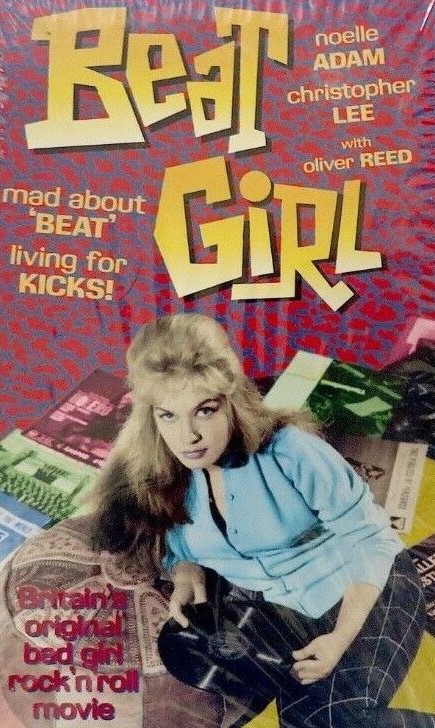
VHS cover.

This is prompted by the discovery that her new too-young stepmother Nichole (Noelle Adams) has been a stripper and most likely a sex worker in Paris before marrying wealthy architect Paul (David Farrar), cueing a round-robin of confrontations. Strangely enough, from the narrative perspective, none of the young bucks appear romantically interested in the provocatively-dressed Jennifer and so it is left to creepy club owner Kenny (Christopher Lee) to make a move.

The gaping hole left by lack of narrative drive is not offset by immersion in the beatnik or striptease scene. Back in the day the British censors took the editing scissors to the striptease  but although restored versions available now contain nudity you are left wishing that there was some lost element to the beatnik sections that would have given the picture the energy it required.

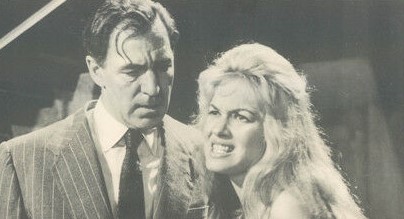
Gillian Hills (Les Liaisions Dangereuses, 1959), comes over as a cross between Brigitte Bardot and Diana Dors without having an ounce of the sex appeal of either. All pout and flounce, she is unable to inject any heart into her two-dimensional character, although given her youth and inexperience this was hardly surprising. Former British star David Farrar (Black Narcissus, 1947) was coming to the end of his career and in a thankless role as a frustrated father could do little to rescue the project.

Father and headache of a daughter – David Farrar and Gillian Hills.

French actress Noelle Gordon (Sergeant X of the Foreign Legion, 1960) could have been Jennifer’s mother given her own tendencies towards wiggle and pout but at least she makes a stab at trying to overcome her step-daughter’s hostility.

In the main, the picture’s delight is bringing to the fore a whole chorus of new faces. Pick of the supporting cast is Shirley Anne Field (Saturday Night and Sunday Morning, 1960) who doesn’t just have a knowing look but looks as if she knows what’s she doing acting-wise. Making his movie debut was teen pop idol Adam Faith, who had made his name playing in coffee bars. He had already notched up a couple of number one singles, but doesn’t quite set the screen on fire. Peter McEnery (The Fighting Prince of Donegal, 1966) plays his inebriated pal. You can also spot Oliver Reed (Women in Love, 1969), Julie Christie (Doctor Zhivago, 1965), Claire Gordon (Cool It, Carol, 1970) and Nigel Green (Jason and the Argonauts, 1963).

Perhaps the most important debut belonged to composer John Barry. He had already been working with Adam Faith. Barry’s music for the film was the first British soundtrack album ever released, reaching number eleven on the charts, and opening the doors for future soundtrack albums, not least of which was the rich vein of theme tunes produced by Barry in the next few years. 

French director Edmond T. Greville, who brought little panache to the subject matter, would redeem himself with his next picture The Hands of Orlac (1960). 

This doesn’t fall into the “so-bad-it’s-good” category, nor has it been unfairly overlooked, and probably is better known as an example of the kind of exploitation B-picture that the Americans do so much better and a reminder that, except on rare occasions such as The Wild One (1953), older moviemakers seem incapable of capturing the essence of youth.

Readers’ Top 30

I’ve been writing this Blog now for one year, beginning July 2020, so I thought I’d take a look at which posts proved the most popular (in terms of views) with my readers. So here’s the annual top 30 films, ranked in order of views.

  1. The Secret Ways (1961) – Richard Widmark and Senta Berger – making her Hollywood debut – behind the Iron Curtain in gripping adaptation of the Alistair Maclean thriller.
  2. Ocean’s 11 (1960) – Frank Sinatra, Dean Martin, Sammy Davis Jr. and the Rat Pack in entertaining heist movie set in Las Vegas.
  3. It’s Not All Rock’n’Roll (2020) – remarkable documentary about the other side of the music business as ageing rocker Dave Doughman tries to keep his dreams alive.
  4. Age of Consent (1969) – British actress Helen Mirren makes her movie debut as the often naked muse for painter James Mason in touching drama directed by Michael Powell.
  5. The Venetian Affair (1966) – Robert Vaughn shakes off his The Man from Uncle persona in taut Cold War thriller also starring Elke Sommer as his traitorous wife and Boris Karloff in a rare non-horror role.
  6. The Golden Claws of the Cat Girl / La Louve Solitaire (1968) – French cult thriller starring Daniele Gaubert as sexy cat burglar forced to work for the government.
  7. Pharoah / Faron (1966) – visually stunning Polish epic about the struggle for power in ancient Egypt.
  8. The Swimmer (1968) – astonishing performance by Burt Lancaster as a man losing his grip on the American Dream.
  9. Stiletto (1969) – Mafia thriller with hitman Alex Cord and and illegal immigrant girlfriend Britt Ekland hunted by ruthless cop Patrick O’Neal.
  10. The Naked Runner (1967) – after his son is taken hostage businessman Frank Sinatra is called out of retirement to perform an assassination.
  11. Marnie (1964) – Sean Connery tries to reform compulsive thief Tippi Hedren in Alfred Hitchcock thriller.
  12. Our Man in Marrakesh / Bang! Bang! You’re Dead (1966) – Entertaining thriller sees Tony Randall and Senta Berger mixed up in United Nations plot involving the likes of Klaus Kinski and Herbert Lom.
  13. The Happening (1967) – Anthony Quinn locks horns with Faye Dunaway and a bunch of spoiled rich kids in kidnapping yarn.
  14. Dark of the Sun / The Mercenaries (1968) – Rod Taylor and Jim Brown head into the heart of darkness in war-torn Africa with a trainload of diamonds and refugees including Yvette Mimieux.
  15. The Guns of Navarone (1961) – men-on-a-mission Alistair Maclean World War Two epic with all-star cast including Gregory Peck, David Niven, Anthony Quinn, Anthony Quayle, Stanley Baker, Irene Papas, James Darren and Gia Scala.
  16. The Sicilian Clan (1969) – three generations of French tough guys – Jean Gabin, Lino Ventura and Alain Delon – clash in Mafia-led jewel heist.
  17. 4 for Texas (1963) – Frank Sinatra and Dean Martin as double-dealing businessmen in highly entertaining Robert Aldrich Rat Pack western starring Ursula Andress and Anita Ekberg.
  18. Five Golden Dragons (1967) – Innocent playboy Robert Cummings becomes enmeshed with international crime syndicate led by Christopher Lee, George Raft and Dan Duryea.
  19. Duel at Diablo (1966) – James Garner and Sidney Poitier team up to protect Bibi Andersson in Ralph Nelson western.
  20. Move Over Darling (1963) – after years marooned on a desert island Doris Day returns to find husband James Garner just married to Polly Bergen.
  21. Pressure Point (1962) – prison psychiatrist Sidney Poitier is forced to treat paranoid racist inmate Bobby Darin.
  22. Wonder Woman 84 (2020) – in one of the few films to get a cinematic screening during lockdown, Gal Gadot returns as mythical superhero to battle supervillain Kristen Wiig.
  23. Genghis Khan (1965) – Omar Sharif as the Mongol warrior who conquered most of the known world, tangling with rival Stephen Boyd and Chinese mandarin James Mason on the way.
  24. A Fever in the Blood (1961) – Warner Bros wannabes Efrem Zimbalist Jr, Angie Dickinson, Jack Kelly and veteran Don Ameche in tough political drama.
  25. The Prize (1963) – Paul Newman and Elke Sommer investigate murder in the middle of the annual Nobel Prize awards in Sweden.
  26. In Search of Gregory (1969) – wayward Julie Christie embarks on pursuit of Michael Sarrazin who may – or may not – be a figment of her imagination.
  27. Justine (1969) – Dirk Bogarde and Michael York become entangled in web woven by Anouk Aimee in corrupt pre-World War Two Middle East.
  28. The Girl on a Motorcycle (1968) – singer Marianne Faithful in a hymn to the open road and sexual freedom.
  29. Blindfold (1965) – psychiatrist Rock Hudson and dancer Claudia Cardinale in highly entertaining mystery thriller about missing scientists.
  30. Hammerhead (1968) – secret agent Vince Edwards and goofy Judy Geeson on the trail of evil mastermind Peter Vaughn.
Discover WordPress

A daily selection of the best content published on WordPress, collected for you by humans who love to read.

The Atavist Magazine

by Brian Hannan

WordPress.com News

The latest news on WordPress.com and the WordPress community.