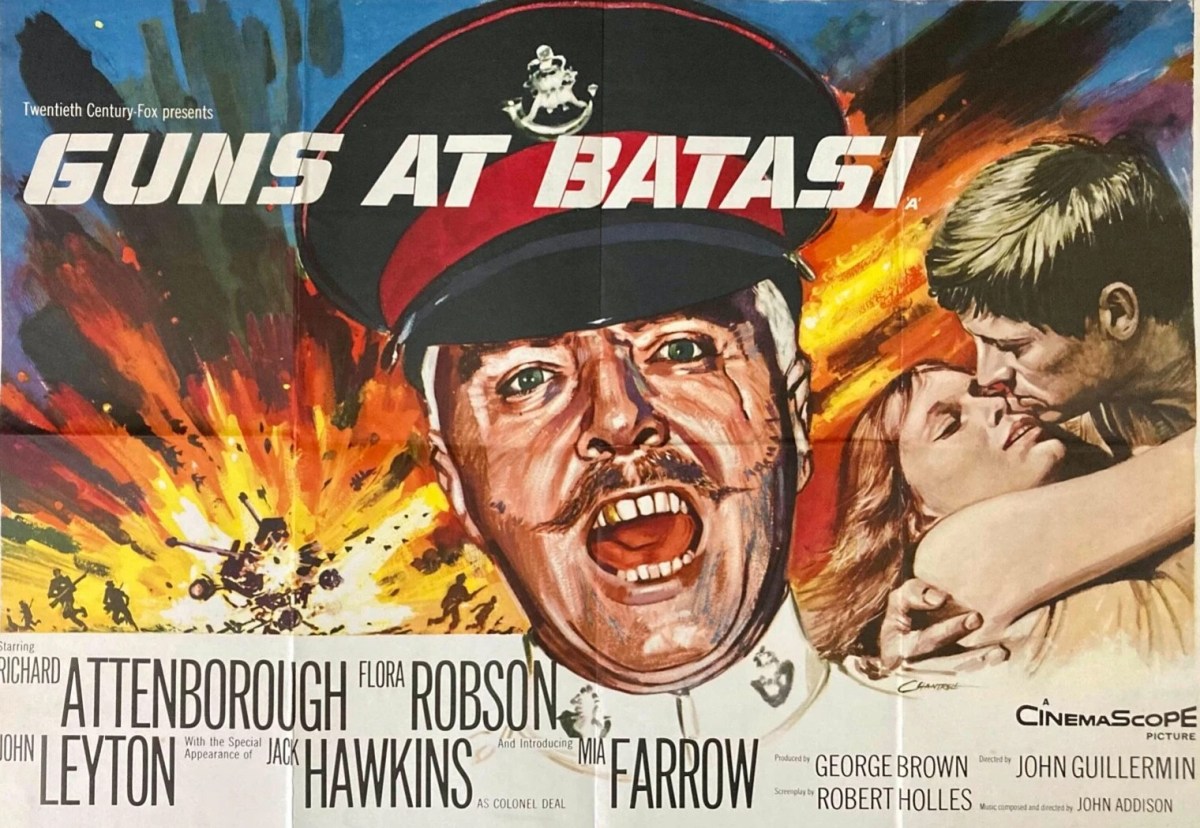
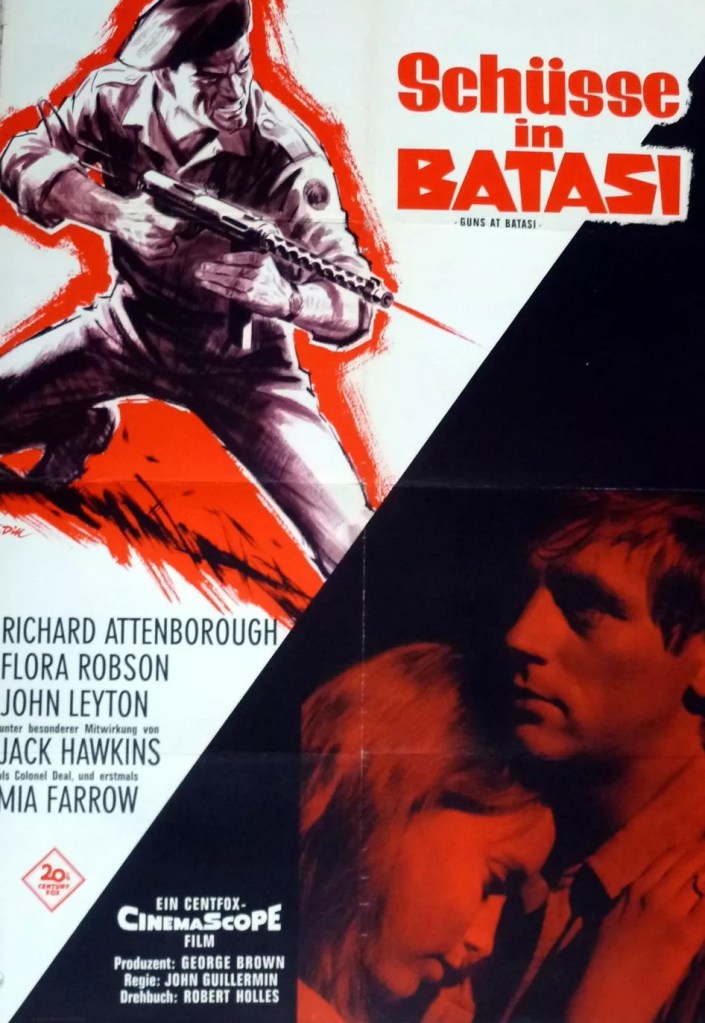
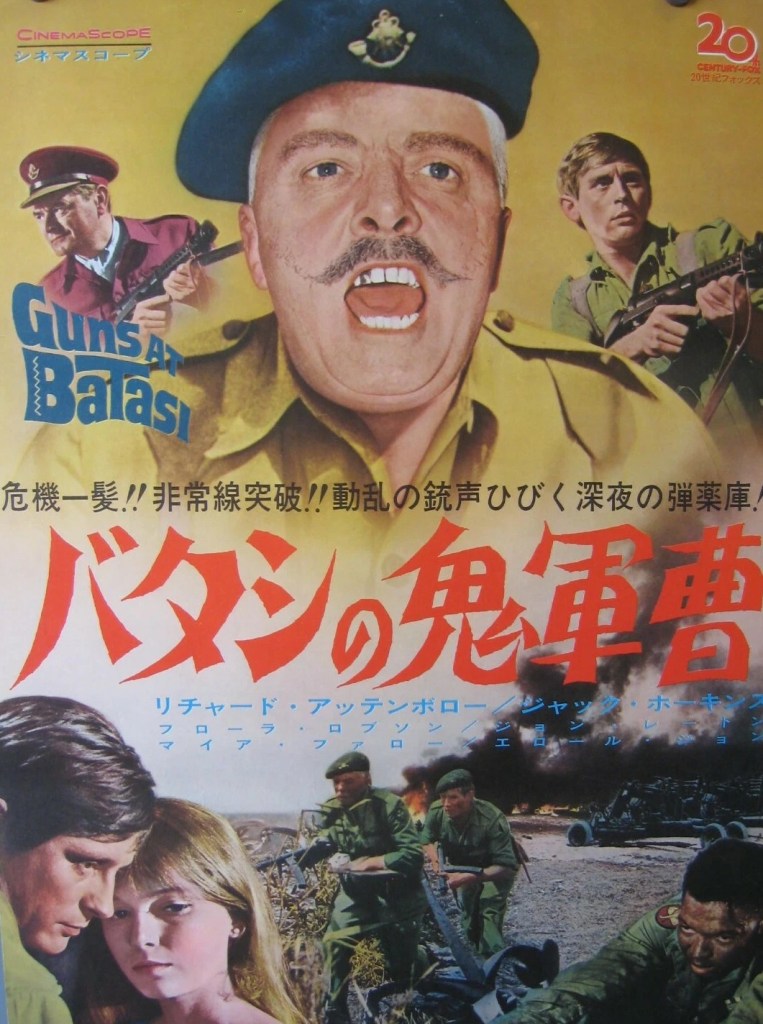
In the same year as the Brits were turning whopping defeat into marginal victory in Zulu (1964) a more complex version of imperialism reflecting modern times (i.e. the 1960s) was being spelled out here and magnified by the performance of Richard Attenborough’s career. The British, as has been their wont, while no longer in complete control of this anonymous African country, have left behind a military operation in theory to support whoever is in power but in reality to safeguard their own commercial interests.
Every side of the coin is shown, from the old school soldiers to raw recruits scarcely able to work a rifle, to the pragmatic politicians and Africans with loyalties split between the mother country and the new regime. There’s a feisty British MP Miss Barker-Wise (Flora Robson) on the side of equality who is given a rude awakening on realpolitik and the well-spoken African, educated in Britain, exalting in throwing off decades of being patronized.
Just as the Africans are in revolt against the existing corrupt regime, so, in his own way, is Regimental Sergeant-Major Lauderdale (Richard Attenborough) who, secretly, refuses to obey the orders of his superior, Lt Boniface (John Errol). Most of the confrontation is distinctly old school, depending on the power of personality, in the best scene in the movie Lauderdale forcing his superior to accept the inferior’s authority. In another scene, the ambushed Col Deal (Jack Hawkins), with considerable British sang-froid, talks his way out of trouble.
The British are caught out by the sudden insurgency and almost certainly would not have become actively involved on the losing side had it not been for trying to save the life of wounded African Capt. Abraham (Earl Cameron) condemned by Boniface as a traitor. It should have been a Mexican stand-off until rebel ire was tamped down and a new kind of status quo – either the Brits tossed out or kept on supporting the new regime – was constituted. No need for violence or action, just keeping your nerve, a quality which Lauderdale has in spades.
Except that the sergeant-major has lied to the African commander, pretending Abraham is dead and not merely being hidden. When the Africans literally bring up the big guns, prepared to blast out the Brits, Lauderdale determines to spike the guns.
Except for the spit-and-polish, in military terms this is a very rusty British unit. You expect that Lauderdale will turn out to be all bluster. But he switches into commander instantly, holds (verbally) the enemy at bay, rallies the troops, leads by example and carries out a clever attack. But it’s a hollow victory. Politics works against him and he is humiliated at the end.
A good chunk of time is spent putting the British in their place.
Although the narrative appears to take time out to indulge the visiting MP and to tee up a piece of romance between raw recruit Pvt Wilkes (John Leyton) and stranded tourist Karen (Mia Farrow), both tales are soon subsumed into the action, the soldier forced into action, the politician forced to confront how little her principles count and how ineffective her authority in a war zone. There is some decent humor, the snarkiness between the soldiers, and Wilkes romantic clumsiness.
Richard Attenborough (Only When I Larf, 1968) is easily the pick as he presents various elements of a complicated character, the dedicated career soldier at the mercy of an inexperienced superior, questioning just what he has devoted his life to, straining to hold up his stiff upper lip, the butt of jokes, boring all with tales of long vanished glory, eventually revealing that he is much more than bluster, taking effective command, but then paying the price as the political scapegoat. Jack Hawkins (Zulu, 1964) has a smaller role than you’d expect from the billing and Flora Robson (7 Women, 1965) weighs in with another battleaxe. In her debut Mia Farrow (Secret Ceremony, 1968) demonstrates ample promise and Errol John (Man in the Middle, 1964) has a peach of a role.
Directed with some distinction by John Guillermin (The Bridge at Remagen, 1968), demonstrating a gift for both action and emotion, from a screenplay by Robert Holles based on his novel.
Although ignored by the Oscars, Attenborough won the Bafta Best Actor Award.
Mirisch could easily lay claim to be the top independent production outfit of the 1960s generating hits like The Magnificent Seven (1960), West Side Story (1961), The Great Escape (1963), The Pink Panther (1964) and its sequel A Shot in the Dark (1964), The Russians Are Coming, Russians Are Coming (1966), In the Heat of the Night (1967) and The Thomas Crown Affair (1968) plus a shelf load of Oscars and Oscar nominations. But dependence on a partnership with Billy Wilder in the 1970s and a more lackluster performance at the box office – with the noted exception of Fiddler on the Roof (1971) – spelled the end of its 17-year relationship with United Artists, which was reeling from financial losses and under new management.
The company found a new partner in Universal which had a series of deals with other major producers like Alfred Hitchcock, Zanuck and Brown (Jaws, 1975) and George Seaton (Airport, 1970). Mirisch was not in any financial trouble, having severed ties with UA after Mr Majestyk (1974), a major success abroad, and recovered its development costs for Wheels, based on the Arthur Hailey novel but the script rejected by UA, from Universal which turned it into a mini-series.
The Universal deal was initially not as good as that enjoyed at UA. Universal charged a twenty-five per cent overhead whereas UA had charged nothing and Universal was now doing direct deals with directors rather than relying on the likes of Mirisch to tie up the talent.
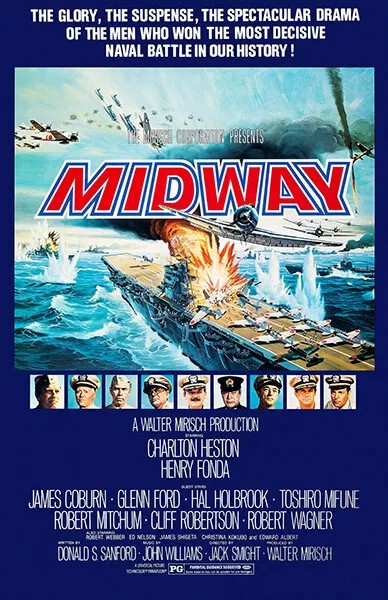
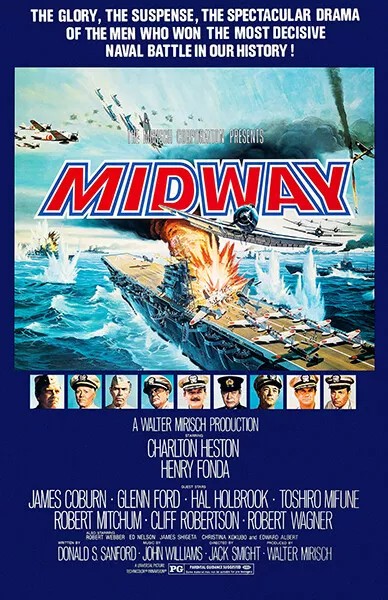
Many years before, Mirisch had commissioned a script on the Battle of Midway from Donald S. Sanford who specialized in war pictures but of the distinctly low-budget variety – Submarine X-1 (1968), The Thousand Plane Raid (1969) and Mosquito Squadron (1969), none of which had enjoyed any success.
Though all of the Mirisch war pictures had concentrated on Europe, Walter Mirisch, generally the creative driving force for the production company, in his previous incarnation with Allied Artists had some experience of the Pacific War, having produced Flat Top / Eagles of the Fleet (1952), set around an aircraft carrier during the Battle of Leyte Gulf, and was an avid reader of books about the Second World War.
John Ford and Louis de Rochmont had made documentaries about the Pacific naval battles. UA rejected the script twice, a shrewd move in the end because Tora! Tora! Tora! (1970) lost a packet for Twentieth Century Fox. The Sanford screenplay had initially taken more of a documentary approach but after gaining the interest of Charlton Heston, who had starred in Mirisch’s The Hawaiians (1970), the script was tweaked.
Programming a war picture was a risk for the studio. There hadn’t been a big-budget war picture in five years. And while Patton (1970) and Kelly’s Heroes (1970) ended up on the right sight of the ledger book, Tora!, Tora! Tora! and Too Late the Hero (1970) were stiffs.
Mirisch signed a two-picture deal with Universal, for Midway and Wild Card with a screenplay by Elmore Leonard (Mr Majestyk). Mirisch proposed to reduce costs by using footage from naval archives, converting the original 16mm film to 35mm. The producer also took footage from Japanese film Storm over the Pacific / I Bombed Pearl Harbor (1960) – the rights cost him $96,000. Footage of the Pearl Harbor attack in Tora! Tora! Tora! doubled for shots of the attack on Midway Island. A clip of the Dolittle raid on Tokyo from Thirty Secondsover Tokyo (1944) was used in the credit sequence after “subjecting it to a sepia bath.”
After the success of Earthquake (1975), Heston was back in the top ranks of box office stars and his involvement guaranteed the green light. The U.S. Navy offered its support, not surprising since Midway was considered its greatest success.
John Guillermin (The Towering Inferno, 1974) was hired to direct and Stirling Silliphant (In the Heat of the Night) signed up for a screenplay rewrite. Mirisch had determined to employ the all-star-cast device that had been an essential ingredient of many of the 1960s roadshow pictures, kicking off with Henry Fonda (The Boston Strangler, 1968), by now pretty much a spent force at the box office – he hadn’t made a picture in three years – but still a well-known name.
The amount of work involved for the other stars was minimal – mostly just one day – and, astutely, Mirisch called on stars who had worked for him in the past and who, like James Coburn (The Great Escape), Cliff Robertson (633 Squadron, 1964) and Christopher George (The Thousand Plane Raid) owed him something in terms of a career leg-up. Others included Robert Mitchum (The Sundowners, 1960), Robert Wagner (The Biggest Bundle of Them All, 1968) and Tom Selleck in an early role. Mitchum was the first of these stars to sign up, in March 1975, six weeks before the scheduled start date of April 27, followed two days later by Coburn.
Toshiro Mifune (Red Sun, 1971) headed up the Japanese cast and proved so meticulous in his preparations that he had his uniform made by Japanese tailors. The white gloves he wore had a finger shortened on the left hand because his character Admiral Yamamoto was missing a pinky. However, despite coaching in English by actress Miko Taka (Walk, Don’t Run, 1966), his dialog was revoiced by Paul Frees.
Guillermin demanded a bigger budget to accommodate more airplanes and equipment and a longer shooting period. Two months before filming was due to start, Mirisch put his foot down and told the director he couldn’t accommodate his requests as Universal had only provided funding on the basis of Mirisch’s original idea. Guillermin walked. As far as the public was concerned, the parting of the ways was due to a “conflict of schedules.” Jack Smight, who had directed Airport ’75 (1974), a box office success and also starring Heston, was his replacement.
The Navy lent aircraft carrier U.S.S. Lexington – the last remaining World War Two carrier – while it was at sea training pilots as long as the shoot didn’t interfere with those exercises. A limited number of World War Two vintage planes – in great condition having been cared for by their owners – were permitted on board. The Navy charged the crew for accommodation – Mirisch was housed in Admiral Strean’s quarters – and meals. “We had a detailed contract with the Navy,” recalled Mirisch, “in which we agreed to stay out of their way when asked.”
On board, the crew filmed scenes, some silent and others with dialog, and “made plates for rearview projection and aerial shots of our vintage planes so positioned that we could print them into flights of six or nine.” Charlton Heston, Glenn Ford (Rage, 1966) and Hal Holbrook (The Group, 1966) were aboard and the shoot went well. A scene involving Henry Fonda was shot at Pensacola. The Florida coast stood in for the Pacific. Additional exteriors were filmed in Los Angeles at Long Beach and Point Dune with interiors at Universal.
The construction of the interiors for the Japanese aircraft carriers was so authentic Mirisch was later asked to reassemble the set for the Smithsonian Institute for a presentation there. The interpolation of the old footage was crucial and it was planned in advance where such shots would appear. The old footage was precut and scenes were shot with actors with “scene missing” in those sequences into which the old footage could be dropped. Other devices were used to ensure the background in the old footage was more lively.
The final element was in cinematic presentation. Sensurround, a precursor of Imax, had been introduced with great success by Universal to Earthquake and this added greater realism to the battle scenes. While limited to those theaters which had installed the expensive equipment, and although the roadshow was long gone, it created an “event” aspect to those viewing it in that system. In his autobiography Mirisch suggested the addition of Sensurround was last minute and sparked by the success of Earthquake. But, in fact, Universal had announced a year in advance of opening that Battle of Midway would utilize Sensurround.
Some cinema owners were outraged at the stock footage, whose proposed inclusion had been kept from them when they went into the blind-bidding process at the start of the year. Mirisch countered that there was no alternative. “A great many aircraft,” he argued, “used in the battle no longer exist.” Universal’s terms were stiff – a minimum nine-week run starting at a 70/30 split for the first three weeks in the studio’s favor, a $75,000 advance guarantee from cinemas and 5% of the gross for use of Sensurround.
With the budget kept as low as a reported $4 million it was a massive hit, picking up $20.3 million in rentals (what the studio retains of the box office gross) – sixth in the annual box office league beaten only by Oscar-winner One Flew over the Cuckoo’s Nest, All the President’s Men with Robert Redford and Dustin Hoffman, demonic The Omen, Walter Matthau baseball comedy The Bad News Bears and Mel Brooks’ Silent Movie and just ahead of such offerings as Sidney Lumet’s Dog Day Afternoon with Al Pacino, and comedy Murder by Death but nearly doubling the take of the more critically-acclaimed Taxi Driver, Clint Eastwood western The Outlaw Josey Wales and thriller Marathon Man also starring Hoffman. The final domestic figure amounted to $21.8 million.
Foreign figures were astonishing, especially in Japan, where its gross exceeded $4 million. The benefits of the promotional tour undertaken by Heston in the Far East were soon obvious – in Manila it beat both Jaws and Earthquake. In the annual box office league there and Hong Kong, it ranked third. In Italy it proved a “big surprise”, coming in fourth behind King Kong, Taxi Driver and a local offering.
While a successful movie could expect to benefit from television viewings – this was before the video revolution – the movie had an unusual afterlife. NBC, which had bought the rights, wanted the film to be longer, so it could be shown over two nights, thus increasing advertising and setting it up as a more prestigious event. Largely by adding plotlines to the Heston character, the running time increased by nearly an hour, which proved a bonus for the future home screening revolution.
“Of all the films that I have made,” noted Mirisch, “it produced the greatest amount of profit.”
SOURCES: Walter Mirisch, I Thought We Were Making Movies Not History (University of Wisconsin Press, 2008) pp324-339; “Readying Midway,” Variety, February 5, 1975, p6; “Universal in New Shake,” Variety, July 23, 1975, p3; “Admiral Mitchum,” Variety, March 12, 1975, p18; ”Jap Feature Footage Inserted into Midway,” Variety, June 6, 1976, p7; “Midway Big in Manila,” Variety, August 11, 1976, p24; “Big Rental Films of 1976,” Variety, January 5, 1977, p14; “Jaws Led Bangkok,” Variety, February 9, 1977, p39; “International,” Variety, June 29, 1977, p35.
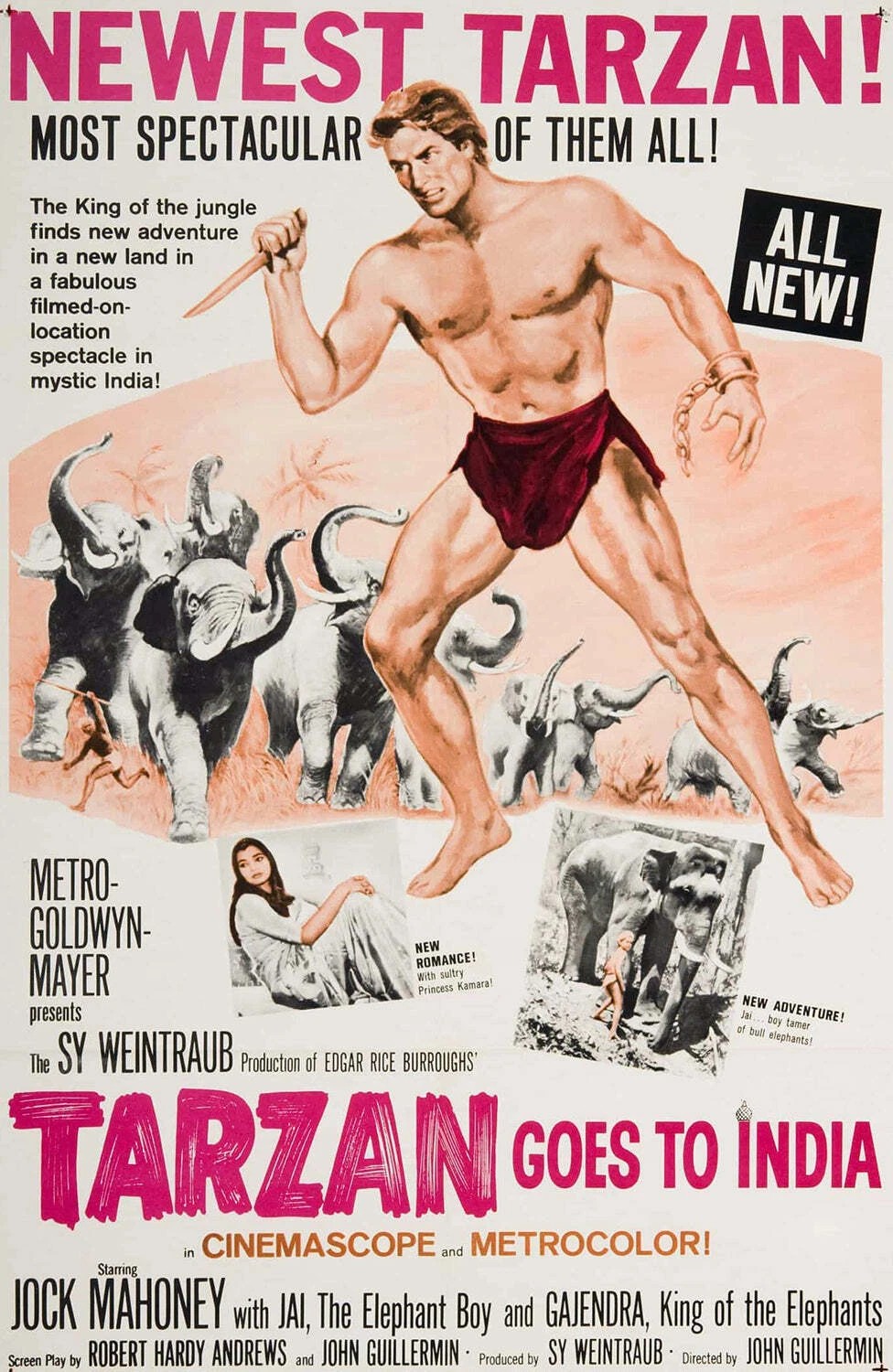
Helluva fillip for reissue and credibility purposes to be able to point to the picture being helmed by the director – John Guillermin – of The Towering Inferno (1974), not to mention King Kong (1976) and The Blue Max (1966) – which suggested top-notch skills if not the budget to match. Guillermin, who also had a share in the screenplay, does a pretty good job of tailoring the picture to highlight issues that in others of the series are treated in more comedic fashion and making tremendous use of the location, far more than subsequent directors do with South American scenery. Elephants go mano a mano, Tarzan has a tussle with a leopard, but for sheer realism there’s little to beat a tiny mongoose putting a cobra in its place.
But what could be more timely for today’s audiences than presenting Tarzan (Jock Mahoney) as an eco-warrior. He is brought in to rescue a herd of 300 wild elephants being drowned when a much-needed hydroelectric dam is opened. Dam engineers Bryce (Leo Gordon) and O’Hara (Mark Dana), who show no compunction about the high death rate among the native laborers, are even less concerned about the fate of the elephants especially as have very tight deadline – the onset of the monsoon season – to meet. Princess Kamara (Simi Garewal), daughter of an old friend from Tarzan’s Africa days, is trying to get villagers out of the way as well. She’s not helped by Bryce’s top engineer Raj (Jagdish Raj) who sides with Bryce.
The main problem is that elephants can’t climb hills and are led by Bala, a rogue of the species, whom Tarzan determines he’ll have to eliminate. He’s helped by a small boy Jai who rides his own elephant Gajendra. Jai’s not there for comedic purpose and Tarzan helps him grow up, their bond facilitated by Tarzan saving the ivory-tusked beast from Bryce in white hunter mode.
Baits abound. Tarzan is chained to a tree by Bryce to entice a leopard. The boy is used, again by Bryce, as lure to draw Tarzan out into the open at the climax. Raj changes sides on seeing how cheaply Bryce treats life, but there’s no time for him to get lovey-dovey with the princess. Which is just as well because Tarzan’s got a lot on his plate. His plan to put an arrow through Bala’s brain goes awry, triggering the Gajandra-Bala duel, which is very well done.
Although set in India, this feels more like the real thing than the sojourns in South America. We never see Tarzan in a suit but I don’t think anyone thought to compare his entrance, emerging from a river clad only in loin-cloth, with the other more famous screen entrance of the year, that of Ursula Andress in Dr No. Tarzan does plenty of swimming, even employing the breathing through a reed trick, and swings through the trees, and runs a lot barefoot, and gets to ride on the back of an elephant. The absence of his usual animal sidekicks is no hindrance. His scenes with the young boy are touching rather than sentimental or clumsily jokey. The kid’s pretty smart, which helps.
Kamara’s there merely to help along the subplot rather than for romantic purposes. Given the lean running time (86 minutes) that kind of palaver would only get in the way. This was shot entirely on location, and it shows, no awkward switches to studio set-ups, glorious scenery all the way.
Best of all John Guillermin, who also helmed Tarzan’s Greatest Adventure (1959), knows how to construct a scene, and how to get the best out of actors whose acting skills would not be considered their main attributes. So it looks good whichever way you cut it.
Former stunt man and athlete Jock Mahoney makes the switch from Tarzan nemesis (Tarzan the Magnificent, 1960) to Tarzan with ease. Less muscle-bound than his predecessors, he brings a more mature tone to proceedings, exuding thoughtfulness more than being gung-ho.
Exceptional down-and-dirty thriller and throwback film noir woefully underrated on release but with a brilliant mystery (or two), a touch of satire, red herrings, some great lines, and believable characters. Private eye P.J. Detweiler (George Peppard) is so down on his luck he is willing to play the lover so an errant wife can be photographed in a motel room. What little he earns goes on paying is debts. So he can hardly down the chance of serious money as bodyguard to Maureen (Gayle Hunnicutt), mistress of rich businessman William Orbison (Raymond Burr), never mind that she initially treats him as a servant.
Orbison has a legendary mean streak – secretaries have to type closer to the edge of sheets of paper, he forces wife Betty (Colette Gray) to account for every dime of her allowance to the point of almost making her beg. Sadism is another character trait. He is happy not to kill off animals he has shot. The childless millionaire adds Maureen to his will for the sole purpose of upsetting every other potential heir. In front of guests at a prestigious party he forces Betty to acknowledge Maureen’s existence.
This apparently wealthy world is riddled with seedy inhabitants, whose only motivation is greed, all desperate to retain status or inheritance and enjoying Orbison’s largesse, which, despite his miserly nature, he nonetheless flaunts. As well as Betty enduring ritual humiliation to remain his wife and enjoy a gilded lifestyle, his executive assistant Jason (Jason Evers) accepts being treated as a gofer in order to keep his position and the perks that go with it, and Maureen makes no bones about prostituting herself for temporary and future gain. Everyone has to kowtow, even the occupants of a West Indian island dependent on Orbison for investment, not only a kids choir welcoming Orbison on arrival, but a calypso performer singing a song in his praise.
As various threats, including narrowly missing a bullet, are made against Maureen, making a classical entrance in a red dress and alternating between helpless victim and femme fatale, with her creepy manservant Quell (Severn Darden) reporting on her every move, inevitably Detweiler grows closer to his client, unaware that Orbison is planning to have someone killed.
That someone turns out to be Jason, whom Orbison suspects of clandestine activity with his wife, and whom Detweiler innocently kills. As this takes place on the island, where the death is easily hushed up, Detweiler begins to wonder if he’s a patsy and, paid off by Orbison, undertakes his own investigation, quickly entering more dangerous waters, viciously beaten up at Quell’s behest in a gay bar, narrowly avoiding death in the subway and literally finding himself in the firing line.
Detweiler’s character undergoes transition, too. From begging for scraps and turning the other way so as not to jeopardize easy income, he rediscovers his suit of shining armor, walking down some pretty mean streets, a diligent private eye who can no longer be bought off, determined to get to the bottom of what turns out to be a complicated mystery.
Detweiler is no Marlowe or even Tony Rome, but rather despicable at the outset, employing all sorts of dodges, his interest in Maureen not slackening even after he knows she indulges in a quickie with Orbison. He takes too much at face value.
The unfolding mystery is superbly handled, involving proper clues and investigation, shoot-outs and fisticuffs, the outcome not what you might initially imagine. Although primarily an old school private eye picture, it’s great fun, with some wonderful comedy involving a dog, gentle satire on the West Indian island where whitewash is the order of the day, and some touching romantic foreplay.
Peppard (Pendulum, 1969) is outstanding as the dupe who rediscovers his moral code and his Detweiler is an excellent addition to the ranks of the private eye. Raymond Burr, a far cry from his Perry Mason (1957-1966) television persona, is easily one of the worst screen millionaires – on a par with Ralph Richardson in Woman of Straw (1964) in his contempt for humanity – and with his silver hair and bulk and scheming proves a slick adversary. Gayle Hunnicutt (Eye of the Cat, 1969) is allure on legs, brilliantly playing every man in sight, eye never diverted from the main chance.
Brock Peters (The Pawnbroker, 1964) has a standout cameo as the island’s cynical police chief. Susan Saint James (The Name of the Game, 1968-1971) makes her movie debut as Orbison’s slinky sex-mad niece. Also putting in an appearance are Wilfrid Whyte-Hyde (The Liquidator, 1965) as the island’s accommodating governor, Colleen Gray (Red River, 1948) as the humiliated wife, Severn Darden as the odious Quell, and John Ford regular John Qualen (The Man Who Shot Liberty Valance, 1962).
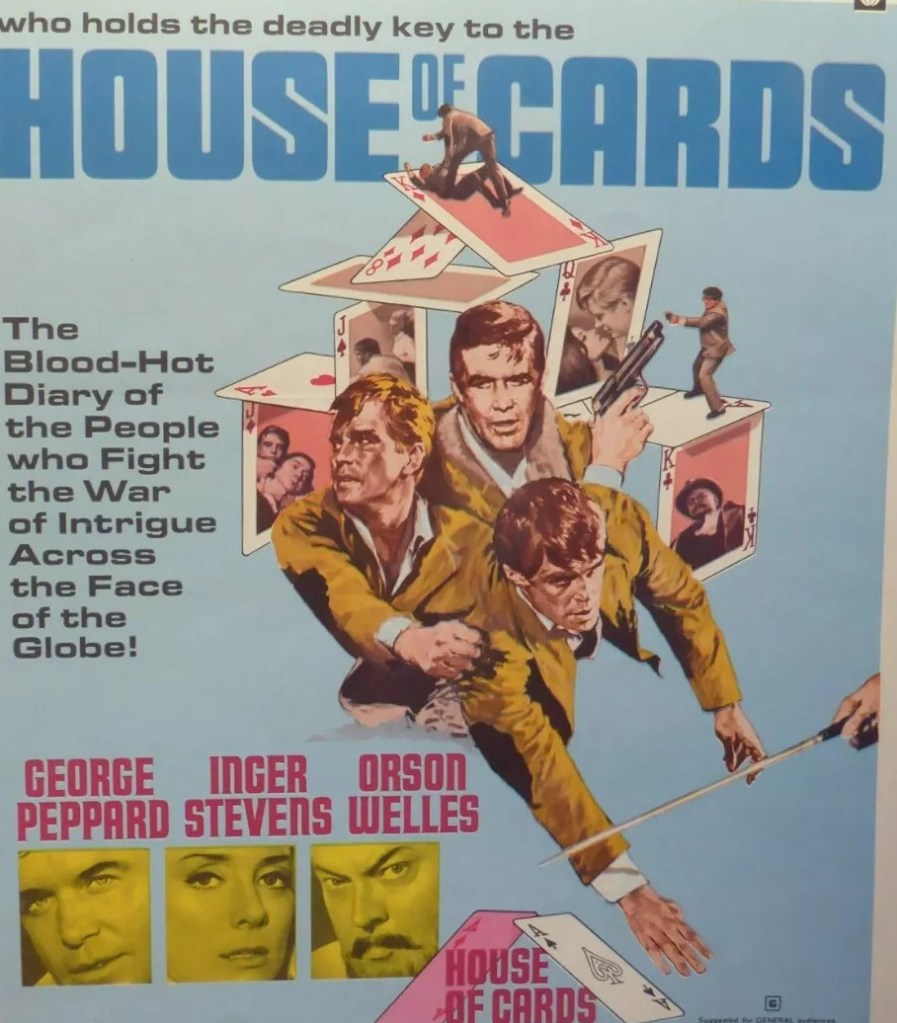
This was the second of director John Guillermin’s George Peppard trilogy following The Blue Max (1966) and prior to House of Cards (1968). Generally dismissed as a journeyman, Guillermin brings a sly eye to this picture, the send-up of British colonialism, the master-servant aspects, an over-the-shoulder shot of an unknown assassin, the scenes in the bar which is effectively Detweiler’s office, and a brilliant subway death adding layers to the movie. He is bold in his use of close-ups with Hunnicutt, some scenes almost a homage to the Bogart-Bacall chemistry, and brings out a world-weary performance from the usually cocky Peppard.
Philip Reisman Jr. (All the Way Home, 1963) fashioned the screenplay, delivering one of cinema’s most memorable final lines.
Bracketed with Pendulum and House of Cards demonstrates that Peppard is under-rated.
American boxer Reno Davis (George Peppard) stumbles on an international conspiracy when hired by rich widow Anne de Villemont (Inger Stevens) in Paris to look after her eight-year-old son Paul (Barnaby Shaw). All roads eventually lead to Rome and a showdown with arch-conspirator Leschenahut (Orson Welles) in this thriller which throws in a couple of measures of Gaslight (1944) and, more obviously, North by Northwest (1959), to the extent of Anne being an icy blonde of the Eva Marie Saint persuasion and the couple, on the run, sharing a compartment on a train.
The boy’s previous tutor has been murdered. After months in a sanatorium, Anne, paranoid about her son being kidnapped, is in virtual house arrest in the family mansion, watched over by arrogant psychiatrist Dr Morillon (Keith Michell) who has diagnosed her as unstable, neurotic and a danger to the boy.
After an assassin on a bridge on the Seine takes potshots at Reno and Paul, Reno is framed for murder but escaping from the police returns to the mansion to find it empty, the furniture covered in dust sheets. I half-expected Reno to be told that the job was all in his imagination and that Anne did not exist, but instead finds out that mother and son have been taken to a castle in Dijon, in reality a fortress with a platoon of armed guards. Only Paul has been already been transported to Italy. So it’s attempted rescue, imprisonment, escape, fistfights, chase, clever moves and countermoves, twists and double twists as Reno and the still icy Anne head for Rome.
In among the mayhem are a few humorous moments, a play on the Trevi fountain scene from La Dolce Vita, a monk mistaken for a killer, a bored girl only too happy to be taken hostage, an over-familiar American who gives away valuable secrets because he mistakenly believes Reno is a co-conspirator, Dr Morillon making the error of treating Reno as a servant. And characters involved in assisting escape extract a high price, one seeking financial reward, another that her husband be killed in the process. There is also a flirtatious but spiky maid Jeanne-Marie (Perette Pradier) and a couple of excellent reversals.
Reno is somewhat innovative in the weaponry department, the hook of a fishing rod, for example, while the son is rather handy with a pistol. But given the opposition are armed with machine guns, knives and swords that seems only fair.
George Peppard seems to have found his niche in this one, dropping the innate arrogance of The Blue Max (1965) and Operation Crossbow (1965), no chip on the shoulder, a good bit more attractive as a screen presence, a nice line with the ladies, more than able to take care of himself, a sprinkling of wit, completely at ease. Inger Stevens comes off well though her psychological problems and concerns for her son get in the way of any burgeoning romance with Peppard. But she has quite a range of emotions to get through, from wondering if she is mad, to dealing with the controlling family, and letting go of her son enough to allow the boy to bond with Reno, and despite her vast wealth down-to-earth enough to see a toothbrush as an essential when on the run.
Orson Welles (Is Paris Burning?, 1966), as ever, looms large over everything, with dialog so good you always have the impression he improvised on the spot. Keith Michell, a couple of years away from international fame in BBC mini-series The Six Wives of Henry VIII (1970), does a very good turn as the psychiatrist.
John Guillermin, who directed Peppard in The Blue Max, has a lot to do to keep the various balls in the air, especially keeping track of a multiplicity of characters. The screenwriting team of Harriet Frank Jr. and Irving Ravetch (Hud, 1963) pulled this one together from the novel by Stanley Ellin. Francis Lai’s memorable score is worth a mention, with distinctive themes for various parts of the story.
Eva Renzi (Funeral in Berlin, 1966) was originally down for the part of Anne and Italian actress Rosemary Dexter (Romeo and Juliet, 1964) has a small part.
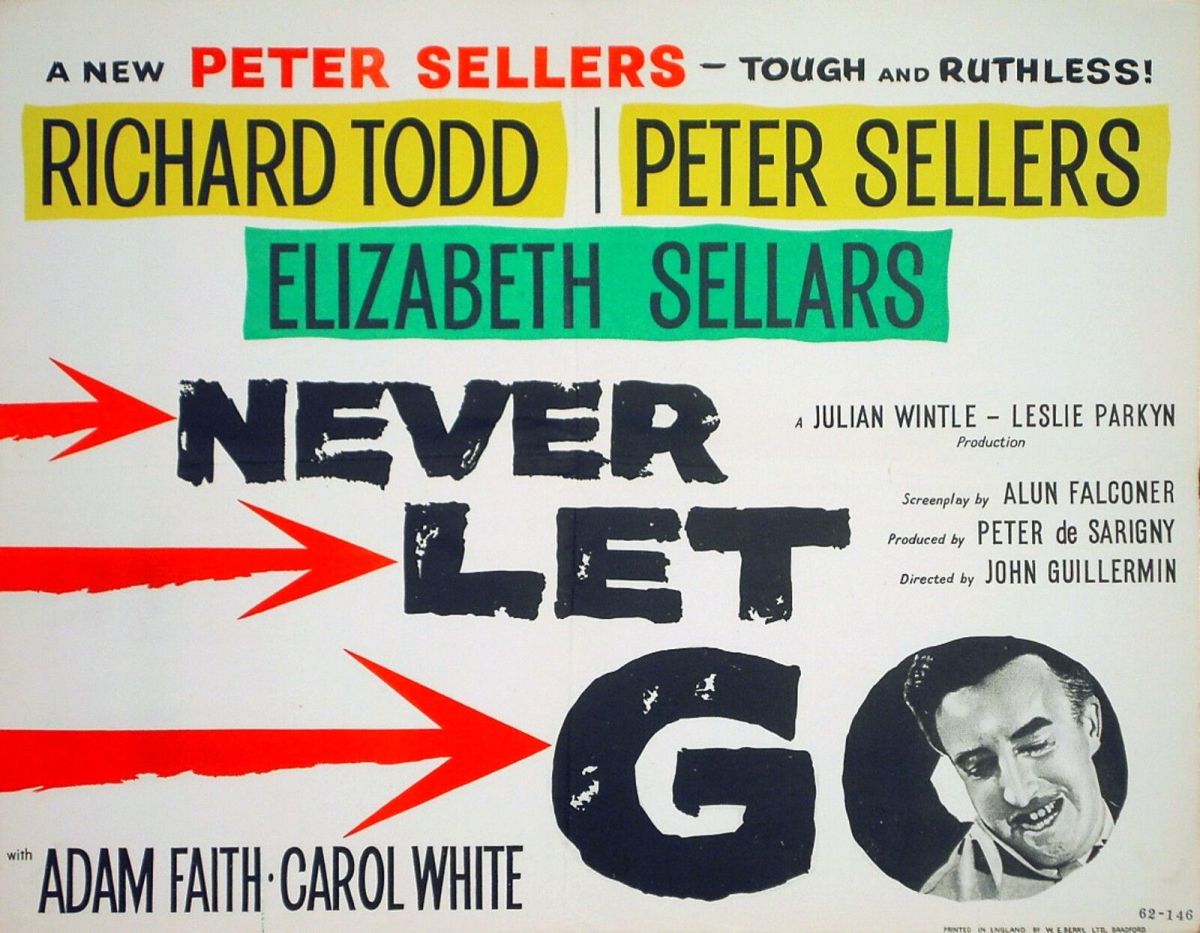
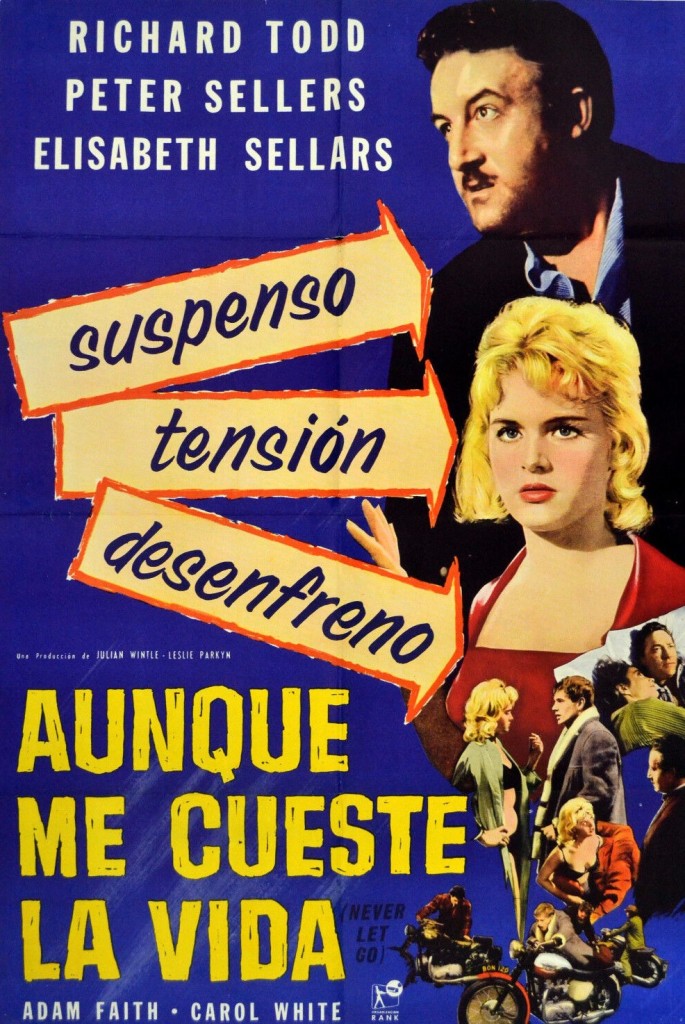
Under-rated British film noir classic. All the principals playing against type. Comedian Peter Sellers (The Millionairess, 1960) as the villain, British hero Richard Todd (The Dam Busters, 1955) comes seriously unstuck, pop star Adam Faith (Beat Girl / Wild for Kicks, 1960) tosses away his cuddly image. One of the earliest scores by John (James Bond) Barry. First grown-up role for Carol White (Daddy’s Gone A-Hunting, 1969). As much savage violence as the censor would allow at the time.
Down-on-his-luck salesman John (Richard Todd) has his car stolen. It’s uninsured. Without it he can’t get to his appointments on time. The police aren’t interested. So he has to investigate. That leads first to dodgy Teddy Boy Tommy (Adam Faith) who steals cars to order for supposedly legitimate businessman Lionel (Peter Sellers) and makes a play for Lionel’s young mistress Jackie (Carol White).
The interest lies not so much in the investigation as how those involved deal with pressure. John, hardly able to support wife Anne (Elizabeth Sellars) and two kids, has a history of failure, squandering money on get-rich-quick schemes, and apt to blow his top at clients who complain when he fails to keep appointments.
Doesn’t take long for him to lose his job. But instead of knuckling down and finding another, he stubbornly refuses to abandon his investigation, upsetting Scotland Yard Inspector Thomas (Noel Willman) who has much bigger fish to fry.
Lionel is a cocky gangster not afraid to lash out. In fact, he seems to enjoy battering people with his fists, feet and broken bottle. He treats Jackie with contempt, reminding her she’d be a sex worker if it wasn’t for him. He’s got a nice little empire and has kept his nose clean. He pays off corrupt cops.
But the last thing he expects is to be pursued by a loser like John who’s not cut from the John Wick template. Not does he possess the very particular set of skills that appear to be the prerequisite of anyone embarking on a mission of revenge.
If director John Guillermin (El Condor, 1970) hadn’t been obliged to tag on a happy ending, this would have been a downbeat tour-de-force, with the good guy losing everything in order to win back his self-respect.
It just sizzles with tension. Lionel belongs to the generation that spawned the likes of Harold in The Long Good Friday (1980) or the Kray Twins, a simmering, stewing piece of work, all gloss on the outside, a tinderbox on the inside.
There’s fabulous photography, eyes trapped in pools of light, overhead camera staking out victims, and seedy London picked out in detail. Newspaper vendor Alfie (Mervyn Johns), of pensionable age, the only witness to the crime, has his bedsit ransacked, the tiny terrapin he treasures crushed underfoot, when inadvertently he gives too much away.
Tearaway Tommy isn’t such a tough guy when Lionel comes battering on his door. Jackie is the only one who not so much stands up to Lionel as treats his idea of romance with disdain. Even when John fingers Lionel, Inspector Thomas bluntly tells him he’s too small fry and the cops aren’t interesting in chasing after his plebeian vehicle.
Lionel is the kind of gangster who is never going to realise he can’t always get away with it, that he might have to trim back his ambition until the coast is clearer. Instead, he batters on regardless, determined to terrify everyone into acquiescence.
As the movie progresses, the more you learn about John, the less you sympathise. His wife has stood by him through mostly thin, and will stick by him even if unemployed, but draws the line at antagonising a gangster who doesn’t know when to draw a line. John isn’t Gary Cooper in High Noon. He’s not a principled defender of the law. He’s almost as bad as the gangster, in that he doesn’t know when to stop, regardless of the danger this places his family.
Understandably, Peter Sellers attracted most of the critical plaudits, but this is the role of a lifetime for Richard Todd, who detonates his screen image, battered and bloodied almost beyond recognition, not hiding behind a stiff upper lip. Carol White, too, is superb as the mistress who just about recognises that this is not a good deal, and that she’s a chattel, not a loved one.
John Guillermin’s direction is superb. Coupled with the insistent, jazzy John Barry score, this is British film noir (admittedly, that’s not large pool to draw on) at its best.
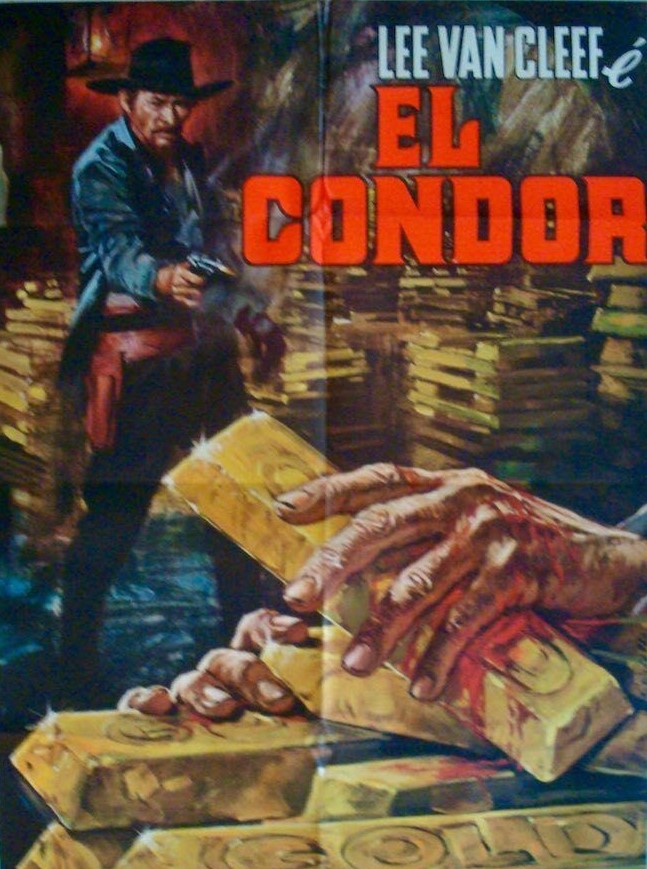
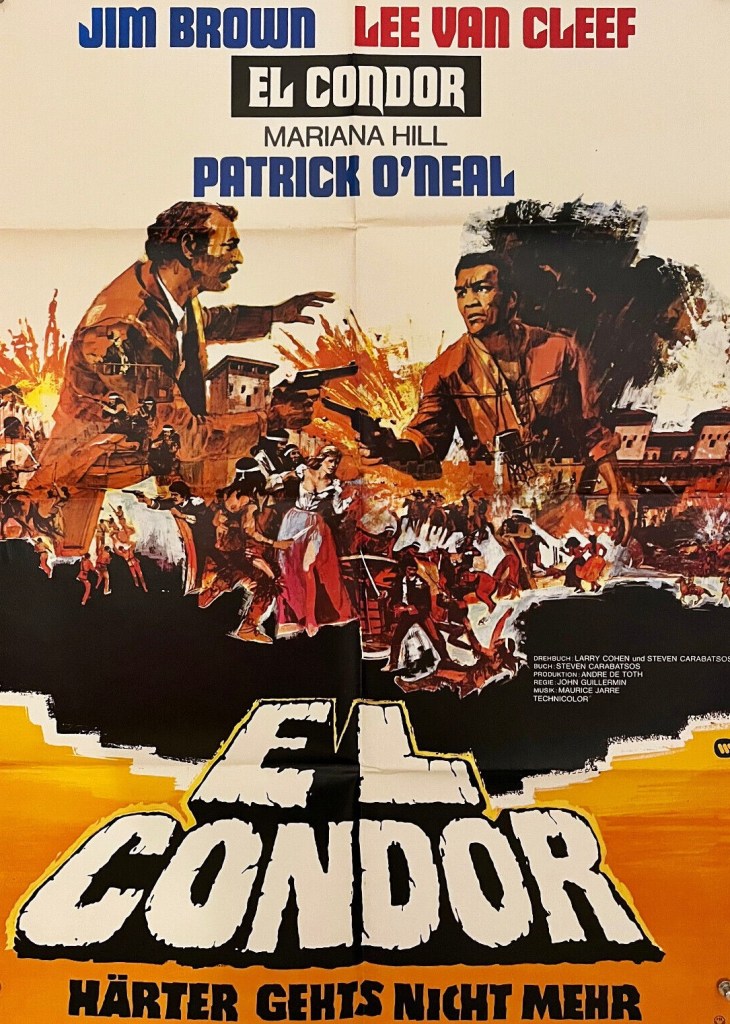
Highly under-rated western, directed with some style by a Britisher, bolsters Jim Brown’s marquee credentials and twists and turns every inch of the way. The basic story couldn’t be more cliché: outlaw Luke (Jim Brown), after escaping from a chain-gang, hooks up with gunslinger Jaroo (Lee Van Clef) and his gang of Apaches to steal the gold bullion hidden inside a Mexican fortress.
It just doesn’t work out that way. Any time a cliché rears its ugly head, director John Guillermin (The Blue Max, 1966) treats it as narrative obstacle and finds a neat way round it. Luke’s attitude doesn’t help either. Looking at a woman the wrong way, not showing Apaches sufficient respect, failing to rein in his larcenous partner, all lead to trouble. But at the right time and the right place, the pair show – almost show off – their respective skills, permitting escape when necessary and finding a way into the citadel.
Lee Van Cleef takes top billing in the Italian poster which adopts a more thematic approach than the normal action-oriented marketing.
Did I mention there was a bullfight with fort commander Chavez (Patrick O’Neal), wielding a saber, dancing around the animal on horseback, or that at one point Luke becomes the bull substitute. Or that, in the picture’s most notorious scene, shades of Raquel Welch taking an impromptu shower in 100 Rifles (1969), the invaders are helped by Chavez’s disgruntled mistress Claudine (Marianna Hill) distracting the defending soldiers by disrobing.
And, though minus such distractions, this is probably where the white walkers in Game of Thrones learned to scale a mighty wall. Even so, it’d be a pretty big ask to infiltrate a fortress almost medieval in its construct with an outer and an inner wall, so Luke evens the odds by subjecting the inmates to involuntary thirst, having destroyed their water tower and poisoned all nearby wells.
Given the heist involves gold, it’s no surprise that the weaselly Jaroo is overcome by greed, taking any opportunity to help himself to more than his fair share, encouraged of course by the even wilier Chavez who has the measure of the potential thief. Luke might have been cautioned about entering into a partnership with such a character after witnessing a couple of Jaroo’s schemes backfire. In one of them, in just about the cleverest and most audacious cut you will ever see, we go from Jaroo in a store stuffing illicit goods under his coat to the pair emerging tarred and feathered from a pond.
And this ain’t The Dirty Dozen, nobody appears to understand a command structure, or even stick to orders, Apache chief Santana (Iron Eyes Cody), left to his own devices, liable to attack a wagon train despite that giving due warning of their presence in the vicinity. But then Luke doesn’t show due respect either, resulting in the pair being staked to the ground in the boiling sun, and finding it impossible to dislodge an Apache clinging to his back.
As you might expect, it’s a bloody affair, but without dwelling on gore, none of the visceral exploding body parts of The Wild Bunch (1969). And there is a surprisingly touching moment when, shades of Charles Bronson in The Magnificent Seven (1960), the hard-nosed Jaroo bonds with a young boy on the grounds that they are both illegitimate and parts with one of his two precious gold nuggets to give the child a start in life.
Harsh reality intrudes. Unspoken racism on the part of Chavez sets him against Luke. And that women are prizes of war provides an uneasy undercurrent. Claudine is Chavez’s lover because he offers safe haven, a security not afforded other Mexican woman, forcibly parted from husbands to provide soldiers with sexual playthings.
Jim Brown (100 Rifles) and Lee Van Cleef (The Good, the Bad and the Ugly, 1967) are an inspired teaming, both playing against type, incurring more laughs than you might expect, and less inclined to play their previous stock characters, the former just a tough guy, the latter a ruthless professional. Patrick O’Neal (Stiletto, 1969) is a formidable opponent, perfectly capable of outwitting the more easily-duped Jaroo.
Despite, perhaps unfairly being remembered more for her nudity than her acting, Marianna Hill (Medium Cool, 1969) exhibits vulnerability as well as a tough core. Iron Eyes Cody (Nevada Smith, 1966) has a very refreshing take on an Apache war chief. And you might spot British starlet Imogen Hassall (The Long Duel, 1967) and veteran Elisha Cook Jr (Welcome to Hard Times, 1967).
But this movie really belongs to director John Guillermin who takes a fairly routine western and turns it on its head, extracting reversals at every opportunity, and clearly delighting in the several twists in the tail. Larry Cohen (Daddy’s Gone A-Hunting, 1969) and in his movie debut Steven Carabatsos (The Revengers, 1972) wrote the screenplay and the presence in the producer’s chair of Andre de Toth (Play Dirty, 1968) might account for some of the movie’s subversiveness.
There’s a historical footnote to El Condor. In a revision of the certificates issued by the censor, the British Broad of Film Classification in 1970 introduced the “AA” certificate, permitting people aged over 14 to view material that would previously have been restricted to the X-certificate. Admission to that category was raised to 18. So for a whole generation of teenage boys, hormones going wild, the first glimpse they had of a naked woman was in El Condor. (In the US it was an “R”.)
Not only well worth seeing but free to view on YouTube.
And when that source dries up you can find it on the Warner Archive.
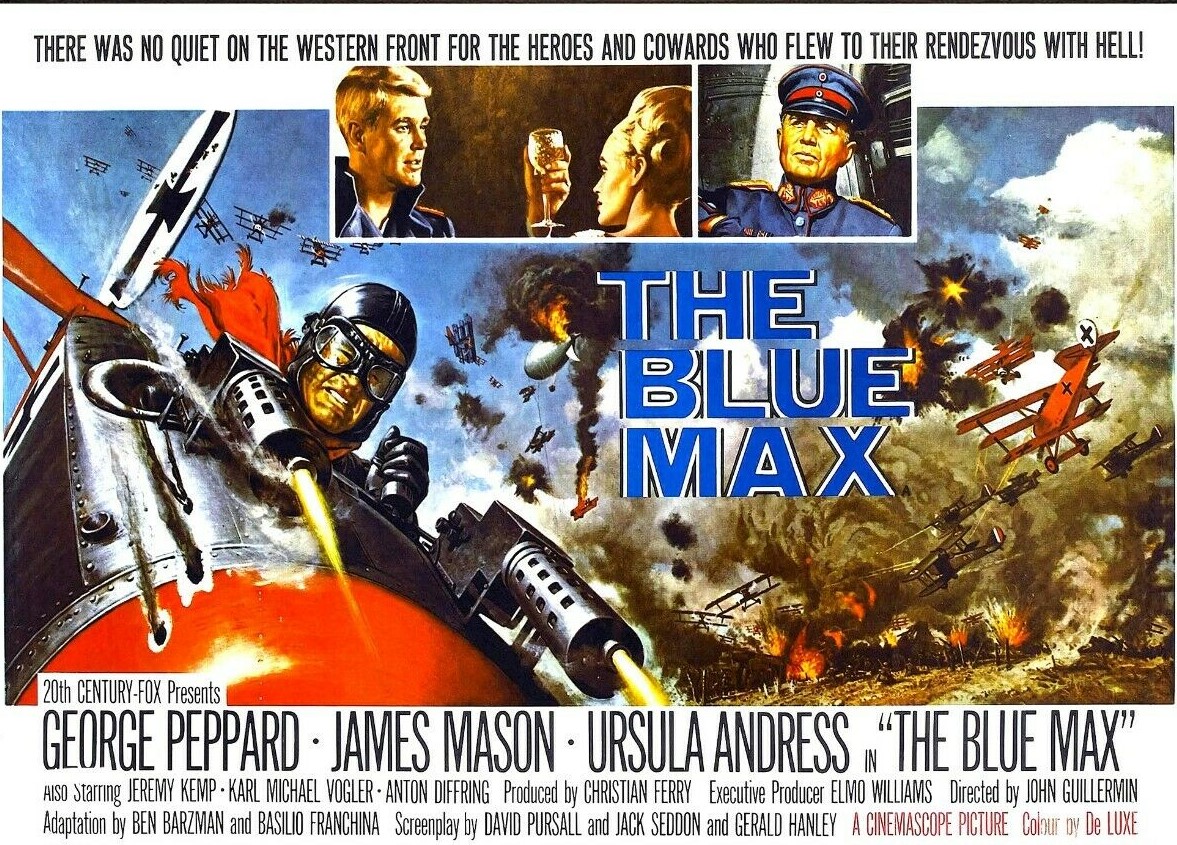
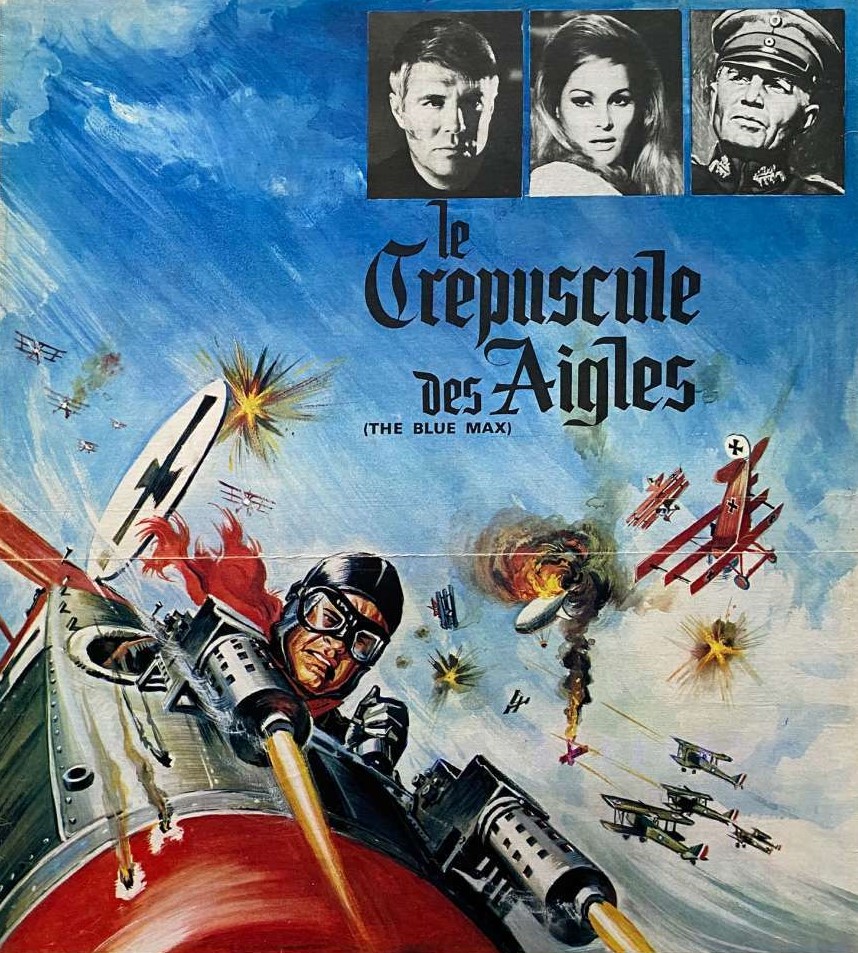
Watching The Bridge at Remagen sent me back with renewed admiration to John Guillermin’s take on World War One in The Blue Max. Again, a tale of two men battling for supremacy, although in this case they are both on the same side. Flying aces Lt Bruno Sachel (George Peppard) and Willi von Klugerman (Jeremy Kemp) could easily be accommodated within the highest echelons of the German fighter pilot division except that each wishes to be known as the country’s number one pilot and there is also a question of class and nepotism.
Quite how working-class Sachel Peppard makes the transition from grunt in the trenches to Germany’s elite flying corps is never made clear in this glorious aerial adventure. But he certainly brings with him an arsenal of attitude, clashing immediately with upper-class colleagues who retain fanciful notions of chivalry – harking back to the days of cavalry charges – in a conflict notorious for mass slaughter.
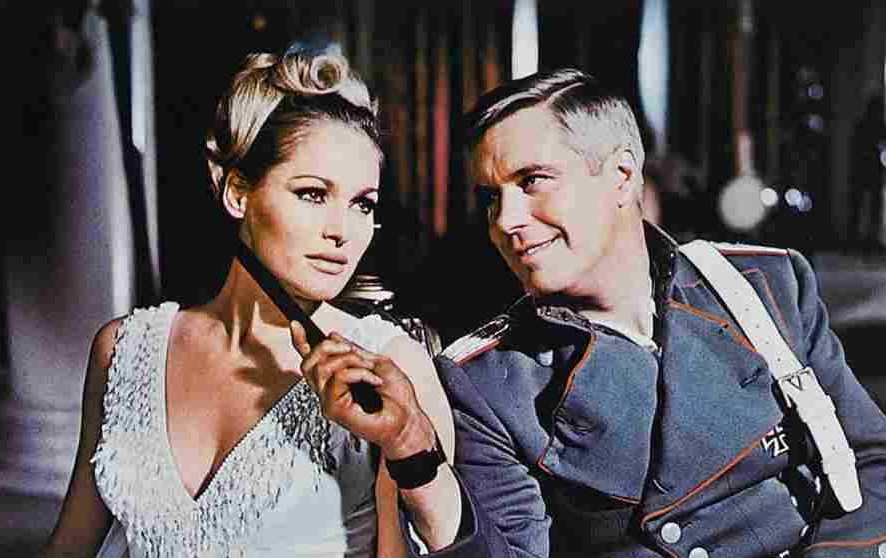
He climbs the society ladder on the back of a publicity campaign designed by General Count von Klugerman (James Mason) intent on creating a new public hero. On the way to ruthlessly gaining the medal of the title, awarded for downing twenty enemy aircraft, he beds Mason’s playful mistress Kaeti (Ursula Andress).
While the human element is skillfully drawn, the innate jealousy and petty rivalries that threaten to spoil the camaderie so essential to any war effort, it is the aerial element that captures the attention. The planes are both balletic and deadly. Because biplanes fly so much more slowly than World War Two fighters, the aerial scenes are far more intense than, say, The Battle of Britain (1969) and the dogfights, where you can see your opposite number’s face, just riveting. Recognition of the peril involved in taking to the sky in planes that seem to be held together with straw is on a par with Midway (2019) while the ability of the best pilots to dodge trouble in the sky has been more recently highlighted in top Gun: Maverick (2022).
I was astonishing to discover not only was this a flop – in part due to an attempt to sell it as a roadshow (blown up to 70mm for its New York premiere) – but critically disdained since it is an astonishing piece of work. Guillermin makes the shift from small British films to a full-blown Hollywood epic with ease. His camera tracks and pans and zooms to capture emotion and other times is perfectly still.
The best scene, packing an action and emotional wallop, will knock your socks off. Having eliminated any threat from an enemy plane, rather than shoot down the pilot, Peppard escorts it back to base, but just as he arrives the tail-gunner suddenly rouses himself and Peppard finishes the plane off over the home airfield, the awe his maneuver originally inspired turning to disgust.
The action sequences are brilliantly constructed, far better than, for example 1917 (2019) – which by contrast appears labored. One battle involving planes and ground troops is a masterpiece of cinematic orchestration, contrasting raw hand-to-hand combat between enemy soldiers with aerial skirmish. Guillermin takes a classical approach to widescreen with action often taking place in long shot with the compositional clarity of a John Ford western. Equally, he uses faces to express emotional response to imminent or ongoing action.
George Peppard (Pendulum, 1969) is both the best thing and the worst thing about the picture. He certainly hits the bull’s eye as a man whose chip on one shoulder is neatly balanced by arrogance on the other. But it is too much of a one-note performance and the stiff chin and blazing eyes are not tempered enough with other emotion, and he fails to portray the kind of complex character he would essay so brilliantly in P.J./New Face in Hell (1968) and House of Cards (1968) It would have been a five-star picture had he brought a bit more savvy to the screen, but otherwise it is at the top of the four-star brigade.
James Mason (Age of consent, 1969) is at his suave best, his aristocratic German somewhat redeems the actor after his appalling turn the same year as a Chinaman in Genghis Khan. Jeremy Kemp (A Twist of Sand, 1968) is surprisingly good as the equally ruthless but distinctly more humane superior officer. For once given the chance to act, Ursula Andress (The Southern Star, 1969) is more than mere eye candy, the kind of mistress with an eye more on the main chance than true love, although she does manage to swan around in one scene clad in only towels.
Look out for Derren Nesbit (The Naked Runner, 1967), Anton Diffring (Where Eagles Dare, 1968), Harry Towb (The Bliss of Mrs Blossom, 1968) and Karl Michael Vogler (The Dance of Death, 1967).
Guillemin’s technical skill is outstanding. In Bridge at Remagen it was the tracking camera and the blitz of war that captured the eye, here it is fabulous aerial photography. In the later picture, it was often hard to delineate individuals within the overall frame since the whole point of the film was the absolute messiness of war, but The Blue Max, dealing with one-on-one duels, presented a better opportunity to take advantage of cinematic elan. The screenplay, based on the bestseller by Jack Hunter, was courtesy of the team of David Pursall and Jack Seddon (The Southern Star) and Gerald Hanley (The Last Safari, 1967) after initial work by Ben Barzman and Basilio Franchina (both The Fall of the Roman Empire, 1964).
There had been a marked trend towards even-handedness in terms of presenting both sides during World War Two, as exemplified by Battle of the Bulge (1965), but this was the first to present the Germans in such heroic fashion.
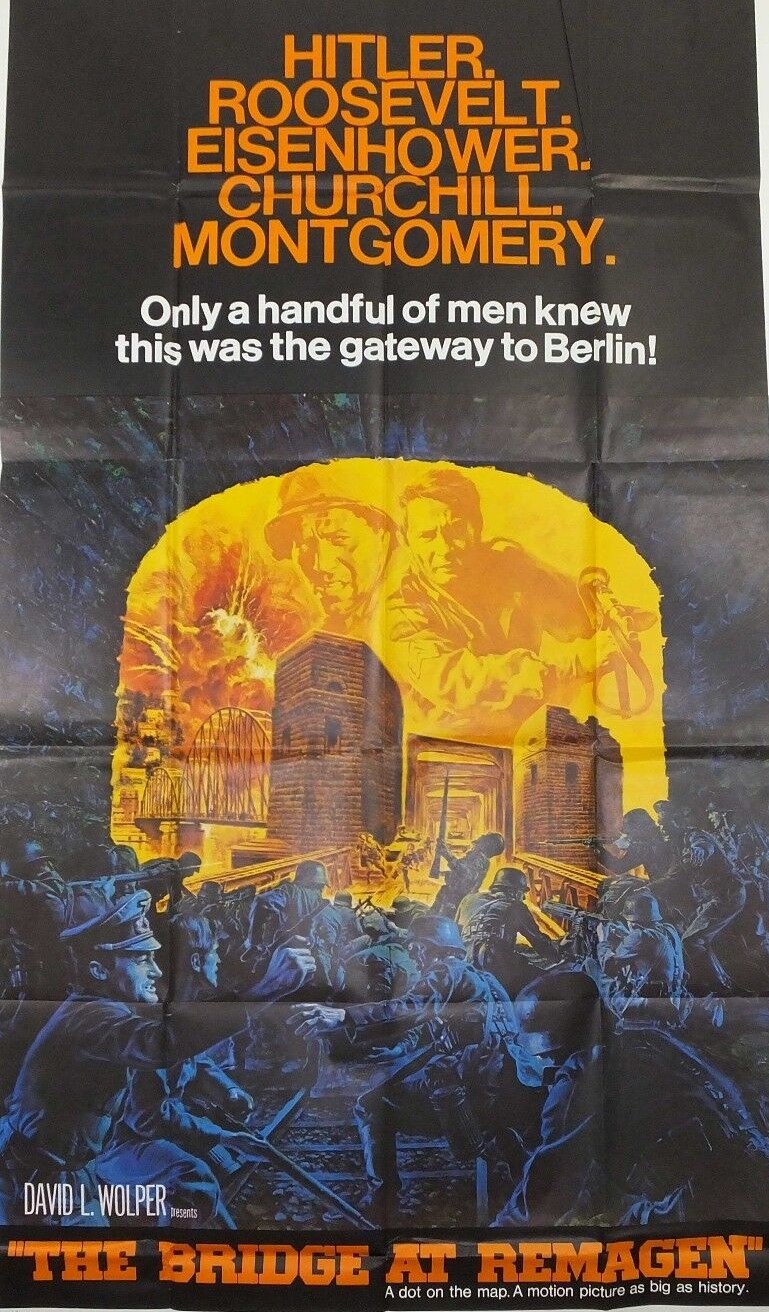
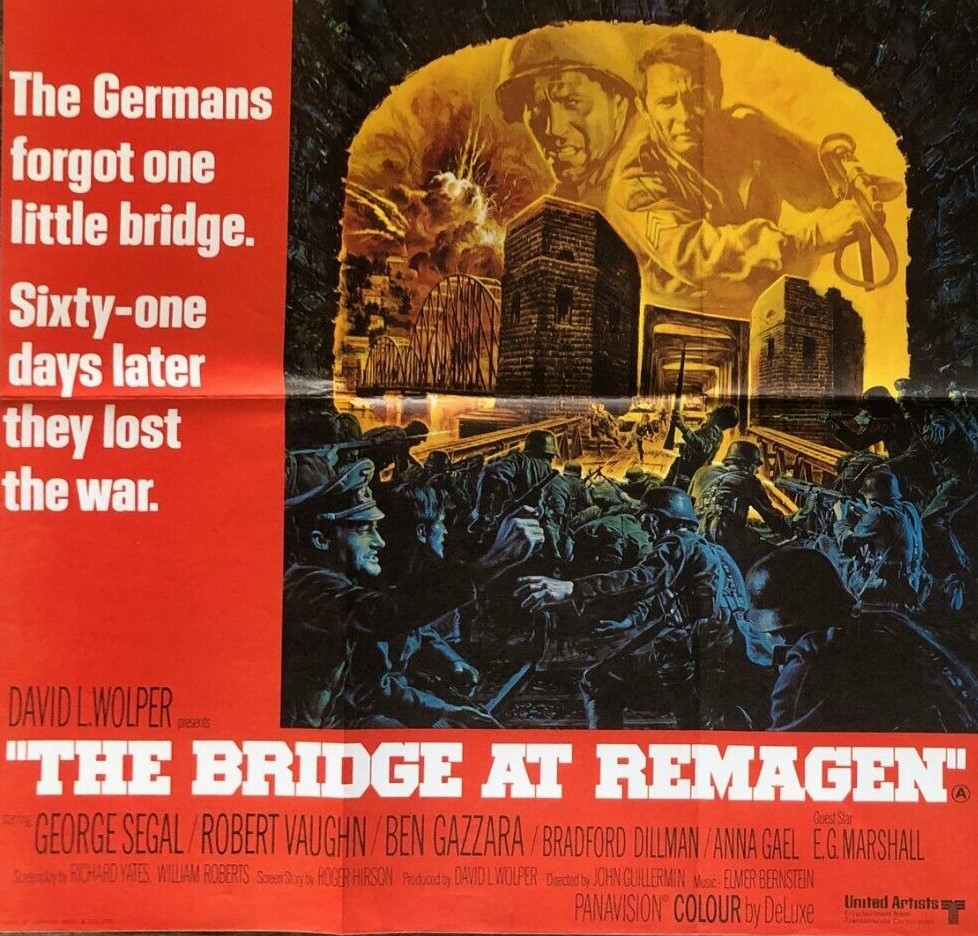
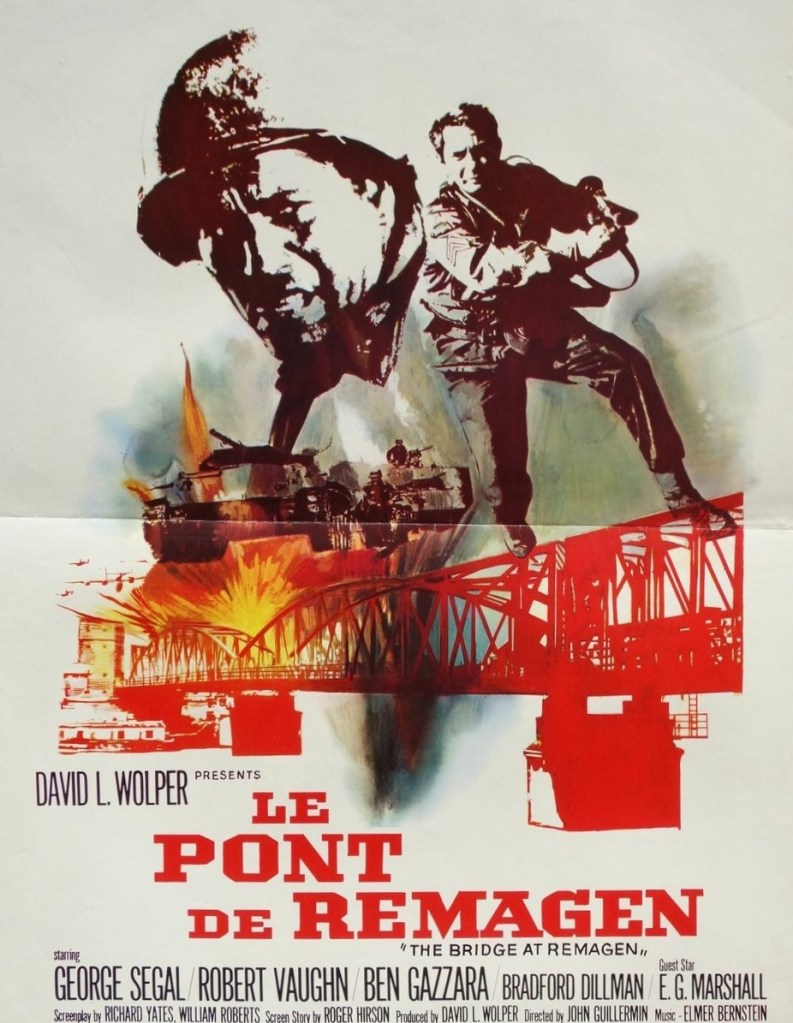
A million-and-a-half dollars potentially went down the drain when, thanks to the Russian invasion two months into production, producer David L. Wolper had to shift location shooting of World War Two picture The Bridge at Remagen from Czechoslovakia to Italy and Germany. Actors and crew woke up on August 21, 1968, to find their hotel surrounded by Russian tanks. Only quick action saw 80 personnel ferried in a taxi convoy through the only remaining open checkpoint to the airport, their departure coinciding with the arrival of the Russian paratroopers.
This had not been the first international incident for the movie, based on the destruction of the Ludendorff Bridge over the Rhine at Remagen in Germany. Previously, Wolper had been accused of being a C.I.A. spy and reports were circulating that armaments were being brought in to support Czech leader Dubcek while rumours flew of “busloads of American troops…arriving in Prague disguised as tourists and film technicians.” Matters were so bad that the Czech army placed under lock and key the film’s entire TNT and dynamite inventory amounting to over 6,000 sticks of the former and 800lb of the latter.
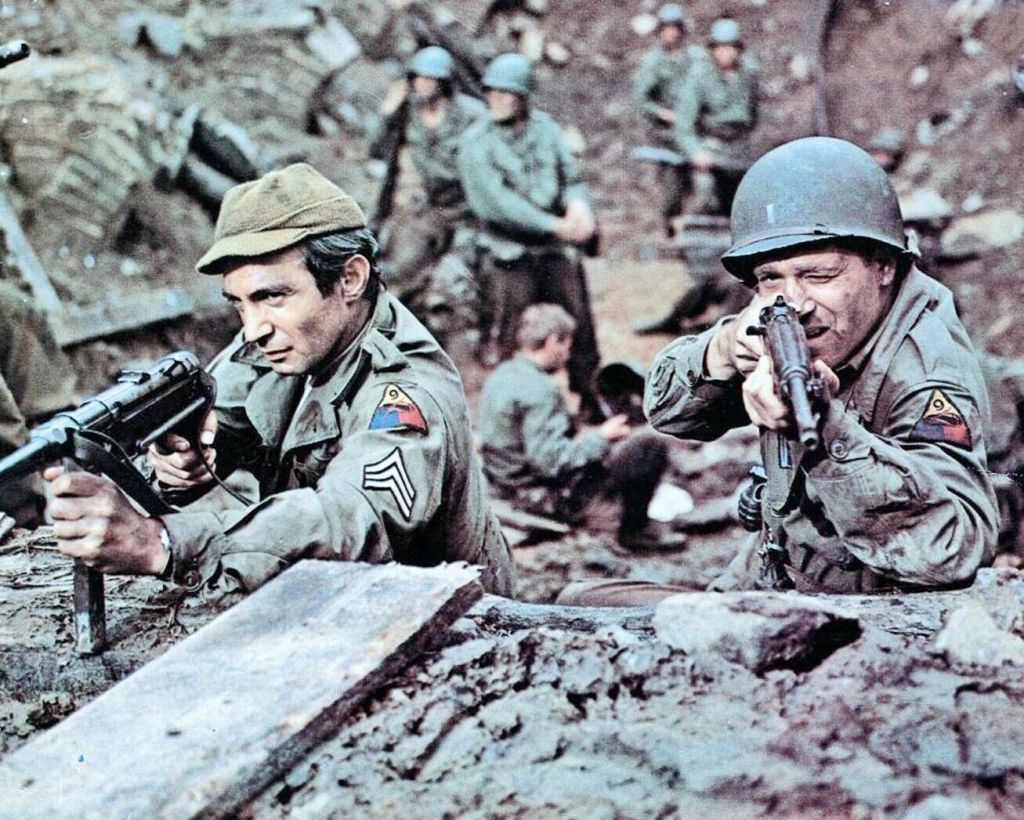
Ben Gazzara and George Segal open fire.
Small wonder the Russians were alarmed because the production had arrived with a massive cache of weaponry – an inventory over 1,000 pieces strong – including eight Sherman tanks and over 130 Browning and Thompson machine guns, MI rifles and carbines and Colt pistols as well as 300 dummy rifles. Luckily, most of the film’s battle scenes action had been completed when production was interrupted but that still meant a month of interiors and exteriors.
Wolper was something of a Johnny-come-lately to the Remagen scene. Budd Schulberg (On the Waterfront, 1954), who had fought at Remagen, and his brother Stuart were first into the frame, planning in 1958 to film for Warner Brothers Ken Hechler’s 1957 bestseller on the battle, as a follow-up to their first production, Wind Across the Everglades (1958). Stanley Kubrick was being lined up to direct. When WB bowed out the Schulberg Brothers moved it first to Columbia and then United Artists. When that gamble failed to come off, United Artists assigned Phil Karlson (The Secret Ways, 1961) as director but that also hit the buffers. Although Wolper started work developing a treatment in 1965 – Irvin Kershner in his mind as director – he had Ihe had to deal with another contender in Flaum and Grinberg Productions which in 1966 announced this as their debut production.
Wolper had come to movies on the back of documentaries. Using his Metromedia outfit as an umbrella, he had struck a six-picture deal with United Artists. The first movie had been the documentary Four Days in November (1964). But the next was intended to be a “plotted dramatic film based on fact with a big star cast” known at the time as The Remagen Bridge. From the outset this was seen as a “harsh recreation of actual slogging combat with some four letter words and not a glorification of war but underlining its hellishness.”
In the event, this was overtaken on the Wolper schedule by another war movie The Devil’s Brigade (1968). Further pictures planned were Europe U.S.A. (a.k.a. If It’s Tuesday It Must Be Belgium, 1968) and All the Conquerors (never made). Wolper had also in 1965 purchased the source material for The Green Beret, that proved to be a war movie too far and the project ended up with Warner Brothers and John Wayne.
After Roger Hirson delivered a story treatment for Wolper in 1965, the screenplay of The Bridge at Remagen went through the hands of Richard Yates, paid $25,000, the uncredited Ted Strauss (a Wolper executive with writing credits on documentaries) and Sam Watson who stiffened the treatment, with input from Wolper determined to “reinforce the image of Michaels (Segal) as one of the walking dead.”
While veteran William Roberts (The Magnificent Seven, 1960) finalized many of the film’s elements, Wolper also turned to Ray Rigby (Operation Crossbow, 1965) to “deepen the characters and create scenes with more punch” and Rod Serling (another $25,000). But Hirson could lay claim to setting up the movie’s dynamic. “This is the story of two men and a bridge,” he wrote. Initially, the American was called Earl Ammerman then Floyd Love before hitting on Michaels and finally Hartman, although that first name went from Curt to Vic to Phil. The German originally Hans Heller transitioned to Major Krueger, based on the real-life Hans Scheller.
Early drafts contained references to German secret weapons, a chaplain, a group of Polish sex workers and a brief glimpse of the woman (Anna Gael) at the end. Anthony Hopkins, then unknown, and Robert Vaughn were considered for the role of Major Krueger. Vaughn could read German and had an Oscar nomination and was a leading television star. George Segal faced no competition for his starring role, having already been in uniform for King Rat (1965). But Alex Cord (Stagecoach, 1966) declined a supporting role and Robert Blake (Tell Them Willie Boy Was Here, 1969) was considered
Filming on the original Rhine bridge was no longer possible given it had fallen ten days after the battle. Depending on which report you read, finding a replacement took around three years or 18 months or maybe just six months and involved a global search. One usable bridge was found in Washington State but with bare hillsides rather than town and mountain. John Frankenheimer on The Fixer (1968) had set a precedent for filming behind the Iron Curtain by using Budapest in Hungary to represent Russia.
Robert Vaughn about to open fire.
Not far from Prague in what was then known as Czechoslovakia the production unit alighted on the Davle road bridge, and struck a deal in October 1967. It was almost a perfect match for Ludendorff once towers had been added at either end, the bridge itself raised by 14ft and been augmented for authenticity by wooden and steel girders. To complete the transformation an 80ft tunnel was blasted out of the surrounding mountains. And a false church, another key scene, was built on a hill.
For $20,000 Wolper also bought a village called Most which the government had marked for demolition, allowing him to blow up designated buildings in a three-square block, providing the location for a key sequence in which the town was devastated by tank bombardment. (As I mentioned in my review, the collapse of these buildings looked incredibly real, and no wonder given they were not plaster-and-lathe imitations but genuine stone.)
Prague’s Barrandov Studios supplied 188 crew, up to 5,000 extras, interiors and transport. As part of the deal Czech labs would carry out the processing but not the synching or mixing. The decision to shoot in Czechoslovakia was primarily financial. Wolper reckoning shooting there could be done for $3.5 million, saving the production an estimated $2 million-$2.5 million if filmed in Hollywood. For the Czechs The Bridge at Remagen was a “test situation.” Should the country’s movie industry prove amenable to Hollywood it could result in an influx of hard currency and a stampede of U.S. productions. Already The Reckoning was heading for Bratislava.
Ironically, the success of a Communist-ruled country like Czechoslavakia in embracing Hollywood business lay in its acceptance of capitalism. It was ironic that what Wolper demanded of his Czech counterparts would have been impossible to achieve in a democratic country. “No western society could suspect traffic from a public thorough fare for three months to benefit a private enterprise.” Motorists were forced to use a temporary ferry and river traffic was held whenever required.
Englishman John Guillermin, a World War Two veteran, was hired on the basis of World War One picture The Blue Max (1966). That he had completed A New Face in Hell (1968) by the time shooting began was a bonus. Vaughn credited Guillemin with the film’s success. “I think he did a lot of research to make it more than just another war movie.”
George Segal concurred, “That was a movie constructed by John Guillermin and cinematographer Stanley Cortez. They shot a war and Guillermin made sense out of it – the angles were so dramatic….It was an epic… (P.J./A New Face in Hell) was a tough-as-nails movie at that time and I knew that’s what Remagen needed…Developing the war-weary character of Hartman was a little bit of me and a little bit of working it out with Guillermin…He brought so much texture to it that you fed off him and his attitudes and the way he conducted himself… Very focused, very concentrated, Guillermin was very economical in his shooting…He was a great influence on me in that film because I was the one who had to take charge and he demonstrated to me how to take charge.”
There was another side to Guillermin that almost caused him to be fired. “He was kind of a martinet,” explained Vaughn, “but I got along very well with him.” Added Segal, “I know sometimes he was implacable and I know that Wolper had problems with him.” That was putting it mildly. “The first day of shooting,” recalled Bo Hopkins, “John Guillermin hollered so loud his veins stuck out.” But when Guillermin attempted to bar Wolper from the set for a complicated battle scene, the producer promptly fired him. “When he realized I was serious,” Wolper recollected, “he apologized so I rescinded his firing. But I wasn’t kidding. Without that apology, he would have been gone. I had learned early that, as a producer, you have to be tough and you have to be tough right away.”
That it was truly a war out there can be judged from the armoury. The rolling stock came courtesy of the Austrian army by way of a sale from the U.S. in 1947. These included eight M-24 Chaffee tanks, three M-3 half-tracks, three M-8 armoured cars, eight 2½ ton trucks and six jeeps. The German actors and extras were armed with 250 Mauser rifles, 28 M-P machine guns, 14 P-38 pistols, 14 Lugers and eight Bren machine guns on top of four 88mm anti-aircraft guns, eight troop carriers and a dozen assorted armoured vehicles. In total the picture drummed up 150,000 rounds of ammunition, and in addition to the TNT and dynamite consignment mentioned above over three tons of smoke-producing powder.
The German and American stories were filmed separately, with little crossover between the two units. Remagen battle tank veteran Col Cecil E. Roberts, retired, oversaw the training of extras as U.S. and German soldiers. Hal Needham took charge of the stunts.
Part of the Czech Hollywood education was understanding the hospitality needs of the stars. Usually for a long shoot abroad, principals would be lodged in private houses, but here the 35 most important personnel were pup up in hotels. To the Czech way of thinking “deluxe hostelry was inappropriate” was actors who would be playing tough soldiers so the worst of the modern hotels, The International, was where many ended up.
The mollycoddled Hollywood contingent, wherever accommodated, found service uniformly slow, water supplies liable to vanish at short notice, no water at all one day, and drycleaning facilities that took two days. The normal contingent of wives had little confidence in the Czechs reaching the necessary standards. Janice Rule (Mrs Ben Gazzara) lasted three weeks before skipping off to Paris. Mrs Segal and her child remained in Switzerland for the duration. Although the three top stars dined each night Segal drank little on the grounds that “it interferes with my suffering.”
The stars were suddenly newsworthy when they became the first refugees from Czechoslovakia. Robert Vaughn and most of the world had expected a different outcome when Alexander Dubcek took over, a basic form of democracy heralded as the “Czech Spring.” Recalled the actor, “By the time we started filming (on June 6, 1968) it was a joyous time to be in Prague…the smiles (the public) wore and their exuberant anything-is-now-possible mood exemplified the socialism with a human face then making headlines the world over.” Ben Gazzara commented: “They were closing down the borders. If one of our people hadn’t called the U.S. Embassy we would have gone to the wrong border checkpoint, one already closed by the Russians.” Gazzara smuggled out a local waitress. The taxi convoy was met at the border by a fleet of buses organized by Wolper.
Stuck with an incomplete movie, and having to come to terms with the volume of equipment equipment left behind, Wolper took three weeks to reorganize. Most of the action sequences had been completed, but the vast arsenal borrowed from Austria would require substantial compensation if not returned. In addition, also lost were 40 reels of unprocessed colour negative worth $250,000 and crucial plates for rear projection work. In the end, the Russians were not willing to go to war with a Hollywood studio and returned 5,200 items of materiel, arms, costumes and film as well as 47 heavy-duty military vehicles straight to Vienna. .
Wolper found two locations to replicate the lost Dalve bridge – a crossing near Hamburg employed to represent the underside of the historic bridge for a key scene and at Castel Gandolfo close to Rome in Italy he built a half-scale replica. The addition of a small part of the bridge and a tunnel allowed the director to complete a number of vital sequences including when Hartman runs under enemy fire.
A second unit under the direction of William Kronick was permitted to return to Czechoslovakia to film 12,000 feet of “critical shots that couldn’t be duplicated.” These comprised long shots of the Germans trying to blow up the bridge and the eventual crossing of the bridge by 600 American soldiers – played by Czech Army personnel in the relevant uniform – and tanks and half-tracks. This was done, however, under the watchful eye of 500 armed Russian troops. Wolper had to pony up an extra $1 million for reconstructing sets originally used in Prague, for building the new bridge in Italy, for transport and for an extraq five weeks in salary.
“We defy anyone to identify what was shot near Prague and what was shot near Hamburg or outside Rome,” boasted Wolper (although in fact such mismatches provoked negative comment). He was especially proud of the scene of George Segal running across the bridge which was begun in Czechoslovakia nine weeks before it was completed at Castel Gandolfo on the reconstructed bridge. “You cannot tell the difference,” he said. Considering the unexpected interruption, he could be justifiably smug that the movie completed shooting in just 93 days.
Wolper had no illusions about the movie business and did not believe in the notion that any studio or producer possessed a magic touch, much though that was a line given out by any filmmaker enjoying a bout of success. “Audiences are very selective nowadays,” he said. “The moviegoer has an antenna that goes up if they like a film. If the antenna doesn’t go up nothing will drag him in.”
Wolper decide to launch the picture with an old-fashioned “local” world premiere. Ever since Cecil B. DeMille premiered The Buccaneer (1938) in New Orleans, this had turned into a major marketing device, with movies having first showings in a variety of small towns and cities all over America linked to a location shoot or birthplace of a star. The idea had long been out of fashion but since the original author was now a respected West Virginia Congressman, the movie premiered at the Keith-Albee cinema in Huntingdon, the mayor declaring a “Remagen Week” and tanks rolling through the streets as part of a publicity blitz.
By the time The Bridge at Remagen appeared, Wolper was a big-time indie producer, having splashed out $500,000 pre-publication on John Updike’s Couples to be directed by Joseph L. Mankiewicz (never made). Also on his agenda were: The Confessions of Nat Turner to star James Earl Jones with first Norman Jewison at the helm then Sidney Lumet, an original screenplay by Mort Fine (The Pawnbroker, 1964) called The Blessed McGill, The Great Cowboy Race from a screenplay by Abe Ginnes, Three Women (renamed I Love My Wife, 1970) and King, Queen Knave (1972) based on the Nabokov novel.
It’s axiomatic of the vagaries of Hollywood for even the most successful producers that two of these films never saw the light of day. Wolper stopped making movies after 1972, concentrating on television mini-series and documentaries for over two decades before returning to Hollywood in triumph with L.A. Confidential (1997).
SOURCES: Steven Jay Rubin, The Making of The Bridge at Remagen, Cinema Retro, Vol 12, Issue 33, pages 26-37 and Vol 12, Issue 34, pages 18-25; “Schulberg Next for WB Rhine Crossing Saga,” Variety, August 13, 1958, p7; “Schulberg Freres Will Roll Book by Congressman,” Variety, June 3, 1959, p7; “Rolling in Germany,” Variety, November 16, 1960, p5; “Phil Karlson Will Direct Mirisch Film in Europe,” Box Office, Jul 26, 1961, pW4; “Remagen Bridge As Plotted Film for UA,” Variety, March 3, 1965, p17; “Wolper Purchases Rights to GreenBeret,” Box Office, July 5, 1965, pW2”; “Flaum and Grinberg Form Production Firm,” Box Office, May 30, 1966, pW1; “Wolper Forms New Company To Produce Features, “ Box Office, February 27, 1967, p5; “Borrow Span, Blow Up Town,” Variety, November 8, 1967, p7; “UA Signs Wolper for Couples Release,” Box Office, February 26, 1968, p5; “Representative Hechler Is Adviser on Bridge at Remagen,” Box Office, April 22, 1968, p8; “Czechs Learn Fast What Yanks location Wants,” Variety, July 3, 1968, p31; “E Germans: Remagen a C.I.A. Front,” Variety, August 14, 1968, p14; “Czechs Want Western Production,” Variety, August 21, 1968, p16 – astonishingly this story ran on the day the Czechs ended any chance of Western movie investment when the Russians invaded the country; “Remagen Crew Safe, Will Finish at Hamburg Studio Site,” Variety, August 28, 1968, p3; “Remagen Weapons List,” Variety, August 14, 1968, p14; “Actors Cross Borders in Nick of Time,” Box Office, September 2, 1968, p12, “Wolper Retreat From Prague Costs Him Vast Arsenal for Remagen,” Variety, September 25, 1968, p32; “Remagen, 2nd Unit Shoots with USSR Troops Watching,” Variety, November 6, 1968, p2; “Despite Reds Czech Invasion, Wolper Winds His Remagen,” Variety, November 27, 1968, p28; Advertisement, Variety, January 15, 1969, p33; Advertisement. “Bridge at Remagen, The Incredible Log of the Motion Picture that Became An International Incident,” Variety, May 7, 1969, p132-133. “Audiences Still Puzzle for Producer David Wolper,” Box Office, July 14, 1969, pWC2; “Photograph,” Box Office, August 18, 1968, pB2.
Superior war film, somewhat underrated. Not just realistic battle scenes, but realistically weary soldiers and taking an even-handed approach to war in the manner of Battle of the Bulge (1965). The Americans want to destroy the bridge to trap 75,000 German soldiers on the wrong side of the Rhine, the German Major Krueger (Robert Vaughn) overrides his orders to also destroy the bridge and prevent the Allies with a direct route to Berlin. Instead with depleted forces – think Zulu (1963) – and hugely outnumbered he attempts to keep the bridge open so the cornered Germans can escape.
Unlike most war films there’s no time for comedy to lighten the spirits, it’s gruelling non-stop action. Even when the advance company, headed by grizzled Lt. Hartman (George Segal) find an abandoned village where the exhausted squad could rest up for a bit, they are ordered to keep going until they find more enemy to engage. Unlike the humane Krueger, the Allied high command are merciless, gung-ho Major Barnes (Bradford Dillman) and glory-hunter Brigadier Shinner (E.G. Marshall) drive their troops on, the latter not bothered how many of his men die in an attempt to blow up the bridge – “it’s a crap shoot” is the closest he gets to apology, claiming his actions will shorten the war.
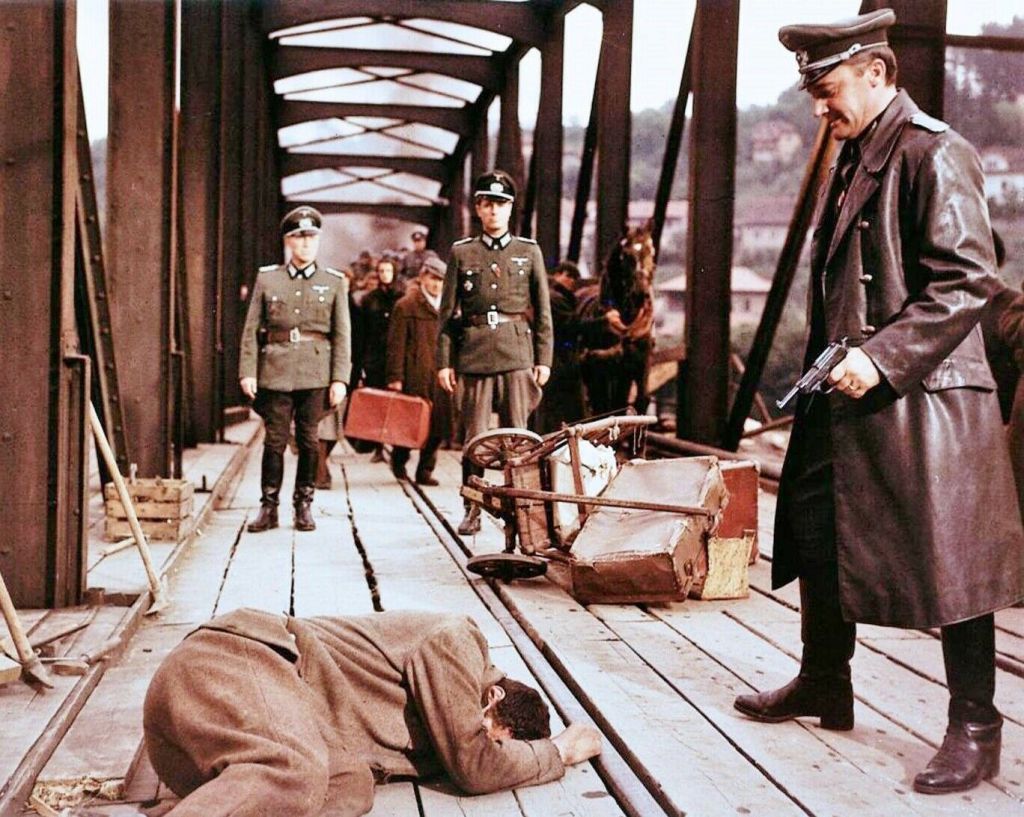
When Allied attempts to blow the bridge fail and with the enemy so close Krueger has to proceed with detonating the explosives littering the bridge and that plan is also scuppered, it’s a battle to the death to secure the crossing. And the story itself is accentuated by nods to the grisly cost of war – on both sides. Heartless Sgt Gazzaro (Ben Gazzaro), whose freebooting Hartman despises, is brought up short when he kills a youth commandeered into action by Krueger in a bid to bolster his meagre outfit – barely 200 men when he expected a force of around 1600. Krueger is sickened to see a German firing squad executing deserters, but has little sympathy for an innkeeper who has lost a son to the fighting when four million Germans are already dead.
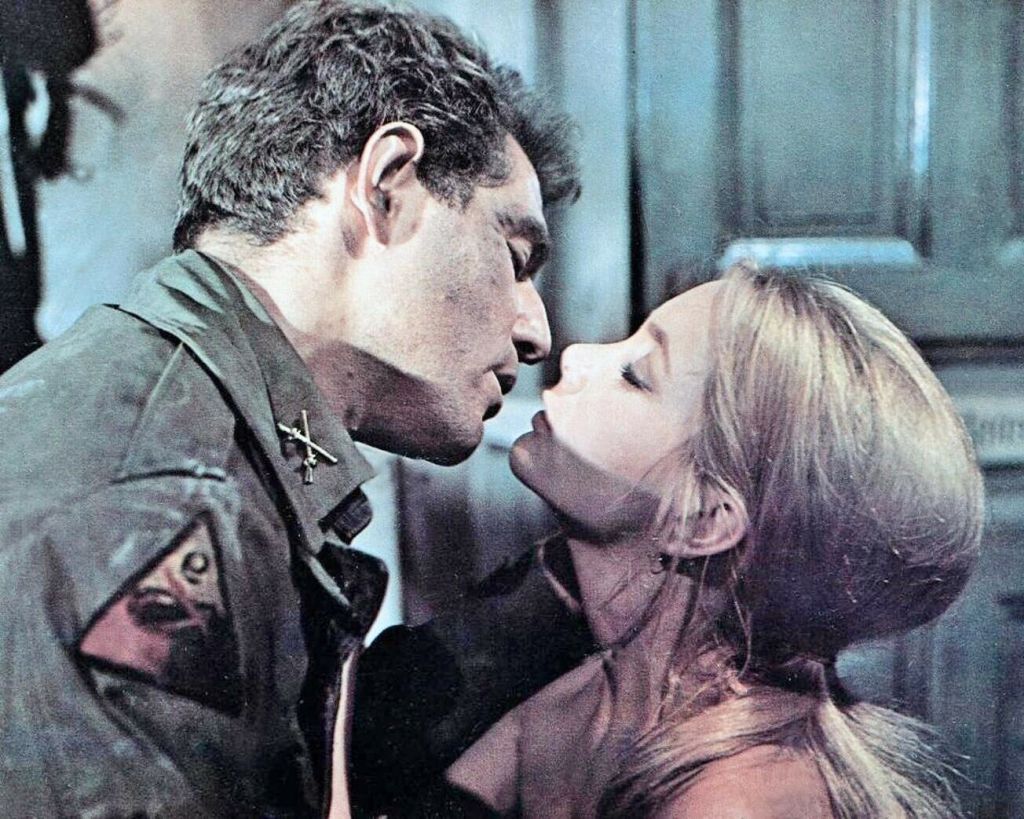
While reining in the worst excesses of Angelo, preventing him taking advantage of a captured woman (Anna Gael) and refusing himself to accept her offer of sex, Hartman does not rail (like Patton, 1970) against those of his men who succumb to pressure. Finding one soldier collapsed, he sympathizes, “sometimes it hits you like that,” and he refuses to put his men in unnecessary line of fire, prompting Barnes into almost killing him. Unlike Battle of the Bulge, however, there is no arrogant German commander (like Robert Shaw) nor complacent Americans.
The action is not only non-stop but hectic and the film begins brilliantly with tracking cameras scarcely able to keep up with American tanks barrelling along the road and aerial shots showing the destruction of another bridge over the Rhine. American tanks and German artillery exchange fire over the river. Buildings are blown out or majestically collapse (turns out these were real buildings, not mock-ups). Bridge stanchions fall in slow motion into the water. Refugees are collateral damage, the camera hardly registering a crying child or an abandoned doll.
As in the best war pictures, strategy and tactics are laid out for the audience, the American blunderbuss approach compares poorly to Krueger’s desperate attempts to utilise every advantage to the point of arming a barge in the river. Hartman and Krueger are well-matched in courage, the former thrown endlessly into action by cynical superiors, the latter, having discharged himself from hospital to fight on, landed with the task of rallying defeatist troops, and leading them into harm’s way in a manner that the American’s immediate superior, Barnes, point-blank refuses to do. Pride drives on the German, the war is almost lost, but surrender would be tantamount to humiliation. All Hartman has to fall back on is an inner core and the chain of command, soldiers obey orders.
Both George Segal (The Quiller Memorandum, 1966) and Robert Vaughn (The Venetian Affair, 1966) are well outside their acting comfort zone. Two stars whose hallmarks are cocky characters and suave charm turn into determined men who barely crack a smile. Segal has done cynical before but not to this degree and what catches the eye more is his sheer physical exhaustion. This is an early career highlight for Vaughn, rarely offered such juicy roles.
Although associated in the general audience mind for playing creepy, not to mention sleazy, characters, Ben Gazzara (Capone, 1975) had not made much impact on 1960s moviegoers, and beyond a handful of supporting roles best known to Americans for a starring role in television series Arrest and Trial (1963-1964). The general untrustworthy screen persona he would come to inhabit is given a good work-out here except for two scenes where his character takes unselfish action. Bradford Dillman, also best known for television (Court Martial, 1965-1966), portrays a largely one-dimension character lifted out of the ordinary in a couple of scenes.
E.G. Marshall (The Defenders, 1961-1965) and Peter Van Eyck (Station Six Sahara, 1963) are the opposing commanders. You can also spot Hans Christian Blech (Battle of the Bulge), Anna Gael (Therese and Isabelle, 1968), Sonja Zieman (The Secret Ways, 1961) and Bo Hopkins (The Wild Bunch, 1969).
John Guillermin (The Blue Max, 1966) directs with aplomb from a screenplay by William Roberts (The Devil’s Brigade, 1968) and novelist Richard Yates (Revolutionary Road, 2008) in his only work for the screen.





 The Magnificent 60s