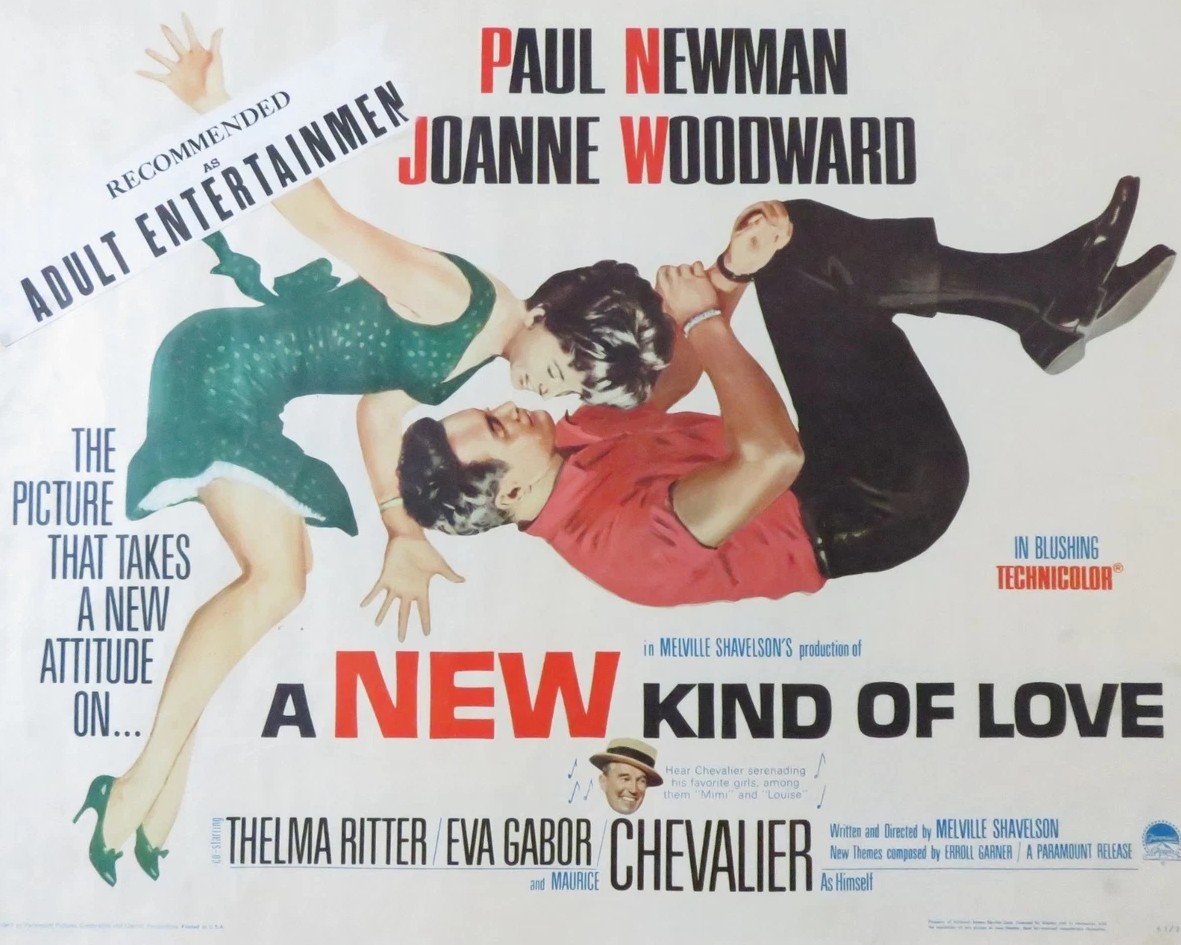
A New Kind of Love (1963) ***

Just about scrapes by, small thanks to Paul Newman’s atrocious Texan accent, Joanne Woodward’s frightful blonde wig – more Lady Penelope than classy Parisian – and Maurice Chevalier serenading a horde of drunken women. Maurice Chevalier? Well, of course this is Paris and Chevalier always sings regardless of being peripheral to the story.

Suffers, too, from being a smart-ass picture, in the vain hope of hitting the satirical bullseye taking swipes at everything in sight, from women barging into a sale to haute couture, airline stewardesses, journalism and even Paris. And there’s a string of fantasy sequences that might (or might not) have worked at the time but fail to gell now. Takes forever for the principals to even be brought close enough together to envisage romance and it doesn’t help that that supposedly most eagle-eyed of creatures, the reporter, can’t see through a simple disguise.

Tomboy Sam Blake (Joanne Woodward) is a pirate. Not the swashbuckling kind, leaping through the rigging, which would be worth seeing I’m sure, but the industrial kind, stealing the designs of better designers for a New York department store.

Steve Sherman (Paul Newman) is piratical, stealing other people’s wives. When his latest conquest turns out to be married to his boss, he is shifted off to Paris as – punishment? Yep, you can see the awry thinking behind this one.

Meanwhile, Sam and a gang from her store, boss Joe (George Tobias) and colleague Lena (Thelma Ritter), are off to Paris on a spying expedition to the annual fashion shows. Lena has her eyes on romance with the boss but is beaten to that prize by the glamorous Felicienne (Eva Gabor). Sam isn’t interested in romance. She’s a career woman, or in the parlance of the day, a “semi-virgin” (though I suspect that description was a screenwriter’s invention). Neither is Steve, for that matter, at least not of the long-lasting kind, he’s happily tearing around with a woman on each arm, enjoying the more nefarious sights of the French capital while Sam is knee deep in work.

After Sam gets a makeover, complete with long cigarette-holder Lady Penelope style, resulting in the bouffant hair style and is sitting in a café, she is approached by Steve who, assuming she is a high-class courtesan, attempts to interview her for the article he hopes will save his job. They’ve bumped into each other, she disdaining his obvious approaches, a couple of times but then she was rigged out in a short haircut and dark glasses. And this is such a complete transformation he doesn’t recognize her. And, in order to make this movie work, the audience has to play along.

As does Sam, keeping up the pretense of being a high-class hooker in order to get her revenge on the man she despises. The fictions she dishes up, of dalliances with powerful men, are published in his column and their success ensures he’s not fired. Felicienne is edged out of the way, revealed as previously a sex worker, so Lena can make her play for Joe.

Before that ploy can work, Steve sets up Sam with Joe who sees through the disguise. There’s a whole bundle of other unlikely shenanigans before we reach the compulsory happy ending.

Hollywood was fairly enamored with the sex worker or goodtime girl – Never on Sunday (1960), Butterfield 8 (1960), Irma La Douce (1963), for example, with the Oscars chipping in to show their support – and another (yes, this had been done before) comedic twist seemed to offer potential especially with two big stars going all risqué.

Paul Newman (The Prize, 1963) never quite worked out how to manage comedy until Butch Cassidy and the Sundance Kid (1969) where he maintained his usual persona and just delivered the lines rather than trying to wring laughs out of them. He also has a bad habit of trying to demonstrate character by fidgeting, so his face, eyes and hands are all over the place.

Joanne Woodward (A Big Hand for the Little Lady/ Big Deal in Dodge City, 1966) is better value initially but when she takes on the disguise there’s too much of the knowing wink. Six-time Oscar nominee Thelma Ritter (Boeing, Boeing, 1965) has a better idea of how to play comedy by just sticking to the knitting.  

Writer-director Melville Shavelson (The Pigeon That Took Rome, 1962) just about makes it work and when it doesn’t throws in sufficient distraction.

Not the Newman-Woodward team’s finest hour.
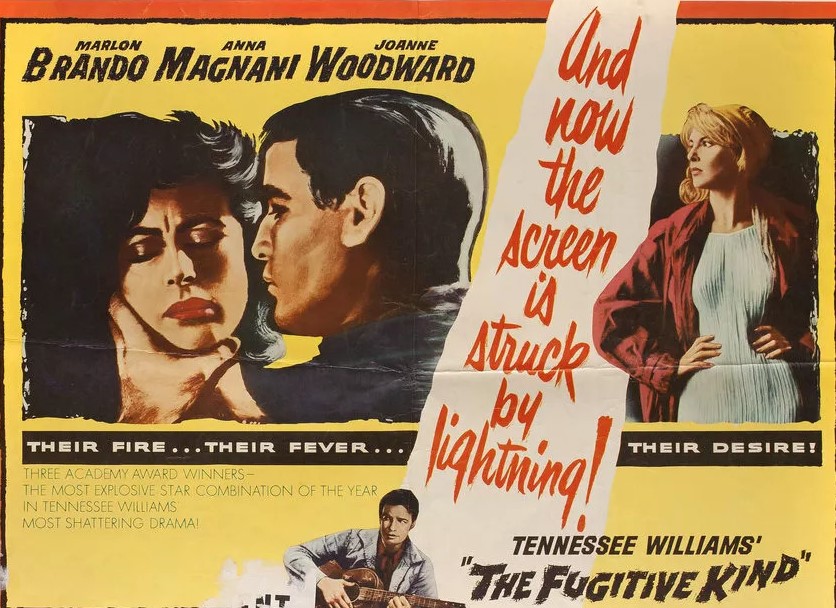
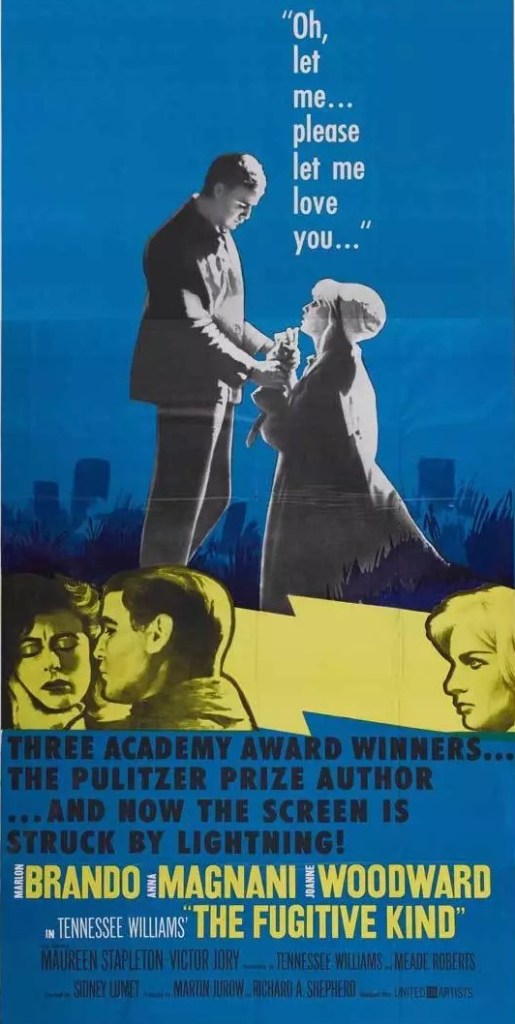
The Fugitive Kind (1960) ***

Audiences were promised sparks that never appeared. Marlon Brando (The Chase, 1960) remained electric but his charismatic screen presence wasn’t matched by miscast co-stars Anna Magnani (The Secret of Santa Vittoria, 1969) and Joanne Woodward (Paris Blues, 1961).  That was three Oscars right there. Throw in a Pulitzer Prize for playwright Tennessee Williams and the project should have been home and dry.

Instead, it struggles to get going as the screenplay flounders under a flotilla of old maids, alcoholics, drug fiends, racists and deadbeats while the central conceit of a May-December romance fails to catch fire. That last element is something of a contemporary trope, and one that even now is exceptionally hard to pull off and it was no easier back in the day.

Itinerant guitarist and sometime criminal Valentine (Marlon Brando), desperate to go straight, ends up in a small Mississippi town when his car breaks down on a stormy night and he finds shelter in the home of Vee Talbot (Maureeen Stapleton), wife of the sheriff. Given his good looks, it’s likely that Valentine would be viewed as a catch, but in this small town he appears to have stumbled upon a nest of sexually frustrated and/or voracious women, way too many dependent on the kindness of a stranger.

First to throw her hat, and virtually everything else, into the ring is the young vivacious unfettered alcoholic Carol (Joanne Woodward), outcast of a wealthy family, barred from shops and bars alike for her uninhibited behavior. But Valentine’s seen too much of her kind. Next up is middle-aged dry goods shop owner Lady Torrance (Anna Magnani) who gives him a job as a counter hand. Bitter and frustrated, she has to run after morphine-addicted husband Jabe (Victor Jory). Vee hovers around trying to pick up the pieces.

Small town, jealousy rife, word bound to get back to duped husbands, tragedy the outcome. By this point the Deep South on screen was pretty much played out as are the various basket cases who inhabit it and there’s not much fresh ground to be ploughed here. Valentine is called upon to do “double duty” as employee and lover, and finally responds to her sense of desperation.

He can’t quite cut his ties to the illicit, stealing from the cash register to fund a gambling stake, and when caught is subtly blackmailed.

The backstory mostly concerns Lady. Her father’s wine plantation was destroyed by vigilantes in revenge for him selling liquor to African Americans. She wants to establish her independence by setting up a confectionary stall. Turns out of course it’s her husband that led the vigilantes. Valentine totes around a guitar that he never plays, as if it’s a reminder of a previous life. He’s running away from a past in New Orleans without any idea of the future to which he aspires. He doesn’t know what he wants but won’t make a move in case it’s the wrong one. He may desire  a mother more than a lover.

It’s all set for a violent melodramatic ending, though the climax doesn’t ring true. Mostly, it’s about loneliness, both within and outside marriage. Relationships fester rather than last. The males are brutal or impotent.

While Joanne Woodward is determinedly over-the-top with her good-time-bad-girl routine, way out of control, and using over-acting as a crutch, Brando’s performance is more subtle and Magnani’s heart-wrenching.

But it just doesn’t add up. There’s too much emphasis on seedy background and forced drama. Williams has an alternative of the Raymond Chandler edict of when in doubt have a man come through a door with a gun; with him it’s unwanted pregnancy.

Director Sidney Lumet (The Appointment, 1969), who would later be more sure-footed, seems unsure here, the faux noir adding little, and inclined to indulge over-acting from the bulk of the supporting cast. Meade Roberts (Danger Route, 1967) adapted the Williams’ play.

An excellent Brando can make up for the rest.

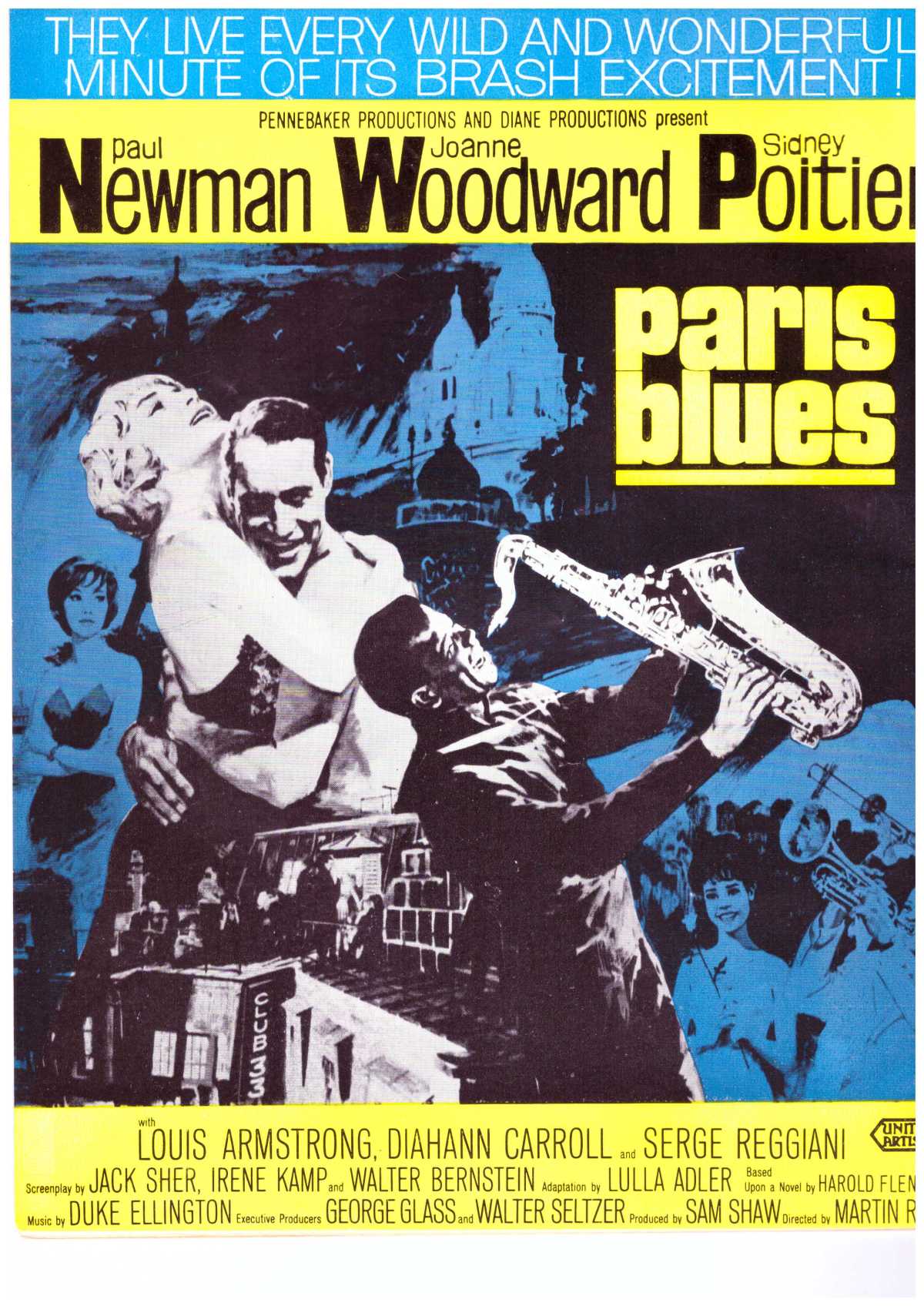
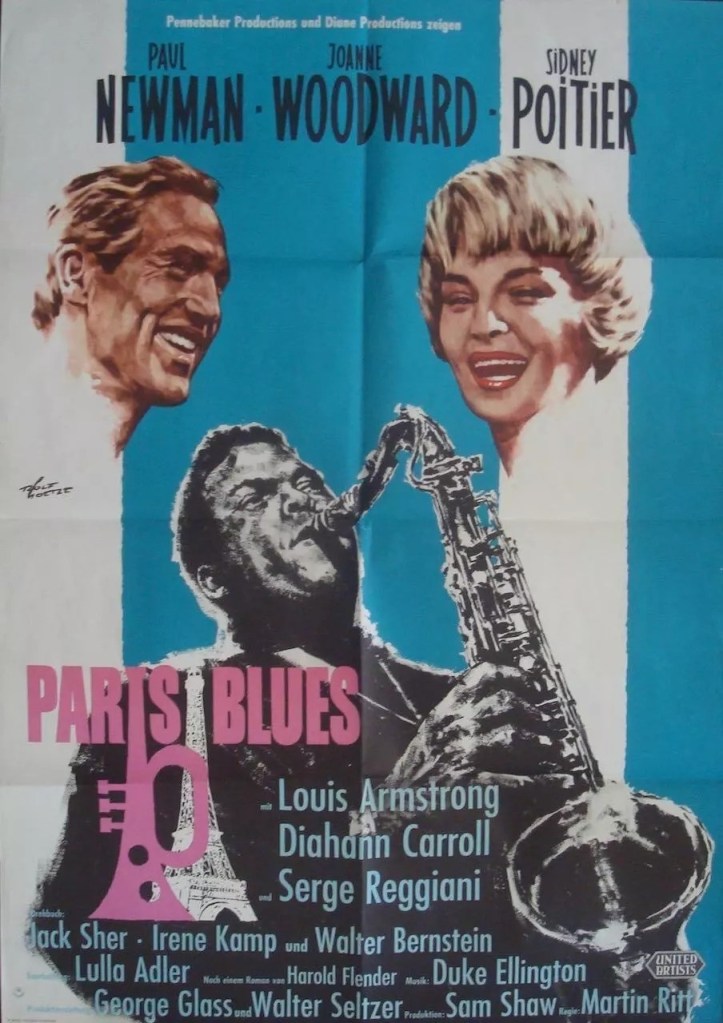
Paris Blues (1961) ****

Sometimes the stars just do align. Issue-driven drama played out against scenic Paris and host of jazz greats in support. The Walter Newman script gets quickly to the nub of a drama that focuses squarely on racism and creativity.

Jazz trombonist Ram (Paul Newman) lives for his music and fancies himself a composer as well as a player and expects women to fall in with his creative lifestyle until he comes across single mother tourist Lillian (Joanne Woodward) who ups the romantic ante by hopping into bed right away. Ram’s buddy, saxophonist Eddie (Sidney Poitier), falls for Lillian’s pal Connie (Diahann Carroll) but not only is she less promiscuous but a civil rights activist who rails against him for abandoning the cause and hiving off to Paris.

There’s a good twist on the will-she-won’t-she trope as this time around it’s the men (no surprises there) who have trouble committing. While the guys are both smitten, and at various times ready to throw up their Parisian lives and head for home, it doesn’t work out that way, so mostly what we get is argument, making up, repeat. But that’s not to suggest this falls into any kind of trap.

While Lillian uses seduction to try and winkle Ram out of his refuge, Connie, on the other hand, depends on guilt. Although Eddie’s able to verbalize the benefits for a black musician playing in Paris, he hardly needs to point it out, it’s plain to see that the innate racism he suffers at home is entirely absent in his adopted city.

If you’re a jazz enthusiast you’ll probably be more aware of the central musical conflict, the older-fashioned New Orleans style versus the modern be-pop. There’s no shortage of jazz. Duke Ellington was Oscar-nominated for the score, Louis Armstrong turns up, mobbed at the train station by fans, and every time the movie’s not cutting away to a Parisian backdrop it’s indulging in some great jazz tunes in the traditional smoky night club.

What’s really attractive here is the assured acting. Paul Newman was in the middle of a hot spurt, both at the box office and from the critics, successive Oscar noms on the way for The Hustler (1961) and Hud (1962) and endorsing his marquee credentials with From the Terrace (1960) and Exodus (1960). This is a lively performance, one in which he doesn’t have to carry the weight of the world on his shoulders or the deadweight of expectation. He’s not a snarling rebel, he doesn’t need to be, not with nightly improvisation, recognition from his peers, and a toehold on the next stage of creativity, composition. If he’s tussling with anybody it’s himself and his spats with Lillian are little more than arguments with himself about the road to take and the sacrifices that might be essential along the way.

Sidney Poitier (The Long Ships, 1964) snags a great career break, like Newman deprived of heavy duty, able to display his great charisma and charm with such a light touch. Joanne Woodward (Big Hand for a Little Lady, 1966) as ever brings a wide range to her role, sassy at times, pragmatic, not inclined to the lovelorn. Diahann Carroll has the hardest part, since she’s the evangelist for modern America, one where equality is going to be a given, so her scenes with Poitier end up mostly being argument rather than pure romance.

This would have been a lot edgier had it gone down the originally planned route of Ram falling for Connie, and that’s hinted at when they first meet, but I guess Hollywood wasn’t ready for that.

This was the second (of five) of director Martin Ritt’s collaborations with Paul Newman – they had formed a production company – and shows the pair’s preference for movies bearing social comment. Ritt (The Spy Who Came in from the Cold, 1965) marries all the various elements to produce an entertaining picture on a serious subject.

Walter Bernstein (The Money Trap, 1965), Jack Sher (Move Over, Darling, 1963) and Irene Kemp (The Lion, 1962) collaborated on the screenplay from the novel by Harold Flender.

Thought-provoking.

Behind the Scenes: “Number One” (1969)

Apart from Ben-Hur and El Cid, most of Charlton Heston’s movies in the 1960s were domestic box office disappointments. Despite this, he was deemed to be still flying high at the marquee, placed seventh in the annual star rankings just as negotiations began in 1967 for Pro (the title changed to Number One just a few months before release). Given there was little interest in American sports in the rest of the world, it was deemed a gamble. That was not just reflected in the budget – a miserly $1.15 million- but in Heston’s salary of $200,000. He and director Tom Gries (Will Penny, 1968) agreed to “work at substantially lower incomes in exchange for a bigger percentage.”

But to make any decent money, of course the movie had to be a big hit. Compare that to the $750,000 he stashed away for The Hawaiians (1970), admittedly after Planet of the Apes (1968) hit the jackpot, but still. From The War Lord, Heston had “learned actors should not put their own money into scripts,” but taking a pay cut appeared a more sensible route.

The movie was a long time coming to fruition. Initially, the idea had been rejected by National General and Martin Ransohoff of Filmways who worked with MGM. By April 1966, Heston was dejected. “Nothing stirring on Pro,” he recorded in his journal. But he understood the need not to “peddle the project” since “it tarnishes my image as an eminently in-demand actor.” Franklin Schaffner (Planet of the Apes) was initially keen, but dropped out after United Artists insisted on smaller fees against a bigger back end, star, director and producer to share 75 per cent of the profits, the kind of deal you get offered “when you want to make a film more than a studio does.” Tom Gries (Will Penny, 1968) was the next directorial target.

By June 1967, the deal was done for Heston, Gries and Selzer. ”I’m damned if know who will write the script,” noted Heston, “No one very expensive, I guess.” In July, he was in San Diego “investigating pro footballers in their natural habitat.” The NFL agreed to allow the New Orleans Saints to participate. David Moessinger had written two screenplays, Daddy-O (1958) and The Caper of the Golden Bulls (1967), but struggled to meet Heston’s expectations.

The actor felt the writer hadn’t “succeeded in dramatizing the most difficult and the most important element of the story. Why Caitlin feels as he does.” His wife, Lydia, agreed. “If women’s can’t relate to the story, then it’s just a picture about a football player and we’re in trouble.” UA had set a deadline and the screenplay would decide whether it was a go or no. Heston planned to get Gries to work on the script, and he subsequently nailed the vital scene.

Even when UA gave the go-ahead there were problems integrating the shooting schedule with that of the Saints which would require filming training camp in summer 1968 and the rest in the fall. Bob Waterfield was teaching Heston how to quarterback. Soon he would have “delusions of adequacy.”  But the training took its toll in the shape of a pulled muscle. In his first proper game, he was “blitzed” 16 times. He ended one day “taped and doped, in the traditional bed of pain.”

Meanwhile, casting proceeded. Heston had “mixed feelings” about Eva Marie Saint (The Stalking Moon, 1968) and Joanne Woodward (Big Hand for a Little Lady, 1966). Suzanne Pleshette (A Rage to Live, 1965) was considered as well as Jean Simmons (Rough Night in Jericho, 1967) – “I think she’d be good for it,” noted Heston. Finally, he pushed for Jessica Walter (Grand Prix, 1966) – “old enough to be plausible as the wife, young enough to manage the flashbacks” – only to find Gries not so keen and preferring Anne Jackson (How to Save a Marriage and Ruin Your Life, 1968). When the situation was resolved in favor of Walter, Heston discovered she was being lined up for a television drama about pro football. The second female lead went to Diana Muldaur.

Meanwhile, Heston was having trouble with Gries. “His attitude towards this film…is very questionable…perhaps it has to do with his recent achievements as a director in theatrical films…he’s finding the wine a bit heady.” Gries fell behind schedule, but finished ahead of it, saving about $30,000. An important scene showing Walters and Heston in bed before the wedding didn’t work and was cut.

Keeping tabs on the budget was producer Walter Selzer, who had worked with the star on The War Lord (1964) and Will Penny, and, would team up with him again for The Omega Man (1971), Skyjacked (1972), Soylent Green (1973) and The Last Hard Men (1976). “You have to be realistic about the subject matter,” said Selzer. “Every story has a certain price and if you try to cheat on your requirements it shows on screen.” That said, he was king of the penny pinchers. “We didn’t use a single piece of new lumber,” he boasted, meaning they didn’t built a single set, instead adapting or re-using old ones.

On location, he negotiated “locked-in” costs, “a flat pre-arranged price” for variety of elements which had a tendency to become variable, increasing costs, such as space on a sound stage, equipment and the editing suite. Cameraman Michel Hugo had to agree to shoot in any weather. “This is very important. Very often a cameraman will refuse to shoot if the weather is questionable, claiming the shots won’t match and then you have the whole company idle for a day when on location.” He nailed down composer Dominic Frontiere (Hang ‘Em High, 1968), paying him a flat fee, with Frontiere left with the task and cost of hiring an orchestra and rehearsal and recording space.

Despite showing his rear end in Planet of the Apes, Heston was touchy about the sex scene. “It’s not really a nudie scene but an intensely sexual scene,” he explained, “There’s not a bare breast seen.” Heston had enough controversy elsewhere. As president of the Screen Actors Guild he appeared not to note the irony that while he was pocketing hundreds of thousands of dollars a picture, he could complain that extras were the cause of the “major increase in costs” of movies.

He was also accused of being hypocritical, signing for Eagle at Escombray, directed by Alexander Mackendrick, to be made by CBS while at the same time, as union leader, pressurizing the Department of Justice to prevent television companies such as ABC and CBS entering the movie business. (It was never made.) For that matter, he shouldn’t have been trying to get National General to fund Pro either, since it owned a cinema chain, and that, too, went against previous Department of Justice rulings.

While Heston like the movie – “some of the best contemporary work I’ve done” – UA did not. The title changed to Number One. By the time the movie appeared, in August 1969, Heston couldn’t have been hotter, thanks to the unexpected success of Planet of the Apes. So the world premiere in New Orleans was allocated a full array of razzamatazz – in the parade were the New Orleans football team, its mascot, cheerleaders and a stream of antique cars, but there was a fire in Heston’s hotel.

Box office was less rosy. There was a decent $179,000 from 32 in New York, a “big” $9,000 in Washington, a “hotsy” $24,000 in Baltimore (and $20,000 in the second week), a “neat” $12,000 in San Francisco and a “trim” $27,000 in St Louis but mostly the figures were “mild”, “okay”, or “fair.” Outside of first run it couldn’t run up any juice. Estimated rentals were $1.1 million, so just about break-even, but United Artists, understandably despite Heston’s contention that it was about a man not American football, refused to give it any meaningful release overseas.

SOURCES: Charlton Heston, The Actor’s Life, Journals 1956-1976 (Penguin, 1980); “All-American Favorites of 1966,” Box Office, March 20, 1967, p19; “Charlton Heston Denies Conflict Between Eagle Role, SAG Policy,” Box Office, January 15, 1968, pW3; “Sports, Flop-Prone Theme Still Dared,” Variety, September 25, 1968, p2; Army Archerd, “Hollywood Cross-Cuts,” Variety, December 18, 1968, p22; Army Archerd, “Hollywood Cross-Cuts,” Variety, February 5, 1969, p34; “Number One Parade To Precede Premiere,” Box Office, August 18, 1969, pSE5; “Falling Stars,” Variety, September 3, 1969, p70; “Critics Wrap Up,” Variety, September 24, 1969, p26; “Variety Box Office Charts Results 1969,” Variety, April 29, 1970, p26.  Weekly box office figures – Variety, 1969 : August 27, September 3, September 10, September 17, September 24

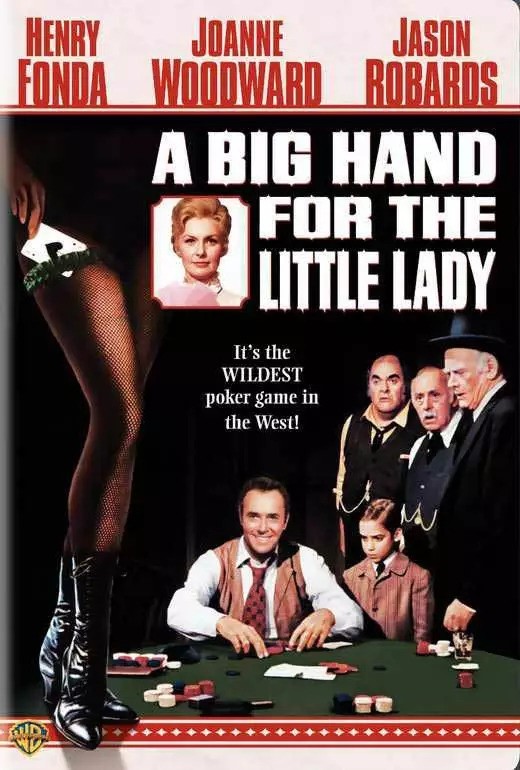
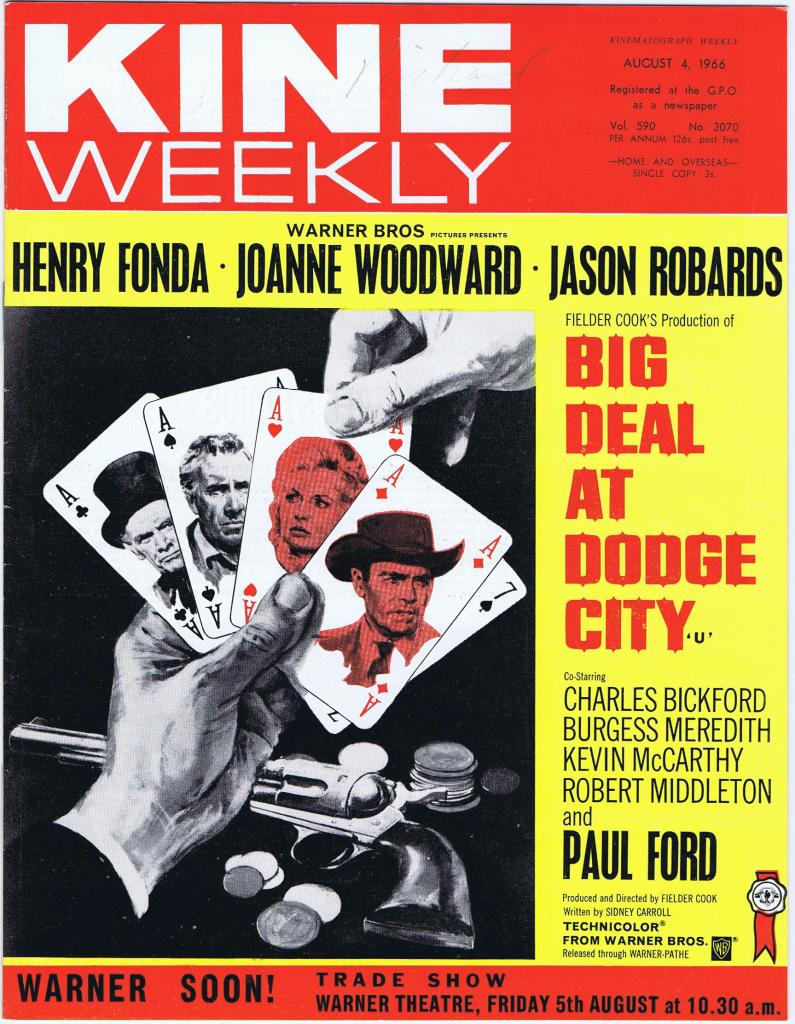
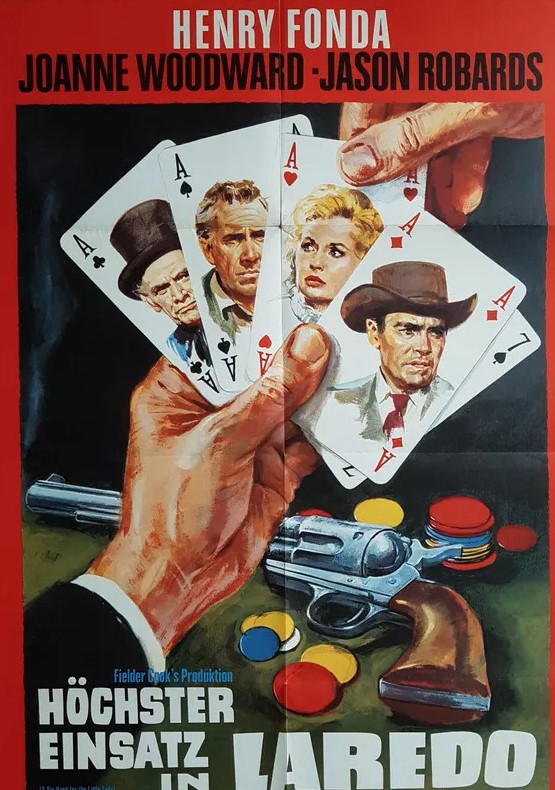
A Big Hand for the Little Lady / Big Deal at Dodge City (1966) ****

An absolute delight. Thrilling too. Knocked sideways in the box office battle of the poker pictures by the purportedly classier The Cincinnati Kid (1965) with Steve McQueen in one of his most iconic roles facing off against Edward G. Robinson and underrated ever since. But this more than holds its own against the Norman Jewison number. In part because of terrific untypical performances from Once Upon a Time in the West alumni Henry Fonda and Jason Robards.

I get my daily movie fix late at night when the rest of the house is abed and disinclined to share my interest in old movies but when at a critical point my DVD gave out instead of, as would be more sensible, giving up and going to bed, I spent ten minutes frantically scouring YouTube for a copy, even glancing hopefully at one in a foreign language, and expended the same time again tearing apart my DVD collection, which at one point had been sensibly arranged alphabetically until too many additions made nonsense of that arrangement, until I found another copy. Finally, I settled down, even later at night, to watch an enthralling finale.

A more blatant example of artistic license you couldn’t find. The movie is set in Laredo, not Dodge.

Fielder Cook (Prudence and the Pill, 1968), with only a handful of movies to his name and generally considered no great shakes as a director, plays this hand brilliantly. It reeks of mystery, as a poker table should. We begin with an undertaker’s coach racing from town to town and  house to house collecting with urgency a disparate collection of people delivered to the backroom of a hotel in Laredo, Texas, where, nonetheless, the townspeople are excited beyond belief. It’s the long-awaited poker game between the five richest men in the territory.

As he stuffs more cash in the safe and pulls out bigger and bigger batches of poker chips, the hotel owner (James Berwick) is constantly badgered by his exuberant customers as to who is winning. He remains mute on that score until Doc Scully (Burgess Meredith), heading out to deliver a baby and a foal, asks the same question. Such is the medic’s local standing, the owner gives a reply. This means something to the onlookers but not to us because we have very little concept of the players.

And that remains largely the case beyond some good-humored and occasionally tense banter when we learn that Drummond (Jason Robards) abandoned his daughter’s wedding to get here and that lawyer Habershaw did likewise in court leaving his client to defend himself. And the game itself is boisterous, devoid of the cathedral-like atmosphere of The Cincinnati Kid.

But when a relatively impoverished newcomer Meredith (Henry Fonda) enters the fray the situation turns ugly as he is besieged by insult and verbal abuse as his paltry stake gets smaller and smaller. When he takes his last $3,000 – the whole sum intended to provide a new future for his wife and son on a farm near San Antonio (“San Antone” he quickly learns is the correct pronunciation) – he discovers that he is undone as his fellow gamblers raise the bidding beyond his amount.

At which point he collapses, potential heart attack. Doc Scully hauls him off on a makeshift stretcher. The money will be defaulted unless upstanding wife Mary (Joanne Woodward) of the anti-gambling fraternity can be called upon to play out his hand in a game of which she is completely ignorant and, more to the point, raise the cash to be allowed to continue.

The players sneer at what she has to offer. The richest men in the territory have no need, even at a cut-price offer, of a gold watch and a new team of horses and wagon. For a moment you think Mary, seeing her family fortunes going downriver, is going to offer herself as collateral, but instead, she decides to try and get a loan, based on the hand she holds, from the bank. You might as well try to get blood out of a stone from bank owner Ballinger (Paul Ford). Maybe she has something worth more to him as collateral than watch and wagon.

I won’t spoil it for you by revealing the ending but it’s well worth the wait and the mystery.

I was knocked out by Henry Fonda’s acting. Usually, he is gritty, upstanding, sometimes the last man standing, and his smile is often more of a grimace. Here, he is nervous, jumpy, anxious, and desperate, the reformed gambler unable to resist temptation, persuading himself that this one last game would be worth all the broken promises given his wife. His smile is so ingratiating you wouldn’t want anything to do with it. As regards the temptation facing addicts it’s on a par with the heroin victim of The Man with the Golden Arm (1955) and the alcoholics of Days of Wine and Roses (1962).

With him removed from the equation, the acting lot falls to Joanne Woodward (A Fine Madness, 1966). She’s the prim opposite and doesn’t overplay her hand, restraining as best possible her confusion and fear. And this is a very fine turn from Jason Robards, most commonly accused of over-acting or under-acting, and here he gets the balance just right, volubility matched by arrogance, and a determination not just to win but to demolish an opponent.

A raw truth is expored here. Winners don’t just like winning – the medal, the lap of honor, the pile of cash, all that jazz – but they enjoy more seeing the defeat of their opponent, savoring that disgrace. This ain’t the kind of game that ends in a handshake or embraces sportsmanship. This is real in a way that The Cincinnati Kid is not.

There are a couple of familiar faces, John Qualen (The Sons of Katie Elder, 1965), and Charles Bickford (Days of Wine and Roses) in his final movie. The rest of the cast is largely anonymous, there to add febrile excitement, with hollering and racing around, desperate to keep up with the action.

Screenwriter Sidney Carroll had been here before, the big stakes, no-hoper taking on the world in The Hustler (1961) but he and Cook had managed a small-screen rehearsal of this picture a few years before on U.S. television in the DuPont Show of the Week series.

Every now and then, as I’ve maybe mentioned before, one of the joys of this little odyssey into the world of the 1960s movie is that you come across a little gem.

This one sparkles.

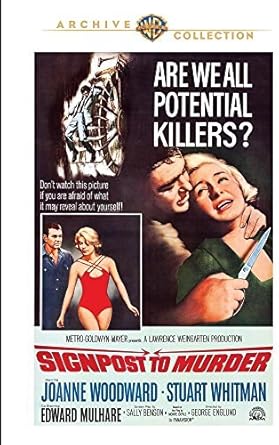
Signpost to Murder (1964) ****

Very tricky home invasion thriller. And not just from the narrative perspective and my guess is you’ll work out what’s going on long before the end, but that’s deliberate, you’re meant to, because the final twist isn’t plot but emotion, unexpected pent-up release.

Deftly directed by George Englund (The Ugly American, 1963), distinguished camerawork, long shot and overhead put to exceptional use. Biggest surprise is Stuart Whitman (Rio Conchos, 1964) taking the acting plaudits from Oscar-winner Joanne Woodward (A Fine Madness, 1966).

Slightly throws you because the interesting questions it asks about the treatment of the insane and the rehabilitation of criminals could, in retrospect, just be a contrivance to serve the plot. Basically, it’s a one-set show but thrumming continually in the background is a working water mill, the location being an English mill house belonging to American Molly (Joanne Woodward) awaiting the return of her husband from a business trip to Amsterdam. She’s got quite the hots for her lover because she’s planning to greet him at the door all decked out in a swimsuit.

But that’s in the future, takes 20 minutes of this exceptionally short picture (just 78 minutes) before we get to her. First of all, we’ve got the set-up. Confined within an asylum surrounded by high electric fences is wife killer Alex (Stuart Whitman), five years into his stretch, whom resident psychiatrist Dr Fleming (Edward Mulhare) not only believes is sane but also innocent, the convicted man having no memory of killing his wife and, as it later transpires, no motive.

The asylum officials ain’t so crazy on Fleming’s theories but by this time the good doctor has fed Alex a line, a loophole in English law dating back to the Victorian Lunacy Act, which, bizarre though it may seem, allows a man who escaped from an institution and remained free for 14 days to be permitted a re-trial.

When Fleming’s request for leniency is turned down, Alex escapes, heads for the river to elude hound dogs picking up his scent and ends up at the mill. The siren has sounded so everyone in the village is on the alert. From his cell high on a hill, Alex has previously scoped out the village, and with the help of Fleming, identified various houses, and from his own observations learned about the community, such as that the mill owner is handy with a shotgun, killing rabbits with abandon.

The original play enjoyed a successful tour of the British provinces after a West End run,
though the characters skewed older in the stage version,
Margaret Lockwood approaching 50, Derek Farr just past 50.

So it’s Alex who is greeted by the swimsuit. And then it’s the familiar duel of minds. Though we’ve just seen him knock out the doctor and an electrician, when Alex enters this house he’s a changed man. Sure, he has the shotgun but he’s planning to only hide out for a night, till the search expands away from the village and he can sneak through the gaps and hide out for the fortnight necessary to implement the loophole.

We know he’s not exactly a maniac, or a tough guy in the Lee Marvin mold, because we’ve seen what a sensitive and intelligent character he is through his conversations with Fleming, and he’s trusted enough by the officials to be allowed an axe to chop wood. But Molly doesn’t know that. She’s expecting a maniac and is thrown when he’s calm and gentle, not to mention tender.

He seems to shed nine lives when he enters this realm of domestication. She’s not half as confident as her sophistication might suggest. Her marriage has not brought her the comfort or the love she expected. The countryside is shrouded in fog, so her husband’s not going to be back till morning, which removes one complication, but adds another, a growing feeling that they are kindred souls, lost and vulnerable.

His story appears to make sense to her and when he espies a corpse trapped on one arm of the wheel it’s she who comforts him when he thinks its imagination run wild and then in the more obvious sense they console each other.

Comes the twist. That was a real body. Her husband.

This where you think. Uh-oh. The old story of the femme fatale and the patsy and you wonder were any of her feelings true or was she just acting the part to gull him. So, when the police and Dr Fleming arrive, the finger is most obviously pointed at a man who has no memory of killing before. Remember, this is in the days when the simple detection methods available now would have easily cleared him, so you have to go with the flow.

When Alex defends himself and declares that they slept together and sounds so utterly confused, one of the cops, for no desperate reason it has to be said in the absence of the usual clues on which we rely, thinks something foul is afoot.

And it’s her who confesses. She had expected a maniac not a gentle man who touched her soul in a way that neither husband nor lover, Dr Fleming, managed. Totally turns the picture on its head. And instead of the usual plethora of clever sleuthing, we have a resounding emotional climax.

Full marks though to George Englund, not just for the outstanding use of the camera, creating distance between characters even in intimate situations, one great shot where through separate windows Alex and Molly stare at each over the rolling watermill, and to offset the tension some excellent  comedy as the Yank comes to terms with British tradition after a death. He cleverly opens up the original stage play by Monte Doyle, and there’s a strong hint of irony in the opening section which sees a car-load of kids point to two loonies on the hill. We quickly learn only one is designated as such, Alex, but the other one, the sane one, Dr Fleming, turns out to be every bit as mad.  

But this is Stuart Whitman’s tour de force. He had earned an Oscar nomination for The Mark (1961) but appeared to exert more box office appeal when he went all square jaw in action pictures. I’m not the first observer to mention that one of the key points in a performance is an actor’s reaction to their surroundings. Like you or me, they should look round. I noted that with David Janssen in The Swiss Conspiracy (1976). But here is an even better example. When Alex sees the lounge and all the elements of domesticity, he’s not just having an ordinary look, he’s soaking it up and it’s taking him back to the life he lost, one he can’t understand why it was taken away from him. You look at a modern film. The camera does all the work. The director uses a habitat to guide you into the mind of the inhabitant but rarely, as in the old days, to allow reflection on the part of a visitor.

There’s a huge range of emotion for Whitman to pack in, not to mention a convincing British accent, and he does it all. Woodward nearly steals the picture away from him with that final, unexpected, scene. Molly knows that by confessing she’s about to lose the love of her life and if she doesn’t be condemned to live with a man who doesn’t come close.

In the stage play Molly was clearly the top role and always attracted the bigger star. Same here, Woodward is billed above Whitman. The last scene is a peach for any actress. But Whitman’s is the more difficult role.  Should maybe be a split decision but I come out for Whitman.

Superb minor gem.

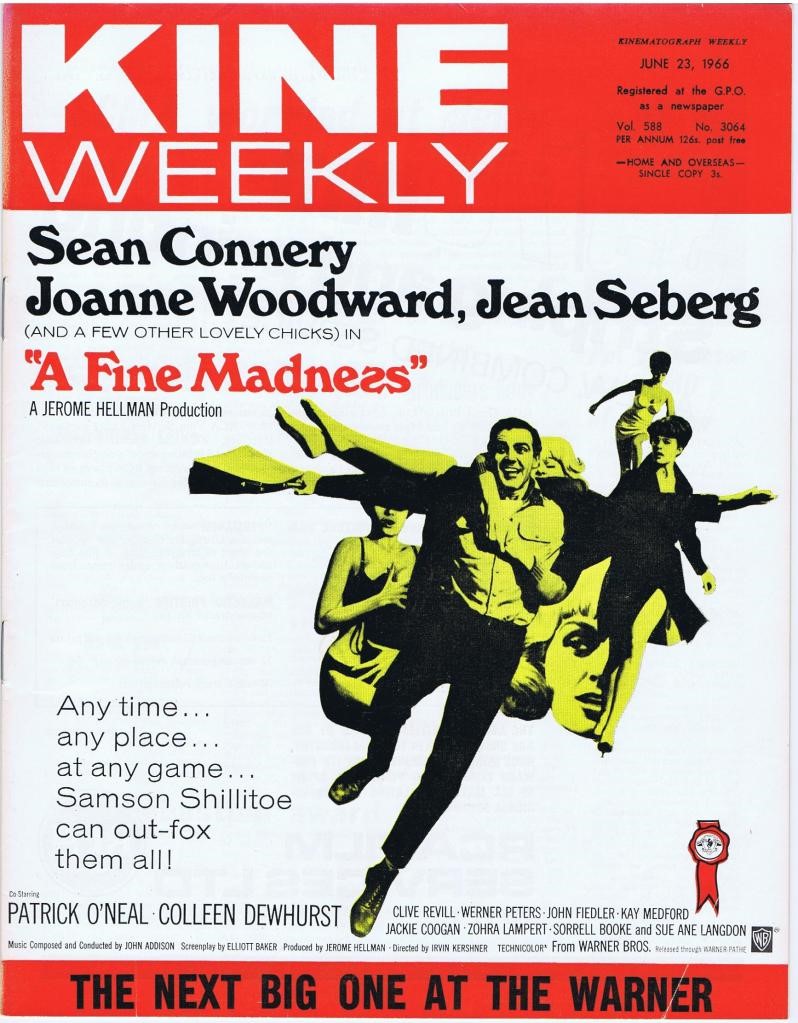
A Fine Madness (1966) **

Let’s start with the Hollywood happy ending. Poet Samson (Sean Connery) slugs pregnant second wife (Joanne Woodward). He’d have punched her lights out before if only she hadn’t been so good at diving out of the way. As it is he manages to throw her down the stairs. The film kicks off with him ill-temperedly whacking her over the head with a pillow.

This is the kind of film where violence against women is treated as a running gag.

Let’s try to sell it as a wacky comedy.

Lydia (Jean Seberg), wife of psychiatrist Dr West (Patrick O’Neal) treating Samson for writer’s block, doesn’t have the courage to make it plain to his creepy colleague Dr Vorbeck (Werner Peters) that she doesn’t fancy him when he endlessly paws her and slaps her rear so he takes this as the green light to attempt to rape her. That’s another running gag.

Surly loud-mouthed bully Samson gets a free pass because he’s an artist, a poet with one poor-selling volume of poetry, and unable to find the time or space to complete his masterpiece. He would have more time if he didn’t spend so much of it chasing women.

At my count, he gets through at least four – Lydia, office secretary Miss Walnicki (Sue Ann Lngdon), a client (he cleans carpets for a living) Evelyn (Zohra Lampert), and Dr Kropotkin (Collen Dewhurst), another colleague of Dr West, not to mention the current wife he drives demented and the previous wife for whom he is being aggressively pursued for alimony.

You can see how director Irvin Kershner was a shoo-in for The Flim-Flam Man/One Born Every Minute (1967) because at every opportunity he tries to turn simple dramatic confrontation that enhance the story into needless chases that divert it and extract slapstick from material that in no way suggests it’s ripe for such an approach.

Trivia lovers note: The John “Redcap” Thaw in the supporting feature “Dead Man’s Chest” is the same John Thaw from “The Sweeney” and “Morse“.

There’s a story in here somewhere and a pretty barmy one at that if you set aside the poor poet’s endless battle against a world that fails to understand his genius and his dodging of the alimony. Rightfully diagnosed as some kind of sociopath by yet another of Dr West’s colleagues, the needle-happy Dr Menken (Clive Revill), he is admitted to a psychiatric hospital initially as a way of dodging his creditors and providing him with space and time to write.

Again, his most creative use of his time is to make out with Lydia and Krokoptin. But since he is spotted in a hydro-bath/ripple bath with  naked Lydia, the vengeful husband gives the go-ahead to perform some kind of lobotomy on the poet, on the assumption it will dull his violent tendencies. (It doesn’t work.) The opportunity to satirise the psychiatric profession takes second place to another opportunity for a chase.

Anomalies abound. Samson’s character is clearly drawn on Welsh poet Dylan Thomas who exploited his fame and made his money on recital tours. Performing is against the broke Samson’s principles and he turns viciously on his audience of appreciative women. Despite demanding center stage, when offered it he turns it down. He lambasts middle-aged women but has little against those younger members of the species more susceptible to his charms. He only has to tell Miss Walnicki she has “pouty lips” and she falls into his arms.

All this has going for it are the performances. Sean Connery (Marnie, 1964), it has to be said, certainly exhibits screen charisma though this is not as far removed as he would like from the macho James Bond. Joanne Woodward (From the Terrace, 1960) – switching from her normal brunette to blonde – is excellent as the downtrodden waitress wife, but on the occasions when she is spiky enough to put him in his place soon regrets her temerity.

Jean Seberg (Pendulum, 1969) – switching from blonde to brunette and paid more ($125,000 to Woodward’s $100,000) – is good as the sexually frustrated rich housewife. And Patrick O’Neal (Stiletto, 1969) looks as if he is desperate to throw a punch. Elliott Baker (Luv, 1967) wrote the screenplay based on his own novel.

You do sometimes wonder at the knuckle-headedness of stars. Was this all that was offered to Connery at his James Bond peak? Or was it a pet project? I doubt if it would have been made with another big star – you couldn’t see even the macho Steve McQueen entering this territory and the likes of Paul Newman wouldn’t go near it.

Theoretically, studio head honcho Jack Warner gets the blame for this. He didn’t like Kershner’s cut and ordered it re-edited but I’d be hard put to see how his hand could be any less heavy than that of the director.

That’s two stinkers in a week. If you want proof of just how rampant sexism was in Hollywood check out a double bill of this and A Guide to a Married Man (1967).

An insult.

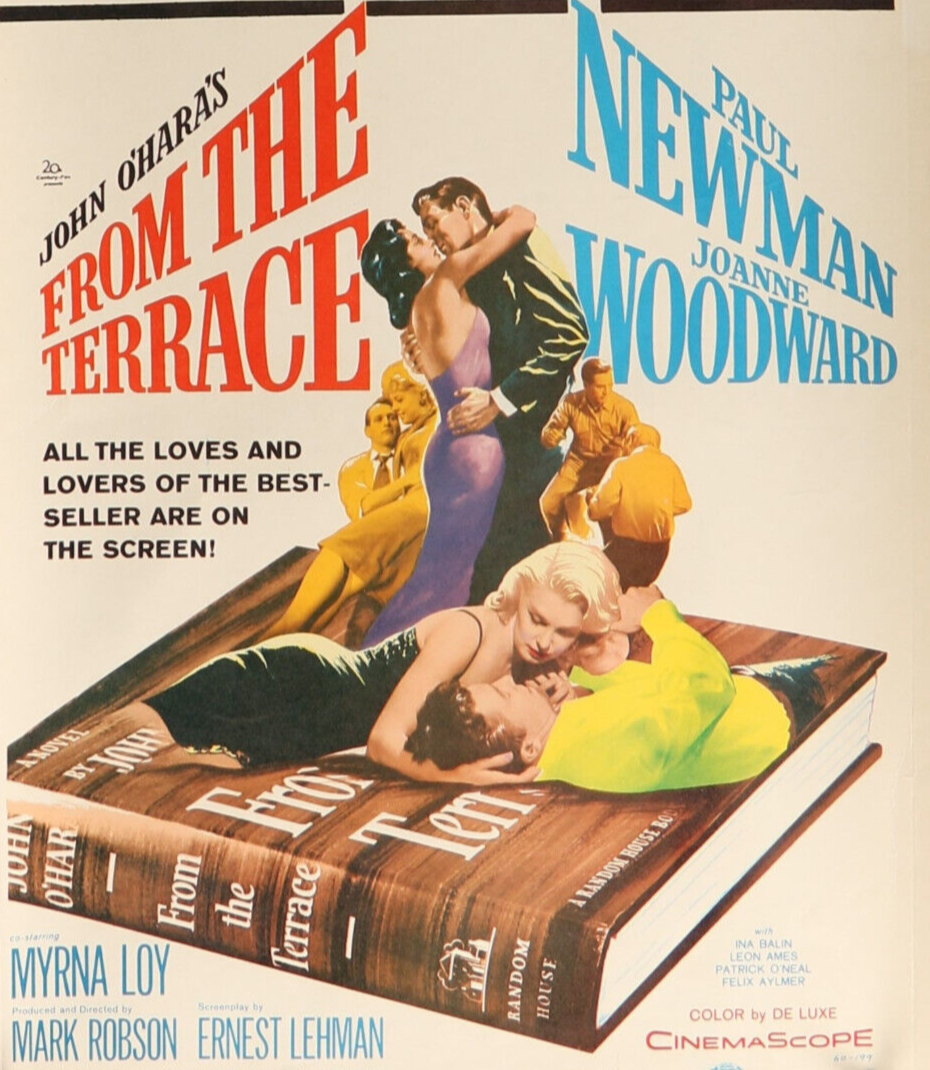
From the Terrace (1960) ***

When your plot pivots on the hero diving into an icy pond to save the grandchild of a Wall St multi-millionaire – and reaping the career benefits – you are kind of in trouble. Not as much, though, as having a self-righteous hypocritical prig of a hero who lacks the self-awareness,  a mark of the John O’Hara bestseller on which the film is based, to realize he is turning into a carbon copy of his father.

But it is handsomely-mounted and a decent enough melodrama with an excellent cast, though you would have to say, given the better material, Joanne Woodward (A Big Hand for the Little Lady, 1966) out-acts husband Paul Newman (The Prize, 1963), adding a rather contemporary element of a free-loving wife who manipulates the constraints of an era (post WW2) when divorce in high society was highly frowned-upon.

It’s a shame it drifts into predicable melodrama because the initial stages are niftily put together. A woman (Myrna Loy) is found dead drunk on a train, steel magnate husband Samuel (Leon Ames) ensuring he is not at home for her return, both actions meaning nobody is there to welcome only son David Alfred Eaton (known as Alfred at the start of the film and David at the end for odd reasons) when he returns from the war.

A few quick scenes establish that: the father holds a grudge against the living son because he has not got over his dead son;  he has ignored his wife in favor of his career; he bullies his staff; the wife has embarked on an affair.

David Alfred’s character is quickly established: he refuses to be stiffed by a cab driver; is adored by the household staff; refuses to work in his father’s business; and beats up his mother’s lover.

After that, for all the emotional shifts through the gears, it slows down, not so laborious as devoting too much time to the inner workings of high society – O’Hara’s metier – rather than the new small-plane-building business into which David Alfred pours his energy. That is, if he has much energy left over after stealing Mary (Joanne Woodward) from fiancé Jim (Patrick O’Neal), a psychiatrist.

You are probably already aware that society operates in various strata. A mill owner is only on the verge of society and looked down upon by the likes of Mary’s wealthier parents who in turn are no match for the grand life enjoyed by the aforementioned Wall St broker MacHardie (Felix Aylmer). Snobbery is rife and money talks. And if you lack the dough you’ve got no say in anything as David Alfred discovers in an aeronautical business venture, his partner Lex (George Grizzard), who has put up all the money, excluding him from key decisions.

Luckily, while driving in the countryside there’s a drowning child to be rescued and a grateful grandfather willing to set you up in his business. But that means sacrifice. David Alfred is away from home so much his neglected wife instead of turning to alcohol merely turns to men. There’s a wonderful scene when after a telephone call with her husband promising not to see Jim again (at this point no impropriety apparently committed as far as David Alfred is concerned), Mary lies down on the bed and turns to an unseen figure and says, “You’re not to come up here any more.”

But there are too few scenes so slickly written. On a job in Pennsylvania David Alfred falls for industrialist’s daughter Natalie (Ina Balin), and as though this is key to their romance tells her to call him David rather than Alfred. As his stock rises in the company, he maintains a hypocritical front with his wife, who he knows is now engaged in various affairs, denying her suspicions that he is having a fling with Natalie.  Mary is quite happy to maintain an open marriage since her status depends on her husband’s position and she still quite fancies him now and then.

You can see how this is going to end, but self-righteousness allows David Alfred to ignore that he is merely repeating the mistakes of his father. In sharp contrast to his wife who is all too conscious of her failings but contrives to make the best of the situation, and would happily continue in an unhappy marriage if only he would play ball. Although nothing is made of this, it’s obvious that David Alfred, despite his progress in the Wall St company, doesn’t have the business cojones of his father. He quit the plane business because Lex wanted to spend more time perfecting the prototype rather than rushing to the market in order to make money quickly. By following his own instinct, Lex is later proved correct, the business grown so big it attracts the attention of MacHardie.

There’s a sense here of Paul Newman pulling his shots. Though he is ruthless in making wife play second fiddle to career, and has no qualms really about playing away from home, nor about edging out MacHardie’s ineffectual son-in-law from the business, he lacks the killer instinct. The ruthlessness and amorality that made The Hustler (1961) and Hud (1962) so enjoyable is sadly missing. Handsome box office idols – the likes of William Holden apart – were reluctant to play the devious.

Mark Robson (Von Ryan’s Express, 1965) directs as if this is an upmarket Peyton Place and can’t resist at least one close-up of Newman’s baby blues. The script by Ernest Lehman (The Prize) only occasionally sparkles but I suspect there was a lot to trim from the O’Hara doorstopper. As I said, Joanne Woodward is the stand-out and you will be surprised to learn that Patrick O’Neal is also minus his later ruthless screen persona. Felix Aylmer (Masquerade, 1965) and Ina Balin (The Commancheros, 1961) are the pick of the supporting cast.

An interesting more than a riveting watch, mostly to see Newman before he reached screen maturity.

Coming Soon: 60 Years Ago

NEW YORK JULY 1960: Although summer six decades ago did not have the same hype as summers now it was still a prime time to launch new movies. The big cinemas also were more attractive than smaller ones because they tended to have air conditioning so if it was hot outside audiences did not swelter inside.

But Disney did not yet have a stranglehold on the summer – although the studio had given note of its intentions by launching Pollyanna at the gigantic Radio City Music Hall – so the range on offer was wide. Psycho had just taken New York by storm so newcomers had their work cut out.

The expected big hitters were Richard Brooks’ Elmer Gantry starring Burt Lancaster and Jean Simmons in a murky tale of evangelism and the under-rated Richard Quine’s steamy drama Strangers When We Meet with Kirk Douglas and Kim Novak. (Douglas and Simmons would be seen later in the year in Spartacus).

Paul Newman was hoping for a commercial breakthrough with From the Terrace, based on the John O’Hara bestseller, co-starring his wife Joanne Woodward and directed by Mark Robson. At this point Newman’s career had yet to spark, the success of Cat on a Hot Tin Roof (1958) in which he was relegated to leading man status behind undoubted star Elizabeth Taylor had been followed by misfires Rally Round the Flag, Boys (1958) and The Young Philadelphians (1959). Plus, Robson with two Oscar nominations and Woodward a winner for The Three Faces of Eve (1957) were more highly-regarded than the star who had but one nomination.

Also hoping for a career uplift was Richard Burton in Ice Palace, adapted from the Edna Ferber bestseller set in Alaska, co-starring Robert Ryan and Martha Hyer and directed by Austrian veteran Vincent Sherman. Targeting a different market entirely were Murder Inc, The Lost World and Battle in Outer Space.

Although Stuart Whitman was the star of the low-budget Murder Inc. set against the background of 1930s gangster Lepke, Peter Falk stole the show with an Oscar-nominated turn. The Lost World had British actor Michael Rennie and Jill St. John in the cast and was more notable for  being one of the few directorial outings of Irwin Allen, later the inventor of the 1970s disaster mini-genre. Sci-fi Battle in Outer Space was a dubbed import from Japan.

Three arthouse pictures also made their debuts. The pick of these should have been The Trials of Oscar Wilde with Peter Finch as the eponymous playwright  but some of its potential had been sapped by the release a short time before of Oscar Wilde starring Robert Morley. The other two were British comedy School for Scoundrels starring Ian Carmichael and Terry Thomas and the Russian adaptation of Fyodor Dostoevsky’s The Idiot.

Sources: Variety – Jul 6, July 13, Jul 20, Jul 27, 1960.

Discover WordPress

A daily selection of the best content published on WordPress, collected for you by humans who love to read.

The Atavist Magazine

by Brian Hannan

WordPress.com News

The latest news on WordPress.com and the WordPress community.