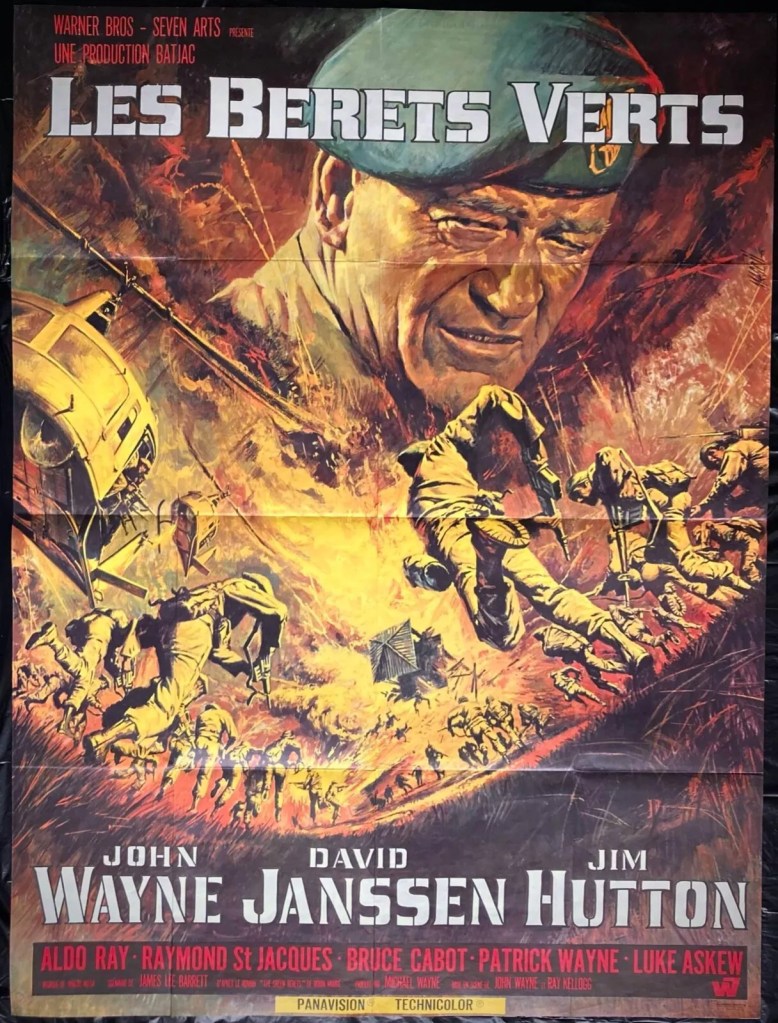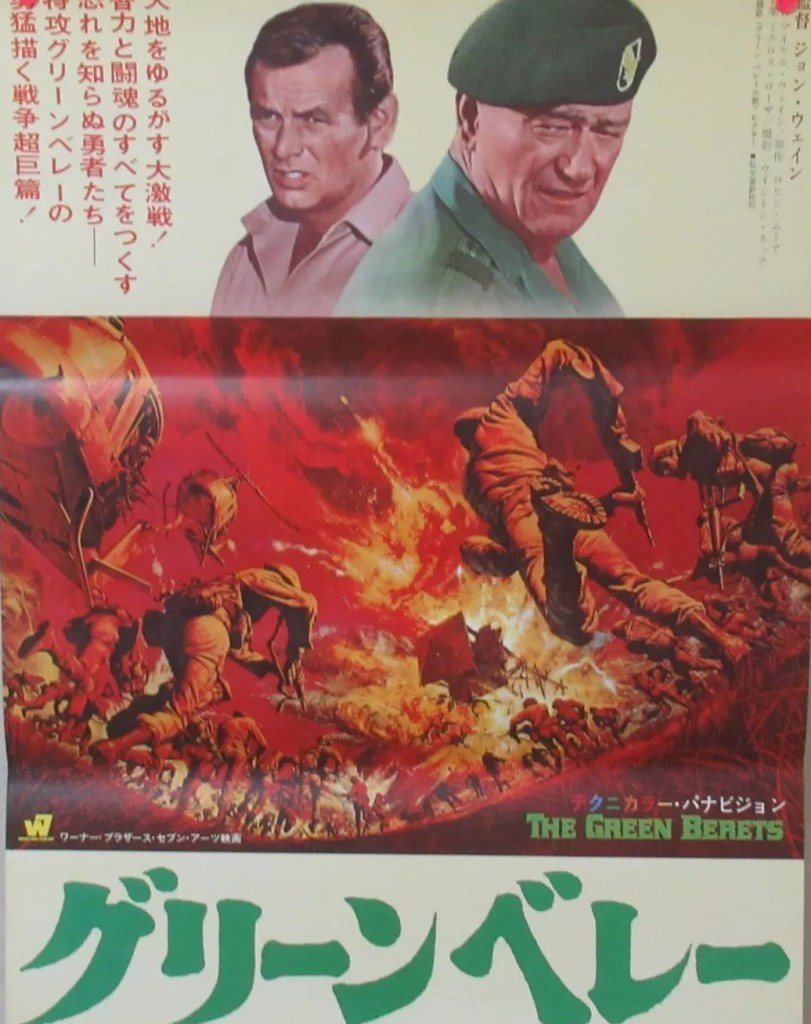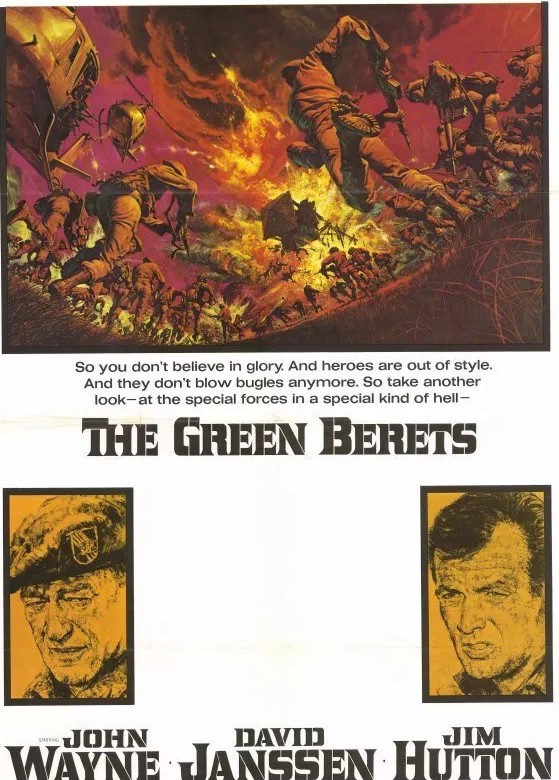
Behind the Scenes: “The Green Berets” (1968)

As if John Wayne hadn’t endured enough directing The Alamo (1960), he took on an even weightier task with this Vietnam War picture which, from the start, was likely to receive a critical roasting given the actor’s well-known stance on the conflict and his anti-Communist views that dated back to the McCarthy Era of the 1950s. Wayne had enjoyed a charmed life at the box office with three successive hit westerns, Henry Hathaway’s The Sons of Katie Elder (1965) with Dean Martin, Burt Kennedy’s The War Wagon (1967) co-starring Kirk Douglas, and best of all from a critical and commercial standpoint Howard Hawks El Dorado (1967) pairing Robert Mitchum. Outside of box office grosses, Wayne’s movies tended to be more profitable than his box office rivals because they were generally more inexpensive to make.

Columbia had been the first to recognize the potential of the book by Robin Moore and purchased the rights pre-publication in 1965 long before antipathy to the war reached its peak. A screenplay was commissioned from George Goodman who had served in the Special Forces the previous decade and was to to return to Vietnam on a research mission. But the studio couldn’t turn out a script that met the approval of the U.S. Army. Independent producer David Wolper (The Devil’s Brigade, 1968) was next to throw the dice but he couldn’t find the financing.
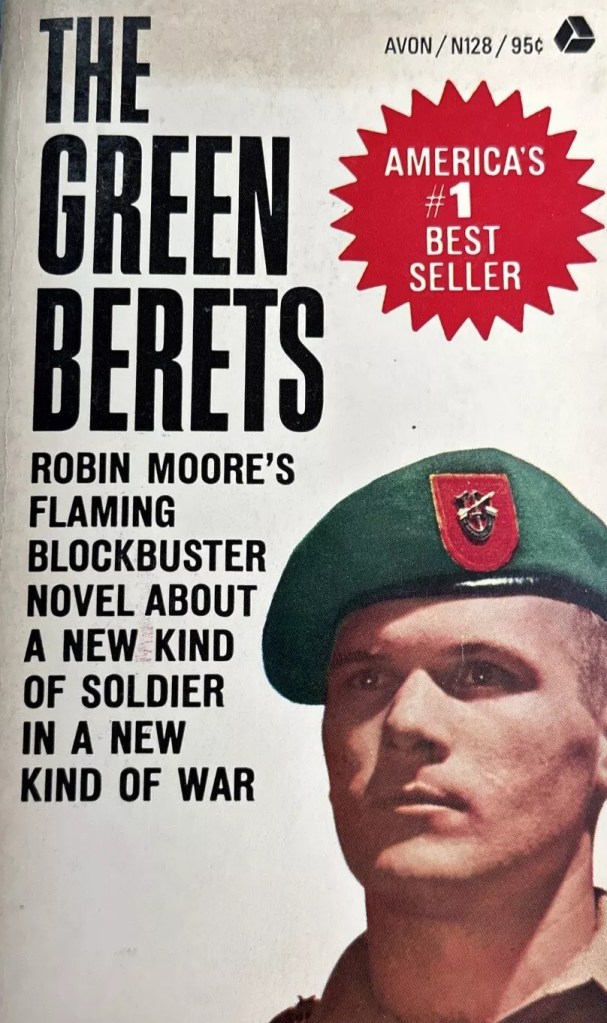
In 1966 Wayne took a trip to Vietnam and was impressed by what he saw. He bought the rights to the non-fiction book by Robin Moore (who also wrote The French Connection) for $35,000 plus a five per cent profit share. While the movie veered away in many places from the book, the honey trap and kidnapping of the general came from that source, although, ironically, that episode was entirely fictitious, originating in the mind of Robin Moore.

Universal originally agreed to back The Green Berets with filming scheduled for early 1967 but when it pulled out the project shifted to Warner Bros. And as if the director hadn’t learned his lesson from The Alamo, it was originally greenlit for a budget of $5.1 million, an amount that would prove signally inappropriate as the final count was $7 million. Wayne turned down the leading role in The Dirty Dozen (1967) to concentrate on this project. Wayne’s character was based on real-life Finnish Larry Thorne who had joined the Special Forces in Vietnam in 1963 and was reported missing in action in 1965 (his body was recovered four decades later).

As well as John Wayne, the movie was a platform for rising stars like Jim Hutton (Walk, Don’t Run, 1966), David Janssen (Warning Shot, 1967) and Luke Askew (Easy Rider, 1969) who replaced Bruce Dern. Howard Keel, who had appeared in The War Wagon, turned down a role.

Wayne holstered his normal $750,000 fee for acting plus $120,000 for directing. But it turned out The Alamo had taught him one important lesson – not to shoulder too much of the responsibility –  and Ray Kellogg for the modest sum of $40,000 was brought in as co-director. It was produced by Wayne’s production company, Batjac, now run by his son Michael. But neither Wayne nor Kellogg proved up to the task and concerned the movie was falling behind schedule and over budget the studio drafted in veteran director Mervyn Leroy – current remuneration $200,000 plus a percentage – whose over 40 years in the business ranged from gangster machine-gun fest Little Caesar (1931) to his most recent offering the Hitchcock-lite Moment to Moment (1966).
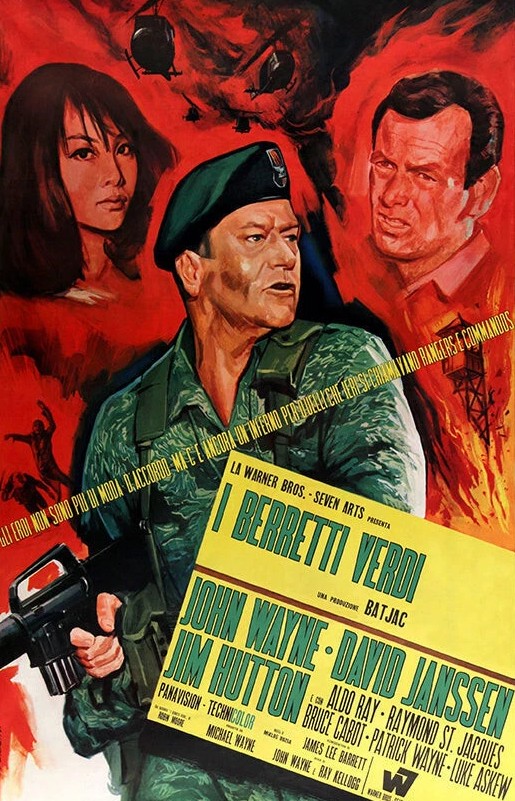
But exactly what LeRoy contributed over the next six months was open to question. Some reports had him directing all the scenes involving the star; others took the view that primarily he played the role of consultant, on set to offer advice. Even with his presence, the movie came in 18 days over schedule – 25 per cent longer than planned. Unlike the later Apocalypse Now (1979), it didn’t go anywhere near South-East Asia so the location didn’t add any of Coppola’s lush atmosphere, though the almost constant rain in Georgia, while a bugbear for the actors, helped authenticity.

It was filmed instead on five acres of Government land around Fort Benning, Georgia, hence pine forests rather than tropical trees.  President Lyndon B. Johnson and the Department of Defense offered full cooperation. But that was only after the producers complied with Army stipulations regarding the screenplay. James Lee Barratt’s script was altered to show the Vietnamese involved in defending the camp and the kidnapped was switched from being over the border. Also axed, though this time by the studio, was Wayne’s wish for a romantic element – the studio preferred more action. Sheree North (Madigan, 1968) was offered the role of Wayne’s wife but she also turned it down on political grounds. Vera Miles (The Hellfighters, 1968) was cast but she was edited out prior to release.

The Army provided UH-1 Huey helicopters, the Air Force chipped in with C-130 Hercules transports,  A-1 Skyraiders and the AC-47 Puff the Magic Dragon gunship and also the airplane that utilized the skyhook system. Actors and extras were kitted out in the correct jungle fatigues and uniforms. Making a cameo appearance was Col Welch, commander of the Army Airborne School at Ft Benning. The sequence of soldiers doing drill was actually airborne recruits.

The attack on the camp is based on the Battle of Nam Dong in 1964 when the defenders saw off a much bigger enemy unit.

This set was built on a hill inside Fort Benning. The authentic detail included barbed wire trenches and  punji sticks plus the use of mortar fire. While the camp was destroyed during filming the other villages were later used for training exercises. .

The pressure told on the Duke physically – he lost 15lb. But the oppressive heat and weather of that location – it was mostly shot in summer 1967 – was nothing compared to the reviews. It was slated by the critics with Wayne’s age for an active commander called into question, never mind the parachuting, the gung-ho heroics and the dalliance in an upmarket nightclub.

“In terms of Wayne’s directorial career,” wrote his biographer Scott Eyman, “The Alamo has many defenders, The Green Berets has none.” That assessment, of course, would be to ignore the moviegoers around the world who bought tickets and put the picture into reasonable profit.

Wayne was clear in his own mind about the kind of movie – “about good against bad”  – he was making and accommodated neither gray areas nor took note of current attitudes to the war as exemplified by nationwide demonstrations. Co-stars David Janssen, Jim Hutton and George Takei were opposed to the war. Takei, a regular on the Star Trek series, missed a third of the episodes on the second season; his lines were written to suit the character of Chekov, who went on to have a bigger role in the television series. Composer Elmer Bernstein turned down the gig as it went against his political beliefs. “The Ballad of the Green Berets,” heard over the opening credits was not composed for the film, having been released two years earlier.

Most critics hated it – “Truly monstrous ineptitude” (New York Times); “cliché-ridden throwback” (Hollywood Reporter); “immoral” (Glamour). Even those reviews that were mixed still came down hard: “rip-roaring Vietnam battle story…but certainly not an intellectual piece” (Motion Picture Exhibitor). Not that Wayne was too concerned. At the more vital place of judgement – the box office – it took in $9.5 million in rentals (what’s returned to the studios once cinemas have taken their cut) – $8.7 million on original release and a bit more in reissue – in the U.S. alone plus a good chunk overseas.

It was virtually impossible to examine a movie like this without taking a political stance. Other movies covering the same topic were allowed greater latitude regarding authenticity, audiences and critics like appearing to accept that creating watchable drama often took precedence over the facts. Both The Deer Hunter (1978) and Apocalypse Now, considered the best of this sub-genre, clearly ventured away from strict reality. With over half a century distancing the contemporary viewer from those inflammatory times, it’s worth noting that it still divides critics. Or, rather, critics and the general public take opposing views.

Although Rotten Tomatoes deems it “an exciting war film”, the critics voting on that  platform gave it a lowly 23 per cent favourable report compared to a generally positive 61 per cent from the ordinary viewer. That contrasts, for example, with a more even split for the likes of Exodus (1960) – 63 per cent from critics and 69 per cent from audiences. However, The Green Berets attracts twice as much interest, collaring 9,000 votes compared to just 4,300 for Exodus.

After this, Wayne’s fee went up to a flat million bucks a picture. “He wasn’t a guarantee of success,” explained his son Michael, “he was a guarantee against failure.” At this point in his career, he was gold-plated. Where other stars in his commercial league suffered the occasional box office lapse – Paul Newman’s career in the 1960s, for example, was riddled with flops like The Secret War of Harry Frigg (1968) – he did not. Especially with a global following, his pictures never lost money.

SOURCES: Michael Munn, John Wayne, The Man Behind the Myth, Robson, 2004; Scott Eyman, John Wayne, The Life and Legend, Simon and Schuster, 2014; Brian Hannan, The Magnificent 60s, The 100 Top Films at the Box Office, McFarland, 2023; Robin Moore, Introduction, The Green Berets, 1999 edition, Skyhorse Publishing; Laurence H. Suid, Guts and Glory, University of Lexington Press, 2002; The Making of The Green Berets, 2020; Review, Hollywood Reporter, June 17, 1968; Review, Motion Picture Exhibitor, June 19, 1968; Renata Adler, “The Absolute End of the ‘Romance of War’”, New York Times, June 30, 1968; Glamour, October 1968; “Big Rental Pictures of 1968,” Variety, January 8, 1969.
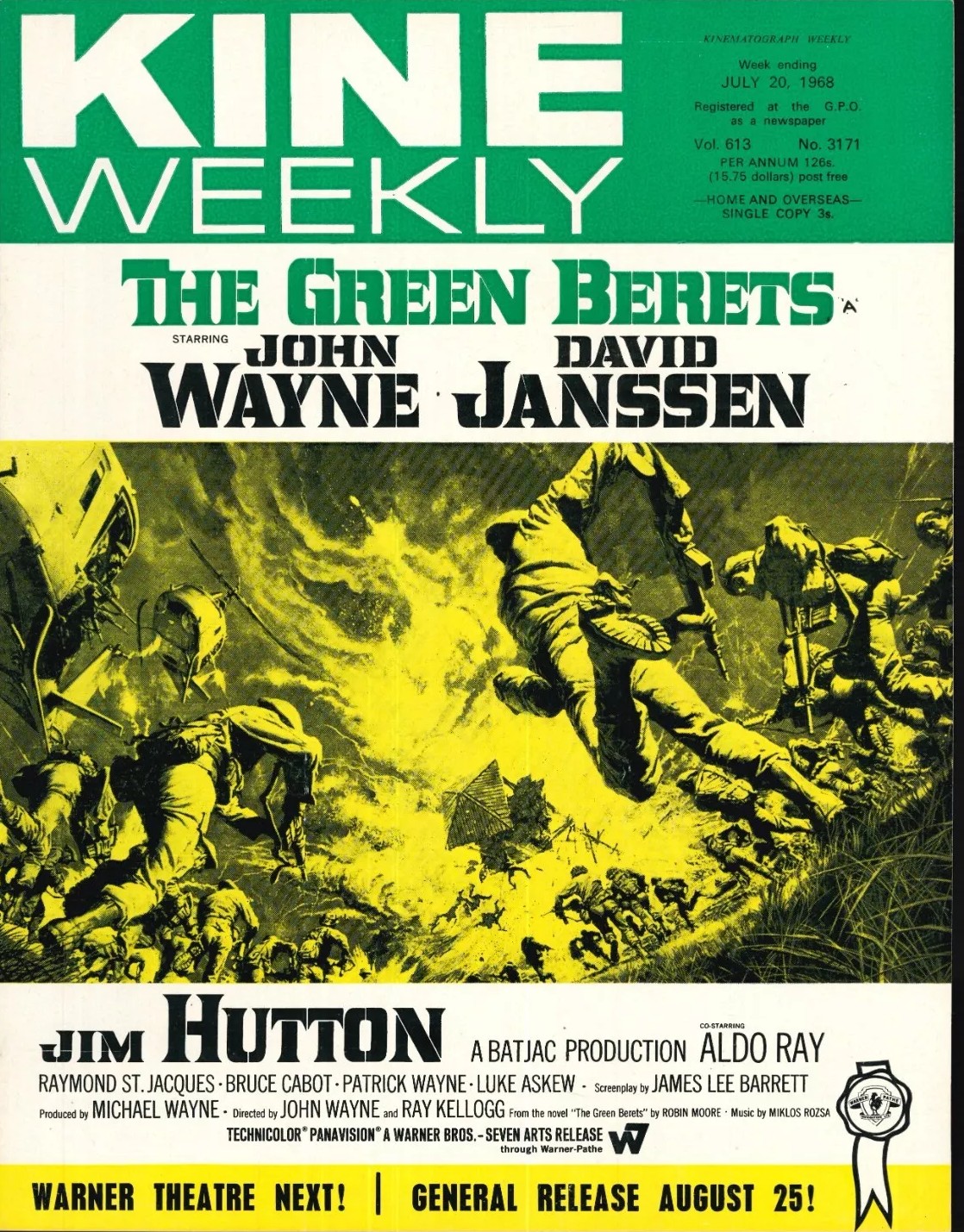
The Green Berets (1968) ***

Apart from attempts to justify the Vietnam War and a hot streak of sentimentality, a grimly realistic tale that doesn’t go in for the grandiosity or self-consciousnesss of the likes of Apocalypse Now (1979), The Deer Hunter (1978) and Platoon (1978). It’s been so long since I’ve watched this that my DVD is one of those where you had to turn the disc over in the middle.

The central action sequence is a kind of backs-to-the-wall Alamo or Rorke’s Drift siege. There’s no sense of triumphalism in the battle where the best you can say is that a reasonable chunk of the American soldiers came out alive but only after evacuating the staging post they were holding, more like Ridley Scott’s Black Hawk Down (2001) where survival is all there is to savor. It’s all pretty brutal stuff, the Americans handicapped by having to also look after the fleeing Vietnamese villagers taking refuge in their camp.

There are plenty grim reminders of how war has become even more devastating in the aftermath of World War Two. The Vietcong take, literally, no prisoners, seen as killing civilians as easily as soldiers. The Americans, for their part, have no compunction in using more sophisticated weaponry, with the addition of targeted air strikes.

Into the mix, somewhat unnecessarily, comes left-wing journo George (David Janssen) whose main job is to change his mind about the work the soldiers are doing, though admitting that to report the truth will lose him his position. He’s slung into the middle of a defensive action headed up by Col Kirby (John Wayne) to hold a position under threat against superior (in numbers) forces. There’s a fair bit of the detail of war but virtually zero about the strategy, whether that’s the U.S. Army’s plan to defeat the enemy or this individual unit’s method of defending this position. Apart from extending the perimeter of the camp to create a more effective killing zone, it’s hard to work out what the heck is going on, no matter how often orders are barked through field telephones or walkie talkies. There are squads out in the field and units in the camp and how the whole operation is meant to mesh is beyond me.

There’s not much time to flesh out the characters, save for “scrounger” Sgt Peterson (Jim Hutton) who adopts an orphan, Vietnamese soldier Capt Nim (George Takei) and Sgt Provo (Luke Askew). The rest of the motley bunch are the usual crew of monosyllabic tough guys and friendly medics and whatnot.

Though the emotional weight falls on Lin (Irene Tsu), fearing shame and being ostracized by her family for befriending the Vietcong general who killed her father and for whom she now lays a honeytrap, Kirby expresses guilt at having to kill anybody.

Despite being sent out to reinforce the position, the Americans are forced to retreat and enjoy only a Pyrrhic victory when the cavalry, in the shape of an airplane, arrives to mow down the enemy after they have captured the position.

The fighting is suitably savage, and there is certainly the notion that the Americans are not only being out-fought but out-thought and that no amount of heavy weaponry is going to win the day.

Possibly to prevent the idea of defeat destabilizing the audience, the movie shifts into a different gear, more the gung-ho commando raid picture that the British used to do so well, where Kirby heads up an infiltration team to capture the Vietcong general who has been seduced by Lin. This sets up a completely different imperative, all stealth and secrecy, the kind of operation that in the past would have been a whole movie in itself rather than the tag-end of one.

While the prime aim of this is to have the audience leave the cinema happier than if they had just witnessed the retreat from the camp, in fact it also serves two purposes. One is worthwhile, to emphasize the sacrifices made by the Vietnamese. Lin, having agreed to prostitute herself, fears being cast out as a result. But the other outcome of this mission is to kill off Sgt Peterson thus leaving the little Vietnamese lad even more orphaned than before.

John Wayne (The Sons of Katie Elder, 1965) doesn’t attempt to gloss over the weariness of his character. Jim Hutton (Walk, Don’t Run, 1966) shifts with surprising ease from comedy to drama. Even as a cliché David Janssen (Warning Shot, 1966) is underused. Watch out for Aldo Ray (The Power, 1968), George Takei (original Star Trek series), Raymond St Jacques (Uptight, 1968), Luke Askew (Flareup, 1969) and Irene Tsu (Caprice, 1967).

Three hands were involved in the direction: John Wayne, veteran Mervyn Leroy (Moment to Moment, 1966) and Ray Kellogg (My Dog, Buddy, 1960). Written by James Lee Barrett (Bandolero!, 1968) from the book by Robin Moore. Worth pointing out the score by triple Oscar-winner Miklos Rosza (The Power, 1968) especially the low notes he hits to provide brooding tension.     

Certainly a mixed bag, the central superb action sequence weighted down by the need to find something to shout about.

Period of Adjustment (1962) ***

You want angst, frustration, tragedy, Tennessee Williams is your man. Comedy? Not so much. He had pretty much supplied Hollywood with an unending stream of hits. From The Glass Menagerie (1950), quadruple Oscar-winner A Streetcar Named Desire (1951), triple Oscar-winner The Rose Tattoo (1955) and four-time Oscar nominee Baby Doll (1956) to Cat on a Hot Tin Roof (1958) with six nominations, Suddenly, Last Summer (1959) three nominations, The Fugitive Kind (1960), Summer and Smoke (1961) four nominations, and Oscar-winner Sweet Bird of Youth (1962) his movies attracted the cream of Hollywood.  The likes of Marlon Brando (twice), Elizabeth Taylor (twice), Montgomery Clift, Vivien Leigh, Paul Newman (twice) and Katharine Hepburn stood in line for the honor of participating.

Tennessee Williams was, unusually for a writer, a marquee name. He promised sensation, sex, scintillation. Audiences in need of a few laffs didn’t look towards his work.

So what to make of his first comedy? He was the biggest name by far involved. And the marketeers made sure audiences were aware this was a comedy and not a searing drama. But absence of the kind of big-name star generally associated with the playwright’s adaptations might have made them leery. Director George Roy Hill making his debut. Anthony Franciosa in his first top-billed role, fourth movie for Jane Fonda, Jim Hutton downgraded to second male lead from being star of his previous picture, Lois Nettleton in her debut. But who knows? It might make stars of them all.

The story itself is slight. A couple with different expectations of each other coming to terms with marriage. There’s a racy element, too. New husband George (Jim Hutton) is suffering from stage fright, can’t deliver in the bedroom department on their honeymoon. Wife Isabel (Jane Fonda) is a bit too ditzy, far removed from the efficient nurse he fell, too fast, in love with. He’s got some odd ideas of his own, a hearse his notion of acceptable transportation.

Anyway, they end up in the home of his Korean War buddy Ralph (Anthony Franciosa) whose marriage to Dorothea (Lois Nettleton) is in tatters. It’s a soft soap version of Who’s Afraid of Virginia Woolf as the newly-weds get a glimpse of what can happen way down the line when marriage is out of control.

Luckily, it’s built as a comedy not as drama, so nothing gets that much out of control and if anything it’s heading in the direction of warm-hearted as the newly-weds find ways to patch up their differences while the warring couple discover exactly what’s gone wrong with their relationship, primarily that good old Ralph married his wife for her money.

But, mostly, instead of trying to fix their own marriages, the couples are more intent on offering advice to the other. The pal’s in-laws take the brunt of the blame. Dysfunctional family and potentially dysfunctioning family have to suck it up and change.

There’s some obvious comedy thrown in to lighten the load, this taking place at Christmas, a bunch of choristers, going door to door, get drunker with every stop-off. But the movie doesn’t quite go in the direction you expect. There’s no easy fix, though there is a fix, but each character goes through a definite change rather than just flipping a switch.

Though Jane Fonda (Barbarella, 1968) is the one who became a star, it took her quite a few acting iterations to achieve it, and this sees her going down the Marilyn Monroe route of  blatant sexiness so in a sense hers is the least interesting character because she’s so shallow to begin with. Anthony Franciosa (Fathom, 1967) is the pick, in part because he’s playing a more genuine character rather than the schemer or matinee idol that he essayed in so many later movies. Jim Hutton (The Hellfighters, 1968) is still in lightweight mode.

George Roy Hill (Butch Cassidy and the Sundance Kid, 1969) is occasionally stagey in his direction but manages to pull out the performances required to make this work. Isobel Lennart (Funny Girl, 1968) does the adaptation.

Not just for Tennessee Williams or Jane Fonda completists.

The Trouble with Angels (1966) ****

Shocking Fact No 1: director Ida Lupino was the only female director working in Hollywood at this time. And she hadn’t worked in features for over a decade. Her previous picture, The Bigamist (1953), was her fifth. And while she had continued to find work in television, the movie business shunned her. What was perhaps more shocking, as I pointed out in my book When Women Ruled Hollywood, was that in the period 1910-1919 more women worked as directors in Hollywood than at any time since and that it was a woman, Alice Guy, rather than Melies, who actually made the first narrative movie. Worst of all, despite being a major box office hit, this was Lupino’s last picture.

Shocking Fact No 2: this didn’t turn Hayley Mills into a major adult star. Oh yes, she made the transition – and how – in The Family Way later that year, a British romantic drama that saw her shed her clothes. Big hit in Britain, not so well-received in the USA. Her career then took an odd turn, into thrillers like Twisted Nerve (1968) and Endless Night (1972).

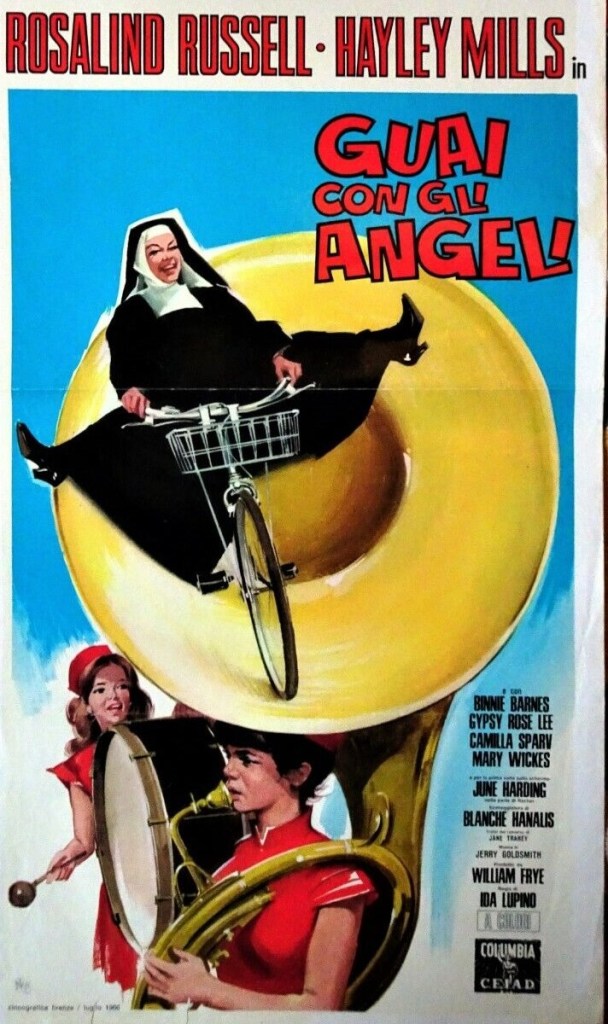
Not exactly demure. Marching band outfit takes the grey out of the convent uniform.

I say an odd turn because if there was any better demonstration that the actress had properly developed her comedy chops I’d yet to see it. Sure, Disney had used her in comedy, but that was mostly routine stuff. Here, she revealed an emotional maturity lacking in her previous work and, to some extent, in her future movies.

And, in part, because Lupino keeps her away from big dramatic moments, relying entirely on her facial expression to reveal character development. I am surprised that, at this point, with Doris Day’s box office allure dimming, that nobody saw Mills as her natural successor. She had the same puckish demeanor and she deftly handled comedy. Give her a few years and she would have been a natural for such polished items as Barefoot in the Park. You get the feeling there was more natural ability that was left untapped.

Anyway, on with the show.

This is just a delight. It shouldn’t work at all, certainly not for a modern audience accustomed to sharply-honed laugh lines. But it’s so cleverly constructed, in covering a three-year period, it could easily have been a string of loosely-connected episodes rather than a picture with an underlying narrative that mostly takes place beneath the surface.

Orphan Mary (Hayley Mills) has been dumped by rich playboy uncle (Kent George) in a  convent boarding school that looks more like a medieval fortress than anything else. She teams up with the equally unhappy Rachel (June Harding), whose parents are at least indulgent, and together they torment the life out of the nuns and other kids, pouring detergent into tea-pots, setting off fire alarms, charging their schoolmates for an illicit guided tour of the convent, developing their smoking habits, breaking everything in sight. One scheme goes so badly awry the nuns have to take shears to a face mask.

Throughout all of this, she comes up against a tough Mother Superior (Rosalind Russell) who comes across like Miss Jean Brodie, minus her dangerously progressive side, but ever ready with a quip, able to tackle any emergency, though Mary drives her to distraction. While set in her ways, the nun does sail close to the wind, kitting out the girls in red cheerleader outfits in order to give them an unfair advantage in a marching band competition.

Any other director would have made the marching band competition the climax of the movie. I was fully expecting it to take up the final third, as pupils with little musical ability work hard and discover they can improve enough to win the competition and in so doing find out some platitudes about themselves. Instead, every episode is kept short and sweet, often the pay-off delivered in unexpected manner, for example, that we discover the girls have won when Mother Superior takes the opportunity to gloat over her rival headmaster (Jim Hutton). Or a section where teenage girls sent to buy their first bra go wild trying on all sorts of outrageous outfits that in other hands could easily have been expanded is ended sharply by Mother Superior holding up the plainest item and ordering two dozen of them.

It fairly skates along. But every now and then it dramatically slows down. And for what? Pretty much nothing at all. Just Mother Superior taking a quiet moment to herself amid all the hurly burly of running a school and dealing with mischief. But gradually, in those quiet moments, she is joined, at a distance, by a staring Mary, wondering about the nun’s inner  calm.

Ida Lupino’s color palette is extraordinary. Sure, it’s nuns, so we can expect a lot of black and white. But Lupino avoids the temptation to compensate with huge swathes of color. Instead, for most of the film, the girls are decked out in grey. So when splashes of yellow or pink or red appear they are distinctive. Only as the girls grow older does more color emerge.

The wry Rosalind Russell (Gypsy, 1962) is on top form. Instead of attempting to dominate, she nips in and steals scenes with her dry delivery. She shifts from indominable to maternal and eventually engages the psychological attention of Mary in a superb scene about her own life.

In that sense Hayley Mills has her work cut out to hold her own against such an accomplished professional, which she achieves through her own delivery, but much more through facial expression. This was June Harding’s only movie. But look out for Camilla Sparv (Assignment K, 1968) in her movie debut and a cameo from Gypsy Rose Lee.   

Terrific direction for Ida Lupino – watch for example how the camera closes in on characters – from screenplay by Blanche Hanalis (Where Angels Go Trouble Follows! 1968) from the bestseller by Jane Trahey.

As old-fashioned as they come and a joy to watch.

Catch it on YouTube – the first link is rent or buy, the second one is free but punctuated by adverts.

https://www.youtube.com/watch?v=37FnvNp2EYc

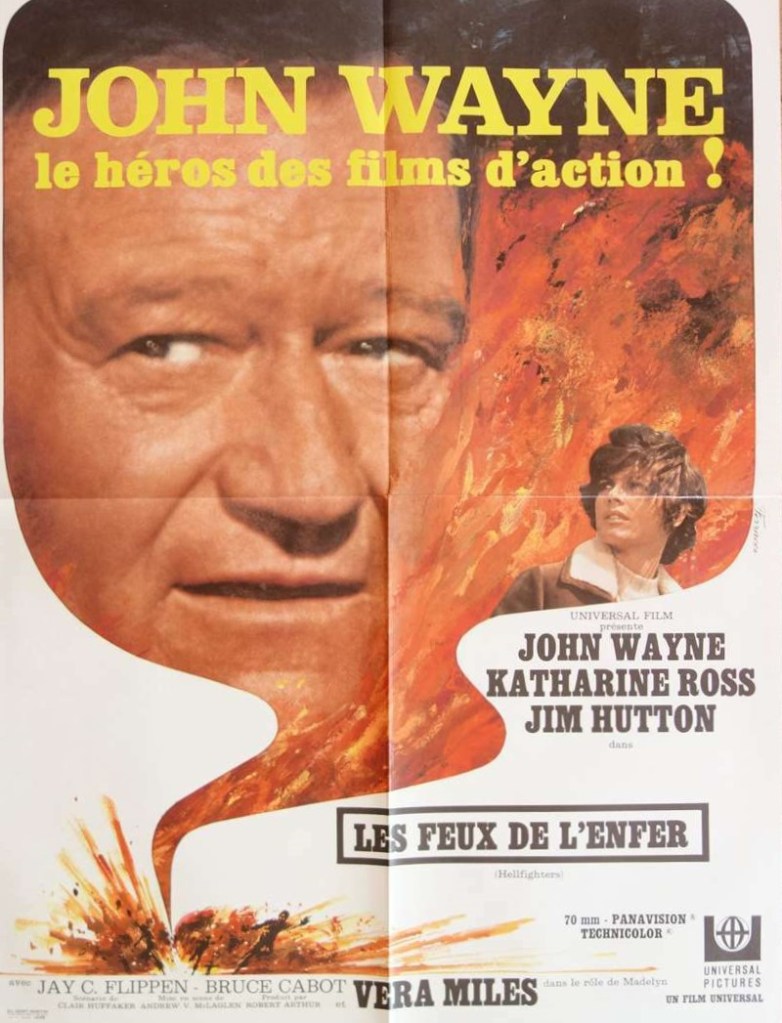
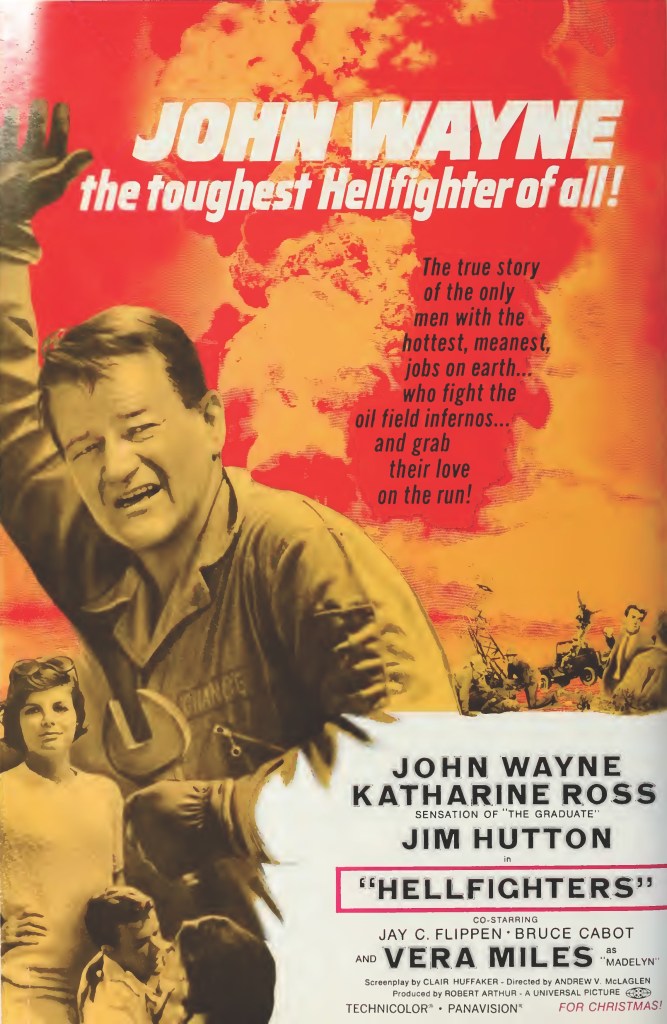
Hellfighters (1969) ****

I’m sticking my neck out on this one – under-rated would be an understatement – and primarily because it’s the Duke’s most intriguing film of the decade and possibly ever. For a start we have John Wayne The Quitter (the hell you say!). Then he ducks out of the picture for a full quarter of an hour (he does what?). Fast forward a couple of years and this would have led the disaster cycle pack – a little tinkering with the structure and you would have all four principals fighting fires in South America in the middle of a revolution (beat that, The Towering Inferno.) But most enthralling of all this is a family drama masquerading as an action picture.

And it led me to thinking if True Grit (1969) had not landed on Wayne’s doorstep whether he would have continued down the dramatic rather than the action road for the tail end of his career. He had just collected his first million-dollar fee so in box office terms he was untouchable. And just for the record, the action scenes, especially given the absence of CGI, are terrific. Sure, the oil’s a little bit too thin to pass for real oil, but it does gets sloshed over all concerned, including the Duke, by the bucketload.

And it might be a shade on the episodic side, Chance Buckman (John Wayne) and compadres racing from one hellish event to another, but it’s wrapped around a tight dramatic core, Chance vs independent daughter Tish (Katharine Ross), Chance vs one-time sidekick and now Tish’s husband Greg (Jim Hutton), Chance vs. Tish’s mother Madelyn (Vera Miles) and Chance vs. all the dimwits on the board of the company he quit his own operation to join.

Chance is based on the real-life Red Adair, an oilman who had invented the extremely scientific but extremely dangerous method of putting out oil-well fires. When a gazillion gallons of oil spurting unchecked out of the ground catch fire you’ve got a helluva problem on your hands. A gazillion gallons of water ain’t going to cut it. The only solution is to cut off the oxygen supply long enough to cap the well. Red Adair’s technique: blast the oxygen out of the way. He’d attach drums filled with massive amounts of nitro-glycerine, roll them into the blaze on the end of cranes, hide behind nothing more resilient than hazard suits and shields made of corrugated iron, and detonate them. The resulting explosion did the trick.

The picture opens with this stunt, although after being accidentally injured, Chance is hospitalized, bringing estranged daughter and ex-wife into the dramatic frame. After a pretty frosty meet-cute,  Tish and Greg hit it off and get married, forcing Tish to confront the fear that drove Chance and Madelyn apart, that, like the wife of a Formula One driver, she never knows if her husband will come back. This bothers the feisty Tish a lot less than the weary Madelyn. And she even ignores all protocol and rushes to her husband’s side, regardless of the danger.

Meanwhile, Chance decides not only has he had enough of dicing with danger but he can leave his company in the safe hands of Greg. His life now on a more mundane keel, Madelyn is attracted back. But of course it wouldn’t do for Chance to live out retirement with nothing more testy than board meetings so he comes back into the fray during a rebellion in Venezula and both women have to confront their true feelings.

The action, considering the lack of CGI, or the kind of budget available to The Towering Inferno, is first-class. This is the ideal movie reversal. Instead of running away from a fire, these characters race towards it. There are some hair-raising moments. At one blowout, gas is leaking from the ground, poisoning everyone in sight, Greg is trapped underwater. And should complacency sneak in, fire, being on the unpredictable side, is prone to sudden explosion.

John Wayne (The Undefeated, 1969) has always excelled at restrained emotion and here he gets both barrels. Having got rid of the over-protective wife he’s now saddled with a daughter he’s desperate to protect from the hell he put his wife through. He’s faultless here, given considerably more acting scope than normal and not, as in McLintock (1963), just able to tan a woman’s backside, presenting a more contemporary male, perhaps as puzzled by female behavior as any of his cowboys, but taking a more modern approach to resolving his feelings.

Katharine Ross (Tell Them Willie Boy Is Here, 1969) has her best role, not a mere appendage as in her other films of this period, but driving forward the action through her independence. Jim Hutton (Walk, Don’t Run, 1966) is growing on me. I’ve reversed my view of him as a lightweight. Vera Miles (The Man Who Shot Liberty Valance, 1962) does a pretty good job of playing older – she was not yet 40 – and essays a complicated character, more rounded than was often the case with the female lead in Wayne pictures. Veterans Jay C. Flippen (Firecreek, 1968) and Bruce Cabot (The Undefeated) head the support.

The perennially underrated Andrew V McLaglen (The Undefeated) does a pretty good job with the action, as you might expect, but is also savvy enough to let the dramatic scenes flow. Clair Huffaker (Rio Conchos, 1964) penned the screenplay.

Guilty pleasure personified, you might say, but I’d retort that this is a damn fine picture erroneously ignored – rating only two paragraphs in Scott Eyman’s  650-page biography of John Wayne for example – possibly because it appeared in between the critically-reviled The Green Berets (1968) and the critically-acclaimed True Grit.

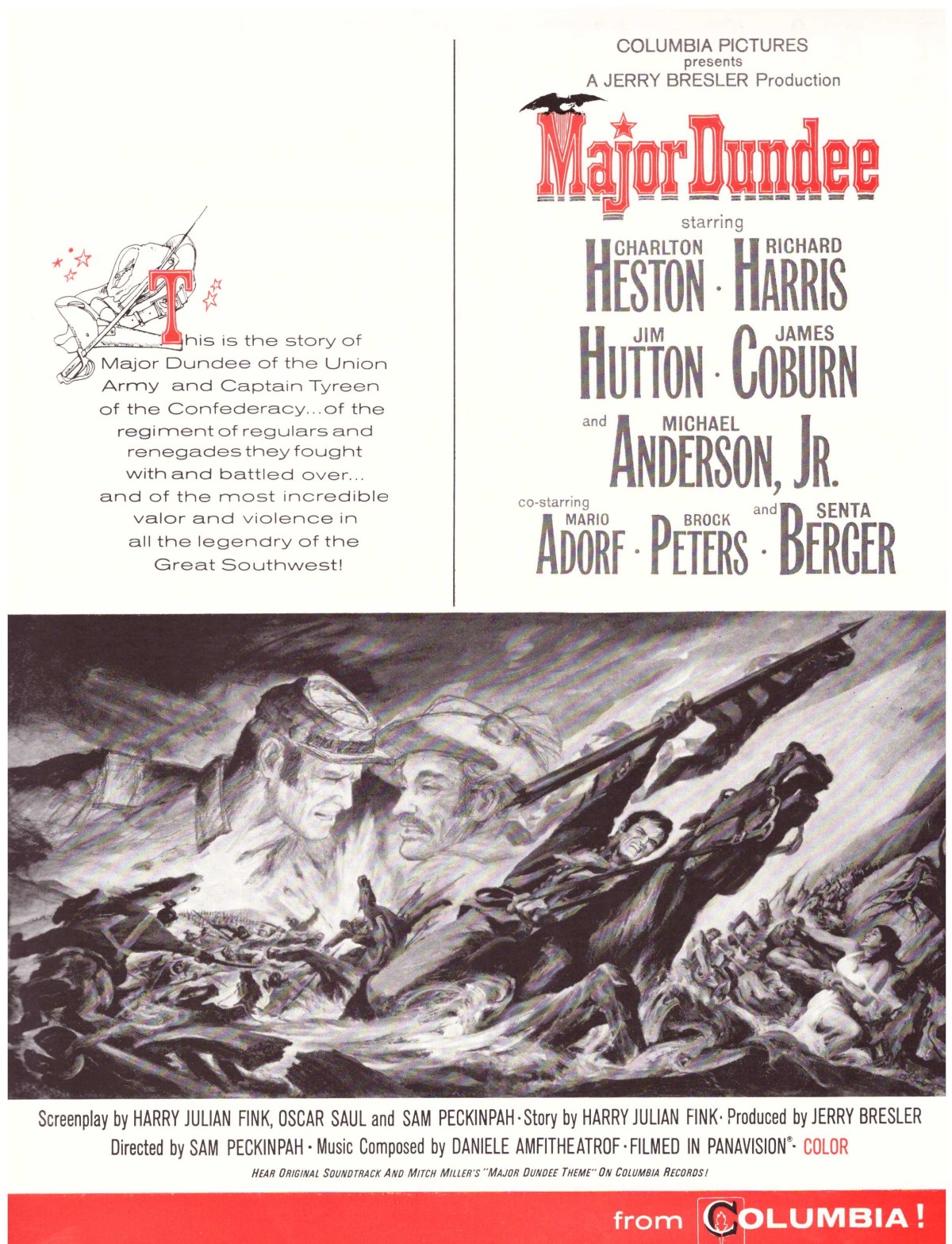
Major Dundee (1965) ***

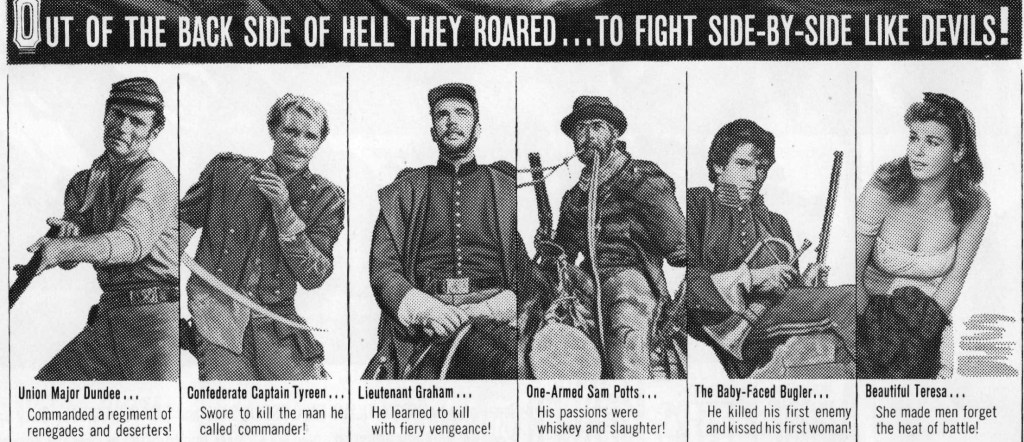
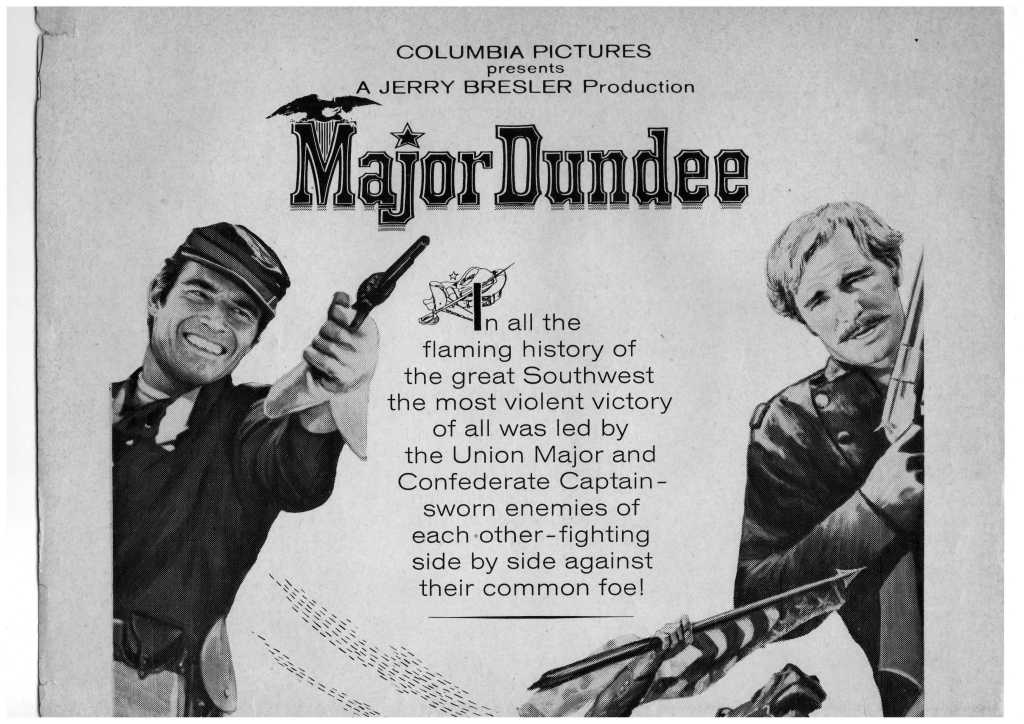
Best viewed as a rehearsal for his classic The Wild Bunch (1969), this Sam Peckinpah western covers much of the same thematic ground – feuding friends, Mexico, betrayal, comradeship, brutality, and a grand gesture climax. But the set-up is more complicated than The Wild Bunch. This time out Unionist Charlton Heston in the titular role and former friend Confederate Richard Harris team up towards the end of the American Civil War to hunt down a band of Apaches. Heston’s prisoner, Harris faces the choice of joining his unit or being shot. Since both lived in the South, Harris sees Heston as a traitor for siding with the North. After the Apaches are destroyed, Harris plans to kill Heston.

If the set-up was as straightforward as that, it would have probably resulted in a better film. But once Heston’s soldiers cross the Rio Grande they also come up against the French. And the timescale of the picture covers a complete campaign from November 1864 to April 1865, barely a month before the end of the Civil War so the pace is sluggish despite being packed with incident.  And it struggles with allowing the weight of narration – via the cliched diary – to fall on a young bugler (Michael Anderson Jr.), the only survivor of an Apache attack.

That said, the action sequences are terrific, especially the battle on the Rio Grande itself. Like the best military movies, there are clever maneuvers and deceptions – from both sides. And since the unit comprises not only the quarreling Heston and Harris but warring Unionists and Confederates, freed former slaves and a bunch of criminals in the same league as Robert Ryan’s Wild Bunch gang the tension remains high throughout. Subsidiary characters are given a full story arc – the raw lieutenant (Jim Hutton) making his bones, the bugler losing his virginity. Added to this, Major Dundee is clearly in the last chance saloon, his posting seen as a punishment, and several times his military decisions are, rightly, called into question. His attitude to command is also questionable, minus his uniform in the field and legs on the table while addressing junior officers. And, as with The Wild Bunch, this is no idealized Mexico, but an impoverished, savaged, ravaged country.

There was no romance in Peckinpah’s original take on the story. But the presence of Senta Berger as a widowed Austrian stranded in Mexico brings out the humanity in Heston. Unlike many of her more volatile Latin counterparts, Berger is soft-spoken and gentle. Here, that acts very much as a counterbalance to the pugnacious Heston. She is fearless, effectively acting as the leader of the Mexican village the soldiers initially intend to pillage, persuading them otherwise. She demonstrates considerable intelligence: “The war won’t last forever,” says Heston; “It will for you,” she replies. But, ultimately, she is betrayed by the womanizing Heston.

In the duel between old friends, Harris comes off best in terms of principle. He defuses an ugly racial incident and clearly commands more authority among his men. When difficult action must be taken regarding a deserter again he does not hesitate to act. And he keeps to his word of honoring a flag he despises as long as he is under Heston’s leadership. In some senses, he has the better part since he has to keep normal impulse in check. Many critics considered Heston miscast but that was mostly after the fact when Peckinpah was able to line up a more dissolute William Holden in The Wild Bunch because by that time the actor was already wasted physically from alcoholism. But Major Dundee’s inability to meet his own high standards is exactly the kind of role you want to see a physical specimen like Heston take on.

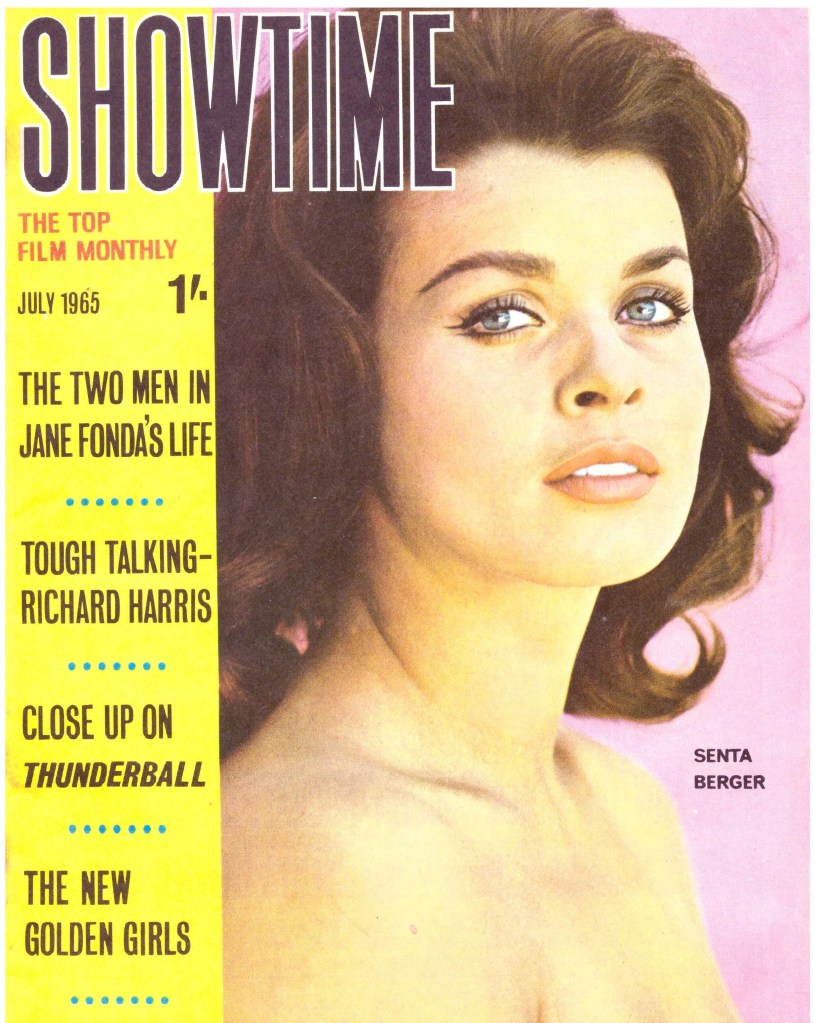
Senta Berger was the cover girl for “Showtime,” the monthly magazine for the Odeon cinema circuit in the U.K. and there was also feature inside on the film’s star Richard Harris.

Half a century after initial release, another dozen minutes were added to the movie as part of an overall restoration, and the film was acclaimed by critics as a lost masterpiece. That was a rather rose-tinted perspective and, although the extra footage clarified some points, in general it did not lift the confusion surrounding the narrative. The movie needed fewer minutes not more. The deletion of the entire French section would have prevented the movie sinking under the weight of its own ambition. Certainly, the studio Columbia played its part in undermining the movie by shaving too much from the budget just as shooting was about to begin. It is still a decent effort and without it, and perhaps learning from his mistakes, the director might never had turned The Wild Bunch into a masterpiece.

Virtually the entire marketing program for “Major Dundee” was based around the military. The film appeared on the centenary of the ending of the Civil War. The movie most likely to take advantage of that anniversary – Gone with the Wind – was in cold storage, having already taken advantage of the centenary of the start of the war for its umpteenth reissue. So exhibitors were encouraged to put on displays of battle flags sourced from a museum or collector or to arrange a parade with buglers enrolled from youth groups or the church. A horseman dressed in Union colors could ride through the streets to raise awareness and the cinema lobby could be decorated with military equipment and both Union and Confederate flags. Any local person named Dundee might be rounded up. On a different note, Charlton Heston had rustled up his own version of Mexican chili and the recipe was being offered to newspapers. Harry Julian Fink had novelized his screenplay so there was the possibility of bookshop displays and Columbia Records had issued the “Major Dundee March” as a single. Unusually, there was an 8mm film about the film’s stunt men which was intended for sale in cinema lobbies.

Many of the films from the 1960s are to be found free of charge on TCM and Sony Movies and the British Talking Pictures as well as mainstream television channels. But if this film is not available through these routes, then here is the link to the DVD and/or streaming service.

Walk, Don’t Run (1966) ***

Stars rarely get to choose when they want to retire. Usually, the phone stops ringing, or they slide down the credits until no one can remember who they once were, or they end up in terrible international co-productions, or like Tyrone Power (Solomon and Sheba) they die on the job or, like Spencer Tracy, because of it.

Cary Grant, on the other hand, went out at the top, or near enough, after a string of box office winners, including this one, throughout the Sixties. If you are more generally familiar with Grant through Hitchcock thrillers or Charade, you might have forgotten his comedy expertise. He was a master of the double take and the startled expression – and he needs that here in what is sometimes a pretty funny farce.

The set-up is peculiar. Grant is a businessman landing in Tokyo two days before the 1964 Olympic Games with nowhere to stay and ends up sleeping on the couch of Samantha Eggar and later sharing his room with Jim Hutton, an athlete equally lacking in the forward planning department. (Excluding the Olympics, of course, the film has a similar concept to The More the Merrier, 1943).

There’s no great plot and no great need for one. Grant’s main purpose is to play Cupid to Hutton and Eggar and steer her stuffy fiancé out of their way. But it says a lot for Grant’s talent that not much plot is required. He is just so deft, whether he is playing top dog or being beaten at his own game by a rather resilient Hutton.

Eggar is Doris Day-lite, but Hutton is a revelation, not the dour dog of later The Hellfighters (1968) and The Green Berets (1968), but showing true comedic talent, especially in quick-fire verbal duels with Grant. There is only a wee bit of stereotype, overmuch bowing mainly and a Russian shot-putter, but some other Japanese customs are more interesting, yellow flags to cross the road, for example.

There are a couple of brilliant visual gags, one involving trousers, another with Grant getting locked out of the apartment, and a terrific payoff in a Japanese restaurant. Except for thrillers, Grant did not need great directors, he knew comedy inside out and here the accomplished Charles Walters (High Society, 1956) has the sense to let him get on with it.

Grant was 62 when the film appeared so quite rightly delegates romance to Hutton, which is a shame because his (non-romantic) interaction with the pernickety Eggar (she and fiance equally matched in this department) carries all the Grant romantic hallmarks. Instead, he ensures that romance between Hutton and Eggar runs its true course, which while that is satisfying enough, is a bit like removing John Wayne from the final shootout in a western. Oh, and there is a reason for the Olympic Games setting.

Discover WordPress

A daily selection of the best content published on WordPress, collected for you by humans who love to read.

The Atavist Magazine

by Brian Hannan

WordPress.com News

The latest news on WordPress.com and the WordPress community.