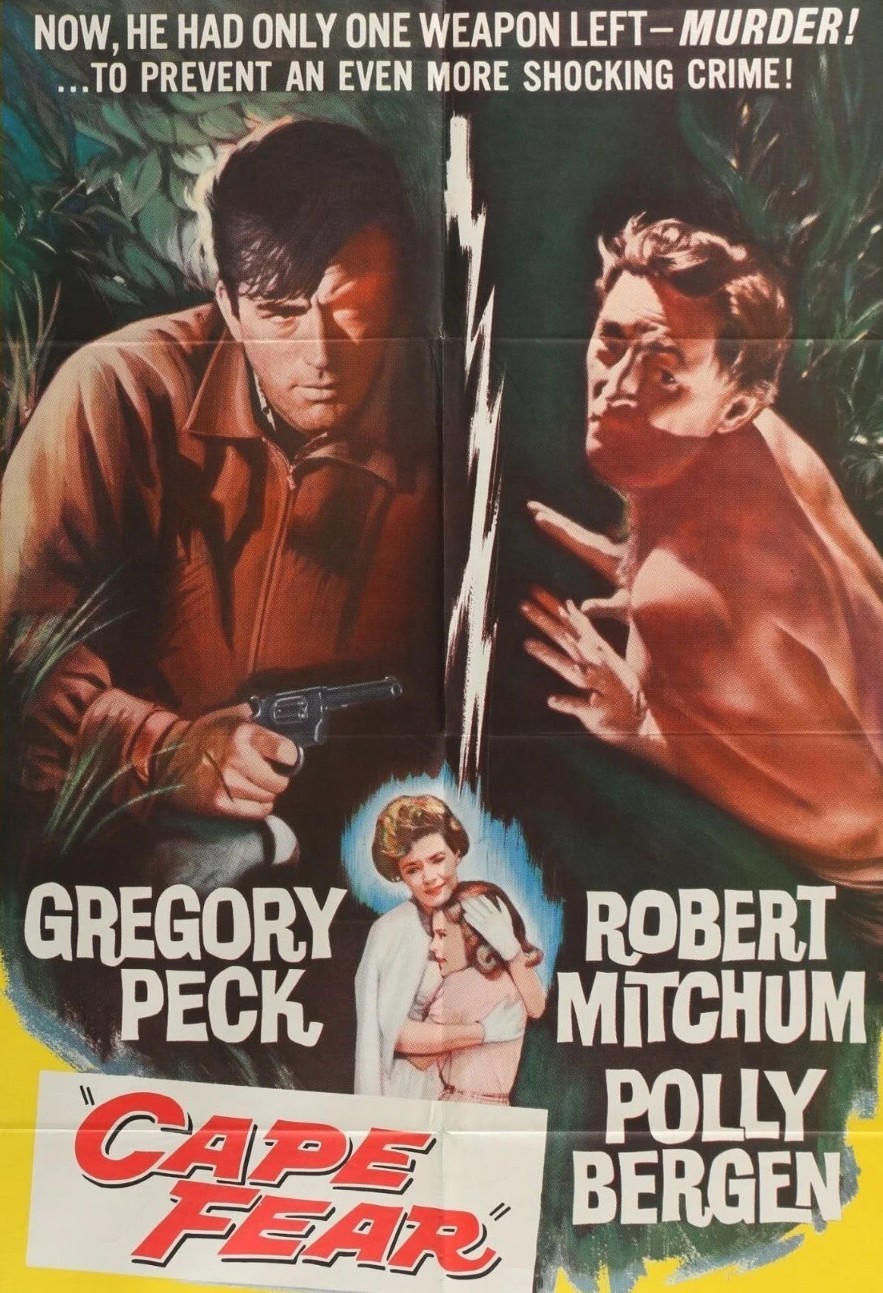
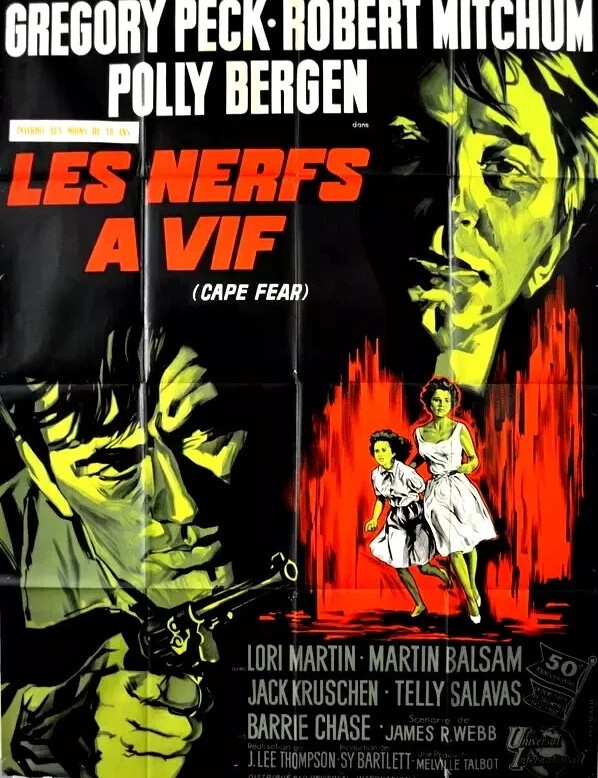
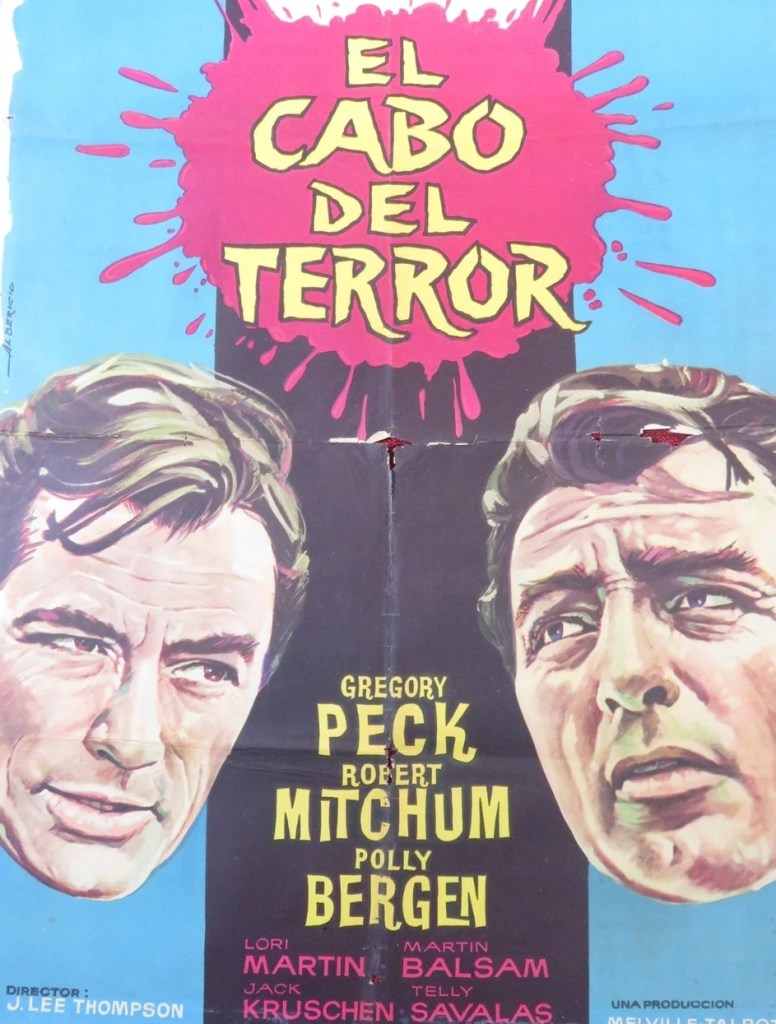
Portraying legal poster boy Atticus Finch in To Kill A Mockingbird (1962) might well have been an act of redemption for Gregory Peck after his portrayal, a few months earlier, of this attorney who has little compunction in walking down the same mean streets as the criminals he wishes to see put away. And it just goes to show how thin the line is between upstanding façade and killer, no matter the excuse or provocation.
Attorney Sam Bowden (Gregory Peck) isn’t permitted as much leeway as you might expect when ex-con Max Cody (Robert Mitchum) turns up in his small town. This could as easily have played out as the virtuously good guy and family being hounded by a thug who would have spent most of his life being prosecuted for crimes except his victims usually failed to bring charges on account of their fear of retribution. Trigger the animal in him for sexual purposes and you’re lighting a fuse that leads directly to violence.
From the audience perspective, the cards should have been stacked against the villain, but that’s not the case here, not when the good guy begins to act more and more like a bad guy, persecuting him, through his police connections, with a string of arrests for crimes of which he is innocent, unable to put the finger on him for the vicious assault he does commit and generally been outwitted by a fella who knows the law a damn sight more than the lawyer.
Bowden isn’t your usual harassed victim, standing up stoutly against criminality, but a man crumbling under pressure and the frustration of being out-thought by the enemy and itching to get it over with the easiest way possible by finding an excuse to kill the perpetrator.
So, yes, if you’re that way inclined, you can view it as an attack on the American justice system that allows villains with criminal intent not to be incarcerated for considering committing a crime. But that’s not the way it plays out, not when Bowden uses every sleazy trick in the legal book to head off Cody, eventually attempting bribery, and when that doesn’t work hiring a gang of thugs to beat him up and when that also fails planning how to draw him into the kind of trap that would allow legal assassination.
So, now Bowden’s every bit as devious as his pursuer and much worse because he’s willing to stake out wife and daughter as bait for a known sexual predator. He seems to have no inkling of the fate that could be in store for his family should his clever plan go wrong and little compunction or remorse about the criminal intent in his own mind.
Back in the day it would have been easier to accept this kind of narrative, that you can step outside the law to protect your family (a trope that would burn through the 1970s once the vigilante was represented by the likes of Charles Bronson and others), but a contemporary audience is more likely to take a more jaundiced view of the good guy “forced” into bad action. Instead of hiring a private detective (Telly Savalas) to keep tabs on Cody, Bowden could as easily invest – and he has more than enough money – in a security guard to watch over the house and family.
So, even as we’re fearing for wife Peggy (Polly Bergen0 and teenage daughter Nancy (Lori Martin) we’re beginning to put the blame for their plight plumb on the shoulders of the upstanding lawyer who thinks he’s smarter than the most dangerous villain this side of Hannibal Lecter.
If there’s a happy ending, you’re left with wondering just what the heck that’s going to look like. Bowden has allowed his wife to be raped and his daughter scared so witless she’ll be mentally scarred for life, and him unemployable, courtesy of being struck off for breaking the law.
And this is all filmed in classic noir style, moody lighting, shadows and darkness squeezing out what little light there is, emphasizing the danger that lurks on the dark side. And a terrific showdown on a boat. But director J Lee Thompson (The Guns of Navarone, 1961) does just as well without going down the obvious noir route. Robert Mitchum never just strolls. He walks with intent, combining panther walk and erect carriage. So, the tracking shots of him approaching the camera, and therefore some potential victim, are enough to give the audience the message.
Robert Mitchum (The Sundowners, 1960) steals the show with his quiet menace and soft drawl. This appeared before How the West Was Won (1962) where Gregory Peck played a con man and after The Guns of Navarone (1961) where he played the action hero’s hero, so this would be the first audience had seen of a switch in the actor’s screen persona. Usually, he’s the guy who can handle pressure.
Polly Bergen (Kisses for My President, 1964) is excellent as is Lori Martin (The Chase, 1966) whose default early on, for narrative purposes, is fear. Look out for Martin Balsam (The Anderson Tapes, 1971) as a complicit cop and Telly Savalas (The Assassination Bureau, 1969).
Superbly directed by J. Lee Thompson. Written by James R. Webb (How the West Was Won) from the novel by John D. MacDonald (Darker than Amber, 1970).
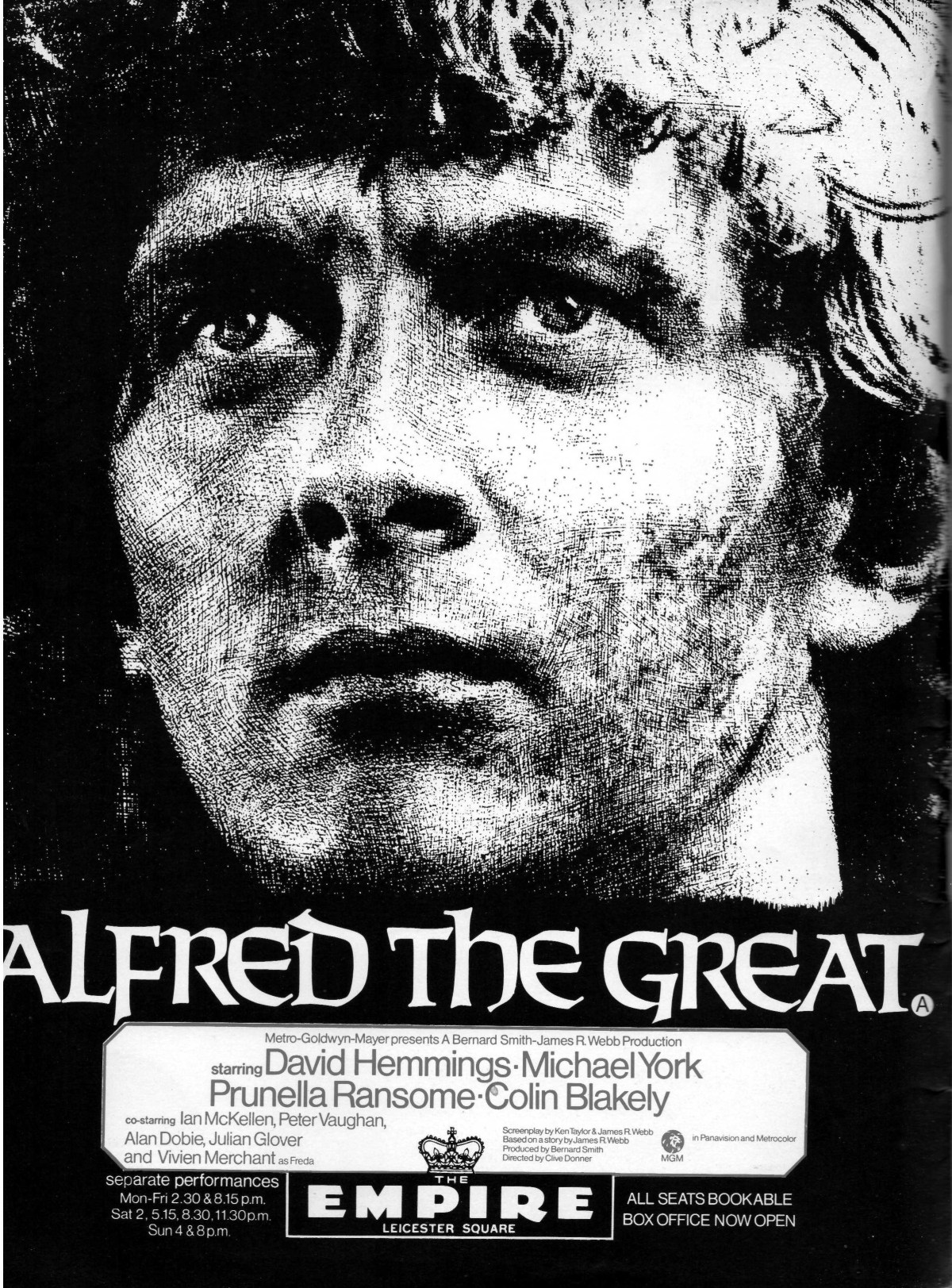
The Prince Who Wanted To Be A Priest. The King Who Didn’t Want To Fight. The Husband Who Raped His Wife.
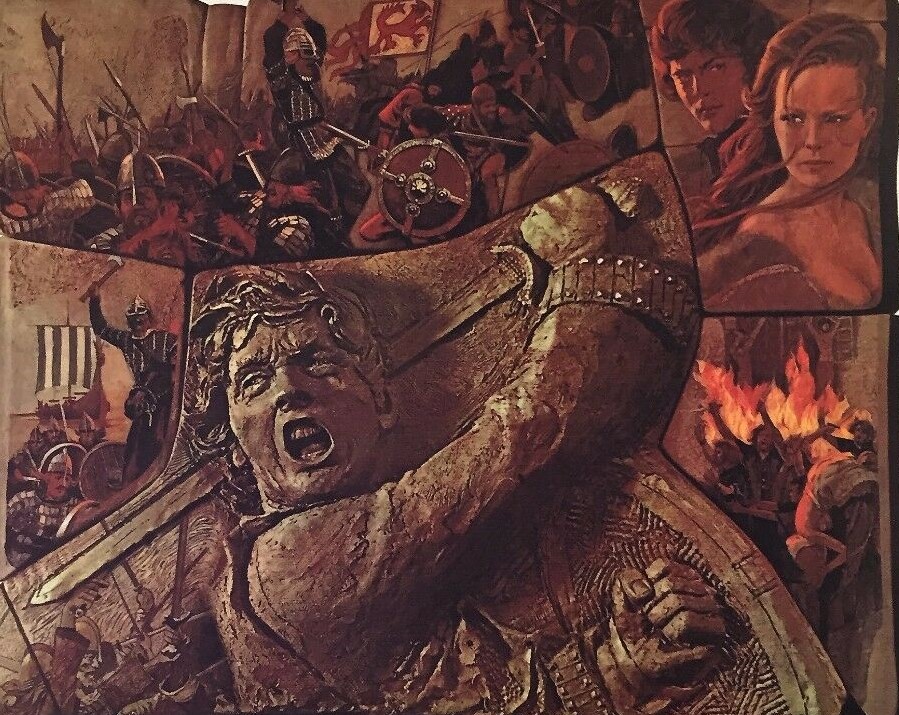
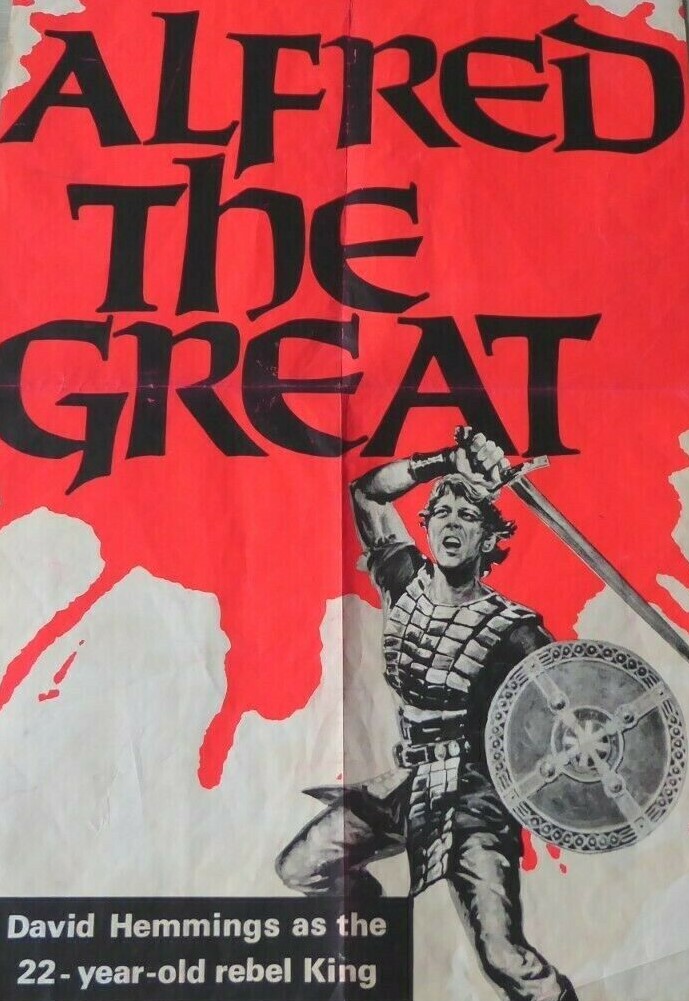
Not exactly taglines in the grand tradition of Gladiator (1999), but a succinct analysis of a Film That Wanted To Be A Roadshow. This is almost an anti-epic, a down-n-dirty historical movie far removed from El Cid (1961), Lawrence of Arabia (1962) and The Fall of the Roman Empire (1964). And one element that has to be taken into consideration when making a historical picture set in Britain in AD 871, if you are aiming for realism, is the rain. The battles in the three movies mentioned, as with virtually every historical movie of the decade, took place in bright sunshine on hard ground, not in the rain on mud-soaked fields. Director Clive Donner lacks the genius of an Akira Kurosawa who turned rain into a glorious image in Seven Samurai (1954) or even Ridley Scott whose first battle in Gladiator took place in a snowstorm. But he does make a battleground reflect the grim reality.
Alfred (David Hemmings) was fifth in line to the throne – and just to a small region of England called Wessex – and as was common practice all set, quite happily, for a career in the priesthood. So it was not surprising, envisioning religion as a mark of civilization, and the priesthood guaranteeing an education, that he was loathe to become a warrior just because his brother King Ethelred (Alan Dobie) was a useless leader. The price of taking on the warrior’s mantle and, after his brother’s death, of ascending to the throne is that Alfred must not only cast away his priestly ambition but his chastity in order to get married to unify rival kingdoms and produce an heir. So there’s a good deal of the religious quandary of El Cid and the sexual ambivalence of Lawrence of Arabia.
So repelled by what he is forced to do, that on his wedding night Alfred rapes new wife Aelhswith (Prunella Ransome) and when the marauding Vikings win a decisive battle and the price of peace is the wife taken in hostage Alfred offers no great protestation. So Alfred is hardly an appealing character. His wife hates him so much that she conceals her pregnancy from him. If you were an Englishman you might well prefer the straightforward lustful Viking leader Guthrun (Michael York) whose men are not restrained by Christianity – “it’s a strange religion,” he mulls, “ that wars with everything your flesh and your blood cries out for” – who makes a better fist of wooing Aelswith, whom he could as easily rape, than Alfred.
Eventually, of course, Alfred gets it together, rallies a bunch of outlaws and steals back wife and son (now four years old). However, there is no romantic reunion. Instead, he plans to imprison her for life, “the whore shall rot in silence.” Nonetheless, Alfred has acquired some tactical skills, adopting the old Roman infantry tactic of forming his troops up in a phalanx behind a wall of shields. His battlefield address is to promise ordinary people a set of laws that will give them equality with the wealthy and powerful.
Given there are no castles and this is indeed the Dark Ages as far as costume and interior design is concerned and that therefore the camera cannot, for respite, be turned onto some glorious image, Clive Donner (Here We Go Round the Mulberry Bush, 1968) concentrates on character rather than scenery. There are a couple of inspired touches. For a start, in permitting various characters to offer prayers to God, he introduces a number of soliloquies which take us to the heart of troubled souls, and then he does a clever split-screen number to effect a transition. You can’t blame him for British weather and the battles are well-staged. He does show the courage of his convictions in making the film concentrate on conflicted character rather than going along the easier heroic route of underdog rallying people to a cause.
David Hemmings (Blow-Up, 1966) is both the film’s strength and weakness. He is excellent at capturing the torment, the soul divided, and the inherent arrogance as well as the preference for peace instead of war. But in terms of his leadership skills he is on a par with Orlando Bloom in Kingdom of Heaven (2005). That part was originally intended for Russell Crowe and Peter O’Toole was first choice for Alfred and you can’t help thinking both would have been a substantial improvement. On the other hand, Alfred was just 22 when he became king and for someone intent on the priesthood there would be no need for him to develop his physique or political skills. So this is a far cry from your typical Hollywood hero and in that regard the casting makes perfect sense and Hemmings a bold actor to take on such an unlikeable character.
Prunella Ransome (Man in the Wilderness, 1971) does well in her first leading role, suggesting both vulnerability and independence and while virtually imprisoned by both Alfred and Guthrun remaining principled. Michael York (Justine, 1969) was a definite rising star at this point and plays the Viking with considerably more gusto than his tendency towards passive characters would suggest.
There’s virtually a legion of excellent supporting players in Colin Blakely (The Vengeance of She, 1968), Alan Dobie (The Comedy Man, 1964), Ian McKellen (Lords of the Rings and X-Men), Peter Vaughan (A Twist of Sand, 1968), Vivien Merchant (Accident, 1967), Barry Evans (Here We Go Round the Mulberry Bush, 1968), Sinead Cusack (Hoffman, 1970), Christopher Timothy (All Creatures Great and Small, 1978-1990) and Robin Askwith (Confessions of a Window Cleaner, 1974).
Oscar-winner James R. Webb (How the West Was Won, 1963) was an improbable name to be attached to a British screenplay. But this was a pet project he had been trying to get made since 1964. Ken Taylor (Web of Evidence, 1959) was brought in to lend a hand.
Not being a student of English history but familiar with the ways of the movie business, I am sure the picture has many historical inaccuracies, but it does present one of the most complex individuals ever to feature in a historical film of the period, when audiences preferred their heroes more black-and-white. So it is a significant achievement in the canon.
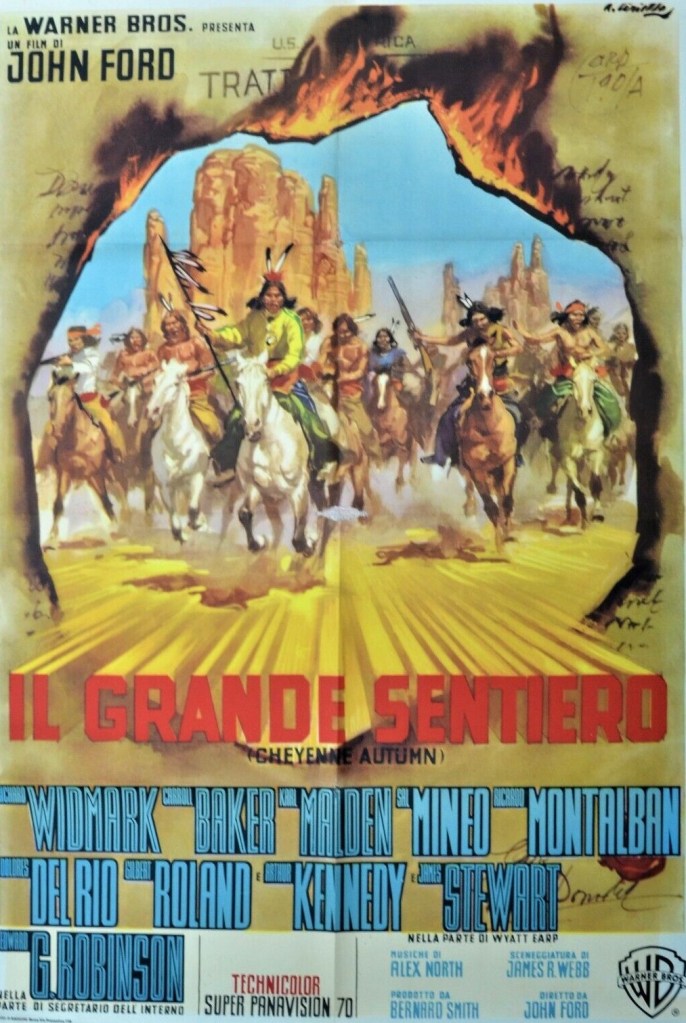
Lack of narrative energy and focus sabotages well-meaning atonement epic. John Ford’s final western, made half a decade before Dee Brown’s seminal Bury My Heart at Wounded Knee was published, is not the epitaph he might have envisioned. For a start, it’s just not rigorous enough. You might accept there’s no mention of the word “genocide” since until Vietnam the United States was hardly capable of mea culpa.
But that we learn very little about the Native Americans trekking 1500 miles from their Oklahoma reservation to their Wyoming homeland beyond that it’s an exhausting trek. Although the Native Americans are treated in a positive manner, and the U.S. Cavalry and Government are seen as inefficient and corrupt, little has been invested in the Native American characters.
The crux of their story is that the two brothers – Dull Knife (Gilbert Roland) and Little Wolf (Ricardo Montalban) leading the journey – eventually go their separate ways, and that a younger headstrong Native American steals one of the brother’s wives. Instead, more attention is paid to a young do-gooding Quaker teacher Deborah Wright (Carroll Baker) who opts to join them on their quest in order to look after the children attending her classes.
Caustic Captain Archer (Richard Widmark), either in person or through voice-over, is the most notable character, fighting his superiors to allow the wanderers unrestricted passage and eventually winning over Secretary of the Interior Carl Schurz (Edward G. Robinson) to ease the last stages of their journey.
The plot diverges from the Exodus-style mission for a totally irrelevant sequence set in Dodge City featuring a gambling Wyatt Earp (James Stewart) and Doc Holliday (Arthur Kennedy) and a spurious bunch of townspeople getting over-excited at the prospect of being attacked. More to the point, when Little Wolf splits from Dull Knife and heads for the sanctuary of Fort Robinson in Nebraska they are imprisoned by authoritative Captain Wessels (Karl Malden), gunning for promotion and in an echo of German apology for the Holocaust “only obeying orders,” with savage consequence.
The couple of action sequences show the fighting skills and tactical ability of the Native Americans but this is undermined by also showing them as sly and cunning, hiding weaponry under campfires and in baby’s clothing.
You might also be asking just how big is Monument Valley for it seems to be the location for about half the picture. Sure, it’s a terrific backdrop and possibly never been better utilized but it’s an example of the creative lethargy not to follow in more authentic manner the actual route of the Cheyenne. Adding to that disgruntlement you might also note the omission of any Native Americans in the leading roles, those parts being taken by Mexicans or dark-skinned Americans.
While John Ford clearly had his heart in the right place, his fans weren’t ready for this kind of revisionist approach – the movie, a 70mm roadshow, was a big flop at the box office – and the result just doesn’t do the subject justice. And in fact a corrective correlative to How the West Was Won (1962) perhaps entitled How the West Was Stolen has yet to be made.
For a long time Bury my Heart at Wounded Knee was considered the landmark historical work depicting the ruthless conquering of the Native Americans but the more recent The Earth Is Weeping by Peter Cozzens, which I read a couple of months back, offers a more authoritative look at the sorry saga, but, without, I hasten to add, a mention of the scary word “genocide.”
I wouldn’t normally be in favor of editing the work of a director as legendary as John Ford but the omission of the Dodge City sequence would have considerably shortened the movie and retained the focus and perhaps improved the picture.
As it stands, a valiant effort. None of the stars is provided with sufficient narrative to make their acting stand out and it feels like they have all stumbled into a documentary.
Contemporary audiences will find much to admire. Perhaps unintentionally, certainly unusual for the era in which it was made, this is driven by a strong feminist streak and the problems of fusing different new cultures – Chinese and Japanese – on an island already dominated by white immigrants. In some respects a companion piece to Diamond Head (1962), which also starred Charlton Heston, but in reality a sequel to epic roadshow Hawaii (1966).
Nyuk Tsin (Tina Chen) has been kidnapped from her village in China with the intention of selling her into a brothel in Honolulu. But when her gender is discovered on board the ship, captained by Whip Hoxworth (Charlton Heston), transporting Chinese laborers to Hawaii, a fight breaks out, her owner is killed and she is taken over by Mun Ki (Mako). He fully intends, on making land, to sell her and keep the money but at the docks Whip’s wife Purity (Geraldine Chaplin) intervenes and the couple are offered jobs as husband-and-wife.
“Hawaii” (1966) was not such a big box office hit abroad as it was in the United States hence the decision not to rely on the U.S. title “The Hawaiians” for the sequel. In fact, unlike the U.S. poster the novel is not so upfront.
Mun Ki’s entrepreneurial spirit is obvious from the minute she reaches Whip’s plantation, as she starts planting seeds in a tiny area in front of the hovel that is their dwelling. That turns into a vegetable garden and eventually she has a side business feeding laborers. Her gardening skills encourage Whip to entrust to her to grow the seed pineapple plants he has stolen from French Guiana, a continent away in South America.
When that proves successful, and Whip manages to find an artesian well through the lava bed, he embarks on a career as a pineapple farmer, and as a reward, deeds her land.
Meanwhile, Nyuk Tsin discovers she is wife only in terms of procreation. Mun Ki already has a wife back home, so Nyuk Sin can only officially become an aunt to the five children she bears him, each named after a continent (Asia, Africa etc) and who do, it must be said, come in handy for her farming business. She is wealthy enough that attempts are made, as much from envy and fury at her success as anything else, to steal her property.
While officially disbarred from the position of wife, her feelings for her husband are so strong that when he contracts leprosy she accompanies him to the island of Molokai and looks after him until rescued by Whip. Now with a prosperous farm, and remaining unmarried, she is rich enough, and clever enough, to send one son to America to train as a lawyer. Through her own endeavors and willpower she becomes not the slavish wife, dependent on her husband and his whims, but a strong independent wealthy woman, and leader of her expanding clan.
Theoretically, this is a subplot in the film, but in reality director Tom Gries (Number One, 1969) affords it as much time as the supposedly main narrative which, in contrast to Diamond Head, sees Whip as the black sheep of the family, disinherited and left only with land that is useless until the cultivation of pineapples makes it viable. His wife, while ostensibly weak, is also of a feminist disposition, abandoning her husband after the birth of her only son Noel (John Philip Law) to return to her Hawaiian roots.
When the Japanese arrive on the island Whip takes as a mistress the educated self-sufficient Fumiko (Miko Mayama). The circle of interbreeding and cultural infusion is complete when Noel marries Mei Lei (Virginia Lee), Nyuk Tsin’s only daughter.
It’s a lot more melodramatic than that, to be sure, Whip at odds with his family, Purity sending him bananas by denying him sex after Noel’s birth, and then withdrawing from his life. Various characters flit in and out, like the alcoholic well-digger Overpeck (Don Knight), and the tale embraces, like Diamond Head, the period when the United States annexed Hawaii.
Allotting so much screen time to Nyuk Tsin can’t have been accidental, maybe it was just visionary, but taking her as the focal point pivots more on her single-minded nature than the haphazard character of Whip, who achieves success through luck, theft and brutality. It’s remarkable that Nyuk Tsin has understood its importance of land ownership, the bedrock of any country’s institutional hierarchy, and strives so hard to achieve that footing and becomes in essence the family breadwinner. If the foreign title had been changed to Mistress of the Islands it would not have gone far wrong.
Fans of the second-billed John Philip Law (Hurry Sundown, 1967) will perhaps be disappointed that he appears so late in the proceedings, essentially to ensure the narrative can embrace the generations, but also to show how attitudes can change for the good from one generation to another.
I’m aware I’m asking you to watch the movie from a different perspective from that advertised but it’s far more rewarding.
Charlton Heston is good, especially when transitioning from commander of all he surveys while on board ship to a mere family footnote on dry land. He can rant with the best of them, for sure, but underneath the fury you can detect the pain, cast aside by family and wife. The scenes where he fails to reignite sexual relations with Purity reveal how great an actor he is. We more often associate Heston with the lower half of his face, the jutting jaw, the flashing teeth, the dominance of his words, rather than the upper half where his eyes are so revealing of inner torment. There’s a sea-change in the standard Heston performance that runs through Planet of the Apes, Number One and here of a powerful man drained by circumstance.
But Tina Chen (Three Days of the Condor, 1975) is the standout, moving from humiliation to pride, often called upon to mutely absorb pain, but fiercely protecting husband and brood, and clever enough to calmly negotiate her way past husband and Whip to potential success.
Tom Gries, in his third picture with Heston, manages to create an epic feel to a picture whose limited running time sabotages that aim. His sweeping tracking shots provide the bravura but that is underpinned in the more intimate moments by sensitivity to character emotion shown in a look rather than expressed in dialog.
Screenwriter James R. Webb (How the West Was Won, 1962) had the job of chiselling another cinematic chunk from James Michener’s door-stopper of a novel and turning this sub-plot into a gem.
These days fact-based magazine articles commonly spark movies – The Fast and the Furious (2001) was inspired by a piece in Vibe, A Beautiful Day in the Neighborhood (2019) started life in Esquire – but it was rare in the 1960s (see Note below).
However, a series of seven lengthy historical articles in the multi-million-selling Life magazine in 1959 about the Wild West, extensively illustrated with material from the time, captured the attention of the nation. Bing Crosby acquired the rights, not as a potential movie, but for a double album recorded in July 1959 on a new label Project Records set up specifically for the purpose – two months after the series ended – and a proposed television special.
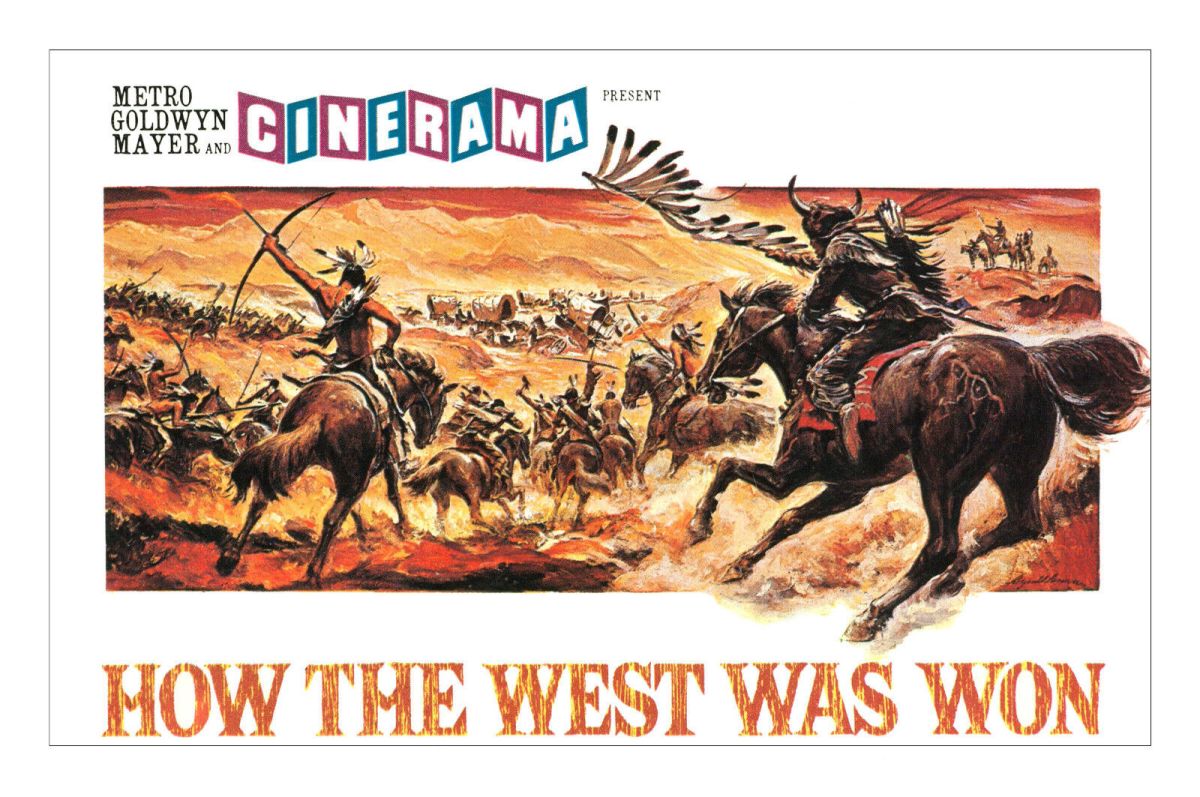
When the latter proved too expensive, the rights were sold to MGM which then linked up in a four-film pact with Cinerama to create the first dramatic picture in that format, the three-screen concept that had taken the public by storm in 1952 with This Is Cinerama. Since then, Cinerama had focused exclusively on travelogs and coined $115 million in grosses from just 47 theaters, including $9 million in seven years at the Hollywood theater in Los Angeles. Eight years in its sole London location had yielded $9.4 million gross from a quartet of pictures, Cinerama Holiday (1955) leading the way with (including reissue) a 120-week run, followed by 101 weeks of Seven Wonders of the World (1956), 86 for This Is Cinerama and 80 weeks for South Seas Adventure (1958).
Box office was supplemented with rentals of the projection equipment. But the novelty had worn off, lack of product denting consumer and industry interest, many of the theaters set up for the project returning the equipment, so that by the time of this venture there were only 15 U.S. theaters still showing Cinerama. The company went from surviving primarily on equipment royalties to becoming a producer-distributor-exhibitor. Ambitiously, the company believed it could generate $5,000 a week profit for each theater, and, assuming growth to 60 houses, that could bring in $15 million a year.
Crosby initially remained involved – crooning songs to connect various episodes – but that idea was soon abandoned. Director Henry Hathaway (North to Alaska, 1960), claimed he came up with the movie’s structure. “The original concept was mine,” he said, “The first step in the winning of the West was the opening of the canal, then came the covered wagon, next the Civil War which opened up Missouri and the mid-West then the railroads, and finally the West was won when the Law conquered it instead of the outlaw gangs; which was the theme I worked out for the picture.
“So I conceived the whole idea and then got writers to work on the five episodes. Each episode was about a song originally. Then I travelled all over the country to find locations.”
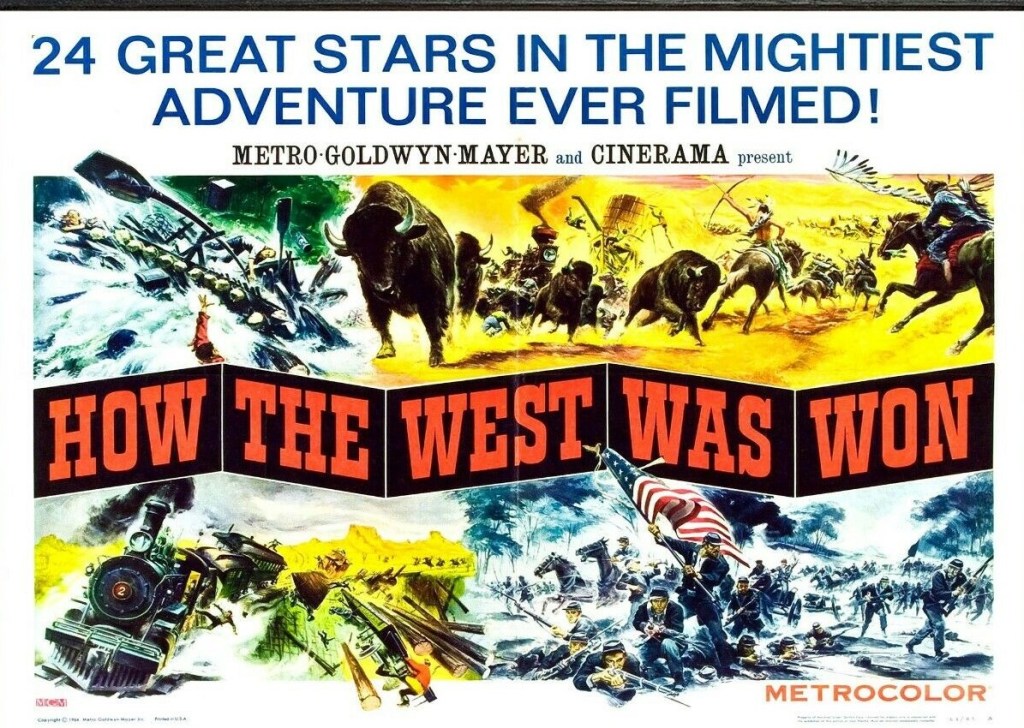
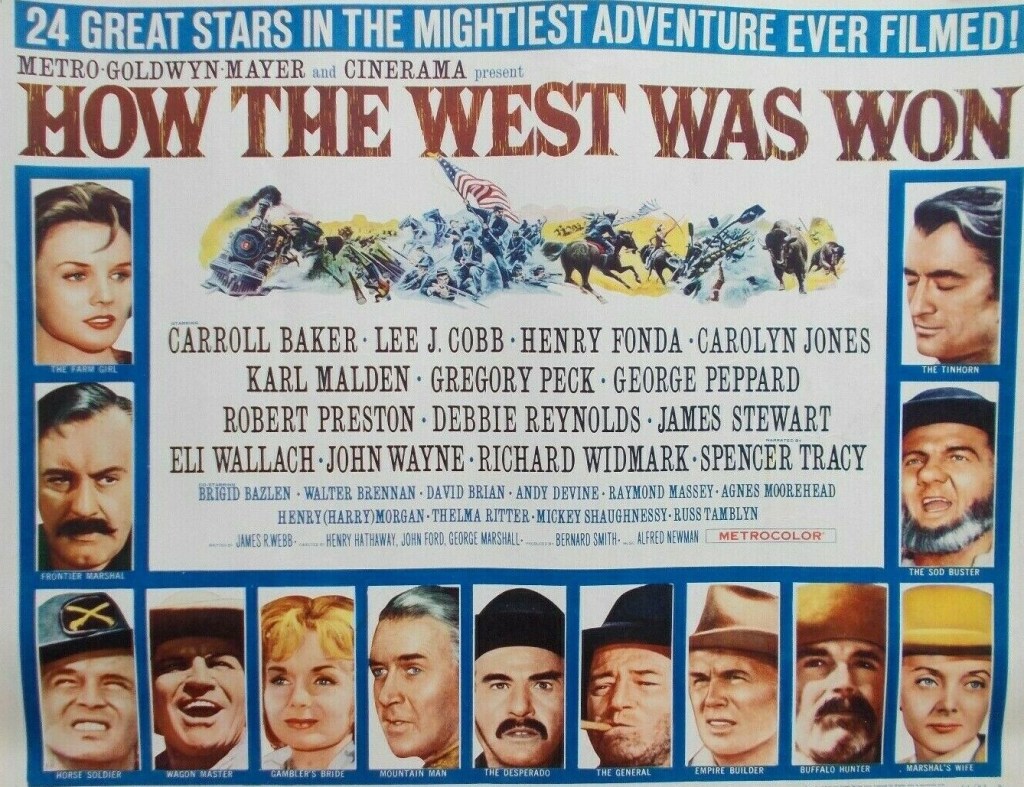
For once this was a genuine all-star cast headed up by actors with more than a passing acquaintance with the western: John Wayne (The Man Who Shot Liberty Valance, 1962), Oscar-winner Gregory Peck (The Big Country, 1958), James Stewart (Winchester ’73, 1950), Richard Widmark (The Alamo, 1960) and Henry Fonda (Fort Apache, 1948) with Spencer Tracy (Broken Lance, 1954) as narrator plus George Peppard (Breakfast at Tiffany’s, 1961) in his first western.
The two strongest female roles were given to actresses playing against type, Carroll Baker (Baby Doll, 1956), who normally essayed sexpots, as a homely pioneer and Debbie Reynolds (The Tender Trap, 1955), more at home in musicals and comedies, as her tough sister. The impressive supporting cast included Lee J. Cobb, Eli Wallach, Walter Brennan, Robert Preston, Carolyn Jones and Karl Malden.
Glenn Ford and Burt Lancaster were unavailable. Frank Sinatra entered initial negotiations but ultimately turned it down. Gary Cooper, also initially considered, died before the film got underway.
Initially under the title of The Winning of the West screenwriter James R. Webb (The Big Country, 1958) was entrusted with knocking the unwieldy non-fiction story into a coherent fictional narrative. In effect, it was an original screenplay at a time when Hollywood was turning its back on bestsellers, “the pre-sold theory less compelling.” His first draft accommodated various montages covering the journey from the Pilgrim Fathers to the building of the Erie Canal and the Civil War and it was only in subsequent drafts that the tale of Linus Rawlings (James Stewart) emerged with surprising focus on female pioneers.
Webb’s initial ending had involved a father-son conflict, presumably a fall-out between the Rawlings played by James Stewart and George Peppard, but that was rejected in order not to finish on a “note of bitterness” out of keeping with the spirit of the movie. Although he did not receive a credit, John Gay (The Happy Thieves, 1961) also contributed to the screenplay.
Given the film’s episodic structure it is amazing how well the various sequences fit together and the narrative thrust maintained. The story covers a 50-year stretch beginning in 1839 with the river sequence bringing together James Stewart and Carroll Baker. After Stewart is bushwhacked by river pirates, he marries Baker and they set up a homestead. The next section pairs singer Debbie Reynolds with gambler Gregory Peck whose wagon train is attacked by Indians on the way to San Francisco. Later, Stewart and son George Peppard enlist in the Civil War (featuring John Wayne as an unkempt General Sherman).
Stewart dies at the Battle of Shiloh. Peppard joins the cavalry and later as a marshal in Arizona meets Reynolds and prevents a robbery that results in a spectacular train wreck. It took a superb piece of screenwriting to pull the elements together, ensure the characters had just cause to meet and to create solid pace with a high drama and action quotient.
The undertaking was too much for one director. Initially, it was expected five would be required but this was truncated to three – John Ford (The Searchers, 1956), Henry Hathaway and George Marshall (The Sheepman, 1958) although Hathaway carried the biggest share of the burden and Richard Thorpe (Ivanhoe, 1952) handled some transitional historical sequences.
The directors broke new ground, technically. The Cinerama camera was actually three cameras in one, each set at a 48 degree to the next and when projected provided a 146-degree angle view. Each panel had its own vanishing point so the camera could, uniquely, see down both sides of a building.
But there were drawbacks. The cumbersome cameras required peculiar skills to achieve common shots. Directors lay on top of the camera to judge what a close-up looked like. Sets were built to take account of the way dimensions appeared through the lens, camera remaining static to prevent distortion. When projected, the picture was twice the size of 65mm and before the invention of the single-camera lens led to vertical lines running down the screen. Trees were built into compositions to hide these lines.
“You couldn’t move the camera much,” recalled Hathaway, “or the picture would distort. You have to shove everything right up to the camera. Actors worked two- and three-feet away from the camera. The opening dolly down the street to the wharf was the first time it had ever been done.
He added, “Over 50 per cent of the stuff on the train was made on the stage (i.e. a studio set) and 60 per cent of the stuff coming down the rapids. I never took a principal up north to the river, the principals never worked off the stage. We never photographed the scenes with transparencies in three cameras with Cinerama – we photographed them with one camera in 70mm and then split the negative.
“I wouldn’t shoot close-ups in Cinerama – I shot the close-ups in 70(mm) and then separated the negative because in Cinerama it distorted their arms. When (George) Stevens shot The Greatest Story Ever Told he used only 70mm and split it all. So from then on they never used the three cameras again. Now they’re actually shooting it in 35(mm).”
Rui Nogueira, “Henry Hathaway Interview,” Focus on Film, No 7, 1971, p19.
After a year spent in pre-production, an eight-month schedule due to start on May 28, 1961, and a completion date of Xmas 1961, MGM anticipated a 1962 launch, Independence Day pencilled in for the world premiere. The original $7 million budget mushroomed to $12 million and then to £14.4 million, $1 million of that ascribed to adverse weather conditions, hardly surprising given the extent of the location work. A total of $2.2 million went on the 10 stars and 13 co-stars, virtually talent on the cheap given the salaries many could command, transport cost $1 million and the same again in props including an 1840 vintage Erie canal boat.
Rain and overcast skies added $145,000 to the cost of shooting the rapids sequence in Oregon and another $218,000 was required when early snowfall scuppered one location and required traveling 1,000 miles distant. Nearly 13,000 extras were involved as well as 875 horses, 1,200 buffalo, 50 oxen and 160 mules. Thousands of period props were dispersed among the 77 sets. Over 2,000 pairs of period shoes and 1500 pairs of moccasins were fashioned as well as 107 wagons, many designed to break on cue.
Virtually 90 per cent of the picture was shot on location to satisfy Cinerama customers accustomed to seeing new vistas and to bring alive the illustrations from the original Life magazine articles. Backdrops included Ohio River Valley, Monument Valley, Cave-in-Rock State Park, Colorado Rockies, Black Hills of Dakota, Custer State Park and Mackenzie River in Oregon.
The picture, including narration, took over a year to make. Cinerama sensation was achieved by shooting the rapids, runaway locomotive, buffalo stampede, Indian attack, Civil War battle and cattle drive. Motion was central to Cinerama so journeys were undertaken by raft, wagon, pony express, railroad and boat, anything that could get up a head of steam.
Initially, too, the production team had been adamant – “rigid plans for running time will be met” – that the movie would clock in at 150-155 minutes (final running time was 165 minutes) and there was some doubt, at least initially, on the value of going down the roadshow route in the United States. Roadshow was definitely set for Europe, a 15-minute intermission being included in those prints, for a continent where both roadshow and westerns were more popular than in the States.
Big screen westerns in particular in Europe had not been affected by the advent of the small-screen variety. Some films received substantial boosts abroad. “The Magnificent Seven and Cimarron (both 1960) took giants steps forward once they made the transatlantic crossing.” British distributors also reported “striking” success with The Last Sunset (1961) and One-Eyed Jacks (1962) which had toiled to make a similar impression in the U.S.
In the end the decision was made to hold back the release in the U.S. in favor of another Cinerama project The Wonderful World of the Brothers Grimm, which had begun shooting later and ultimately cost $6 million, double its original budget. Rather than bunch up the release of both pictures, MGM opted to kick off its Cinerama U.S. launch with Grimm in 1962 and shifted How the West Was Won to the following year. MGM adopted the anticipation approach, holding the world premiere in London on November 1, 1962, and unleashing the picture in roadshow in Europe.
A record advance of $500,000 was banked for the London showing at the 1,155-seat Casino Cinerama (prices $1.20-$2.15) on roadshow separate performance release. Before the advertising campaign even began in October, a full month prior to the world premiere, over 62,000 reservations had been made via group bookings. Critics were enamored and audiences riveted. The cinema made “unusually large profits” and after two years had grossed $2.25 million from 1722 showings.
Dmitri Tiomkin (The Alamo, 1960) was hired to compose the music, but an eye condition prevented his participation though he later sued for $2.63 million after claiming he was fired before the assignment began. Alfred Newman (Nevada Smith, 1966) wrote the thundering score but uniquely for the time MGM shared the publishing rights with Bing Crosby. In the U.S. Bantam printed half a million copies of a paperback tie-in, sales of the soundtrack were huge and there was a massive rush to become involved by retailers and museums with educational establishments an easy target.
Audience response was overwhelming, a million customers in the first month, two million by the first 10 weeks at just 36 houses, some of which had only been showing it for half that time. But it failed to hit ambitious targets – predictions that it would regularly run for three years in some situations “based on the star roster and the fact the pic offers more natural U.S. vistas than anything yet done on the screen” proving wildly over-optimistic. Still, it had enjoyed 80 roadshow engagements including eight months at the Cinerama in New York and grossed $2.3 million in 92 weeks in L.A, $1.14 million after 88 weeks in Minneapolis and $1.5 million after one week fewer in Denver.
By 1965, as it began a general release 35mm roll-out with 3,000 bookings already taken, it had already passed the $9 million mark in rentals including a limited number of showcase breaks the previous year.
Nominated for a Best Picture Oscar, it won for screenplay, sound and editing. The movie became MGM’s biggest hit after Gone with the Wind and Ben-Hur. In my recent book The Magnificent ‘60s, The 100 Most Popular Films of a Revolutionary Decade I placed it twelfth on the chart of the decade’s top box office films.
It provided a popularity fillip for most of the big stars involved, none more so than James Stewart who, prior to shooting, had been on the verge of retirement. Box office appeal diminishing, work on his next picture Take Her, She’sMine postponed by the Actor’s Strike, after the death of his father he had “quietly begun to make plans to get out of his Fox contract, retire, and move his family out of Beverly Hills.” He had spent $500,000 on a 1,100-acre ranch and was already well set to quit acting having accumulated a large real estate portfolio in addition to oil well investments.
NOTE: Robert J. Landry (“Magazines a Prime Screen Source,” Variety, May 30, 1962, 11) pointed to Cosmopolitan as the original publication vehicle for To Catch a Thief (1955) by David Dodge in 1951 and Fannie Hurst’s Back Street (1932), serialized over six months from September 1930. Frank Rooney’s The Cyclist’s Raid – later filmed as The Wild One (1953) – first appeared in Harpers magazine. Movies as varied as Edna Ferber’s Ice Palace (1960) and The Executioners by John D. MacDonald, later filmed as Cape Fear (1962), were initially published in Ladies Home Journal. The Saturday EveningPost published Alan Le May’s The Avenging Texan, renamed The Searchers (1956), and Donald Hamilton’s Ambush at Blanco Canyon, renamed The Big Country (1958) as well as Christopher Landon’s Escape in the Desert which was picturized under the more imaginative Ice Cold in Alex (1958).
SOURCES: Brian Hannan, The Magnificent ‘60s, The 100 Most Popular Films of a Revolutionary Decade (McFarland, 2022) p168-170; Marc Eliot, James Stewart A Biography (Aurum Press, paperback, 2007) p350-351; Rui Nogueira, “Henry Hathaway Interview,” Focus on Film, No 7, 1971, p19; Sir Christopher Frayling, How the West Was Won, Cinema Retro, Vol 8, Issue 22, p25-29; Greg Kimble, “How the West Was Won – in Cinerama,” in70mm.com, October 1983; “Reisini Envisions Cinerama Leaving Travelog for Fiction Pix,” Variety, December 14, 1960, p17; “Metro in 4-Film Deal with Cinerama,” Variety, March 1, 1961, p22; “Cinerama Action Awaits Plot Tales,” Variety, March 8, 1961, p10; “Fat Bankroll for How West Was Won,” Variety, May 24, 1961, p3; “Return to Original Scripts,” Variety, June 28, 1961, p5;“MGM-Cinerama Set 3-Hour Limit For West Was Won,” Variety, August 23, 1961, p7; “Hoss Operas in O’Seas Gallop,” Variety, August 23, 1961, p7; “Coin Potential As To Cinerama,” Variety, September 20, 1961, p15; “Changing Economics on Cinerama,” Variety, October 11, 1961, p13; “Bantam’s 22 Paperback Tie-Ups in Hollywood,” Variety, October 25, 1961, p22; “How West Was Won for July 4 Premiere,” Box Office, December 11, 1961, p14; “Crosby Enterprises Holds West Cinerama Songs,” Variety, January 24, 1962, p1; “Grimm First in U.S. for Cinerama but Abroad West Gets Priority,” Variety, April 4, 1962, p13; “Cinerama Fiscalities,” Variety, April 11, 1962, p3; “Cinerama Story Pair Burst Budgets,” Variety, May 16, 1962, p3; “Tiomkin’s $2,630,000 Suit Vs MGM et al,” Variety, June 27, 1962, p39; “Hathaway a Pioneer,” Variety, July 25, 1962, p12; “Bernard Smith Clarifies Fiscal Facts,” Variety, August 8, 1962, p3; Review, Variety, November 7, 1962, p6; “London Critics Rave Over West,” Variety, November 7, 1962, p19; “Brilliant World Premiere in London for West,” Box Office, November 12, 1962, p12; “West in Cinerama the Big Ace,” Variety, November 14, 1962, p16; Feature Reviews, Box Office, November 26, 1962; Bosley Crowther, “Western Cliches; How West Was Won Opens in New York,” New York Times, March 28, 1963; “Big Book Aid for West,” Box Office, April 1, 1963, pA3; “West Was Won Seen By 2,000,000 in 10 Weeks,” Box Office, June 3, 1963, p15; “How West Was Won for 19 Showcase Theaters,” Box Office, June 15, 1964, pE1; “West End,” Variety, November 11, 1964, p27; “How West Was Won Ends Roadshowing,” December 9, 1964, p16; “3,000 Bookings Expected for How the West Was Won,” Box Office, May 3, 1965.
I’ve got Alfred Newman’s toe-tapping theme music in my head. In fact, every time I think of this music I get an earworm full of it. Not that I’m complaining. The score – almost a greatest hits of spiritual and traditional songs – is one of the best things about it. But then you’re struggling to find anything that isn’t good about it. But, for some reason, this western never seems to be given its due among the very best westerns.
Not only is it a rip-roaring picture featuring the all-star cast to end all-star casts it’s a very satisfying drama to boot and it follows an arc that goes from enterprise to consequence, pretty much the definition of all exploration.
Given it covers virtually a half-century – from 1839 to 1889 – and could easily have been a sprawling mess dotted by cameos, it is astonishingly clever in knowing when to drop characters and when to take them up again, and there’s very little of the maudlin. For every pioneer there’s a predator or hustler whether river pirates, gamblers or outlaws and even a country as big as the United States can’t get any peace with itself, the Civil War coming plumb in the middle of the narrative.
Some enterprising character has built the Erie Canal, making it much easier for families to head west by river. Mountain man fur trader Linus Rawlings (James Stewart) on meeting prospective pioneers the Prescotts has a hankering after the young Eve (Carroll Baker) but as a self-confessed sinner and valuing his freedom has no intention of settling down. But he is bushwhacked by river pirates headed by Jeb Hawkins (Walter Brennan) and left for dead, but after saving the Prescotts from the gang changes his mind about settling down and sets up a homesteading with Eve.
We have already been introduced to Eve’s sister Lilith (Debbie Reynolds) who has attracted the attention of huckster Cleve Van Valen (Gregory Peck) and they meet again in St Louis where she is a music hall turn and widow. Her physical attraction pales in comparison with the fact she has inherited a gold mine. He follows her, unwelcome, in a wagon train which survives attack by Cheyenne, but still she resists him, not falling for him until a third meeting on a riverboat.
Zeb Rawlings (George Peppard) wants to follow his father to fight in the Civil War. Linus dies there, but there’s no great drama about it, he’s just another casualty, and the death is in the passing. In probably the only section that feels squeezed in, following the Battle of Shiloh a disillusioned Zeb saves General Sherman (John Wayne) and Ulysses S. Grant (Harry Morgan) from an assassin.
Returning home to find Eve dead, Zeb hands over his share of the farm to his brother and heads west to join the U.S. Cavalry at a time when the Army is required to keep the peace with Native Americans enraged by railroad expansion. Zeb links up with buffalo hunter Jethro Stuart (Henry Fonda), who appeared at the beginning as a friend of his father.
Eve, a widow again, meets up in Arizona with family man and lawman Zeb who uncovers a plot by outlaw Charlie Gant (Eli Wallach) to hijack a train. Zeb turns rancher once again, looking after her farm.
But the drama is peppered throughout by the kind of vivid action required of the Cinerama format, all such sections filmed from the audience point-of-view. So the Prescotts are caught in thundering rapids, there’s a wagon train attack and buffalo stampede, and a speeding train heading to spectacular wreck. There’s plenty other conflict and not so many winsome moments.
Interestingly, in the first half it’s the women who drive the narrative, Eve taming Linus, Lilith constantly fending off Cleve. And there’s no shortage of exposing the weaknesses and greed of the explorers, the railroad barons and buffalo hunters and outlaws, and few of the characters are aloof from some version of that greed, whether it be to own land or a gold mine or even in an incipient version of the rampaging buffalo hunters to pick off enough to make a healthy living.
And here’s the kicker. Virtually all the all-star cast play against type. John Wayne (Circus World, 1964) reveals tremendous insecurity, Gregory Peck (Mirage, 1965) is an unscrupulous though charming renegade, the otherwise sassy Debbie Reynolds (My Six Loves, 1963) is as dumb as they come to fall for him, and for all the glimpses of the aw-shucks persona James Stewart (Shenandoah, 1965) plays a much meaner hard-drinking hard-whoring version of his mean cowboy. Carroll Baker (Station Six Sahara, 1963) is an innocent not her usual temptress while George Peppard (The Blue Max, 1966) who usually depends on charm gets no opportunity to use it. .
Also worth mentioning: Henry Fonda (Madigan, 1968), Lee J. Cobb (Coogan’s Bluff, 1968), Carolyn Jones (Morticia in The Addams Family, 1964-1966), Eli Wallach (The Moon-Spinners, 1964), Richard Widmark (Madigan), Karl Malden (Nevada Smith, 1966) and Robert Preston (The Music Man, 1962).
Though John Ford (The Man Who Shot Liberty Valance, 1962) had a hand in directing the picture, it was a small one (the short Civil War episode), and virtually all the credit belongs to Henry Hathaway (Circus World) who helmed three of the five sections with George Marshall (The Sheepman, 1958) taking up the slack for the railroad section.
And though you might balk at the idea of trying to cover such a lengthy period, there’s no doubting the skill of screenwriter James R. Webb (Alfred the Great, 1969) to mesh together so many strands, bring so many characters alive and write such good dialog. Bear in mind this was based on a series of non-fiction articles in Life magazine, not a novel, so events not characters had been to the forefront. Webb populated this with interesting people and built an excellent structure.
I’m still tapping my toe as I write this and I was tapping my toe big-style to be able to see this courtesy of the Bradford Widescreen Weekend on the giant Cinerama screen with an old print where the vertical lines occasionally showed up. Superlatives are superfluous.




 The Magnificent 60s