The Demon (1963) *****

I was riveted. Never mind the spider-walk, this is one of the most extraordinary films I have ever seen. Highly under-rated and largely dismissed for not conforming to audience expectation that horror pictures should involve full moons, castles, darkness, fog, costumes, nubile female victims, graveyards, a male leading character, shocks to make a viewer gasp, and the current trend for full-on gore. So if that’s what you’re looking for, give this a miss. Even arthouse critics, spoiled by striking pictures by the Italian triumvirate of Fellini, Visconti and Antonioni, were equally scornful. For the most part this takes place in broad daylight and is set in an impoverished town in the Italian mountains where primitive farmers till the soil with horse and plough and water is collected in buckets from the river.

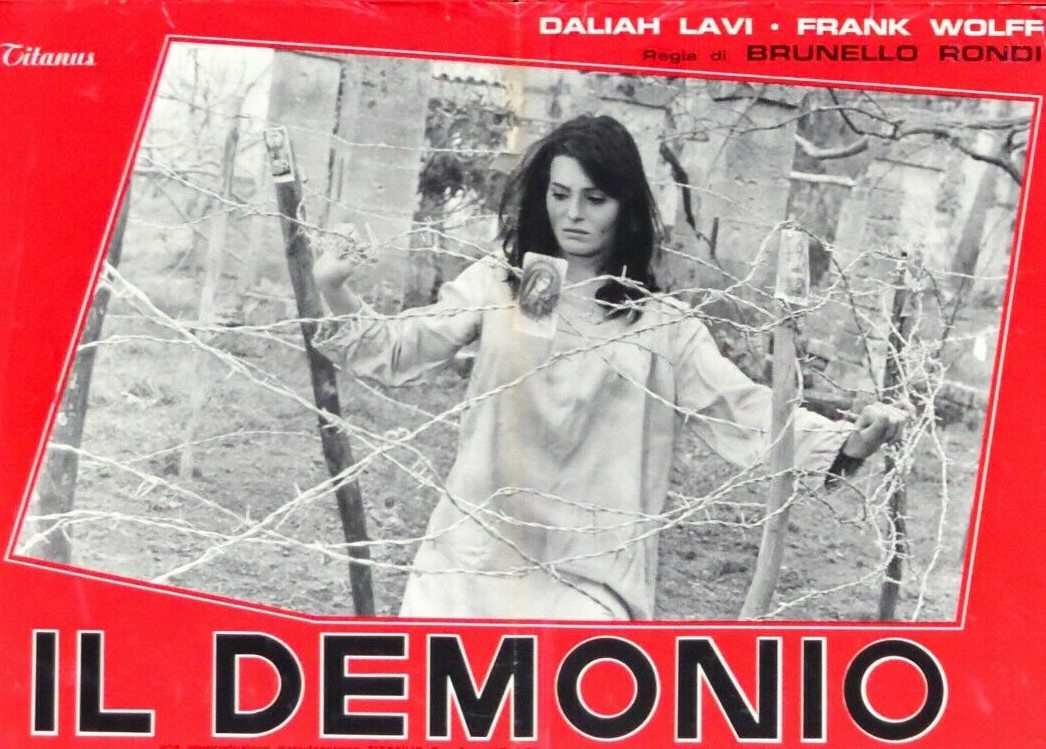
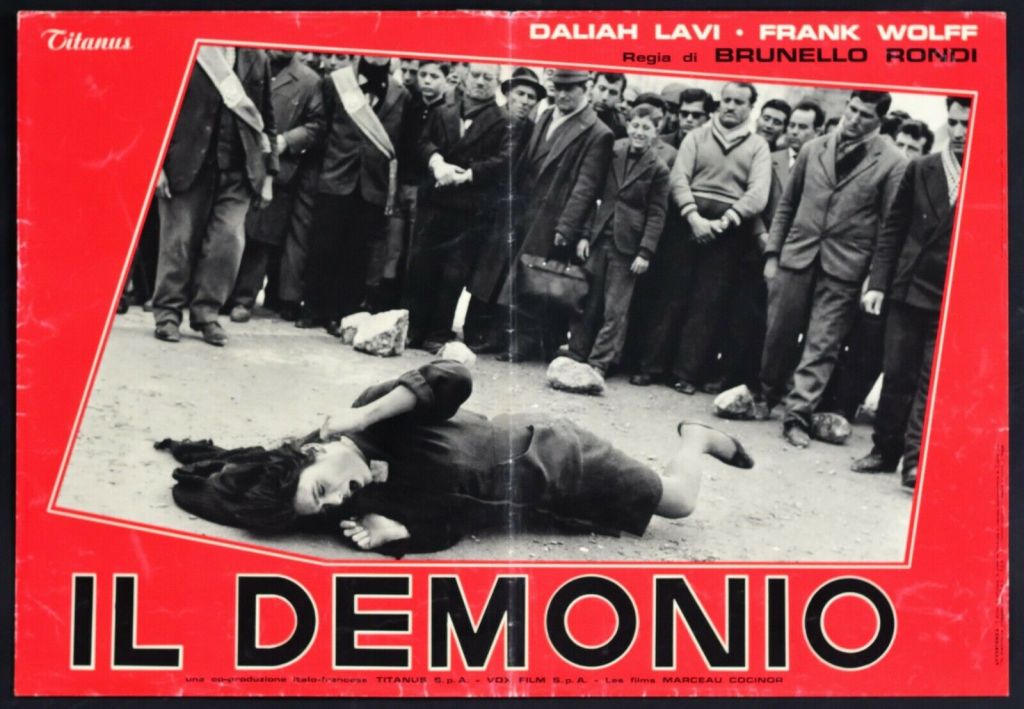
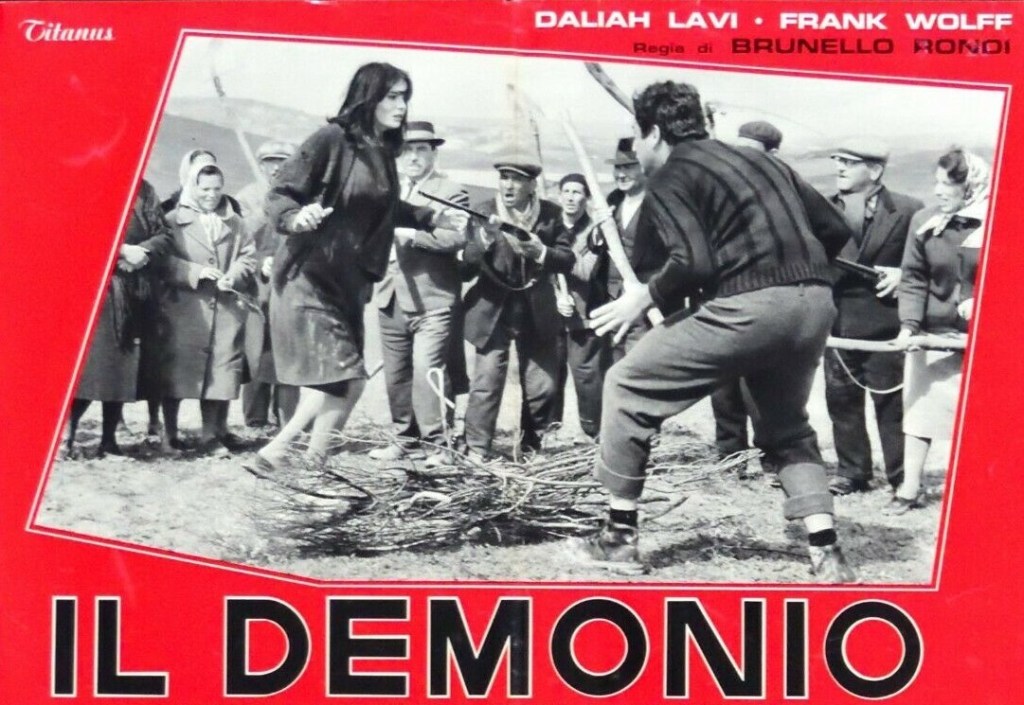
One of the most striking aspects of the picture is that it creates its own unique universe. The townspeople are both highly religious and deeply superstitious, every traditional Catholic ceremony matched by age-old ritual. Even some of the formal traditions seem steeped in ancient belief, sinners marching up a steep hill with people being scourged or carrying a heavy rock, in a convent the tree of a suicide covered in barbed wire. At a wedding in a church, how low the candles flicker is deemed to indicate the length of the marriage. A wedding night rite involves shoving a scythe under the bed to cut short Death’s legs with the bedspread covered in grapes – to soak up evil and discord – arranged in the form of a cross to act as bait for bad thoughts and poison them before they can cause the couple harm. When the people run through the town brandishing torches it is not, as would be genre tradition, to set fire to a castle but to vanquish evil from the air.

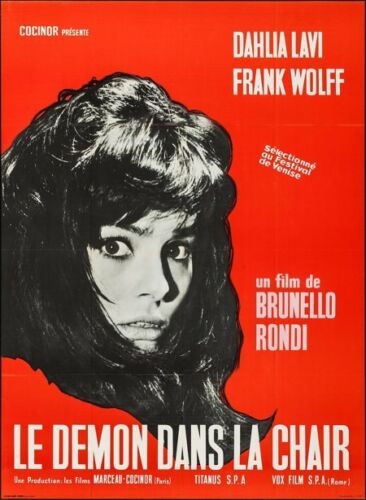
French poster.

It is filmed in austere black-and-white. In the Hollywood Golden Era of black-and-white movies, lighting and make-up transformed heroines, rich costumes enhanced background. Here, if the heroine is wearing make-up it’s not obvious and the only clothes worth mentioning are a priest’s robes or a plain wedding dress. Otherwise the most arresting feature is the stark brightness against which the black-dressed figure of the heroine Puri (Daliah Lavi) scuttles about.

And although there are no jump-out-of-your-seat shocks, there are moments that will linger on in your mind, not least the heroine enduring a vicious extended beating from her father, an exorcism that turns into rape and (Exorcist-fans take note) a spider-walk, the young woman’s torso thrust up high on elongated arms and legs. Virtually the entire success of the picture relies on atmosphere and in places it is exquisitely subtle, the audience only realizing she is being raped by the look on her face.

The picture opens with a dialogue-free scene of stunning audacity, foreshadowing the idea from the start that image is everything. Puri pierces her chest with a needle, cuts off a chunk of her hair to mop up the blood, throws the hair into the oven and rams the crisp remains into a loaf of bread. Not to be consumed, as you might imagine, but as a tool of transport. Shortly after, having failed to seduce Antonio (Frank Wolff), she tricks him into drinking wine infused with the ashes of her bloodied hair, bewitching him, so she believes, to abandoning his betrothed. In an echo of a Catholic sacrament she shouts, “You have drunk my blood and now you will love me, whether you want to or not.”  

The next morning when collecting water at the river she has a conversation with a boy Salvatore, only to discover he has just died. His death is blamed on her because his last words were a request for water, which she is judged to have denied him. She is beaten by women. She is feared by everyone in the village, her family tainted with the same brush, wooden crosses nailed to their door. She is not a ghostly figure, flitting in and out of the townspeople’s lives, an apparition tending towards the invisible, but fully formed, highly visible in her black dress and anguished expression, doomed by her often vengeful actions and forceful words.

Much of the film involves Puri being beaten or chased or captured, at one point trussed up like a hog. Attempts to exorcise her, whether pagan or Catholic, focus on getting the demon to speak his name. The ritual performed by heathen priest Guiseppe involves blowing on a mirror before taking on sexual aspects which culminate in rape. The Catholic version in a church in front of her family is primarily, as it would be in The Exorcist, a duel between the priest and whatever possesses her.

Movie producers who took one look at the beauty of Palestinian-born Daliah Lavi (Blazing Sand, 1960) thought she would be put to better use in bigger-budgeted pictures made in color that took full advantage of her face and figure. So they stuck her in a series of hardly momentous movies such as The Silencers (1966) and Some Girls Do (1969). they should be ashamed of themselves for ignoring her astonishing acting ability. And much as I have enjoyed such films, I doubt if I could watch them again without thinking what a waste of a glorious talent. This is without doubt an acting tour de force, as she alternatively resists possession and adores the being who has taken hold of her mind. She dominates the screen.

The rest of the mostly male cast are dimmed in comparison, as if overawed by the power of her personality. Future spaghetti western veteran Frank Wolff (Once Upon a Time in the West, 1968) comes off best. Director Brunello Rondi (Run, Psycho, Run, 1968) is better known as a screenwriter for Federico Felllini. He made few films, none matching this in scope or imagination, perhaps as a result of the picture not receiving the praise it deserved. Even now it does not have a single critical review on Rotten Tomatoes.

One other point: you may have noticed that in general the proclivities of male horror characters are never in need of psychological explanation. Nobody considers that the Wolfman must have suffered from childhood trauma or that a vampire drinks blood because he was a rejected suitor. Strangely enough, as would be the case in The Exorcist and other instances of female possession, psychiatry is usually the first port of call and here all reviews I have read implicitly see Puri’s actions as based on sexual inhibition and rejection by Antonio.  

I saw this on an old DVD but you can catch it for free on Youtube.

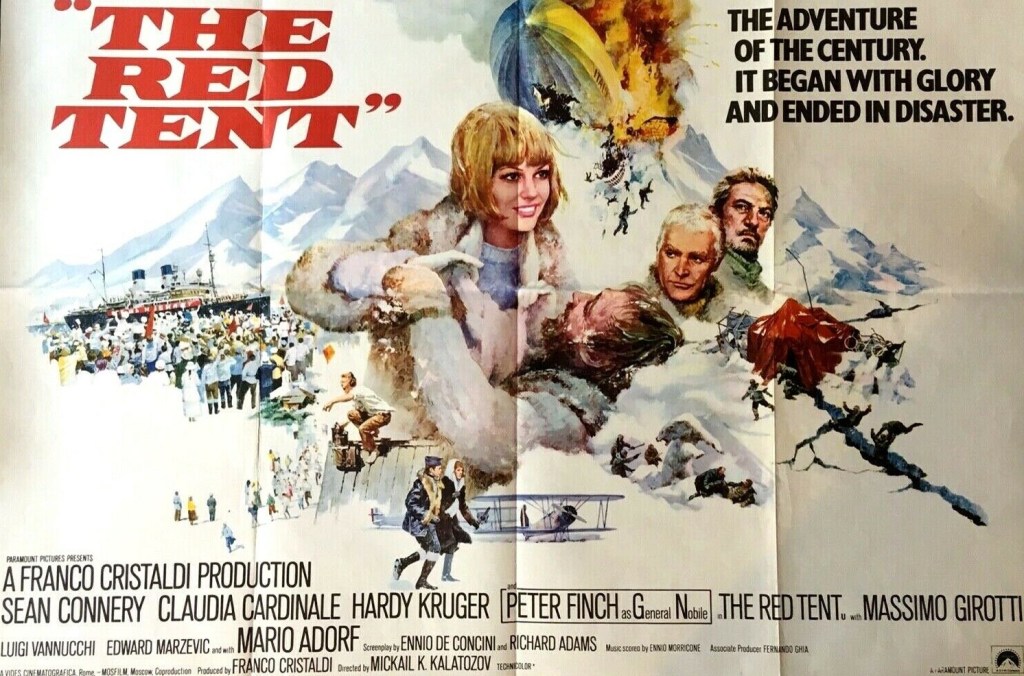
The Red Tent (1969) ***

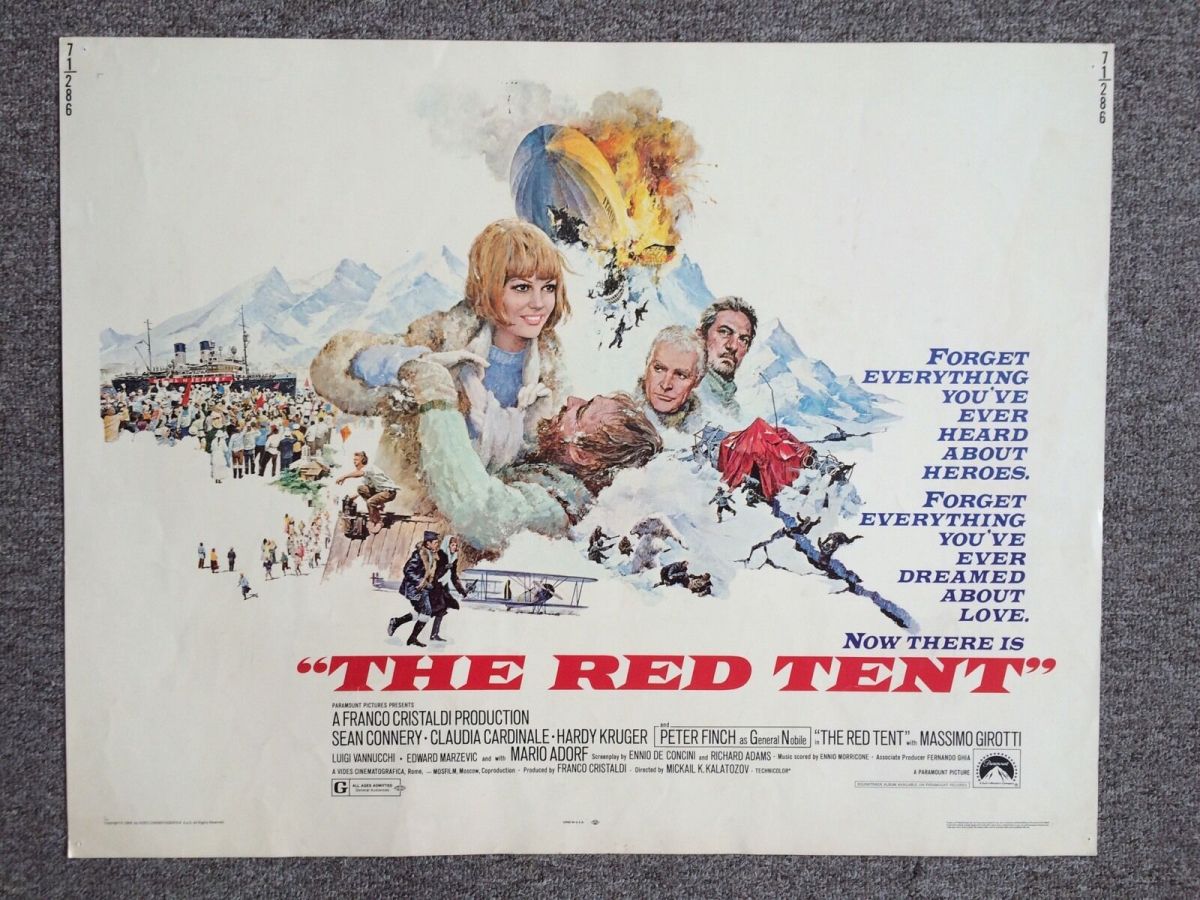
If you’re unfamiliar with the abortive Italian airship expedition to the North Pole led by General Umberto Nobilo (Peter Finch) in 1928, you’ll find this an absorbing tale. If you are familiar then you will probably appreciate the film-makers’ attempts, via an unusual framing device, to carry out a post-mortem and to apportion blame for the disaster. If you know your history you’ll also be aware both poles had already been conquered, American Robert Peary first to the North Pole in 1909, Norwegian Roald Amundsen (Sean Connery) claiming South Pole bragging rights two years later. So you’re also probably wondering what was the point nearly two decades later of the Nobilo operation?

But the sled-led efforts of Peary and Amundsen were feats of endurance i.e. man vs.  nature. This was science vs. nature. The dirigible was the apex of aviation advancement and nations still battled for exploration glory. So to travel in some comfort and fly over the North Pole in a few days would be a demonstration of scientific supremacy. Conquest of one of the most inhospitable places on earth was almost a PR exercise. With no intention of landing it was also a glorified tourist trip.

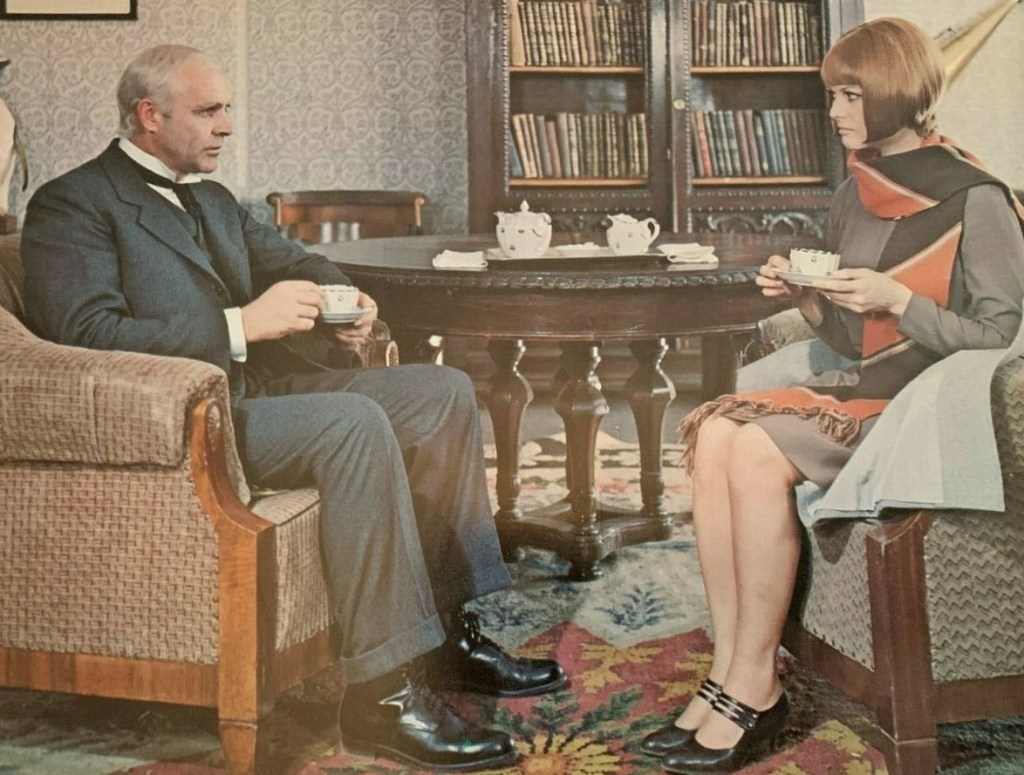
Connery and Cardinale lock horns over tea.

However, the science was flawed. Nobody had counted on the build-up of ice. The airship crashed and since this was a joyride nobody was equipped to walk their way out. Just surviving would be difficult enough. Loss of radio transmission (science) indicated a problem to those waiting back at the base so rescue airplanes were deployed. But without a location to pinpoint, the searchers had about two million square kilometers cover. Luckily, a brilliant scientific deduction by expedition member Finn Malmgreen (Eduard Martsevich) saves the day and a ham radio user (amateur science) picks up the location. Game on!

Except airplanes are too easily thwarted by blizzards, fog and the inhospitable. Home base, set up simply to welcome home a successful jaunt, is not capable of organizing a proper rescue. A Russian ice-breaker joins the rescue attempt. Taking greater risks is aviator Einar Lundborg (Hardy Kruger), fired up by the promise of sex with desperate nurse Valeria (Claudia Cardinale), who happens to be Malmgreen’s girlfriend, and a bounty from Nobilo’s insurers. The redoubtable Valeria does not have to sell her body to persuade the more highly-principled Amundsen to join the rescue effort.

So it’s gripping clock-ticking-down stuff, action shown in considerable detail, almost over-populated in one sense as director Mikhail Kalatozov (The Cranes Are Flying, 1957) covers multiple storylines, the various disjointed rescue efforts, the survivors weakening by the day, imperiled by marauding polar bears and the ice cracking up beneath their feet.

In the main it’s a true story, Valeria the only fictional element, inserted for dramatic purpose, to give the audience someone to emotionally root for back on land and for her character to guide us in almost contemporary fashion through the ghoulish carnival onshore as thousands gather to witness first-hand news of disaster.

What’s patently untrue is the framing device, given that it shows the still-living Nobilo summoning up the ghosts of others involved in the event for a post-mortem, in which his guilt drives him into the position of sacrificial lamb. Although on first encounter it appears a bizarre idea, that, too, soon achieves dramatic purpose. Clearly there was intense discussion at the time and in the immediate aftermath by those who survived the disaster and there must have been high-level talks behind closed doors that usually excluded the main characters of the kind that was played out in a host of historical pictures made during the decade. Lawrence of Arabia (1963) and Khartoum (1965) had many such set-pieces where reputations were shredded.

This approach permits opportunity for all the principals to come together for confrontational purposes in the one room. Not all discussion follows the expected path and there is an interesting argument between Nobilo and Amundsen about leadership. From an audience perspective, it is, of course, quite satisfying to see Sean Connery facing off against Peter Finch with Hardy Kruger and Claudia Cardinale embroiled in the debate.

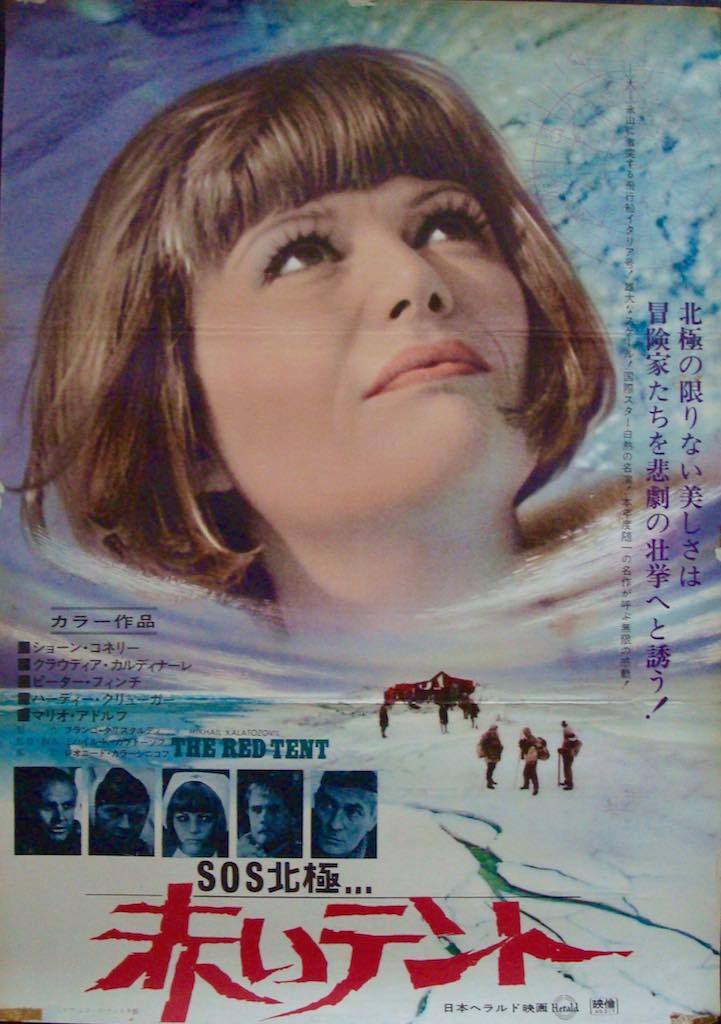
All eyes on Claudia Cardinale in the Japanese poster.

There is the bonus of fabulous cinematography of the majestic Arctic, the icy waste and breaking up of ice floes and collapsing icebergs never before captured in such widescreen glory. Further pluses are in the performances, especially Connery as an aged Amundsen, Finch as the glorious pioneer bewildered the sudden turn of events and Cardinale as a woman willing to go to any lengths to save her lover. Ennio Morricone provided the score.

However, you are best going into this to be aware that while Finch has a goodly amount of time onscreen, Connery and Cardinale (the ostensible stars judging by the credits) are not seen so frequently. That said, the movie happily falls into the survival sub-genre. The DVD version I saw was just a shade over two hours – cut by about 30 minutes from original release – but reportedly the longer version adds little more than some extra angst.

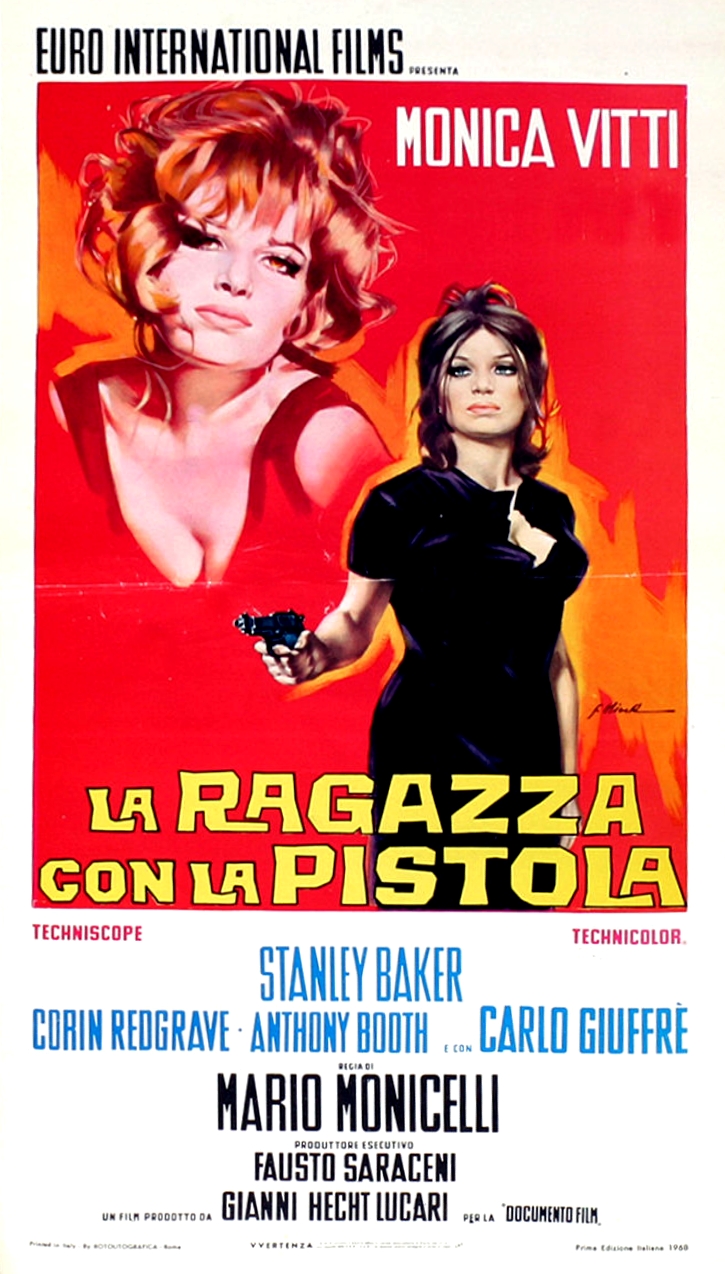
The Girl with a Pistol (1968) ****

Off-beat Oscar-nominated comedy-drama that is both a marvelous piece of whimsy and a slice of social realism set in the kind of Britain the tourist boards forget, all drizzle and grime. It zips from Edinburgh to Sheffield to Bath to London to Brighton to Jersey as if the characters had been dumped from an  If It’s Tuesday It Must Be Belgium sketch. If your idea of Italy was Fellini’s glorious decadence or Hollywood romance amid historic ruins and fabulous beaches, then the upbringing of Assunta (Monica Vitti) is the repressive opposite. All women in her small Sicilian town wear black. Men are not allowed to dance with women and must make do with each other. A man like Vincenzo (Carlo Giuffre) desiring sex must kidnap a woman, in this case Assunta, to which she will consent as long as he marries her. When instead he runs off to Scotland, she is dishonored and must kill him, armed with the titular pistol.

Pursuit first takes her to Edinburgh and a job as a maid, has a hilarious encounter with a Scottish drunk, and various other cross-cultural misinterpretations – in a bar she cools herself down with an ice-cube then puts it back in the bucket. Then it’s off   to Sheffield where she falls in with car mechanic Anthony Booth (television’s Till Death Do Us Part) because he is wearing Italian shoes. She can’t imagine he can watch sport for two hours. “You’re a man, I’m a woman, nobody in the house and you look at the television.” Although tormented by images of being attacked back home by a screaming mob of black-robed women, she begins to shed her inhibitions, wearing trendier clothes, although an umbrella is essential in rain-drenched Britain and given the Italian preference for shooting exteriors.  

In between sightings of Vincenzo there are episodes with a suicidal gay man (Corin Redgrave) and a doctor (Stanley Baker). She becomes a nurse, then a part-time model, sings Italian songs in an Italian restaurant, drives a white mini, wears a red curly wig and more extravagant fashions. It turns out she can’t shoot straight. Gradually, the mad chorus of home gives way to feminist self-assertion as she becomes less dependent on men and a world run by chauvinists. It’s a starling mixture of laugh out loud humour and social observation. And while the narrative at times verges on the bizarre, Assunta’s actions all appear logical given her frame of mind.

Vitti was Italian director Michelangelo Antonioni’s muse (and companion) through  L’Avventura (1960), La Notte (1961) and L’Eclisse (1962) to Red Desert (1964). She had a brief fling with the more commercial, though still somewhat arty, movie world in Joseph Losey’s Modesty Blaise and the nothing-artistic-about-it comedy On the Way to the Crusades (aka The Chastity Belt, 1968) with Tony Curtis. Director Mario Monicello had two Oscar nominations for writing but was best-known for Big Deal on Madonna Street (1958) and Casanova ’70 (1965). The Girl with a Pistol was nominated in the Best Foreign Language film category at the Oscars.

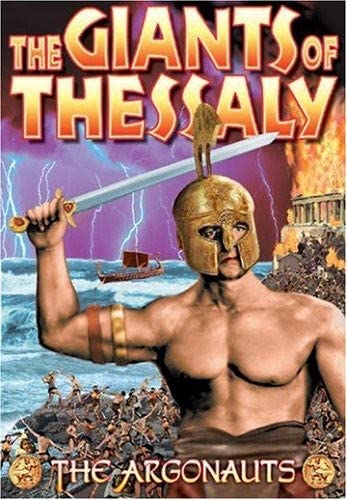
The Giants of Thessaly (1960) ***

Spoiler alert – this film contains no giants unless you count the one-eyed Cyclops. It’s the Jason and the Argonauts story with a lot of political shenanigans thrown in.

Even lacking the Ray Harryhausen special effects of the film covering the same ground a few years later and without the kind of budget dropped into the lap of a Stanley Kubrick it’s not a bad stab at retelling the myth. And Carlo Rambaldi (later the creator of E.T.) does a decent job of the Cyclops at a time when special effects were primitive.

This belongs to the Italian-made “peplum” genre, out of which came Hercules (1958). What struck me most was the director’s use of the camera, very often tracking a character in scenes that would otherwise have been static. There are virtually no close-ups and hardly any medium close-ups.

It’s quite strange to see. On the one hand a moving camera is an expense and on the other hand lack of close-ups saves money, so it’s possible the money spent on one technique was the result of saving money from another. Alternatively, much of the director’s work has gone into arranging characters in group scenes in such a way that dramatic impact is sustained while not moving the camera.

There’s enough political chicanery going on to keep two different plots going. Back in Jason’s homeland, where he is a king, an usurper not only seeks his throne but wants his wife and tries to deceive the population into thinking Jason is dead. Meanwhile, Jason faces mutiny on board the Argo and then the temptations of the Siren, battle with the Cyclops, and then a final bold act to reclaim the Golden Fleece.

Possibly the best scene is kept for the end, when the Argo arrives home with its own brand of deception. The film is topped off with a clever trick. Sometimes what we would now view as a B-film, ideal Saturday matinee material, sticks in the mind because it has been the proving ground for a future director or star but writer-director Riccardo Freda had already turned out Spartacus the Gladiator (1953) and Theodora, Slave Empress (1954).

Star Roland Carey was unusual in this field because he was actually a trained actor rather than hired for his torso, but this did not exactly stoke his career – his appearance in Fall of the Roman Empire (1962) was uncredited. Female lead Ziva Rodann was unusual, too, in that she was Israeli rather than Italian, had appeared in Samuel Fuller’s Forty Guns (1957) and second- billed in exploitationer Macumba Love (1960) and would later play Nefertiti in the Batman television series.

If you go in not expecting much, you might get a surprise, though, be warned the acting is wooden and other special effects, such as the storm, not quite in the Rambaldi class.   

 https://www.amazon.co.uk/Giants-Thessaly-DVD-Regions-NTSC/dp/B0006IUE20/ref=sr_1_2?crid=J9IQ33P0SVDW&dchild=1&keywords=the+giants+of+thessaly&qid=1593760959&s=dvd&sprefix=the+Giants+of+%2Caps%2C145&sr=1-2

Discover WordPress

A daily selection of the best content published on WordPress, collected for you by humans who love to read.

The Atavist Magazine

by Brian Hannan

WordPress.com News

The latest news on WordPress.com and the WordPress community.