Sisters (1969) ****

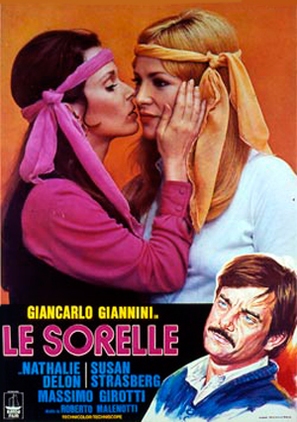
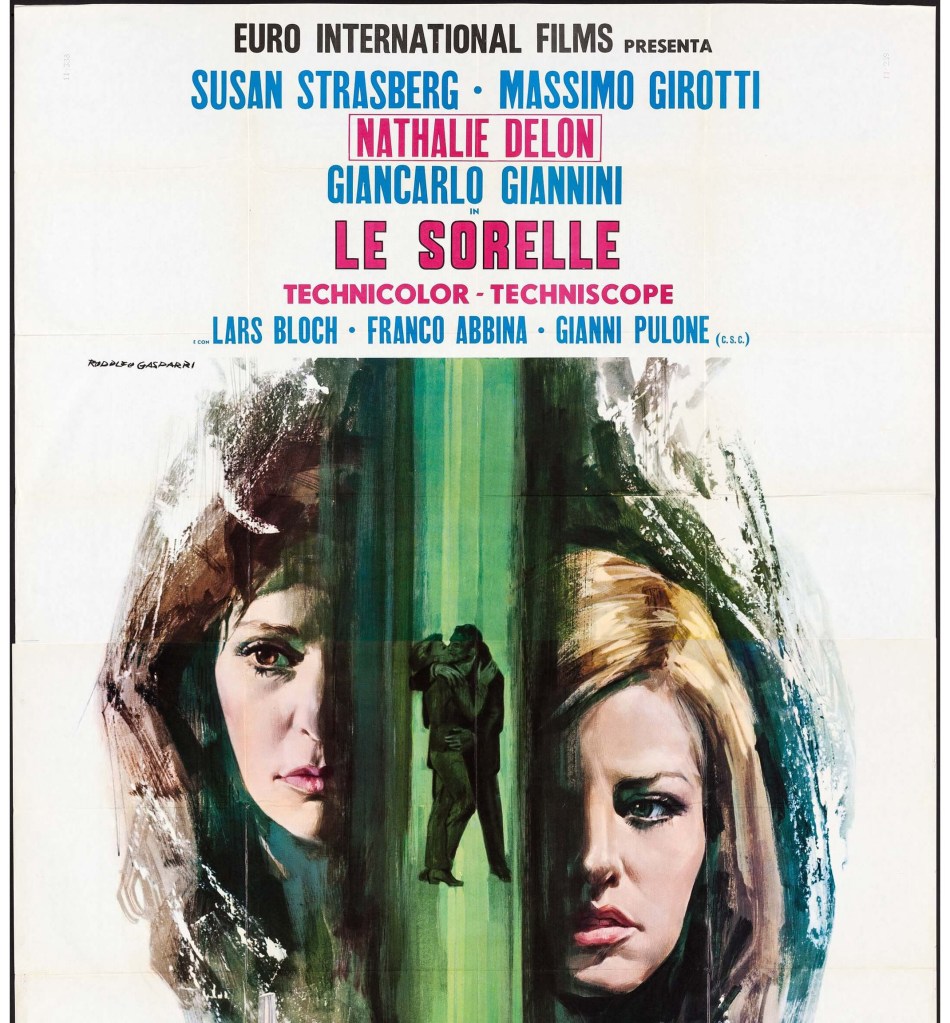
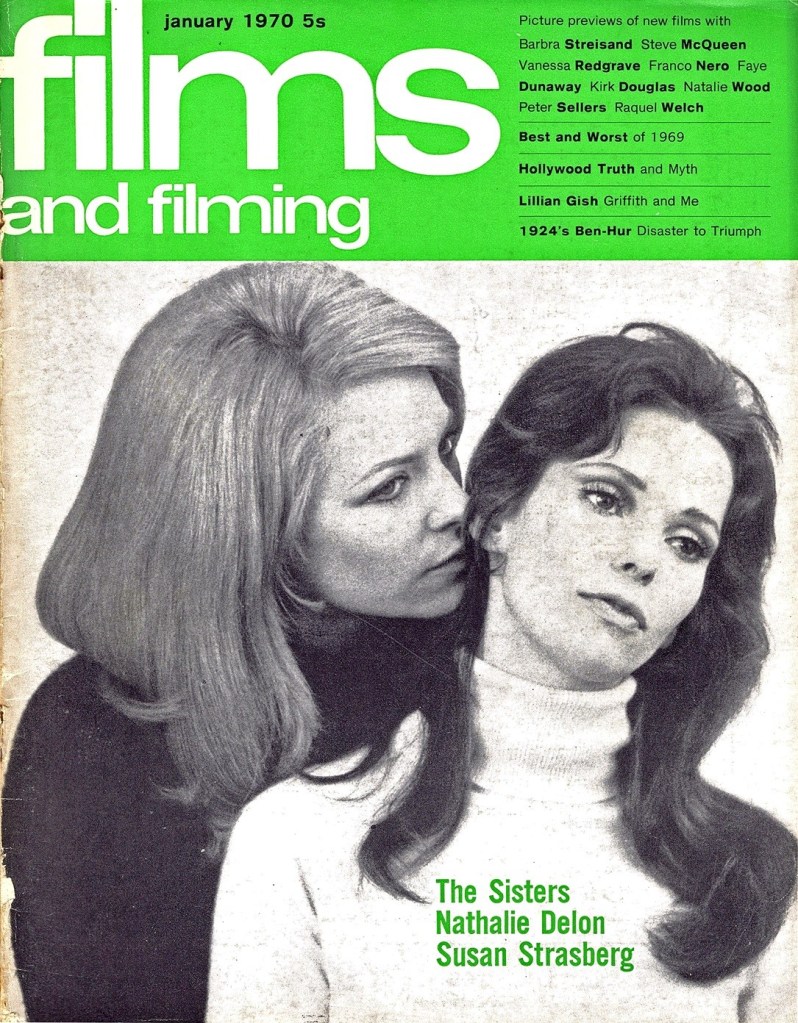
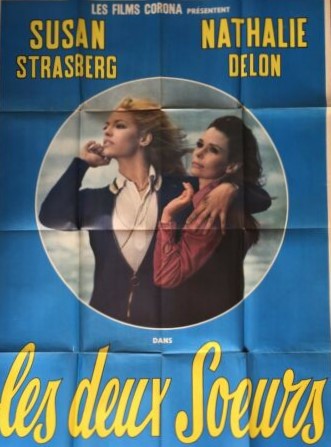
Erotically-charged, symbolically-heavy French drama of siblings trying to re-establish the intense relationship they enjoyed as teenagers. After a nervous breakdown and on the point of divorce, blonde translator Diana (Nathalie Delon) seeks respite at the home of younger sister Martha (Susan Strasberg), a brunette happily married to the wealthy and indulgent Alex (Massimo Girotti).

Initially, the more worldly Diana, the more flamboyant dresser, appears the superior but it soon transpires she is the more fragile. The apparently timid Martha allows her husband to control her life to the point of buying all her clothes and she confesses to feeling as if she is on “a perpetual cruise.” While on the surface, it seems as if she has given up too much, in reality she disapproves of disorder and seeks perfection. She comes across as needing protection, and believes the woman’s role is to sacrifice, but in fact has managed to arrange her life to her own satisfaction.

Their competitive streaks emerge in different ways, Diana in obvious fashion, seeking to beat her sister while out horse-riding, Martha in more subtle and sensual manner, flaunting her sexual relations with her husband, almost offering her sister to her husband, and having a lover (Lars Bloch) on the side. There is a sense of each attempting to impose their world view on the other. Diana gives her sister a make-over, a new look which Alex adores, Martha hates it. There’s a sense of a chess game, males the obvious pawns.

Sensuality is never far away. Diana nuzzles her sister’s neck to smell her perfume. Alex is photographed, encouraged by Martha, in almost intimate mode with Diana. Dario (Giancarlo Giannini) is brought in to tempt Diana. And a scene where the girls experiment with colorful scarves suggests libertarianism. 

But it is clear that both sisters live empty lives devoid of true love and equally obvious as the picture progresses that both have arrived at the conclusion that they were at their most happiest when together. There are subtle hints of incest, comforting each other in bed, the sensuality electric and the film begins to examine whether this taboo can be crossed and, if so, will it provide the necessary escape.

Despite Martha’s apparent subjugation, there is more than an inkling of feminism, the girls involved in a complicated scenario in which males are either rejected or made to look fools. While not fulfilled, Martha has turned as much as possible to her own advantage and Diana seems perfectly capable of taking what she wants.

Alex provides the symbolism. He cultivates rare plants in a greenhouse that need to hide from the sun, lengthy exposure to whose atmosphere would be fatal to humans. He endlessly photographs them because they won’t last long. And in similar fashion provides a haven for the apparently vulnerable Martha.

Nathalie Delon (When Eight Bells Toll, 1970), married at this point to Alain Delon, shows a subtlety of expression that is rare for someone appearing in just her third film, and effects a gradual character transition throughout. Susan Strasberg, daughter of famed acting coach, Lee Strasberg, inventor of the Method Style of Acting, was one of the boldest actors of her generation, appearing in drug pictures The Trip (1967) and Psych Out (1968). She delivers an excellent portrait of a woman who manages to keep her true personality hidden, and for whom sexuality has few barriers.

This is the puppy-fat version of Giancarlo Giannini (Swept Away, 1974), barely recognizable as the future arthouse superstar whose physical appearance relied on gaunt, angst-riddles features.  Massimo Girotti (Theorem, 1968) is good as the husband who thinks he has everything, not realising how little he has.  

Although this was an accomplished directorial debut from Roberto Malenotti, he only made one more movie. Perhaps he made enough from directing the famous Coke commercial I’d Like To Teach The World To Sing (1971).

Always intriguing, revelations continually undercutting what we think we know of the characters, but delivered in subtle European tones rather than employing Hollywood shock, each of the four main people involved changing considerably due to their interaction with the others. While certainly skirting close to the borders of what was permissible at the end of the 1960s, it does so without exploiting the actresses.

Not an easy one to find, your best bet is a secondhand copy on Ebay.

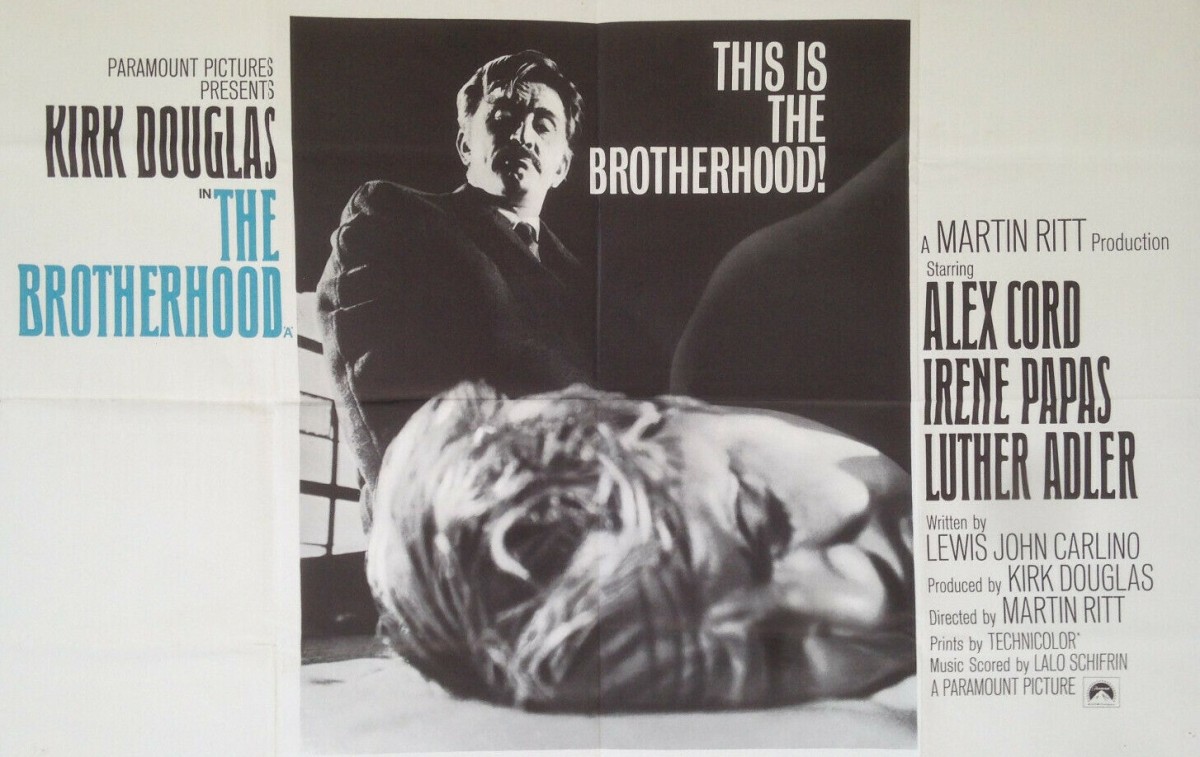
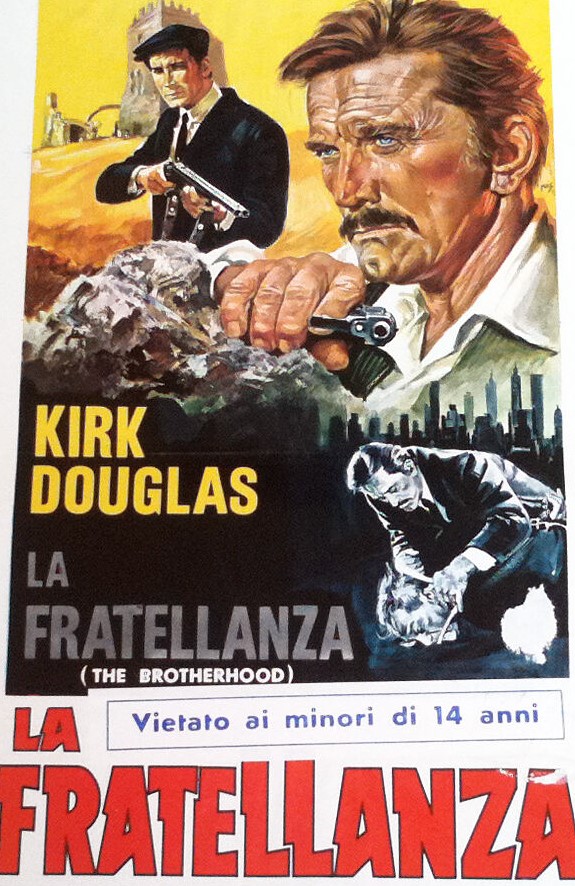
The Brotherhood (1968) ****

Minimal violence and no sex was the wrong recipe for this Mafia picture – as proven at the box office – but this is an absorbing, underrated drama nonetheless.

It bears a surprising number of parallels to The Godfather (1972). Pure coincidence, extraordinary though that may appear, because The Brotherhood premiered in December 1968 while the Mario Puzo novel was printed in March 1969 (and delivered to the printers long before), so no opportunity at all for plagiarism.

The two films could be opposite sides of the same coin. For a start, both begin with a wedding. Vince Ginetta (Alex Cord), brother of Mafia kingpin Frank (Kirk Douglas), is marrying Emma (Susan Strasberg), daughter of another Mafia chief Dominick (Luther Adler). Like Michael (Al Pacino) in The Godfather, Vince is just out of the army, well-educated and primed for a life outside the business. And like Michael is called upon to commit an act of supreme violence. There’s even a hint of Tom Hagen (Robert Duvall) in the relationship between the brothers, Frank having brought up the much younger Vince after his father’s premature death.

And just as Don Corleone (Marlon Brando) refuses to join the other Mafia families in a new business venture (in that case, drugs) so Frank bows out of an incredibly high risk (but amazingly prescient) scheme to invest in electronic firms involved in military work for the government, a deal that not only promises huge profits but a potential hold over the powers-that-be.

Frank’s wife Ida (Irene Papas) is like Don Corleone’s wife, not wanting to know anything about the business, but both Emma and Frank’s daughter Carmela (Connie Scott) are thematic cousins to Kay Adams (Diane Keaton) as initial implicit trust is wiped away. When Frank dances with Carmela at the wedding, that is reflected in Don Corleone dancing with his daughter at her wedding. Like The Godfather our first sight of the other Mafia chieftains – including Jim Hagen (Murray Hamilton) and Don Peppino (Eduardo Cianelli) – is at the feast where they are viewed with suspicion by Frank’s clan. And the scene where Frank uses a banana to tease his nephew will remind you of Don Corleone spooking his grandson with an orange.

However, the twist, if you like, is that, unlike Michael, Vince is desperate to join the Family and is instrumental in developing legitimate enterprises, which is echoed by Michael Corleone’s strategic shift to Las Vegas. In some respects, Frank is more like Sonny (James Caan), happy to assume personal command of murders which the other Mafia chiefs now scrupulously delegate to “mechanics” in Los Angeles. He is more old-school whereas the others act as respectable businessmen.

And then it becomes a question of loyalty. Which side the ambitious Vinnie will take is crucial to the story. Frank is under pressure on all sides, from the other Mafia leaders, a government investigation, Vinnie, and the need to exact revenge on the man who caused his father’s death.

There is authentic detail here as well – religious procession in Sicily, Frank playing boccia (the Italian version of the French boules) with his old pals, family dinner, canary stuffed in the mouth of a stool pigeon, but it is less spaghetti-drenched than The Godfather. Screenwriter Lewis John Carlino (The Fox, 1967), also listed as technical adviser, claimed to be drawing on his intimate knowledge of organized crime.

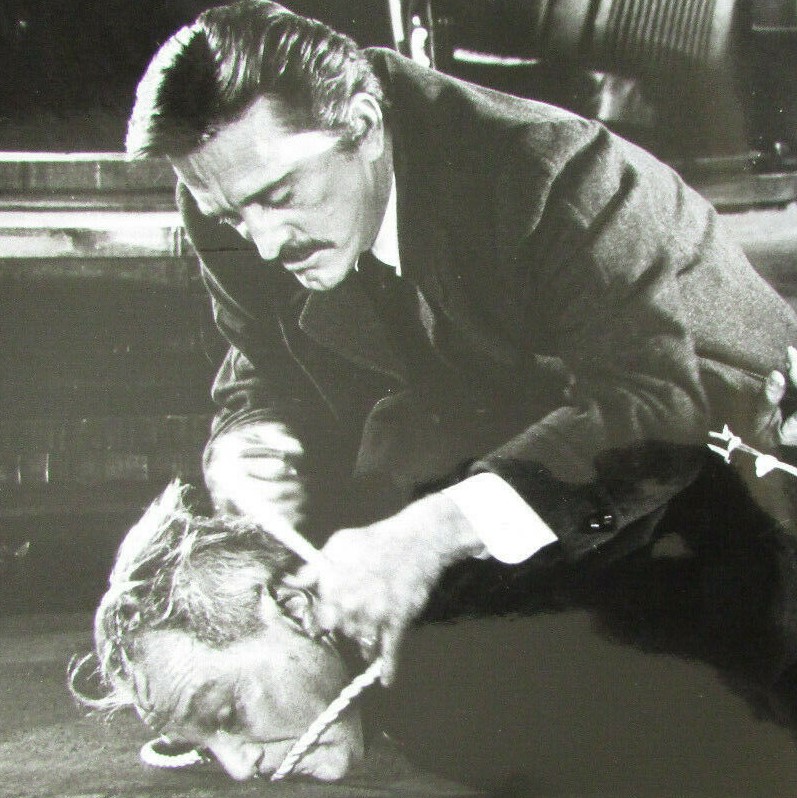
There are only three moments of violence – four if you count a shocking moment of someone spitting on a corpse at a wake – a pair of straightforward murders that bookend the film, plus a scene of Godfather-style brutality in which a man slowly strangles himself to death after being hogtied. Everyone is happily married, Ida very old-school to the extent of removing her husband’s clothes (and shoes) when he returns home drunk, Vince in a good relationship.

Kirk Douglas (Cast a Giant Shadow, 1966) is excellent in a difficult role that presents a fully rounded character, playful with his daughter, loyal to his wife, holding his own against the other mob bosses, enjoying the company of the old-timers who resemble his father, and the changing nature of his relationship with brother Vince. Alex Cord, whose work I initially dismissed (Stiletto, 1969), I have come to more fully appreciate, especially here, where, in a masterpiece of restraint, he makes the transition from adoring brother to threat.

The supporting cast is terrific, a rare Hollywood sojourn for Irene Papas (The Guns of Navarone, 1961), Luther Adler  (Cast a Giant Shadow, 1966) as one of the hoodlums exasperated by Frank’s recalcitrance,  Murray Hamilton (The Graduate, 1967) but, except at the start, Susan Strasberg (The Trip, 1967) is underused.

While director Martin Ritt (Hombre, 1967) is at times guilty of melodrama, his rendering of family life is much more nuanced than Coppola’s. There are very tender moments between Frank and his wife and Frank and his daughter, as well as moments where Ida plays a more maternal role.

For nearly half a century, The Brotherhood has lain in the shadow of The Godfather simply because they both deal with the Mafia. But this is an excellent movie in its own right.

The Devil’s Brigade (1968) ***

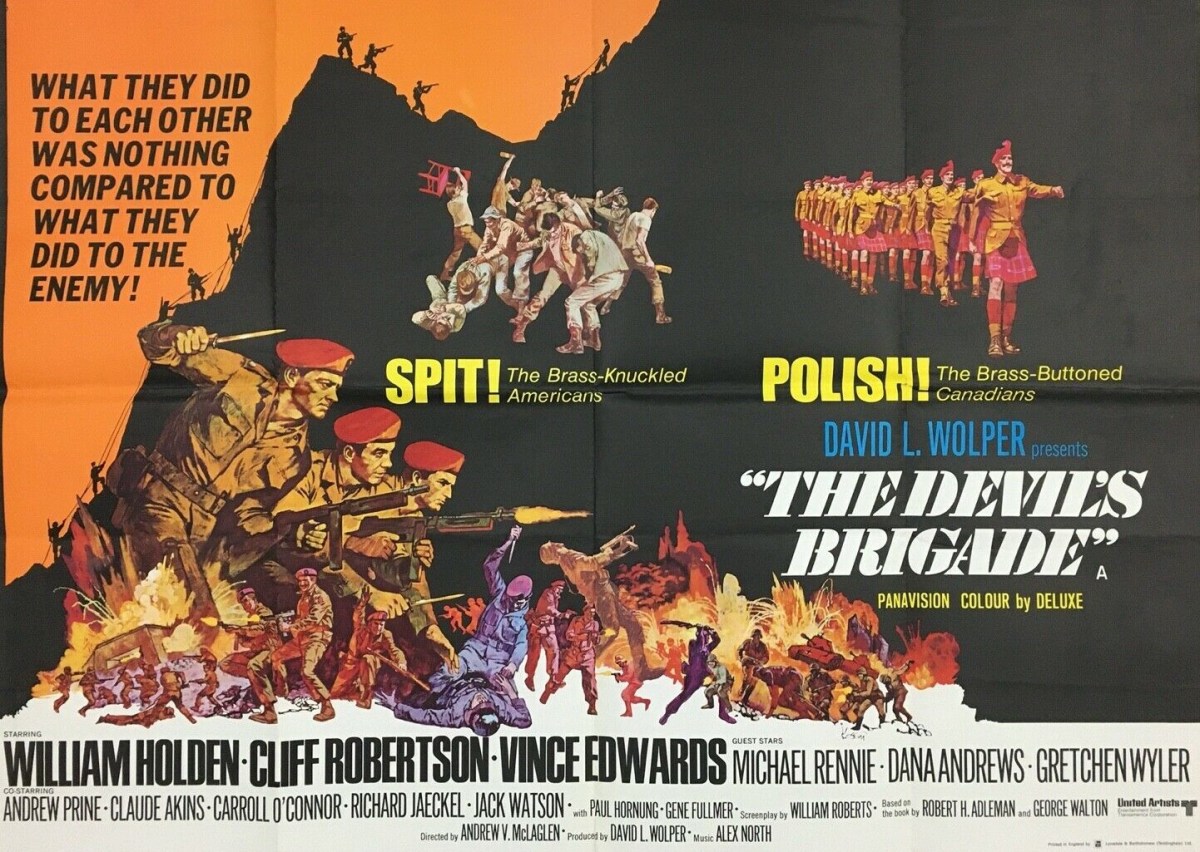
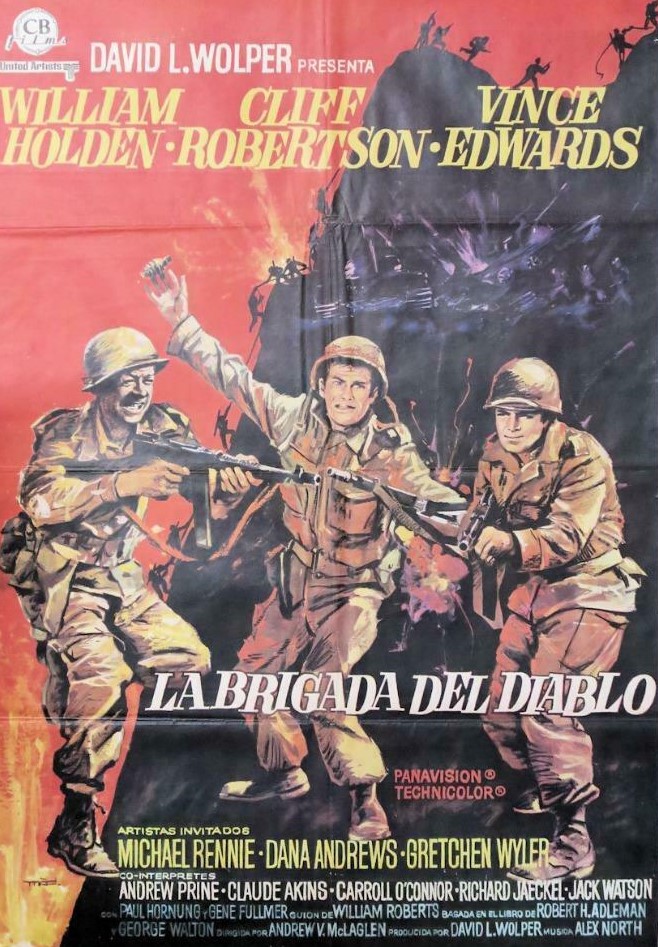
I couldn’t get my head around the idea of the U.S. Army recruiting a bunch of undisciplined misfits, many with jail time, in order to link them up with a crack Canadian outfit. Turns out this part of the film was fictional, the Americans in reality responding to advertisements at Army posts which prioritized men previously employed as forest rangers, game wardens, lumberjacks and the like which made sense since the original mission was mountainous Norway.  I should also point out the red beret the soldiers wear is also fictional and while depicted on the poster sporting a moustache commanding officer Lt. Col. Frederick (William Holden) is minus facial hair in the film.

But, basically, it follows a similar formula to The Dirty Dozen (1967), training and internal conflict followed by a dangerous mission. The conflict comes from a clash of cultures between spit-and-polish Canucks and disorderly/juvenile Yanks though, as with the Robert Aldrich epic, the leader taking some of the brunt of the discontent.  Collapsible bunk beds, snakes under the sheets and a tendency to fisticuffs are the extent of the antipathy between the units, which is all resolved, as with The Dirty Dozen, when they have to take on people they jointly hate, in this case local bar-room brawlers in Utah.

The movie picks up once they are sent to Italy. Initially employed on reconnaissance, Frederick challenges Major-General Hunter (Carroll O’Connor) who wants to do things by the book and sets out to take an Italian position by trekking two miles up a riverbed, creeping into town by stealth and capturing the location without firing a shot. 

Next up is the impregnable Monte la Difensa. Taking a leaf out of the Lawrence of Arabia playbook, in a brilliant tactical move, the Americans attack the mountainous stronghold from the rear by way of a mile-high cliff.  But that’s the easy part. The rest is trench-by-trench, pillbox-by-pillbox, brutal hand-to-hand fighting.

The battle scenes are excellent and the training section would be perfectly acceptable except for the high bar set by The Dirty Dozen. That said, there is enough going on with the various shenanigans to keep up the interest, but we don’t get to know the characters as intimately as in The Dirty Dozen and there is certainly nobody in the supporting cast to match the likes of Telly Savalas, Charles Bronson, Jim Brown and John Cassavetes. That also said, the men do bond sufficiently for some emotional moments during the final battle.

At this point William Holden’s career was in disarray, just one leading role (Alvarez Kelly, 1966) and a cameo (Casino Royale, 1967) in four years, and although his screen persona was more charming maverick than disciplined leader he carries off the role well, especially solid when confronting superiors, exhibiting the world-weariness that would a year later in The Wild Bunch put him back on top. Ironically, Cliff Robertson was coming to a peak and would follow his role as the strict disciplinarian Major Crown, the Canadian chief, with an Oscar-winning turn as Charly (1968). Vince Edwards (Hammerhead, 1968) as cigar-chomping hustler Major Bricker makes an ill-advised attempt to steal scenes.

This was the kind of film where the supporting cast were jockeying for a breakout role that would rocket them up the Hollywood food chain – as it did with The Dirty Dozen. Jack Watson (Tobruk, 1967) is the pick among the supporting cast, but he has plenty of competition from Richard Jaeckel (The Dirty Dozen), Claude Akins (Waterhole 3, 1967), Jeremy Slate (The Born Losers, 1967), Andrew Prine (Texas Across the River, 1966), Tom Stern (Angels from Hell, 1968) and Luke Askew (Cool Hand Luke, 1967). Veterans in tow include Dana Andrews (The Satan Bug, 1965) and Michael Rennie (Hotel, 1966).

William Roberts (The Magnificent Seven, 1960) adapted the bestselling book by Robert H. Ableman and George Walton. Director Andrew V. McLaglen (Shenandoah, 1965) was more at home with the western and although there are some fine sequences and the battle scenes are well done this lacks the instinctive touch of some of his other films.

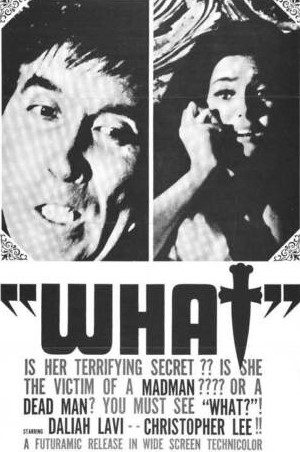
The Whip and the Body / The Whip and the Flesh / What? (1963) ****

Has there ever been actress so skilled at displaying fear as Daliah Lavi? Where the female stars of horror movies too quickly succumbed to the scream and goggle eyes, Lavi could run a whole gamut of terror without uttering a sound and continue doing so for virtually an entire picture. Top-billed ahead of the reigning king of British horror Christopher Lee, this is another acting tour de force, not quite sustaining the intensity of The Demon (1963) but at times not far off it.

Italian director Mario Bava (Black Sabbath, 1963), here masquerading as John M. Old, has stitched together a mixture of horror and an early form of giallo, the picture taking place in the classic old dark house, in this case a castle perched on a rock above the sea, the deaths grisly, and almost fitting into the “locked room” subgenre of the detective story, where the murders appear impossible to carry out.

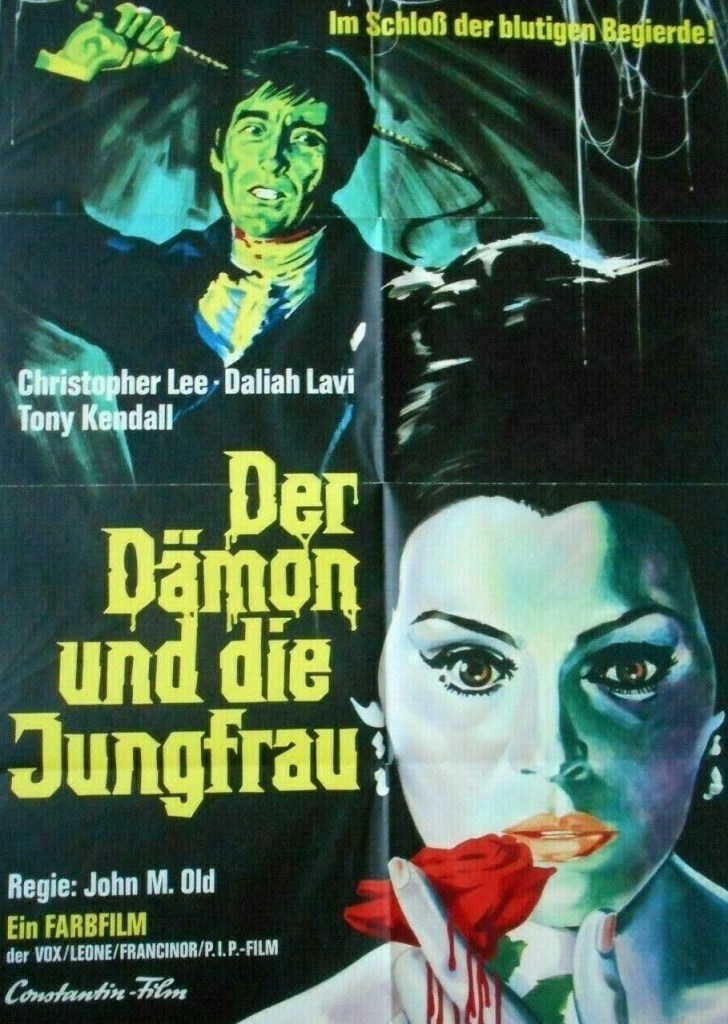
Originally released as The Whip and the Body, it underwent some title changes, first to The Whip and the Flesh, the German title translated as The Devil and the Young Woman and while in the U.S. it was shown as What?

The disgraced Kurt Menliff (Christopher Lee) returns to his ancestral home, begging forgiveness from his father Count Vladimir (Gustavo De Nardo) and hoping to reclaim his inheritance and his betrothed Nevenka (Daliah Lavi). While his father exonerates him, Kurt is denied the rest, Nevenka already committed to marriage to his brother Christian (Tony Kendall). Other tensions are soon evident: the housekeeper Giorgia wants revenge on Kurt for the death of her daughter and Christian is in love with another, Katia (Evelyn Stewart).

Nevenka who outwardly protests how much she hates Kurt quickly reveals masochistic tendencies as she gives in to a whipping. But Kurt’s sudden inexplicable murder instigates an investigation, suspicion falling firstly on the father, then Christian and finally Giorgia.

But Nevenka is not convinced Kurt is dead, although his body has been entombed in the castle crypt. Torment creeps into her face at his funeral and we can almost see her grow gaunt in front of our eyes. In a brilliant scene where she tracks what she imagines to be the sound of whip it turns out to be a branch lashing a window in a storm. Some of her supposed visions are easily explained, muddy footsteps leading from Kurt’s tomb actually belonging to the limping manservant Losat (Luciano Pigozzi). But how do you account for the hand, in an almost 3D shape, reaching out to her in the darkness or her ecstasy in still being whipped, her nightdress stripped from her back?

Although sometimes relying too heavily on atmospherics – windows swinging open at night, storm outside – Bava brilliantly marshals the real and the imagined, until the investigation into murder involves all the characters. Once the film begins, the drawbridge in a sense comes down, and nobody else enters the castle, and so we move from one character to another, each with their own motive for possibly committing dire deed. And with each passing moment we return to the demented Nevenka, who wishes Kurt dead but cannot live without him, and, craving the whip, cannot escape his sadistic power. Her faith in Kurt’s resurrection is so intense that the others are soon seeking signs that the dead man is still alive.

This is superior horror to Hammer. Using the same leading man, the British studio generally expected Lee to be over-the-top, his innate malevolence very obvious from the start. Here, he is at his most handsome and although definitely sadistic, the emphasis is less on his pleasure than that of his victim. And while Bava resorts to a similar kind of Hammer set, this castle is remote, has no relationship with villagers, and exudes regal dominance rather than just the normal fear of a Dracula picture. Bava employs a more subtle color palette and the piano theme tune by Carlo Rusticelli has a romantic tone.

But for all Bava’s proven skill, this would not be the same without Lavi. I doubt if there is a single actress in the horror domain throughout the 1960s who could match the actress for portraying fright, as she marches up the scale from mere anxiety to full-blown terror. And although women in Dracula movies succumbed to vampire teeth with more than a frisson of sexuality, there is a different deeper sensuality at work here, in what must rank as one of the greatest-ever portrayals of masochism embedded in love.

As noted previously, Lavi, in stepping onto the bigger Hollywood stage of Lord Jim (1965) and The Silencers (1966), lost the intensity she displayed here and never came close to matching this performance or that of The Demon. Christopher Lee, although claiming to dislike his experience, continued to rule the horror world until afforded a wider audience through James Bond, Star Wars, J.R.R. Tolkien and Tim Burton. 

Tony Kendall made his debut and soon graduated to the Kommissar X series, spaghetti westerns (he played Django twice), horror (Return of the Evil Dead, 1973), and thrillers such as Machine Gun McCain (1969). Evelyn Stewart went down much the same route, her long career sprinkled with gems like Django Shoots First (1966), The Sweet Body of Deborah (1968) and The Psychic (1977).

Mario Bava continued to exploit the horror vein including Blood and Black Lace (1964), Planet of the Vampires (1965) and Lisa and the Devil (1973) with Telly Savalas and Elke Sommer.

Three (1969) **

More interesting for the stars involved – in particular Sam Waterston and Charlotte Rampling as well as an ex-fighter pilot, an Australian pop star and a model – than the film itself, which presents a European arthouse take on youngsters freewheeling around Europe looking for their share of the free love purportedly available everywhere.

There’s not really any story, mostly it’s scenery, and whatever tension there is rarely rises to the point of drama. However, it is refreshing to see a picture not steeped in angst that reflects the normality of life rather than superficially-imposed heightened confrontation. On a tour of Italy, American college buddies Taylor (Sam Waterston), the shy gawky one, and Bert (Robie Porter), the better-looking confident one, take up with British girl Marty (Charlotte Rampling). The guys make a pact not to compete for the girl’s attentions, but that idea doesn’t last long. The title suggests she might end up with one – or both. In trying to sell the film, the marketeers felt obliged to make that idea more implicit.

The guys make plays for other girls they meet but seem to find little genuine action and in that sense it is more true to life than other films of the period which suggested sex was there for the asking. But none of the characters are particularly interesting and while that is also more realistic it diminishes enjoyment. The highlight is a naked Taylor attempting to save a girl from drowning in the sea, but in keeping with the film’s tone he is beaten to it by a boat.

There’s not much sign here of the intense dramatic style Oscar nominee Sam Waterston would later bring to the movies. This was his third film after small parts in The Plastic Dome of Norma Jean (1966) and Dick Van Dyke vehicle Fitzwilly (1967) and he wouldn’t hit his stride until The Great Gatsby (1974).

Perhaps the oddest movie fate befell Charlotte Rampling, also a later Oscar nominee. How else to explain that she followed up this picture with Luchino Visconti’s The Damned (1969) and preceded it with Roger Corman’s Target: Harry (1969). With a career that at this point appeared to follow no particular pattern, after making an impact in Georgy Girl (1966) as a libidinous flatmate, she took a small role in The Long Duel (1967) before reaching leading lady status opposite Franco Nero in Italian thriller Sequestro di Persona (1968). Her languid screen persona was turned on its head with The Night Porter (1974).

Who was Robie Porter you might very well ask? And why did he only make two pictures, the other being The Carey Treatment (1972)? He was an Australian pop star, specializing in instrumentals on a steel guitar, with a series of hits including two at number one. He chanced his arm in Britain, without repeating that success, then moved to the U.S. and landed parts in television series Daniel Boone and Mannix. After Three, he returned to the music business, as part-owner of record label Sparmac and producing for the band Daddy Cool.

Other names in Three, in bit parts only, none making any discernible impact in the picture, included model Edina Ronay (daughter of celebrated food critic Egon Ronay) who had appeared in A Study in Terror (1965) and Prehistoric Women (1967). Equally as celebrated, if for other reasons, was Gillian Hills, best known as one of the girls cavorting naked with photographer David Hemmings in Blow Up (1966) and as the titular Beat Girl (1960)

Writer-director James Salter was a genuine Hollywood curiosity. He hit a peak of cinematic activity in 1969, with two other screenplays filmed – Downhill Racer (1969) and The Appointment (1969). This is pretty much a companion piece to Downhill Racer (1969) which has a bunch of professional skiers on a similar scenic tour and often sitting around with not much to do although that film builds in confrontation and a more standard love affair.

Generally considered a “writer’s writer” – i.e. adored by his peers more than the public – his first novel The Hunters (1958), based on his Air Force experiences, was turned into a movie starring Robert Mitchum. He dabbled in documentary film-making, whose impact can be seen in his feature films, but was better known for a short erotic novel A Sport and a Pastime set in Europe. None of his 1969 trio were hits, he ended up in Hollywood limbo, and he didn’t reappear on the movie credits list until Richard Pearce’s sci-fi Threshold (1981) starring Donald Sutherland.   

It’s not a stinker, but it’s not much of anything else either.

Selling Sophia Loren – The Pressbook for “It Happened in Naples”

Unusually for a movie of this era, Paramount took one image of Clark Gable and Sophia Loren up close and personal and stuck to it. It was more normal for an marketing campaign to include half a dozen different adverts each with a separate strapline. Here, while the copy occasionally changed the central image remained the same.

Unusually, too, Paramount made a big play of getting critics on board prior to the film’s release. So it came garlanded with the imprimatur of the likes of television host Ed Sullivan, famed critic Louella Parsons and syndicated columnist Dorothy Kilgallen. Plus the studio had embarked on a major promotional campaign in the Sunday supplements of the biggest circulation newspapers in the U.S.

Overall, there was a broad sell. While Clark Gable and Sophia Loren – “two prime examples of cinematic sex appeal” – were of course key, the marketeers also promoted “sensational young Italian boy Marietto” (playing the orphaned Nando) and Carlino, the Neapolitan answer to Elvis Presley who was Loren’s guitar-playing accompanist. In appealing to “those who like poignant drama” it also set out to hook “those who like musicals” as well as moviegoers who “like being magic-carpeted away to far-away places.”  In other words, something for everyone.

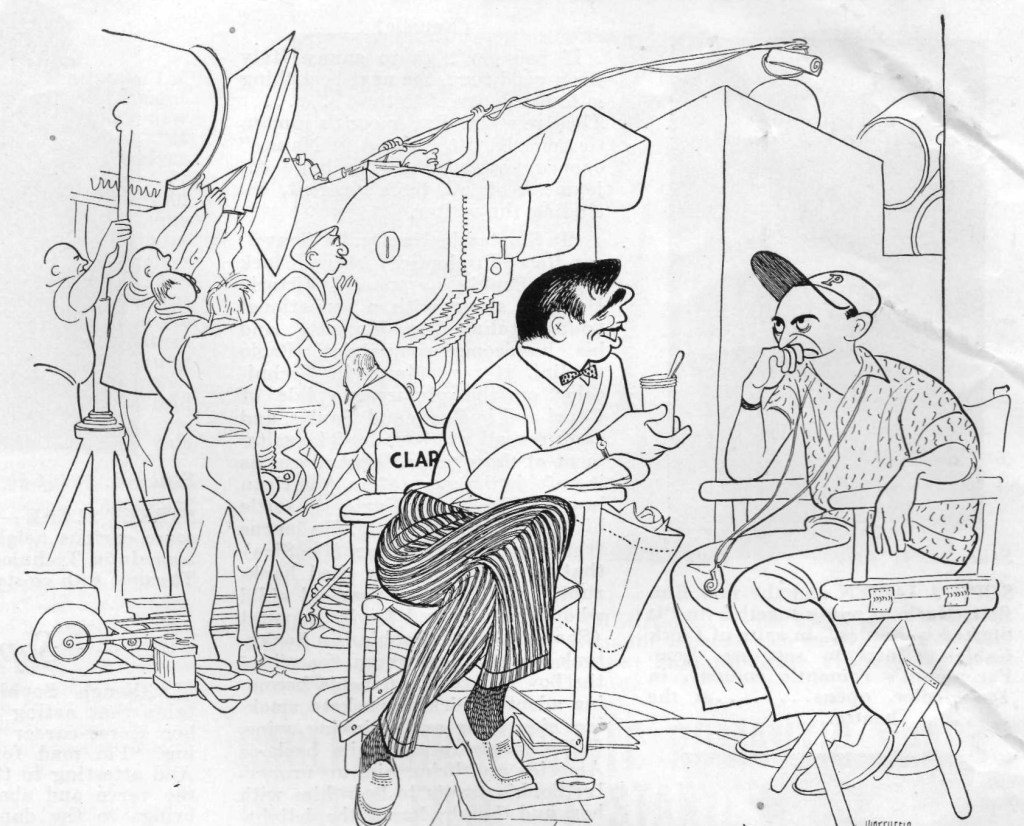
Cartoon of Clark Gable and director Melville Shavelson consulting on set. Cartoons like this were occasionally part of a promotional push, giving newspapers something different to use, and they were seen as a classier promotional device than just stills or adverts.

But the write-ups and photography favor Loren, who displays her legs in a revealing costume, as well as her cleavage and a separate article extols her singing and dancing, the latter described as “her secret career passion.” Audiences were promised an “all-out rock-and-roller.” Loren, of course, had come into her own as a singer in Houseboat (1958), where she performed two songs, but declined offers of a recording career.

The Pressbook is somewhat short on the nuggets that usually accompany this kind of promotional material because the two stars were already so well known. About all potential moviegoers learned about Gable was that he was now such a devoted father he brought his family on location.

There’s certainly a curious piece called “It Hurt Gable More Than Sophia” which, on reading the text, turned out to be untrue. When Gable was called upon to throw Loren out of bed in one scene, he “put too much Gablesque gusto” into it, flipping her out onto the marble floor.  Loren was the one who suffered bruises on legs, hips and shoulders. And in true Hollywood fashion producer Jack Rose “rushed to her aid” but only after ensuring that her startled expression had been captured on camera.

Tie-ups were travel agencies. Italian restaurants and department stores featuring Italian imports were suggested to exhibitors as cost-free ways of encouraging local support. A soundtrack album featuring Loren’s voice was released as well as a paperback novelization targeted at book stores, drug stores, supermarkets and newsstands.

Taglines employed included “you, too, will say it’s wonderful;”  “you’ll loosen up and pleasure up on the isle of Capri;” and “you’ll want to be there when the fun starts.”

It Started in Naples (1960) ***

By this point in her career Sophia Loren was adopted by Hollywood primarily as a means of rejuvenating the romantic screen careers of much older male stars. John Wayne was over two decades her senior in Legend of the Lost (1957), Frank Sinatra and Gregory Peck nearly two decades older in The Pride and the Passion (1957, and Cary Grant a full three decades in Houseboat (1958). But where Grant was sprightly enough and with superb comic timing and Loren had the charm to make Houseboat work, the May-December notion lost much of its appeal when translated to her Italian homeland and an aging Clark Gable.

While engaging enough, the tale mostly relies on a stereotypical stuffy American’s encounters with a stereotypical down-to-earth Italian although Loren adds considerable zap with her singing-and-dancing numbers. Lawyer Michael Hamilton (Clark Gable), in Italy to settle his deceased brother’s affairs, discovers the dead man has left behind eight-year-old boy Nando (Marietto) being looked after in haphazard fashion and in impoverished circumstances in Capri by his aunt Lucia (Sophia Loren), a nightclub singer.  Determined to give the boy a proper American education, Hamilton engages in a tug-of-war with Lucia.

In truth, Lucia lacks maternal instincts, allowing the boy to stay up till one o’clock in the morning handing out nightclub flyers and not even knowing where the local school is. Hamilton is in turns appalled and attracted to Lucia, in some part pretending romantic interest to come to an out-of-court settlement. To complicate matters, Hamilton is due to get married back home.

At times it is more travelog than romantic comedy, with streets packed for fiestas and cafes full well into the night, a speedboat ride round the glorious bay, another expedition under the majestic caves, a cable car trip up the cliffs to view spectacular scenery, and the local population enjoying their version of la dolce vita. But the piece de resistance is Lucia’s performance in the nightclub, ravishing figure accompanied by more than passable voice as she knocks out “Tu vuo fa L’Americano” (which you might remember from the jazz club scene in The Talented Mr Ripley, 1999). She has a zest that her suitor cannot match but which is of course immensely appealing.

Lucia is torn between giving the boy a better start in life, already insisting for example that he speak English, and holding on to him while street urchin Nando is intent on acting as matchmaker.  Most of the humor is somewhat heavy-handed except for a few exceptional lines – complaining that he cannot sleep for the noise outside, Hamilton asks a waiter how these people ever sleep only to receive the immortal reply: “together.”

Gable lacks the double-take that served Cary Grant so well and instead of looking perplexed and captivated mostly looks grumpy. But this is still Gable and the camera still loves him even if he has added a few pounds. He was by now a bigger global star than in the Hollywood Golden Era thanks in part to regular reissues of Gone with the Wind (1939) but mostly to a wider range of roles and he was earning far more than at MGM, in the John Wayne/William Holden league of remuneration. Loren was the leading Italian female star, well ahead in Hollywood eyes of competitors Claudia Cardinale and Gina Lollobrigida, and had the skill, despite whatever age difference was foisted upon her, of making believable any unlikely romance. Here, zest and cunning see her through. Vittorio De Sica (The Angel Wore Red, 1960) has a scene-stealing role as an Italian lawyer with an eye for the ladies.

Director Melville Shavelson (Cast a Giant Shadow,1966)  thought he had cracked the problems of the older man-younger girl romance having shepherded Houseboat to box office glory . While this picture doesn’t come unstuck it is nowhere near Houseboat. This turned out to be Gable’s penultimate film, not quite the fitting reminder of a glorious career, and he died shortly after its release. While Loren trod water with this picture she was closing in on a career breakthrough with her Oscar-winning Two Women (1960).

Seven Golden Men (1965) ****

Very stylish caper picture that dispenses with the recruitment section, the ingenious hi-tech robbery accounting for the first half, escape and double-cross the second, a slinky Rosanna Podesta (the eponymous Helen of Troy, 1956, in case you’ve forgotten, and also appearing in Sodom and Gomorrah, 1962) an added attraction/distraction. The Professor (Phillippe Leroy), in bowler hat and umbrella, orchestrates the gold bullion theft from an uber-secure bank using hidden microphones, cameras and a host of electronic equipment, the inch-perfect heist organized to mathematical precision and timed to the second.

His team, disguised as manual workers, dig under the road, don scuba gear to negotiate a sewer, drill up into the gigantic vault and then suck out the gold bars using travelators and hoists. Giorgia (Podesta), sometimes wearing cat-shaped spectacles, a body stocking and other times not very much, causes the necessary diversions and plants a homing device in a safety deposit box adjacent to the vault. Occasionally her attractiveness causes problems, priests in the neighboring block complaining she is putting too much on show.

It’s not all plain sailing. A cop complains about the workmen working during the sacrosanct siesta, a bureaucrat insists on paperwork, a radio ham picks up communication suggesting a robbery in progress, the police appear on the point of sabotaging the plan.

But the whole thing is brilliantly done, the calm professor congratulating himself on his brilliance, Giorgia seduction on legs. The getaway is superbly handled, the loot smuggled out in exemplary fashion, its destination designed to confuse. Then it is double-cross, triple-cross and whatever-cross comes after that, and with every reversal no idea what is going to happen next. It is twist after twist after twist. Some of the criminals are slick and some are dumb so as well as the high drama there are moments of exquisite comedy.

Italian writer-director Mario Vicario (The Naked Hours, 1964) handles this European co-production with considerable verve and although, minus the normal recruitment section, we don’t get to know the team very well except for The Professor and Giorgia each is still given some little identity marker and in any case by the time they come to split the proceeds we are already hooked. Frenchman Phillippe Leroy (Castle of the Living Dead, 1964) is the standout as a mastermind in the British mold, a stickler for accuracy, calm under pressure, working with military discipline. Podesta (also The Naked Hours) has no problem catching the camera’s attention or playing with the emotions of the gang  to fulfill her own agenda. The gang is multi-national – German, French, Italian, Spanish, Portuguese, Irish – with only Gabriel Tinti likely to be recognized by modern audiences.

And there is a terrific score by Armando Trovajoli (Marriage Italian Style, 1964) that changes mood instantly scene by scene. One minute it is hip and cool jazz, the next jaunty, and then tense.

If ever a picture was pure cult, this is it.

Advance Buzz – The Phenomenon Created in the 1960s

In 1964, Twentieth Century Fox created a new way of selling pictures by inventing the advance buzz.

Of course, movies had always had some kind of pre-launch push but mostly on a small-scale via gossip columnists, who, while they had some influence, did not actually receive much space in a newspaper. Fox set out to change all that and put movies on the front pages and gain big feature spreads inside, an event that only usually occurred through  unwanted scandal (Cleopatra, for example), death  or a photo of a big female star.

Fox revamped the press junket – at that time primarily used as a vehicle to announce a movie premiere – and turned it into a method of creating advance publicity and expanding awareness on new pictures long before they reached the screen. And did so with enormous style, transporting over 100 American journalists to Europe to watch the production of three major big-budget roadshows.

Cecil B. DeMille of all people had invented the movie press junket – for the world premiere of his swashbuckler The Buccaneer in 1938. At a time when world premieres were confined to New York and Los Angeles, Hollywood had begun experimenting on a small scale with different locales for a first showing – whaling picture I Conquer the Sea (1936) was unveiled in New Bedford, Massachusetts, The Petrified Forest (1936) in St Louis and Sutter’s Gold (1936) in Sacramento. But these were all local affairs, the selected city putting on a big show for local dignitaries but the media were drawn only from the immediate surrounding area with stories syndicated to bigger newspapers.

When he selected New Orleans for his world premiere, DeMille, as skilled in marketing as he was in direction, hired a deluxe train to bring journalists from the top newspapers and magazines down from New York and Chicago. The train had a special compartment kitted out with typewriters, telephones, radio, Dictaphones and even stenographers to “relay hot news as it happens.”

All expenses – accommodation, meals, alcohol and various other sundries – for an entire week were picked up by Paramount. Three radio stations made daily broadcasts and the journalists filed news stories and features about the stars and the city, and, most important of all, reviews of the film they were privileged to be the first to see. The city went to extraordinary trouble, proclaiming a local holiday, organizing parades, enlisting the help of local organizations to ensure there was some event worth reporting every day. Local retailers, hoteliers and restaurateurs made a fortune as hundreds of thousands of people piled in to see the stars and witness the festivities.

The press junket was born.

In the following years, world premieres were held all over America either in locations where the movie was filmed or places linked with a star or character. These varied from major metropolises like Detroit (Disputed Passage, 1939), Houston (Man of Conquest, 1939), Memphis (Dr Erlich’s Magic Bullet, 1940) and Philadelphia (Intermezzo, 1939) to smaller locales like Littleton, New Hampshire (The Great Lie, 1941) and South Bend, Indiana (Knute Rockne, All American, 1940).

But by the 1960s, the world premiere idea had been done to death. There was scarcely a town, city or venue that had not been the subject of premiere marketing.

So in 1964 with an unprecedented three roadshow pictures in production Twentieth Century Fox upped the press junket ante by flying a fleet of 110 journalists on a specially chartered Boeing 707 to Europe to watch filming on actual locations in Britain, Austria and Italy.

Over 40 cities were represented by reporters and included representatives of the New York Post, Los Angeles Times, UPI, Detroit Free Press, Kansas City Star, Boston Globe and the Seattle Times as well as The Mike Wallace Show (television) and NBC Radio and magazines as diverse as McCalls, Cue and Newsweek.

At the reconstructed Booker Airport in Britain, journalists watched stunts for Those Magnificent Men in their Flying Machines (1965) and interviewed stars like Sarah Miles, Terry-Thomas and Robert Morley. Each journalist had a photograph taken as a personal souvenir alongside a replica of a 1910 Antoinette airplane specially built for the film, but undoubtedly many such photographs found their way into the newspapers and magazines.

When the media cavalcade shifted to Austria they were treated to a massive banquet at Schloss Klessheim in Salzburg where The Sound of Music (1965) was being filmed. Julie Andrews was interviewed with her feet on a table and the reporters watched choreographer Marc Breaux rehearsing the “I Have Confidence” number (the music had been recorded in Hollywood and then played back synchronized to the action). Andrews and co-star Christopher Plummer were interviewed at Frohnburg Castle.

Italy – where The Agony and the Ecstasy (1965) was being shot – was the final destination. The visitors were conveyed up the perilous Carrera Mountains to the 4,700 ft Monte Altimissino to watch a scene being filmed in a quarry usually closed to visitors of a 200-ton block of marble being cut. Director Carol Reed, producer Darryl F. Zanuck and star Charlton Heston were on hand to welcome them. Rex Harrison (playing the Pope) was interviewed outside a restaurant in Rome that bore the Pontiff’s name 

Even before the journalists returned from the seven-day trip, they were sending stories back – over $8,000 (worth about $70,000 today) was spent on cable fees and nearly one million words had been written. Many of the journalists had never been to Europe before and took full advantage of the opportunity. Newspaper and magazines would not permit journalists to spend such a length of time away from the office without expecting a substantial bounty in the shape of news stories – the trip itself received extensive coverage.

Feature editors were deluged with stories and interviews that ran in the main sections of the newspaper and in weekend supplements, shifting the coverage of movies away from the  entertainment sections. In addition, to justify their time away, stories ran in the food, travel and fashion sections.

It was an unprecedented publicity bonanza for films that were still a full year away from release, creating a tsunami of public interest. For the first time a studio had created movie awareness on its own terms. While movies filmed in Europe had often received coverage based on reports by journalists living in that continent, this was rather cursory, had always appeared piecemeal in American newspapers, largely depended on an editor’s decision about reader interest in a particular star, and, more importantly, such stories usually coincided with the film’s launch rather than well in advance.

This huge media onslaught whetted public appetites well in advance. In addition, there were enough articles left over to be used up when the movies actually did open.

The trade press also widely reported on the event and Box Office magazine ran a 12-page feature one month later. In its evaluation of the junket, the studio concluded that it was the “most advanced type of industrial marketing.”

SOURCES: Brian Hannan, In Theaters Everywhere: A History of the Hollywood Wide Release 1913-2017, p32-36 (McFarland Publishing, 2019); “That Was the Week That Was…Fantastic,” Box Office, Jul 6, 1964, p10-21.

Bronson Unwanted

That Farewell, Friend / Adieu L’Ami (1968) was a smash hit in France did nothing for Charles Bronson’s Hollywood career. Hollywood had form in disregarding U.S.-born stars that Europe had taken to its box office bosom. Example number one of course was Clint Eastwood, ignored by the big American studios until four years after his movies had cut a commercial swathe through foreign territories. Charles Bronson took about the same length of time for his box office grosses abroad to make an impact back home.

While we tend to look upon The Dirty Dozen (1967) as a career-making vehicle for many of the supporting stars, that wasn’t actually the case. Jim Brown was quickest out of the blocks, a full-blown top-billed star a year later in The Split (1968). Otherwise, John Cassavetes had the biggest crack at stardom after landing the male lead in box office smash Rosemary’s Baby (1968). But the rest of the gang – Telly Savalas, Donald Sutherland, Charles Bronson, Richard Jaeckal et al – remained at least for the time being strictly supporting players.

For Charles Bronson, the year of The Dirty Dozen produced nothing more than television guest spots in Dundee and the Culhane, The Fugitive and The Virginian. Beyond that he had a berth in two flop westerns Villa Rides (1968) and Guns for San Sebstian (1968) and no guarantee his career was moving in an upward direction. But the latter picture was primarily a French-Mexican co-production, the Gallic end set up by top French producer Jacques Bar under the aegis of Cipra which had previously been responsible for Alain Delon vehicles Any Number Can Win (1963), Joy House (1964) and Once a Thief (1965).

There was another, as vital, French connection. Henri Verneuil directed both Any Number Can Win and Guns for San Sebastian so could attest to Bronson’s screen presence. And another legendary French producer, the Polish-born Serge Silberman, best known for Luis Bunuel’s Diary of a Chambermaid (1964), had taken note of Bronson, whose screen persona was similar to that of French stars Lino Ventura and Jean Gabin. Silberman’s Greenwich Films production shingle was in the process of setting up Farewell Friend / Adieu L’Ami.

Like The Girl on a Motorcycle (1968), Farewell Friend was part of a new trend to make French productions in English as well as French, in this case the English version viewed as “the working one.” But that ploy failed to convince U.S. distributors to take a chance and the film sat on the shelf for five years. And little that Bronson did in the meantime increased his chances of a serious stab at the Hollywood big time.

Although Paramount had piled cash into the Italian-made Once upon a Time in the West (1968) it was counting on Henry Fonda – undergoing a career renaissance after Madigan (1968), The Boston Strangler (1968) and Yours, Mine and Ours (1968) – to provide the box office momentum. Bronson was billed fourth after Claudia Cardinale, Fonda and Jason Robards, so still in Hollywood’s eyes a supporting player.

And while the Sergio Leone picture flopped Stateside, the success of Farewell, Friend in France turned Bronson into a star and was instrumental in the western breaking box office records in Paris (where it ran for a year) and throughout the country.

Fortunately for Bronson, European producers recognized his potential. His next picture should have been an Italian-French-German co-production of Michael Strogoff, for which he was announced as the top billed star (Advert, Variety, May 8, 1968, p136-137).  When that fell through, Italian company Euro International, bidding to become the top foreign studio outside Hollywood, gave him top-billing in Richard Donner drama Twinky (aka Lola, aka London Affair, 1970) and Serge Silberman tapped him for Rene Clement thriller Rider on the Rain (1970), another French hit.

British director Peter Collinson (The Italian Job, 1969) was responsible for recruiting him for You Can’t Win ‘Em All (aka The Dubious Patriots, 1970), but with Tony Curtis taking top billing. Again, though funded by an American studio, this time Columbia, it was another big flop, mostly because the studio did not know how to market the picture, Curtis in a box office slump and Bronson considered to have little appeal.

But still the Europeans kept the faith. Another French-Italian co-production Sergio Sollima’s Violent City (1970) gave him top billing over exiles Telly Savalas and Jill Ireland, Bronson’s wife. That was also the case with Cold Sweat (1970), helmed by British director Terence Young (Dr No, 1962).  He had another French-made hit with Someone Behind the Door (1971) and Terence Young hired him again, along with Farewell, Friend co-star Alain Delon, Japanese star Toshiro Mifune (Seven Samurai, 1954) and Dr No alumni Ursula Andress for international co-production Red Sun. While this western sent box office tills whirring all over the world, it only made a fair impression in the U.S., ranking 53rd in the annual box office chase.

Riding on the back of The Godfather phenomenon, Italian producer Dino De Laurentiis chose Bronson for Mafia thriller The Valachi Papers (1972), again directed by Terence Young, which produced something of a box office breakthrough in the U.S., ending the year just outside the Top 20. But it took another British director, Michael Winner, to help solidify the Bronson screen persona and boost his global appeal. Four – and all of the hits – out of the star’s next six pictures were directed by Winner.  These were the western Chato’s Land (1972), The Mechanic (1972), The Stone Killer (1973) and Death Wish (1975). The Mechanic was such a big hit Stateside it did better in its second year of release than the first and Columbia redeemed itself by giving prison escape thriller Breakout (1975) the widest release – up to that point – of all time.

That America had little interest in developing Bronson as a breakout star could be judged by the distribution treatment of his pictures. As mentioned above, Farewell, Friend had to wait until 1973 for its U.S. debut and then renamed Honor among Thieves. Twinky was denied a cinema release in the U.S. and went straight to television in 1972. Violent City had to wait until 1973 for a distribution deal, Cold Sweat until 1974 and even Red Sun took nine months before it hit American shores.  Until The Valachi Papers did the business, Bronson was not considered the kind of star who could open a picture in the U.S.

By then, of course, Bronson had reversed the normal box office rules. Usually, for films starring American actors, foreign revenues were the icing on the cake. For Bronson it was the other way round. Along with Clint Eastwood he was the first of the global superstars, whose name resonated around the world, and whose pictures made huge amounts of money regardless of American acceptance or interest. But had it been left to Hollywood, Bronson would never have made the grade.

Discover WordPress

A daily selection of the best content published on WordPress, collected for you by humans who love to read.

The Atavist Magazine

by Brian Hannan

WordPress.com News

The latest news on WordPress.com and the WordPress community.