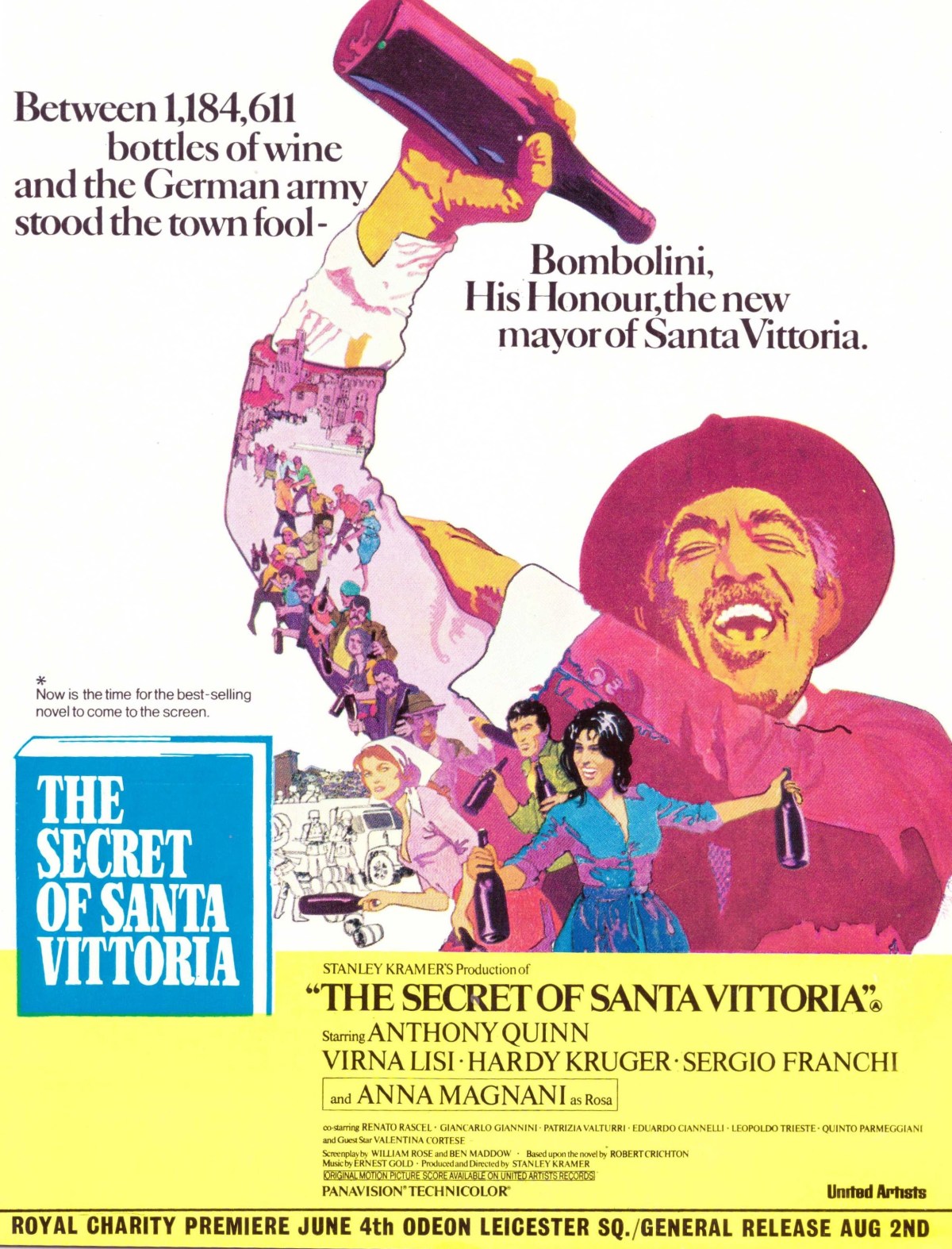
Sounds like a treasure hunt picture, contemporary buccaneers or thieves in search of missing gold. But there’s nothing in the way of maps waiting to be discovered, no clues, no character unhinged by its pursuit. In fact, the valuable commodity here is wine, over a million bottles of it. Everyone in the hilltop town of Santa Vittoria is in on the secret. Because they hid it from prying Germans who have taken over the place after the death of Italian dictator Mussolini. And that element of the story, once we finally embark on it, doesn’t begin until halfway through.
Meanwhile, we are treated to the browbeaten drunk Bombolini (Anthony Quinn), too dumb to realize that being elected mayor – the previous incumbent kicked out for being a Fascist – is a poisoned chalice. However, taking a few tips from Machiavelli he works out that his survival depends on bringing together a council of more sensible heads. His new position cuts no ice with disgruntled wife Rosa (Anna Magnani) whose weapons of choice, vicious tongue apart, include copper pans and an elongated rolling pin.
But if you were desperate to know how to bury treasure, here’s your chance. A good quarter of an hour is spent on that element. I’m not entirely sure what fascinated director Stanley Kramer (Guess Who’s Coming to Dinner, 1967) about this. Because, clever though the scheme is of vanishing into thin air more than a million bottles, it takes little more than lining up the populace in rows close enough together so they can pass a bottle onto their neighbor, until the total amount – minus 300,000 bottles left behind to fool the Germans – is hidden in tunnels in the caves below the village.
Assuming of course the Germans fail to prod the stones concealing the tunnels and discover the cement is too fresh to be ancient. But Bombolini is in luck because German leader Captain von Prum is a “good German,” inclined to take things easy, coming down hard of any of his soldiers who pester female villagers, allowing the mayor to negotiate to retain some of the supply being handed over to the invaders, half his mind on the local Countess Caterina (Virna Lisi) with whom he fancies his chances, but in gentlemanly fashion of course, aiming to seduce her over dinner rather than resorting to force.
That matter is complicates because the widowed countess already has a lover, a wounded soldier Tufa (Sergio Franchi) whom she nursed. It’s only when the captain realizes that he has been duped by the apparent buffoon of a mayor and by the countess that things start ugly and soon you can hear cries of the torture echoing out over the piazza.
The odd mixture of comedy and reality fails to gel. Anna Magnani (The Fugitive Kind, 1960) doesn’t look as if she’s acting in showing her distaste of Anthony Quinn (Lost Command, 1966) possibly because he is over-acting, cowing and whimpering and using his hands to express every single word he speaks. But it looks authentic enough. Either Kramer has rounded up every aged extra left over from Once Upon a Time in the West (1969) or he has recruited scores of ordinary peasants to play the villagers.
Kramer’s usual earnestness has disappeared, and although his first movie was a comedy, and Guess Who’s Coming to Dinner, his previous picture, played on the comedic elements of the situation, his feeling for comedy is rusty at best, non-existent at worst. It’s hard to feel any particular sympathy, as would be the point, in the villagers outwitting the Germans and in the fact that they have changed from ostensible World War Two conquerors to the conquered once their erstwhile allies turned on them.
You might consider this a feminist twist on The Taming of the Shrew, Rosa not only being a shrew who would never be tamed, not even by Germans, but actually the family breadwinner. While, until his election, her husband is a nonentity. And it might be viewed as a choice role for Anthony Quinn, a dramatic shift away from the heroic roles with which he was more often associated. Anna Magnani mostly looks as if wondering why she agreed to participate.
The best acting comes from Virna Lisi (How to Murder Your Wife, 1965), a widow realistic about the lack of true love in what sounds like an arranged marriage, and faced with having to keep the amorous captain sweet, and possibly doing whatever that takes in order to protect the townspeople. Hardy Kruger (The Red Tent, 1969) has also abandoned his normal arrogance, is uncomfortable with being a despot, wanting to maintain friendly relations with the villagers, and seeking solace in gentlemanly fashion from the countess. He has the best scenes, the look of superiority as he outwits, he thinks, Bombolini, and the look on horror on his face as he discovers the countess’s lover.
Based on the bestseller by Robert Crichton with a screenplay by William Rose (Guess Who’s Coming to Dinner) and Ben Maddow (The Way West, 1967) it’s the kind of movie that raises a lot of questions without bothering to answer any of them.
After Murderers Row (1967), Ann-Margret flipped Hollywood the finger. At one point in the early 1960s contracts had been oozing from every pore, multiple deals with multiple studios, even one to star opposite Frank Sinatra. And despite showing considerable acting talent as a mother rather than moll in Once A Thief (1965), the career she had envisaged had not materialized.
In part, her reign as a glamor queen had been usurped by Raquel Welch, who had out-bikinied her in One Million YearsB.C. (1966) and Fathom (1967), or by the slimmer versions of beauty emanating from Britain in the shape of Julie Christie or from French exile in the shape of Jane Fonda.. But mostly, you would say, her box office hadn’t matched her salary and she was learning fast that promise can only take you so far. So, she took a leaf out of La Welch’s book, and headed for Italy, for a three-year four-picture sojourn.
She was probably the biggest Hollywood star to head there during the whole decade, not the never-was-es and has-beens who usually made the Transatlantic crossing. But if she had thought she would get the pick of the roles, juicy parts directed by top arthouse names, she was sadly mistaken. It was clear Hollywood-on-the-Tiber viewed it the other way round, and saw her as adding some box office pizzazz to, by Hollywood standards, less well-made productions. This was her final effort.
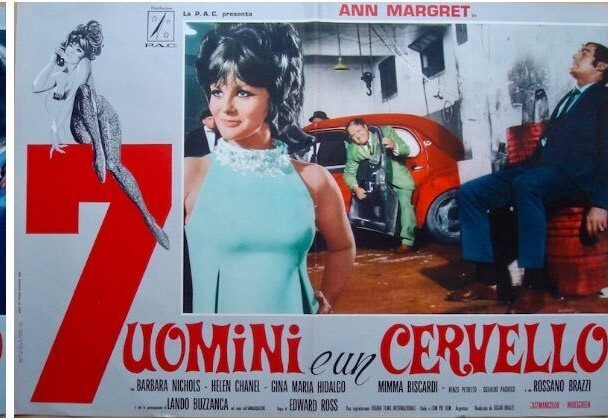
I never thought I’d be saying this but in Criminal Affair Ann-Margret gets in the way of a neat heist thriller that occasionally slips into the broad Italian comedy unbeloved by everyone outside Italy. But this one does have a clever premise and like many of the best robbery movies the set-up is intriguing.
Criminologist professor Simpson (Rossanno Brazzi), classes filled with more adoring female students than Indiana Jones, has more than an academical interest in his subject, having planned and executed one jewel theft, and in traditional gangster fashion pulled a fast one on his confederates. As luck would have it, his bosses grant him an all-expenses paid sabbatical to Buenos Aires where he plans to pull off the crime of the century.
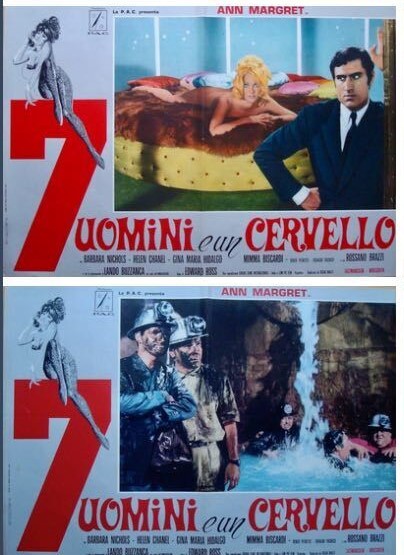
FYI, that ain’t Ann-Margret on the bed and, despite the opportunity to get her soaking wet as was always a prerequisite regarding women when water was introduced, she doesn’t appear in the sewer scene either.
Accompanying him is mooning secretary Leticia (Ann-Margret) who prefers sporting herself in sexy ensembles or nothing at all to attract his attention rather than undertaking the more mundane tasks her job title might suggest. All to no avail, so it would seem, although she does, without her knowledge, play a vital role in his plan, as do some parakeets.
Academic profile opening doors, Simpson is able to scour police files to find his team, with one particular set of skills, that they can sing and properly for the grand plan is to stage a robbery at the opening night of La Traviata in the city, attended by the high and mighty who have paid colossal sums for the privilege.
He enrols other accomplices such as Georgette (Helene Chanel) whose task is divert the owner of the box overlooking the stage for which Simpson has another use. Her presence and that of the diva (Barbara Nichols) enrages Leticia, who resorts to swimming naked in the pool, flirting with the muscular butler and when that fails bombarding Simpson with dinner plates.
The use of the sewer is something of a heist trope, although there’s an original method of covering up the drilling and explosion, but mostly through misdirection we don’t quite work out how Simpson is going to fleece the opera house. Improbable a ruse as it is, nonetheless, as befits his high opinion of himself, the concept is a work of genius. Complications arise when the jewel robbers pursue him to Argentina. The film pretty much dispenses with the other heist trope, of spending much time on the character development of his new thieving team, beyond some obvious comedy.
The fact that Leticia has little to do deprives the picture of any reason for her presence, except as a dupe, physical attributes a distraction when necessary, and her lack of awareness that she is playing a key role leads to the movie’s sting in the tail.
But, in terms of the way the heist plays out, any actress could have played the part. It didn’t need to be Ann-Margret. And there’s not even any excuse, in a movie where singing is central, for her to sing. It’s possibly the most redundant role she ever took on. A bit more screenplay could have fixed that, had her character been developed along the lines of that of La Welch in her Italian-made heist picture The Biggest Bundle of Them All which appeared the same year.
And it might have better just to concentrate more on Rosanno Brazzi (The Battle of the Villa Florita, 1965) because he has mother issues, carries his absent-minded personality disguise well, and allocate more time to the intricacies of the plot and his pursuers. Viewed just as a heist picture without the unnecessary diversions of the female lead and the comedy it pretty much makes the grade. On the other hand Ann-Margret’s existence might simply have been that since he was also director he couldn’t carry the acting side of the picture on his own.
No doubt, though, I will have to check out, for your benefit, Ann-Margret’s other Italian trio.
Spoiler alert – this film contains no giants unless you count the one-eyed Cyclops. It’s the Jason and the Argonauts story with a lot of political shenanigans thrown in.
Even lacking the Ray Harryhausen special effects of the film covering the same ground a few years later and without the kind of budget dropped into the lap of a Stanley Kubrick it’s not a bad stab at retelling the myth. And Carlo Rambaldi (later the creator of E.T.) does a decent job of the Cyclops at a time when special effects were primitive.
This belongs to the Italian-made “peplum” genre, out of which came Hercules (1958). What struck me most was the director’s use of the camera, very often tracking a character in scenes that would otherwise have been static. There are virtually no close-ups and hardly any medium close-ups. It’s quite strange to see.
On the one hand a moving camera is an expense and on the other hand lack of close-ups saves money, so it’s possible the money spent on one technique was the result of saving money from another.
Alternatively, much of the director’s work has gone into arranging characters in group scenes in such a way that dramatic impact is sustained while not moving the camera. There’s enough political chicanery going on to keep two different plots going. Back in Jason’s (Roland Carey) homeland, where he is a king, an usurper not only seeks his throne but wants his wife and tries to deceive the population into thinking Jason is dead.
Meanwhile, Jason faces mutiny on board the Argo and then the temptations of the Siren, battle with the Cyclops, and then a final bold act to reclaim the Golden Fleece. Possibly the best scene is kept for the end, when the Argo arrives home with its own brand of deception. The film is topped off with a clever trick. Sometimes what we would now view as a B-film, ideal Saturday matinee material, sticks in the mind because it has been the proving ground for a future director or star but writer-director Riccardo Freda had already turned out Spartacus the Gladiator (1953) and Theodora, Slave Empress (1954).
Star Roland Carey was unusual in this field because he was actually a trained actor rather than hired for his torso, but this did not exactly stoke his career – his appearance in Fall of the Roman Empire (1962) was uncredited. Female lead Ziva Rodann was unusual, too, in that she was Israeli rather than Italian, had appeared in Samuel Fuller’s Forty Guns (1957) and second- billed in exploitationer Macumba Love (1960) and would later play Nefertiti in the Batman television series. If you go in not expecting much, you might get a surprise, though, be warned, the acting is wooden and other special effects, such as the storm, not quite in the Rambaldi class
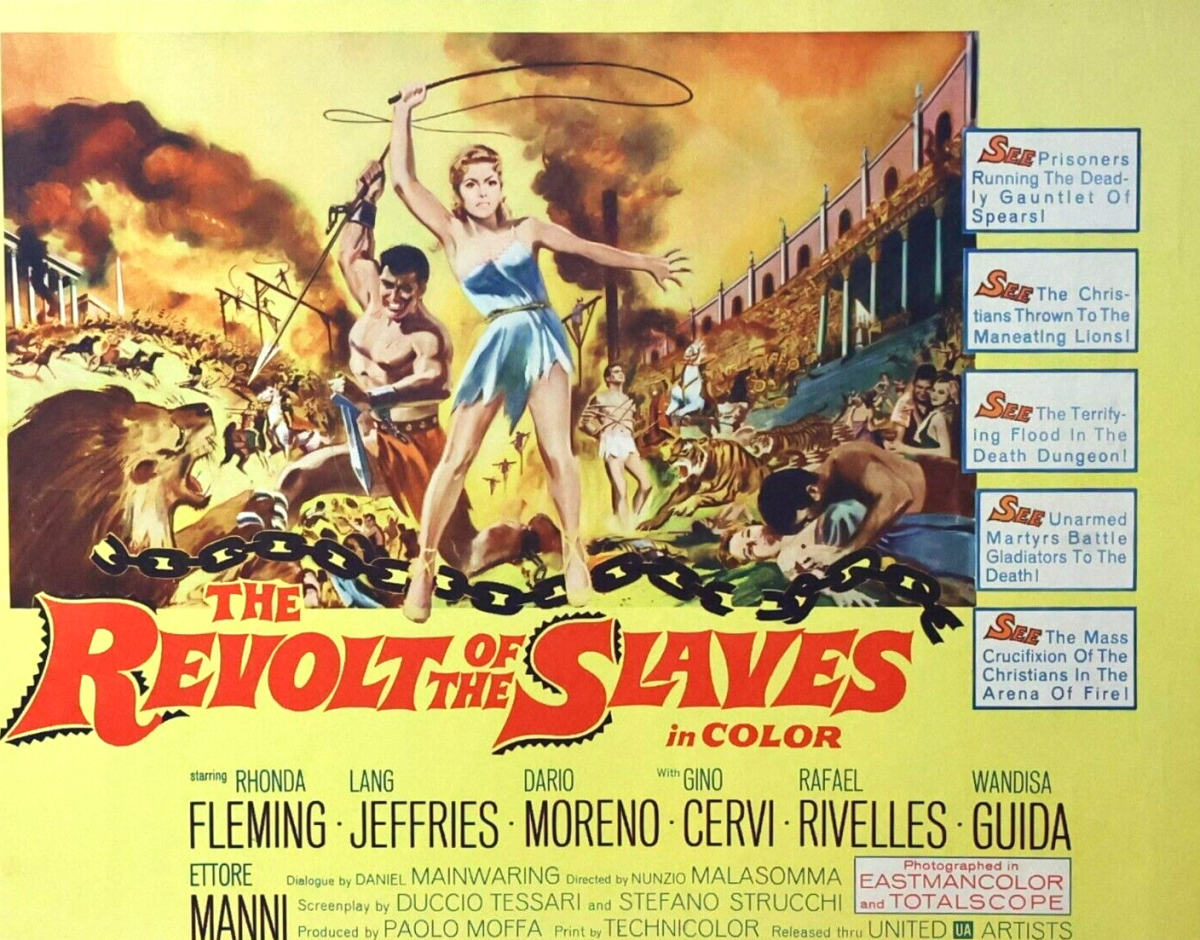
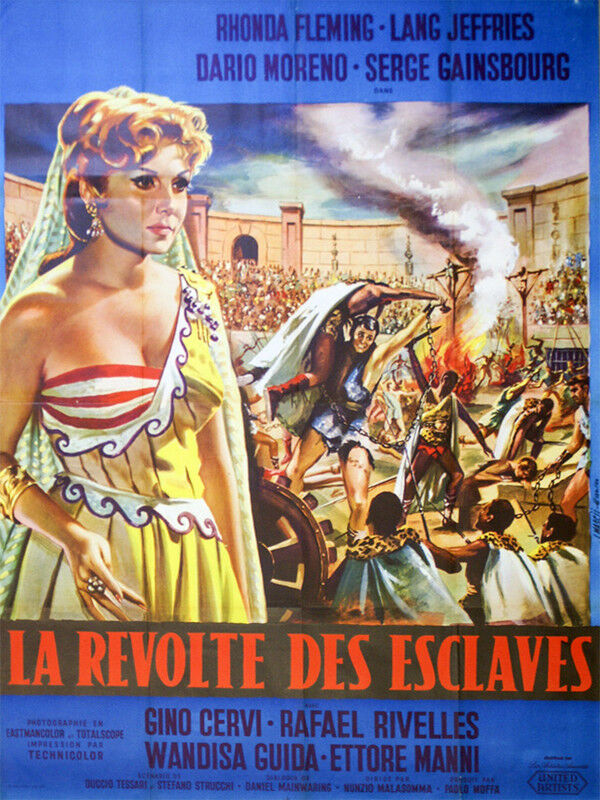
Time has been very kind to this underrated handsomely-mounted hugely enjoyable historical romp about victimised Christians in ancient Rome. Virtually a last hurrah for 1950s redhead Rhonda Fleming (Gunfight at the OK Corral, 1957), known as The Queen of Technicolor and here gifted lines like “the whip will do him good.” Fernando Rey (The French Connection, 1971) is thrown into a pit of ravenous hounds. Singer and serial lothario Serge Gainsbourg, immortalised by late Sixties bedroom anthem “Je t’aime,” plays a sadistic villain.
Despite the occasional over-the-top religious references – a character called Sebastian (Ettore Mane) is pinioned to a tree by arrows because the overseer (“don’t aim for the heart”) wants to prolong his agony, a prisoner facing death is baptised in a convenient flood – the piety is largely kept under wraps because these Christians refuse to turn the traditional cheek and inflict considerable damage on their masters. A voice that sounds like the Voice of God is revealed as an ordinary mortal. And there are nods to modern politics, the powers behind the throne.
Cool Hand Luke couldn’t have come up with better plans for escape, filling a cell with water from the sewer till inmates, except the aforementioned late convert, float to the hatch in the ceiling. A sojourn along a river is enough to put the pack of chasing hounds off the scent. Pursuers are trapped in the catacombs by the simple device of bringing down the roof.
After wealthy patrician Claudius (Gino Cervi) saves the life of escaped slave Vibio (Lang Jeffries) his arrogant daughter Claudia (Rhonda Fleming), introduced driving a chariot along packed streets with little regard for public safety, finds every excuse to humiliate him.
The plot is triggered when Claudia’s cousin/niece (the English translation is unclear) Agnese (Wandisa Guida) is followed by spy Corvino (Serge Gainsbourg) to a Christian hideout. Claudia becomes implicated when Agnese seeks refuge and for a good while she’s on the run, eventually committing her first act of unselfishness after falling for Vibio. But, to save her family, Claudia denounces the Christianity she has begun to accept, only to become involved in the finale in the arena where Christians are killed one by one, not by the waiting lions, but by spear.
It’s mostly heady and bloody action, the driving narrative only pausing now and then to make a religious point. The Emperor, like any leader in Game of Thrones, is afflicted with illness which makes his face burst out in spots. There’s some excellent use of music. In one sequence the hunters with a soundtrack of barking dogs are contrasted with a peaceful scene of the Christians not realising their pursuers are so close until the barking infuses their scene.
Fair bit of poetic license here. No tigers!
Star of the show is undoubtedly Rhonda Fleming. A huge post-war marquee idol, she starred opposite the likes of Bing Crosby (A Connecticut Yankee in the Court of King Arthur, 1949), Glenn Ford (The Redhead and the Cowboy, 1951), Dana Andrews (While the City Sleeps, 1956) and Burt Lancaster (Gunfight at the OK Corral). But she was equally well-known as the top-billed star of adventures like The Golden Hawk (1952), Serpent of the Nile (1953) and Those Redheads from Seattle (1953). It was once said of her by a cinematographer that her beauty was so flawless she was stunning from any angle.
Quite why roles had dried up so much that she headed across the Atlantic to Italy for this is anybody’s guess. It certainly failed to revive her career, possibly because the religious aspects would have been more grating for audiences of the period whereas now they are less dominant.
Oddly enough, it was virtually a last hurrah also for veteran Italian director Nunzio Malasomma (The White Devil, 1947) who didn’t make another picture – his last – for seven years. But he handles the whole venture with aplomb, interspersing humor with action, moving along at a terrific pace, and making the most of a dream cast. In his debut Lang Jefferies (Don’t Knock the Twist, 1962) shows some acting talent among the flash of muscle. But it’s Rhonda Fleming’s picture.
Note: dubbing into English has changed some names. In the Italian version Claudia is named Fabiola – it’s a remake of the earlier Fabiola (1949) starring Michele Morgan – and her father Fabio, so stand by for confusion on imdb.
Certainly a cut above the sword-and-sandals epics flourishing at the time. I’d add that it’s an ideal matinee feature except I watched it late at night and it was just as entertaining. Highly recommended as an easy watch or just to see Rhonda Fleming at her best. The rating might err a little on the high side but every now and then we are allowed our guilty pleasures.
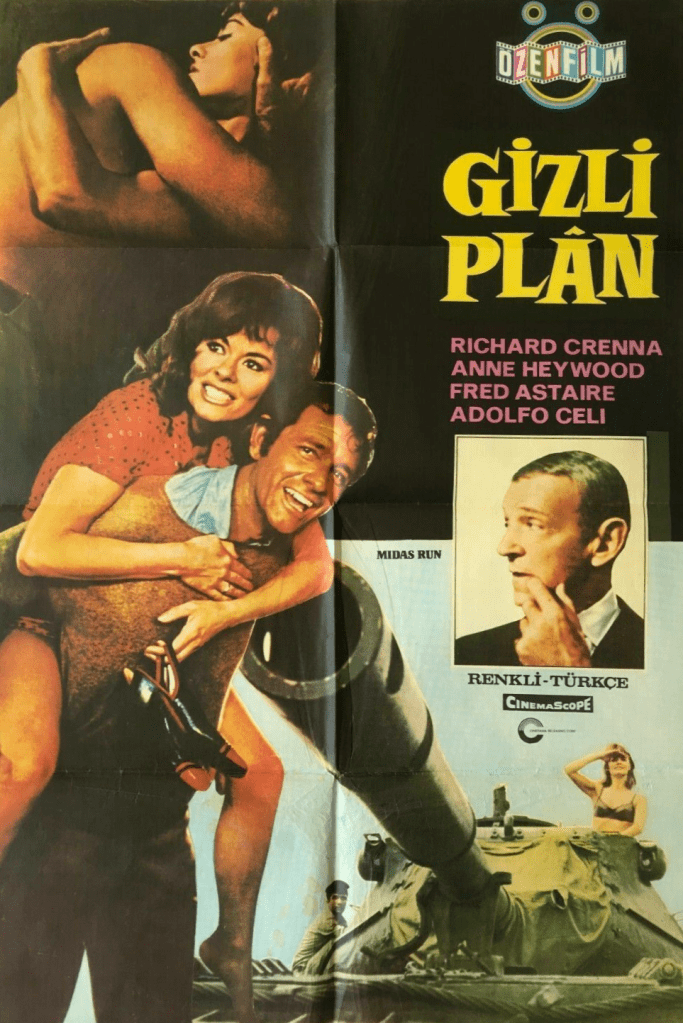
You ever wonder what triggers criminality? Don’t deny an upper class English civil servant his knighthood, don’t fire an American university lecturer for an anti-war demonstration, don’t humiliate your beautiful wife by making her part of a business transaction. They might all feel robbery is the best revenge.
The highly respected Pedley (Fred Astaire) has talked his superiors in government into the notion that the best way to ship a consignment of gold is by passenger rather than commercial airplane. He recruits wannabe author Mike (Richard Crenna) who, in turn, comes to the rescue of glamorous Sylvia (Anne Heywood) when she is being sold off to sweeten a business deal.
The apparently eccentric casting was based on unfulfilled promise. Fred Astaire, who had not starred in a film for over decade, had made a comeback for Finian’s Rainbow (1968). But that had flopped, putting a dent in his marquee credentials and dramatic roles were hardly the forte of this twinkle-toed dancer. Richard Crenna’s bid for leading man status in Star! (1968) had spectacularly derailed at the box office.
Anne Heywood, the only one of the three principles to have a recent hit, in unexpected sleeper The Fox (1967), found no demand consequently for her services except from lover, future husband and biggest fan, producer Raymond Stross who had bankrolled the lesbian drama, and assigned her female lead here. You could extend your incredulity to the involvement of Swedish director Alf Kjellin,who hadn’t made a picture since Siska seven years before, and like most of his countrymen was seen as producing arthouse fare.
The biggest problem in a gold heist, as anyone watching the current television series The Gold will be aware, is shifting loot that weighs a ton. So Mike and Sylvia hire some Italian crooks to supply a couple of petrol tankers to hide and transport the bullion after the airplane has been forced down over Italian airspace by an Albanian fighter plane, Mike driving the World War Two tank that supplies the ground-based pressure.
As with any heist picture, robbery is only the beginning, double-cross the middle and triple-cross the end. Pedley, who has accompanied the shipment, is delegated by the British secret service to recover the gold, aided by suspicious assistant Wister (Roddy McDowall). The twist here is that he not only recovers most of the gold, apart from some secreted away by the now romantically-inclined twosome, but points the finger at his accomplices, including the fence General Ferranti (Adolfo Celi).
It then becomes a question of whether the younger crooks can evade his clutches, whether Wister can confirm his suspicions that the investigation has proceeded a tad too conveniently, and discover what the heck the bowler-hatted Englishman is up to. And, of course, whether Mike can trust Sylvia. It wouldn’t be the first – or last (see Perfect Friday, 1970) – grand theft in which the male has been the dupe.
Along the way there is some clever comedy, a play on the British assumption that everyone in the world naturally speaks English, the implicit trust that the upper-classes place in each other, and the stock view that any Italian, law enforcer or crook, can be distracted by a pretty face or comely derriere.
On the downside, the set-up takes too long coming to fruition, especially a mid-movie interlude that seems intend on channelling the worst romantic notions of the era, idyllic strolls in fields, that I half-expected a burst of slow-motion trotting, or some metaphor for the orgasm. There is some little understood banter about war games. And, for obvious reasons, La Heywood strips down to brassiere in the overheated tank (Mike manages to resist such un-English impulses) though she has previously indulged her innovative ideas about dress, turning a bedsheet into a fashionable toga at a moment’s notice.
There’s nothing particularly new here but Fred Astaire makes a deft impression as a typical upper-class Englishman, accent not found wanting, and successfully reinvents himself as a dramatic actor, that highpoint an Oscar nomination for The Towering Inferno (1974). Anne Heywood, once you realise she is playing all sides against each other, slips easily into the femme fatale role. Richard Crenna’s acting appears limited since his character, despite occasional initiative, is outwitted by all and sundry, and that was scarcely a good look in those days for the leading man to be out-thought by the leading woman.
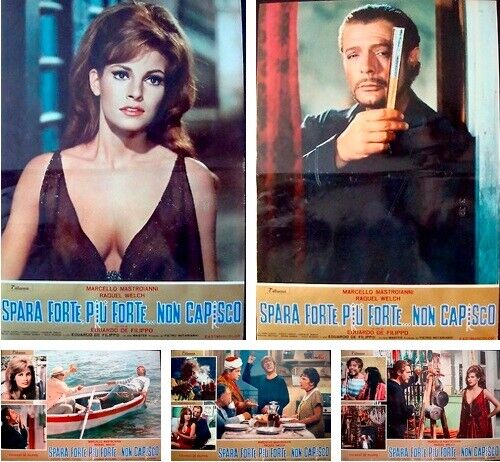
The Raquel Welch picture nobody’s seen. Which is a shame because she demonstrates considerable comedic flair. And there’s a freshness and naturalness – almost a youthful gaucheness – about her that’s lacking in other movies where she was developing her more iconic acting style.
Tania (Raquel Welch) literally bumps into sculptor Alberto (Marcello Mastroianni) when his latest acquisition, an iron gate (locked naturally), blocks a footpath. Intrigued, she enters his Aladdin’s cave of artefacts and is frightened by his mad uncle who communicates via fireworks. With a start like that, you’re either headed for gentle romance between sensible young woman and less sensible artist, the usual on-off on-off scenario, or, this being quirky Italy and the director the even quirkier Eduardo Di Filippo (better known as a playwright – Saturday, Sunday, Monday) it’s going to follow a different route.
While Raquel Welch is for the most part costumed in alluring dresses she does not wear a bikini as in the poster at the top.
And so it does. Alberto thinks he has witnessed the murder of neighbor Amitrano (Paolo Ricci) – blood-soaked glove one clue – but when he confesses it might have been a delusion, something to which he is prone, he is arrested because the dead man was a gangster. That sets a surreal tone – chairs raining from the sky, anyone?, a coffin full of potatoes, fortune tellers – and for some reason Alberto (who has received a bang on the head) begins to think Tania is also a figment of his imagination.
You can see where that idea came from, the delectable Tania in cleavage-resplendant form wearing dresses with clasps that appear unwilling to do their job. But on the other hand, he is handsome enough, with an artistic beard, and I doubt it would be the first time he had attracted a beautiful woman.
Tania is certainly a character, driving around in a sports car (with pink drapes) that appears to float rather than drive, containing another receptacle for a blood-soaked glove and with hot food in the glove compartment. In fact, she carries around a goodly supply of this local delicacy in case she might feel hungry in a police station or what have you.
Raquel Welch wasn’t girl of the year when this was made but by the time it was released in the USA in 1968 she had made a name for herself, in particular being named Star of the Year by one of the industry’s exhibiting organisations.
There’s certainly a bunch of dream-like sequences. After he finds a bloody knife and bloodied clothes Alberto gets punched on the head by a turbaned man, only to wake momentarily and fan his face with a fan, the kind of imagery Fellini could have dreamed up in his sleep. But this is set against a realistic backdrop, neighbors screaming at each other in the traditional Italian manner.
So, what we are left with is a perfectly acceptable comedy where Alberto is accused of a crime he didn’t commit but the film might be too Italian for most tastes. This was made before La Welch achieved screen notoriety through the donning of a fur bikini and critics tended to look on Mastroianni (A Place for Lovers, 1968) as a serious actor rather than someone mixed up in this kind of gentle tomfoolery. I thought he was excellent in the role. But that was par for the course here, everyone dismissed.
De Filippo (Ghosts – Italian Style, 1967) didn’t have the kind of critical following ascribed to the likes Fellini and Antonioni so if this fitted into his normal style nobody was aware of it. But I’ve a feeling that this quirkiness was one of his hallmarks.
If you accept it on face value without looking to insert some kind of meaning then it makes perfect sense. As I mentioned, although her voice is dubbed, Raquel Welch (Bandolero, 1968) comes across very well, especially as, despite the enticing attire, she is not required to be all sexed-up or carry the dramatic weight of the tale, unlike the westerns where she is generally an object of lust and continually attempting to assert independence.
Having said that, this is particularly hard to track down, so you might not think it’s worth the bother. But, of course, if you are a Welch completist, nothing will be too much trouble. However, you’ll need to scour the second-hand markets to find a DVD.
Under-rated comedy, set in 1928 Italy, had me chuckling all the way through. An episodic structure sees Arabella (Virna Lisi) duping an Italian hotel manager, British general and an Italian Duke (all played by Terry-Thomas) out of their cash in order to pay off the mounting tax debts of her grandmother Princess Ilaria (Margaret Rutherford) while trying to avoid the attentions of the mysterious Giorgio (James Fox).
Her scams are quite ingenious, beginning with arranging for a public urinal to be erected outside a five-star hotel and, pretending to be the lover of Benito Mussolini, convincing the manager that, for a price, she could arrange its removal. There’s nothing particularly original about faking a breakdown to attract the attention of the general, a royal flunkey, but the blackmail trap she sets is elaborate.
But just as you think you know here this is going, it sprints off in another direction altogether, Arabella being the mark, and it’s one twist after another. She is rooked by Giorgio with whom she falls in love. The Duke, whom she sees as easy meat, instead uses her. Her grandmother’s ploy to burn down her mansion and claim the insurance money is foiled by a cat.
All sorts of sly observations come into play. The hotel manager and his pals siphon off a large chunk of the cash they have taken from the safe to pay her off. The general, operating incognito, has his cover blown by a piece of music. The Duke turns the tables on his domineering wife and his son has an exceptionally clever ploy to keep mama sweet while enjoying his sexual independence. And it appears that every time Arabella gives in to entreaty, she is exploited. In other words, show weakness, give a loser an inch and they’ll take you for all you’ve got.
Terry-Thomas as a bumptious hotel manager with James Fox looking mysterious.
There’s no desperate reason for it to be set in the 1920s and, beyond the Charleston and costumes, it makes little attempt to evoke the era except perhaps to make the point that the world was not full of submissive women. And you might find inappropriate the trope about using a sexy woman to turn a gay man straight. It’s a sex comedy in the Italian style where just about anything goes and the act, rarely consummated, instead involves humiliation.
But Virna Lisi (How To Murder Your Wife, 1965) certainly commands the screen, carrying the show, fashionably stylish rather than overtly sexual, a born comedienne. Terry-Thomas (How To Murder Your Wife), while initially appearing under his trademark persona, completes a transition for the Duke, almost another twist if you like, audiences expecting a similar duffer to his previous parts. Lisi and Terry-Thomas clearly have rapport, almost a synergy, not the charisma of a screen couple, as in romantic pairing, but work very well with each other.
Margaret Rutherford (Murder Ahoy!, 1964) and James Fox (The Chase, 1966) let the side down with such insipid portrayals you wonder why they signed up. It’s almost as if they couldn’t be bothered working on their characterisations. Cigar smoking and general ditziness is as far as Rutherford, in her final role, goes. Fox just looks fey and the one flaw in the narrative is why Arabella could look at him twice. As the Duke’s son, duping his mother, a pre-gaunt Giancarlo Giannini (The Sisters, 1969) is very entertaining.
To enjoy this you have to suspend your ideas about comedy based on the British and Hollywood tradition. It aims for farce, no attempt to make larger comment on life.
Mauro Bolognini (He and She, 1969) hangs this together in a decent enough fashion, confident enough of his material to lead the audience into a bait-and-switch. In his debut Giorgio Alorio (Burn!/Queimada, 1969) and Adriano Baracco (Danger: Diabolik, 1968) wrote the screenplay with British playwright Alan Hackney (Sword of Sherwood Forest, 1960) spicing up the English dialog. Ennio Morricone provided the score.
Having complained about lists and then recanted when one of my favorites got the nod at the top of the heap, I’m doing the same again.
The recent Sight & Sound once-in-a-decade Directors Poll did the unthinkable and placed Once Upon a Time in the West ahead of John Ford’s The Searchers (1956) which, virtually since release, had been anointed the top western of all time. The critics who participated in the Critics Poll, which ran concurrently with the Directors Poll, were not, I hasten to add, quite so convinced. According to the critics, the John Ford picture was still top dog, ahead of the Leone masterpiece in second place. But in a battle between directors, who make a living making pictures, and critics, whose only skill is writing about them, I know which side I would come down on. And in any case I had long sided with the directors on this issue.
A masterpiece to savor. The greatest western ever made. Sergio Leone’s movie out-Fords John Ford in thematic energy, imagery and believable characters and although it takes in the iconic Monument Valley it dispenses with marauding Native Americans and the wrecking of saloons. That the backdrop is the New West of civilisation and enterprise is somewhat surprising for a movie that appears to concentrate on the violence implicit in the Old West. But that is only the surface. Dreams, fresh starts are the driving force. It made a star out of Charles Bronson (Farewell, Friend, 1968), turned the Henry Fonda (Advise and Consent, 1961) persona on its head and provided Claudia Cardinale (Blindfold, 1965) with the role of a lifetime. And there was another star – composer Ennio Morricone (The Sicilian Clan, 1969)
New Orleans courtesan Jill (Claudia Cardinale) heads west to fulfil a dream of living in the country and bringing up a family. Gunslinger Frank (Henry Fonda), like Michael in The Godfather, has visions of going straight, turning legitimate through railroad ownership. Harmonica (Charles Bronson) has been dreaming of the freedom that will come through achieving revenge, the crippled crooked railroad baron Morton (Gabriele Ferzetti) dreams of seeing the ocean and even Cheyenne (Jason Robards) would prefer a spell out of captivity.
The beginnings of the railroad triggers a sea-change in the west, displacing the sometimes lawless pioneers, creating a mythic tale about the ending of a myth, a formidable fable about the twilight and resurgence of the American West. In essence, Leone exploits five stereotypes – the lone avenger (Harmonica), the outlaw Frank who wants to go straight, the idealistic outlaw in Cheyenne, Jill the whore and outwardly respectable businessman Morton whose only aim is monopoly. All these characters converge on new town Flagstone where their narratives intersect.
That Leone takes such stereotypes and fashions them into a movie of the highest order is down to style. This is slow in the way opera is slow. Enormous thought has gone into each sequence to extract the maximum in each sequence. In so doing creating the most stylish western ever made. The build-up to violence is gradual, the violence itself over in the blink of an eye.
Unusually for a western – except oddities like Five Card Stud (1968) – the driving force is mystery. Generally, the western is the most direct of genres, characters establishing from the outset who they are and what they want by action and dialogue. But Jill, Harmonic and Cheyenne are, on initial appearances, mysterious. Leone takes the conventions of the western and turns them upside down, not just in the reversals and plot twists but in the slow unfolding tale where motivation and action constantly change, alliances formed among the most unlikely allies, Harmonica and Cheyenne, Harmonica and Frank, and where a mooted alliance, in the romantic sense, between Jill and Harmonica fails to take root.
There’s no doubt another director would have made shorter work of the opening sequence in Cattle Corner, all creaky scratchy noise, in a decrepit railroad station that represents the Old West, but that would be like asking David Lean to cut back Omar Sharif emerging from the horizon in Lawrence of Arabia (1962) or Alfred Hitchcock to trim back the hypnotic scenes of James Stewart following Kim Novak in Vertigo (1958). Instead, Leone sets out his stall. This movie is going to be made his way, a nod to the operatic an imperative. But the movie turns full circle. If we begin with the kind of lawless ambush prevalent in the older days, we end with a shootout at the Sweetwater ranch that is almost a sideshow to progress as the railroad sweeps ever onward.
No character is more against audience expectation than Jill. Women in westerns rarely take center stage, unless they exhibit a masculine skill with the gun. There has rarely been a more fully-rounded character in the movies never mind this genre. When we are introduced to her, she is the innocent, first time out West, eyes full of wonder, heart full of romance. Then we realise she is a tad more mercenary and that her previous occupation belies her presentation. Then she succumbs to Frank. Then she wants to give up. Then she doesn’t. Not just to stay but to become the earth mother for all the men working on the railroad.
Another director would have given her a ton of dialogue to express her feelings. Instead, Leone does it with the eyes. The look of awe as she arrives in flagstone, the despair as she approaches the corpses, the surrender to the voracious Frank, the understanding of the role she must now play. And when it comes to close-up don’t forget our first glimpse of Frank, those baby blue eyes, and the shock registering on his face in the final shoot-out, one of the most incredible pieces of acting I have ever seen.
And you can’t ignore the contribution of the music. Ennio Morricone’s score for Once Upon a Time in the West has made a greater cultural impact than even the venerated John Williams’ themes for Star Wars (1977) and Jaws (1975) with rock gods like Bruce Springsteen and Metallica among those spreading the word to successive generations and I wonder in fact how people were drawn to this big-screen showing by the opportunity to hear the score in six-track Dolby sound. There’s an argument to be made that the original soundtrack sold more copies than the film sold tickets.
The other element with the music which was driven home to me is how loud it was here compared to, for example, Thunderball (1965), which as it happens I also saw on the big screen on the same day. Although I’ve listened to certain tracks from the Bond film on a CD where the context is only the listener and not the rest of the picture, I was surprised how muted the music was for Thunderball especially in the action sequences. Today’s soundtracks are often loud to the point of being obstreperous, but rarely add anything to character or image.
If you live in the U.K. you should get the opportunity to see this once again on the big screen because the British Film Institute, which coincidentally owns Sight & Sound, is planning to screen all the 100 films in its latest poll. Other countries might take note.
It could as easily have been Cecil B. DeMille (The Ten Commandments, 1956) in the director’s chair. And Yul Brynner (The Magnificent Seven, 1960) and Jeanne Moreau (Jules and Jim, 1962) as the stars.
The Barabbas tale had already been plundered before Swedish novelist Par Lagerkvist published his relatively short bestseller – only 144 pages – in 1950. An earlier novel of the same name by Emery Bekessy hit American bookstalls at the height of the mid-1940s religious cycle kicked off by Going My Way (1944) and The Bells of St Mary’s (1945). DeMille – whose portfolio included Biblical epics The Ten Commandments (1923), King of Kings (1927) and The Sign of the Cross (1932) – was in competition with British producer Alexander Korda to buy the rights.
While that production never entered production, just to confuse matters a British film, Now Barabbas, based on a successful West End play and with no Biblical element, was released in 1949.
Swedish director Alf Sjoberg (Miss Julie, 1951), twice winner of the Grand Prix at Cannes, turned the Lagerkvist book into a black-and-white film in 1953, the first Swedish picture to be dubbed into English.
A bigger-budgeted version, piggybacking on the success of Ben-Hur (1959), was the brainchild of Italian producer Dino De Laurentiis who had pacted with Hollywood studio Columbia on a four-picture slate worth $17 million, the bulk of which, $10 million, was to be spent on Barabbas “with a cast of thousands headed by some of the biggest names in motion pictures.”
“Hollywood on the Tiber” was producing movies at a record rate – topping 200 a year – and De Laurentiis, who had shot to fame with Bitter Rice (1949) starring future wife Silvana Mangano and Fellini’s La Strada (1954) was intent on gaining a foothold in America beyond the arthouse market. Producing King Vidor’s War and Peace (1956) for Paramount had not done the trick and the Columbia slate was a last-ditch attempt to break into the Hollywood game.
Hollywood had originally invested in Europe to take advantage of tax breaks or to access monies frozen by countries after the Second World War, but by the 1960s the continent had become more attractive as a cheaper production alternative. While Britain had been a substantial recipient of Hollywood largesse, Italy was fast catching up as the chosen locale for pictures as varied as Cleopatra (1963), The Pigeon That Took Rome (1962) and Jason and the Argonauts (1963).
Director Richard Fleischer’s career was at a curious impasse. The son of world-famous animator Max Flesicher, creator of the Popeye cartoons, Richard had won critical acclaim for low-budget thriller The Narrow Margin (1951), followed up with a pair of stupendous action hits, 20,000 Leagues under the Sea (1954) and The Vikings (1958), both starring Kirk Douglas, and a daring examination of the world’s first “thrill killing” Compulsion (1959) with Orson Welles.
But he was at loggerheads with Twentieth Century Fox, to whom he was contractually tied, having turned down North to Alaska (1960) with John Wayne. As a result, he was relegated to lesser projects, Crack in the Mirror (1960), again with Orson, and The Big Gamble (1961), a picture with virtually no stars unless you count the questionable marquee value of Juliette Greco and Irishman Stephen Boyd trying to capitalize on his success in Ben-Hur (1959).
“Holdover” also meant it was not playing as a roadshow. In the roadshow exhibition situation, a cinema would be required to play a movie for an agreed number of weeks, generally a minimum of eight or thirteen. Non-roadshow films relied on box office performance for the length of their run, the engagement extended week-by-week.
He had been on Dino De Laurentiis’ radar before, approached to helm War and Peace, circumstances dictating otherwise, and a $10 million project, a 70mm roadshow, presented an ideal opportunity to resuscitate his moribund career. As Fleischer put it, “Even if I had loved Darryl (F. Zanuck, the legendary Fox producer of The Big Gamble), I would gladly have jilted him for this assignment.”
Despite the promise of the budget, the reality was off-putting. The De Laurentiis studio was housed in a “dreary industrial slum” and consisted of a two-storey wooden building housing the offices and “three decaying stages.” However, there was little downbeat about De Laurentiis, “an impeccably tailored bundle of raw energy,” according to Fleischer, “the impact of meeting him for the first time is something akin to sticking your finger into an electric light socket.”
The Italian producer possessed a quality that was appreciated in Hollywood, especially among old-school mavens. He was a showman. He could drum up publicity at the drop of a hat. His first publicity coup was hiring French star Jeanne Moreau, at the time considered one of the few foreign actresses who need not rely on buxom figure, as the female lead. Her arrival in Rome for pre-production prerequisites such as costume and make-up testing induced a flurry of front pages. A mob of about 30 reporters almost prevented any testing. “Even though the tests were purely mechanical, she became the character in the script the moment the camera turned,” observed Fleischer.
Unfortunately, De Laurentiis had no intention of hiring her, not when he had wife Silvana Mangano at home. The press reaction to Moreau might have suggested he was backing the wrong horse, despite Mangano’s own marquee appeal, but he appeared delighted to have achieved a publicity coup, no matter that he had manipulated and duped a great actress and the director.
De Laurentiis pursued Yul Brynner for the titular role, a suggestion with which the director was in accord. This was the real thing, attempted recruitment not just a publicity gag. Until Charlton Heston muscled in with Ben-Hur, Brynner was the go-to actor for historical epics, The Ten Commandments (1956) making him an instant star, a position solidified with an Oscar for The King and I (1956) and commanding a $750,000 payday, on a par with john Wayne and William Holden.
Brynner was initially disinclined to play the role but after a day in discussion with Fleischer they shook hands on a deal only to have it torpedoed by De Laurentiis.
Scriptwriters Christopher Fry, famed English playwright but novice screenwriter, Nigel Balchin (The Man Who Never Was, 1956) and Diego Fabbri (The Corsican Brothers, 1961) were recruited with De Laurentiis reporting that they were “currently at work after having studied the material at length.” Later added to the roster was Italian Nobel prize-winning poet Salvatore Quasimodo. Not trusting the producer to stick to the text, Lagerkvist assigned his son as overseer, a tactic that singularly failed to work.
Still lacking a male lead, De Laurentiis announced the movie would start shooting on January 7, 1961, with French pair Jeanne Moreau and Simone Signoret (Room at the Top, 1958) in the top female roles, neither of whom were ultimately involved.
Despite two Oscars as Best Supporting Actor, Anthony Quinn (Guns for San Sebastian, 1968) had failed to reach the top echelons of Hollywood stardom, stuck in the rut of male lead to top-billed female or starring in lower-budgeted pictures. To rectify the situation, he had embarked on a project intended to provide a prestigious showcase for his acting skills. He had signed up to play opposite Laurence Olivier in the Broadway production of Jean Anouilh’s acclaimed play Becket.
He had to be prised away from the Broadway run by De Laurentiis who forked out $37,500 in compensation and guaranteed the actor time off halfway through the shoot to fulfil a commitment to Lawrence of Arabia (1962). In fact, Becket, while attracting good notices, was a Broadway flop, the production only going into the black as a result of the De Laurentiis pay-off.
The all-star cast never materialized. But there was prestige aplenty, three members of the cast Oscar winners, another trio nominees. Vittorio Gassman (Ghosts of Rome, 1961) was at best a rising star, marquee value restricted to Italy. Jack Palance (Shane, 1953), was better known in Italy than the U.S., having spent the previous five years in Italy and now attempting a Hollywood comeback as a director. He was signed to play the notorious gladiator intent on killing Barabbas in combat. Ernest Borgnine (The Vikings) was still clinging on to vestiges of stardom after unexpectedly winning the Best Actor Oscar for Marty (1955). His wife Katy Jurado (High Noon, 1952) remained a starlet. Despite a bout of Oscar nominations in the supporting actor category Arthur Kennedy (Elmer Gantry) and never-nominated Harry Andrews (Solomon and Sheba, 1959) were no more than character actors.
It would have been impossible to make Barabbas on the tiny studio De Laurentiis owned so, encouraged by tax breaks, he invested in hundreds of acres of cheap land to build a new state-of-the art studio. But when Fleischer first saw it, it was nothing but a barren wasteland. Even so it was in these empty fields that production designer Mario Chiari would construct the ancient world.
Over several hours, simply by pointing his finger in vague directions, the pair came up with over 100 buildings, and the sets for Jerusalem and the Praetorium. The movie already had its arena – the 2,000-year-old structure in Verona – which would double for the Rome Colosseum. The complicated gladiatorial spectacle was the first sequence to be shot, with a world-record 9,115 costumed extras, arriving on a fleet on 75 buses from nearby towns. The only obstacle to rolling the cameras: Anthony Quinn’s specially designed gladiator sandals had been left behind in Rome. A temporary pair were mocked up so the first shot could be completed before lunch.
On the second day of shooting occurred a Hollywood fairy story. Looking for good characters to focus on in the crowd “one face truly stood out, that of an eighteen-year-old girl of stunning beauty.” The daughter of an officer at a U.S. military base in Vicenza, her name was Sharon Tate. Shortly afterwards, she moved in with Jack Palance, and not too long after that she was on the Hollywood glory trail prior to her premature death.
Another mishap threatened to spoil the scene where Quinn and Gassman, playing prisoners in the sulphur mine, were going to be chained together. The location was the top of Mount Etna in Sicily. On hand were 500 extras dressed as Roman slaves. It was a Sunday since that was the only day the roads would be clear enough to transport so many people and all the equipment up the two-hour drive from Catania up the twisty route.
The weather was terrible, the sky so black, the volcanic cinder ground a perfect match, with barely enough light to get an exposure. The only section of the scene unrehearsed was the riveting of the chains. And that required charcoal. But someone had forgotten the charcoal. A race down the mountain to bring back the charcoal took till the afternoon. But just as the charcoal arrived there was a break in the clouds and a spot of perfect light. It lasted just long enough for the shot to be taken.
The solar eclipse was no special effect. It was actually taking place on February 15, 1961, and Fleischer had cameras in place to record the phenomenon, the only genuinely ethereal scene in a movie that was more concerned with realism. The burning of Rome was also filmed “in camera,” the sets consumed in one take in one night.
While there were other occasional production errors, Fleischer found the Italian crew as professional as he required. And as accommodating. One day he was informed the crew had to go on strike for one hour. But after consultation with the director, the crew was happy to strike during the lunch break.
Even with a schedule rearranged to include Quinn’s time away filming Lawrence of Arabia (1962), shooting went smoothly with no overages or budget-blowing.
The production faced other threats. The 1953 version, already conveniently dubbed, was being reissued. There was a television production called Give Us, Barabbas, and a new play was launched off-Broadway by Belgian playwright Michel de Ghelderode, all of which could have stolen the limelight.
The movie followed an unusual distribution pattern. Launched in Italy at the tail end of 1961 to big box office it was another six months before it made a mark in London. In June 1962 it was the opening presentation for a new cinema, the Odeon Haymarket in London’s West End, a 600-seat underground emporium set up to take advantage of the demand for hard-ticket roadshow venues. The premises had not operated as a cinema since 1939 when it had been known for a short period as the Gaumont. It was only the second cinema built in London since the Second World War, the other being the Columbia in Shaftesbury Ave which had opened in 1959. In separate-performance advance-booking format, and tickets priced at $1.05-$2.80, Barabbas would remain at the Odeon for over six months.
It didn’t reach the United States – at the DeMille in New York – until October and even then was beaten to the North American punch by the 2,318-seat Odeon Carlton in Toronto, the largest cinema to enter the roadshow arena. And although available as a 70mm roadshow, in most locations it was more likely to be presented in 35mm minus the separate performances that were the hallmark of the prestigious hard-ticket presentation.
Columbia created some enterprising marketing concepts for the U.S. launch, including a touring exhibit by six well-known painters who had all used the film as the basis of artworks. A 41-foot high float including a 10-foot high revolving figure of Barabbas had been seen by 1.2 million people when paraded through Los Angeles. A special 190-page “making of” book was published in hardback. Six months after launch, the film was promoted as a “Special Lenten Presentation” in local cinemas with prices increased by 25 cents.
Although a huge success in native Italy and generally well-received at the international box office, Barabbas came up short in the U.S., rentals barely hitting $3 million, earning a lowly 35th place in the annual chart.
SOURCES: Richard Fleischer, Just Tell Me When To Cry, A Memoir (Carroll & Graf, 1993) p217-226; “Another Religious Picture May Be Barabbas Novel,” Variety, December 4, 1946, p4; “Now Barabbas Was A Robber,” Variety, June 1, 1949, p1; “First Swedish Picture Dubbed Into English,” Variety, June 23, 1954, p4; “Swedish Barabbas,” Variety, June 1, 1960, p4; “Lagerkvist, Nobel Winner, Assigns Son To Rome As Watchman on Barabbas,” Variety, December 14, 1960, p17; advert, Variety, January 4, 1961, p71; “Barabbas Budget over $10,000,000,” Variety, February 15, 1961, p3; “Dino De Laurentiis No 1 Indie Producer?,” Variety, February 15, 1961, p24; “Figure $17,500 for Off-Broadway Barabbas,” Variety, February 15, 1961, p71; advert, Variety, April 26, 1961, p71; “Becket Got 37½G On Quinn’s Exit,” Variety, May 3, 1961, p83; “Becket Folds As 40G Sleeper; Had Seemed Prestige-Only Flop,” Variety, May 31, 1961, p59; “Quinn Back To Work in Barabbas,” Variety, October 11, 1961, p17; “No Time To Fiddle in Rome,” Variety, November 15, 1961, p1; “To Write Barabbas Dialog,” Box Office, November 27, 1961, pW6; “Canada Coin,” Variety, March 21, 1962, p40; “Barabbas Exhibits Start Key City Tour,” Box Office, March 26, 1962, pE8; “Barabbas London Event: New York Date Oct 10,” Box Office, June 11, 1962, p14; “Barabbas Premiere Set For Oct 4 in Toronto,” Box Office, July 23, 1962, pE8; “Hard Cover Book to Ballyhoo Barabbas,” Box Office, July 30, 1962, p10; “Palance Back, Try Directing,” Variety, October 17, 1963, p3; “Big Barabbas Float,” Box Office, January 4, 1963, pA1; advert, Variety, January 23, 1963, p27; “Barabbas at Eight,” Box Office, February 18, 1963, pK2; “Lenten Angle for Barabbas Date,” Variety, March 13, 1963, p17; “Top Rental Features of 1963,” Variety, June 8, 1964, p37.
Brutally ironic ending adds a final twist to this religious epic that sheds a murky rather than heavenly light on the early days of Christianity. Barabbas (Anthony Quinn), in case you are unaware, is the criminal who, in a public vote, is spared crucifixion instead of Jesus Christ. Intent on returning to his lusty life, instead he finds himself drawn to the teachings of the Son of God despite his feverish attempts to deny it. Death might have been preferable to two decades spent imprisoned in the sulphur mines followed by a stint as gladiator only, finally refusing to deny his conversion, he ends up on a cross.
The fate of Barabbas in the Bible is undetermined, only meriting a few lines, but in the imagination of Swedish novelist Par Laverkvist he lived quite an extraordinary life, a criminal vagabond coming to believe in what he originally despised. The religious element is almost an excuse to investigate life at the edge of a pauper’s existence, a world in which faith is possibly the only way to get through the day. It’s an episodic tale with Barabbas as a Job-like peasant on whom constant indignity and humiliation is heaped.
A witness at times to the most exalted elements of Christianity – the eclipse surrounding the crucifixion, the stone rolled away from the tomb – he also sees lover Rachel (Silvana Mangano), a Christian convert, stoned to death. It’s a miracle he survives imprisonment in the mines and that when, thanks to an earthquake, he escapes it’s almost bitter irony that he ends up in gladiator school, facing the demonically sadistic Torvald (Jack Palance). Even when pardoned, he is again arrested for, believing the end of the world is nigh as described in the Christian teachings, helping burn Rome to the ground. Arrest this time sends him back to where he started, heading for crucifixion, though this time willingly.
Anthony Quinn (Guns for San Sebastian, 1968) is excellent as the dumb, mostly mystified peasant, only occasionally rising to the occasion, mostly defeated, or captured, and failing to defend those he should protect. Not entirely cowardly, witness his battle in the arena, but self-serving, and in a sense cursed by events outside his control.
Others are only briefly in the spotlight, Silvana Mangano (Five Branded Women, 1960) good as the converted Christian accepting her fate, ditto Vittorio Gassman (Ghosts of Rome, 1961) as an enemy prisoner in the mines, and Jack Palance (Once a Thief, 1965) over-the-top as the kingpin gladiator. In cameo roles – not exactly the promised all-star cast – you can find Ernest Borgnine (Chuka, 1967), Arthur Kennedy (Claudelle Inglish, 1961), Katy Jurado (A Covenant with Death, 1967), Valentina Cortese (The Visit, 1964) and Harry Andrews (The Charge of the Light Brigade, 1968).
Director Richard Fleischer (The Big Gamble, 1961) does a brilliant job of keeping reverence at bay, turning the potential awe of the eclipse into a moment of personal terror, ensuring that current persecution rather than potential eternal life remains foremost, focusing on the human not the ethereal. He presents Barabbas as constantly mystified at his escape, guilt-ridden that he has done nothing with his life, thwarted in virtually every attempt at redemption.
The big scenes are well-handled, the sulphur mines a pit of Hell, the arena far more realistic than Spartacus (1960), the burning of Rome that initially represents freedom turning into a trap. Filmed in Technirama 70mm, Fleischer makes the most of the widescreen and the historical detail.
In some respects this makes more sense if viewed alongside the director’s crime triptych of Compulsion (1959), The Boston Strangler (1968) and 10 Rillington Place (1970) which concentrate on outsiders coming to national attention through illicit activity.
Far from the usual stodgy religious offerings of the period, more in keeping with a Pasolini-like vision, with a keener eye on history than creed, it’s been rather overlooked and deserves reappraisal.
Christopher Fry (The Bible…in the Beginning, 1966) was credited with the screenplay from the book by the Nobel prize-winning novelist Par Laverkvist.