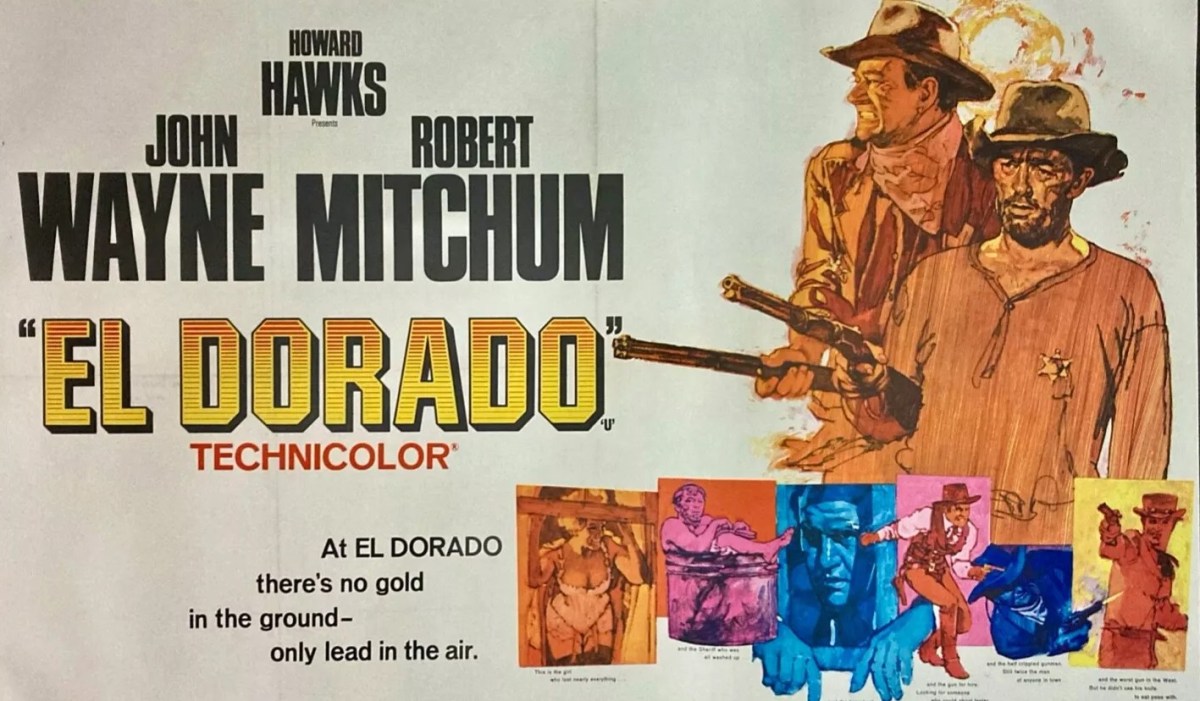
El Dorado (1966) ****

John Wayne incapacitated? Robert Mitchum a liability? The hell you say! You bring together two of the greatest male action figures only to turn the genre upside down and inside out. And I know it’s tradition for heroes to be unable to listen to their hearts, never mind deal with emotion, but it’s a heck of a stretch for them to just completely fall apart when spurned. And I know also that Duke is not invulnerable, this isn’t the MCU for heaven’s sake, and he’s been known in his long career to take a bullet, but to be shot by a woman! That’s very close to taking the proverbial.

Also, westerns usually operate on fairly tight timeframes. If the situation takes place over a longer period that’s usually because it involves a journey. Here, there’s a split of six months between the opening section and the main action, and it does kinda defy belief that the bad guys don’t make the necessary hay while the sheriff is drunk and his main assistant has scarpered.
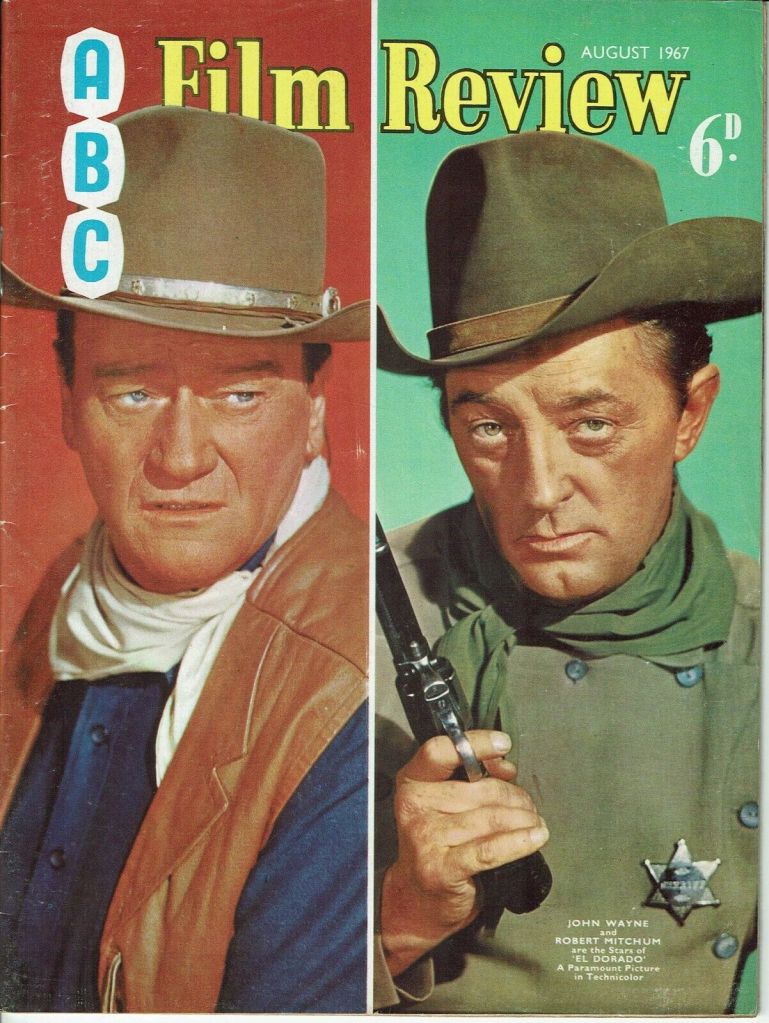
There’s hardly a word spoken here – between the good guys again for heaven’s sake – that isn’t an insult. Never mind The Magnificent Seven (1960) this is teed up as The Bickering Quartet. And I do have to point out a couple of elements that won’t go down so well with a contemporary audience, one character imitating a Chinese, and a scene where one of our heroes is constantly interrupted in the bath by females, a twist to be sure on the usual scenario of the female lead skinny dipping in a handy pool or river, but it’s like a lame comedy sketch.

This won’t have been influenced by the spaghetti western, the first Sergio Leone game-changer wasn’t screened in the U.S. until the following year, so it’s also worth pointing out that some of the action is pretty savage, both John Wayne and Robert Mitchum indulging in the kind of mean behavior that was usually the prerogative of the villains. Wayne even cheats when it comes to the traditional shoot-out. And while there’s none of the blood-letting that later became synonymous with the genre, director Howard Hawks does something else that is far more realistic than anything that has gone before and would count as a genuine shock to our senses. The gunfire is incredibly loud. Imagine that on Imax and you’d be jumping out of your seat every few minutes.

And just in case you think this is nothing more than a remake of Rio Bravo (1959) where a gunslinger and a drunken sheriff are holed up in jail, here the jail is mostly used as a base, the good guys racing out every now and then to pick someone off. That running, too, by older guys certainly prefigures later action pictures like Taken (2008).

We need the time gap to allow Sheriff J.P. Harrah (Robert Mitchum), one of the three best gunslingers alive, to disintegrate. He goes from tough lawman keeping an unruly town in order and holding back the worst instincts of land-owner Bart Jason (Ed Asner) planning to go in mobhanded against rival rancher Kevin MacDonald (R.G. Armstrong) in an argument over water rights.

Hired gun Cole Thornton (John Wayne), one of the three best gunslingers alive, turns up for a job with said Jason but is turned off the idea when J.P. gives him the lowdown on the situation. He dallies long enough to set up the notion that he’ll try to win back saloon-owning old flame Maudie (Charlene Holt) from J.P.

Thornton moseys off to the Mason spread to give the owner the bad news. On the way back, Luke Macdonald (Johnny Crawford), Kevin’s youngest son, on guard duty, mistakes Thornton for the enemy and shoots at him. Which results in his death. So Thornton does not get a good welcome when he arrives at the Macdonald farm toting a corpse.

Turns out the young whelp, although taking bullet in the gut, committed suicide because the pain was too much and Luke had been told by his dad that he wouldn’t recover anyway and just suffer a hideous death. While the father accepts this, his daughter Joey (Michele Carey) does not and ambushes Thornton, putting a bullet in his back. Said bullet is mighty inconveniently lodged close to his spine and needs more than the town quack to remove it. Despite sparking up old feelings for said old flame and the prospect of stealing her back from old buddy J.P., Thornton doesn’t dally longer than it takes to get temporarily fixed up, bullet still in place to cause later problems.

Now the tale takes a detour. Not only has six months passed and Thornton miles away from El Dorado, but we’ve got to hold up proceedings to introduce naïve youngster Mississippi (James Caan). Howard Hawks certainly hasn’t learned the knack of the compact introduction from John Sturges a la The Magnificent Seven (1960) so we learn that this young whelp is best with the knife and has spent two years tracking down the four killers of his foster father. The last man to die happens to be an employee of Nelse McLeod (Christopher George), one of the three best gunslingers alive, on his way to take up the job Thornton turned down, a task made a helluva lot easier because J.P is now the town drunk, having hit the bottle when spurned by a woman, not Maudie I hasten to add.

Thornton heads for El Dorado with Mississippi tagging along, armed with of a sawn-off shotgun. First task is to sober up the sheriff – by fistfight and awful concoction – and stop him becoming a worse figure of fun. On the evidence here Deputy Bull (Arthur Hunnicutt) was probably one of the three best riflemen – not to mention archers – alive. He also totes a bugle.
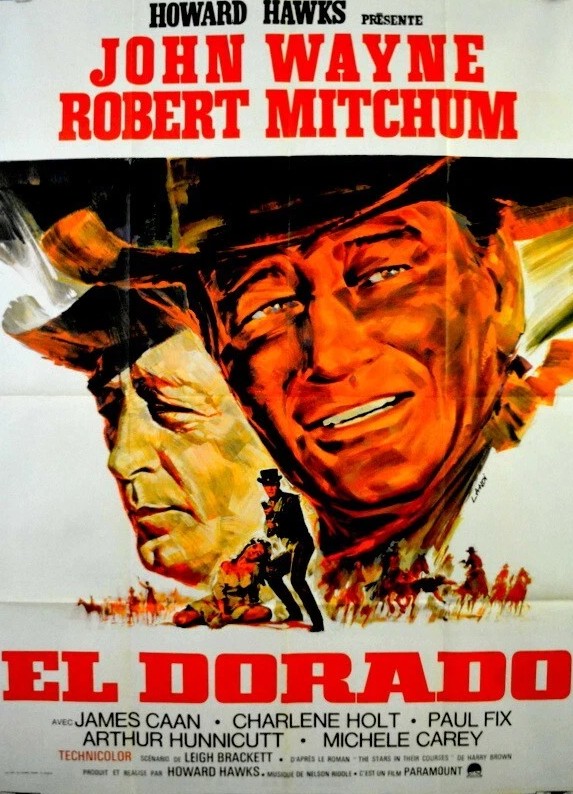
The sober J.P. strolls into the saloon and arrests Bart Jason and sticks him in jail, and to avoid being in a complete siege situation, the quartet, sometimes as a group, sometimes a pair, sometimes alone, venture out, as I mentioned, to pick off the enemy. This allows Mississippi a meet-cute with Joey who’s planning a short-cut to justice by shooting Jason. Maudie re-enters the frame.

The bullet in the back sporadically paralyzes Thornton and J.P. is wounded in the leg so eventually the pair are hobbling around on crutches. Maudie also turns out to be a liability, taken hostage, ensuring Thornton goes to the rescue. But the bullet in the back plays up at exactly the wrong time and Thornton’s also captured, trussed up like a hog (what, John Wayne?) then traded in for the prisoner.

Having by now reduced the odds and not wanting to be caught in a siege, the quartet take the battle to the enemy, ambushing them front and back in the saloon, Thornton ridding Nelse of the notion that he and Thornton will enjoy a winner-takes-all shootout by killing him with a rifle while lying on the ground.

While it could be trimmed – television screenings generally eliminate the racist Chinese impersonation – the action when it comes is blistering. There’s a terrific scene in a tower when Bull targets the bells to disorientate the enemy with their horrendous ear-jarring clanging. And the final shoot-out is exceptionally well done.

In ways not usually gone into, the quartet are experts in their fields. Thornton backs up his horse to get out of a difficult situation, J.P. detects a man hidden behind a piano in the saloon, Mississippi stalks a potential lone assassin, Bull uses bow-and-arrow when silence is required.

Theoretically, Robert Mitchum (Five Card Stud, 1968) steals the show as the drunken sheriff, but that’s only if you are taken in by the surface. The sight of John Wayne with his useless twisted right hand harks back to the arm in The Searchers (1956) and his one-armed rifle action predates True Grit (1969). James Caan (The Rain People, 1969) tries to steal scenes but what chance does he have with these two stars at the top of their game and past master at the scene-stealing malarkey Arthur Hunnicutt (The Cardinal, 1963). Charlene Holt (Red Line 7000, 1965) and Michele Carey (The Sweet Ride, 1968) come out honors even as do Edward Asner (The Venetian Affair, 1966) and Christopher George (The Thousand Plane Raid, 1969).

I don’t put this in the same bracket as Howard Hawks’ Red River (1948) and Rio Bravo, but it’s certainly one of the best westerns of the decade. Written by Leigh Brackett (Hatari!, 1962) from a novel by Harry Brown.

Not one to miss.
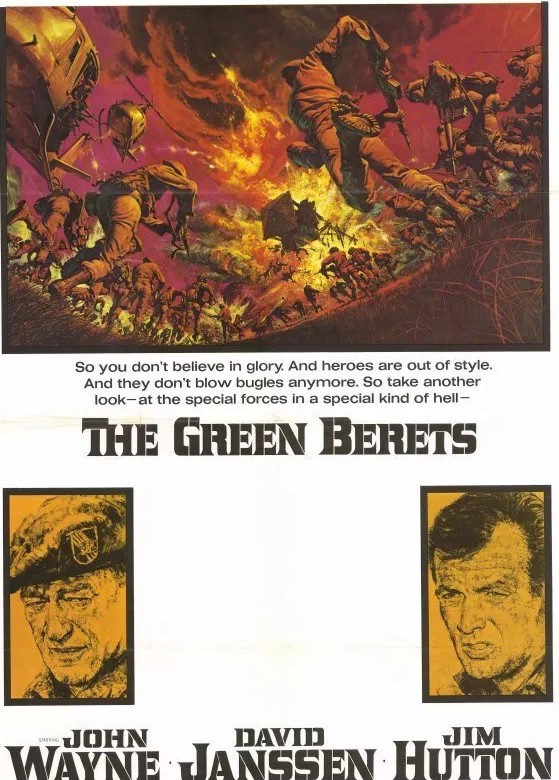
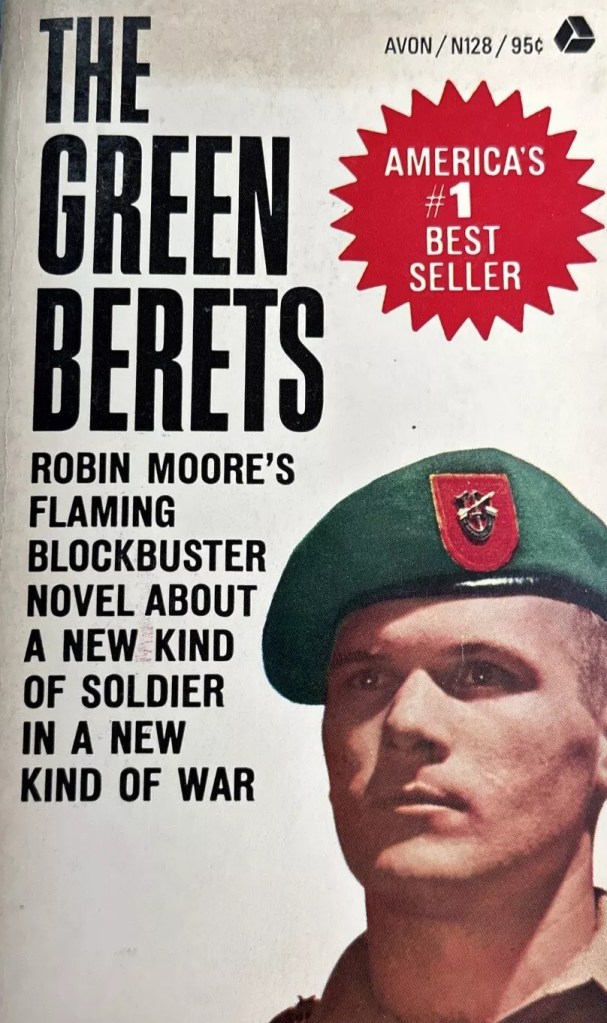
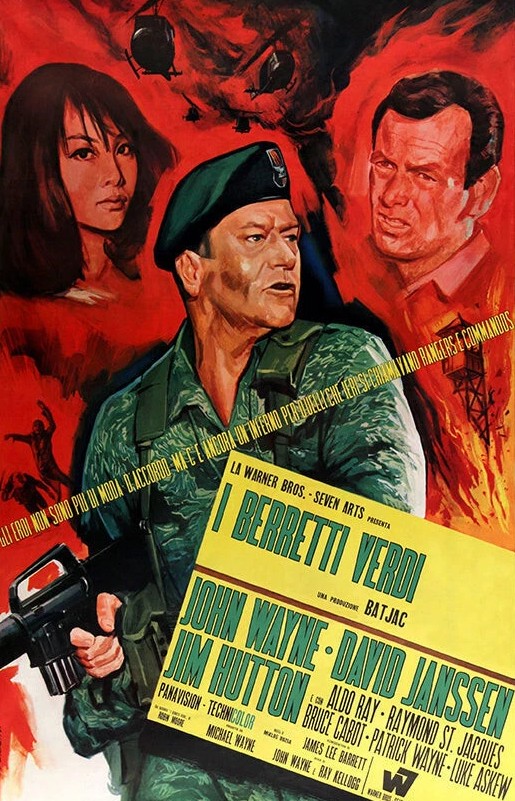
Behind the Scenes: “The Green Berets” (1968)

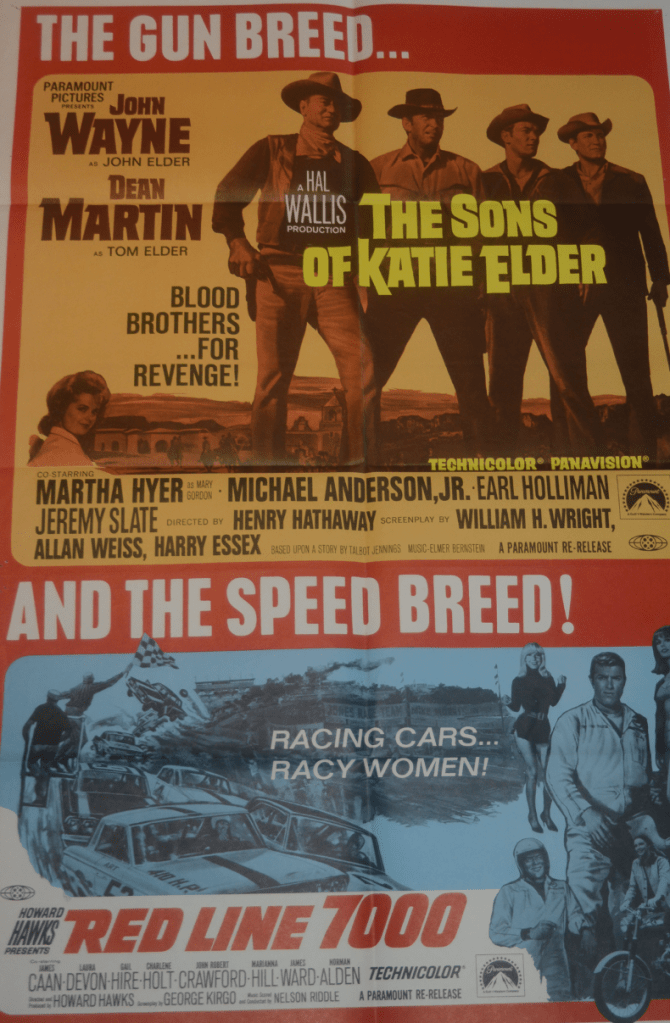
As if John Wayne hadn’t endured enough directing The Alamo (1960), he took on an even weightier task with this Vietnam War picture which, from the start, was likely to receive a critical roasting given the actor’s well-known stance on the conflict and his anti-Communist views that dated back to the McCarthy Era of the 1950s. Wayne had enjoyed a charmed life at the box office with three successive hit westerns, Henry Hathaway’s The Sons of Katie Elder (1965) with Dean Martin, Burt Kennedy’s The War Wagon (1967) co-starring Kirk Douglas, and best of all from a critical and commercial standpoint Howard Hawks El Dorado (1967) pairing Robert Mitchum. Outside of box office grosses, Wayne’s movies tended to be more profitable than his box office rivals because they were generally more inexpensive to make.

Columbia had been the first to recognize the potential of the book by Robin Moore and purchased the rights pre-publication in 1965 long before antipathy to the war reached its peak. A screenplay was commissioned from George Goodman who had served in the Special Forces the previous decade and was to to return to Vietnam on a research mission. But the studio couldn’t turn out a script that met the approval of the U.S. Army. Independent producer David Wolper (The Devil’s Brigade, 1968) was next to throw the dice but he couldn’t find the financing.

In 1966 Wayne took a trip to Vietnam and was impressed by what he saw. He bought the rights to the non-fiction book by Robin Moore (who also wrote The French Connection) for $35,000 plus a five per cent profit share. While the movie veered away in many places from the book, the honey trap and kidnapping of the general came from that source, although, ironically, that episode was entirely fictitious, originating in the mind of Robin Moore.

Universal originally agreed to back The Green Berets with filming scheduled for early 1967 but when it pulled out the project shifted to Warner Bros. And as if the director hadn’t learned his lesson from The Alamo, it was originally greenlit for a budget of $5.1 million, an amount that would prove signally inappropriate as the final count was $7 million. Wayne turned down the leading role in The Dirty Dozen (1967) to concentrate on this project. Wayne’s character was based on real-life Finnish Larry Thorne who had joined the Special Forces in Vietnam in 1963 and was reported missing in action in 1965 (his body was recovered four decades later).

As well as John Wayne, the movie was a platform for rising stars like Jim Hutton (Walk, Don’t Run, 1966), David Janssen (Warning Shot, 1967) and Luke Askew (Easy Rider, 1969) who replaced Bruce Dern. Howard Keel, who had appeared in The War Wagon, turned down a role.

Wayne holstered his normal $750,000 fee for acting plus $120,000 for directing. But it turned out The Alamo had taught him one important lesson – not to shoulder too much of the responsibility –  and Ray Kellogg for the modest sum of $40,000 was brought in as co-director. It was produced by Wayne’s production company, Batjac, now run by his son Michael. But neither Wayne nor Kellogg proved up to the task and concerned the movie was falling behind schedule and over budget the studio drafted in veteran director Mervyn Leroy – current remuneration $200,000 plus a percentage – whose over 40 years in the business ranged from gangster machine-gun fest Little Caesar (1931) to his most recent offering the Hitchcock-lite Moment to Moment (1966).

But exactly what LeRoy contributed over the next six months was open to question. Some reports had him directing all the scenes involving the star; others took the view that primarily he played the role of consultant, on set to offer advice. Even with his presence, the movie came in 18 days over schedule – 25 per cent longer than planned. Unlike the later Apocalypse Now (1979), it didn’t go anywhere near South-East Asia so the location didn’t add any of Coppola’s lush atmosphere, though the almost constant rain in Georgia, while a bugbear for the actors, helped authenticity.

It was filmed instead on five acres of Government land around Fort Benning, Georgia, hence pine forests rather than tropical trees.  President Lyndon B. Johnson and the Department of Defense offered full cooperation. But that was only after the producers complied with Army stipulations regarding the screenplay. James Lee Barratt’s script was altered to show the Vietnamese involved in defending the camp and the kidnapped was switched from being over the border. Also axed, though this time by the studio, was Wayne’s wish for a romantic element – the studio preferred more action. Sheree North (Madigan, 1968) was offered the role of Wayne’s wife but she also turned it down on political grounds. Vera Miles (The Hellfighters, 1968) was cast but she was edited out prior to release.

The Army provided UH-1 Huey helicopters, the Air Force chipped in with C-130 Hercules transports,  A-1 Skyraiders and the AC-47 Puff the Magic Dragon gunship and also the airplane that utilized the skyhook system. Actors and extras were kitted out in the correct jungle fatigues and uniforms. Making a cameo appearance was Col Welch, commander of the Army Airborne School at Ft Benning. The sequence of soldiers doing drill was actually airborne recruits.

The attack on the camp is based on the Battle of Nam Dong in 1964 when the defenders saw off a much bigger enemy unit.

This set was built on a hill inside Fort Benning. The authentic detail included barbed wire trenches and  punji sticks plus the use of mortar fire. While the camp was destroyed during filming the other villages were later used for training exercises. .

The pressure told on the Duke physically – he lost 15lb. But the oppressive heat and weather of that location – it was mostly shot in summer 1967 – was nothing compared to the reviews. It was slated by the critics with Wayne’s age for an active commander called into question, never mind the parachuting, the gung-ho heroics and the dalliance in an upmarket nightclub.

“In terms of Wayne’s directorial career,” wrote his biographer Scott Eyman, “The Alamo has many defenders, The Green Berets has none.” That assessment, of course, would be to ignore the moviegoers around the world who bought tickets and put the picture into reasonable profit.

Wayne was clear in his own mind about the kind of movie – “about good against bad”  – he was making and accommodated neither gray areas nor took note of current attitudes to the war as exemplified by nationwide demonstrations. Co-stars David Janssen, Jim Hutton and George Takei were opposed to the war. Takei, a regular on the Star Trek series, missed a third of the episodes on the second season; his lines were written to suit the character of Chekov, who went on to have a bigger role in the television series. Composer Elmer Bernstein turned down the gig as it went against his political beliefs. “The Ballad of the Green Berets,” heard over the opening credits was not composed for the film, having been released two years earlier.

Most critics hated it – “Truly monstrous ineptitude” (New York Times); “cliché-ridden throwback” (Hollywood Reporter); “immoral” (Glamour). Even those reviews that were mixed still came down hard: “rip-roaring Vietnam battle story…but certainly not an intellectual piece” (Motion Picture Exhibitor). Not that Wayne was too concerned. At the more vital place of judgement – the box office – it took in $9.5 million in rentals (what’s returned to the studios once cinemas have taken their cut) – $8.7 million on original release and a bit more in reissue – in the U.S. alone plus a good chunk overseas.

It was virtually impossible to examine a movie like this without taking a political stance. Other movies covering the same topic were allowed greater latitude regarding authenticity, audiences and critics like appearing to accept that creating watchable drama often took precedence over the facts. Both The Deer Hunter (1978) and Apocalypse Now, considered the best of this sub-genre, clearly ventured away from strict reality. With over half a century distancing the contemporary viewer from those inflammatory times, it’s worth noting that it still divides critics. Or, rather, critics and the general public take opposing views.

Although Rotten Tomatoes deems it “an exciting war film”, the critics voting on that  platform gave it a lowly 23 per cent favourable report compared to a generally positive 61 per cent from the ordinary viewer. That contrasts, for example, with a more even split for the likes of Exodus (1960) – 63 per cent from critics and 69 per cent from audiences. However, The Green Berets attracts twice as much interest, collaring 9,000 votes compared to just 4,300 for Exodus.

After this, Wayne’s fee went up to a flat million bucks a picture. “He wasn’t a guarantee of success,” explained his son Michael, “he was a guarantee against failure.” At this point in his career, he was gold-plated. Where other stars in his commercial league suffered the occasional box office lapse – Paul Newman’s career in the 1960s, for example, was riddled with flops like The Secret War of Harry Frigg (1968) – he did not. Especially with a global following, his pictures never lost money.

SOURCES: Michael Munn, John Wayne, The Man Behind the Myth, Robson, 2004; Scott Eyman, John Wayne, The Life and Legend, Simon and Schuster, 2014; Brian Hannan, The Magnificent 60s, The 100 Top Films at the Box Office, McFarland, 2023; Robin Moore, Introduction, The Green Berets, 1999 edition, Skyhorse Publishing; Laurence H. Suid, Guts and Glory, University of Lexington Press, 2002; The Making of The Green Berets, 2020; Review, Hollywood Reporter, June 17, 1968; Review, Motion Picture Exhibitor, June 19, 1968; Renata Adler, “The Absolute End of the ‘Romance of War’”, New York Times, June 30, 1968; Glamour, October 1968; “Big Rental Pictures of 1968,” Variety, January 8, 1969.

Behind the Scenes: The All-Time Top 20

The “Behind the Scenes” articles have become increasingly popular in the Blog. As regular readers will  know I am fascinated about the problems incurred in making certain movies. Perhaps one of the more interesting aspects of this category is that every now and there is out of nowhere massive interest in the making of a particular movie and it shoots up the all-time tree. Most of the material has come from my own digging, and sources are always quoted at the end of each article, but occasionally I have turned to books written on the subject of the making of a specific film. 

As with the All-Time Top Movies section, the top 20 comprises the choices of my readers. Alistair MacLean still exerts an influence, which is reassuring because my next book is about the films made from his books.

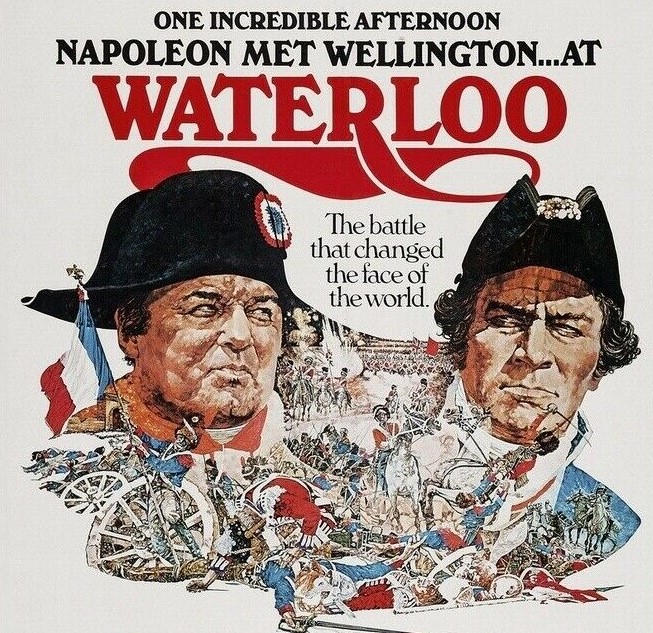
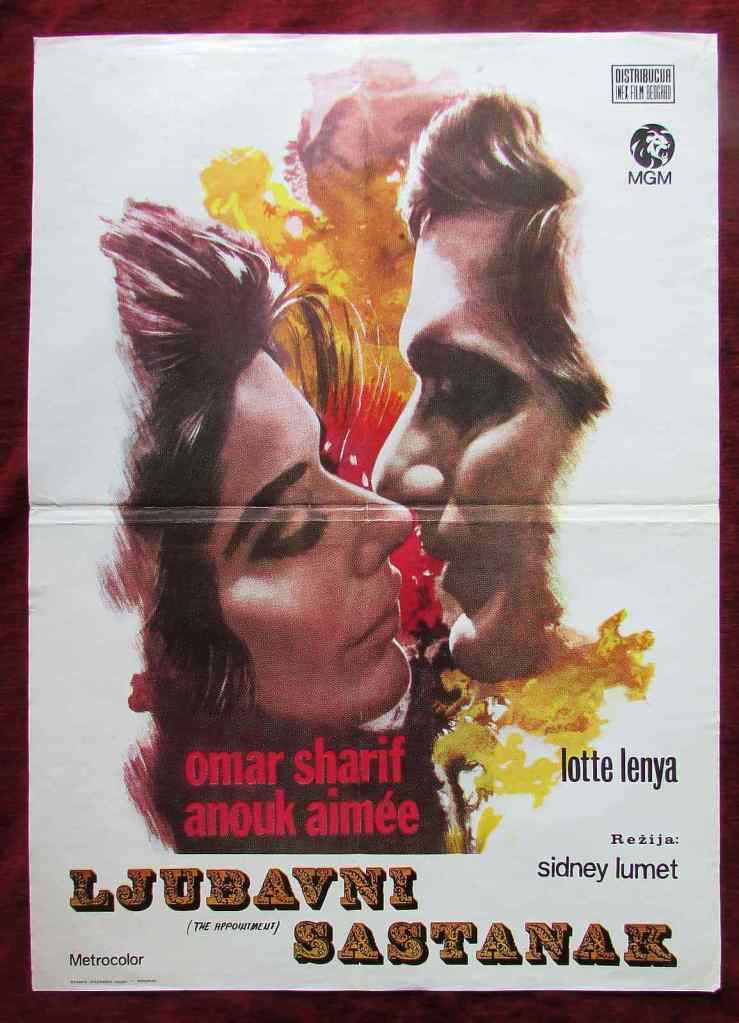
While Waterloo remains firmly out in front there are some interesting new entries such as The Cincinnati Kid, The Appointment, Mackenna’s Gold, The Train, The Sons of Katie Elder and The Trouble with Angels while Man’s Favorite Sport has made a steady climb upwards.

  1. (1) Waterloo (1970). No doubting the effect of Ridley Scott’s Napoleon in racketing up interest in this famous flop.
  2. (2) Ice Station Zebra (1968). A complete cast overhaul and ground-breaking  special effects are at the core of this filming of an Alistair MacLean tale.
  3. (3) In Harm’s Way (1965). Otto Preminger black-and-white epic about Pearl Harbor and after.
  4. (7) The Guns of Navarone (1961). Alistair MacLean again, setting up the template for the men-on-a-mission war picture with an all-star cast and enough production jeopardy to qualify for a movie of its own.
  5. (6) The Satan Bug (1965). The problems facing director John Sturges in adapting the Alistair MacLean pandemic classic for the big screen.
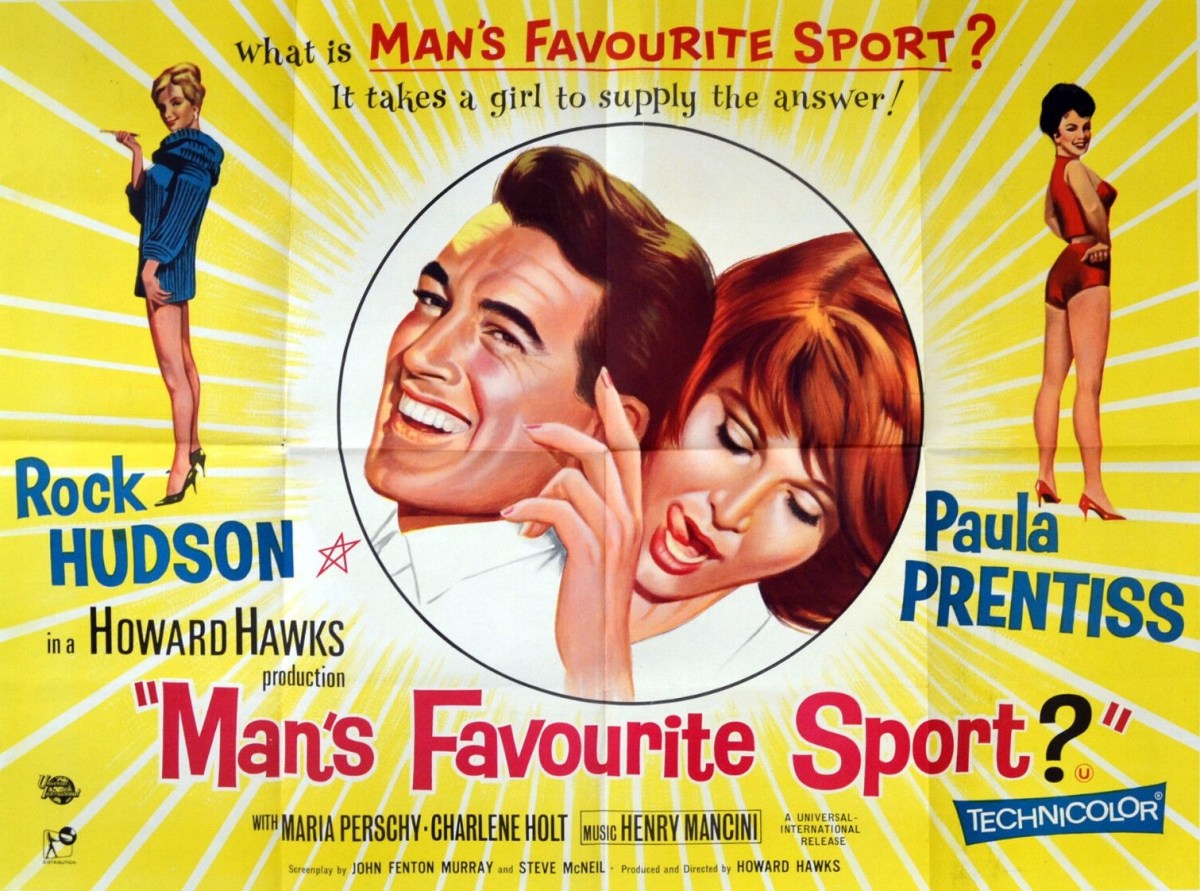
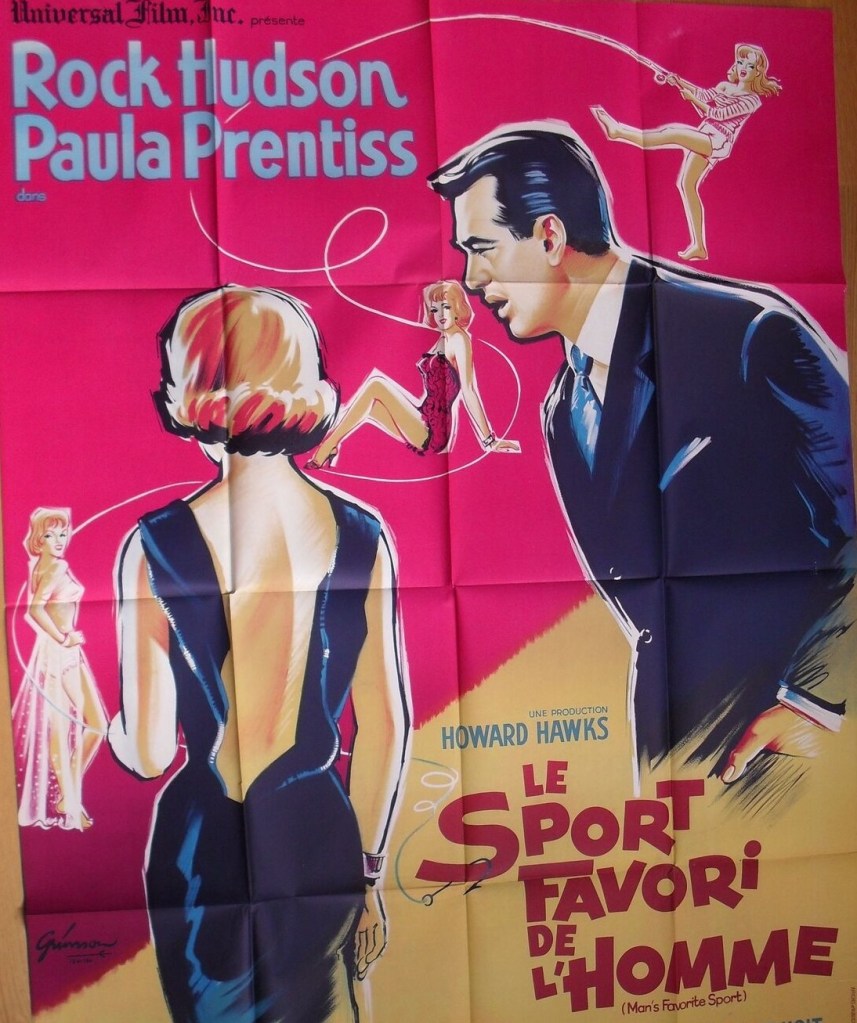
  6. (9) Man’s Favorite Sport (1964). Howard Hawks back in the gender wars with Rock Hudson and Paul Prentiss squaring off.
  7. (4) Battle of the Bulge (1965). There were going to be two versions, so the race was on to get this one to the public first.
  8. (5) Cast a Giant Shadow (1965). Producer Melville Shavelson wrote a book about his experiences and this and other material relating the arduous task of bringing the Kirk Douglas-starrer to the screen are told here.
  9. (10) The Girl on a Motorcycle (1968). Cult classic starring Marianne Faithful and Alain Delon had a rocky road to release, especially in the U.S. where the censor was not happy.
  10. (8) Sink the Bismarck! (1962). Documentary-style British WW2 classic with Kenneth More with the stiffest of stiff-upper-lips.
  11. (11). Tora! Tora! Tora! (1970). Richard Fleischer dispenses with the all-star cast in favor of even-handed verisimilitude.
  12. (New Entry) The Cincinnati Kid (1965). Once Sam Peckinpah was fired from the poker epic, Norman Jewison took over. Steve McQueen, Ann-Margret and Edward G. Robinson are top-billed.
  13. (New Entry) The Trouble with Angels (1966). Hayley Mills causes trouble at a convent school where Rosalind Russell tries to rein her in.
  14. (13). The Bridge at Remagen (1969). John Guillerman WW2 classic with George Segal and Robert Vaughn
  15. (17). The Collector (1963). William Wyler’s creepy adaptation of John Fowles’ creepy bestseller with Terence Stamp and Samatha Eggar.
  16. (New Entry) The Train (1964). Another director fired, this time Arthur Penn, with John Frankenheimer taking over in this cat-and-mouse WW2 struggle between Burt Lancaster and Paul Schofield.
  17. (New Entry) The Appointment (1969). Sidney Lumet has his hands tied in Italian drama with Omar Sharif and Anouk Aimee.
  18. (20) The Way West (1967). Kirk Douglas and Robert Mitchum face off in pioneer western.
  19. (New entry) Mackenna’s Gold (1969). Producer Carl Foreman has his work cut out bringing home western Cinerama epic starring Gregory Peck and Omar Sharif.
  20. (New entry) The Sons of Katie Elder (1965). Long-gestating Henry Hathaway western with John Wayne and Dean Martin as brawling brothers.

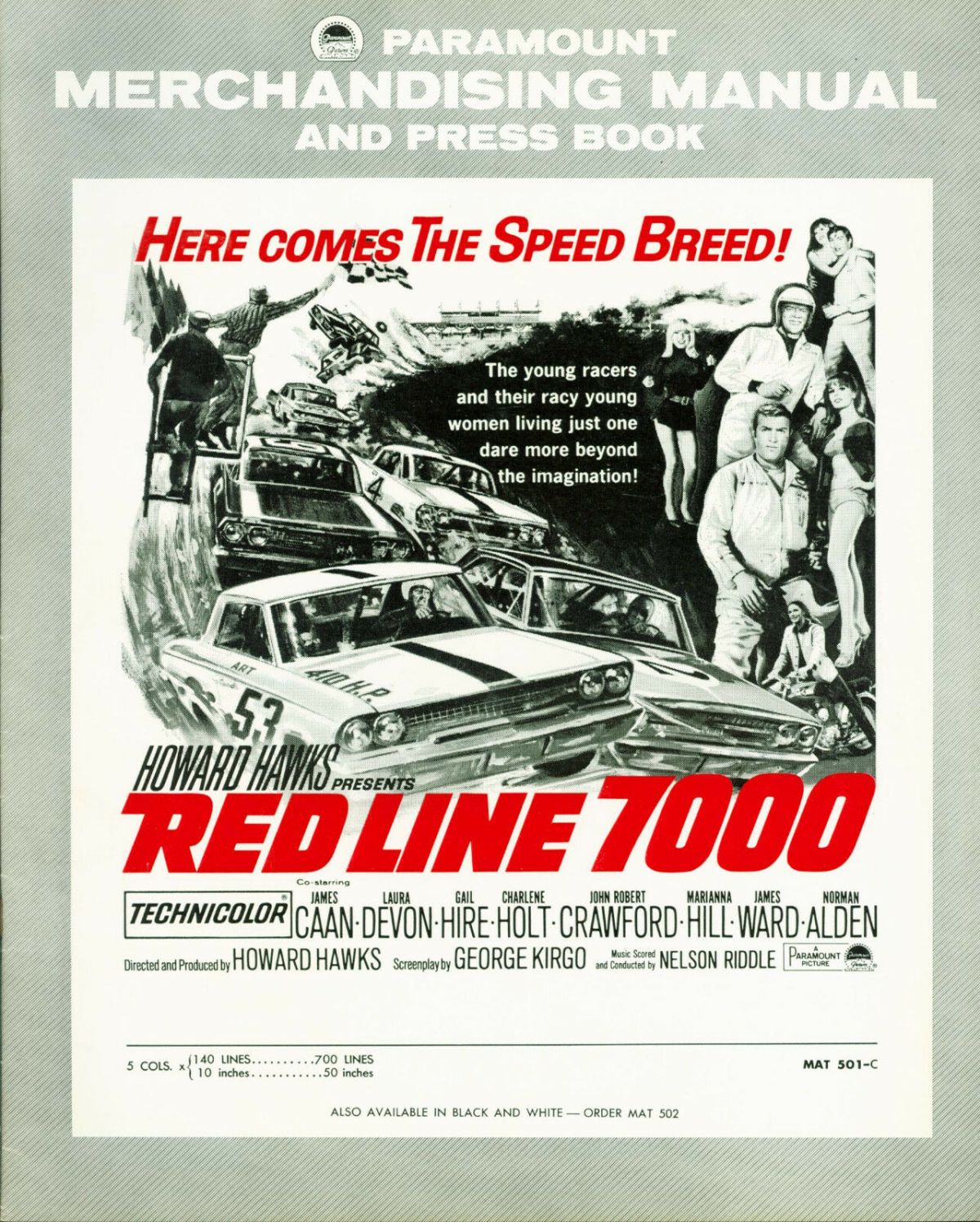
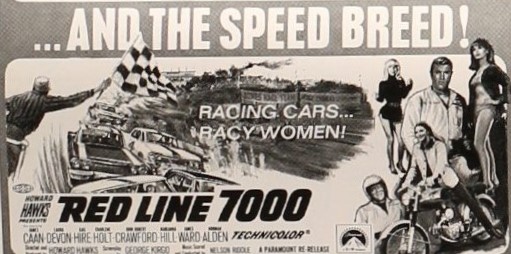
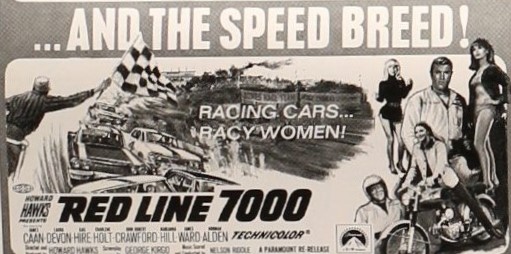
Red Line 7000 (1965) **

Quentin Tarantino is probably alone in preferring this movie mishap to John Frankenheimer’s Grand Prix (1966) – or I have somehow missed a “cult” picture. There was no doubt director Howard Hawks could handle speed. Check out the action in Hatari! (1962) as jeeps battle across tougher terrain than NASCAR racing circuits. But for some reason, he thought he would get away with interspersing footage of races and spectacular crashes with shots of actors behind the wheel. Any time something exciting is about to happen we’re alerted by the commentator saying “oh oh” or “wait a minute” or “hold it.” There’s none of the feverish excitement or authenticity of Grand Prix.

Hawks hired a no-name cast in a bid a) to become a star-maker, b) to prove he did require the marquee wattage of the likes of John Wayne and c) to show he could make a movie cheaply. He failed on all three counts. He probably didn’t think he was taking any kind of gamble at all, as a man approaching 70, in trying to depict the lives of people around 50 years younger. James Caan, in his sophomore outing, comes out best, but that’s not saying much since he has very little to do except growl and look broody. Marianna Hill (El Condor, 1970) is also believable.

While the racing footage has dated in a way that Grand Prix has not, the main problem is just a jumble of characters getting lost in a jumble of stories. No sooner has one character been introduced than we are onto another. There’s none of the cohesive story-telling that marked out The Big Sleep (1946) or Rio Bravo (1959) and, frankly, none of the characters are particularly interesting. And what possessed him to stick in a song sung by a character (Holly, played by Gail Hire) who cannot sing – she talks the lyrics – with a backing group made up of waitresses, I can’t begin to guess.

The most fun to be had is spotting in bit parts people famous for other reasons. Carol Connors, for example, who co-wrote the lyrics to “Gone Fly Now” (Rocky, 1976) appears as a waitress. As does Cissy Wellman, daughter of veteran director William Wellman. Comedian Jerry Lewis has a cameo. It says much for Hawk’s star-spotting abilities that of two female leads, Laura Devon only made five pictures and Gail Hire just two.

Henry Hathaway and Howard Hawks…Together!

Of the main supporting males, this was the beginning and end of John Robert Crawford’s movie career while Skip Hire made a bigger splash as a producer of television series The Dukes of Hazzard. Co-written by the director, George Kirgo (Spinout, 1966) and Steve McNeil (Man’s Favorite Sport, 1964)..

However, the French had a word for it – “genius.” Despite being dismissed as a rare misstep by the bulk of critics worldwide, Cahiers du Cinema decided it was one of the year’s Top Ten pictures. So what do I know?

Behind the Scenes: “Man’s Favorite Sport” (1963)

Should have been, as you might have guessed, Cary Grant (Charade, 1963) in the lead. Should have featured, which you won’t have guessed, Ursula Andress (She, 1965). Should have run, which you’d be amazed to learn, for 145 minutes, almost as long as your standard epic. Should have appeared, like Hatari! (1962), under the Paramount banner.

In fact, the most likely studio destination was Columbia. Hawks’s agent Charles Feldman had  spent 16 months trying to thrash out a very good deal for his client. Feldman, who owned the rights to Casino Royale, was also keen on Hawks directing a James Bond picture. That got as far as discussing Cary Grant as the handsome spy and Hawks’ enlisting the aid of his favorite screenwriter Leigh Brackett (Hatari!).

But instead of moving studios, Hawks decided to stay put, sitting on a three-picture deal worth a hefty $200,000 plus a 50 per cent profit share. First item on the new agenda could have been reuniting Rio Bravo (1959) alumni John Wayne and Dean Martin for The Yukon Trail. But that was before Hawks expressed interest in a romantic short story, The Girl Who Almost Got Away, published in Cosmopolitan magazine, and an ideal fit for Cary Grant.

But Grant, something of the entrepreneur himself, would only sign up if Hawks in turn agreed to direct one of the actor’s pet projects, The Great Sebastian. But the director didn’t like the idea of being a gun for hire and Grant’s attention meanwhile had wandered in the direction of Charade. Rock Hudson, borrowed from Universal, was seen as an ideal replacement. For the female lead Hawks initially enthused about Joanna Moore (Walk on the Wild Side, 1962) until he chanced upon Paula Prentiss (Where the Boys Are, 1960), an MGM contract player.

Paramount balked at a relative unknown. Hawks balked at anyone balking at his choice and switched the project to Universal. While toying with Casino Royale, Hawks had a sneak preview of Dr No (1962) and espied a natural for the second female lead in Ursula Andress. But her management team reckoned the Bond movie would open bigger doors. Instead, Hawks plumped for Austrian blonde Maria Perschy (The Password Is Courage, 1962). Charlene Holt (If A Man Answers, 1962) made such an impression on Hawks that she not only won the part of Rock Hudson’s fiancée but the role of regular girlfriend to the director and parts in his next two pictures.

Leigh Brackett  was brought in to pep up the original script by John Fenton Murray (It’s Only Money, 1962) and Steve McNeil (Red Line 7000, 1965). Unusually, she was rewriting on the hoof, earning $1,000 a week to refashion the lines scene by scene as production unfolded. Everything except the opening scene set in San Francisco was shot on the Universal backlot. Even then, neither Hudson nor Prentiss was transported to San Francisco, their close-ups while driving cars filmed at the studio and inserted as process shots. Hawks didn’t leave the studio either, entrusting that initial footage to associate producer Paul Helmick and cinematographer Russell Harlan.

Like Otto Preminger, Hawks liked a lot of takes. Paula Prentiss didn’t, in part because she felt he was trying to mold her into a screwball comedy heroine of the past, and in part because every take not printed impinged on her confidence. Although Hawks lacked the reputation as a bully of the Otto Preminger variety, nonetheless the inexperienced Prentiss found herself in tears more than once. Cary Grant dropped by one time for a friendly chat. He was made welcome. Angie Dickinson, expecting a similar welcome, received a curt put-down, Hawks making it clear he preferred as a brunette.

While the credit sequence by photographer Don Ornitz was deemed sexist since it comprised 33 models in sports or beach gear, it was actually the opposite because the women were proving how superlative they could be at sports generally considered the preserve of men. But there was no doubt the reaction Hawks expected when he spent $20,000 on black scuba outfits for Prentiss and Perschy, using molds made from their bodies to achieve the skin-tight effect. Hawks was notoriously slow, the picture taking three and a half months.

The initial version of the film attracted at a sneak preview the most positive responses the studio had ever received. The only problem was – it ran 145 minutes, considered an impossible length for a light romantic comedy. Although the next version was shorter, the audience response was decidedly worse. Even so, Universal insisted on further cuts until the movie came in at the two-hour-mark.

Not everyone went along with the official Hawks version of events. Others remembered the response to the various cuts not being so different. The film wasn’t released until six months later and there is no evidence that Hawks fought hard to retain his edit. Although he would later complain that the movie was “sabotaged,” that may have been his automatic default position once the movie proved a relative commercial failure, with only $2.35 million in U.S. rentals

Leigh Brackett had more right to feel disgruntled. She was denied a credit by the Writers Guild of America who contended her work was a polish rather than an original contribution.

I have to say I’m out of step with some of the critical opinion. Molly Haskell reckoned the film was actually some kind of Adam and Eve deal with Hudson “a virgin who has written a how-to book on sex while harbouring a deep fastidious horror of it.” The Haskin critique allows that fish are phallic symbols, therefore giving sexual credence to the scene about learning to handle a fish.

It might just be more straightforward to say that, of course, this isn’t as good as Bringing Up Baby but then, nothing ever was, and just enjoy what Hawks did manage to conjure up with very likeable leads.

SOURCES: Todd McCarthy, Howard Hawks, The Grey Fox of Hollywood (Grove Press, 1997), p595-603; Joseph McBride (editor), Focus on Howard Hawks (Englewood Cliffs); Molly Haskell, “Howard Hawks: Masculine Feminine,” Film Comment, March-April 1974.  

Man’s Favorite Sport (1964) ****

Wow! From an academic/critical perspective this is veteran director Howard Hawks (Hatari!, 1962) taking the mickey out of his famed style, where women are always competing to enter the sacrosanct male world. But, shades of his earlier Bringing Up Baby (1938), a fast-talking assured sassy woman takes command of a hapless male. Sure, Rock Hudson and newcomer Paul Prentiss aren’t in the Cary Grant-Katharine Hepburn league but they make darned good substitutes. And there’s a big difference to the earlier picture. There, Grant was an accepted expert, and it’s not his knowledge that’s in question but here Hudson is a phoney and relies on the woman.

But fiddlesticks to academe and critics, this is just helluva good fun. Built on a brilliant premise, it just rolls along from one set-piece to another to fashion as daft a screwball comedy as you could imagine.  Maybe Rock Hudson left all the physical comedy in Send Me No Flowers (1964) to Doris Day because he was plumb tuckered out by his exertions on this one.

So, Roger Willoughby (Rock Hudson) is a fishing expert employed as a salesperson by Abercrombie & Fitch. When, in a public relations wheeze, Abigail Page (Paula Prentiss) invites him to participate in a competition, she uncovers his terrible secret. He’s never fished before in his life, he’s just a clever listener, passing on fishing lore from one customer to another. She agrees to help him out. But, of course, he’s an idiot and it’s not long before he’s upside down in a car that’s way too small for him, walking around with rubber buckets for shoes and upside down (again) in a lake trapped by inflatable waders.

There’s a marvellous meet-cute where they get off on the wrong foot because she steals his reserved parking spot and his first encounter with her dexterity with language should have warned him what he’s letting himself in for. The situation is complicated by, natch, Abigail falling in love with him, not to mention her buddy Easy (Maria Perschy) not unattracted either, and his fiancée Tex (Charlene Holt) about to appear any second.

So when Roger’s not tying himself in knots, he’s allowing himself to be persuaded to pretend to have a broken arm, which to make it realistic must be encased in plaster, which Abigail and Easy concoct.  The fact you know full well this is only the first step to major complication doesn’t make it any the less funny. Then there’s the problem of the zip in a sleeping bag. And the fiancée turning up at the wrong time.

I could have done without the fake Native American (Norman Alden), but the rest is top-notch. Any other director would have kept the wig gag going for ages, but here it’s dumped early on because the wearer, Roger’s boss Cadwalader (John McGivern), needs little excuse to stop wearing it.

You’d be hard put to find sexuality as cleverly dealt with as here, Abigail and Easy provided with good reason to swan around in skin-tight clothing and later prattling on fifteen to the dozen as pouring rain renders their shirts see-through much to the discomfort of Roger. While Roger might be a typical male, the trio of women are far from typical of the period with a streak of independence that allows little room for the notion of men as the superior species. Not only is Abigail as competent as any male in this type of sport, she far exceeds the capabilities of the supposed expert. Furthermore, Abigail is the antithesis of the scatter-brained Susan Vance from Bringing Up Baby. She knows exactly what she’s doing even if shifted slightly off kilter by the unexpected impact of love.

As the male coming unstuck outside of his comfort zone, Rock Hudson is excellent especially in the physical comedy but the real gem is Paula Prentiss, as effervescent a star as you would ever find. You only have to see her in The Parallax View (1974) to understand what a terrific character she has succeeded in creating. Never mind that she handles the script deftly, she virtually bursts off the screen.  

The general critical consensus is that Howard Hawks went downhill after Rio Bravo (1959), and that outside his final pair of westerns El Dorado (1966) and Rio Lobo (1971) was very much at the tail end of his career. Most critics seemed to have simply ignored that Man’s Favorite Sport took a different approach to the male-female dynamic or that, setting academia aside, this is just a very enjoyable romantic comedy.

Red Line 7000 (1965) *

Quentin Tarantino is probably alone in preferring this movie mishap to John Frankenheimer’s Grand Prix (1966) – or I have somehow missed a “cult” picture. There was no doubt director Howard Hawks could handle speed. Check out the action in Hatari! (1962) as jeeps battle across tougher terrain than NASCAR racing circuits. But for some reason, he thought he would get away with interspersing footage of races and spectacular crashes with shots of actors behind the wheel. Any time something exciting is about to happen we’re alerted by the commentator saying “oh oh” or “wait a minute” or “hold it.” There’s none of the feverish excitement or authenticity of Grand Prix.

Hawks hired a no-name cast in a bid a) to become a star-maker, b) to prove he did not require the marquee wattage of the likes of John Wayne and c) to show he could make a movie cheaply. He failed on all three counts. He probably didn’t think he was taking any kind of gamble at all, as a male approaching 70, in trying to depict the lives of people around 50 years younger. James Caan, in his sophomore outing, comes out best, but that’s not saying much since he has very little to do except growl and look broody. Marianna Hill (El Condor, 1971) is also believable.

While the racing footage has dated in a way that Grand Prix has not, the main problem is just a jumble of characters getting lost in a jumble of stories. No sooner has one character been introduced than we are onto another. There’s none of the cohesive story-telling that marked out The Big Sleep (1946) or Rio Bravo (1959) and, frankly, none of the characters are particularly interesting. And what possessed him to stick in a song sung by a character (Holly, played by Gail Hire) who cannot sing – she talks the lyrics – with a backing group made up of waitresses, I can’t begin to guess.

The most fun to be had is spotting in bit parts people famous for other reasons. Carol Connors, for example, who co-wrote the lyrics to “Gonna Fly Now” (Rocky, 1976) appears as a waitress. As does Cissy Wellman, daughter of veteran director William Wellman. Comedian Jerry Lewis has a cameo. It says much for Hawk’s star-spotting abilities that of two female leads, Laura Devon only made five pictures and Gail Hire just two. Of the main supporting males, this was the beginning and end of John Robert Crawford’s movie career while Skip Hire made a bigger splash as a producer of television series The Dukes of Hazzard.

However, the French had a word for it – “genius.” Despite being dismissed as a rare misstep by the bulk of critics worldwide, Cahiers du Cinema decided it was one of the year’s Top Ten pictures. So what do I know? Make up your own mind – catch it on Amazoon Prime.

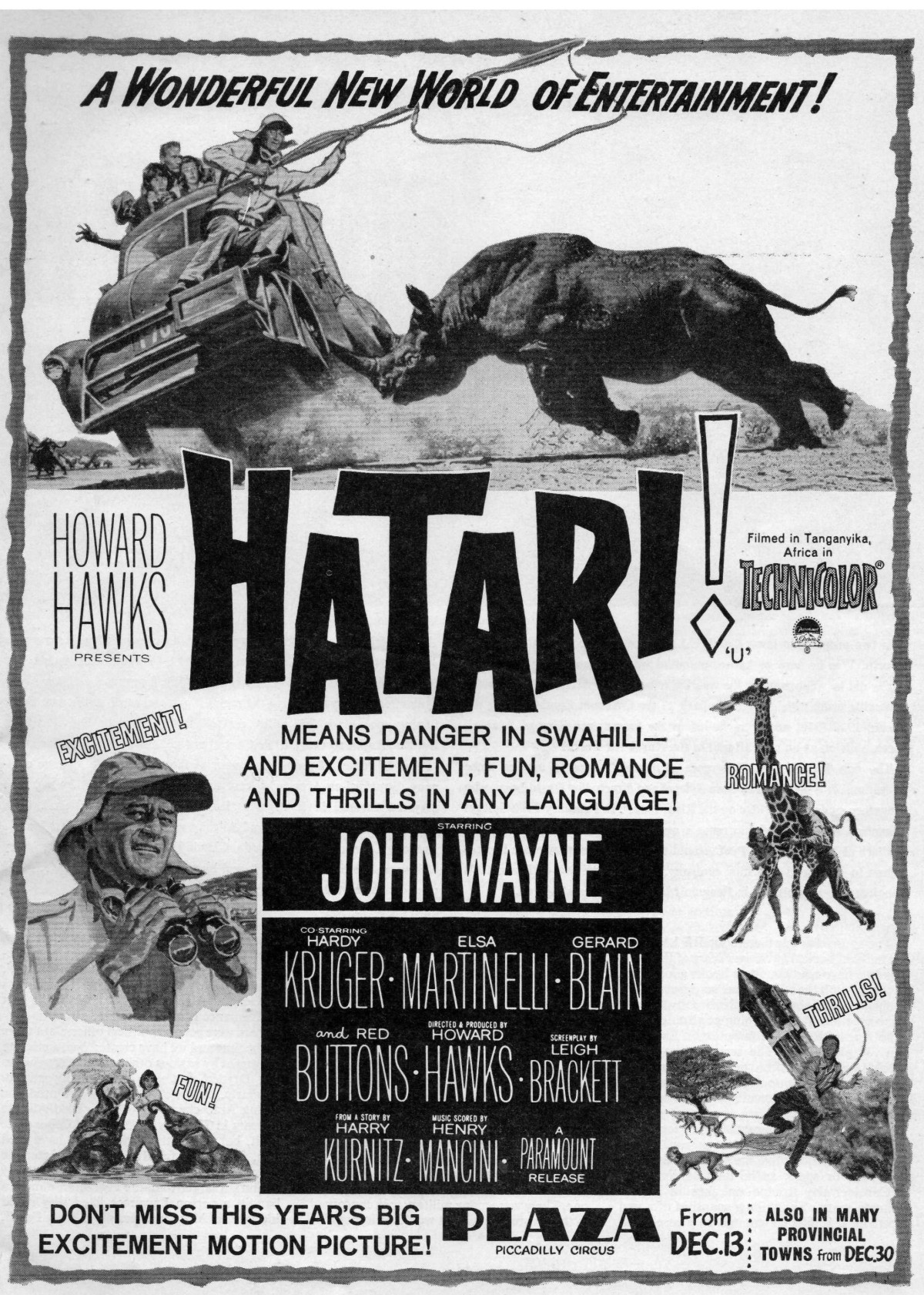
Hatari! (1962) ***

What this movie needed was Cinerama. That format blended exotic locale and thrills. The Tanganyika setting and jeeps belting across uneven terrain to capture myriad wildlife provide the two required elements. But the rest of the film struggles to keep up.

Here Howard Hawks combines his two most common themes, a group of men stuck together facing an unusual task and a battle of the sexes. But without the tension of an upcoming gunfight (Rio Bravo, 1959) or bizarre romantic comedy contrivance (Bringing up Baby, 1938), it falls short of the director’s highest standards. But as he set such high standards, virtually anything would.

Paramount went the extra mile on this one, producing, in addition to the normal pressbook, a special “Care and Handling Manual” such as had previously accompanied Psycho. This was a week-by-week breakdown of marketing activities – from arranging a John Wayne hat tie-up, to getting record stores and bookshops to prepare window displays, stencilling paws on the ground leading to the cinema and organising permits for a safari-parade on opening day. There was a tie-in with Jeep and the movie was a natural for involvement with schools and kids

The original concept intended to pair Clark Gable and John Wayne so that might have produced better results. Setting aside the gripe of the unlikely romance between a young Elsa Martinelli (rather than a mature Maureen O’Hara) and the ageing Wayne, this remains highly entertaining and a thrilling ride. Watching the actors do their own dangerous stunts, bouncing over potholes and battered in trucks moving at high speed, holding on for dear life (Wayne as the catcher unprotected on the outside)  as the vehicles swerved and twisted, the thunder of hooves, confronting extremely dangerous and extremely wild animals such as rhinos, makes up for other deficiencies.

Martinelli does not quite have the zap of a Hepburn or Monroe but does well as the photographer infiltrating a male enclave and her bonding with the baby elephant (triggering Henry Mancini’s “Baby Elephant Walk” theme) steals the picture. A pet leopard also provides a decent riff on the girl-in-the-bath number. Quite a number of plot lines are worked in to give actors of the calibre of Hardy Kruger something to do and to stretch the likes of Red Buttons who is rarely given any decent dramatic material.

In quite a different role, Wayne, for once not called upon to save the day, gives a good performance. Not only do they not make them like that anymore, they wouldn’t be allowed to make them like that these days, notions about working with animals (though none were harmed) much changed.  


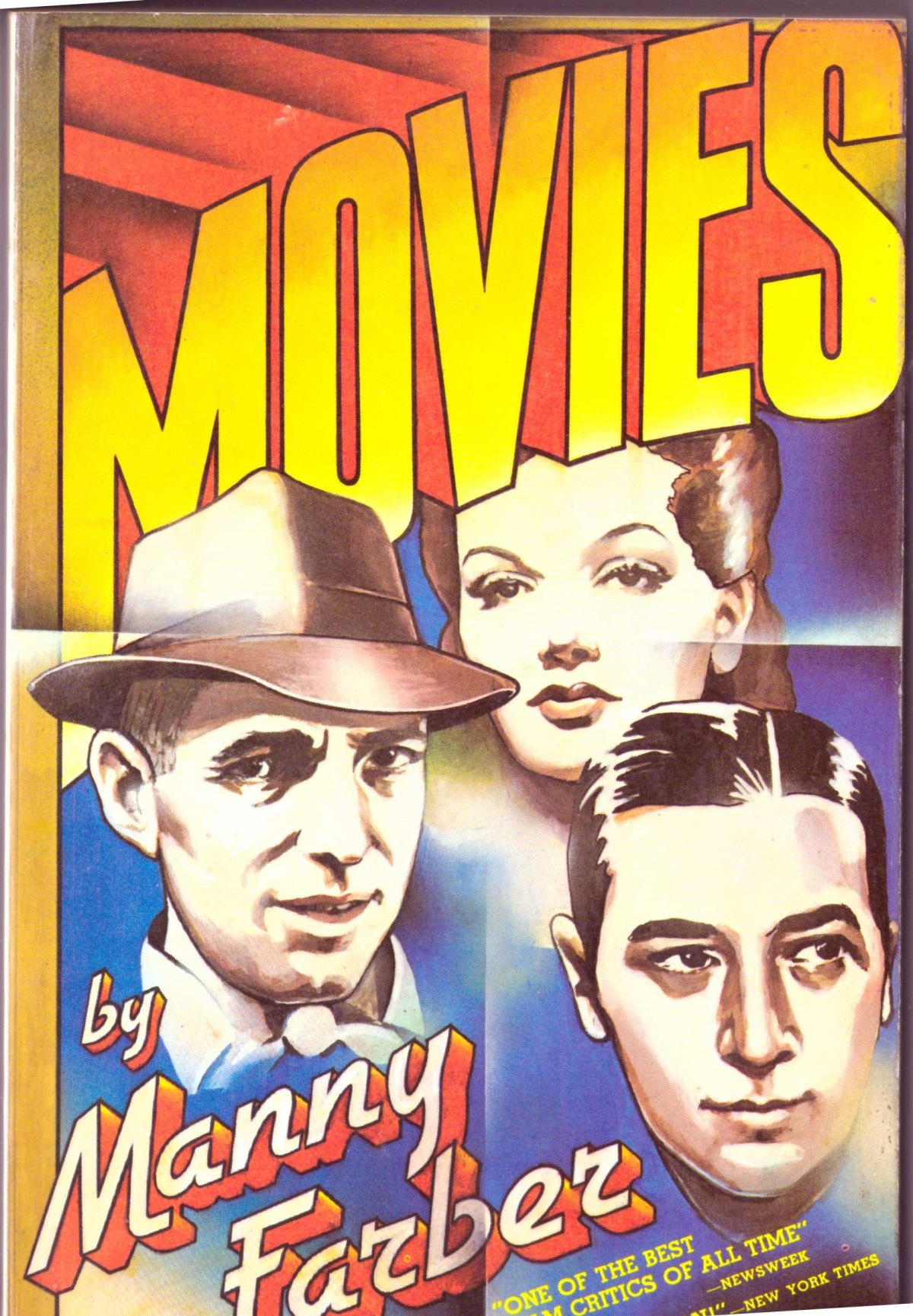
Manny Farber, Critic’s Critic

Gunning for You – Manny Farber

You wouldn’t want to pick a fight with Manny Farber, generally considered along with Andrew Sarris, the godfather of serious film criticism. “Visceral” was the word most commonly associated with his writings.

He came to movies from an unusual perspective. He was a painter, one of the most celebrated still life artists of his generation. He never worked for a big paper like the New York Times or a stylish magazine like the New Yorker. Instead, his work appeared in Film Culture, Artforum, The Nation and men’s magazine Cavalier.

An early advocate of the work of Howard Hawks, Anthony Mann and Raoul Walsh, he was also inclined towards lean B-films over more profligate big-budget pictures.

Chances are you will disagree with everything he said, especially when he was slicing-and-dicing one of your favorites, but it is equally guaranteed that you will marvel at his prose. His work had punch and clarity and it might just make you laugh.

Here are some of his musings on the 1960s movie scene:

Easy Rider (1969): “Dennis Hopper’s lyrical, quirky film is better than good in its handling of death…The death scenes, much more heartbreaking, much less programmed than Peckinpah’s (The Wild Bunch), come out of nowhere…The finality and present-tense quality of the killings are remarkable: the beauty issues from the quiet, the damp green countryside and a spectacular last shot zooming up from a curving road and a burning cycle.”

Lawrence of Arabia (1962): “The most troublesome aspect of Peter O’Toole’s Lawrence is that the story moves faster and further than the actor who is not unlike the Tin Woodsman of Oz (O’Toole starts with a springing outward movement, to walk over the world, then turns into a pair of stilts walking in quick, short strides.)”

On Albert Finney: “The Big Eat is a growing factor in films, in effect probably invented by Finney in his Saturday Night. In his case, it was a combination effect, involving a big chomp, heavy breathing, slashes of braggadocio, a side swivel, and baring of teeth. This emphasized eating has been fined and slowed down in his latest work, but within the timespan of four Finneyfilms it has taken hold, cementing a new convention for giving an underside, the animalistic traits, to character.”

The Ipcress File (1965): “This is a Chandleresque thriller that has no thrills, with an antihero who is more like a sugary flavor than an actor doing a Philip Marlowe…the only suspense is how slowly a knight (non-played ‘superbly’ by Michael Caine) can put dimes in a parking meter, crack eggs in a skillet or flatfoot his way through a library.”

The Rounders (1965): “Fonda’s entry into a scene is of a man walking backward, slating himself away from the public eye. Once in a scene, the heavy jaw freezes, becomes like a concrete abutment, and he affects a clothes-hanger stance, no motion in either arm.”

Who’s Afraid of Virginia Woolf (1966): “The most famous scene is an erotic nondancer, which is neither erotic nor dancelike, in which Elizabeth Taylor suggests a gyrating milk-bottling mechanism.”

The New York Film Festival 1968: “In the category called Bloody Bores, the Festival offered Capricious Summer, Hugo and Josefin and Twenty Four Hours in a Woman’s LifeHugo and Josefin is life as seen through the eyes of a Kodak camera ad.”

On Rita Tushingham: “An even worse example of megalomaniac star who can make the simplest action have as many syllables as her name. The myth that a director makes or breaks a film is regularly disproved by this actress who…carries on a war of nerves against the other actors.”

The Graduate (1968): “Benjy…leads a split life on screen; half the time he’s hung up between Mrs. and Miss Robinson; the other half he’s at half mast; a flattened silhouette…Dustin Hoffman is laid out like an improbably menu. People are always darting into his periphery to point him out as a boy wonder…Benjamin, as it turns out, is Bill Bradley crossed with Denny Dimwit.”

It is unlikely you’ll get hold of this book Movies at a decent price since it is long out-of-print and a collector’s item but you can easily find Farber on Film, a whopping 800-page tome which covers his compete writings.

The Unforgiven (1960) ****

Largely ignored at the time and since due to similarities to The Searchers (and not to be confused with Clint Eastwood’s Unforgiven)  this is worth a second look because it actually bears few similarities to The Searchers.

The overriding thrust (or threat) of the tale is, yes, forcible repatriation but this is a long way from John Wayne’s obsessive twenty-year hunt to kill an innocent girl. While it does ask questions about race and race hatred, it is as much an involving portrait of frontier life – breaking-in horses, cows on the roofs of houses, meals with friends – and a natural cycle of life, young girls bewailing their marital prospects, young men adrift in the wilderness agog at the prospect of visiting a town to see a saloon girl.

Audrey Hepburn plays a foundling, rumored of Native American blood, but brought up under the matriarchal gaze of Lillian Gish and fraternal protection of Burt Lancaster. But she doesn’t “play” a foundling, and certainly not someone unsure of her place in the world. She plays a skittish teenager on the brink of adulthood, on a spectrum between gauche and vivacious, who can’t make up her mind between a young suitor or an Native American horse expert and her suppressed feelings towards Lancaster. She is as apt to leap on an unsaddled horse as jump fully clothed into a river.

Lancaster has a more considered role than usual, a calming influence, sometimes an intermediary, sometimes taking control. Though some characters’ reactions to Native Americans are stereotypical, Huston does not go down that line.  Following the truism that action reveals character, there is a wonderful scene breaking in the horses: while white men struggle, being thrown off or otherwise injured, the Indian simply talks gently to the horse and climbs on board and rides it, revealing that Lancaster, who hired him, saw natural dexterity beyond the stereotype.

What caught my eye most was Huston’s fluidity with the camera. In many scenes, something interesting is developing in the background, in others characters move into frame or their reaction is momentarily captured as the camera busies itself on a more central activity. There are virtually no cutaways to subsidiary characters as you would find in Ford or Hawks. When an unarmed Lancaster confronts a small group of Native Americans at his ranch the camera tracks him as he goes out and then tracks him as he comes back, tension mounting as we wait for the Native Americans over his shoulder to possibly take action. 

The thoughtful and even-handed manner in which Huston handles the material is a bridge to his more mature later works. My only gripe was Lillian Gish’s very white face, as if she had never strayed from her silent film origins or never spent a minute in the sun. Otherwise, this is absorbing and rewarding stuff, and quite unlike anything else from the period.

Discover WordPress

A daily selection of the best content published on WordPress, collected for you by humans who love to read.

The Atavist Magazine

by Brian Hannan

WordPress.com News

The latest news on WordPress.com and the WordPress community.