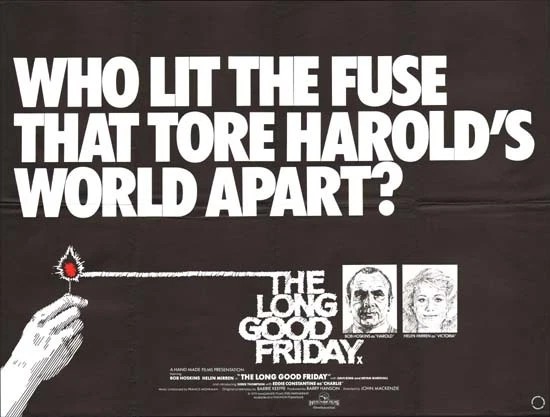
The Long Good Friday (1980) *****

Got two predictions correct – that the conversion of London Docklands into upmarket housing was a potential goldmine and that London would become the beating financial heart of Europe. Though I would have thought everyone, even as arrogant a character as gangster Harold Shand (Bob Hoskins), would have known not to tangle with the IRA. Of course, he hasn’t done this deliberately, that’s just the sting in the tail, unravelling the complex mystery of who’s got it in for him.

This would be a fitting addition to the 1970s trilogy of British gangster pictures par excellenceGet Carter (1971), Villain (1971) and Sitting Target (1972) –  except you could argue it’s better than the lot. Here we’re on The Godfather Part II territory, the big-time hood who’s gone legit. Harold already owns a casino, upmarket restaurant and pubs, and swans around in a luxury yacht but he’s got his eye on bigger game, investment in the Docklands, an ideal money-laundering concept, and he’s hooked a potential partner in American Mafia chief Charlie (Eddie Constantine).
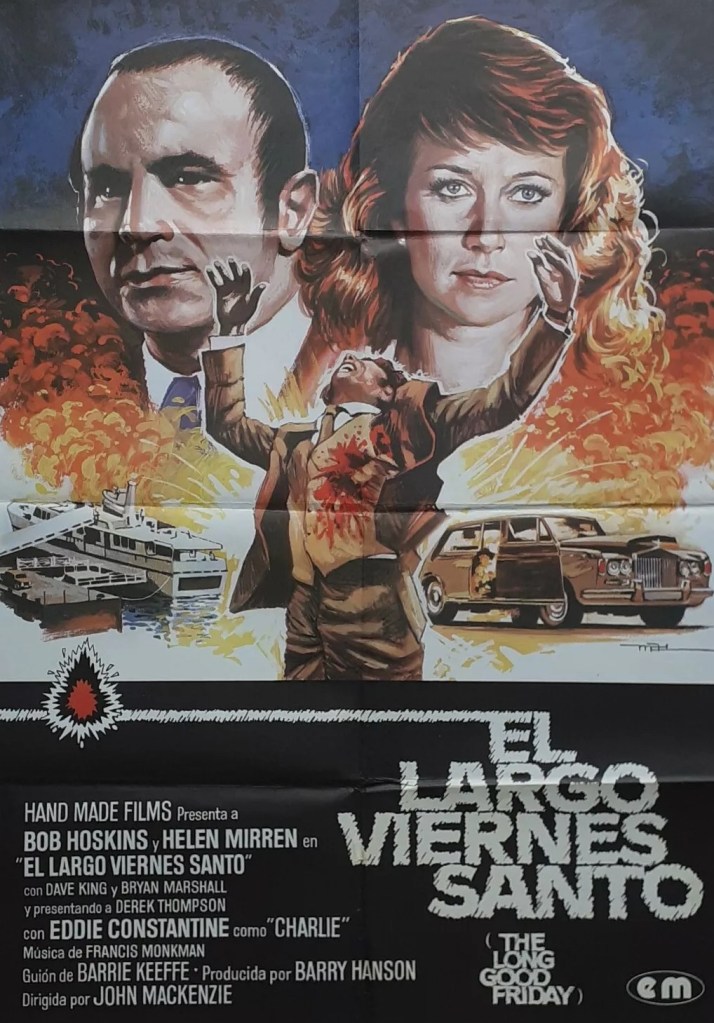
Much as Harold would like to show off his svelte businessman side, his attempts to ooze class disappear at the first sign of trouble and soon he is working those teeth so hard he could be auditioning for Jaws. We’ve got an inkling of what’s going on but it takes a good while for everything to add up and even then Harold is convinced someone’s got their sums wrong since he’s ruled the London underworld for a decade and nobody with any sense would take him on.

The businessman façade falls away when his close aide and longtime buddy Colin (Paul Freeman) is murdered and his Rolls Royce and a pub are blown up. And it takes virtually the whole picture for Harold to discover just why a woman on her way to a funeral stopped the car long enough to spit in the face of one of Harold’s top henchmen, Jeff (Derek Thompson).

So mostly what we’ve got is Harold reverting to old-style violence, presumably using the methods that got him to the top in the first place, as he tortures and terrifies everyone in sight. Some of the brutality is inventive stuff as movie torture goes, one fellow having his naked backside sliced open by a machete, the rest of the top gang leaders rounded up in an abattoir as if they were sides of beef awaiting slaughter.

Meanwhile, wife Victoria (Helen Mirren), a version of what used to be known as “posh totty”, tries to keep the deal active by charming the pants off every male who comes within a sniff of her, some so driven by temptation they declare they “want to lick every inch of her.”

So, on the one hand, it’s big business and all the jiggery-pokery that goes in the legitimate world even among illegal contenders, and on the other hand it’s all the jiggery-pokery that goes on in the illegal world among all the illegal contenders.
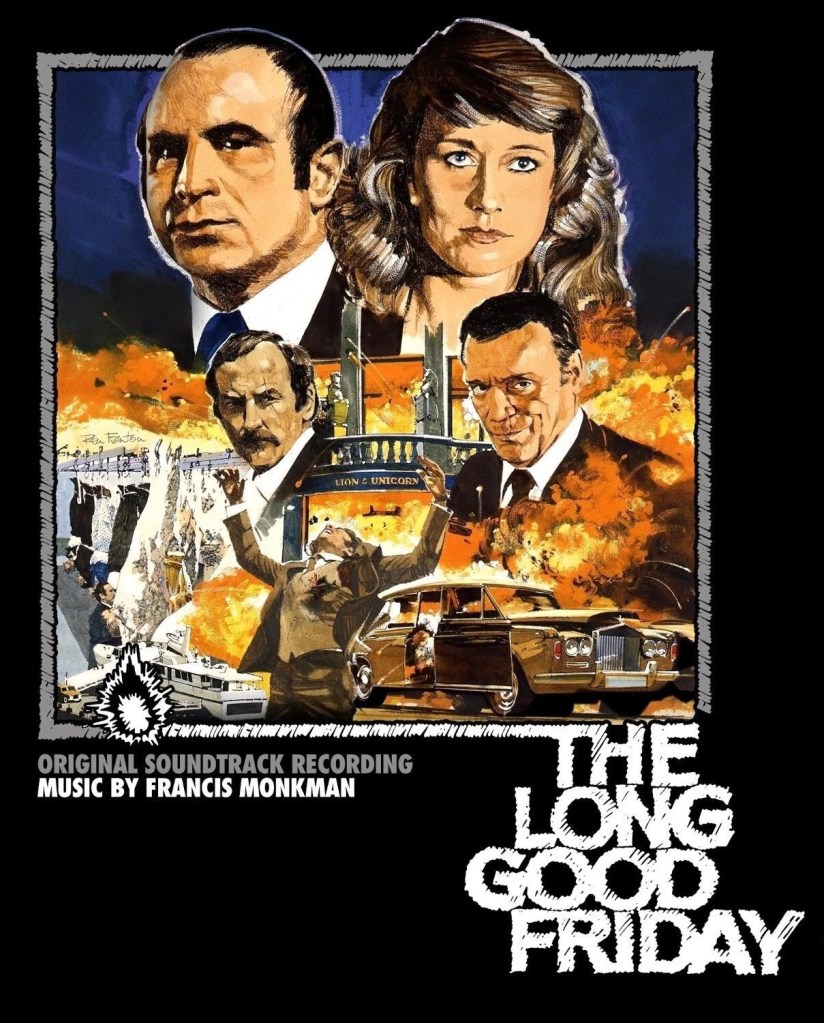
Incredible score by Francis Monkman. Why he wrote so few is a mystery.

While there are many standout moments – and you’d be hard put to beat the climactic scene of Harold in the back of a taxi facing his demise – and director John MacKenzie wields his camera with considerable verve, his ace in the hole is always the expressive face of Harold. Whether he’s practising his bonhomie, or stiffening at the latest outrage, or letting loose physically and verbally it’s a fabulous acting tour de force as if James Cagney had met Al Pacino. And like Oliver Reed in Sitting Target, simmering rage is smoothed over by feminine companionship, the close bond between Harold and Victoria one of the key ingredients.

Turned Bob Hoskins (Zulu Dawn, 1979) into a star and had the British end of the industry been in better shape he had might made a smoother transition to the top echelons instead of waiting for Mona Lisa (1986) to polish his credentials.

Although we Brits like to think the acting of “national treasure” Helen Mirren was always being recognized on the domestic front, long before she achieved unquestionable credibility from pocketing an Oscar for The Queen (2006), in truth by this point her movie career was in limbo. Hardly any screen work since her breakthrough in Age of Consent (1969) and three of her last four pictures – Caligula (1979), S.O.S. Titanic (1979) and The Fiendish Plot of Fu Manchu (1980) – counting as calamities. This was a fresh take on an actress who, too often for her own good, had been seen as better naked than clothed.

It was almost a homage to cult to employ Eddie Constantine (S.O.S. Pacific, 1960) but it was surprising how many of the supporting cast came good including future James Bond Pierce Brosnan as a gay killer, Paul Freeman (Raiders of the Lost Ark, 1981), Derek Thompson (nearly 40 years on BBC series Casualty), and future director Dexter Fletcher (Rocketman, 2019).

Original screenplay by Barrie Keefe on his debut.

Still stands up as a gangster great.
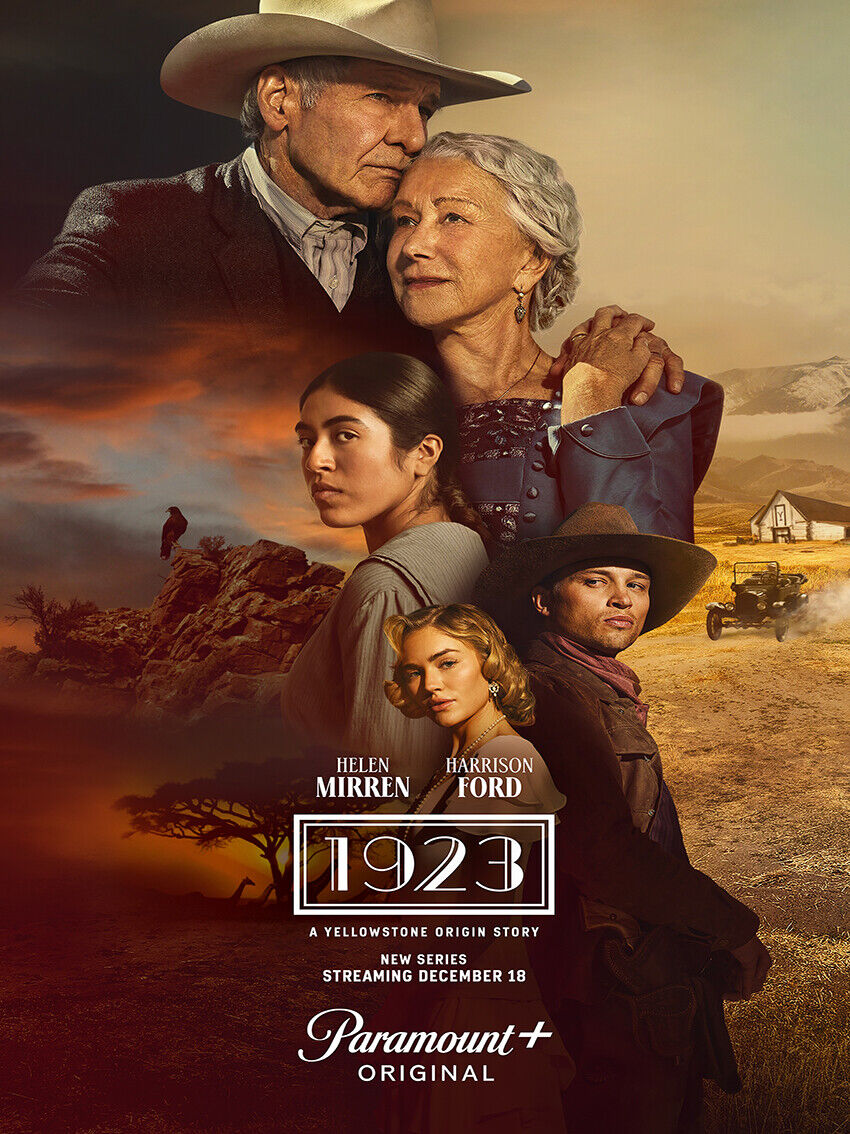
1923 (2023) ***

“The herd comes first,” says matriarch Cara Dutton reading the riot act to a rancher’s daughter. Except it doesn’t. We’ve got umpteen diversions before herd matters lumber into frame. We’ve got dodgy accents, dodgy sheep, dodgy big-game hunters, even dodgier priests and nuns, and you have the feeling that the opening episodes are trying to cram in as many characters (and narrative arcs) as possible at the same time as deciding which ones, for dramatic effect, to kill off or fatally wound.

Some whose purpose remains obscure get beaten half to death anyway, in a quite bizarre segment, Native American Teonna Rainwater (Amina Nieves) has her hands beaten to a pulp by hardass nun Sister Mary (Jennifer Ehle), who in turn receives the same treatment from headmaster Father Renaud (Sebastian Roche) before he thrashes the young lass until she bleeds. Then we’ve got Spencer (Brendon Sklenar) whose only way to put out of his mind the horror of machine-gunning half the German army in the trenches of World War One is to head off to Africa and start knocking off elephants, leopards and lions, who have the temerity to get in some rich guy’s way. He’s not even that good a tracker, failing to notice that it’s two leopards not one who have been picking off humans. Presumably, the leopards had some clever way of masking their footprints.

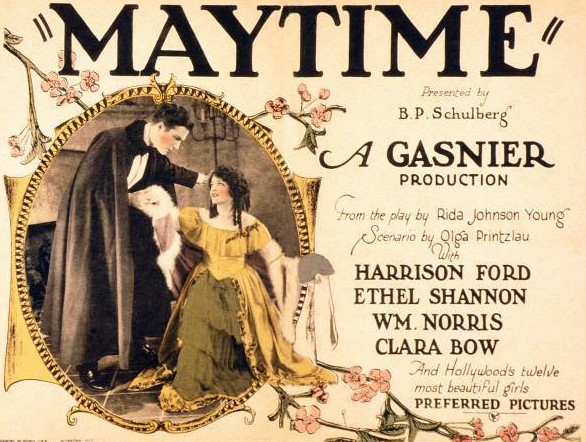
The original Harrison Ford in 1923 picture “Maytime.”

Because of his failing he doesn’t notice the other leopard creeping up on some dumb rich blonde who’s stupid enough to venture out of her tent for late night ablutions. Even more surprising, nobody digs him up for this and, in fact, instead, another far more intelligent blonde Alexandra (Julia Schlaepfer) takes a shine to him – perhaps because he has the temerity to call her Alex – and soon they are sharing a tree to escape marauding lions and hyenas.

And while I’m being picky, what kind of rancher’s daughter, Liz Stafford (Michelle Randolph), doesn’t know that “the herd comes first” and kicks up a ruckus when cattle take precedence over her impending marriage to Jack Dutton (Darren Mann).

You’ll probably be aware that this is a prequel-sequel (taking place before Yellowstone but after 1873) so I suppose you can expect some confusion as the series struggles to get all its ducks in a row. Throw in Prohibition, possibly to explain why machine guns are so easy to come by.

Anyway, the central narrative, once you’ve managed to put all these interruptions to one side, is that there’s a drought and tough ornery patriarch Jacob Dutton (Harrison Ford) isn’t inclined to share his lush pastures with the neighboring sheep farmers led by Banner Creighton (Jerome Flynn). But if in Yellowstone the ranchers occasionally had to abide by the law, here they take advantage of more lawless times and it’s not long before sheep farmers are being lynched. And it’s not long before revenge becomes the order of the day, the various Duttons ambushed in episode three, some so badly you might have believed this was the kind of horror film where you had to guess who lived and died. If Cara is anything to go by, nobody crosses the Duttons, as witnessed in the opening scene where she brutally guns down a fleeing wounded man.

I caught the first three episodes courtesy of British Airways when I was returning on the red eye from a trip to Los Angeles and had enjoyed what I had seen of Yellowstone (catching it on DVD rather than Paramount Plus) so I was looking forward to some slow-burn drama with electrifying acting.

What I got was a mini-series-by-numbers, unlikely development heaped on unlikely development, characters with no room to maneuver and closed-off from any arc and nothing of the freshness of the original. I’m so used to Harrison Ford turning off the charm by now and reverting to his grumpy old man persona and to Helen Mirren going tough that this almost seemed like routine. The two other love duets were just cliché. The white hunter and the English grand dame, and the spoiled rancher’s daughter with little to do but wail about how the cattle that brought her such prosperity were spoiling her life.

I had expected that I would enjoy such a tantalising glimpse of a new series that I’d be obliged to sign up for the streamer the minute I got home. But I think I can just as easily do without.

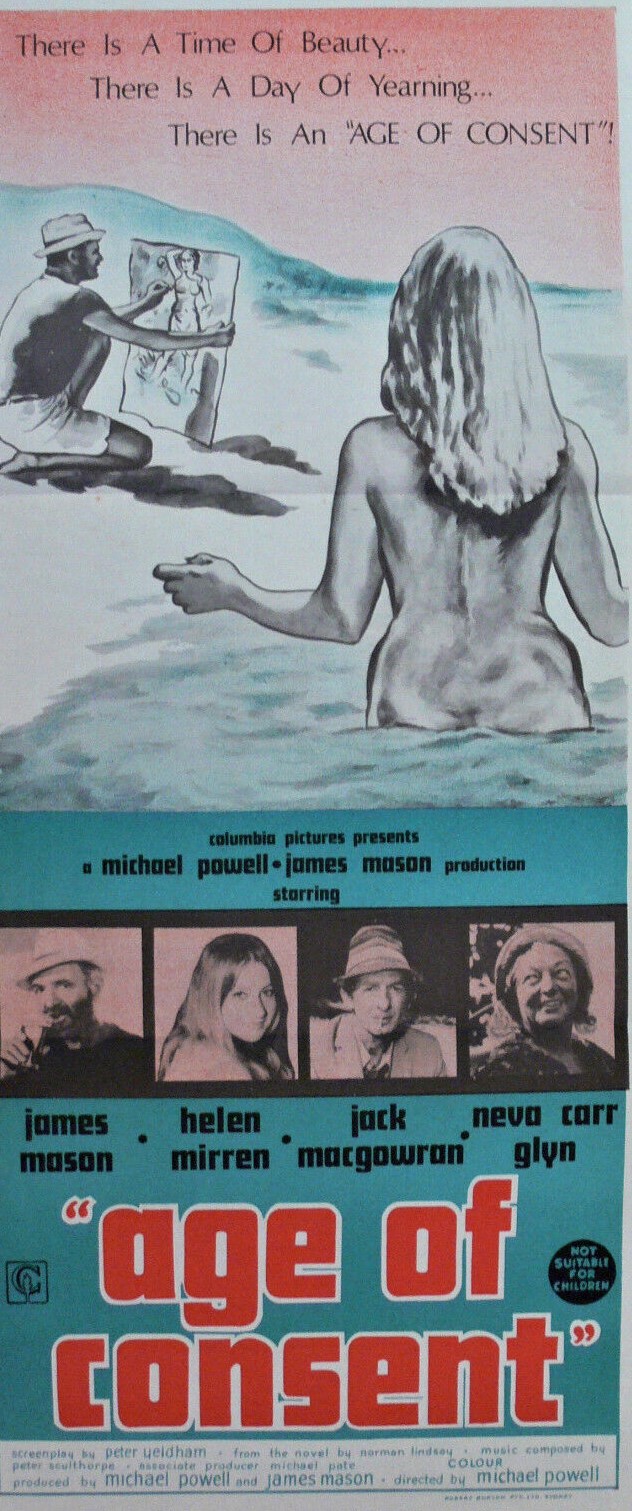
Age of Consent (1969) ***

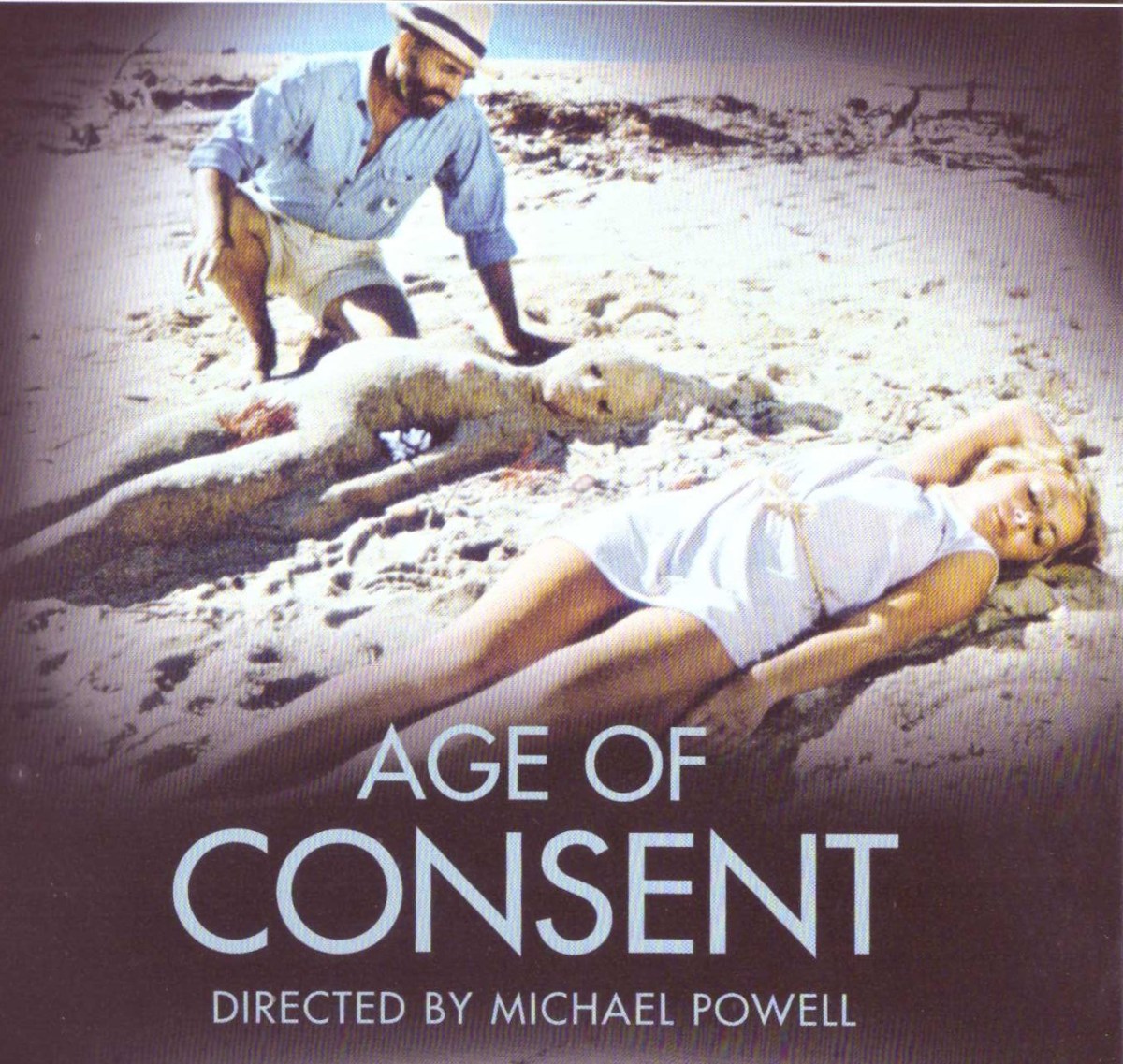
Reputations were made and broken on this tale of a jaded artist returning to his homeland to rediscover his mojo. Director Michael Powell had, in tandem with partner Emeric Pressburger, created some of the most acclaimed films of the 1940s – A Matter of Life and Death (1946), Black Narcissus (1947) and The Red Shoes (1948) – but the partnership had ended the next decade. Powell’s solo effort Peeping Tom (1960) was greeted with a revulsion from which his career never recovered. Age of Consent was his penultimate picture but the extensive nudity and the age gap between the principals left critics shaking their heads.

For Helen Mirren, on the other hand, it was a triumphant start to a career that has now spanned over half a century, one Oscar and three nominations. She was a burgeoning theatrical talent at the Royal Shakespeare Company when she made her movie debut as Mason’s muse. It should also be pointed out that when it came to scene-stealing she had a rival in the pooch Godfrey.

You would rightly be concerned that there was some grooming going on. Although 24 at the time of the film’s release, Cora (Helen Mirren), an under-age nymph, spends a great deal of time innocently cavorting naked in the sea off the Great Barrier Reef in Australia. But there are a couple of provisos. In the first place, Cora was not swimming for pleasure, she was diving for seafood to augment her impoverished lifestyle. In the second place, she was so poor she would hardly have afforded a bikini and was the kind of free spirit anyway who might have shucked one off.

Thirdly, and more importantly, artist Bradley Morahan (James Mason) wasn’t interested. He wasn’t the kind of painter who needed to perve on young girls. An early scene showed him in bed with a girlfriend and it was clear that he was an object of lust elsewhere. Morahan, fit and tanned, obsessed like any other artist about his talent, and was in this remote stretch not to hunt for young naked girls but to find inspiration. As well as eventually painting Cora, he also transforms the shack he rents into something of beauty.

Morahan is vital to Cora’s self-development. The money he pays her for modelling goes towards her escape fund. Her mother being a useless thieving alcoholic, she has little in the way of role model. And the world of seafood supply is competitive. She is lost in paradise and the scene of her buying a tacky handbag demonstrates the extent of her initial ambition. Although her physical attributes attract male attention, it is only on forming a relationship with the painter that Cora begins to believe in herself. There’s not much more to the central story than the artist rediscovering his creative spark and helping Cora’s personal development along the way.

Morahan is a believable character. He is not an impoverished artist. Far from being self-deluded, he is a questing individual, turning his back on easy money and the temptations of big city life in order to reinvent himself. He isn’t going to starve and he has no problems with women. And he is perfectly capable of looking after himself.  A more rounded artist would be hard to find. Precisely because there is no sexual relationship with Cora, the movie, as a film about character development, is ideally balanced.

The movie is gorgeously filmed, with many aerial shots of the reef and underwater photography by Ron and Valerie Taylor. 

What does let the show down is a proliferation of cliched characters who over-act. Nat Kelly (Jack McGowran), sponging friend, ruthless seducer and thief, leads that list closely followed by Cora’s grandmother (Neva Carr-Glynn) who looks like a reject from a Dickens novel. There’s also a dumb and dumber cop and a neighbor so bent on sex that she falls for Kelly. It’s not the first time that comedy has got in the way of art, but it’s a shame it had to interrupt so often what is otherwise a touching film.

At its heart is a portrait of the artist as an older man and his sensitive relationship with a young girl. In later years, Powell married film editor Thelma Schoonmaker and after his death she oversaw the restoration of Age of Consent, with eight minutes added and the Stanley Myers score replaced by the original by Peter Sculthorpe. 

Unusually sensitive screenplay from Peter Yeldham who, as my readers will know, is more usually associated with Harry Alan Towers productions like Bang! Bang! You’re Dead / Our Man in Marrakesh (1966), based on the novel by Norman Lindsay.  

Intriguing, occasionally moving, superb debut from Mirren plus it works.

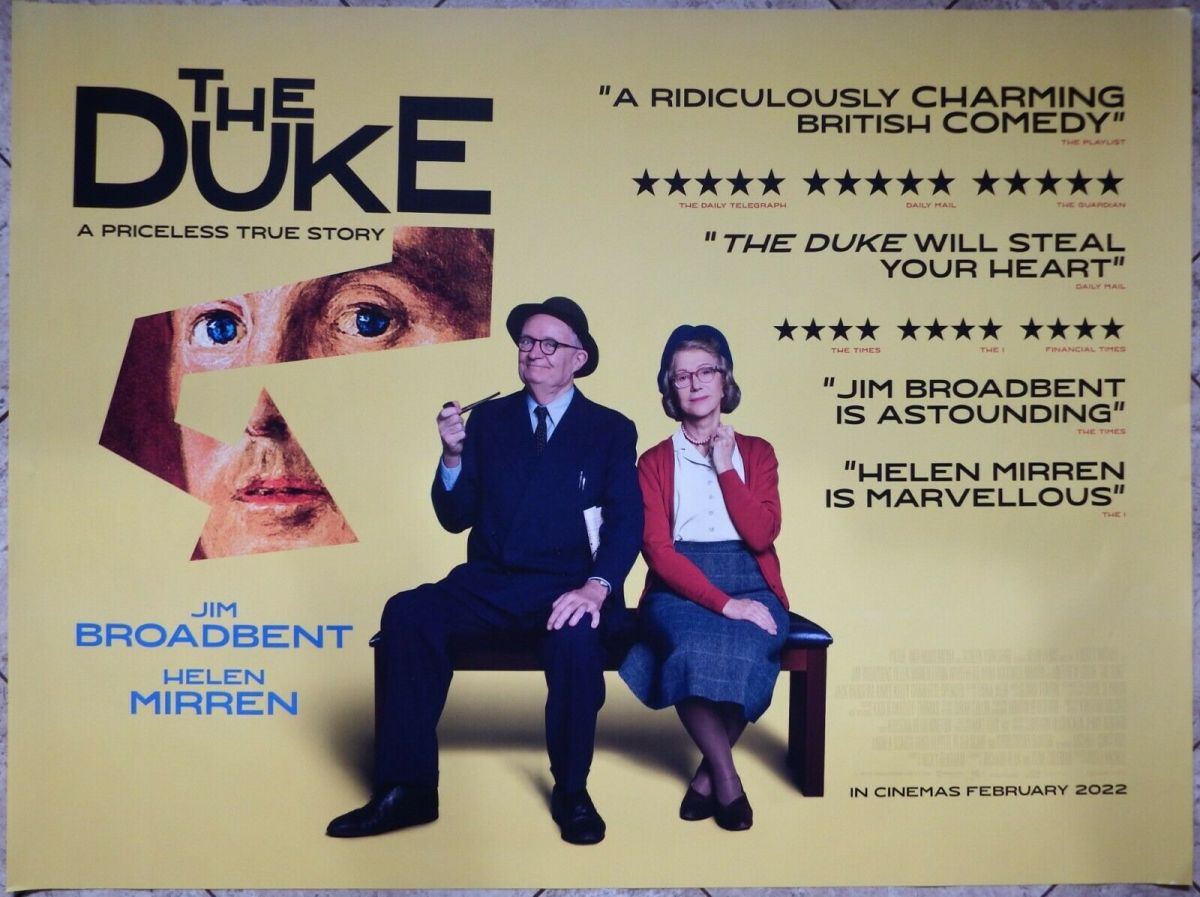
The Duke (2020) *** – Seen at the Cinema

The most stunning twist since Keyser Soze shucked off his disguise in The Usual Suspects (1995). But where Soze’s trick was a cinematic triumph, here moviegoers are duped by unfair sleight-of-hand. 

If ever there was a movie of two halves, this is it. For the first half we are presented with  Kempton Bunton (Jim Broadbent) as a dour working-class liberal devoted to fighting every cause. In the second half he’s a stand-up comic with the legal profession eating out of his hand, as if the character that turned up in court bore no relation to the one in the initial section. And if his defense for stealing from the National Gallery a Goya painting of the Duke of Wellington seemed rather far-fetched even for someone as cause-addicted as him that is because, as we discover in the trick ending, it was just that, entirely made up.

You may also have wondered how a 60-year-man was quite so nimble as to scale a high fence and climb up a couple of floors by ladder, then the trick at the end reveals that this too is part of the audience deception.

Which leaves you wondering just why the core of the story – that a father volunteers to take the place of his guilty son and face the prospect of years in prison – does not even merit a scene. If it wasn’t for the performance of Broadbent and Helen Mirren as his wife, as tour de force an acting partnership as you could hope for, you would wonder what on earth was the point of making the film.

Who outside Britain has ever heard of the license fee? Everyone knows about the BBC, of course, but I would doubt very much if anyone has any idea that what appears to be a free public service broadcasting body (akin to PBS in the U.S.) actually has to be paid for on an annual basis by every single person in the country who owns a television set. Since Bunton claims he stole the painting in protest against certain members of the public being forced to pay this fee, you might wonder how this is going to go down in foreign parts. Setting Bunton up as a working-class rebel on the basis of this preposterous idea is one of the barmiest notions ever to afflict a screenwriter.

This movie has been receiving rave reviews – and picked up £3 million at the box office – because it is charming, pokes fun at the BBC and the Police and the Government and feels like a latter-day Ealing comedy with Broadbent and Mirren in top form. I was duped by the reviews and by the trailer which showed all the funny bits but was bored for a first half that seemed like a very out-of-date attack on too many targets, without providing any real measure of the man who turned into a supreme entertainer in the second half. Some of the issues he raised such as racism were worthy of his defence, but others were simply ignored. The fact that workers could be dismissed in the 1960s for any reason whatsoever with no recourse to tribunals was glossed over. The fact that he was sacked for allowing his taxi passengers to travel for free – the taxi owners not Kempton thus footing the bill – or possibly for boring is passengers to death with his strident views is equally ignored.

I have to say that initially I did enjoy the film. But afterwards I began to have a niggling feeling that somewhere along the way I had been cheated. If Bunton knew he was innocent and was simply taking the fall for his guilty son, his idealistic crusade was pointless. You would have to ask why did he not just return the painting? I can’t believe there was no confrontation with his son. Are we expected to imagine that Bunton just congratulated his son on providing him with a perfect opportunity to embarrass the BBC and thought to himself it was well worth a jail sentence regardless of the fact it would put his wife through hell.

It feels like the director was expecting after the revelation at the end that the audience would just say “oh now it all makes sense” rather than the opposite, that it made no sense at all unless we were shown collusion between father and son, and the son especially accepting the burden of the sacrifice his father was making.

In The Usual Suspects, audiences went back over the film to marvel at just how clever Soze had been. Here, though, when you try to do the same, it doesn’t work. The Bunton we are shown in the first half was not a deliberate fiction dreamt up by the character, but simply a directorial device to misdirect the audience. The big reveal appears without any reference to the father and no sign of guilt on the part of the son.

This was not one of those legal pictures where there would be a last-minute reprieve or a lawyer in the Perry Mason mold saving the day. It was a contrivance so Bunton would have his day in court and deliver his philosophy on life to a wider audience. For all I know he may well have thought such an opportunity was worth the imprisonment. But for all this sleight-of-hand to work the director had to just completely ignore the core relationship between father and son and between innocence and guilt. It would say a lot for a son that he carried out the theft out of love for his deluded father, but such a scene would have to be left to our imagination.

Year-End Round-Up: Top 30 Films Chosen by You

Top 30

This isn’t my choice of the top films of the year, but yours, my loyal readers. This is a chart of the films viewed the most times over the full calendar year of January 2021 – December 2021.

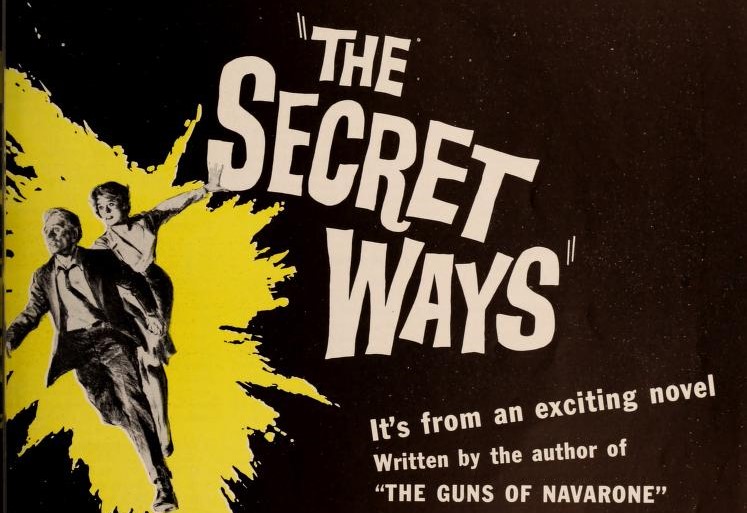
  1. The Secret Ways (1961). Richard Widmark in spy thriller set in Hungary during the Cold War and adapted from the Alistair MacLean novel. Senta Berger has a small role.
  2. Ocean’s 11 (1960). Frank Sinatra, Dean Martin and the Rat Pack embark on an audacious Las Vegas robbery.  
  3. Pharoah (1966). Epic Polish picture about political shenanigans in ancient Egypt.
  4. Age of Consent (1969). Helen Mirren stars as the nubile muse of jaded painter James Mason returning to his Australian roots.
  5. The Venetian Affair (1966). Robert Vaughn hits his acting stride as a former CIA operative turned journalist investigating suicide bombings in Venice. Great supporting cast includes Elke Sommer and Boris Karloff.
  6. The Golden Claws of the Cat Girl (1968). Cult French movie  starring Daniele Gaubert as a sexy cat burglar.
  7. Moment to Moment (1966). Jean Seberg is caught up in a Hitchcockian murder plot in the French Riviera. Also features Honor Blackman.
  8. It’s Not All Rock’n’Roll (2020).  Ageing rocker Dave Doughman aims to mix a career with being a father in this fascinating documentary.
  9. 4 for Texas (1963). Frank Sinatra and Dean Martin face off in a Robert Aldrich western featuring Ursula Andress and Anita Ekberg with Charles Bronson in a smaller part.
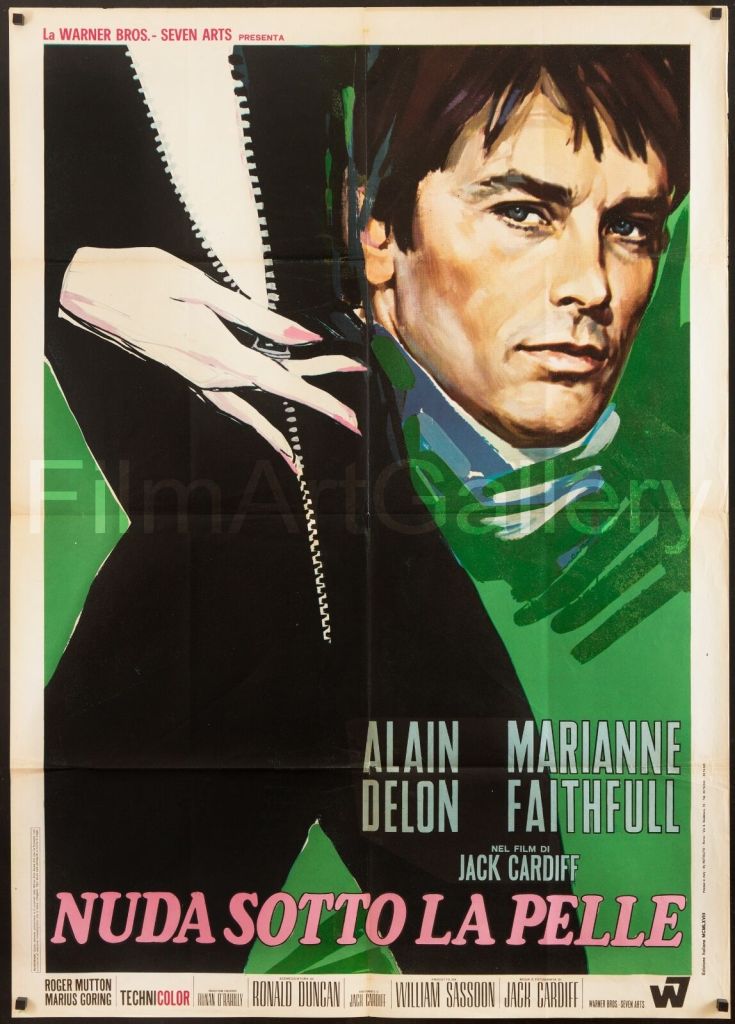
  10. Once a Thief (1965). Trying to go straight ex-con Alain Delon is coerced into a robbery. Ann-Margret is a revelation as his wife. Jack Palance, Van Heflin and Jeff Corey add up to a great supporting cast.  
  11. Stiletto (1969). Alex Cord as a Mafia hitman wanting to retire is pursued by tough cop Patrick O’Neal. Britt Ekland heads a supporting cast which includes Roy Scheider, Barbara McNair and Joseph Wiseman.
  12. Subterfuge (1968). C.I.A. operative Gene Barry is called to London to uncover a mole in M.I.5. Joan Collins provides the romance. Richard Todd, Tom Adams, Suzanna Leigh and Michael Rennie lend a touch of class.
  13. The Swimmer (1968). Burt Lancaster delivers a superlative performance as a man whose life is falling apart.
  14. The Rock (1996). Blistering thriller starring Sean Connery as an ex-inmate of Alcatraz helping Nicolas Cage infiltrate the island to prevent mad general Ed Harris destroying San Francisco. Michael Bay directs.
  15. The Sicilian Clan (1969). Alain Delon joins forces with Jean Gabin to pull off an daring jewel heist with tenacious cop Lino Ventura on their trail. French thriller directed by Henri Verneuil.
  16. The Naked Runner (1967). With his son held hostage, Frank Sinatra is forced to carry out an assassination in East Germany.
  17. A House Is Not a Home (1965). Biopic of notorious madam Polly Adler (played by Shelley Winters) who rubbed shoulders with the cream of Prohibition gangsters.
  18. Pressure Point (1962). Prison psychiatrist Sidney Poitier must help racist Nazi Bobby Darin.
  19. Genghis Khan (1965). Omar Sharif plays the legendary warlord who unites warring Mongol tribes. Stellar cast includes Stephen Boyd, James Mason, Francoise Dorleac, Eli Wallach, Telly Savalas and Robert Morley.
  20. A Twist of Sand (1968). Beleaguered smuggler Richard Johnson spars with Jeremy Kemp in thriller about hidden diamonds in Africa. Honor Blackman is along for the voyage.
  21. Jason and the Argonauts (1963). Ray Harryhausen special effects dominate this legendary tale of the hunt for the Golden Fleece.  
  22. Dr Syn Alias the Scarecrow (1963). Disney movie that was turned into a mini-series in the U.S. starring Patrick McGoohan as the eponymous Robin Hood-type character who assists smugglers.
  23. The Hitman’s Wife’s Bodyguard (2021). Ryan Reynolds and Samuel L. Jackson reunite for wild sequel also featuring Salma Hayek and Antonio Banderas.
  24. Dark of the Sun / The Mercenaries (1968). Rod Taylor leads a private army into the war-torn Congo to rescue a cache of uncut diamonds. Jim Brown, Yvette Mimieux and Kenneth More co-star. Based on the Wilbur Smith bestseller.
  25. The Guns of Navarone (1961). Classic war mission picture with an all-star cast of Gregory Peck, David Niven, Anthony Quinn, Stanley Baker, Irene Papas and Gia Scala. Adapted from the Alistair McLean bestseller.
  26. Maroc 7 (1967). Gene Barry infiltrates a gang of jewel thieves in Morocco operating under the cover of a fashion shoot. Dazzling female cast includes Elsa Martinelli, Cyd Charisse, Tracy Reed and Alexandra Stewart.
  27. The Satan Bug (1965). John Sturges adaptation of Alistair MacLean pandemic thriller stars George Maharis, Richard Basehart and Dana Andrews.
  28. Five Golden Dragons (1967). Cult thriller with Robert Cummings as the playboy caught up in an international crime syndicate. Klaus Kinski and Christopher Lee head an exceptional supporting cast that also includes Margaret Lee, Brian Donlevy, George Raft, Dan Duryea and Maria Rohm.
  29. Claudelle Inglish (1961). Diane McBain as the poor farmer’s daughter who wants to get rich quick.
  30. Jessica (1962). Angie Dickinson plays a young widow who turns so many heads in a small Italian town that their wives seek revenge.

Readers’ Top 30

I’ve been writing this Blog now for one year, beginning July 2020, so I thought I’d take a look at which posts proved the most popular (in terms of views) with my readers. So here’s the annual top 30 films, ranked in order of views.

  1. The Secret Ways (1961) – Richard Widmark and Senta Berger – making her Hollywood debut – behind the Iron Curtain in gripping adaptation of the Alistair Maclean thriller.
  2. Ocean’s 11 (1960) – Frank Sinatra, Dean Martin, Sammy Davis Jr. and the Rat Pack in entertaining heist movie set in Las Vegas.
  3. It’s Not All Rock’n’Roll (2020) – remarkable documentary about the other side of the music business as ageing rocker Dave Doughman tries to keep his dreams alive.
  4. Age of Consent (1969) – British actress Helen Mirren makes her movie debut as the often naked muse for painter James Mason in touching drama directed by Michael Powell.
  5. The Venetian Affair (1966) – Robert Vaughn shakes off his The Man from Uncle persona in taut Cold War thriller also starring Elke Sommer as his traitorous wife and Boris Karloff in a rare non-horror role.
  6. The Golden Claws of the Cat Girl / La Louve Solitaire (1968) – French cult thriller starring Daniele Gaubert as sexy cat burglar forced to work for the government.
  7. Pharoah / Faron (1966) – visually stunning Polish epic about the struggle for power in ancient Egypt.
  8. The Swimmer (1968) – astonishing performance by Burt Lancaster as a man losing his grip on the American Dream.
  9. Stiletto (1969) – Mafia thriller with hitman Alex Cord and and illegal immigrant girlfriend Britt Ekland hunted by ruthless cop Patrick O’Neal.
  10. The Naked Runner (1967) – after his son is taken hostage businessman Frank Sinatra is called out of retirement to perform an assassination.
  11. Marnie (1964) – Sean Connery tries to reform compulsive thief Tippi Hedren in Alfred Hitchcock thriller.
  12. Our Man in Marrakesh / Bang! Bang! You’re Dead (1966) – Entertaining thriller sees Tony Randall and Senta Berger mixed up in United Nations plot involving the likes of Klaus Kinski and Herbert Lom.
  13. The Happening (1967) – Anthony Quinn locks horns with Faye Dunaway and a bunch of spoiled rich kids in kidnapping yarn.
  14. Dark of the Sun / The Mercenaries (1968) – Rod Taylor and Jim Brown head into the heart of darkness in war-torn Africa with a trainload of diamonds and refugees including Yvette Mimieux.
  15. The Guns of Navarone (1961) – men-on-a-mission Alistair Maclean World War Two epic with all-star cast including Gregory Peck, David Niven, Anthony Quinn, Anthony Quayle, Stanley Baker, Irene Papas, James Darren and Gia Scala.
  16. The Sicilian Clan (1969) – three generations of French tough guys – Jean Gabin, Lino Ventura and Alain Delon – clash in Mafia-led jewel heist.
  17. 4 for Texas (1963) – Frank Sinatra and Dean Martin as double-dealing businessmen in highly entertaining Robert Aldrich Rat Pack western starring Ursula Andress and Anita Ekberg.
  18. Five Golden Dragons (1967) – Innocent playboy Robert Cummings becomes enmeshed with international crime syndicate led by Christopher Lee, George Raft and Dan Duryea.
  19. Duel at Diablo (1966) – James Garner and Sidney Poitier team up to protect Bibi Andersson in Ralph Nelson western.
  20. Move Over Darling (1963) – after years marooned on a desert island Doris Day returns to find husband James Garner just married to Polly Bergen.
  21. Pressure Point (1962) – prison psychiatrist Sidney Poitier is forced to treat paranoid racist inmate Bobby Darin.
  22. Wonder Woman 84 (2020) – in one of the few films to get a cinematic screening during lockdown, Gal Gadot returns as mythical superhero to battle supervillain Kristen Wiig.
  23. Genghis Khan (1965) – Omar Sharif as the Mongol warrior who conquered most of the known world, tangling with rival Stephen Boyd and Chinese mandarin James Mason on the way.
  24. A Fever in the Blood (1961) – Warner Bros wannabes Efrem Zimbalist Jr, Angie Dickinson, Jack Kelly and veteran Don Ameche in tough political drama.
  25. The Prize (1963) – Paul Newman and Elke Sommer investigate murder in the middle of the annual Nobel Prize awards in Sweden.
  26. In Search of Gregory (1969) – wayward Julie Christie embarks on pursuit of Michael Sarrazin who may – or may not – be a figment of her imagination.
  27. Justine (1969) – Dirk Bogarde and Michael York become entangled in web woven by Anouk Aimee in corrupt pre-World War Two Middle East.
  28. The Girl on a Motorcycle (1968) – singer Marianne Faithful in a hymn to the open road and sexual freedom.
  29. Blindfold (1965) – psychiatrist Rock Hudson and dancer Claudia Cardinale in highly entertaining mystery thriller about missing scientists.
  30. Hammerhead (1968) – secret agent Vince Edwards and goofy Judy Geeson on the trail of evil mastermind Peter Vaughn.

Age of Consent (1969) ***

Reputations were made and broken on this tale of a jaded artist returning to his homeland to rediscover his mojo. Director Michael Powell had, in tandem with partner Emeric Pressburger, created some of the most acclaimed films of the 1940s – A Matter of Life and Death (1946), Black Narcissus (1947) just remade by the BBC and The Red Shoes (1948) – but the partnership had ended the next decade. Powell’s solo effort Peeping Tom (1960) was greeted with a revulsion from which his career never recovered. Age of Consent was his penultimate picture but the extensive nudity and the age gap between the principals left critics shaking their heads.

For Helen Mirren, on the other hand, it was a triumphant start to a career that has now spanned half a century, one Oscar and three Oscar nominations. She was a burgeoning theatrical talent at the Royal Shakespeare Company when she made her movie debut as the muse of the artist played by James Mason. It should also be pointed out that when it came to scene-stealing she had a rival in the pooch Godfrey.

You would rightly be concerned that there could be some grooming going on. Although 24 at the time of the film’s release, Mirren played an under-age nymph who spent a great deal of time sporting naked in the sea off the Great Barrier Reef in Australia. But there are a couple of provisos. In the first place, Mirren’s character was not swimming for pleasure, she was diving for seafood to augment her impoverished lifestyle. In the second place, she was so poor she would hardly have afforded a swimsuit and was the kind of free spirit anyway who might have shucked one off. Thirdly, and more importantly, Mason wasn’t interested. He wasn’t the kind of artist who needed to perve on young girls. An early scene showed him in bed with a girlfriend and it was clear that he was an object of lust elsewhere. Mason was an artist, fit and tanned, as obsessed any other artist about his talent, and was in this remote stretch not to hunt for young naked girls but to find inspiration. As well as eventually painting Mirren, he also transforms the shack he rents into something of beauty.

Mason is as vital to Mirren’s self-development. The money he pays her for modelling goes towards her escape fund. Her mother being a useless thieving alcoholic, she has little in the way of role model. And the world of seafood supply was competitive. She is lost in paradise and the scene of her buying a tacky handbag demonstrates the extent of her initial ambition. Although her physical attributes attract male attention, it is only on forming a relationship with the painter that Mirren begins to believe in herself. There’s not much more to the central story than the artist rediscovering his creative spark and helping Mirren’s personal development along the way.

And if Powell had wanted to make an erotically-charged movie, he need look no further than his own Black Narcissus, in which two nuns are brought to the brink of lustful temptation in a convent in the Himalayas. Powell, himself, had form in the erotic department, having previously been the illicit lover of the film’s star Deborah Kerr and at the time of making the movie had switched, in similar illicit fashion, to her co-star Kathleen Byron. There is no question that the young Mirren in a beauty, but it is not lust that guides Mason.

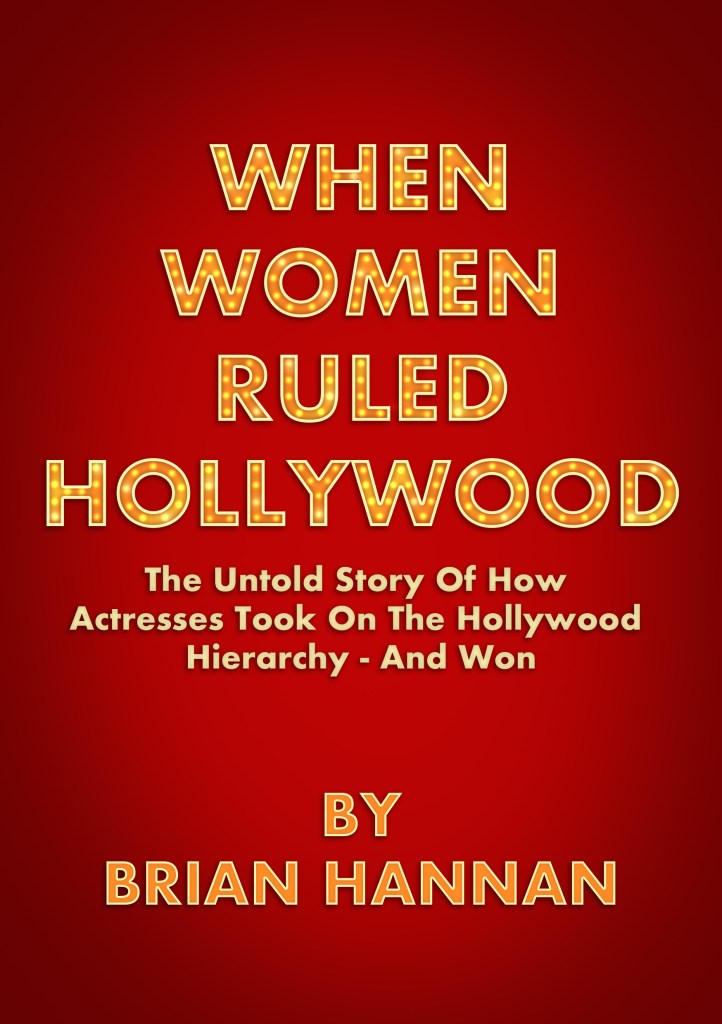
Female career longevity has always been an issue in Hollywood, the assumption being that women had shorter careers than men. But when I was writing “When Women Ruled Hollywood,” I discovered this was not true. Until Sophia Loren’s late foray this year, Jane Fonda had led the roll of honor – male or female – with a career lasting 58 years. Next came Shirley Maclaine with 56 years, then Clint Eastwood (54), Katharine Hepburn (52) and Helen Mirren (51) and Robert Redford (51). Loren’s latest – The Life Ahead – gave her a career as a recognised star turn of 66 years.

Mason is a believable character. He is not an impoverished artist. Far from being self-deluded, he is a questing individual, turning his back on easy money and the temptations of big city life in order to reinvent himself. He isn’t going to starve and he has no problems with women. And he is perfectly capable of looking after himself.  A more rounded artist would be hard to find. Precisely because there is no sexual relationship with Mirren, the movie, as a film about character development, is ideally balanced.

The movie is gorgeously filmed, with many aerial shots of the reef and underwater photography by Ron and Valerie Taylor.  

What does let the show down is a proliferation of cliched characters who over-act. Jack McGowran as a sponging friend, ruthless seducer and thief heads that list closely followed by Neva Carr-Glynn as Mirren’s grandmother who looks like a reject from a Dickens novel. There’s also a dumb and dumber cop and a neighbor so bent on sex that she falls for McGowran. It’s not the first time comedy has got in the way of art, but it’s a shame it had to interrupt so often what is otherwise a touching film.

At its heart is a portrait of the artist as an older man and his sensitive relationship with a young girl. In later years, Powell married film editor Thelma Schoonmaker and after his death she oversaw the restoration of Age of Consent, with eight minutes added and the Stanley Myers score replaced by the original by Peter Sculthorpe.

Discover WordPress

A daily selection of the best content published on WordPress, collected for you by humans who love to read.

The Atavist Magazine

by Brian Hannan

WordPress.com News

The latest news on WordPress.com and the WordPress community.