Bachelor Flat (1961) ****

Stereotypical Englishman reinvented. Where the suited-and-booted traditional British gent, umbrella at the ready, moustache awaiting twirling, bristling with pomposity, usually of military background and inclined towards the pedantic, was treated as a figure of fun, here in a marvelous conceit he is instead catnip to the ladies. You could imagine this was somewhat prophetic given the imminent arrival on Hollywood shores of such testosterone-charged figures as Sean Connery, Richard Harris et al.

All the elements that previously pointed to mickey-taking – impeccable manners, a sense of fair play anathema in the cut-throat American world, respect extended towards the opposite sex – are here presented as such ideals that the entire female population of a small town is swooning at the feet of its only known Englishman.
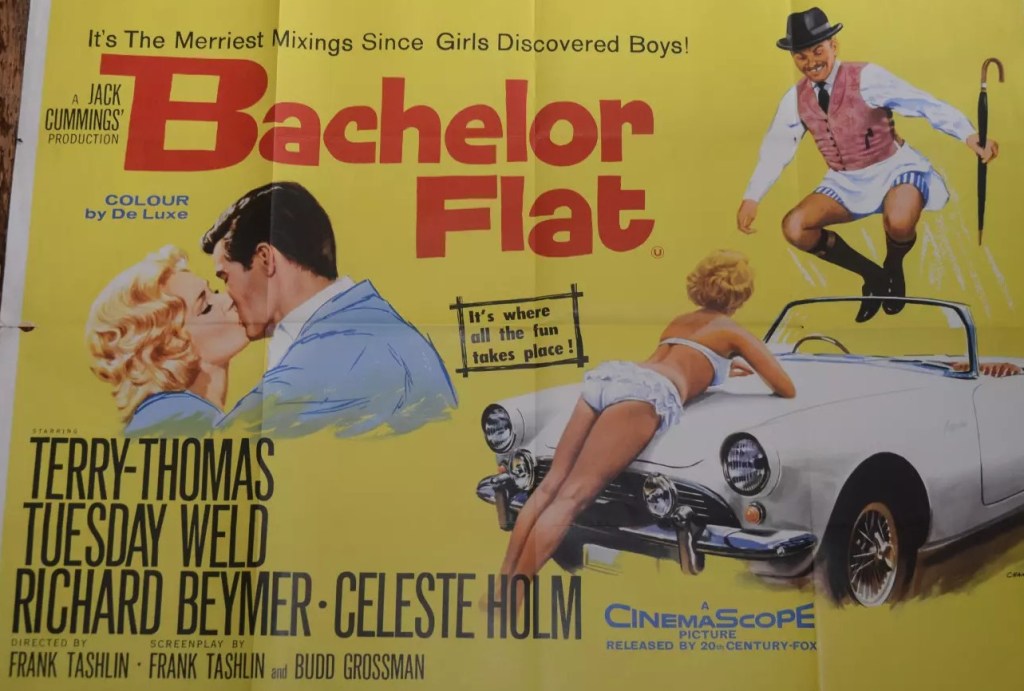
What’s more, director Frank Tashlin (The Glass Bottom Boat, 1966) doesn’t ask star Terry-Thomas (Arabella, 1967) to lampoon himself, as would often later be the case, where the actor was called upon to play an overstuffed romantic fantasist of the Bob Hope variety or presented as comedic villain or overacting butler. Instead, Terry-Thomas plays it straight, oozing astonishing charm that allows the slapstick and farcical ingredients to work a treat.

Sure, it’s mostly a dressed-up farce, people hidden in cupboards and under beds, doors slamming in faces, faces drenched in cake, and in a sharp swipe-left on gender equality, the man, rather than the woman, mostly seen in a state of undress.

Professor Patterson (Terry-Thomas) throws his adoring mostly adorable students into a tizzy when they discover he is engaged to actress Helen (Celeste Holm) currently residing in Paris. They met when the academic rented her beach house which is where Libby (Tuesday Weld) comes in. Astonished to discover a stranger in her mother’s house, Libby doesn’t let on she’s Helen’s daughter and instead pretends to have escape from juvenile detention. Helen has so far balked at telling her lover she has a 17-year-old daughter by a previous marriage.

Professor’s young neighbor, law student Mike (Richard Beymer), takes a shine to his unwelcome guest, but he’s mostly there to add complication to complication.
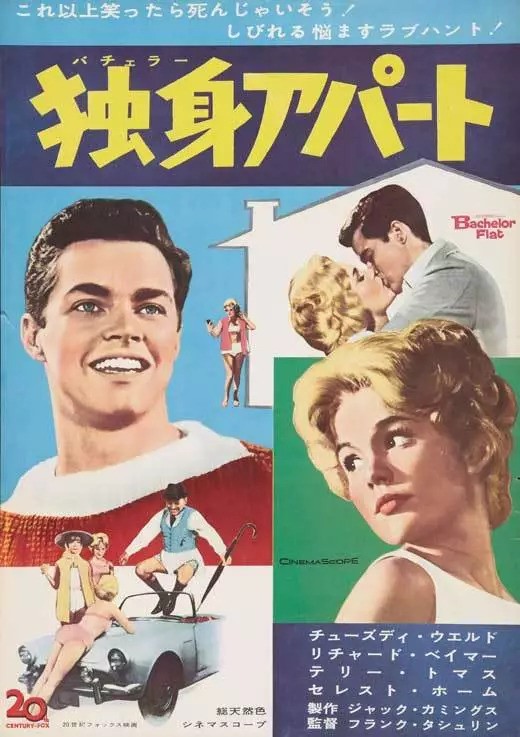
Usually, in these farces, it’s the guilty man trying to hide his various lovers from one another, hence stowing them away in cupboards and beds and whatever. But here the professor is a determined innocent who has to stoop to such shenanigans to pretect his integrity. But not only is he assailed by Libby but also by student Liz (Ann Del Guercio) who lets down his tyres so she can run him home and neighbor Gladys (Francesca Bellini) who makes eyes at Mike as a way of infiltrating Patterson’s defences. Added complications are a suspicious cop and a rival academic.

So when Patterson is not trying to keep the various female invaders from discovering one another, or the cop or Mike from finding them stashed away, he’s trying to fruitlessly explain how he has been snagged by the aforesaid predatory women. And of course when his fiancee returns there’s no queston she’ll catch him in some questionable act.

In some senses this is pretty formulaic stuff but it is brightened immeasurably by some choice lines (“I don’t take money from strangers unless I steal it” and “either you get a smaller bone or I get a bigger dog”), the occasional madcap situation (one of his suitors eating a slice of cream came while on a vibrating slimming machine and Mike discovering how Libby fed him a line), but mostly by the spirited playing of Terry-Thomas and Tuesday Weld. Apart from a small part in Tom Thumb (1958) this was the actor’s introduction to Hollywood and it says a lot for his talent that he’s entirely believable as the kind of charmer that women flock to.

Tuesday Weld (Pretty Poison, 1968) is more than glamor on legs and finesses her first top-billed role into surprising depths beyond the obvious enthusiastic ingenue, especially given her Ann-Margret-style shake-your-booty introduction, suggesting talent to burn. Richard Beymer (West Side Story, 1961), who was holding a real-life candle for Ms Weld, is little more than eye candy for the female gaze. And if none of this trio is sufficient to hold your attention, there’s a cute dog.

Frank Tashlin occasionally made films with more acerbic bite, but this isn’t one of them. It sticks to a magic formula that works mostly thanks to the two principles.

Raised up a good notch by the revelatory performance by Terry-Thomas, his drunk scenes are just superb and unusually played, and you probably can guess from this where Four Weddings and a Funeral (1994) got its rain-soaked proposal scene.

Tremendous fun.

The Alphabet Murders (1965) ***

Just about the barmiest idea ever. Just about works. Tony Randall (Bang! Bang! You’re Dead / Our Man in Marrakesh, 1966), a cross between David Niven’s younger brother and a distant relation of Inspector Clouseau, would be nobody’s notion of a perfect Hercule Poirot. But back in the day, Agatha Christie’s famed detective was not a hallowed concept.  

In fact, in movie terms he was pretty much a nobody, not a single big screen appearance in three decades, the forgotten man of cinema sleuths, not a patch on Sherlock Holmes or Maigret who had enjoyed umpteen iterations. So that character, if you like, was there for the taking, up for grabs, not one so sacrosanct it was imprinted on audience minds.

You could do what you liked as long as he had a moustache, spoke with an exaggerated foreign accent and every now and then pointed to his head and mumbled something about little grey cells.

MGM had had some fun and box office success with Christie’s other famous criminal creation Miss Marple in a quartet of low-budget pictures in the light comedy vein starring Margaret Rutherford beginning with Murder, She Said (1961) and clearly believed the same recipe would work wonders with a character generally considered too stiff to work at all.

This is a chucklesome broth, some astute detective work mixed up with all sorts of sight gags. Frank Tashlin (The Glass Bottom Boat, 1966) is at the helm and the writing team of Jack Seddon and David Pursall who reimagined Miss Marple adapt the mystery.

It kicks off with the very contemporary trope of talking to the camera as real-life actor Tony Randall walks off an MGM set and transforms himself into Poirot. Hastings (Robert Morley), who in the novels is more an amiable companion, a kind of Dr Watson, is here portrayed as somebody high up in the British Secret Service trying to whisk Poirot out of the country. Mostly, he acts as a comedy foil.

After being attacked by a beautiful masseuse, Poirot finds himself on the trail of a serial killer who conveniently leaves an ABC London Guide at the scene of the crime and kills in alphabetical order (with a bent for alliteration) which would make the attempt on the detective’s life a bit of an aberration (that even Poirot doesn’t apparently notice). Anyway, the first victim is an Aquabatic, the second Betty Barnard (Grazine Frame). Poirot is on the case by the time the third likely victim Sir Carmichael Clarke (Cyril Luckham) hoves into view.

As luck would have it, a fourth contender Duncan Doncaster (Guy Rolfe) is both psychiatrist to chief suspect Amanda Beatrice Cross (Anita Ekberg) and lover of Clarke’s wife Diane (Sheila Allen). Inspector Japp (Maurice Denham) of Scotland Yard and Poirot are invariably at cross purposes.

The detective has a special set of skills, including cooking to restaurant standard, being able to vanish in a trice, horse-riding, and knocking down two sets of ten-pin bowling pins at the same time.  

That the comedy works is mostly thanks to the likes of Airplane (1980) which has accustomed contemporary audiences to barmy, almost literal sight, gags, faces elongated via shaving mirrors, while a cop elucidates a clever plan we are only shown the back of the map he’s pointing to, a conversation takes place over the sleeping body of a snoring wife, a business card tossed nonchalantly onto a desk ends up in a coffee cup, Hastings is trapped in the trunk of a car with a comely wench

You still get your London tourist features – the docks, bus stops, military parade, horse riding in Hyde Park – but these are invariably set-ups for sight gags. A naked Hastings invades the parade, fog shrouds the docks, Poirot’s horse leaps over (wait for it!) a park bench.

This version of Poirot might be heresy to some, and too jaunty by half, but there’s too much serious detection – and some classic Poirot intuition – to dismiss it as entirely a spoof, and I spent too much time chortling to dismiss it as a waste, so it lands in an odd halfway house, but I suspect that’s very much where Tashlin intended it to land.  

Worth a look if only to suspend your disbelief.

PREVIOUSLY REVIEWED IN THE BLOG: Frank Tashlin’s The Glass Bottom Boat (1966); Tony Randall in Let’s Make Love (1960), Lover Come Back (1961), Send Me No Flowers (1964), Bang! Bang! You’re Dead (1966); Anita Ekberg in 4 for Texas (1963); Robert Morley in Oscar Wilde (1960), Nine Hours to Rama (1963), Hot Enough for June (1964), Of Human Bondage (1964), Topkapi (1964), Genghis Khan (1965), The Loved One (1965), A Study in Terror (1965), Some Girls Do (1969).

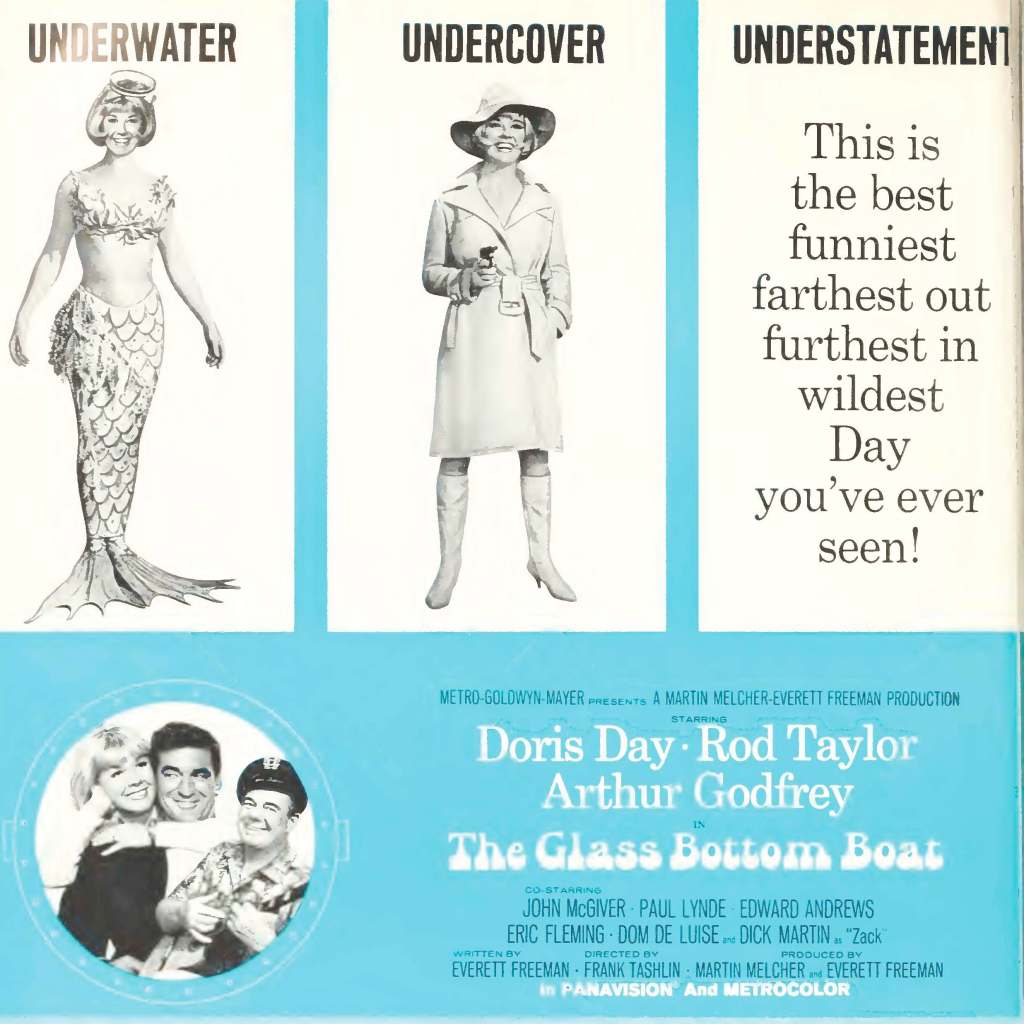
The Glass Bottom Boat (1966) ***

One of the joys of writing this blog has been the opportunity to reassess stars that I’ve had a tendency to under-rate. You’ll maybe forgive me for putting Doris Day in that category especially as I’ve had ample reasons now to take a different, Please Don’t Eat the Daisies (1960) just one of the many instances where the actress has confounded my expectations.

Until I started on the Blog I’d never gone out of my way to watch a Doris Day picture with the exception of musical Calamity Jane (1953) when it became a camp classic as well as Hitchcock’s The Man Who Knew Too Much (1956) and films where she happened to be co-starring with Cary Grant.

So I came to The Glass Bottom Boat with low expectations, especially as this was towards the end of her two-decades career and her co-star was Rod Taylor, a different level of star to Grant and Rock Hudson. By now, she had dropped the musical and dramatic string to her bow and concentrated on churning out romantic comedies and also been supplanted by Julie Andrews as Hollywood’s favorite cute star.

But it was in part on the evidence here that I changed my tune regarding Day. This is entertaining enough. And she sings – the theme song, one other and a riff on one of her most famous tunes “Que Sera Sera.” Unless there’s a symbolism I’ve missed, the title is misleading since the boat only appears in the opening section to perform the obligatory meet-cute with Taylor as a fishermen hooking Day’s mermaid costume.

The plot is on the preposterous side. The occasionally hapless Jennifer (Doris Day) is suspected as a spy after infiltrating Bruce Templeton’s (Rod Taylor) aerospace research operation. It’s partly a James Bond spoof – when her dog is called Vladimir you can see where the movie is headed – with all sorts of crazy gadgets. But mostly the plot serves to illustrate Day’s substantial gifts as a comedienne. For an actress at the top of her game, she is never worried about looking foolish.

And that’s part of her appeal. She may look sophisticated even when, as here, playing an ordinary public relations girl, but turns clumsy and uncoordinated at the first scent of comedic opportunity. There’s some decent slapstick and pratfalls and some pretty good visual gags especially the one involving a soda water siphon. A chase scene is particularly inventive and there’s a runaway boat that pays dividends. But there are a couple of effective dramatic moments too, emotional beats, when the romance untangles.

She’s in safe hands, director Frank Tashlin responsible for Son of Paleface (1952) and The Girl Can’t Help It (1956). I also felt Rod Taylor (Dark of the Sun, 1968) was both under-rated and under-used, never given much to do onscreen except stick out a chiseled jaw and turn on the charm. Although he had been Day’s sparring partner in her previous picture Do Not Disturb (1965) he’s not in the Cary Grant-Rock Hudson league.

It’s also worth remembering that the actress had her own production company, Arwin, which put together over a dozen of her pictures, including this one, so she would be playing to her strengths rather than those of her co-star. On the bonus side, watch out for a blink-and-you-miss-it cameo by Robert Vaughn (The Man from Uncle), and a featured role by Dom DeLuise as a bumbling spy.

Everett Freeman (The Maltese Bippy, 1969) wrote the screeplay. 

https://amzn.to/46DGUpF

The Glass Bottom Boat (1966) ***

I’ve never gone out of my way to watch a Doris Day picture with the exception of musical Calamity Jane (1953) when it became a camp classic as well as Hitchcock’s The Man Who Knew Too Much (1956) and films where she happened to be co-starring with Cary Grant.

So I came to The Glass Bottom Boat with low expectations, especially as this was towards the end of her two-decade career and her co-star was Rod Taylor, a different level of star to Grant and Rock Hudson. By now, she had dropped the musical and dramatic string to her bow and concentrated on churning out romantic comedies and also been supplanted by Julie Andrews as Hollywood’s favourite cute star.

But on the evidence here I can certainly see her attraction. This is entertaining enough. And she sings – the theme song, one other and a riff on one of her most famous tunes “Que Sera Sera.” Unless there’s a symbolism I’ve missed, the title is misleading since the boat only appears in the opening section to perform the obligatory meet-cute with Taylor as a fishermen hooking Day’s mermaid costume.

The plot is on the preposterous side, Day suspected as a spy infiltrating Taylor’s aerospace research operation. It’s partly a James Bond spoof – when her dog is called Vladimir you can see where the movie is headed – with all sorts of crazy gadgets. But mostly the plot serves to illustrate Day’s substantial gifts as a comedienne. For an actress at the top of her game, she is never worried about looking foolish.

And that’s part of her appeal. She may look sophisticated even when, as here, playing an ordinary public relations girl, but turns clumsy and uncoordinated at the first scent of comedic opportunity. There’s some decent slapstick and pratfalls and some pretty good visual gags especially one involving a soda water siphon. A chase scene is particularly inventive and there’s a runaway boat that pays dividends. But there are a couple of effective dramatic moments too, emotional beats, when the romance untangles.

She’s in safe hands, director Frank Tashlin responsible for Son of Paleface (1952) and The Girl Can’t Help It (1956). I also felt Rod Taylor was both under-rated and under-used, never given much to do onscreen except stick out a chiseled jaw and turn on the charm. Although he had been Day’s sparring partner in her previous picture Do Not Disturb (1965) he’s not in the Cary Grant-Rock Hudson league.

It’s also worth remembering that the actress had her own production company, Arwin, which put together over a dozen of her pictures, including this one, so she would be playing to her strengths rather than those of her co-star. On the bonus side, watch out for a blink-and-you-miss-it cameo by Robert Vaughn (The Man from Uncle), and a featured role by Dom DeLuise as a bumbling spy.    

The Glass Bottom Boat (1966) ***

I’ve never gone out of my way to watch a Doris Day picture with the exception of musical Calamity Jane (1953) when it became a camp classic as well as Hitchcock’s The Man Who Knew Too Much (1956) and films where she happened to be co-starring with Cary Grant.

So I came to The Glass Bottom Boat with low expectations, especially as this was towards the end of her two-decade career and co-star Rod Taylor was a different level of star to Grant and Rock Hudson. By now, she had dropped the musical and dramatic string to her bow and concentrated on churning out romantic comedies and also been supplanted by Julie Andrews as Hollywood’s favourite cute star.

But on the evidence here I can certainly see her attraction. This is entertaining enough. And she sings – the theme song, one other and a riff on one of her most famous tunes “Que Sera Sera.” Unless there’s a symbolism I’ve missed, the title is misleading since the boat only appears in the opening section to perform the obligatory meet-cute with Taylor as a fishermen hooking Day’s mermaid costume.

The plot is on the preposterous side, Day suspected as a spy infiltrating Taylor’s aerospace research operation. It’s partly a James Bond spoof – when her dog is called Vladimir you can see where the movie is headed – with all sorts of crazy gadgets. But mostly the plot serves to illustrate Day’s substantial gifts as a comedienne. For an actress at the top of her game, she is never worried about looking foolish.

And that’s part of her appeal. She may look sophisticated even when, as here, playing an ordinary public relations girl, but turns clumsy and uncoordinated at the first scent of comedic opportunity. There’s some decent slapstick and pratfalls and some pretty good visual gags especially the one involving a soda water siphon. A chase scene is particularly inventive and there’s a runaway boat that pays dividends. But there are a couple of effective dramatic moments too, emotional beats, when the romance untangles.

She’s in safe hands, director Frank Tashlin responsible for Son of Paleface (1952) and The Girl Can’t Help It (1956). I also felt Taylor was both under-rated and under-used, never given much to do onscreen except stick out a chiseled jaw and turn on the charm. Although he had been Day’s sparring partner in her previous picture Do Not Disturb (1965) he’s not in the Cary Grant-Rock Hudson league.

It’s also worth remembering that the actress had her own production company, Arwin, which put together over a dozen of her pictures, including this one, so she would be playing to her strengths rather than those of her co-star. On the bonus side, watch out for a blink-and-you-miss-it cameo by Robert Vaughn (The Man from Uncle), a featured role by Dom DeLuise as a bumbling spy and, in a bit part as a neighbour, silent screen comedienne Mabel Normand.    

  https://www.amazon.co.uk/Glass-Bottom-Boat-Doris-Day/dp/B089Q38254/ref=sr_1_2?crid=33N53Z2O4WYJB&dchild=1&keywords=the+glass+bottom+boat+dvd&qid=1595511843&s=dvd&sprefix=the+glass+bottom%2Caps%2C146&sr=1-2

Discover WordPress

A daily selection of the best content published on WordPress, collected for you by humans who love to read.

The Atavist Magazine

by Brian Hannan

WordPress.com News

The latest news on WordPress.com and the WordPress community.