Few stars were as willing to trade their glamorous screen persona for a decent role as Elizabeth Taylor, here eschewing the trademark hip swivel, low cut dresses and elegant costumes for a clumping walk, frumpy look and eating with her mouth full. After a chance meeting on top of a bus with rich waif Cenci (Mia Farrow) middle-aged prostitute Leonora (Elizabeth Taylor) swaps a dingy bedsit for life in a massive mansion, cupboards stuffed full of furs, all her needs met. Cenci seeks a mother; Leonora, whose daughter drowned aged ten, seeks a child substitute.
Soon Leonora is prisoner to a fantasist, her own identity swamped by Cenci’s needs, accepting the role of “mummy” as the price of a life of luxury until she learns that what appears so freely given can be as easily taken away. This cloistered life is creepy. Cenci has rape fantasies. To a pair of interfering and thieving aunts, Leonora pretends to be Cenci’s dead mother’s cousin.
The fantasy conjured is threatened by the presence of Cenci’s poet stepfather Albert (Robert Mitchum) who intends to become the girl’s legal guardian. He talks like a child molester, “the extraordinary purity of my longings,” but given the depth of Cenci’s fantasies Leonora initially discounts inappropriate behavior on his part especially when Cenci wishes to become inappropriate with her. If Leonora stands in Albert’s way it is only to have the girl – and her wealth – to herself.
A psychological drama that appears more like a stage play in structure, skirting around core issues in favor of later revelation, and in essence making a good effort at dealing with behavioral problems which would find greater currency today – inherited mental illness, PTSD, low self-esteem, abuse, and incest. Though the last area is hard to specify, on the basis that, technically, Albert is a stepfather rather than a father, underage sex would appear to be more likely.
In an era when permissiveness virtually ensured audience shock, director Joseph Losey makes a decent stab at presenting the impact of sex on the vulnerable, despite her apparent steely exterior Leonora damaged by life as a sex worker, Cenci pretending to be younger as if that can sustain her innocence, not realizing how appealing that would be to a predator.
At once hypnotic and impenetrable, this is director Joseph Losey (The Servant, 1964) at his best, a story that by its subject matter must remain obscure, a mother-daughter relationship that should be twisted but reveals nothing but tenderness, ending for a time the torment of the emotionally unfulfilled, but when bonds appear to be strengthened they are fragmenting. However, the film is let down by the script and the somewhat grand guignol setting. Losey is wonderful at times with nothing to say just a prowling camera, only two lines of dialog exchanged in the first 15 minutes. You would certainly file it under “eclectic.”
The two main performances are electric. This is Taylor at her powerhouse best, her profession not glamorized as in Butterfield 8 (1968) and no male to bring to heel, and her last scene with Cenci is extremely touching. This was a bold role, too, for Mia Farrow after the success of Rosemary’s Baby (1967) turned her into a box office star. She brings believability to a difficult role, especially as she is far from the spoiled child one might expect.
Robert Mitchum fans must have received the fright of their life to see their hero not just with uncomely beard but portraying a sinister character, not an out-and-out villain which would have been acceptable, but fast forward a couple of years and you can see evidence here of the kind of portrayal he would evince in Ryan’s Daughter (1970). Look out for Peggy Ashcroft (The Nun’s Story, 1959) in a smaller role, her first film in nearly a decade.
Check out the “Behind the Scenes” article for this film.
There were five our great reasons to see this picture. Firstly, it was in Cinerama. Secondly, it was the first attempt in that special format to tell a dramatic story rather than offer just a travelog. Though How the West Was Won (1962) was promoted at the first dramatic use of Cinerama, that was actually untrue. This came first. Third, there was a terrific gimmick – Smell-O-Vision – which allowed audiences to inhale around 30 fragrances at the same time as the onscreen characters. Fourthly, it was produced by Mike Todd Jr., son of the Oscar-winning producer of Around the World in 80 Days (1956) and second husband of Elizabeth Taylor who was instrumental in bringing Cinerama to the big screen in the first place., Lastly, it was the first top-billed appearance of rising British star Denholm Elliott.
Unfortunately, none of these hit the target and it remains a novelty in the Cinerama canon. For a start, there wasn’t much of a story – it’s a chase tale of sorts with crime novelist Oliver (Denholm Elliott) uncovering a plan to kill American heiress Sally Kennedy. In setting out to thwart it he travels all over Spain in the company of philosophic wise-cracking taxi driver Smiley (Peter Lorre). Cue travelog of scenic Spain including fiestas, dances and the running of the bulls, which appears not to have been specially staged but filmed documentary-style as it occurred with the bulls inflicting considerable damage on the humans foolish enough to think it’s a lark.
The hook is the mystery woman who can only be detected by her Schiaparelli perfume while the giveaway for the villain, hired assassin Baron saradin (Paul Lukas), is his tobacco. Cue an onslaught of scents. But the smells don’t just pop up when characters are involved. When a barrel of wine smashes, that produces another smell.
Astonishingly, the movie manages to bring in some of the Cinerama trademarks – the runaway element seen from the audience POV, not just the traditional vehicle but also barrels of wine.
The smell gimmick worked well enough in cinemas set up for such technical aspects, but that amounted to very few screens, and outside of those the movie just seemed a random series of scenes with only panoramic views of Spain to lessen the boredom.
It did nothing for the career of Denholm Elliott and he did little for the movie. He lacked the edge or innocence required to make such a character come alive and mostly he looks as though he doesn’t know what to do. He didn’t make another movie for three years and on his return for Station Six Sahara (1963) he was no longer the star but quickly shifting into the character actor he would be for the rest of his screen career.
It was nearly the last hurrah for Peter Lorre. He suffered heart attack during filming so the real Peter Lorre is only seen in half the picture, for the other half it’s a stand-in.
The presence of Elizabeth Taylor (Butterfield 8, 1960) could conceivably have redeemed the picture but she puts in only a fleeting appearance, so speedy her distinctive features barely register. You see more of Diana Dors (Baby Love, 1969).
In the hands of Alfred Hitchcock (Psycho, 1960) or imitators like Stanley Donen (Charade, 1963) and with a more finely worked screenplay, reliant on neither visual nor olfactory gimmick, this might have worked. But it was in hands of Jack Cardiff (The Girl on a Motorcycle, 1968), famed cinematographer but only his third outing as a director, and he clearly didn’t know how to balance the various ingredients and so it limps home.
The minute the location of the source novel by Audrey Kelley and William Roos shifted from New York to Spain and the number of investigators halved, the trouble started. The hunt for a woman whose existence is in question was a standard mystery trope and might very well have worked here minus the smells and Cinerama.
My discovery that Hayley Mills’ career could have taken an entirely different turn had either Deep Freeze Girls or When I Grow Rich entered production in 1965/1966 and therefore prevented the star returning to Britain for The Family Way (1966) – and, as it transpired, love and marriage – made me look again at the huge volume of movies that were either never made at the time initially announced or never made at all.
I’d covered a couple of classic examples previously, 40 Days of Musa Dagh for example taking nearly half a century from initial proposal to some kind of fruition. And, of course, the financial collapse of studios at the end of the 1960s put an end to the prospects of such big budget movies as Man’s Fate, to be directed by Fred Zinnemann.
But sometimes as many as half the movies announced by a studio or independent for their forthcoming schedule never made it to the big screen. Others such as This Property Is Condemned (1966), initially to star Elizabeth Taylor and directed by John Huston, still got over the line but with new players, Natalie Wood as star and Robert Mulligan in the hot seat. On the other hand, of the quartet of movies – Lie Down in Darkness, Guardians, Grass Lovers, and Linda – that producer William Frye (The Trouble with Angels) thought would make his name, none were made.
Everyone knows moviemaking is a dicey business, but you don’t realize just how tricky it is unless you count up just how many pictures, often trumpeted with big stars signed up, just don’t make it to the cinema screen. Not that Hollywood was unwilling to gamble. Studios snapped up anything – novel, Broadway play – that appeared a decent prospect.
In the early 1960s talent agency Famous Artists earned for its clients a grand total of $850,000 (equivalent to $8.5 million now) for a disparate bunch of properties. King Rat by James Clavell went for $160,000 plus a percentage and was made in double quick time. As was Lilith by J.R. Salamaca, costing $100,000, and Sylvia ($20,000 purchase price) by E.V. Cunningham (aka Howard Fast). Ken Kesey’s One Flew Over the Cuckoo’s Nest went for $85,000 to Kirk Douglas’s Bryna outfit, which explained why, a decade later, it ended up being produced by his son, Michael.
But Broadway play The Perfect Set-Up by Jack Sher, sold to Hollywood for $400,000 and with Angie Dickinson signed up for the lead, was never made. You might recall George Peppard in a TV movie Guilty or Innocent: The Sam Sheppard Murder Case (1975) but that wasn’t based on The Sheppard Murder Case by Paul Holmes that someone shelled out $25,000 for in 1962.
Director Paul Wendkos had planned to follow up Gidget Goes to Rome (1963) with Native Stone, an architectural drama in the vein of The Fountainhead based on the Edwin Gilbert book that cost him $10,000 but that hit the buffers. Two novels by thriller writer John D. MacDonald, hot after Cape Fear (1962) – the aforementioned Linda costing $15,000 and A Child Is Crying $5,000 – were not made either. Nor, out of this batch, were Indian Paint by Glenn Balch or Fish Story by Robert Carson.
Even as powerful a producer as Ross Hunter (Midnight Lace, 1960), couldn’t get onto the starting grid The Public Eye as a vehicle for Julie Andrews, Laurence Olivier and director Mike Nichols (it would have been his movie debut) – when made in 1972 starring Mia Farrow and Topol it was under the aegis of Hal Wallis. Hunter also spent $350,000 on Dark Angel to star Rock Hudson but that fell at the first hurdle as did Broadway play A Very Rich Woman to star Katharine Hepburn.
Tony Curtis was down for a remake of Casablanca (1942) called The Fifth Coin and relocated in Hong Kong and to co-star Nancy Kwan. Shooting on the Seven Arts production had a start date: November 15, 1965. But never went in front of the cameras. Kwan was particularly unlucky. The aforementioned Deep Freeze Girls also had a budget ($1.5 million) and a start date (October 1965) but it didn’t get off the ground either.
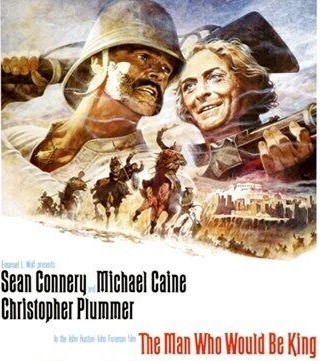
And of course Seven Arts had become enmeshed in the long-running John Huston saga of The Man Who Would Be King. This version, to star Richard Burton, had been set a $4 million budget and was due to start in April 1966. No go. At least The Owl and the Pussycat, budgeted then at $1.6 million and due to start on Dec 1965, was worth waiting five years for – when it was eventually filmed, though by Rastar not Seven Arts, it starred Barbra Streisand and George Segal.
In 1964 Columbia had 77 movies on the stocks. Richard Brooks was setting up Catch 22, Peter Sellers was being lined up for the musical Oliver!, and Carl Foreman was prepping Young Churchill. All these projects dropped off the roster, only to pop back up several years later with different stars (Ron Moody in Oliver!) or directors (Mike Nichols for Catch 22) or even studios (Paramount for Catch 22).
But others were simply shunted aside. Whatever happened to The Gay Place to team James Garner and Jean Seberg? Or The Fabulous Showman to be directed by Blake Edwards? Or another long-running saga, Andersonville with Stanley Kramer at the helm? Or Stephen Boyd as Richard the Lionheart? Even though The Ipcress File (1965) proved a big hit the same author’s Horse Under Water stalled at the starting gate, as did Robert Rossen’s Cocoa Beach and Ann-Margret in Strange Story.
When Robert Evans ushered in a new era at Paramount he placed his faith in writers. He doubled production and had over 40 writers working on projects. Some had little or no experience of movies but were big literary names. John Fowles, the adaptation of whose The Magus (1968) was an expensive flop, was hired to write Dr Cook’s Garden, but it was never made. Edna O’Brien had Three into Two Won’t Go on the stocks at Universal so she was set to write Homo Faber. Another casualty.
Oscar-winning screenwriter Edward Anhalt (Becket, 1964) was to make his directorial debut with We Only Kill Each Other. It didn’t happen. Nobody had ever managed to film Thomas Wolfe’s epic novel Look, Homeward Angel, so Paramount took a tilt at that without success. Escape from Colditz went into cold storage and an adaptation of Harold Robbins bestseller 79 Park Avenue ended up as a television mini series in 1977 and at a rival company, Universal.
It’s still standard operating procedure for Hollywood to snap up any big bestseller or Broadway hit without ever knowing whether it will ever see the light of day but willing to take the risk.
SOURCES: “Famous Artists,” Variety, August 8, 1962, p5; “Sanford and Frye of TV To Make Theatrical Films,” Box Office, January 7, 1963, p10; “Col-Frye TV Pact,” Box Office, August 19, 1963, p10; “Columbia Policy,” Variety, May 6, 1964, p13; “Seven Arts Pix Multiply,” Variety, March 31, 1965, p4; “Ross Hunter’s Crowded Future,” Variety, May 12, 1965, p7; “Bob Evans Pays Chip Service To Writer As Star,” Variety, May 1, 1968, p19.
Vanity dies hard. It’s not the first time a top-ranked actor was convinced he could show Hollywood how it should be done. A raft of stars in the 1950s and 1960s – from John Wayne and Burt Lancaster to Gregory Peck and Frank Sinatra – had lost their shirts setting up production companies. The notion of the creative hyphenate only made sense as a tax dodge, being able to spread earnings from a big hit over decades rather than paying all your dues in one year. But you could do that anyway, by means of the initial contract, as William Holden had done with Bridge on the River Kwai (1957).
Otherwise, the vanity project was littered with box office and critical disasters. And it’s odd that it took so long for one of the best-known notions in literature – the idea of selling your soul to the Devil in return for earthly reward – to be realized on film. Especially as it had a line – “was this the face that launched a thousand ships?” – to rival “To be or not to be” as the most famous sentence in literature. The Tragical History of Doctor Faustus by Christopher Marlowe, a contemporary of Shakespeare, was published in 1604.
Rosemary’s Baby (1968) was a more diabolical and commercial spin on the same theme but it’s not as if the movies had ignored the idea – The Devil and Daniel Webster (1941), Bedazzled (1967) and later Ghost Rider (2007) and Hellblazer (2013) could lay claim to be inspired by the legend, never mind musician Robert Johnson who famously sold his soul to the devil (beware of crossroads).
Presumably, multiple Oscar nominee and theatrical giant Richard Burton believed nobody had done the original play justice. Films made from historical plays were quite the thing in the late 1960s – Romeo and Juliet (1968) might have in retrospect seemed a sure thing, but The Taming of the Shrew (1967), even with Burton and Taylor in tow, was a considerable risk.
Doctor Faustus, Burton’s follow-up to that bawdy Shakespearian romp, was certainly a low-budget affair, with little more than $1 million available, derived from various sources including the pockets of the star and producer Joseph E. Levine (The Carpetbaggers, 1964) , with Columbia on board as distributor to give it the Hollywood seal of approval.
But, critically, Burton also shouldered directorial duties along with academic Nevill Coghill who had no experience either in that arena. It looks good in an old-fashioned costumed-to-the-hilt fashion but all the actor does is speak the lines. Burdened at times with a wig or thick-framed black glasses he comes across more like smutty British comedian Benny Hill than a classical actor, that comparison not helped by the occasional emergence of naked women with conveniently very long hair to hide most of their nudity.
Beyond an occasional scene filmed through the eye of a skull, there’s no discernible style and since Burton is surrounded by amateur actors no detectable drama, except, theoretically, the battle for his soul. There are some woeful images, Faustus, victorious in battle, prancing around with swords sticking out of his body, and even an appearance of Elizabeth Taylor as Helen of Troy, at one point like a silver version of the gold-painted Shirley Eaton in Goldfinger (1964), offers mere diversion rather than dramatic focus.
So, unlike Ice Palace (1960), we’ve got the sonorous growling whisky-sodden voice but not even a whisper of true drama. A touch of melodrama here would certainly not have gone amiss. Just Faustus sauntering around speaking lines in the iambic pentameter of the period to make the tale even harder to understand.
Even sold under the Burton-Taylor brand, it made little headway with audiences, even those turning up at their local arthouse, which was its default destination. Proof, judging from the poster, that you can always find a laudatory critic when you need one.
Theoretically, it should have gained a lease of life in the So Bad It’s Good cult category but for that to occur you needed an audience to watch it the whole way through and that’s a pretty big ask.
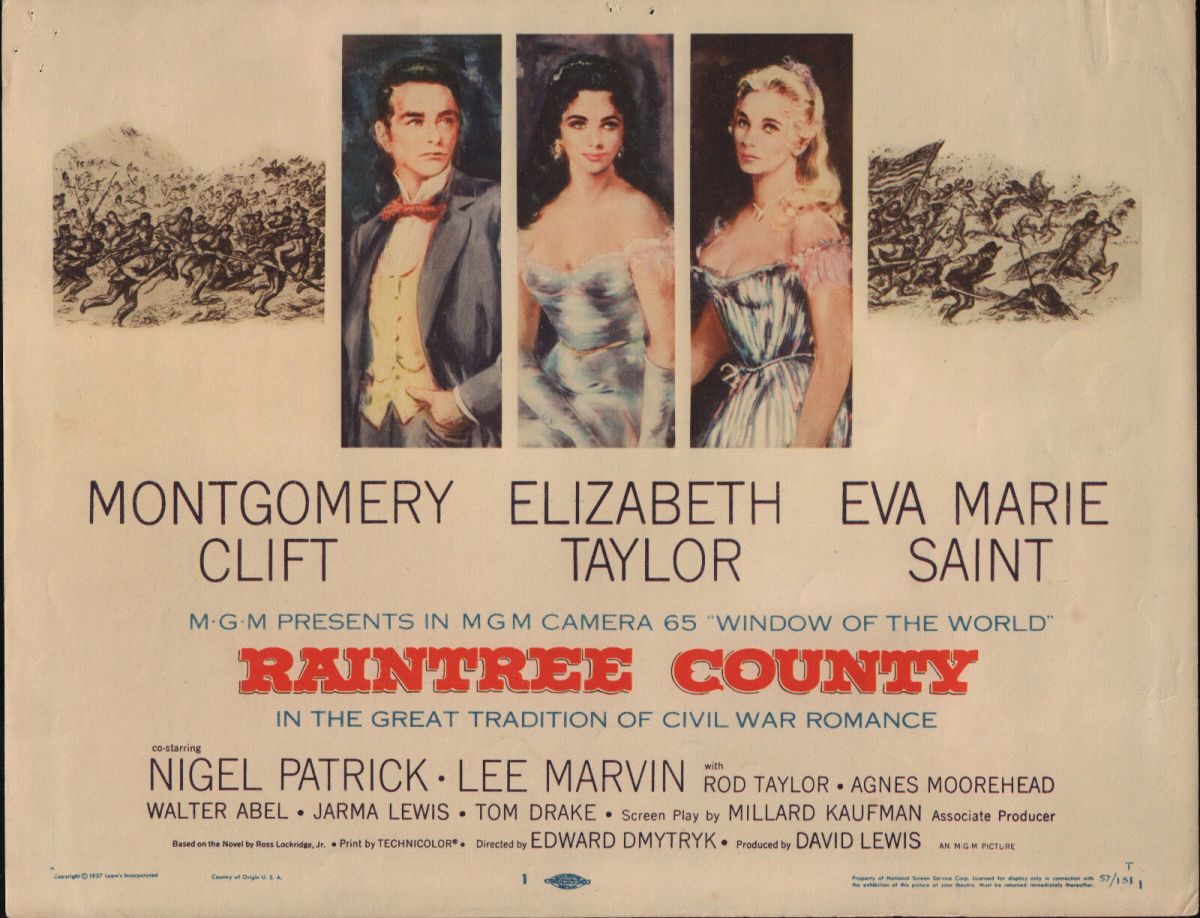
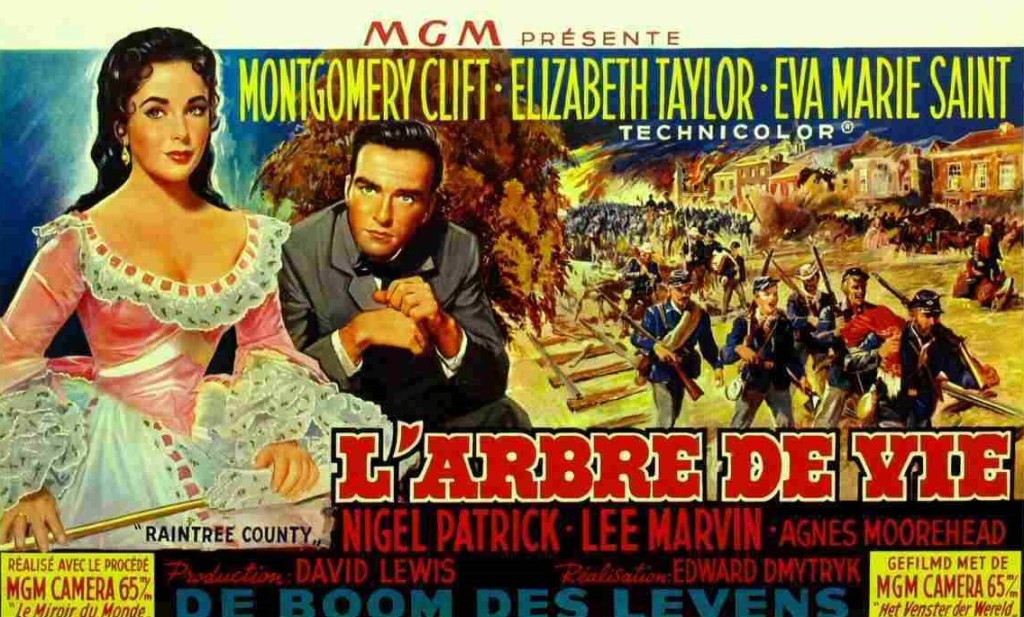
Much-maligned melodrama. No more episodic over a three-hour running time than Ben-Hur (1959) or Doctor Zhivago (1965) and though bookended by the American Civil War has less grandiose views on history. Part of the problem is that, faced with such length, critics expected something with greater depth rather than just ordinary people caught up in circumstance. As if a stunning treatment of madness was not enough, inside the warring mind of a beautiful woman, whose realisation of her condition sets her on the road to tragedy. But it is riddled throughout by an element of fantasy, the fabled “rain tree” with golden leaves triggers a moment of madness in all who seek to find it in the swamps.
Like Zhivago, the narrative arc is a love triangle between principled teacher John Shawnessy (Montgomery Clift), southern belle Susana (Elizabeth Taylor) and reporter Nell (Eva Marie Saint). Sub-plots involved drunken gregarious Flash (Lee Marvin), bumptious Garwood (Rod Taylor) and the charming adulterous Professor (Nigel Patrick). The characters intertwine at various points and John, Flash and the Professor come together during the war while Garwood tries to make political capital out of it afterwards.
John and Nell have known each other since childhood, but there’s no real sense that they are childhood sweethearts. If they have passion for each other, it’s well hidden, and when Susana turns up, she steals him away, in part by the ruse of pregnancy. Despite her incipient madness, perhaps because of it, John sticking by her no matter what, there’s grand passion in full view. But the best scenes are Susana talking not about her condition, but what she believes to be true and her fears that her truth may be false. She lies, for example, about her age when a fire killed her father and his lover. She leaves her husband a note that she discovers she has never written. Her confusion at the depth of her illness, fear that she might have inherit the genes of her mother (also insane), is very touching.
She also does one thing that smacks of “Hollywood madness,” the crazy action that is shorthand for insanity, but within the twisted confines of her mind that is out of love for John. She has a dark secret about her role in the events surrounding the fire. But she overcomes her innate racism out of love for him, prior to the war freeing her slaves. She clings to John because she knows he is the one route out of her madness.
Audiences wouldn’t buy a three-hour picture about madness. You might perceive the other episodes as mere filler, and in some senses that’s true, but the episodes in themselves are quite entertaining and revealing. Though told the “rain tree” is a local myth, a kind of “holy grail”, John is the only character who tries to find it, out of idealism or insanity who knows, and nearly drowns as a result. Flash has come by his nickname for his running exploits and is challenged to a race by John and the otherwise outwardly idealistic Professor, a gambler, tries to influence the outcome.
Though a stranger in town Susana (“I’ll arrange it”) positions herself to place the garland of victory upon his head. When the Professor tries to make off with another man’s wife, John’s skills with a bullwhip prevent him getting shot. Although John’s mother and Nell push him towards politics, Susana leaves him be, recognizing the joy and fulfilment he gets from teaching.
The war is primarily viewed through the perspective of the Professor, a non-combatant who has found himself a job as a war correspondent, making wry comment as he illustrates various battles. By the end of it, soldiers on both sides are weary of the slaughter.
This was intended as one of the first roadshows, MGM’s initial attempt at incorporating its innovative widescreen process Camera 65 (meaning 65mm – the other 5mm in the more common 70mm taken up with the sound strip) that was later used to tremendous effect on Ben-Hur. And while this lacks the scope or action sequences of the Biblical epic, it looks just sumptuous on the wide screen.
Director Edward Dmytryk (Mirage, 1965) has a keen compositional eye and he also favors actors over showing off his directorial skills. But there are exceptional scenes from the directorial perspective. In one the camera remains fixed on Montgomery Clift at the side of the screen while in the background Lee Marvin is creating havoc. In another we follow a female warden as she unlocks door after door in an asylum before Montgomery Clift is led to Elizabeth Taylor.
The acting is superb, Elizabeth Taylor was nominated for an Oscar and might well have won except Joanne Woodward was playing a character with a split personality in The Three Faces of Eve. But it was a bold role for a young star like Taylor, and a tremendous piece of casting. As much as she uses words to try to explain or understand herself, when the camera cuts to her face you can see the terror in her eyes.
Clift had disfigured his face during an accident during shooting and that clearly physically affected his performance. Eva Marie Saint (36 Hours, 1964) is very effective as the rejected lover. Lee Marvin (Point Blank, 1967) takes the showboating approach to his role while Rod Taylor (Chuka, 1967) is not above some scene-stealing himself. But then both are competing with the over-the-top Nigel Patrick (The Battle of Britain, 1969). Millard Kaufman (The War Lord, 1965) wrote the screenplay from the Ross Lockridge Jr. bestseller.
The kind of film to immerse yourself in the performances and let the running time take care of itself.
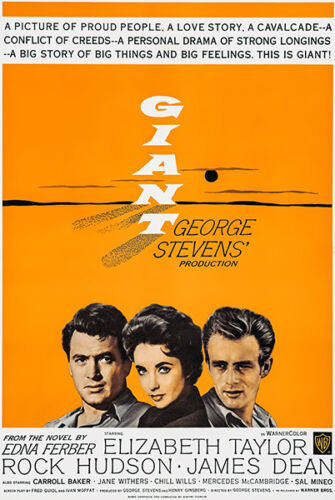
Should James Cameron require any suggestions on how to structure a family saga featuring exclusion, rebellion, adolescence, revenge and racism without relying on repetitive action beats he could do worse than check out this towering epic. There’s a seamlessness to the screenplay that allows the director to move quickly along, drama and conflict that initially tear a family apart in the end bringing it back together.
The story charts the romance of Texan rancher Bick (Rock Hudson) to socialite Leslie (Elizabeth Taylor), their marital conflict as she exerts her personality in a male-dominated world, her battle with Bick’s older sister Luz (Mercedes McCambridge) for control of the household, and the infatuation of ranch hand Jett (James Dean) with Leslie.
First child Jordan (Dennis Hopper), pushed unwillingly into masculine pursuits by Bick, bucks his father’s long-term plan by determining to become a doctor. Second child Judy rebels against the extravagant lifestyle and opts, along with husband Dace, for a small spread, the cattleman’s version of a mom-and-pop operation. Third offspring Luz the Second (Carroll Baker) romances the older Jett, now an oil millionaire, and Bick’s business rival.
Racism and exclusion form the core of the picture. Leslie is shocked to discover her father’s employees living in abject poverty, that he will not countenance the cost of improving living conditions, partly on racist grounds, partly on the American principle that it’s every man for himself, a race in which losers are left behind like sores to fester. Jordan marrying a Mexican brings these issues to the fore, especially when his grand heritage cannot protect her from humiliating racism. Bick and Leslie bicker, fall out, make up, are exploited by their children, who can always find one or the other to take their side in any dispute.
Sure there are some terrific lines but the best scenes are simply visually dramatic. Luz, furious at Leslie encroaching on her territory, lames her rival’s favorite horse by riding it with spurs digging into its flesh. A huge crowd welcomes home a white World War Two hero, a handful of people the Mexican equivalent, only when the train pulls away do we see the draped coffin. The introverted by now incoherent Jett unable to summon up the words to complete his proposal to Luz the Second. Terrified four-year-old Jordan atop a horse, not being able, or willing, to ride the worst sin in Bick’s world.
Bick, restraining himself from launching into a fistfight with Jett in the wine cellar of the oil man’s opulent hotel, throws an item at racks of bottles, only to see it topple back, the camera remaining on Bick’s face as we hear the successive toppling of rack upon rack upon rack. Jett, all the wealth he could ever want, wakens from drunken slumber to an empty banqueting room, guests long departed.
A tiny house, as grand as it is, sits in the distance on a massive plain. The passing of time is delineated in relation to horsepower. We are introduced to Bick staring out of a train window watching horses which almost match the speed of the train. Then it is a plane which outruns a car. Finally, when speed, as a demonstration of inherent power, is no longer of the essence the family, in a car, is happy to be overtaken by a speedster.
The power of wealth, the power of power, its corrosive impact on those sharing in what it can bestow, the damage inflicted on those who get in the way, is the other great theme, spelled out not in dogma or speeches but in human cost. And no matter how powerful, someone is always bigger. The dominant Texan cattleman is easily overtaken in the wealth stakes by the oilman, whose political donations ensure tax exemption.
The vindictive Luz gains revenge on her brother by bequeathing Jett a small parcel of land, just enough to prevent the cattleman from owning everything as far as the eye can see and far beyond, just enough to cause irritation.
And this is before we come to the performances. It’s hard to choose between the three principals. Elizabeth Taylor (The Comedians, 1967), fiery, humane, loving, submitting unwillingly to the superior male, arguing her corner, fighting for the rights of others, brings a superbly complex character to brilliant life. But Rock Hudson (Tobruk, 1967) , in a less showy part, is just as good, conflicted, stubborn, initially shy, forced to take on inherited stances, only at the end standing up against what he formerly believed. And you can hardly take your eyes off James Dean, hiding behind a Stetson or a bottle of whisky, inarticulate, lost, greedy, infatuated.
John Huston used to aver that in any given scene the camera did all the work, that with three or four people to choose from, all on screen at the one time, the strongest performer would attract audience attention. Here, that attention constantly flickered from Taylor to Hudson to Dean, as, almost without exerting an acting muscle, they battled for screen dominance.
Taylor was ignored come Oscar time, but Hudson and Dean split the vote allowing Yul Brynner to sneak in, Mercedes McCambridge nominated in the supporting category, Stevens winning his second Oscar. The supporting cast had tremendous depth: Carroll Baker (Station Six Sahara, 1963), Dennis Hopper (Easy Rider, 1969), Mercedes McCambridge (99 Women, 1969), Sal Mineo (Escape from Zahrain, 1962), Rod Taylor (The Birds, 1963), Jane Withers (Captain Newman M.D., 1963) and Chill Wills (The Alamo, 1960). Fred Guiol (Shane, 1953) and Ivan Moffat (The Heroes of Telemark, 1965) adapted the Edna Ferber bestseller.
I saw this on the big screen in a 4K restoration which means it’s probably heading for streaming and/or DVD but if your local arthouse chances to program this any effort to see it will be well worthwhile.
As is by now traditional (well, it’s the second full year) this isn’t my choice of the top films of the year, but yours, my loyal readers. This is a chart of the films viewed the most times over full calendar year of January 2022 – December 2022.
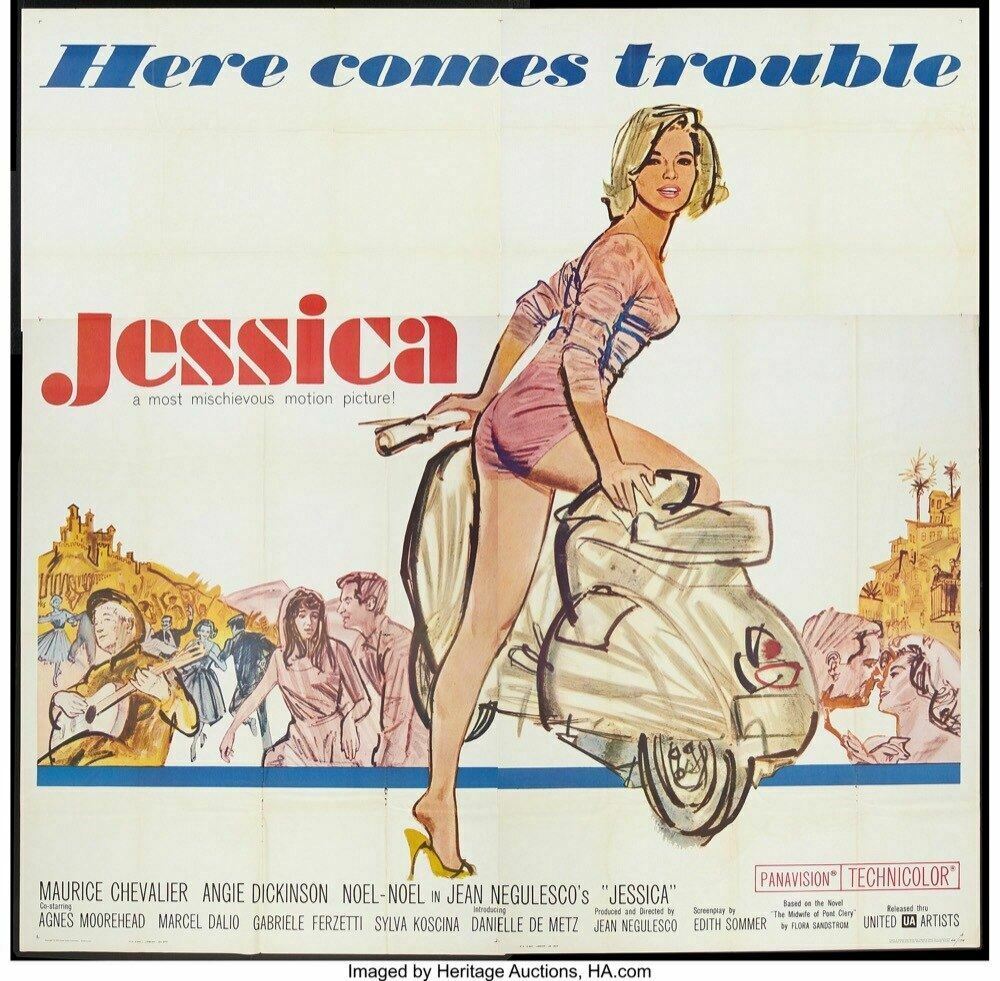
Jessica(1962). Angie Dickinson plays a young widow who turns so many heads in a small Italian town that their wives seek revenge. The film had debuted at No 30 in the previous year’s chart so showed remarkable staying power.
Once Upon a Time in the West (1969). Sergio Leone’s masterpiece now acclaimed as the greatest western ever made. Top class cast – Claudia Cardinale, Charles Bronson, Henry Fonda and Jason Robards – and one of the greatest scores ever written courtesy of Ennio Morricone.
The Swinger (1966). Ann-Margret sparkles as author reinventing herself by writing a sex novel.
Fraulein Doktor (1969). Suzy Kendall as German spy outwitting the British during World War One.
Can Heironymus Merkin Ever Forget Mercy Humpe and Find True Happiness? (1969). Fellini-esque musical with abundant nudity as writer-director-star Anthony Newley tries to unravel the meaning of life.
Father Stu (2022). Under-rated biopic with Mark Wahlberg as unlikely priest.
Blonde(2022). Andrew Dominik’s controversial reimagining of the life of Marilyn Monroe with Ana de Armas
For a Few Dollars More(1965).Sergio Leone re-teams with Clint Eastwood in the second in the spaghetti western trilogy with Lee Van Cleef as a rival bounty hunter.
A Place for Lovers(1968). Faye Dunaway and Marcello Mastroianni in Vittorio De Sica doomed romance.
Fade In(1968). Burt Reynolds disowned this romance filmed against the backdrop of making the Terence Stamp western Blue but it’s better than he thinks.
The Secret Ways (1961). Richard Widmark in spy thriller set in Hungary during the Cold War and adapted from the Alistair MacLean novel. Senta Berger has a small role. Top film for 2021, so demonstrating the ongoing popularity of films based on the author’s works.
The Sisters (1969). Complicated menage a trois that borders on the semi-incestuous starring Nathalie Delon and Susan Strasberg.
Pharoah (1966). Epic Polish picture about political shenanigans in ancient Egypt. Another film with legs – it was No 3 in the 2021 annual chart.
Water Gate Bridge / Battle at Lake Changjin II (2022). Another epic, non-stop action from the Chinese point-of-view in a sequel to one of the most famous battles of the Korean War.
Harlow (1965). Carroll Baker as the blonde bombshell who rocketed to fame in 1930s Hollywood.
Baby Love (1969). Morality tale as orphaned Linda Hayden tries to fit into an upper-class London household.
Moment to Moment (1966). Hitchockian thriller set in the South of France with adulterous Jean Seberg suspected of killing her lover.
Secret Ceremony (1968). Elizabeth Taylor, Mia Farrow and Robert Mitchum in atmospheric Joseph Losey drama.
Lady in Cement (1969). Gangster’s moll Raquel Welch steals the show in Frank Sinatra’s second outing as private eye Tony Rome.
Subterfuge (1968). Suzanna Leigh steals the show as a sadistic henchwoman trying to prevent Gene Barry uncovering a mole in M.I.5.
P.J. / New Face in Hell (1967). George Peppard taken to the cleaners as down-on-his luck private eye.
The Golden Claws of the Cat Girl (1968). Cult French movie starring Daniele Gaubert as a sexy cat burglar. This was No 6 last year.
The Gray Man (2022). Spectacular Netflix misfire with Ryan Gosling and Chris Evans as rival assassins and Ana de Armas adding some spice.
The Brotherhood (1968). Martin Ritt Mafia drama sees siblings Kirk Douglas and Alex Cord falling out.
Some Girls Do (1969). Richard Johnson returns as Bulldog Drummond battling archvillains Daliah Lavi and Beba Loncar.
Pressure Point (1962). Prison psychiatrist Sidney Poitier treats racist patient Bobby Darin. Very unusual imagery.
The Double Man (1967). C.I.A. operative Yul Brynner battles Russian espionage in Switzerland with Britt Ekland providing the glamor.
Operation Mincemeat (2022). Re-telling of “The Man Who Never Was” World War Two plot that duped Hitler over Sicilian invasion plans.
Orgy for the Dead (1965). Bizarre cult horror tale where most of the female characters appear to be auditioning for a nudie film.
Texas Across the River (1966). Alain Delon acts against type in Dean Martin comedy western.
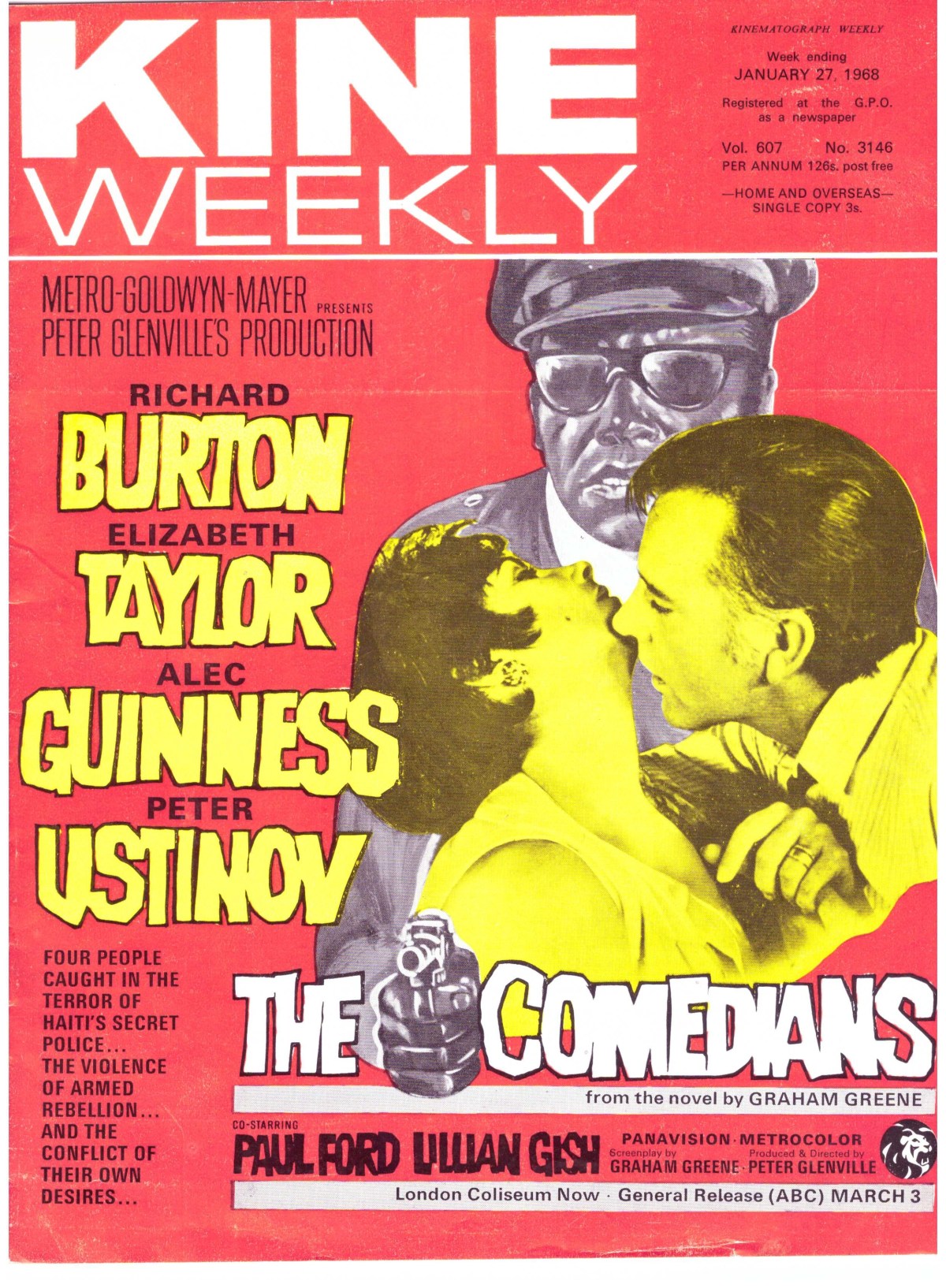
Richard Burton was at his box office peak. From Cleopatra (1963) through The VIPs (1963), Becket (1964), The Night of the Iguana (1964), The Spy Who Came in from the Cold (1965), The Sandpiper (1965), Who’s Afraid of Virginia Woolf (1966) and The Taming of the Shrew (1967) he had enjoyed massive box office success and notched up three Oscar nominations. He was being pursued for Camelot (1967) – the part he played on Broadway – and himself pursued the rights to Bernard Malamud’s The Fixer. But out of admiration for novelist Graham Greene he accepted, sight unseen, the leading role in The Comedians.
Director Peter Glenville, better known at the time as a stage director, owed his career to the two male principals. Alec Guinness had backed him for his debut The Prisoner (1955) and starred in his latest film, the farce Hotel Paradiso (1966). Burton had been one of his two incendiary stars of Becket (1964), a box office smash, as a consequence of which the director signed a four-picture deal with MGM. All three of his previous films had begun life as plays directed by Glenville.
Before the picture could get off the ground it faced a potential legal minefield from producer George Glass. He owned the rights to a short story The Prisoner, written by screenwriter Ernest Lehman (North by Northwest, 1959) and published in the January 1952 edition of Cosmopolitan magazine. It had since been turned into a television play directed by john Frankenheimer for the Playhouse 90 series in February 1957. Glass argued the new picture would infringe his copyright.
Although without doubt Taylor was the bigger box office star, the better remunerated and the more acclaimed, at least by Oscar standards (two wins to his five nominations), in their personal life the roles were reversed. “There seems little doubt,” wrote Burton biographer Melvyn Bragg, “that although he was drawn into what he saw as the mystery and fun of Elizabeth he was the dominating partner. She soothed him. She sought him in bars.” Burton himself said, “We never had any question of who was boss. She always realised I was to run the show.”
Whether that was the reason she took what was no more than a supporting role in The Comedians at half her usual salary (for the first time Burton on $750,000 versus her $500,000 was the financial top dog) is unclear, but she certainly, as was attested on The Spy Who Came in from the Cold, did not like to leave him footloose and fancy free on a film set where he could indulge his liking for liquor and pretty women. On her previous film, Reflections in a Golden Eye (1967) “she resented playing second fiddle” to Marlon Brando, and might have preferred making a picture where she regained a sense of her own importance, but instead she accepted a role that was not up to her usual high standard.
Director Peter Glenville (Becket) had not particularly wanted Taylor for the role, possibly feeling she might over-balance the project. It would be the couple’s seventh movie together, a pairing that was being discussed in the same hushed tones as the legendary Tracy-Hepburn. Alec Guinness was somewhat apprehensive about the film. Calls he had made to the couple’s suite at the Dorchester Hotel in London had gone unanswered and gifts returned. Burton was mortified. It turned out his staff had been too protective of their employer.
Shooting began in January 1967 before the novel was published. Although producers often purchased books while still in galley stage, they generally preferred the book to have acquired a substantial readership before embarking on a costly movie investment. However, Graham Greene could fairly lay claim to being the greatest living English writer and his involvement appeared to add gravitas to the project, although it would be fair to say that none of the translations of his works into movies had enjoyed anything like the success of The Third Man (1949). He had not written for the screen since Our Man in Havana (1960), also starring Guinness.
Unusually for a novelist, he had acquired a reputation for setting his stories in trouble spots. Often, he would take on a journalistic assignment from the likes of the British Sunday Times to investigate conditions in countries undergoing brutal change. His literary reputation often gave him access to the inner sanctum from which an ordinary reporter would have been barred. The author had adored Haiti before the Duvalier takeover and hated that Papa Doc ruled by terror, backed by the dreaded Tonton Macoutes. The Comedians was a determinedly political novel, the author hoping his expose of an “unique evil” might put pressure on the dictator.
Greene described Haiti as a “a tormented little country” and had feared for his life on his last visit. The author told an Italian journalist that he had clearly got under Duvalier’s skin. “A writer is not so powerless as he usually feels,” he once wrote, “and a pen, as well as a silver bullet, can draw blood.” Martha (the Elizabeth Taylor character) was based on a woman the author had known in Martinique who ran a hotel and had a son.
Initially, Glenville had envisaged making the film in Haiti, where the book was set, but, given the author had taken careful aim at country it was a concern that the dictator might take revenge on stars who had the audacity to film in his own backyard. Dahomey, in West Africa, about the size of Cuba, was its replacement.
When accidents plagued the shoot, and since voodoo was a story element, rumors spread that Duvalier had ordered witch doctors to curse the production. “Apparently voodoo spells cannot travel over water,” recollected Guinness, “and have to be operated at hand…(but) on the first day of filming one of the unit stumbled on the beach, possibly from a heart attack, and drowned in a foot of water before anybody could assist him. Several people complained of difficulty in breathing, suffering from acute headaches and deep depression; one or two had to be sent home….there was something a little sinister in the atmosphere.” Guinness, in conversation with the French Consul, was informed the country was still inhabited by cannibals, a threat he took seriously enough to warn actor Paul Ford’s wife not to sit around alone on her porch, but which was later discounted by the local archbishop as the kind of joke a foreigner would too easily fall for
Guinness also saved the director from drowning. Not realizing how treacherous the sea, with an infamous undertow, could be, Glenville had gone for a swim. Reading on the beach nearby, Guinness heard him calling for help and had to drag him to safety. Guinness suffered from a mysterious rash for four days.
Of course, Burton and Taylor were treated like royalty, They were met by President Soglo and given use of the presidential compound. And it was also a humbling experience. Washing was strung along lines in the presidential courtyard, the Queen’s closet was filled with “a perfectly ordinary rack of shoes.” Burton had mixed feelings, commenting in his diary, about the President: “his clothes were ill-made…he obviously likes women and was forever taking E (Taylor) by the arm…We both found the experience oddly moving. Here was this huge, mosaiced palace, only completed three years ago, and outside the immense Salle de Reception, capable of receiving 3,000 people at one time, there was washing on the line.”
But this treatment did not extend everywhere, and for the better. Most people in Dahomey had never heard of the couple so they were able to dine out without harassment. “Glenville noticed that the lack of outside stress helped them relax in front of the camera.”
But the heat was intolerable, temperatures some days reaching 110 degrees, hitting 138 degrees under movie lights. This resulted in no one dallying over takes. The situation was exacerbated by Burton’s drinking. “I hardly find him the same person,” commented Guinness, recalling the times the pair had occasionally spent together in the late 1940s when he was by far the bigger star. “Drink has taken a bit of a toll.” Breakfast for Burton on the first day of shooting was a Bloody Mary. On one occasion Burton was so inebriated he failed to turn up for a presidential dinner in their honor in front of two hundred guests. He was an ugly drunk and his wife bore the brunt of it. Being top dog financially and in terms of screen credit did not appear to bring him the solace he required.
The Burtons’ extensive entourage recruited an additional member with a specific skill. Photographer Gianni Bozzachi was “considered the number one re-toucher in Italy,” his job solely to ensure that any photographs of Taylor sent to the press were “as beautiful as humanly possible.” He became the couple’s official photographer, often taking candid pictures unobtrusively.
Bozzachi believed Taylor more beautiful in person – her left and right profiles were equally symmetrical, a rare physical gift – than on camera and was attempting to capture that inner beauty. He said, “without make-up she glows. There’s a sensuality always present.” But he also exuded a sensuality that disturbed Burton. That a tall curly-haired handsome young man was showering attention on his wife made Burton jealous.
Burton and Alec Guinness respected each other’s talent. In one four-minute scene where Guinness took center stage and Burton was simply listening, Guinness commented, “That was the greatest support I’ve had from an actor in my life.”
Burton was not particularly enamored of Dahomey. Although he retained a “certain amount of nostalgia” for the country, he also referred to the “dangerous sea,” the arrogance of the Americans, the “mad palace, the President and his dowdy provincial wife.” But then Burton in his diaries was particularly waspish. Guinness was even more forthright. “I was glad to leave Dahomey. I couldn’t help feeling it was sinister…ideas of voodoo are never absent from one’s mind.” The final stages of filming were completed in Nice.
In the wake of the violence in The Dirty Dozen (1967) and, more especially, Bonnie and Clyde (1967), which stirred up huge controversy, not least against the Production Code which had passed both films, MPAA president Jack Valenti took against the violence in the film and persuaded Glenville to “mute” one particularly bloody scene.
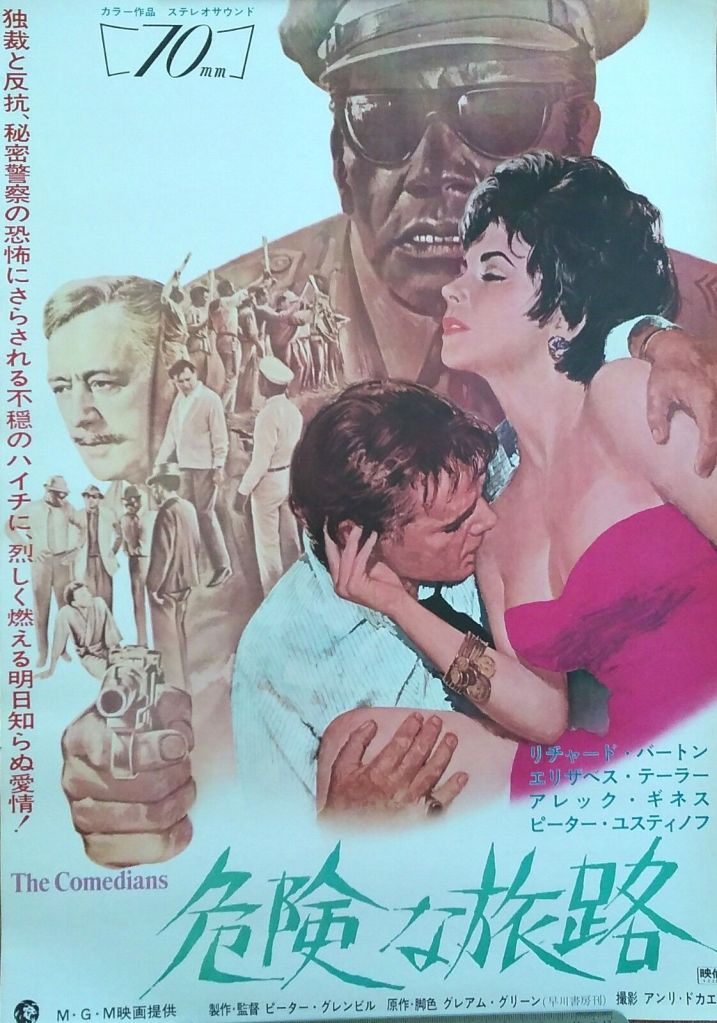
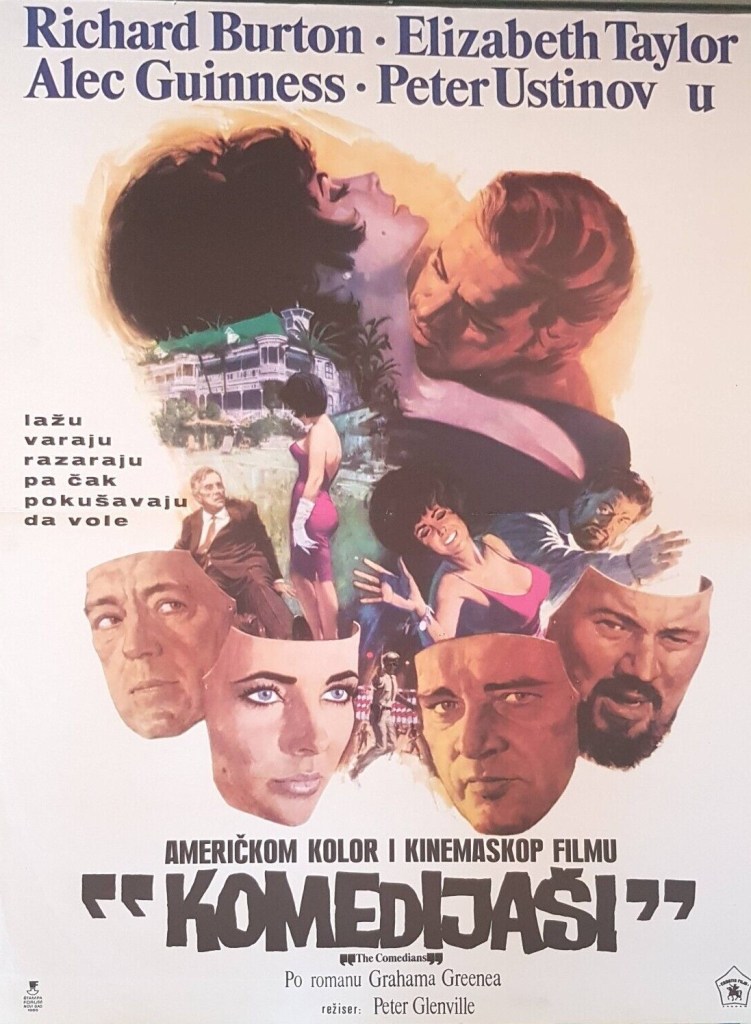
This proved a difficult film to market outside of the star names and the adaptation of a literary bestseller. However, Duvalier inadvertently helped, launching a furious tirade in the press against the picture, threatening legal action against what he termed “inflammatory libel” and exciting the U.S. media so much it triggered a four-part television series. There was a major article in Look magazine which had sent a reporter and photographers to the set in Dahomey. And the marketing team pulled off something of a coup in persuading the Museum of Modern Art in New York for the first time to devote a complete exhibition to a movie.
Despite the top-heavy English cast, the movie premiered in New York at the Coronet where it ran concurrently at the DeMille. Although it opened in the same week as Cool Hand Luke, it trailed the Paul Newman prison drama at the box office, taking $64,000 from two cinemas compared to $92,000, also from a pair. But that was still deemed a good result and initial U.S. first run bookings were brisk – the box office termed “socko” and “boffo.”
Post-production MGM had considered turning it into a roadshow for the U.S. market but decided against it. However, for the later British launch, in January 1968, it was blown up into 70mm and presented as roadshow in London’s West End at the Casino Cinerama and in various countries around the world. The American version, running at 156 minutes, was edited by nine minutes though the programme was effectively lengthened to accommodate the necessary roadshow intermission.
Though named by three critics as one of the top ten films of the year, the movie received no Oscar nominations. It proved to be Glenville’s last film although he lived for another 30 years.
SOURCES: Chris Williams (editor), The Richard Burton Diaries (Yale University Press, 2012) p130-131, 152-157; Melvyn Bragg, Rich, The Life of Richard Burton (Hodder and Stoughton, 1988) p223, 231-232, 236-237; Sam Kashner and Nancy Schoenberger, Furious Love, Elizabeth Taylor, Richard Burton, The Marriage of the Century (JR Books paperback, 2011) p196-204; William J. Mann, How to Be a Movie Star, Elizabeth Taylor in Hollywood (Faber and Faber, 2009) p378-379; Alec Guinness, Blessings in Disguise (Hamish Hamilton, 1985) p209-210; Leopold Duran, Graham Greene, Friend and Brother (Harper Collins, 1994) p153, 238, 258; “Burton-Guinness Teamed,” Kine Weekly, September 8, 1966, p4; “Burton-Guinness Teamed,” Box Office, September 16, 1966, p4; “George Glass Protests Metro’s Comedians Treads on his Teleplay,” Variety, October 26, 1966, p5; “Elizabeth Taylor to Co-Star in Comedians for MGM,” Box Office, October 10, 1966, p7; “Comedians Looms as Metro Roadshow,” Variety, April 12, 1967, p26; “Plan Comedians Premiere,” Box Office, September 11, 1967, pE3; “Urge Films Shun Shock’n’Violence for Own Sake,” Variety, October 25, 1967, p1; “Museum to Devote Entire Exhibit to Comedians,” Box Office, October 30, 1967, pE7; “Haiti Protests Showing of Comedians,” Box Office, November 6, 1967, pE4; “Comedians on Roadshow at London Coliseum,” Variety, January 3, 1967, p5; “Year-End Best Picks,” Variety, January 10, 1968, p8.
Over-long, over-hyped and over-cast. Pretty much an early example of virtue-signalling, exposing corruption in a dictatorship (Haiti), but offering more through the singular self-deception of the main characters. An element of sleight-of-hand is also practiced on an audience enticed by four big stars “above the title” comprising three Oscar winners and one multiple nominee. Luckily, the ironic in-joke of naming characters with traditional English names – Smith, Jones and Brown – would probably pass most people by.
Brown (Richard Burton), a hotelier, is present throughout but Major Jones (Alec Guinness) appears only briefly at the beginning then disappears until late on to spike the plot. Martha (Elizabeth Taylor), the adulterous love interest, pops up sporadically as does her husband Ambassador Pineda (Peter Ustinov). There’s not much of a story, Brown, cynical about the dictatorship, is friendly with a rebel leader, Jones is an ineffectual arms dealer, and missionary couple the Smiths (Paul Ford and Lillian Gish) offer comic relief until barbarity rears its head.
Great play is made of naivete but the film suffers from the Hollywood curse of only being able to examine foreign politics through the prism of a (white) American or Englishman. At the time it might have been shocking to see brutality so convincingly dispensed, and there is, also, in Mondo Cane fashion, too much time spent on strange ritual, but at the same time, of course, the U.S. was inflicting its own barbarities on the Vietnamese.
On the other hand, Brown is exactly the kind of foreigner who believes things must improve because, damn it all, he’s British and bad things can’t happen to a Brit in a strange land. He is convinced he will be able to sell a hotel located in a war-torn country, persists in believing Martha will abandon husband and son, and convinces himself he is the very man the rebels have been looking for.
Jones mistakenly believes everyone is taken in by his hail-fellow-well-met routine and his tales of heroism in World War Two jungles, thinks he is in with a chance with Martha and that his gun-running activities will avoid detection. The ambassador thinks his wife will not leave him as long as he turns a blind eye to her affairs. And Martha, probably wondering why she married such a buffoon, can’t work out to dump him. Everyone who has much to lose appears to be continually on a precipice and it’s hard to see what they could gain from their actions.
They are all misfits, “comedians,” stuck in the rut of their own destiny, unable to change.
Nobody is more gullible than those who dupe themselves and the film comes into its own when it sets personal delusion against political naivete. In narrative terms Jones is the most obviously unmasked but the others are no less shown to be foolhardy in their expectations.
This had all the hallmarks of a prestige picture, initially planned as a roadshow, around $2 million spent on the above-the-line cast, another chunk on buying the rights to the Graham Greene bestseller and assigning the author the screenplay, location shooting in Dahomey.
Don’t expect oratorical fury from Richard Burton (The Bramble Bush, 1960) nor outbursts of angst from Elizabeth Taylor (Secret Ceremony, 1969). There’s something almost comically homely in their deception and in the outwardly confident Brown perceiving Jones as a love rival. Alec Guinness (The Quiller Memorandum, 1966) is the big treat, an upmarket con man, his boisterous voice and mannerisms far removed from his more usual introspective performances. Peter Ustinov (Topkapi, 1964), a bit too fidgety for my liking, nonetheless attracts sympathy as the man who is batting above his weight in snaring a trophy wife he knows he cannot hold onto.
Burton was the odd one out in the Oscar rankings. Despite five nominations by this stage, he had never taken home the statuette. Elizabeth Taylor, by contrast, had won twice, for Butterfield 8 (1960) and Who’s Afraid of Virginia Woolf (1966), Guinness once for Bridge on the River Kwai (1957) and Ustinov also twice Spartacus (1961) and Topkapi.
However, in some senses if you remove the star turns, you are left with a rawer picture, and director Peter Glenville (Becket, 1964) captures much of the personal intensity of the novel. Taylor, in particular, misses the mark. Although playing a German, she never once bothers attempting an accent. Had Burton been the sole star, the movie would have worked much better since his low-key playing would not have been so much at odds with other actors.
There’s a host of striking turns from supporting stars, ranging from silent film star Lillian Gish (The Unforgiven, 1960) to Roscoe Lee Brown (Topaz, 1969), James Earl Jones (The Great White Hope, 1970), Raymond St Jacques (Uptight, 1968) and Cicely Tyson (Sounder, 1972).
Last week’s headline-grabbing articles about how few women featured in the rankings of top-earning movie stars, suggesting this was an age-old problem, overlooked one inconvenient truth. A century ago, actresses were the biggest earners in Hollywood.
In fact from Hollywood’s inception around 1910 and for the next sixty years actresses from Mary Pickford in the 1910s to Elizabeth Taylor either out-earned or equalled the male pay packets. I know. I wrote a book about it – When Women Ruled Hollywood (Baroliant, 2019). It was subtitled – “How Actresses Took on the Hollywood Hierarchy – and Won.”
The simple fact of the matter is that a woman – Florence Lawrence – in 1910 became the first Hollywood star, on the princely (or should I say princessly) salary of $50 a week, at a time when 77% of the female workforce survived on less than $7 a week. She was the equal highest-paid earner of the day.
Taylor earned $3 million for Cleopatra.
When movies began, movie stars were not as highly paid as those who worked on stage. But, again, women were by far the highest paid earners. The number one star in vaudeville – the U.S. version of music hall – was Gertrude Hoffman on, wait for it, $3,000 a week (about $90,000 equivalent now). In 1911 the number one spot was shared – by two women. Sarah Bernhardt and Gaby Deslys now took home $4,000 a week. The following year Bernhardt was top dog again, on $9,000 a week and the next year again as the highest earner she pulled in $22,000 a week.
Movie stars of neither gender were earning that much but everyone knew what vaudeville stars earned so there was no shortage of precedent for actresses in the burgeoning movie business to ask for more. They employed a simple technique. They held studios to ransom. Give me more money or I jump ship.
In 1915, Mary Pickford broke all records for movie star earnings by taking in more than $150,000 a year. This was far more than male sensation Charlie Chaplin and even as his salary leapt upwards so did hers. In 1918 she picked up $1.8 million a year.
Despite the advent of top males in the 1920s of the calibre of Valentino, Lon Chaney, Tom Mix, Harold Lloyd and John Gilbert, women topped the earning chart once again. Gloria Swanson would have easily been the top-ranked earner had she accepted an offer of $18,000 a week but turned it down preferring to retain her independence. In her absence Corinne Griffiths came out of top with a $13,000 a week salary at First National.
Hepburn was on a cool $1 million per picture.
In the early 1930s Greta Garbo topped the heap with $500,000 a year – for a 40-week deal. In 1935 Mae West took home $480,000, not just the highest earner in the movies, but the second highest earner, $20,000 behind publishing magnate William Randolph Hearst, in the whole of the United States.
In 1936, when Gary Cooper came top with Ronald Colman second, women occupying the next three spots. In 1937 when Fredric March took the top spot, women placed, second, third, four, fifth and sixth. In 1938 Claudette Colbert was number one and Irene Dunne the topper in 1939.
Bing Crosby topped the bill in 1940, and the next year it was Colbert again. The war inflicted a number of anomalies on the business, mainly the arrival from radio of Abbott and Costello, top earners in 1942, with Fred MacMurray, without even taking top billing in most of his films of the period, hitting the earnings peak for both 1943 and 1944. Ginger Rogers was top in 1945, Joan Crawford in 1946 and except for a parachute payment to stop him leaving Warner Brothers Humphrey Bogart would have been pipped at the post by Bette Davis, with chanteuse Deanna Durbin top of the heap in 1948.
With demise of the studio system in the 1950s, female earnings tumbled except for Marilyn Monroe who ran top earners John Wayne and William Holden close. But in the 1960s Elizabeth Taylor out-earned everyone by a huge margin and Audrey Hepburn, Doris Day and Julie Andrews either earned or equaled the earnings of top male attractions like John Wayne, Steve McQueen and Paul Newman.
The advent of action pictures, which sold more easily around the world than comedies or dramas, ensured that from the 1970s onwards men mostly ruled the earnings game. But still stars like Barbra Streisand, Jane Fonda, Julia Roberts and Sandra Bullock held their own. And it was not so long ago that it was the likes of Jennifer Lawrence, thanks to The Hunger Games franchise, beat everyone.
You can buy my book on Amazon for about £10 and $12.











 The Magnificent 60s