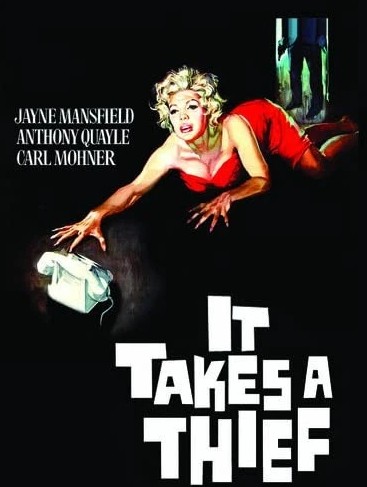
It Takes a Thief / The Challenge (1960) ****

Extremely dark-edged thriller at least a decade ahead of its time. Absolute corker of a sting in the tail. Instead of being the gangster’s moll, Jayne Mansfield – following on from another British-made thriller Playgirl After Dark / Too Hot to Handle (1960) – turns the genre on its head by playing the smart leader of a gang of bank robbers constantly evading detection by the police. Anthony Quayle (East of Sudan, 1964) drops his good guy stiff upper lip screen persona in favor of a villain.

Most heist movies either fall into the category of mostly heist (Topkapi, 1964) and half-heist and half-aftermath. Here the heist is dealt with pretty quickly and then we’re into a complicated aftermath with double cross the order of the day. Even the supposed good guys – a cop and a union leader – have a distinctly mean streak. And on top of that we have a whole load of car chases. Just one would be unusual at the time for this budget category, but here we have three, complete with crashes and cars totaled off the road. And on top of that there’s an exceptionally creepy attempt at getting an inconvenient young child to commit suicide by playing chicken on a railway line.
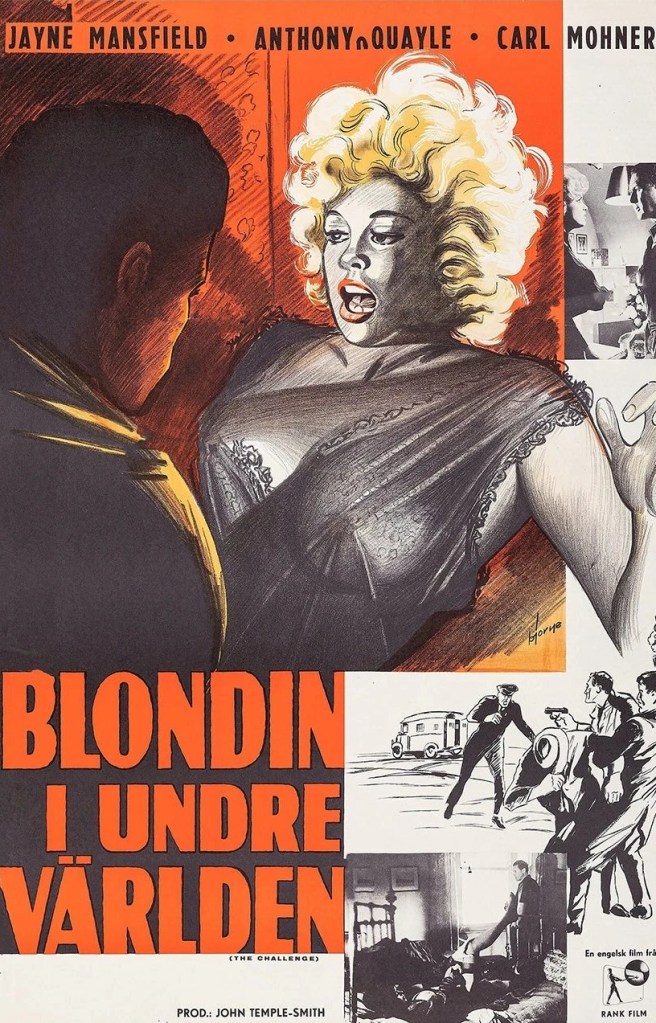
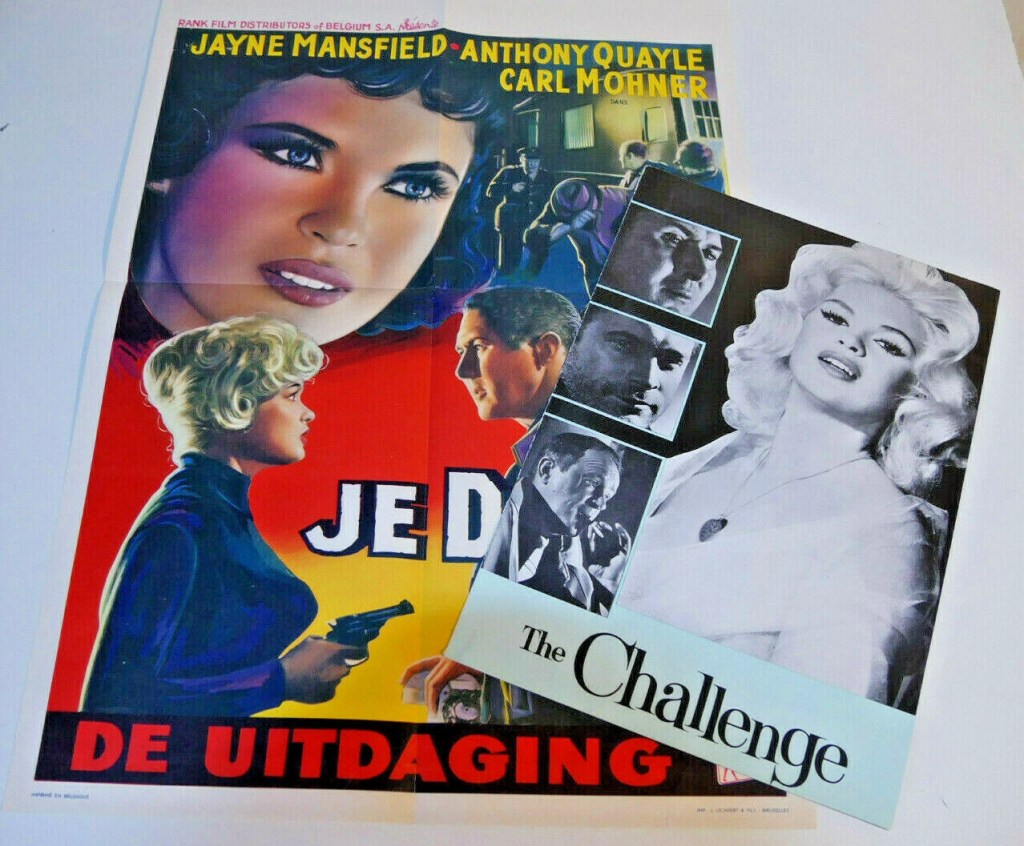
Widowed lorry driver Jim (Anthony Quayle), who has dreams of owning a farm, is seduced into acting as the driver for the latest bank heist organized by Billy (Jayne Mansfield). While his van loaded with the loot tootles off unimpeded, she acts as bait in another car to snooker the cops into pursuing the rest of the gang. As proof of her love for him, she entrusts him with burying the loot in a place of his choosing.

He doesn’t get the chance to dig it up again because someone’s snitched on him, most likely Billy’s ex Kristy (Carl Mohner). And since he can’t snitch on the gang to save his own skin he ends up doing a five-year stretch. When he comes out, he finds the cops shadowing his every move, and Kristy taking his place in Billy’s bed. Det Sgt Gittens (Edward Judd) decides to play dirty by suggesting that Jim is intent on double-crossing her.

The gang, determined on recovering the loot as soon as possible, have their own arsenal of dirty tricks, beating up Jim’s mother and kidnapping his son.  You’d think that with his mum black and blue and his son in the hands of the crooks that Jim would give up the loot. But, as I said, he’s not a good guy and is willing to risk all he supposedly holds dearly to get his hands on the dosh.
There’s a twist that Thunderbolt and Lightfoot (1974) later down the line exploit. Instead of someone building a school over the hiding place as with the Clint Eastwood picture, here it is hidden under dozens of barrels of high explosive encased in barbed wire. With the deadline approaching for killing his son, Jim attempts to enlist a bunch of local laborers only to be stopped in his tracks by the bureaucracy of a union shop steward.

Meanwhile, the couple, and despite all the motherliness of the childless wife (Barbara Mullen), forced to hide the child aren’t making the slightest attempt to help him escape. Instead, we watch with incredulity as one of the hoods, stumbling upon an easy way to get rid of a body, tempts the child into playing the aforementioned game of chicken.

Tension remains at a peak all the way through, in part because audiences are expecting Anthony Quayle to rouse himself from the depths of criminality and do the right thing, but mostly, in the template that Christopher Nolan would follow, three sets of narrative constantly come together.

There are two stings in the tail. Firstly, the burial site is obliterated when the barrels of high explosive shoot sky high. Secondly, with decided relish, Sgt Gittens informs Billy that the cops recovered the loot years before, so he’d risked mother and son for nothing. You can’t get blacker irony than that.

Jayne Mansfield was a much bigger attraction than Anthony Quayle and she puts in a superb performance as the mastermind and the practical woman, not willing to put career or love life on hold while Jim does his time. And while she’s slinky enough and occasionally brazen, she’s also decidedly human, but no more inclined than Jim to allow anybody to get in the way of the rewards of crime.

Like the crime pictures Britain showed a distinct aptitude for in the 1970s – Get Carter (1971), Villain (1971) and Sitting Target (1972) – this stays resolutely on the wrong side of the fence with not a single redeemable character.

Written and directed by John Gilling before he shifted into horror (The Reptile, 1966), this is a more than able piece, pulling no punches and resisting the temptation to sneak in any sentimentality.

Minor gem.

Catch it on Talking Pictures TV.
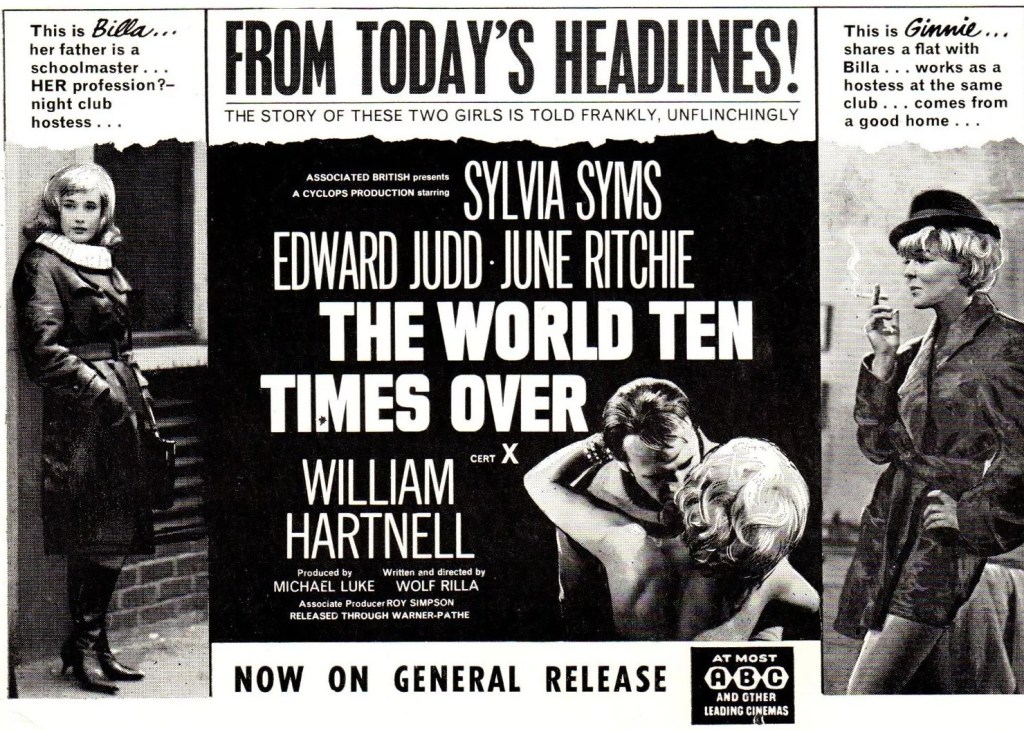
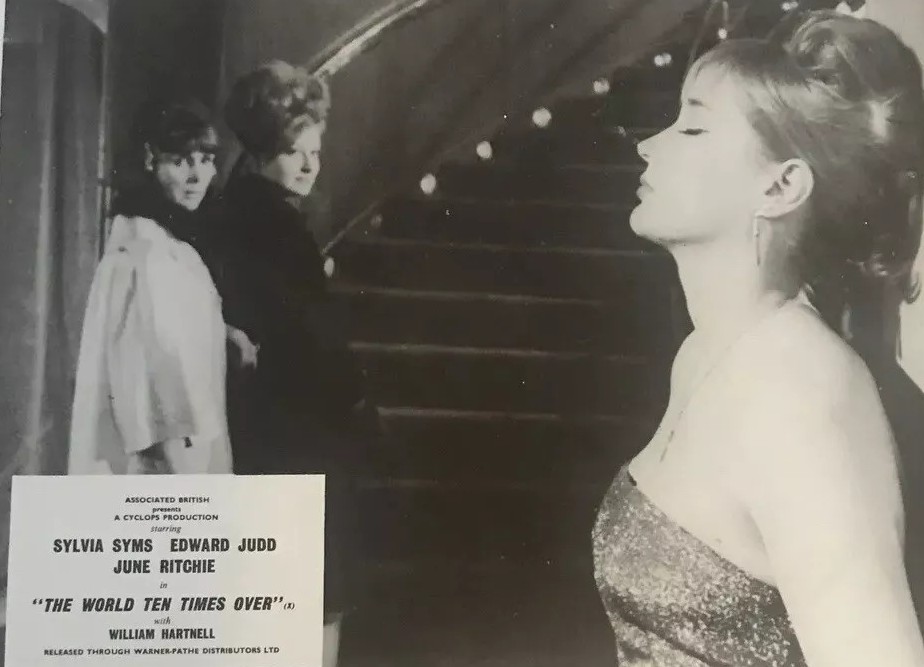
Pussycat Alley / The World Ten Times Over (1963) ***

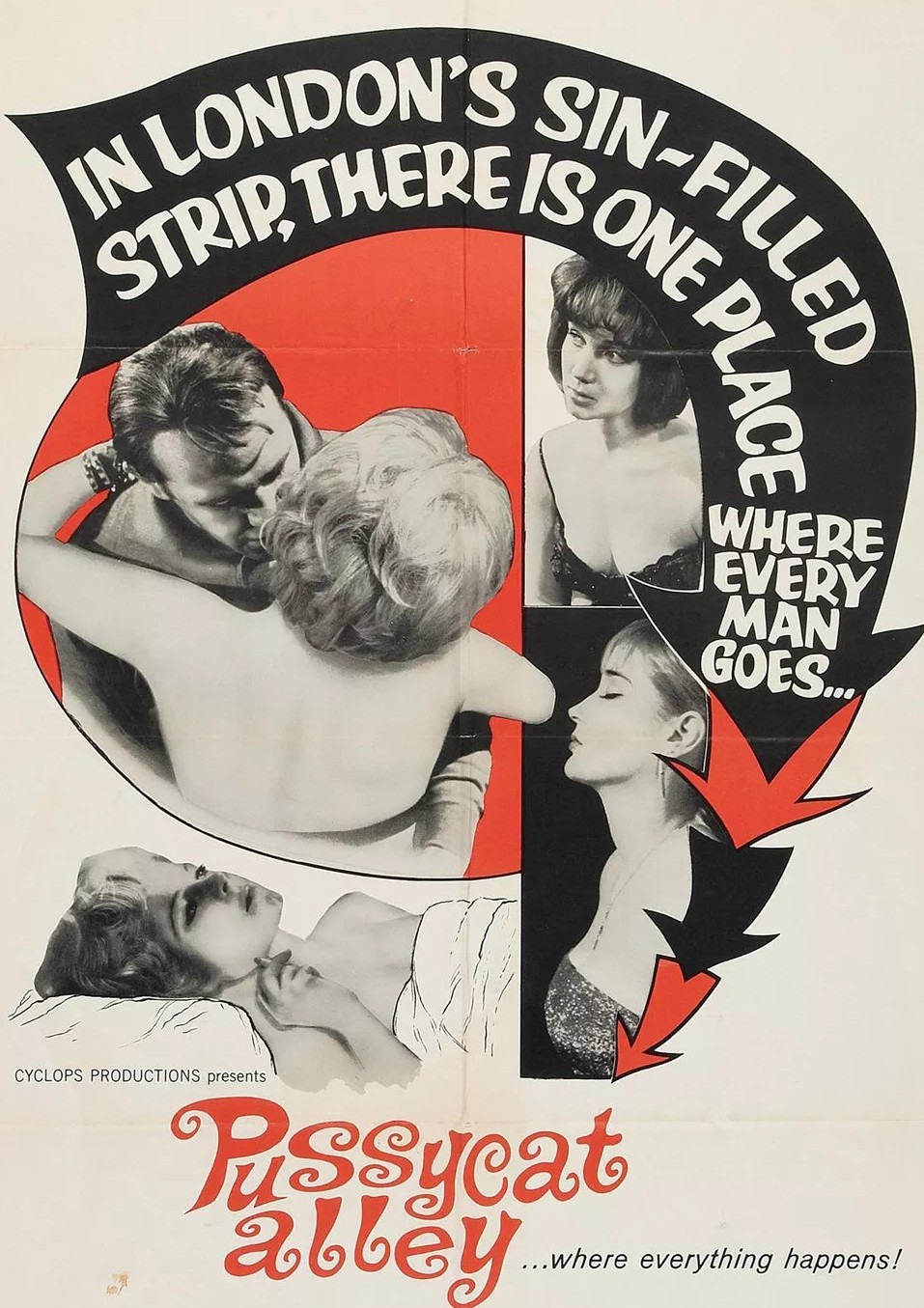
Sold as sexploitation fare, this is more of a chamber piece as flatmates Billa (Sylvia Syms) and Ginnie (June Ritchie) face up to crises in their lives. For two-thirds of the picture we steer clear of their place of occupation, a Soho nighclub, and only go there for a scene of unsurpassed male humiliation. Unusually, since the expectation would be that the two girls, supplementing their official income with some part-time sex working (implicit rather than explicit), would be treated as victims of wealthy males, in reality they serve up several plates of juicy revenge, but in accordance with their characters rather than as noir femme fatales.

In a very drab London, shorn of tourist hallmarks and red buses and royal insignia, Ginnie sets the tone, furious at lover Bob (Edward Judd), pampered son of a wealthy industrialist, for bringing mention of “love” into what she views as either (or both) an expression of pure pleasure or financial transaction. Bob is the old cliche, the client fallen in love with the girl. Attracted as she is by the pampering and the fact that she can twist him round her little finger, she values her independence too much to commit to such a weak man. In addition, she is so used to getting her way and so wilful that she delights in running rings around him, humiliating him in front of his entire office. 

A contemporary picture like Anora (2024) would find space to excuse or explain her choice of employment, but here, beyond the fact that she left school aged 15 and has no qualifications, we are given nothing to work on, except that her predilection for doing exactly what she wants to do most of the time means she she might find steady employment a drain on her spritely personality.

Billa’s problem is she’s pregnant with no idea who the father might be and becomes infuriated by her widowed teacher  father  (William Hartnell) who can’t let go of his childlike notions of his beloved daughter. Thankfully, no  notions of abuse, but just a dad not coming to terms with a grown-up daughter, shocked that she can knock back the whisky, and whose idea of a treat is taking her to one of the most difficult of the Shakespeare plays. Eventually, suspicions aroused, he tracks her down to the nightclub where she takes great delight in behaving disgracefully, refusing to leave at his presence, parental authority cut stone dead, the staff treating the father like any other punter, even setting him up with a girl (though on the house and he doesn’t take them up on the offer). 

Meanwhile, the over-entitled Bob, failing to get his father to offer Ginnie a job except as an escort for the company’s clients, decides to leave his wife, books plane tickets for an exotic holiday only to be spurned. Ginnie recognizes more easily than him what a disaster marriage would be. She enjoys the fancy restaurants and fast cars but draws the line at commitment. She’s at her best when prancing around, indulging her whims, and yet there is a price to pay for her lifestyle as we discover in more sober fashion at the end.

Billa is sober pretty much all the way through, thoughtful, withdrawn, unable to connect with her father, her biggest emotional support being Ginnie. Despite her failure to go along with her father’s vision of her as an innocent child, her apartment is bedecked with childish paraphernalia, teddy bears, dolls etc. 

Not quite a harder-nosed version of Of Human Bondage, and not far off as far as the males are concerned, but more of a character study of the two women.

Although she has the less showy part, Sylvia Syms is the peach here, and if you consider her portfolio from The World of Suzie Wong (1960) through to East of Sudan (1964) this shows the actress at the peak of her ability. June Ritchie (A Kind of Loving, 1962) is excellent as the flighty piece and Edward Judd (The Day the Earth Caught Fire, 1961) steps away from his normal more heroic screen persona. This was William Hartnell’s last movie before embarking on his time travels for Doctor Who and it’s a moving portrait of an old man whose illusions are shattered.

Directed by Wolf Rilla (Village of the Damned, 1960) from his own screenplay.

Low-life never looked so glam and so shoddy at the same time.

The Vengeance of She (1968) ***

Sequels boomed in the 1960s mainly thanks to multiple spy spin-offs in the James Bond/Matt Helm/Derek Flint vein but for every From Russia with Love (1963) and In Like Flint (1967) there was a more tepid entry like Return of the Seven (1966). One of the prerequisites of the series business was that the original star reappeared. But Ursula Andress who played the title character in Hammer’s She (1966) declined to reprise the role.

John Richardson did return from the first picture but in a different role, as the immortal Killikrates within the lost city of Zuma. So Hammer brought in Andress lookalike statuesque Czech blonde Olinka Berova (The 25th Hour, 1967), even emulating the Swiss star’s famous entrance in Dr No (1962), although instead of coming out of the sea Berova is going in and substituting the bikini with bra and panties, but the effect is much the same.

Story, set in the 1960s, has supposed Scandinavian Carol (Berova) mysteriously drawn south against her will and driven by voices in her head conjuring up the name Ayesha. We first encounter her walking down a mountain road in high heels only to be chased through the woods by a truck driver. It transpires she had unusual powers, or someone protecting her has, for the lorry brake slips and the truck crushes the driver. Next means of transport is a yacht owned by dodgy drunken businessman George (Colin Blakely) and before you know it she is in Algeria, assisted by Kassim (Andre Morell) who attempts to forestall those trying to control her mind, but to no avail.

Philip (Edward Judd), whose character is effectively “handsome guy from the yacht,” follows as she continues south and eventually the pair reach Kuma, where she is acclaimed as Ayesha aka She. Kallikrates’ immortality depends on her with some urgency crossing through the cold flames of the sacred fire. There’s a sub-plot involving high priest Men-hari (Derek Godfrey) promised immortality for returning Ayesha to Kuma and further intrigue that comes a little too late to help proceedings. You can probably guess the rest.

There’s no “vengeance” that I can see and certainly no whip-cracking as suggested in the poster. Berova, while attractive enough, lacks the screen magnetism of Andress and the mystery of who Carol is and where she’s headed is no substitute for either pace or tension and Berova isn’t a good enough actress to convey the fear she must be experiencing. The script could have done without weighting down the Kuma high priests with lengthy exposition explaining the whys and wherefores. Neither a patch on the original nor the expected star-making turn for Berova, this is strictly Saturday afternoon matinee fare and the slinky actress, despite her best sex-kitten efforts, cannot compensate.

Director Cliff Owen (A Man Could Get Killed, 1966) assembles a strong supporting cast, headed by Edward Judd (First Men in the Moon,1964) and Colin Blakely (a future Dr Watson in Billy Wilder’s The Private Life of Sherlock Holmes, 1970). You can also spot Andre Morell (Dark of the Sun, 1968), George Sewell (who later enjoyed a long-running role in British television series Special Branch, 1969-1974) and television regular Jill Melford. 

Curious change of pace for writer Peter O’Donnell, best known at this point for creating another sultry heroine, Modesty Blaise (1966).

Stolen Hours / Summer Flight (1963) ***

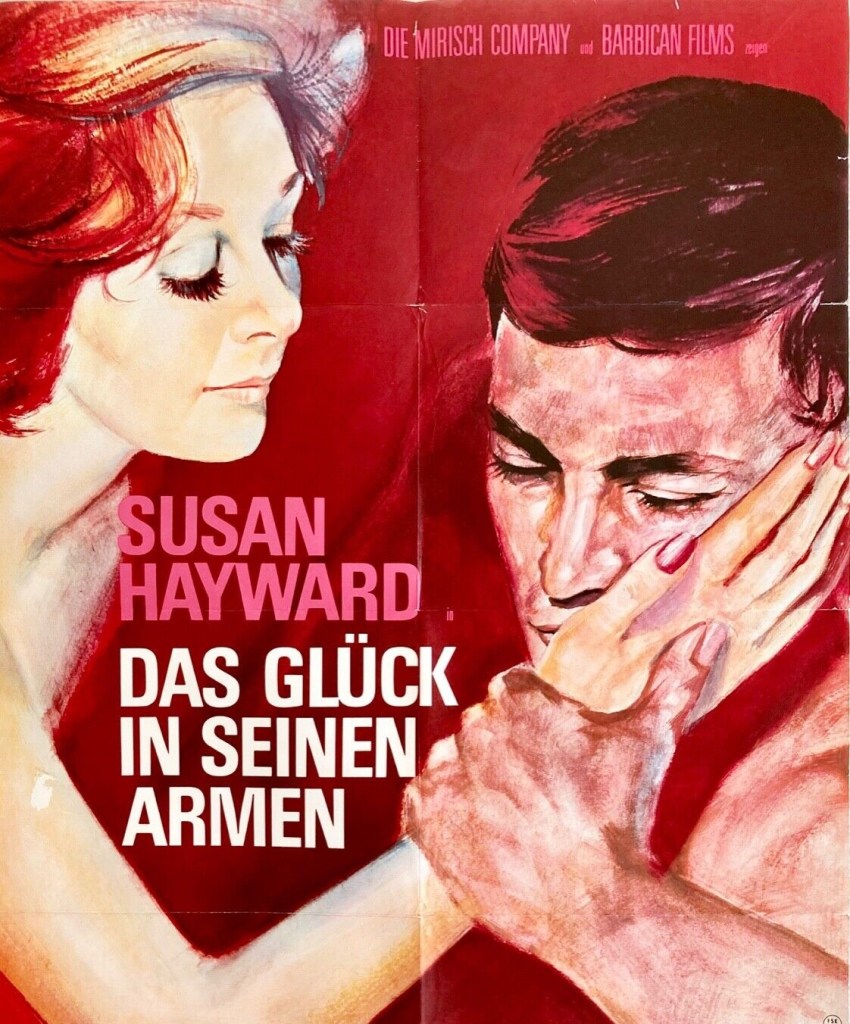
New York Times critic Bosley Crowther famously took Susan Hayward to task for over-acting in the first half of this picture before turning subtle in the second without realizing that was the whole point. Hayward was always full-on, either because he played tougher-than-tough characters (weakness their Achilles heel) or was squaring up against macho males like Clark Gable (Soldier of Fortune, 1954) or John Wayne (The Conqueror, 1956).

Here, she duped audiences. Anyone expecting to view her normal feisty screen persona would come away happy with the first half, bewildered by the second. But, as I said, that was the whole point, a superb effort turning expectations on their head. In any case it was a pretty bold undertaking. In the 1960s, Hollywood went on a cycle of regurgitating old classics but mostly with newcomers like Alex Cord standing in for John Wayne in Stagecoach (1966) or Doug McClure for Gary Cooper in Beau Geste (1966).

There were not many actresses who would think of trying to match the legendary Bette Davis in one of her legendary roles. But Susan Hayward was not just larger than life but a queen of melodrama, able to ratchet up emotions with a look. No actress in the early 1960s could match Davis’s record of two Oscars and a further eight nominations (she would win another one later). By that point Katharine Hepburn equalled her on number of wins but had two fewer nominations (her other wins also came later).  But Hayward ran both pretty close, one win (for I Want To Live, 1959) and four nominations.

So if you were going to select an actress to take on the Davis role in a remake of Dark Victory (1939) you could do worse than choose Hayward. The plot’s been transitioned to England but it follows the same formula as before – in other words stand by for a full-scale weepie. Jet-setting divorced socialite Laura (Susan Hayward) lives life to the full – and then some. When diagnosed with a brain tumor, her reaction is to let all her wildness hang out, reviving romance with old racing driver boyfriend Mike (Edward Judd) before taking stock and abandoning the high life and settling down in the back of beyond (remote Cornwall) with Dr Carmody (Michael Craig).

It’s basically a film of two halves. The almost otherworldly life of the rich and famous who chase after every expensive delight without any notable increase in their happiness quotient contrasts with life in a Cornish village where problems, although apparently smaller, are every bit as vital to those affected. The gaudy section is filled with fine costumes, grand houses and glorious scenery. The serious part is a good bit more down-to-earth as the grande dame discovers her neighborly and maternal qualities. The characters inhabiting the rich life appear flimsy, the poorer people much more realistic. It is almost as if she has swapped fantasy for reality and uncovered a different kind of richness.

There’s not much more to the story than that so it requires acting of the highest caliber to keep us hooked all the way through. Well, for that, you’ve certainly come to the right place. What appears over-acting in the first section is just that, and deliberately so, since the personality switch is the ideal hook. The film’s emotional impact will hit you hard especially the ending. What initially appears to be heading for the sensational soon pulls back to reveal an ordinary person trying to overcome adversity, not with a grand gesture, but simply by living an ordinary life to the full.

While Michael Craig (Life at the Top, 1965) is pretty much a bystander, his calming approach sorely needed in the first half is redundant in the second as Laura comes into her own, developing an inner life she never knew was possible. Hitchcock protege Diane Baker (Mirage, 1965) continues to show early-career promise.

Perhaps more attention should be focused on director Daniel Petrie (The Main Attraction, 1962) who slides out from under his journeyman tab to over-egg the first section and under-egg (if there is such a word) the second. You could almost get the impression of a conductor fine-tuning an orchestra of one.

Superb showing from Hayward certainly gives Bette Davis a run for her money though you could argue she was too old for the role, Davis half her age in Dark Victory, but it’s to Hayward’s credit that you feel the loss of such a vibrant middle-aged personality as you do with Davis’s younger protagonist.

They don’t do melodrama like this anymore, mostly because there isn’t the likes of a Susan Hayward to make them work.

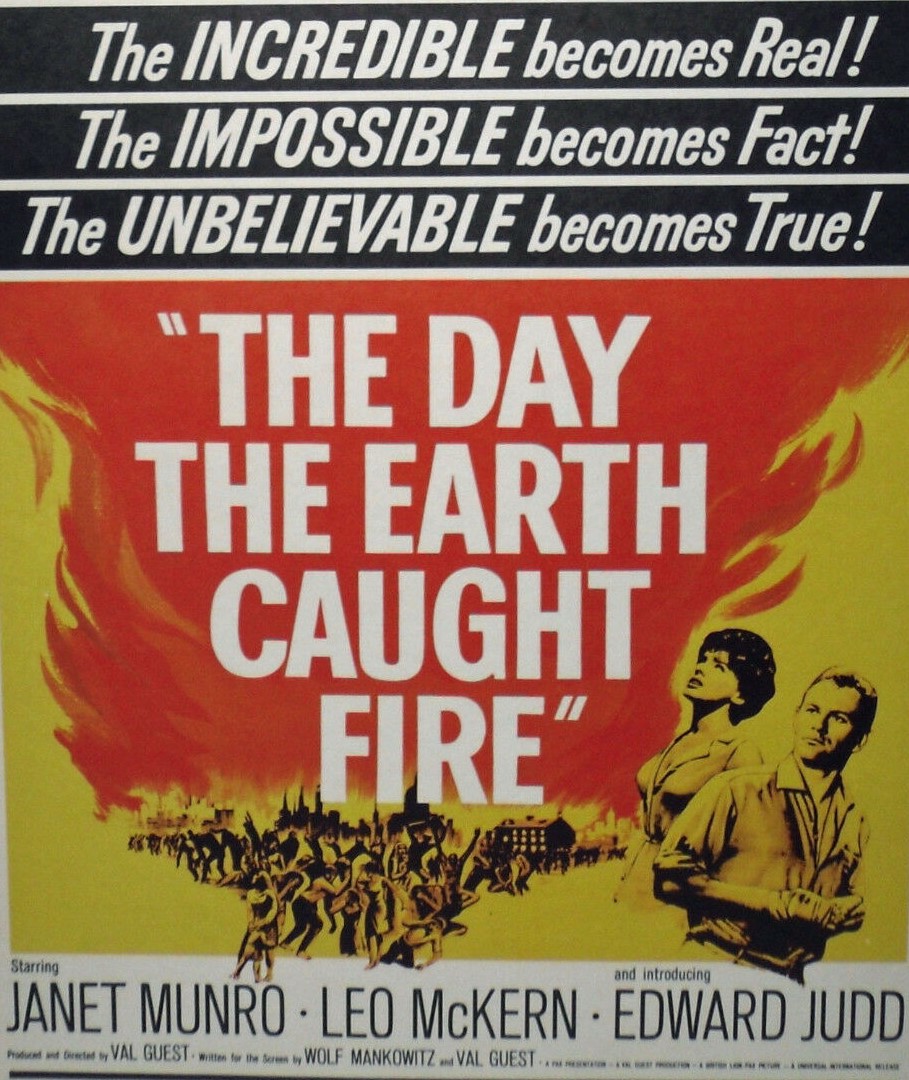
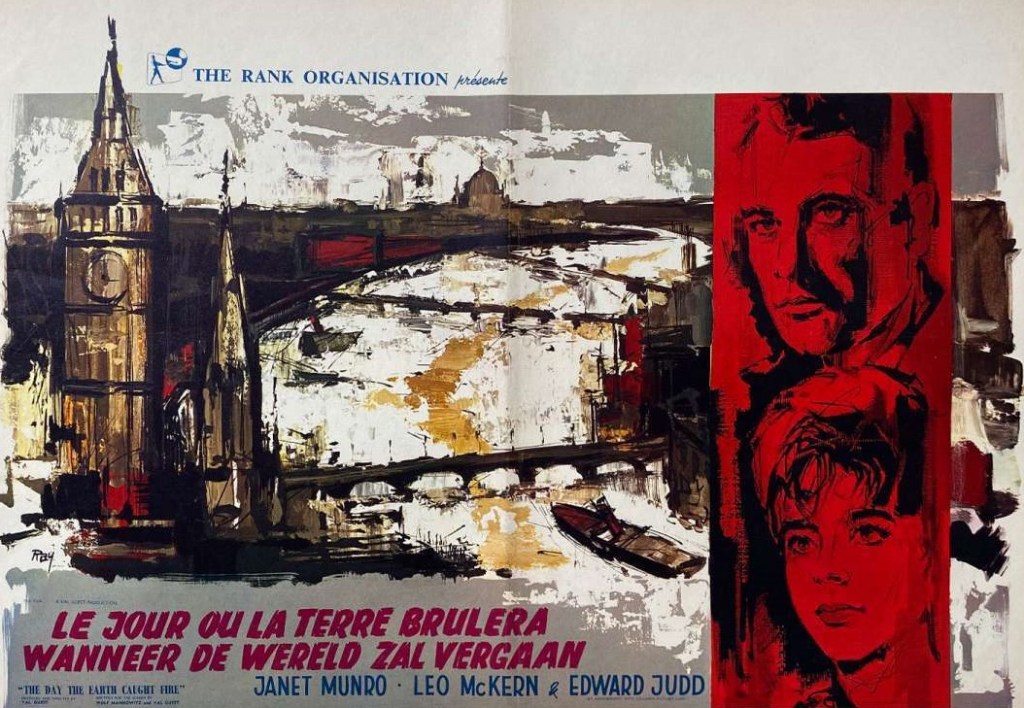
The Day The Earth Caught Fire (1961) ****

A more prescient picture you couldn’t find, tapping into a contemporary audience’s greatest fear – global warming. Its bold cliff-hanger ending would also appeal to a modern audience often left dangling at the climax of a blockbuster. And it cleverly skims on the special effects, relying on the more easily achieved downpours, thick fog, constant sweating, newsreel footage of natural disasters, water rationing and end-of-the-world riots than anything bigger.

But what surprised me more was the sheer pace. Not just a story moving at a frenetic pace but the British characters acting like they had been injected with a heavy dose of New York zap, talking over each other, hardly getting a complete sentence in before interruption, like Howard Hawks had taken command instead of a mere Englishman like Val Guest (Assignment K, 1968), a former journalist.

Front cover of the Pressbook.

It channels the director’s experience into creating the most realistic newspaper office you will ever come across, beating out All the President’s Men (1974) in its representation of how journalism really works, as concerned as much with the general fodder of unheralded stories as the scoops that normally drive such a narrative. And for a story that started off as pure pulp, the dialog is superb, so good it won the Bafta award.

It certainly helped that an actual newspaper editor, Arthur Christiansen (of the Daily Express) lent a guiding hand, playing the role of the editor of this downmarket daily. The summoning of copy boys (actually grown men), the demand for 500 words, the printers ready to switch the front page at a moment’s notice, the inevitable diet of pie and pint, and the emotional casualties as marriages crumble under the strain of a husband more concerned with this next story than wife or children, all serves to ground the film.

And yes, the narrative plays into the usual journalistic tropes, ambitious newspaperman Peter (Edward Judd), career on the line, uses typical wiles, duping lowly scientific secretary Jeannie (Janet Munro) into revealing more than she should. It’s a meet-cute of the old-fashioned variety, she hates him on sight.

Peter is as off-kilter as the world, knocked off its axis by the simultaneous explosion of nuclear devices, unable to come to terms with his divorce, finding solace in the time he spends with his child, and it seems fitting that much of that is spent diving into the darkness of the ghost train ride, the fog equally thematic as he wanders round in circles in that, as aimless as in his life, while a bath is just as cinematically important, not just for the obvious semi-nude scene but as a place of refuge from impending terror.  

These journalists know how to sniff out a story, how to separate the what from the chaff of the official line, digging deeper, and with global connections able to put two and two together far swifter than officialdom. It helps that Peter’s guardian angel Bill (Leo McKern) has a scientific brain and is able to work out the source of the infernal rising temperature.

It’s axiomatic of how clever the screenplay is that Peter and Jeannie come together over a lost child, although Peter, cynical and bitter, but more vulnerable than most, remains a conniving character, happy to risk their burgeoning relationship for the sake of a scoop.

Like Quatermass and the Pit (1967) it’s one revelation after the other as the world hurtles towards oblivion, though not before ending up as the biggest barbecue of all time. The film acknowledges the anti-nuclear demonstrations of the time before piling on proof that man has sown the seeds of destruction on a four-month countdown to doomsday.

We have been here before with end-of-the-world scenarios but this story unfolds not in scientific or official offices, and there’s no President around to add gravitas or take the blame, but in the minds of the dogged journalists, soon appalled by their discoveries, and for once a scoop is unable to save the day or give the villain his just deserts. Whoever is behind the catastrophe remains nameless, although the outcome of superpowers duking it out for supremacy is never in doubt.

Edward Judd (First Men on the Moon, 1964) delivers a star-making performance as the jaded, jagged, journo capable of emotional depths while Janet Munro (Hide and Seek, 1964) escapes Disney tomboy servitude with a very adult role. Leo McKern (Assignment K) has the solid acting chops that would, two decades before television fame as Rumpole of the Bailey, see as a formidable heavyweight addition to any film and a threat to any co-star through jis charismatic ability to steal scenes.

But the film belongs to Val Guest, who constantly turns up the emotional heat and the terror scale, getting the most out of the riveting, sparkling screenplay he co-wrote with Wolf Mankowitz (The 25th Hour, 1967).  

The Vengeance of She (1968) ***

Sequels boomed in the 1960s mainly thanks to multiple spy spin-offs in the James Bond/Matt Helm/Derek Flint vein but for every From Russia with Love (1963) and In Like Flint (1967) there was a more tepid entry like Return of the Seven (1966). One of the prerequisites of the series business was that the original star reappeared. But Ursula Andress who played the title character in Hammer’s She (1966) declined to reprise the role.

John Richardson did return from the first picture but in a different role, as the immortal Killikrates within the lost city of Zuma. So Hammer brought in Andress lookalike statuesque Czech blonde Olinka Berova (The 25th Hour, 1967), even emulating the Swiss star’s famous entrance in Dr No (1962), although instead of coming out of the sea Berova is going in and substituting the bikini with bra and panties, but the effect is much the same.

Story, set in the 1960s, has supposed Scandinavian Carol (Berova) mysteriously drawn south against her will driven by voices in her head conjuring up the name Ayesha. We first encounter her walking down a mountain road in high heels only to be chased through the woods by a truck driver. It transpires she has unusual powers, or someone protecting her has, for the lorry brake slips and the truck crushes the driver. Next means of transport is a yacht owned by dodgy drunken businessman George (Colin Blakely) and before you know it she is in Algeria, assisted by Kassim (Andre Morrell) who attempts to forestall those trying to control her mind, but to no avail.

Philip (Edward Judd), whose character is effectively “handsome guy from the yacht,” follows as she continues south and eventually the pair reach Kuma, where she is acclaimed as Ayesha aka She. Kallikrates’ immortality depends upon her with some urgency crossing through the cold flames of the sacred fire. There’s a sub-plot involving high priest Men-hari (Derek Godfrey) promised immortality for returning Ayesha to Kuma and further intrigue that comes a little too late to help proceedings. You can probably guess the rest.

There’s no “vengeance” that I can see and certainly no whip-cracking as suggested in the poster. Berova, while attractive enough, lacks the screen magnetism of Andress and the mystery of who Carol is and where she’s headed is no substitute for either pace or tension and Berova isn’t a good enough actress to convey the fear she must be experiencing. The  script could have done without weighting down the Kuma high priests with lengthy exposition explaining the whys and wherefores. Neither a patch on the original nor the expected star-making turn for Berova, this is strictly Saturday afternoon matinee fare and the slinky actress, despite her best sex-kitten efforts, cannot compensate.

Director Cliff Owen (A Man Could Get Killed, 1966) assembles a strong supporting cast, headed by Edward Judd (First Men in the Moon,1964) and Colin Blakely (a future Dr Watson in Billy Wilder’s The Private Life of Sherlock Holmes, 1970). You can also spot Andre Morrell (Dark of the Sun, 1968),  George Sewell (who later enjoyed a long-running role in British television series Special Branch, 1969-1974) and television regular Jill Melford.  

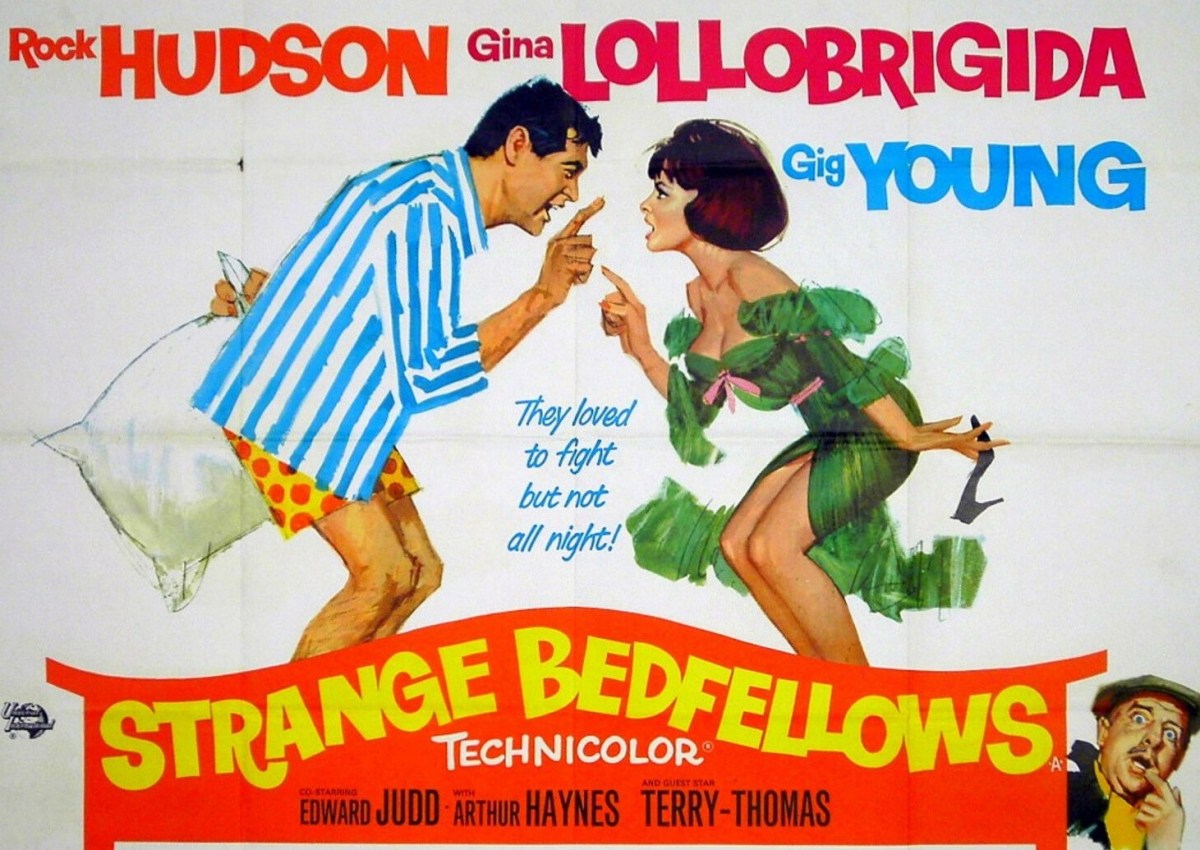
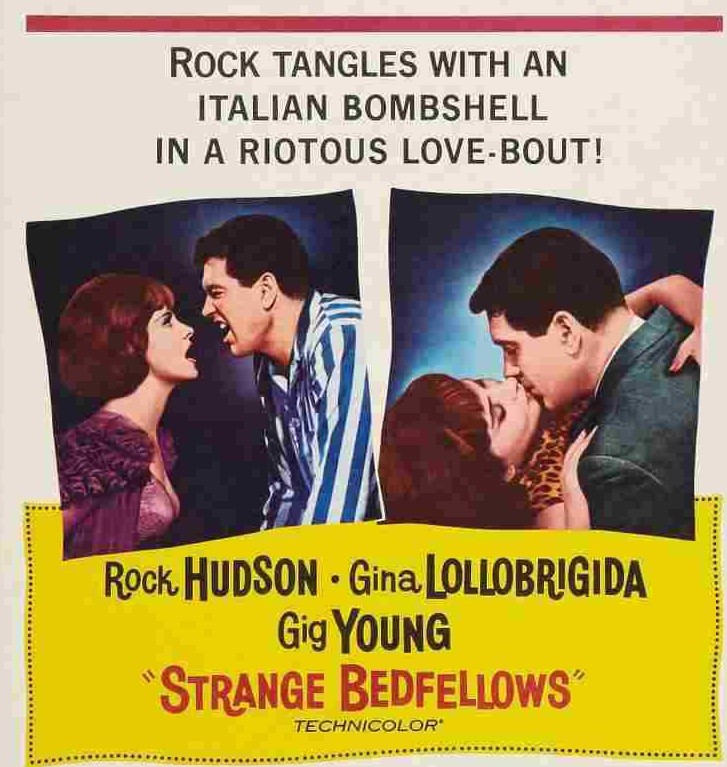
Strange Bedfellows (1963) ****

I had my first belly-laugh within seconds, a wonderful sight gag, and was chortling all the way through this London-set battle-of-the-sexes comedy. Rock Hudson is a high-flying businessman who needs to win back long-estranged wife Gina Lollobrigida in order to gain promotion in a family-conscious oil company. Initially, Hudson re-discovers the reasons he had first fallen in love with her but then, of course, only too bitterly, why they split. Hudson and La Lollo had previously teamed up for Come September (1963) and Hudson had spent most of the early 1960s in romantic mishap with Doris Day so he could call on an extensive range of baffled and enraged expressions. Lollobrigida is an artist-cum-political-firebrand which sets up hilarious consequence. Gig Young is on hand to act as referee.

There’s some marvelous comic invention,  a conversation between the two principals relayed through taxi controllers turns into a masterpiece of the misheard and misunderstood. Complications arise from Lollobrigida’s fiance Edward Judd (First Men on the Moon, 1964), also an activist, but on the pompous side, and an Italian lothario. Taking advantage of the less than congenial London weather, there are jokes aplenty about umbrellas and in a nod to farce occasions for Hudson to lose his trousers and share a bed with the fiance. Smoldering sexual tension also kindles many laughs. By the time the film enters its stride it’s one comedic situation after another. It being England, naturally enough Lady Godiva is involved.

Hudson in suave mode trying to cope with the feisty Lollobrigida is an ideal comedy match. Costume designer Jean Louis has swathed the actress in a stunning array of outfits, some of which leave little to the imagination. When Doris Day got angry you tended to laugh, not quite believing this was anything more than a moderate hissy fit, but if you crossed Lollobrigida you were apt to get both barrels and it never looked like acting, she was a very convincing when she switched on the fury engine, plus, of course, whatever she threw added both to the comedy and her character’s conviction.   Both have terrific comic timing.

Writer-director Melvin Frank was something of a comedy specialist, a dab hand at suiting comedy to screen persona having previously set up Road to Hong Kong (1962) and Mr.  Blandings Builds a Dream House (1948). Terry-Thomas makes an appearance as a comic mortician and there are parts for English comedian Arthur Haynes and Dave King. Hudson and Lollobrigida exude screen charisma and while not in the class of Come September this delivers enough laughs to make you wonder why they don’t make them like that anymore.

You should find this in Amazon Prime.

Discover WordPress

A daily selection of the best content published on WordPress, collected for you by humans who love to read.

The Atavist Magazine

by Brian Hannan

WordPress.com News

The latest news on WordPress.com and the WordPress community.