When we talk about realistic war movies, we generally mean ones chock-full of brutality and violence. But there was another reality rarely touched upon, and that was guys to trying to get through the whole shooting match without getting killed. Not cowards, necessarily, but people unwilling to take stupid action in the guise of blind obedience.
This ends up being a highly unusual and hence highly original take on the war picture. Where, in another film, enemies might duel fiercely to the death, attempting to outwit each other at every turn, this delivers on a more emotional, thoughtful, and human, level.
You wouldn’t have thought, either, that the combination of two wildly different humor codes, the more overt Italian and the laid-back British, would work. So in subject matter and style, this takes a helluva risk. Much of the effect rides on exposing as misleading the standard tropes regarding the different countries – that the Italians are weak and that Brits, feelings numbed by stiff upper lip and upbringing, never complain.
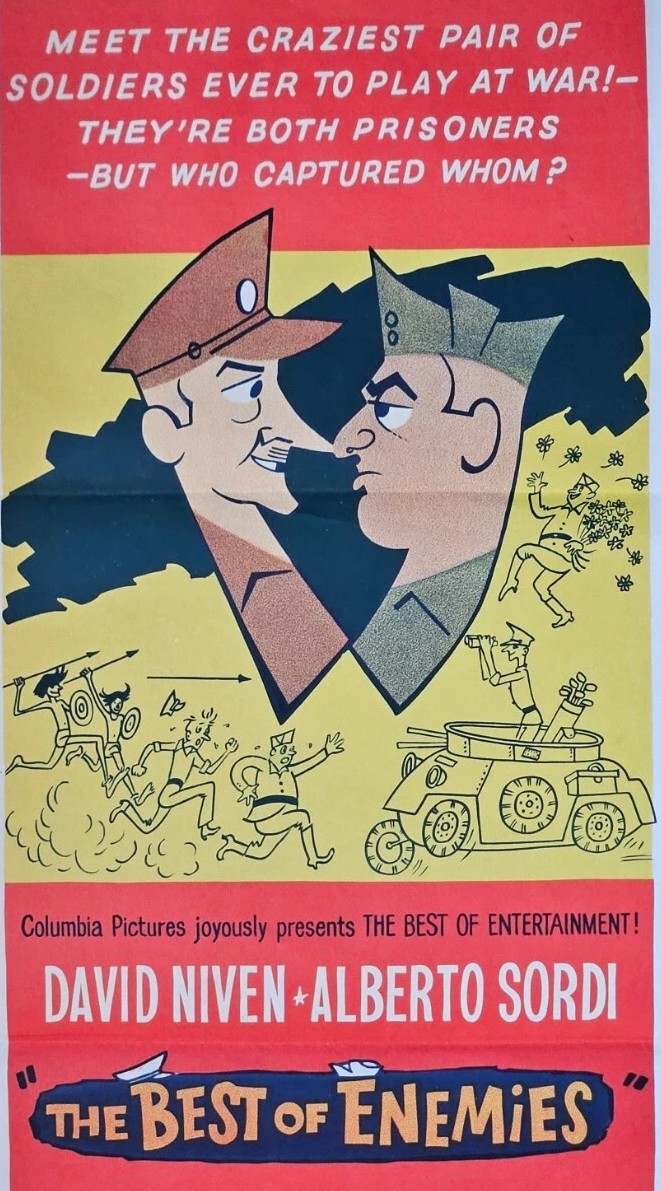
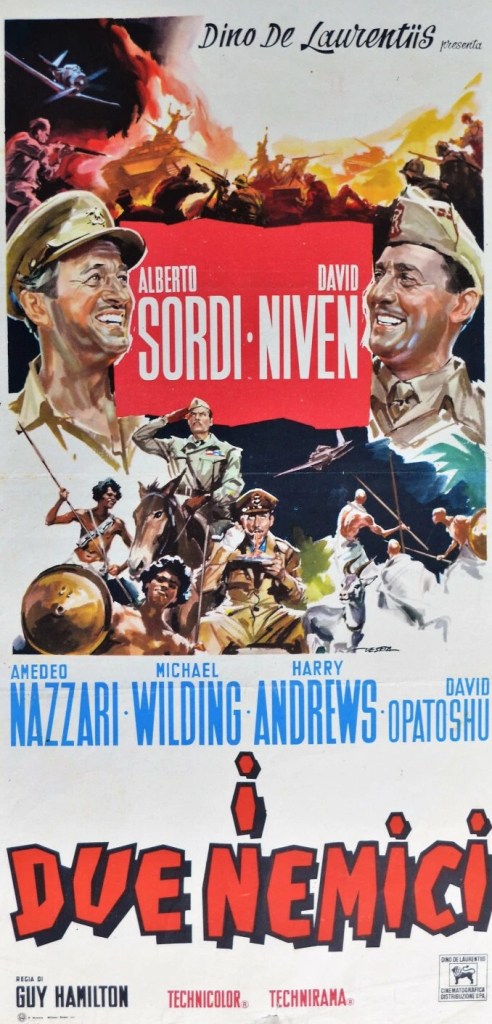
Major Richardson (David Niven), reconnaissance plane shot down in Italian-held Abyssinia (Ethiopia) in 1941 in World War Two, is captured in the desert by a unit led by Captain Blasio (Alberto Sordi). Blasio doesn’t want the responsibility of prisoners and encourages Richardson to escape, hoping that the Brit, taking note of how weak the Italian unit was, would leave them alone.
The opposite is true. The Brits would like nothing better than to capture a weak section of the Italian Army. So Richardson, leading a stronger unit with tanks and stuff, confronts the Italian who is furious that the man he let go has somehow reneged on an unwritten code of honor and come back. Using a simple ruse, the Italians escape.
The Brits nearly catch up with them several times but incompetence gets in the way. Then Blasio gets annoyed with some of his natives and cuts them loose and in revenge they start a fire that drives both Brits and Italians together. Blasio is happy to surrender since that means the Brits, devoid of transport after the fire, have to holster Italian rifles and carry on a stretcher any Italian, such as Blasio himself, who falls ill.
The enemies unite to escape an interfering native tribe but then Blasio gets the hump at Richardson once again, returning the Italians to prisoner status once they are free. Hiding out in an abandoned village, the Italians are put to work building latrines – and according to the British class system different ones for officers and soldiers. A bid by Blasio to put Richardson in his place misfires. The two units bond again over a game of football and when the tribesmen return Richardson breaks the rules by handing back the Italians their rifles. Only thanks to British incompetence there’s no Italian ammo.
So then, weapon-less, and nobody apt to take sides, they stagger over the desert, directed by Richardson to safety. Richardson and Blasio bond over wives and family. But when they reach a proper road, Richardson reverts to the status quo and insists the prisoners form up at the rear. Except, he’s got it all wrong and they have ended up in the Italian-controlled zone. Blasio can’t contain his delight, mocking the Brits, but not taking them prisoner. Except he’s got it wrong, too, as the desert campaign is over and the Brits are victorious.
It doesn’t end well for either officer. Richardson is threatened with being put in the catering corps, Blasio a bedraggled prisoner. But it finishes on an uplifting moment, Richardson instructs his men to present arms to the prisoners, indicating their mutual respect.
So, as I said, nothing like your usual war movie. Both commanders are incompetent. Richardson despises Blasio for not “putting any effort” into his job. Blasio can’t understand why Richardson takes the job so seriously. Even if it marked him down as a coward, Blasio’s wife just wants him home safe. Incompetence rules, mistakes are legion, and pettiness guides the action of the officers. Movie makers of the period tended to concentrate on the heroism of war, but there must have been a ton of expeditions like this that went awry.
The script allows both David Niven (Bedtime Story, 1964) and Alberto Sordi (Anzio, 1968) considerable latitude, the Englishman afforded a wider range than usual, the Italian encouraged to tone down the over-acting, so each turns in a more measured performance. Sordi was nominated for a Golden Globe and the movie was nominated for two other Globes including Best Foreign Film.
The supporting cast includes Michael Wilding (The Sweet Ride, 1968), Harry Andrews (The Hill, 1965) and David Opatoshu (Guns of Darkness, 1962).
Directed by Guy Hamilton (Battle of Britain, 1969) from a screenplay by Jack Pulman (The Executioner, 1970).
More rewarding and emotionally satisfying than I expected.
Con men at opposite ends of the grifter divide face off in a duel over territoriality in the French Riviera. Freddy Benson (Marlon Brando) is a low-level scam artist who is happy to scrounge a meal or talk his way into an innocent damsel’s bed. Lawrence Jameson (David Niven) is his polar opposite, posing as an impoverished aristocrat to relieve gullible women of their wealth, seduction an added extra.
Initially, Jameson gets the better of their encounters until Benson realizes just what a killing the Englishman is making. Initially, too, Benson is happy to pair up with Jameson, although that involves demeaning himself as a supposed mad brother kept in a dungeon, until the Englishman dupes him out of his share. Eventually, they agree a winner-take-all battle – whoever can swindle heiress Janet Walker (Shirley Jones) out of $25,000 shall inherit the shyster kingdom.
Benson takes the sympathy route to the woman’s heart, turning up in a wheelchair, while James adopts a psychological approach, persuading Ms Walker that Benson’s illness is psychosomatic for which he has the cure for the small consideration of $25,000. And then it’s one devious twist after another as the pair attempt to out-maneuver, out-think and generally embarrass the other. Both have a despicable attitude towards women, whom they view as dupes, but it is woman who proves their undoing.
Most comedies rely on familiar tropes and you can usually see the twists coming, but this is in a different imaginative league and once the pair are in their stride I defy you to work out what they will come up with next. It is full of clever quips and small dashes of slapstick and because neither actor chases the laughs but plays their roles straight it is a very effective and entertaining morsel.
Director Ralph Levy in his movie debut knows more than where to just point a camera since he had decades of experience extracting laughs in television with top comedians like Jack Benny and Bob Newhart. Brando (The Chase, 1966) free of the shackles of the angst he normally incorporates into his dramatic performances, looks as if he is having a ball and while teetering occasionally on the edge of mugging never quite overplays his hand.
David Niven (Prudence and the Pill, 1968) was born with a stiff upper lip in his mouth and while this kind of aristocratic character is a doddle for an actor of his stature the portrayal here is much more like the sharpest tool in the box. While oozing charm, Niven exhibits deadly spite.
Screenwriters Stanley Shapiro and Paul Henning had previously collaborated on Lover Come Back (1961) and Shapiro particularly made his bones on the Doris Day-Cary Grant-Rock Hudson axis so it is interesting to see him shift away from the romantic comedy cocoon into something that is a good deal sharper.
Enjoyable and original with excellent performances from the two principles and great support from Shirley Jones (The Music Man, 1962) as the mark and Egyptian Aram Stephan (55 Days at Peking, 1963) as an only too congenial French policeman.
Imperialism is hard to stomach these days but at the start of the twentieth century it was rampant and not restricted to the main culprit, the British. China was Imperialism Central, round about a dozen nations including the USA and Russia claiming control of sections of the country or its produce. So they had all set up diplomatic shop in Peking. And the film begins with an early morning roll call of national anthems before this domination by outside interests is shattered by rebellion.
Just as hard to stomach, of course, was the movie mainstream notion in those days that all rebellions must perforce be put down regardless of how put-upon the peasant classes were. Audiences had to rally round people in other circumstances they would naturally hate. So one of the problems of 55 Days at Peking is to cast the rebels (known as Boxers) and the complicit Chinese government in a bad light while ensuring that those under siege are not seen as cast-iron saints. There’s no getting round the fact that the rebels are shown as prone to butchery and slaughter while the Chinese rulers are considered ineffective and traitorous.
So it’s left to the likes of Major Mark Lewis (Charlton Heston) heading up the U.S. Marines stationed in the city to bring some balance to proceedings. “Don’t get the idea you’re better than these people because they can’t speak English,” he expounds. British Consul Sir David Robertson (David Niven) tries to keep this particular league of nations onside while negotiating with one hand tied behind his back – “we must play this game by Chinese rules” – with the Chinese Dowager Empress Tzu-Hsi (Flora Robson) while knowingly endangering his wife Lady Sarah (Elizabeth Sellars) and two children. Unscrupulous Russian baroness Natalie Ivanoff (Ava Gardner) exhibits little loyalty to her home country.
The picture is one-part action, one-part politics and one-part domesticity, if you include in the last section the major’s romance with the baroness, the consul’s guilt when his son is wounded in an attack and Lewis’s conflict over a young native girl fathered by one of his own men who is then killed. Two of the best scenes are these men coping with parental obligation, Sir Arthur managing a wounded son, Lewis finding it impossible to offer succor to the child.
The action is extremely well-handled. The siege goes on longer than expected when the expected troops fail to arrive, tension rising as casualties mount and supplies fall low. As with the best battle pictures, clever maneuvers save the day. Two sections are outstanding. The first has Lewis marshalling artillery to prevent the Chinese gaining the high ground. The second is a daring raid – Sir Arthur’s idea, actually – through the city’s sewers to the enemy’s ammunition dump. Personal heroism is limited – Lewis volunteers to go 70 miles through enemy territory to get help but has to turn back when his men are wounded or killed.
There’s a fair bit of stiff upper lip but while Lewis, in familiar chest-baring mode, has the baroness to distract him, Sir Arthur is both clever, constantly having to outwit the opposition and hold the other diplomats together, and humane, drawn into desperation at the prospect of his comatose son dying without ever having visited England. The baroness moves from seducer to sly traitorous devil to angel of mercy, wapping glamorous outfits for a nurse’s uniform, at the same time as changing her outlook from selfish to unselfish.
Charlton Heston (Diamond Head, 1962), David Niven (Eye of the Devil, 1966) and Ava Gardner (The Angel Wore Red, 1960) acquit themselves well as does Flora Robson (Eye of the Devil) in a thankless role. In supporting roles are John Ireland (The Swiss Conspiracy, 1976), Harry Andrews (The Charge of the Light Brigade, 1968) and Leo Genn (Ten Little Indians, 1965).
This was the third of maverick producer Samuel Bronston’s big-budget epics after King of Kings (1961) and El Cid (1961) with a script as usual from Philip Yordan – sharing the credit with Robert Hamer (Kind Hearts and Coronets, 1949) and Bernard Gordon (Custer of the West, 1967) – and directed by Nicholas Ray (King of Kings) who also had assistance from Guy Green (Diamond Head).and Andrew Marton (Africa: Texas Style, 1967)
All in all it is a decent film and does not get bogged down in politics and the characters do come alive but at the back of your mind you can’t help thinking this is the wrong mindset, in retrospect, for the basis of a picture.
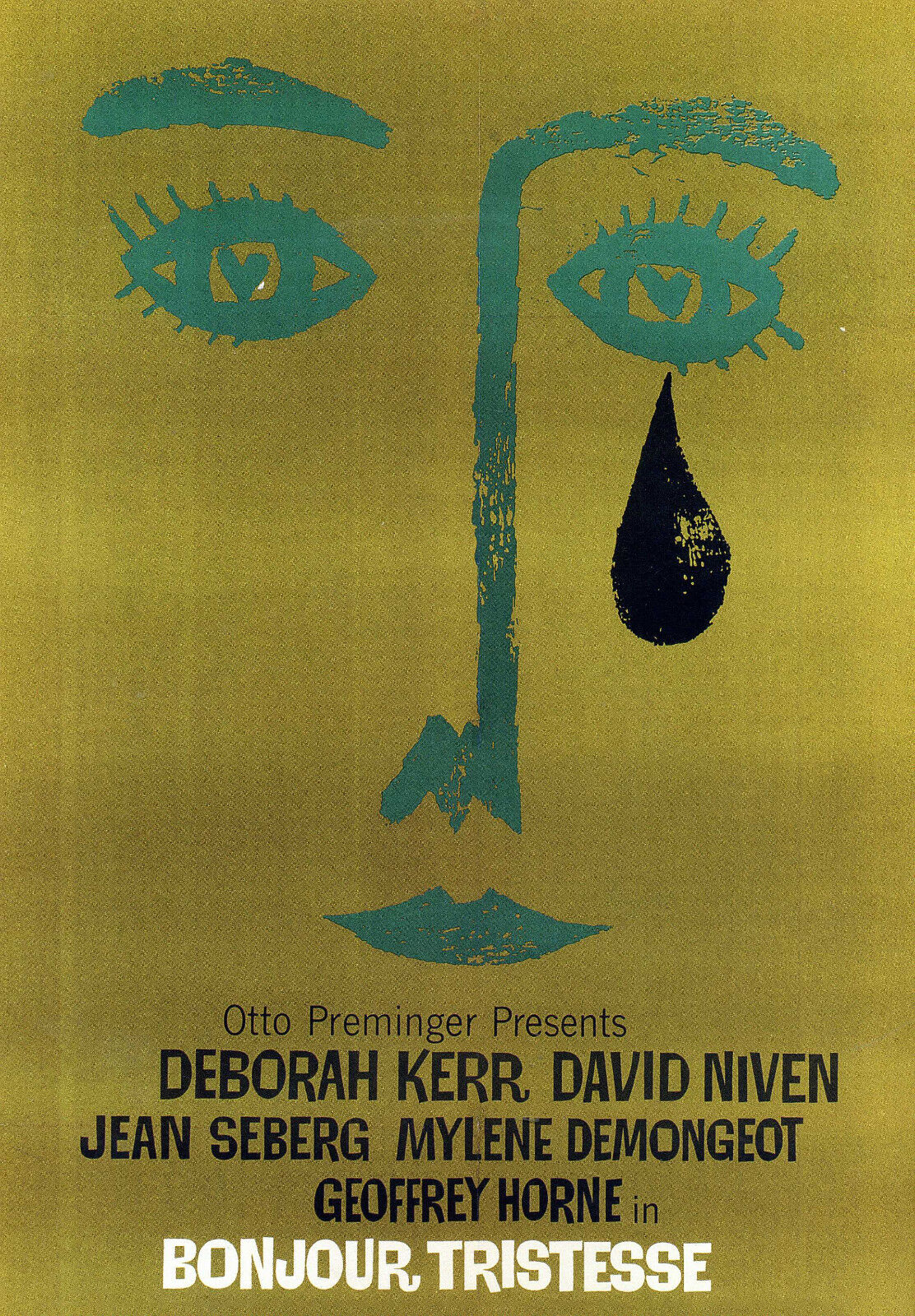
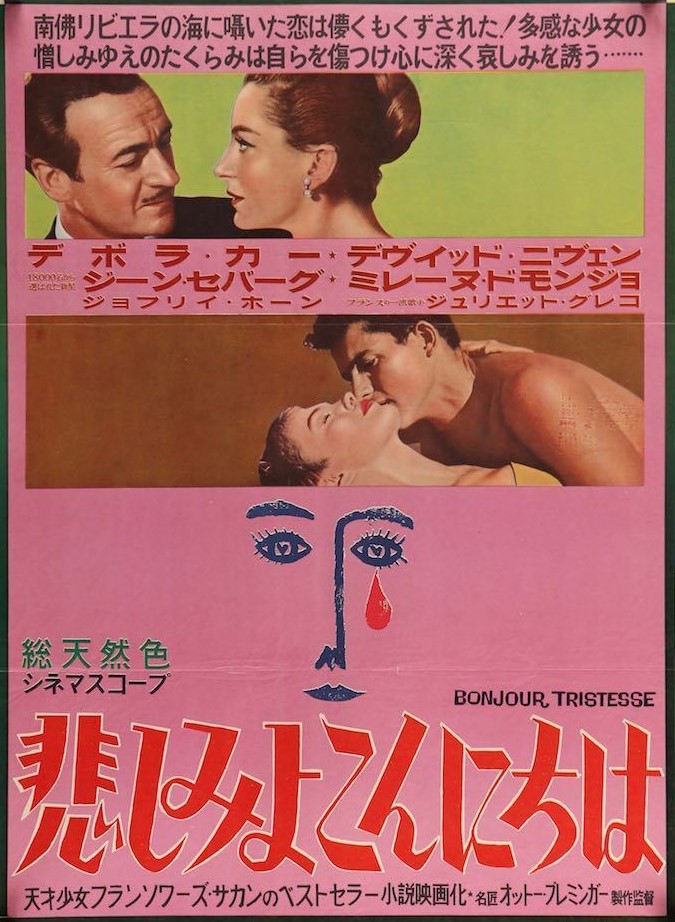
Audrey Hepburn and Cary Grant (later a famous duo in Charade, 1963) were the first names associated with Bonjour Tristesse. The former was mooted soon after the movie rights were sold to French producer Ray Ventura. She remained in the frame after Otto Preminger took over in 1955, when the project was intended for MGM rather than Columbia, at which point Grant was being targeted.
But, unfortunately, this was not being proposed as a dream team. Vittorio De Sica was being lined up to play the father in the Hepburn version that was to be directed by Jean Negulesco.
(You can see why uncovering this information prompted me to have a second shot at a “Behind the Scenes” for this picture. When I did the original article, I didn’t have access to my usual online sources. But after a query from a reader over the success/failure of the movie, and with internet access restored, I began to check out its box office and, in so doing, found a treasure trove of new data.)
Even after Preminger dumped Hepburn – and Maggie MacNamara, star of The Moon Is Blue (1953) for that matter – as being too old, at this point Preminger was not looking in the direction of Jean Seberg either. Instead, he was going down a more traditional route to find an actress to play disturbed teenager Cecile. He embarked on a publicity-driven new star hunt. After in 1956 holding a “talent search for femme lead” in France, the director selected 17-year-old Gisele Franchomme for the role.
But she never made the grade either and was quickly jettisoned for Francoise Arnoul (French Cancan, 1955), aged 25 at the time, with another Frenchwoman, Michele Morgan (Lost Command, 1966), as the older woman who snares Cecile’s father, still to be played by Grant.
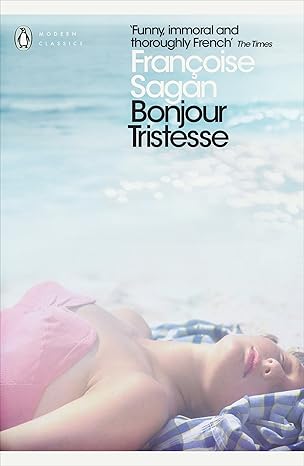
It’s hard to visualize now just what a hot number the source material was. The novel by Francoise Sagan had been a massive U.S. bestseller. By September 1955 it was in its ninth hardback printing, shifting 110,000 copies, and in 1956 became Dell’s top-selling paperback of the year. The movie rights had originally sold for just $3,000 to Ventura before Preminger ponied up $100,000 (or $150,000 depending on who you believe and in either case still the highest price ever paid for a French novel) and set the movie up at MGM.
So that studio was determined to strike while the novel was hot, taking advantage of the sensational sales figures achieved by Dell. Preminger had different plans. He had a double whammy in mind, planning to pre-empt the movie with a play written by S.N. Berhman (on loan-out from MGM who took first stab at the screenplay) initially scheduled to hit Broadway more than a year before the film appeared.
Preminger had worked the play-into-movie magic before, directing The Moon Is Blue on Broadway in 1951 two years prior to his controversial movie version. In the end Preminger concluded there was “insufficient time” to put a play into production before he was due to begin shooting.
Although it had originally gone along with the idea of the play to the extent of funding the stage production, MGM grew increasingly anxious about the delay in moving onto the picture-making part of the deal. Originally, it was planned as Preminger’s follow-up to The Man with the Golden Arm (1955) which would have seen it released either in later 1956 or early 1957.
The notion of turning the book into a play first probably caused the parting of the ways between MGM and Preminger, the studio unable to pin him down to a start date that would take advantage of phenomenal public interest. He was a hard guy to pin down, already commissioning Alec Coppel to write the screenplay of The Wheel, his proposed biopic of Gandhi, and he also had an ongoing deal with United Artists. So when MGM pulled out, the director turned to Columbia, planning Bonjour Tristesse as the first film in a multi-picture non-exclusive deal.
You could see why MGM were so anxious to get going. The studio was leading the way in a new trend, “the newest film cycle is controversy,” trumpeted Variety in a front-page splash in 1956, tagging Bonjour Tristesse “an unpleasant tale.”
But there was a better reason to act fast rather than just to be seen as with-it. Not only was the paperback market booming, its fastest-growing sector was the movie tie-in. While the 4,500 titles appearing annually accounted for sales of around 200 million copies, publishers also printed movie tie-ins for another 200 titles.
Movie tie-ins had turned into a publishing phenomenon. Sales of Dell movie tie-in paperbacks rocketed year on year, so much so that the rise in 1959 was 23 per cent over the previous year. Ironically, Preminger’s Anatomy of a Murder (1959) has been the publisher’s top title for that year. Peyton Place had taken the top spot in both 1957 and 1958 – 4.2 million copies in print – with Bonjour Tristesse its top seller in 1956.
Typically, a movie tie-in was, in effect, a follow-up to the initial paperback. Often the tie-in print run was much higher than the initial printing. The tie-in edition for Bridge on the River Kwai, for example, topped 750,000 copies, for Sayonara it was 900,000. Don’t Go Near the Water sold one million in a month. The average movie tie-in print run for Bantam was 200,000-350,000 copies; for Dell 250,000-300,000; for Signet 300,000; Popular Library 250,000-300,000; and Pocket 225,000-375,000.
Paperbacks accessed a new market. Apart from traditional bookshops, they were available in drugstores, newsstands, supermarkets, impulse buys when the reader was purchasing something else. But they provided for studios a powerful marketing tool. Dell advertised that its paperback “bestsellers were movie pre-sellers” and for good reason. Front covers adorned with stills from a forthcoming movie offered studios fresh promotional opportunity. When a big picture was due you could hardly walk down a street without your attention being called to a tie-in.
Paperback sales were also viewed as a providing a strong indication of box office potential. Based on its sales, it was predicted that Bonjour Tristesse would do as well as Old Yeller and Don’t Go Near the Water, which turned into, respectively, the 10th and 14th biggest films of the year. Columbia sales chief Rube Jackter was so confident of success for Bonjour Tristesse that he departed from convention, taking a groundbreaking approach, personally undertaking a nationwide tour to sell the project to his local sales teams. Perhaps he didn’t want to be beaten to the punch by A Certain Smile (1958), Sagan’s sophomore novel, rights selling for $150,000 and eight per cent of the gross.
Newcomer Jean Seberg was in the vanguard of a new talent hunt. Undaunted by his experience with Seberg in Saint Joan and the critical pummelling she had personally taken, Preminger defended his protégé. “I think she has talent. If I’m wrong, I’ll pay for it. I don’t say I’m infallible, but neither are the critics.”
Preminger backed new talent, taking a chance on Maggie MacNamara in The Moon Is Blue, Lee Remick in Anatomy of a Murder and, later, Tom Tryon in The Cardinal (1963) and Carol Lynley in Bunny Lake Is Missing (1965). In the late 1950s, Twentieth Century Fox was particularly active in developing younger – and cheaper – stars. But other studios such as Universal and Paramount (who had picked up Audrey Hepburn in a talent hunt in the earlier part of the decade) were also keen.
Lynley and Remick were among those being tipped for the top in 1959 in addition to Rod Taylor (Dark of the Sun, 1968), Jill St John (Tony Rome, 1967), Stuart Whitman (Rio Conchos, 1964), Troy Donohue (Rome Adventure, 1962), Bradford Dillman (The Bridge at Remagen, 1969), Sandra Dee (A Man Could Get Killed, 1966), John Gavin (Psycho, 1960) and Cliff Robertson (Masquerade, 1965).
Preminger’s cinematographer George Perinal (who had taken over Saint Joan, 1957, at short notice) hankered after using Technirama for the picture until the director pointed out “the difficulties of using such a large camera in the tiny interiors of the locations.” These included an art gallery in Montparnasse round the corner from Notre Dame where Preminger negotiated a one-day rental (and the purchase of a Picasso) from the Japanese owner. Following Saint Joan, Perinal was so taken with the experience of working with Preminger that he had turned down several other offers in order to keep himself free for a possible shot at Bonjour Tristesse.
“A large part of my job,” noted Perinal, “ is keeping out of the way once I had lit the set as Preminger wanted,” leaving the physical shooting to the cameraman. He had “great admiration for Preminger’s methods” since “unlike most directors he doesn’t protect himself by having one or two extra cameras covering the scene from different angle. He knows the angle he is after, and he gets it.” If the rushes proved the scene didn’t go as planned, he simply shot it all over again.
The scene in Maxim’s was filmed for a day and a night, extras being rehearsed in the morning. Most of the takes concentrated on chanteuse Juliette Greco. Francoise Sagan was tapped to write the lyrics for the movie’s theme song, but that didn;t work out instead it’s credited to Jacques Datin.
It’s worth remembering the ease with which top stars travelled. Deborah Kerr had booked passage on the Queen Mary sailing from New York to Cherbourg in the north of France for herself and two children, Melanie and Francesca, and after docking took a leisurely drive down to St Tropez.
As well as paperbacks offering marketing opportunities, the theme song to Bonjour Tristesse was also a promotional tool, Gogi Grant released it as a single, Les Baxter as an instrumental and Janet Blair sang it on British television top show Sunday Night at the London Palladium while the soundtrack album was a premier release for RCA Victor, which backed it up with an advertising campaign.
Released in February 1958 in the U.S., Bonjour Tristesse was one of 35 pictures distributed by Columbia over a six-month period. Thanks to the book sales and the cast, expectations were high. David Niven was riding a commercial (blockbuster Around the World in 80 Days, 1956, still in cinemas) and critical wave (Separate Tables, 1958, would earn him an Oscar). Deborah Kerr remained one of the industry’s most sought-after stars, her commercial and critical standing (three Oscar nominations 1956-1958 in a row) far higher than Niven’s. She had hit box office heights in The King and I (1956) and played opposite such top male stars as William Holden (The Proud and the Profane, 1956), Cary Grant (An Affair to Remember, 1957) and Robert Mitchum (Heaven Knows Mister Allison, 1957).
Robert Coyne of exhibitor alliance Compo rated it potentially one of the year’s “big pictures” along with The Young Lions and Peyton Place. But while enjoying some reasonable results in prestigious first run theaters in hi-hat locations, Bonjour Tristesse quickly fizzled out.
Although a dud in the United States – in terms of rentals it didn’t even clear $1 million – it enjoyed greater success elsewhere, ranking fifth in Japan, 20th in the annual Italian box office race, and in the Top 50 in France, “bang-up business” in journalistic parlance. But it was banned in Ireland. However, suggestions it was a box office smash elsewhere had to be taken with a pinch of salt. It only earned $195,000 in rentals in Japan. So, it is doubtful if it ever reached profitability on initial release.
There was some respite in the critical pummeling of Seberg. Hollywood Reporter, in a favorable review, tabbed her a “delicious little eyeful” noting her style was better suited to this than Saint Joan. And despite her experience of working with the director, the actress, one year later, was reported as “hoping Otto Preminger will come through with a commitment to her” not realising he was on the stage of ducking out of her contract, explaining that there wasn’t a suitable role for her in his next three planned pictures. So that contract, too, went the way of Columbia who tested her for a supporting role in The Beach Boys, a starring vehicle for Kim Novak to be helmed by Charles Vidor.
There was some reassessment of the title post-release. When Columbia sold a batch of 60 movies to television in 1964, Bonjour Tristesse was hailed in the trade advertising campaign as the main attraction, photos of the three stars adorning a full-page advert in Variety. It was reissued in Tokyo in 1981. It was featured in a 15-picture Columbia retrospective at the Museum of Modern Art in New York in 1985.
SOURCES: “Europe,” Hollywood Reporter, August 18, 1954, p7; “Otto Preminger Acquires Bonjour Tristesse Novel,” Hollywood Reporter, April 27, 1955, p2; “Tristesse Legit Version Being Financed by MGM,” Hollywood Reporter, May 31, 1955, p1; “Preminger Gets Behrman To Script Play and Film,” Hollywood Reporter, August 5, 1955, p3; Mike Connolly, “Rambling Reporter,” Hollywood Reporter, August 24, 1955, p2; “M-G Bankrolls Tristesse Legiter,” Variety, September 7, 1955, p3; “Literati,” Variety, September 7, 1955, p69; “Preminger Sets Coppel To Script Wheel,” Hollywood Reporter, January 12, 1956, p3; Stuart Schulberg, “Europe’s Unpampered Stars,” Variety, February 15, 1956, p7; “Chatter,” Variety, February 15, 1956, p74; “Paris,” Hollywood Reporter, May 22, 1956, p20; Mike Connolly, “Rambling Reporter,” Hollywood Reporter, June 8, 1956, p2; “Chatter,” Variety, June 13, 1956, p78; “Looky – We’re Controversial,” Variety, June 26, 1956, p5; “Bonjour Tristesse,” Variety, July 25, 1956, p4; “Chatter,” Variety, August 22, 1956, p62; ”Niven and Kerr Will Star in Tristesse,” Hollywood Reporter, February 21, 1957, p2; “Broadway Ballyhoo,” Hollywood Reporter, April 19, 1957, p10; “Insufficient Time for Tristesse Stage Version,” Variety, March 28, 1956, p2; “Cameraman on the Sidelines,” American Cinematographer, August 1957, p510; “The Note-Book,” Hollywood Reporter, August 5, 1957, p7; “Broadway Ballyhoo,” Hollywood Reporter, August 13, 1957, p4; “Broadway Ballyhoo,” Hollywood Reporter, August 20, 1957, p4; “Preminger,” Variety, October 16, 1957, p75; “Jackter Hits Sticks for Bonjour Release,” Variety, December 18, 1957, p3; “Foreign TV Follow-Up,” Variety, December 18, 1957, p38; Advert, “Dell Book Best-Sellers Are Movie Pre-Sellers,” Hollywood Reporter, January 8, 1958, p5; Review, Hollywood Reporter, January 15, 1958, p3; Advert, Variety, January 22, 1958, p56; RCA Victor advert, Variety, January 29, 1958, p56; Advert, Billboard, January 27, 1958, p49; “Columbia Feeds 35 by August,” Variety, February 5, 1958, p18; “A Film ‘Still’ Big Sell on Paperback,” Variety, March 5, 1958, p7; “Irish Want New Film Censoring,” Variety, June 11, 1958, p11; “Broadway Ballyhoo,” Hollywood Reporter, July 1, 1958, p4; “Sindlinger: And Rebuffed,” Variety, July 2, 1958, p5; “Paris First Runs,” Variety, July 16, 1958, p12; “New York Sound Track,” Variety, July 30, 1958, p21; “Columbia To Test Seberg for Beach Boys Role,“ Hollywood Reporter, August 15, 1958, p1; “Yank Films Still Dominate Italy,” Variety, December 3, 1958, p12; “Top Grossers* of 1958,” Variety, Jan 7, 1959, p48; “Kwai Tops in Japan,” Variety, March 18, 1959, p24; “Nine U.S. Pix,” Variety, May 13, 1959, p12; “Hollywood Takes To Tyros,” Variety, September 2, 1959, p3; “Paperback-Film Zowie Tandem,” Variety, February 3, 1960, p5; Advert, Variety, September 9, 1964, p39; “Bull Takes Charge,” Variety, May 25, 1981, p32; “MoMa Columbia Retro Set,” Variety, January 30, 1985, p4.
* NOTE: Just to confuse things, Variety headlined its annual rentals report as “Top Grossers of 1958” but in the small print clarified that these figures related to “domestic market rentals accruing to distributors (i.e. studios) a distinguished from total theater gross.”
Otto Preminger was initially beaten to the punch, rights to Francoise Sagan’s 1954 bestseller already sold to Ray Ventura, forcing the director to ante up $150,000 a year later to retrieve them. The director started working on the script with S.N. Behrman (Quo Vadis, 1951) but, dissatisfied with the result, turned to Arthur Laurents (Rope, 1948), who was permitted to complete his screenplay without any interference.
Shooting began in July 1957 in Paris and locations included Maxim’s and jazz club La Hachette where Preminger filmed Juliette Greco singing the title song. The main locale, a villa in Le Lavandou in the South of France, was rented from French publisher Pierre Lazareff.
By casting Deborah Kerr (The Night of the Iguana, 1964) and David Niven, who had starred in The Moon Is Blue (1953) as principals, it was officially turned into a British production, providing access to Eady Levy monies, although it was shot with a French crew who proved largely hostile to the director’s personality and went on strike on the second day. Due to a scheduling misunderstanding, Niven and Preminger got off on the wrong foot.
But the chief victim of the director’s ire was Jean Seberg, star of his previous effort – and substantial flop – Saint Joan (1957). While not entirely happy with the neophyte’s performance in her debut, he decided to give her the benefit of the doubt. “I refused to believe that I was so wrong and the critics so right, that this girl was so completely devoid of talent,” he complained, offering her a second chance. “He showed a faith in me nobody expected him to show,” commented a grateful (at the time) Seberg.
But Preminger soon regretted his decision. “I don’t like the way you talk, walk or dress,” he told her. Unable to get a better performance from her after four or five takes he would just give up. At one point, she was drenched with buckets of water for a scene where she was emerging from the sea. However, that scene only took seven takes, something of a triumph for Seberg. And it’s worth noting that seven takes was nothing for Preminger if he really wanted to make an actor suffer.
If you think the movie takes a very melodramatic turn, the screenplay toned down much of the book’s melodrama and especially its more serious overtones. Preminger stuck to the script. He invented camera movement and blocking during the day’s rehearsals rather than arriving at the studio with fixed ideas. To allow the camera to move more freely, the floor of the set was treated with gelatin. He relied on only a few takes, expecting the actors to deliver what he wanted, so in some respects it was no surprise he reacted badly when Seberg failed to follow his instructions, although as a last resort he knew he could always cut to another actor.
Niven and Kerr both braced the director about his treatment of Seberg, telling him “to lay off this girl, because she’s had it, and if you continue, we don’t want to keep working. ”
The movie was completed at Shepperton Studios in England. The last shot of the film took an entire day to shoot, Cecile removing her makeup with cold cream in front of the mirror and tears form. Preminger wanted “the face to remain a child’s face.” Two days of flashback shoots had to be re-done as they had by mistake been processed in color rather than black-and-white
Preminger should have been a happy man. He was falling in love with costume coordinator Hope Bryce, a model who had worked with Givenchy, and in due course she became his third wife. Ditto, Seberg, who had fallen for lawyer and nobleman Count Francois Moreuil – a relationship that also ended in marriage – and as a result of the romance grew more relaxed on the set and “didn’t let Preminger’s demands bother her.”
Opinions differ regarding Seberg. Arthur Laurents deemed her “a shrewd cookie, I don’t care what they say about her.” Deborah Kerr averred: “I think any other woman would have collapsed in tears or walked out, but she took calmly all the berating and achieved a very interesting and true Sagan-type heroine.” Co-star Mylene Demongeot said, “For a while she had everything in her hands to have a successful career.” From Seberg’s perspective she viewed Preminger as a father figure, with the attendant hate that often comes with that.
Demongeot, however, fought fire with fire, calmly warning the director he would get a heart attack if he kept on yelling at her. Standing up to him and occasionally dissolving into fits of laughter at his instructions kept him at bay. She saw a different side of the director, although tagging him as “ a nasty man,” she also recalled him as “a very funny, intelligent man…and he could even be charming…outside of work.” Seberg and Demongeot had become friends after the American had stayed with the French actress and her husband in order to learn the lines of French required for her role.
After filming ended, Preminger’s current wife Mary Gardner sued for divorce and Twentieth Century Fox threatened to take him to court for repayment of $60,000 for a film bever made. Preminger sold Seberg’s contract to Columbia. “He used me like a Kleenex and threw me away,” said Seberg. But, interestingly, it was only after that relationship ended that she took acting lessons.
In truth Seberg’s Hollywood career never recovered although she enjoyed a brief mainstream revival a decade later through Paint Your Wagon (1969) and Airport (1970). Hollywood has its revenge on Preminger. After the failure of Skidoo (1968), Paramount chief Charles Bluhdorn exacted “a very slow death” on the director.
NOTE: There’s an update to this called Part Two which is published on Oct 19, 2023. When I did this original article I didn’t have my normal online access which permits me to check through trade magazines. Because I received a query about box office I decided, once the online issue had been cleared up, to check that issue and in the process I uncovered so much fascinating information I took a second stab at it.
SOURCES: Chris Fujiwara, The World and Its Double, The Life and Works of Otto Preminger (Faber and Faber, 2008) pp210-217; Eric Braun, Deborah Kerr ( W.H. Allen , 1977) pp164-165; Garry McGee, Jean Seberg, Breathless, Her True Story, (2017) pp42-48.
You might be forgiven for wondering why Otto Preminger, a past master at film noir, did not simply adapt the source novel by Francoise Sagan by tilting the material in that direction. After all, Preminger had helped create the genre with Laura (1944) and followed up with noir trilogy Whirlpool (1950), Where the Sidewalk Ends (1951) and Angel Face (1952).
The purported saving grace of the Sagan novel is the main character’s guilt at the disaster she triggers, although, from another perspective that could be viewed as author cunning, employing acceptance of culpability to render her more sympathetic. In other words, she gets away with it, and that’s a completely different twist.
Whereas, in another world, she would be doing jail time or at least undergoing psychiatric care, her action appears to make her even more independent, discarding men at whim, turning into the character whom Jean-Luc Godard would use as the inspiration for Breathless (1960).
The tale is told in flashback, allowing a peppering of grief into what otherwise would be a straightforward story of spoiled little rich girl Cecile (Jean Seberg) plotting to rid herself of interloper Anne (Deborah Kerr) who has disrupted the perfect life she shares with doting father Raymond (David Niven).
In some respects it applies a coming-of-age template to all the main characters, adults as well as young required to adjust to the consequences of love and alter their behavior. It’s not just the teenage Cecile who’s spoiled – nothing to do but laze in the sun, swim in the sea and attend parties and night clubs – but Raymond, a charming philanderer/perfect cad, new girlfriend on tap, the beauty of current one, Elsa (Mylene Demongeot), undercut by her propensity to blister under the sun and despite her overall shallowness a mathematical whiz in the casino, a skill which would probably allow her to dispense with her apparent dependence on an older rich lover.
Into this cosy set-up arrives, by an accident of timing, old flame Anne, a successful couturier, whose mental fragility is disguised by an outwardly strong character. Her presence is accepted until Elsa is sent packing and Raymond proposes marriage. Anne makes the fatal mistake of overdoing the maternal, seeking to rein in Cecile, instructing her to chuck her boyfriend Philippe (Geoffrey Horne) and spend her time studying. It says a lot about Anne’s character that she couldn’t have more seriously miscalculated not just Cecile’s character but that of Philippe, who, intending to become a lawyer, seems a sensible choice for a boyfriend.
So, Cecile hatches a plan to bring Elsa back into Raymond’s orbit knowing that fidelity is scarcely his strong suit. Oddly enough, this kind of plotting, especially given the South of France atmosphere, would play better as a standard rom-com ploy, daughter trying to push father in the direction of preferred lover.
Instead, it exposes the cracks in Anne’s psyche and drives her to suicide. But since no one is aware, and Elsa too dumb ostensibly to recognize the part she plays, of the machinations, Cecile gets off scot-free, and in reality using the guilt to make her appear more sympathetic. This probably worked better in the Sagan novel which, with a first-person narrative, allows the author to form the other characters in a manner that makes Cecile’s actions more understandable or at least acceptable, nudging the reader towards sympathy rather than repulsion.
Whatever way the story is pitched, it doesn’t really work. All the characters, save Elsa, are exposed as inherently fragile, unable to accept change and/or reality. The suicide seems a mundane narrative ploy. Raymond is never presented as the love of Anne’s life and her death seems an incredible over-reaction, intended to give the story a more dramatic climax.
However, the characters are all well-drawn and the vivacity of the French lifestyle brings the picture to life, but hardly suited to Preminger who, by this stage, had a tendency to look for a bigger issue to chew over.
Jean Seberg (Moment to Moment, 1966) never managed a successful Hollywood career but this film was a big hit with emerging French filmmakers, and she was a far bigger box office attraction in France. The iconic short haircut and Givenchy attire seemed to present her as a latter-day Audrey Hepburn, but it was her screen independence that appealed more. Deborah Kerr (Prudence and the Pill, 1968), portraying a complex character, would be the pick of the actors except David Niven (Prudence and the Pill) exerts effortless charm and in terms of screen splash you could scarcely fault the effervescent Mylene Demongeot (The Singer not the Song, 1961).
Preminger, as ever, toys with convention. It’s the present day that’s shot in black-and-white rather than the past. Just as he rid John Wayne of his trick of breaking sentences in two in In Harm’s Way (1965), here Deborah Kerr is revealed without make-up, her freckled face providing her with an innocence. He had some fun with the house servants, apt to glug champagne, literally, behind their employer’s back. Arthur Laurents (Rope, 1948) wrote the screenplay.
Not quite sure how it ended up at the Bradford Widescreen Weekend since although it is in Cinemascope it was not one of that process’s more outstanding champions. Nor why it was introduced as Deborah Kerr’s movie when as far as the public was concerned the star was Jean Seberg. Nor even why Kerr was deemed a “Queen of Scope” since you could apply that term to virtually every female star who appeared in the 1950s in Cinemascope (20th Century Fox), VistaVision (Paramount) or Panavision (MGM).
If this were made now, there would be a scene at the end where Cecile tips the wink to the audience and enjoys rather than feels guilty about her clever ploy.
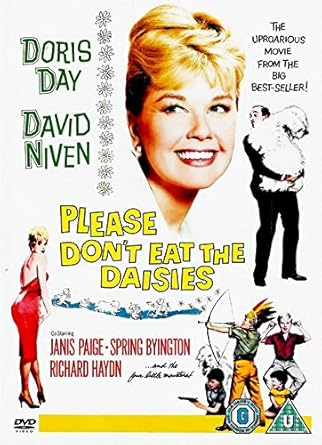
This shouldn’t work at all. The episodic structure breaks all the narrative rules. Doris Day fans should be disappointed as she’s not in typical prim rom-com mode (Pillow Talk, That Touch of Mink), but a mother – and with four kids for goodness sake. And, beyond for some reason a sotto voce rendering of “Que Sera Sera,” she doesn’t sing until late on. Worse, she hardly qualifies as the main character. That privilege falls to David Niven.
But it has charm in buckets, it plays around with the rules, breaking all narrative conventions, setting up traps for the viewer, and the four siblings are superbly realistic, little cute or adorable about them, given their main occupation is dropping water bombs on unsuspected passers-by and, even adopting sedentary positions, can’t help but cause mischief.
Initial focus is on academic Laurence (David Niven), promoted to Broadway critic, making mincemeat of a play produced by best friend Alfred (Richard Haydn), in the process savaging its star Deborah (Janis Paige). He quickly becomes front page news when Deborah’s revenge is captured by a photographer. Fame goes to his head and wife Kate (Doris Day) feels she is losing him.
But then suddenly we switch to the countryside after they swap their New York apartment for a huge house. Cue the usual slapstick caused by holes in floors and the inevitable paint. Laurence’s lofty attitudes rile the locals. But before you know it we’re onto the third storyline, Kate reviving her dancing career by putting on a show with the local dramatic society.
By now we’re also knee-deep in sub-plots. Taxi driver Joe (Jack Weston), budding playwright friend of Kate’s mother Suzie (Spring Byington), weaves in and out of the tale. You are led to expect that his Biblical musical script, initially dismissed by Laurence, is going to play a part, perhaps turning up at the dramatic society, or being reworked by Alfred into a hit. You are almost certainly going to be convinced that Laurence will end up in Deborah’s bed. And you are even more certain that Alfred is going to get his revenge by bringing a huge squad of critics and celebrities to the first night of Kate’s play. Unknown to Laurence, Alfred has passed to Kate a rejected early embarrassingly bad effort by her husband when he harboured ambitions to be a playwright.
That all these set-ups are brilliantly confounded turns the entire movie on its head. And the reversals don’t involve cheating. It’s not a question of bait-and-switch, red herrings or sleight-of-hand, but down to the believable reactions of the characters.
In the middle of this, romance would be taking a back seat except both Kate and Laurence are aware of the growing distance between them so it’s more of a middle-aged love story, marriage on the rocks, but both parties making the same type of mistakes in trying to rectify the situation as in the usual will-she-won’t-she romantic template.
The central focus could not be more topical – sudden fame, its impact on the lucky person and on those around. And I suppose the newspaper stunt that kicks off Laurence’s sudden notoriety is even more common today.
And I have to mention the kids. One of them gets his head stuck in a chair because “nobody told me not too.” That’s the kind of infuriating children they are, parents driven bonkers trying to anticipate their next unexpected venture. There’s a marvellous scene that pinpoints exactly why this whole picture works – by taking reality as its benchmark: Kate, trying to get ready to go out, is surrounded by apparently docile kids. But one, lying on the couch, has lifted his feet, unseen by her, so that he can tap the bottom of a painting on the wall, swaying it gently from side to side behind her head, just waiting for it to fall off.
Doris Day (With Six You Get Eggroll, 1968) digs a bit deeper than normal into her characterization. David Niven (Guns of Darkness, 1962) acts as if he is in a drama, not a comedy, never playing a scene for laughs, which is why he gets so many. When he does turn on the charm it’s not to seduce but to defuse a situation.
Janis Paige (Welcome to Hard Times, 1967) has a ball as the over-the-top star, posterior a matter of public interest, who is rewarded as much as the rest of the cast with deeper characterization than her initial shallowness could expect. Jack Weston (Mirage, 1965), too, goes through various shades before discovering that he has something unexpected to offer.
There’s a bunch of belly laughs, a joke dog, high-class bitchiness among the cocktail set, and a raft of reversals, but mostly it gets by on charm.
Veteran Charles Walters (Walk Don’t Run, 1966) looks as if he’s having a ball too, pulling the audience in different directions, turning up trumps with every reversal. Isobel Lennart (Fitzwilly / Fitzwilly Strikes Back, 1967) created the cunning screenplay from the book by Jean Kerr.
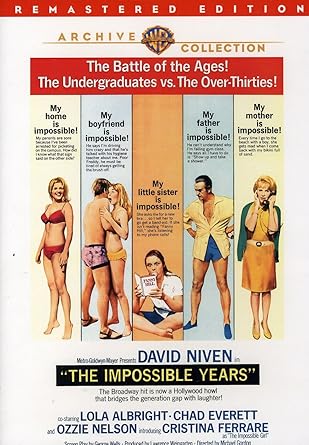
Generation gap comedy driven by unmentionables and the prospect of perplexed father getting more pop-eyed by the minute. By default, probably the last bastion of morality before censorship walls – the U.S. Production Code eliminated the following year – came tumbling down and Hollywood was engulfed in an anything goes mentality. Denial enters its final phase, quite astonishing the mileage achieved by not letting the audience in on what’s actually going on.
Psychiatrist lecturer Jonathan (David Niven) finds his chances of promotion potentially scuppered after lissom teenage daughter Linda (Christine Ferrare) is arrested at a demonstration carrying a banner bearing an unmentionable word. That brings to the boil the notion that Linda may not be quite so sweet as she appears, Jonathan previously willing to overlook minor misdemeanors like smoking and speeding. But it turns out Linda may also have lost her virginity, that word also verboten, and may even be, worse, illegally married.
So the question, beyond just how manic her parents can be driven, is which male is her lover: the main candidates being a trumpet-blowing teenage neighbor and let) or laid-back artist hippie who has painted her in the nude.
Innuendo used to be the copyright of the Brits, in the endlessly smutty Carry On, series, but here the number of words or phrases that can be substituted for “sex” or “virgin” must be approaching a world record, but delivered with gentle obfuscation far removed from the leering approach of the Brits.
It’s a shame this movie appeared in the wake of bolder The Graduate (1967) because it was certainly set in a gentler period and its tone has more in common with Father of the Bride (1950). Setting aside that most of the adults, for fear of offending each other, can’t ever say what they mean, the actual business of a young woman growing up and demanding freedom without ostracising her parents is well done, Linda stuck in the quandary of either being too young or too old to move on in her life.
The scenes where that issue is confronted provide more dramatic and comedic meat than those where everyone is grasping, or gasping like fish, for words that mean the same as the other words they refuse to utter.
Parental issues are complicated in that Jonathan has set himself up as an expert on dealing with the problems growing children present. He views himself as hip when, as you can imagine, to younger eyes, he’s actually square. And he’s also worried his younger daughter Abbey (Darlene Carr) will start to emulate her sibling.
Compared to today, of course, it’s all very innocent and I’m sure contemporary older viewers might pine for those more carefree times. It doesn’t work as social commentary either, given the rebellion that was in the air although it probably does accurately reflect how adults felt at confronted by children growing up too fast in a more liberal age.
David Niven (Prudence and the Pill, 1968) brings a high degree of polish to a movie that would otherwise splutter. He’s playing the equivalent of the stuffy Rock Hudson/Cary Grant role in the Doris Day comedies who always get their comeuppance from the flighty, feisty female. That fact that it’s father-and-daughter rather than mismatched lovers only adds to the fun. And there were few top-ranked Hollywood actors, outside perhaps of Spencer Tracy (Guess Who’s Coming to Dinner, 1967) who audiences would be interested in seeing play a father.
The unmentionable conceit wears thin at times but Niven and Cristina Ferrare (later better known as the wife of John DeLorean) do nudge it towards a truthful relationship. Former movie hellion Lola Albright (A Cold Wind in August, 1961) is considerably more demure as the Jonathan’s wife. Chad Everett (Claudelle Inglish, 1961) breezes in and out.
Although at times giving off a “beach party” vibe, it manages to examine the mores of the time.
Director Michael Gordon has moved from outwitted controlling mother (For Love or Money, 1963) to undone controlling father without dropping the ball. It’s based on the Broadway play of the same name by Robert Fisher and Arthur Marx.
Lightweight for sure but worth it for David Niven and the sultry Ferrare.
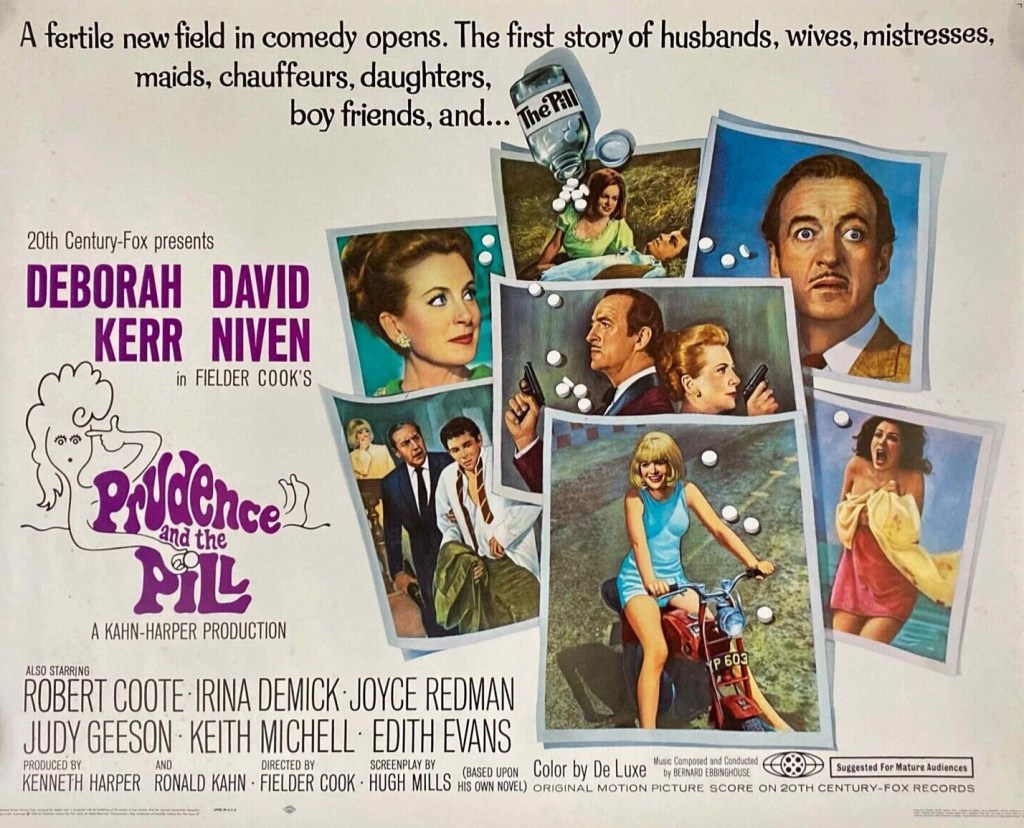
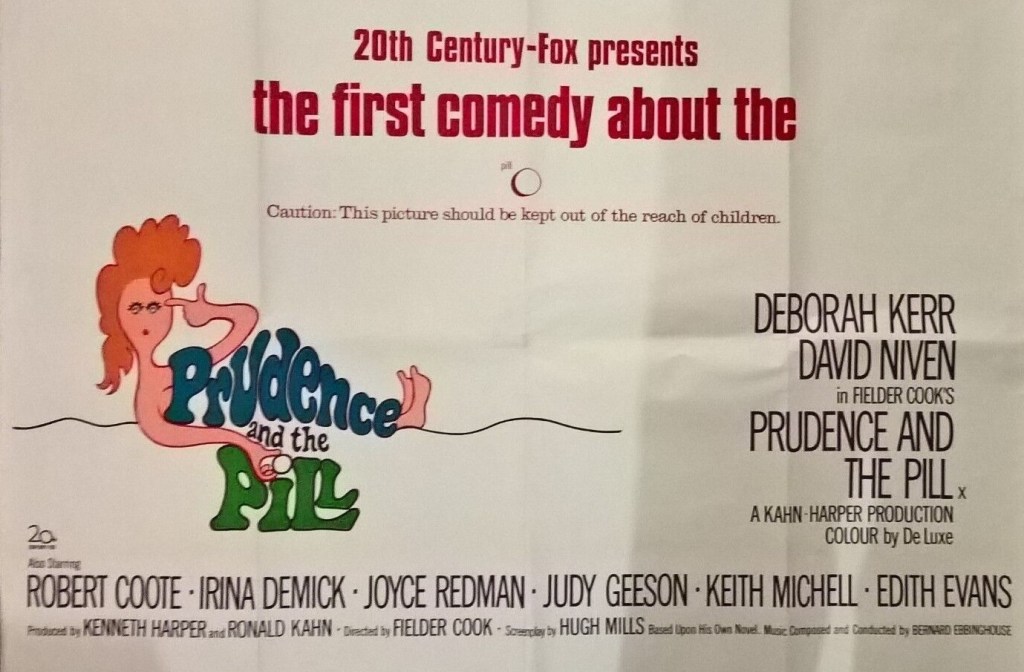
Cleverly calibrated chuckle-worthy comedy of manners. Far more enjoyable than the basic material might suggest, especially as you will easily guess where it all ends. Anchored by redemptive performances, after disappointing turns in The Eye of the Devil / 13 (1966), by Deborah Kerr and David Niven, playing a middle-aged upper-class childless couple whose marriage survives on civility alone, and a sparkling showing by Judy Geeson (Here We Go Round the Mulberry Bush, 1967).
It’s surprising what a fresh look at cliché can achieve. On the face of it, American director Fielder Cook (How to Save a Marriage and Ruin Your Life, 1968) is the last person to be tackling the upper classes, especially as there’s scarcely a hint of satire. It’s wonderfully pitched, no sexist jokes, no farce, no tourist or Swinging London, and avoids the temptation of aiming for the lowest common denominator (Carry On Up the Pill for example). But authority is constantly confounded, pomposity pricked, and, astonishingly for a movie about relationships in Britain – the home of the kitchen sink drama – in the late Sixties, everyone ends up happier ever after.
The titular drug in question, in case that term is no longer in common usage, is the contraceptive pill, here sold under the generic name of Thelon. The biggest shocks here might well be that mothers and fathers in middle-age still have sex. Although that is balanced by a contemporary vibe of having children late in life.
So the fun begins when Henry (Robert Cooote) and Grace (Joyce Redman) discover bubbly daughter Geraldine (Judy Geeson) in bed with Tony (David Dundas). Cue howls of anger from staid parents, who divide up the ticking-off, the mother tasked with warning daughter about the dangers of pregnancy – and with it the specter of single motherhood, a high society no-no – the father to whip the young rascal.
The mother is only mollified – though still affronted at such blatant expression of sexuality – when she discovers her daughter is on the Pill. But shocked to discover Geraldine has been pilfering her own supply. Father is taken aback to discover the lover is not only heir to a fortune but has already proposed.
Unlike most movies of the era, where sexuality remained a dirty word, and most illicit romances were conducted in secrecy and ended up in disaster, the vivacious Geraldine could be the poster girl for sex. She is delighted to have lost her virginity, and to expand her sex education, and stands up against her mother’s old-fashioned views.
However, the replacement of mother’s Pill with aspirin presents a dilemma. Robert and Grace are also enthusiastic lovers and the absence of contraception for so long points towards the possibility of a very embarrassing pregnancy.
Meanwhile, Henry’s brother, bored company chairman Gerald (David Niven), who lives in a mansion with servants and swans around in a chauffeur-driven Rolls-Royce, discovers, to his horror, that his wife Prudence (Deborah Kerr) has been taking the Pill, denying him his much-cherished desire to have children. So he swaps it for a vitamin pill. Unknown to him, his young maid Rose (Vickery Turner), warming to the amorous attentions of the chauffeur Ted (Hugh Armstrong), has taken a leaf out of Geraldine’s book and snaffled her mistress’s Pill.
You can see where this is headed. But there’s a complication. Assuming (as a man would) that their lack of children was due to his wife’s infertility, Gerald could have had children by his younger mistress Elizabeth (Irina Demick). But he refuses to seek a divorce (the scandal, don’t you know) and Elizabeth views him as a poor candidate for marriage (would he not just have another mistress) and fatherhood.
Prudence, it soon transpires, also has a lover, Dr Huart (Keith Michell). Equally resistant to divorce, for societal reasons and to prevent her husband marrying his mistress, Prudence soon warms to the thought of having a child, but abhors the prospect of having Gerald as its father.
In the best Hitchcock fashion, the audience is privy to information denied the characters who fluster around in their incompetence.
It should never work. The story is so obvious and, from a narrative perspective – given unplanned pregnancy does not lead to dark deeds, humiliation and abandonment – weak. That it is pretty much a triumph owes as much to the direction (witty use of musical cues, for example) as a script that feasts on reversals. The acting is first-class all round. David Niven and Deborah Kerr, in their final pairing, atone for the under- and over-acting, respectively, of Eye of the Devil. Judy Geeson is a standout as a marvellously gleeful liberated young woman. Edith Evans (The Chalk Garden, 1964) pops up for a delightful cameo.
It would have been a different movie entirely with Kim Novak (The Legend of Lylah Clare, 1968) in the lead and directed by Sidney J. Furie (The Ipcress File, 1965). He was one of three directors – the others being Arthur Hiller (The Americanization of Emily, 1964) and Michael Anderson (Operation Crossbow, 1965) – to pass on the picture (then known as 13) before it ended up in the lap of J. Lee Thompson (Return from the Ashes, 1965). Terry Southern (Dr Strangelove, 1964) also hnded the screenwriting torch over to Robin Estridge (the author under a pseudonym of source novel Day of the Arrow) and Dennis Murphy.
Possibly because of the potential involvement of Hiller, and that Martin Ransohoff, producer of The Americanization of Emily, was funding this film through his Filmways shingle, Julie Andrews was mooted for the lead. Instead, the part went to Kim Novak, who had just finished another British production The Amorous Adventures of Moll Flanders (1964). She had signed a three-picture deal with Ransohoff who was firming up productions with a number of Hollywood studios
According to co-star David Niven (The Extraordinary Seaman, 1969), Novak was insecure about acting the part. “I don’t think I’m betraying any confidences,” said Niven, betraying her confidence to a reporter, “if I said that Kim often told me ‘I think I’m not right for this part. I think I’m a sex-pot.’ ” Given she was playing a mother-of-two, it’s doubtful that she was intended to be overtly sexy, although that would certainly provide a different reading for the role.
Some of Novak’s concerns could be ascribed to any Hollywood-trained actress. “While highly professional,” observed Niven, “Kim worried about her looks, her scenes, her individual lines, everything.” Novak’s professionalism included arriving at the studio at 4.30am and often doing her own make-up accompanied by an “entourage of dialog coach, press agent and personal secretary, with whom she rehearsed her lines before going on set.” (I’m sure she practiced her lines with her dialog coach rather than secretary.)
As if British actresses prepared for a movie with ease and turned up on the set without a care in the world. However, that was Niven’s conclusion. As if little preparation was involved, “Deborah Kerr,” said Niven, “just walked before the camera and did them (her lines); stand-in Esmee Smythe would occasionally hear her lines – very occasionally because she always knew them – and once in a while would help out if the dresser was not on the spot.”
Four-fifths of the picture was completed when Novak pulled out. The standard reason given was because of a back injury. Initial filming had taken place in fall 1965 in France at the main location of Chateau de Hautefort in Dordogne before Novak fell from her horse. Production was suspended for two weeks. But the actress proved unfit to rejoin the unit.
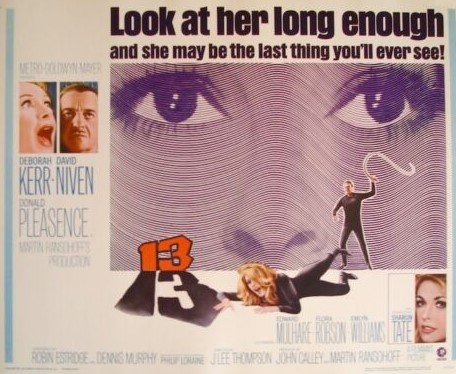
Title changed to “13.” It’s worth noting that the main images of the poster refer to Sharon Tate. It’s her eyes that are hypnotic and she’s the one being whipped.
Supporting star David Hemmings (The Charge of the Light Brigade, 1968) offered a different reason for her departure. This was the actor’s first big-budget international full-scale picture. His career was in reverse, from starring in Be My Guest (1964) he had tumbled to fourth billing in Two Left Feet (1965). As if forever destined to be the ingenue, here he was billed eighth.
Hemmings knew the director from No Trees in the Street (1959) and had worked with Donald Pleasance in Wind of Change (1961). He recalled “the comparatively unknown but totally ravishing Sharon Tate who was the same age and had done about as much as I did.”
Given his lack of knowledge of American television it was understandable he believed he was in the same bracket as Tate. In fact, she was such a hot prospect, coming off a role in the wildly successful series The Beverly Hillbillies she was given an “introducing” credit and had far the superior part.
“ I loved the setting and my part which demanded skills in riding and toxophily (archery),” said Hmmings. He found all the time wasted in playing darts in pubs assisted him in his archery training. “But I found it quite odd that a young lad of 24, dressed in black leather and riding a white horse, albeit with my toxophilic advantages, should have been thrown together with such a distinguished cast.”
The fact that he presented such a visual treat in his blonde curls and black leathers appeared not to occur to him. “The older actors were astonishingly kind to me. Niven’s charm was profound and genuine.”
One of the older stars who reached out to him proved to be Kim Novak. Although only eight years older she had been a star for more than a decade, leading lady to William Holden in Picnic (1955), Frank Sinatra in the Man with the Golden Arm (1955) and Pal Joey (1957), James Stewart in Vertigo (1958) and Bell, Book and Candle (1958) and Kirk Douglas in Strangers When We Meet (1960) while in most of her films in the 1960s she had received top billing ahead of the male star.
When Hemmings took to riding his white horse through the French countryside Novak became his companion. “We would stop somewhere to sit and chat. Easily and at great length almost about everything…and to begin with no hint of physicality…after a while I began to detect that strangely attractive wicked look in her eye that an experienced woman gives to an inexperienced man.”
One day, though staying in different hotels, she asked to meet him in a large park in the centre of Brive. “It wasn’t a suggestion, it was a command,” he recollected, “and being the young man it was a command I knew would lead inevitably to possibilities.” The assignment in the park led to a short affair conducted in her hotel room.
Shorty afterwards, at a press conference, “I can’t recall what Marty (Ransohoff) said to upset Kim or if it justified her reaction but I have an indelible vision of her stubbing out a cigarette in his one good eye which led to an ugly scene…and Kim being sacked.”
But it would be hard to convince the completion guarantee bonding companies and the insurance company that a back injury had been faked to cover the embarrassment of the producer. Original budget of £1 million was supplemented by another £600,000 from the insurers to complete the movie. Deborah Kerr had been holidaying at Klosters in Switzerland when she received the call and began work as a replacement at the Borehamwood studio in Britain over Xmas 1965.
Since Novak had not been in every scene, the opening scenes and the beguiling of the children by Sharon Tate, for example, it wasn’t a case of starting completely from scratch. And the director and cinematographer would have the advantage of already having made decisions regarding camera placement, while the other actors would be well-rehearsed. However, weather for the previous filming had been cold so there would have been a worry about matching exteriors since conditions in France in January-February 1966 were “like summer.”
It was Niven who had suggested Deborah Kerr as the replacement. This was the third of the five pictures they made together, preceded by Bonjour Tristesse (1958) and Separate Tables (1968), followed by Casino Royale (1967) and Prudence and the Pill (1968). Niven welcomed her presence. “Playing opposite Deborah is as delightful an experience as an actor can have,” he said. “I’ve always felt I won my Academy Award (Best Actor Oscar for Separate Tables) because she made me look so good. That sort of thing makes for a warm and relaxed screen relationship.” Niven was clearly ignoring the fact that, although happily married, the relationship of the couple on Eye of the Devil was tense and strained.
But the France reshoot took place at a different location, Brives Les Gaillards in Perigord, an overnight train journey from Britain. Perhaps in a bid to save money, Esmee Smythe was eliminated from the personnel intended to be shipped abroad. After a few words from Kerr – who otherwise would effectively be acting as her own stand-in for scenes involved horse-riding, driving and standing on the parapets – Ransohoff changed his mind. Despite the pressures to complete and ensure that Kerr’s work – a “daunting job of re-shooting” – would fit in with what had come before, shooting was deemed “pleasant.” Kerr again stood up to the producer when informed further work in Borehamwood would begin immediately on the morning of the overnight train journey home.
The original stars were paid twice, for Hemmings “the most lucrative job I’d ever done.” Nonetheless, there was clealry doubt about its box office potential and, unsually for a film with denoted stars, it sat on the shelf for over a year.
Despite MGM’s best marketing efforts the movie fizzled out in the United States where it opened in fall 1967. Prospects proved poor. It waited another seven months before a British premiere at the Ritz in London’s West End in March 1968, that showing possibly the result of the unexpected success for MGM with David Hemmings’ breakout movie Blow-Up (1966).
But the West End opening counted for nothing when it came to general release it the UK. On the ABC circuit it was only the supporting feature to The Heroin Gang (1968) starring David McCallum and Stella Stevens. It might have done better had it been delayed further and taken advantage of the successful comedy pairing of Kerr and Niven in Prudence and the Pill.
Like many a horror movie, the production was considered jinx. Filming on Prudence and the Pill was delayed when Kerr, who “had never had a day’s illness in her life,” was diagnosed with labyrinthitis, a condition which destroyed her sense of balance. While she recovered, others involved in Eye of the Devil were not so fortunate. Not only was Sharon Tate slaughtered by the Manson gang but a member of the location crew was crushed by a car and the chateau burned down a few years later.
SOURCES: Eric Braun, Deborah Kerr (WH Allan, 1977) p198-202; David Hemmings, Blow-Up and Other Exaggerations (Robson Books, 2004) p123-126.











 The Magnificent 60s