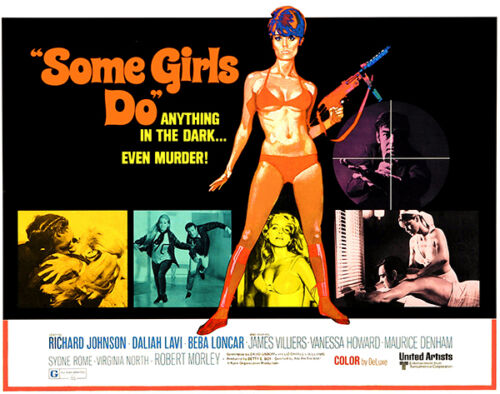
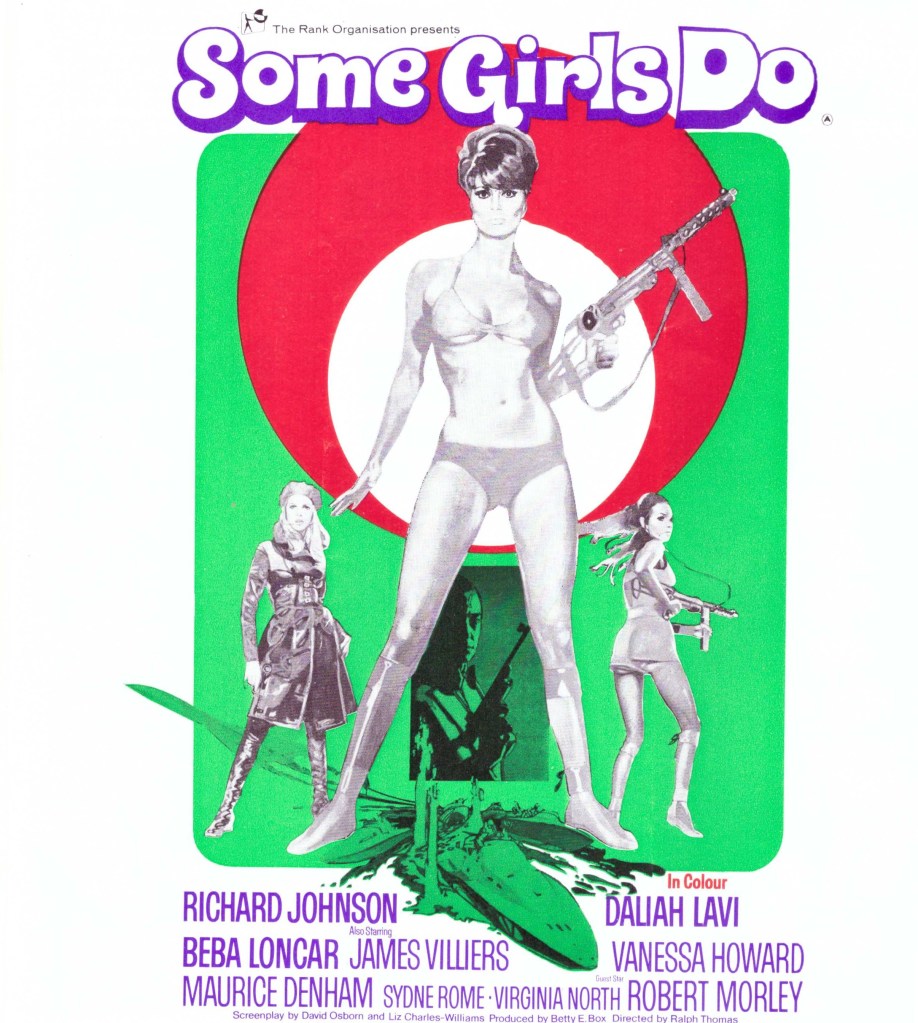
Enjoyed this sequel to Deadlier Than the Male (1967) far more than I expected because it sits in its own little world at some point removed from the espionage shenanigans that dominated the decade. Hugh (nee Bulldog) Drummond (Richard Johnson) is neither secret agent nor involved in espionage high jinks, instead employed in the more down-to-earth domain of insurance investigator, albeit where millions are at stake. Although his overall adversary is male, the smooth-talking Carl Petersen (James Villiers), adopting a series of disguises for most of this picture, the real threat comes from a pair of villainesses in the shape of Helga (Daliah Lavi) and Pandora (Beba Loncar). If anything, this pair are a shade more sadistic than Irma and Penelope from the previous outing.
The sequel doubles up – or doubles down – on the female villainy quotient, Petersen having created a race of lethal female robots who spend their time dispatching scientists working on the world’s first supersonic airliner. Global domination is only partly Petersen’s aim since he also stands to gain £8 million ($134 million today) if the plane doesn’t launch on schedule. Livening up proceedings are Flicky (Sydne Rome), a somewhat kooky Drummond fan who has her own agenda, Peregrine “Butch” Carruthers (Ronnie Stevens), a mild-mannered embassy official assigned bodyguard duties, and chef-cum-informant Miss Mary (Robert Morley).
Villiers has found a way of turning an ultrasound device intended originally to aid cheating in a boat race into something far more dangerous. But, of course, for Helga seduction is the main weapon in her armory, and Drummond’s first sighting of her – a superb cinematic moment – is sitting on the branch of a tree wielding a shotgun. Equally inviting are the squadron of gun-toting mini-skirted lasses guarding Petersen’s rocky fortress.
The movie switches between Helga, Pandora and the robots raining down destruction and Drummond trying to prevent it. Dispensing with the boardroom activities that held up the action in Deadlier than the Male, this is a faster-moving adventure, with Drummond occasionally outwitted by Helga and calling on his own repertoire of tricks. Dialog is often sharp with Drummond imparting swift repartee.
The action – on land, sea and air – is a vast improvement on the original. The pick is a motorboat duel, followed closely by Drummond in a glider coming up against a venomous aeroplane and saddled with a defective parachute. And there are the requisite fisticuffs. Various malfunctioning robots supply snippets of humour.
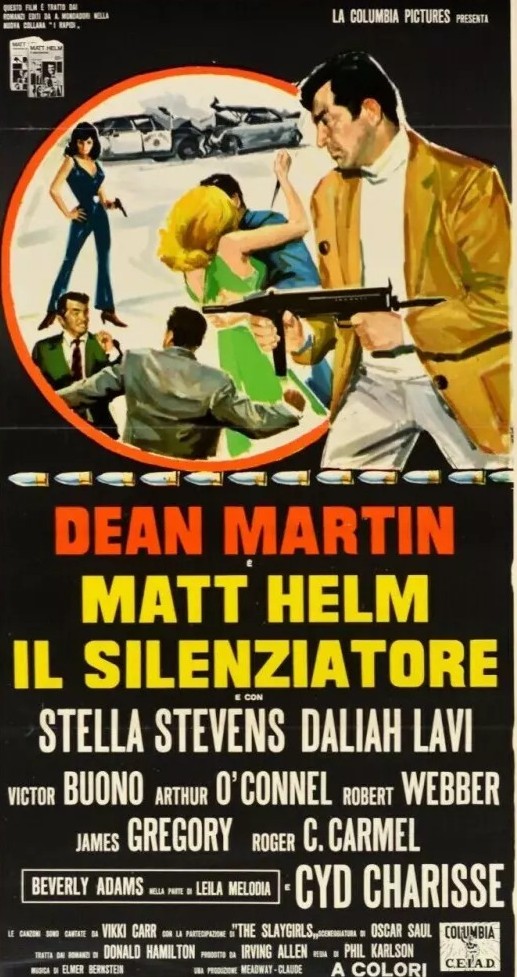
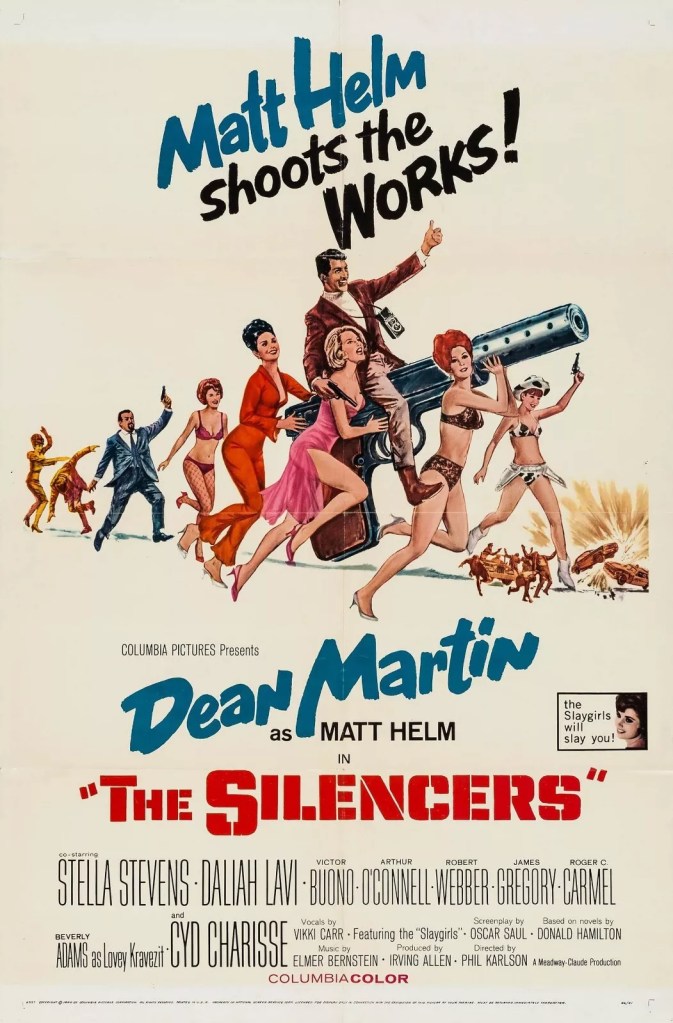
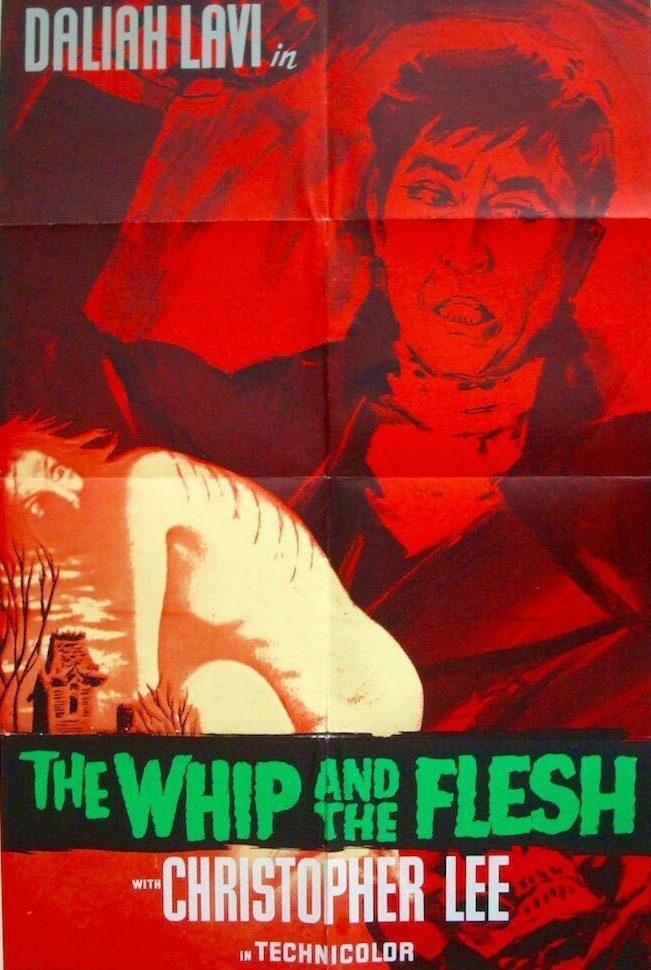
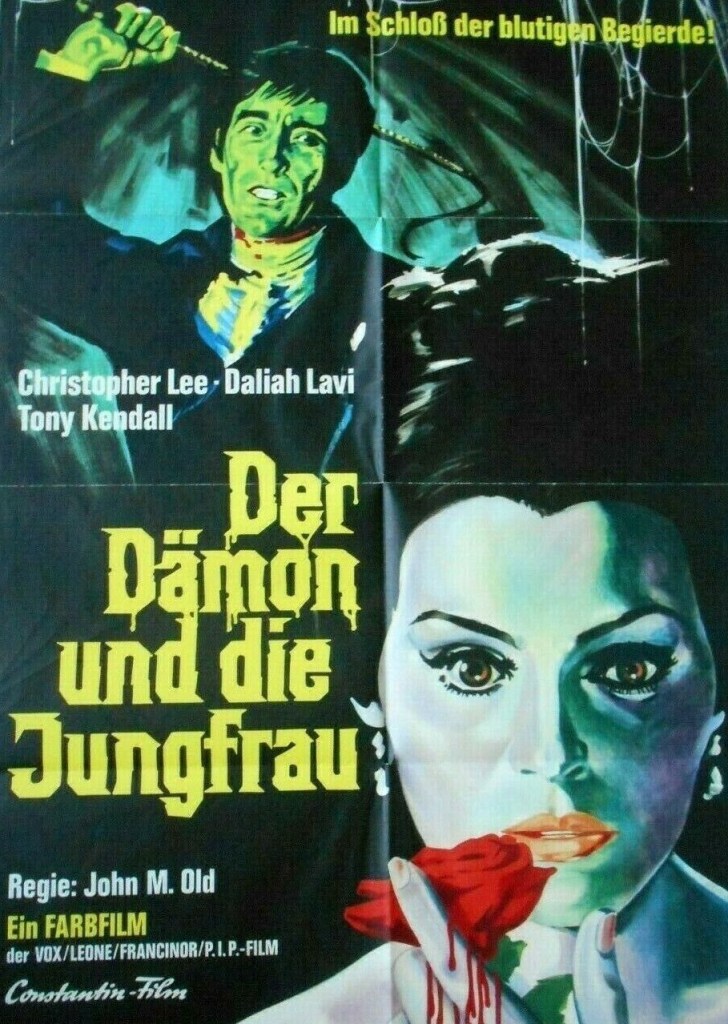
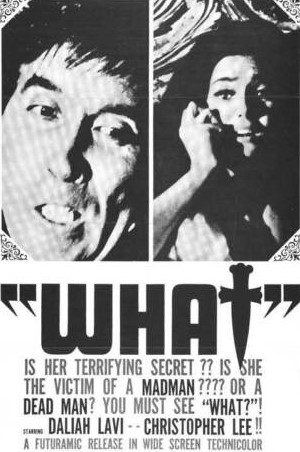
Richard Johnson (A Twist of Sand, 1968) truly found his metier in this character and it was a shame this proved to be the last of the series. Although Daliah Lavi never found a dramatic role to equal her turns in The Demon (1963) and The Whip and the Body (1963) and had graced many an indifferent spy picture as well as The Silencers (1966), she is given better opportunity here to show off her talent. Beba Loncar (Cover Girl, 1968) is her make-up obsessed bitchy buddy. Sydne Rome (What?, 1972) makes an alluring debut. James Villiers (The Touchables, 1968) is the only weak link, lacking the inherent menace of predecessor Nigel Green.
There’s a great supporting cast. Apart from Robert Morley (Genghis Khan, 1965) look out for Maurice Denham (Danger Route, 1967), Adrienne Posta (To Sir, with Love, 1967) and in her first movie in over a decade Florence Desmond (Three Came Home, 1950). The robotic contingent includes Yutte Stensgaard (Lust for a Vampire, 1971), Virginia North (Deadlier Than the Male), Marga Roche (Man in a Suitcase, 1968), Shakira Caine (wife of Sir Michael), Joanna Lumley (television series Absolutely Fabulous), Maria Aitken also making her debut, twins Dora and Doris Graham and Olga Linden (The Love Factor, 1969). Peer closely and you might spot Coronation Street veteran Johnny Briggs.
The whole package is put together with some style by British veteran Ralph Thomas (Deadlier than the Male). Screenplay by David Osborn and wife Liz Charles-Williams (Deadlier than the Male) is based on the book by “Sapper”.
Producer Irving Allen remains best known as the fella who turned down James Bond. While partnered with Cubby Broccoli in Warwick Films, he decided the Ian Fleming books were not big screen material. Their production shingle, based in Britain, had turned out movies like The Red Beret (1953) with Alan Ladd and Fire Down Below (1957) pairing Robert Mitchum and Rita Hayworth. Divorced from Broccoli, Allen headed down the big-budget historical adventure route but neither The Long Ships (1964) spearheaded by Richard Widmark and Sidney Poitier nor Omar Sharif as Genghis Khan (1965) hit the box office target.
Luckily, Allen had already made an investment in espionage, owning the rights to the hard-edged Matt Helm novels, knocked out at the rate of one or two a year since 1960 by Donald Hamilton whose most notable brush with Hollywood was selling the rights to his novel The Big Country (1958) filmed by William Wyler with a top-class cast. The Matt Helm series was praised by the top thriller critic of the era, Anthony Boucher, who noted that Hamilton brought “sordid truth” to the espionage genre and “the authentic hard realism of Dashiell Hammett.”
Having optioned the books, Allen persuaded Columbia to buy the rights to eight, with the notion of setting up a direct rival to James Bond, that idea given an extra fillip when the Sean Connery series which had appeared on an annual basis skipped 1966. Initially, Allen planned to make films that followed the novel’s serious approach to espionage, intending to cast a marquee name like Paul Newman (The Prize, 1963) – who ironically proved major competition for the first offering through Hitchcock’s Torn Curtain (1966) – or conversely a relative unknown such as Mike Connors (Harlow, 1965).
To hook Dean Martin, Allen had to make him a partner, resulting in the actor making more dough out of a spy film than Sean Connery did from Bond. Martin was something of a Hollywood enigma. Audiences who flocked to the Rat Pack outings tended to disdain his stand-alone efforts such as Toys in the Attic (1963) and Kiss Me, Stupid (1964) and if he was a current household name that owed much more to his recording and television career.
But Allen shifted the emphasis away from straight adaptation to tongue-in-cheek, setting up the series initially as gentle parody rather than out-and-out spoof though as the movies progressed they fell more into the latter category.
Playing to Martin’s strengths of urbane charm and effortless style, as well as his reputation as a lothario, and accommodating his age (he was 48) by ensuring his character was brought out of retirement, and with comedy writer Herbert Baker brought in at Dean Martin’s behest to beef up Oscar Saul’s script, and by surrounding him with more heavyweight damsels than the Bonds, the series was good to go. Baker had written early Dean Martin-Jerry Lewis vehicles like Jumping Jacks (1952) and Scared Stiff (1953). The script drew upon two Hamilton novels, Death of a Citizen (the first in the series) and The Silencers (the fourth). The idea of Helm being married was dropped to allow him the same sexual license as James Bond.
Stella Stevens and Daliah Lavi were unusual choices for the leading ladies of a spy picture, their proven marquee appeal considerably in excess of that of Ursula Andress (Dr No, 1962), Honor Blackman (Goldfinger, 1964) and Claudine Auger (Thunderball, 1965), that trio of movies opening Hollywood doors for the actresses rather than as with Stevens and Lavi already being welcome attractions. Lavi had starred in The Demon (1963) and Lord Jim (1965) while Stella Stevens had been female lead in The Nutty Professor (1963) and Advance to the Rear (1964). The Slaygirls, however, a direct imitation of the Bond Girls, also owed something to Playboy’s Playmates.
Other cast members had some distinction, Victor Buono Oscar-nominated for Whatever Happened to Baby Jane (1962) and James Gregory acclaimed for his role in The Manchurian Candidate (1962). Both had worked previously with Martin, Gregory on The Sons of Katie Elder (1965) and Buono on 4 for Texas (1963) and Robin and the 7 Hoods (1964).
Martin also called upon President Lyndon B. Johnson’s personal shirtmaker Sy Devore, previously personal clothier to Martin and Lewis, to come up with his stylish attire.
Budgeted at just under $4 million, The Silencers began shooting on 12 July 1965, the 12-week schedule (ending 16 September) taking in locations like Carsbad Caverns, White Sands, El Paso and Juarez with the car chases filmed in Santa Fe and Phoenix, Arizona. Columbia’s backlot was deemed too small for interiors, and two of Desilu’s largest soundstages were joined together to make Big O’s underground HQ.
Director Phil Karlson (The Secret Ways, 1961) and the producer didn’t see eye-to-eye. Despite ostensibly aiming for a comedy, Allen wanted Karlson to adopt the style of the more serious The Ipcress File (1965) and shoot “through chandeliers, under tables.” It turned out that movie’s director Sidney J. Furie had relied on Karlson for most of his cinematic flourishes.
Like Sinatra, Martin preferred one take. “Dean was always great to work with,” recalled James Gregory, “because he never took himself seriously…Dean was always relaxed – if it doesn’t work do it over, but for heaven’s sake you oughta not need more than that one or two times to get it right.”
Despite the easy-going atmosphere, there were casualties. Buono was out of action for four days after slipping while climbing a wall, foot in an unseen cast for the rest of his time on the picture. Supporting actor Arthur O’Connell’s face was sliced open during an explosion. He completed the scene with the bandage covering the wound hidden under a turtleneck sweater. Stunt man Tom Hennessey lost three front teeth. There was a bill of several thousand dollars to cover an unexpected explosion on set, combustible dust igniting after one of the grenades went off on the Big O set.
Astonishingly the movie came in $500,000 under budget and $1 million was recouped from television sales. Columbia was so taken with the end result that prior to its release two sequels were announced.
The Slaygirls featured prominently in promotional activities in the U.S. with six sent overseas to hustle up interest. As well as a movie tie-in paperback and album, merchandising included toy guns from Crescent Toys and Louis Marx. Martin wasn’t available for the Chicago world premiere (he was shooting Texas Across the River, 1966) on 16 February 1966. The movie was gangbusters from the start, clocking up $7.35 million in U.S. rentals (the studio’s cut of the box office), enough for 85th spot (by my exclusive count) on the list of the top earning films of the decade.
SOURCES: Brian Hannan, The Magnificent ‘60s, The 100 Most Popular Films of a Revolutionary Decade (McFarland, 2022); Bruce Scivally, Booze, Bullets and Broads, Behind the Scenes with Dean Martin’s Matt Helm Films of the 1960s (Henry Gray, 2013); William Schoell, Martini Man: The Life of Dean Martin (Cooper Square Press, 2003); Cinema Retro Movie Classics Issue No 9: Matt Helm’s Back in Town.
An absolute delight. Have to confess though I had been pretty sniffy about even deigning to watch what I always had been led to believe was an ill-judged spoof of the Bond phenomenon especially with a middle-aged Dean Martin with scarcely a muscle to crease his stylish attire.
Full of witty repartee, and even a whole jukebox of snippets from the Dean Martin repertoire (plus an aural joke at the expense of Frank Sinatra) and a daft take on the Bond gadget paraphernalia. The spoofometer doesn’t go anywhere near 10 and the whole enterprise not only works but damn near sizzles. No wonder it led to another three.
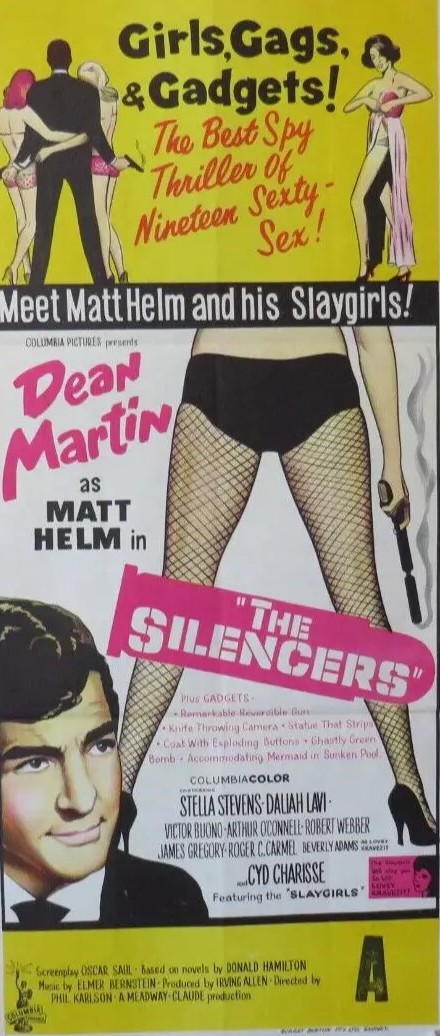
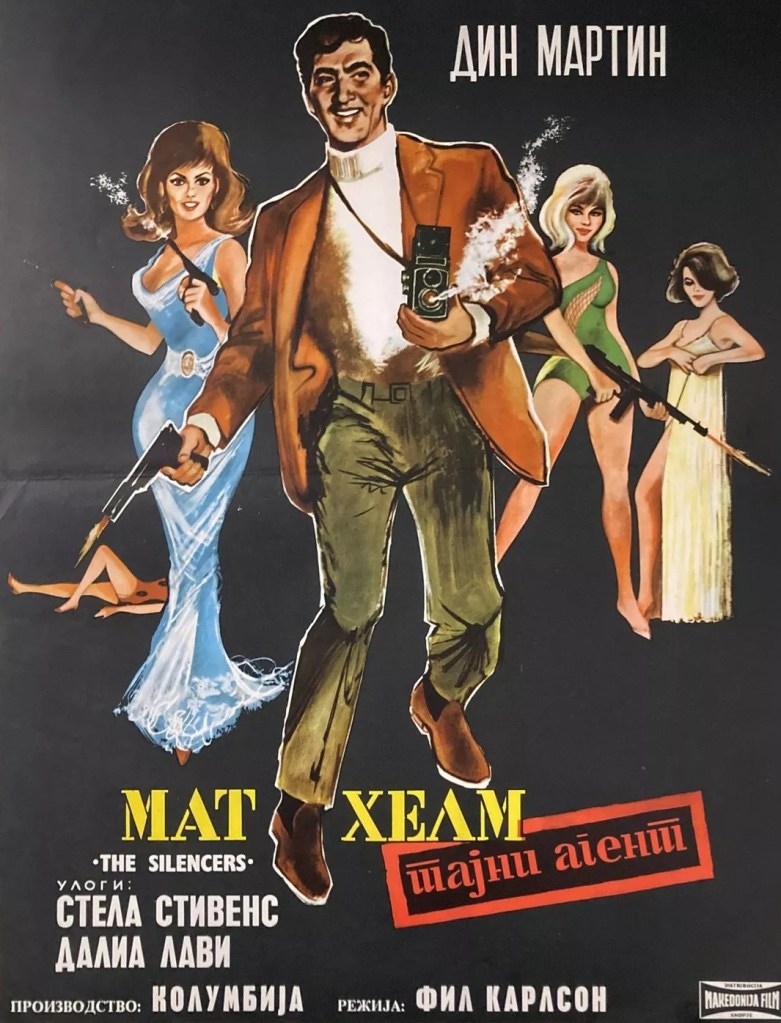
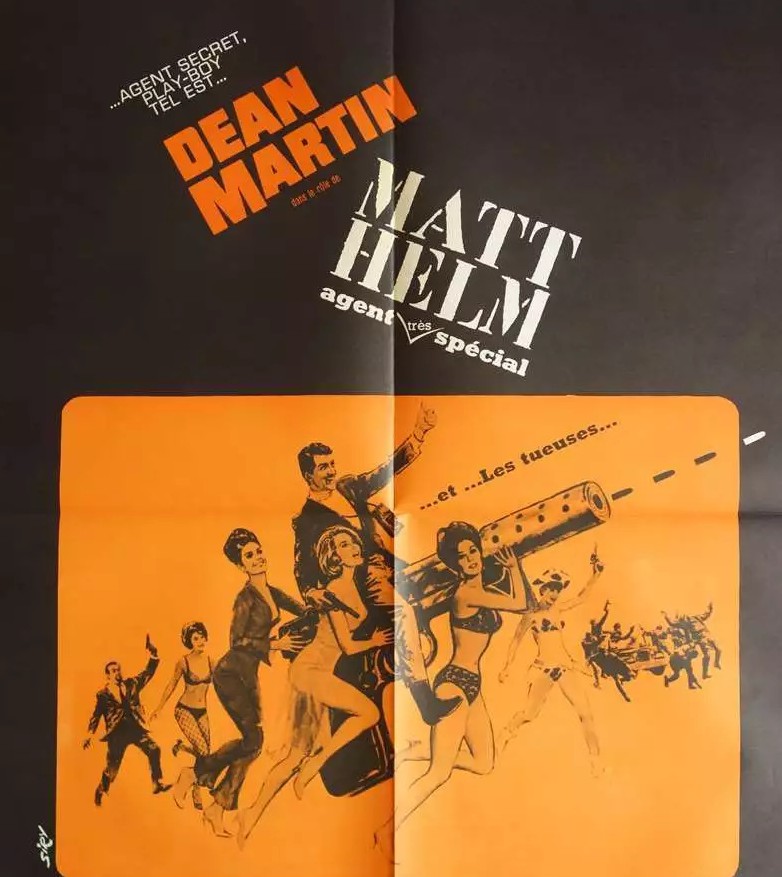
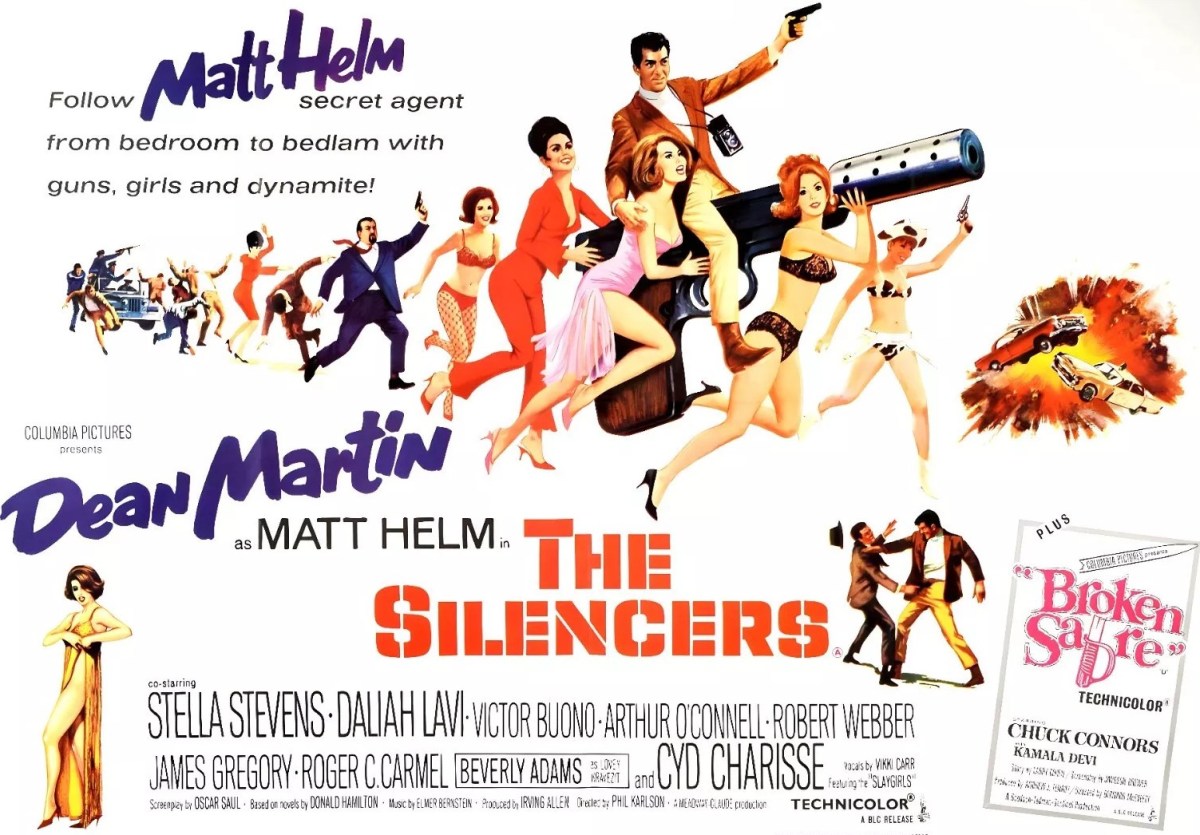
Called out of retirement – hence cleverly swatting away any jibes about his age – Matt Helm (Dean Martin) resists becoming re-involved in the espionage malarkey until his life is saved by former colleague Tina (Daliah Lavi) as he falls for the seductive technique of an enemy agent. Back in harness with ICE (Intelligence and Counter Espionage), Helm is called upon a thwart a dastardly scheme by the Big O organization headed by Tung-Tze (Victor Buono) to stage a nuclear explosion.
Some malarkey about a secret computer brings into Helm’s sphere the klutzy Gail (Stella Stevens) whom he initially treats with suspicion. Gail and Tina end up as rivals for Helm’s afections.
But you could have invented any number of stories and they would still have worked because it’s the rest of narrative that makes the whole thing zing. We could start with the massive effort that goes into ensuring that the private parts of naked men (and women) are concealed by a wide variety of objects, a kind of bait-and-switch that paid homage to the James Bond legend while casually taking it apart. Since Helm now operates legitimately as a fashion photographer it makes sense that his most deadly gadget is a camera that fires miniature knives.
And knowing how much delight villains take in despatching secret service agents in the most gleeful fashion, wouldn’t it make sense to kill said agent with his own gun? Who could resist such a notion? Until it, literally, backfires and the bad guy is shot by a gun that shoots a reversible bullet – two bullets if you’re so dumb you can’t believe that’s what’s happening and you shoot yourself twice.
And what about the laser? Another famed Bond device. Why not have that go haywire?
But there’s also a playful Heath Robinson aspect to those gadgets whose purpose is pure labor-saving. Helm can automate his circular bed so he doesn’t have to get out of it to answer the phone and to save him walking a few steps into the bath the bed is programmed to jerk upwards and tip him in.
“Treasure hunt,” remarks Helm, slyly, as he spies a string of discarded female clothing. But making love to a strange woman feels rude so Helm is impelled to complain they haven’t been introduced. “You’re Matt Helm,” says the stranger. “Good enough,” replies Helm.
And that’s before we come to the joy of Gail, who has been taking lessons from Mrs Malaprop, and, despite lurching into Helm at every opportunity, giving him the mistaken impression that she’s keen to get to know him better, Gail actually is wary. So wary that in a thunderstorm she tries to escape their cosy nest of a car (equipped with separate sleeping arrangements, don’t you know) only to end up slipping and sliding through the mud.
While Daliah Lavi (The Demon, 1963) isn’t exactly called upon to act her socks off, she at least is afforded a believable character, but she can’t hold candle to Stella Stevens (Rage, 1966) when the blonde one decides to go full-tilt boogie into comedy slapstick. Sure, Stevens relies overly on other occasions on a pop-eyed look, but the thunderstorm sequence reveals a deft, and willing, knack for physical comedy.
Dean Martin (Rough Night in Jericho, 1967) struck a solid seam with his interpretation of Helm, slick enough to get away with Bond-style lothario, laid-back enough for no one to take it seriously.
Nancy Kovack (Tarzan and the Valley of Gold, 1967), Cyd Charisse (Maroc 7, 1967) and Beverley Adams (Hammerhead, 1968) up the glamor quotient.
Director Phil Karlson (The Secret Ways, 1961) and screenwriter Oscar Saul (Major Dundee, 1965), adapting the Donald Hamilton bestseller, provide the basic template but Dean Martin makes it work.
Has there ever been actress so skilled at displaying fear as Daliah Lavi? Where the female stars of horror movies too quickly succumbed to the scream and goggle eyes, Lavi could run a whole gamut of terror without uttering a sound and continue doing so for virtually an entire picture. Top-billed ahead of the reigning king of British horror Christopher Lee, this is another acting tour de force, not quite sustaining the intensity of The Demon (1963) but at times not far off it.
Italian director Mario Bava (Black Sabbath, 1963), here masquerading as John M. Old, has stitched together a mixture of horror, and an early form of giallo, the picture taking place in the classic old dark house, in this case a castle perched on a rock above the sea, the deaths grisly, and almost fits into the “locked room” subgenre of the detective story, where the murders appear impossible to carry out.
The disgraced Kurt Menliff (Christopher Lee) returns to his ancestral home, begging forgiveness from his father Count Vladimir (Gustavo De Nardo) and hoping to reclaim his inheritance and his betrothed Nevenka (Daliah Lavi). While his father exonerates him, Kurt is denied the rest, Nevenka already committed to marriage to his brother Christian (Tony Kendall). Other tensions are soon evident: the housekeeper Giorgia wants revenge on Kurt for the death of her daughter and Christian is in love with another, Katia (Evelyn Stewart).
Nevenka who outwardly protests how much she hates Kurt quickly reveals masochistic tendencies as she gives in to a whipping. But Kurt’s sudden inexplicable murder instigates an investigation, suspicion falling firstly on the father, then Christian and finally Giorgia.
But Nevenka is convinced Kurt is not dead, although his body has been entombed in the castle crypt. Torment creeps into her face at his funeral and we can almost see her grow gaunt in front of our eyes. In a brilliant scene where she tracks what she imagines to be the sound of a whip it turns out to be a branch lashing a window in a storm. Some of her supposed visions are easily explained, muddy footsteps leading from Kurt’s tomb actually belonging to the limping manservant Losat (Luciano Pigozzi). But how do you account for the hand, in an almost 3D shape, reaching out to her in the darkness? Or her ecstasy in still being whipped, her nightdress stripped from her back?
Although sometimes relying too heavily on atmospherics – windows swinging open at night, storm outside – Bava brilliantly marshals the real and the imagined, until the investigation into murder involves all the characters. Once the film begins, the drawbridge in a sense comes down, and nobody else enters the castle, and so we move from one character to another, each with their own motive for possibly committing dire deed. And with each passing moment we return to the demented Nevenka, who wishes Kurt dead but cannot live without him, and, craving the whip, cannot escape his sadistic power. Her faith in Kurt’s resurrection is so intense that the others are soon seeking signs that the dead man is still alive.
This is a horror superior to Hammer. Using the same leading man, the British studio generally expected Lee to be over-the-top, his innate malevolence generally very obvious from the start. Here, he is at his most handsome and although definitely sadistic, the emphasis is less on his pleasure than that of his victim. And while Bava resorts to a similar kind of set, this castle is remote, has no relationship with villagers, and exudes regal dominance rather than just the normal fear of a Dracula picture. Bava employs a more subtle color palette and the piano theme tune by Carlo Rusticelli has a romantic tone.
But for all Bava’s proven skill, this would not be the same without Lavi. I doubt if there is a single actress in the horror domain throughout the 1960s who could match the actress for portraying fright, as she marches up the scale from mere anxiety to full-blown terror. And although women in Dracula movies succumbed to vampire teeth with more than a frisson of sexuality, there is a different deeper sensuality at work here, in what must rank as one of the greatest-ever portrayals of masochism embedded in love.
As noted previously, Lavi, in stepping onto the bigger Hollywood canvas of Lord Jim (1965) and The Silencers (1966), lost the intensity she displayed here and never came close to matching this performance or that of The Demon. Christopher Lee, although claiming to dislike his experience, continued to rule the horror world until he was afforded a wider audience through James Bond, Star Wars, J.R.R. Tolkien and Tim Burton.
Tony Kendall, making his debut, soon graduated to the Kommissar X series, spaghetti westerns (he played Django twice), horror (Return of the Evil Dead, 1973), and thrillers such as Machine Gun McCain (1969). Evelyn Stewart went down much the same route, her long career sprinkled with gems like Django Shoots First (1966), The Sweet Body of Deborah (1968) and The Psychic (1977).
Mario Bava continued to exploit the horror vein including Blood and Black Lace (1964), Planet of the Vampires (1965) and Lisa and the Devil (1973) with Telly Savalas and Elke Sommer.
The Jules Verne express grinds to a halt in part because the promise of outer space adventure fails to materialize and in part because the treatment is comedic in the manner of The Great Race (1965). A series of sketches with a shifting array of characters rarely works. Occasionally it hits the mark in a laugh out loud fashion but too often the jokes are labored although as a tribute to a maze of inventive invention it’s a treat.
Unusually for such an all-star cast venture, we are, long before the titular action and a race (of sorts) commences, treated to the greatest hits from the book of all-time failures. So we have electricity setting on fire the first country house, belonging to the Duke of Barset (Dennis Price), to be so illuminated; a new-fangled suspension bridge, courtesy of Sir Charles Dillworthy (Lionel Jeffries), that collapses when Queen Victoria cuts the ribbon; and a new type of explosive invented by German von Bulow (Gert Frobe) that proves a tad overpowering. Meanwhile, making possible the idea of sending a man to the moon is the arrival in Britain of the diminutive General Tom Thumb (Jimmy Clitheroe) accompanied by the bombastic and greedy Phineas T. Barnum (Burl Ives).
Combining the various scientific advances of propulsion and engineering have the flaw of not being able to bring a manned rocket back home. And sinister forces are at work, spies and fraudsters.
As with all these all-star comedies you spend half the time wondering how your favorite star is going to be worked into the equation and, having been squeezed into the narrative, justify their ongoing involvement. Daliah Lavi (Old Shatterhand, 1964), not particulary known for her comic gifts, is a case in point. On her wedding day she (as Madelaine) jilts French groom Henri (Edward de Souza) in favor of balloonist Gaylord (Troy Donohue) who has, literally, appeared on the horizon. Henri trying to down said balloon triggers an awful joke about a shotgun wedding.
To gain revenge, Henri funds the project on the basis of Gaylord being the moon pilot, and, in anticipation of the craft’s failure, that he will regain his bride. Madelaine, having been sidelined by all the developments, suddenly rushes back to center stage when she uncovers the devious plot and is shipped off to a home for wayward girls, run by the very wayward Angelica (Hermione Gingold). But that requires she escape and find her way back to her beloved, that aspect complicated because she loves both men (it transpires).
As the script is in the invidious position of having to place the participants into similar frying pans in order to effect similar rescues it’s as much a game of ping-pong as a movie. But there are some nice gags, a rocket attached to a helmet, the ruination of a teleprinter and the criminally-inclined Washington-Smythe (Terry-Thomas) who rooks billiard players with a magnet. And there’s a very contemporary financial element in that large wagers are placed on failure rather than success, the equivalent of betting on stocks going down rather than up (short selling in the modern idiom)
The rocket is launched, with rather a different crew than originally anticipated following further skullduggery, and although it’s something of a cosmic joke that it only gets as far as Russia it’s rather a disappointing ending for fans of Verne who anticipated a more rigorous approach. Verne’s novel From the Earth to the Moon was surprisingly accurate in imagining how a projectile would achieve its aims. The novel had even more of a contemporary feel since it left the crew floating in space, a daringly artistically inconclusive climax, leaving the way open – again the contemporary flair – for sequel Around the Moon that explained their fate.
Oddly enough, Daliah Lavi, as the bride who can’t make up her mind, has one of the better parts, more fleshed out than most of the other flimsy characterizations. The likes of Troy Donohue, caught between heroism and doing nothing much at all, often looks flummoxed. Terry-Thomas (How To Murder Your Wife, 1965) in wily mode is the pick of the rest.
Director Don Sharp (The Brides of Fu Manchu, 1966) proves that comedy is not his metier. Screenplay by Dave Freeman (British TV sitcom writer making his movie debut) after Harry Alan Towers (Five Golden Dragons, 1967) altered the author’s original premise. While it could be skewered for taking such liberties with the august author, it is far better than you might expect, but not as good as it could, or should, be.
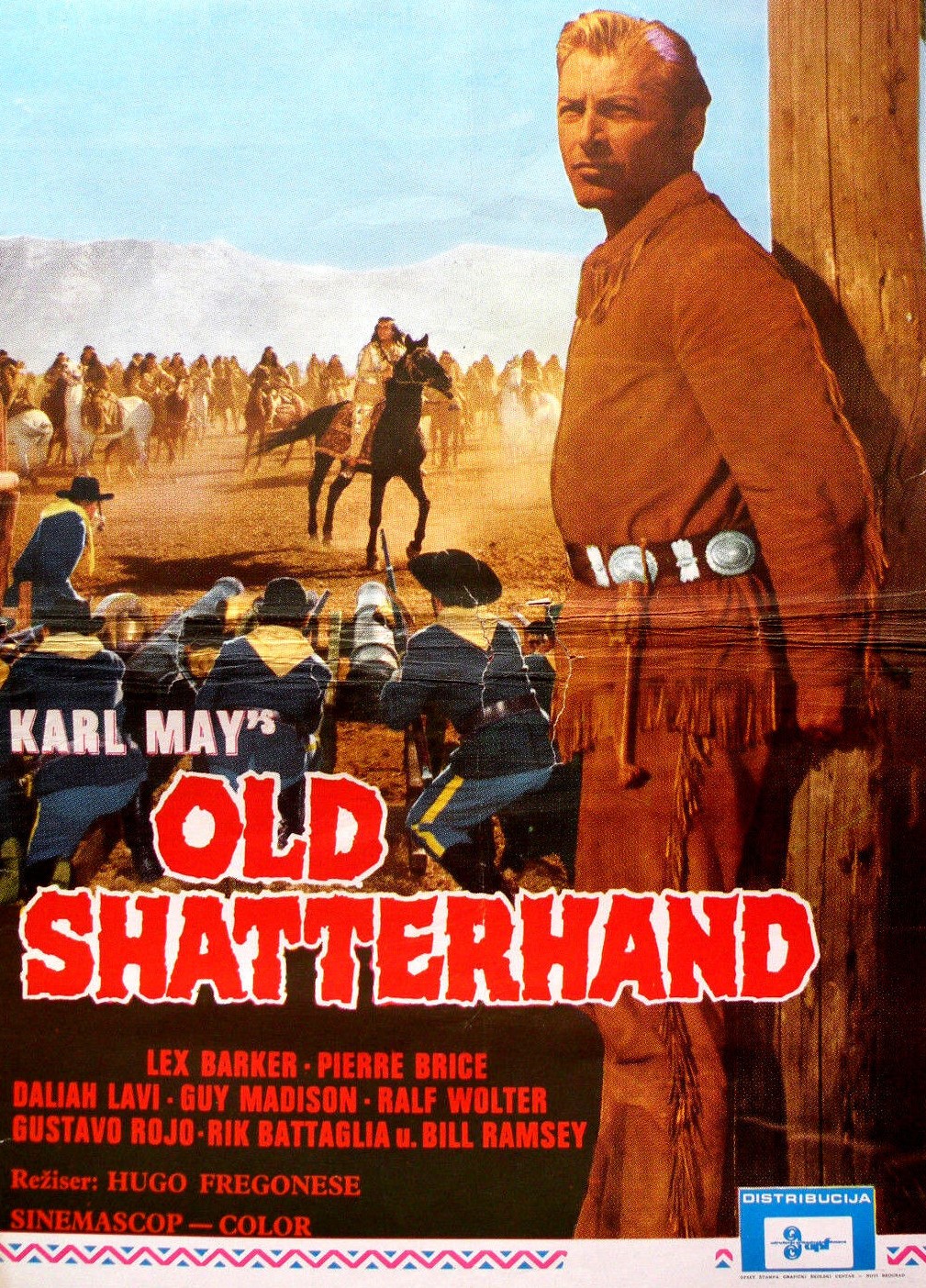
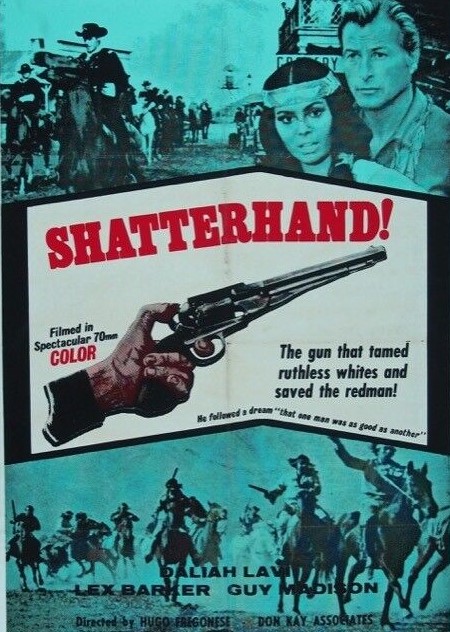
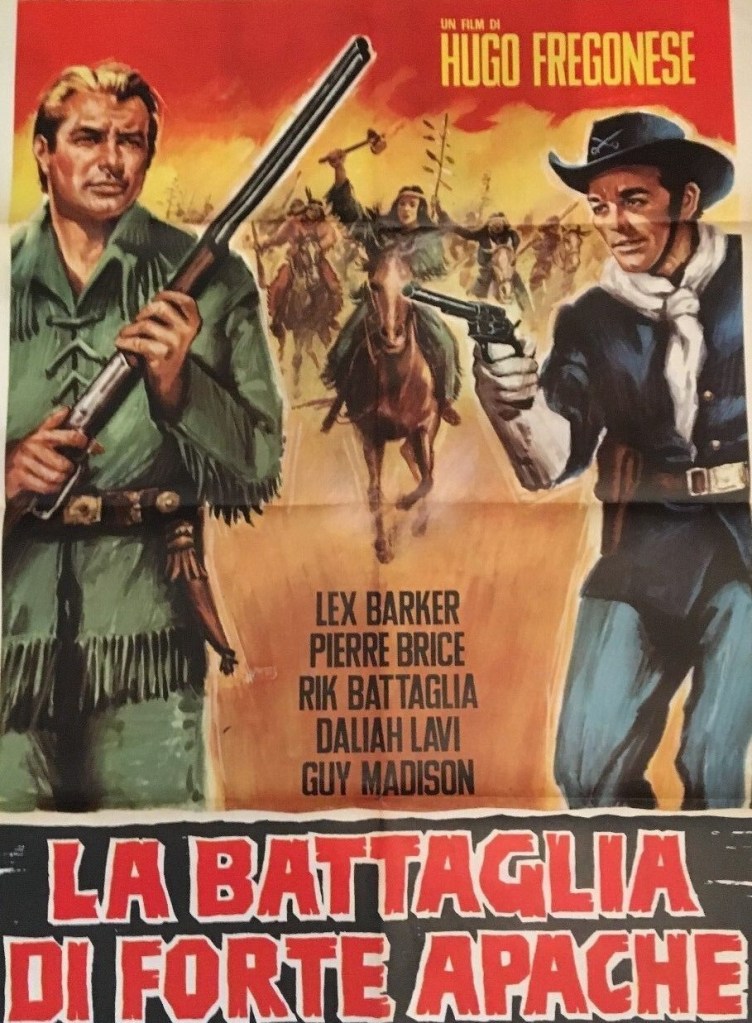
Blame Lex Barker (Pirates of the Coast, 1963) and Daliah Lavi (The Demon, 1963) for my interest in this German-made western. In the aftermath of the spaghetti western and the messianic writings of Christopher Frayling I’d been aware of the Karl May western boom in the early 1960s and a series revolving around cowboy Old Shatterhand and his buddy Apache chief Winnetou, based on the novels of May who died in 1912. Quite why it took the 50th anniversary of his death to make the Germans wake up to his potential is anybody’s guess.
Theoretically, he was the German equivalent of Zane Grey, but unlike the American author whose novels were filmed over 100 times before the 1960s, only six movies were made from May westerns up to that point compared to over 20 and umpteen small-screen features and series since. Treasure of the Silver Lake (1962), the number one film at the German box office that year, was credited with starting the boom.
Story here is quite simple but the cinematography, filmed in 70mm, is breath-taking, even if it’s primarily of Yugoslavia. And there’s an iconic score. Hugo Fregonese (Marco Polo, 1962) isn’t in the Sergio Leone league – he doesn’t come close – but the picture is held together by Lex Barker (Pirates of the Coast, 1963) as Shatterhand and Frenchman Pierre Brice (Samson and the Slave Queen, 1963) as Winnetou with Daliah Lavi popping up as half-breed Paloma, not, interestingly enough, romancing either of the principals, and actually exploring her maternal instinct, looking after the orphaned Tom (Leonardo Putzgruber), more central to the narrative.
Guy Madison (Tobruk, 1967) used his matinee idol looks in kind of a role reversal, the idea of a handsome villain being anathema to audiences of the period, more accustomed to bad guys in the Jack Palance-Lee Marvin vein.
U.S. Cavalry Capt. Bradley (Guy Madison) teams up with the Commanche to frame Winnetou for the murder of settlers in order to disrupt peace negotiations between the Native Americans and the Government. Tom, the only survivor of a massacre, is later brutally murdered by the soldiers. Not quite lingering on the baby blues of ruthless killer Henry Fonda in Once Upon a Time in the West (1969) but still breaking a big taboo.
As you might expect there’s an attempted lynching but you’d be surprised to see this amount of nudity for the time, though, of course, a nice peaceful river always proves too much of a temptation for skinny dipping. There’s some pretty decent action, and the Native Americans get to show off their marksmanship with a bow-and-arrow, and there’s an axe duel instead of the usual fisticuffs. Shatterhand doesn’t always come to the rescue, for the finale he’s tied up. But there’s some interesting authentic detail, a male saloon keeper, for example, hanging out towels to dry, and when Native Americans ambush a wagon train with boulders it is logically achieved – and the boulders look dangerous enough. There’s a pretty big reversal when you’re cheering on a Native American attack on a fort.
Although the American western was about to enter a revisionist period, there was no equivalent to the ongoing friendship between Shatterhand and Winnetou or the idea that the Native American was a regular guy.
There’s not enough story to support a two-hour movie but the scenery is stunning and you can see why Lex Barker was invited back to the well several times. Daliah Lavi’s talent was often overlooked in favor of her beauty but here, at least, she has a part with some meat.
This is more like it. Classic Agatha Christie mystery told in classic fashion but devoid of either of her major sleuths, Hercule Poirot or Miss Marple, and set in the grander equivalent of the country house locale that had become something of a trademark. Here it’s the kind of castle perched atop a mountain, accessible only by cable car unless you have mountaineering skills, that you would need the combined services of Clint Eastwood and Richard Burton to affect a rescue, and as with Where Eagles Dare (1968) the conditions are distinctly wintry.
Ten strangers, including the two servants, have been invited to this retreat by the mysterious Mr Owen. They soon learn they are cut off, telephone lines down, cable car out of commission for a couple of days, nearest village a straight drop 15 miles down a perilous cliff.
All they have in common, as they discover via a taped message delivered by their host, is that they all got away with murder or at the very least a dubious death. There is a private eye on hand, former cop Blore (Stanley Holloway), but he’s lacking in the little grey cells that Poirot put to such clever use in such circumstances. So, like a troupe of actors let down by some stage entrepreneur, they have to get the show on the road themselves, a combined effort to solve the problem.
Not so much why they are gathered here, but why they keep on getting bumped off, and rather in the fashion of the titular song. The movie business wasn’t awash with serial killers though this decade would see nascent interest in this sub-genre, witness Psycho (1960) and The Boston Strangler (1968). But Ms Christie mysteries never really seemed to get going until the death toll had reached multiple figures.
The good element of this kind of movie with a large cast is that each character gets a moment in the sun, here that spotlight largely concerned with what crime they committed for which they were never truly punished. Pop singer Mike (played by pop singer Fabian) gets the ball rolling, explaining that his only punishment for killing someone while driving under the influence was a temporary withdrawal of his license.
And so it goes on, everyone wondering who will be next to be despatched and going from the initial conclusion that Owen is responsible and is hidden somewhere in the house to the obvious one that Owen is one of them. I have to confess I’m easily gulled by the murder mystery and I hadn’t reached that conclusion myself.
The movie’s not necessarily filled with that kind of twist – although there certainly are a good few, some people not as guilty as they might appear, not quite who they appear to be – more you glancing at the cast list and wondering, by dint of billing or box office pull, who will be next for the chop and unless the director has got the Hitchcock vibe it’s not going to be one of the leads.
So it’s a choice of Hugh Lombard (Hugh O’Brian), secretary Ann Clyde (Shirley Eaton), actress Ilona Bergen (Daliah Lavi), General Mandrake (Leo Genn), Judge Cannon (Wilfrid Hyde White), Dr Armstrong (Dennis Price) and the aforementioned Blore plus servants the Grohmanns (Marianne Hoppe and Mario Adorf). And this isn’t your standard serial killer either with a constant modus operandi that will eventually, through standard detection, trap him or her. Instead, variety is the key. Death by fatal injection, knife, poison, slashed rope.
As the numbers whittle down, and you even feel sorry for the actions of some, the actress, for example, whose husband committed suicide when she left him, the tension mounts. You won’t be on the edge of your seat because there are just too many characters involved for you to become overly concerned with their plight but it’s still has you on the hook. You do want to know whodunit and why and you can be sure Ms Christie, as was her wont, will have some clever final twist.
At least, unlike the later variations on the genre, nobody’s been bumped off because they are too fond of sex, and the violence itself is restrained, almost dignified, and there’s no sign of gender favoritism.
All in all, entertaining stuff, though since by now this kind of murder mystery, given we’ve been through various iterations of Poirot – Albert Finney, Peter Ustinov, Kenneth Branagh et al, not to mention numerous Miss Marples – a lot of this feels like cliché (though that’s a bit like a contemporary audience considering John Ford’s Stagecoach old hat, not realizing this was where many of those western tropes were invented or polished to a high level). And I had to say I had a sneaky hankering for some of the out of left field goings-on of The Alphabet Murders (1965).
Sad to see Hollywood not taking advantage of Daliah Lavi’s acting skills, under-estimated in my opinion after her terrific work in The Demon (1963) and The Whip and the Body (1963). But then this wasn’t Hollywood calling but our old friend producer Harry Alan Towers (Five Golden Dragons, 1967) who specialized in dropping a biggish American name into a B-list all-star-cast.
George Pollock, who helmed this decade’s four Miss Marple movies, enjoys keeping the mystery alive without resorting to a central know-it-all. Everyone cast does what they’re expected to do. Towers wrote the screenplay with his usual partner Peter Yeldham.
Worth considering alongside The Alphabet Murders, but stands up well on its own.
PREVIOUSLY REVIEWED IN THE BLOG: Hugh O’Brian in In Harm’s Way (1965), Texas: Africa Style (1967); Daliah Lavi in The Demon (1963), The Whip and theBody (1964), Lord Jim (1965), The High Commissioner (1968), Some Girls Do (1969).
Until a technological invention first used in Once a Thief (1965) it was impossible to shoot “day for night” without it appearing very obvious. So when director Vincente Minnelli aimed for as much verisimilitude as possible for the Rome-set drama it meant half the shoot took place at night. “Minnelli could sleep easily during the day,” recalled star Kirk Douglas (The Arrangement, 1969), “sometimes till six o’clock in the evening, but I couldn’t so there were three unpleasant weeks of night shooting and not much sleep.”
But the movie suffered, Douglas later complained, by studio interference at the editing stage. When the movie fell foul of the Production Code, change of MGM management vetoed the more salacious aspects of the movie – the worst aspects of “La Dolce Vita” including a sequence in a nightclub where guests watched an unseen sexual act. Fifteen minutes were cut including a scene that showed Cyd Charisse’s character in a more sympathetic light. In an ironic reflection of the film’s narrative, Minnelli played no part in the editing, not due to production deadlines as in the movie, but out of choice.
The actual producer John Houseman – producer of Douglas starrers The Bad and the Beautiful (1952) and Lust for Life (1956) though later best known as an actor in Rollerball (1975) etc – backed out of any tussle with MGM head honcho Joseph Vogel. Douglas implored Vogel and editor Margaret Booth, to no avail. Consequently, in Douglas’s opinion, the film was “emasculated.” He argued MGM had turned an “adult” picture into a “family” film. Quite how this could be squared with marketing that promised a “shocking intimate view of Rome’s international film set” (see below) was not mentioned.
Following the commercial and artistic success of Spartacus (1960), Douglas was at the peak of his career, though his last three pictures had been flops. After nabbing an Oscar for Gigi (1959), Minnelli also enjoyed a career high, and although best known for musicals like Meet Me in St Louis (1944) and An American in Paris (1951) was equally adept at drama like The Bad and the Beautiful, Lust for Life (1956) and Some Came Running (1958). But he, too, was running empty, his last three serious films – Home from the Hill (1960), All the Fine Young Cannibals (1961) and big-budget roadshow The Four Horsemen of the Apocalypse (1962) coming up short at the box office.
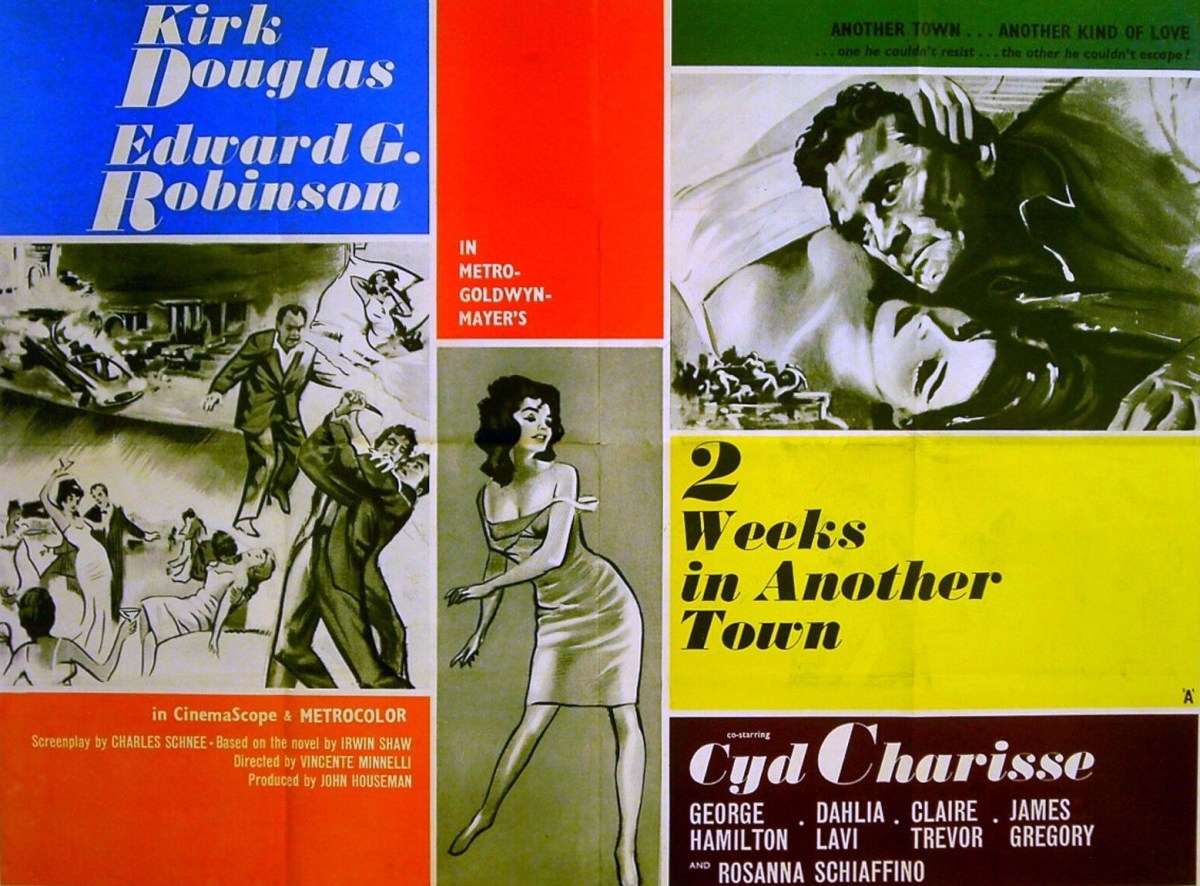
Douglas earned $500,000 and a percentage of the profits (though none were forthcoming – it made a loss of $3 million) and top-billing. Although co-star Edward G. Robinson (Seven Thieves, 1960) appeared above the title, Douglas refused to accord female lead Cyd Charisse (Maroc 7, 1967), on one-tenth of his salary, that concession.
Douglas recalled that he build up his acting skills through wrestling. A college wrestling champ, he barnstormed across the country in a carnival, playing the cocky person reputedly from the audience who challenged the giant resident wrestler. “My job was to make the audience think he was going to murder me,” Douglas told the Pressbook/Campaign Manual. “And the way to do this was by expressions on my face. To yell out in pain would seem cowardly. But I learned a hundred and one ways of showing it through use of my eyes and the muscles in my face.”
The actor escaped serious injury when lightning, preceding one of the worst thunderstorms in a decade, struck a 200-year-old clock on the top of the church in Santa Maria Square. Four huge iron numerals were torn off and crashed to the ground, one grazing Douglas’s head.
In fact, the movie’s authenticity owed much to being filmed on the streets of Rome rather than reconstructed on the studio lot. In particular, scenes utilizing the Via Veneto, two long blocks of sidewalk cafes where the movie industry socialized, created a realistic atmosphere, especially when a hundred or so of the extra employed were actually people who would naturally populate the location. So, for example, when the script called for an opera star among the extras, casting director Guidarino Guidi used Bostonian Ann English, an opera singer studying in Rome. Among those sitting in the background at café tables were a promising young painter, a poet and a librettist.
George Hamilton (Act One, 1963), who had worked in Home from the Hill and just finished Light in the Piazza (1962) also shot in Rome, reckoned he couldn’t have been more miscast given his role called for a “funky James-Dean type.” He got the role through the influence of Betty Spiegel, wife of producer Sam, and her friend Denise Gigante, the director’s current girlfriend (later wife). Hamilton drove around in a red Ferrari costing $18,000 (ten times that at today’s prices) and, as he put it, “Italians knew how to worship” Hollywood stars.
Hamilton reckoned part of the problem of the film was that Minnelli was so “besotted with Denise that he had lost his vision.” Jumping to the defence of Cyd Charisse against a tirade from journalist Oriana Fallaci at the Venice Film Festival won Hamilton, unexpectedly, the cover of Paris-Match.
Daliah Lavi owed her career break to Douglas. As a nine-year-old in Hiffa, Israel, she struck up a friendship with the actor when he was filming The Juggler there in 1952. The actor and other stars attended her birthday party, Douglas presenting her with a ballet dress. Later a dancer and then an actress, this was her Hollywood debut. Erich von Stroheim Jr, making his movie acting debut, had his head shaved to make him appear more like his famed director father. Originally employed as an assistant director on the picture, Minnelli decided he would make a good Ravinski, the “fast-talking press agent.”
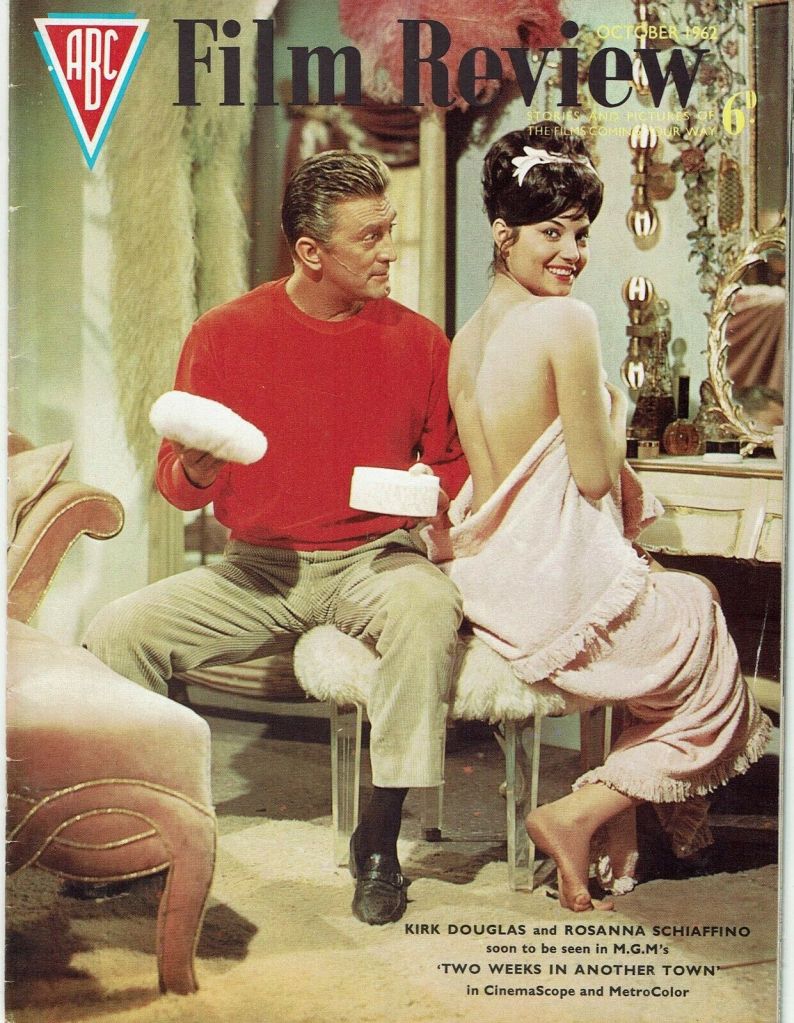
Chauvinism reared its ugly head, especially when women had to apologise for being on the receiving end. “What goes on in the minds of beautiful women when they get slapped for the cameras?” mused the editor of the Pressbook/Campaign Manual. Rossano Schiaffino’s response regarding being whacked on the behind by Douglas: “He hits hard so charmingly I didn’t mind standing up for a day of two.”
The actress proved tougher than many of her colleagues. She turned down the offer of a double for a scene in which she jumped into a lake. That might not have been such an undertaking had the sequence been shot in the hot Italian sunshine at the height of summer. But the MGM studio tank on Lot 3 was a different – and much colder – proposition. “She shrugged off her stunt with the remark that heated pools are unknown where she comes from.”
Irwin Shaw, author of the best-selling source novel, wasn’t too upset at the way the movie turned out. “An author who wants complete control of his work on the screen is in something of a cleft stick,” he observed. “He can either go into production himself, which is often neither possible nor desirable, or he can refuse to sell his work to the movies. Minor deviations in screen conception don’t send me reeling back a stricken man. I think I’m sufficiently realistic to know that even in the most enlightened films there must be some compromise if they are to be a success. What does matter very strongly to me is that the theme of the novel…should come over on the screen.”
Music trivia: Kirk Douglas was the first big Hollywood star to perform “The Twist” on screen and the song “Don’t Blame Me” was reprised from The Bad and the Beautiful, sung here sung by Leslie Uggams and in the older film by Peggy King.
French designer Pierre Balmain created the dresses, allowing a marketing campaign to be built around those stores which supplied his clothes. TWA, which flew directly to Rome, was suggested to cinema owners as an ideal tie-in. Not only did New American Library issue a new movie tie-in paperback/soft cover but cinemas were encouraged to build a campaign around a director, many of whose films would be well-known to audiences. The marketeers also had material to tie in with stores retailing music, women’s sportswear, menswear, men’s sweaters, beauty and hair styling.
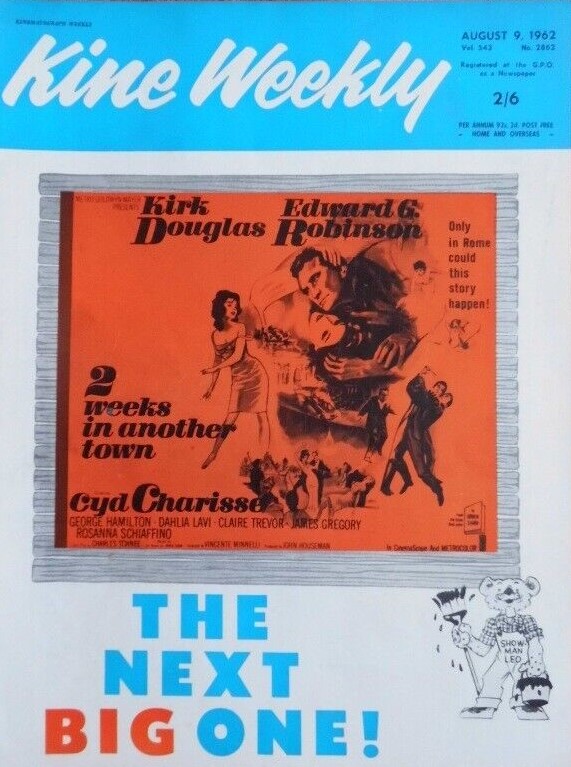
The 16-page A3 Pressbook/Campaign Manual offered a selection of advertisements and taglines. The key advert tagline ran “Another town…another kind of love…one he couldn’t resist…the other he couldn’t escape.” But there were alternatives: “Only in Rome could this story be filmed/Every town has women like Carlotta and Veronica and the kind of man they both want!/From Irwin Shaw’s great best seller.”
Or you could opt for: “Irwin Shaw’s shocking intimate view of Rome’s international film set. The world only sees the glamor. This is the drama behind it!.” Or: “Only in Rome could this story happen. Only in Rome could this story be filmed!”
SOURCES: Kirk Douglas, The Ragman’s Son (Simon and Schuster paperback, 2010) p342-344; George Hamilton, Don’t Mind If I Do (JR Book hardback 2009)pp 155-159; Pressbook/ Campaign Manual, Two Weeks in Another Town (MGM).
Unholy triumvirate of director Vincente Minelli, star Kirk Douglas and screenwriter Charles Schnee had been here before, eviscerating Hollywood in The Bad and the Beautiful (1952). Now, while the locale has shifted to Rome, Hollywood-on-the-Tiber, the behind-the-scenes battles are, if anything, even more fraught since careers are on the slide.
Burnt-out washed-up star Jack (Kirk Douglas) is duped by washed-up director Maurice (Edward G. Robinson) into thinking he is going to revive his career with a supporting role in a low-budget movie made at Cinecitta. In reality, Maurice wants Jack to oversee the dubbing, time restraints preventing the director doing this. Jack and Maurice have history, good and bad, making some fine pictures together, but inveterate womanizer Maurice bedding Jack’s wife Carlotta (Cyd Charisse).
Carlotta, divorced from Jack, now living in Rome and married to a shipping magnate, wants Jack back, if only to keep her bed warm while her husband is away. Young beauty Veronica (Daliah Lavi) dumps temperamental boyfriend and fading star Davie (George Hamilton), in favour of Jack. Maurice is having an affair with his latest find, the tempestuous Barzelli (Rosanno Schiaffino), so brazen she strokes his legs while he toasts his wife Clara (Claire Trevor) at a dinner to celebrate their tenth anniversary. Clara is prone to attempting suicide.
So far, so melodramatic. But instead of explosive melodrama, it’s more about insecurity and the honing of the cutting line. We know enough about vicious Hollywood in-fighting so none of this will come as a surprise, but it’s still astonishing the depth of self-deception on display that occasionally flowers into genuine insight. Maurice may be ducking and diving in the last chance saloon but he still knows how to disarm a young man with a knife. Not sure Jack giving Barzelli a kick in the pants would be deemed an acceptable method of calming down a screeching star. And you won’t get much kudos for a line like “all women are monster.”
But there are nuggets of Hollywood lore. Barzelli being forced to keep her arms in a certain position for a shot, for example, that actors doing the dubbing require direction, the shifting around of scenes, the producer already guaranteed profit through pre-sales before the movie is released, the endless rewrites, and of course that career rejuvenation brings actors a sudden jolt of power. And there’s a car ride that matches Hitchcock for sheer terror, regardless of the fact it is shot with back projection.
Fame as we all know is an illusion, but so is success. The famous are notoriously lonely. What’s hardest to get your head round is failing to notice when your career is on the slide. Being so wrapped up in your notion of invincible self, to which, while you are successful, all pander. There’s some lovely stuff about the collusion of audience and moviemaker, both hiding from reality.
But it’s a true adult drama, far superior in many ways to Once Upon a Time in Hollywood (2019) or Babylon (2022), avoiding the excesses of both, while homing in on character fragility, weakness exacerbated under pressure. In the end all make concession, some beating a tune of self-awareness. Even Maurice accepts he needs his wife to provide him with grounding and self-belief. The aloof arrogant Davie has to beg Jack not to steal his girl. Jack learns to ignore adulation.
If you like long speeches and elegant camerawork and confident direction this is for you. There’s plenty attendant glamor, but mostly it’s characters coming apart and putting themselves back together again, with or without a side order of bitchiness.
The acting is uniformly top-notch. Kirk Douglas might be auditioning for The Arrangement (1969), in which he essays a similar ambitious talent coming unstuck, but here he underplays, to the picture’s benefit, the early scenes when he’s still working out why he has fallen out of favor, and who he now is, just outstanding. But Edward G. Robinson’s (Seven Thieves, 1960) callous insecure monster runs him close. And the petulant performance by George Hamilton (Angel Baby, 1961) had critics purring and the industry predicting great things.
But it wouldn’t be anything without the believable women, all convinced their version of themselves will win favor. Cyd Charisse (Maroc 7, 1967), the female equivalent of the predatory Maurice, Claire Trevor (The Cape Town Affair, 1967) with suicide the preferred option to divorce, and especially Daliah Lavi (Some Girls Do, 1967) who gives Hollywood splendid notice of what she can do away from the sex symbol persona she was later lumbered with. Rossano Schiaffino has a ball as the sex symbol who views powerful men as playthings.
This was Vincente Minnelli’s fourth film with Kirk Douglas and just like Anthony Mann with James Stewart and John Ford with John Wayne or, more recently, Antoine Fuqua with Denzel Washington, draws a greater maturity from the actor. Charles Schnee wrote the screenplay based on the Irwin Shaw bestseller.
Sure-footed, bitchy as hell, hard-hitting, honest and unmissable.
I was riveted. This is one of the most extraordinary films I have ever seen. Highly under-rated and largely dismissed for not conforming to audience expectation that horror pictures should involve full moons, castles, darkness, fog, costumes, nubile cleavage-exposing female victims, graveyards, a male leading character, shocks to make a viewer gasp, and the current trend for full-on gore.
So if that’s what you’re looking for, give this a miss. Even arthouse critics, spoiled by striking pictures by the Italian triumvirate of Fellini, Visconti and Antonioni, were equally scornful. For the most part the action takes place in broad daylight, rather than the twilight and darkness beloved of Hollywood (and British) horror.
It is set in an impoverished town in the Italian mountains, where farming is so primitive the soil is tilled with horse and plough and water is collected in buckets from the river.
One of the most striking aspects of the picture is that it creates its own unique universe. The townspeople are both highly religious and deeply superstitious, every traditional Catholic ceremony matched by old-fashioned ritual. Even some of the formal traditions seem steeped in ancient belief, sinners marching up a steep hill with people being scourged or carrying a heavy rock, in a convent the tree of a suicide covered in barbed wire.
Less conformist notions include a wedding night rite involving shoving a scythe under the bed to cut short Death’s legs with the bedspread covered in grapes to soak up evil and discord arranged in the form of a cross to act as bait for bad thoughts and poison them before they can cause the couple harm. When the people run through the town brandishing torches it is not, as would be genre tradition, to set fire to a castle but to vanquish evil from the air.
It is filmed in austere black-and-white. In the Hollywood Golden Era of black-and-white movies, lighting and make-up transformed heroines, rich costumes enhanced background. Here, if the heroine is wearing make-up it’s not obvious and the only clothes worth mentioning are a priest’s robes or a plain wedding dress. Otherwise the most arresting feature is the stark brightness against which the black-dressed figure of the heroine Puri (Daliah Lavi) scuttles about.
And although there are no jump-out-of-your-seat shocks, there are moments that will linger on in your mind, not least the heroine enduring a vicious extended beating from her father, an exorcism that turns into rape and the sight, Exorcist-fans take note, of a spider-walk, the young woman’s torso thrust up high on elongated arms and legs. Virtually the entire success of the picture relies on atmosphere and in places it is exquisitely subtle, the audience only realizes she has been raped, for example, by the look on her face.
The picture opens with a dialogue-free scene of stunning audacity, foreshadowing the idea from the start that image is everything. Puri pierces her chest with a needle, cuts off a chunk of her hair to mop up the blood, throws the hair into the oven and rams the crisp remains into a loaf of bread. Not to be consumed as you might imagine, but as a tool of transport.
Shortly after, having failed to seduce Antonio (Frank Wolff), she tricks him into drinking wine infused with the ashes of her bloodied hair, bewitching him, so she believes, to abandon his betrothed. In an echo of a Catholic sacrament she shouts, “You have drunk my blood and now you will love me, whether you want to or not.”
The next morning when collecting water at the river she has a conversation with a boy Salvatore only to discover he has just died, his death blamed on her because his last words were a request for water, which she is judged to have denied him. She is beaten by women. She is feared by everyone in the village, her family tainted with the same brush, wooden crosses nailed to their door. She is not a ghostly figure, flitting in and out of the townspeople’s lives, an apparition tending towards the invisible, but fully formed, highly visible in her black dress and anguished expression, doomed by often vengeful action and forceful word.
Much of the film involves Puri being beaten or chased or captured, at one point trussed up like a hog. Attempts to exorcise her, whether by pagan or Catholic means, focus on getting the demon to speak his name. The ritual performed by heathen priest Giuseppe involves blowing on a mirror before taking on sexual aspects which culminate in rape. The Catholic version in a church in front of her family is primarily, as it would be in TheExorcist, a duel between the priest and whatever possesses her.
Movie producers who took one look at the beauty of Palestinian-born Daliah Lavi (Blazing Sand, 1960) and thought she would be put to better use in bigger-budgeted pictures made in color that took full advantage of her face and figure and that stuck her in a series of hardly momentous movies such as The Silencers (1966) and Some Girls Do (1969) should be ashamed of themselves for ignoring her astonishing acting ability.
And much as I have enjoyed such films, I doubt if I could watch them again without thinking what a waste of a glorious talent. This is without doubt a tour de force, as she alternatively resists possession and adores the being who has taken hold of her mind. She dominates the screen.
The rest of the mostly male cast is dimmed in comparison, as if overawed by the power of her personality. Future spaghetti western veteran Frank Wolff (Once Upon a Time in the West, 1969) comes off best. Director Brunello Rondi (Run, Psycho, Run, 1968) is better known as a screenwriter for Federico Fellini. He made few films, none matching this in scope or imagination, perhaps as a result of the picture not receiving the praise it deserved. Even now it does not have a single critical review on Rotten Tomatoes.
One other point: you may have noticed that in general the proclivities of male horror characters are never in need of psychological explanation. Nobody considers that the Wolfman must have suffered from childhood trauma or that a vampire drinks blood because he was a rejected suitor. Strangely enough, as would be the case in The Exorcist and other instances of female possession, psychiatry is usually the first port of call and here all reviews I have read implicitly see Puri’s actions as based on sexual inhibition and rejection by Antonio.
You would need to chase up a secondhand copy to find this, I’m afraid.