The Devil’s Brigade (1968) ***

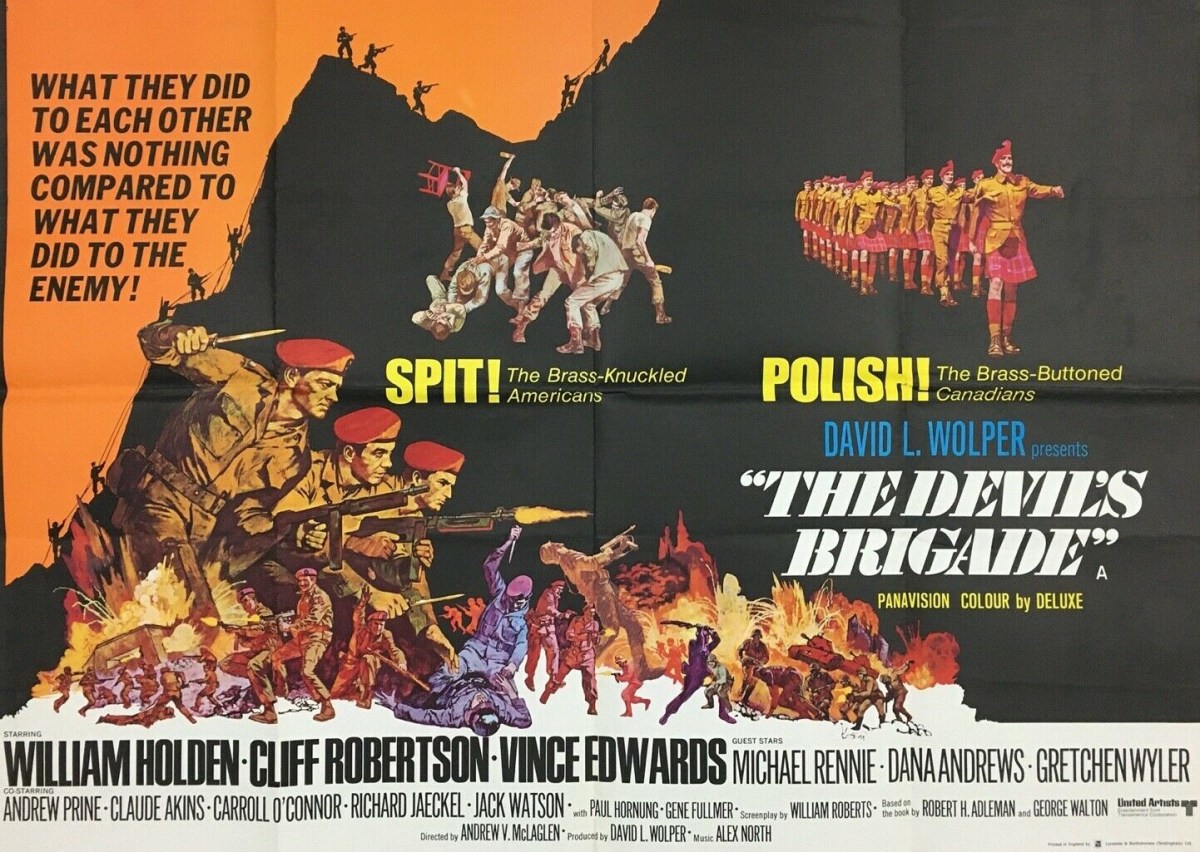
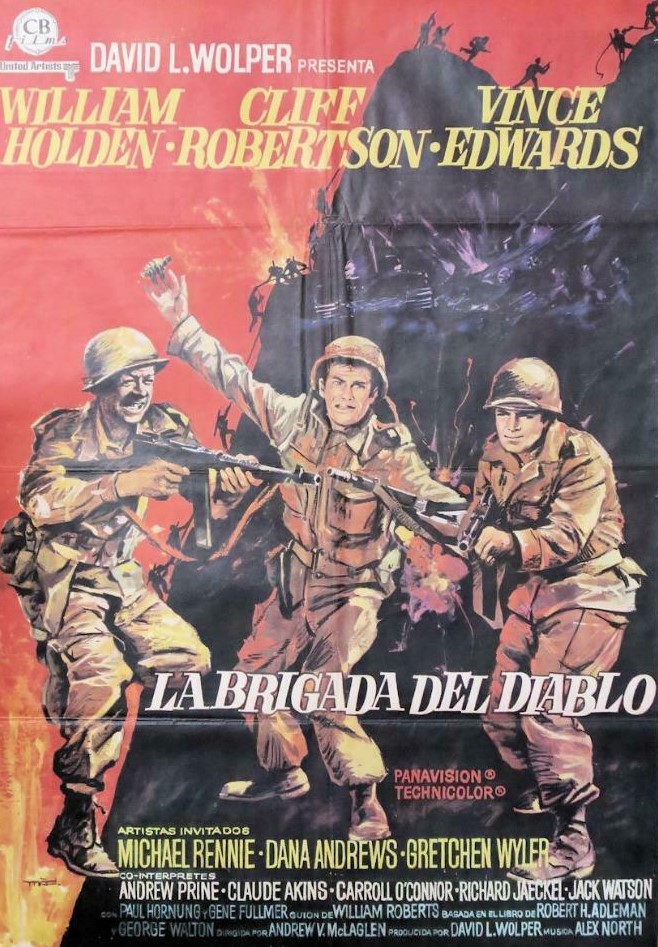
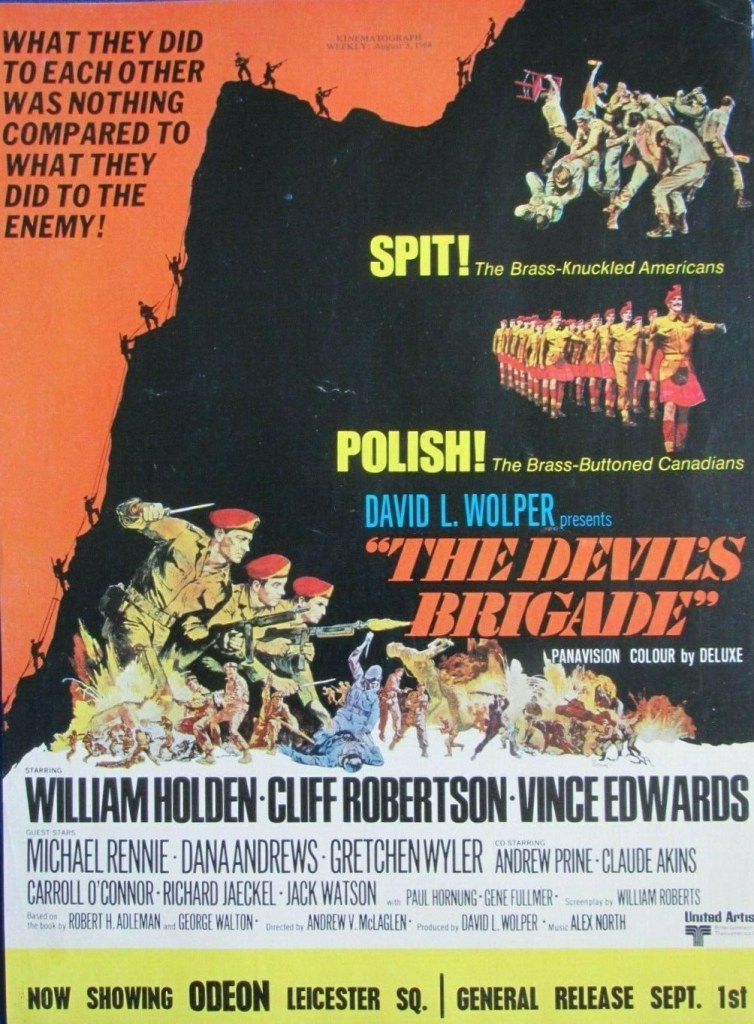
I couldn’t get my head around the idea of the U.S. Army recruiting a bunch of undisciplined misfits, many with jail time, in order to link them up with a crack Canadian outfit. Turns out this part of the film was fictional, the Americans in reality responding to advertisements at Army posts which prioritized men previously employed as forest rangers, game wardens, lumberjacks and the like which made sense since the original mission was mountainous Norway.  I should also point out the red beret the soldiers wear is also fictional and while depicted on the poster sporting a moustache commanding officer Lt. Col. Frederick (William Holden) is minus facial hair in the film.

But, basically, it follows a similar formula to The Dirty Dozen (1967), training and internal conflict followed by a dangerous mission. The conflict comes from a clash of cultures between spit-and-polish Canucks and disorderly/juvenile Yanks though, as with the Robert Aldrich epic, the leader taking some of the brunt of the discontent.  Collapsible bunk beds, snakes under the sheets and a tendency to fisticuffs are the extent of the antipathy between the units, which is all resolved, as with The Dirty Dozen, when they have to take on people they jointly hate, in this case local bar-room brawlers in Utah.

The movie picks up once they are sent to Italy. Initially employed on reconnaissance, Frederick challenges Major-General Hunter (Carroll O’Connor), who prefers to do things by the book, and in a maverick move sets out to take an Italian position by trekking two miles up a riverbed, creeping into town by stealth and capturing the location without firing a shot. 

Next up is the impregnable Monte la Difensa. Taking a leaf out of the Lawrence of Arabia playbook, in a brilliant tactical move, the Americans attack the mountainous stronghold from the rear by way of a mile-high cliff.  But that’s the easy part. The rest is trench-by-trench, pillbox-by-pillbox, brutal hand-to-hand fighting.

The battle scenes are excellent and the training section would be perfectly acceptable except for the example of The Dirty Dozen which set a high bar. That said, there is enough going on with the various shenanigans to keep up the interest, but we don’t get to know the characters as intimately as in The Dirty Dozen and there is certainly nobody to match the likes of Telly Savalas, Charles Bronson, Jim Brown and John Cassavetes. That also said, the men do bond sufficiently for some emotional moments during the final battle

At this point William Holden’s career was in disarray, just one leading role (Alvarez Kelly, 1966) and a cameo (Casino Royale, 1967) in four years, and although his screen persona was more charming maverick than disciplined leader he carries off the role well, especially solid when confronting superiors, exhibiting the world-weariness that would a year later in The Wild Bunch put him back on top. Ironically, Cliff Robertson was coming to a peak and would follow his role as the strict disciplinarian Major Crown, the Canadian chief, with an Oscar-winning turn as Charly (1968). Vince Edwards (Hammerhead, 1968) as cigar-chomping hustler Major Bricker makes an ill-advised attempt to steal scenes.

This was the kind of film where the supporting cast were jockeying for a breakout role that would rocket them up the Hollywood food chain – as it did with The Dirty Dozen. Jack Watson (Tobruk, 1967) is the pick among the supporting cast, but he has plenty of competition from Richard Jaeckel (The Dirty Dozen), Claude Akins (Waterhole 3, 1967), Jeremy Slate (The Born Losers, 1967), Andrew Prine (Texas Across the River, 1966), Tom Stern (Angels from Hell, 1968) and Luke Askew (Cool Hand Luke, 1967). Veterans in tow include Dana Andrews (The Satan Bug, 1965) and Michael Rennie (Hotel, 1966).

William Roberts (The Magnificent Seven, 1960) adapted the bestselling book by Robert H. Ableman and George Walton. Director Andrew V. McLaglen (Shenandoah, 1965) was more at home with the western and although there are some fine sequences and the battle scenes are well done this lacks the instinctive touch of some of his other films.

Dirty Dozen-lite.

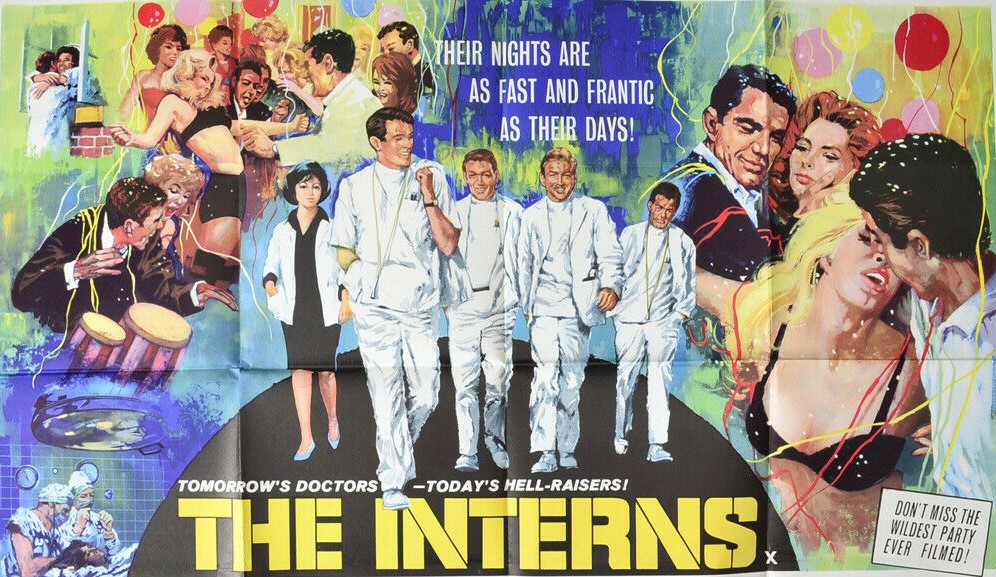
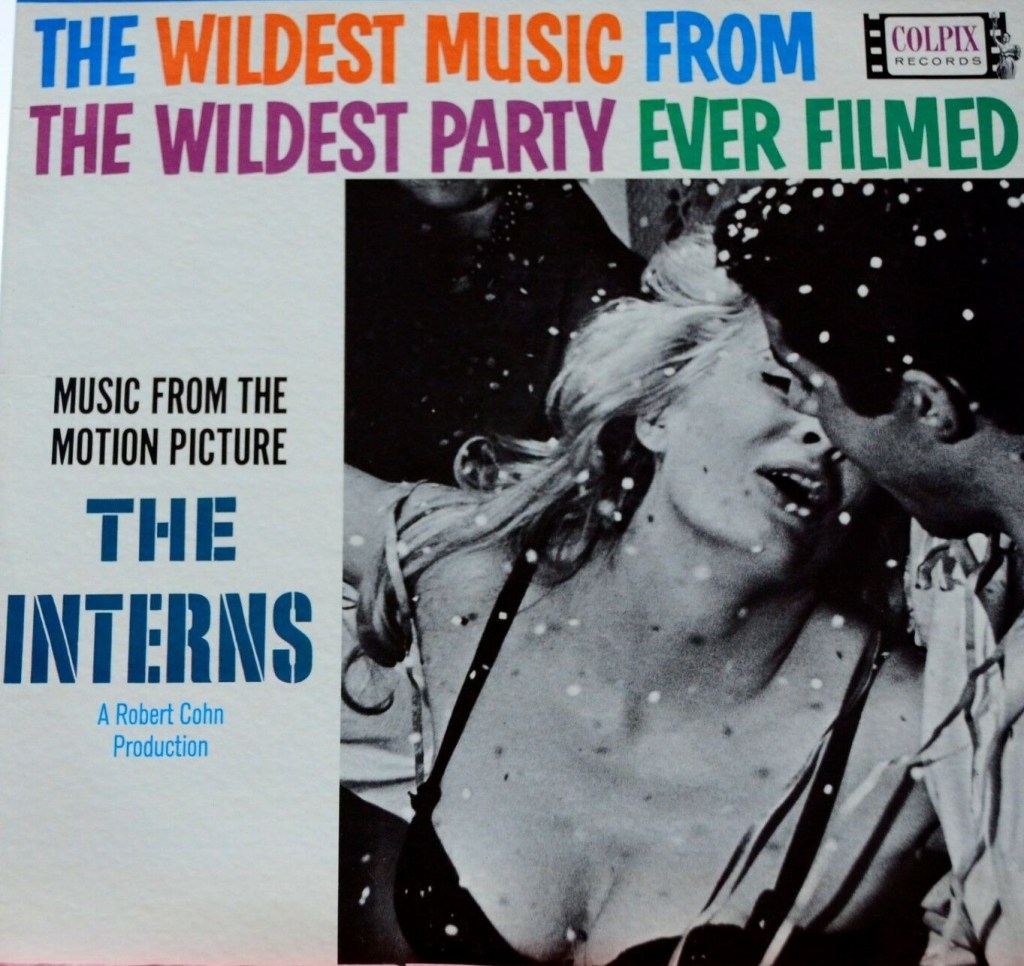
The Interns (1962) ***

Patients are a nuisance to be tolerated on the route to wealth in this superior soap opera that sees young doctors wrestling with ambition and ethics. Although also concluding that impending lofty status will snare them an attractive bride, they find women less biddable than expected, romance proving the trickiest of all procedures.

The main cast of four men and one woman are played by a roster of hotly-tipped newcomers, including future Oscars winners and nominees and the elusive Haya Harareet (The Secret Partner, 1961). Director David Swift, accustomed to handling multiple characters in the likes of Pollyanna (1961), keeps the pot boiling and although some storylines lead to obvious conclusions the screenwriters bring sufficient imagination to the various strands.

The story unfolds over the one year the doctors spend in a general hospital, where the patients are liable to be drunk and obstreperous, before taking up residencies elsewhere. As you might expect, the main characters divide into the good and the arrogant. Heading the latter are Alec Considine (Michael Callan) who cheats on girlfriend Mildred (Anne Helm) with older nurse Vicky (Katharine Baird) in order to gain through her connections a residency at a highly prestigious hospital.

Matching him in the cocky stakes is John Paul Otis (Cliff Robertson), charming to old ladies but willing to risk his career to bed movie actress Lisa (Suzy Parker). The good guys are Lew Worship (James MacArthur) who is seduced into the supposed backwaters of obstetrics and Sid Lackland (Nick Adams), an all-round good egg who falls for a patient Loara (Ellen Davalos).

The most interesting of the young doctors, however, is single mother Madolyn Bruckner  (Haya Harareet) who takes on surgeon Dominic Riccio (Telly Savalas) at every turn. Riccio spends his time berating his charges and, in particular, has a downer on female doctors. At every encounter, despite his vicious tongue, she refuses to back down.

But it is the patients, in particular Arnold Auer (Peter Brocco) and Loara, who blow a hole in the myth of hospitals. In the best scene in the film, Auer, suffering from a degenerative illness that will turn him into a vegetable, takes over from the doctor in giving his own awful diagnosis. His pleas for clemency from his ordeal, in essence assisted suicide, create an ethical dilemma for the young doctors who did not realize that modern medicine could prolong rather than curtail patient suffering.

Auer’s anguished wife Emma (Angela Clarke) flits in and out of the picture as she buttonholes any doctor willing to listen to a new cure she has discovered. While the more hard-hearted doctors can inure themselves to his agony, a savage turn of events finds them all caught up in a situation that could jeopardize their future careers.

Although Loara has an incurable disease and has more or less given up, Lackland’s effervescent good humor and determination that surgery can resolve all health issues brings her hope and if you were in her condition possibly the last thing you would want would be a cheerleading doctor on your side, but in this instance it brings succor and in the doctor’s case forces him to rethink his priorities.

Probably the last thing the doctors – and the audience – expected was to come up against such stubborn, free-thinking women. While Bruckner appears to fly the flag for female independence, she has solid support from Lisa who spends most of the picture rejecting Otis’s advances on the grounds that even when he becomes rich he will be too poor for her liking. Eventually, Vicky forces Considine to choose. Shy nurse Gloria (Stefanie Powers) shocks Worship by putting global travel ahead of marriage. But she’s not as shocking as the bespectacled inhibited Olga (Carroll Harrison) who loses her inhibitions in style at a wild party.

Theoretically, a film about young doctors having a romp, in reality a thoughtful and thought-provoking picture, tackling issues that would have been taboo at the time and removing the submissive tag that daunted most movie female characters in the movies.

Those who succeeded in later winning Oscar favor were Cliff Robertson, Best Actor for Charly (1968), and Nick Adams and Telly Savalas, both nominated for Best Supporting Actor, the former in Twilight of Honor (1963) and the latter in The Birdman of Alcatraz (1962).

Robertson was the pick of the bunch, a star in his own right graduating from 633 Squadron (1964) and Masquerade (1965) to J.W. Coop (1971) which he also directed. But largely, the stars did not fulfil initial promise. The peak of Michael Callan’s movie career was reprising his role in The New Interns (1964), star in British director Michael Winner’s You Must Be Joking! (1965) and second male lead in Cat Ballou (1965). James MacArthur had a steady movie career before an epic run in television series Hawaii Five-O (1968-1979). Nick Adams switched between film and television before his premature death in 1968.  Haya Harareet made only one more film, The Last Charge (1962). In a bit part here, this is the same Brian G. Hutton who went on to greater things as a director, most notably Where Eagles Dare. (1968).

Although primarily in television, the less-heralded stars enjoyed greater ongoing success. Mainly a strong supporting actor, Telly Savalas had only one stab at a starring role (Land Raiders, 1970) before achieving worldwide fame as Kojak (1973-1978).  Stefanie Powers was television’s The Girl from U.N.C.L.E. (1966-1967) and later Hart to Hart (1979-1984). Buddy Ebsen (who plays the older Dr Sidney Wohl) went straight into a nine-year run of The Beverley Hillbillies

Directed with considerable care and awareness of relevant issues by David Swift (Pollyanna, 1961) who co-wrote the screenplay with Water Newman (The Magnificent Seven, 1960) from the novel by Richard Frede. It spawned sequel The New Interns and a TV series. Some reports have The Interns as the biggest of the year for Columbia, but that would only be correct if you were only able to exclude the massive box office for Lawrence of Arabia.

Still a soap, but an interesting one.

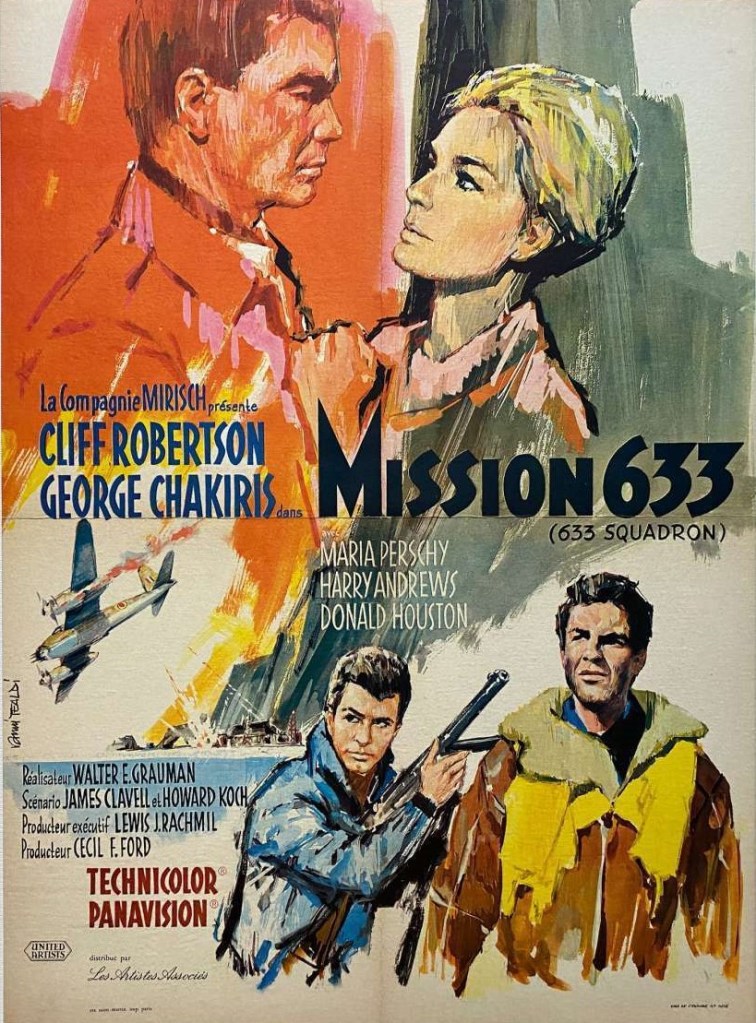
633 Squadron (1964) ***

You can keep your current and future Oscar winners, George Chakiris (for West Side Story, 1961) and Cliff Robertson (for Charly, 1968). The stars here are the mechanical birds, the Mosquito bombers, and the Ron Goodwin score, a thundering rehearsal for Where Eagles Dare (1968).

The aerial photography was pretty amazing for the day, though there were no Top Gun: Maverick shenanigans with actors supposedly actually flying the planes, just sitting there with an occasional turn or yank of the controls.  Even so, watching the planes take off, land, propellers describing perfect arcs, being attacked on ground or in the air, firing back, and the (apologies) bird’s eye view of dashes along precipitous cliffs takes up a huge amount of the running time.

You’ll know by now there was no actual 633 Squadron – but there was an international squadron (see the current Masters of the Air) to accommodate the various accents on show – and that the mission is also fictional, though the idea that the Germans had chosen the Norwegian fjords to hide a factory making rocket fuel for the V1s currently in production elsewhere wasn’t too far off the mark given (see The Heroes of Telemark, 1965) they were using that country for atomic bomb experiments.

The British know the rockets are inevitable, impossible to completely destroy them, but as long as they don’t interfere with D-Day that will be good enough. Wing Commander Grant (Cliff Robertson), although his squadron is exhausted from flying too many daily missions, has his leave curtailed, and told he’s on a strict deadline to destroy the factory.

Like the factory in The Heroes of Telemark, it’s virtually impossible to hit, buried beneath too much rock, but the Germans ain’t that clever, and it’s the rock that is the weakness. The theory is hit the overhang with sufficient bombs and the mountain will come tumbling down and destroy the factory.

Norwegian Resistance fighter Lt Bergman (George Chakiris) is on hand to explain just how difficult the task is, flying at extremely low altitude along fjords guarded by anti-aricraft guns. To add more tension, or just for the hell of it, Air Vice Marshal Davis (Harry Andrews) keeps on truncating the already tight deadline. The pilots have barely got time for a few practice runs along Scottish glens before it’s M-Day (no idea where that daft moniker came from, presumably a D-Day discard).

But there is just enough time for Grant to make pretty with Bergman’s refugee sister Hilde (Maria Perschy). Although after Bergman returns to help out his mates and is unhelpfully captured by the Nazis, Grant has to bomb the Gestapo building to kill him before he can be tortured and give out vital information.

In another film, Hilde would have been a spy or cut off the burgeoning romance after discovering Grant’s mission, but instead she’s not in the espionage line and she thanks the wing commander for sparing her brother torture. In the only major twist in the picture, it turns out Grant was too late, for there’s a nasty welcome committee awaiting the bombers.

Not quite the Boy’s Own derring-do adventure tale I remember, what with the torture and the climax, but it was still in my day one of the few films that appealed heart-and-soul to the pre-teen and teenage boy, along with The Magnificent Seven and The Great Escape, in part, I guess, because it was so thrifty in terms of character development.

No time is wasted giving everyone a character arc, beyond the usual daredevil and someone getting married, the characters are sketchy beyond belief, but who the hell cares, let’s get on with the action. So, it certainly delivers on that score. But watching as an adult, and I’ve probably not seen this in four decades, it’s a good bit tougher than the surface might suggest, eating away at the idealism of war, of the noble sacrifice, and tuning in better than most World War Two pictures to raw finality.

Perhaps it’s emblematic that the best cinematic introduction is given to the arrival of the new-style bombs, although Hilde turning up to a torrent of wolf whistles in the bar runs it close, and she does have a habit of leaning out a window to give the audience a glimpse of cleavage every now and then.

No wonder we all came out humming the Goodwin theme. You can’t escape it. It’s in virtually every scene. Memorable final line uttering by the air vice marshal, “You can’t kill a squadron.”

It would have set the bar high for aerial photography, except that by showing how it could be done, triggered a small flurry of similar pictures, most notably The Blue Max (1966) and The Battle of Britain (1969).

Walter Grauman (A Rage to Live, 1965) clearly adores the machines more than the humans, but the script by James Clavell (The Great Escape, 1963) and Howard Koch (The Fox, 1967) based on the novel by Frederick E. Smith doesn’t give him much option.

Still worth a watch.

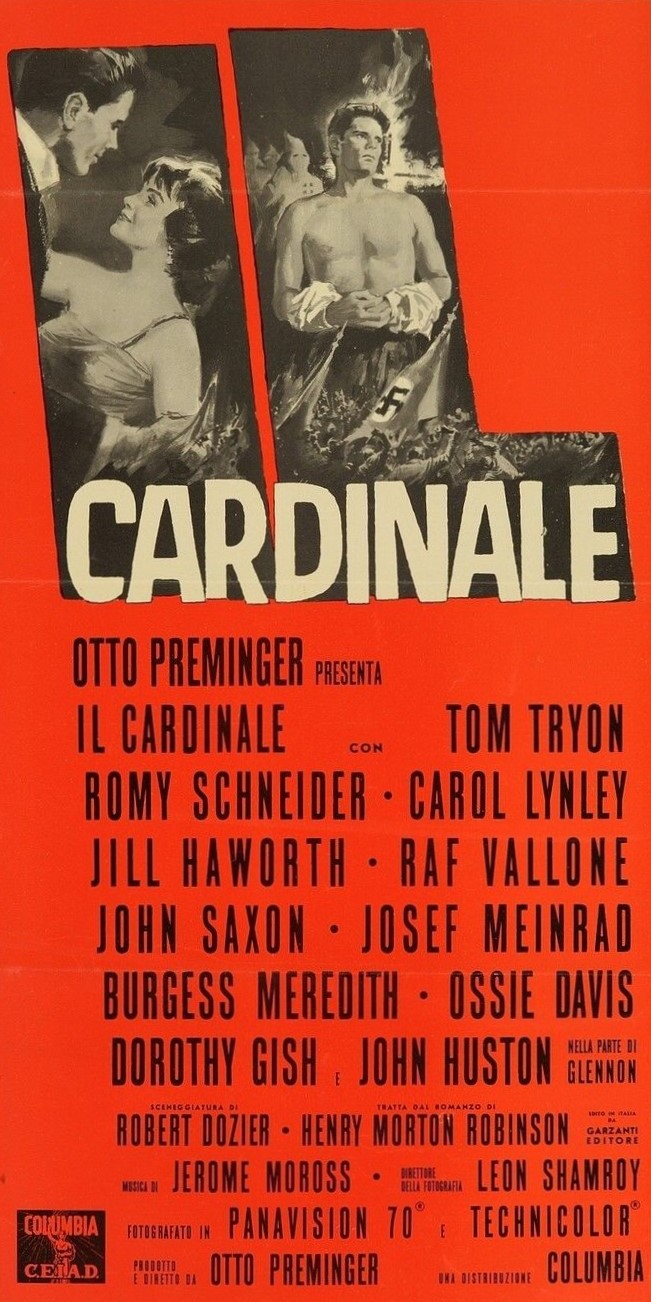
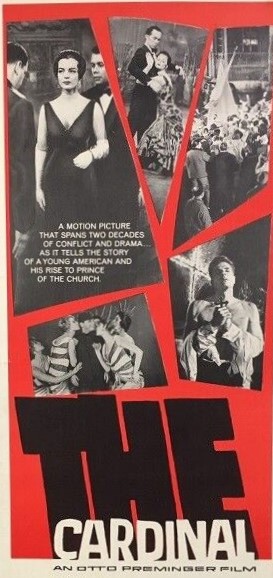
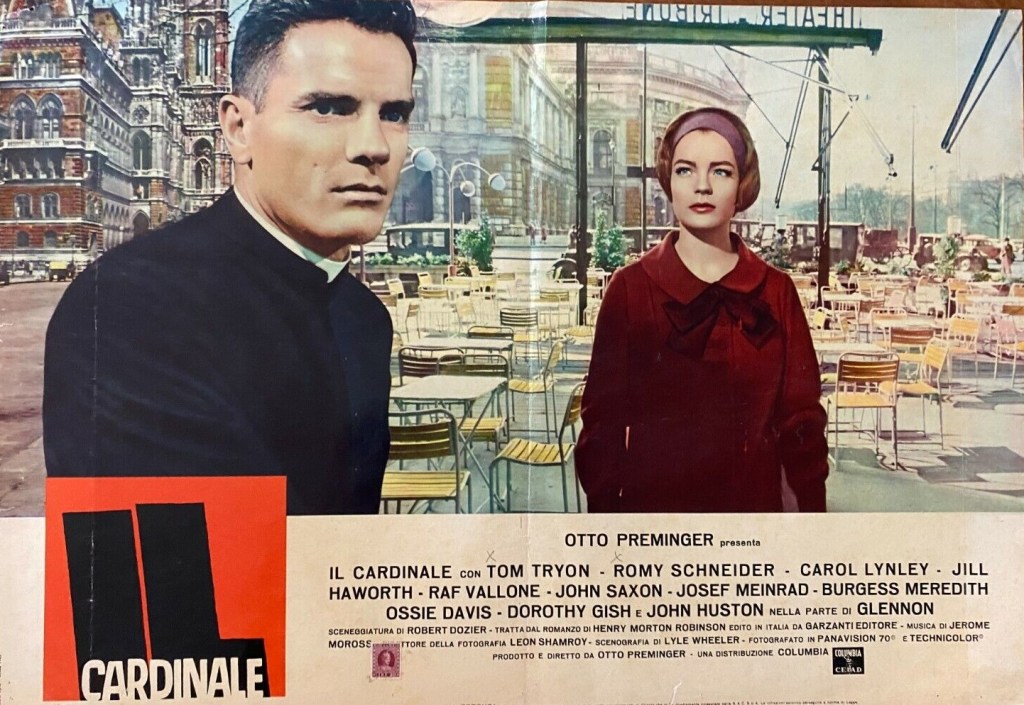
Behind the Scenes: “The Cardinal” (1963)

Otto Preminger was beaten to the punch on this one, the scandalous Henry Morton Robinson bestseller snapped up in 1955 by producer Louis de Rochemont (The Roman Spring of Mrs Stone, 1961) who had a tie-up with Columbia. Due to interference from the Catholic Church, de Rochemont dropped his option which Preminger picked up in 1961 while working on Advise and Consent (1962).

The last section of the novel, set in Austria during the Anschluss, reverberated with the director who was born in what was then the Austro-Hungarian Empire and although a Jew was well acquainted with Catholic society.  One of his most significant changes to the book was introducing the Austrian cardinal who endorsed Hitler.

The first two screenwriters James Lee (Banning, 1967) and Daniel Taradash (Castle Keep, 1969) failed to whittle down the complex novel to cinematic proportions. So Preminger brought in Robert Dozier (The Big Bounce, 1969) and began working with him in summer 1962 making other alterations to heighten the drama. The incident involving the unborn child of the sister of Fr Fermoyle (Tom Tryon) acquires greater emotional power in the film, touching on the ambiguities inherent in any institution and provoking the priest’s guilt.

Gore Vidal (The Best Man, 1964) also worked on the script, swapping the novel’s Italian countess for the Viennese Annemarie (Romy Scheider) who, abandoned by the priest had married and was reunited with him prior to the Anschluss, and is sympathetic to Hitler until her husband’s faith endangers them both. Ring Lardner, who had satirized the Catholic church in a recent novel, was the final screenwriter added, his main task to rewrite scenes “to achieve what he (Preminger) wanted,” and, more importantly, to introduce the flashback structure. Ironically, both Vidal and Lardner were atheists.

Tom Tryon and Romy Scheider meet again in Vienna.

The director considered five actors for the leading role – Hugh O’Brian (Africa – Texas Style, 1967), Stuart Whitman (The Commancheros, 1961), Cliff Robertson (The Devil’s Brigade, 1968), Bradford Dillman  (Circle of Deception, 1960) and Tom Tryon (In Harm’s Way, 1965), the latter three advancing to the screen-testing stage. The 34-year-old Tryon won the role and a five-picture contract he would later regret. Carol Lynley (Bunny Lake Is Missing, 1965) who plays the priest’s sister also pacted for five movies.

Romy Scheider’s (Triple Cross, 1966) part was enhanced by the work of cinematographer Leon Shamroy who “fell madly in love with her,” resulting in the actress virtually shimmering on screen, never before “looking as beautiful.” Held in warm regard by the director, she was exempt from his tirades.

It took considerable persuasion on the part of Preminger for John Huston to participate. Curd Jurgens, initially cast as the Austrian cardinal, pulled out and was replaced by character actor Josef Meinrad whose lack of English meant he had to learn his lines phonetically.

Tom Tryon described Preminger as “tyrant who ruled by terror.” He was fired on the first day and probably wished the director had not rescinded the decision, for thereafter the actor was tabbed “lazy…a fool…stupid and unprofessional.” Commented Tryon, “I was so frightened he was going to scream that…I (just) wanted the experience to end.”

One scene with John Huston took 78 takes because Tryon could not deliver what the director wanted. And at one point first assistant director Gerry O’Hara (later director of The Bitch, 1979) found the star in tears and refusing to return unless the director agreed not to shout at him. Eventually, during the Italian section of the shoot, Tryon collapsed from nervous exhaustion, and was prescribed two days rest, and after this incident Preminger let up on his demands of the actor. 

Explained Preminger, “I probably chose him without deliberation because he is weak.” He felt than an ordinary person would not side with the Church against a family member in a predicament, and that only a person “with weakness in his character” would be believable in the role. The character “fails because when you become a priest you substitute your own judgement and your own feelings for the law of the Church…The big decisions are made for him.” (Quite why he never chose an actor who could portray such weakness is not known.)

Tryon admitted that he owed a brief let-up in the bullying to “Schneider’s benign presence.” He commented, “The only fun I ever had on The Cardinal was a (ballroom) scene I did with Romy.” Prior to turning the cameras, Prior called both over, appeared ready to issue instructions, but instead waved them away “you know what to do.”

Added Schneider, “Preminger taught me an important thing: work fast. It’s true that it greatly helps our acting. Each of his directions, whether of gesture or of intonation, is precise and correct. Even better, it’s the only one possible…Each phrase, each world, each syllable are minutely weighed.” That dexterity applied to his positioning of the camera. He made decisions immediately, never hesitating “over the placement of the camera and each time…it was the simplest, the most natural and, dramatically, the best.”

Ossie Davis (The Scalphunters, 1968),  who professed to have enjoyed a marvellous relationship with the director, observed:  “I met actors whom Otto liked, I met actors that had no relationship or feelings one way or the other and I met actors who were almost absolutely destroyed, almost literally in panic because of Otto Preminger (who) was always looking for a spark…whether you had the spark or not, he was going to find it and even put it in you.”

But Patrick O’Neal stood his ground. “I woiuld not take it from him.” And they became friends.

The unit shot for five weeks in New England before heading to Vienna, Preminger choosing to stay in the same suite in the Hotel Imperial as appropriated by Hitler when visiting the city. Permission to shoot in the National Library, “one of the most beautiful monuments in the city” was attacked by the current minister of education who wanted the Hitler era erased from memory. And he was barred from using other government buildings for spurious reasons.

After four and a half months in Austria, the unit shifted to Rome, locations including St Peter’s Square and inside St Peter’s Cathedral and the Santa Maria sopra Minerva church, with priests and monks hired as extras for the various ceremonies. The Georgia scenes were shot in Hollywood on the Universal back lot.

Although generally dismissed by the critics and given a hard time as you might expect from the Catholic Church, The Cardinal hit a chord with audiences, who turned it into Premigner’s second-biggest hit of the decade.

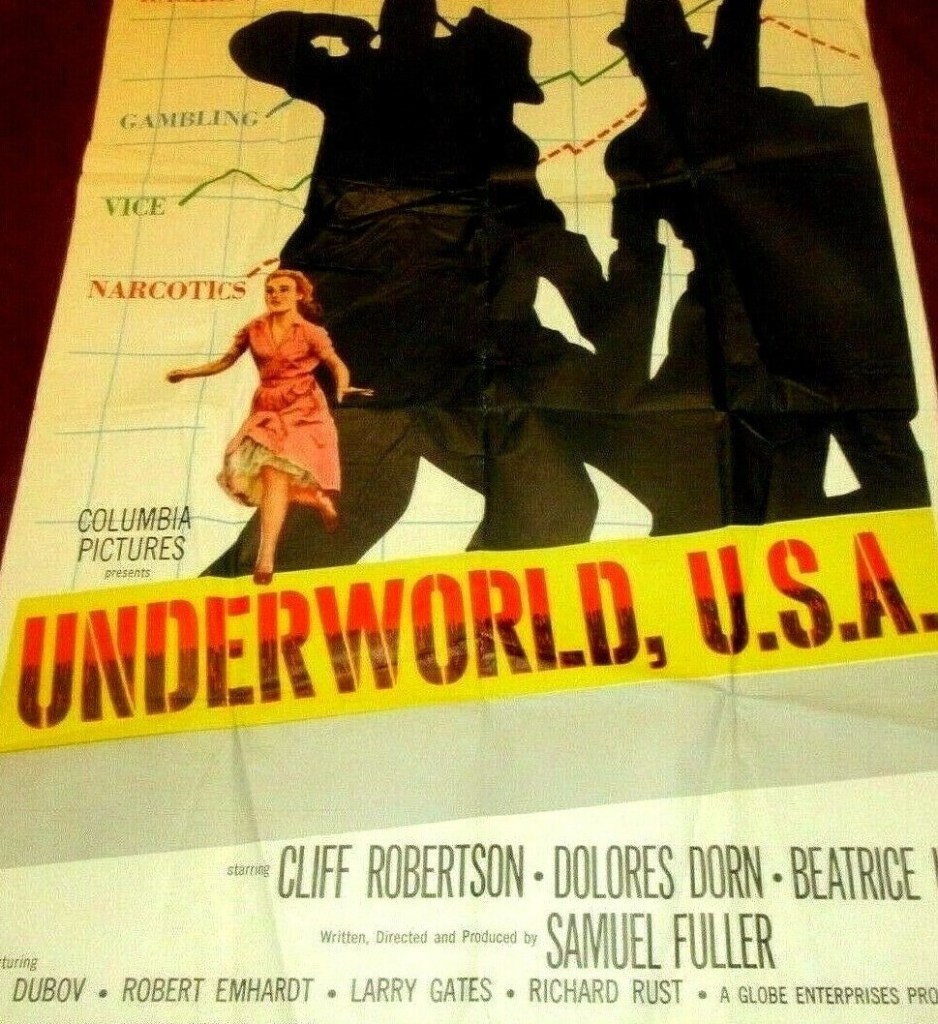
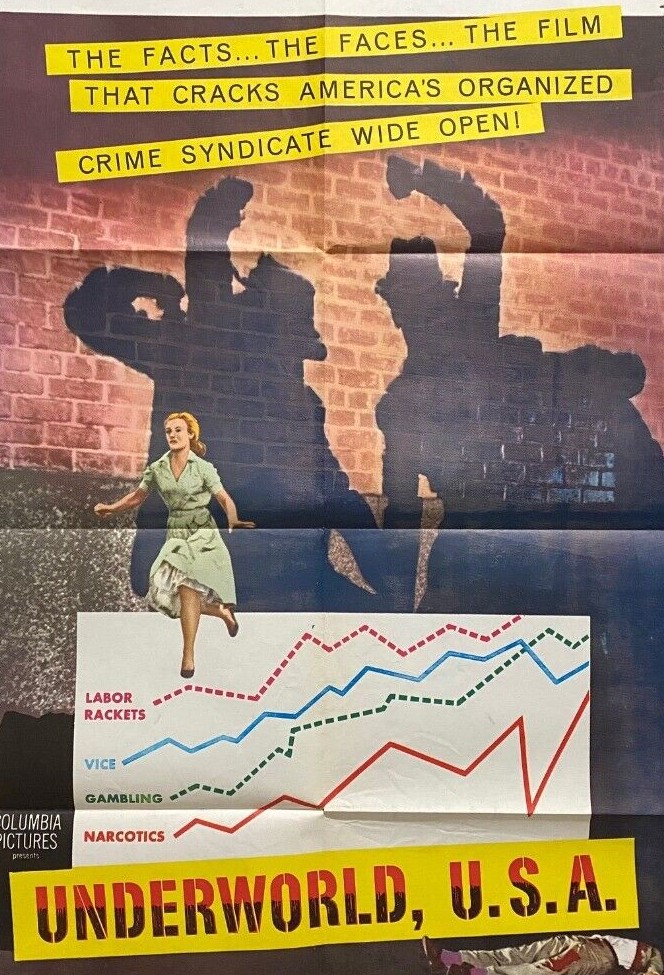
Underworld U.S.A. (1961) ***

Could be a companion piece for The Oscar (1966). Dumb punks with scarcely a redeemable feature. Treat women like garbage. Obsessed by an unachievable aim. In this case it’s revenge for the death of a no-good hoodlum father that provides an expose of the Mob. Sam Fuller opts for a documentary approach, rather than delving into the soap opera of The Oscar, and at times info dumps threaten to run away with the picture. While raw enough, lacks the emotional kick of The Naked Kiss (1964).

When habitual jailbird Tolly (Cliff Robertson) comes across one of his father’s murderers in gaol he tricks him into revealing the names of the three others – Gela (Paul Dubov), Gunther (Gerald Milton) and Smith (Allan Gruener) – who are now high-ranking gangsters. Having gained entrée to the hoodlum kingdom, he becomes an unlikely ally of top cop Driscoll (Larry Gates), devising a clever plan to suggest to Mob boss Connors (Robert Emhardt) that his lieutenants are so untrustworthy they should be rubbed out.

Along the way he enjoys a dalliance with a Mob runner Cuddles (Dolores Dorn) who draws the lines at handling drugs, and ruthlessly pulls her into his scheme. Motherless Tolly’s mother figure Sandy (Beatrice Kay) does her best to put him off his skulduggery.

When he’s not robbing or working on his scheme, he’s either seething or dashing Cuddles’s dreams of living together, not as his moll, put up in an apartment, but as an honest couple. He’s not remotely interested in doing the right thing or imagining himself as a public-spirited hero and would rather be executioner than laboriously bringing his targets in to face justice.

But the cops are equally ruthless, fully aware of the dangers facing informants, but so intent of catching the gangsters they do little to minimize the peril. Characters pop up in bit parts to make points about police corruption and when Fuller lurches away from Tolly to deliver lectures about the extent of the Mob’s tentacles it loses focus.

See what I was saying about stats. When did they ever sell a picture?

But all the statistics and operational details count for a lot less than venal assassin Gus (Richard Rust) cold-bloodedly running over a young girl to deliver a warning to others and Connors intending to turn schoolkids into drug addicts.

You can see why Fuller fell back on stats because there was hardly anything new to say about gangsters after a three-year crime biopic spree kicked off by Machine Gun Kelly (1958). Every major crime figure had been given the treatment – Al Capone (1959), Ma Barker’s Killer Brood (1960), Murder Inc. (1960), Pretty Boy Floyd (1960), The Rise and Fall of Legs Diamond (1960), King of the Roaring 20s: The Story of Arnold RothsteinMad Dog Coll (1961) and Dutch Schulz in Portrait of a Mobster (1961).

There wasn’t much new about Tolly except he believed his killings were sanctioned by a complicit police force and his own ideas about justice.

That said, Cliff Robertson (The Devil’s Brigade), before his twisted grin got the better of him, and he resorted to scene-stealing, is excellent as a driven dumb thug who lets anything worthwhile, namely the courageous Cuddles, slip through his figures. And Robert Emhardt has a ball running his empire from the poolside. But mostly, it’s tough guys talking tough, sometimes with the aid of a cigar.

You can’t not have seen most of this before. Sure, Fuller is a bit more stylish. The death of the father, all shadow, might be a homage to film noir. But, like all gangster films with the exception of Bonnie and Clyde (1967) and The Godfather (1972) and the Scorsese movies, it loses audience empathy because Fuller is unable to make likeable his unlikeable characters.

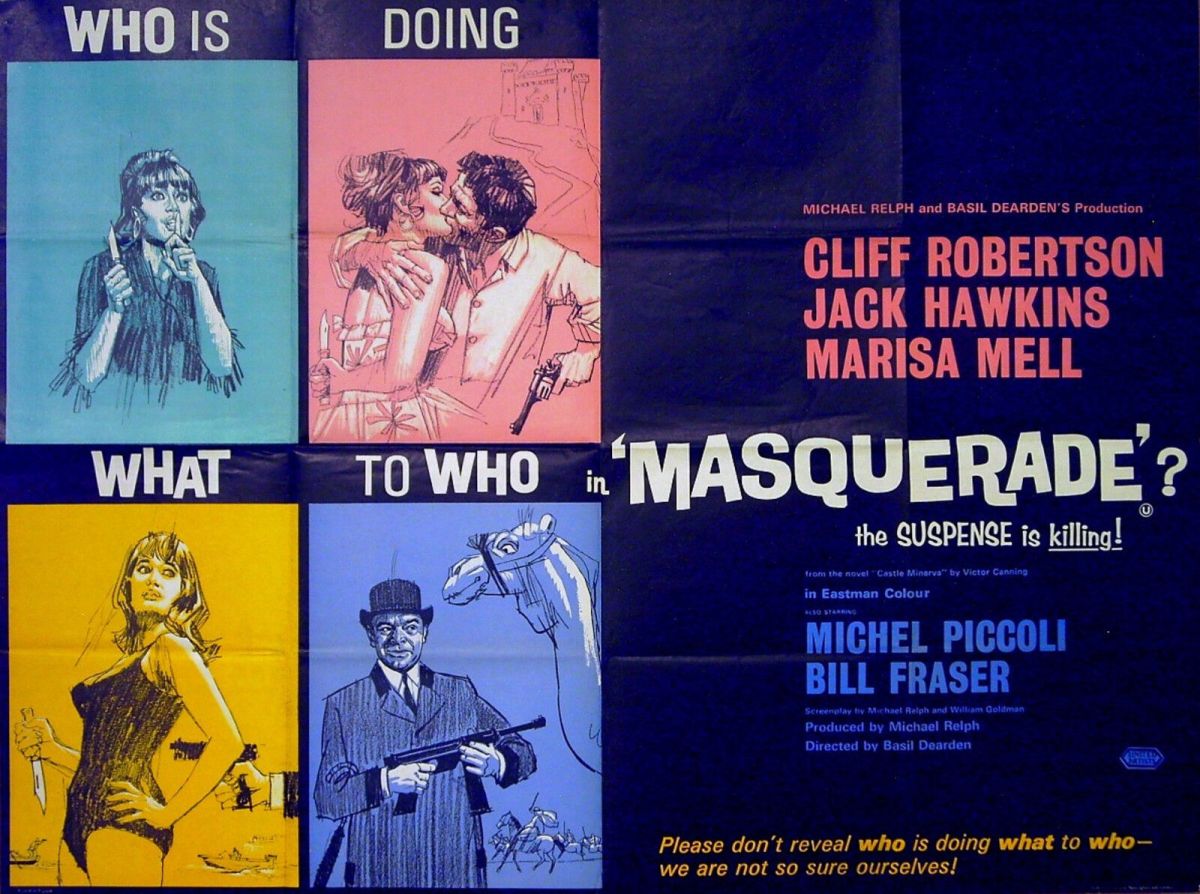
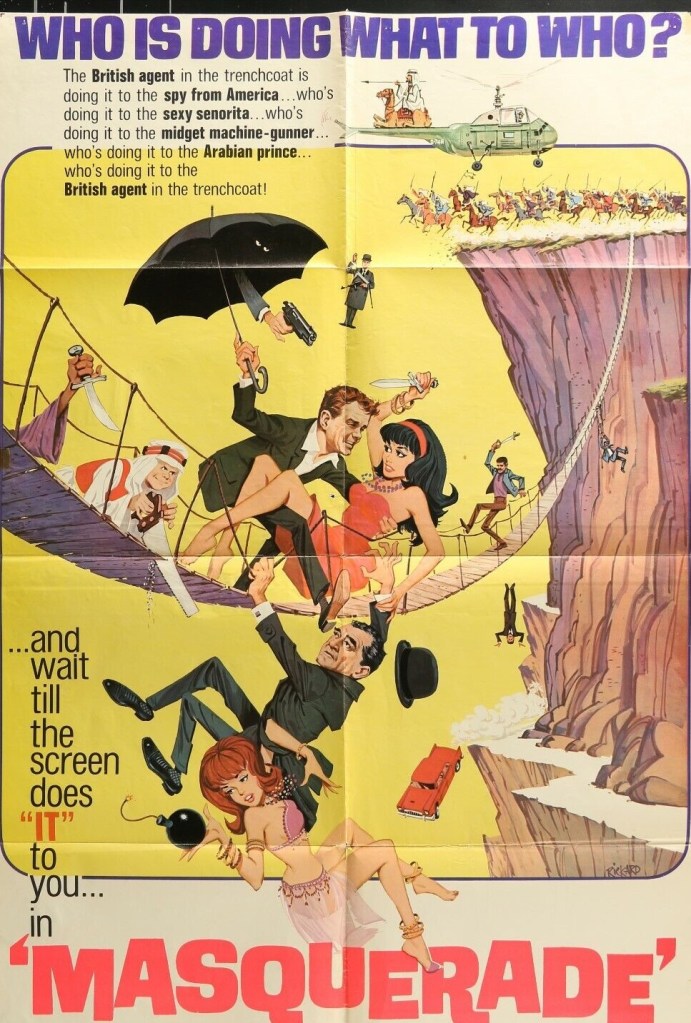
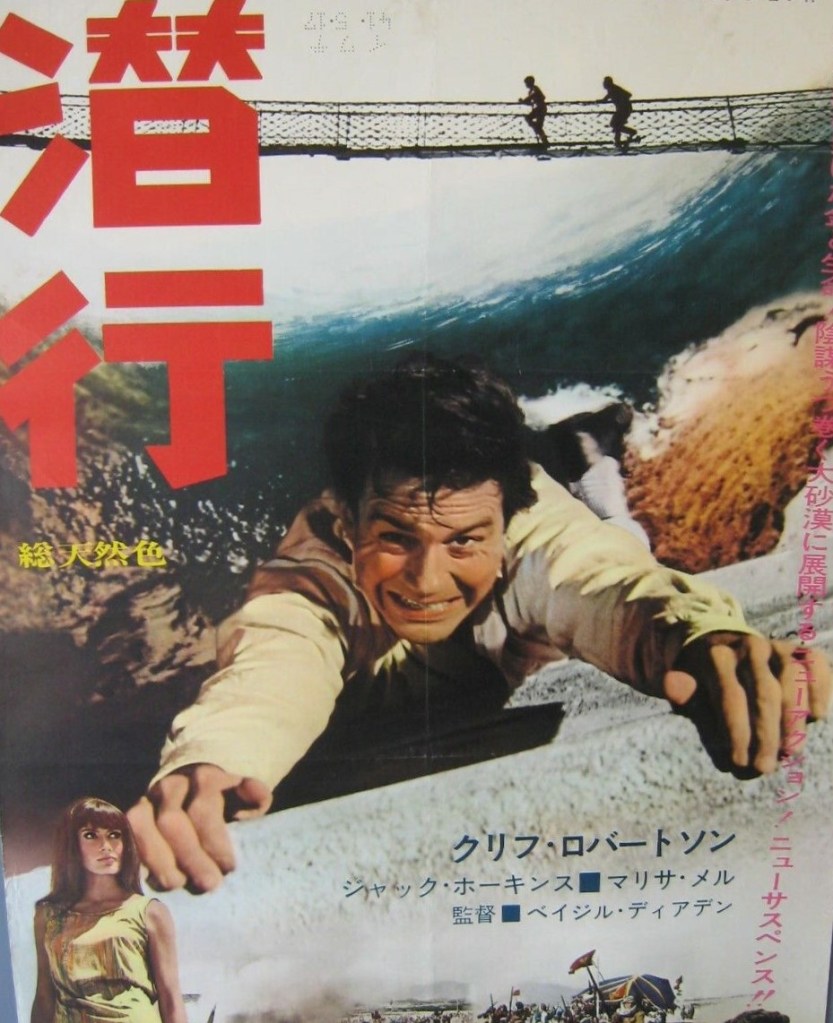
Masquerade (1965) ***

Made just before director Basil Dearden embarked on Khartoum (1965), this is probably best-known these days for being screenwriter – and ace self-publicist – William Goldman’s first credit. It’s based on Castle Minerva by Victor Canning whose previous filmed books included The Golden Salamander (1950) with Trevor Howard, The Venetian Bird (1952)  with Richard Todd, and The House of the Seven Hawks (1959) with Robert Taylor.

I’d like to say this is a self-aware thriller with spy and comedic elements but it veers awful close to either a cult film or a mess. Basic story has Frazer (Cliff Robertson) hired by former wartime commander and now British intelligence agent Col Drexel (Jack Hawkins) to look after an Arab princeling who has been kidnapped by the British (so much for Brits always being on the side of the angels) to help seal an oil concession in the Gulf.

Theoretically, the kidnapping is for the teenager’s own good, to prevent him being assassinated before he ascends to the throne…see it’s getting awfully complicated already. Anyway, it turns out he actually has been kidnapped by Drexel who has turned rogue in order to fund his retirement. The boy is held in some kind of fortress/castle in Spain and then another more sinister one.

Frazer meantime falls for the seductive charms of Sophie (Marisa Mell) who he thinks is a smuggler intent on stealing his boat but a) is part of the kidnap gang and b) in love with him enough to help him escape when he in turn is captured.

Did I mention the film also included a circus, a clown act, a gunfight on a dam, characters left dangling on a rope bridge, a lady in red, a balancing act along a perilous ledge, entrapment in a wine tanker (huh?) and an animal cage (double huh?), a vulture, men in bowler hats…

It is enlivened by visual gags – ultra-large footprints (from somebody wearing flippers). The dialogue sparkles as when the prince, with an overactive entitlement gland, says, “I am practically divine,” to which Hawkins deadpans “Your Highness, you are irresistible.” Add to that various cliché-twisting scenes – the double-dealing Sophie now overcome by love, says to Drexel: “Ask me anything you want and I will tell you the truth,” but every question he asks solicits the response, “I don’t know.” Then, imprisoned in a cage, after protracted cobbling together of lengths of bamboo to steal keys they turn out to be the wrong keys.

Throw in: British propriety  – Frazer’s  substantial fee for risking his life is reduced to a miserable sum once tax has been deducted; and a superb Arab charge on horseback with tracking cameras, either a rehearsal for Khartoum or the scene that got Dearden the gig.

Actually, the more I write about it the more fun it sounds and I wish it were, but it does not quite gel. Cliff Robertson (The Devil’s Brigade, 1968) and Marisa Mell (Danger: Diabolik, 1968) don’t convince – Robertson talks through gritted teeth without suggesting he has much inner grit – although Jack Hawkins (The Third Secret, 1964) and other British stalwarts like Charles Gray (The Devil Rides Out, 1968) and Bill Fraser (The Best House in London, 1969) and Frenchman Michel Piccoli (Danger: Diabolik) deliver the goods. It should have been a straightforward three-star job or – if qualifying as a cult – in the five-star class. It is definitely not an outright stinker. Perhaps best filed under “curiosity.”

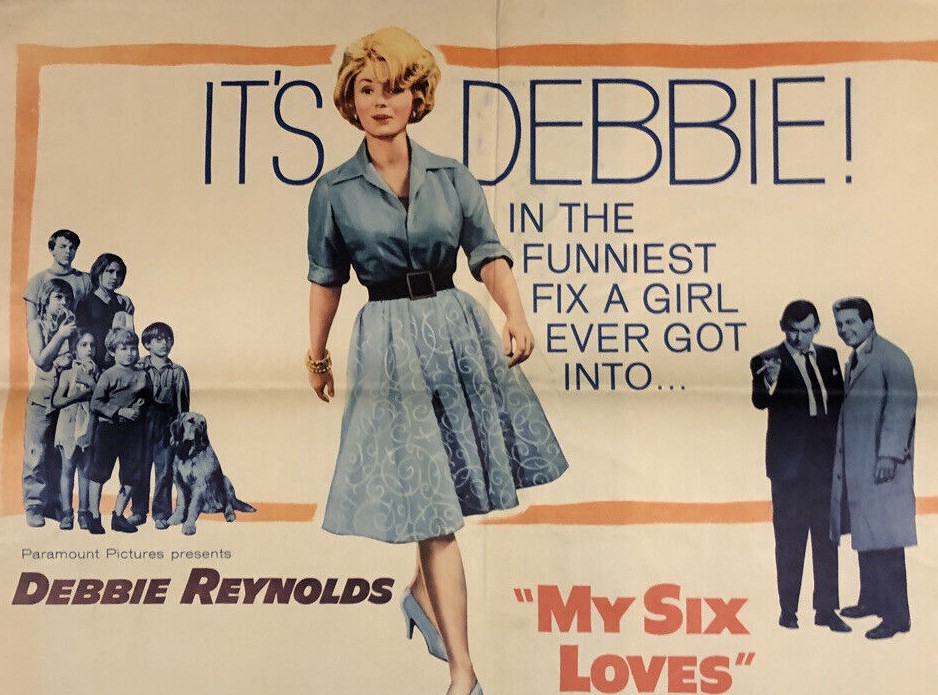
My Six Loves (1963) ***

It was a rite of passage for rising male stars to take second- or third-billing to an established top-billed female. And, more importantly, rein in all attempts at scene-stealing. This is a Cliff Robertson minus the distinctive hunk of hair and lip-chewing of later performances and a David Janssen only beginning to learn the knack of talking out of the side of his mouth. They were probably kicking themselves for the indignity of ending up in such as harmless concoction, but the idea was, if it was a hit, it’d be a leg up the career ladder.

This frivolity, by the way, is probably offensive to a contemporary audience since the thrust of the story is an actress abandoning a successful Broadway career in favor of motherhood. On the other hand it is the very definition of comfort movie.

Janice (Debbie Reynolds), in love with her aggressive and somewhat conniving producer Marty Bliss (David Janssen), collapses at a publicity junket and convalesces at her second home in Connecticut, so far removed from the center of theatrical civilization that she never visits and in consequence the property has been taken over, for their own enjoyment, by her housekeeper and her daughter, who now object to spending a moment catering for their employers. In the grounds lurk a brood, half a dozen orphans taking refuge from their exploitative foster parents.

It doesn’t take long for Janice to sucker herself into taking them into her house, assistant Ethel (Eileen Eckhart) as clueless. On hand offering advice is local minister Jim (Cliff Robertson).  If the kids are a handful, refusing to be separated which entails them all sleeping in the same room, they’ve got nothing on their boisterous hound Butch.

We’re past the halfway mark before it occurs to Janice that she is treading dangerous emotional waters and she jumps at the chance to star in a heavyweight drama by current Broadway playwright kingpin. Meanwhile, smelling a hefty payoff, drunken foster parents Doreen (Mary McCarty) and BJ Smith (Max Showalter) turns up, Jim takes an unrequited romantic interest in his neighbor, Janice discovers her community spirit by helping raise money for charity, one of the kids runs away from hospital, and another has trust issues, leaving the other four with little to do but look cute.

Somehow within all this there’s a cue for a song, “It’s a Darn Good Thing” before Janice has to take the decision to sink or swim with the kids or hi-tail it back to Broadway where the prospect of a Tony beckons.

You’ve probably seen this all before, but somehow – taking the career issue out of the equation – it all works, an overactive ice machine, racing in and out of the school bus, meal-time complications, and wouldn’t you believe it a slice of love. No prizes for guessing the ending.

But it’s testament to Debbie Reynolds (How the West Was Won, 1962) that the movie has an appealing center. Cute kids are ten a penny in Hollywood but an actress able to make believable such an old-fashioned family-friendly tale is hard to come by.  Sure, by today’s standards it’s outdated, but if we can just slip on a retrospective hat, she would not be the first career-minded woman of that decade to find she had ignored her maternal instinct. It might have been better all round if she had found a way to have both career and motherhood but the planet and certainly not Planet Hollywood was not yet on that wavelength.

Of course, it being lightweight ensures none of the other characters have any depth and to their credit neither Cliff Robertson (Masquerade, 1965) nor David Janssen ((Warning Shot, 1967) resorts to showboating, a smart decision because with the charismatic Reynolds taking center stage they could hardly compete. And I have to confess I quite like this early version of Robertson before he was overtaken by a need for weightier roles. He showed a neat comedic touch, had some of the best lines, and proved no slouch in the verbal sparring department. Janssen, too, showed a lot of promise.

Max Showalter (How to Murder Your Wife, 1965) had such a convincing drawl that I was convinced I was watching Strother Martin (Cool Hand Luke, 1967). A good opportunity also to check out distinctive character actors Eileen Eckhart (No Way To Treat a Lady, 1968) and  John McGivern (Midnight Cowboy, 1969)

You can hardly blame famed Broadway director Gower Champion (The Bank Shot, 1974), only too aware of the pressures of maintaining a stage career, for thinking that a life in Connecticut with a bunch of eventually pliant and cute kids would be a welcome alternative. It took three screenwriters to spin this tale – John Fante (Maya, 1966), William Wood (The Lively Set, 1964) and Joseph Calvelli (Death of a Gunfighter, 1969).

Bearing in the mind the aforementioned provisos, not a bad Sunday matinee. Alternatively, come at it from today’s perspective and you will be inclined to rip it to shreds before you give it a chance to be entertaining. You might even consider it a tad more adventurous in its more realistic approach than other multiple-kid pictures like Cheaper than the Dozen (1950) and Yours, Mine and Ours (1968).

All In A Night’s Work (1961) ***

What wouldn’t Hollywood give now for a pair of personable players who could take as slight a piece of fluff as this and through sheer force of screen personality turn it into an enjoyable experience.  Based entirely around misconception, misunderstanding, characters at cross purposes and mild business satire this would have been hailed as a classic had it appeared in the golden age of the screwball comedy.  

Playboy Tony Ryder (Dean Martin) inherits a publishing empire from his uncle but discovers an unsavoury fact about his relative’s demise that could severely damage the business. A naked woman was seen running from his hotel room. When hotel house detective Lasker (Jack Weston) identifies her as Katie Robbins (Shirley MacLaine), a lowly employee in the company, the suspicious minds of big business surmise that she intends to blackmail them.

The plot, such as it is, concerns Ryder and Co’s attempts to avoid this, by bribing her to shut up and at the same discrediting her. Ryder is conflicted, in part because he fancies her rotten, in part because he doesn’t quite believe she could be so duplicitous, and in part because he can’t afford to risk believing her. For some reason, as a researcher, she is involved in union negotiations, giving him the opportunity to get to know her better, as part of a “sub-committee of two” established to examine union claims more thoroughly.

So it’s basically one set-piece after another. A flashback explains why Katie came to be in the uncle’s bedroom – to escape in the same hotel the lustful attentions of the elderly wealthy guest Kirby Hackett (Johnstone White) whom she saved from drowning. Her behaviour at the uncle’s funeral suggests she is stricken by his death. And unfortunately, she is the recipient from the grateful Hackett of a mink coat worth thousands of dollars which, on her meagre salary, she can’t explain.

Katie is dithering over her planned wedding to dull vet Warren Kingsley Jr. (Cliff Robertson) and, aiming to discredit her with him, Ryder plants the seed that actually she is a showgirl on the side, arranging for her to receive five star treatment at various nightclubs, inciting suspicion from her fiancé and his extremely conventional parents. In order to get to the bottom of everything, Ryder agrees to be bugged for a private meeting with Katie. You can imagine how that goes. But the outcome is never in doubt of course.

What the audience knows but the participants do not is that this couple is well-suited. Ryder is far from the playboy of his reputation, having started at the bottom of a rival publishing empire and worked his way up to the top, so he turns out to be a more astute businessman than the sycophants on the board anticipate – “you may not be much but you’re all we’ve got” typical of the welcome he receives. Far from being a good-time girl, Katie is a woman of principle, refusing to take the mink coat as a gift and determining to pay it off at the rate of $10 a week.

The humour derives almost entirely from the cross-purpose nature of the plot and the set-pieces work out well, especially when Ryder kidnaps a sheepdog as an excuse to visit the vet, and stumped for a reason comes up with the notion the animal is suffering from amnesia. “He gives me that ‘who are you’ look,” Ryder explains. As the tale unfolds Kingsley becomes more insufferable by the minute.    

There’s a romantic subplot involving Katie’s outgoing office chum Marge (Norma Crane) and the shy detective and some satirising of big business but that all plays out in relation to the main story.

If you remember Dean Martin from heavyweight dramas like The Young Lions (1958), Some Came Running (1958), Rio Bravo (1959) or the breezy Rat Pack comedies and the equally breezy Matt Helm spy pictures will probably not be aware he started his career in comedy, as one half of the Dean Martin-Jerry Lewis combo, a box office sensation in the early to middle 1950s. So, although he was primarily the straight man to the more obviously comedic Lewis, he was still well versed in the nuances of the genre. Nothing is ostensibly played for laughs, but he gets the laughs nonetheless.

Martin was always badly under-rated, in part because of the perma-tan, in part down to the his television show, and in part because he just wasn’t Frank Sinatra. But he was an accomplished actor, as this proves. One of the aspects of his performance I liked was that he moves with purpose. In most movies, characters cross a room or change position simply because a director calls the shots. But here, every time Martin moves it’s for a designated reason, to touch something, admire something, maneuver himself closer to someone else.

Shirley MacLaine is also refreshing, considerably less conniving or lovelorn than in her breakthrough role in The Apartment (1960), and coming to believe in her screen presence. She inhabits this character’s innocence very well, is suitably baffled on occasion, and exhibits a screen persona that simply lights up the screen. Together they are a great screen couple and in the charisma-starved Hollywood of today would be very welcome.

Cliff Robertson (The Honey Pot, 1967), almost unrecognizable without that hefty hunk of hair and the grandstanding he often effected, plays his small role to perfection. Norma Crane (Penelope, 1966) and Jack Weston (The Cincinnati Kid, 1965) – minus the screen tics he later exhibited – are quietly effective. Veteran Charles Ruggles (The Parent Trap, 1961) puts in a decent shift.    

Confident direction by Joseph Antony (The Rainmaker, 1956) in just his fourth film out of a grant total of five makes you forget this was based on a hit play by Margit Veszi and Owen Elford. The screen transition was down to Maurice Richlin (The Pink Panther, 1963), Edmund Beloin (Donovan’s Reef, 1963) and future bestselling author Sidney Sheldon (Billy Rose’s Jumbo, 1962).  

The real beauty of this piece is how effortless it all looks. The characters are grounded and believable, viewed from varying perspectives the plot remains logical, and there is enough daft invention to tickle your fancy.

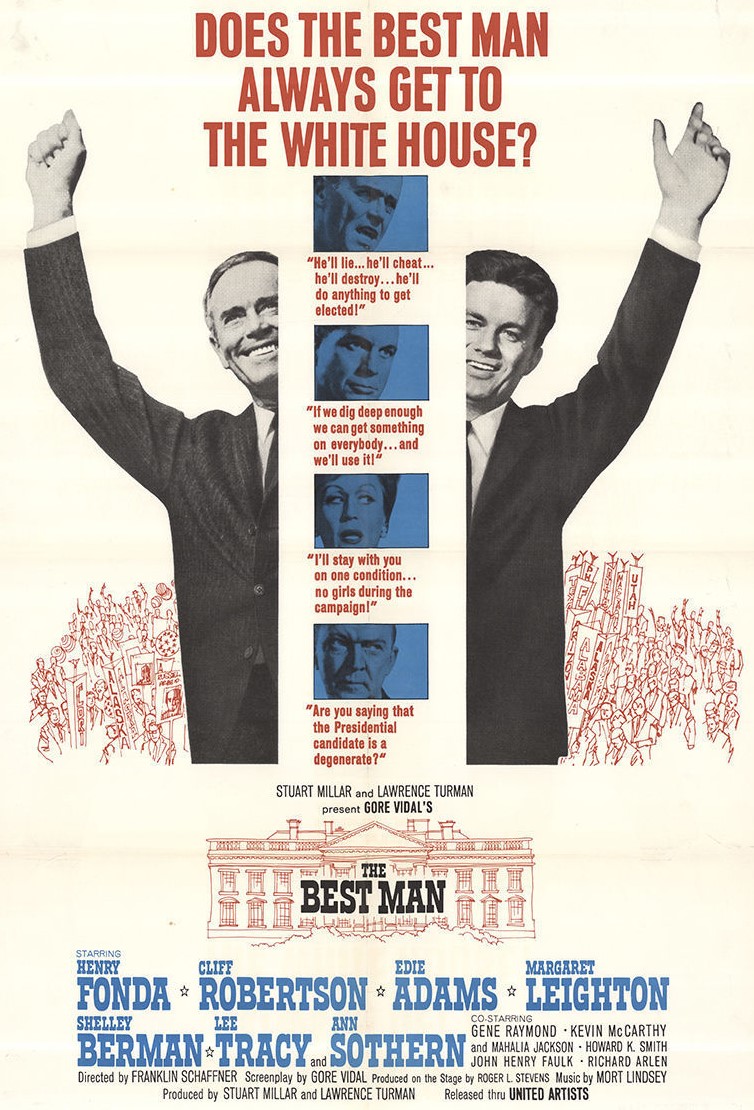
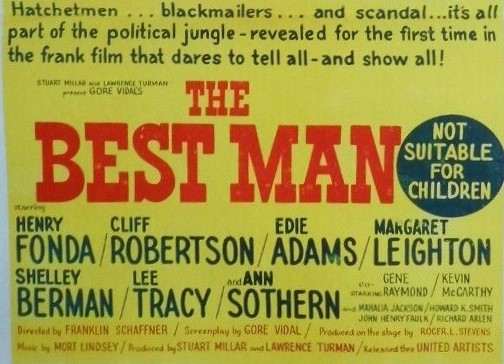
The Best Man (1964) ****

Current openness towards mental health issues has bestowed a contemporary vibe on this lively political drama. The other topic raised here has long ceased to be controversial. Not that far removed from Otto Preminger’s Advise and Consent (1961) in terms of dirty dealing and horse trading, flaw is the weapon used to cut opponents down to size.

The two principal candidates seeking their (un-named) party’s Presidential nomination could not be further apart, William Russell (Henry Fonda) a rich intellectual, Joe Cantwell (Cliff Robertson) a self-styled man of the people. Cantwell chases the populist vote with a  campaign built on fulminating against immigration and Communism, driving down taxes and spending more on the military. Russell seems unsuited for the cut-and-thrust of politics, too idealistic, too indecisive.

But he is a good judge of character whereas Cantwell most decidedly is not and in misreading the intentions of President Hockstader (Lee Tracy) shoots himself in the foot and leaves the nomination wide open, triggering his use of the dark arts, planning to circulate a file on his opponent’s problems with mental illness. Existing on a much higher plane, Russell refuses to fight back, although he has access to a witness claiming Cantwell was gay.

Apart from discussing these taboo issues – this was the first time the word “homosexual” was uttered in a movie – what’s interesting is that Russell’s philandering is not deemed damaging as long as his wife Alice (Margaret Leighton) is seen to publicly stand by him. Despite the fact that Cantwell is as clean as a whistle – doesn’t drink or smoke or have a lover – affairs are seen as such a fact of life of politics that Cantwell’s wife Mabel (Edie Adams) assumes he will have one. Cantwell, very much one to go for the jugular, clearly believes the public takes the same non-judgemental view otherwise he would easily skewer Russell on his marital discord.

In some respects, Cantwell is by far the better candidate if you were to judge him on personal behaviour, but he lacks the necessary savvy, “ a tragedy in a man and a disaster in a president.

As you might expect from a script written by novelist Gore Vidal, sometime political heavyweight, there are plenty zingers: “expect 22 minutes of spontaneity”; “I don’t object to you being a bastard, I object you being a stupid bastard;” and “I won’t throw my mud if you won’t throw your mud.”

It may be artistic irony that determined director Franklin J. Schaffner to film in black-and-white since politics is nothing but various shades of grey, but there was probably a more practical reason, to incorporate footage from conventions.

Somewhat surprisingly, both men are honest with their wives, Russell making a pact to divorce Alice if not elected, their marriage long ago defunct, while Cantwell’s wife is fully aware of the slur on her husband’s name. The women here are well-drawn, not quite the submissive types you might expect, certainly not Alice who has every right, given his infidelities, to act the shrew, instead of which she plays the shrewd card. Mabel proves a loving wife but a little indulged to the extent her teetotal husband has no idea how much alcohol she can shift and she reserves her right to keep him waiting. Alice, it might be noticed, is more vicious than her husband should it come to the down-and-dirty.

And there’s a stack of wannabe power-makers from pushy busybody Mrs Gamidge (Ann Sothern) – so full of her own importance that she fails to see the slight in being told that “talking to you is like talking to the average American housewife” – to walking timebomb Sheldon Bascomb (Shelley Berman).

Not so full of arcane American politics as Advise and Consent, and with a more straightforward narrative, it digs the dirt in compulsive fashion on the dirt-diggers. In questioning whether someone with mental health issues could be a worthy national leader, the movie naturally ignores the narcissism and megalomania that seemed essential criteria for any person achieving high office or excessive business success. It’s probably a subject that remains unresolved, although a good many personalities have admitted to such problems.

Cliff Robertson (The Honey Pot, 1967) takes the acting honours if only because we have seen a version of the Henry Fonda (Battle of the Bulge, 1965) political idealist before in Advise and Consent. Robertson essays a character of Donald Trump dimensions and Fonda is clearly modelled on Kennedy, but Robertson comes across stronger and even Fonda may have been getting fed up with being such a straight-shooter as seen by his later villainous choices. Edie Adams has a more complex part here than in The Honey Pot and Margaret Leighton (The Fighting Pimpernel, 1949) can play ramrod-stiff women till the cows come home.

Hollywood veteran Ann Sothern of Maisie fame is terrific as the interfering Mrs Gamidge and Shelley Berman (Divorce American-Style, 1967), making his movie debut, is one of the most irritating characters you will ever see. Kevin McCarthy (Mirage, 1965) plays Russell’s whip-smart aide with Lee Tracy (Dinner at Eight, 1933) in his first movie in nearly two  decades as the wily President. 

Audiences were denied the first glimpse of Penny Singleton (the Blondie series) in fourteen years when her part was excised. To make up for that, we get to see Mahalia Jackson sing.

Director Franklin J. Schaffner (The Double Man, 1967) keeps characters to the fore rather than relying on the many twists, and does a decent job, complete with aerial helicopter shots, of opening up Gore Vidal’s stage play. Vidal (Ben-Hur, 1959) had stood unsuccessfully for Congress so had an insider’s viewpoint.

The Honey Pot (1967) ***

Shave 20-30 minutes from this and you would have had a taut thriller. You could start with the number of clever dicks who happen to notice that what’s going on bears a close resemblance to a play Volpone by Shakespeare contemporary Ben Johnson, even down to the anglicizing of the names of those fictional characters. And prune the number of detectives, three is two too many especially when there’s an actual genuine detective in the mix. And the shock ending is just…well…mince.

Otherwise, quite fun in a way. Wealthy Cecil Fox (Rex Harrison) hires sometime actor, sometime factotum, law graduate Marty McFly – oops William McFly – to help him pull off an elaborate joke, “people-baiting”, a modern version of “bear-beating” apparently. Fox pretends to be dying in order to bring three former lovers, all he presumes desperate to be named in his will, to his bedside in a grand palazzo in Venice. Upfront reason, some kind of revenge. Hidden reason, something darker obviously.

The trio are Texan Mrs Sheridan (Susan Hayward), movie star Merle (Edie Adams) and Princess Dominique (Capucine). Sheridan is accompanied by a nurse Sarah (Maggie Smith), the “voice of morality.” They all certainly seem to have a sense of humor. Two presenting Fox with gifts of clocks, the princess with an hour-glass filled with gold dust instead of sand, presumably with the notion that he can watch his life ticking away. Needless to say, this is like an reality TV show, Fox not having named an heir in his will, so they are all battling to be the heir, and as he points out, even the rich will succumb because there is no such thing as “enough money.”

Things do not go according to plan when Sheridan unexpectedly dies. Enter Inspector Rizzo (Adolfo Celi). Sarah suspects McFly because he used her as an alibi but disappeared for a time when she (for unexplained reasons) fell asleep in a posh restaurant (and nobody tried to wake her). Turning detective herself, she comes up with “proof positive.” Turns out the two remaining suspects had conspired to also give themselves an alibi, easily demolished by the kindly inspector. McFly, too, has been doing some digging.

But then comes another twist and everything you thought you knew flies out the window. Cue more investigation, more alibis and finally an Agatha Christie pay-off when the two amateur detectives and the real one confront everyone in the drawing room. By which time the twists are coming thick and fast.

Best thing about this is the playing. Although decidedly stagey, very little in the way of visual audacity, that works to the movie’s benefit, and not a bad choice to rely so heavily on the acting given the cast. With the exception of Edie Adams, Capucine and Celi, all were Oscar anointed. Two winners – Rex Harrison for My Fair Lady (1964) and Susan Hayward for I Want to Live (1958) – and between them another five nominations – and two future winners in Cliff Robertson for Charly (1968) and Maggie Smith for The Prime of Miss Jean Brodie (1969). The others were not out of their depth, Edie Adams (Made in Paris, 1966) clocking up Emmy nominations. Adolfo Celi (In Search of Gregory, 1969) a deuce of nominations from the Cannes Film Festival while even Capucine (The 7th Dawn, 1964) had been nominated for a Golden Globe.  

So director Joseph L. Mankiewicz (Cleopatra, 1964) makes the right decision to let his actors get on with. Rex Harrison is at his suave best, but with a malevolent undercurrent, and has most of the best – and zestiest – lines. Robertson, usually the hero, is sly and duplicitous. Susan Hayward was in her comfort zone, forthright and taking no prisoners, Capucine at her cold and haughty best. Smith and Celi were the revelations, the former losing the trademark drawl and the nurse’s mousiness as to some extent she exerts control, and Celi departing from the bombast and delivering a lower-keyed performance.

Doing double duty, Mankiewicz worked up the script from three sources: the original Volpone,  the play Mr Fox of Venice by Frederick Knott (Dial M for Murder) and a novel The Evil of the Day by Thomas Sterling. Next time the director went to the stage for inspiration he chose a better source for a mystery – Sleuth (1972).

Discover WordPress

A daily selection of the best content published on WordPress, collected for you by humans who love to read.

The Atavist Magazine

by Brian Hannan

WordPress.com News

The latest news on WordPress.com and the WordPress community.