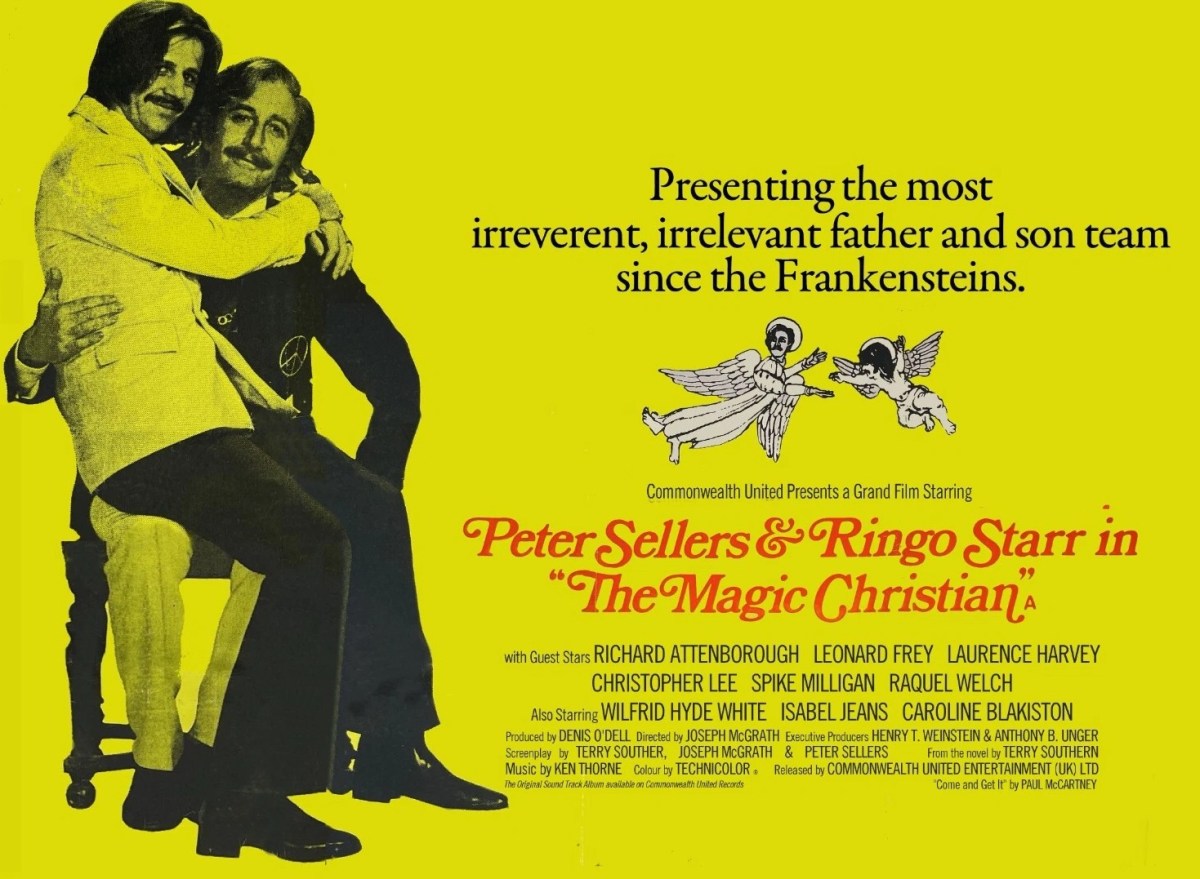
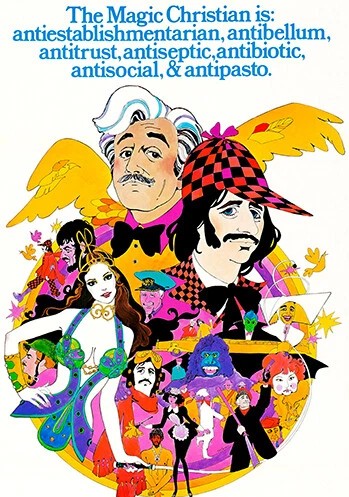
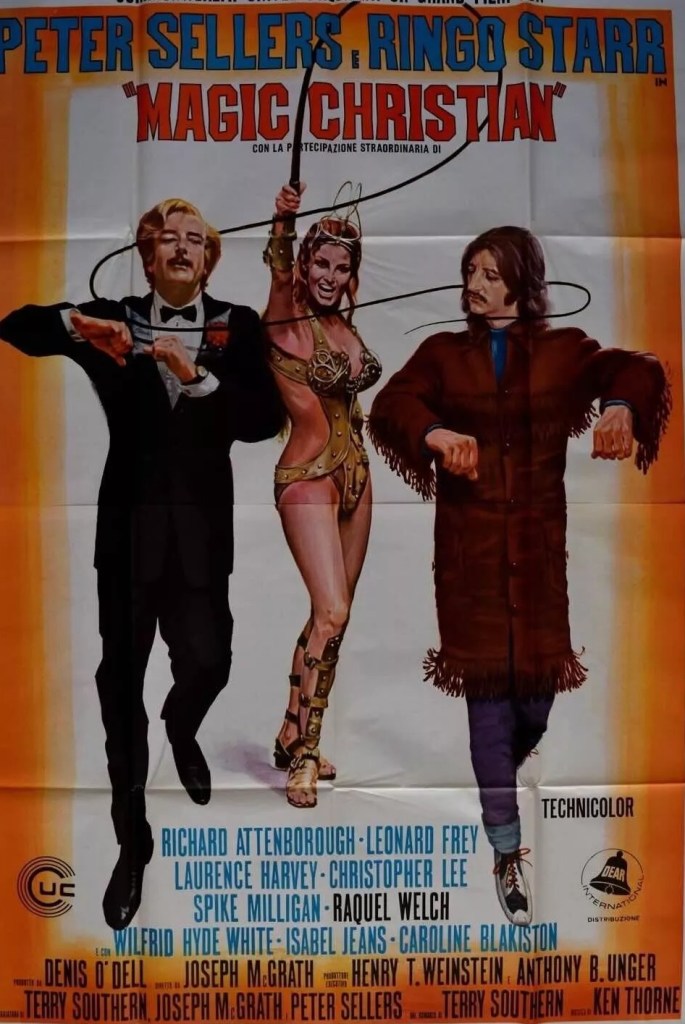
Substitute contemporary artwork/installation/performance art for practical joke and this will come up trumps. Taken in the artistic sense, where artists are pillorying society, there are gems – a stage Hamlet performing a striptease, feeding scraps of money to the ducks, ship passengers experiencing an apparent voyage when the vessel hasn’t left land, cutting up a famous work of art. Although I have to point out this will inevitably be remembered by some for a bikini-ed Raquel Welch cracking the whip over a galley of topless oarswomen.
Effectively a series of comedy skits loosely tied together under the theme of money, mostly in the form of bribery. Billionaire Sir Guy Grand (Peter Sellers) sets out to teach adopted son Youngman (Ringo Starr) just what money can buy. Could you pay one of the teams sufficient dough in the annual Boat Race for them to ram the other? Would a parking warden (Spike Milligan) eat the parking ticket he has just issued? In the spirit of fair play is it okay to down a pheasant with an anti-aircraft gun?
When the going slows down, surrealism enters the equation: ship’s captain kidnapped by a gorilla, vampire waitperson, black head on white body, urine-soaked banknotes given away to a crowd, the occasional nun or Nazi, newspapers where apologies are written in Polish.
Plot-wise, there’s not much to it and the satire is merely repetitive as Sir Guy embarks on educating Youngman on the perverse uses of money. It has the feeling not of following a storyline but of “what can we get up to next” and attempting to layer shock upon shock in the manner, it has to be said, of some contemporary directors.
But there’s neither sufficient bite to the satire nor punch to the shock so it remains an elaborate series of disconnected sequences. Luckily, nobody’s having to pretend to put in an acting shift which is just as well because Ringo Starr proves he can’t act.
And it’s not much helped by a host of cameos – Laurence Harvey (A Dandy in Aspic, 1968), Richard Attenborough (Guns at Batasi, 1964), Christopher Lee (Dracula, Prince of Darkness, 1965), Raquel Welch (Bandolero!, 1968), director Roman Polanski (Rosemary’s Baby, 1968), Wilfred Hyde-White (P.J. / New Face in Hell, 1967), comic Spike Milligan and various members of the future Monty Python team including John Cleese (A Fish Called Wanda, 1988) and Graham Chapman. Harvey and Welch make the biggest splash.
Excepting Dr Strangelove, Hollywood had failed to capture the essence of offbeat novelist Terry Southern (Candy, 1968) and despite input from Chapman, Cleese and Sellers, this never really gets off the ground.
Peter Sellers (The Pink Panther, 1963) was in something of a career rut where very little struck home at the box office and he would continue a dismal losing streak until resuscitating The Pink Panther franchise in 1975.
Director Joseph McGrath’s (The Bliss of Mrs Blossom, 1967) record was spotty. Best known for music videos for The Beatles, he was only well served when his cast was filled with strong actors.
No more than an occasionally humorous trifle with an equally occasional target hitting the bullseye.
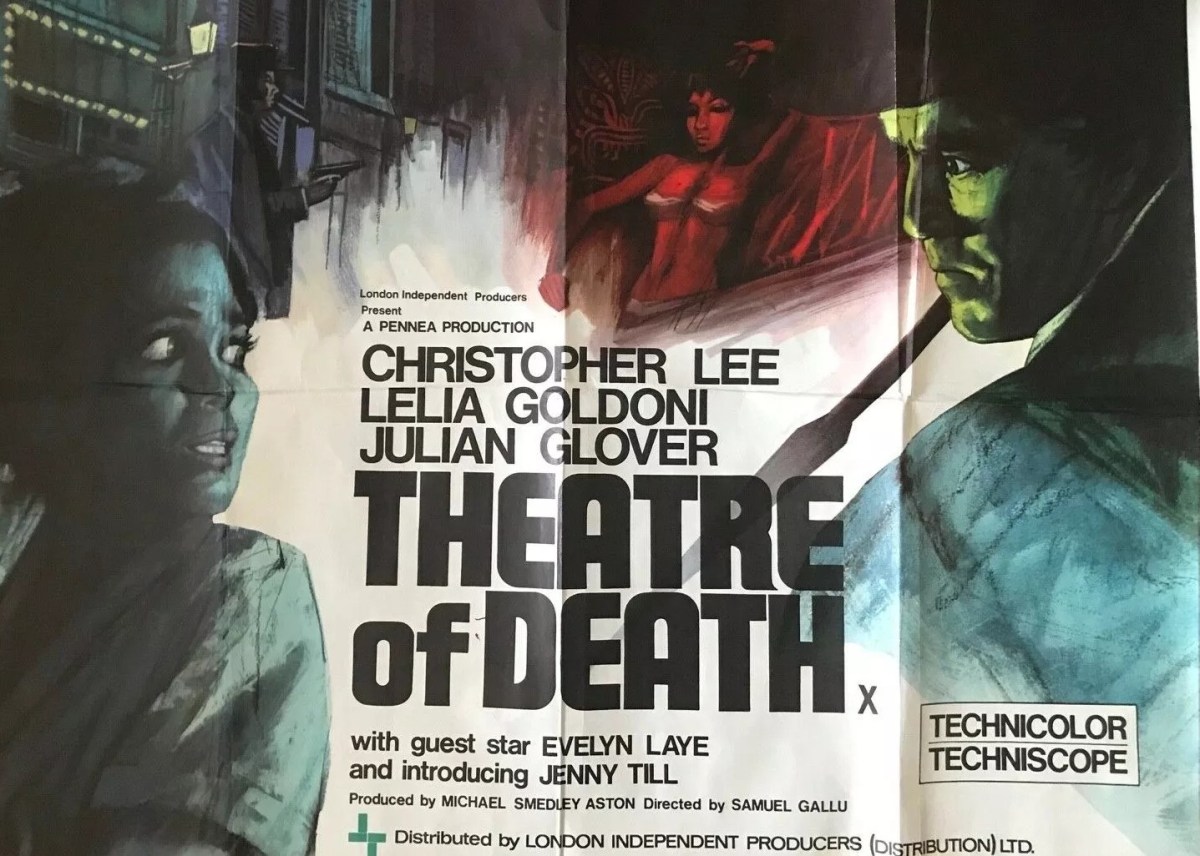
Takes considerable brass neck to treat master of the macabre Christopher Lee as nothing more than a red herring. A very slow slow-burn with a pinch of the vampiric, quartet of characters with a mysterious past, Grand Guignol Parisian setting, some decided sleight of hand and a series of murders staged to huge audience delight (in the titular theater, you understand) turns this into a more interesting venture than you might expect. In more literary hands, the incident on which this pivots could well have turned into tragedy.
Impresario Darvas (Christopher Lee) has launched The Theatre of Death, a show comprising a series of highly realistic sketches in which characters appear to be brutally killed. At a first night party he hypnotizes neophyte actress Nicole (Jenny Till) into nearly burning star Dani (Lelia Goldoni) in the face with a branding iron during a sketch about witches, disaster prevented by the intervention of Dani’s boyfriend Charles (Julian Glover). He’s a police surgeon called in to help investigate a series of murders with vampire overtones. Just as sinister is hypnotism which apparently can be self-imposed.
Charles begins to suspect Darvas. And small wonder the audience does too. Darvas has a lair, trap doors, secret passageways, concealed voyeuristic viewpoints and the kind of cat that only a villain strokes. Darvas clearly believes Nicole is more than just a protégée but a tool in his hands who can be called upon to act “when your conscience is asleep,” and given his predilection for brutality, even if apparently only staged, you have to think she will be called upon to do more than act. There’s even a suggestion that he might be able to inhabit her body.
Everyone has secrets. Darvas’s father disappeared in mysterious circumstances, Charles can’t operate following an unspecified accident, Dani spent two years in a mental asylum and Nicole barely survived being trapped in an avalanche in the Alps. Darvas humiliates Dani and promotes Nicole.
The murders switch from a trio of young women to men. Inspector Micheaud (Ivor Dean) is baffled. Naturally, he doesn’t want to risk the public ridicule of announcing there is a vampire on the loose in Paris (though some decades later, as you will be aware, a werewolf, of American origin, was roaming free), setting aside the fact that the French capital had been the scene for various nefarious acts in locales as varied as the Rue Morgue, Notre Dame and the Opera.
Darvas remains the obvious suspect until director Samuel Gallu (The Limbo Line, 1968) pulls a Hitchcock – or should that be, after A Poppy Is Also A Flower/Danger Grows Wild (1966), a Terence Young – and kills off his star halfway through. Initially, Darvas is reported as missing, but his cloak is found covered in blood. Naturally, we are led to believe he is going to turn up, and be identified as the killer.
But nope, in a considerable coup de theater (or coup de cinema), he’s been done away with by the real killer who is cleverly covering their tracks by getting Dani to write a suicide note before killing herself.
It’s certainly a shock to discover that the killer is Nicole, who is very partial to blood after being fed the blood of her brother while trapped in the avalanche. Quite why she has managed to conceal her thirst for so long is never revealed. However, there’s an unforeseen ironic twist which prevents her terrorizing the Parisian citizens any further.
Christopher Lee (Dracula, Prince of Darkness, 1966) is in Hamlet mode, hair combed forward, eyes bristling with intensity. Julian Glover (Alfred the Great, 1969) doesn’t really have enough dramatically to do. Neither Lelia Goldoni (Hysteria, 1965) nor Janet Till (A Challenge for Robin Hood, 1967) does much to burnish their reputation. Written by Ellis Kadison (The Gnome-Mobile, 1967) and Roger Marshall (Invasion, 1966).
Works very well by playing with audience expectation
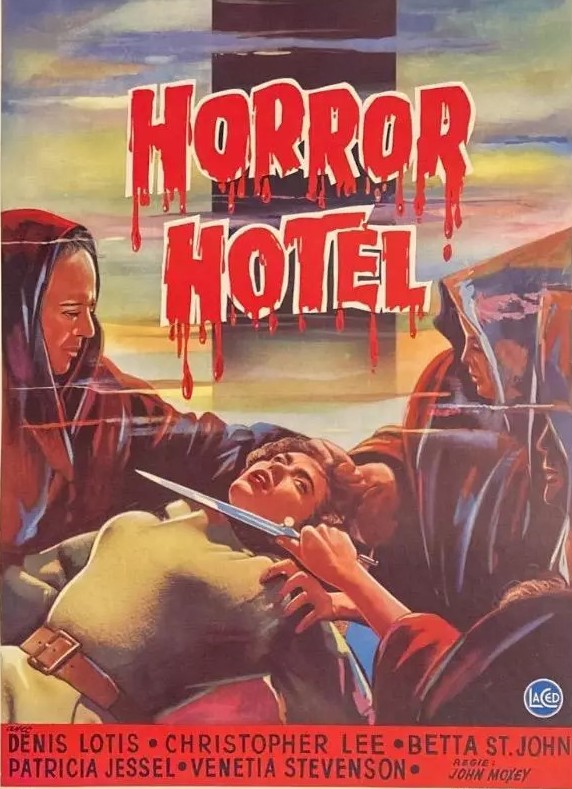
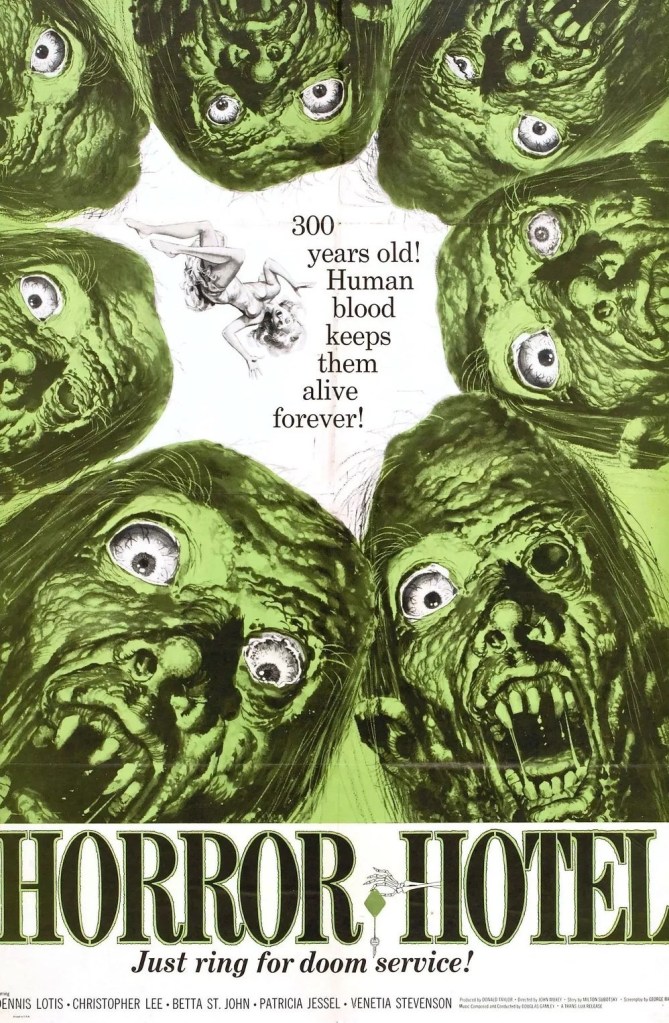
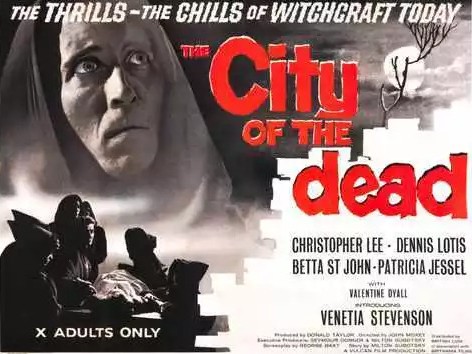
The structure of this piece gives away its origins. It’s effectively a portmanteau, though limited in this instance to three connected tales. Mention the word “portmanteau” and Amicus springs to mind. While that outfit didn’t exist at this precise moment, the movie was put together by the team behind Amicus, American producers Milton Subotsky and Max Rosenberg. The odd American accents might provide the clue that it was made entirely in Britain with British actors.
The witchcraft-zombie combo works well enough but horror mainstay Christopher Lee (Dracula, Prince of Darkness, 1966) is used sparingly. It marks the debut of Argentinian-born director John Llewellyn Moxey who has acquired something of a cult status in these parts.
We begin with a prolog set in Whitewood, Massachusetts, in 1692 at the height of the witch-burning epidemic where Elizabeth Selwyn (Patricia Jessel) is burned at the stake. Her lover Jethrow (Valentine Dyall) made a pact with the Devil to supply virgin sacrifices at a propitious time in the necromancy calendar in return for eternal life.
Three centuries later history student Nan Barlow (Venetia Stevenson), a virgin with an interest in witchcraft, sets off, at the instigation of Professor Driscoll (Christopher Lee) and against the advice of fiancé Bill ((Tom Naylor) and brother Dick (Dennis Lotis), to investigate the happenings at Whitewood. She puts up at The Raven’s Inn whose landlady Mrs Newless bears at distinct resemblance to Elizabeth.
Had this picture carried the Amicus stamp, I might have been prepared for what happened next. Nan doesn’t get much chance to do much investigation before she is burned at the stake by the coven of Mrs Newless, revealed as Elizabeth.
So we are on to the third part of the portmanteau. Dick discovers that his missing sister’s supposed abode, The Raven’s Inn, doesn’t exist in any directory, so he ups sticks and with the fiancé sets off in pursuit. Crucially, brother and fiancé, are separated, effectively allowing the stories not so much to dovetail but to keep the fiancé out of action until he is needed.
Dick makes acquaintance with Patricia (Betta St John), antiques dealer and witchcraft expert, who warns him off. Any impending romance, such as would be de rigeur in normal circumstances, is cut off after Patricia is kidnapped and set up for the virgin sacrifice ceremony.
Two virtual last-minute entrants serve to provide a big climax. Driscoll is revealed to be a member of the coven and Bill arises from his sick-bed – he was badly injured in a car crash – to save the day, despite his cynicism knowing enough of demonic folklore to bring a cross into the proceedings. This he does by the complicated process of yanking up from a graveyard a fallen large wooden cross which inflicts the necessary damage on the coven. Though Elizabeth escapes it’s not for long.
Dodgy accents aside, and slightly discombobulated by the structure, which, given it wasn’t released in the U.S. until 1962, might have been viewed as a nod to Hitchcock’s Psycho (1960) in despatching the heroine halfway through, there’s enough here in the atmosphere and the performances to keep the enterprise afloat, if only just.
A good dose of fog always helps and the occasional appearance of the undead and the olde worlde atmosphere makes this work more than the acting which, excepting Lee, is on the basic side. Venetia Stevenson (The Sergeant Was a Lady, 1961) otherwise the pick.
This didn’t set Moxey on the way to fame and fortune but somehow in the world of cult less is more. He made only a handful of movies including Circus of Fear (1966). Written by Subotsky and George Baxt (Night of the Eagle, 1962).
A good first attempt at horror from the Amicus crowd.
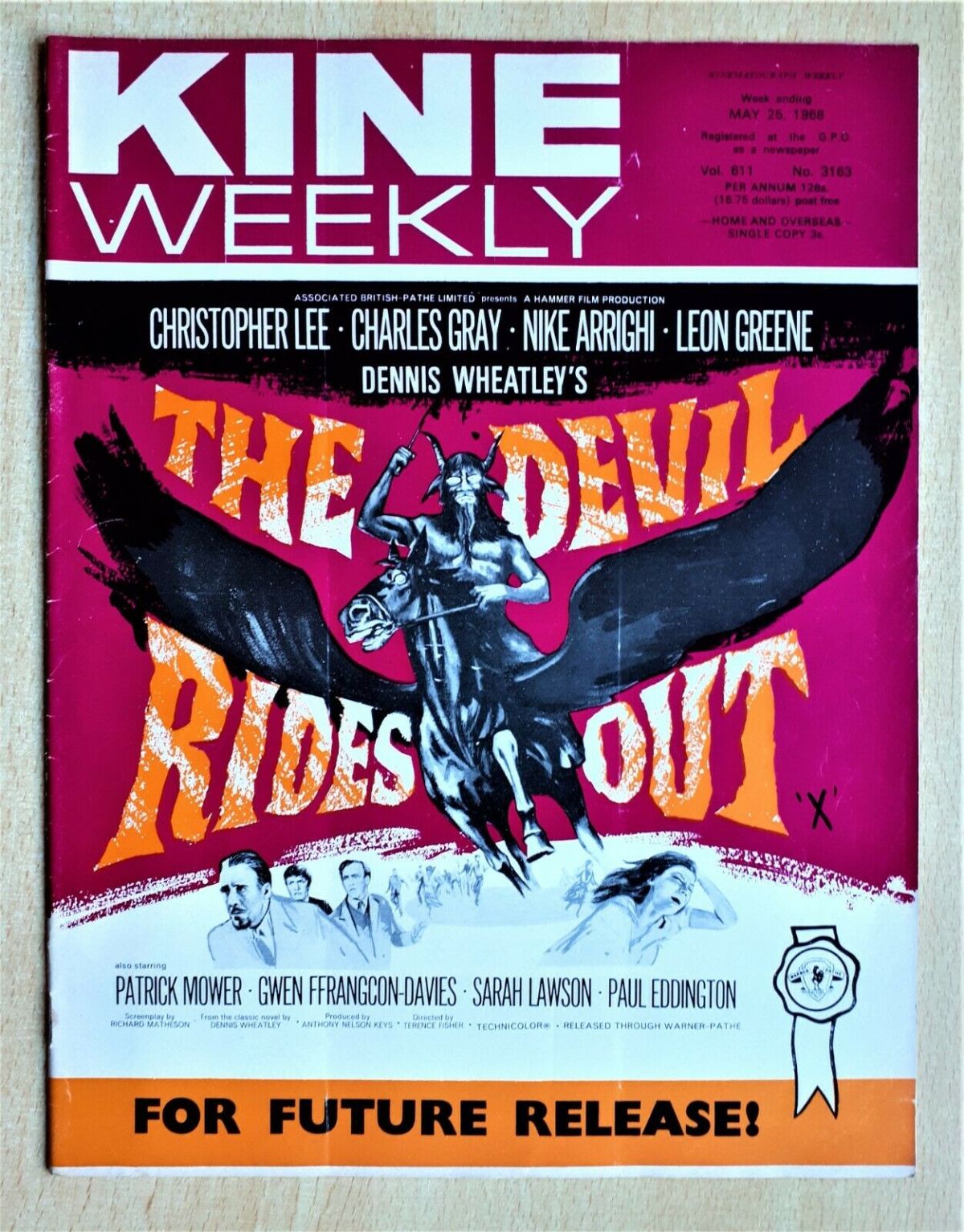
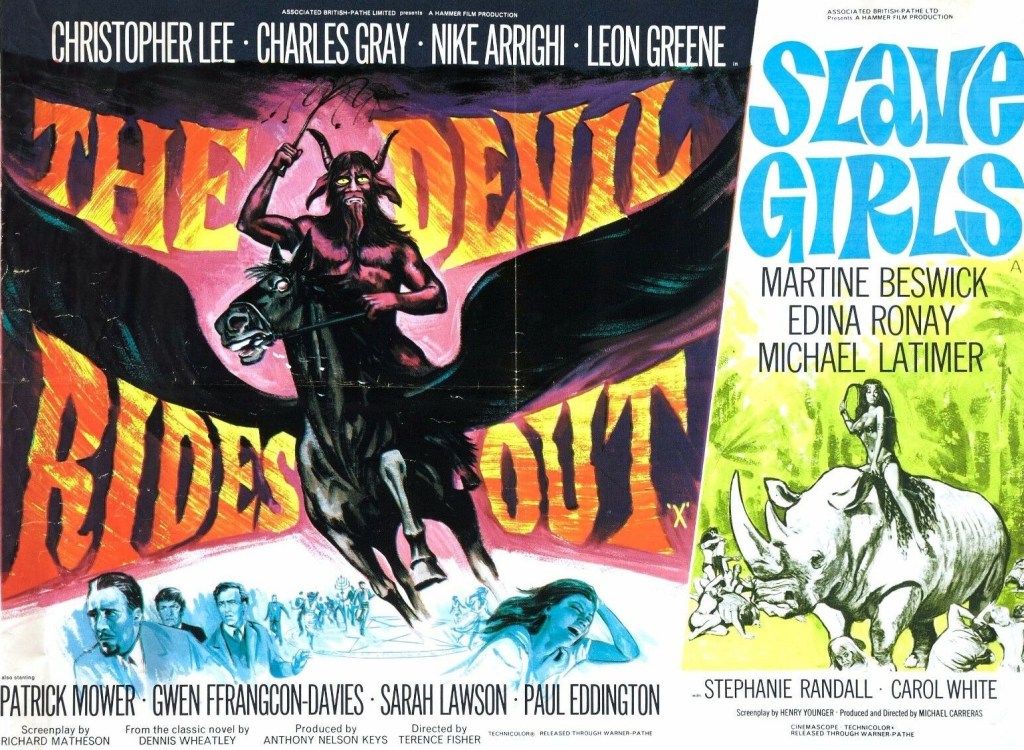
Strong contender for Hammer’s film of the decade, a tight adaptation of Dennis Wheatley’s black magic classic with some brilliant set pieces as Nicholas de Richleau (Christopher Lee) battles to prevent his friend Simon (Patrick Mower) falling into the hands of satanist Mocata (Charles Gray).
Initially constructed like a thriller with Simon rescued, then kidnapped, then rescued again, plus a car chase, it then turns into a siege as Richleau and friends, huddled inside a pentagram, attempt to withstand the forces of evil. Sensibly, the script eschews too much mumbo-jumbo – although modern audiences accustomed to arcane exposition through MCU should find no problem accommodating ideas like the Clavicle of Solomon, Talisman of Set and Ipsissimus – in favour of confrontation.
Unlike most demonic pictures, de Richleau has an array of mystical weaponry and a fund of knowledge to defend his charges so the storyline develops along more interesting lines than the usual notion of innocents drawn into a dark world. In some senses Mocata is a template for the Marvel super-villains with powers beyond human understanding and the same contempt for his victims. And surely this is where Marvel’s creative backroom alighted when it wanted to turn back time. Though with different aims, De Richleau and Mocata are cut from the same cloth, belonging to a world where rites and incantations hold sway.
While special effects play their part from giant menacing tarantulas and the Angel of Death, the most effective scenes rely on a lot less – Simon strangled by a crucifix, Mocata hypnotizing a woman, a bound girl struggling against possession. Had the film been made a few years later, when Hammer with The Vampire Lovers (1970) and Lust for a Vampire (1971) increased the nudity quotient, and after The Exorcist (1973) had led the way in big bucks special effects, the black mass sequence would have been considerably improved.
The main flaw is the need to stick with the author’s quartet of “modern musketeers” which means the story stretches too far in the wrong directions often at the cost of minimizing the input of de Richleau. In the Wheatley original, the four men are all intrepid, but in the film only two – de Richleau and American aviator Rex van Ryn (Leon Greene) – share those characteristics. At critical points in the narrative, de Richleau just disappears, off to complete his studies into black magic. Where The Exorcist, for example, found in scholarship a cinematic correlative, this does not try.
Christopher Lee (She, 1965), pomp reined in, is outstanding as de Richleau, exuding wisdom while fearful of the consequences of dabbling in black magic, both commanding and chilling. Charles Gray (Masquerade, 1965) is in his element, the calm eloquent charming menace he brings to the role providing him with a template for future villains. The three other “musketeers” are less effective, Patrick Mower in his movie debut does not quite deliver while Leon Greene (A Challenge for Robin Hood, 1967) and Paul Eddington (BBC television’s Yes, Minister 1980-1984) are miscast. Nike Arrighi, also making her debut as love interest Tanith, is an unusual Hammer damsel-in-distress.
Hammer stalwart Terence Fisher (The Gorgon, 1964) creates a finely-nuanced production, incorporating the grand guignol and the psychological. Screenwriter Richard Matheson (The Raven, 1963) retains the Wheatley essence while keeping the plot moving. A few years later nudity was no longer be an issue and Hollywood injected big bucks in horror special effects, so with those constraints in mind the studio did a devilish good job.
BOOK INTO FILM
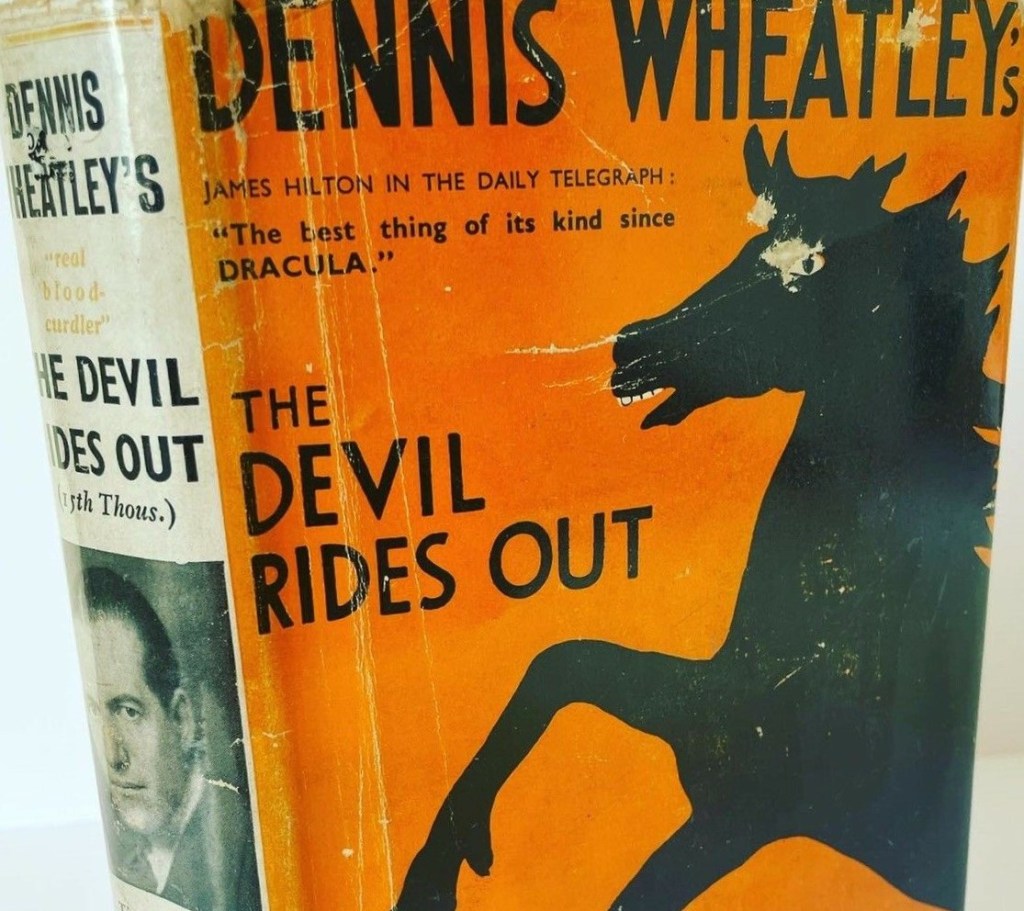
Dennis Wheatley was a prolific bestseller producing three or four titles a year, famous for a historical series set around Napoleonic times, another at the start of the Second World War and a third featuring the “four modern musketeers” that spanned a couple of decades. In addition, he had gained notoriety for books about black magic, which often involved series characters, as well as sundry tales like The Lost Continent. Although largely out of fashion these days, Wheatley set the tone for brisk thrillers, stories that took place over a short period of time and in which the heroes tumbled from one peril to another. In other words, he created the template for thriller writers like Alistair MacLean and Lee Child.
The Devil Rides Out, his fourth novel, published in 1934, featured the “musketeers” involved in his phenomenally successful debut The Forbidden Territory (1933), and introduced readers to his interest in the occult. Although of differing temperaments and backgrounds his quartet – the Russian-born Duke De Richleau (Christopher Lee in the film), American aviator Rex Van Ryn (Leon Greene) and wealthy Englishmen Richard Eaton (Paul Eddington) and Simon Aron (Patrick Mower) – are intrepid. And while screenwriter Richard Matheson stuck pretty much to the core of the Wheatley story, the film was hampered by the actors. The laid-back Paul Eddington hardly connects with the Wheatley characterization and Patrick Mower is too young for Aron.
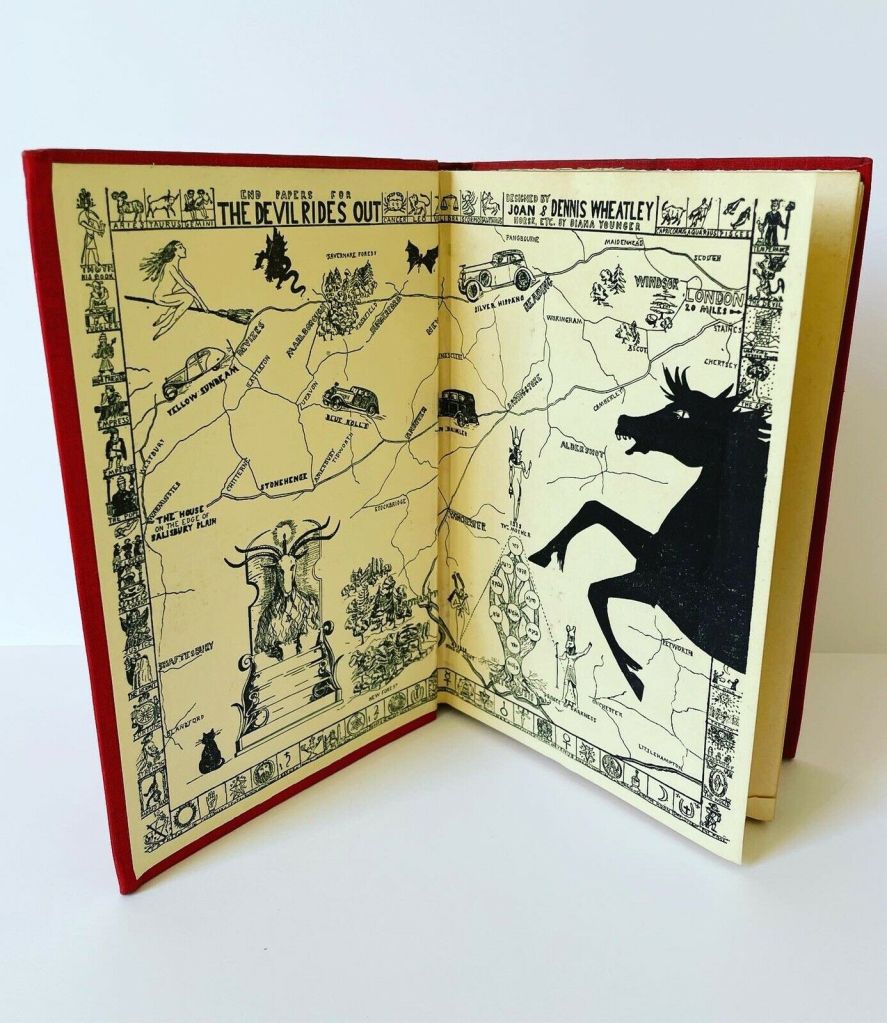
As with the book, the story moves swiftly. Worried that Aron is dabbling in the black arts, De Richleau and Van Ryn go haring down to his country house where they meet black magic high priest Mocata (Charles Gray) and discover tools for satanic worship. And soon they are embroiled in a duel of wits against Mocata, climaxing in creating a pentagram as a means of warding off evil.
In order not to lose the audience by blinding them with mumbo-jumbo the script takes only the bare bones of the tale, bringing in the occult only when pivotal to the story, and that’s something of a shame. A modern audience, which has grown up on enormously complicated worlds such as those created for Game of Thrones and the MCU, would probably have welcomed a deeper insight into the occult. While out-and-out thrillers, Wheatley’s novels also contained copious historical information that he was able to dole out even when his heroes were in harm’s way. The Devil Rides Out is not a massive tome so it’s a measure of the author’s skill that he manages to include not just a condensed history of the occult but its inner workings. Every time in the film De Richleau goes off to the British Library for some vital information, his departure generally leaves a hole, since what he returns with does not always seem important enough to justify his absence.
But then the screenwriter was under far more pressure than a novelist. In some respects, this book like few others demonstrated the difference between writing for the screen and writing for a reader. With just 95 minutes at his disposal, Matheson had no time to spare while Wheatley had all the time in the world. Wheatley could happily leave the reader dangling with a hero in peril while dispatching De Richleau on a fact-finding mission, the action held up until his return. It’s interesting that Matheson chose to follow Wheatley’s characterization of De Richleau, who didn’t know everything but knew where to look. Matheson could easily have chosen to make De Richleau all-knowing and thus able to spout a ton of information without ever going off-screen.
But here’s where the book scores over the film. The reader would happily grant Wheatley his apparent self-indulgence because in the book what he imparted on his return, given the leeway to do so, was so fascinating. There are lengthy sections in the book which are history lessons where De Richleau gives readers the inside track on the satanic. In the opening section, once De Richleau and Van Ryn have rescued Aron, the author devotes a full seven pages to a brief introduction to the occult that leaves the reader more likely to want more of that than to find out how the story will evolve. He has hit on a magic formula that few authors ever approach. To have your background every bit as interesting as the main story is incredibly rare and it allowed Wheatley the opportunity to break off from the narrative to tell the reader more about the occult, which in turn, raised the stakes for the characters involved.
Dennis Wheatley
Effectively, there was too much material for a screenwriter to inflict upon an audience ignorant of the occult. Some decisions were clearly made to limit the need for lengthy exposition. But these often work against the film. For example, Mocata wants the Talisman of Set because it bestows unlimited power with which he can start a world war, but in order to accomplish that he needs to find people with the correct astrological births, namely Simon and Tanith. But this element is eliminated from the story, making Mocata’s motivation merely revenge. Matheson also removed much of the historical and political background, replaced the swastika as a religious symbol with the more acceptable Christian cross, and deleted references to Marie’s Russian background. Her daughter Fleur becomes Peggy. Matheson also treats some of the esoteric light-heartedly on the assumption that seriousness might be too off-putting.
Overall, the adaptation works, you can hardly argue with the movie’s stature as a Hammer classic, but the more you delve into the book the more you wish there had been a way for much of the material to find its way onscreen and to inform the picture in much the same way as the depth of history and character backstory added to Game of Thrones.
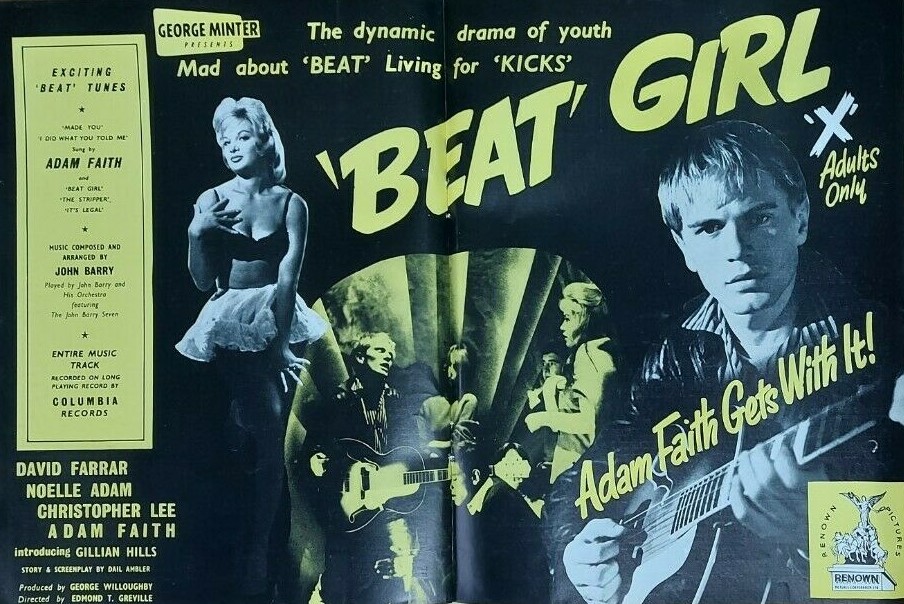
More social document than drama, but that aspect somewhat diluted by the moviemakers’ attempts at exposing rebellious youth while taking for granted more sordid adult behavior. Narrative flow is interrupted now and then to showcase Adam Faith’s singing and to accommodate a few striptease acts. Probably more interesting is the array of new talent on show.
Spoiled teenager Jennifer (Gillian Hill) heads for the wild side of town to experience the beatnik lifestyle in Soho coffee shops and cellars. That there are no drugs involved, and that alcohol is considered “square” – as for that matter is violence – may come as a surprise to students of the period. Apart from one episode of road-racing and playing “chicken” along a railway track, most of the time the gang listen to music or dance until Jennifer gets it into her head that ejoining a striptease show might give her life the thrill it is missing.
This is prompted by the discovery that her new too-young stepmother Nichole (Noelle Adams) has been a stripper and most likely a sex worker in Paris before marrying wealthy architect Paul (David Farrar), cueing a round-robin of confrontations. Strangely enough, from the narrative perspective, none of the young bucks appear romantically interested in the provocatively dressed Jennifer and so it is left to creepy club owner Kenny (Christopher Lee) to make a move.
The gaping hole left by lack of narrative drive is not offset by immersion in the beatnik or striptease scene. Back in the day the British censors took the editing scissors to the striptease but although restored versions available now contain nudity you are left wishing that there was some lost element to the beatnik sections that would have given the picture the energy it required.
Gillian Hill (Les Liaisions Dangereuses, 1959), comes over as a cross between Brigitte Bardot and Diana Dors without having an ounce of the sex appeal of either. All pout and flounce, she is unable to inject any heart into her two-dimensional character, although given her youth and inexperience this was hardly surprising. Former British star David Farrar (Black Narcissus, 1947) was coming to the end of his career and in a thankless role as a frustrated father could do little to rescue the project.
French actress Noelle Gordon (Sergeant X of the Foreign Legion, 1960) could have been Jennifer’s mother given her own tendencies towards wiggle and pout but at least she makes a stab at trying to overcome her step-daughter’s hostility.
In the main, the picture’s delight is bringing to the fore a whole chorus of new faces. Pick of the supporting cast is Shirley Anne Field (Kings of the Sun, 1963) who doesn’t just have a knowing look but looks as if she knows what’s she doing acting-wise. Making his movie debut was teen pop idol Adam Faith, who had made his name playing in coffee bars. He had already notched up a couple of number one singles, but doesn’t quite set the screen on fire. Peter McEnery (The Fighting Prince of Donegal, 1966) plays his inebriated pal.
You can also spot Oliver Reed (Women in Love, 1969), Julie Christie (Doctor Zhivago, 1965), Claire Gordon (Cool It, Carol, 1970) and Nigel Green (Jason and the Argonauts, 1963).
Perhaps the most important debut belonged to composer John Barry. He had already been working with Adam Faith. Barry’s music for the film was the first British soundtrack album ever released, reaching number eleven on the charts, and opening the doors for future soundtrack albums, not least of which was the rich vein of theme tunes produced by Barry in the next few years.
French director Edmond T. Greville, who brought little panache to the subject matter, would redeem himself with his next picture The Hands of Orlac (1960).
This doesn’t fall into the “so-bad-it’s-good” category, nor has it been unfairly overlooked, and probably is better known as an example of the kind of exploitation B-picture that the Americans do so much better and a reminder that, except on rare occasions such as The Wild One (1953), older moviemakers seem incapable of capturing the essence of youth.
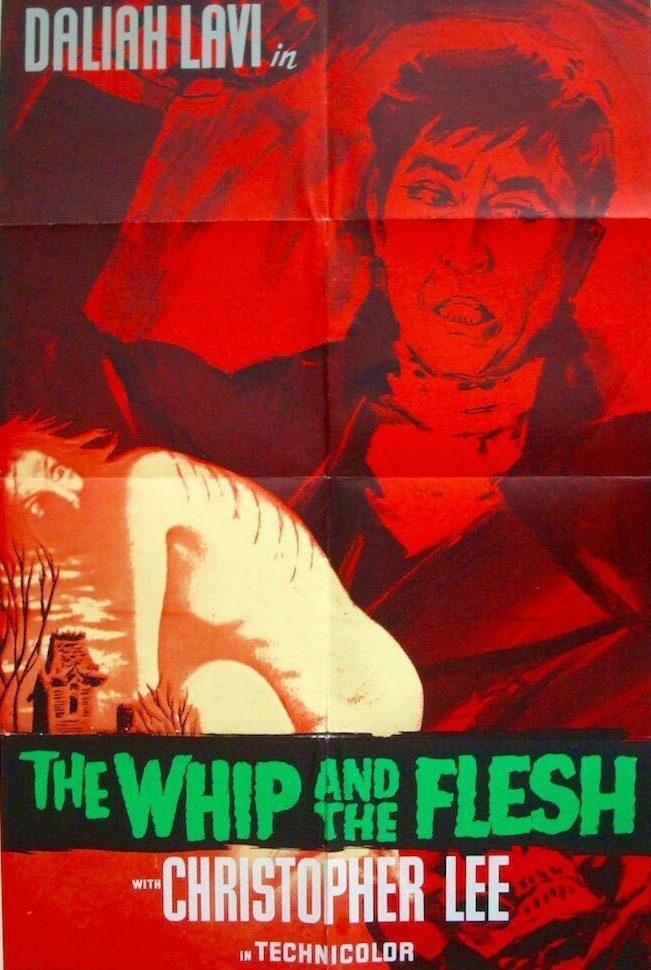
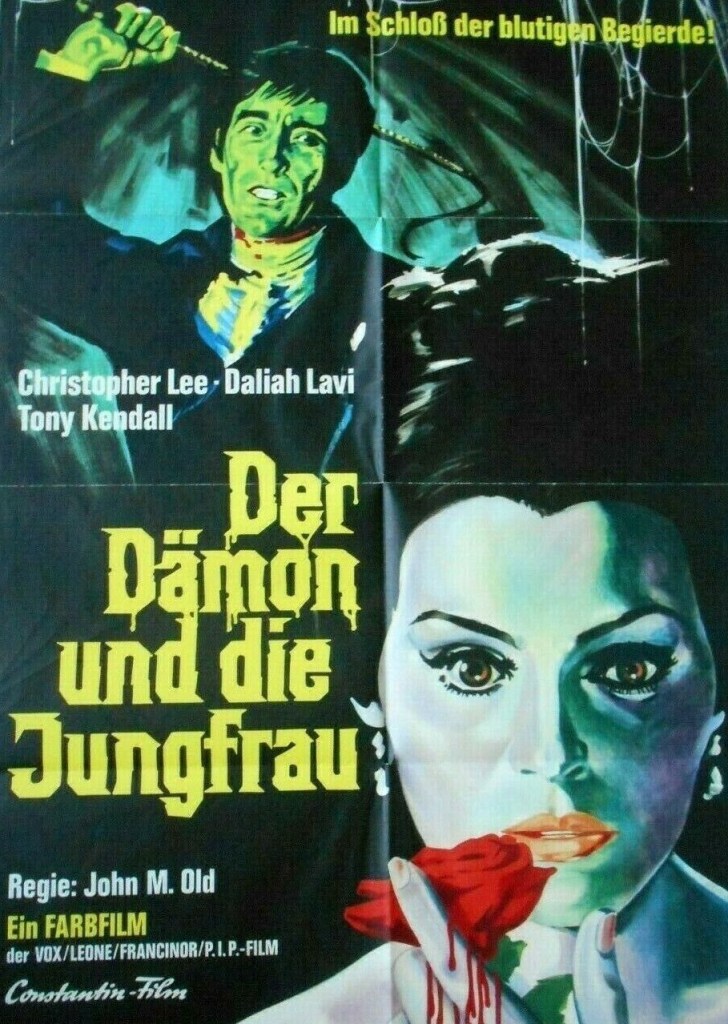
Has there ever been actress so skilled at displaying fear as Daliah Lavi? Where the female stars of horror movies too quickly succumbed to the scream and goggle eyes, Lavi could run a whole gamut of terror without uttering a sound and continue doing so for virtually an entire picture. Top-billed ahead of the reigning king of British horror Christopher Lee, this is another acting tour de force, not quite sustaining the intensity of The Demon (1963) but at times not far off it.
Italian director Mario Bava (Black Sabbath, 1963), here masquerading as John M. Old, has stitched together a mixture of horror, and an early form of giallo, the picture taking place in the classic old dark house, in this case a castle perched on a rock above the sea, the deaths grisly, and almost fits into the “locked room” subgenre of the detective story, where the murders appear impossible to carry out.
The disgraced Kurt Menliff (Christopher Lee) returns to his ancestral home, begging forgiveness from his father Count Vladimir (Gustavo De Nardo) and hoping to reclaim his inheritance and his betrothed Nevenka (Daliah Lavi). While his father exonerates him, Kurt is denied the rest, Nevenka already committed to marriage to his brother Christian (Tony Kendall). Other tensions are soon evident: the housekeeper Giorgia wants revenge on Kurt for the death of her daughter and Christian is in love with another, Katia (Evelyn Stewart).
Nevenka who outwardly protests how much she hates Kurt quickly reveals masochistic tendencies as she gives in to a whipping. But Kurt’s sudden inexplicable murder instigates an investigation, suspicion falling firstly on the father, then Christian and finally Giorgia.
But Nevenka is convinced Kurt is not dead, although his body has been entombed in the castle crypt. Torment creeps into her face at his funeral and we can almost see her grow gaunt in front of our eyes. In a brilliant scene where she tracks what she imagines to be the sound of a whip it turns out to be a branch lashing a window in a storm. Some of her supposed visions are easily explained, muddy footsteps leading from Kurt’s tomb actually belonging to the limping manservant Losat (Luciano Pigozzi). But how do you account for the hand, in an almost 3D shape, reaching out to her in the darkness? Or her ecstasy in still being whipped, her nightdress stripped from her back?
Although sometimes relying too heavily on atmospherics – windows swinging open at night, storm outside – Bava brilliantly marshals the real and the imagined, until the investigation into murder involves all the characters. Once the film begins, the drawbridge in a sense comes down, and nobody else enters the castle, and so we move from one character to another, each with their own motive for possibly committing dire deed. And with each passing moment we return to the demented Nevenka, who wishes Kurt dead but cannot live without him, and, craving the whip, cannot escape his sadistic power. Her faith in Kurt’s resurrection is so intense that the others are soon seeking signs that the dead man is still alive.
This is a horror superior to Hammer. Using the same leading man, the British studio generally expected Lee to be over-the-top, his innate malevolence generally very obvious from the start. Here, he is at his most handsome and although definitely sadistic, the emphasis is less on his pleasure than that of his victim. And while Bava resorts to a similar kind of set, this castle is remote, has no relationship with villagers, and exudes regal dominance rather than just the normal fear of a Dracula picture. Bava employs a more subtle color palette and the piano theme tune by Carlo Rusticelli has a romantic tone.
But for all Bava’s proven skill, this would not be the same without Lavi. I doubt if there is a single actress in the horror domain throughout the 1960s who could match the actress for portraying fright, as she marches up the scale from mere anxiety to full-blown terror. And although women in Dracula movies succumbed to vampire teeth with more than a frisson of sexuality, there is a different deeper sensuality at work here, in what must rank as one of the greatest-ever portrayals of masochism embedded in love.
As noted previously, Lavi, in stepping onto the bigger Hollywood canvas of Lord Jim (1965) and The Silencers (1966), lost the intensity she displayed here and never came close to matching this performance or that of The Demon. Christopher Lee, although claiming to dislike his experience, continued to rule the horror world until he was afforded a wider audience through James Bond, Star Wars, J.R.R. Tolkien and Tim Burton.
Tony Kendall, making his debut, soon graduated to the Kommissar X series, spaghetti westerns (he played Django twice), horror (Return of the Evil Dead, 1973), and thrillers such as Machine Gun McCain (1969). Evelyn Stewart went down much the same route, her long career sprinkled with gems like Django Shoots First (1966), The Sweet Body of Deborah (1968) and The Psychic (1977).
Mario Bava continued to exploit the horror vein including Blood and Black Lace (1964), Planet of the Vampires (1965) and Lisa and the Devil (1973) with Telly Savalas and Elke Sommer.
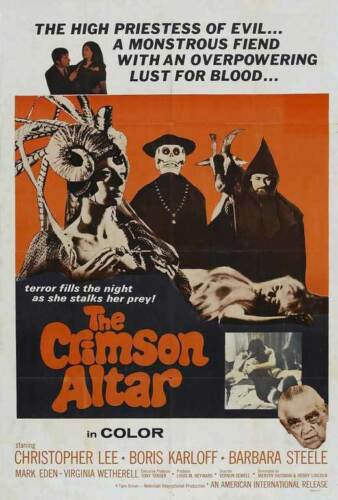
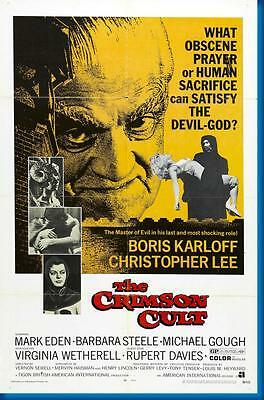
Horror is a small world and at any moment you are likely to bump into stars of the caliber of Christopher Lee, Boris Karloff and Barbara Steele – or in this picture all three. Investigating his missing brother Peter sends antiques dealer Robert Manning (Mark Eden) to a remote country mansion where he encounters owner Morley (Christopher Lee), his seductive niece Eve (Virginia Weatherall), the wheelchair-bound authority on witchcraft Professor Marsh (Boris Karloff), deaf mute Elder (Michael Gough) and a centuries-old mystery.
Morley can legitimately deny that Peter has ever set foot on the premises since it was common for the brother to adopt an alias when seeking out significant antiques. By the time Robert amasses sufficient clues to challenge Morley on this particular issue, it appears that further ideas of more sinister goings-on may be illusory. On his first night Robert observes an annual celebration of the Black Witch but although an effigy is burned this festival appears to have more to do with the innocent consumption of alcohol and heady bouts of sex than satanism.
And after a while, Robert indulges in carnal delight with Eve. However, he is plagued by a nightmare that involves a grotesque trial by a jury wearing animal heads. Gradually, he learns Morley, meanwhile, is such a congenial host, and his niece delightful and sybaritic company, that the finger of suspicion points at Elder, who does take a pot shot at Robert, and the professor who has a collection of instruments of torture.
Were it not for veteran director Vernon Sewell (Urge to Kill, 1960) beginning proceedings with some kind of black mass complete with floggings and female sacrificial victim, the audience might have been kept in greater suspense. As it is, the non-violent annual celebration throws us off the scent as does the seduction of Eve and the prospect that Robert’s nightmare is little more than psychedelic hallucination. The denouement is something of a surprise. The ritualistic aspects of the picture are well done and given this is a Tigon film rather than Hammer you can expect harsher treatment of the S&M element, especially for the period.
The eerie atmosphere and well-staged witchcraft scenes are a plus, but, despite the involvement of a handful of horror gods, the movie’s reliance on lesser players to drive the narrative is a minus. Lee, Karloff and Steele (though in a more minor role) are all excellent as is the demented Michael Gough but Mark Eden (Attack on the Iron Coast, 1968) is too lightweight to carry the picture although Virginia Wetherall in her first big part suggests more promise. More of Lee, Karloff and Steele would have definitely added to the picture but since this type of film often requires the young and the innocent to take center stage that was not to be.
Directed by Vernon Sewell (The Blood Beast Terror, 1968) from a script by Dr Who writers Mervyn Haisman and Henry Lincoln and Jerry Sohl (Die, Monster, Die, 1965).
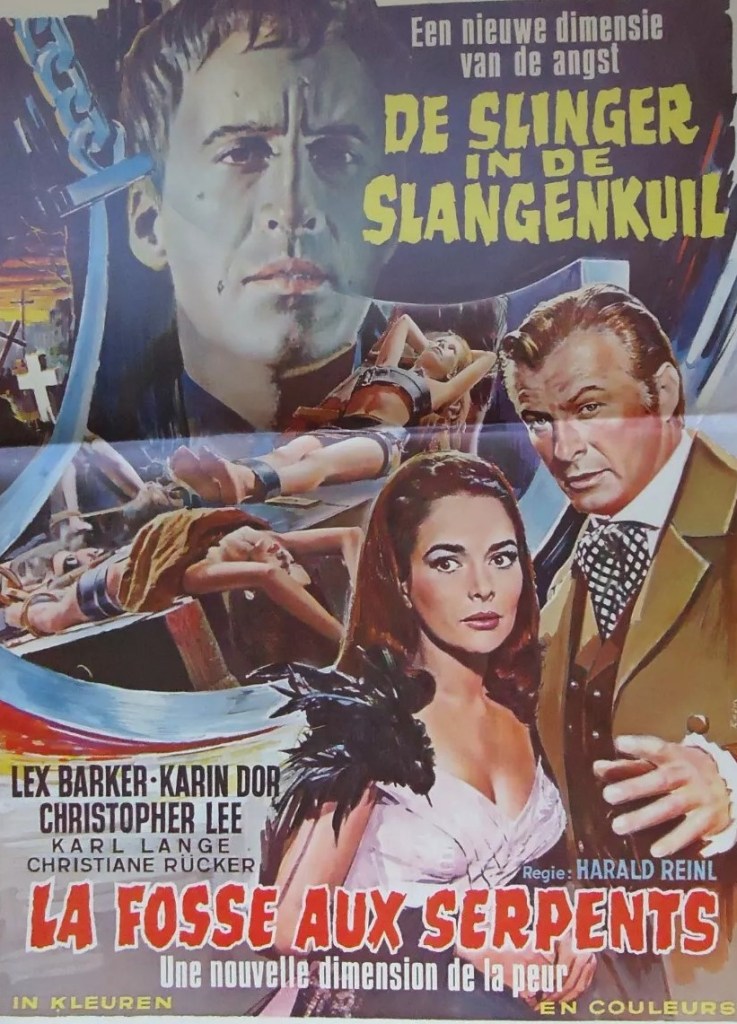
Heavy on atmosphere but not much else, a gender-switch take on the Countess Bathory horror tale (made by Hammer as Countess Dracula, 1971), which sees Count Regula (Christopher Lee) as, oddly enough, being one virgin’s blood short of achieving immortality, thirteen being the vital number, when he is arrested. Condemned to die in traditional fashion, first of all face impaled on a golden iron maiden then body torn apart by a quartet of horses, but not before casting a curse on the prosecutor.
Thirty years later or thereabouts Roger von Marienberg (Lex Barker), son of the prosecutor, turns up seeking the family castle only to find no one will show him the way. And that when he does get going it’s through intermittent fog, past burnt-out buildings and a forest strung with corpses and, it has to be said, a countryside that occasionally takes on an artistic hue, such as one sequence where the coach rides through the countryside with the sky above solid red and the land below solid green.
Along the way he encounters Baroness Lilian (Karin Dor) – the daughter of the evil count’s intended victim number thirteen – and her maid Babette (Christiane Rucker) who go through a routine of being captured and rescued, captured and rescued. When finally, halfway through, we reach the castle, we find the count in a glass coffin awaiting rebirth.
And then it’s like a reality tv show as the visitors undergo a series of torturous obstacles, Babatte hung over a bed of knives while time runs out, Lilian encountering rats and spiders and potentially dropping into a nest of (rather disinterested) snakes, Roger taking a leaf out of the Edgar Allan Poe playbook and facing either the pit or the pendulum.
The count – his awakening shown in shadow the best sequence in the movie – looks like a survivor from A Quiet Place, face desperately white, and frantic to fulfill his quest, with Lilian designated the unlucky thirteenth. Of course, although it took an iron mask and four stout horses to bring him to heel three decades before, he’s not so familiar with the rules governing the undead and a crucific is all it takes to unhinge him.
Very much horror by the numbers without much pizzazz. Lex Barker (Old Shatterhand, 1964) looks as if he’s more worried about his quiff being out of place than anything else. Christopher Lee (The Devil Rides Out, 1968) isn’t in it often enough and, minus the fangs, hasn’t the wherewithal to drum up a scare. Karin Dor (Topaz, 1969), beautiful though she is, doesn’t quite make it as a Scream Queen.
Atmosphere is the best element here, from the opening march from dungeon to execution through long echoing corridors to the Hieronymous Bosch-inspired backdrop of the castle, and the bodies that appear to have dived headling into trees rather than merely dangling from them.
Lex Varker is the key that this is German-made, directed without requisite suspense or fright, by Harald Reinl (Winnetou, 1963).
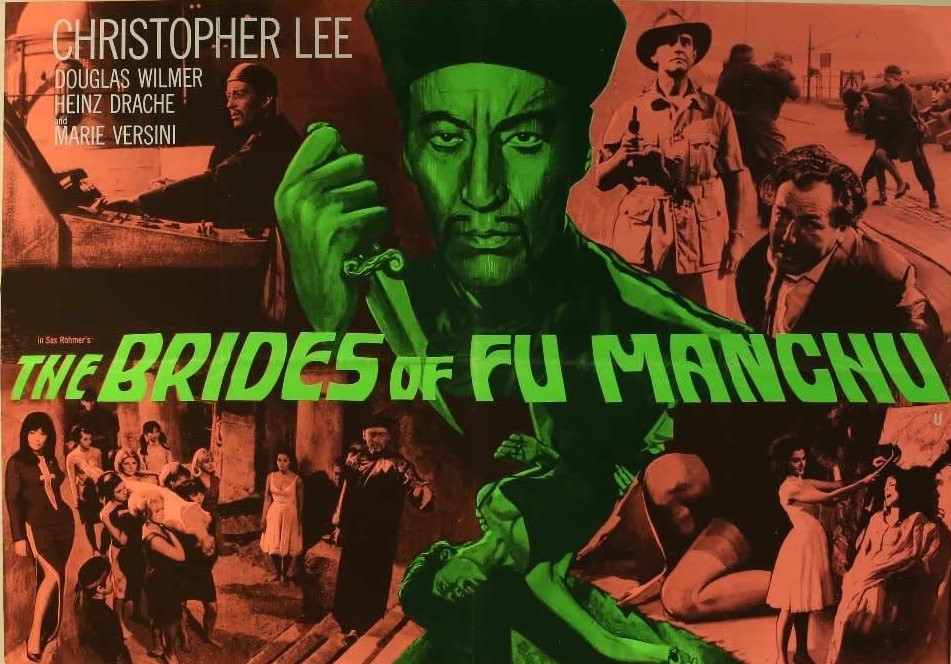
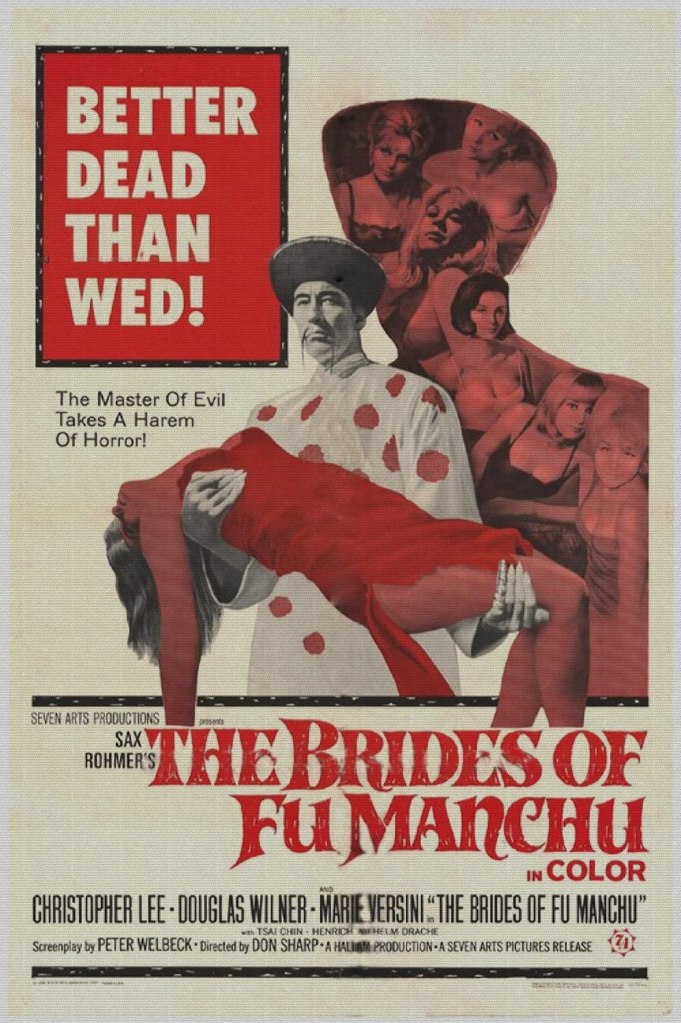
The 1960s was awash with movie megalomaniacs, most courtesy of the spy vogue. You could also count on secret agents for trailing in their wake bevies of beauties. So no surprise then that criminal mastermind Fu Manchu (Christopher Lee) has his own gang, his “brides,” although they are hardly volunteers, being the kidnapped daughters of top scientists. His plan for global domination this time consists of transmitting energy as sound waves, using miniaturization, a sonic death ray, with enough power to destroy a city.
The result is good hokum, a thriller set in the 1920s with a cracking pace, plenty of action, explosions, burgeoning romance, and a plot that gets more complicated by the minute as a tribe of worthies try out to outwit the evil genius. There is a terrific lair – where the disobedient end up in a snake pit – a passable laboratory, chases, truth serums (“the dust that loosens tongues”), hypnotism, bait-and-switch tricks and decent special effects. Three stories race along in a parallel pell-mell: Manchu needs one more kidnapping to complete his complement of daughters, while the good guys headed by Fu Manchu’s old adversary Nayland Smith (Douglas Wilmer) are trying to locate the bad guy’s secret location while at the same time attempting to find out where he will strike next.
While Fu Manchu is indestructible – supposed dead after the previous film – his henchmen (and henchwomen) are all too human. It takes three attempts to kidnap Manchu’s next victim. They are easily identifiable by their giveaway cummerbunds and bandanas and their method of assault is not kung fu but brawling so a good solid British punch of the old-school soon sorts them out. Manchu’s daughter Lin Tang (Tsai Chin) is a chip off the old block, delighted at any opportunity to torment the brides.
The brides, in diaphanous gowns that might have been a job-lot from the set of She, are far from compliant, even rebelling at one point, and employing vicious fight tactics. Fans of director Don Sharp will find him every bit as inventive as in The Devil-Ship Pirates (1964) and Bang, Bang, You’re Dead (1966) . It’s another Harry Alan Towers (written under his pseudonym Peter Welbeck) effort so that means an international cast.
Two television cops, British Rupert Davies (BBC’s Maigret) and German Heinz Drache (cop in a Francis Durbridge series), plus Francois Mitterand’s brother-in-law Roger Hanin, provide solid support. Not forgetting Burt Kwouk as a henchman. Brides of the year include French Marie Versini (German western Winnetou, 1963) and Rhodesian Carole Gray (Curse of the Fly, 1965). The film did not prove much of a jumping-off point for other brides such as Ulla Berglin, Danielle Defrere and Anje Langstraat, for whom this debut was as far as their careers went.
Christopher Lee, despite the dodgy moustache, is resplendent, exuding evil, and with a gift for rising again (just like Dracula) as he would do for another three films in the series.
This impressive Hammer conspiracy-of-silence slow-burner, more thriller than horror, features the triumvirate of Christopher Lee (The Devil Ship Pirates, 1964), Peter Cushing (The Sword of Sherwood Forest, 1960) and Barbara Steele (Dracula, Prince of Darkness, 1966) in untypical roles. Lee and Cushing, of course, had locked horns before, namely in Hammer’s reimagining of the classic Dracula, with the former the charismatic fiend and the latter his nemesis.
Dr Namaroff (Peter Cushing) is a doctor in an unnamed European turn-of-the-twentieth-century police state who knows more than he is letting on about seven inexplicable deaths in five years and the possibility of a 2,000-year-old myth coming to life and taking on a human form. And with quite a human side, jealous when his assistant Carla (Barbara Shelley) falls for a younger man, Paul (Richard Pascoe). Professor Karl Meister (Christopher Lee) appears late in the day to investigate.
Director Terence Fisher, who had shepherded the studio’s Dracula, Frankenstein, the Mummy and Dr Jekyll franchises through the starting gate, builds up the atmosphere with full moons, haunting voices, fog, sudden sounds, drifting leaves and an abandoned castle forever in shadow. The camera is often a weapon of stealth. Shock is kept to a minimum, fleeting ghostly apparitions and a finger falling off a corpse. Given the limitations of special effects in this era, that was a smart move.
Far better to concentrate on fear of impending doom, a man knowing he is turning to stone, a woman living in terror of being taken over by the phantom. The title gives away the story somewhat – even if you didn’t know the Gorgon was a mythical monster with a headful of snakes and the ability to turn people to stone, that is soon explained.
Death remains the trigger for action, the suicide of an artist after he has apparently murdered his pregnant girlfriend bringing his father onto the scene and then his brother accompanied by Lee. But all investigation hits a wall of silence after Inspector Kanof (Patrick Troughton) refuses to instigate detection.
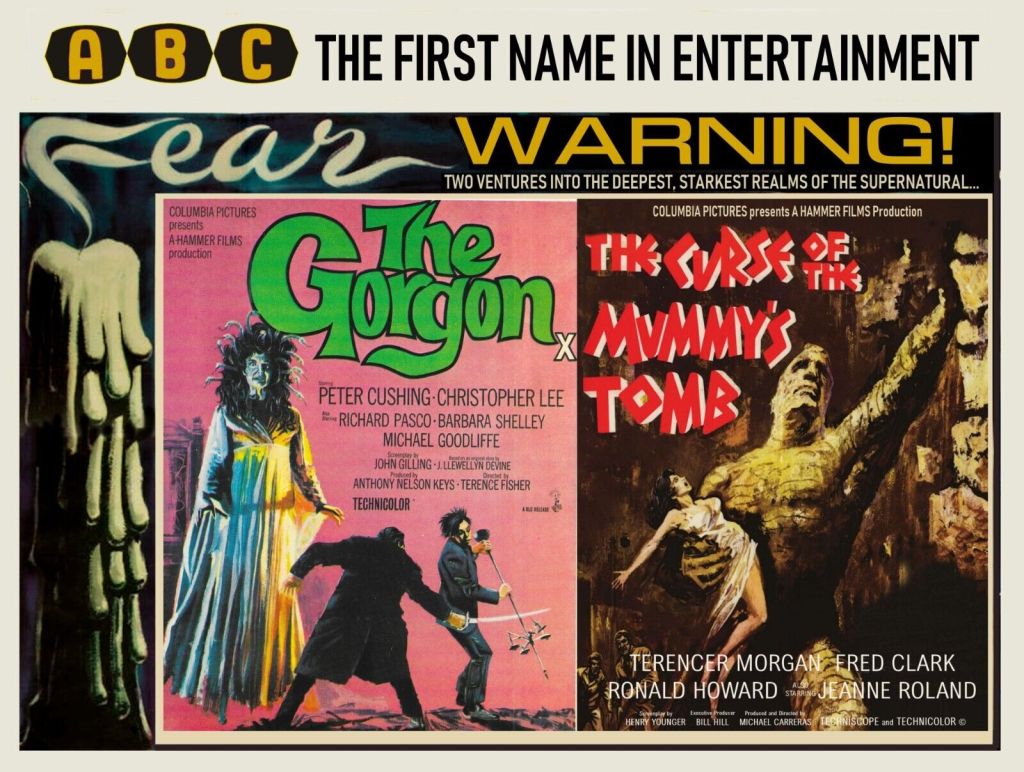
The Hammer double bill was a common feature in British cinemas. It also meant Hammer didn’t need to share box office receipts with another company.
At the heart of all the relationships is betrayal. The artist leading his girlfriend on, Namaroff willing to endanger Carla, whom he professes to love, rather than revealing the truth. Even Carla spies on the brother, with whom she is falling in love, in order to gather information for Namaroff.
Forgive the pun, but Shelley steals the picture. An amnesiac, a victim and finally the lure, she remains enigmatic, a whisper of a woman. It is a haunting portrayal far removed from Hammer’s traditional cleavage queens. This is a very human character who nonetheless must stand guard over herself. Shelleye, here a gentle beauty, initially introduced as merely the love interest, becomes central to the story but without sucking up all the available horror oxygen by over-acting.
Cushing embroiders his character with little touches, smoking a cigarette in a holder, for example, but Shelley’s character, her distrust of herself, shows in every move she makes.










 The Magnificent 60s